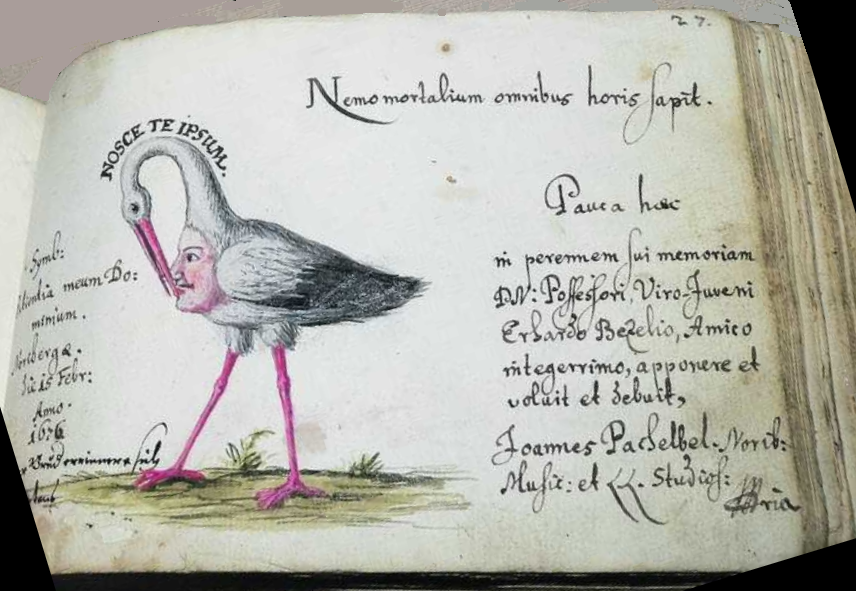
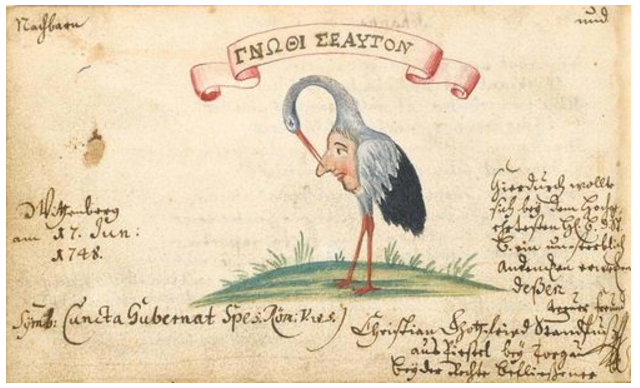
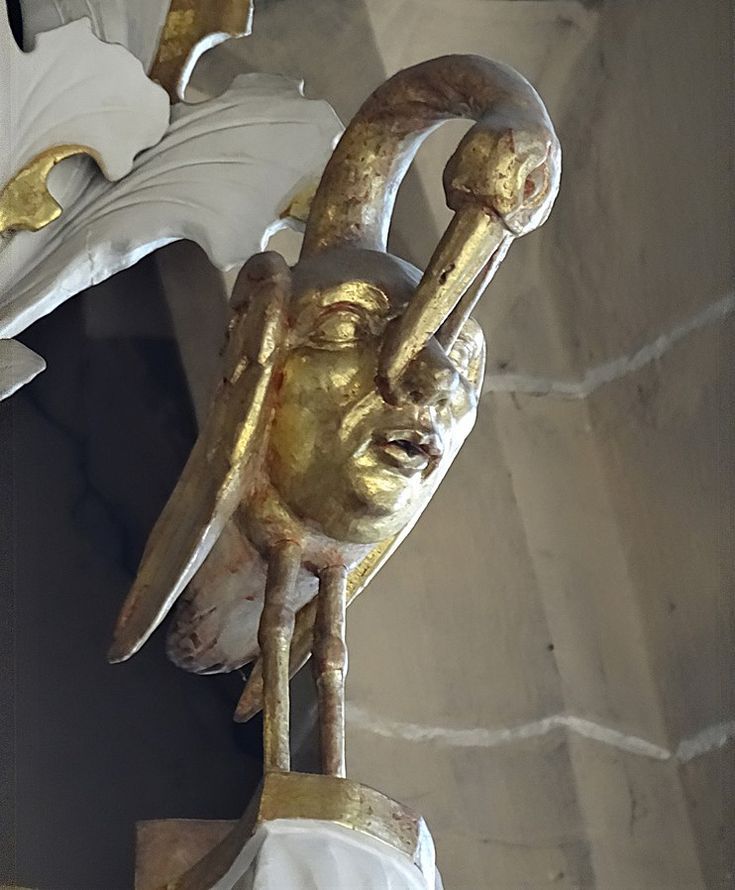
This is the (?Germanic) motif of the grotesque which is composed of a long-necked bird’s head which bends down to bite the nose of the (human) head in its breast. Weirdsville! The naming of the nose is important in the German verbal idiom, sich an die eigenen Nase fassen [to grasp oneself by the nose/to tweak one’s own nose]. In German the figure is known as Der Vogel Selbsterkenntnis [see the great Lutz Röhrich’s seminal Lexikon der Sprichwortlichen Redensarten]. The way in which this is to be understood is explained by the Italian proverbial couplet which captions the image in the Springenschmidt album (below) which may be translated as, “Don’t talk about me unless you know me well, think of yourself before you talk about me”. It is often accompanied by the injunction to ‘Know yourself’. Here again the album painters appear to be breaking new ground, their miniatures being now the earliest known examples of the motif (1619) — the fact that at least 5 examples antedate the earliest extant print of the subject (below), suggests the existence of an earlier print no longer known.
In other media one of the panels of the painted ceiling of the church at Martinjak near Cerknica in Slovenia bears our motif and, though evidently re-painted, is dated 1621 (see below).


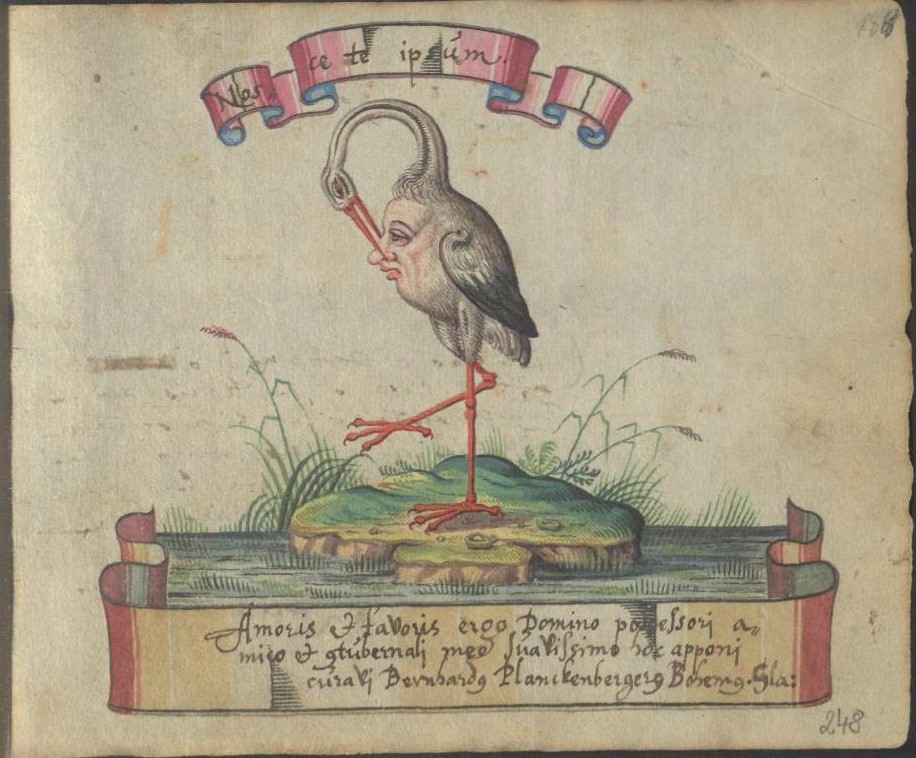


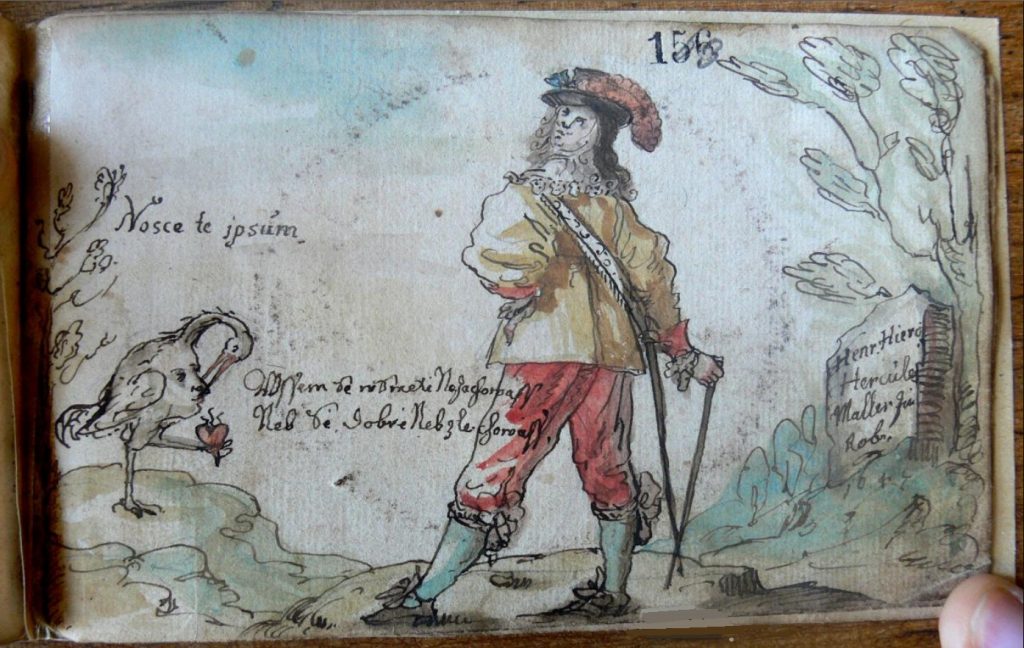
The above entry in the album of Abraham Regulus is signed and dated by the painter Heinrich Hieronimus Hercules who describes himself as Maller zu Rab, i.e. painter from Rab, the Slovakian name for the city of Győr in northwest Hungary. It is thanks to contributors to the Reddit/Kurrent forum I am able to say that the inscription is in Slovakian:
Wssem Se w Swetie Nezachowass
Neb Se dobře, Neb zle chowass.
and means ‘Whether you behave well or badly, you’ll still never manage to please everyone’.

prints
This seems to be the earliest print version of the motif. This impression is in the GNM [HB23822] with no imprint information, but dated by the Museum “1640-50” — which looks rather too early by about half a century to me! And I see that Fraenger associated it with the Augsburg publisher, Joseph Friedrich Leopold, born 1668, so hardly likely to be publishing much before 1700.

Here our bird is in flight! And carries a mirror for us to look in and know ourselves!

Other media — 17C only


selected 18C examples
It seems to have been a popular device with which to decorate the finials of sleighs.


Love this one — sitting on a table in a domestic interior! I think it’s my favourite!


Leave a Reply