Another popular sexual innuendo in the albums. The motif is seemingly restricted to the Germanic area, but the foxtail is a very common phallic symbol, doubtless assisted by the fact that the fox’s tail is called Rute, a word which is also used for ‘penis’ at this period in German — but, then, the ‘tail’ word is frequently used in this sense in many vernaculars — the question is, rather, why that of the fox ? Presumably on account of its particularly large and prominent tail in comparison to the size of its body. But, of course, the animal is proverbial for his slyness and cunning, and the beast-epic hero Reynard, an unconscionable rapist to boot. For the curious pseudo-punishment of being beaten with a foxtail [flap with a foxtail is the English phrase] — evidently felt as particularly demeaning — see my https://www.academia.edu/51425337/Fiddlers_on_the_Roof_and_Friars_with_Foxtails_David_Teniers_Netherlandish_Proverbs_1646_7_
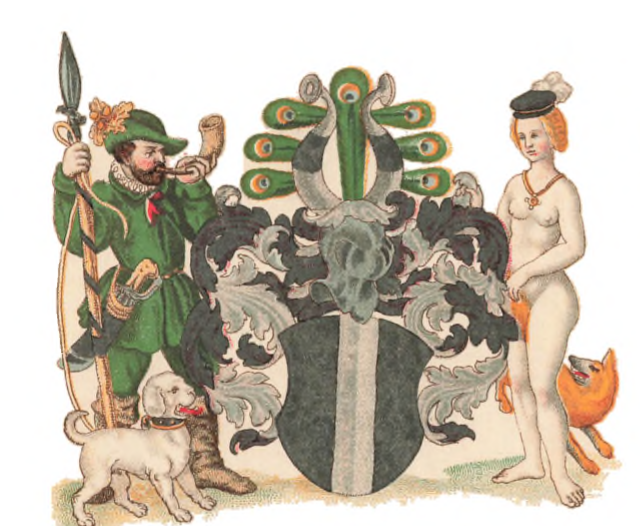
[The only significant discussion of the present specific, foxtail-through-woman’s-legs motif, that I have found to date is by Bretscher, “Die Dame mit dem Fuchs als heraldische Begleitsfigur” in Archive Heraldiques Suisses 97 (1983).]
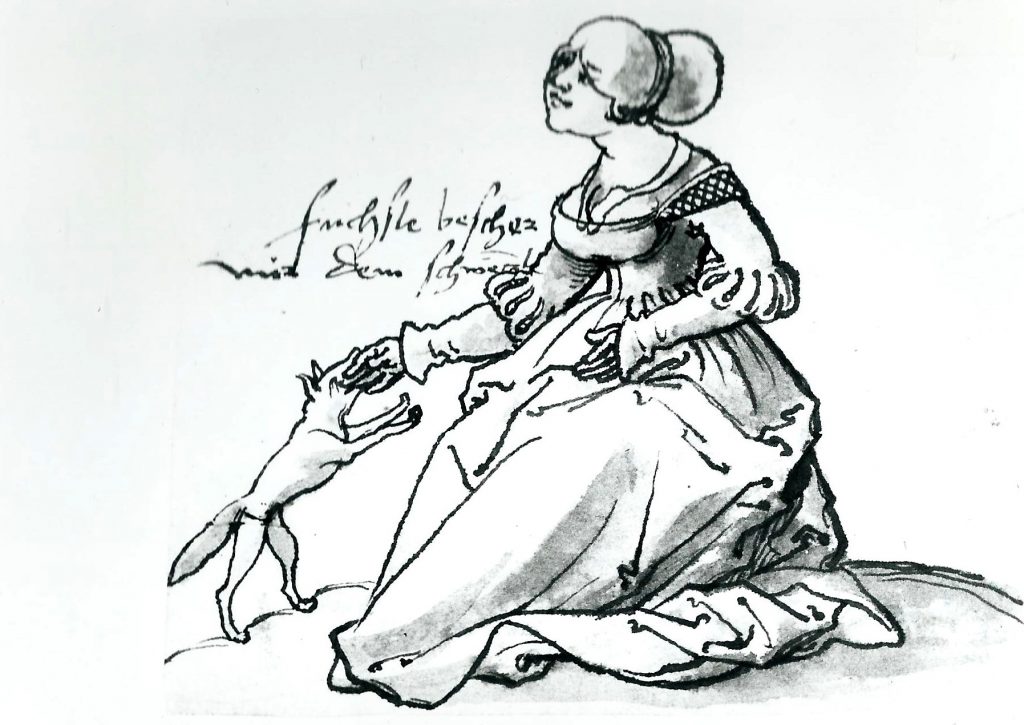
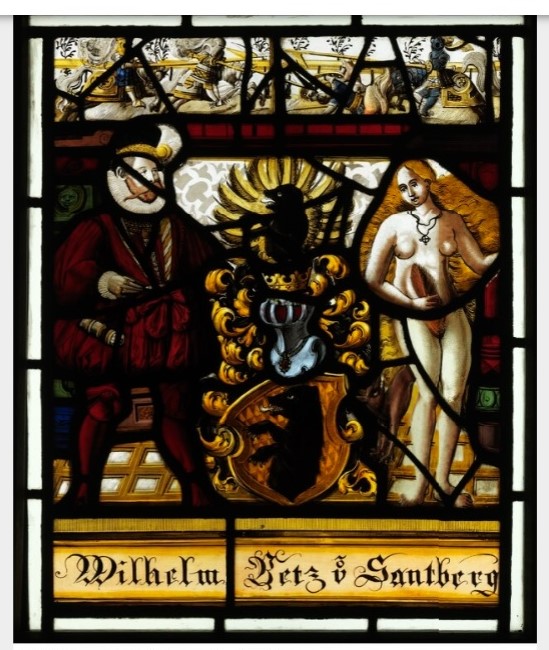
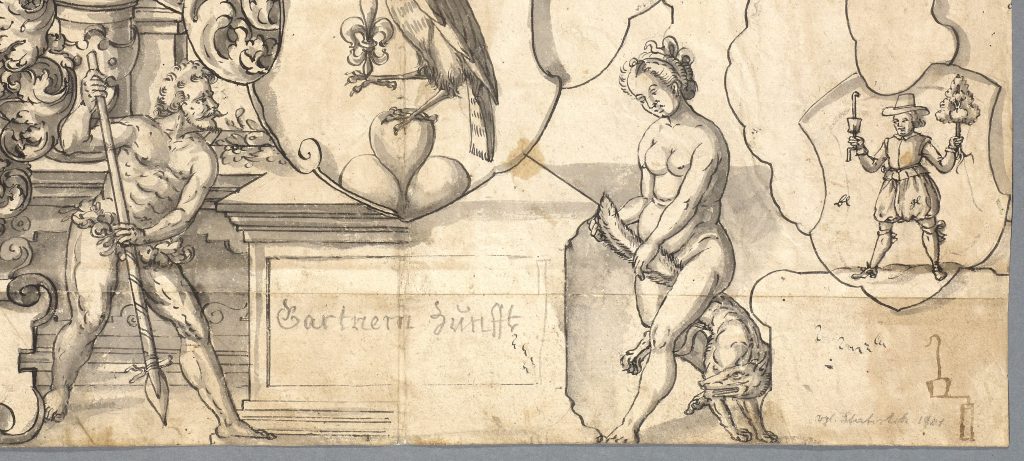
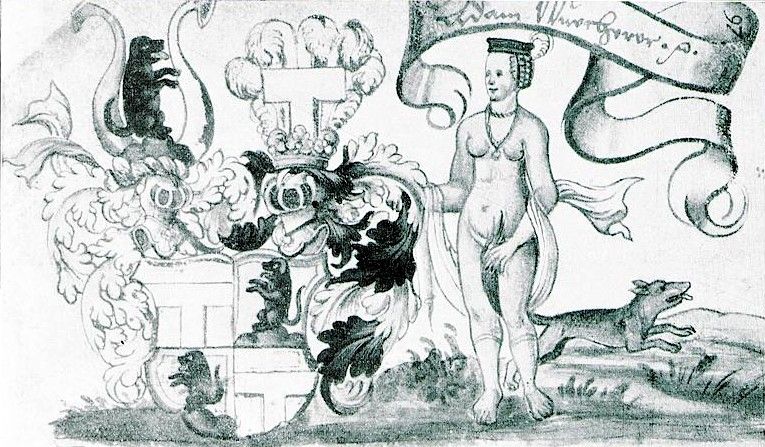
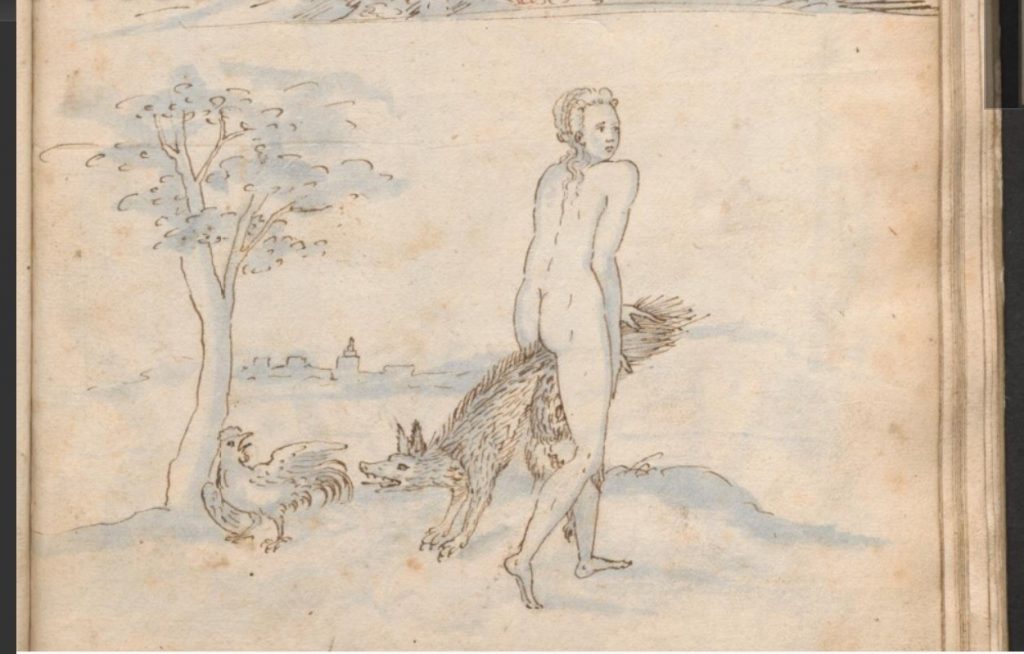
The motif evidently existed before the albums came into being, and the earliest example known to me appears on a glass pane painted c.1550 in Uberlingen (see below), but the evident sexual innuendo is already present in this South German drawing of c.1530.
South German drawing of c.1530. Universitatsbibliothek, Erlangen-Nurnberg
The seated young woman whose fingers appear to be nibbled by the fox says, Fuchsle bescher mir dein schwenzle [Foxy, make me a present of your little tail]. As in many other vernaculars, the ‘tail’ word is a common euphemism for penis.
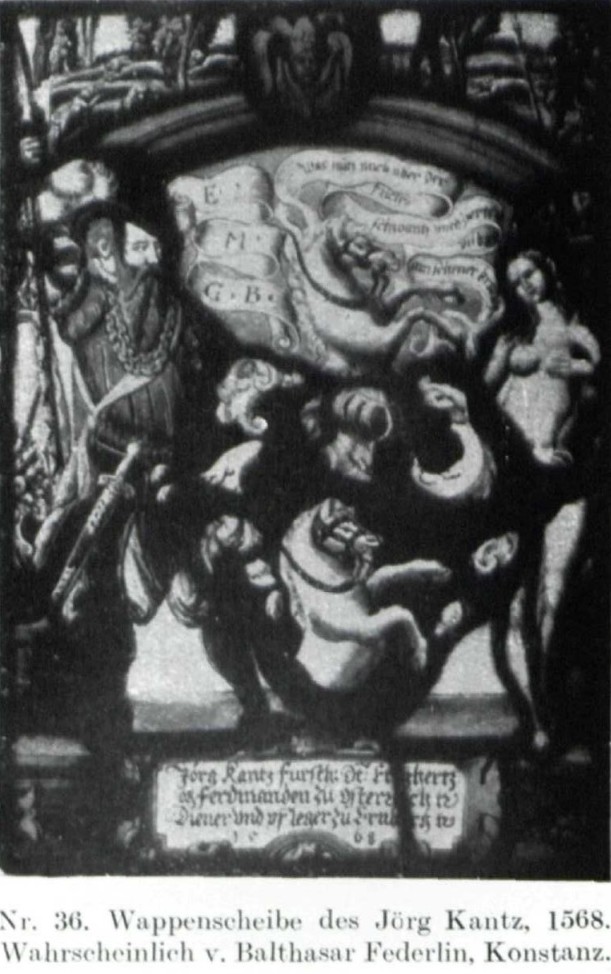
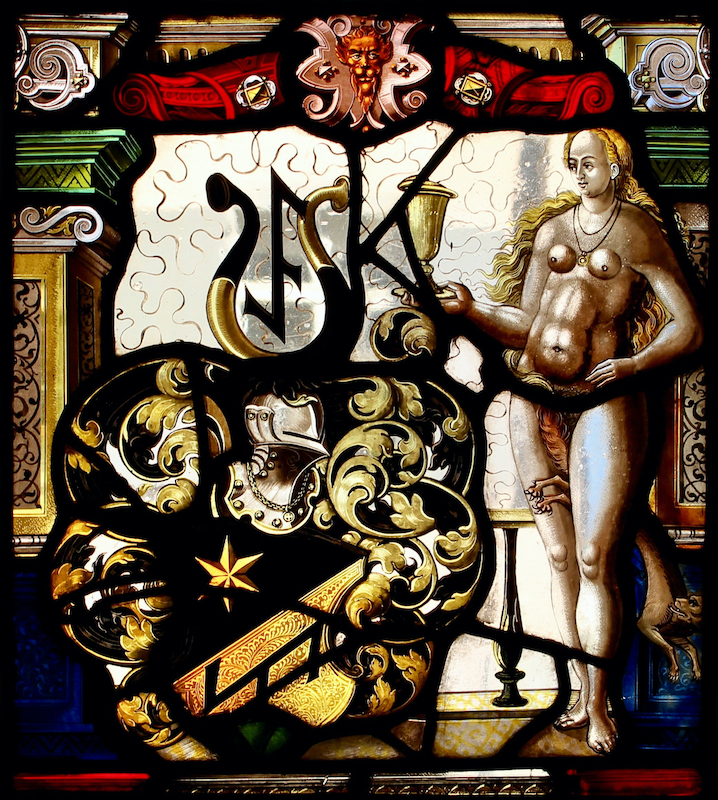
painted glass pane of the arms of Wilhelm Betz von Sandberg, Uberlingen, c.1550 — Nurnberg, Germanisches Nationalmuseum, MM903[apologies that fox between woman’s legs is here invisible!] Wappenscheibe, painting attributed to Balthasar Federlin, dated 1568. In the Ferdinandeum, Innsbruck.
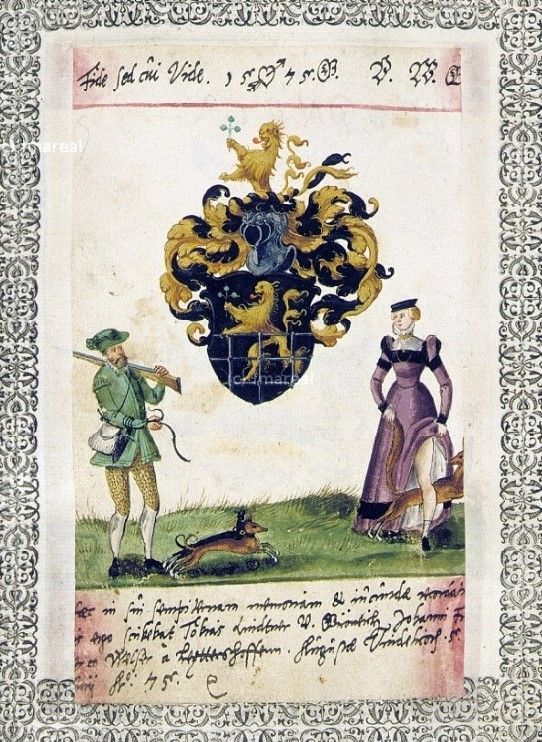
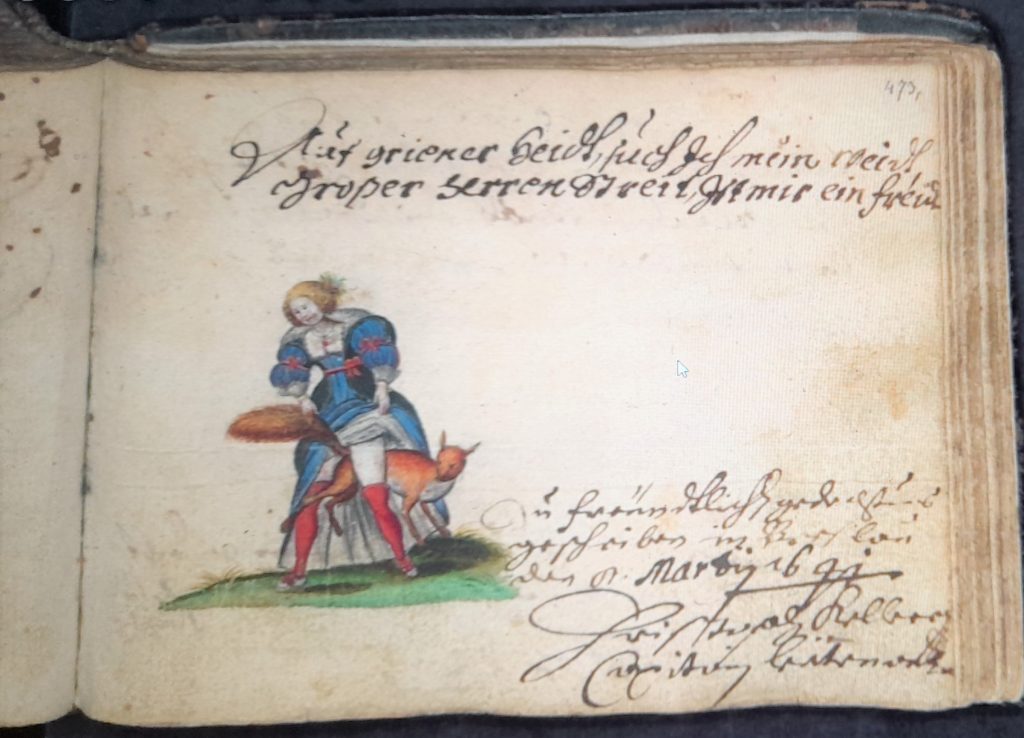
The earliest example of the motif in the albums I have noticed to date is a fully clothed woman painted in 1575 in the Welser abum which, according to the invaluable online Repertorium Alborum Amicorum, is still in the possession of the Welser family. (I owe this image to the Salzburg Institut fur Realienkunde website)
from the album of Bartholomäus Welser, this page dated 1575. private collection
Ostensibly a hunting scene, the huntsman’s two hounds are chasing the fox which runs through the lady’s legs who lifts up her skirt with one hand to allow it passage, fully exposing her bare leg, while her other hand grips the tip of the foxtail. Contemporary (c.1580) is a similar foxhunting scene in the album of Christen Holck (now in Copenhagen), though here the lady who grasps the tip of the foxtail is entirely naked — but for a hat! There must surely be contemporary literary reflexes of this erotic metaphor but I have yet to notice one. (Readers, please?!)
from the album of Chisten Holck, dated entries 1579-1612. Copenhagen, Nationalmuseet Signatur Nr. D310/2019
The motif is fond in other media too, of course, such as the glass jug dated 1572 in the MAK
enamel-painted glass jug dated 1572. Vienna, Museum für angewandte KunstDetail of Scheibenriss [design for glass pane] dated 1579, attributed to Hans Jakob Plepp. Zurich, Schweizerisches Landesmuseum
The motif seems to have been particularly popular amongst glass-painters:
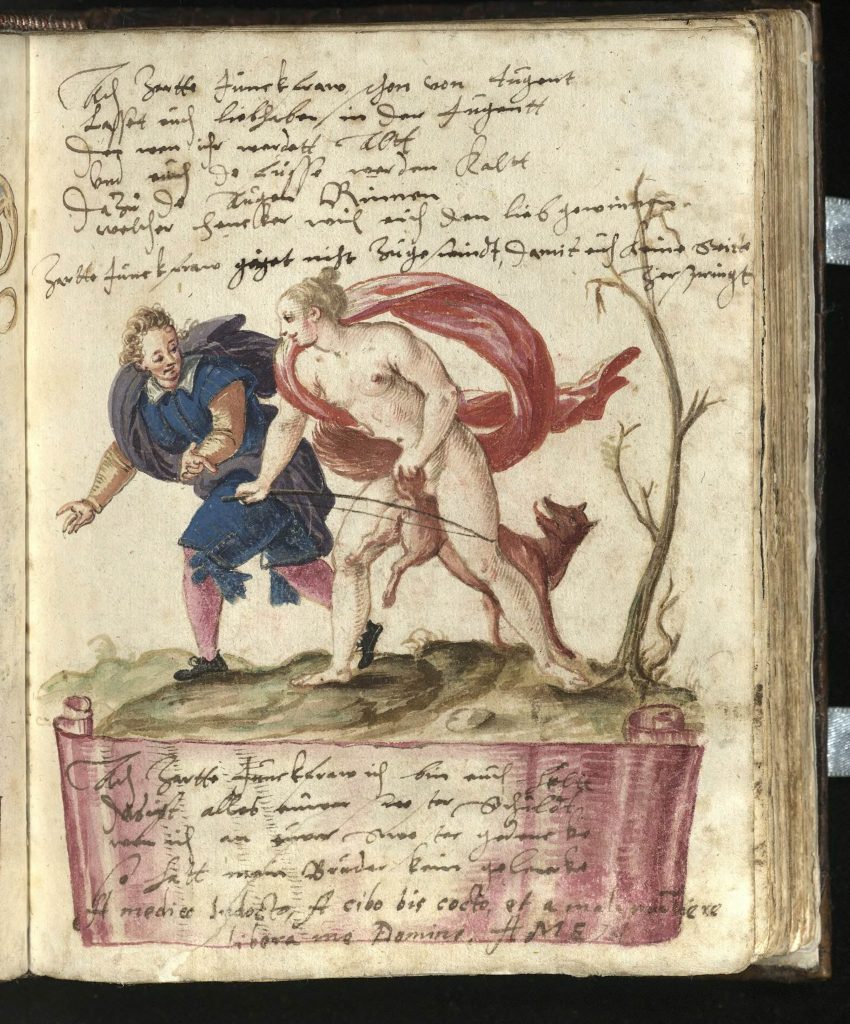
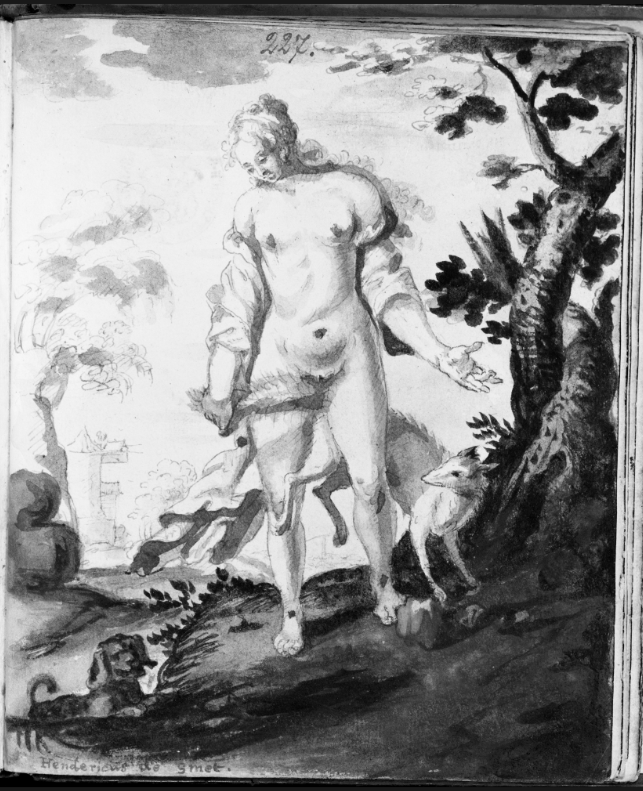
Detail of Scheibenriss drawn by Bernhard Herzog dated 1586. Basler KupferstichkabinettWappenscheibe c.1600, attributed to Hans Sur (arms of Bart. Merian, d.1609). In the Liestal RathausDetail of Scheibenriss drawn by Wettenwech [SEE ALSO my Woman as bait in eel-pot post] Basel, Inv. Z.106from the album of Gilg Gottgatter, dated entries 1603-26. Stuttgart, WLB, Frommann Collection, cod. hist. fol. 888-18, f.185v.from the wonderfully rich album of Michal von Heidenreich (dated entries 1601-1612) now in the Polish Biblioteka Kornicka in Poznan, where it is sygn.BK01436 — NB. woman holds foxtail and bows fox’s arse with violin-bowfrom the album of Wolfgang von Apfaltern, dated entries 1557-93. private collectionfrom the dismembered album of Gottfried Muller, drawing signed by Hendrik de Smet, c.1610. Staatliche Museen zu Berlin, Kupferstichkabinett
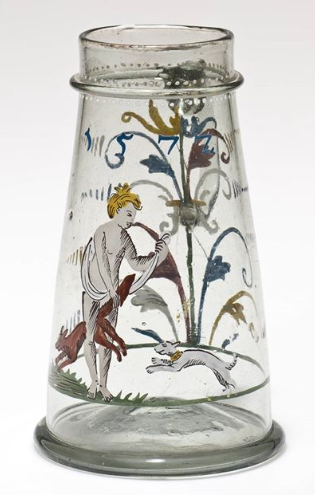
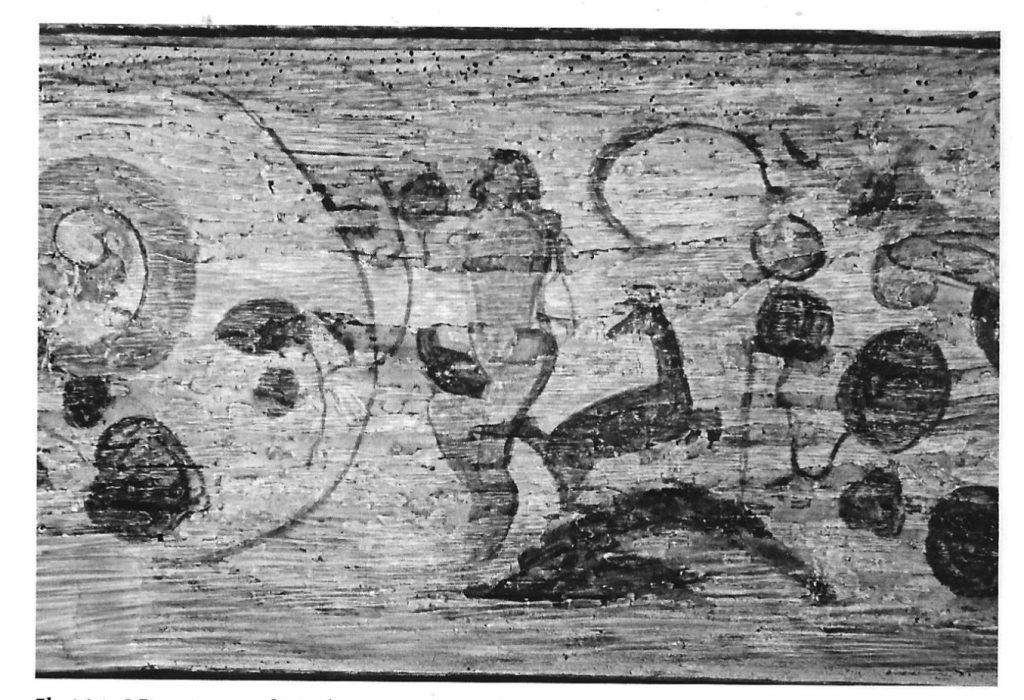
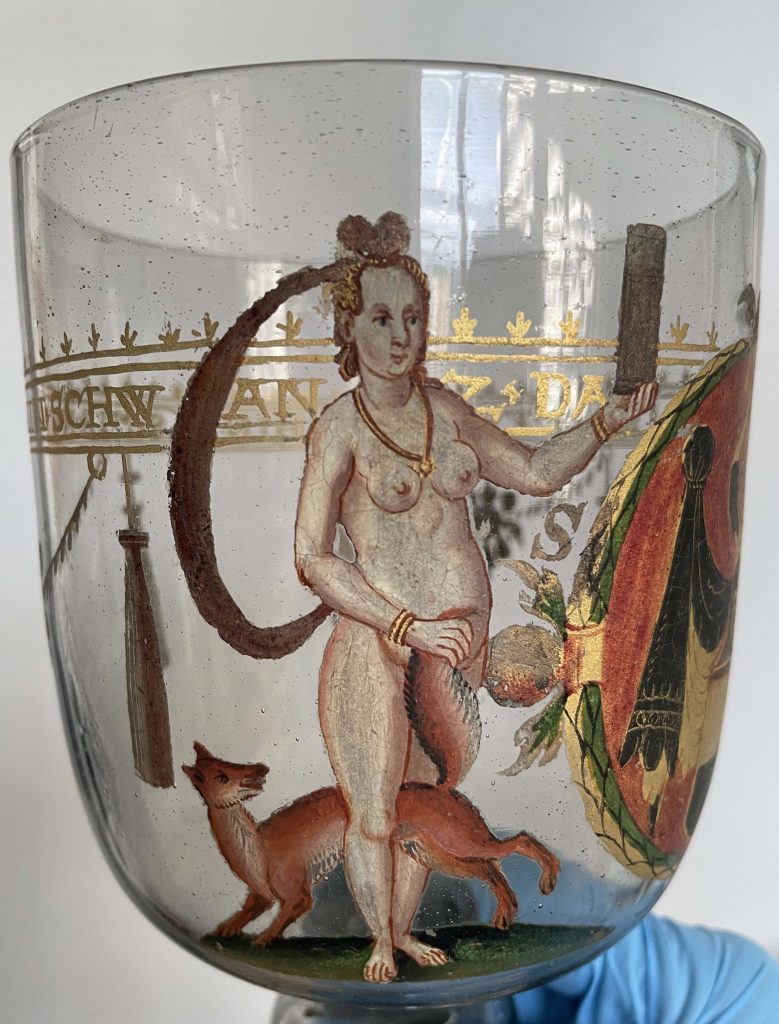
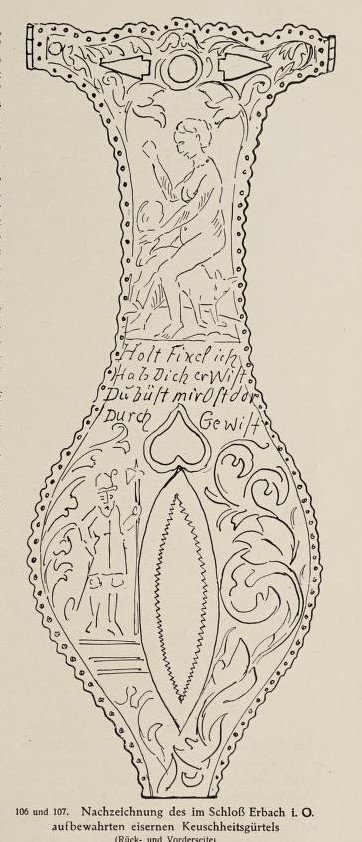
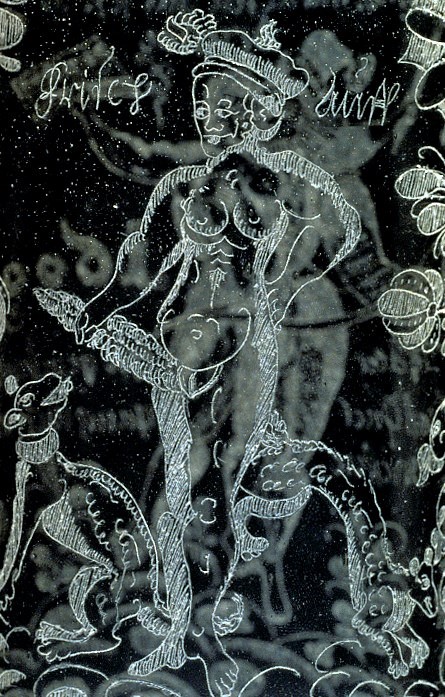
In the 17C the motif is to be found in an increasing range of media, as one of the numerous ‘Schnacken’ painted on ceilings (see Wroclaw ceiling detail below), and engraved on items of wood, metal (including a ‘chastity-belt’, if not a 19C fake — SEE BELOW), and glassware — including the remarkable Getty Stangenglas on which it features with similar ‘erotic’ motifs. It is also in the 17C that it is taken up by the print-books and single-sheet prints.
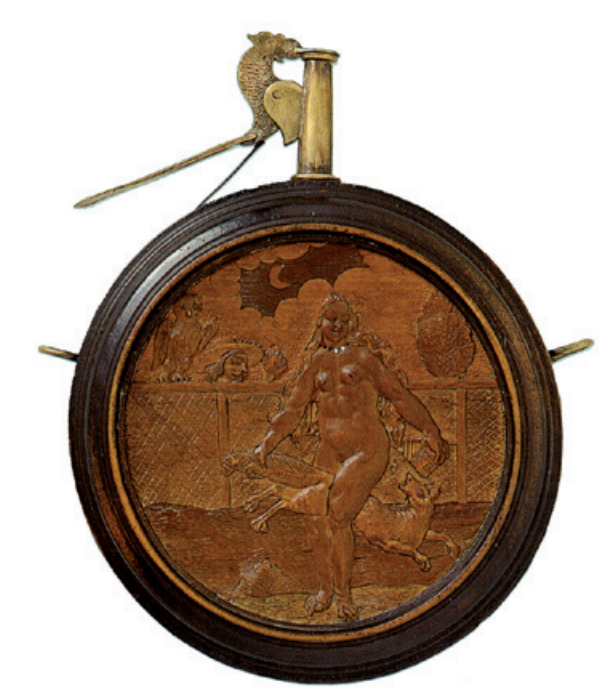
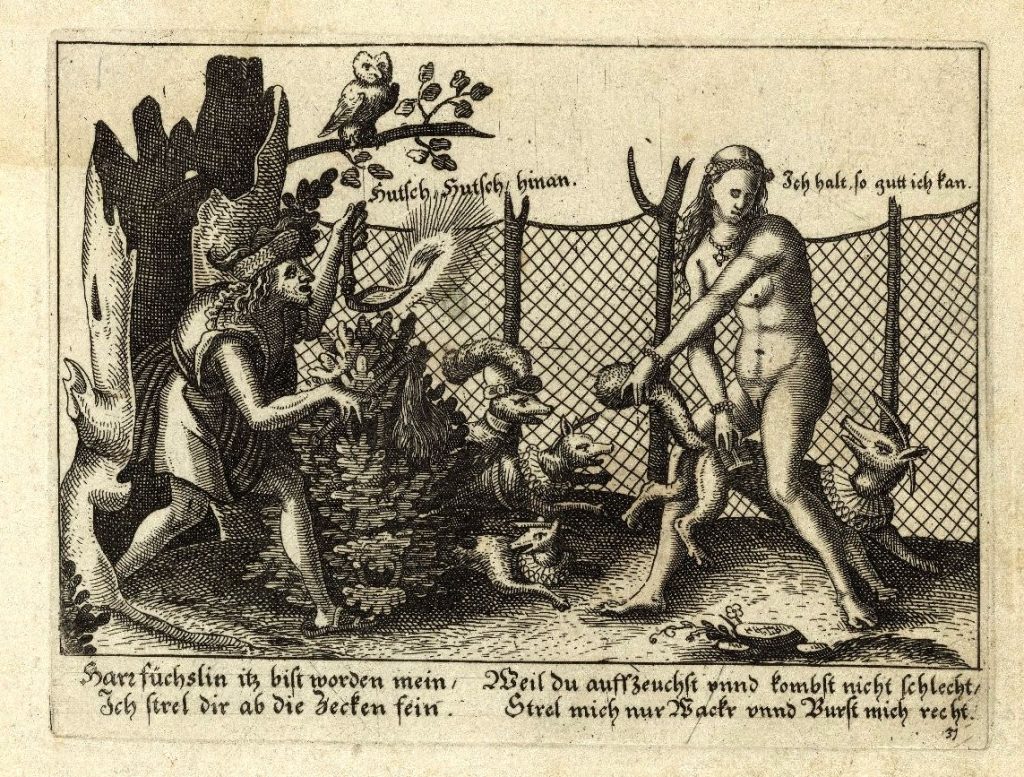
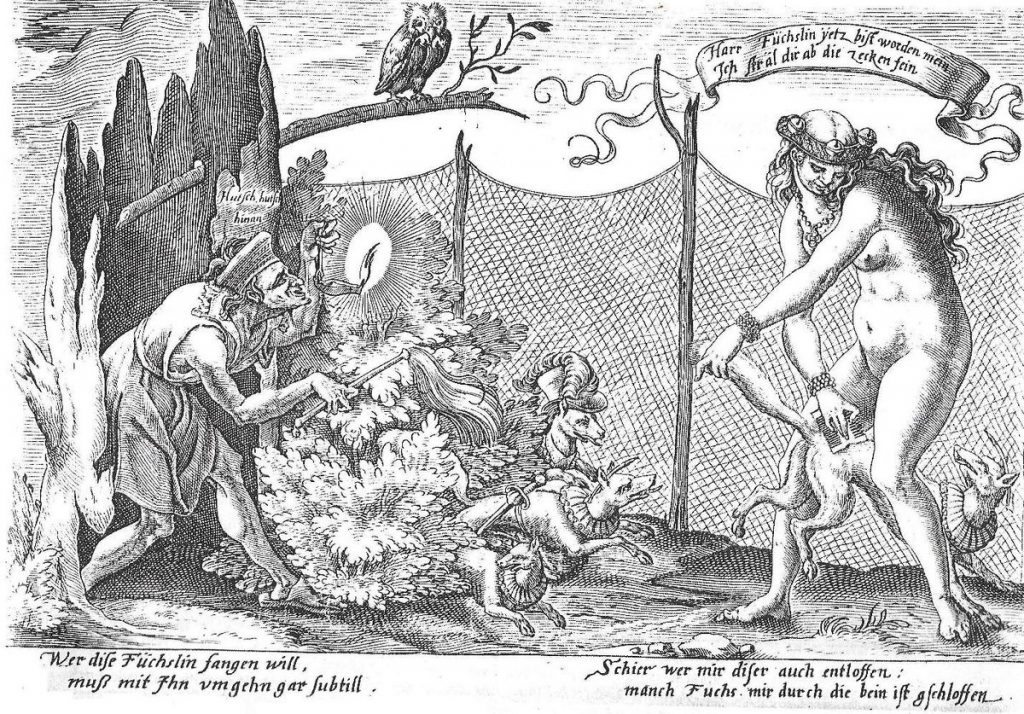
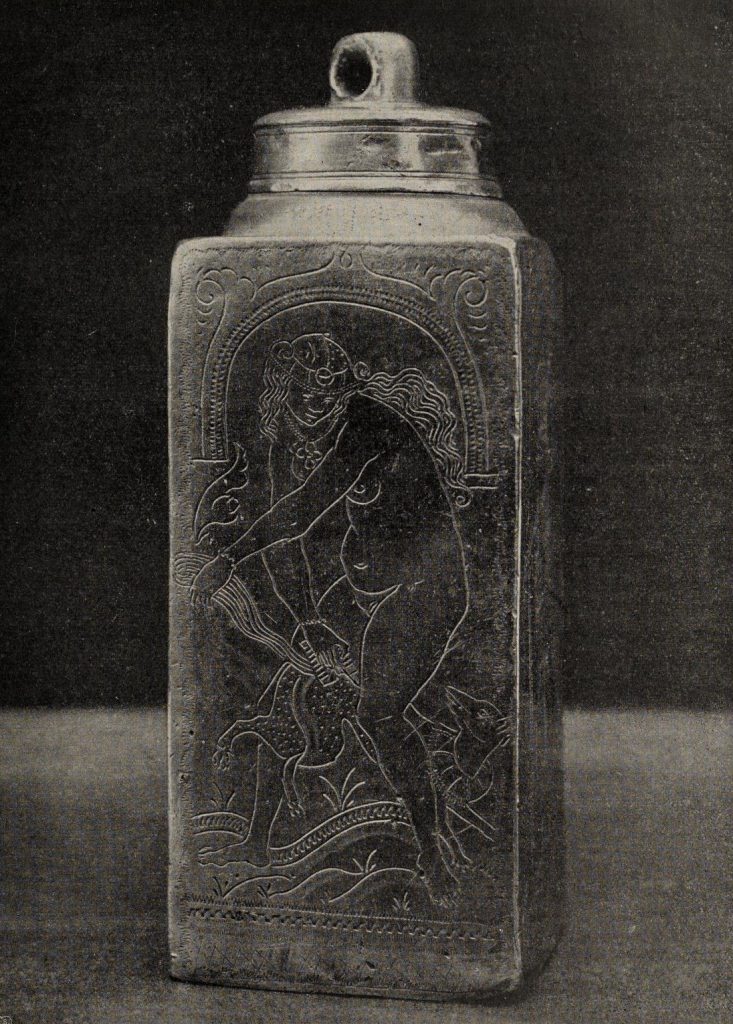
detail of the Wroclaw painted ceiling (?c.1600) scanned from Ewa Morisson, Swiat na opak. Renesansowy karnawal na malowanych stropach w kamienicy “Pod Zlotym Sloncem” we Wroclawiu (Wroclaw 2010), Il.121enamel-painted goblet dated 1630, Nurnberg, Germanisches Nationalmuseum, Gl155engraved on one of the white squares of several gameboards made in Augsburg in the early 17C — this example from a private collection in the Netherlands — scanned from Volkskunde 103 (2002), “Spreekwoorden op een onbekend Hainhofer Spelbord uit de 17e eeuw”, by Karel F. Kerrebijnpowder-flask now in the Deutsches Historisches Museum, Berlin — clearly copied frpom the print below.from the print-book Philotheca Corneliana (Berlin 1619) engraved by Peter Rollos (Folger copy)single sheet (Flugblatt) version — W. Harms, Illustrierte Flugblatter IE 124, Wolfenbuttel 1,103engraved decoration on 17C zinc cannister — reproduced in Eduard Fuchs (!),Illustrierte Sittengeschichte — Erganzungsband Renaissance (Munchen, 1909), p.251, Abb.200. The woman’s hair clearly derives from the Flugblatt versionnsteel ‘chastity belt’ — from Eduard Fuchs (!) Illustrierte Sittengeschichte from the sketchbook of the so-called ‘Breslau/Wroclaw Goldsmith’, drawn c.1601 — Wroclaw, University Library, Department of Manuscripts, IV F 23n (now digitised)detail of engraved decoration on the Getty Stangenglas dated 1600, Southern Bohemia. Los Angeles, J. Paul Getty Museum, 84.DK.559
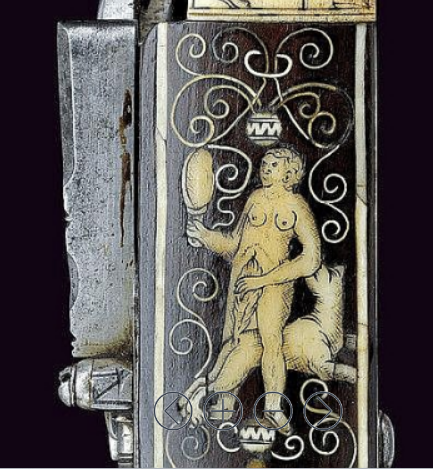
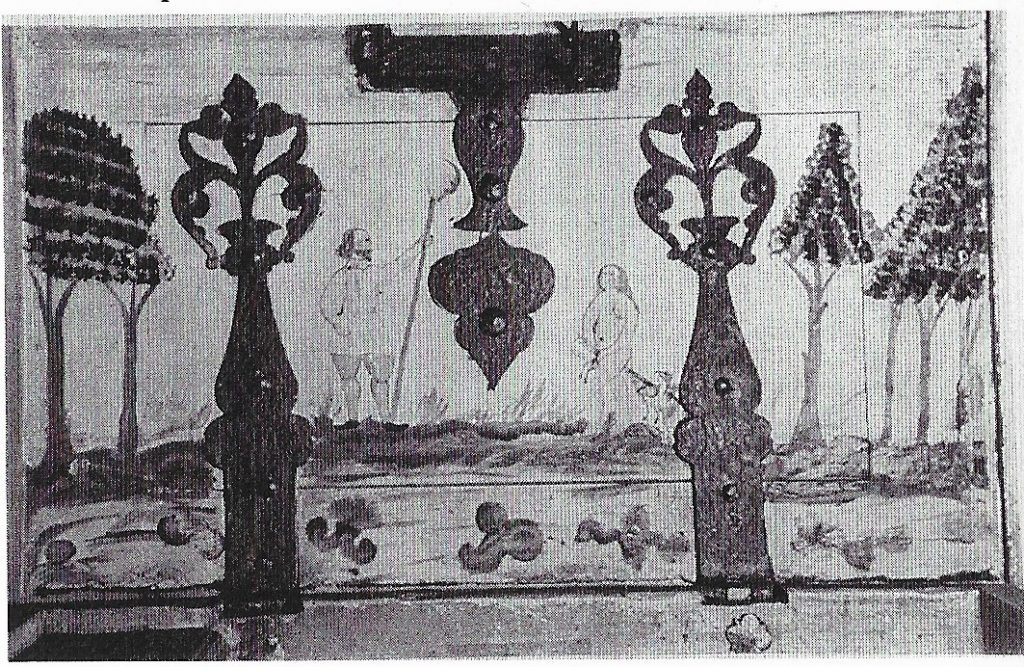
engraved bone inlay on rifle dated 1642 which includes other motifs of interest — see my Provision for the Convent postfrm the album of Melchior Lucas, this page dated 1641. via Wroclaw University Library websitelid of chest of Bakers’ Guild painted 1670. Stadt- und Bergbaumuseum, Freiberg, Saxony.
18C examples of the motif
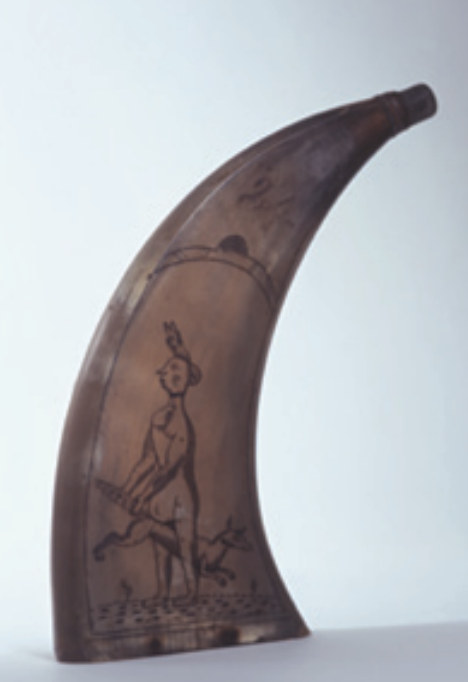
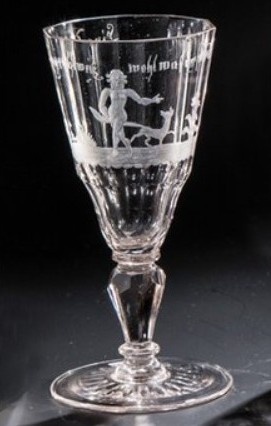
mid-18C powder hornc.1740. gingerbread mouldengraved glass, Riesengebirge, mid-18C. Inscribed Eine Jungfer wohl gemuth / weiss wohl was der Fuchsschwantz tuht [a jolly maiden well knows what the foxtail does] Dr. Fischer Art Auctions, Auction 262, lot 38
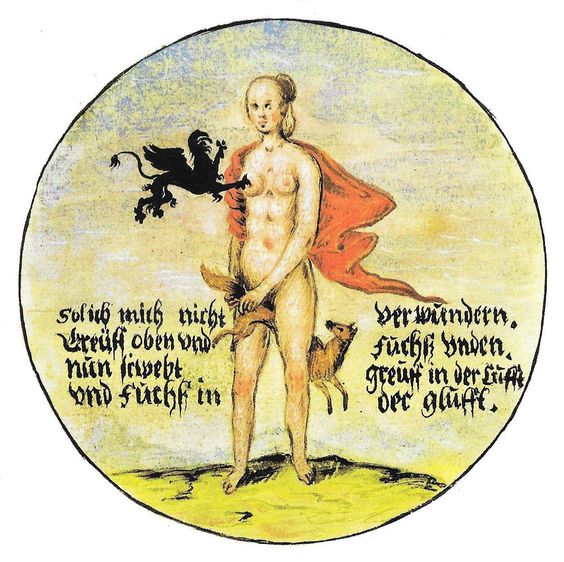
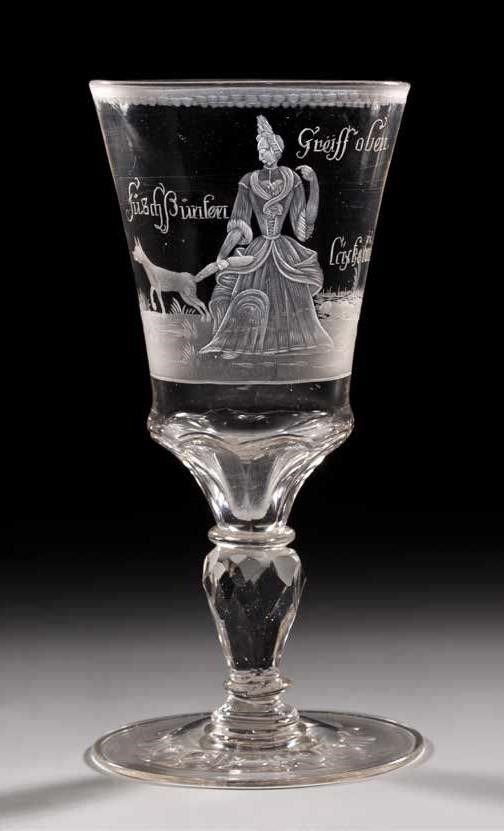
Fox & Griffin combo
A sophistication of our motif adds a griffin to the scene. The design for this shooting-target painted in 1629 in the Coburger Scheibenbuch is the earliest example known to me. The verse: sol ich mich nicht verwundern / Greuff oben vnd fuchsz Vnden. / nun scwebt greuff in der Lufft / Vnd fuchsz in der glufft. [Should I not be amazed, griffin above and fox below. Now griffin hovers in the air and fox in the cleft].

Leave a Reply