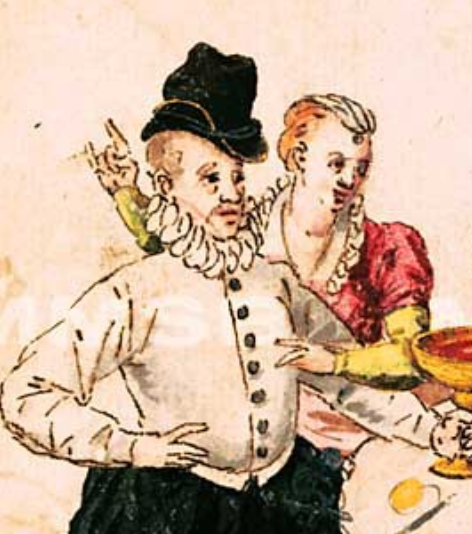
One of the many invaluable insights the album images have to offer is examples of gesture — especially in the genre scenes of everyday life. The well-known and usually abusive ‘horns’ gesture (though at times used apotropaically) is well-represented — if we look carefully.
Horns
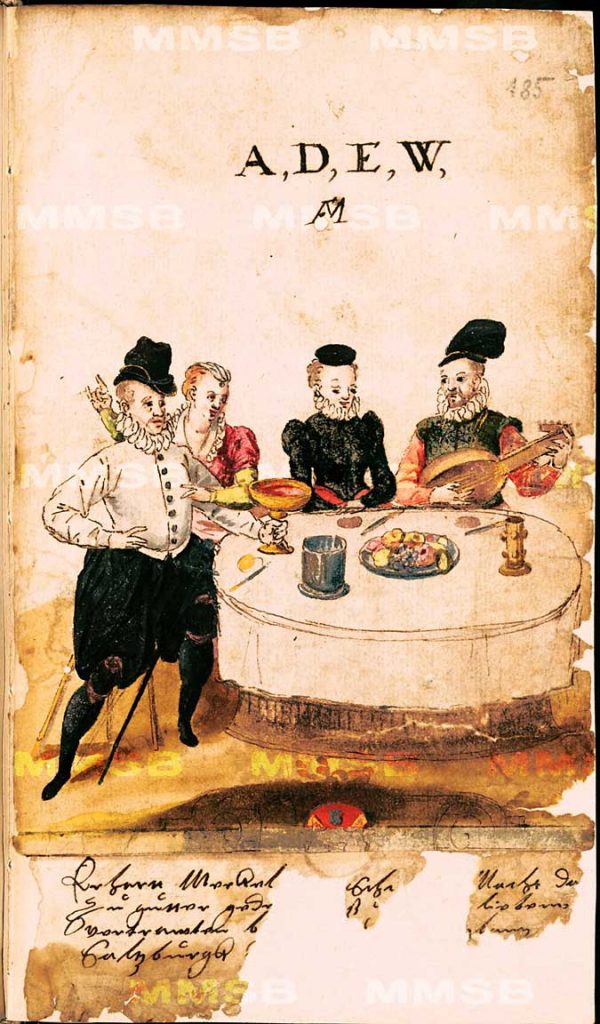
In this detail from a miniature in the Plan album (dated entries 1574-92) we are shown two couples at table, the husband of one couple playing the lute while his wife sits demurely, her hands in her lap. The other husband has just risen from his chair, perhaps to propose a toast, as he holds up a goblet, but behind his back his wife holds up her hand in the horns gesture, suggesting he is unknowingly a cuckold. The mysterious acronym A,D,E,W, — such abbreviations being very common in the albums* — may stand for the proverb Alle Ding Eine Weil [all things (last only) a while], in this context perhaps a cynical comment on marital happiness?
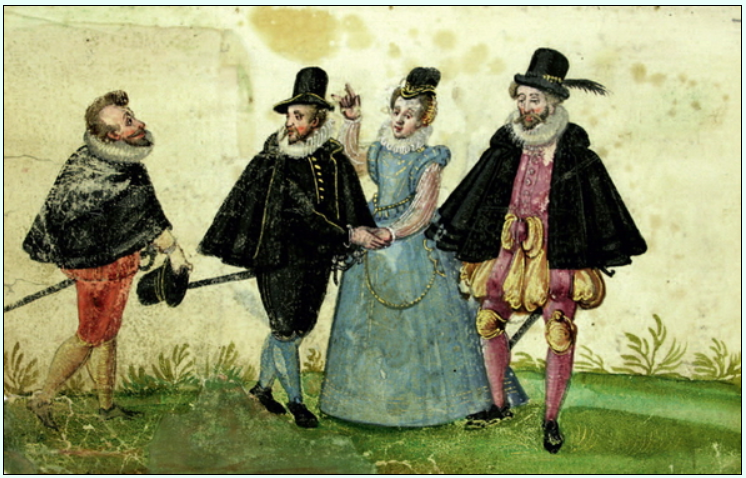
But what is going on in the painting below? The woman is evidently signalling to the man approaching on the left (but presumably the gesture is also visible to the man on the right), that the man currently holding her hand is a cuckold. In a forthcoming post I shall discuss the very popular motif I call Woman & the 3 Suitors, in which it is a fool who makes the horns gesture — which this may well be an example of!
[ It has now forthcome! https://albumamicorumear-e4qvahs764.live-website.com/woman-and-the-3-suitors/ ]
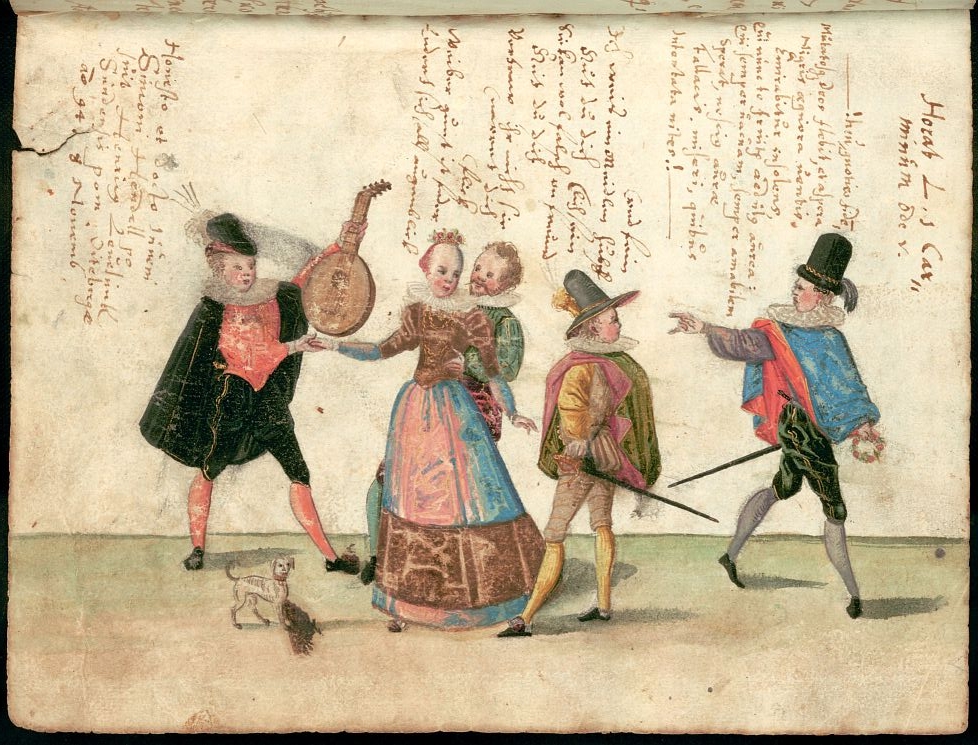
In this miniature from the Händl album (below) the gesture appears to be being used abusively by the man departing — someone with sufficient expertise and patience to read all the inscriptions can doubtless explain the precise circumstances to us!
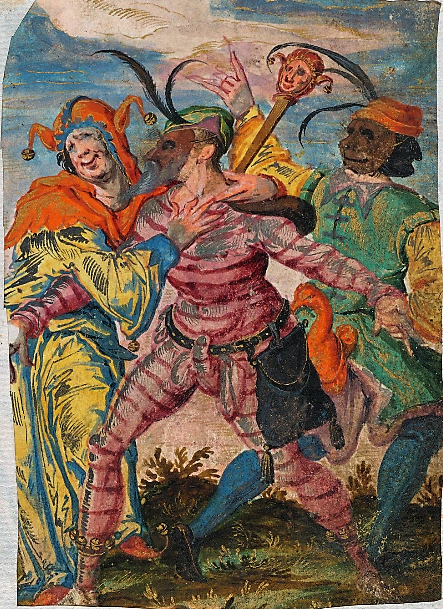
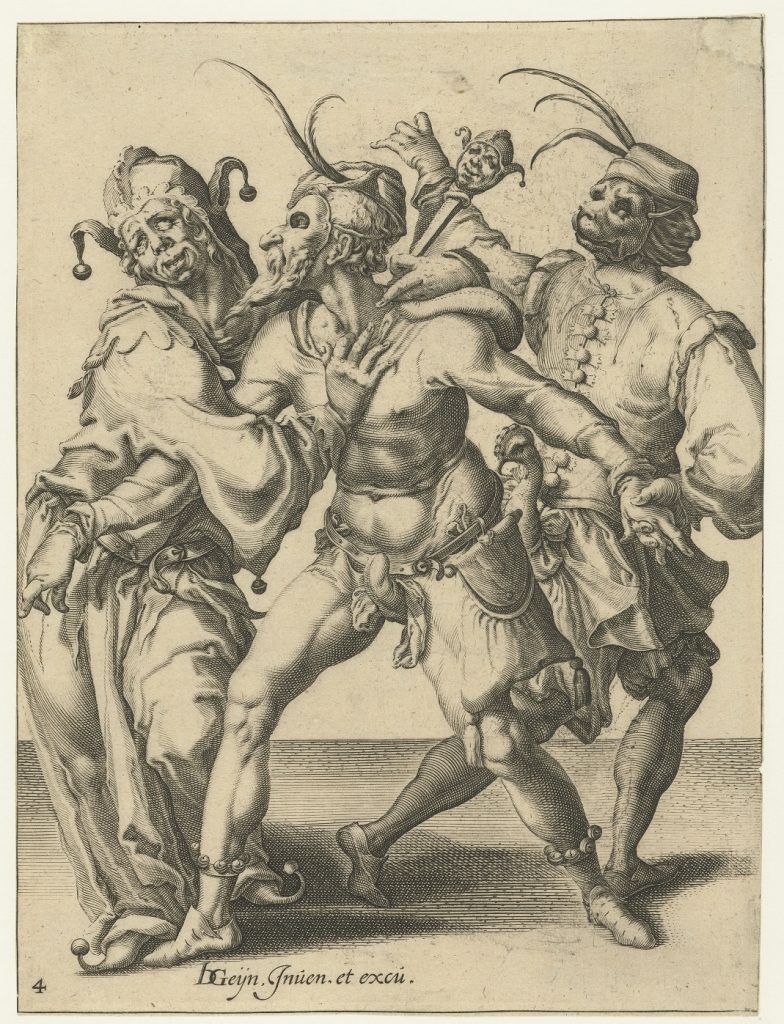
In this orphaned leaf in the Frommann collection (below) the gesture seems randomly abusive! But interestingly the painter has added it to his model, for here he is copying an engraving from Jacques de Gheyn’s popular Masquerade series
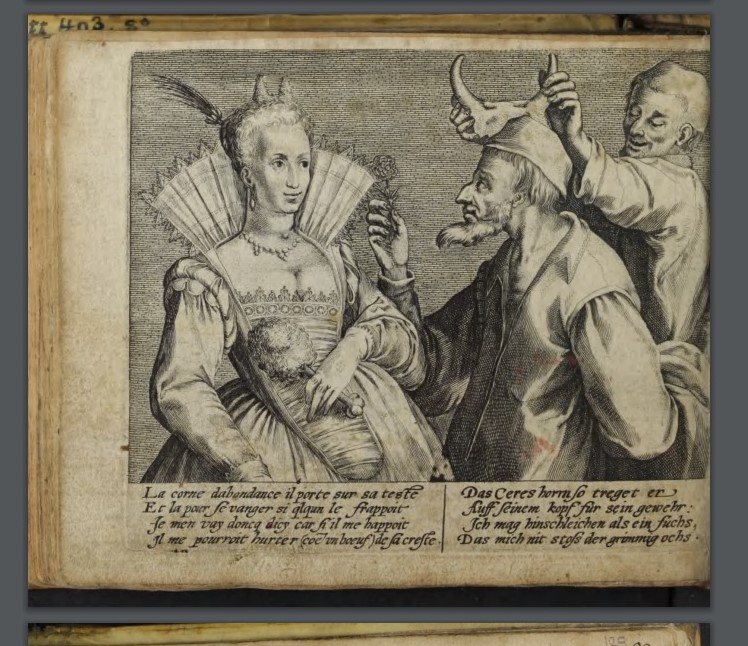
A miniature in the Müllegg album depicts an old man offering a young woman a flower while a younger man holds up a pair of horns over his head — suggesting he is, or will be, a cuckold.
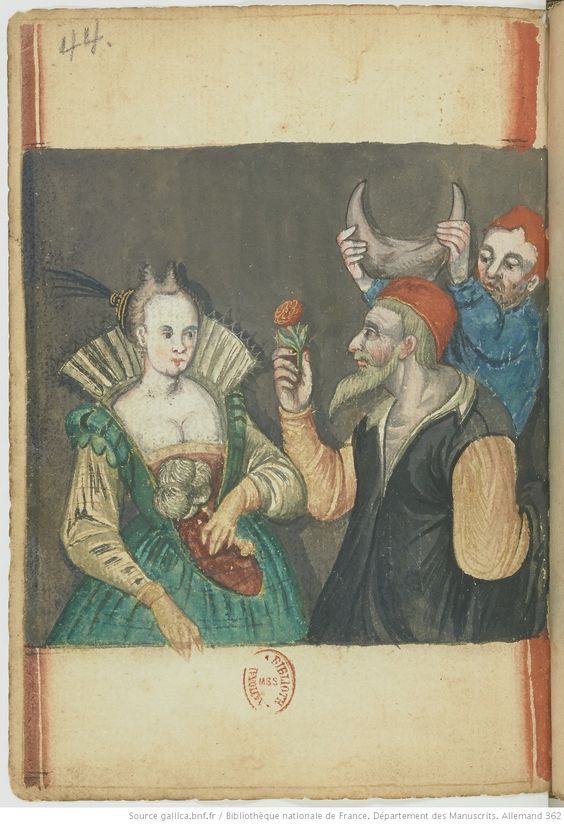
In fact, this is not some original invention on the part of the album-painter, but his copy of an engraving by Crispijn de Passe (after Bellange) from a series of four entitled Mimicarum aliquot facetiarum icones issued in 1600 or 1601 — and it and two others from the series were pasted into the album of Andreas Blume (dated entries 1614-39).
‘How the naked truth once came to light’
An extraordinary dinner-party painted in the album of Michael von Heidenreich in the first decade of the 17C includes two examples of the horns gesture made by ladies at a dinner-party (far left and far right) …
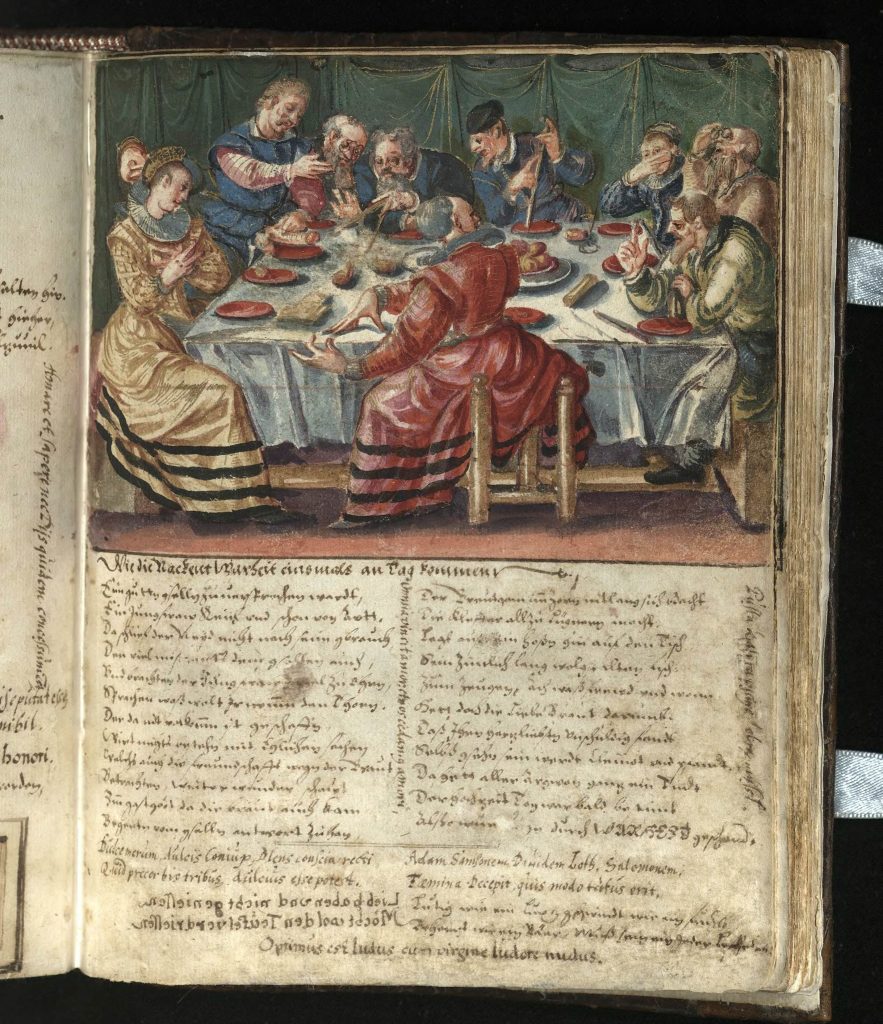
Five of the other six, male diners are seated, but the sixth, evidently the youngest of the men at the table, stands and proudly displays his erect penis across the breadth of a dinner-plate!
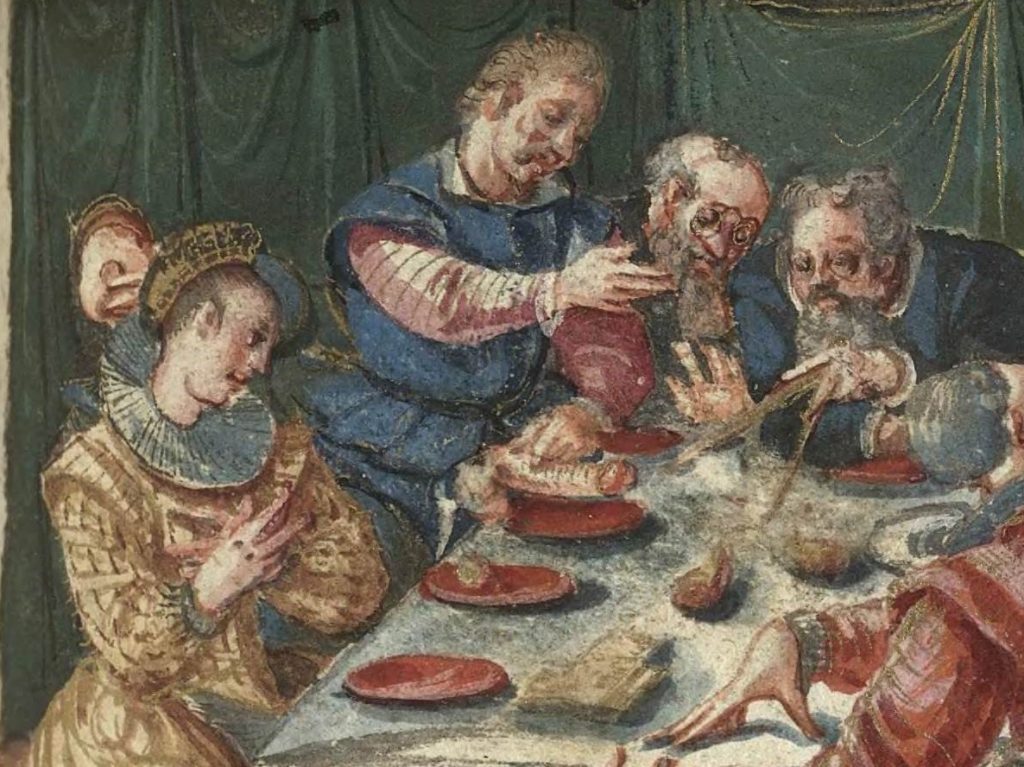
Two of his older companions are intent on measuring his impressive manhood with the aid of dividers and measuring-rod. The bizarre scene is entitled, Wie die Nackend Warheit einsmals an Tag kommen [How the naked truth once came to light], and the occasion described in 23 lines of German verse below, together with sundry other, seemingly appropriate, sentences, such as
Adam, Sampsonem, Loth, David, Salomonem / Femina decepit: quis modo tutus erit? [Adam, Samson, Lot, David, Solomon — a woman deceived them all: who would now be safe?]
Optimus est ludus cum virgine ludere nudus [The best game is played with a naked girl]
Dulce merum, dulcis coniux, mens conscia recti, Quid precor his tribus dulcius esse potest. [sweet wine, a sweet wife, a mind that knows what is right, pray what could be sweeter than these three],
and — in mirror-writing, for some reason — though given the pictorial content above, there seems no reason for such verbal coyness!
Lieb haben und nicht geniessen [To be loved and not to enjoy (that love) Möchte wol der Teufel verdriessen even the Devil would be fed up!]
This last couplet is a popular quotation, and accompanies the painting of a young beauty dated 1601, for example, in an album the Keils do not identify.
Looking through the fingers
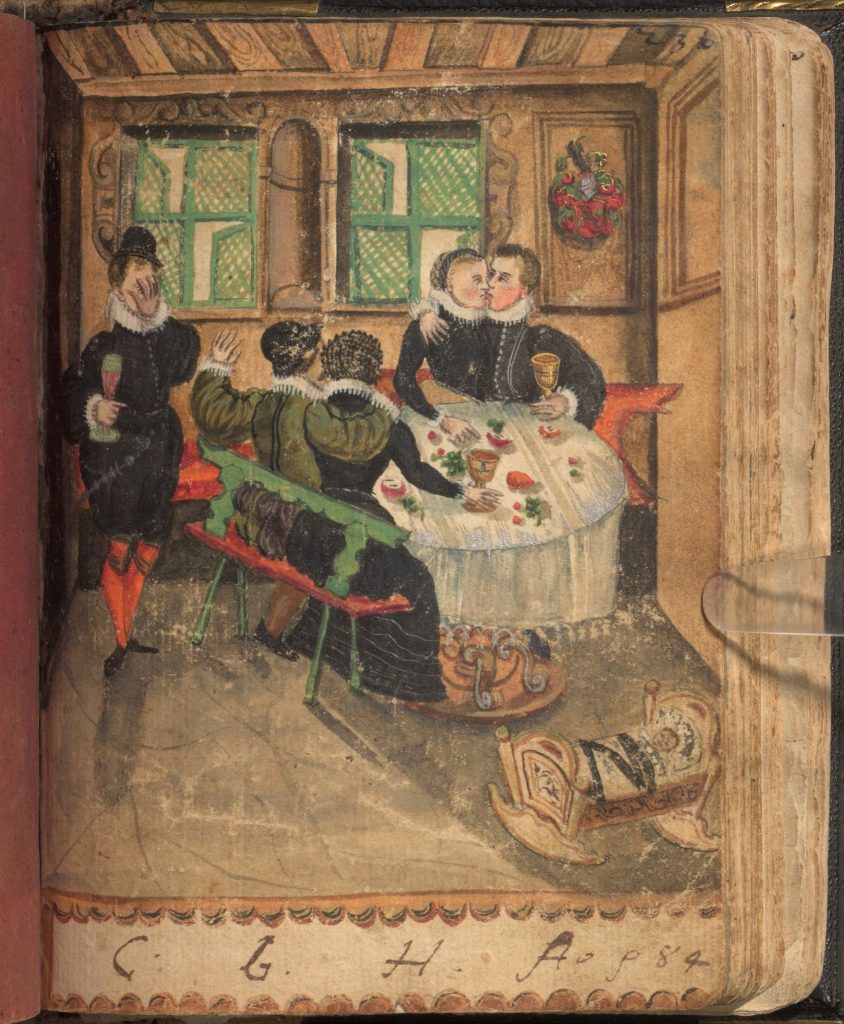
There are numerous painted and engraved images of the fool looking through his fingers — which may ultimately go back to the woodcut in Brant’s Narrenschiff (Basel 1494). The gesture conveys condonement, acquiescence, albeit reluctant — one makes a token gesture of covering one’s eyes with one’s hand, yet sees through the fingers all the same. In the Reutter album painting (below) the standing man is perhaps the complaisant cuckold, who tolerates the evident intimacy with his wife of the man sitting in front of him — doubt is also cast on the paternity of the baby in the cradle.
The ‘horns’ gesture is sometimes part of the popular scene of the young wife or prostitute who helps herself to money from the old husband’s or client’s purse, as in this orphaned leaf which was part of the du Rosey collection sold by Weigel in Leipzig in 1864:

confirming an oath — Schwurfinger
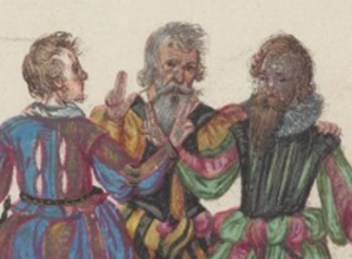
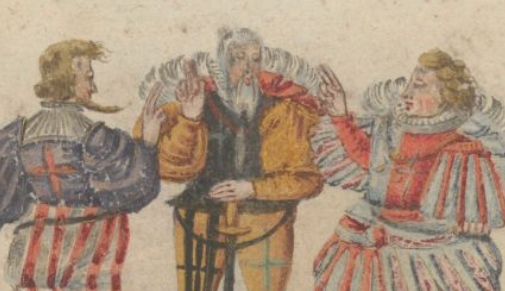
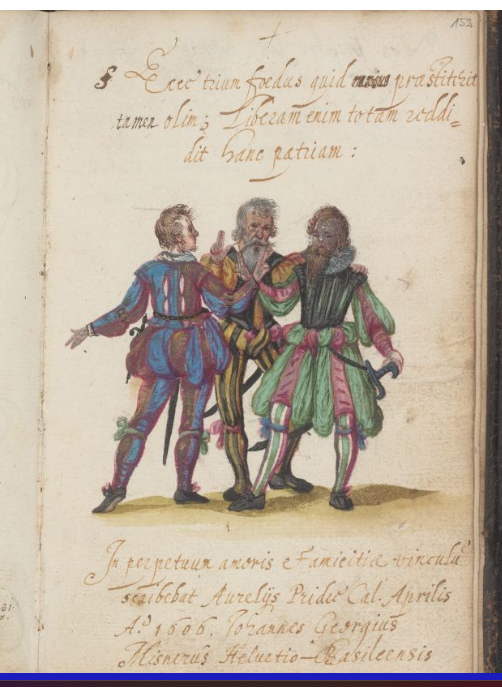
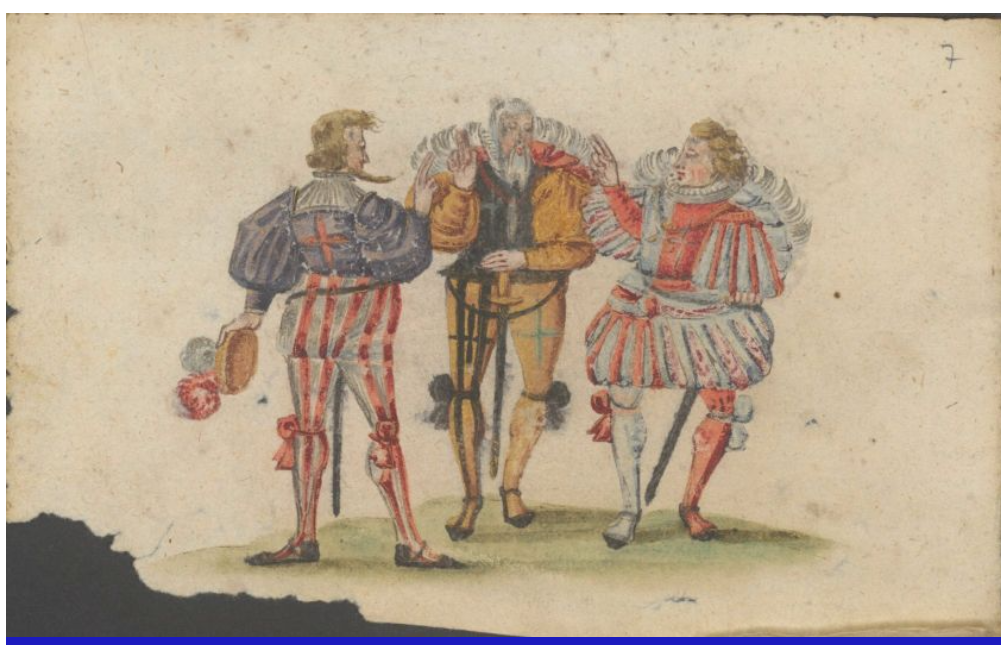
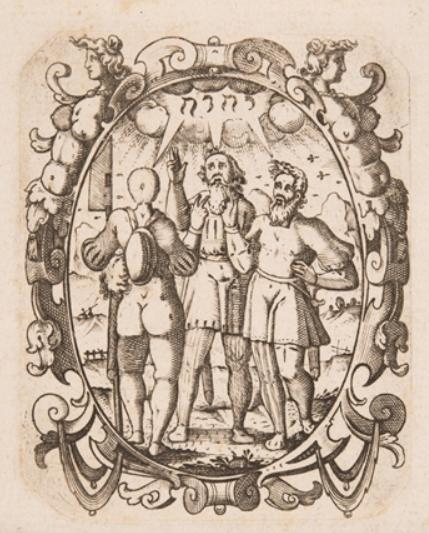
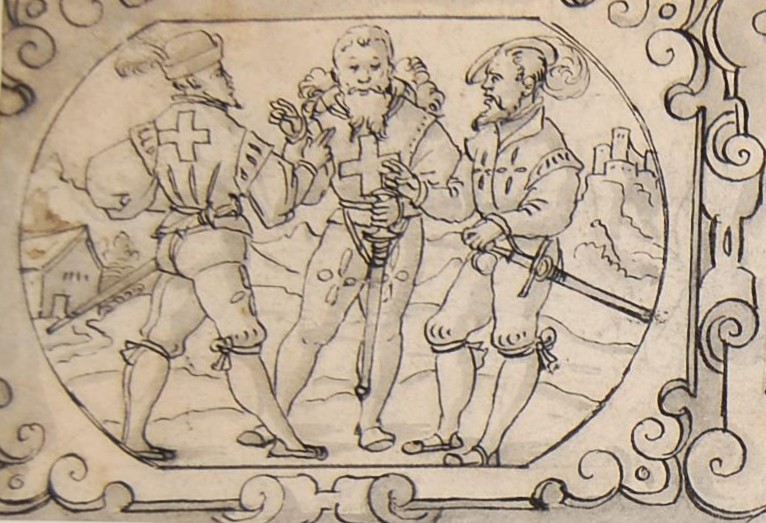
In this detail of a miniature painted in the Lichthammer album in 1606 we see three men swearing an oath and confirming it by their hand-gestures — first and second fingers raised, thumb held at an angle from them. These fingers and thumb together of the right hand are still known in modern German as the Schwurfinger [oath fingers]. The same three men appear a generation later in the Huber album — though here the thumb is tucked in behind the upright fingers.
And another slightly earlier example from the album of Balthasar von Nostitz, painted in 1585:
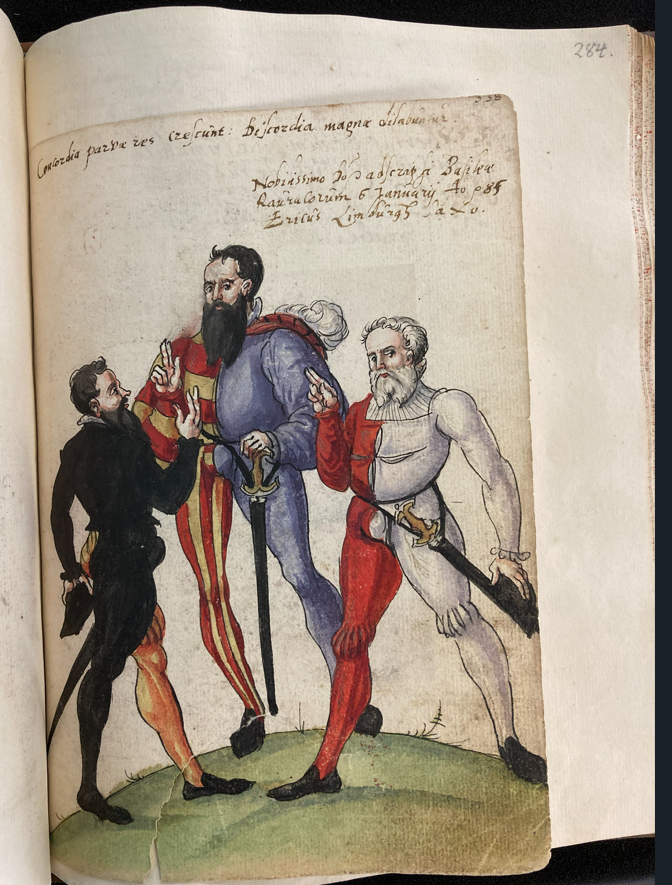
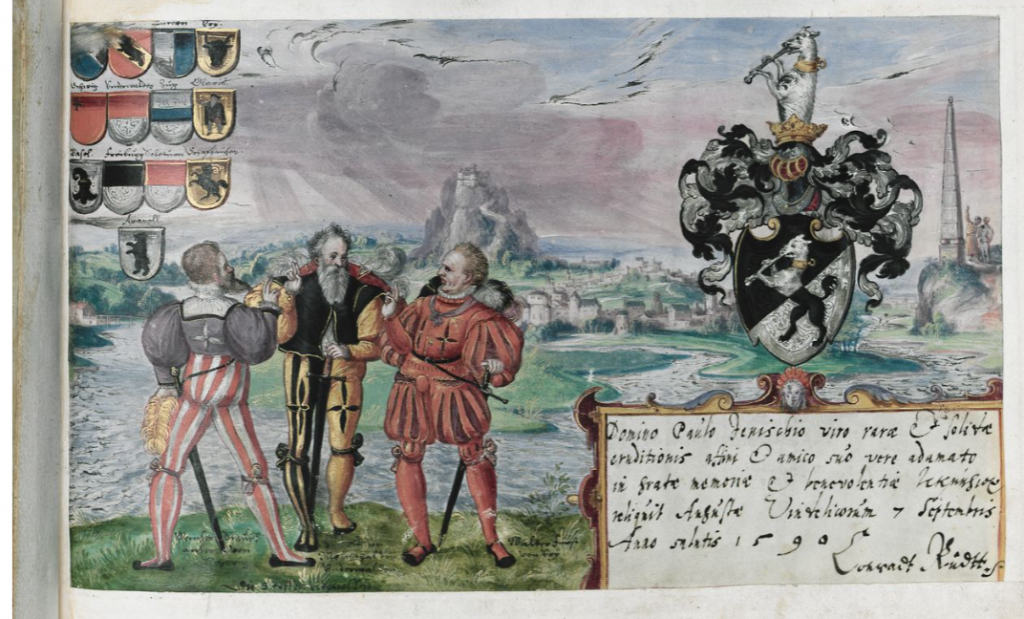
But this is no ordinary oath! This is an important historical occasion — known to every Swiss — the Rütlischwur, the oath taken at Rütli, a hillside meadow beside Lake Lucerne in Uri, by the three representatives of the cantons of Uri, Schwyz and Unterwalden in 1307, which marks the foundation of Switzerland.
Leave a Reply