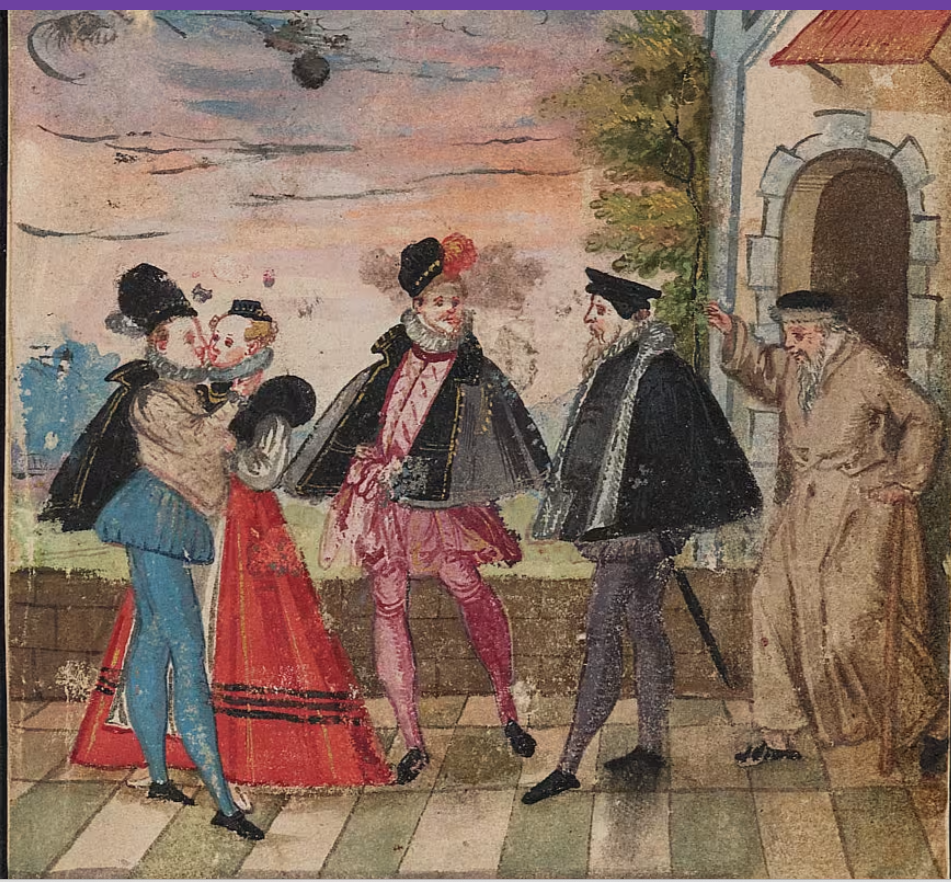
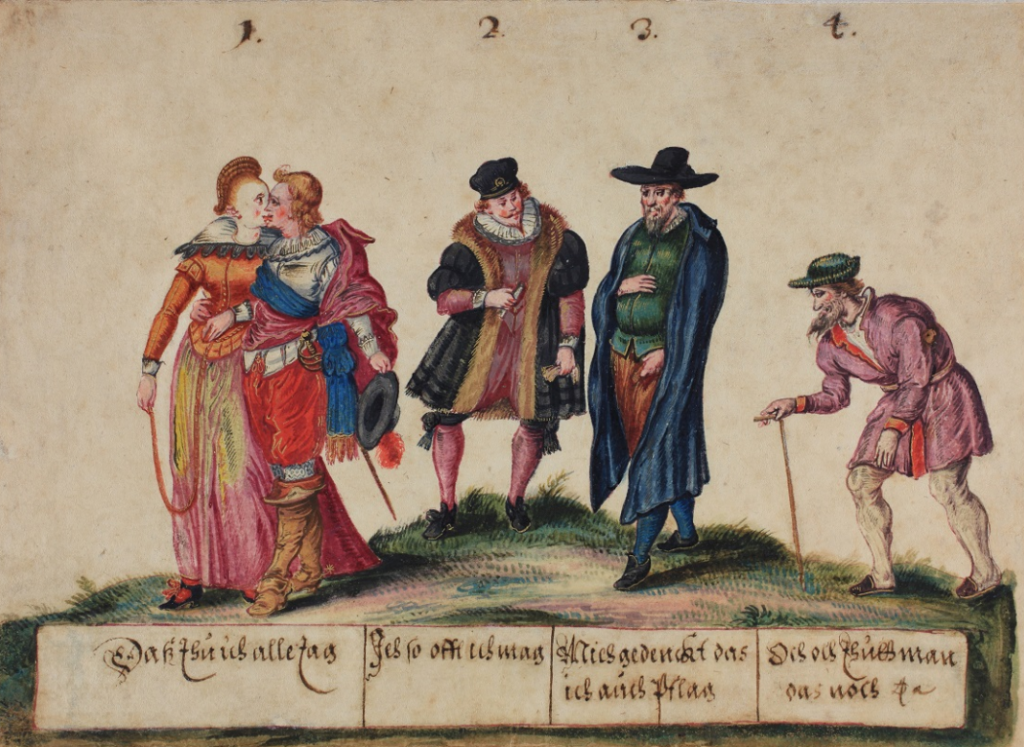
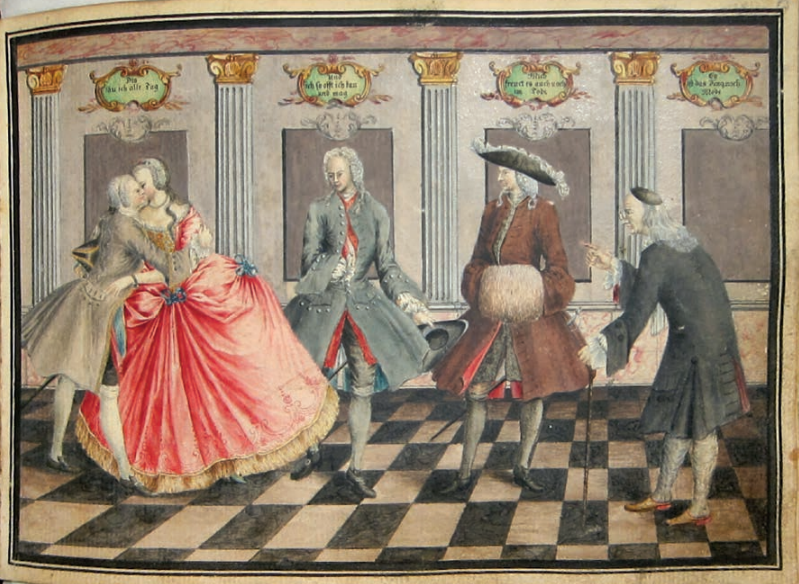
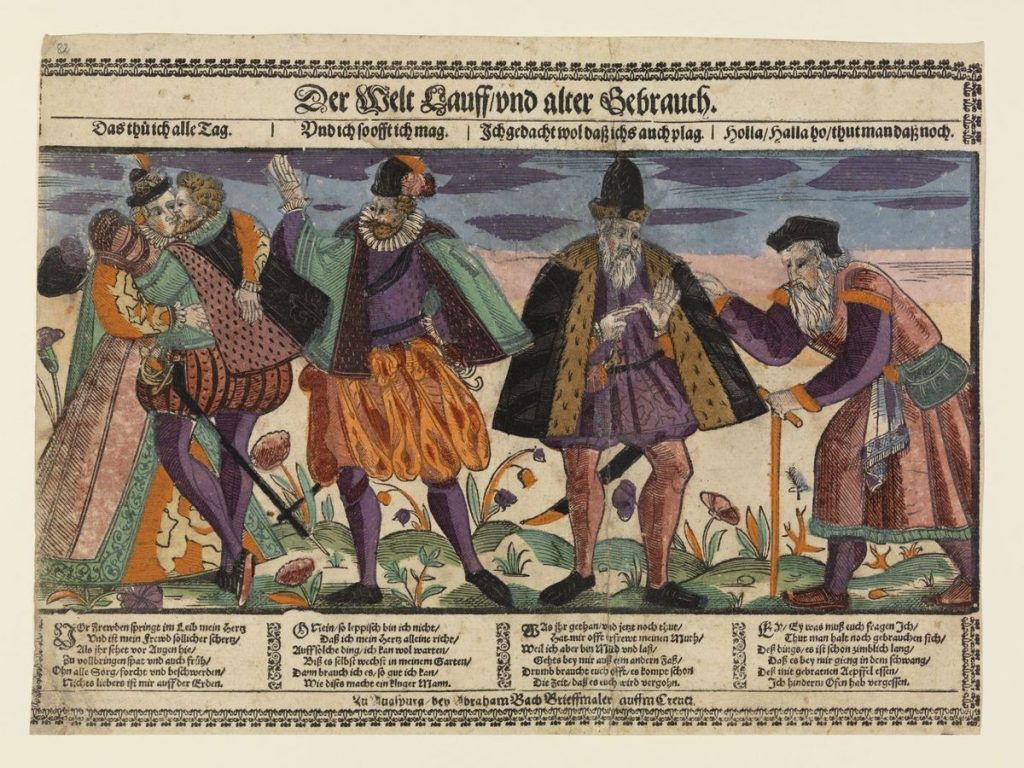
This is a gentle satire on the inevitable fall-off in sexual performance as a man ages. It features men of four ages, the youngest embracing a young woman.
Jakob von der Heyden, the publisher of the Pugillus Facetiarum (Strasbourg 1608, 1618) states in his preface that many of the designs in this print-book were taken from actual students’ albums he had seen and, inasmuch as examples are found in albums before 1608 (see the Melchior Pfinzing von Henfenfeld album miniature below), this does indeed seem to be true.
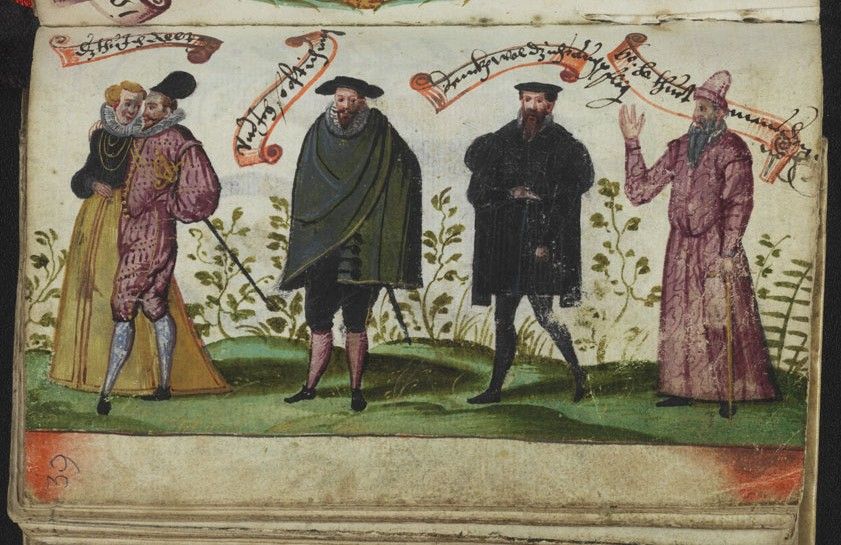
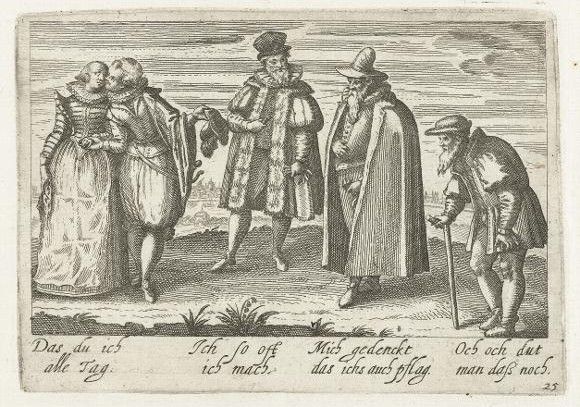
The standard German speeches as given in the first edition of the Pugillus (1608) and in the second edition of the de Brys’ Emblemata Saecularia (Oppenheim, 1611) are as follows:
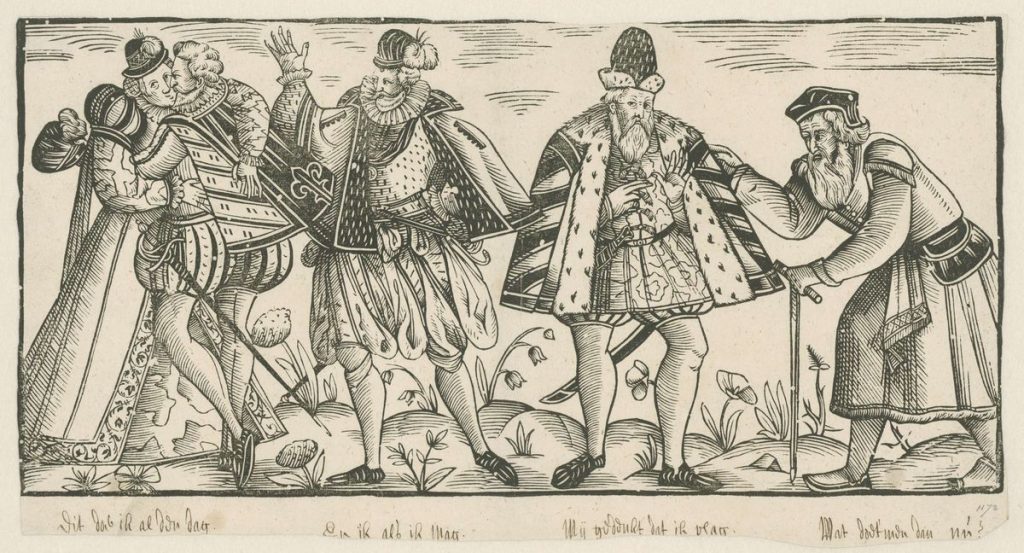
Youngest man embracing woman: Das du ich alle Tag I do this all day
Middle-aged man: Ich so oft ich mach I as often as I may/can
Mature man: Mich gedenckt das ichs auch pflag I think I used to do that
Old man: Och och dut man dass noch? Oh! Oh! Do people still do that?
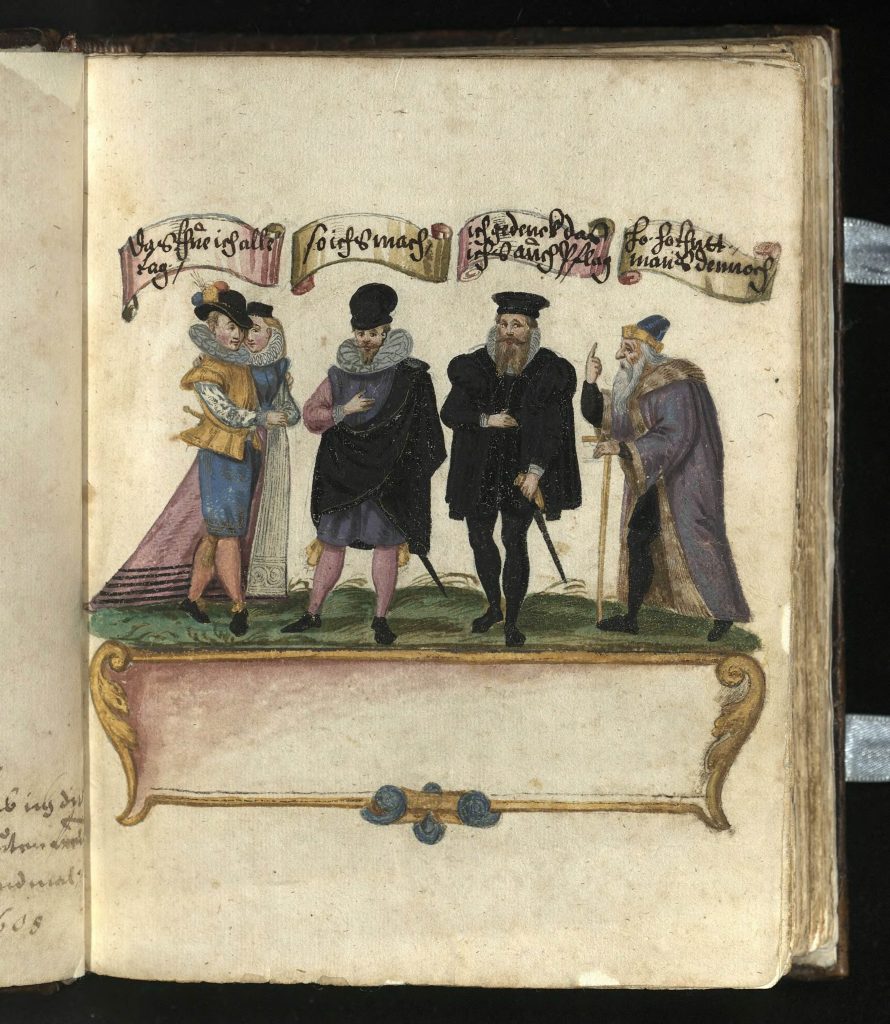
The version, painted in the Heidenreich album a.1612, allots the same speeches to its participants,
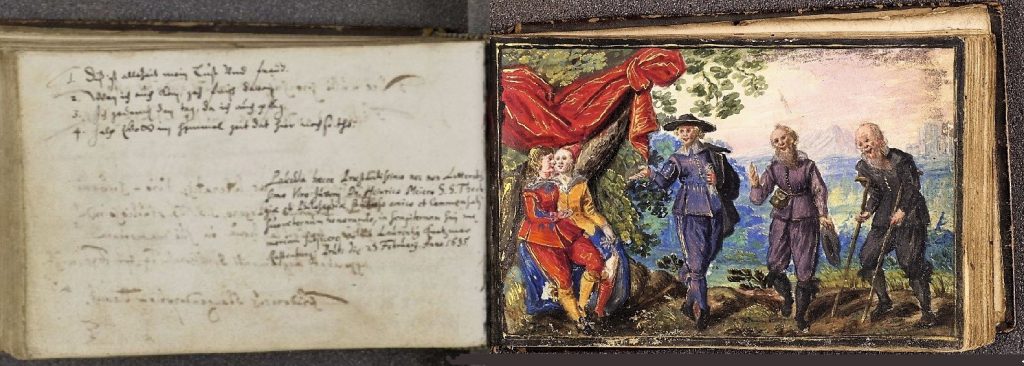
while that in the Meyer album (1635), with the young couple seated, lacks banderoles altogether, giving their speeches, numbered 1 to 4, on the adjacent page,
the same, evidently traditional, speeches that occur in the pre-Pugillus album of Melchior Pfinzing von Henfenfelden, painted in the early 1590s (above).
But, in fact, the graphic motif can be traced back to the end of the middle ages, being found on a unique but damaged hand-coloured woodcut print now in Munich. The somewhat risqué nature of the motif has clearly led to this drastic censorship, with the embracing couple – evidently seated – having been almost entirely torn away, and all the men’s banderoles having been carefully excised.
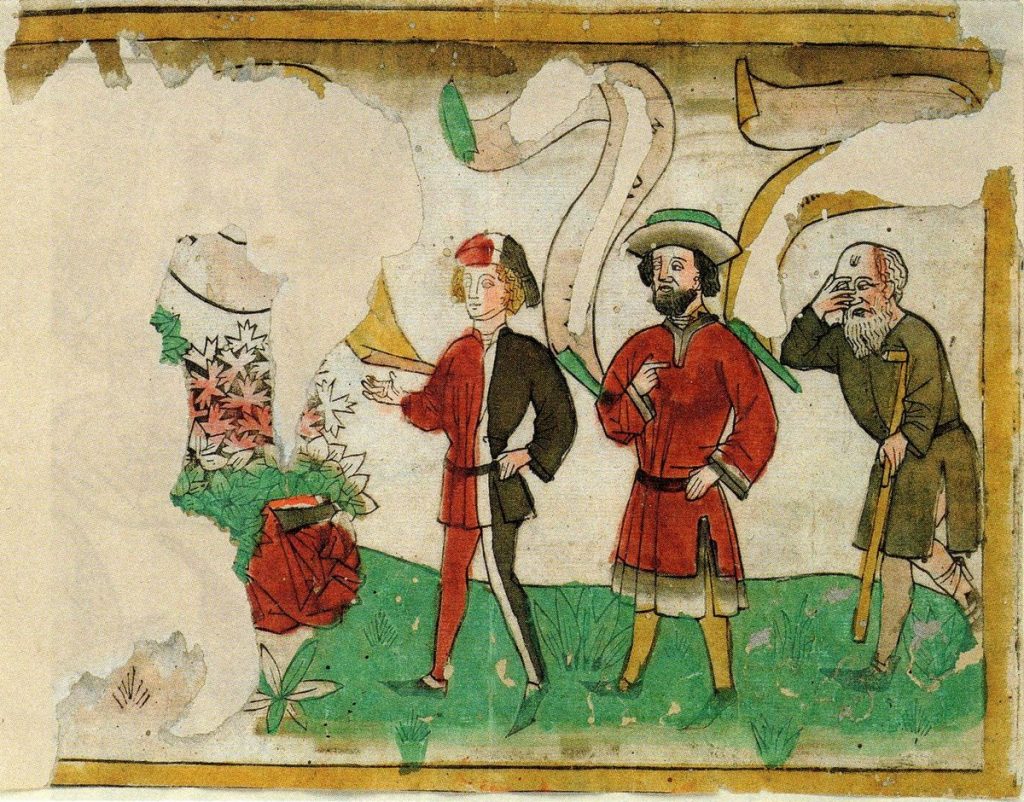
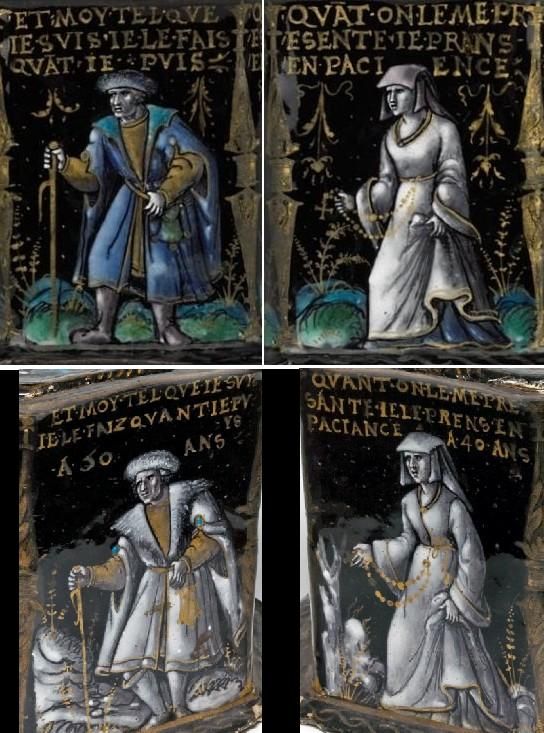
While the above print in Munich is the earliest example of the motif known to me, the next earliest is not a graphic image at all, but an enamel-painted salt made by Colin Nouailher in Limoges in 1542
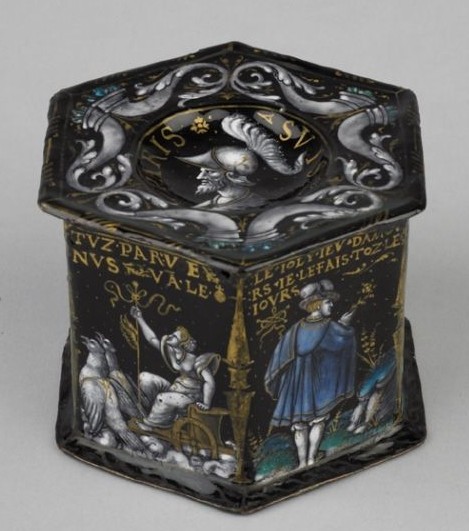
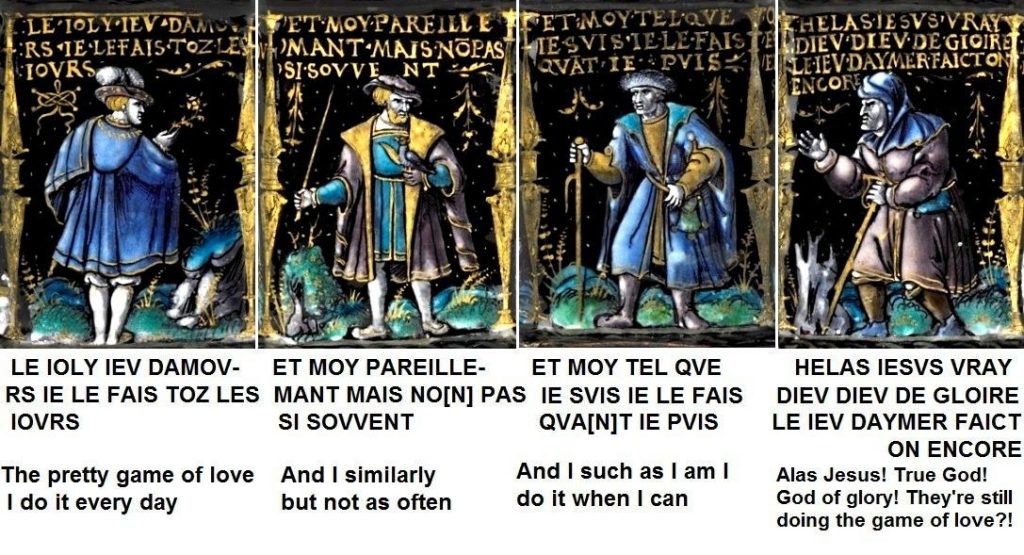
Here (above) we see the young man boasting: LE IOLY IEV DAMOVRS IE LEFAIS TOZ LE IOVRS [the pleasant game of love, I do it every day]. The excellent photographs of the salt on the Wallace Collection site enabled me to put together this composite of the four men and their speeches:
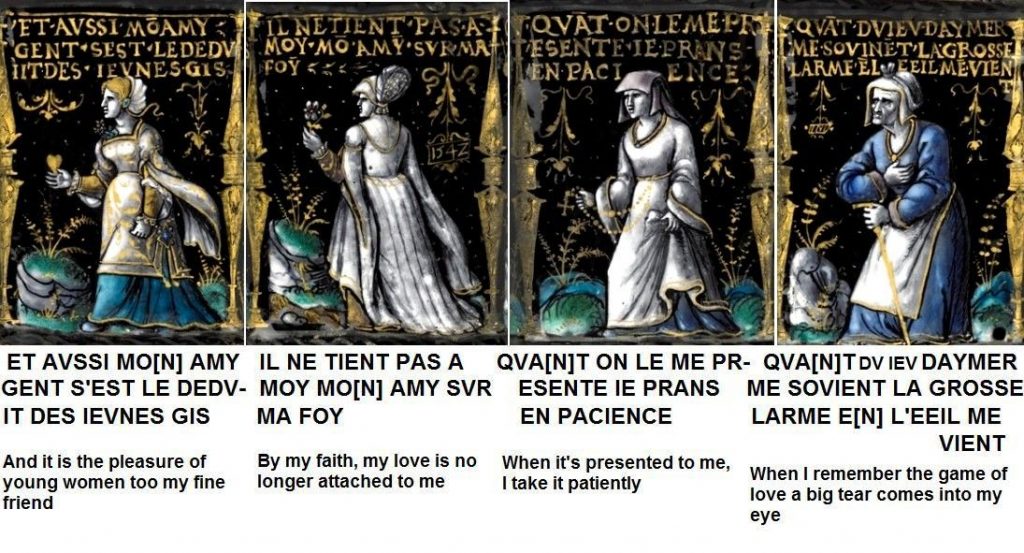
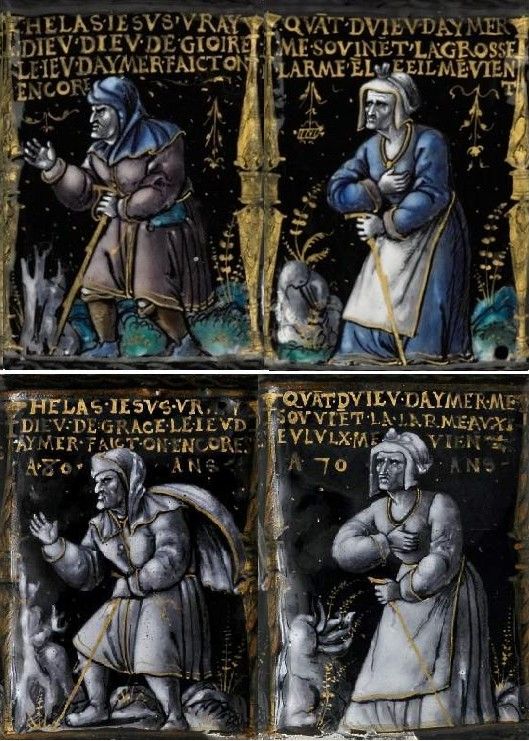
Refreshingly — perhaps uniquely — as this is a pair of salts, we also hear of things, poignantly, from the woman’s perspective:
Nouailher’s workshop also produced these salts in grisaille, and such a pair is preserved in the collection of the Fitzwilliam Museum in Cambridge; here are two comparisons of the Wallace Collection salts (above) with those in the Fitzwilliam Museum (below):
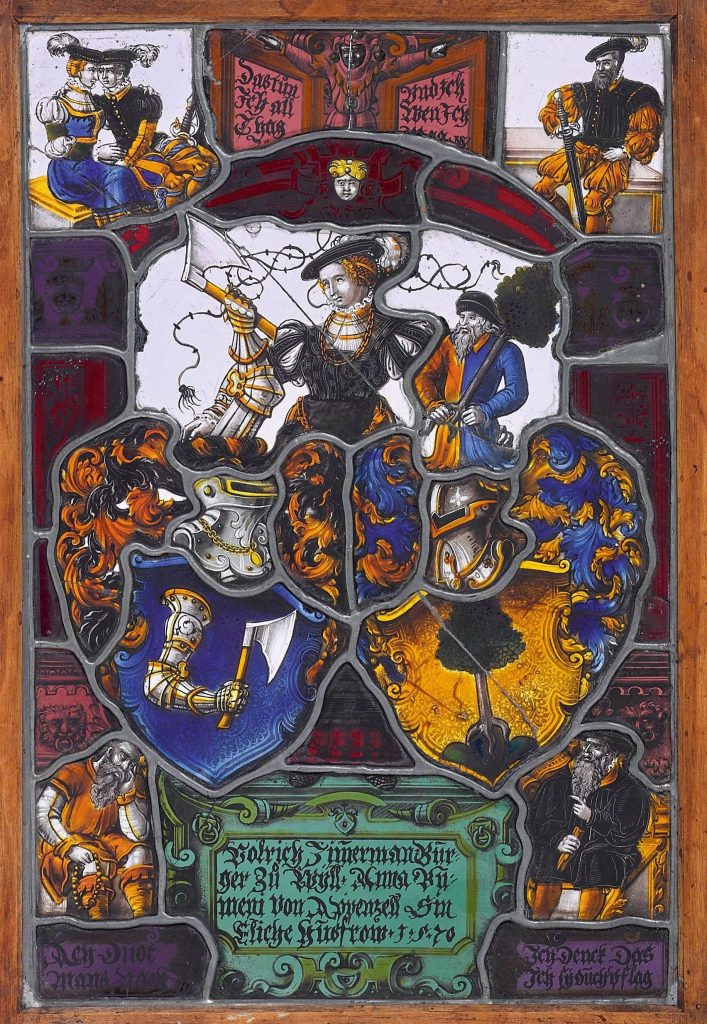
But — like any motif worth its salt — it was also taken up by the glass-painters, and is found on a Swiss panel dated 1570 recently sold at auction, each of the ages occupying a corner of the pane with their usual inscriptions.
But a generation or so before the appearance of the motif in the print-books, it appeared as a German single-sheet entitled, Wer weis obs war ist [Who knows if it’s true].
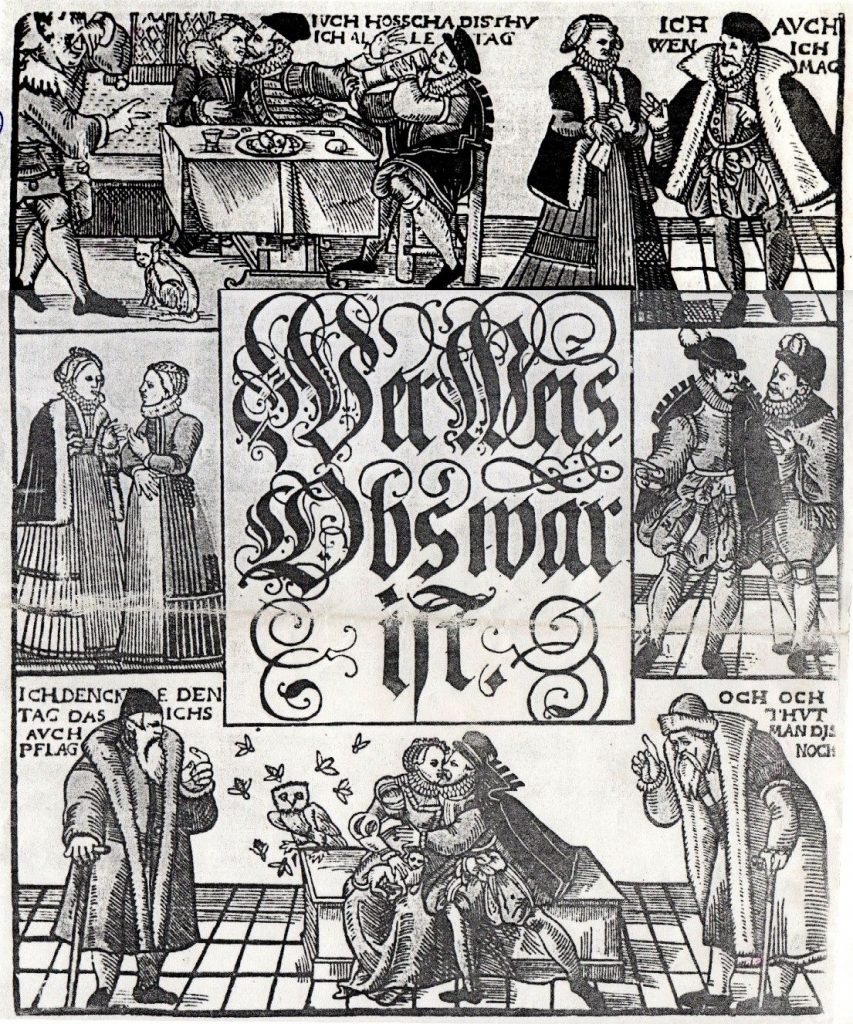
The Lüneburg pastor, Georg Starck, complained about this very sheet in a pamphlet published in 1582, saying it was pasted to the wall of almost every house he entered, but recommending it should rather be used as toilet paper. As ever, it is chastening to reflect that for such an evidently popular print, we have but one example extant.
Other media
Further evidence of the popularity of the motif is afforded by its presence in other media, including a set of stove-tiles of late 16C date, only one of which is preserved — in this drawing —
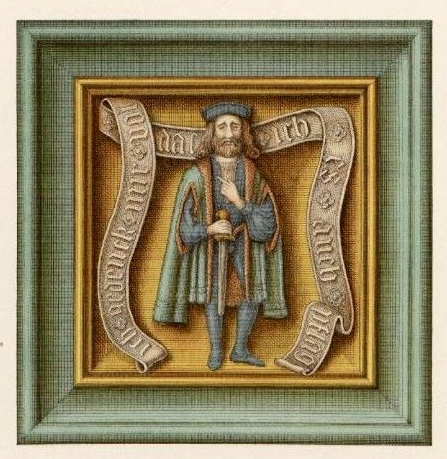
and as carved at the four edges of a gameboard dated 1603 in the Bayerisches Nationalmuseum:
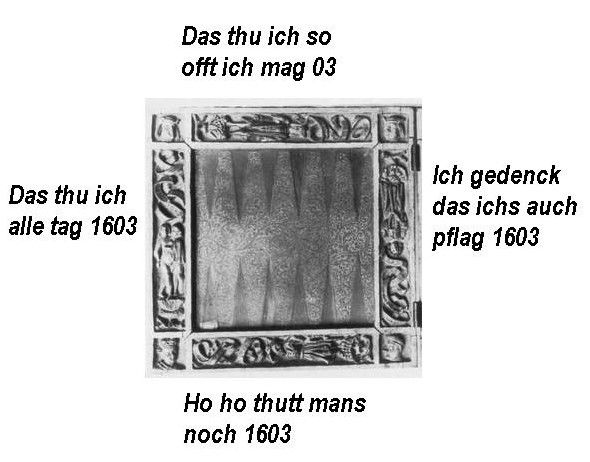
Even in England!
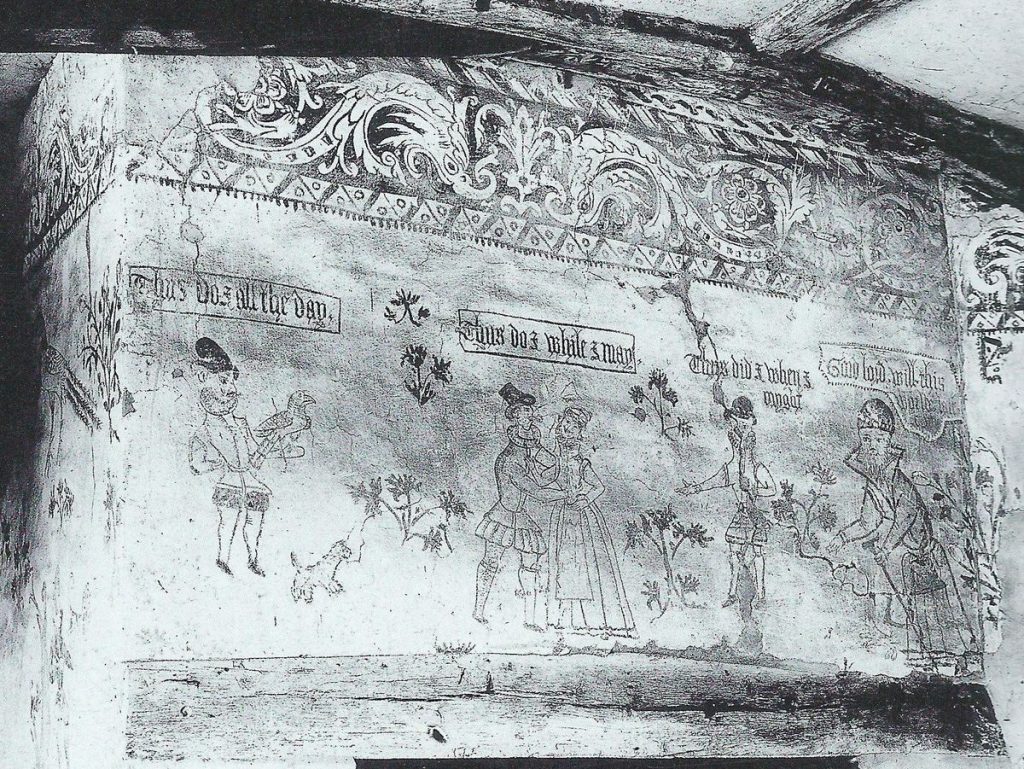
An extraordinary survival in England is a mural of our motif above the fireplace in the lodge of West Stowe Manor in Suffolk, painted c.1600 (above), though, thanks to the German examples, we can also say that the English painter has somewhat diluted the strength of his joke by attributing the wrong verse to the young couple! He has painted the four verses in the correct order from right to left, but because he has moved the embracing couple into second, instead of first place, the youngest lover now speaks the words that rightly belong to the slightly older man. Restoring the correct order, then, and noting that all the remarks relate to the courting couple, they should read from left to right thus:
Youngest man embracing woman: Thus do I all the day
Middle-aged man Thus do I while I may
Mature man: Thus did I when I might
Old man Good lord will thes world last for ever
By a strange co-incidence, we know that what is essentially the same joke as that purveyed by our print was current in the Elizabethan oral tradition, thanks to the autobiography of the lute-teacher, Thomas Whythorne, written in the 1570s:
A good fellow which being somewhat steeped in years and had passed the snares of Venus’ darlings and babes … came by chance into a secret place where he found a young man and a young woman embracing and kissing together, wherewithal he stood still a little and then he made a cross on his forehead with thumb, and then with hand he made, as it were, a pent-house over his eyes, as one doth whose sight is troubled by the brightness of the sunlight if he look toward it, the which being done, he said, “Jesus, doth this world last yet?” as who would have said, “Doth this embracing and kissing continue still?” Because all such kind of occasions were past with him, he thought that they had been done with everybody else.
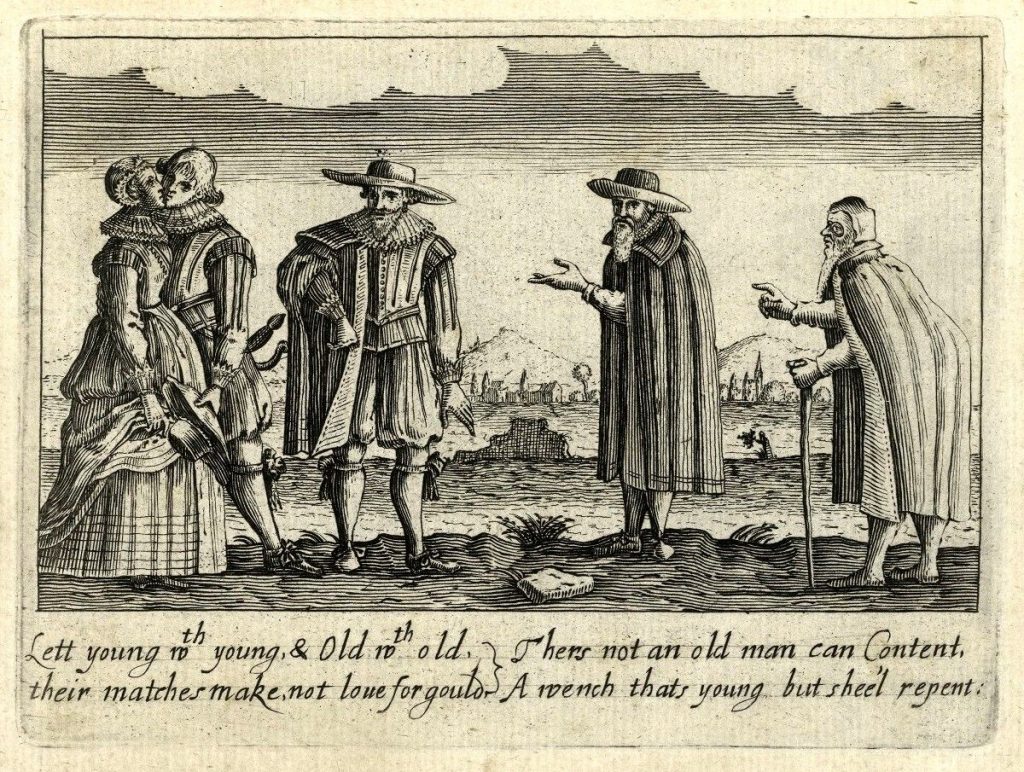
Remarkably, a dozen sheets from an otherwise lost English print-book published in 1628 survive in the Folger Shakespeare Library in New York. Their German engraver, Friedrich van Hulsen, who is known to have been working in London in 1627, derived the majority of the 12 extant images from the German print-books he was familiar with. But it is clear that the text which accompanies the English print issued in 1628 — from both the Pugillus source and the West Stowe mural –has been bowdlerised for the English market!
But back to our albums. Here is an orphaned leaf in the Bayerisches Nationalmuseum, there dated c.1580. No texts, but we cannot mistake the subject — as always, note the beard-length of the men which increases with age in this motif!
And here, exactly contemporary with the Meyer album painting (above), another example — attributed to the painter, Adolf Boy:
There is apparently another example of our motif in the album of Carl d.J. Elsenheimer (dated entries 1616-31), but I have not been able to confirm this, and the Keils refer to another which they dated to the 1590s in their Die Deutschen Stammbucher Des Sechzehnten Bis Neunzehnten Jahrhunderts (1893), in an album kept by an unnamed student of Altdorf university, but interpret the oldest man as a Jew with a long beard.
A late album example:
Later prints
First, an only apparently later print, issued by Abraham Bach in the mid-17C — but it is clear from the costume that he is re-issuing a late 16C sheet. [The Rijksmuseum has a copy of this woodcut cut from the sheet and annotated in manuscript in Dutch — but it is not a Dutch print!]
Couples
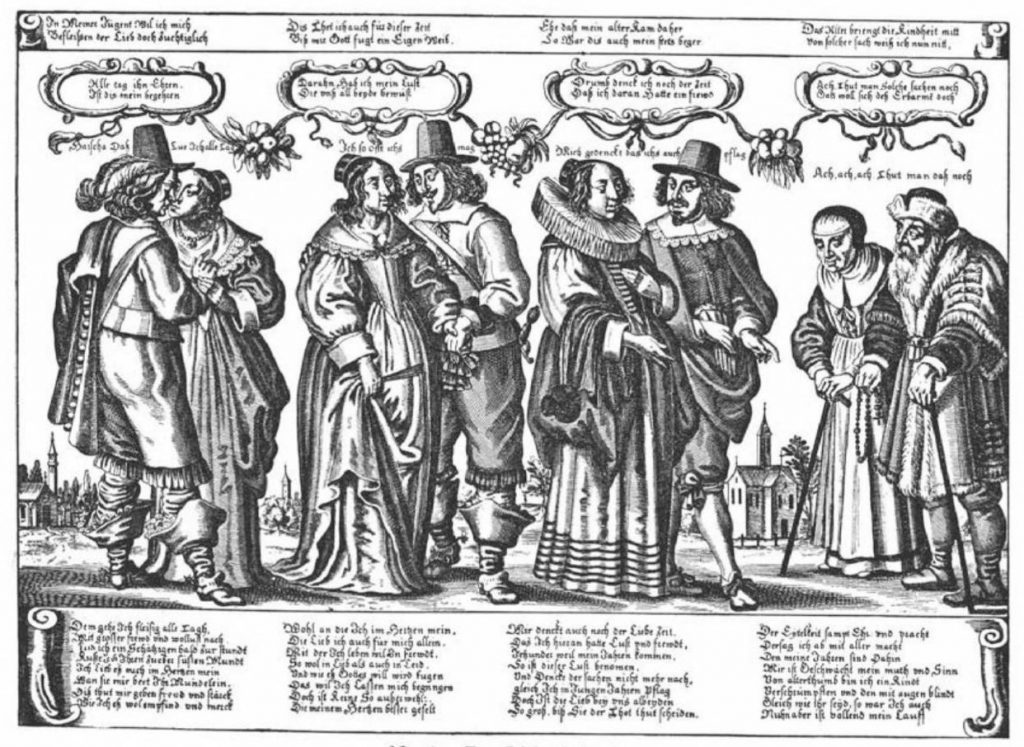
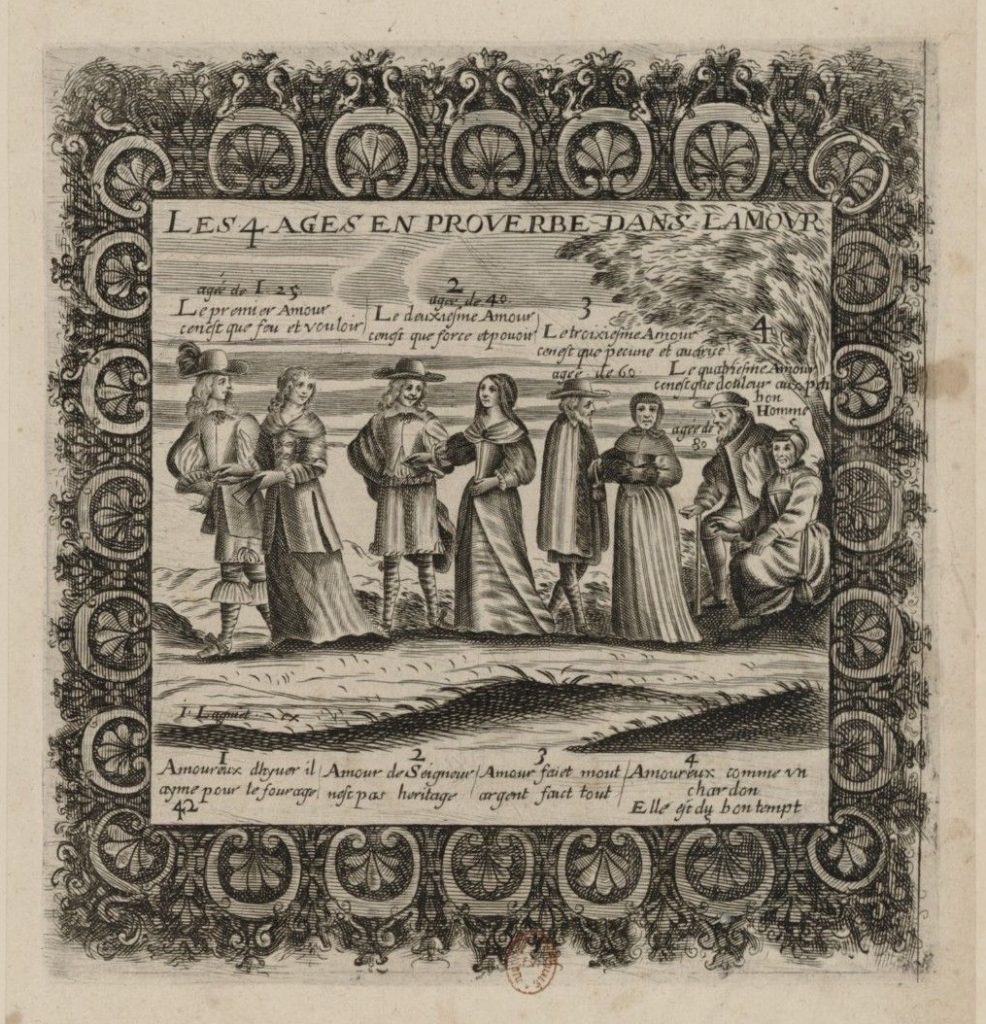
From around the middle of the 17C, German and French publishers issued versions of our motif but with the 4 Ages as couples.
Postscript
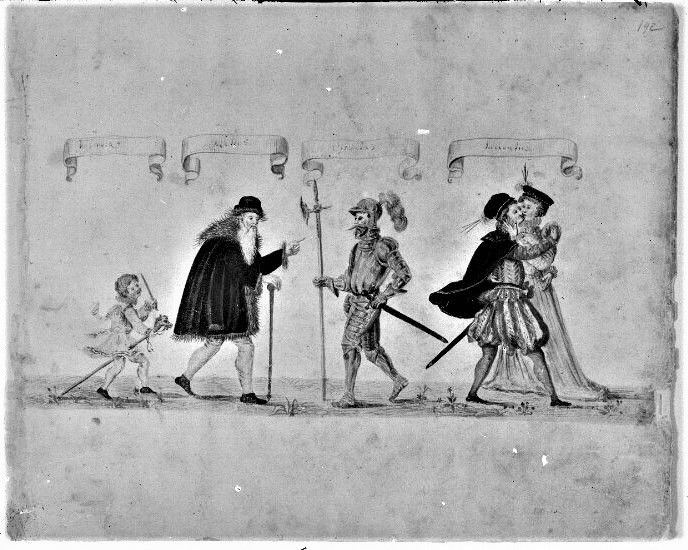
This orphaned leaf of c.1600 in the collection of the Austrian National Library, on the other hand, shows us the Four Ages of Man in the ordinary, non-sexual sense — though, oddly, not in chronological order! The 4 figures are labelled (from left to right), Pueritia [Boyhood] Senectus [Old Age] Virilitas [Manhood] Iuventus [Youth].
Leave a Reply