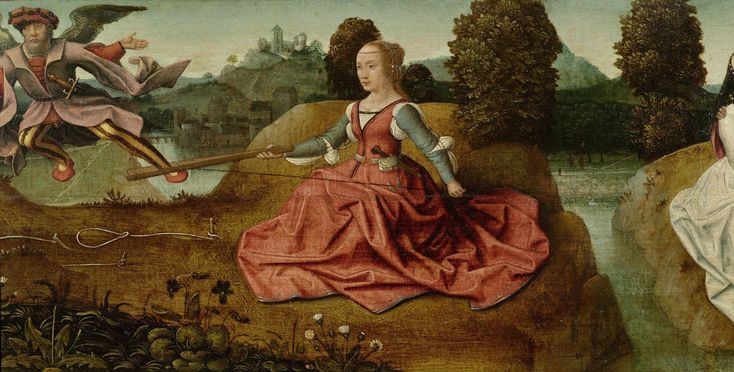
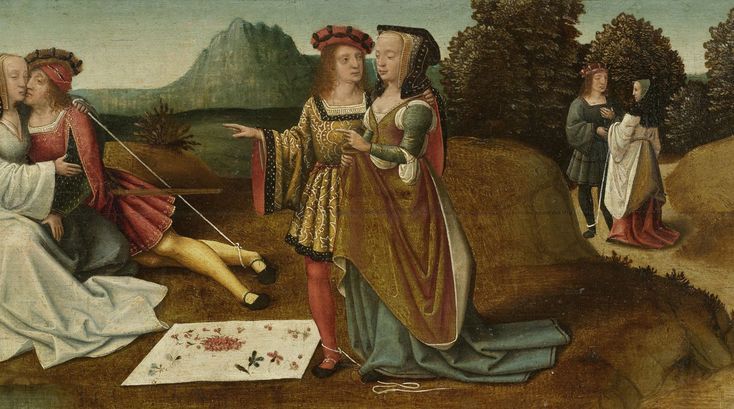
In this motif the Devil, or Cupid, or a human fowler uses a human decoy — in the same way the owl was traditionally used to catch small birds — to catch humans of the opposite sex. The wonderful panel painting attributed to the Master of the Frankfurt Altarpiece, that only came to light in 2013, shows that the motif was already known in the early 16C.
Before the albums
The motif of women fowlers ensnaring flying men which – like so many late medieval motifs continues into the image-repertoire of the alba amicorum – emerged in spectacular fashion in the shape of a long panel painting, hitherto unknown, attributed to the early 16C Master of Frankfurt. It depicts a group of four winged men standing conversing on the left – whose costume shows them to come from all ranks of society — three couples on the right, and between the two groups, centrally, a seated young woman who has caught a young man by the ankle, who hovers in mid-air. Beside her lying on the ground are noose-like snares, three of which are still visible around the ankles of the three young men. On the other side of her a cloth lies on the ground in which are flower-heads and many detached petals, perhaps deriving from a lovers’ game of the ‘daisy oracle’ type. On the extreme left of the composition, beside the group of young men who have already flown in and landed, stands a ‘commentary’ fool in costume, who grasps the shoulder of the nearest man and waves his marotte in the air – there could be no clearer signal that what we are looking at is a folly! The long narrow format of the composition has led to the suggestion that it may once have been part of a wedding-chest, or even the painted lid of a clavichord.

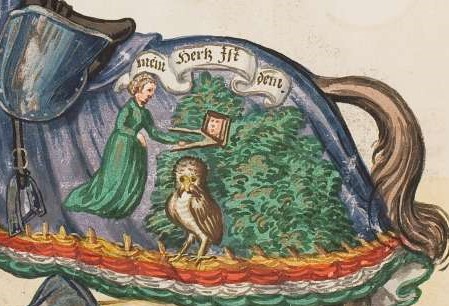
In a tournament held in 1485, the trapper of Marx Walther’s horse bore the device of a fowler in a hide from which the forked stick [Kloben] projects, and beside which stands an owl decoy [Lockvogel]. He has caught a young woman who says mein Hertz Ist dein [my heart is yours].
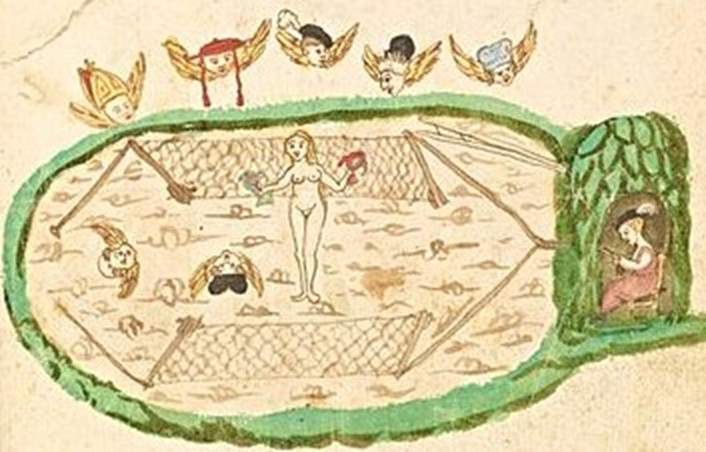
The annual Nurnberg Schembartlauf carnival procession of 1521 included a float depicting our motif
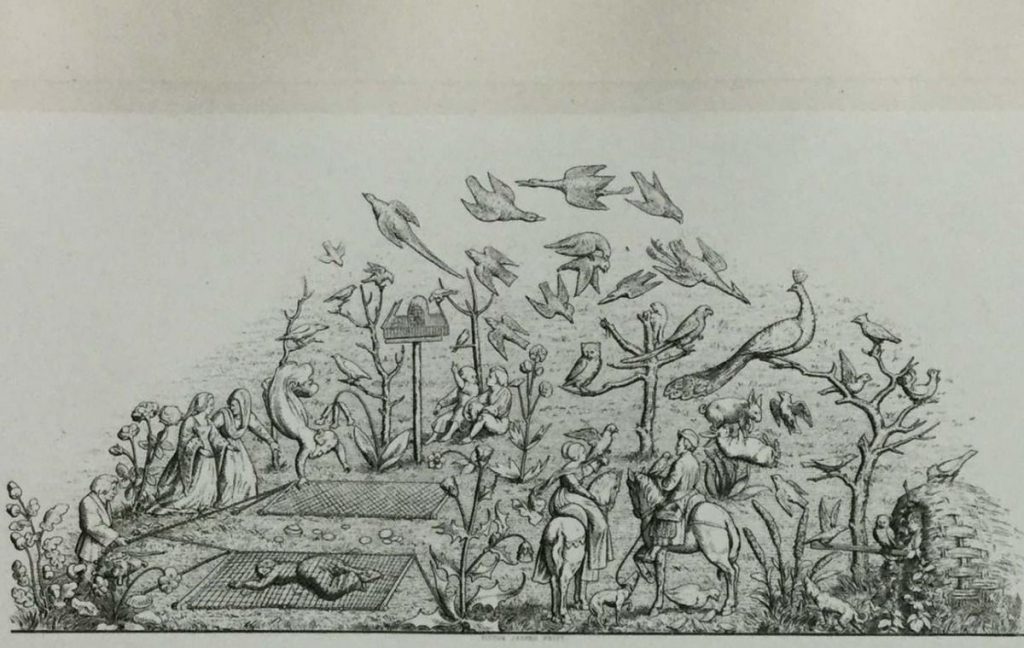
The National Museum of Switzerland houses the famous — and famously misnamed! — ‘Holbeintisch‘, the table-top painted in 1515, which Lucas Wuthrich showed was actually painted by Hans Herbst. Our motif appears along with ordinary scenes of fowling with an owl decoy, and of a mobbed owl, but is easier to see in this 19C drawing:
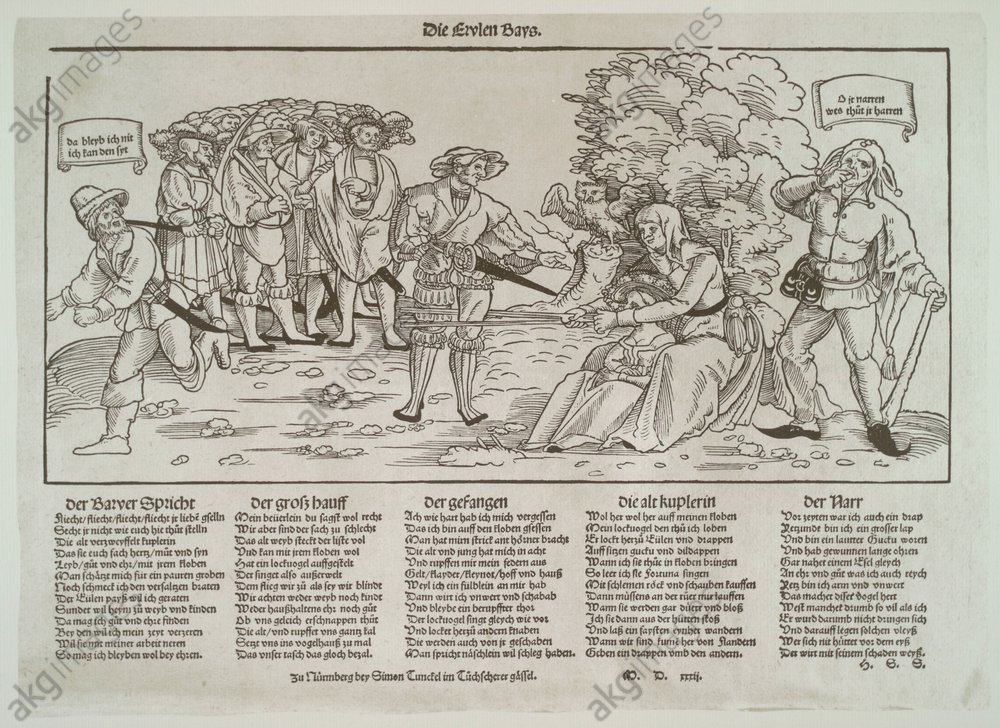
Nikolaus Stör produced two woodcut images of our motif in the early 1530s, Die Ewlen Bays (1532) illustrating a poem by Hans Sachs, and Buhler Vogelherd (1534).
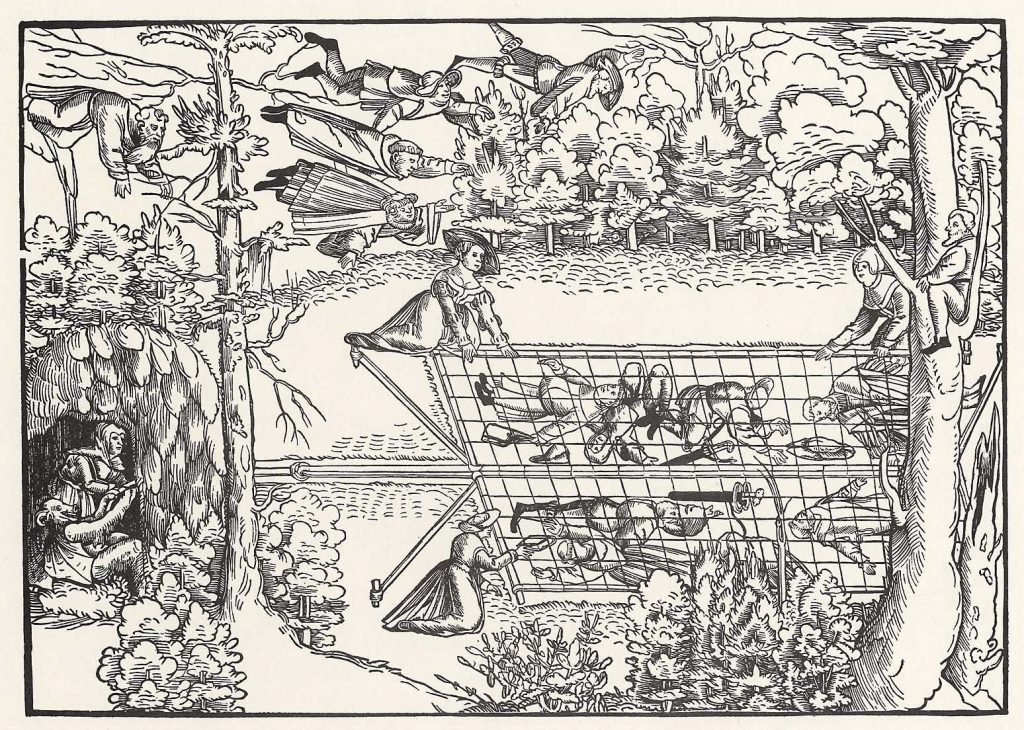
His contemporary, the prolific Erhard Schoen, whose woodcuts illustrate many prints of verses by Hans Sachs, issued his own version of the motif also in 1534:
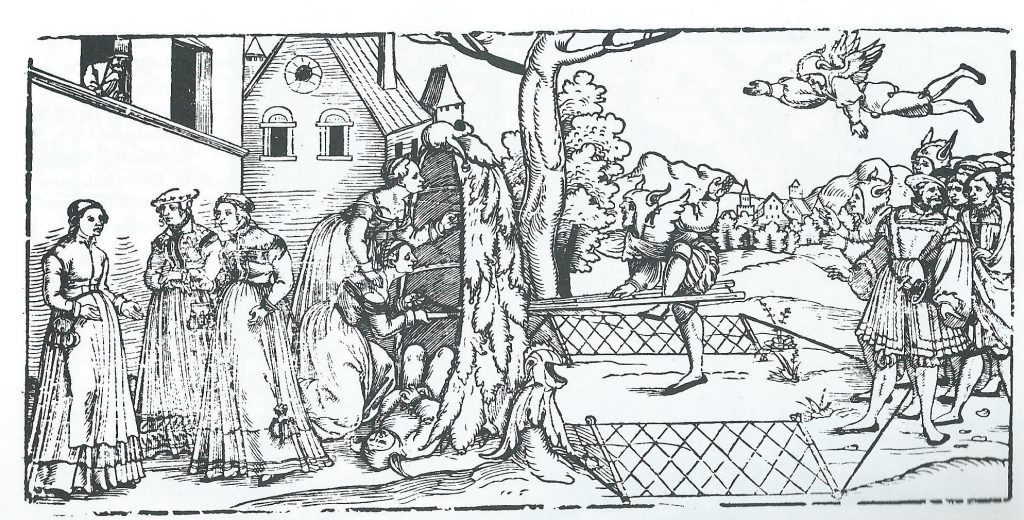
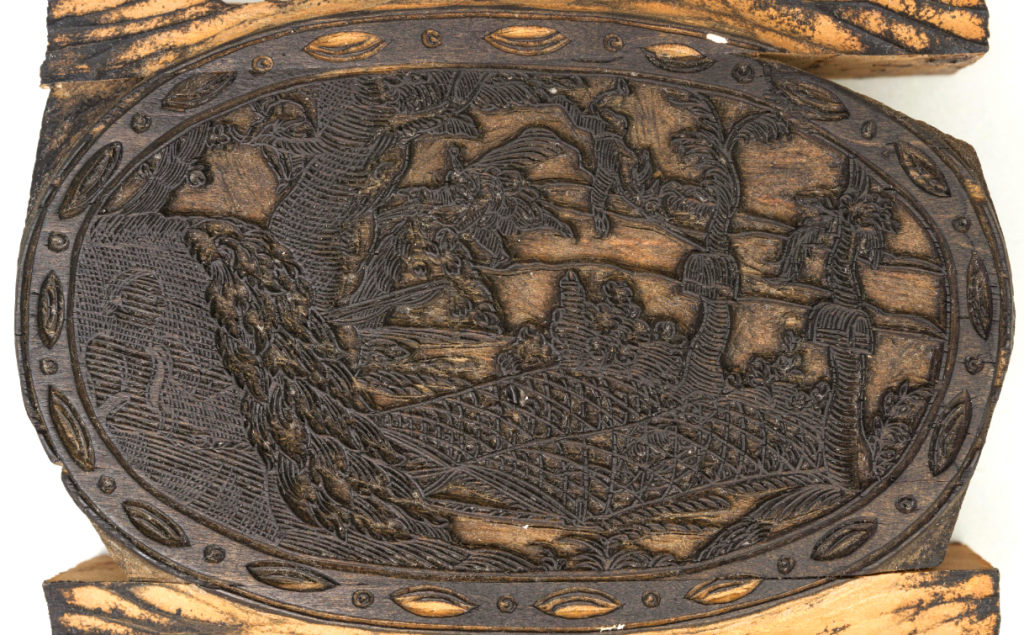
The woodblock for producing this illustration survives in the extraordinary collection of blocks in Derschau (no.484), as does another contemporary oval block of our motif (no.149), which similarly shows fools coming flying in. One can make out the woman in the hide, the Kloben which projects from it, and the clap-nets on the ground. [I have reversed the photo in order to show how the woodcut would have looked when printed]
In the albums
The earliest example of the motif I have noted in the albums to date is that in the album of William Helbig:
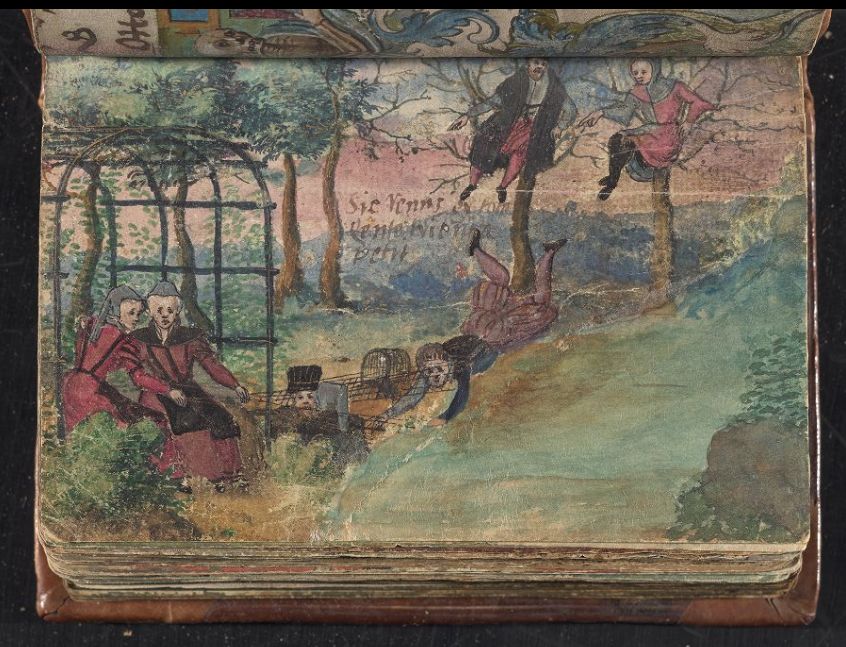
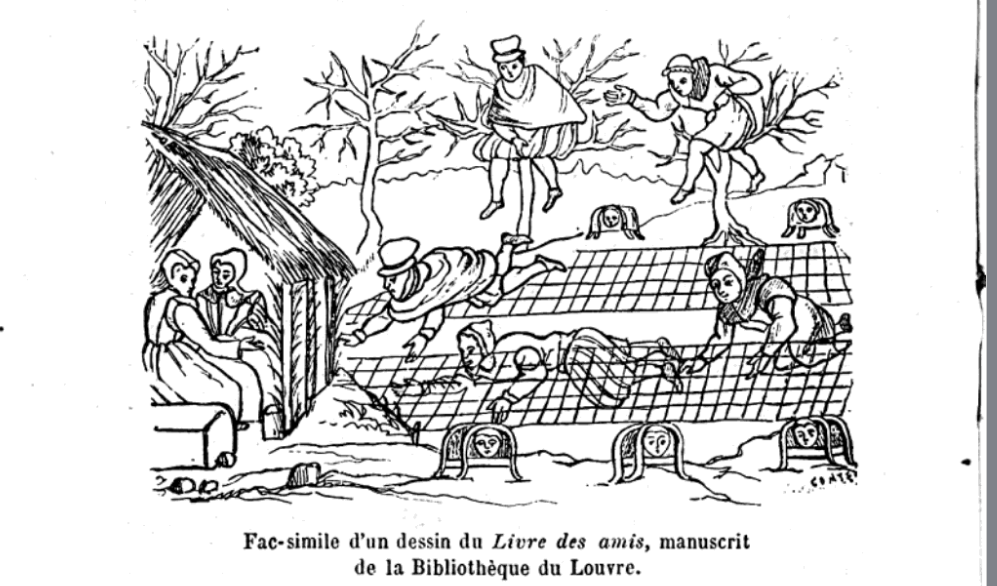
The lost Rietheim album (destroyed in the Louvre fire of 1871) and the extant Helbig album had much in common — and, indeed, Rietheim signed an entry in Helbig’s book. Their women fowling miniatures are labelled with the same Latin quotation Sic Venus a tota gente tributa petit [Thus Venus seeks tribute (‘victory’ in the Helbig album) from the whole clan] from Ovid’s Heroides. But this particular version of the motif is found in other albums too:
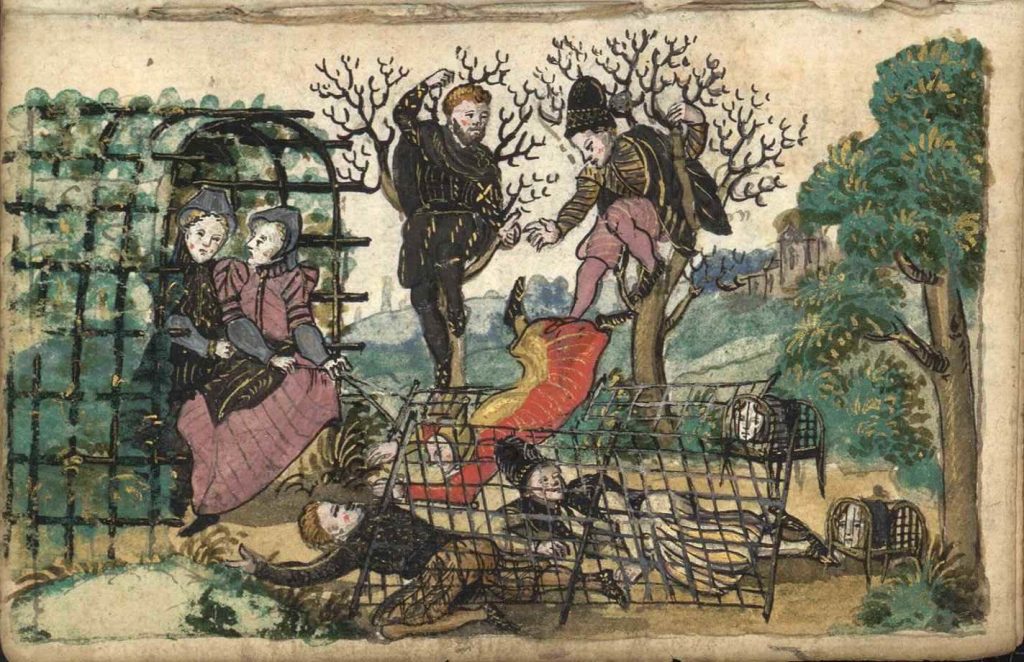
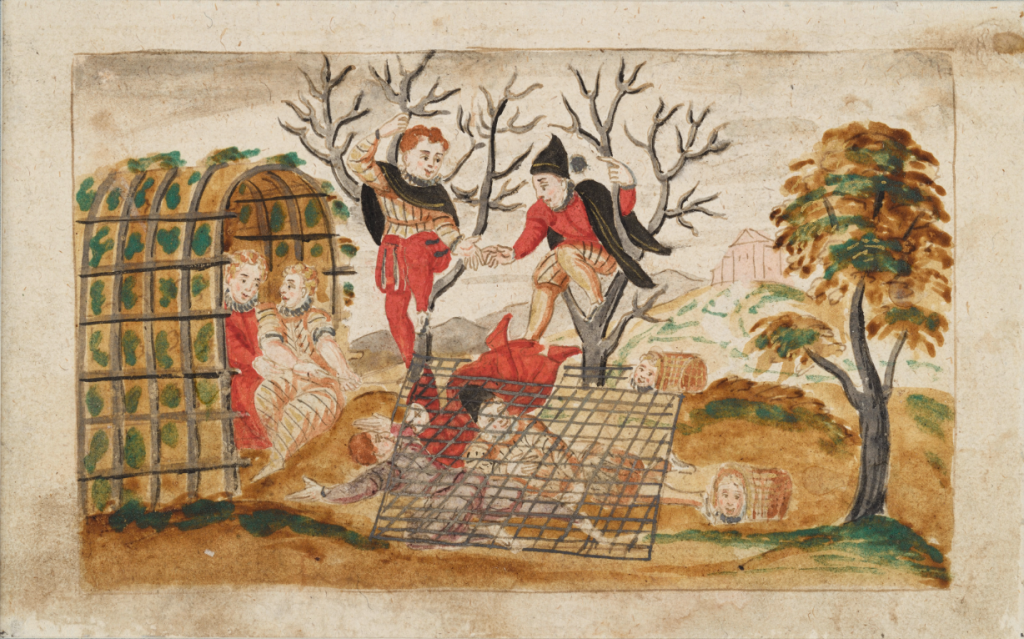
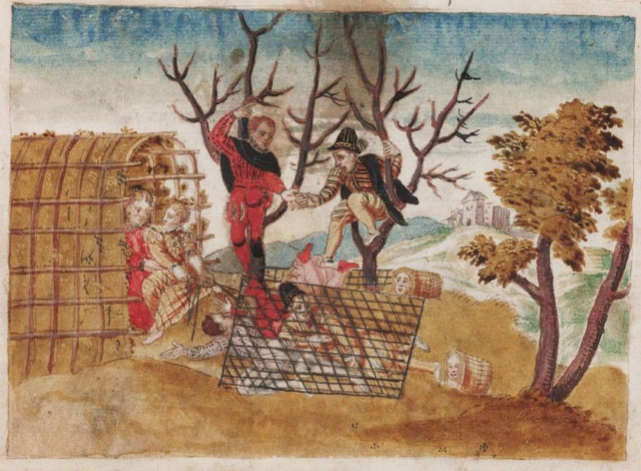
And this sounds like yet another example from the 1570s:
The inclusion of this design in the Beinecke series of drawings of Italian costumes and scenes of everyday life, made in 1575, suggests that such a model lies behind all the above miniatures.
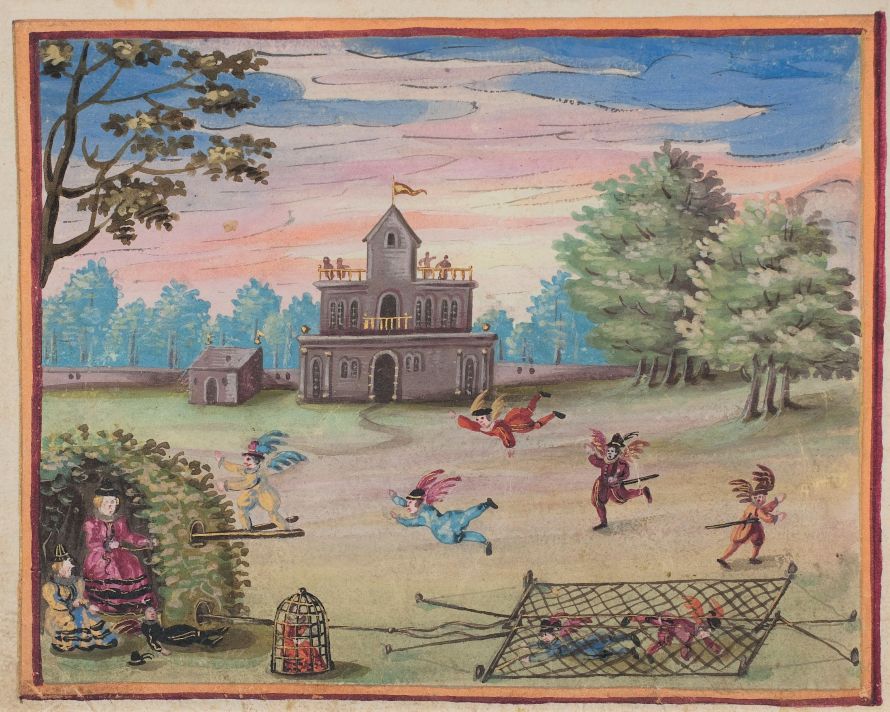
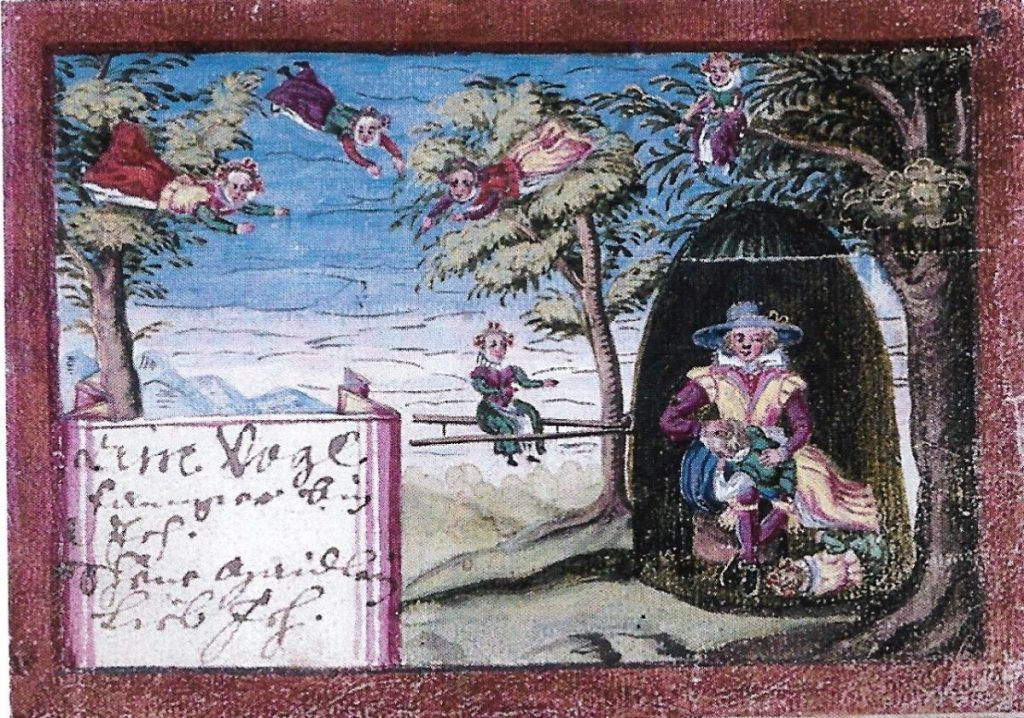
FB 11.652, f.7
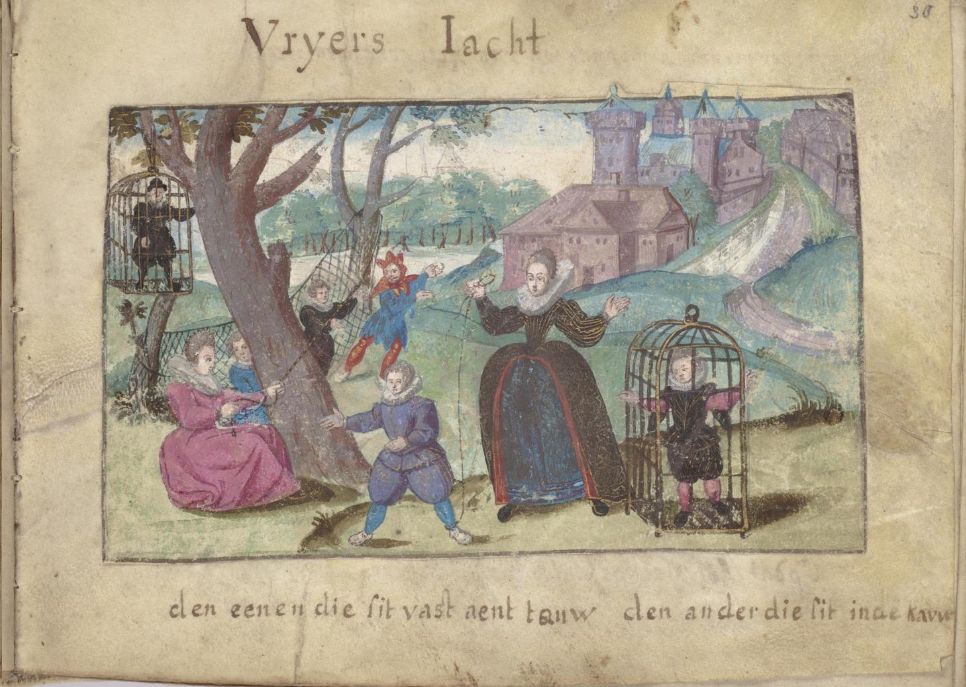
Albums come in many sizes and varieties, that of Hendrik van der Borch is as much a song-book as an album amicorum — the illustration is entitled in Dutch, Vryers Iacht [Hunting lovers] and captioned with a rhyming couplet which refers to the two small captured men in the foreground of the painting:
die eenen die sit vast aent tauw one is tied by a rope
den ander die sit inde kauw the other is in the cage.
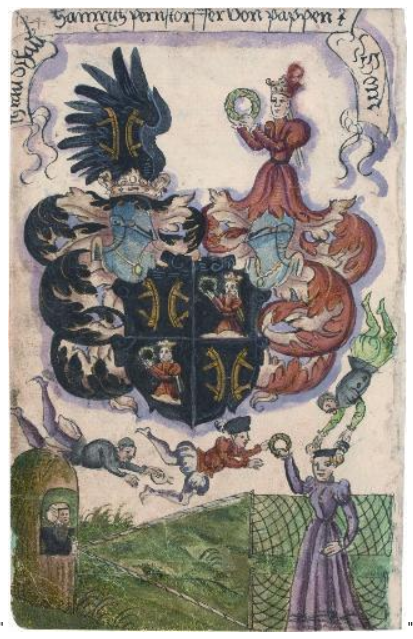
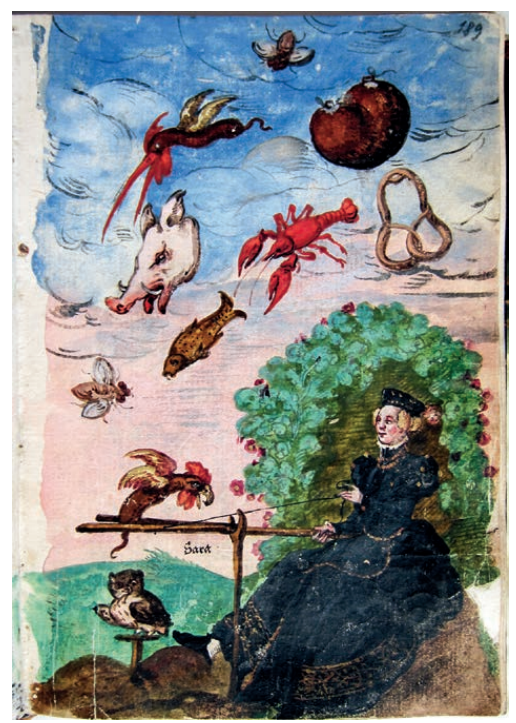
The Reichwein album contains two examples of a woman fowling, one relatively ‘normal’, the other surreal:
Enter Cupid!
Van Veen’s Amorum Emblemata of 1608 introduced the fashion for playful Cupid emblems, and in 1617 the de Passe family produced their own such volume, a print-book entitledThronus Cupidinis (1617, 1620) — here Cupid appears in the role of fowler, but actually catching birds, not humans (below)!
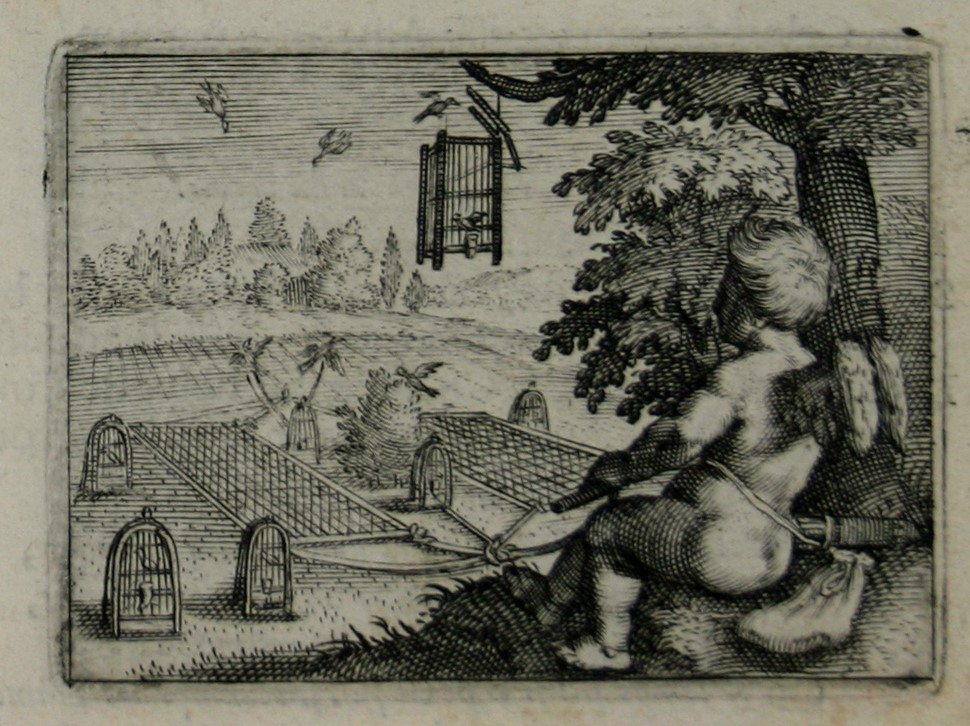
It seems to have been the album-painters who had the idea of making Cupid the fowler of humans rather than birds, building on the earlier tradition, and such miniatures appear during the 1620s:
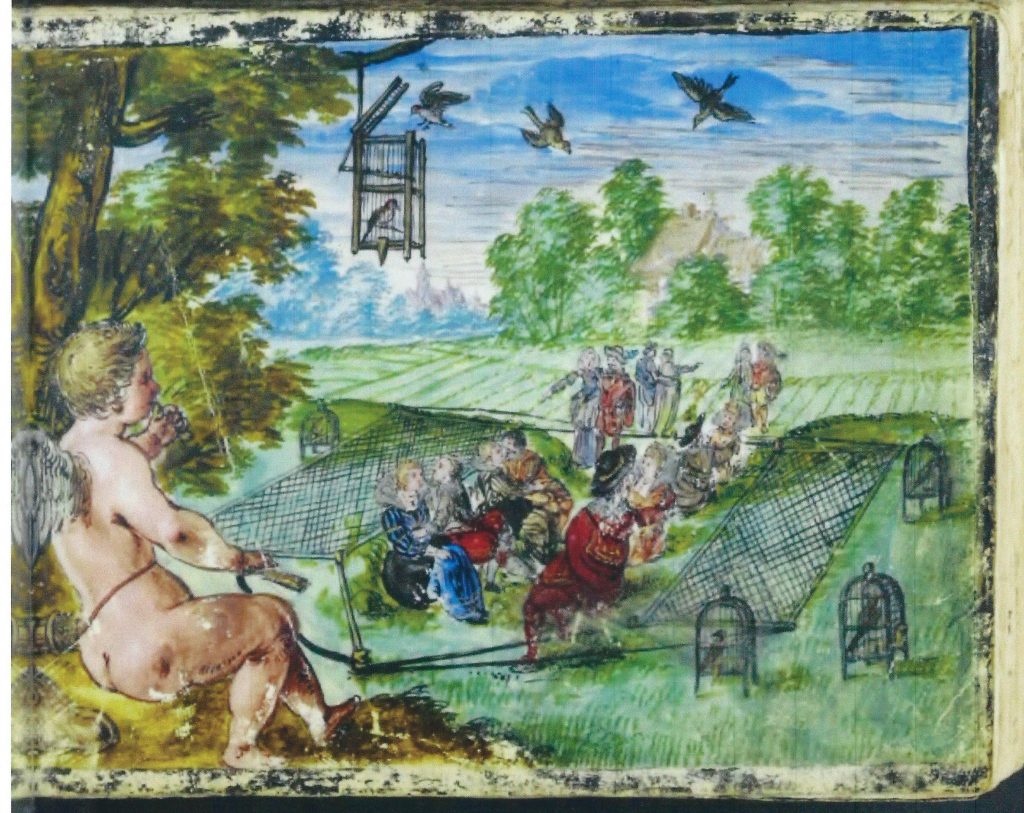
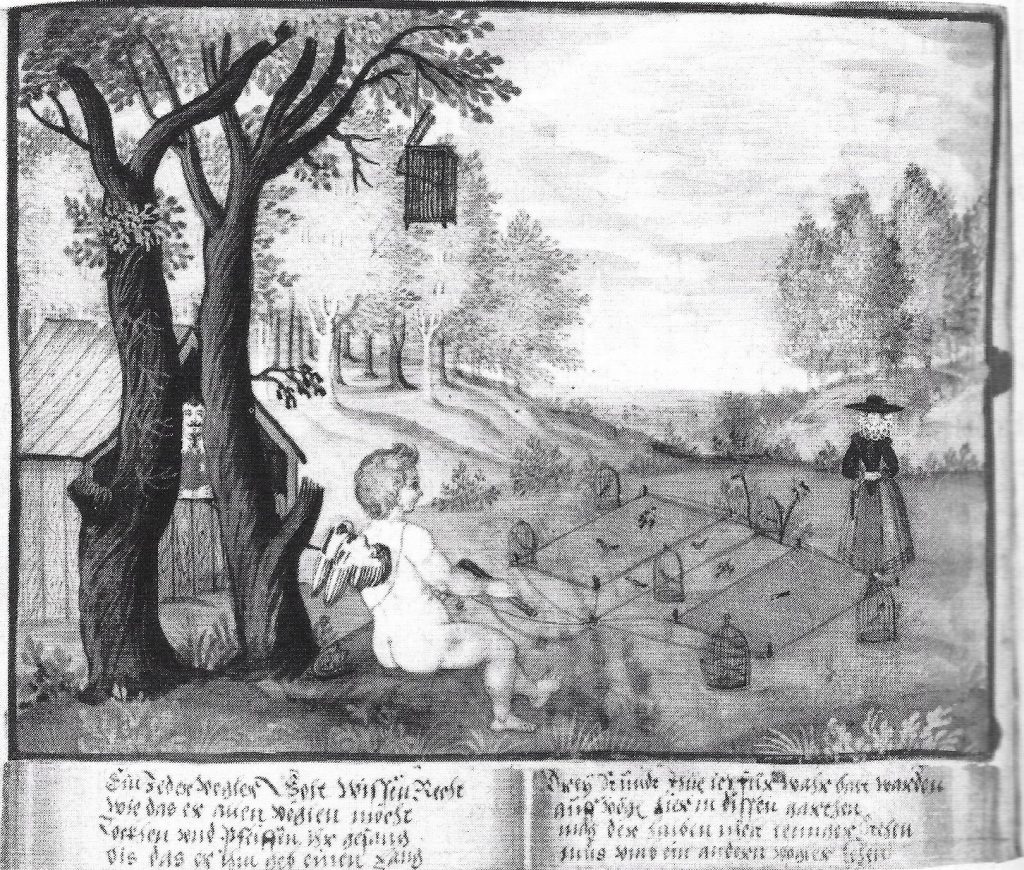
A third example is found in the album of Nathanael Schmidt (dated entries 1618-23), according to a description published in 1881 when it was in a private collection. Here, Cupid has placed a woman as his decoy out in the open as men, some wearing fools’ caps, come flying in, as in the earlier miniatures.
Other media
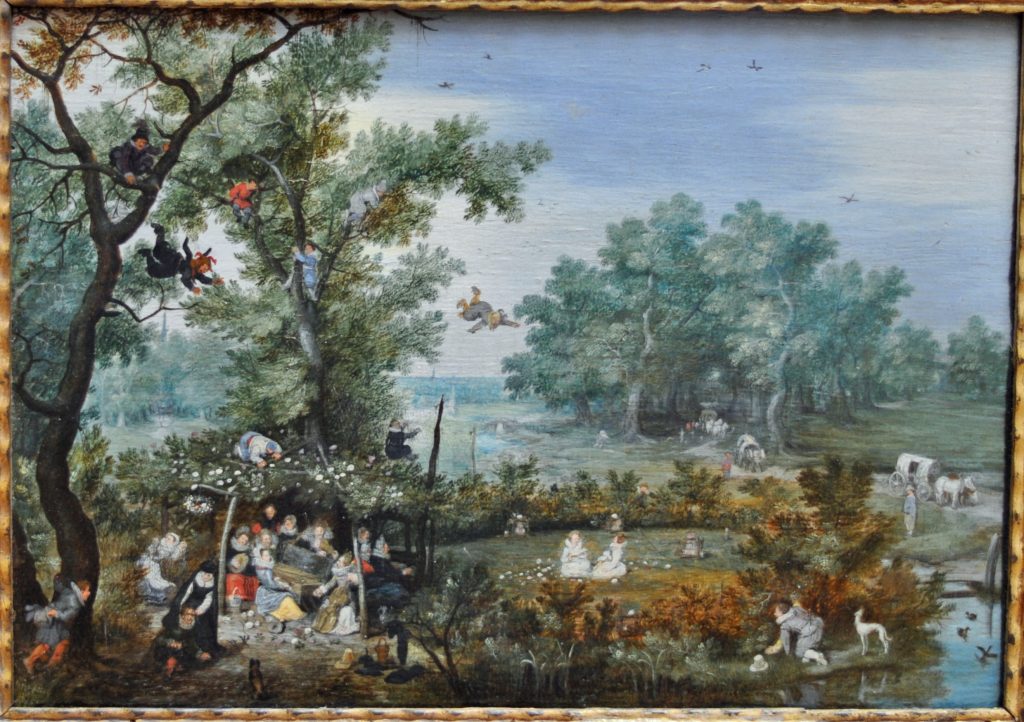
Adriaen Van der Venne was still working in this earlier tradition when he painted his playful Spring/Merry Company in an Arbour in 1615, and one of the men who comes flying down, attracted by the two young ladies sitting out in the open. wears a fool’s cap.
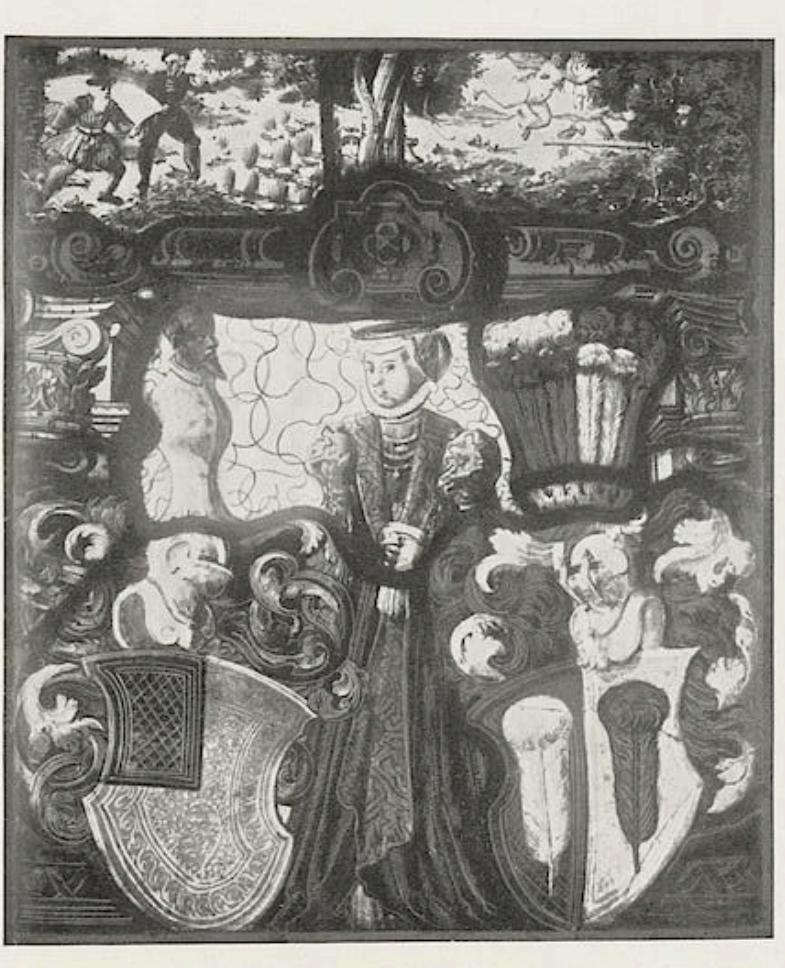
As we have frequently noted, many of the popular album images were taken up by the glass-painters too, and this is no exception. c.1570 an unknown artist painted a Wappenscheibe with the arms of the Zollikofer-Flar family — our motif was rendered in the upper border — as the present whereabouts of the pane are unknown, I can only reproduce the poor-quality photograph from the catalogue of the 1904 sale in Zurich. In the top righthand corner a face peering out of the hide is just visible, as is the Kloben projecting from it, and two fluttering human figures descending towards it.
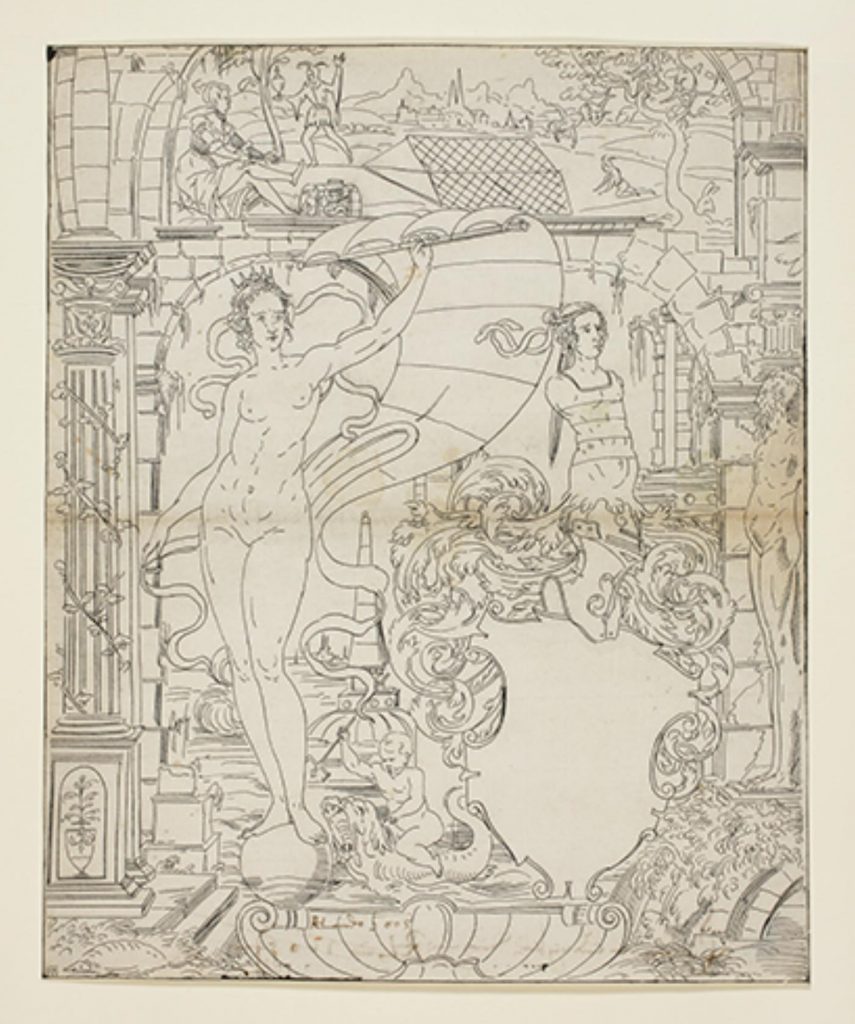
A contemporary design for such a pane is preserved in the Historisches Museum, Bern — again our motif fills the upper border. A figure of indeterminate sex is manipulating the clap-net and at least one man in fool’s costume is perched in the nearby tree, while another costumed fool (holding a covered cup?) appears to be leaving the scene.
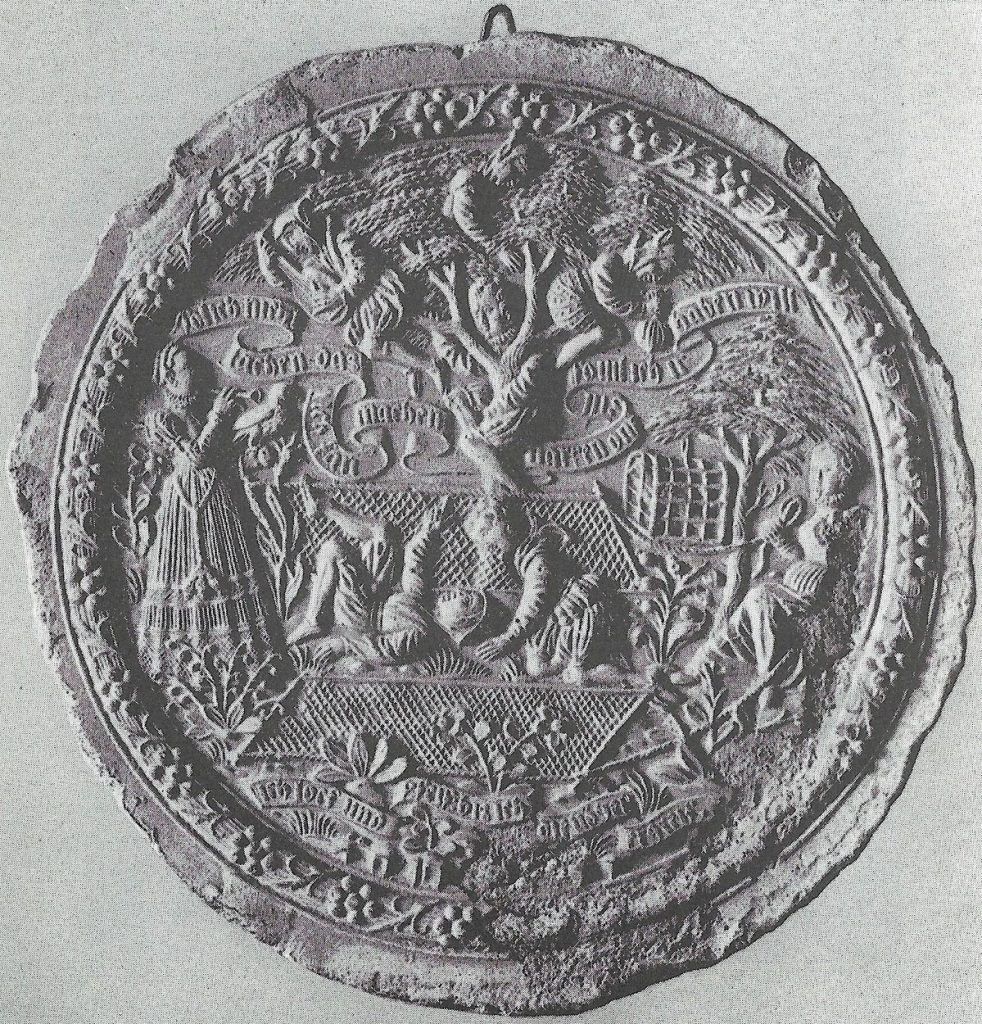
This minutely detailed clay biscuit-mould [Tonmodel], 100mm in diameter, must have been produced c.1600. Two women are catching fools; one operates the clap-net in which two fools lie already, the other pipes and holds the decoy owl on her wrist — four more fools are perched in the tree. Despite the small size of the mould the legends are remarkably legible:
sol ich nicht lachen/ das ich kan machen/ narren one zal/ soviel ich ir haben will Should I not laugh/that I can make/ innumerable fools/as many as I want!
ich lock und pfeif/ bis ich die vogel ergreif I entice and whistle until I catch the birds.
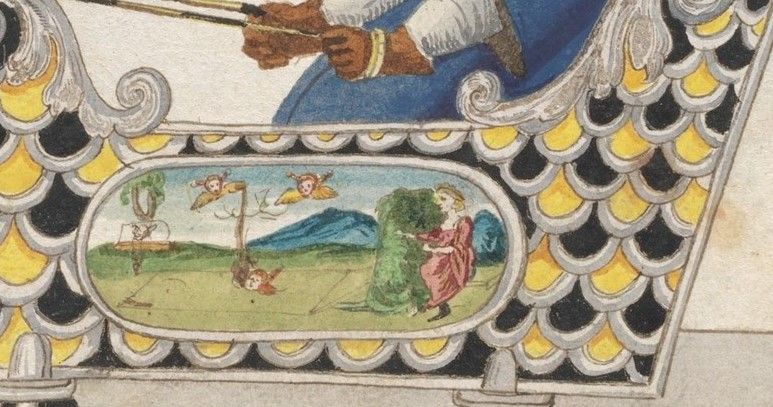
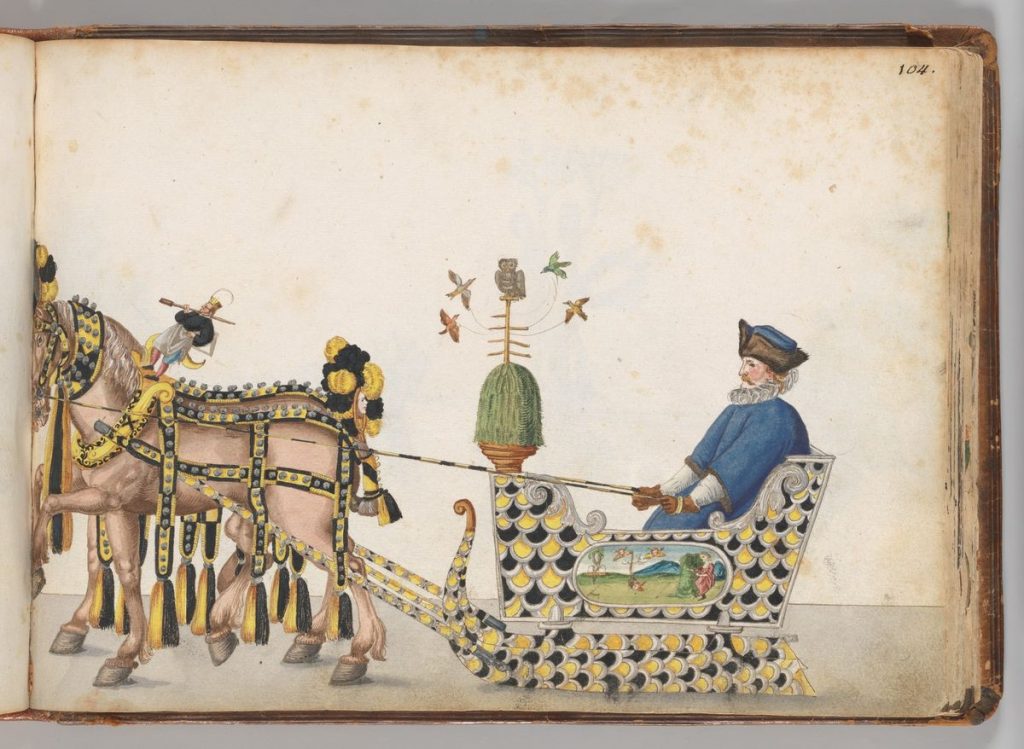
Another unexpected site for the motif is as part of the decoration of a sleigh, as recorded c.1640 in an album recording tournaments and parades in Nurnberg
a Pornographic Postscript
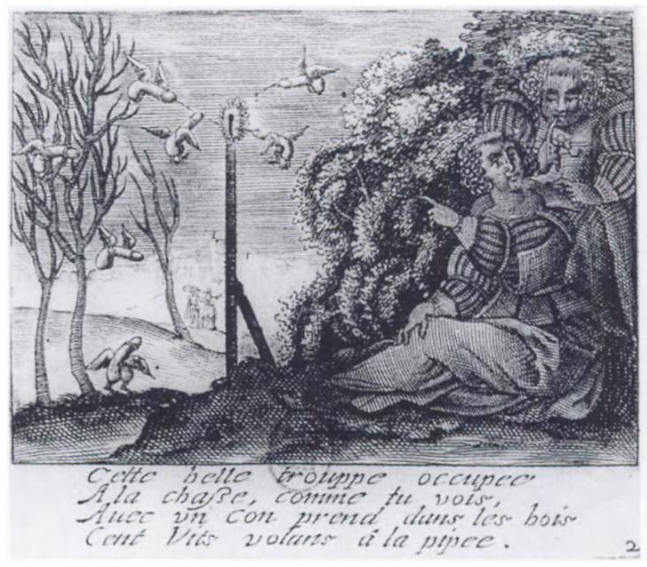
Two ladies in a hide observe their decoy — a vulva — being mobbed by flying phalluses.
Leave a Reply