πόλλ’ οἶδ’ ἀλώπηξ, ἀλλ’ ἐχῖνος ἓν μέγα [The fox knows many small things, but the hedgehog one big thing] — thankyou, Archilochus!
The omniscient Erasmus was familiar with the saying, rendering it as Multa novit vulpes, verum echinus unum magnum [The fox knows many things, but the hedgehog one big thing] in his Adagia, from 1500 onwards.
But here is the one big thing the hedgehog knows:
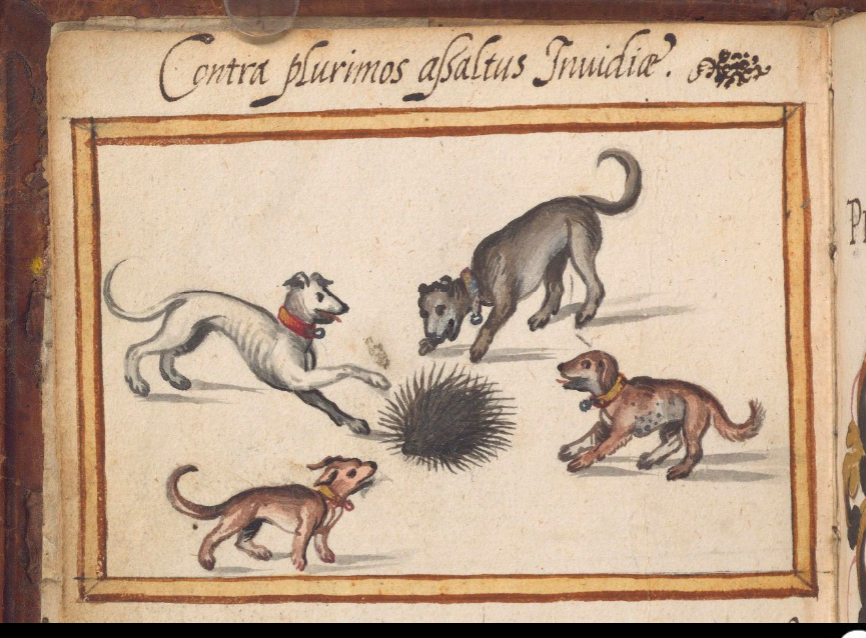
The commissioner of this miniature in the Praun album has captioned it contra plurimos assaltus invidiae [against the many assaults of Envy].
I’m using the term fable somewhat loosely here, to mean both those fables traditionally regarded as part of the Aesopic canon, and scenarios that involve animals. Ultimately, of course — as this is my blog — I’m using it to mean whatever I want it to mean! Of course, some fables are used as emblems, so that the distinction between the two genres is not always clear, nor — in my opinion — always worth making! The same might be said of proverbs — there are plenty of sometimes unrecognised proverbial idioms in English that are verbal condensations of fables — sour grapes, dog in the manger, etc. (for which latter, see below). I am not concerned here with the validity of the attribution of any particular fable to ‘Aesop’.
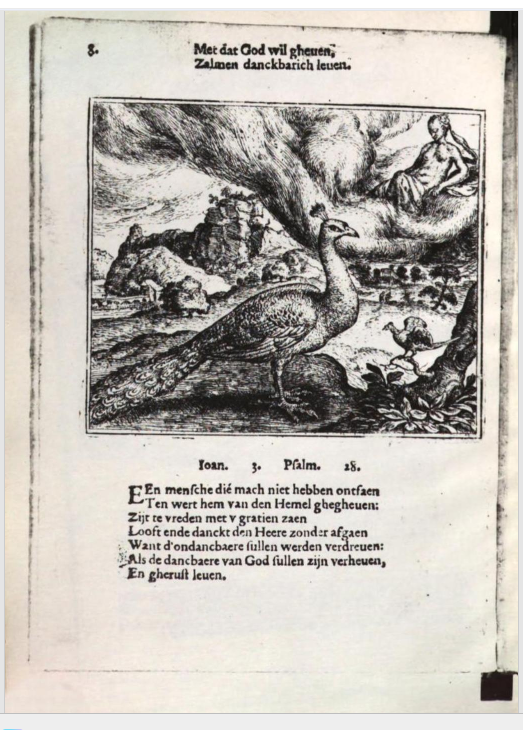
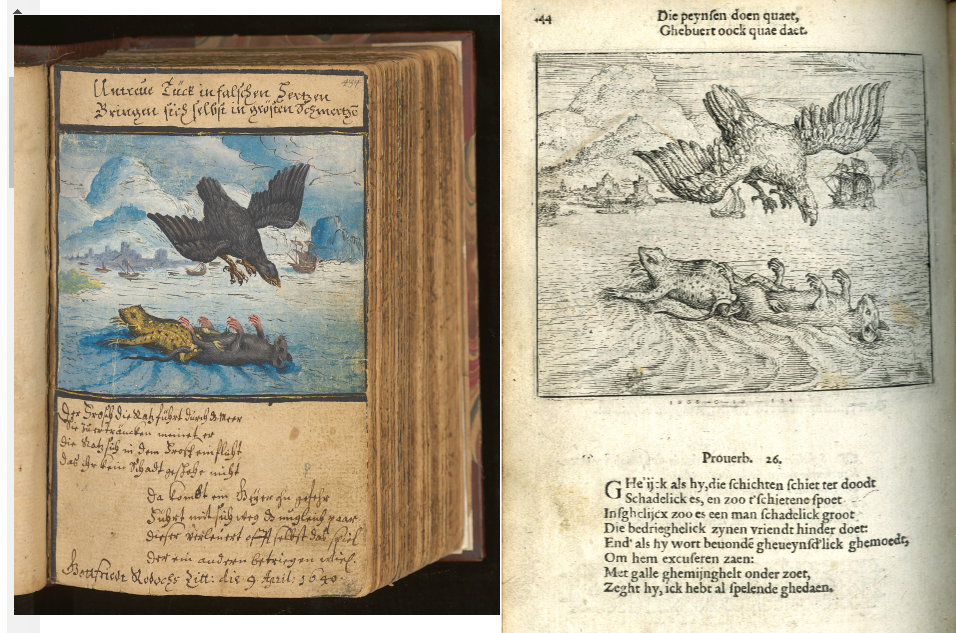
The engravings made by Marcus Gheeraerts to illustrate Eduwaert de Dene’s De Warachtighe fabulen der dieren, published in Bruges in 1567, were undoubtedly the most influential source for fable-illustration in our period. They were copied by several other engravers, such as Aegidius Sadeler in Theatrum Morum (Prague 1608), and Christoph Murer in his XL Emblemata Miscella Nova (Zurich 1622).
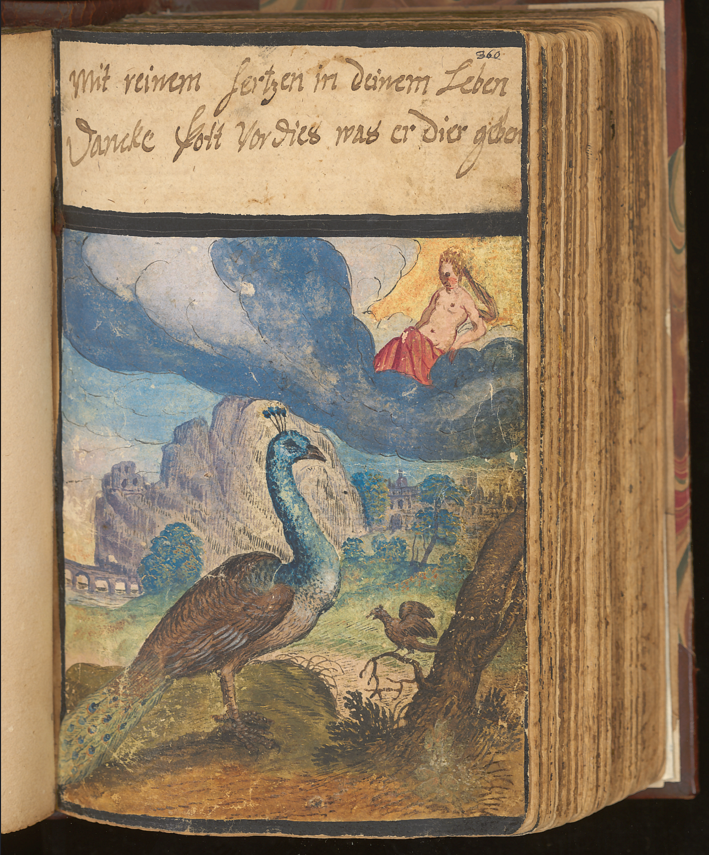
Three of the Gheeraerts-derived fable-illustrations were painted in the album of Melchior Otto in 1640: the Peacock & the Nightingale; the Eagle, the Frog & the Rat, and the Travellers and the Bear.
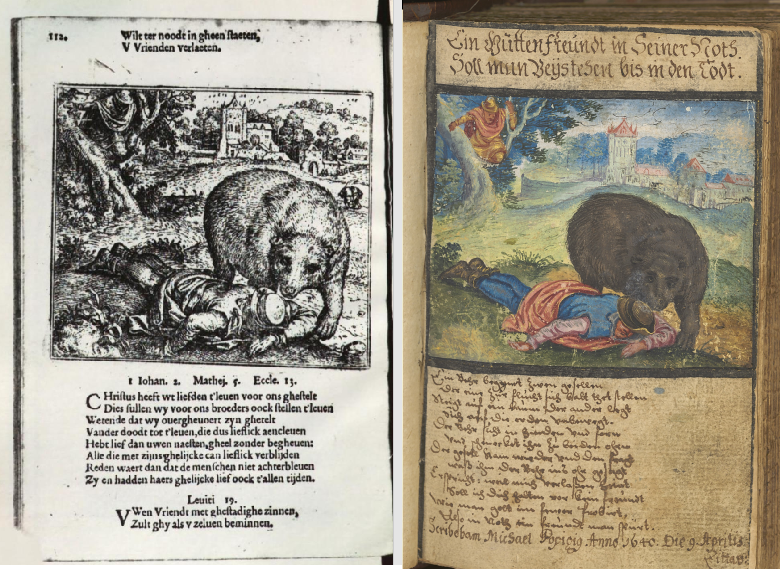
The fable of the Fowler and the Asp was drawn into the album of Christoph Gugel in the early 1620s, again accompanied by an emblem-like motto, INSIDIAE INSIDIATORI INSIDIOSA. Here, as so often in the albums, the owner has marked the date of the contributor’s death with a little black-ink cross [Sterbekreuz].
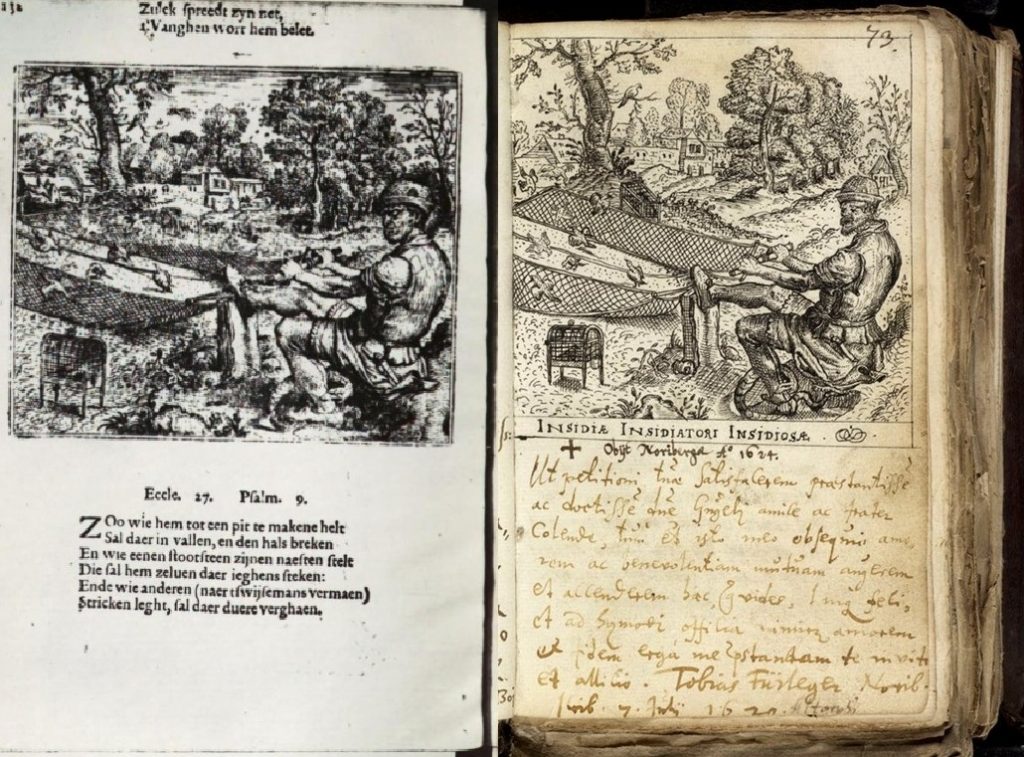
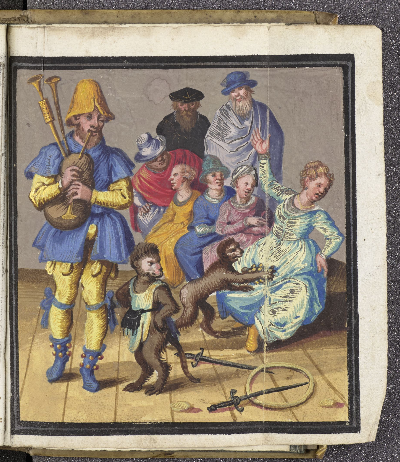
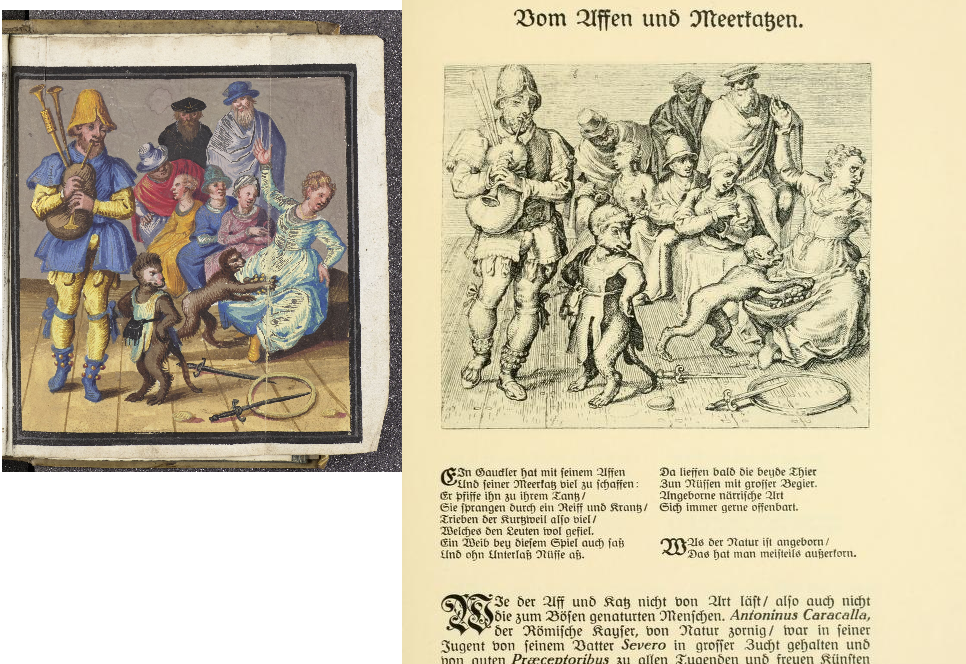
Painted in the album of Paul Langermann in 1614 is very close copy — but in reverse — of the fable of the monkey who steals food from a woman’s lap. No painter in his right mind is going to deliberately reverse his model, so in this case, we must be looking at derivation from a reversed copy of the Gheeraerts original, specifically, the engraving in the Theatrum Morum of 1608, for which book Aegidius Sadeler copied all the Gheeraerts engravings in reverse — such reversal being completely normal, for technical reasons, in such ‘mechanical’ copying.
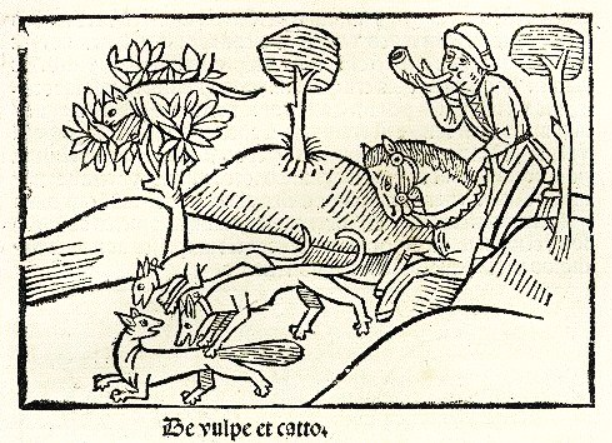
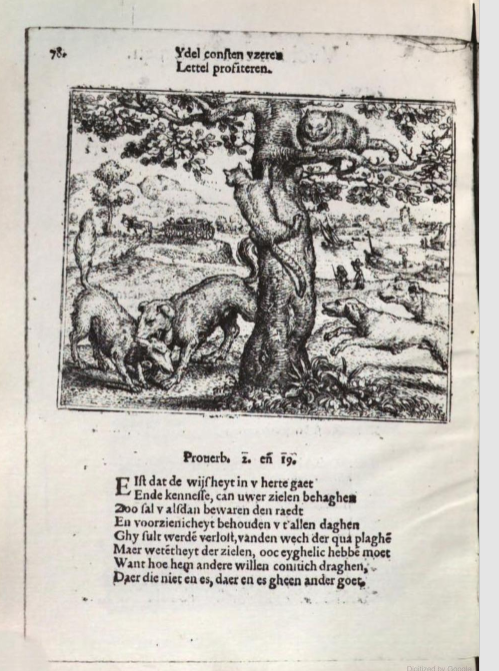
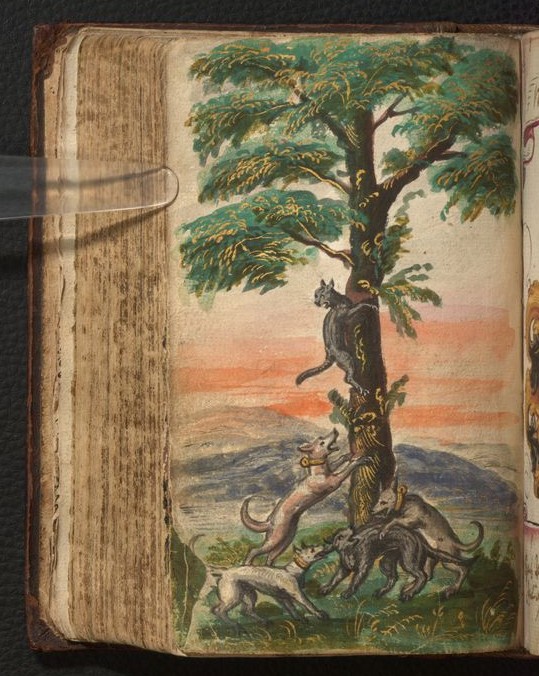
A variant of Archilochus’s proverb [see epigraph above] is the fable of the Fox and the Cat — again the fox boasts of his many tricks, the cat confesses to having only one; when the huntsman’s dogs appear, the cat scrambles up a tree, but the fox spends too much time thinking which of his many wiles would be best to use, and is caught by the dogs. It is illustrated as early as Steinhowel’s Aesop of 1476:
The Gheeraerts engraving of 1567 shows a second cat already safely lodged in the tree, but it seems likely that the artist who painted the scene in the Berbinger album (dated entries 1570-84, adjacent page dated 1579), though he shows only one cat and no fox, was working from the Gheeraerts original.
The miniature in the Jenisch album is perhaps a variant — but here labelled with a Latin inscription meaning, “We can’t all do everything” — in this case, presumably, meaning that dogs can’t climb trees!
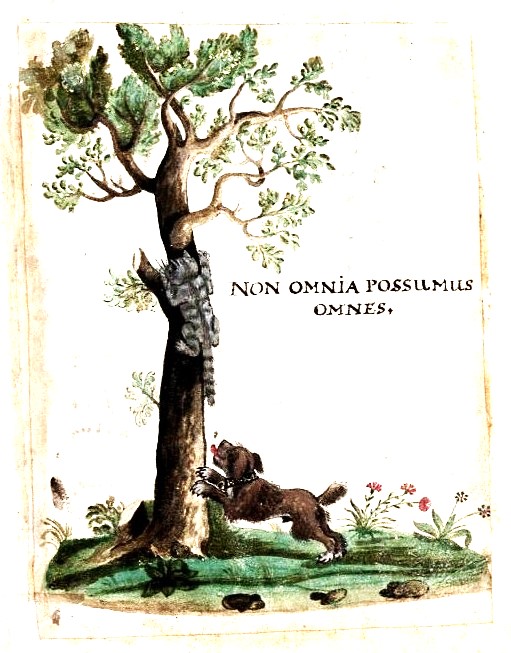
The Jenisch album miniature perhaps owes more to the engraving of the city of Florence in Daniel Meisner’s Thesaurus Philo-politicus (Frankfurt, 1624-9) with its characteristic inset illustrated proverbs.
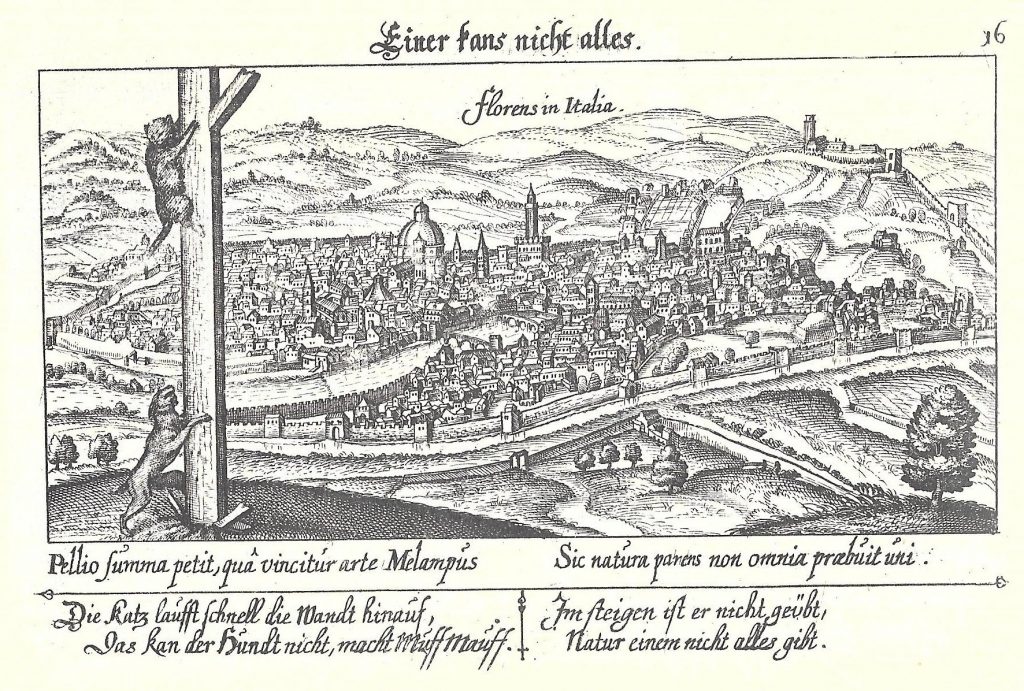
Though admittedly not a tree, the image is entitled Einer kans nicht alles [one cannot do everything], repeated bilingually in the caption: natura parens non omnia praebuit uni [Mother Nature did not provide everything for one person], and Natur einem nicht alles gibt [Nature does not give one everything].
belling the cat
But probably the best known fable involving the cat is the story of ‘belling the cat’ — also rather charmingly depicted in the Jenisch album:
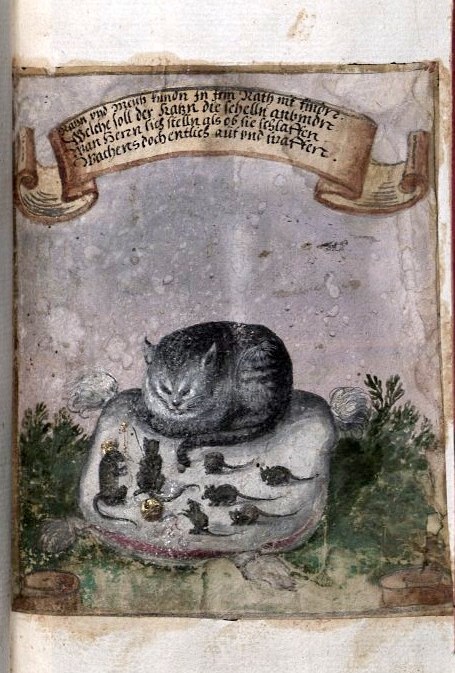
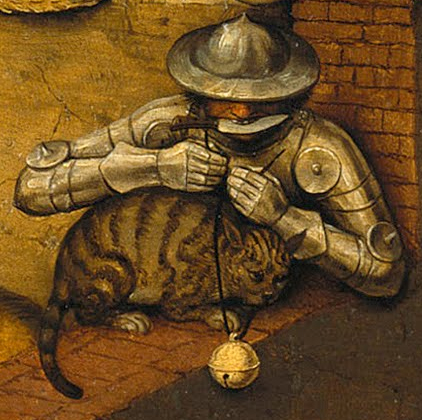
Here are some more images of the motif — the only one that comes up on google is the Bruegel Netherlandish Proverbs (1559) detail:
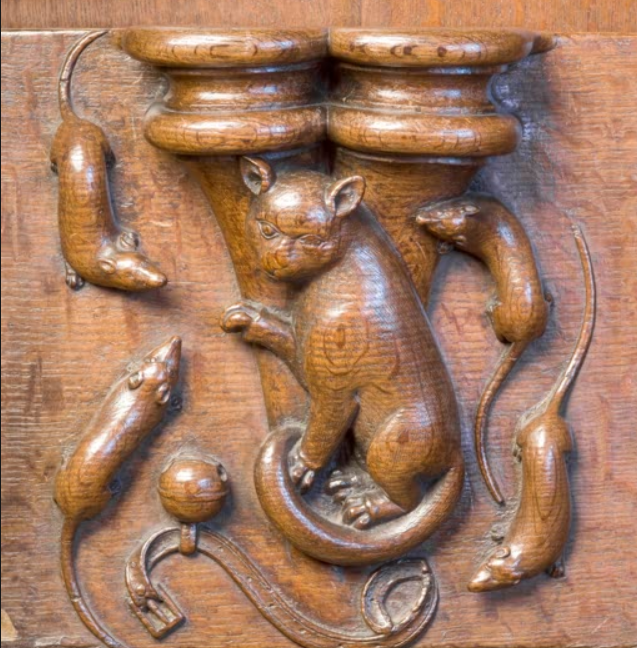
To which I add the misericord at Kempen, carved in 1493:
and from a late 15C Flemish tapestry, often cited as a precursor of the Bruegel painting:
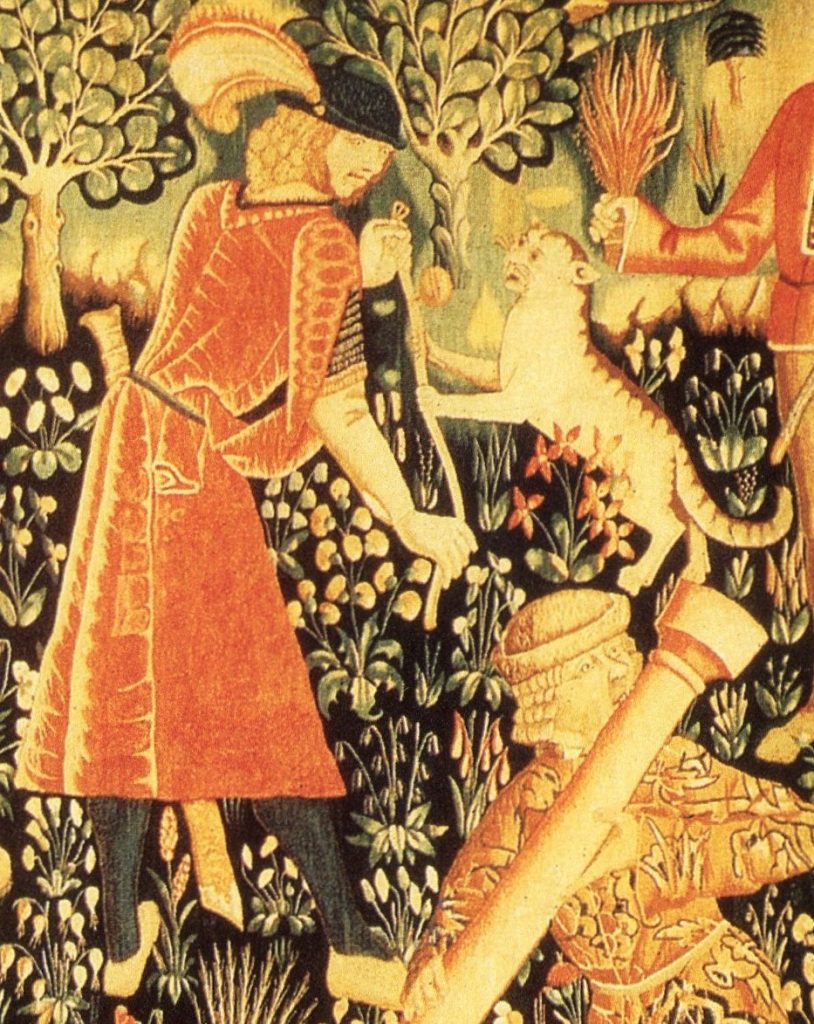
But back to the Jenisch album miniature! — I’ve done my best to transcribe and translate the quatrain — not sure of final word — so would welcome help/corrections from readers!
Ratzn vnd meuss kunden in irm Rath nit findn
Welche soll der katzn die schelle anbindn
Wan Herzn sich stelln als ob sie schlaffen
Wachens doch entlich auf vnd waffen ?snaffen
[The rats and mice could not come to a decision who should tie the bell on the cat ….
I take it that the two larger rodents are rats — one wears a crown, reminding me of the Mouse King in this Weiditz woodcut of the dogs bringing the cat to be tried before the Mouse King!
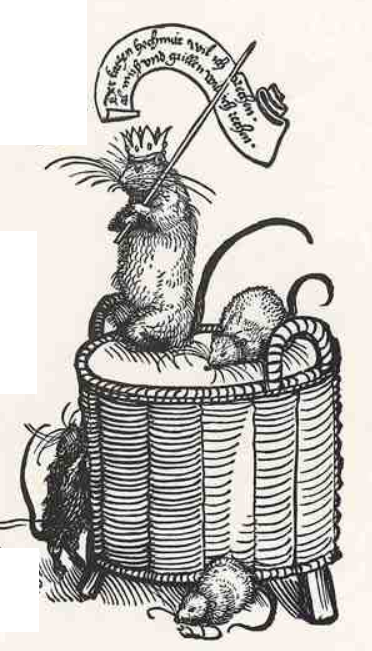
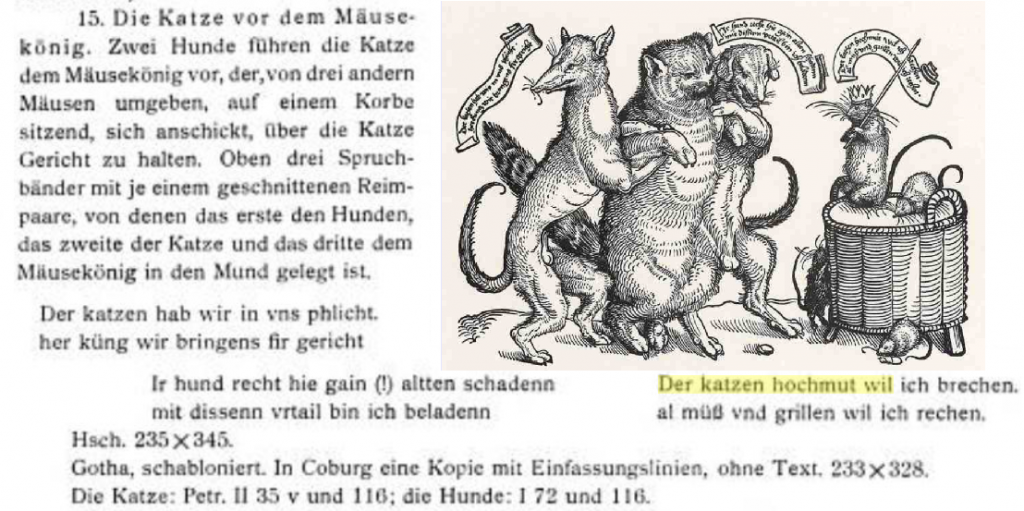
But back to our album fables!
lion spares puppy
Beneath the title Parcere subiectis [spare the subjected], on f.138r. of the album of Georg Pfinzing von Henfenfeld, we see a lion with his paw on a prostrate puppy.
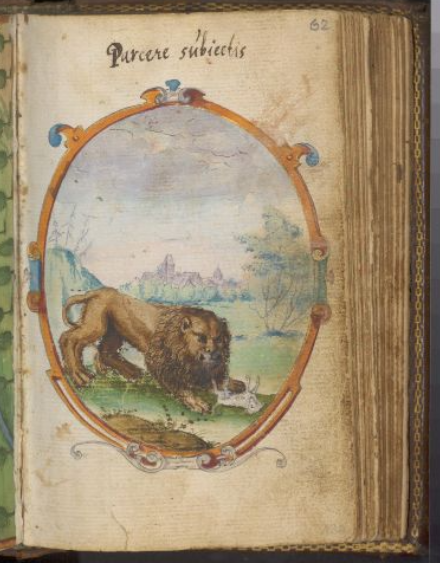
This is not from a Gheeraerts fable engraving, but is copied closely from one of the plates engraved by Isselburg in Emblemata Politica : In aula magna Curiæ Noribergensis depicta (Nürnberg, 1617):
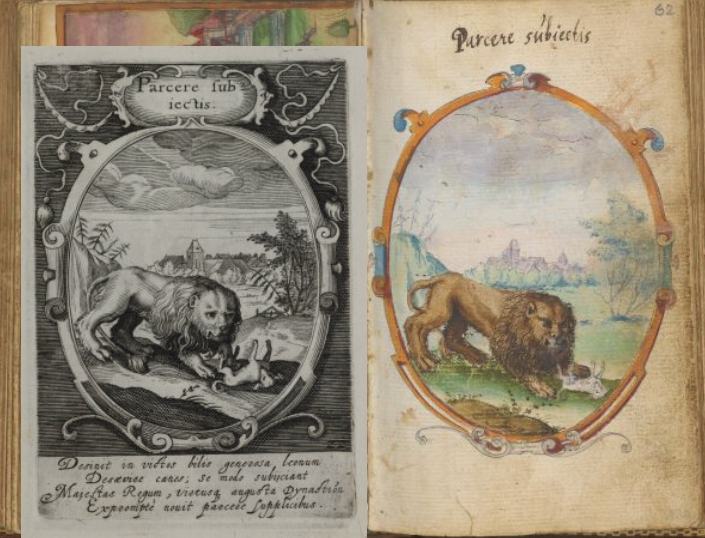
I imagine this is another example:
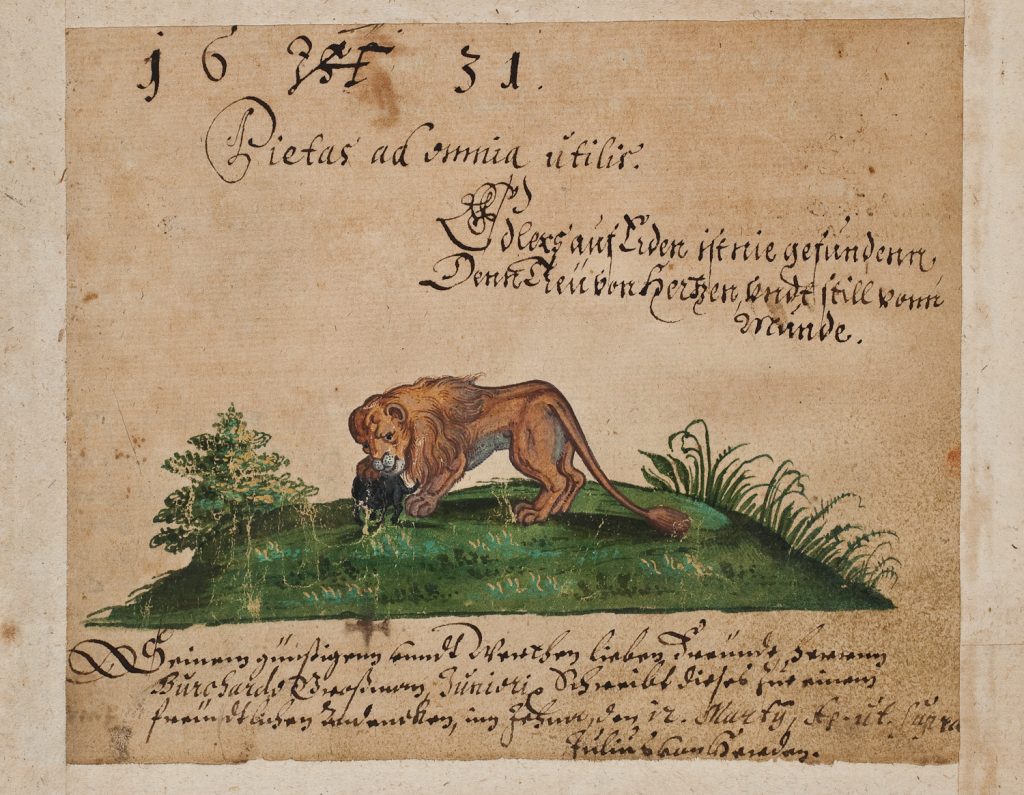
lion and mouse
Nor is this amateurish drawing of the fable of the Lion and the Mouse copied from the Gheeraerts engraving. The fable features a grateful mouse, which the lion had earlier spared (cf. previous), who when seeing the lion caught in the hunter’s net, then gnaws through all the cords, freeing the lion — only here we have a team of no fewer than 8 mice!
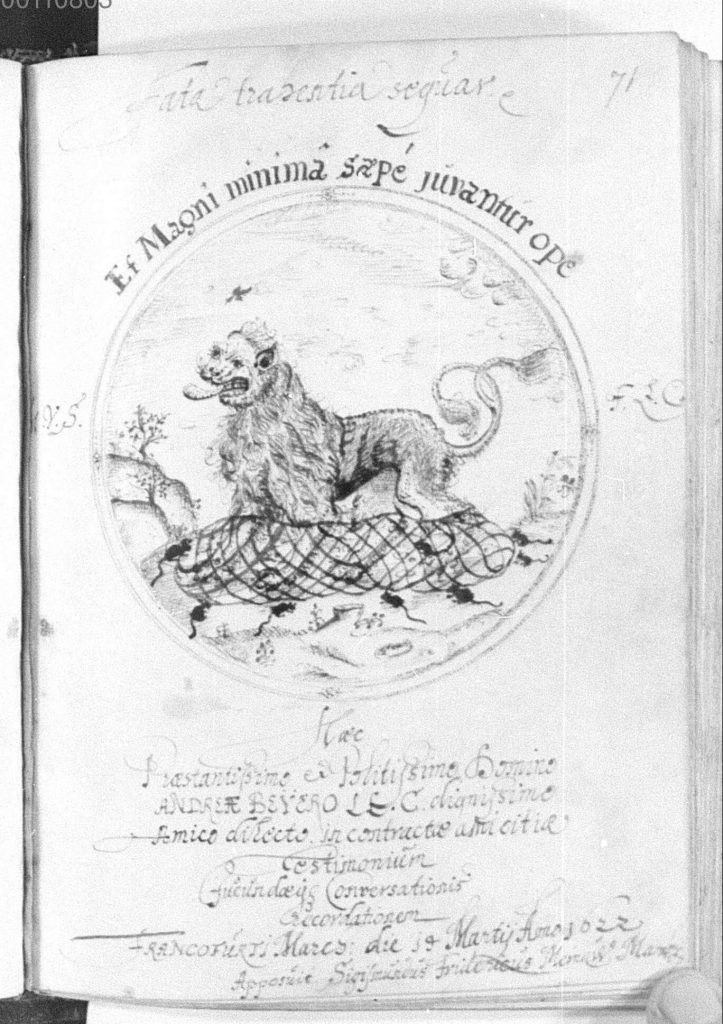
Drawn within a roundel, and provided with the motto, et Magni minima saepe juvantur ope [the great in strength are often aided by the smallest], the fable illustration in its circular frame seems to aspire to be an emblem.
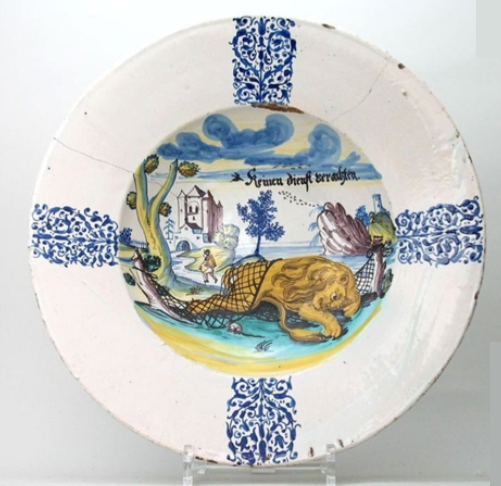
Couldn’t resist this mid-17C Winterthur plate! The legend reads Keinen dienst verachten [Do not despise any service]
other lion motifs
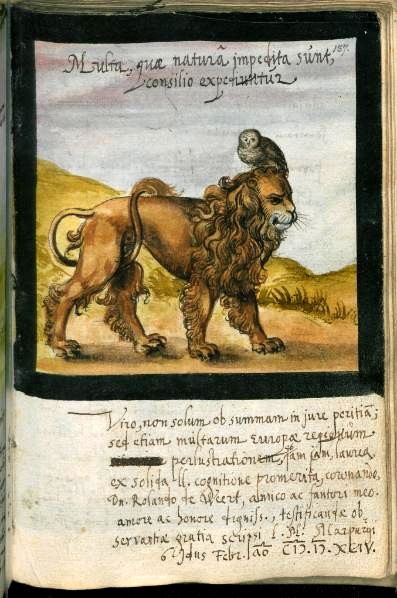
With its title from Livy, Ab Urbe Condita, XXV.11, “Many things that are hindered by nature are made easier by counsel”, is this somewhat bizarre image of the owl sitting on the lion’s head. How are we meant to understand this? Does the proverbially wise owl represent consilio, ‘counsel’ here, so that the overall image represents strength (as represented by the lion) governed by wisdom?
This friendly-looking lion (below) looks merely peaceful, with his mate just visible in the cave beneath — the accompanying German verse seems to suggest he represents muth [courage].
In Vngluckh trag eins Lowen muth In misfortune bear a lion’s courage
Vertrauwe Gott es wird werden guth Trust in God things will be well
Viel besser als mans hoffen thut Much better than one might hope
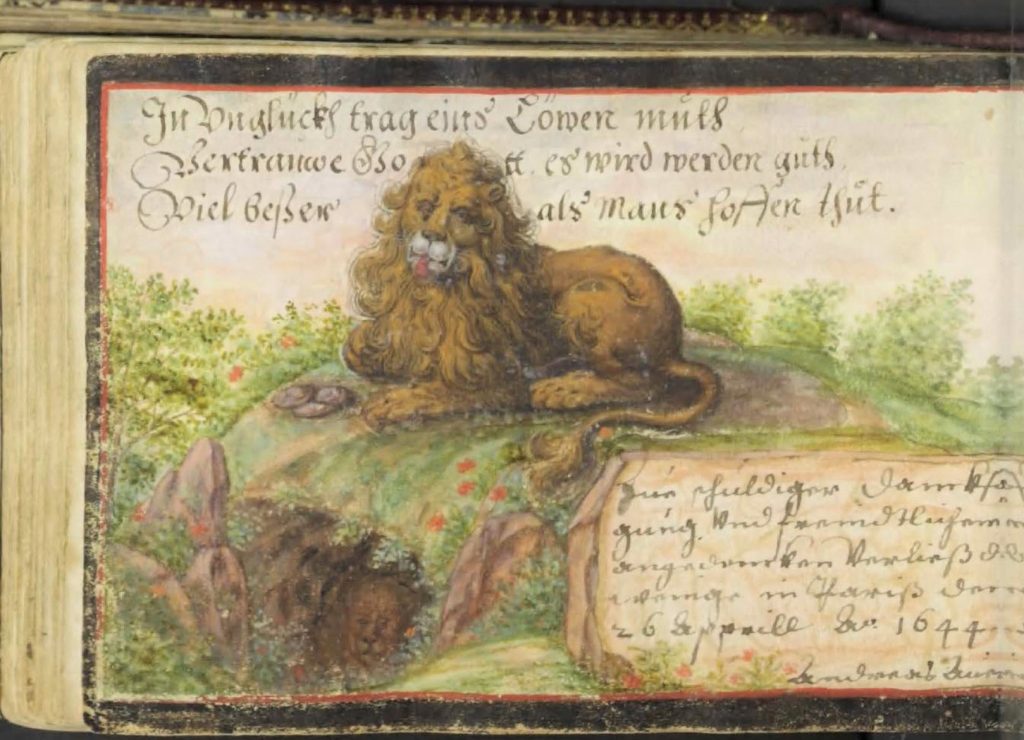
Thott 434, 8°, image 386
wolf & crane
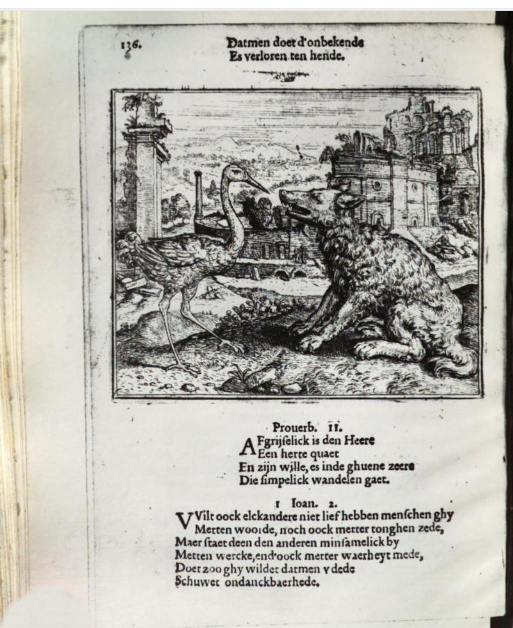
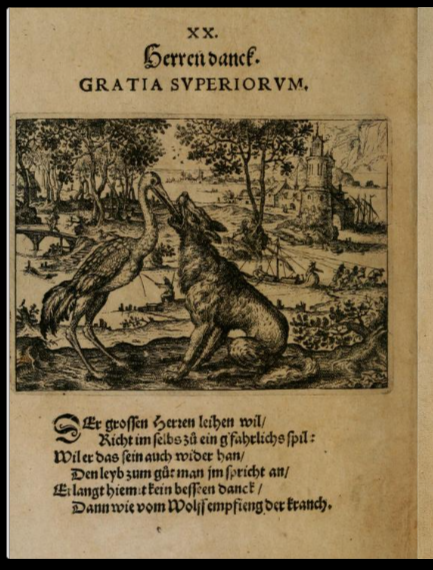
This very amateurish coloured sketch in the Von Schellenberg album, dated 1583, shows a crane with its long bill attempting to remove the bone stuck in the wolf’s throat, illustrating the fable known as The Wolf and the Crane,
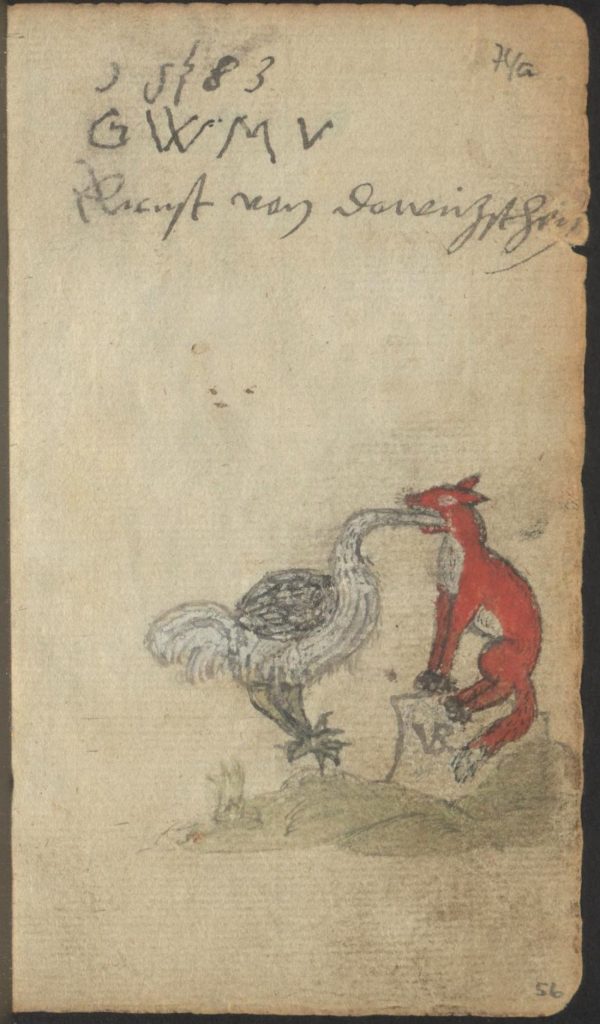
a far cry from the sophisticated engravings of Gheeraerts (1567) and Murer (1622):
Dining with the Wolf
Signatur, cod. hist. oct. 264, f.162v.
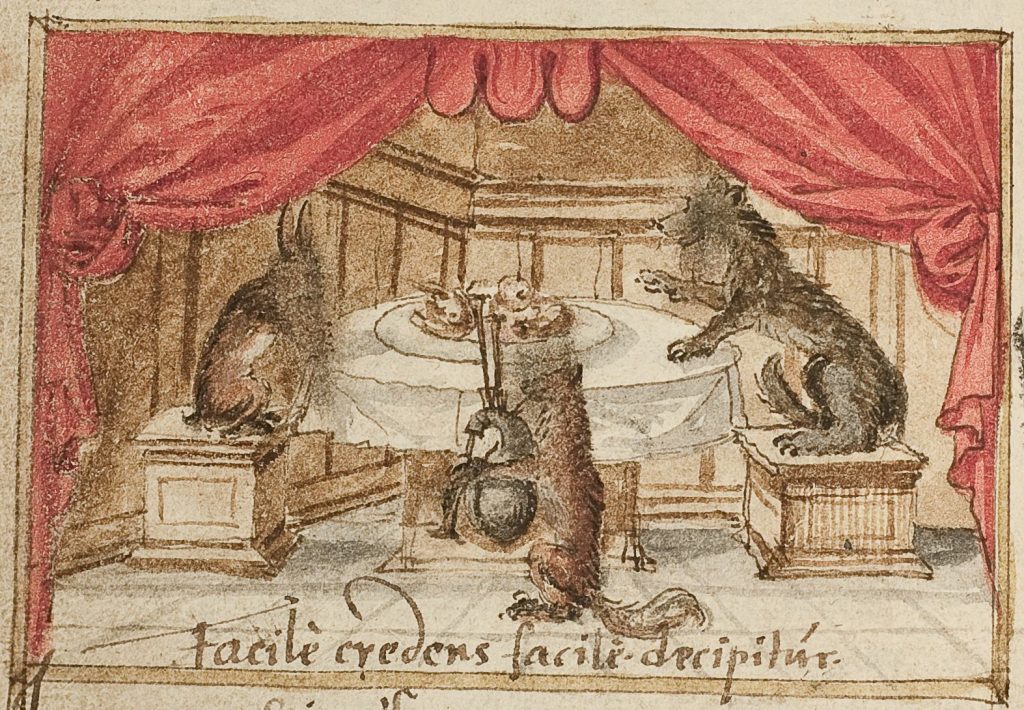
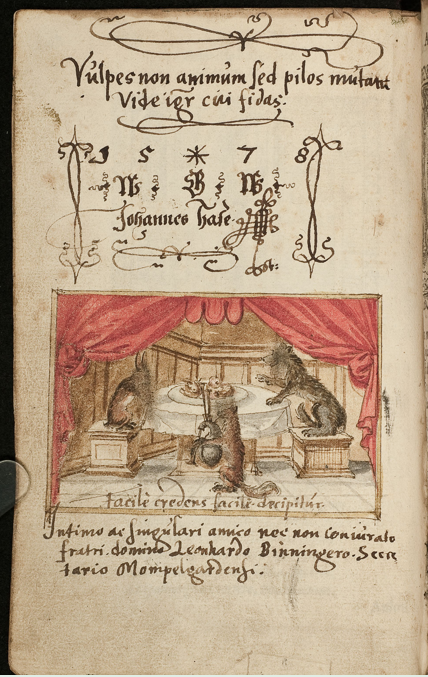
A non-Aesopic fable was drawn into the Bininger album in 1578. Here, the wolf has evidently invited the hare to dinner, and foolishly, the hare has accepted, and sits on the opposite side of the table, while the fox provides the mood-music, on that unlikely instrument, the bagpipe. The entry is signed by one Johan Hase – Hase, being the German word for ‘hare’ – but he has added two further inscriptions: Vulpes non animum sed pilos mutant [foxes change their coats, but not their mentalities – TPMA, s.v. Fuchs 4], and Vide ig[itu]r cui fidas [beware therefore in whom you trust].
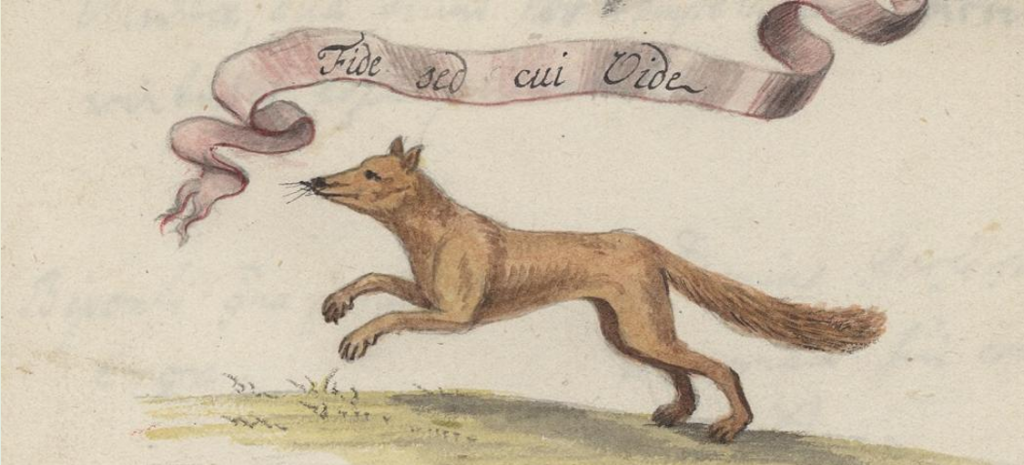
This last, a very popular album inscription, is more usually found in the succinct rhyming form that accompanies this album fox below — Fide sed cui Vide [Trust, but be careful who].
Reynard
The hero of the medieval beast-epic is oddly absent from the albums — to date, I have noticed only a single miniature, and that in the same album as the Wolf & the Crane (above).
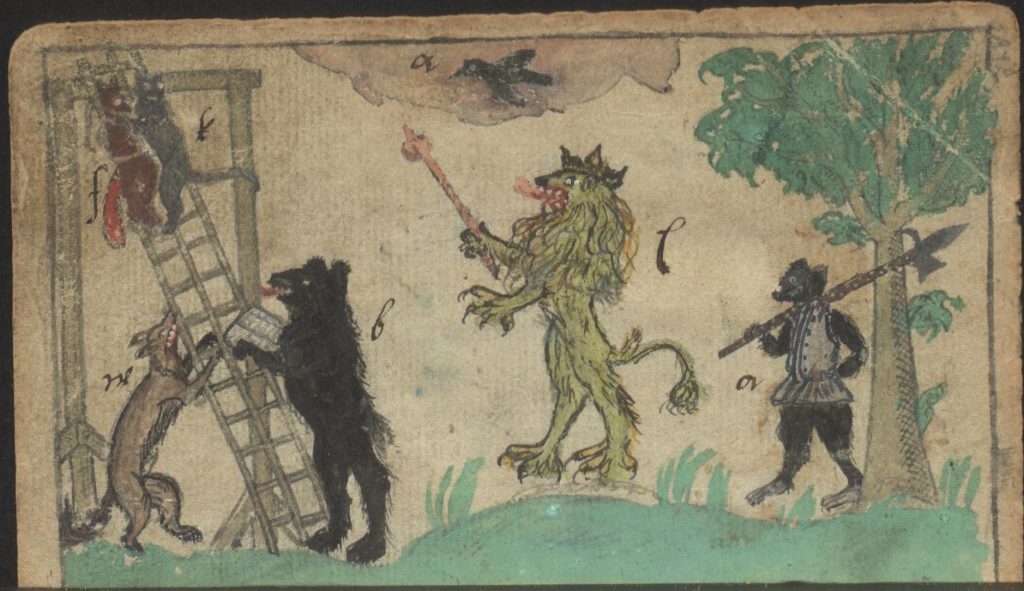
This is the popular scene of Reynard on the gallows about to be hanged, and the animals have been labelled with the initial letters of their names — at the top of the ladder, f forFuchs and k forKatze ; at the foot of the ladder, w for Wolf and b for Bär; King Lion is labelled with an l for Löwe. I’m not sure of the bird or the creature with the halberd over his shoulder [any offers, please, Readers?]
dog-in-the-manger
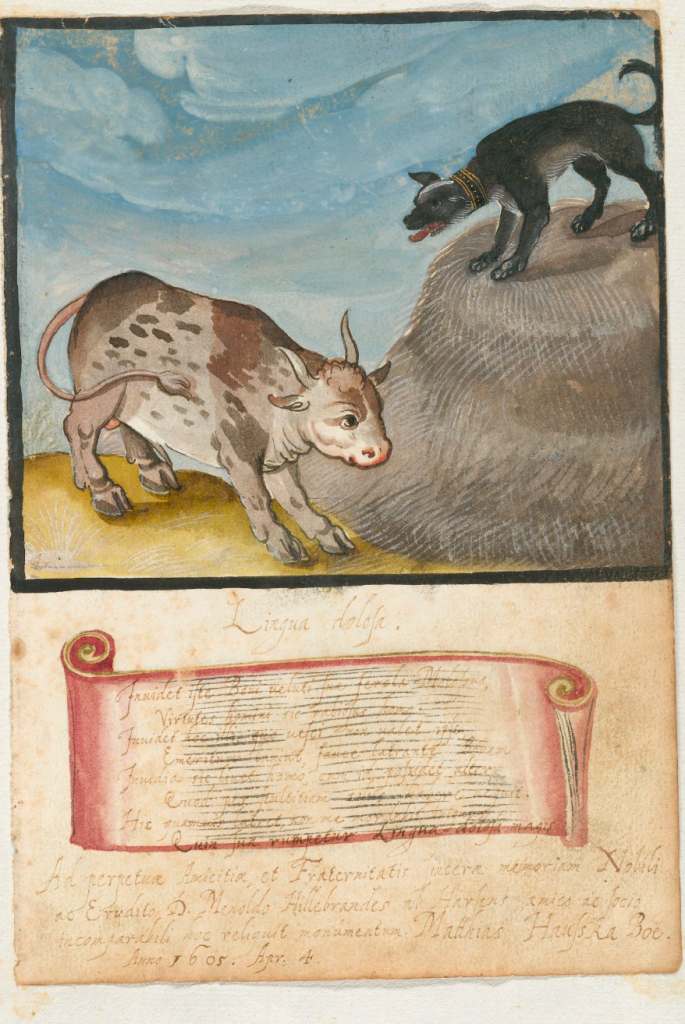
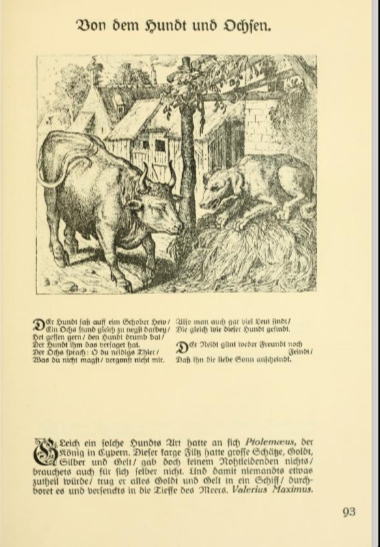
Entitled Lingua Dolosa [the deceitful tongue], a dog standing on a mound of what must be hay, barks at a bullock. This is the dog who — though the hay is inedible for him — is so bloody-minded as to prevent the bullock from eating it. The manger is clearer in the engravings; I give below the scene as engraved by Aegidius Sadeler in 1608 (which, as usual, reverses the Gheeraerts 1567 engraving), but this cannot be the painter’s source for chronological reasons.
another dog
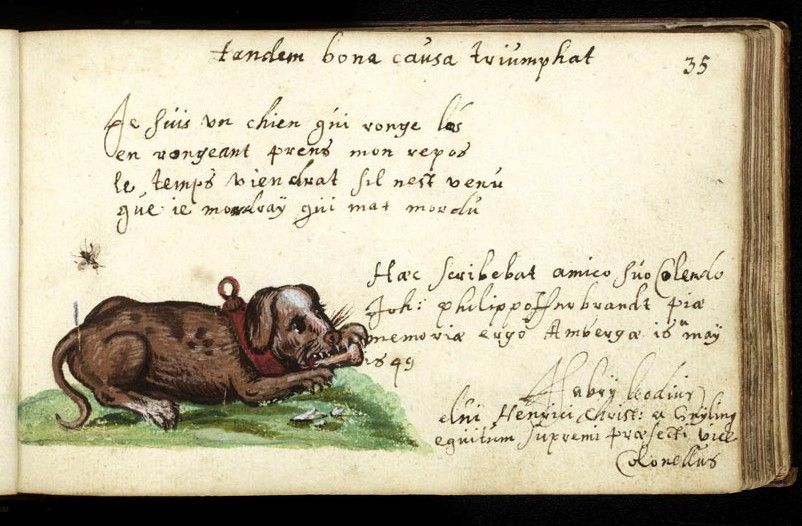
Beneath the title, tandem bona causa triumphat [in the end the good cause triumphs] is a French quatrain, and the miniature of a dog chewing a bone with a wasp above his rump. The verse is as follows:
je suis un chien qui ronge l’os I’m a dog chewing a bone
en rongeant prend mon repos and in chewing take my rest
le temps viendrat sil nest venu the time will come, if it hasn’t (already)
que ie mordray qui mat mordu when I will bite what has bitten me
— the last couplet, I’m assuming, alluding to the wasp above his rump?
storks
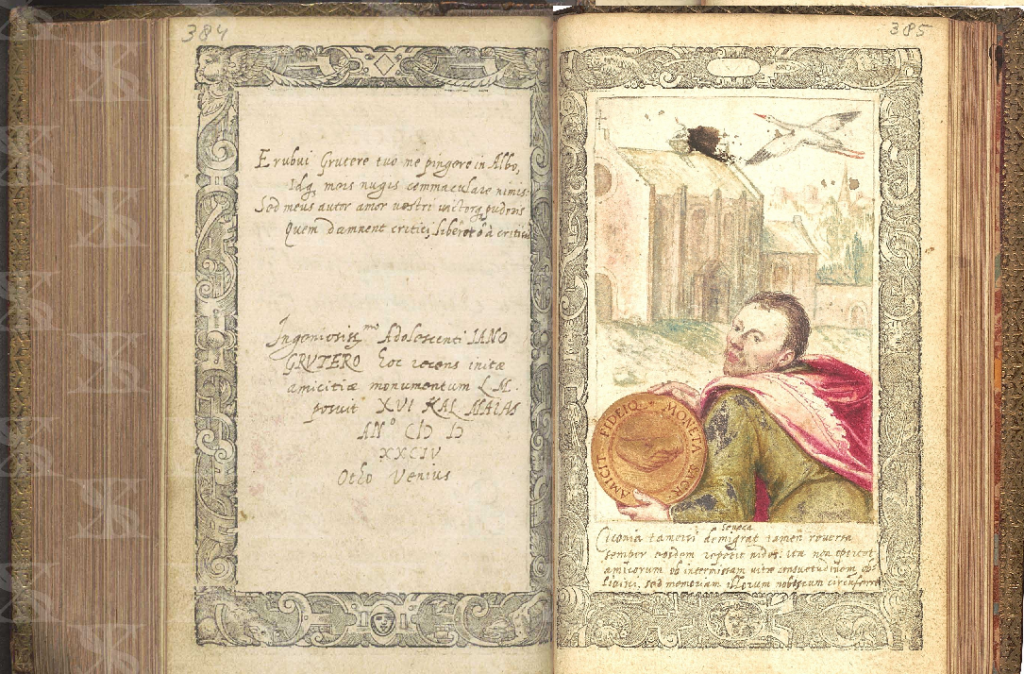
An album miniature painted by Otto Van Veen, no less! The adjacent page is signed Otto Venius and dated 1584. The stork doesn’t forget to return to its nest and friends every year, according to the inscription from Pliny’s Natural History, Book XII.23 [not seneca as the author seemed to think!] — a passage often quoted by humanist anthologists including, most significantly, Erasmus, who is almost certainly the immediate source of the quotation here. The coin of friendship shows a hand-shake and bears the legend MONETA SACR[A] AMICIT[IAE] FIDEIQ[VE] [the sacred coin of faithful friendship].
frogs and storks
I have yet to notice the King Log /The Frogs who desired a King fable painted in the albums, though it exists in other media, of course — as in this painted glass pane
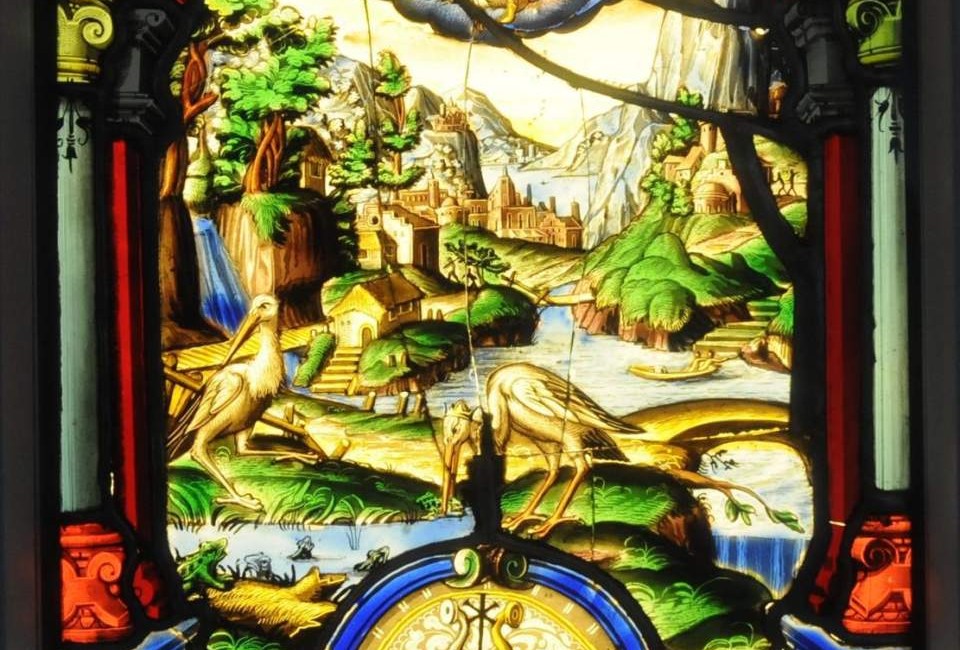
The Museum suggests it is probably based on Murer’s emblem of 9 years earlier (below) — can’t see it myself!
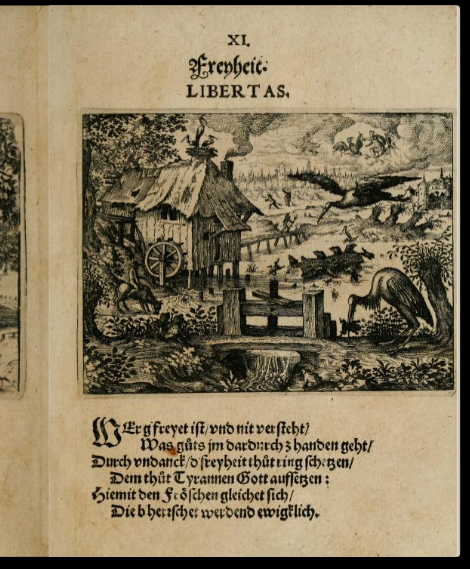
But onwards!
Two Bags of Faults
We carry two bags with us through life; into the one in front we put all our neighbours’ faults, into the one at our back, all our own — which is why we never see our own, while our neighbours’ faults are constantly in view!
I hadn’t come across this one before looking into it — and can’t recall ever seeing it illustrated — though, of course, an image of a man wearing two shoulder-bags would not normally attract my attention. I’m wondering now whether the painter of the miniature in Matthäus Miller’s album took it from some emblem- or other book I should know — an illustrated Aesop, perhaps? [Incidentally, I see this fable is called The Two Wallets by Perry, in whose standard Index it is no.266]
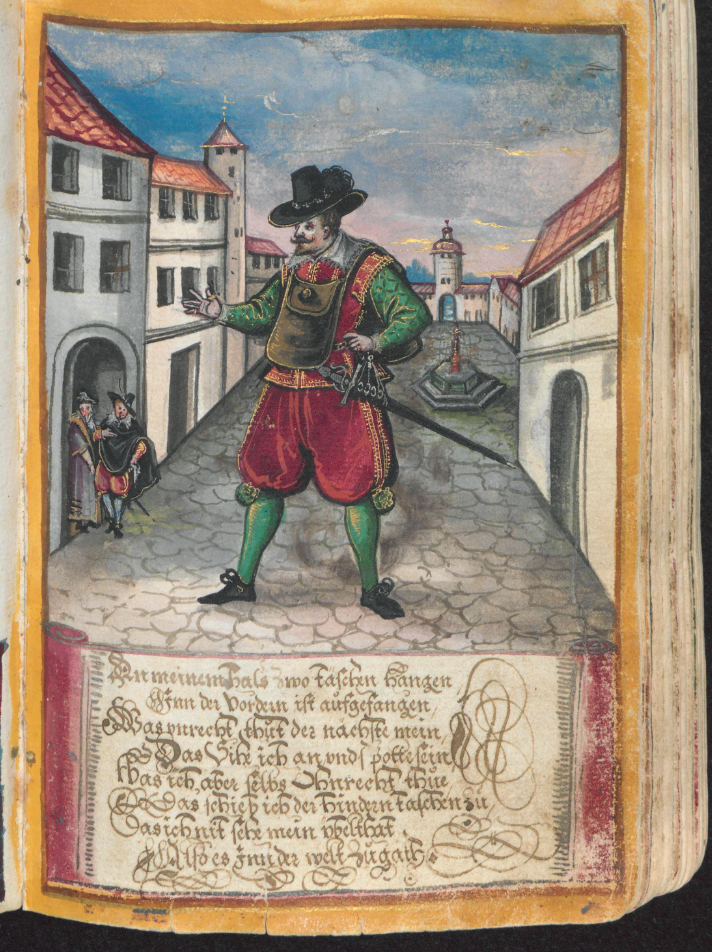
An meinem Hals zwo Taschen hangen Two bags hang from my neck
Inn der Vordern ist aufgefangen in the front one is caught
Was vnrecht thut der nächste mein whatever wrong my neighbour does
Das Sihe ich an vnds pott es ein I see it and pop it in.
Was ich, aber selbs Ihnrecht thue What wrong I myself do however
Das schieb ich der hindern Taschen zu I shove in the back bag
das ich nit sehe mein vbelthat so I don’t see my wrongdoing,
Also es Inn der welt zu gath. That’s how it goes in the world.
Does anybody know this story?
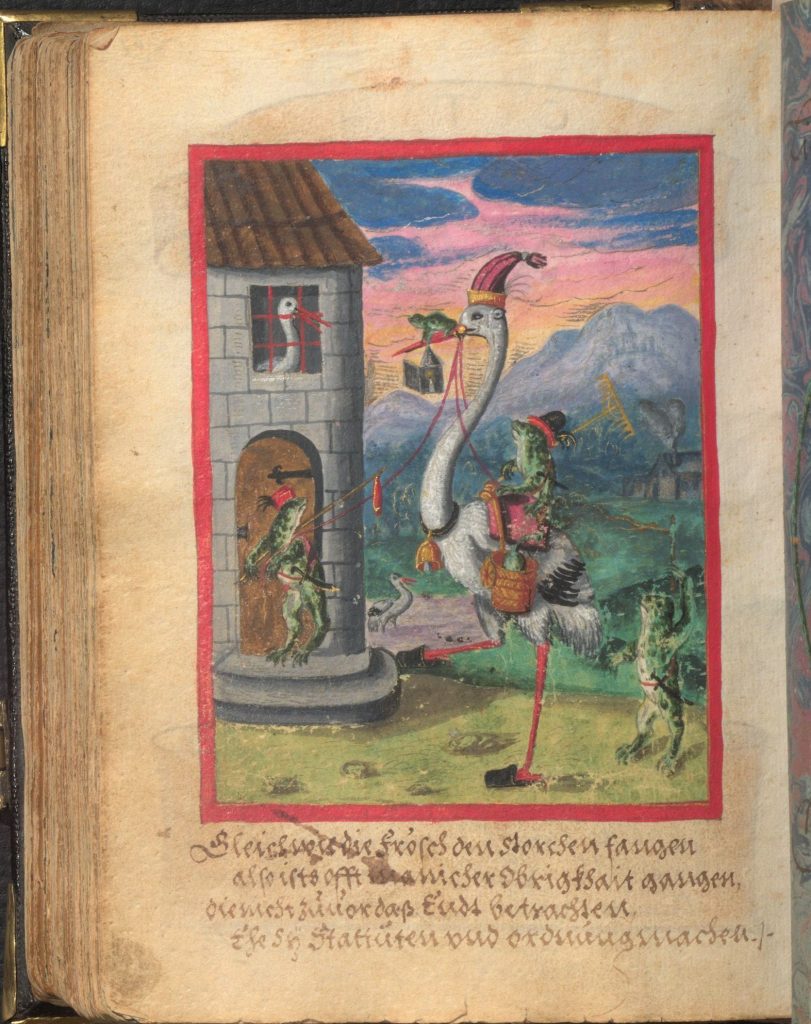
For me, the most intriguing ‘fable’ is this (below), which at first sight — in Lotte Kurras’s excellent Zum gutem Gedenken (1987) — I was inclined to think merely quirky, a one-off, amusing image:
but then I found another one!
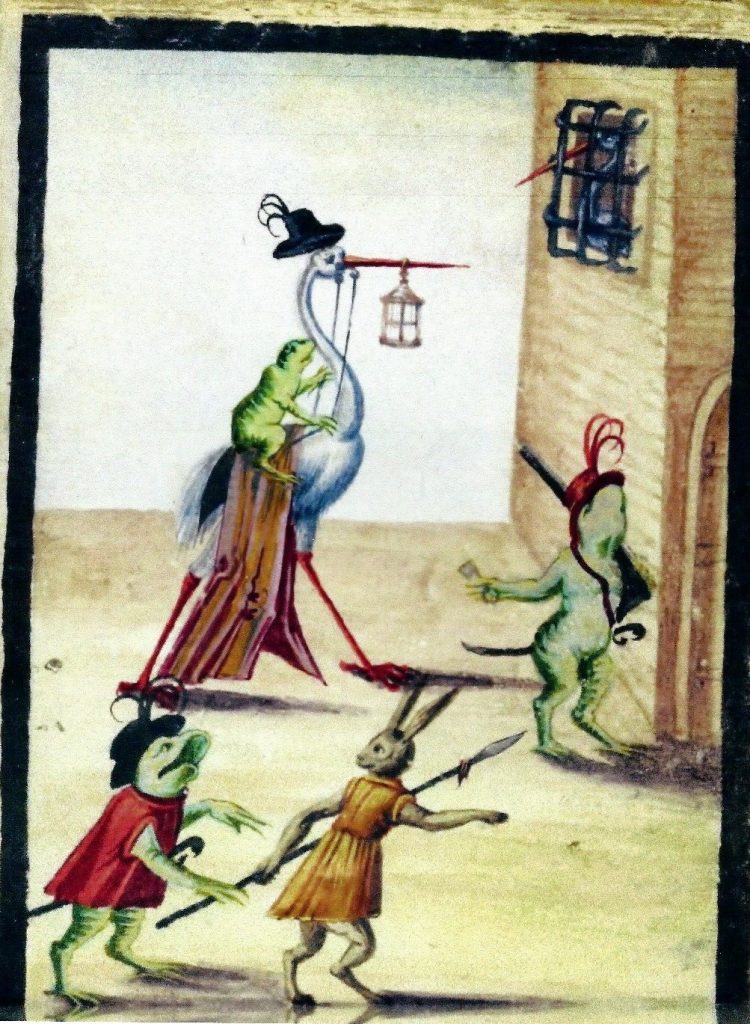
Thott 432, 8°
The Reutter miniature appears to be the earlier, and the Rentsch example reversed with respect to it — so I have reversed it (below) to facilitate the comparison:
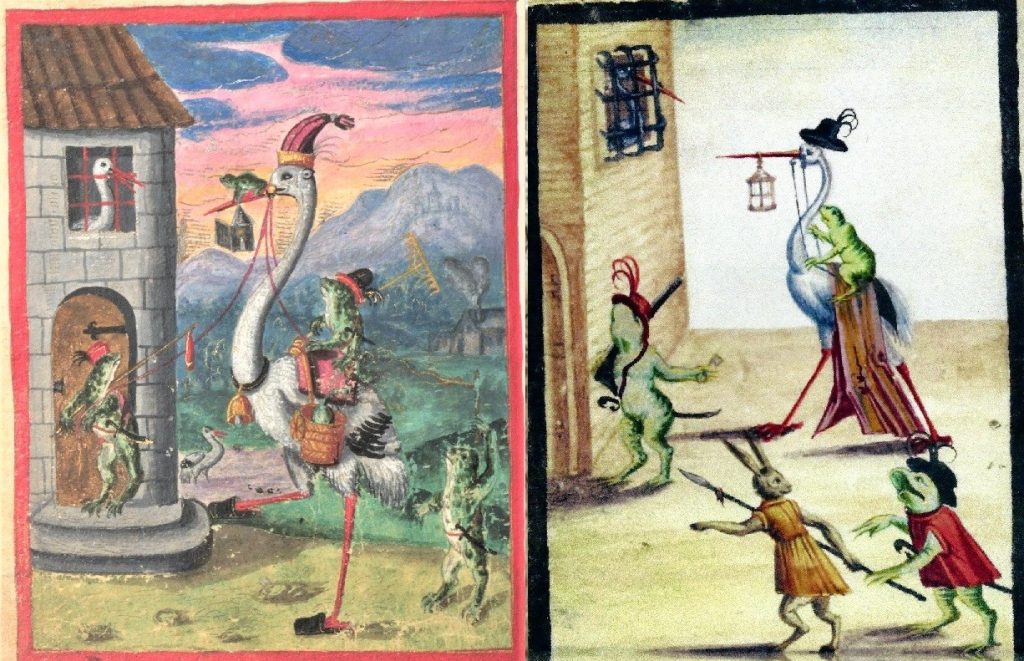
We see a small stork looking through the barred window of a prison, and a frog with key in hand, who has either just locked the prison door, or is about to open it. Stopped in front of the jailhouse, is a very large stork wearing a hat and being ridden by a frog – from its bill hangs a small lantern. Another frog (standing upright on two legs) looks on – in the Rentsch version he is accompanied by a hare carrying a spear. Perhaps this is some sort of monde renversé fable, perhaps with a political import, for the verse-caption below the Reutter version seems satirical:
Gleich wie die frosch den storchen fangen Just as the frogs catch the stork
Also ists offt manicher Obrigkhait gangen so it is often with many of our superiors
Die nicht zuvor daβ Endt betrachten who do not consider the end
Ehe sie Stattuten vnd ordnung machen before making statutes and orders.
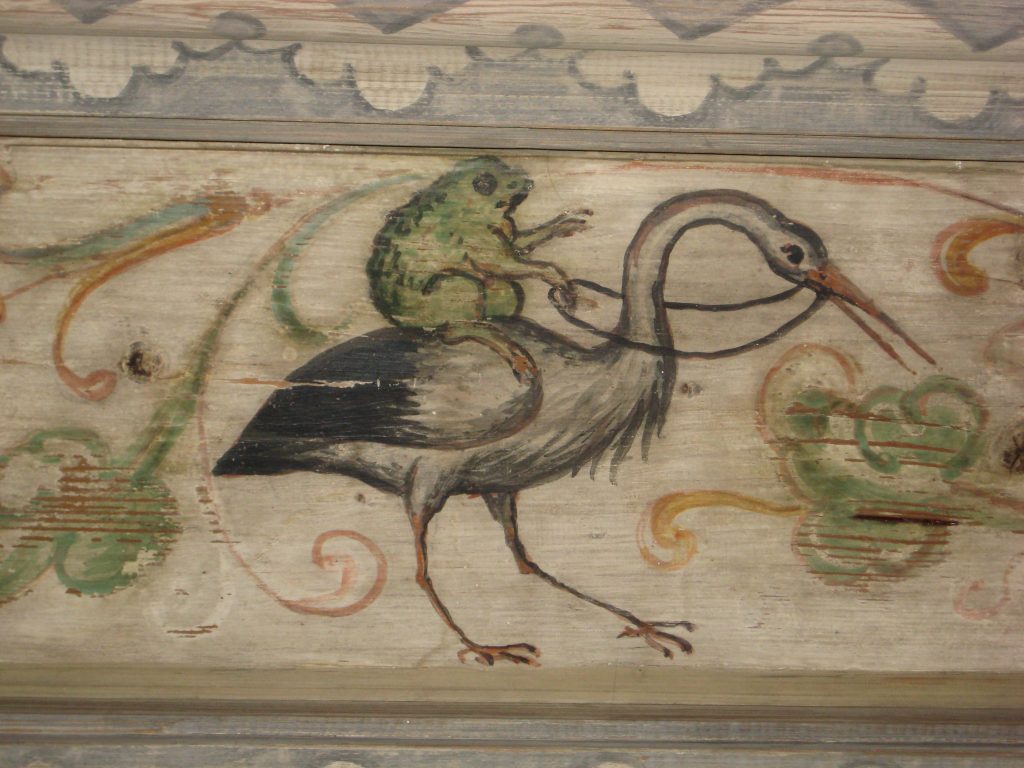
The frogs and storks are proverbial enemies, so to see a frog riding on a stork may also be considered a motif of the World Turned Upside Down, and I close this post with another example from the ceiling of the Fembohaus in Nürnberg, just one of the numerous motifs which have so much in common with the contemporary album imagery.
Leave a Reply