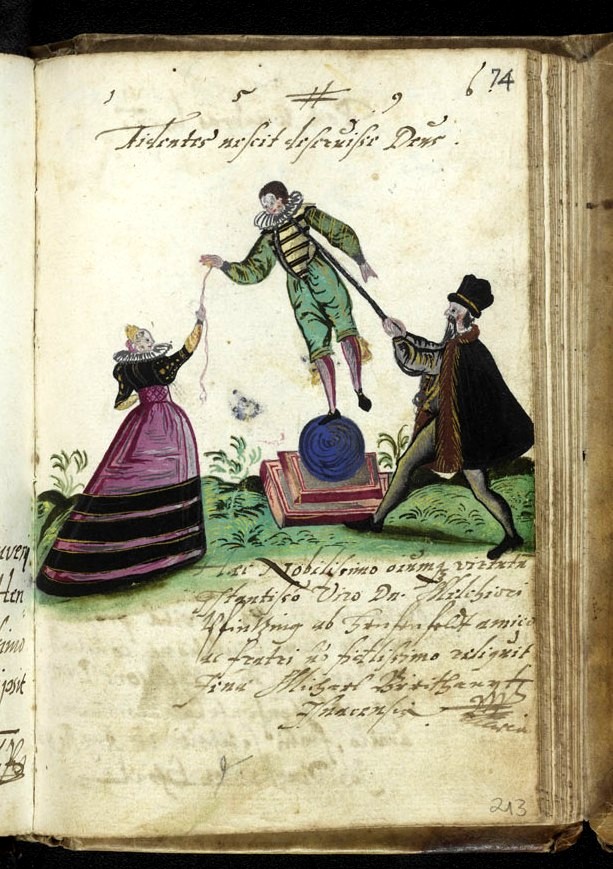
This transparent motif was enormously popular, and is perhaps the commonest allegorical motif to be found in the albums. The typical form depicts a youth — often standing on a sphere — pulled on on side by a person (usually a young woman) holding a thread, and on the other by a person (usually a male of mature age) holding a chain or rope. They are competing for the ‘soul’ of the young man/student — typically the struggle is between love (symbolised by the young woman) and study (symbolised by an academic) or religion (symbolised by a priest, hermit, etc.). While I believe that this is how the motif begins, a young woman soon appears at the centre of the struggle and this version of the motif would seem to be just as popular, if not more so (see examples below).
In the albums, to judge from dated examples, the type seems to begin only in the 1570s — the earliest I have noticed is dated 1579 — and becomes increasingly rare as we approach 1650. A version of the young man on an airborne ball appeared in the de Brys’ Emblemata Nobilitati (Frankfurt 1592) but proved decidedly unpopular — it seems the standard design was already too well-established by that date — and I have noticed only a single example (see below).
The Man-in-the-Middle
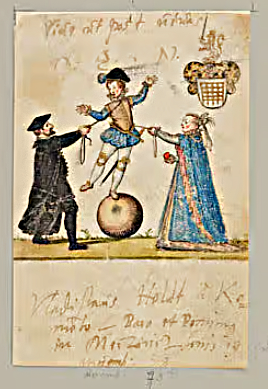
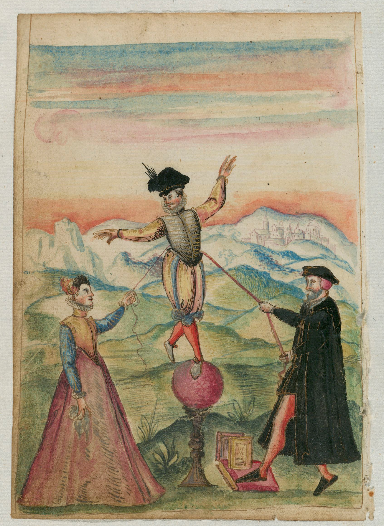
In this earliest miniature, on an orphaned leaf, dated Siena 1579, we see a young man standing on a ball precariously balancing on one leg, pulled in one direction by a man in academic dress with a rope, in the other by a young woman with a string and a ?heart in her other hand. I take this to be the archetype, symbolising the struggle between the pleasures of love and the rigours of study.
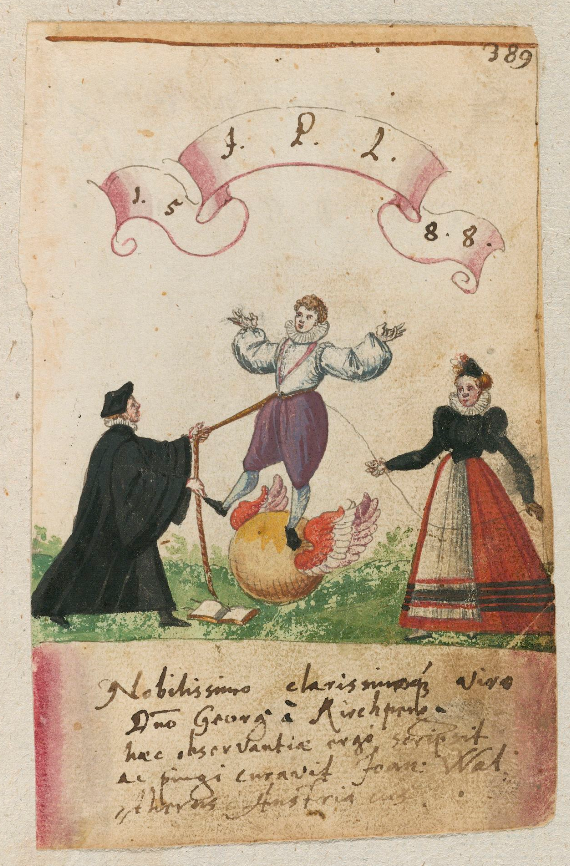
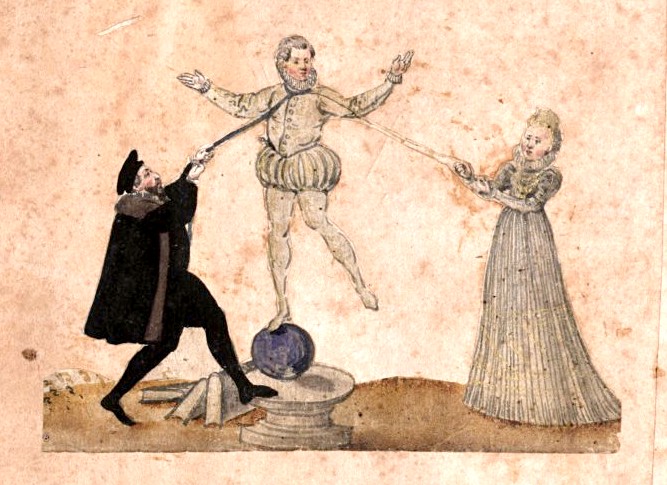
Nine years later on this orphaned leaf in the Frommann Collection, the same personnel are involved but here the ball is winged — adding extra precariousness to the student’s balancing act — but it is also the normal attribute of Fortuna, of course [see further below]. A book on the ground confirms the identity of the academic pulling on the rope, and the young woman pulls on a markedly thinner string, a mere thread, emphasising how little effort she needs to exert in order to secure the young man’s attention!
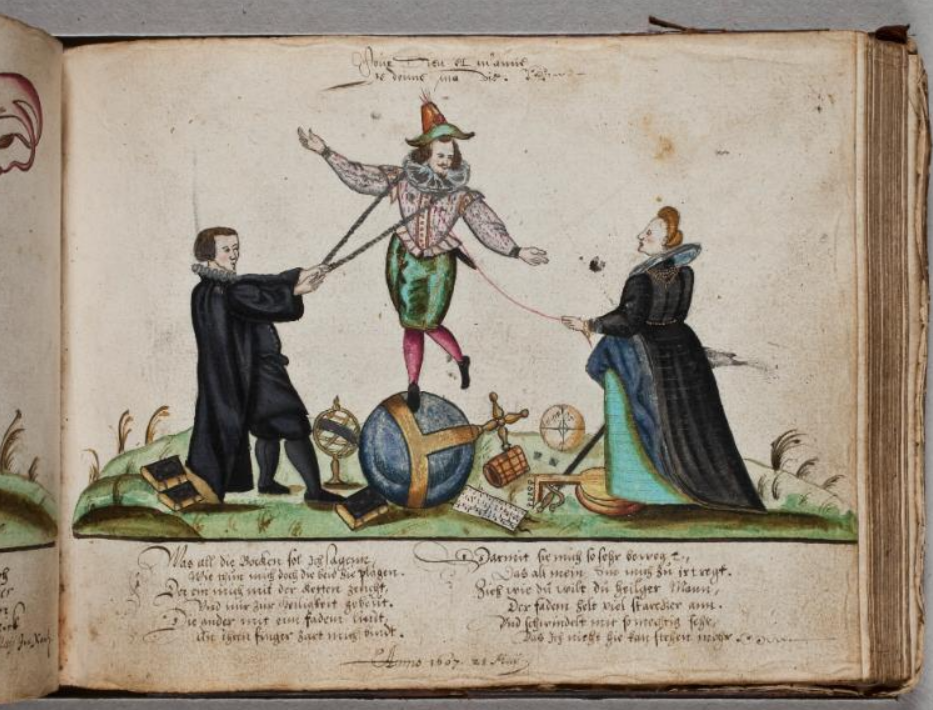
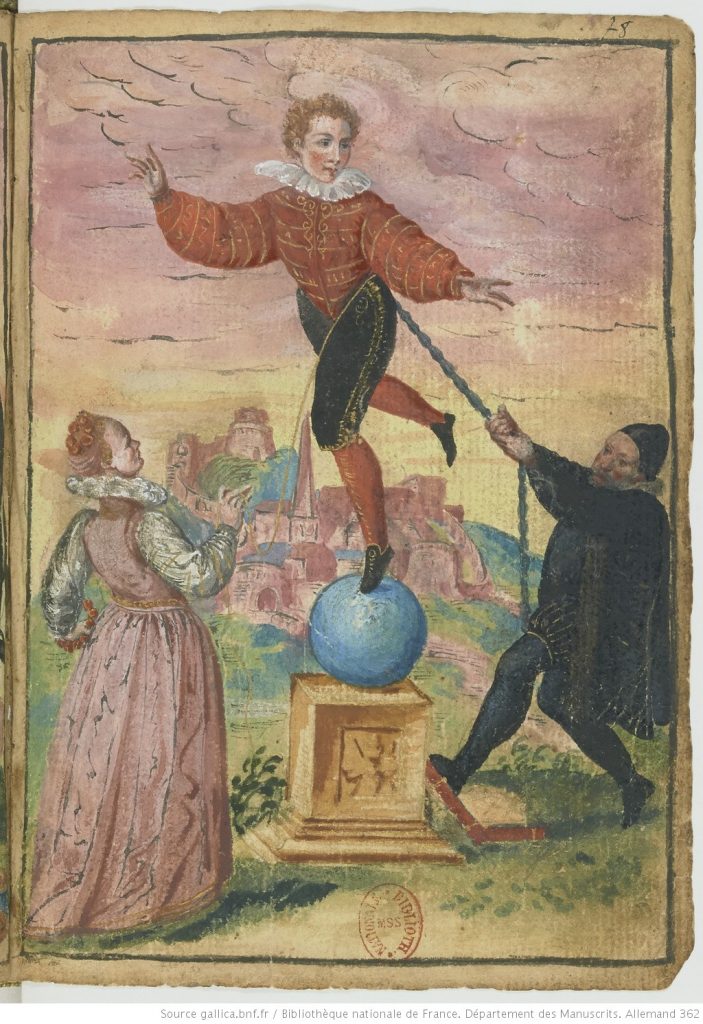
The Elverick album painting is very close to the first print-book version of the scene, published the following year in the editio princeps of the Pugillus facetiarum (Strasbourg 1608), though the captioning verse refers to the black-clad figure as a heiliger Mann, suggesting he is an ecclesiastic, whereas the figure in the print is probably an academic (?):
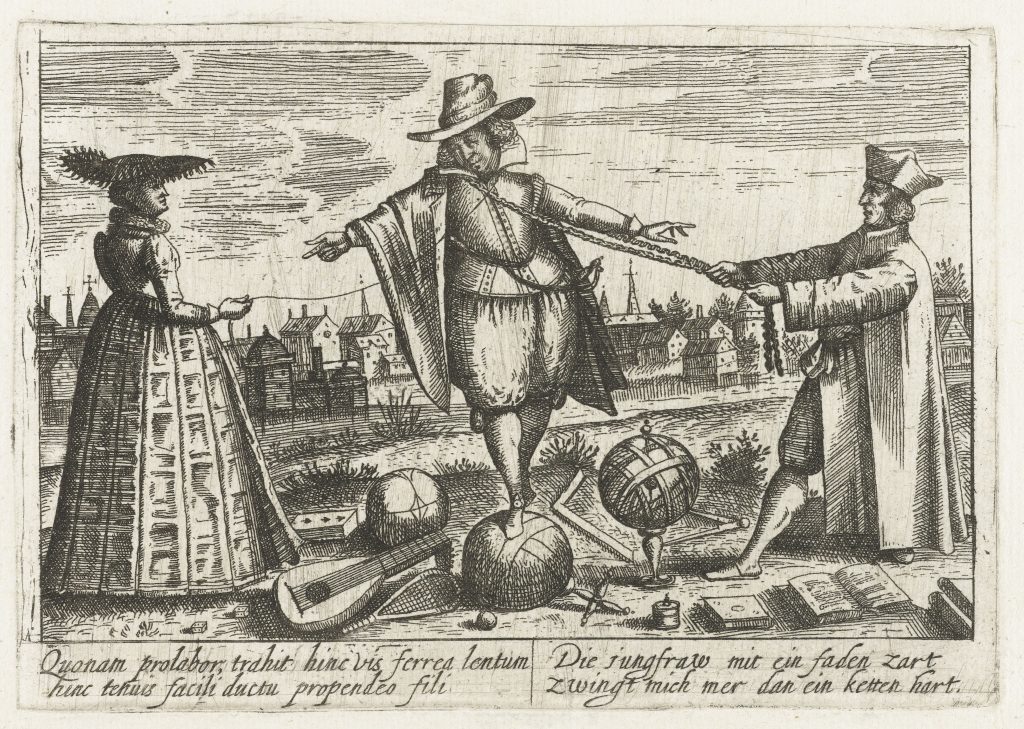
The print-book’s German couplet is frequently quoted
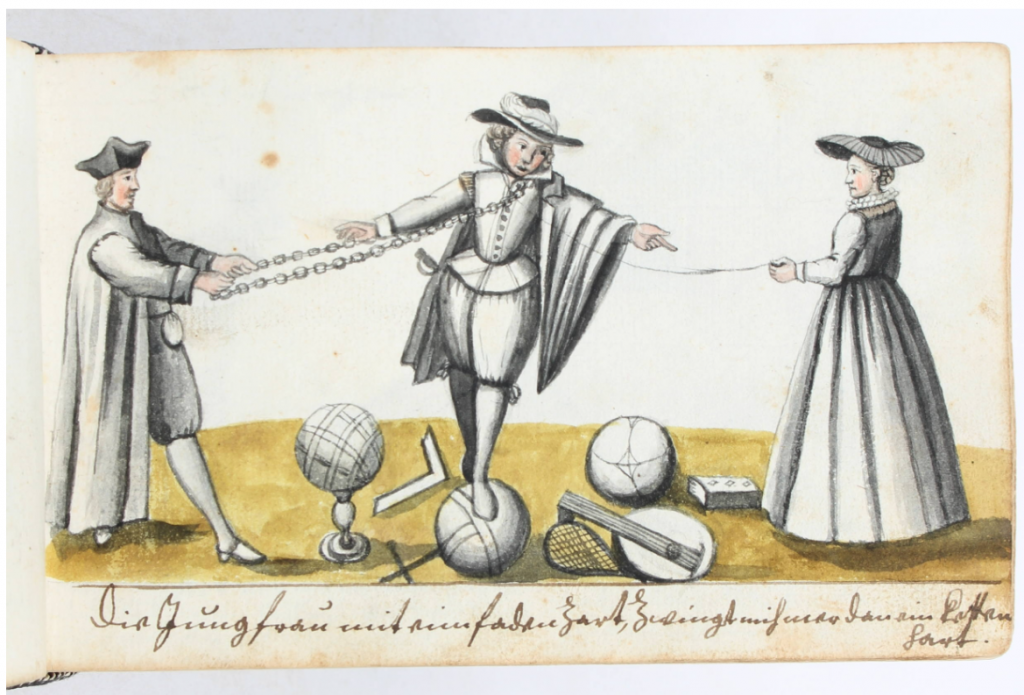
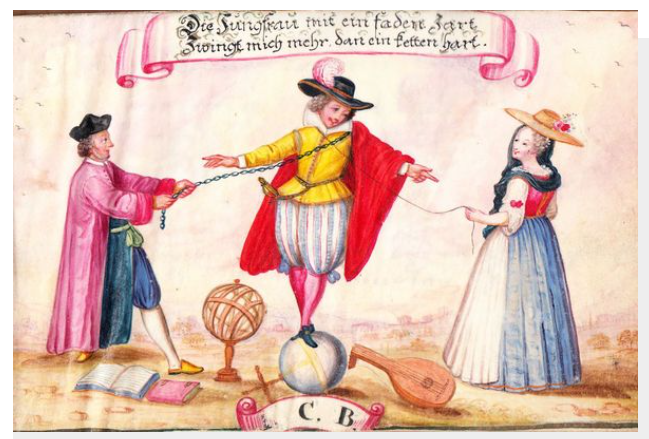
Die iungfraw mit ein faden zart With a slender thread the girl
zwingt mich mer dan ein ketten hart compels me more than a strong chain.
[late examples]
I happened upon two late examples — i.e. after my nominal cut-off date for this blog of c.1650 — but I think they’re worth including to show how very long-lasting the influence of this particular design was — though both appear to depend on a copy of the Pugillus plate in reverse.
the Winged Ball
The winged ball is Fortuna‘s, one of her traditional attributes — it is appropriate in the present context as it is the young man’s/woman’s fortune that is being decided in our ‘tug-of-love’. Fortuna is the commonest allegorical figure to appear in the albums, but here is an interesting early and somewhat untypical example from the album of Georg Bernhard, this particular page being dated 1573.
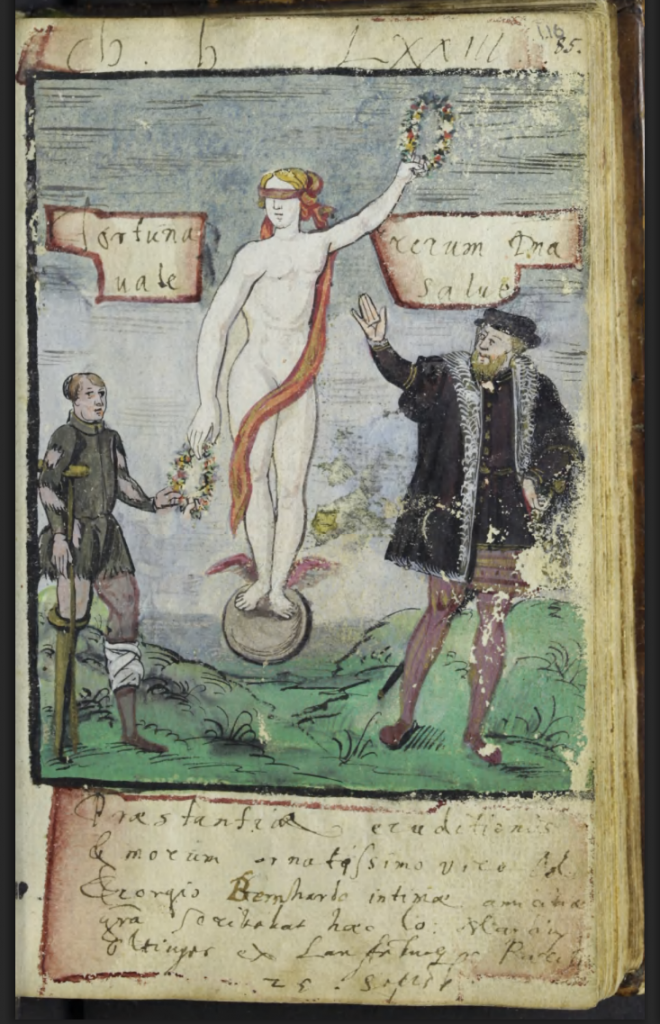
Here as usual, Fortune is blind(folded), signifying her impartiality, the gifts she bestows, and pains she inflicts, she does randomly. A scarf partially covers her nakedness, as she hands out garlands to a young man in tattered clothes with crutch and bandaged leg, and a mature, well-dressed man who appears to be hailing her. The speech ‘bubble’ above the young man reads, fortuna uale [Fortune, farewell!], that above the older man, rerum Dna salue [Hail, Mistress of all things] — this last, a popular reminiscence of Cicero’s rerum humanarum domina Fortuna [ Fortune is the mistress of all human things].
But back to our present motif!
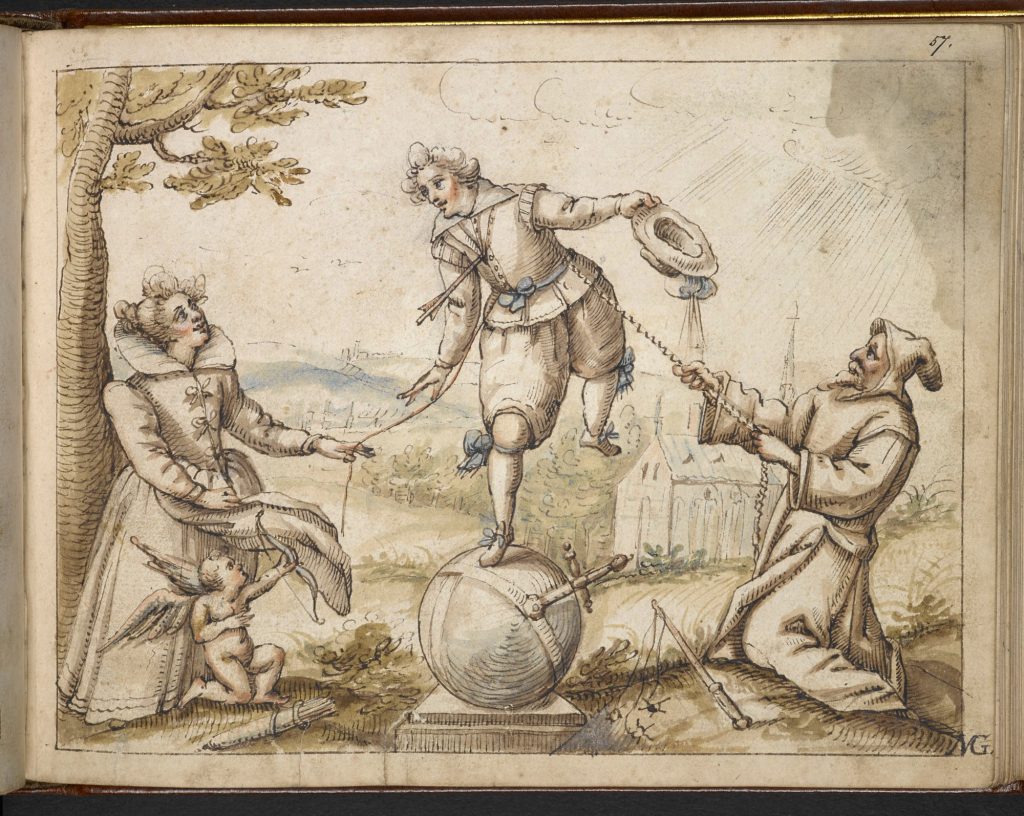
The Walens album painter (NG ?) has retained the idea of having the young man balance on an out-of-kilter world-orb, as per the Pugillus plate, but introduced a Cupid who has shot him in the heart, and we have a definite monk or hermit with his metal-studded scourge on the ground beside him.
Other/Multiple Claimants for the Young Man’s Attention
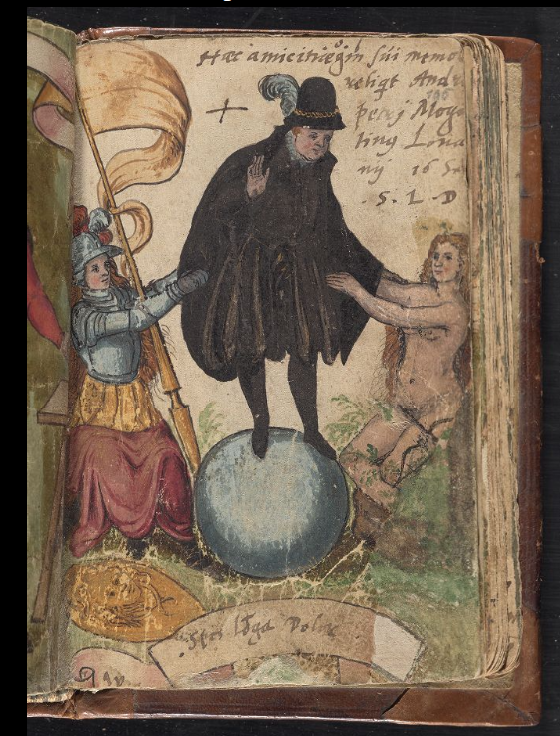
The Helbig album miniature is unfortunately undated, but likely to be nearer the earlier terminus than the later one, and may even antedate our earliest, 1579 painting — there is no thread or chain here, and the two women who vie for his attention have laid hands on him, and it is far from clear to which lady he inclines. The naked woman presumably represents the pleasures and demands of love, the woman in armour, the stern duties of a military career. The motto, Spes Longa Dolor [Hoping long (brings only) sorrow], is not helpful.
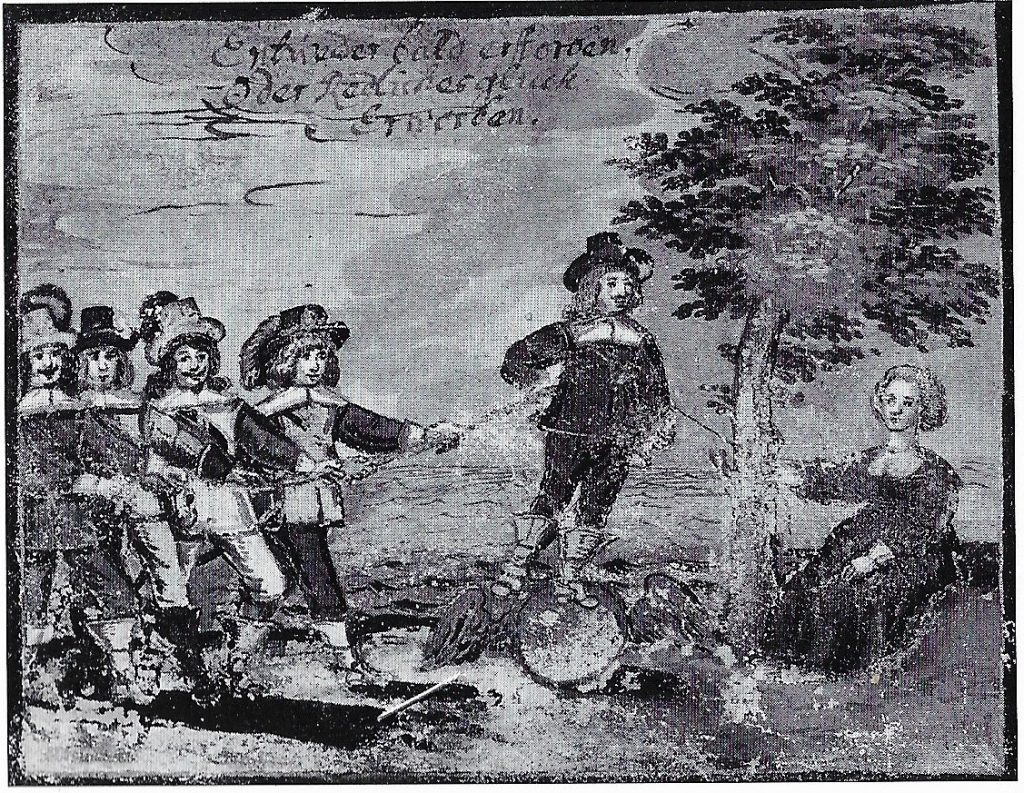
Above, see what is essentially the same confrontation in this much later miniature, only here the ‘love-interest’ pulling the young man by a thread is dressed, and even four soldiers heaving on a chain seem unable to pull him into their camp!
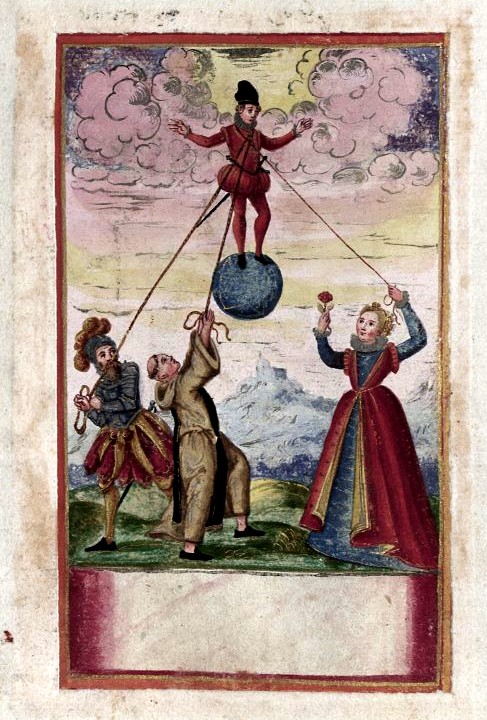
To the representatives of love and the military, another miniature in the Jenisch album adds religion, in the person of a monk:
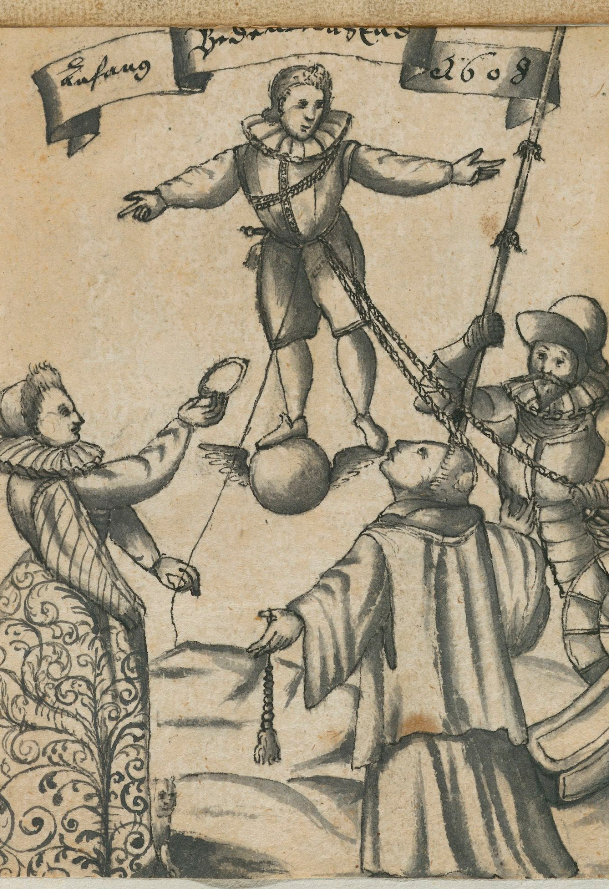
The same team are at work on this orphaned leaf dated 1608, only here the young woman offers him a garland (or perhaps an outsize ring?):
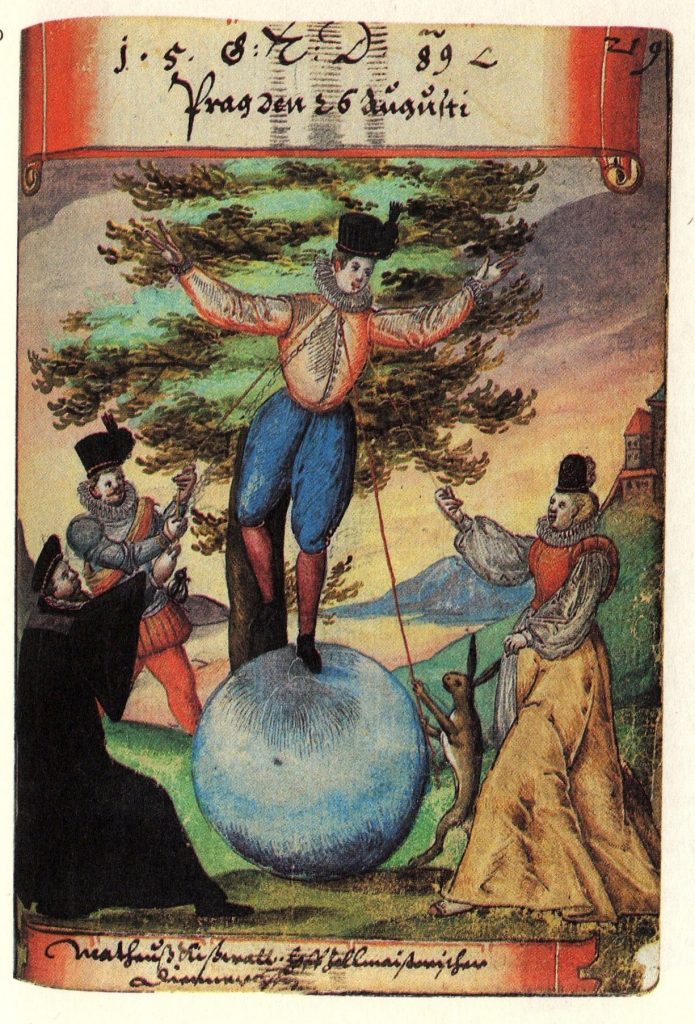
A curious new addition to the team in this miniature dated 1589 (below), is a hare! In German iconography the hare is almost always an emblem of foolishness rather than timidity — as the animal appears on the same ‘side’ as the young woman, towards whom the youth inclines, is the painter hinting at the foolishness of choosing love over the options on the other side?
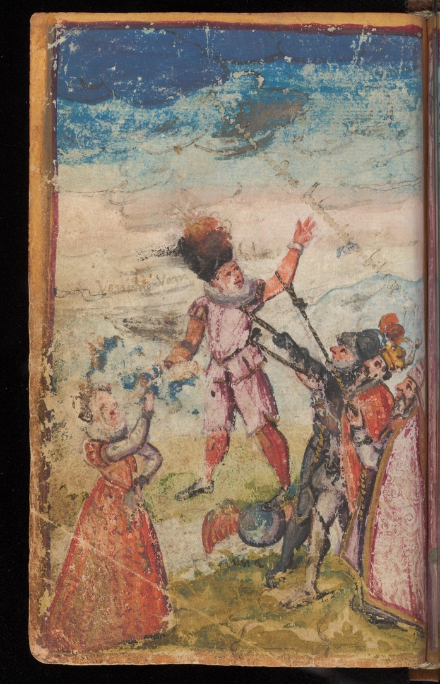
The miniature in the Hygel album shows a pope, king and soldier (?the Three Estates) pulling at the youth with their respective chains, and the usual young woman on the other side, from whom he perhaps takes a garland — but the painting is unfortunately too rubbed to make identification certain.
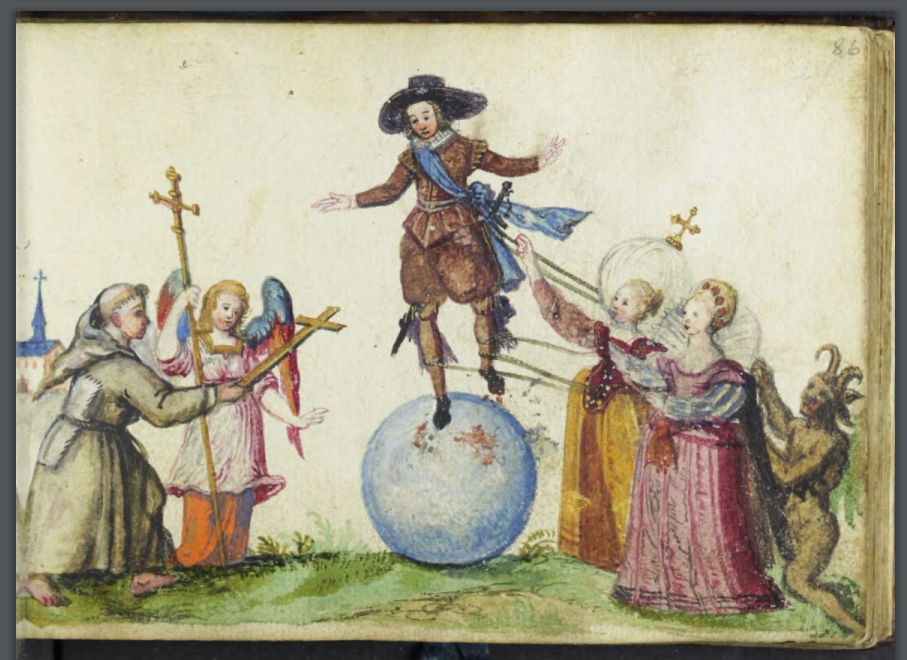
The young man in the Hensel album (below), painted c.1630, balances on his ball between an angel and a barefoot monk who shows him the Cross, representing the Church and religion, and on the other side the World, the Flesh and the Devil with their chains tugging at him. The Flesh is represented by the beautiful young woman, of course — as is the World, with the globus cruciger on her shoulders, for this is Frau Welt (see the further discussion below under Other Media).
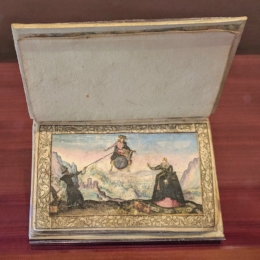
Thott 377, 8°
The young man seated on the aerial ball in the Castellio album is copied from the plate in the de Brys’ earliest print-book, the Emblemata Nobilitati (1592); yet again, the pull of the representative of religion (a miniature church on his head) is not as strong as the thread held by the young woman the youth looks towards.
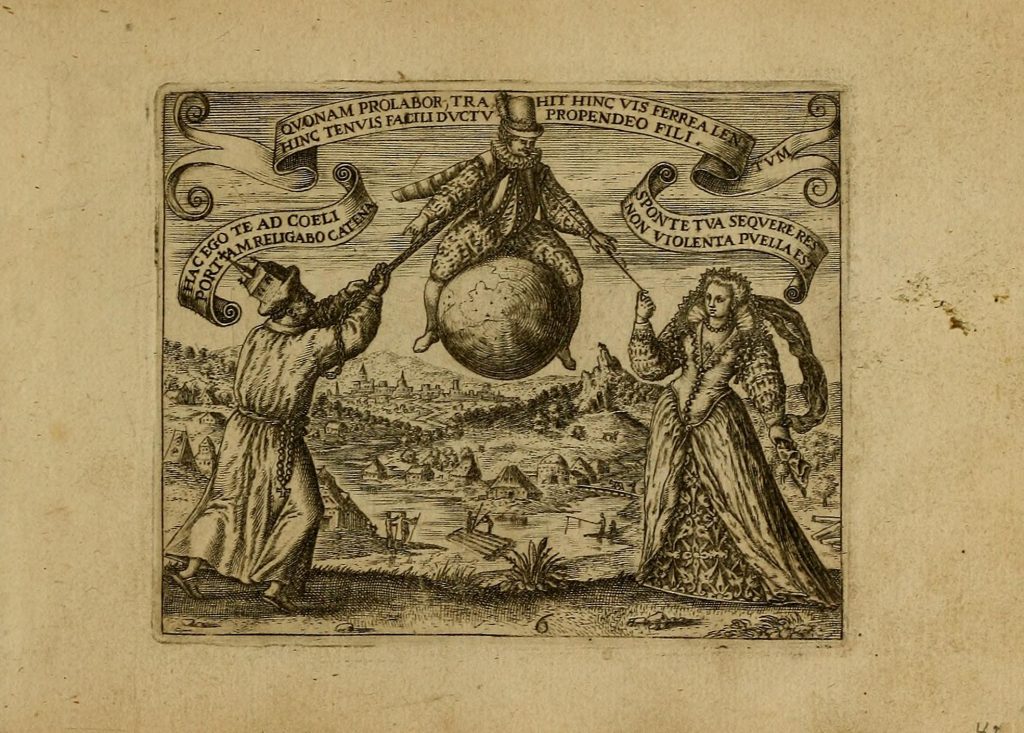
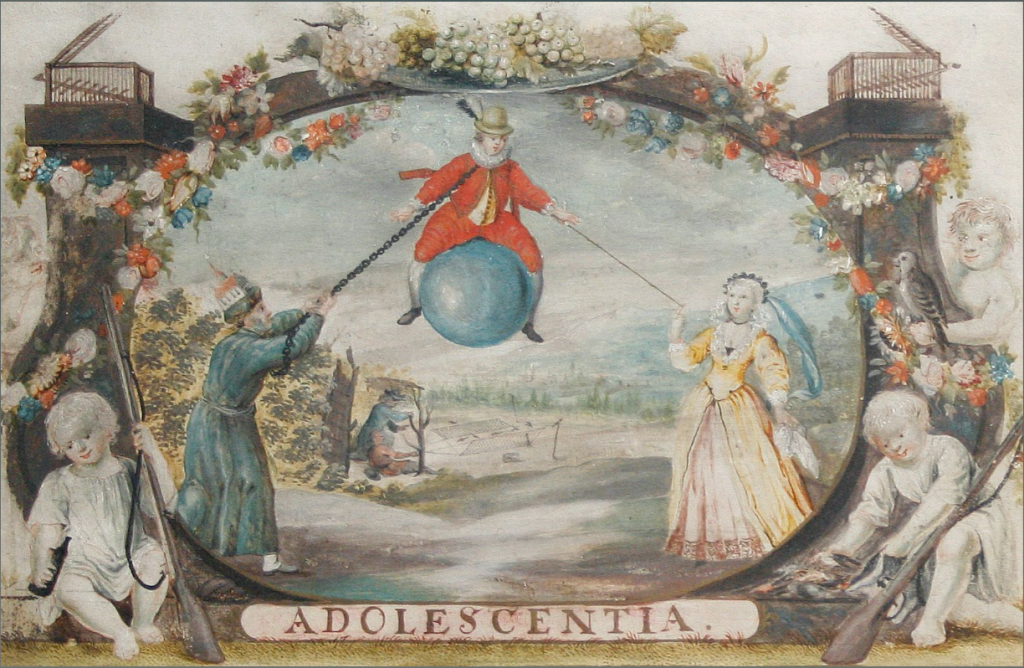
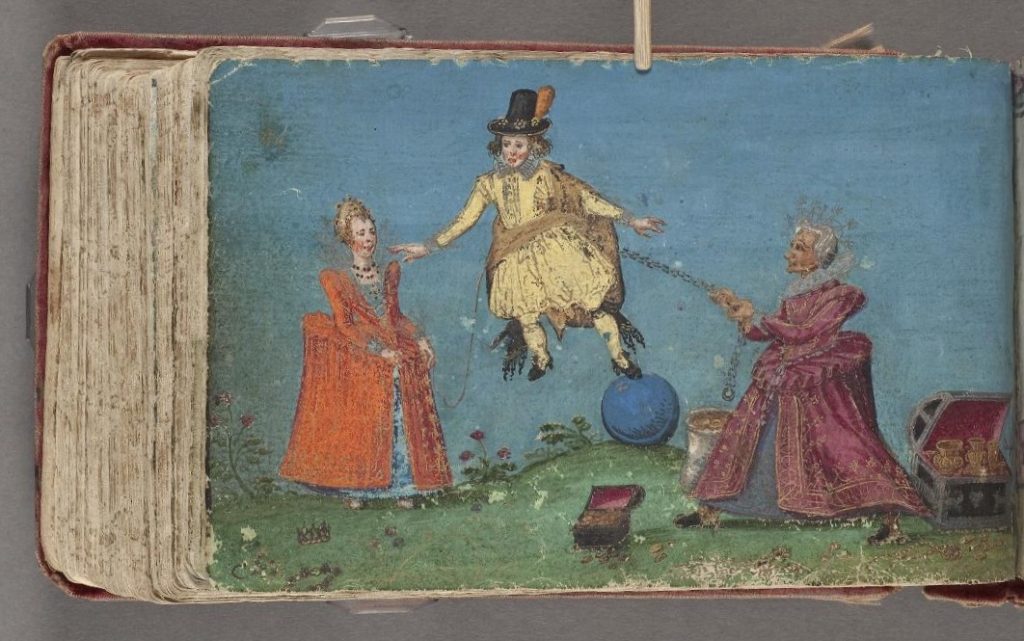
The miniature in the Lilliesparre album shows the young man between two women; the beautiful young (and penniless) woman, whose thread connected to him is not even taut — and the ugly old rich woman, whose chain is evidently of no avail as he topples towards her young rival. This motif is much commoner with the sexes reversed.
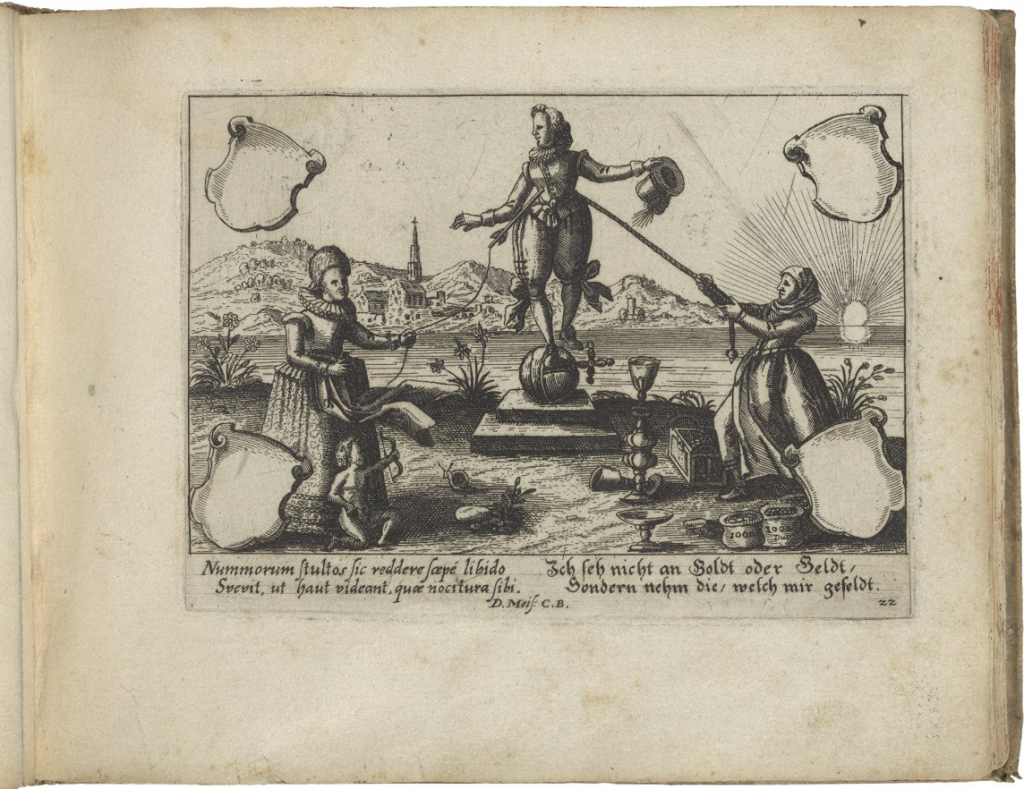
The same personnel appear on a plate in Rollos’ Philotheca Corneliana (Frankfurt 1619), but there are too many differences to suggest direct derivation
The Woman-in-the-Middle
As we noted above, though the motif did appear in 1592 in the de Brys’ Emblemata Nobilitati, it did not prove popular in that form — nor did this female version engraved by Crispijn de Passe for Rollenhagen’s emblem-book, Nucleus Emblematum published in 1611:
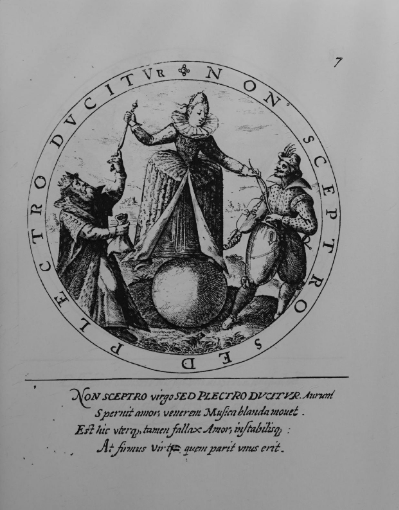
There is neither chain nor thread here, and the old man is here a king, because he needs his sceptre for the sake of the motto — but none of my post-1611 examples models itself on the emblem.
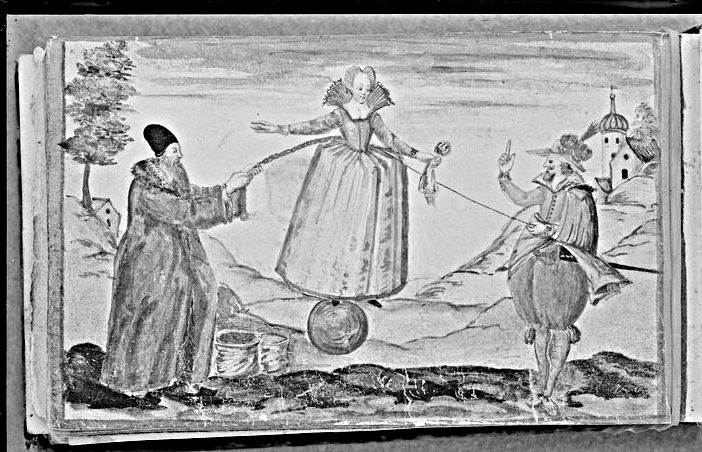
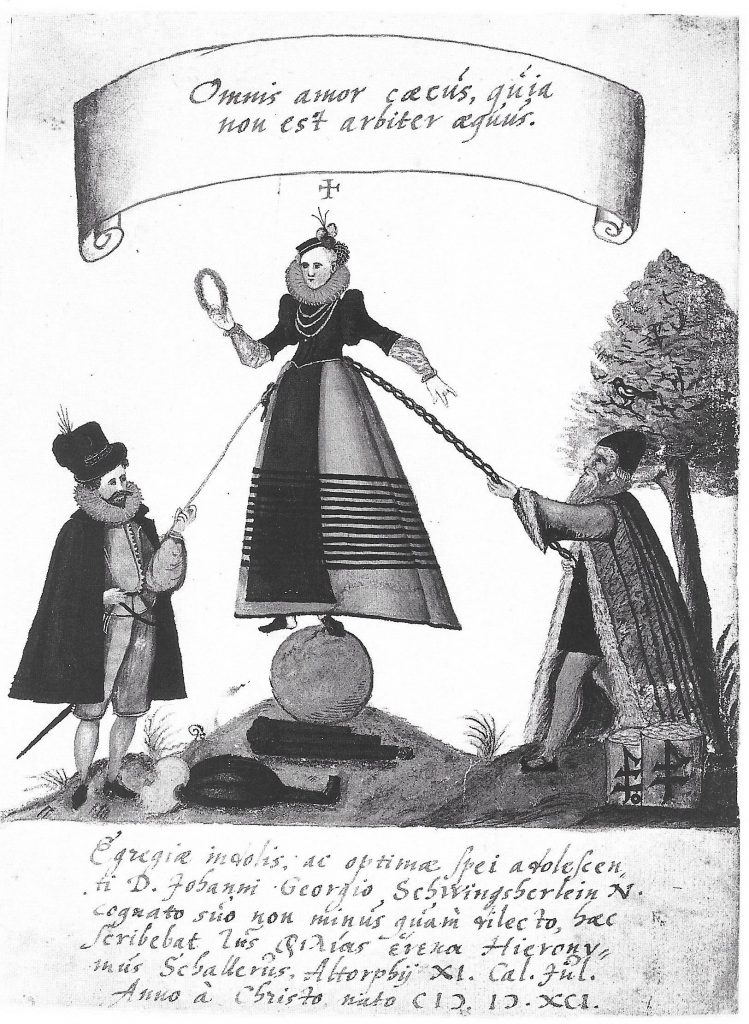
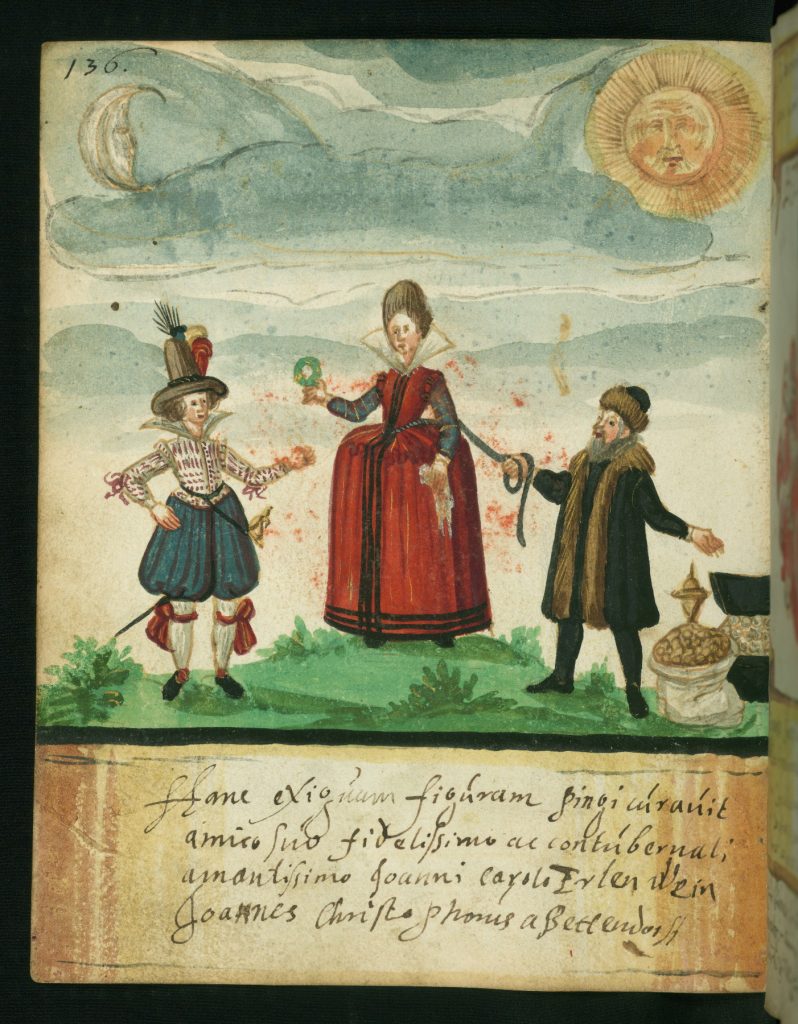
In our period, of course, the young woman does not have to decide whether or not to follow the path of study, as a university education is not a possible life-choice for her. She is expected to marry, so faces the familiar dilemma: attractive young-but-penniless man, or rich-but-old man. The design is accordingly much simpler and, in fact, entirely unvaried — in every one of the 20 examples of this scene I have collected. But balanced on her ball, the young woman is not entirely passive — though where she reveals her preference, it is always for the young man, but it is indicated decorously, even subtly.
In the miniature below, for example, she extends her handkerchief towards the young man, which is alone enough to convey her approval…
Slightly less subtly, in the Marzeller album and on an orphaned leaf in the Frommann collection, the lady offers the young man a flower:
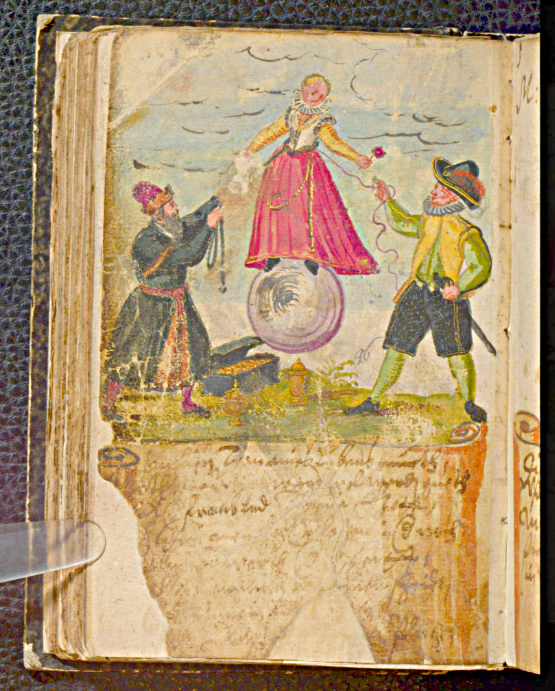
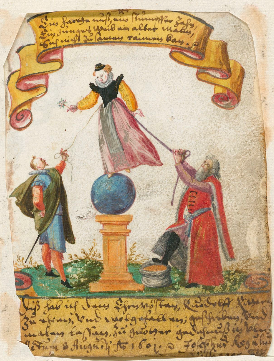
In the Schwingsherlein and Erlenwein album miniatures (exceptionally, in the latter, she is not standing on a ball), she offers the young man a garland:
And, finally, casting all subtlety aside, in the Petzke album painting dated 1614, and on an undated leaf in the Frommann collection, she offers the youth a flaming heart!
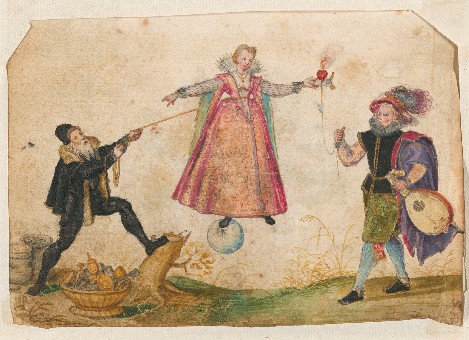
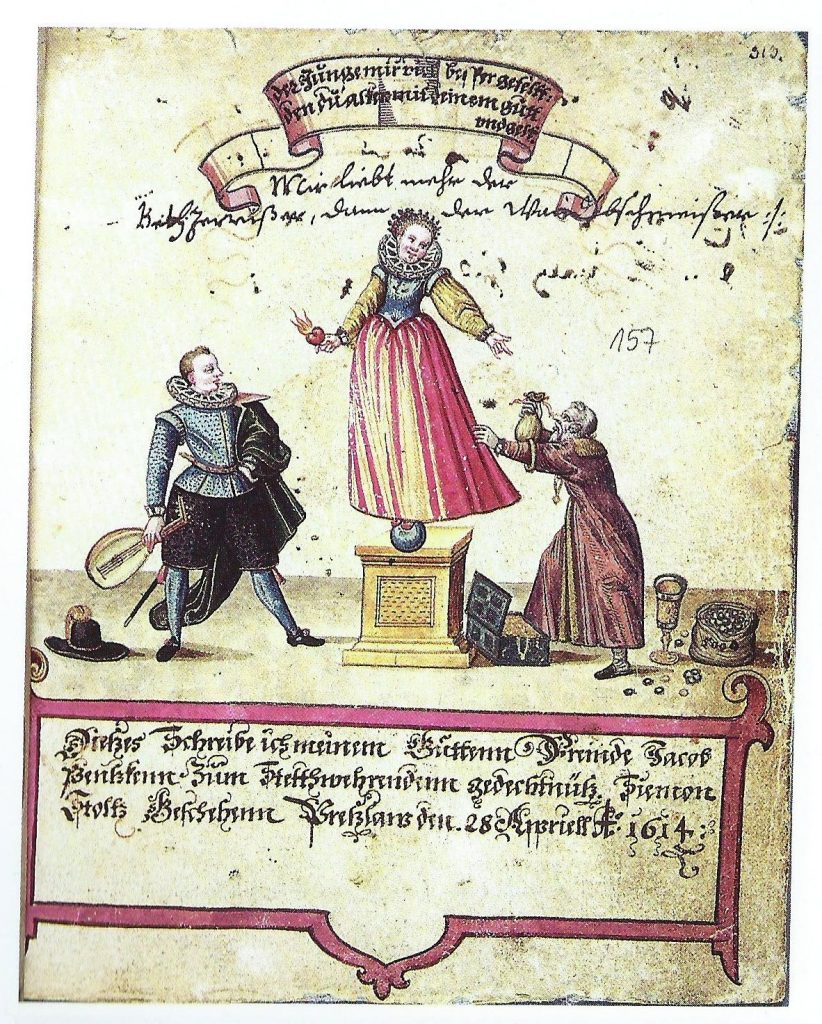
It would seem too much of a co-incidence for this plate in the Philotheca Corneliana (Frankfurt 1619) to be unrelated to the two miniatures above — one dated 1614 —
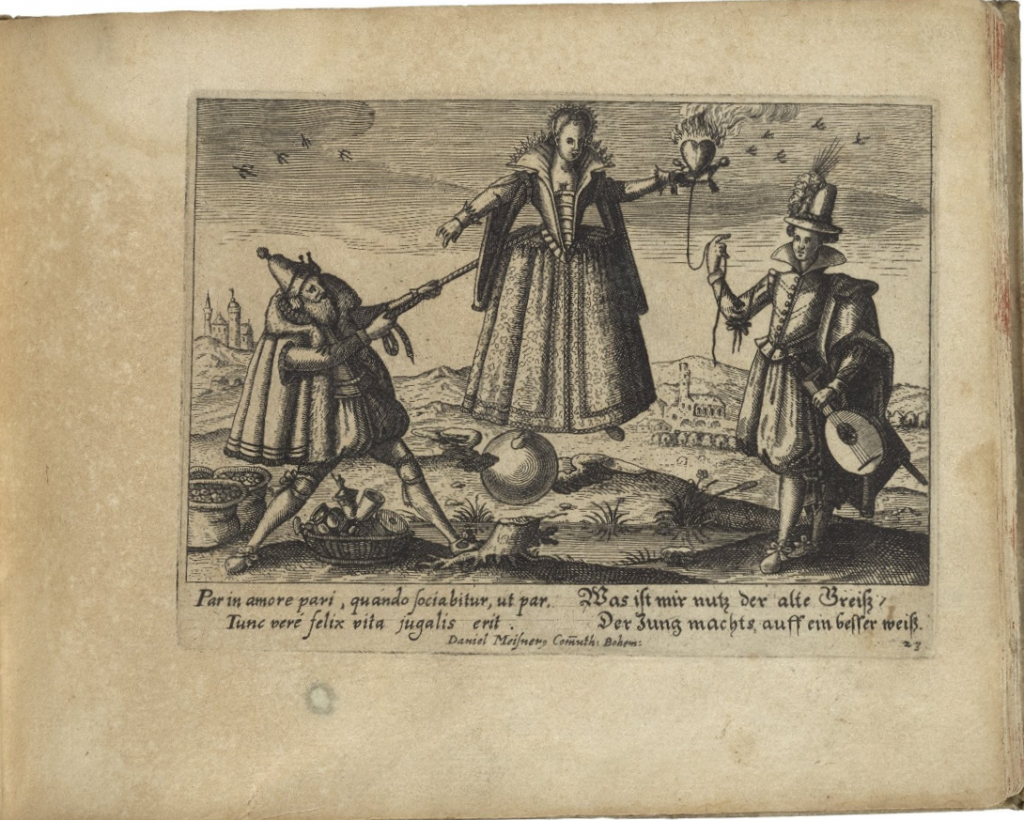
The undated Frommann leaf may well be copied from the print-book-plate — note the same positioning of the old man’s treasure between and behind his legs, his foot braced against the tree-stump, and the lady balancing on the ball on only one foot, in both
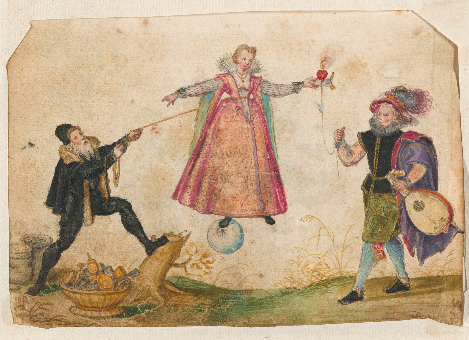
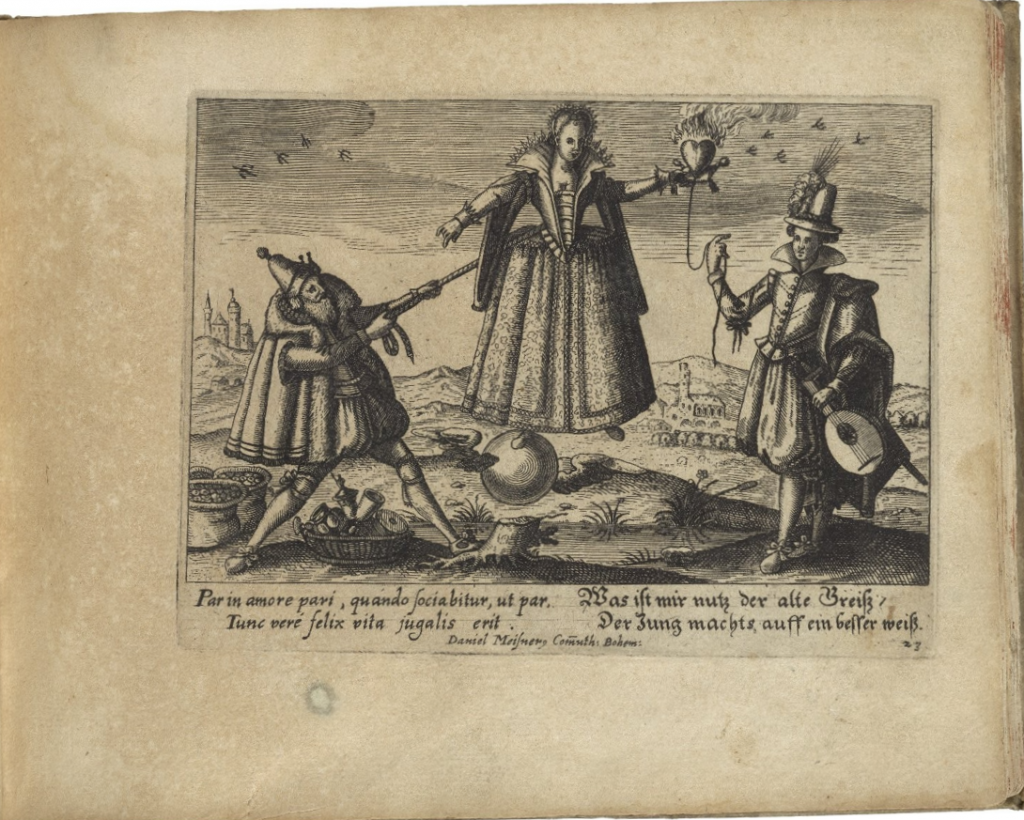
The Petzke album miniature, however, painted 5 years before the Philotheca was issued, suggests that — like von der Heyden — Peter Rollos too was engraving some of his plates after paintings he had seen in actual students’ albums.
The men are pretty much stock types too — the old man is usually a literal ‘greybeard’, and even stoops perhaps — in the Löffelholz album his crutches lie on the ground beneath him — as he stands beside his riches, ostentatiously displayed.
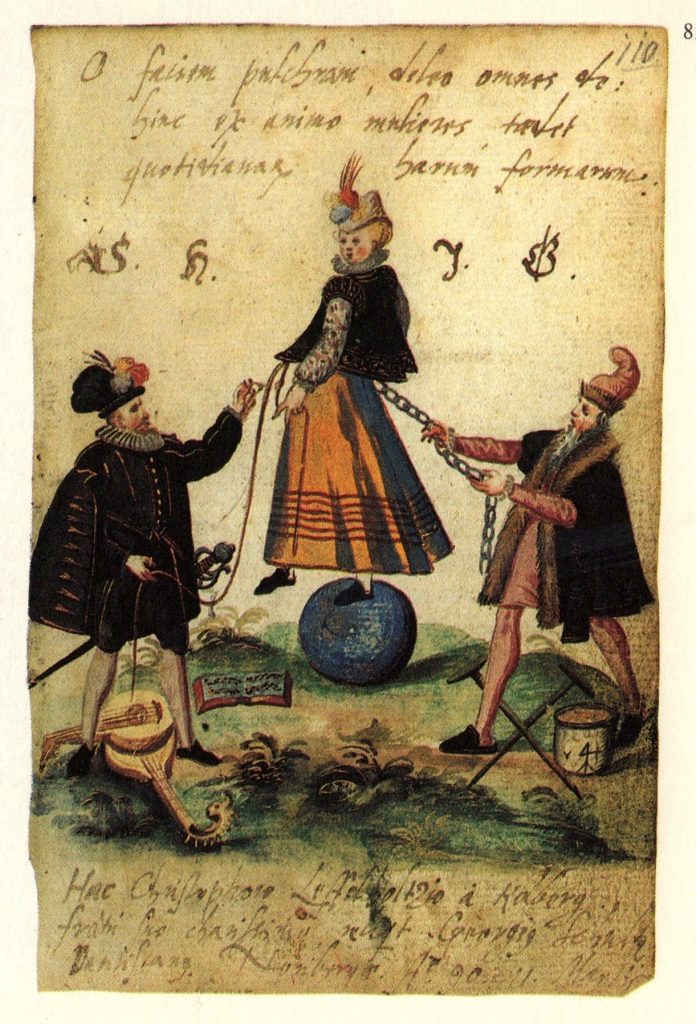
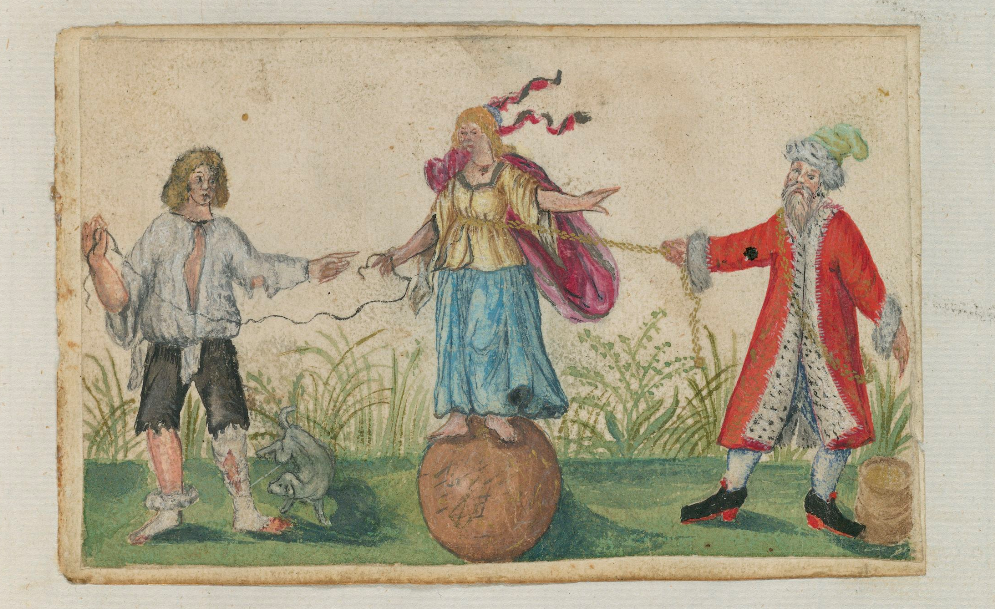
As we have seen above, the young man is usually dressed elegantly in the height of fashion, and perhaps carries or stands beside a lute, showing he has all the fashionable accomplishments expected — though in a rare strategy to increase the contrast between the suitors, and thus the discomfit of the old man — on an orphaned leaf in the Frommann Collection (below), his clothes and shoes are in tatters, and — adding insult to injury — a dog urinates on his leg! Nevertheless, the young woman here signals her preference quite strongly by her hand gesture, presenting her open palm towards the old man as if to ward him off:
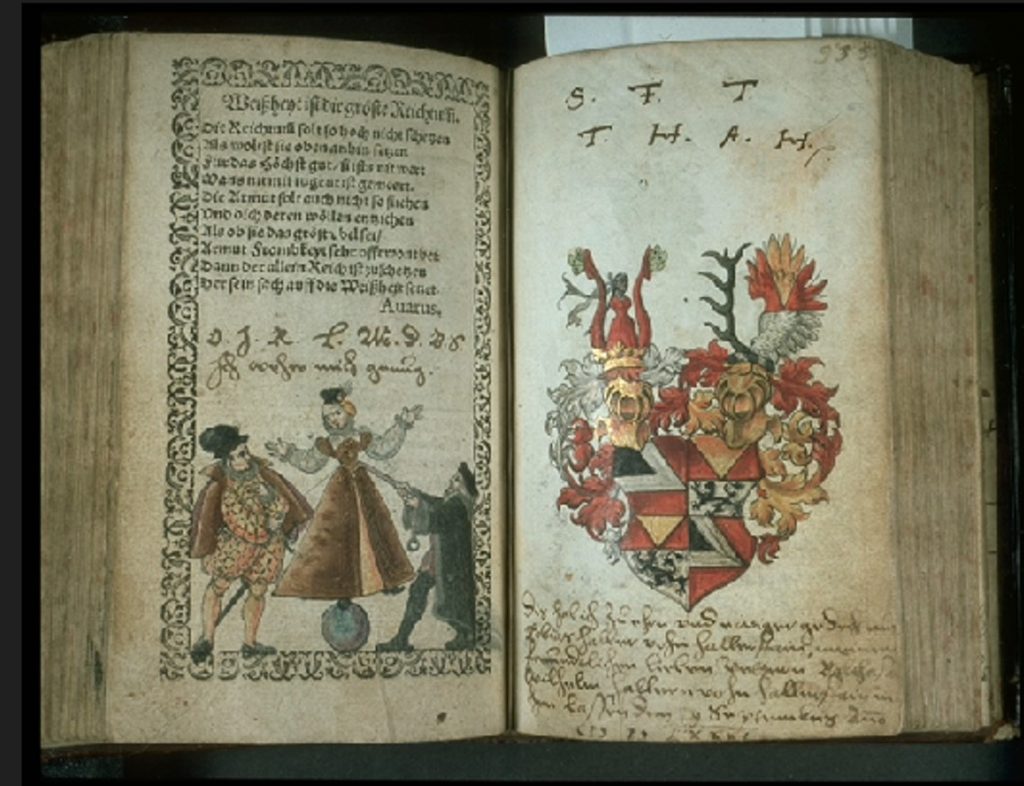
I close this selection with an entirely undistinguished, yet typical, example of the motif, squeezed onto a printed page in an emblem-book being used as an album — as so many were — in this case, Holzwart’s Emblemata Tyrocinia (Strasbourg, 1581). Having said that, I now see that this is the earliest female example of the motif I have noticed so far, as it can be dated 1581. It is painted beneath the motto, Ich wehre mich genug, which ought to mean “I can defend myself well enough”, and was perhaps the personal motto of the contributor.
Other media
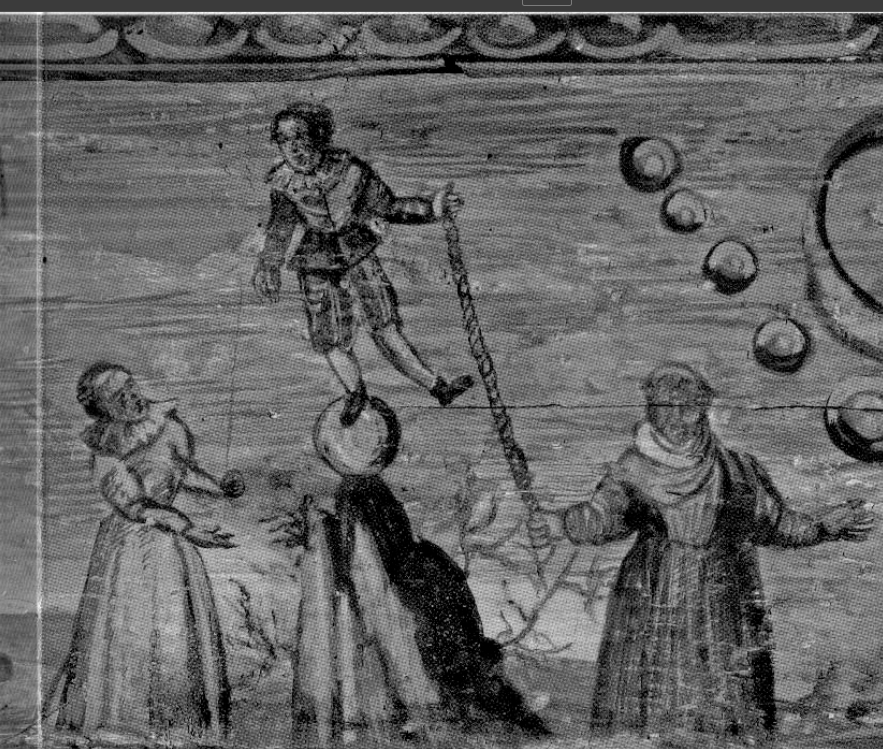
The abovementioned book from which I have scanned the image, unfortunately makes no attempt to date the ceiling painting, nor was the author aware of the very similar Nurnberg ceiling now installed in that city’s Fembohaus Museum.
Though there is no ball for the youth to balance on, two anonymous oil paintings sold at auction in recent years are closely related to our album motifs
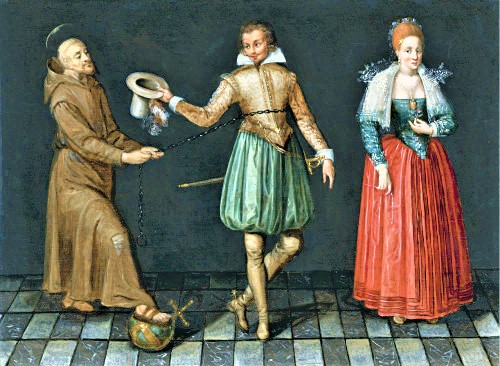
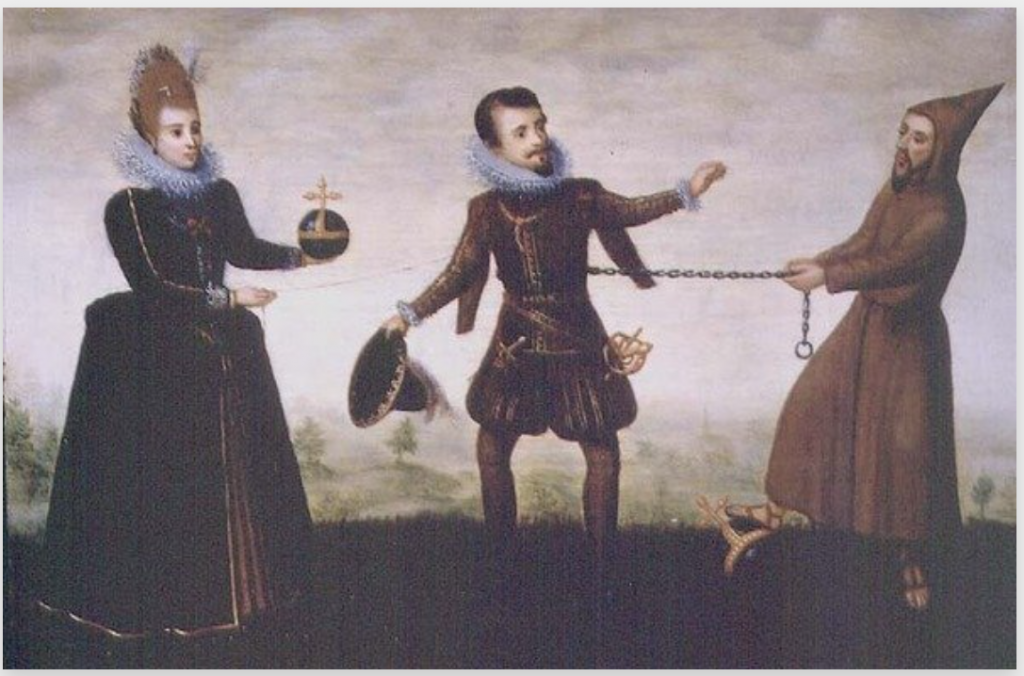
Iconographically, they appear to have a good deal in common with a variant of our motif — which also features no ball — we have already discussed in our post on lift-the-flap miniatures:
https://albumamicorumear-e4qvahs764.live-website.com/lift-the-flap-pictures-klappbilder/
This design — which is also a memento mori (the skeleton is visible in the full illustration — for which see the above post) — again shows our fashionably-dressed young man between a monk/hermit, who points at the vanities at their feet, and an elegant young woman — here identified by the globus cruciger on her head — as Frau Welt, Lady World.
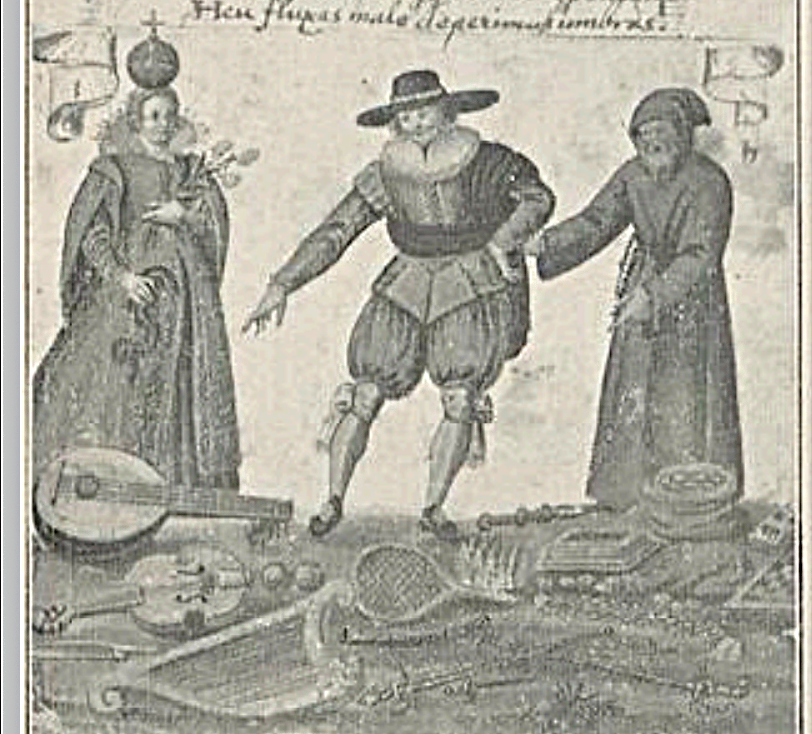
We saw above — in the Hensel album — how one of the party tugging on the chains attached to him was similarly identified as Frau Welt by the cross-mounted world-orb on her shoulders. In the above paintings the monk/friar treads on the world-orb in an obvious symbolic rejection of the world and worldly pursuits, but in the painting sold in 1995, the lady offers the young man another such orb in her free hand. The auction cataloguer was at pains to identify the actors in this little morality play as contemporary monarchs, as Albert the Pious, Archduke of Austria, who in order to marry Isabella Clara Eugenia in 1598 had to obtain a papal dispensation to resign his archbishopric of Toledo, whereafter they married and were joint regents of the Spanish Netherlands. Personally, given the pre-existing motif so amply attested by the albums — of which the cataloguer was perhaps unaware — I’m not convinced!
Frau Welt & other Allegorical Personages wearing the world-orb [globus cruciger] on their heads, c.1590 — a short excursus prompted by the Hinterhofer album miniature (above)
Where at least 5 of his contemporaries used actual copies of the de Brys’ Emblemata saecularia (Frankfurt 1596) as their alba amicorum — either interleaving them or squeezing in contributions on blank pages and spaces in the text — Adam Pusch cut out all the engraved ’emblems’ and had them coloured sometimes adding comments of his own or — as here — copying the verses given earlier in the book (see below)
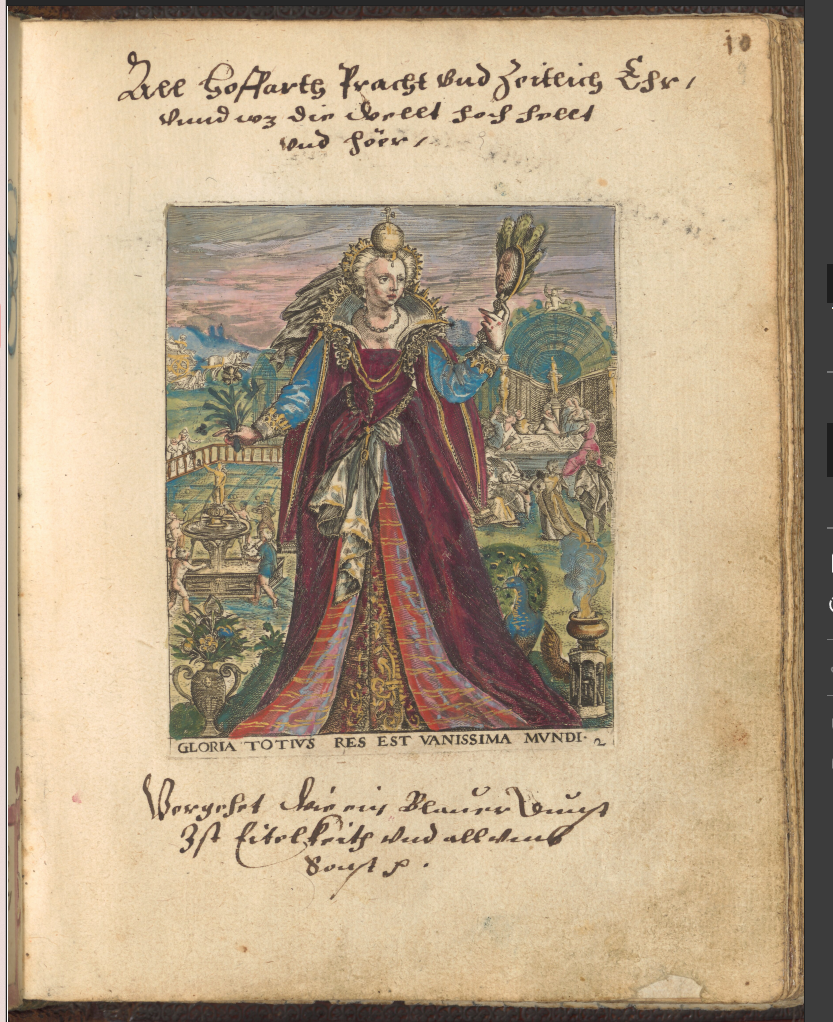
Here Adam has simply transcribed the German verse or Emblem II — Die Hoffart [Pride] — as printed on p.14:
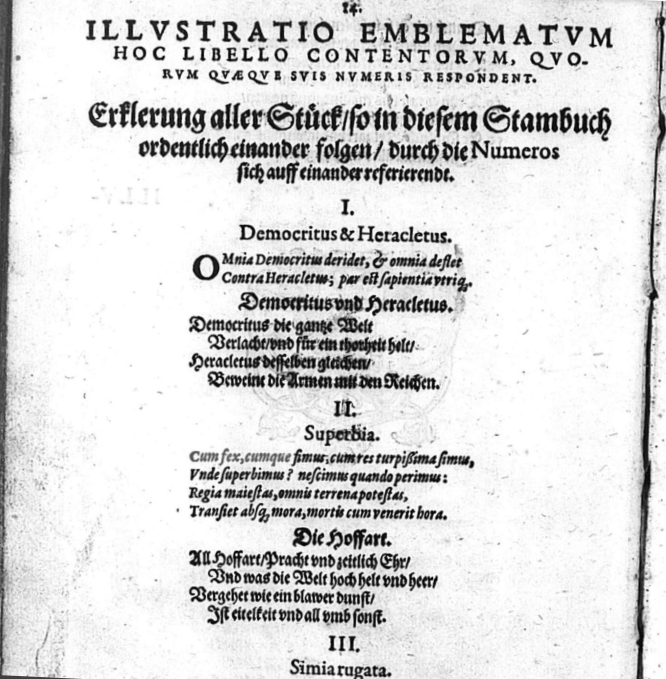
Here we also learn that the allegorical figure with the globe on her head represents Superbia [Pride], though the motto below the plate itself meaning, literally, “The glory of the whole world is the vainest thing”, makes Vanitas an equally suitable name for her.
A copy of this image engraved by Salomon Miller is dated 1592, four years before the Emblemata saecularia was published,
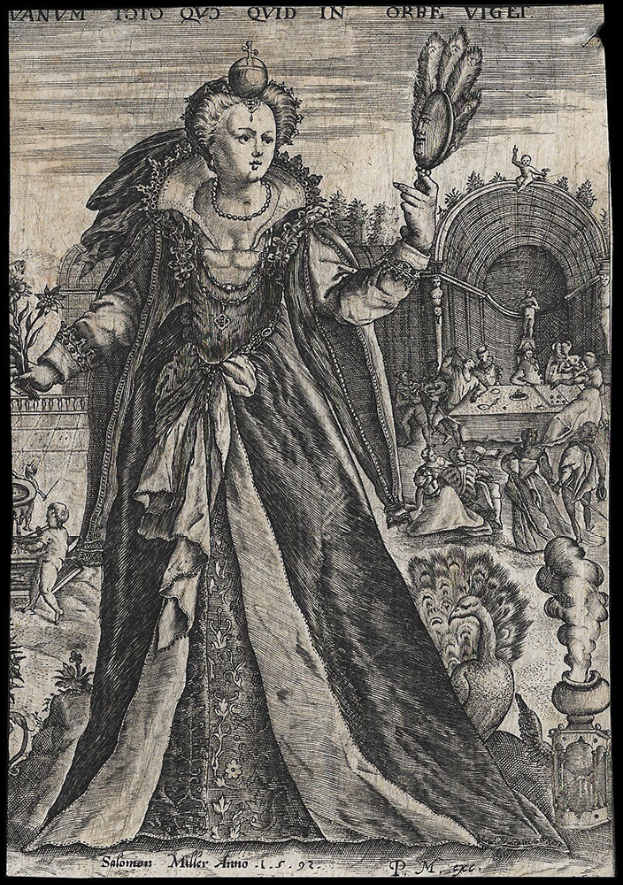
but — especially because it is in reverse — it seems likely that de Bry was copying this undated print attributed to Crispijn de Passe by Hollstein
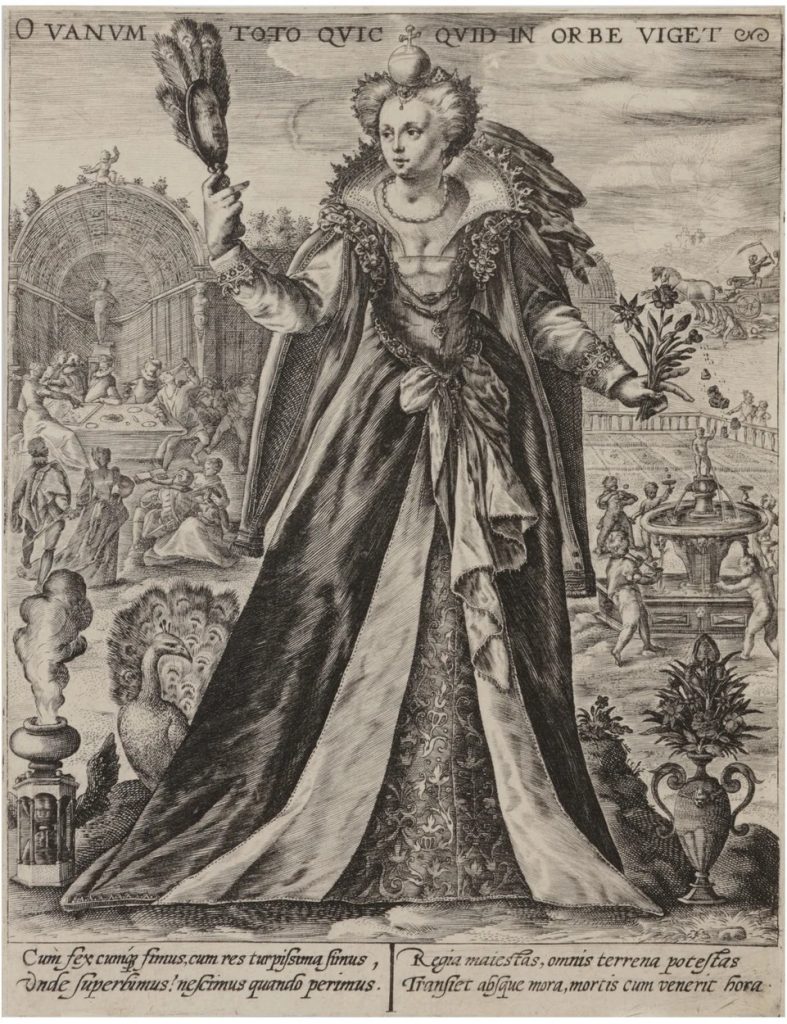
The captioning Latin verses are the same as those found under Superbia on p.14 of the Emblemata Saecularia (above) — so it seems de Bry copied those too — unless, of course, the debtor is de Passe, and the situation is the opposite! In favour of this last suggestion is the fact that almost all de Bry’s emblems are supplied with similar Latin verses in the Introductory matter, and undoubtedly late 16C Frankfurt could furnish competent neo-Latin laureates.
Perhaps a little earlier (BM suggests 1580s) is this figure labelled MVNDVS [World] from an engraving by Hiernymus Wierix:
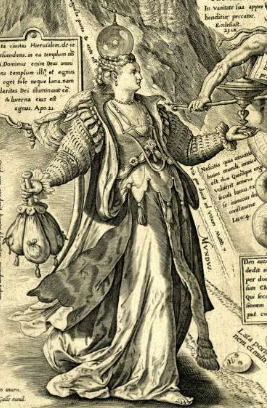
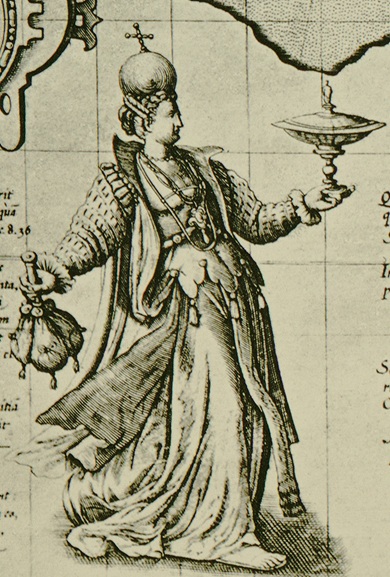
It was copied closely by Jodocus Hondius to inset in a large expanse of ocean at the foot of his world map of c.1596
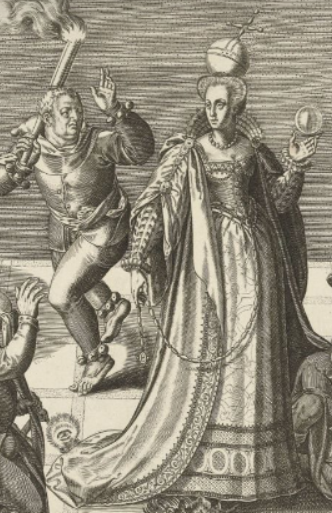
A similar Mundus appears at the centre of the Chorea Mundi [Dance of the World], an engraving sometimes attributed to Pieter Baltens, and dated c.1600 by the Rijksmuseum. In addition to the identifying globe, she holds a bubble, symbol of transience and Vanitas in one hand, and a peacock feather, symbol of Superbia, peeps out from under her gown:
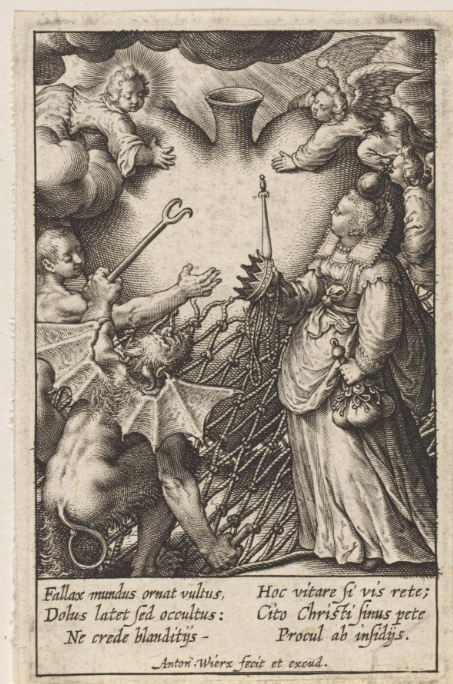
Around the same period, another member of the Wierix family, Anton (d.1604), produced a series of heart-themed engravings under the title, Cor Iesu amanti sacrum, which were to become highly influential, and may be said to be responsible for the outpouring of books of heart-emblems in the first half of the seventeenth century. In the present engraving, Fallax mundus [the false World] — with the identifying globus cruciger on her head, as usual — holds the trappings of royalty in one hand and — as in the earlier engraving of Mundus by his older brother (above) — a purse in the other.
Thus we see how the Hinterhofer album painter (after 1591)
Leave a Reply