Images of human beings divided vertically in half — a strikingly graphic means of suggesting, for example, 2 sides to a personality, or any binary opposition, living/dead, male/female, old/young/, fool/wise man, Catholic/Protestant, etc. — and one of the commonest images in the albums. Although found in the albums as early as 1560 (below), there can be no doubt that the inclusion of such figures in Jost Amman’s Stam und wapenbuch (1579) and Kunstbuchlein (1577, 1578, 1580, 1599) — books which were themselves used as albums — greatly increased the visibility of such motifs. Of course, the motif is not an invention of the album-painters, and occurs ‘instinctively’ in various cultures and eras. The design is clearly appropriate to symbolise any situation in which a person’s motives or loyalties are divided, and outside the ‘Germanic’ countries, it came naturally to artists wishing to symbolise the English Civil War, for example.
A distinct sub-type — attested from the 17C — is the memento mori, showing one half of the figure as a skeleton.
We begin with a few examples of the ‘normal’ type, which pre-date the albums:
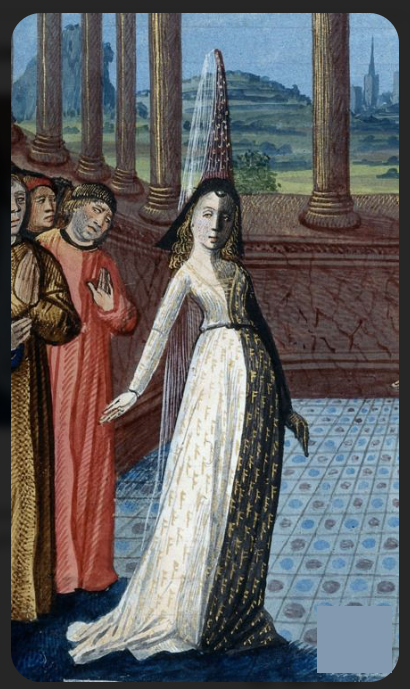
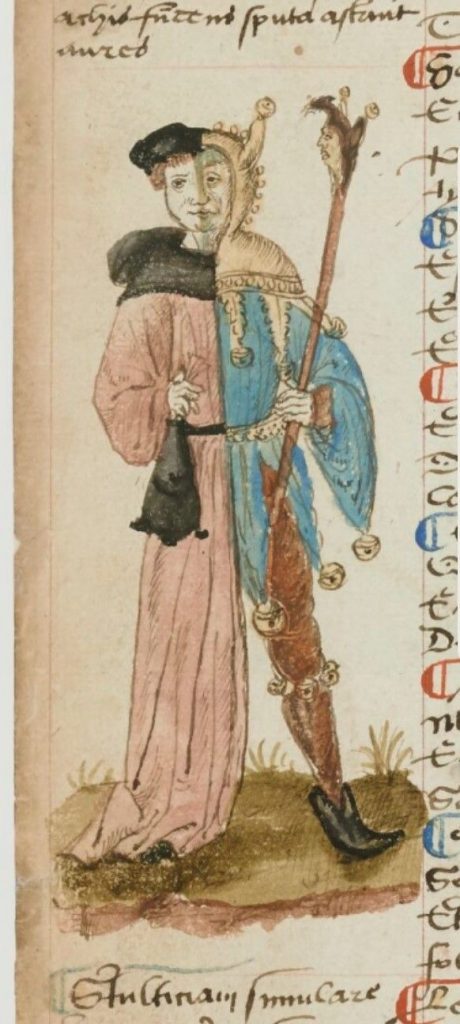
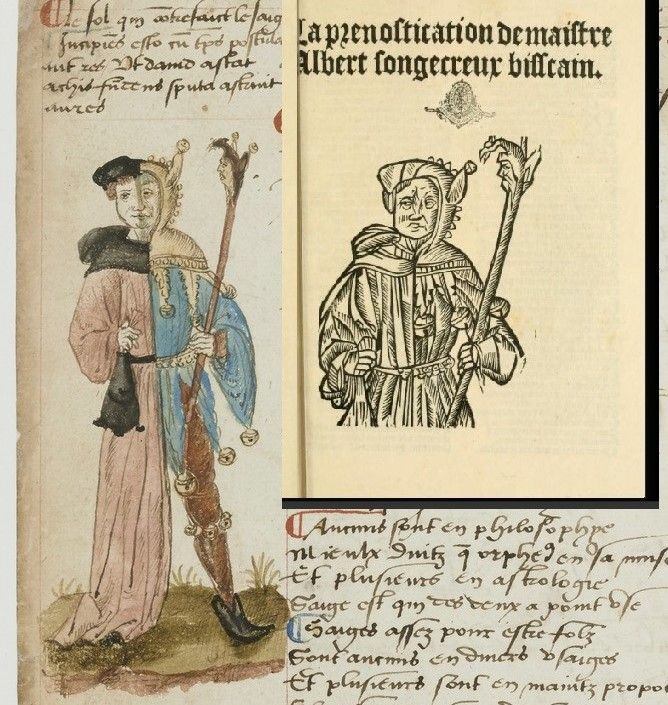
But the bifid figure above is copying the woodcut illustrating a lost pamphlet published in Paris c.1525:
In a manuscript of Johann von Schwarzenberg’s Memorial der Tugendt, compiled in the 1530s, a bifid man/woman kneels before Christ and the Devil — in an attempt to ‘serve two masters’ [Matthew VI.26].


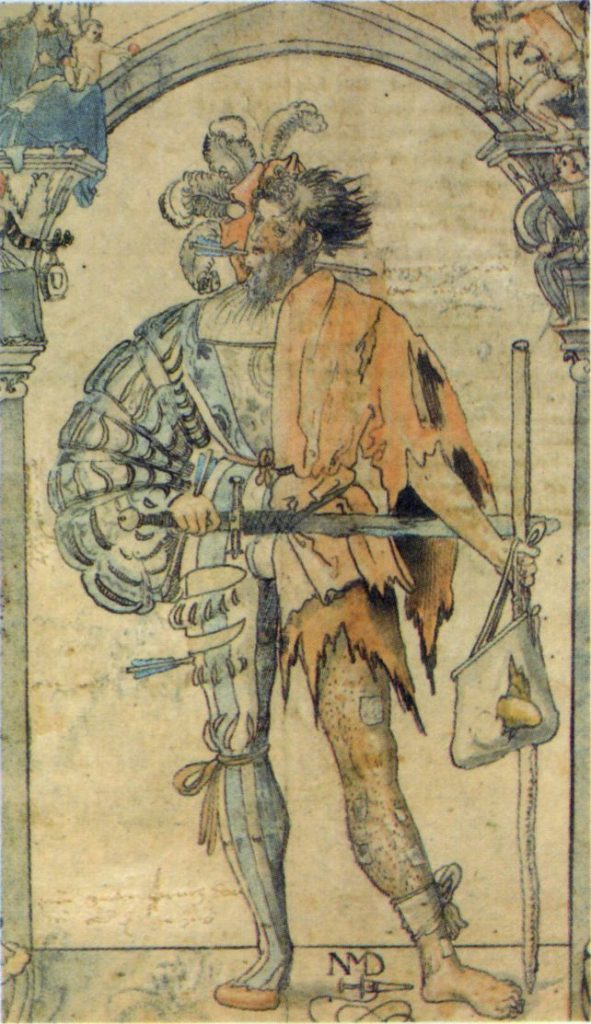
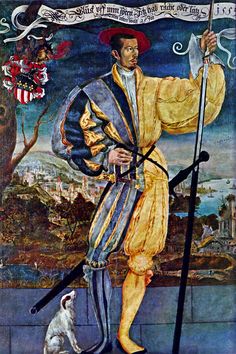
Of course, mi-parti was part of the real-life costume of some occupations, the fool, as of long-standing and, more recently, the German mercenary soldier [Landsknecht]. This is his brother, Rudolf’s, portrait of Niklaus Manuel Deutsch (artist of the 1514 bifid above), dated 1553:
And contemporary with the earlier album images, this alchemical androgyne from Leonhardt Turneysser zum Thurn’s Quinta Essentia (Munster 1570):

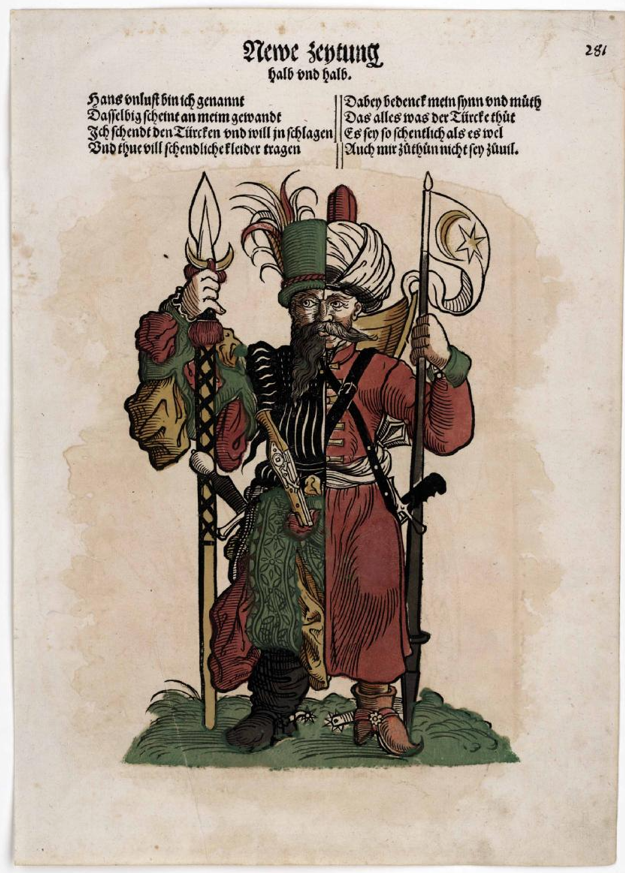
A satirical woodcut-illustrated print preserved uniquely in the Gotha collection undated but certainly a.1550, and entitled Newe Zeytung halb vnd halb [News — half and half] depicts a bifid figure who says his name is Hans Unlust and is depicted as half-Landsknect/half-Turk. The text explains that the Landsknechts’ dress is every bit as exotic as the Turks against whom they fight.
In the albums
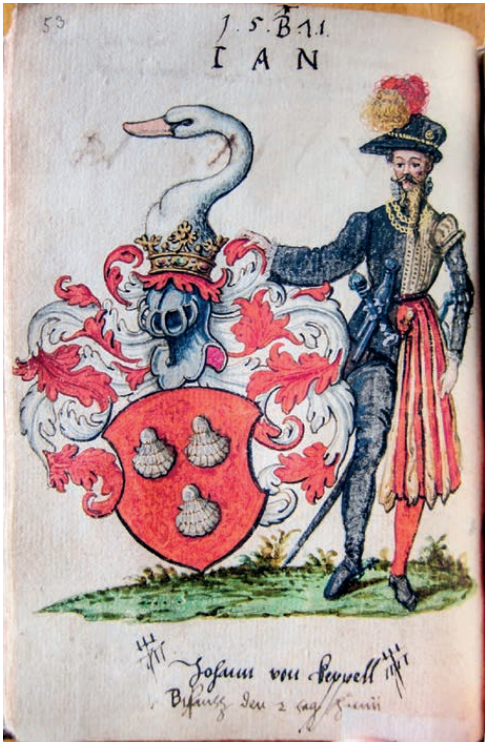
Such composite bifid figures are found as early as 1560 in the album corpus, and significantly the earliest in the Keuther album — half doctor, half Landsknecht — functions as a supporter to the coat-of-arms, but with a banderole curiously reading,
Bin ich schon ains buchs beraübt [I’ve already had one book stolen
So ist mir doch ain spies erlaübt So I’m allowed a spear!]

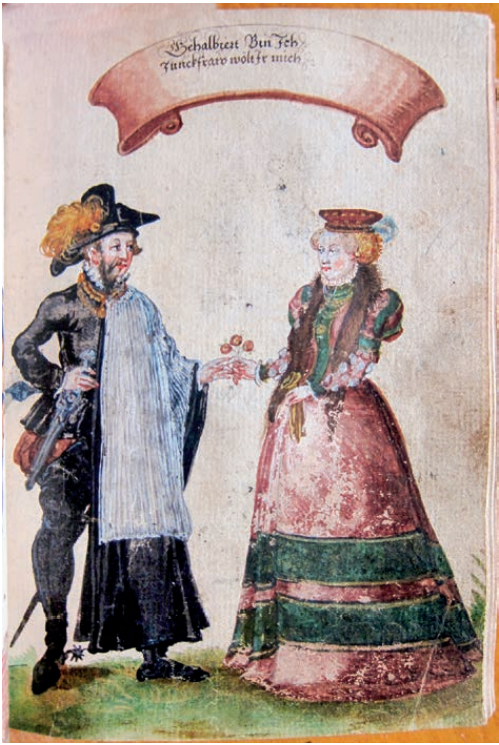
The motto here reads
Behalbiert Bin Ich Junckfraw wolt Ir mich [I am divided in half, girl, do you want me?]
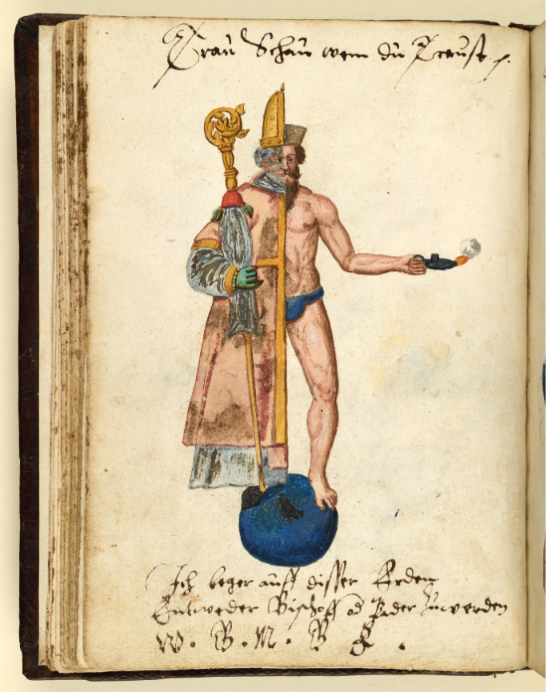
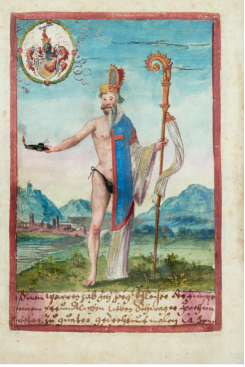
Below is a page from Jost Amman’s Stamm und wappenbuch hochs und nider stands published by Feyerabend in Frankfurt in 1579 — this copy of the book was used as his album by Bernhard Kötzler from 1582 to 1598. It shows Feyerabend’s coat-of-arms supported on one side by a bifid figure, half-bishop, half-bathhouse-attendant, alluded to in the verse below which explains that it is entirely in God’s hands ‘whether I become a bishop or bathhouse-attendant’ [ob ich Bischoff oder Bader werd].
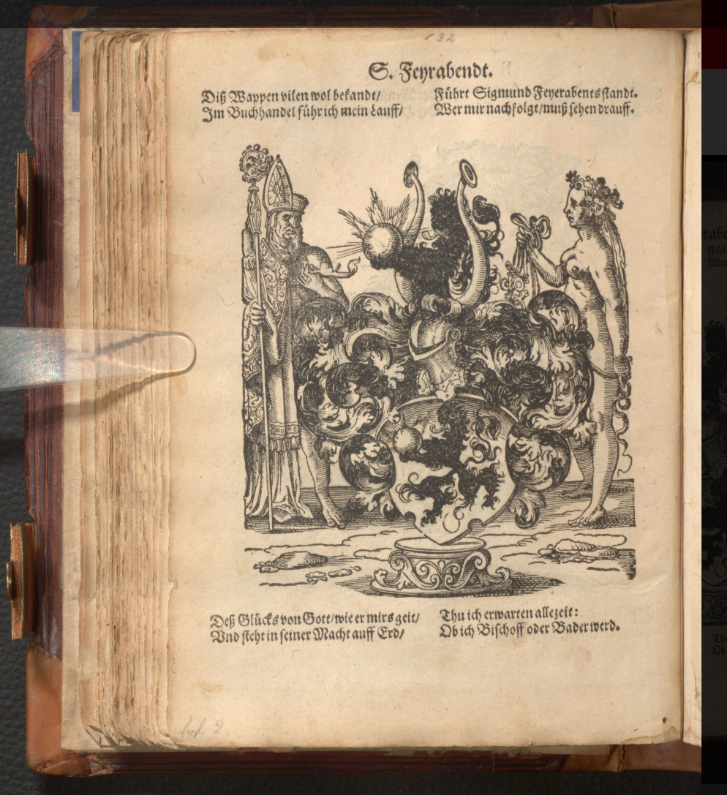
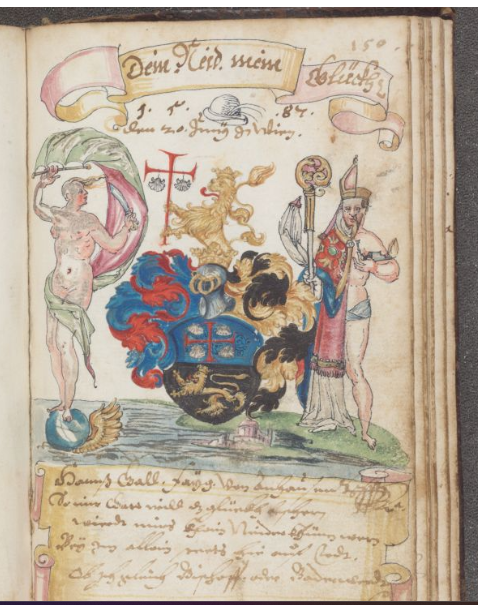
The alliterative juxtaposition Bischoff oder Bader [bishop or bath-house attendant], fairly common in German in the 17C, seems to be found first here, both as text and image. The painter of this page (below), dated 1587, in Paul Baumgartner’s album has clearly copied Amman’s bifid to be one of the supporters of the coat-of-arms of the commissioner, Hannß Gall. Fayg. von Anhausen — and Amman’s final couplet:
Bey im [Gott] allain steets hie auf Erdt
Ob ich gleich Bischoff oder Bader werdt.
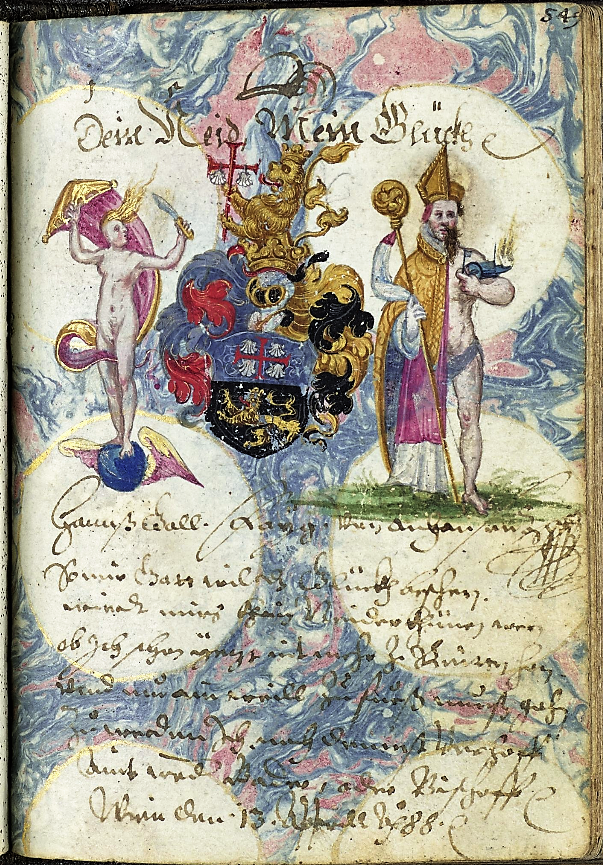
But the following year the same man signed the album of Caspar von Abschatz with exactly the same arms and supporters:
In Sieber’s important Volk und volkstümliche Motivik im Festwerk des Barocks (Berlin 1960) he noted that in the 1587 celebrations at the ducal court in Dresden appeared three such bifid actors: a bishop/poor man, a scholar/fool, and a cavalryman wearing old/new fashions — but, especially in view of the date (as above), it seems highly likely that Sieber’s armer Mann was, in fact, the usual other half of this particular bifid, i.e. the bathhouse-attendant — being semi-naked, it is perhaps understandable that he might be misunderstood as a poor man with hardly any clothes to wear!
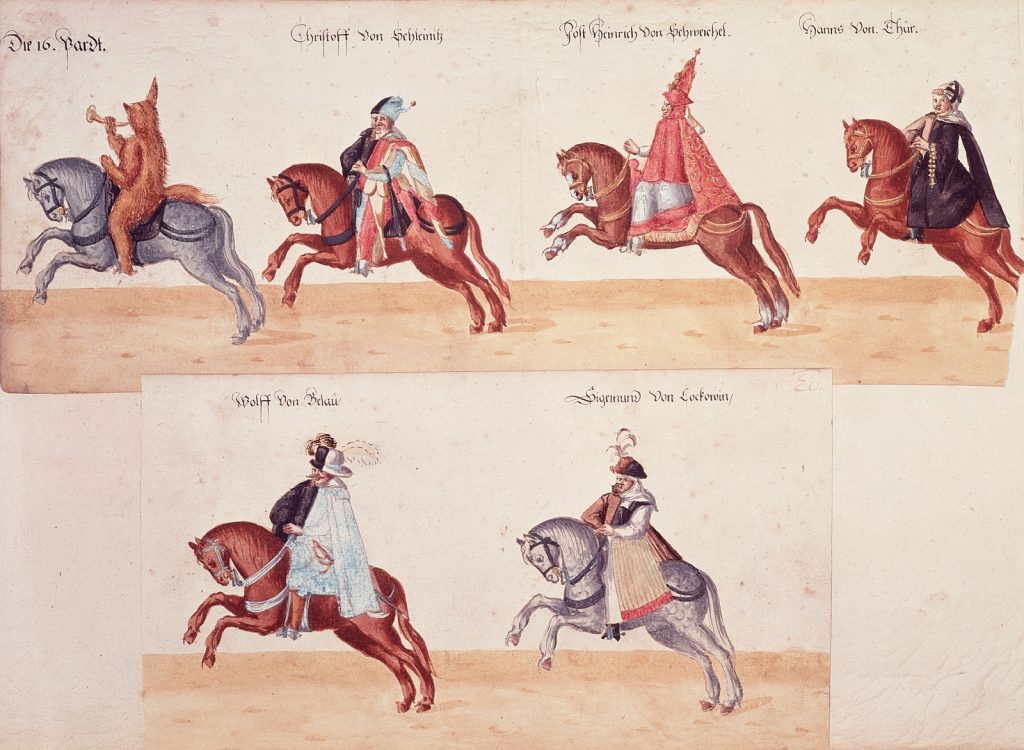
In the 1609 Dresden Fastnacht [Carnival] pageant six such bifid figures appeared on horseback led by a bifid animal, a fox/hare blowing a hunting-horn — in hot pursuit followed another scholar/fool, then a bishop/lawyer, a monk/nun, another cavalryman wearing old/new fashions, and finally a man/woman bifid — a wilde Jagd indeed! Here are all six bifids as portrayed by Daniel Brettschneider (the Elder), court-painter to the Duke of Saxony:
If we now turn to the editio princeps of the Pugillus facetiarum (Strasbourg, 1608)
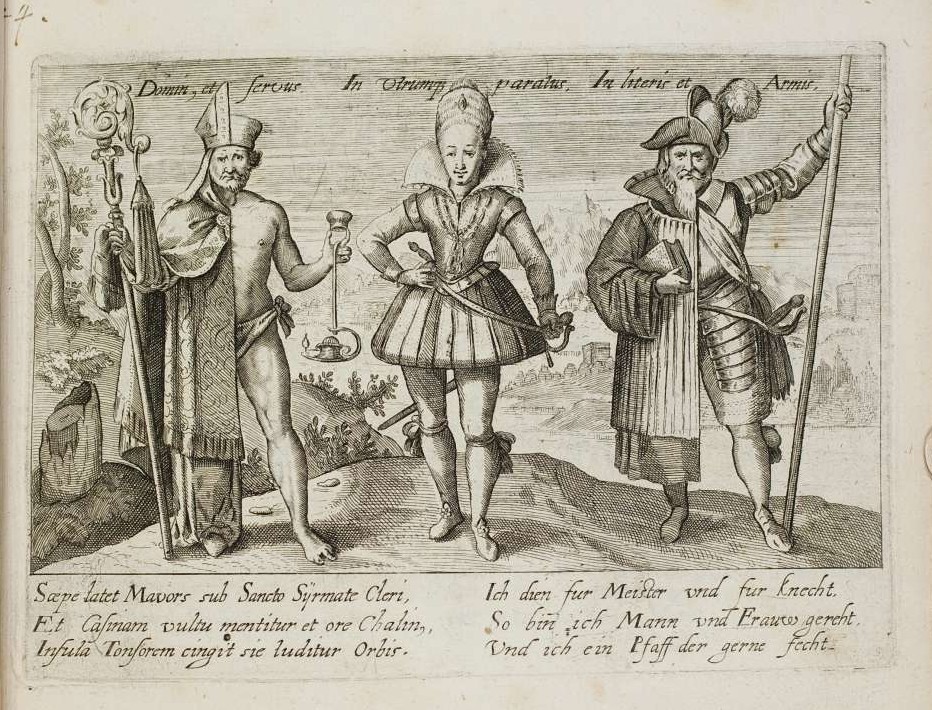
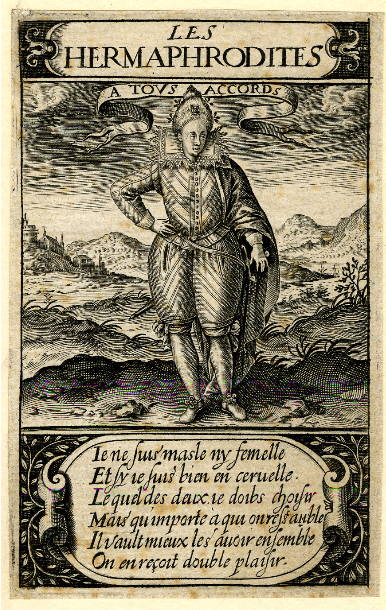
we can see where Jacob von der Heyden found his first bifid. The middle figure is not a bifid as such, i.e. not divided vertically into two different halves, but a hermaphrodite [Mann und Frau gerecht — as the verse caption puts it], and in fact, von der Heyden took this man/woman from the title-page engraving of a book published 3 years earlier entitled, Les Hermaphrodites. The figure describes itself in the verse below the illustration as neither male nor female [Ie ne suis masle ny femelle]. The Latin motto accompanying the figure in the print-book, In utrumque paratus [ready for anything], similarly translates the French motto of that work, A tous accords [ready for anything].
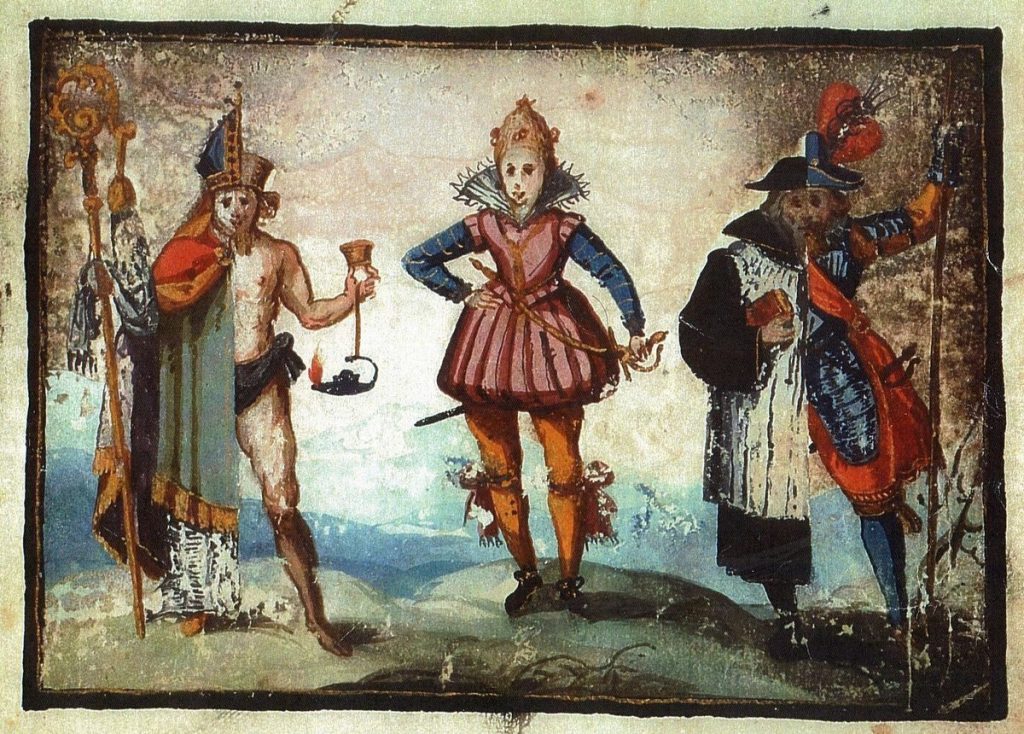
This image in the Hartmann album has clearly been copied wholesale from the Pugillus plate
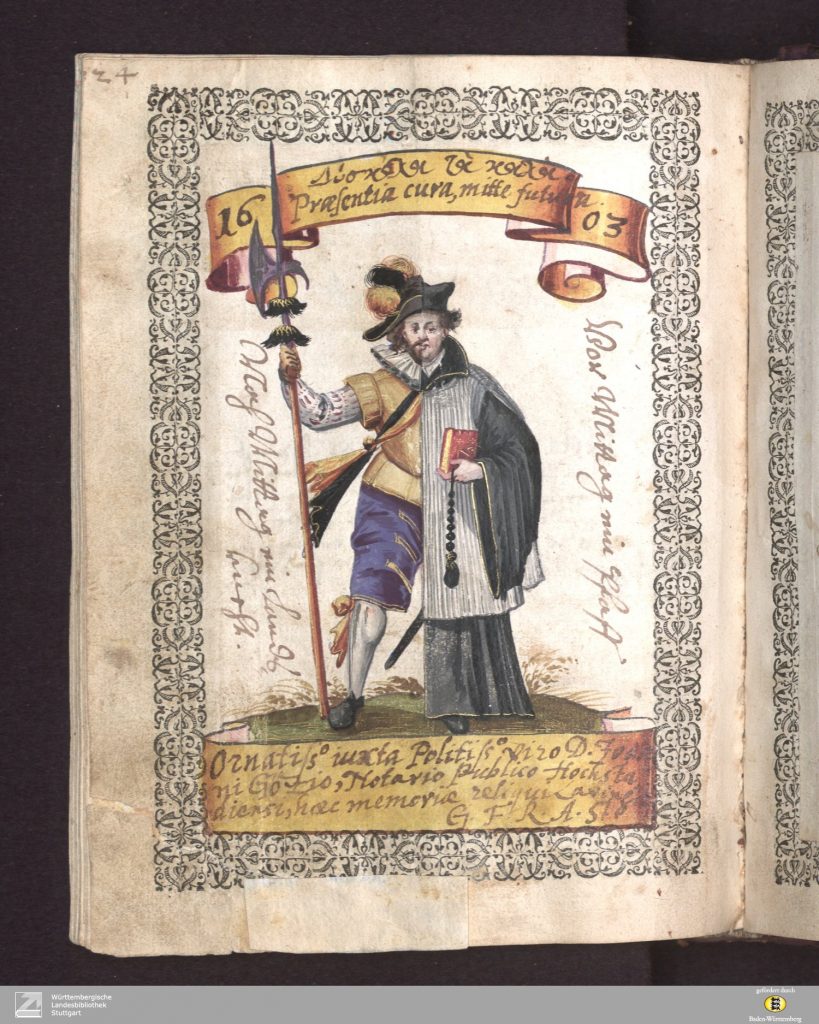
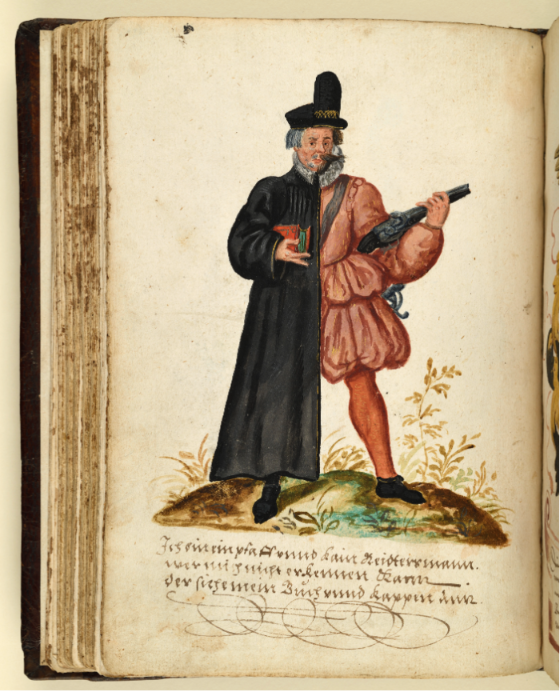
The remaining pastor/soldier bifid was a popular combination both before and after the publication of the Pugillus, and yet again, earlier examples confirm Von der Heyden’s assertion that the plates he engraved were based on paintings he had seen in actual students’ albums. This miniature in the Loth von Weissenbach album painted 2 years before the Pugillus appeared, is particularly close to the Pugillus plate:
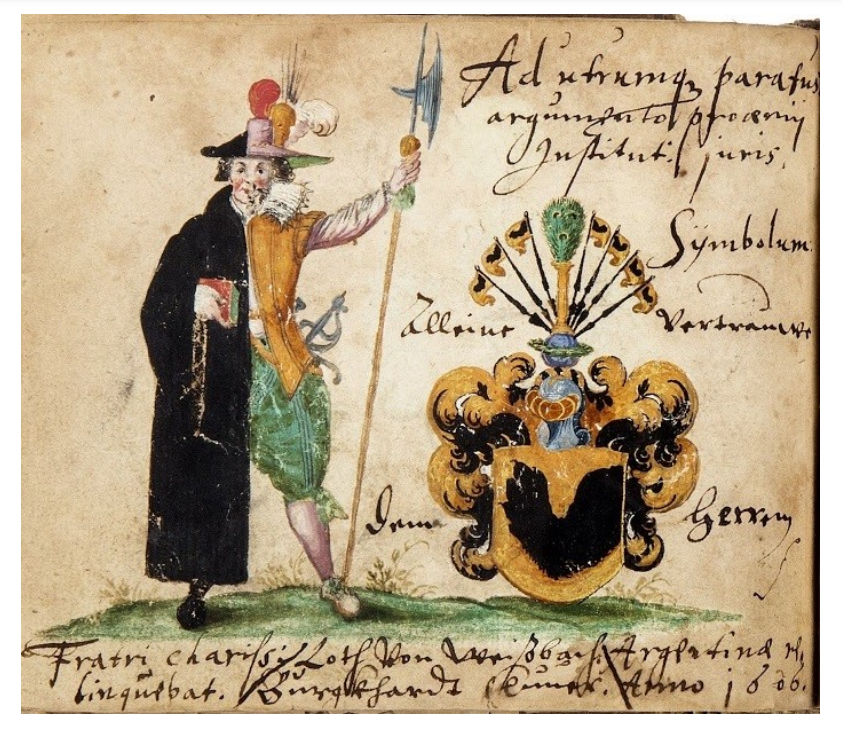
The Hayder album painter has copied the bifids only, not the hermaphrodite
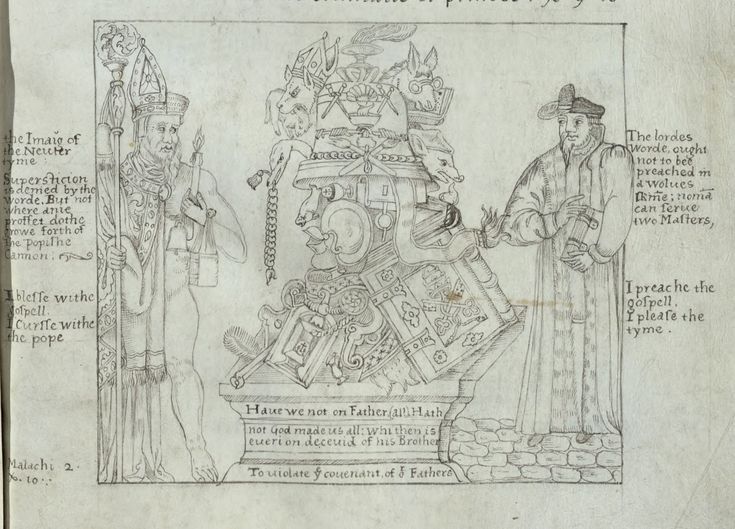
I was excited to discover the drawing below in an anti-papal English manuscript compiled in 1623 — note how, in place of the bath-house attendant’s oil-lamp, that half of the bifid figure here is equipped to curse with “bell, book and candle”.
[ I discuss the manuscript and reproduce the relevant images and their derivations here: https://uk.pinterest.com/malcmjones/jacobean-anti-papal-manuscript-tcc-r1626-1623/ ]
We have seen how Hannß Gall. Fayg. von Anhausen made use of the bishop/bathhouse-attendant bifid in two of the albums to which he contributed in the late 1580s (above), and doubtless via its appearance in Amman’s books, it is found, independently, as it were, in other albums too:
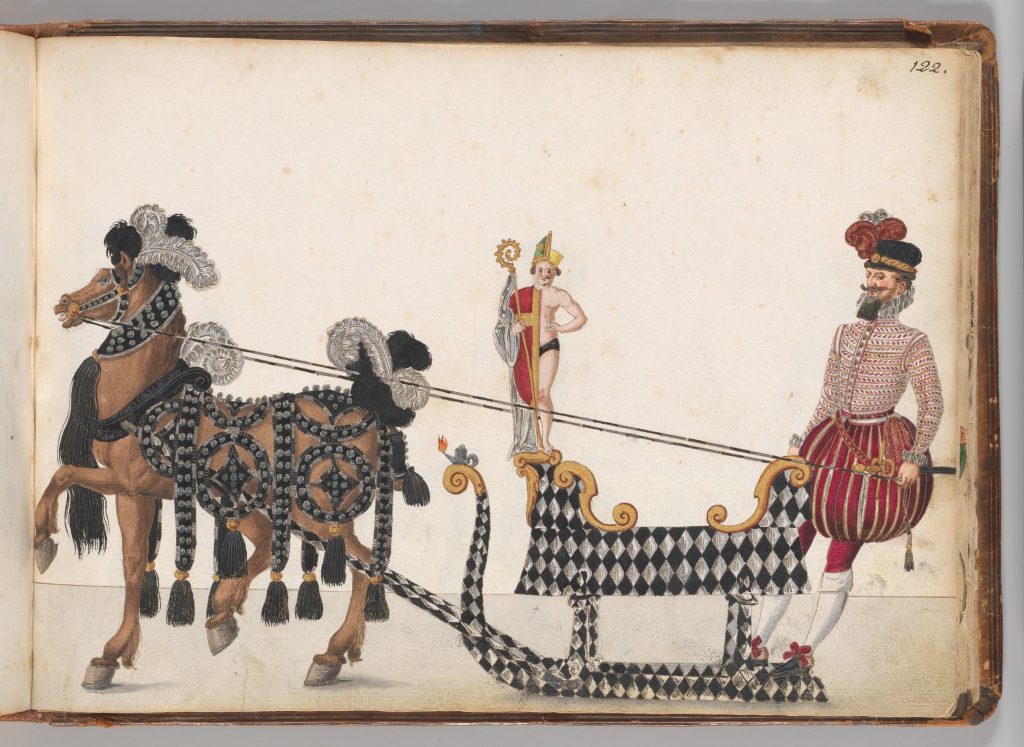
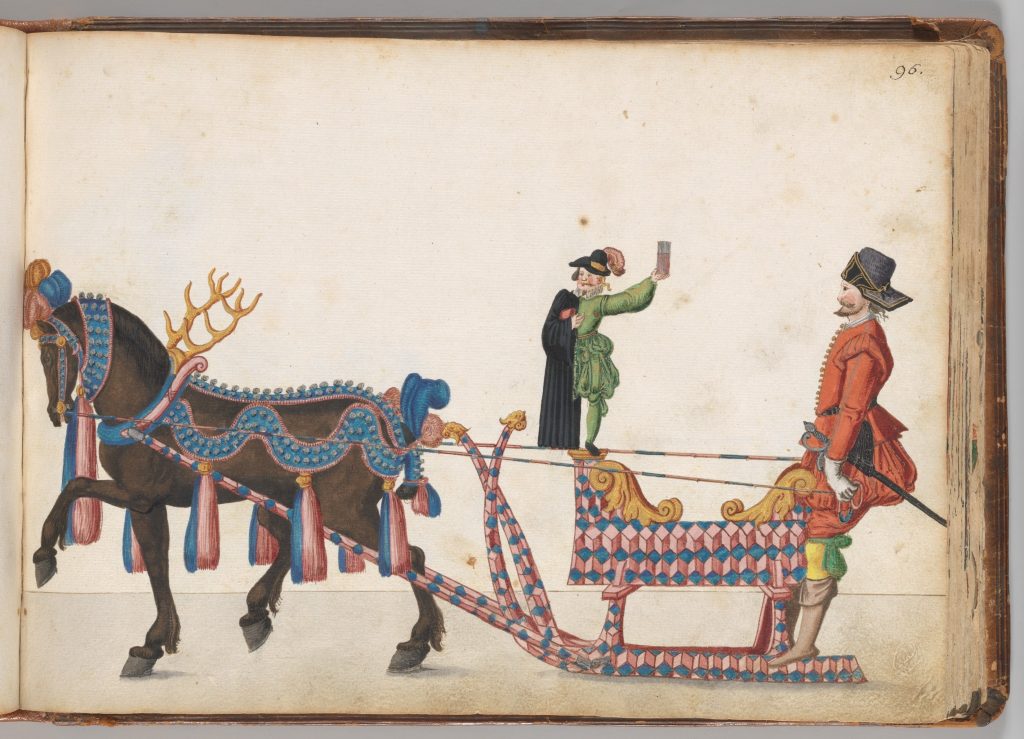
but he/they make(s) an unexpected appearance as a sleigh-finial in the record of a pageant which took place in Nurnberg c.1640. The fact that one of the other finials is the pastor/soldier type, that accompanies the bishop/bathhouse-attendant in the Pugillus plate, suggests that the pageant-designer was using the print-book as his source.


Other bifids
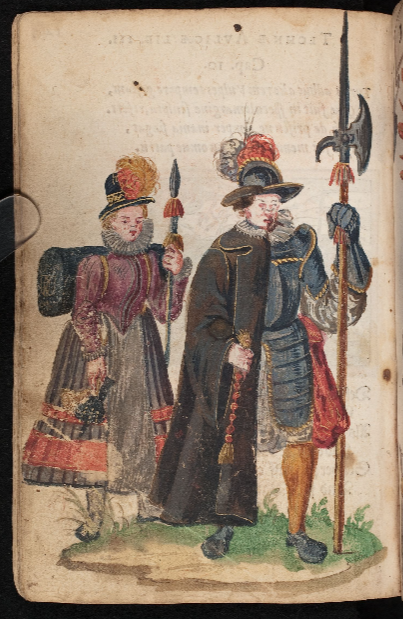
The Landsknecht half of the bifid painted in Schenk von Limburg’s album is accompanied by his ‘camp-follower’ — who does not share his bifidity — and now it occurs to me that I have not noticed any female bifids in the albums.
Here are a couple of bifid musicians, painted some 40 years apart:
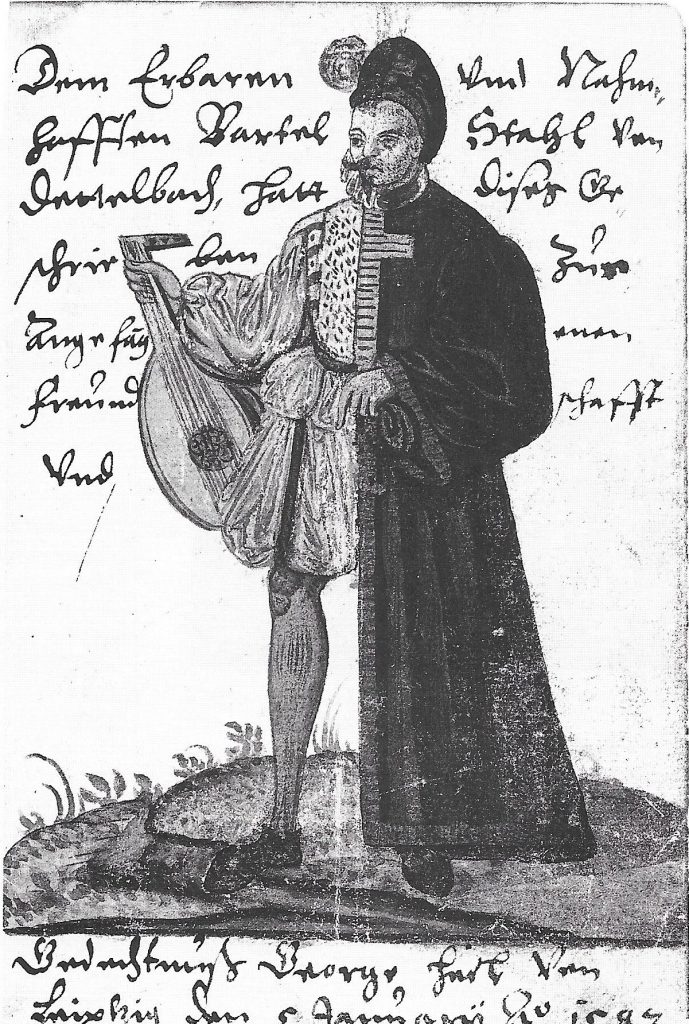
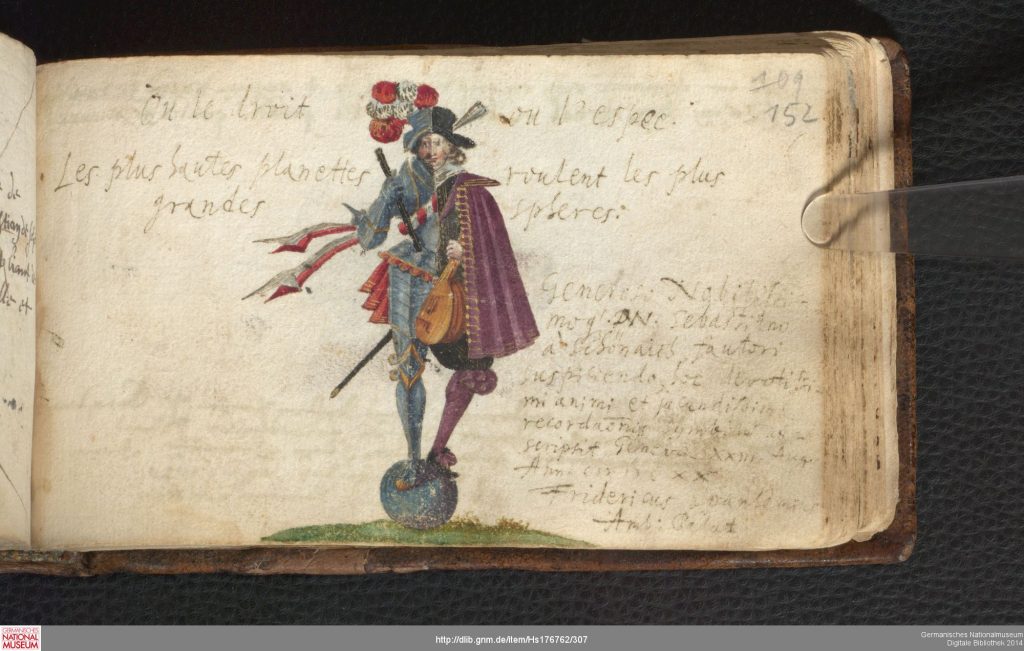
The French mottoes do not seem relevant to the miniature here: Ou le droit ou l’espee [Either the law or the sword] would be appropriate if the other half of the bifid were carrying a law-book, but he’s carrying a lute — a musical lawyer perhaps?
In this miniature in the Medinger album (below) I think we have an ecumenical bifid! His lefthand side with its rosary beads is the exterior of a Catholic priest, his righthand side the outward appearance of a Protestant divine. The words on the book read Verbum Dei manet in Aeternum [The word of God endures forever] were a favourite Lutheran slogan — here, I suggest, deliberately — ecumenically — placed in the hand of a Catholic priest.

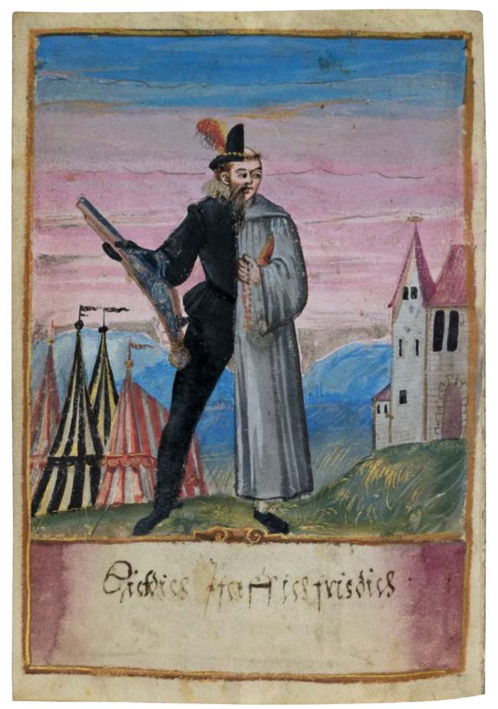
This bifid in the Widholz album (below) painted in 1583 or 4 is half-monk/half-soldier his appropriate sides facing the army tents and the monastery. The inscription reads Hiet dich Pfaff ich fris dich [defend yourself, ‘priest’, I shall eat you!] — a man at war with himself? But for two other examples of the animosity between monks and Landsknechte, see my post
https://albumamicorumear-e4qvahs764.live-website.com/monks-behaving-badly/
Below, an orphaned leaf sold at auction a decade ago. A bifid Fortuna ! Good & Bad fortune. She holds a pair of scales in one hand and a palm-leaf in the other. On her Good Fortune side, the sun shines down on a ship sailing peacefully on the sea; on the Bad Fortune side, the ship looks about to sink in a thunderstorm — and the wing of the customary winged ball she stands on droops down! The leaf is dated 1617 above and entitled Aequanimiter, which I take to mean that we should face our fortune — good or bad — with equanimity!

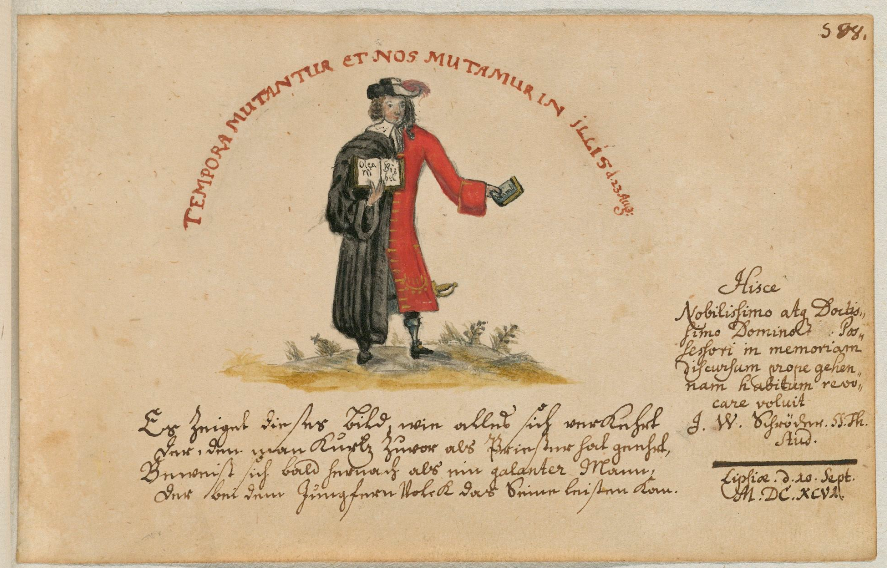
A late example (1696?) , this one amusingly captioned with the Latin tag that “Times change and we must change with them”!
To date, this is the only scene I have come across involving a bifid figure (below) — if, indeed, he is!
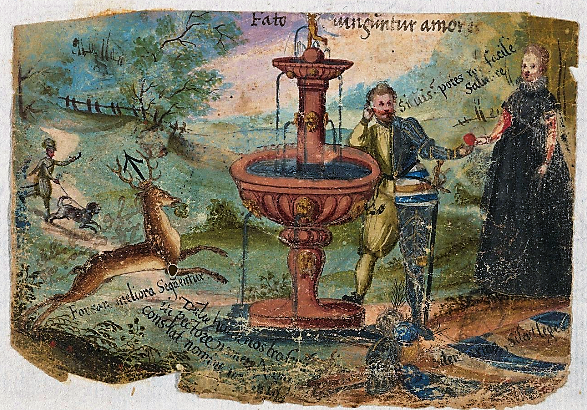
As we look at him, he appears to me to be wearing armour on his right side, and to be in civilian dress on his left side. The leaf is very rubbed so that much detail is lost, including inscriptional detail, but he appears to be offering a heart to the lady as he leans on the fountain basin. The title to the scene is Fato iunguntur amores which I take to mean “Love(r)s joined by fate”. His speech, as far as I can make it out, Si uis pots re facile Salu—- His helmet and perhaps the striped military banner he was carrying lie on the ground in the bottom righthand corner inscribed, inter arma silent leges [in wartime the law is silent] — which I cannot see is relevant in the present context. Enough of the severely rubbed longer inscription is readable to identify it as coming from the (Catholic) Shorter Catechism in the form disseminated by Peter Canisius in 1556:
Dulce tuum nostro scribas in pectore nomen Namque tuo constat nomine nostra salus
[may you imprint your sweet name in our breast for our salvation rests upon your name]
The prayer is addressed to Jesus in the catechism, so again, it does not seem appropriate to the present scene.
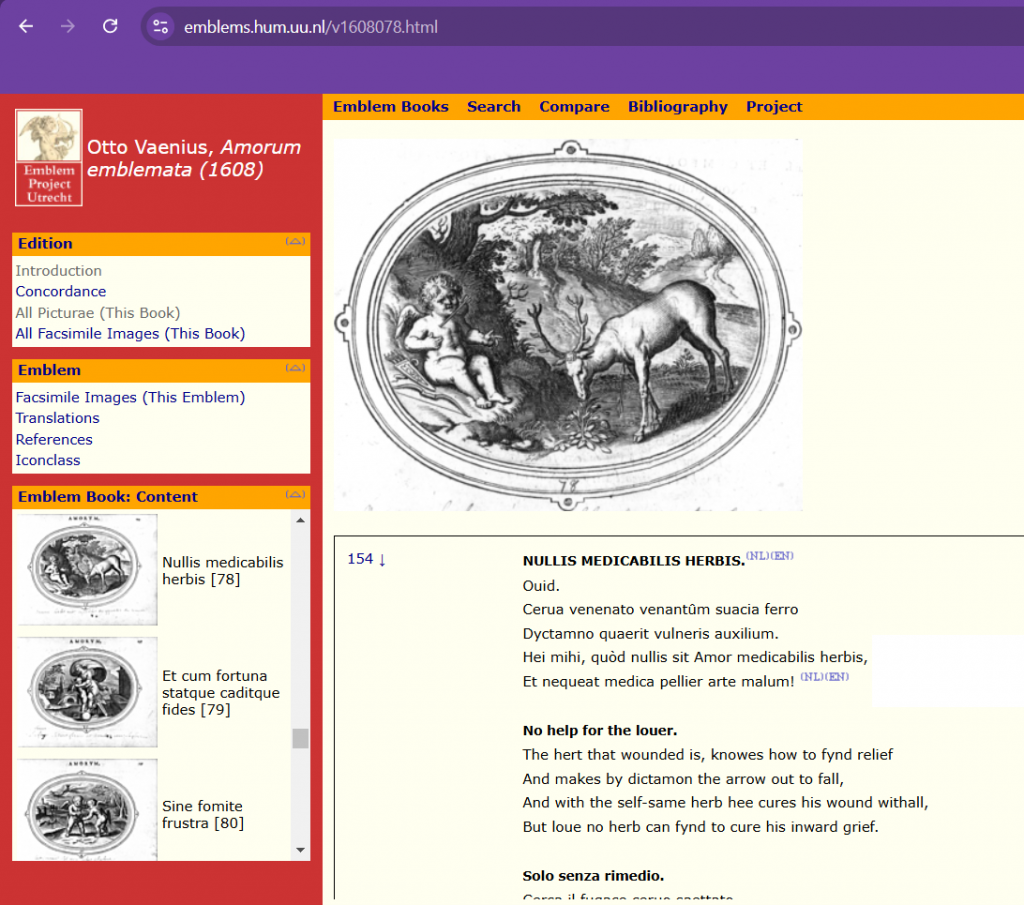
The stag on the left is labelled Forsan meliora Sequentur [perhaps things will follow], an arrow seems to be emerging from its head and it appears to be eating a leaf — doubtless of dittany, the herb which Pliny claimed the wounded stag would eat in order to eject the arrow with which it had been shot! Another stag munching on a dittany leaf is to be seen in the album of Margaretha van Wassenaer (below)
But the fact that the stag is heading for the fountain must surely remind us of Psalm 42, “as pants the hart for cooling streams when wounded in the chase…”

The stag eating dittany from Van Veen’s book of love-emblems — via the Utrecht Dutch emblem-books site — showing how well-known the motif was:
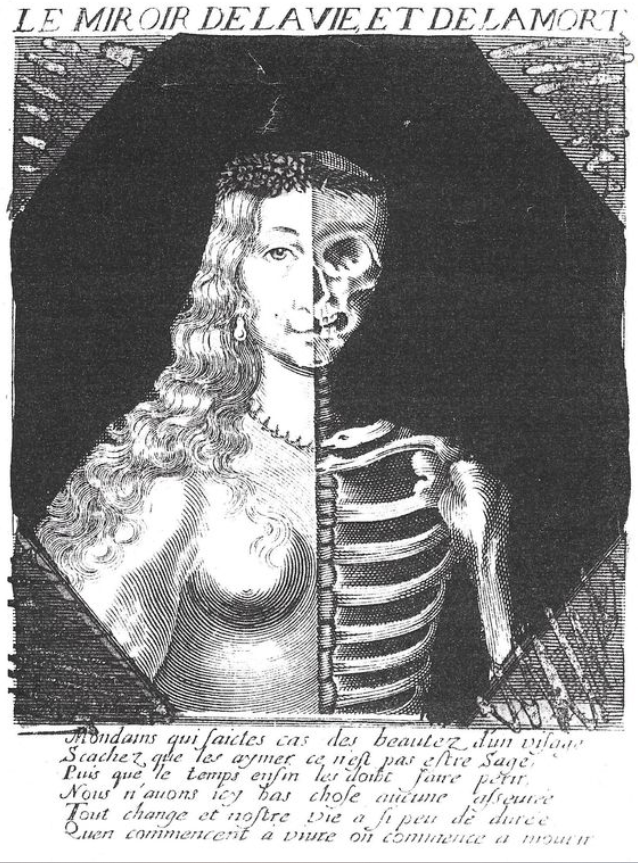
Memento mori bifids
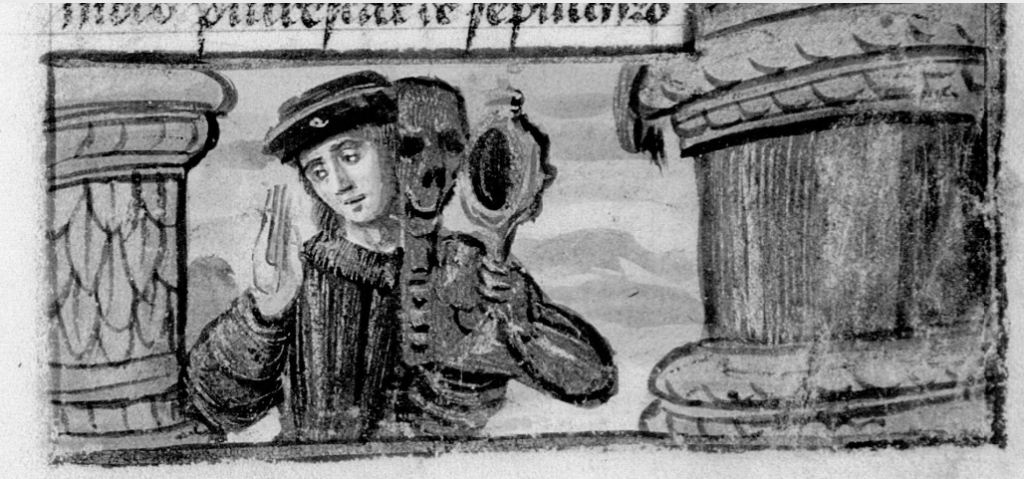
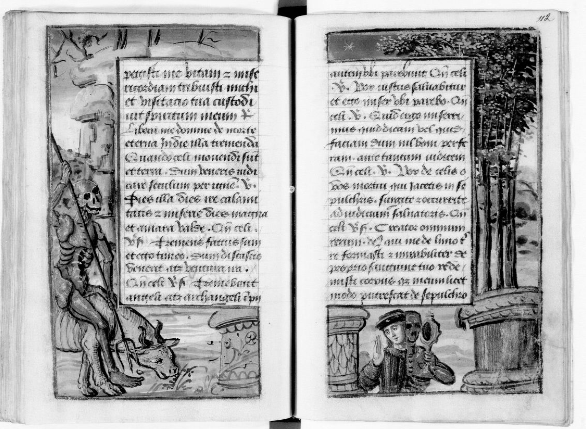
An obvious binary opposition is life/death, living/dead, live body/skeleton, live head/skull — and such grisly bifids are indeed to be found in the albums. Beore the albums, in graphic, as opposed to sculptural form, such bifids seem to be rare — the only one I have spotted myself is in this late 15C French Horae manuscript:
In the albums, the earliest such bifid I have noticed is dated 1592. The orphaned leaf in question was commissioned by one Hannibal von Waldstein who also dedicated the same inscription — ille sapiens qui utilia non qui multa scit [He is wise who knows useful things, not he who knows many things] in the album of Abraham & David Ulrich two months later:
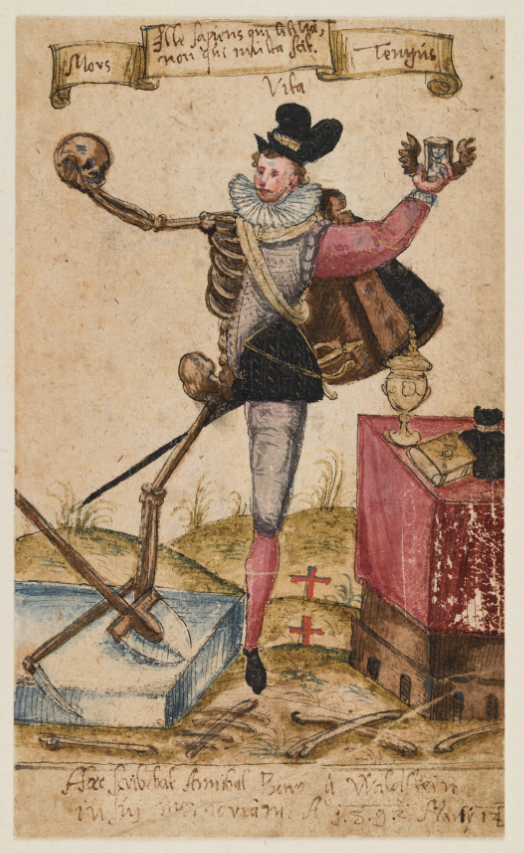
.
This contemporary, half-skeletonised Cupid is a new one on me! Note how the flowers on the skeletal half are withering. The Venus is very odd too — open heart, and the snake which usually belongs to Prudentia, wrapped round her arm. Sun and a ?wind-head behind her. And the dog?!
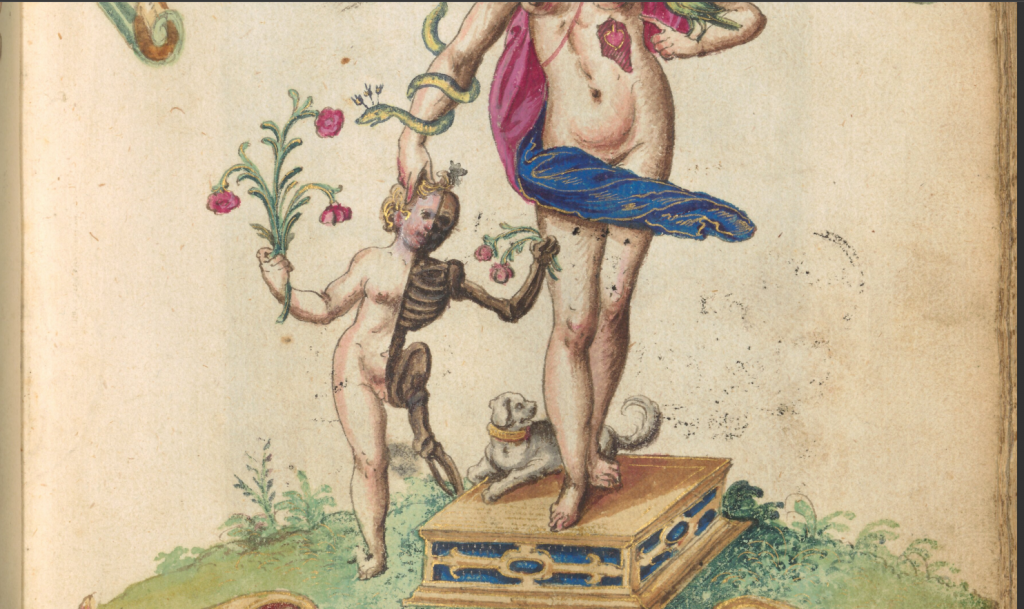

The title to this miniature is the very common memento mori inscription, Hodie Mihi Cras Tibi — me today, you tomorrow — the vernacular caption [kindly read for me my members of the Reddit forum Kurrent ] reads
Der Mensch Ist gemachet von Erdenn, wirdt wieder Zu der Erdenn Werdenn [Man is made of earth, will become earth again].
Here is a contemporary Italian print of this type (Rome 1593) though divided laterally rather than vertically:
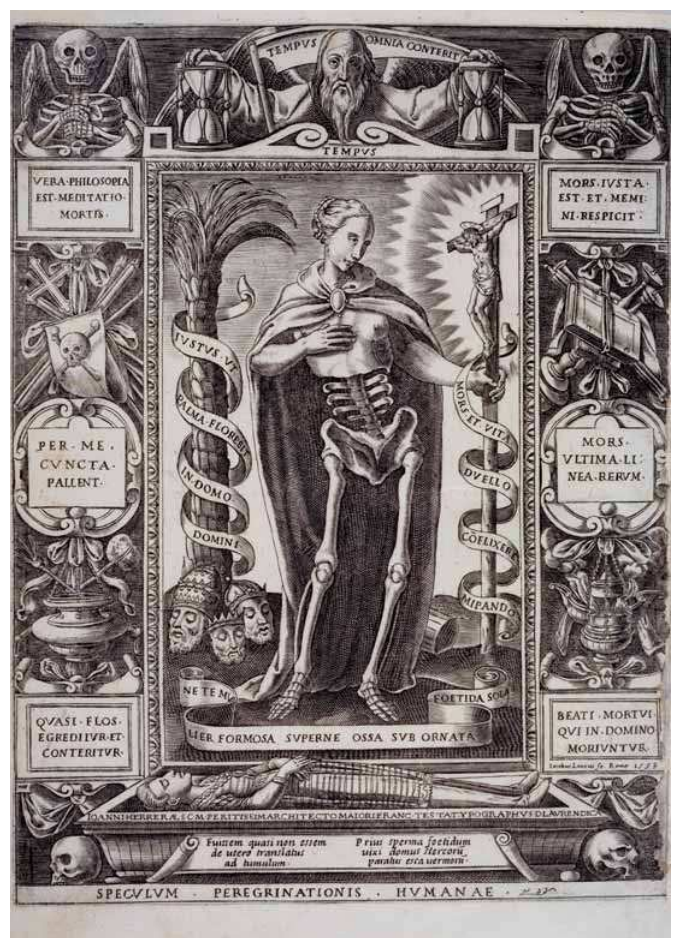
From the end of our period, dated 1643, a bifid head and shoulders, half-skull:
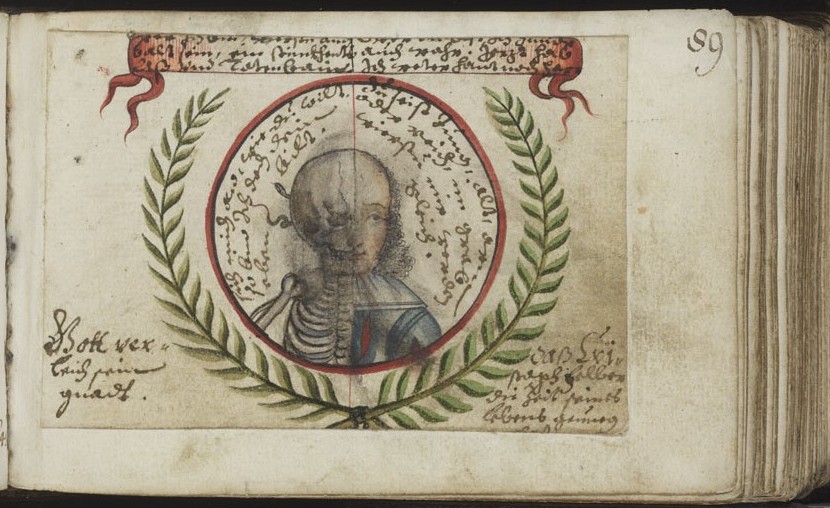
Two contemporary French prints — one of a decidedly more popular appearance:

Other media — and even English bifids!
Outside the album repertoire — apart from the sleigh ornaments (above) — I have noticed one such figure as one of the Schnacken painted on the early 17C ceiling of the tenement house in the Wroclaw main square …..

A surprising appearance of the bifid motif is to be found in a quasi emblem-book published in England in 1618, entitled The mirrovr of maiestie
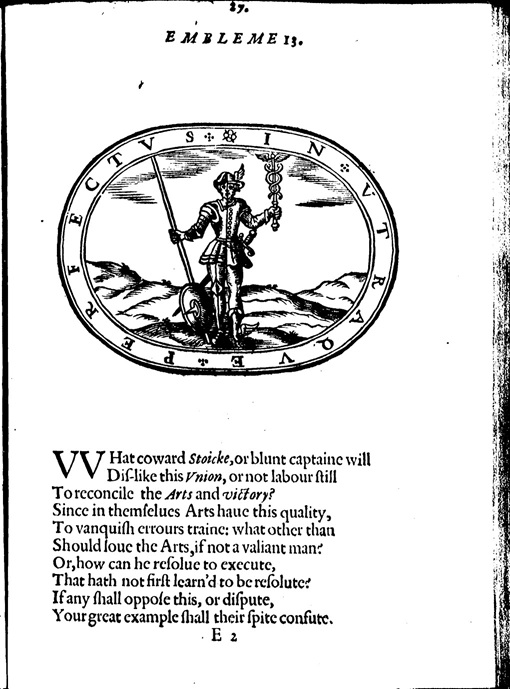
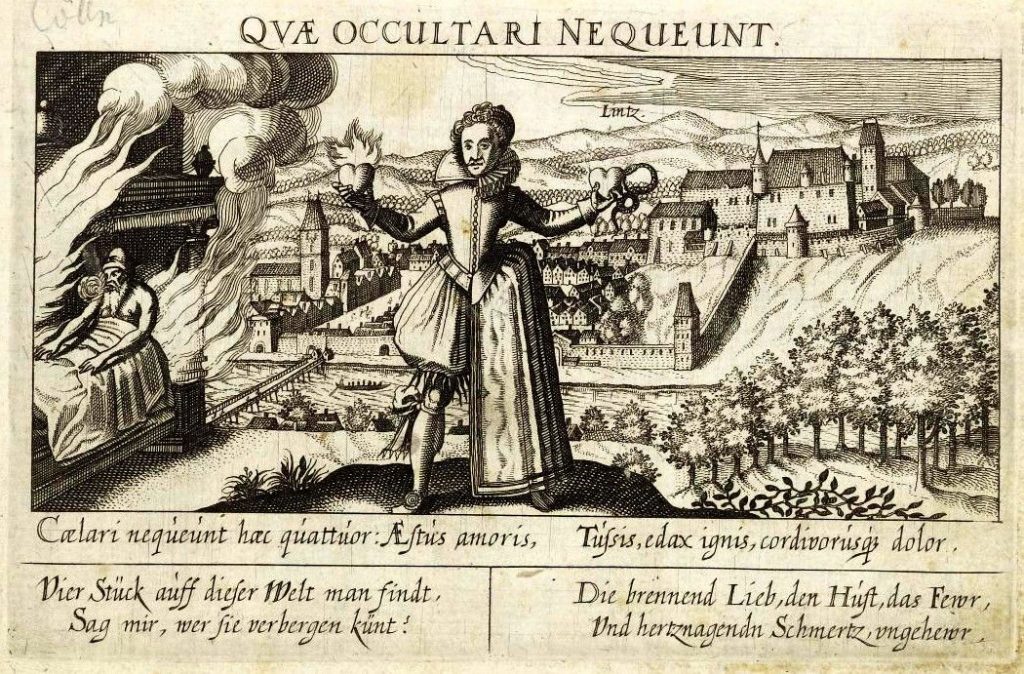
And back in Germany, here (below) is a page from Meisner’s massive Thesaurus Philo-politicus, from the volume issued in 1623, though it is not at all clear why this man/woman bifid is here illustrating the Four Things That Cannot Be Hidden; which — according to the German text (below the Latin, not visible in the image) — are burning love [symbolised by the flaming heart in the hand of the male half of the bifid], the cough, fire [see the old man coughing in bed — doubtless brought on by the smoke from the fire in his bedroom!], and the monster of heart-gnawing love [hertznagendn Schmertz vngehewr — symbolised by the heart being gnawed by a serpent in the hand of the female half of the bifid].
At the end of our period, preserved in Würzburg, is a glass dated 1649 enamel-painted with another man/woman bifid composed of a clothed male half holding a crossbow, and a semi-naked female half holding aloft a flaming heart. According to Axel von Saldern from whose book I have scanned this illustration, the lengthy inscription on the glass “refers to the man who courageously encounters the dangers of love and hunting ” (!)

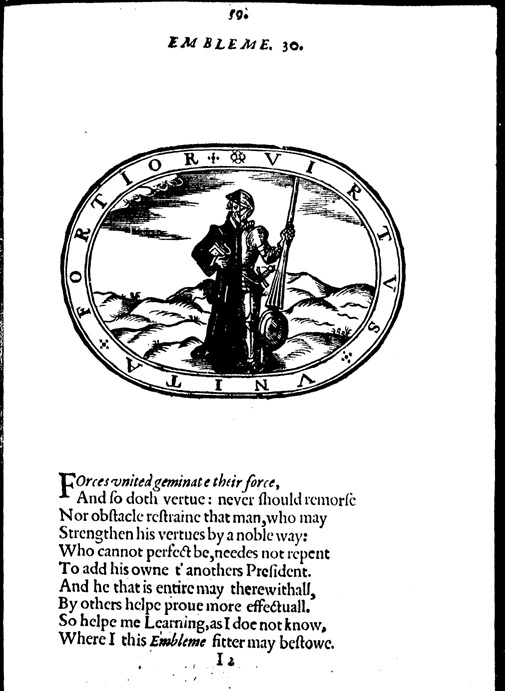
Embleme 30 in H.G’s Mirrour of Maiestie published five years earlier, is very probably the pastor/soldier bifid from the same plate
The pastor/soldier bifid with its motto, In Litteris et Armis, was a particularly popular combination, both before and after the Pugillus, and must also be one of the first album images to appear reproduced in a printed book, on p.362 of Schneidern’s Saxonia Vetus (Dresden, 1727) where a Dutch example is said to be a caricature of Christoph Bernard von Galen, the martial Prince-Bishop of Münster.
Dr Fischer Kunstauktionen, 193-I Europäisches Glas und Studioglas sowie die Studioglassammlung Kirchhoff. [DATE!] 6A – Becher mit Sinnsprüchen.
Leave a Reply