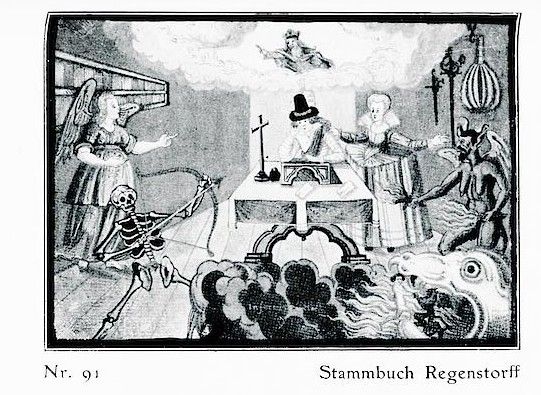
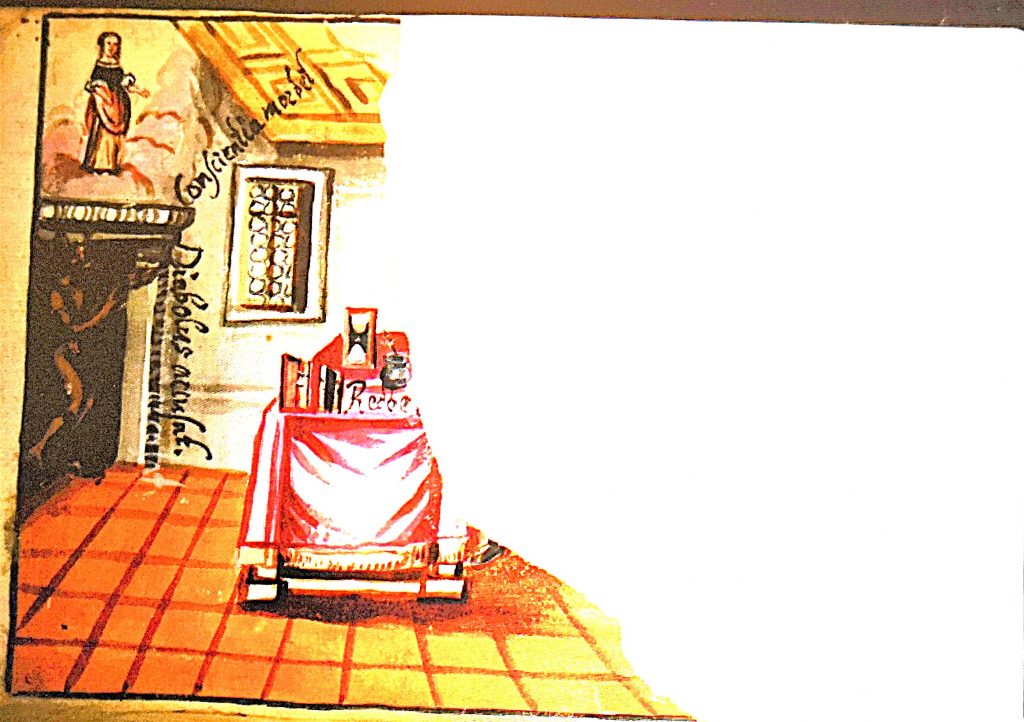
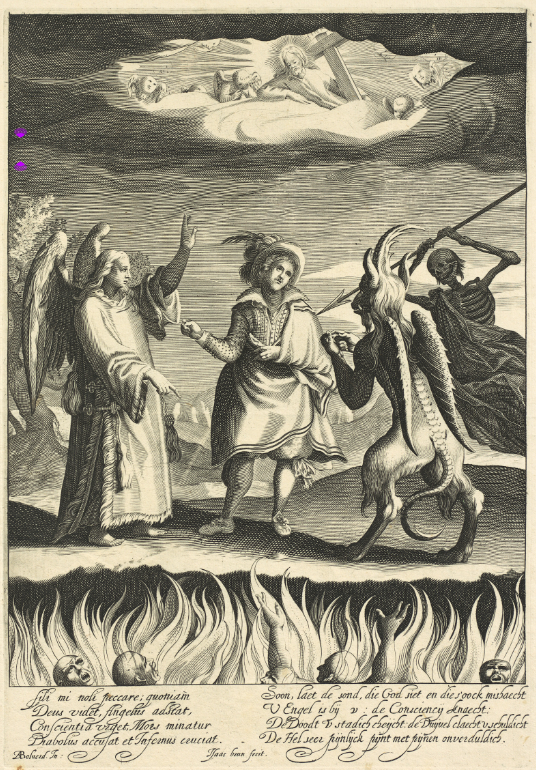
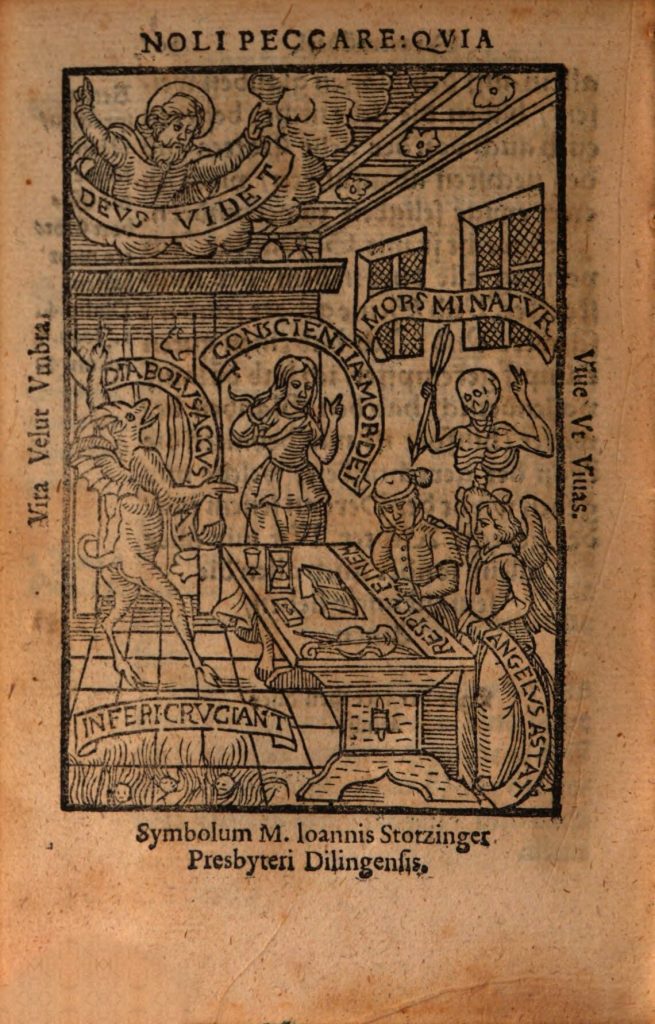
The manifold temptations to which the student is subjected, the battle for his soul, indeed, is the subject of an engraving signed with Jacob von der Heyden’s monogram and published in the 2nd edition of the Pugillus Facetiaum, re-titled the Speculum Cornelianum (Strasbourg, 1618). It shows the student at his desk, head in hand, with God the Father in a cloud above him and a yawning hell-mouth beneath him. To his right he is approached by an angel and a skeletal Death holding hour-glass and dart, while to his left a bare-breasted (Venetian-style) courtesan and the Devil approach. I know of 5 painted versions of this scene in the album corpus, none of them dated ante 1618, the von Nostitz example (BELOW) being a very close copy of the print, the Gastel and Rosenberg (1615×23) examples being vertical in format, and another on a leaf that has been torn in half, leaving only the Devil and a (heavenly) image of Conscience visible – it is possible the page was censored thus on account of the unusually alluring nature of the courtesan.
Though the album miniatures painted in these students’ alba amicorum copy a plate published in the Speculum Cornelianum (Strasbourg 1618), the ‘student’ here merely continues the ‘everyman’ of earlier representations, and the captioning Spruch goes back at least as far as Bebel’s Proverbia Germanica (1508): Noli peccare/ Deus videt/ Angelus adstat/ Conscientia mordet/ Mors minatur/ Diabolus accusat/ Inferi cruciant [Sin not! / God sees/ the Angel stands by/ Conscience gnaws/ Death threatens/ the Devil accuses/ Hell torments]
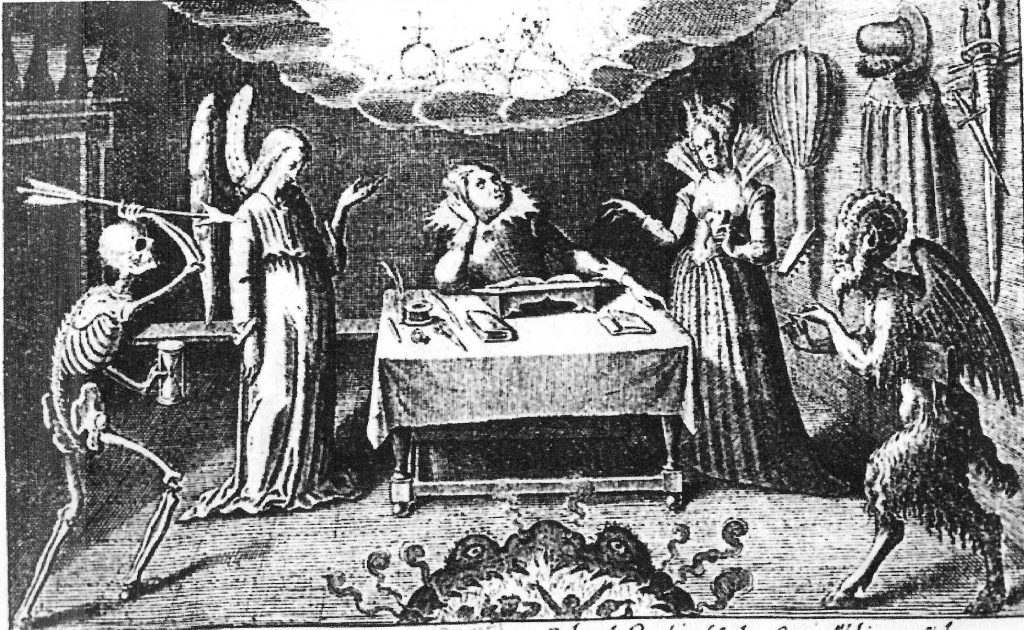
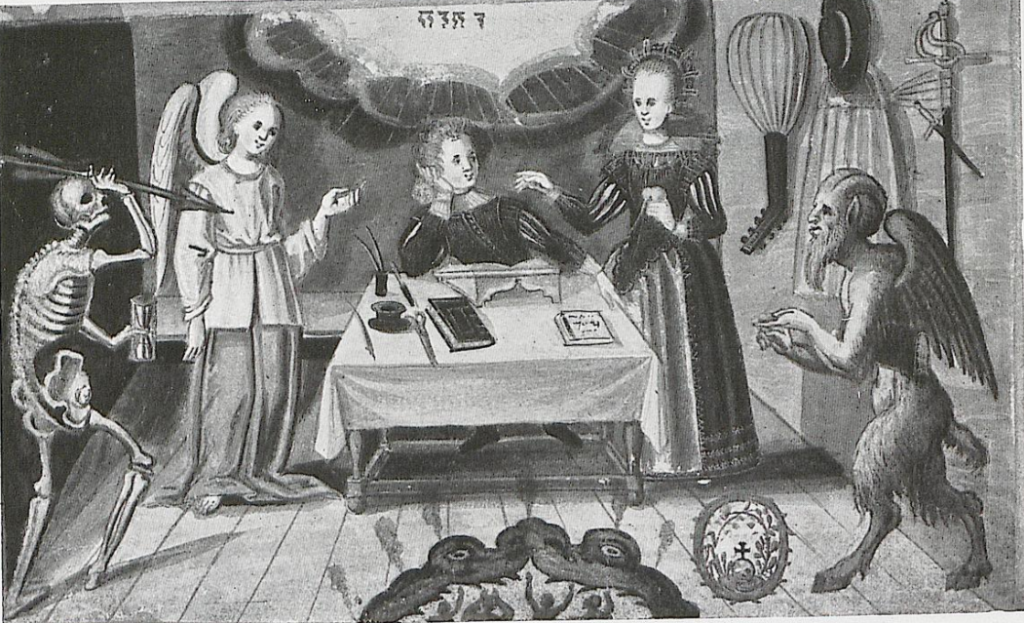
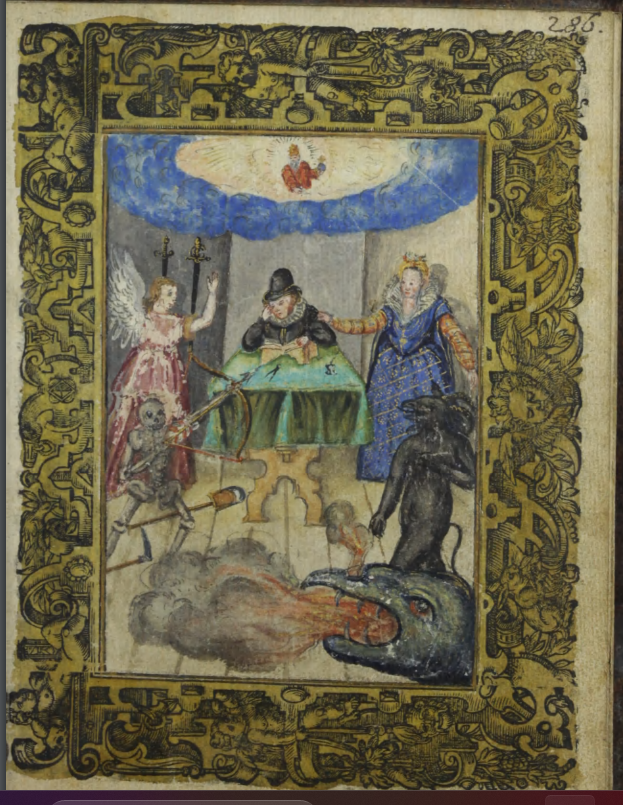
NKS 2090 h, 4°
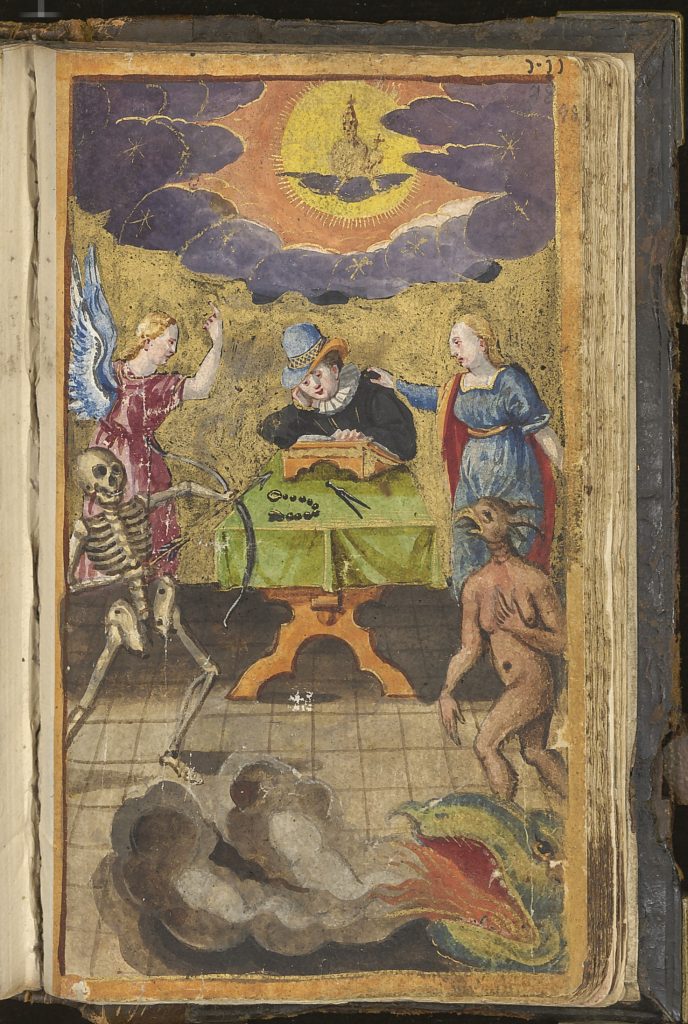
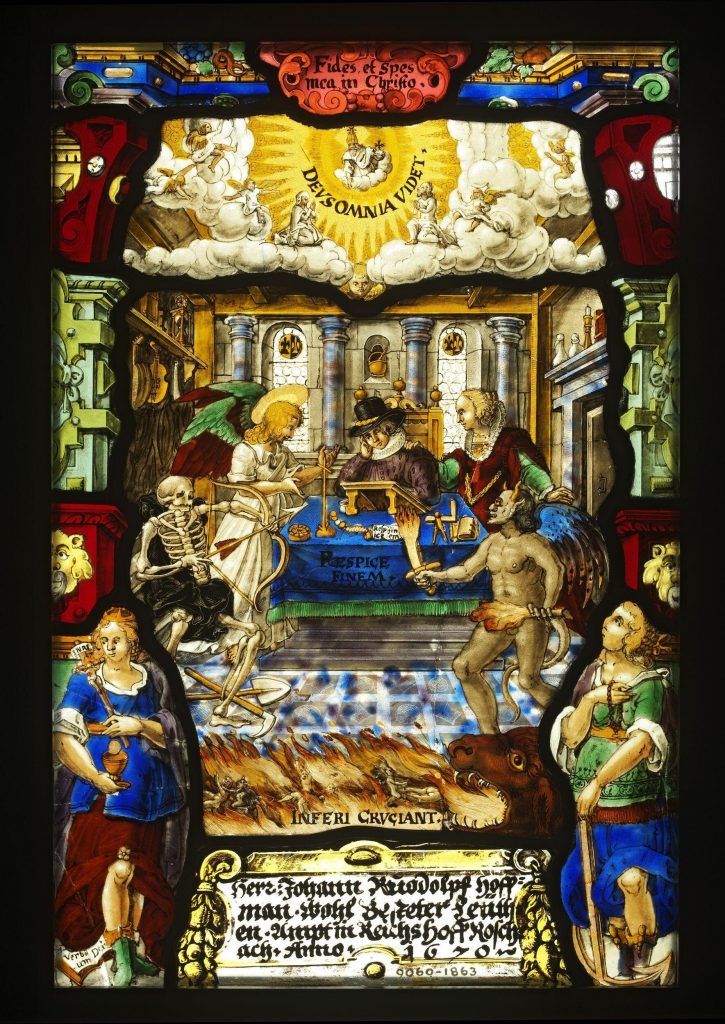
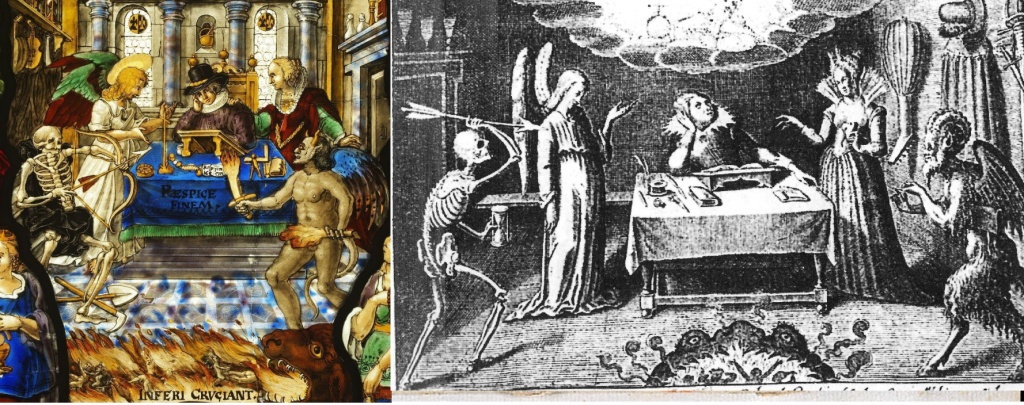
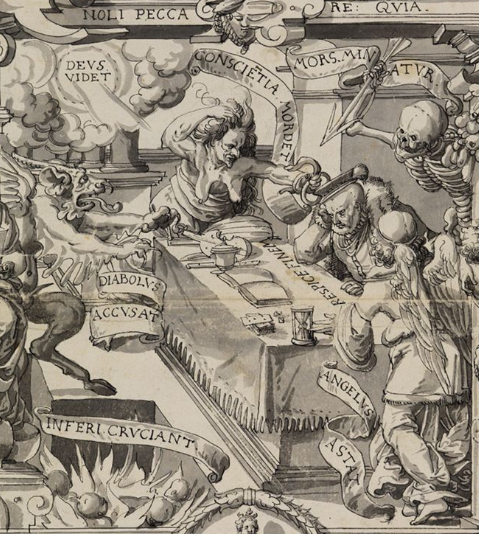
A different version was published as one of the plates engraved by Peter Rollos in his Philotheca Corneliana (Frankfurt 1619) — here the student sits at table with his inamorata :

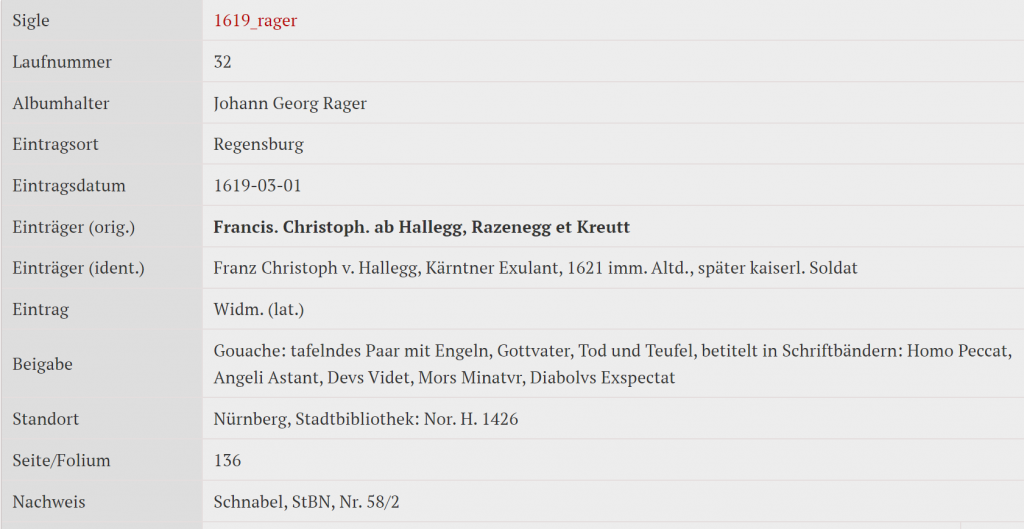
There is at least one album painting that copies this plate — I have not seen any reproduction of it, but the description of this page in the album of Johann Georg Rager in the Repertorium Alborum Amicorum [RAA] (below) is clearly the same composition. Dated 1st March 1619, it implies that the Philotheca Corneliana was published very early in the year.
A different version:
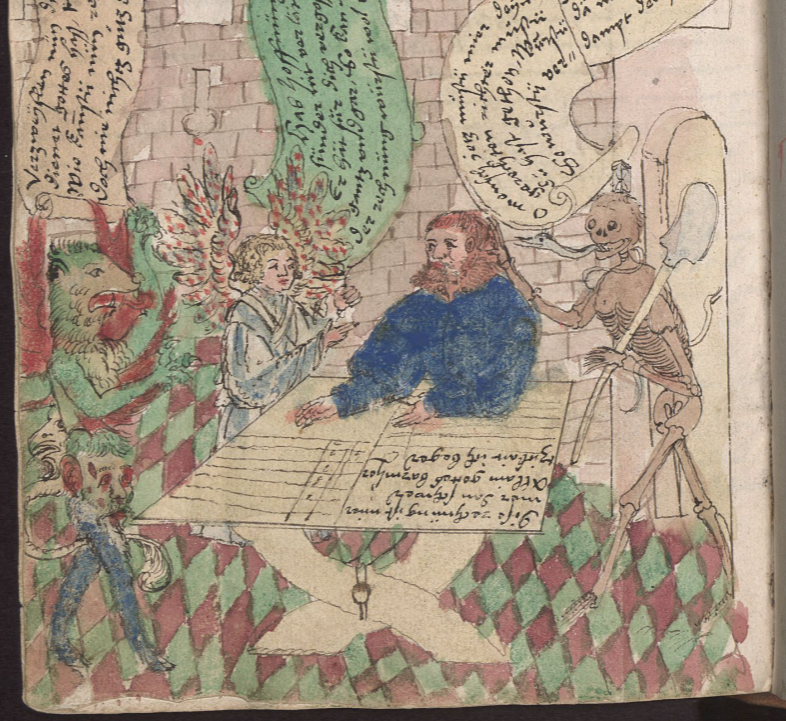
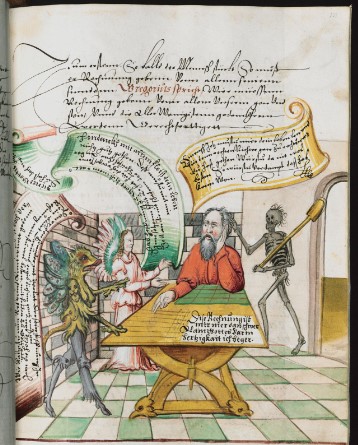
Origins of the composition; earlier versions
Leave a Reply