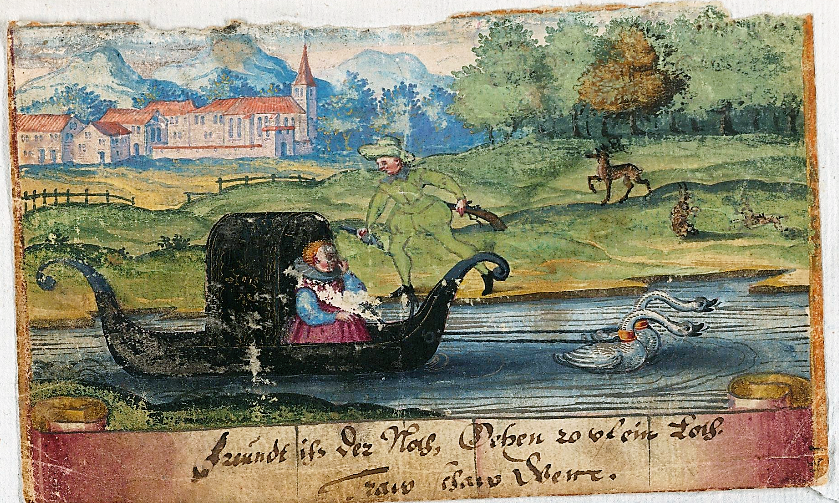
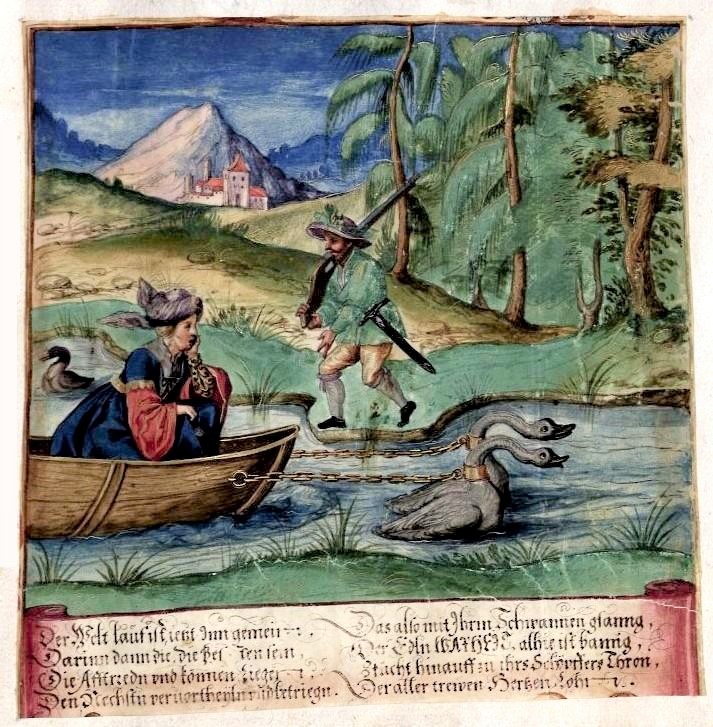
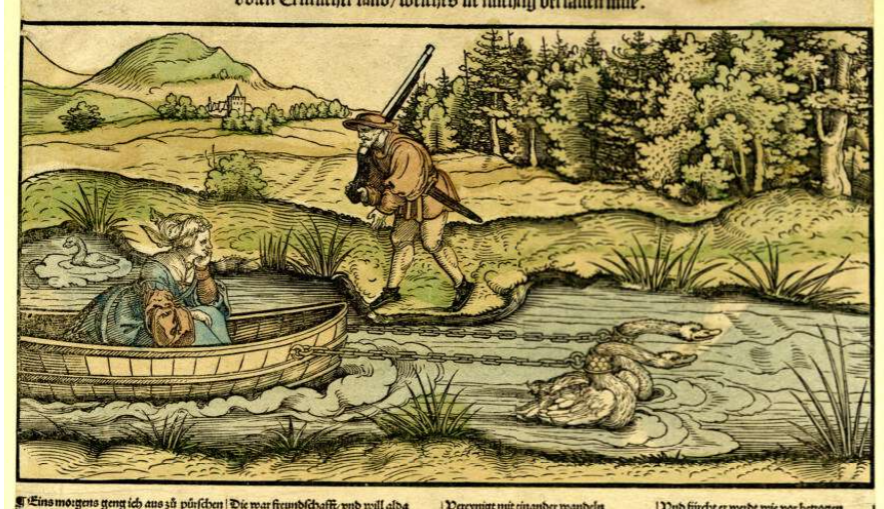
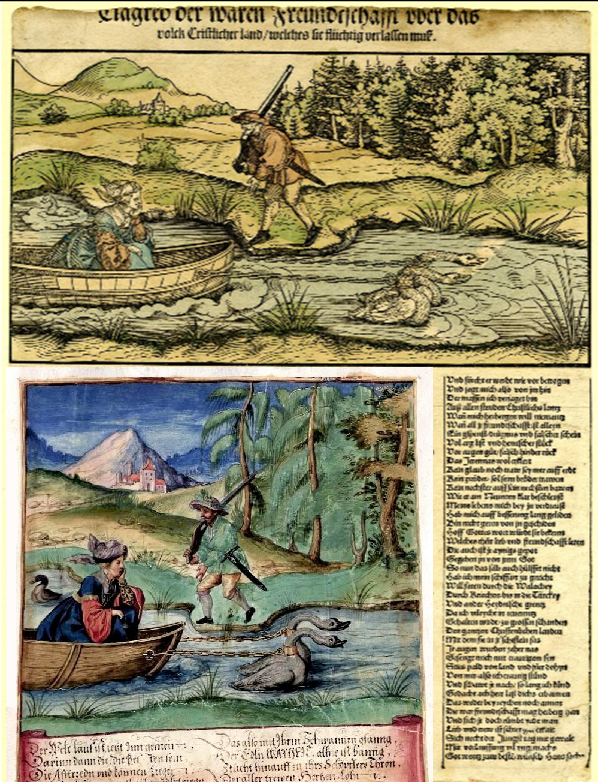
Head-in-hand, a melancholy-looking woman sits in a small boat pulled along a stream by two swans, observed by a hunter on the bank. The scene is copied — very closely, in the Jenisch album miniature — from the woodcut by Erhard Schoen illustrating a print issued in Nurnberg in 1534 with verses by Hans Sachs, entitled Clagred der waren Freundtschafft [Complaint of true friendship]
A third example was painted in the album of Conrad Knoll, at some date between 1606 and 1628 to judge from the description in the Repertorium Alborum Amicorum: “Aquarell: Flußlandschaft mit Dame im Nachen, von zwei Schwänen gezogen, am Ufer Jagdszene” [Watercolour: river-scape with lady in small boat drawn by two swans, on the bank, hunting scene]
Captions to the Frommann Collection leaf
Freundt ifs der Noth, Gehen 20 vf ein Loth — this is the German version of the English “A friend in need…” proverb. Literally, “friends in need are 20 to the Loth ” where the Loth is a unit of measurement equivalent to half an ounce, i.e. true friends are extremely thin on the ground!
and Traw Schaw Wem
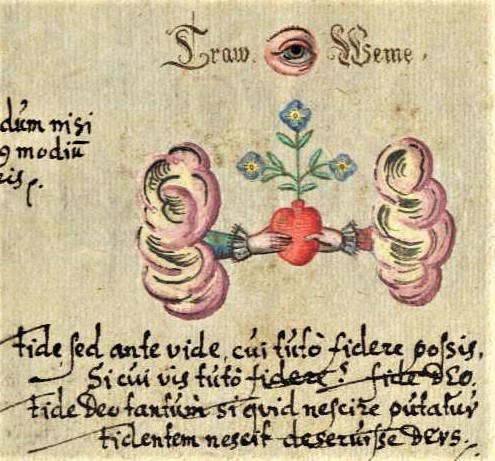
Traw Schaw Wem — “Trust, (but) Look to whom (you trust)” — is one of the commonest mottoes to be written in the albums, sometimes appearing in rebus form, as here in the Sagittarius album, above the emblem of friendship, where the eye stands for Schaw [look]:
or here on the title-page engraving of Stamm und Wappenbuchlein (Frankfurt 1592), as the rebus motto on the horse’s caparison — here the handshake represents Traw [trust]:
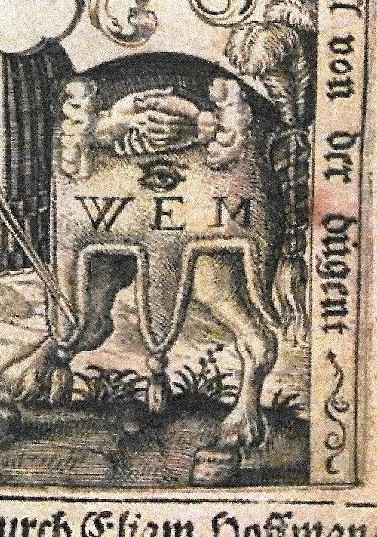
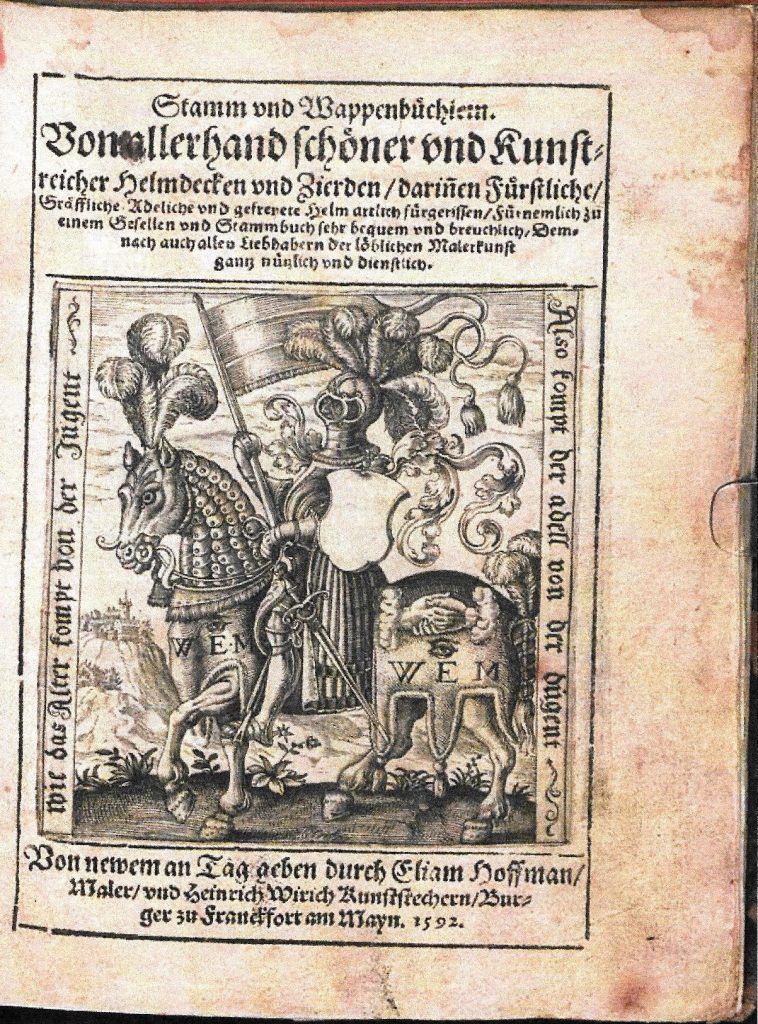
title-page engraving by Heinrich Wirrich to Stamm und Wappenbuchlein (Frankfurt 1592)
On this orphaned leaf in the Frommann Collection the motto is spelled out in full — and the poor man has his hands full (of snake), and his feet occupied too, in dodging the scorpion and caltrops!
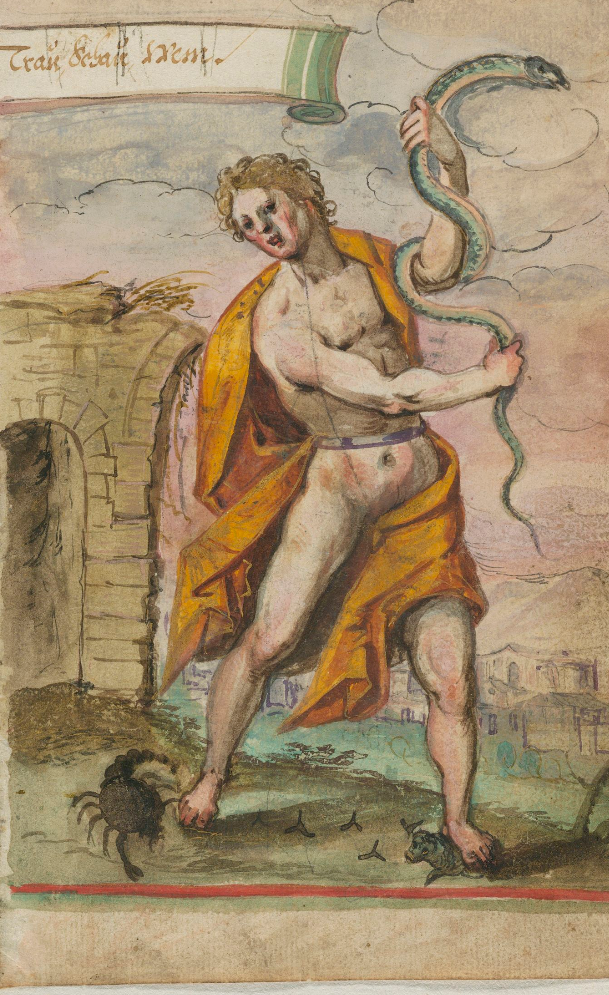
fide (sed) cui vide
This is the Latin equivalent of traw schaw wem — and just as popular, if not more so. Literally, “Trust (but) see who (you trust)”, i.e. check them out! Be cautious! Sometimes it actually labels a scene in the albums, as in this miniature where it presumably is a warning to young men — such as the album-owner, Jacob von Zinnenburg, and his student friends — not to put their trust in women unthinkingly
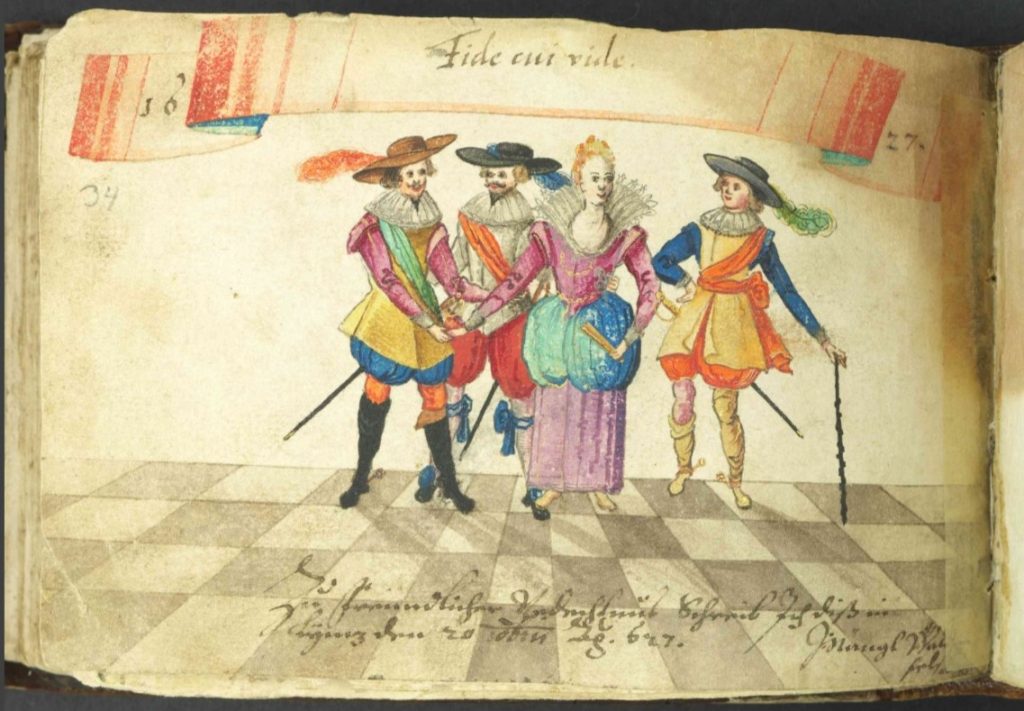
The particular gestural motif illustrated here has already been the subject of a post: https://albumamicorumear-e4qvahs764.live-website.com/woman-and-the-3-suitors/
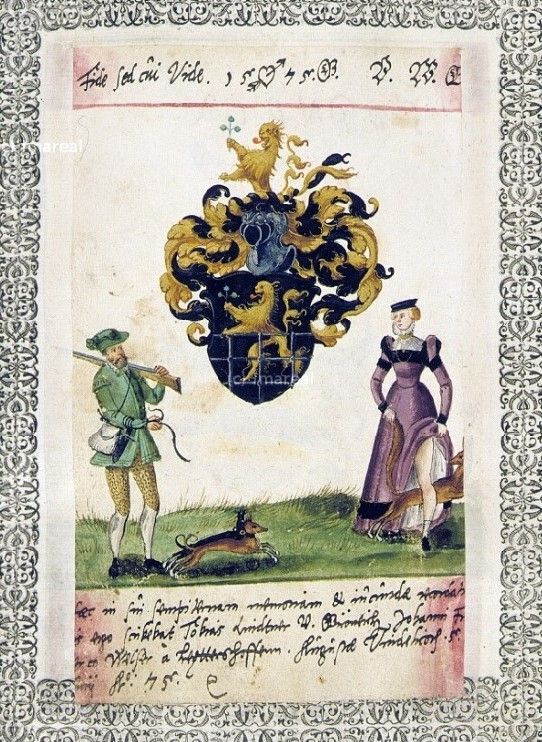
The Latin motto also captions this example (below) of the very popular foxtail-through-woman’s-legs innuendo, which we have also already treated exhaustively here — again, perhaps, a warning to young men:
https://albumamicorumear-e4qvahs764.live-website.com/foxtail-between-womans-legs/
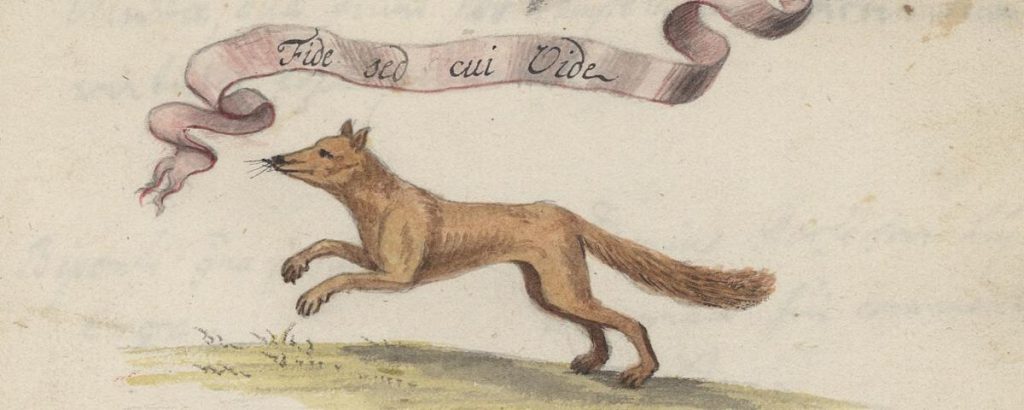
But, of course, the fox alone is an emblem of cunning, of trickery, of the need to be on one’s guard against potential fraudsters and people not being what they seem to be:
An emblem in the proper, technical sense — from an emblem-book! — was painted in the album of Johann Ludwig Bilfinger in 1640 (when he was a 19-yr-old student) labelled with our motto. Here the hand holdng the heart signifies the trust, the eye in the palm of the hand, the wariness:
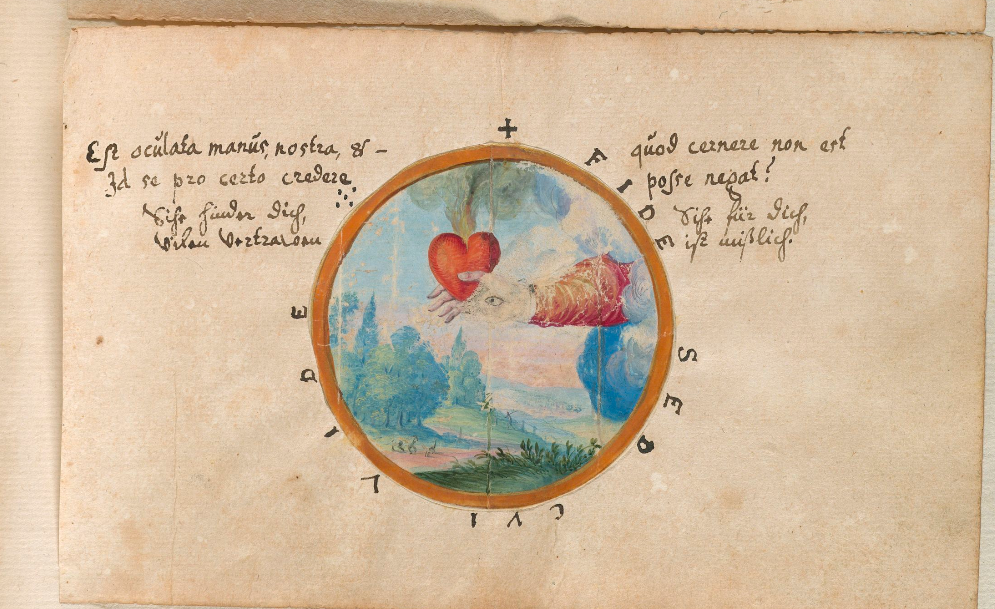
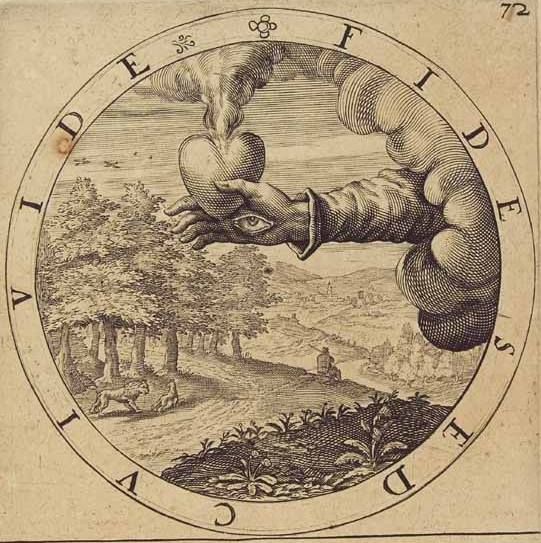
But — as the circular format strongly hints — the painter has copied one of the emblems engraved by Crispijn de Passe for Rollenhagen’s Nucleus Emblematum published in Koln in 1611:
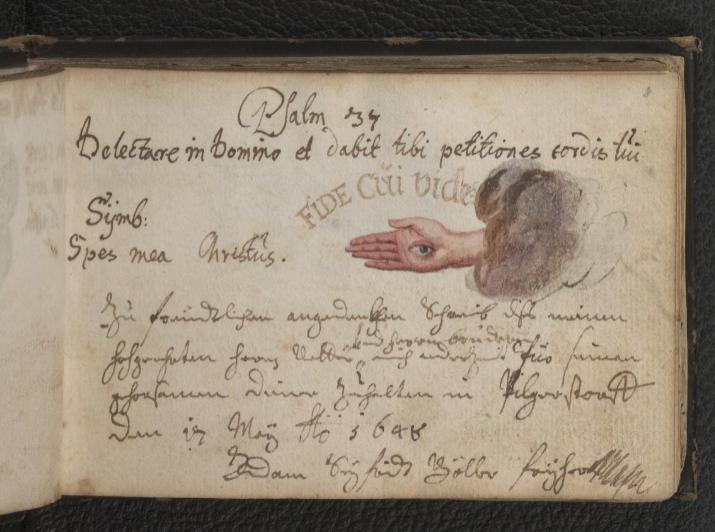
Eight years later an abbreviated version was drawn in the album of Hans Ferdinand Speidel von Vattersdorff:
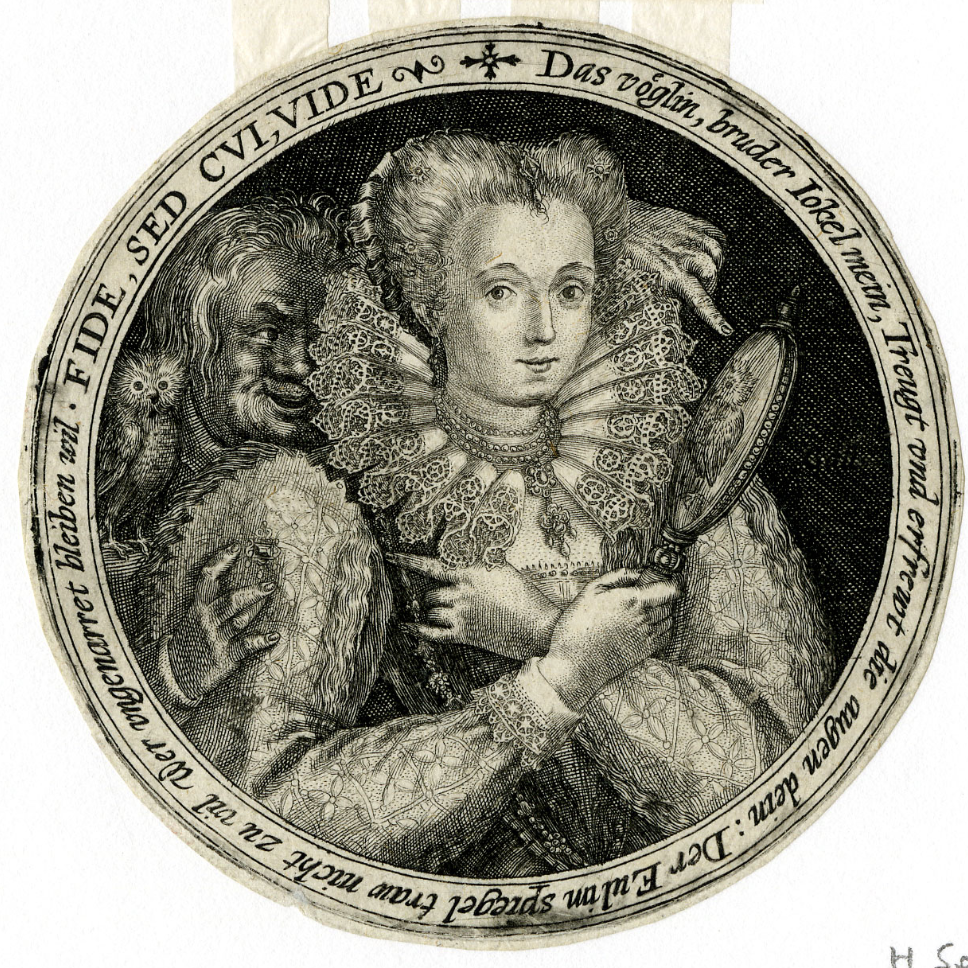
A decade or so before engraving the 100 emblems for Rollenhagen’s book, Crispijn de Passe executed a series of Five Senses in national costume — the Frenchwoman here represents Sight, and holds a mirror in which the owl on the shoulder of the man standing behind her is reflected (below). The accompanying German text refers to this Eul in spiegel, a transparent allusion to the celebrated Trickster, Til Eulenspiegel, and advises us not to be too trusting if we want to remain unfooled, summing up with our motto: FIDE, SED CVI, VIDE!
But this tiny engraving is still not exhausted — look at the finger-gestures!
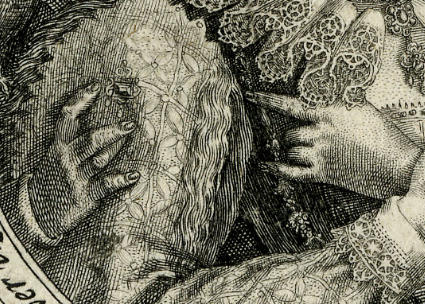
Her free hand makes the apotropaic/aggressive ‘horns’ gesture we have already illustrated from the albums in this post:
https://albumamicorumear-e4qvahs764.live-website.com/gesture-in-the-albums/
while his hand makes the ‘fingers crossed’ defensive gesture — though here with the second and third fingers.
Leave a Reply