As the overwhelming majority of albums were begun when their owners were students, this is not surprisingly one of the most popular motifs to be found in them.
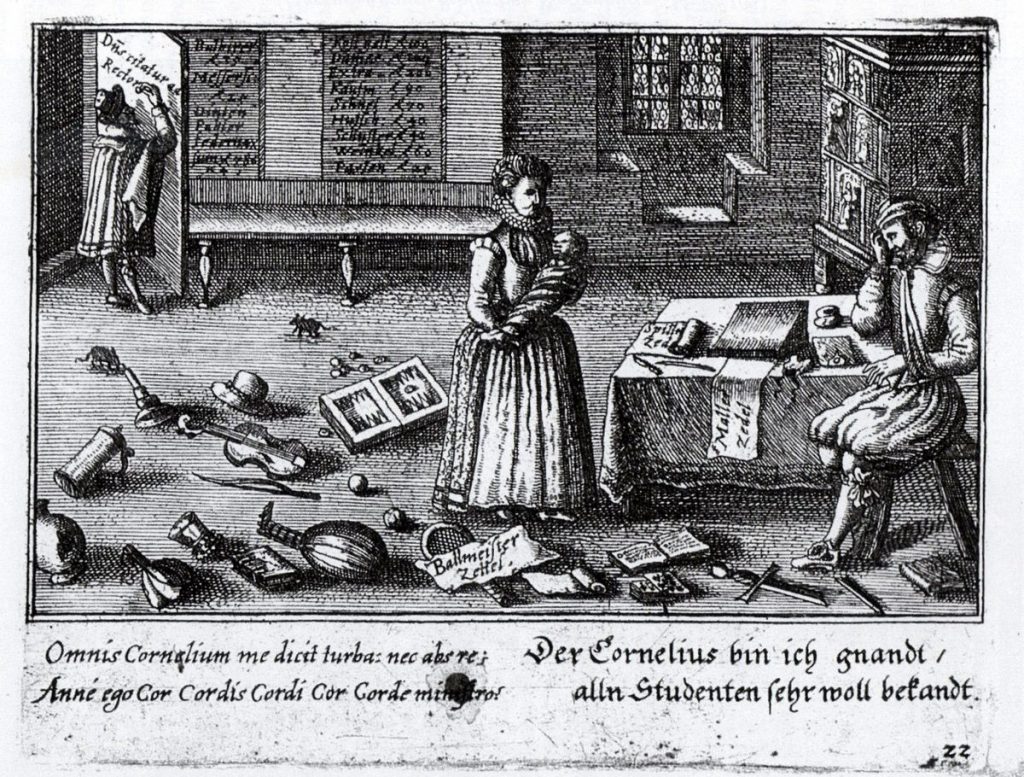
Cornelius bin ich genant [My name’s Cornelius Allen Studenten wolbekant well known to all students]
So runs the caption to what was to become the archetypal representation of the Bummelstudent, the engraved plate – perhaps, originally, the first in the book – published in the Pugillus Facetiarum, issued in Strasbourg in 1608 by Jacob von der Heyden (below). It shows Cornelius sitting head-in-hands at his desk in his study amidst a considerable clutter, being evidently addressed by a young woman with a swaddled baby in her arms, while the university beadle chalks a notice on his door summoning him to the rector. Rats run along his table and the floor is a welter of sports equipment, gameboards, drinking vessels, playing-cards, etc. – and unpaid bills are everywhere. He himself, as he turns towards the young woman with the baby, has a bandage round his head and one arm in a sling, doubtless from injuries sustained while fencing. Of course, the woman has come to tell him the child is his…
The iconic representation was first issued independently in Strasbourg by Heinrich Ulrich, before being absorbed into the first edition of the Pugillus, which was itself pasted into several early 17C albums, including that of Elias Geiselbrunner — in 1617, apparently (below).
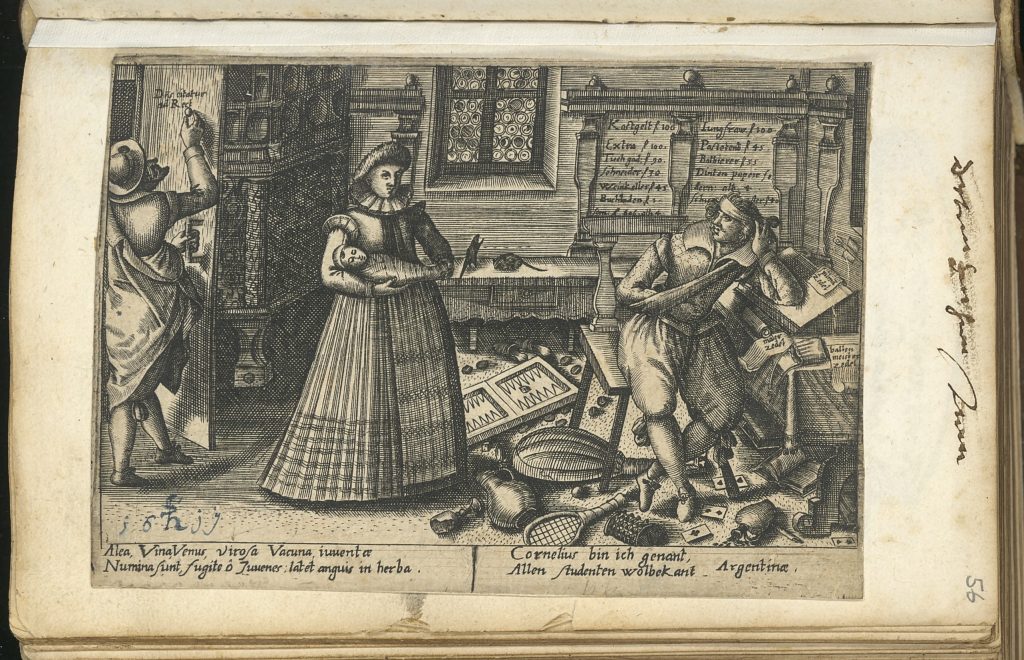
Doubtless the average male student then – there were no female students, of course – was no less industrious than his modern counterpart, but as ever, it was the worst example of the type whose image soon came to dominate the idea of ‘student’ in the popular consciousness – and this fictitious student was called Cornelius, after the eponymous hero of a neo-Latin comedy, Cornelius Relegatus, chronicling the career of a dissolute student, first performed in 1600 at the university of Rostock, and published there the same year.
The title-page of the first German translation of the play, published in Magdeburg in 1605, is illustrated with a woodcut of a design which was already on its way to becoming iconic:
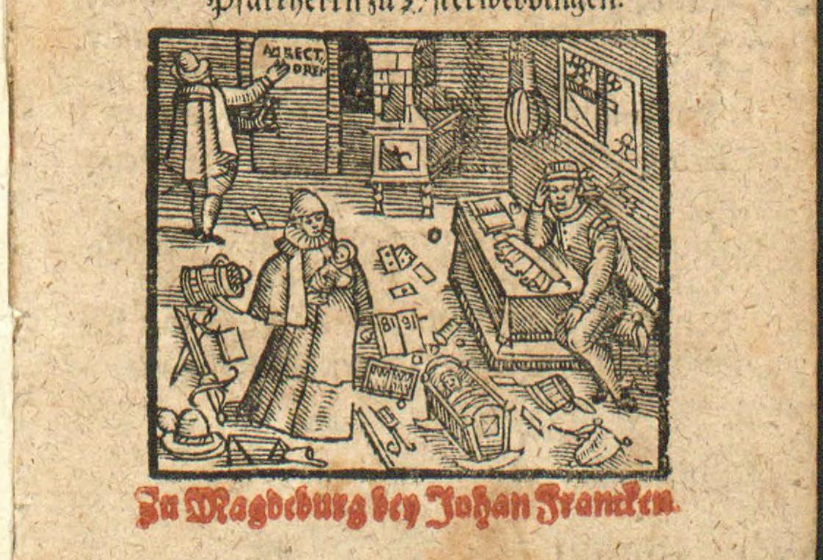
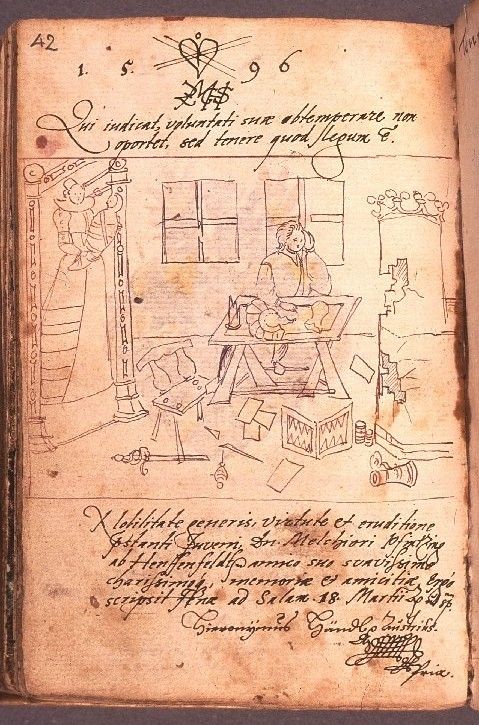
The design was fixed by its appearance in the first edition of the Pugillus facetiarum, published in Strasbourg in 1608 by Jakob von der Heyden (as pasted into Geiselbrunner’s album — above), but there are several album miniatures which predate the printed versions. Ulrich Rasche has shown that the image of Cornelius besieged in his study was already adumbrated in an album drawing made in 1596 – further testimony to the truth of Jakob von der Heyden’s claim that his Pugillus plates were based on the pictures to be seen in existing students’ albums:
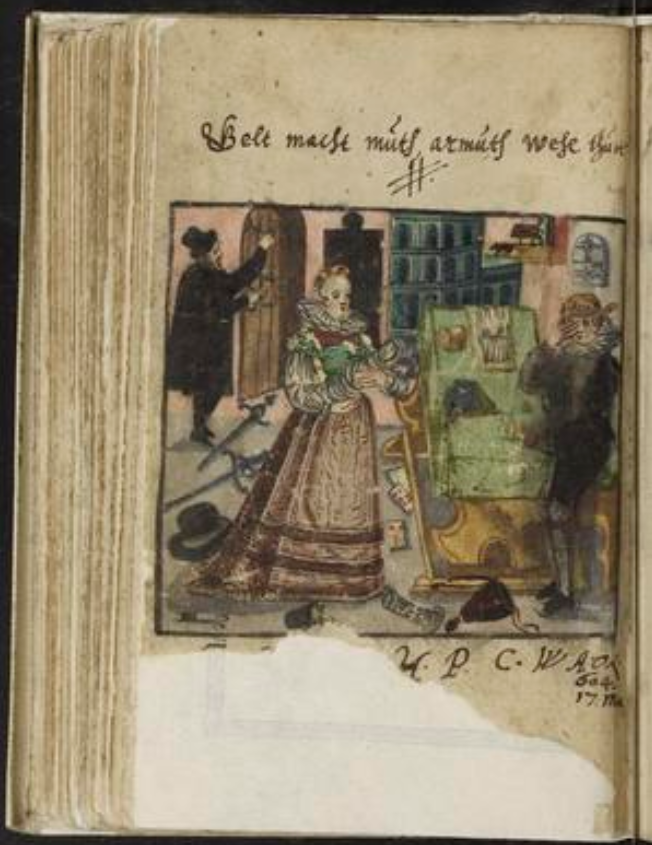
And here is another pre-Pugillus miniature, painted in the album of Petrus Hieronymi Glandius in 1604:
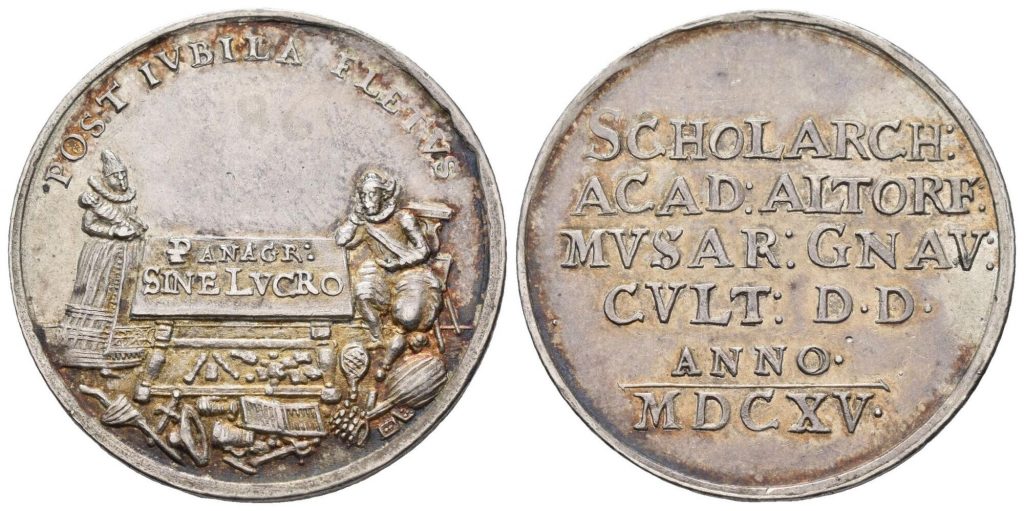
One of the prize medals awarded by the Altdorf Academy in 1615 is clearly derived from the — by now, ‘standard’ presentation — of Cornelius, head-in-hands, as the young woman presents him with his baby. The motto is POST IVBILA FLETVS [after jubilation, weeping], but there is another inscription written on the table: P ANAGR: SINE LVCRO [as an anagram: ‘without money’] — a very fitting ANAGRam of the name of the penniless CORNELIVS !
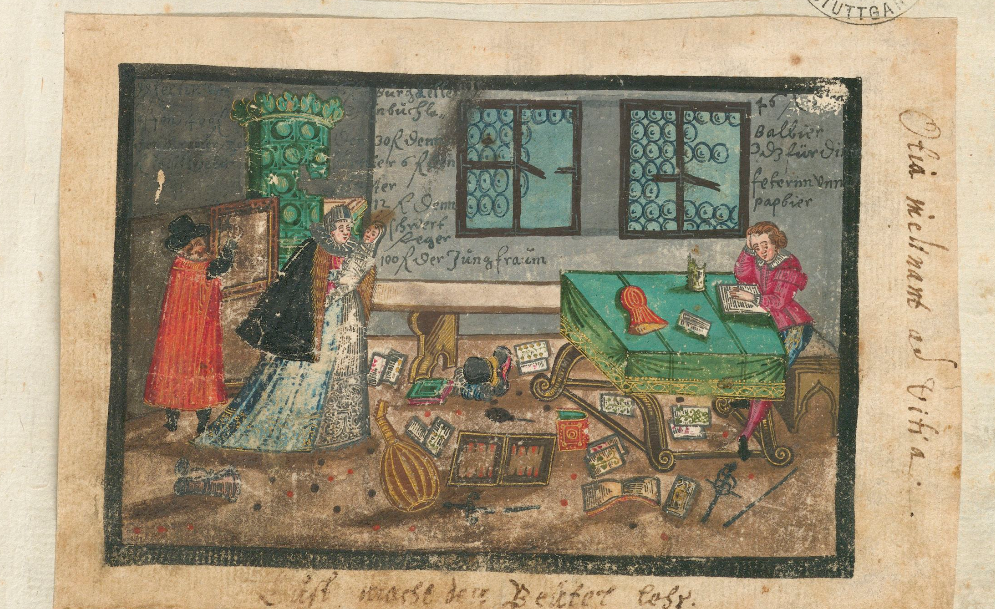
This orphaned leaf in Stuttgart’s voluminous Frommann Collection is captioned with appropriate maxims in Latin and the vernacular: Lust macht den Beutel lehr [Lust/Pleasure makes the purse empty], and Otia inclinant ad vitia [Idle things incline to vice].
This next example is unusual in presenting Cornelius frontally and without the beadle wrting the summons on his door – so perhaps pre-Pugillus
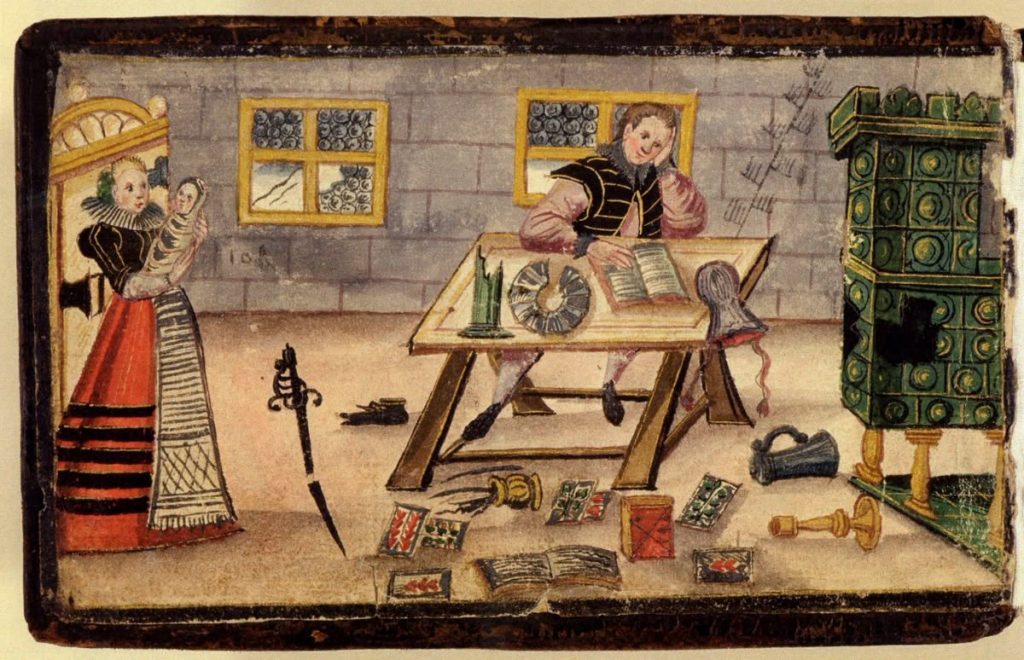
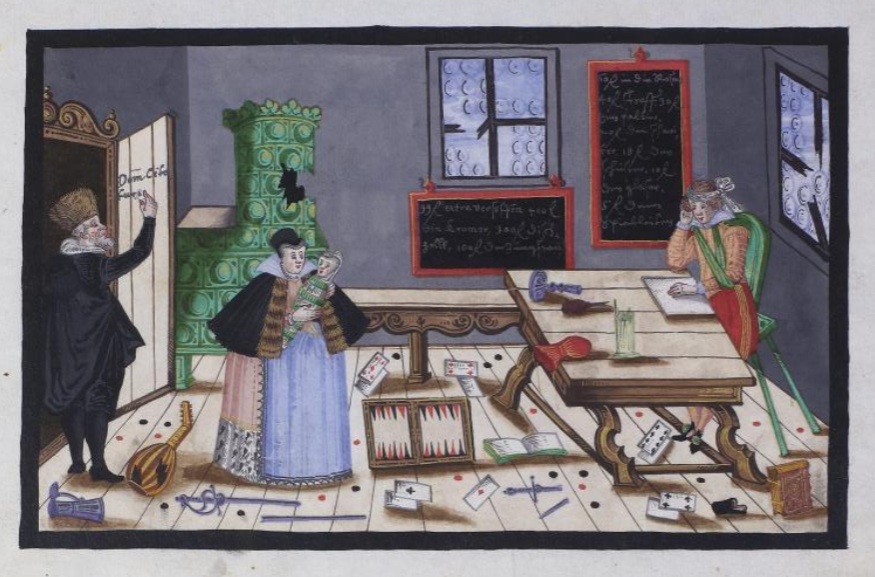
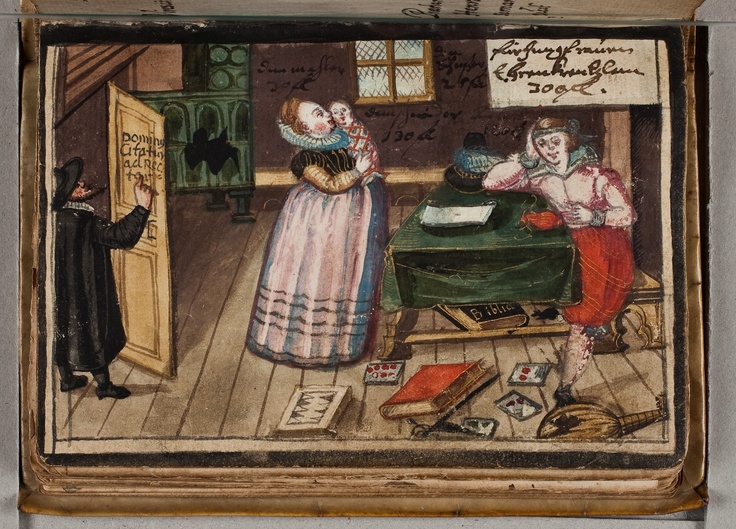
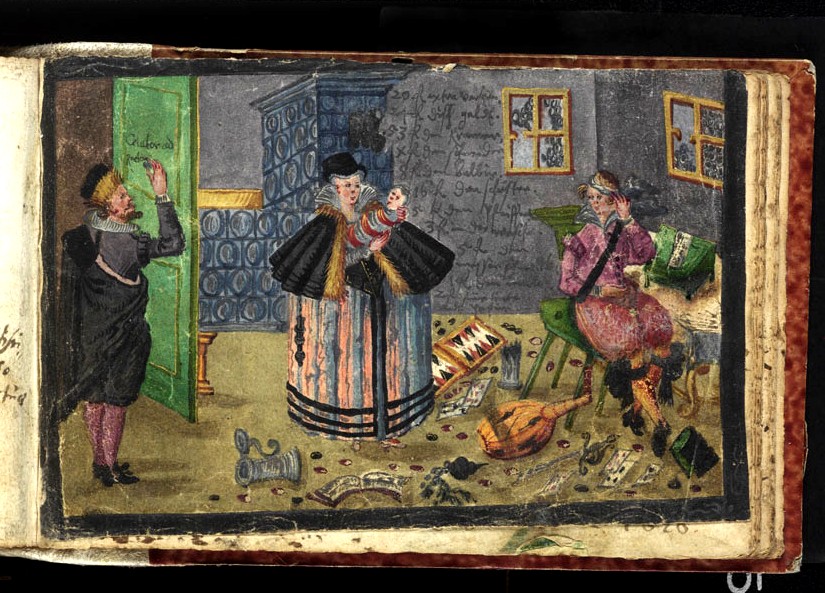
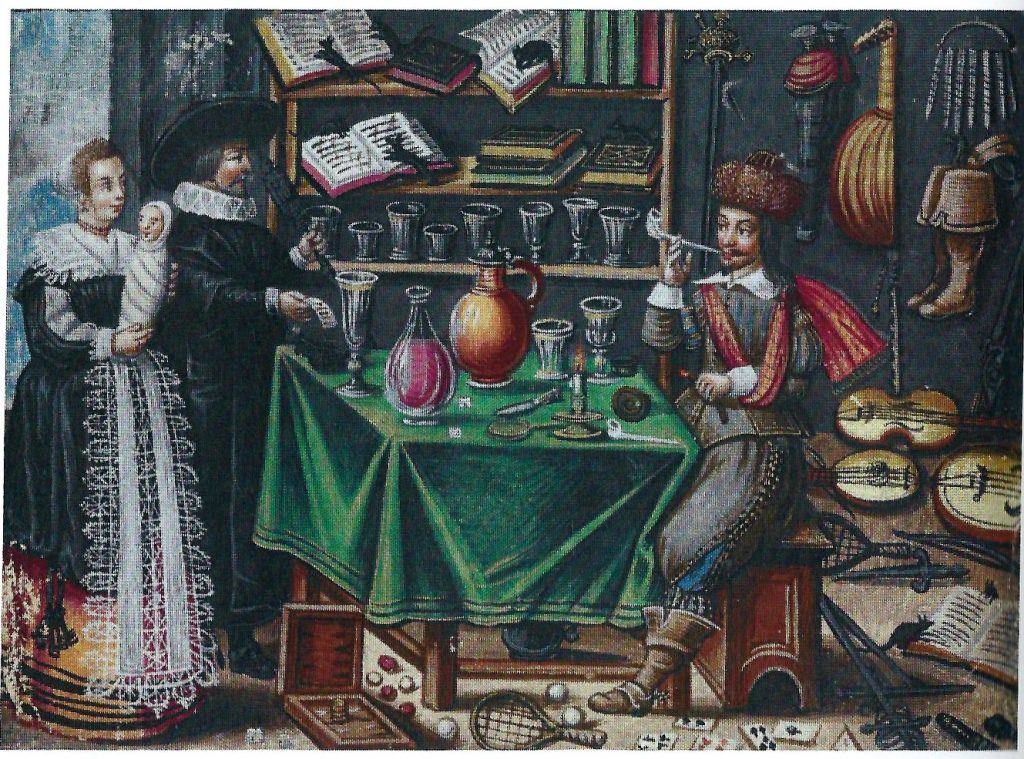
The album of Georg Schutz, in which appear entries dated from 1608-13, includes our scene only as the last of six in a multi-frame composition:
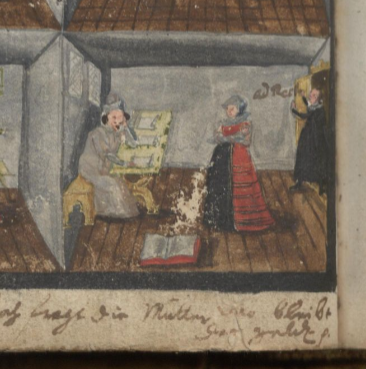
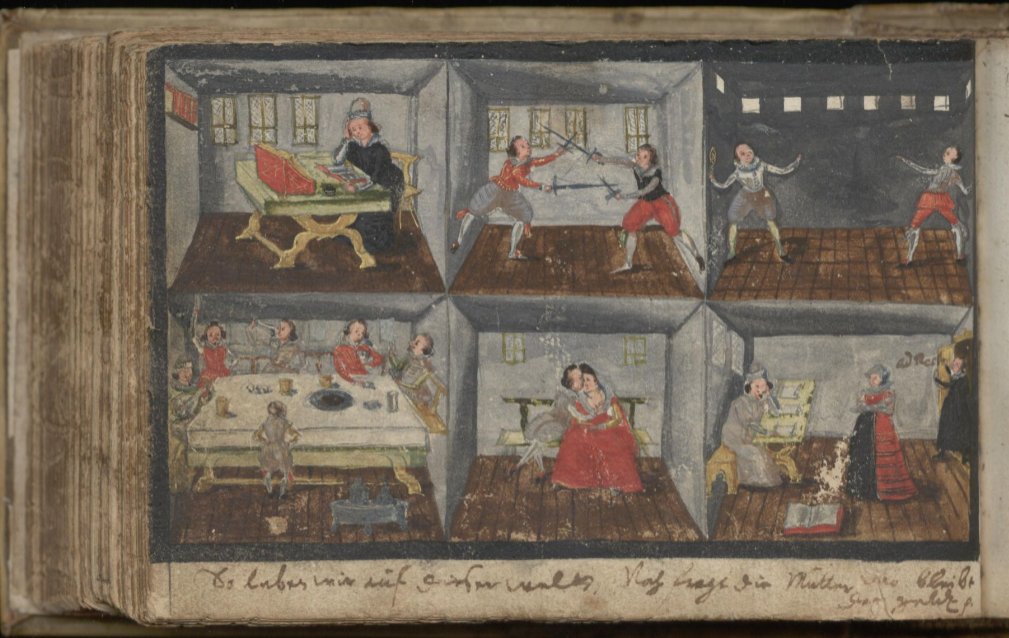
The caption below reads So leben wir auf dieser welt / Noch fragt die Mutter wo bleibt der [sic] geldt — which would seem to mean, “Thus we live in this world, ‘But’, the mother asks,’where is the money?’ ” Unless the final question is some contemporary catch-phrase unknown to me, then it can only relate to the mother of the baby our hero has sired — and, of course, there is no money! CORNELIVS — true to his anagrammatised name — is SINE LVCRO !
Other print-book examples
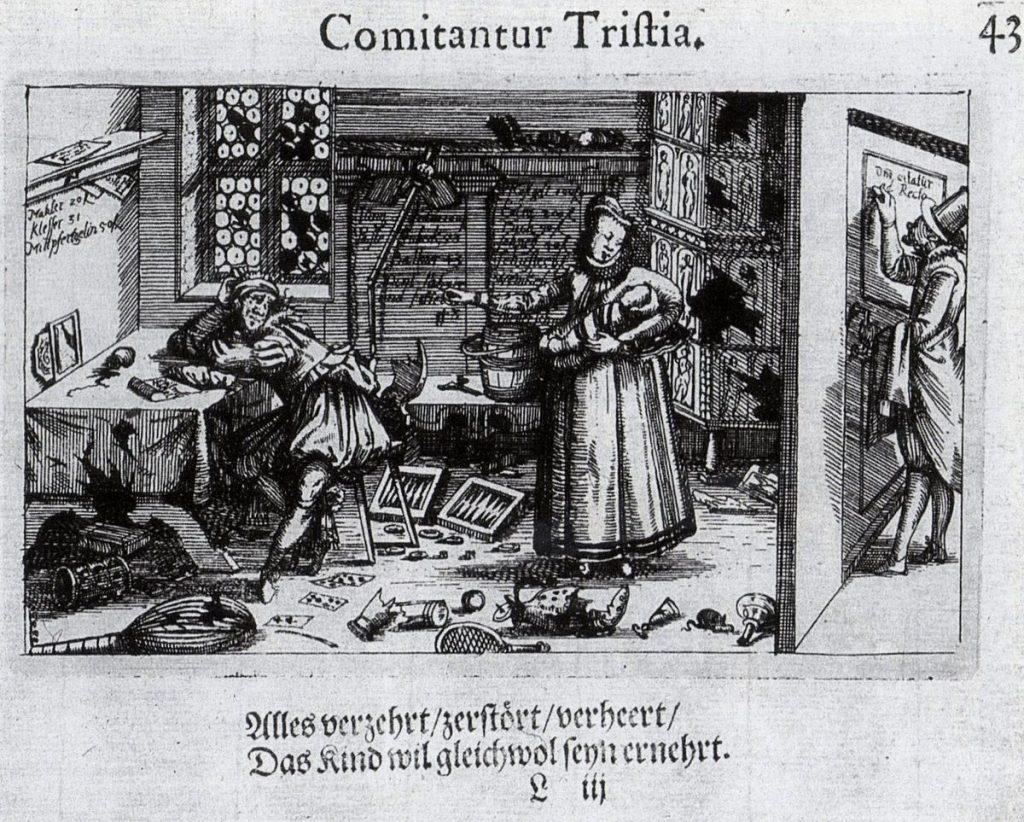
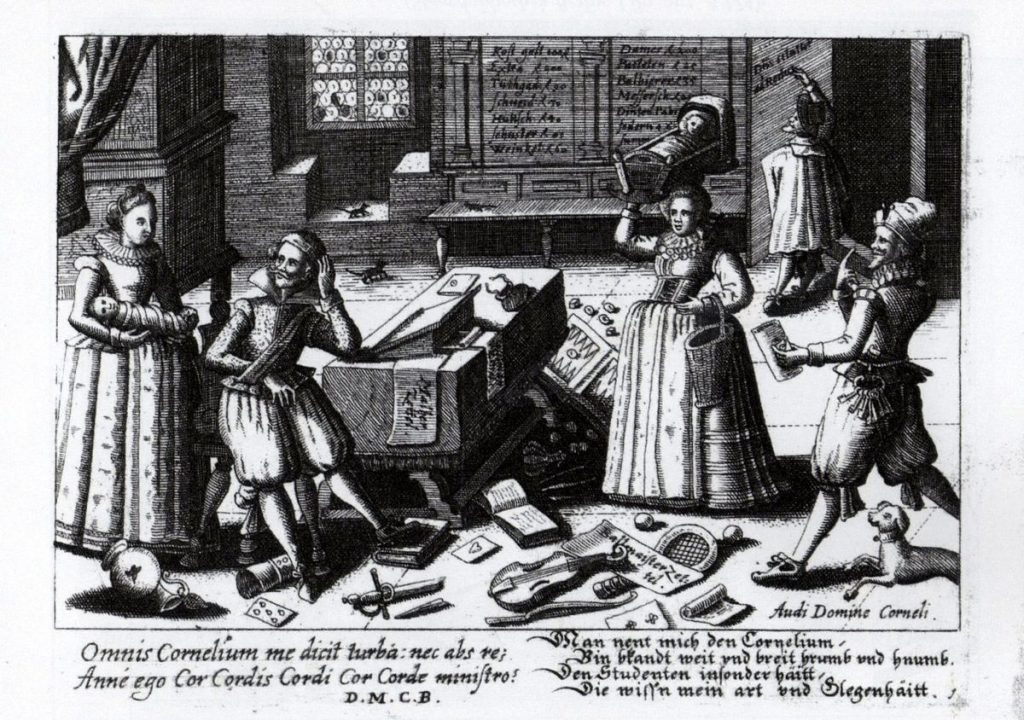
Perhaps most surprising of all, the motif appeared in the only contemporary English print-book known — its title unknown — but etched by the ‘German’, Frederick van Hulsen, in London in 1627 (published 1628). The plate in question survives uniquely — as one of a series of unbound plates — in the Folger Shakespeare Library
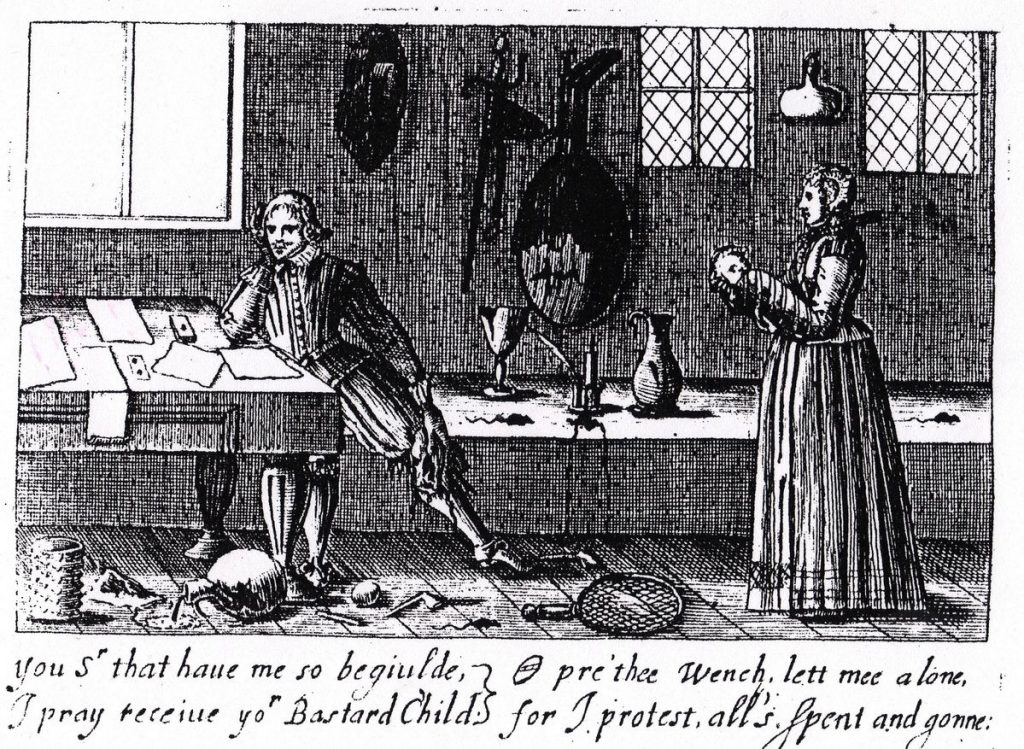
The caption:
[Woman] You S[i]r that haue me so begiulde [sic]
I pray receiue yo[u]r Bastard Child
[Cornelius] O pre’thee Wench, lett mee alone
for I protest all’s spent and gonne
Title-page details
Three such:
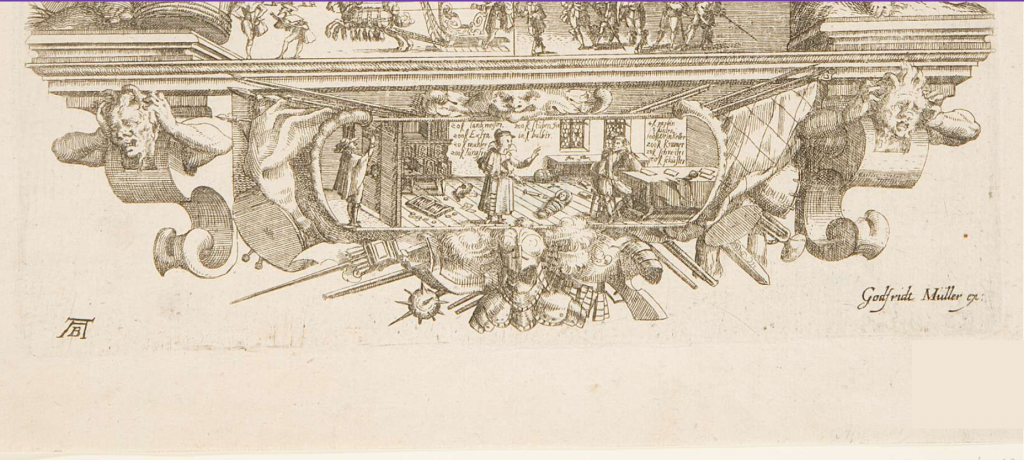
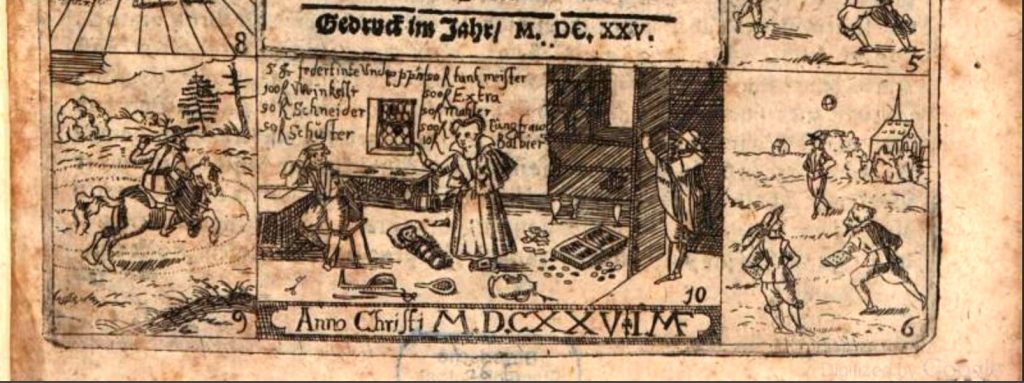
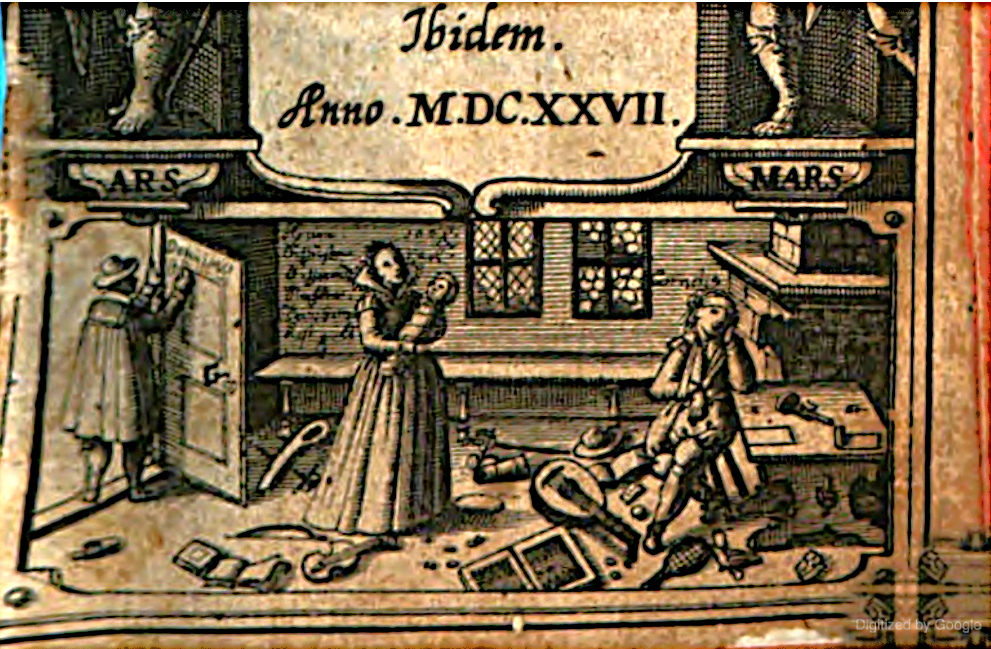
DETAIL of Johann Leib, Studentica (1627)
Later examples
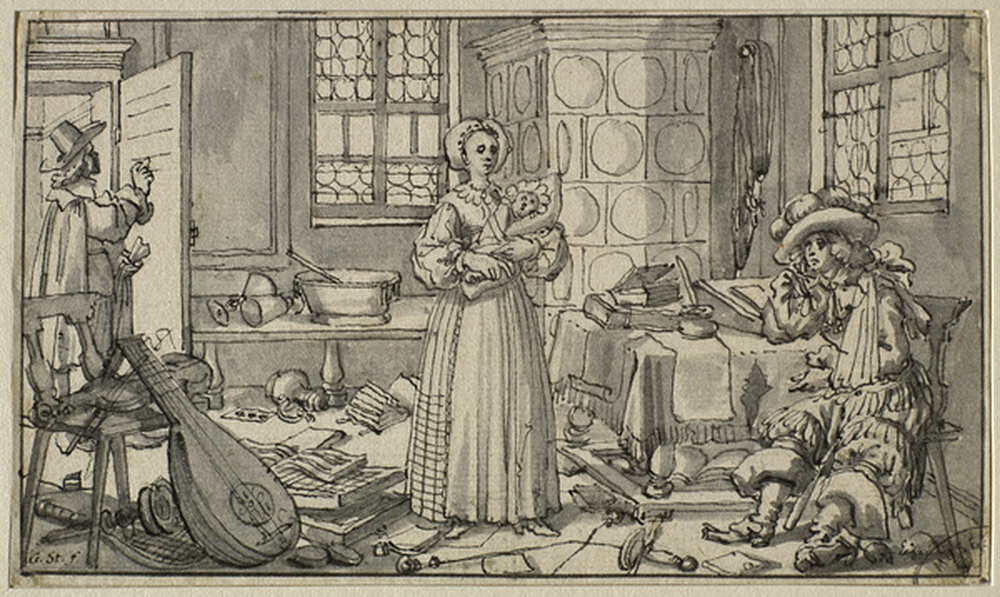
This evidently mid-17C pen-&-ink drawing, now in the Musée de Grenoble, attributed to the artist Georg Strauch, may well have been made for, or extracted from, an album. Ulrich Rasche has already reproduced several 18C album examples of our motif — here is another from the 1770s:
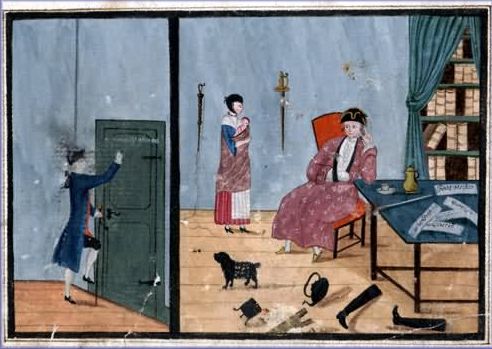
I add this 18C print which I have not seen reproduced elsewhere:

Other media
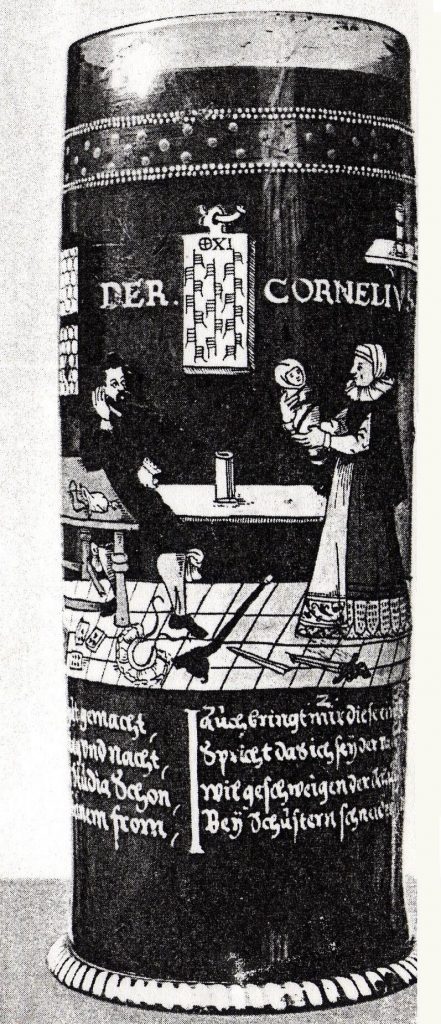
I would like to know the whole of the verse inscribed on this unique Humpen in the GNM — I shall write to them and ask for it! Watch this space!
Postscript
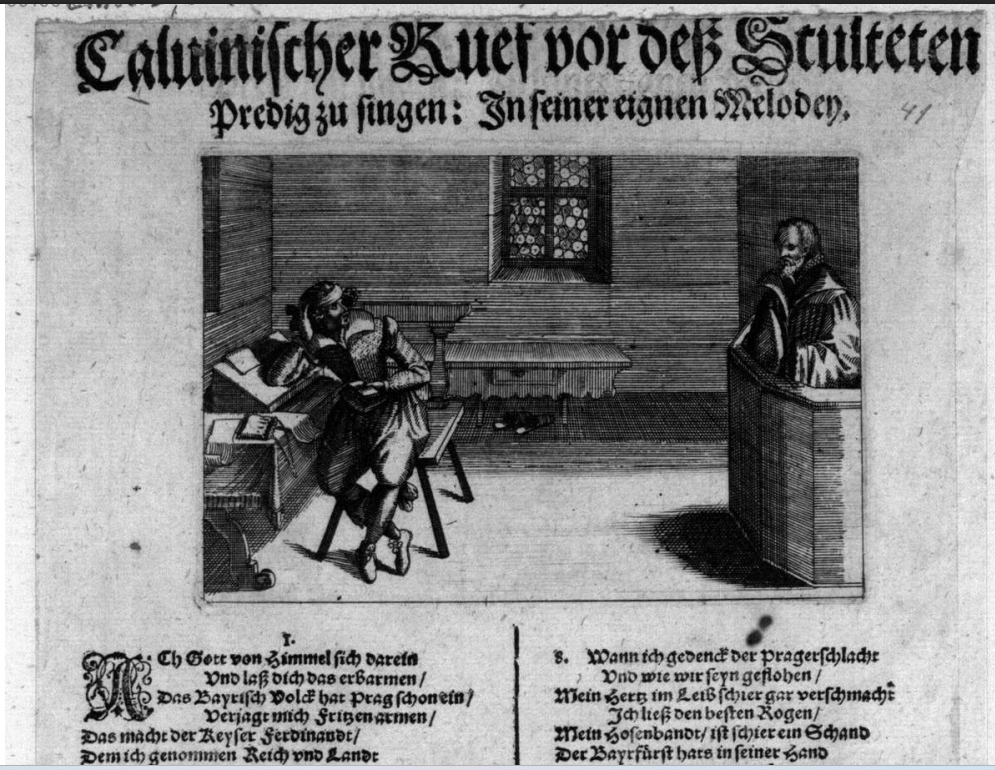
An interesting re-use of the Cornelius icon — copied in the illustration to Caluinischer Ruef vor deß Schulteten Predig zu singen: In seiner eignen Melodey [1621]
[A detailed discussion of the make-up of the Speculum Cornelianum is to be found in Frederick J. Stopp’s essay, “Wichgrevius and the Speculum Cornelianum” in Sprache und Bekenntnis, Sonderband des Literatur-wissenschaftlichen Jahrbuchs fur Hermann Kunisch, 1971, pp. 29-50. Here, I will only say that, while there are several plates that clearly depict student life, I find the thesis that the Speculum print-book is a sort of pictorial biography of Cornelius unconvincing].
[i] Identified as a student in RAA
Leave a Reply