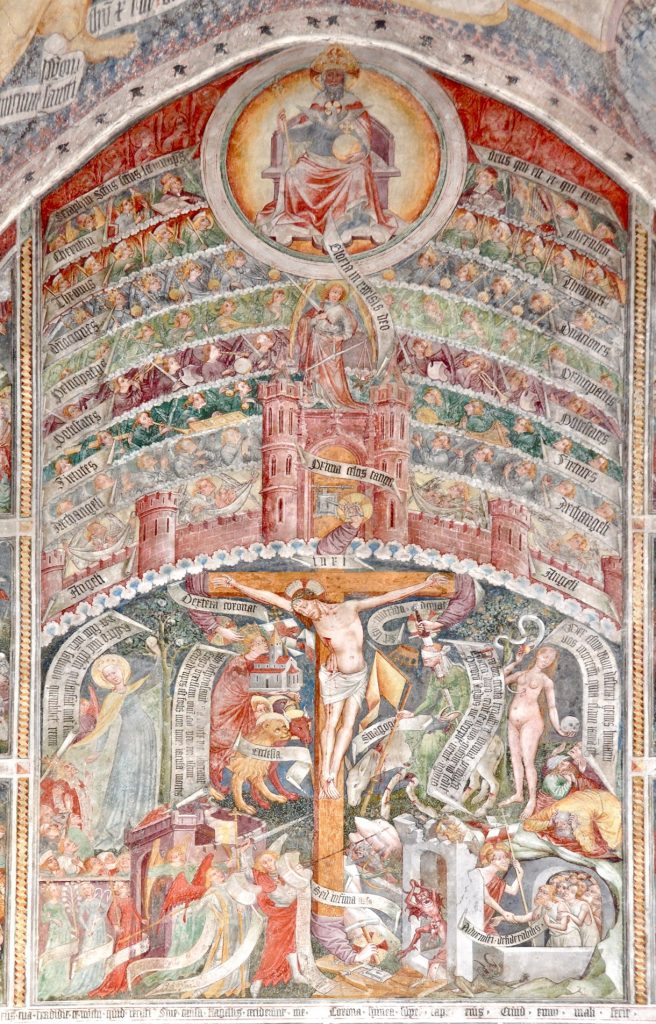
This is a complex allegorical composition based around a central Crucifixion, but in which hands issue from the terminals of the Cross. It is mainly confined to central Europe and seems to have originated c.1400 and to have gone out of fashion shortly after 1600.
The only example I have noticed is in the iconographically rich album of Paul Jenisch in which the painting is dated 1588 and evidently derives from a rare, unsigned print dated to the final quarter of the 16th century — our miniature now provides a terminus ante quem for the print.
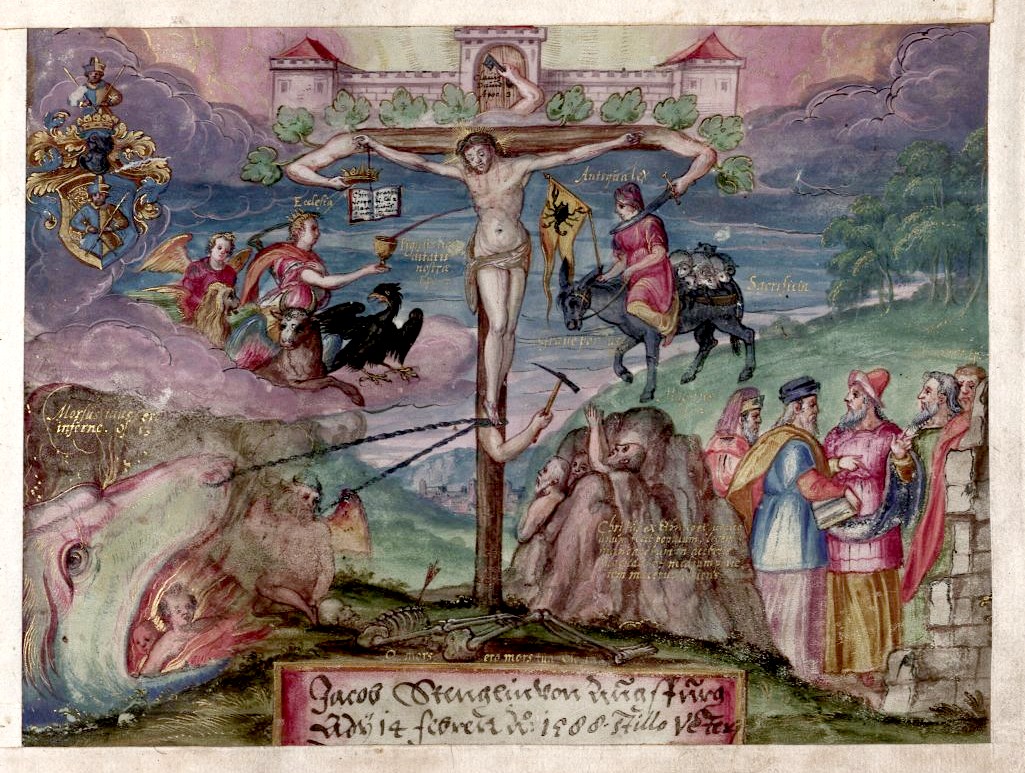
It is not clear whether the Jakob Stenglin of Augsburg who signs the painting was the artist or merely the commissioner, but the evidently competent painter has successfully altered the format of the composition from portrait to landscape, retaining the inscriptions — even adding that at bottom right — and also the coat-of-arms (top left).
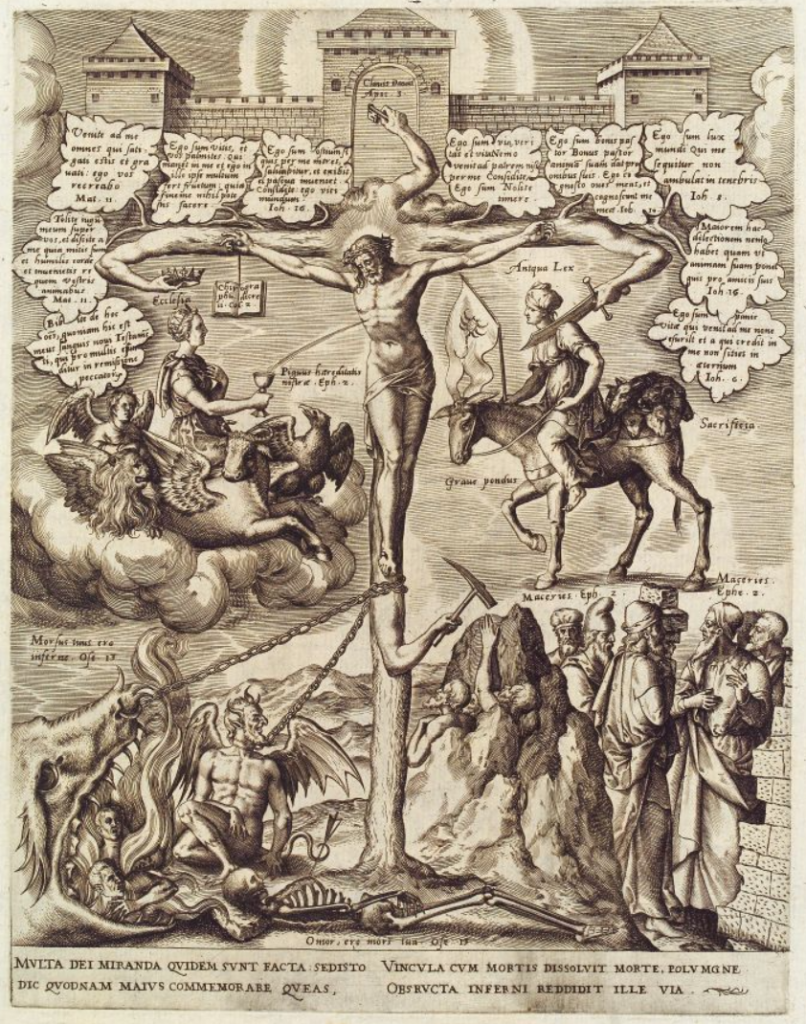
Ecclesia riding the tetramorph composed of the symbols of the Four Evangelists, receives Christ’s blood in a chalice, while opposite, the Old Law [Antiqua Lex] rides an ass with the heads of sacrificial animals behind her. The arms emerging from the ends of the transom respectively crown Ecclesia and cut into the shoulder of the Old Law with a sword. The arm projecting from the top of the Cross holds the key to the gate of the Heavenly Jerusalem depicted above the Crucifixion, while that emerging from the foot of the Cross wields a hammer which would be difficult to understand without the evidence of earlier examples of the motif which show it smashing the lock on the gate of Hell.
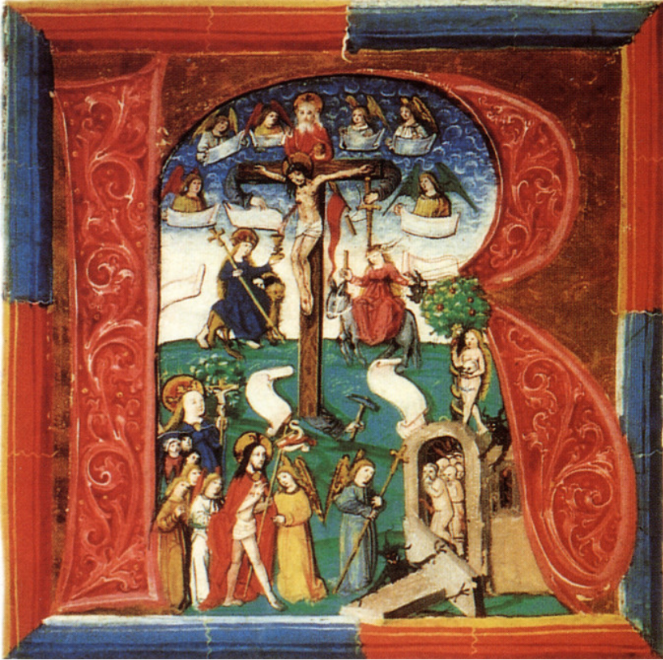
Though also found in late 15C illuminated manuscripts:

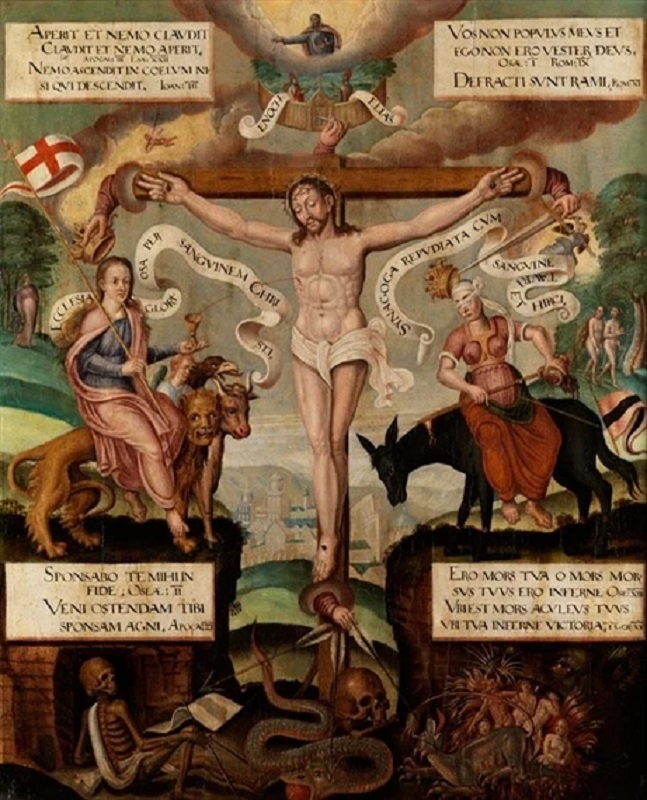
and occasional panel paintings — as this, auctioned in 2013
by far the commonest medium for this motif, however, is the mural; I content myself with reproducing just one, perhaps the best preserved, in the Austrian church of Thoerl Marglen
Leave a Reply