I feel like something of an interloper here, in an area I regard as the preserve of M.A. Katritzky — still, we press on!
Professor Katritzky has shown how important the evidence of the album miniatures is for understanding the history of the Italian popular theatre we know as the commedia dell’ arte, from her 1995 thesis available online, A Study in the Commedia dell’Arte 1560-1620 with special reference to the visual records, onwards. But I shall concentrate here on more recent discoveries, many more albums having become available in digitised form since Professor Katrizky made her fundamental researches.
We should begin by saying that a trip to Italy was a must for the early modern German student on his peregrinatio academica. The home of the writers and thinkers of Antiquity, and their monuments, not to mention the more modern attractions, such as the famous Venetian courtesans — images of these fascinating beauties with their distinctive ‘horns’ coiffure being endlessly reproduced. But nor should we be so naive as to think all these images were copied from life! It is clear from the very close similarity between the sets of miniatures, that the album-painters of Italy (and Germany!) had models of the costumes of all classes of Italian society, and scenes of everyday life, and indeed, Classical antiquities.
A series of five commedia dell’arte scenes were engraved by Crispijn de Passe after Bellange and published c.1600/1601 under the title, Mimicarum aliquot facetiarum icones ad habitum italicum expressi. Four of the set were pasted into the Blume album (1614-39), and other single members of the series in other albums, but there is a very accomplished copy of the cuckold horns plate in the Mullegg album (1596-1612) which I have reproduced in the Gesture post, so here I shall content myself with showing only the rather less accomplished copy of the Francescina plate in the Eder album.
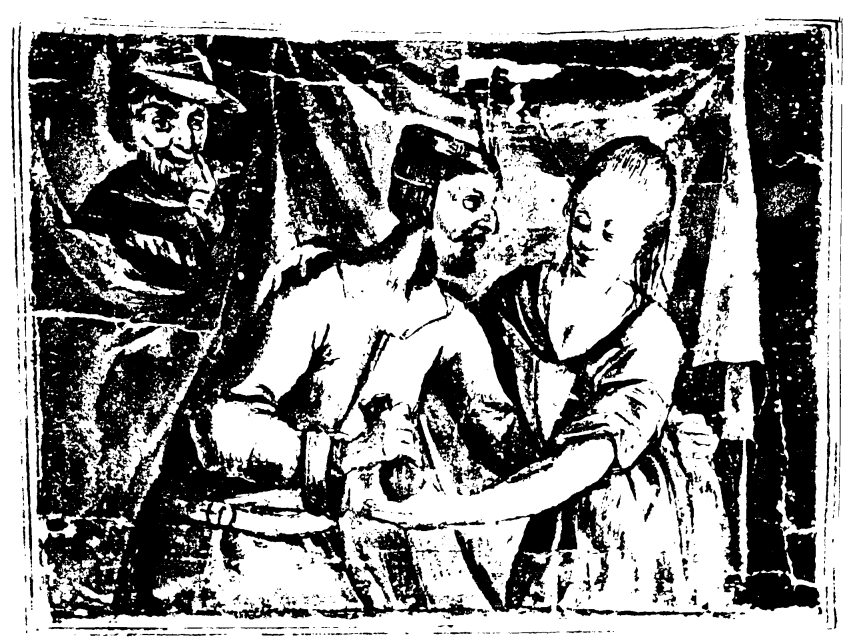
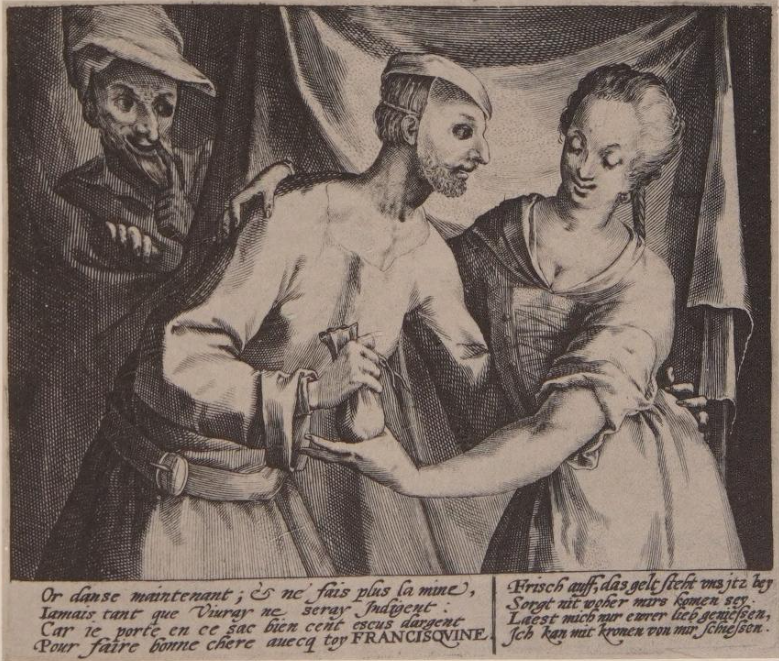
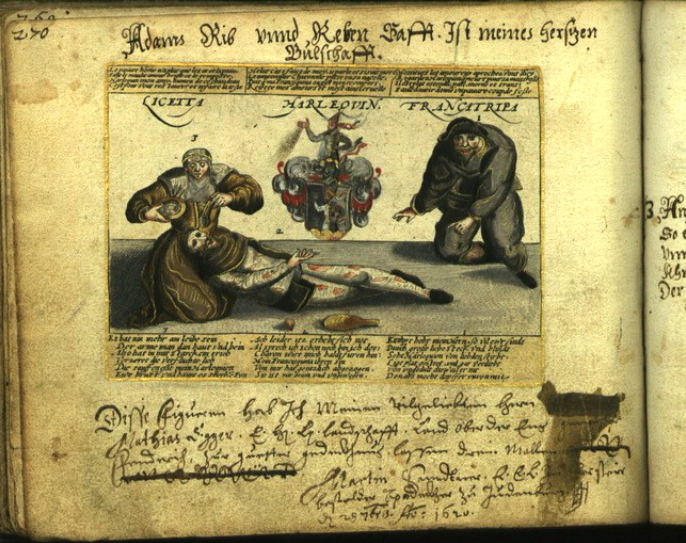
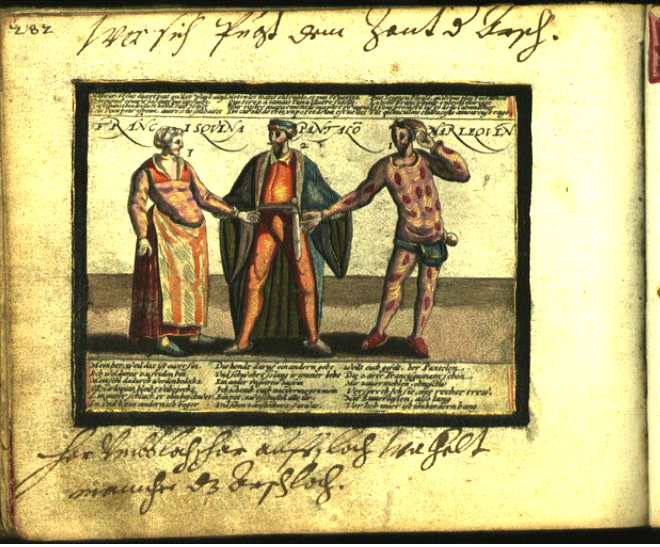
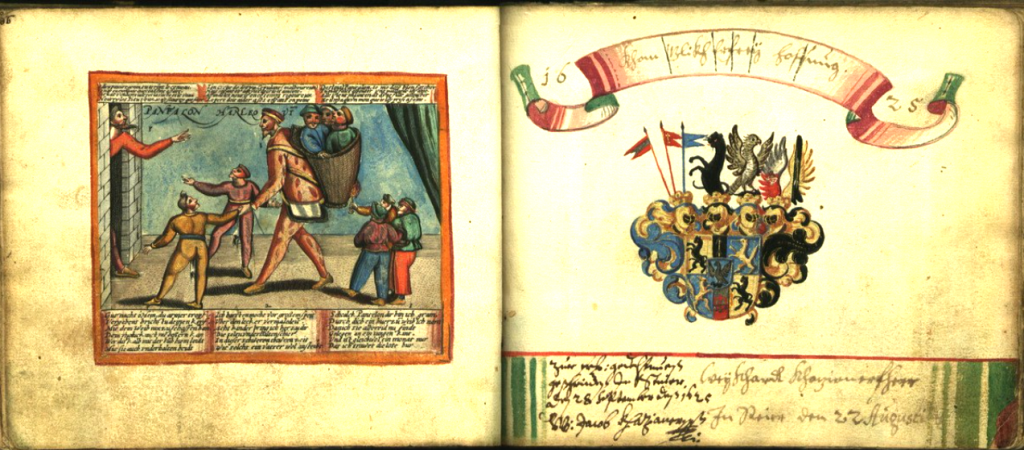
Similarly, an anonymous series of 5 commedia dell’arte scenarios were included amongst the engravings in a purpose-made printed album, the Stam und Wapenbuchli[n], issued in Koln by the publisher Bussemacher in 1600. The album of Georg Mehlmann preserved in Gdansk (Biblioteka Polskiej Akademii Nauk, Ms.2507) uses the book for this very purpose, containing entries dated between 1614 and 1619. Matthias Egger, on the other hand, seems to have cut up the book and pasted its numerous engravings on separate pages which were then re-bound. Entries in his album begin in 1618 and end in 1630, and it includes 4 of the 5 commedia dell’arte scenes which have been hand-coloured, 3 of which I reproduce here:
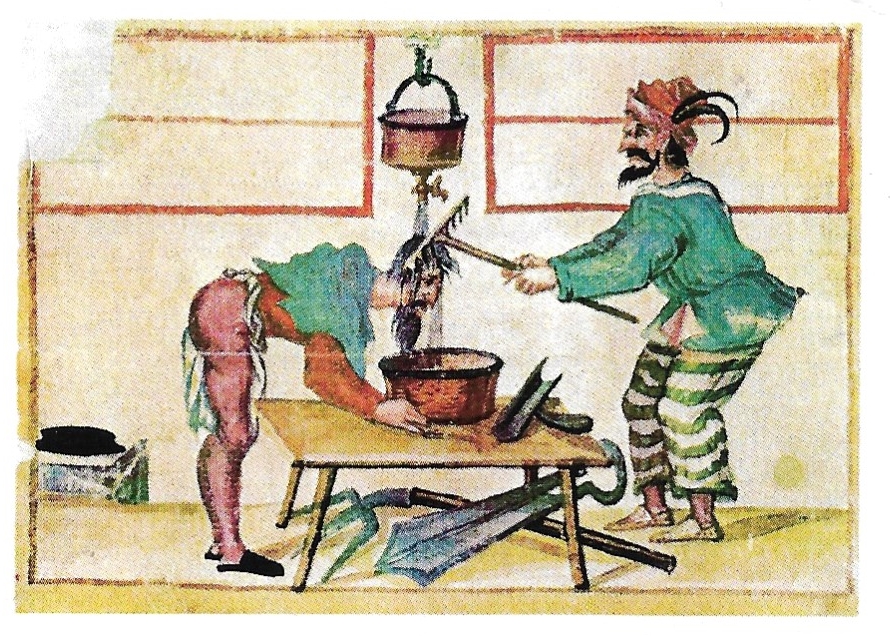
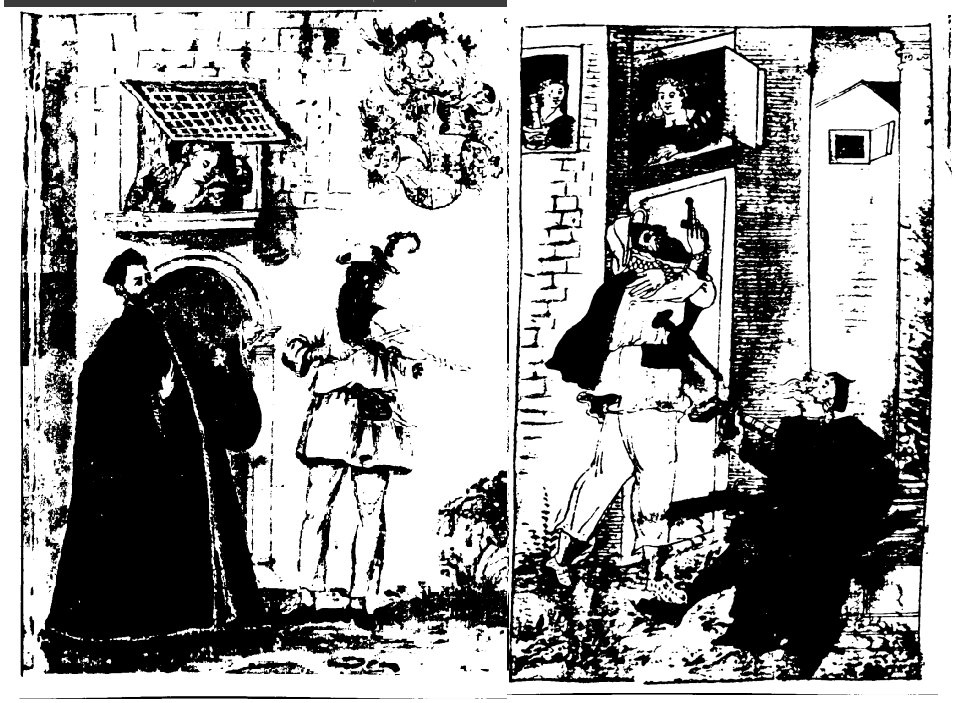
A commedia dell’arte scenario painted in the Schurf album (1577-87) is copied from a sheet of multiple scenes etched by Brambilla and issued in Rome at some point between 1575 and 1590,
Below I have superimposed the album scene on the British Museum’s sheet of commedia dell’arte scenes engraved by Ambrogio Brambilla, there dated 1575×90 — our album painting now helps narrow that date-bracket down a little!
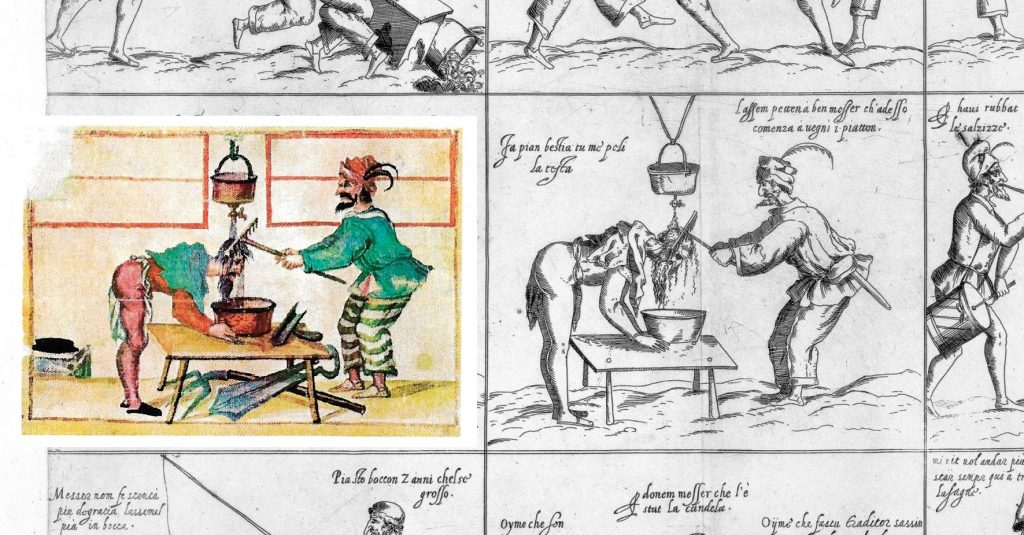
It is interesting to see how the ‘German’ painter has added a curry-comb, a pair of giant shears and a three-pronged fork to his model, reminiscent of the similar implements that are found in contemporary images of German student hazing rituals
[see my post on that subject here: https://albumamicorumear-e4qvahs764.live-website.com/hazing-early-modern-student-initiation-rituals/ ]
Though a German copy of the Brambilla sheet exists, it is a copy in reverse, and the Schurf album painter must have copied the original, as it is in the same direction.
serenade
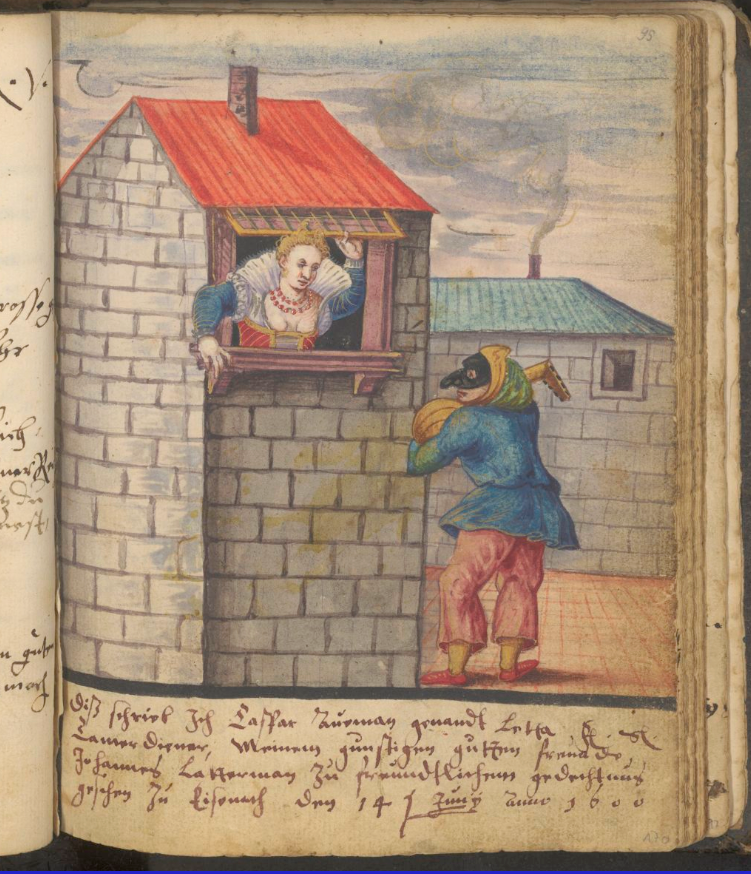
Here a masked lutenist serenades a lady who leans ?provocatively out of her window. The album painter has here ‘improved’ on one of the numerous engraved plates to be found in Pietro Bertelli’s frequently reprinted ‘costume-book’, Diversarum Nationum Habitus (Padua 1589, etc.) — adding a roof and another building, and significantly increasing the lady’s décolletage !
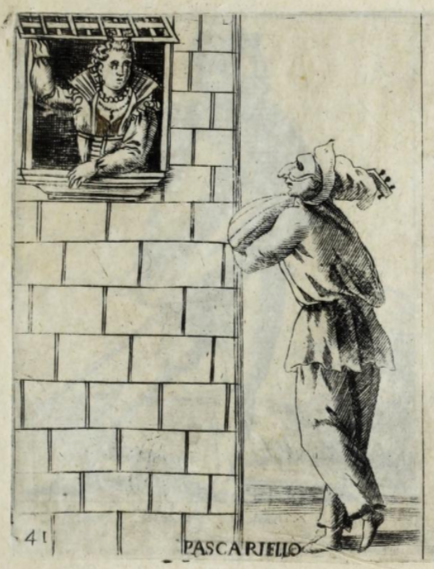
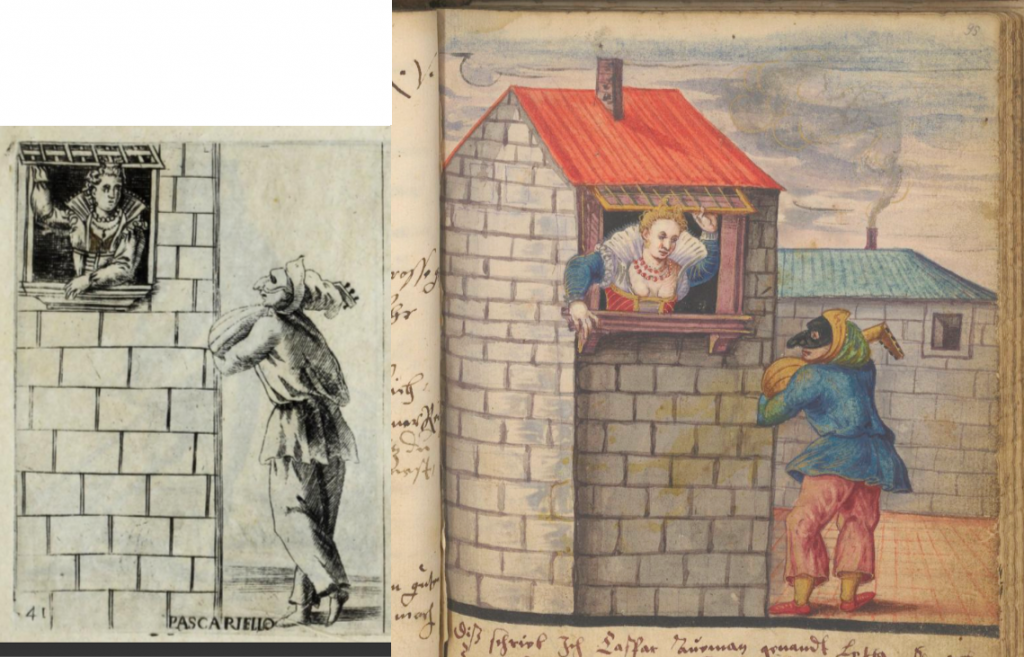
Pantalone goes courting
The commedia dell’arte is peopled with stock characters. Two of the most popular being the old, lecherous (but probably impotent) rich man, Pantalone, and his tricksy, comic servant, Zanni. Indeed, as Professor Katritzky has written, “The Zanni-Pantalone partnership forms the heart, and oldest core, of the commedia dell’arte ” [A Study in the Commedia dell’Arte 1560-1620 with special reference to the visual records (1995), p.168].
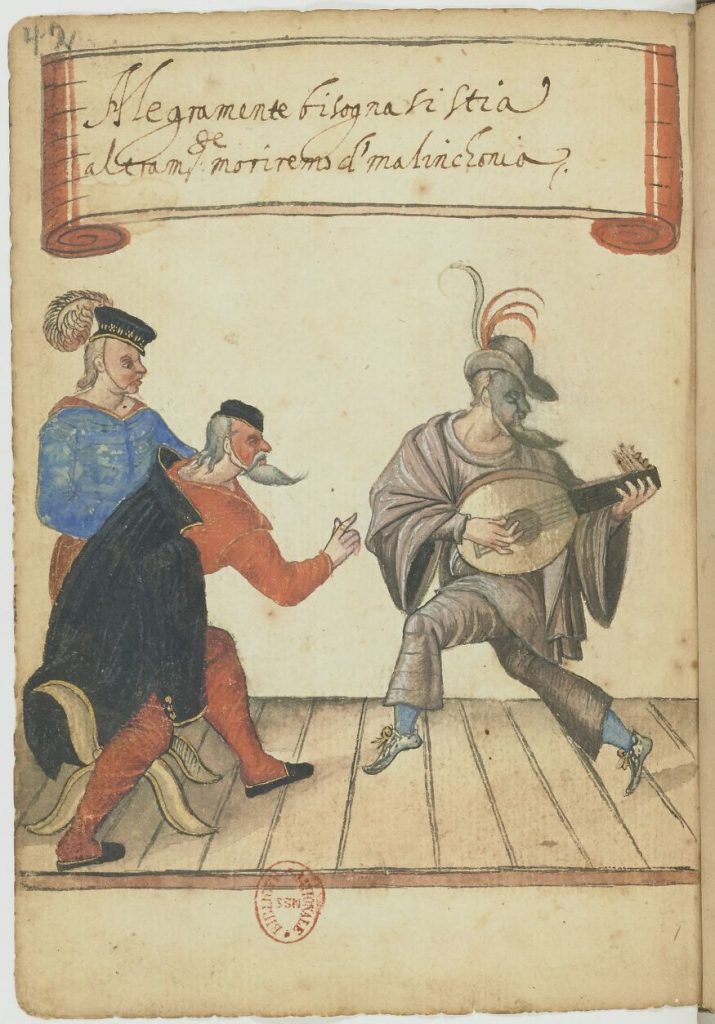
One relatively common scene shows the old man standing outside the house of his inamorata who opens the window to see what the racket is — it is Zanni singing, or singing to a violin! This is one of the typical Italian scenes that must have appeared in every album-painter’s repertoire — below, I reproduce an example from the series of watercolour drawings preserved in the Beinecke Library dated 1575.
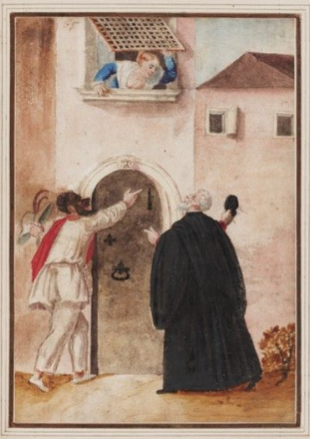
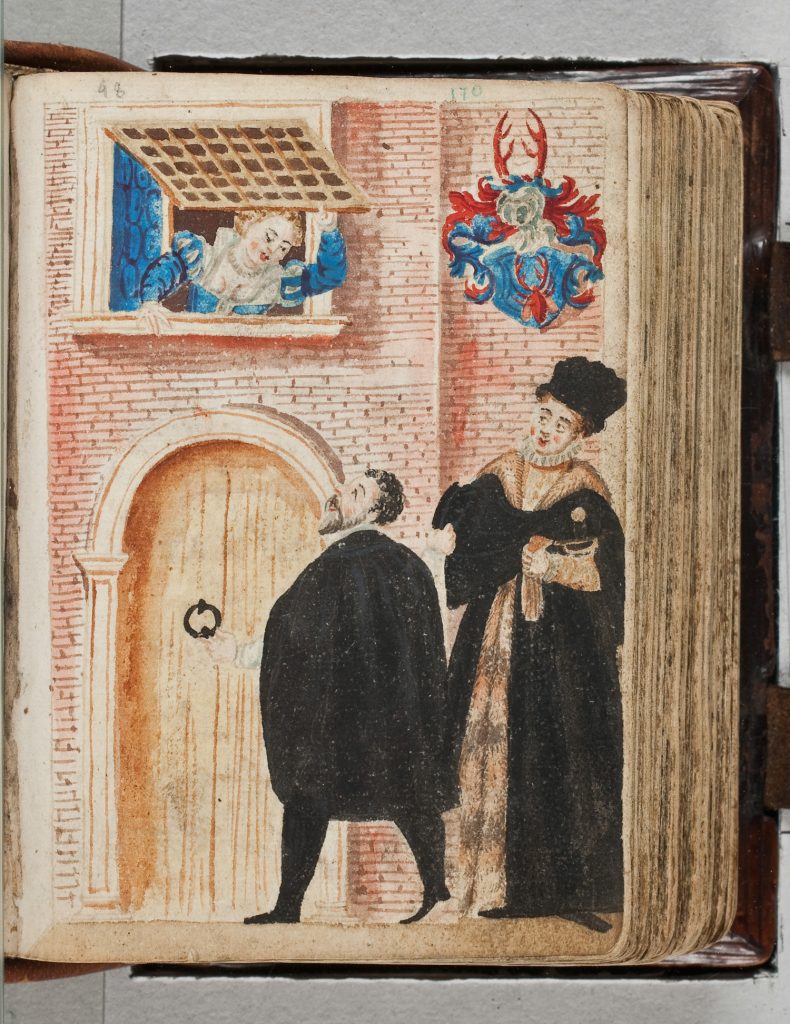
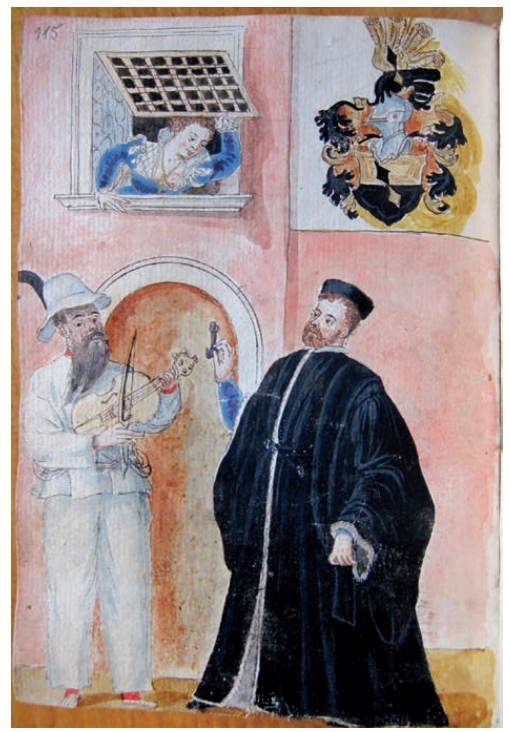
In the Aernout van Buchell album the pair appear to be visiting a courtesan, Zanni providing the music while Pantalone makes his addresses to the lady:
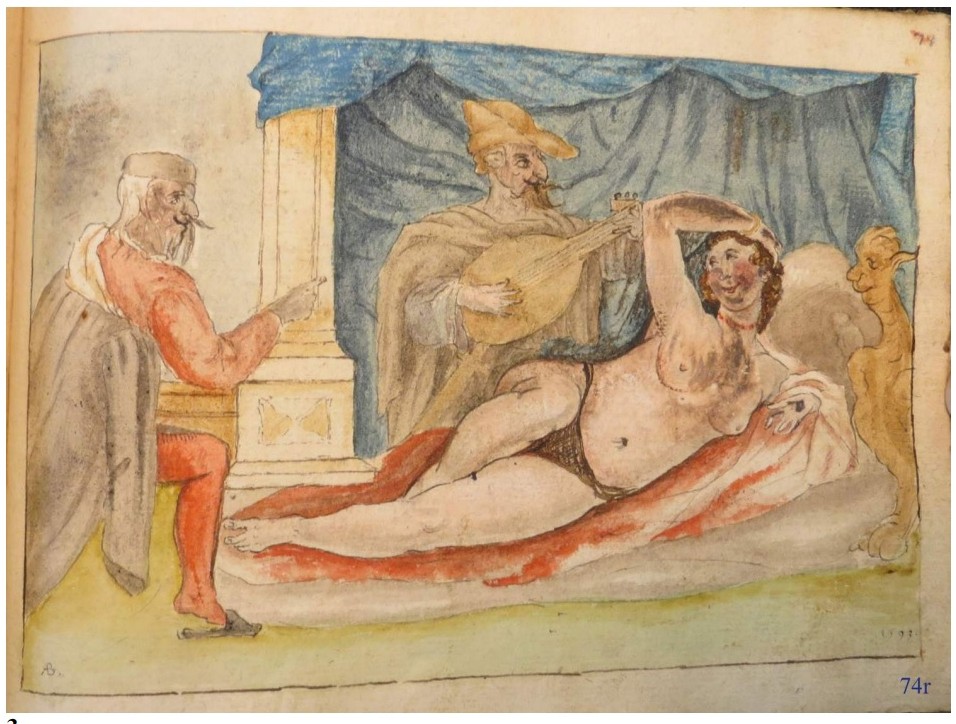
from the album of Aernout van Buchell, this page 1593. Berlin, Kunstbibliothek Staatliche Museen zu Berlin, Lipp OZ 3, f.74r.
[Praun album]
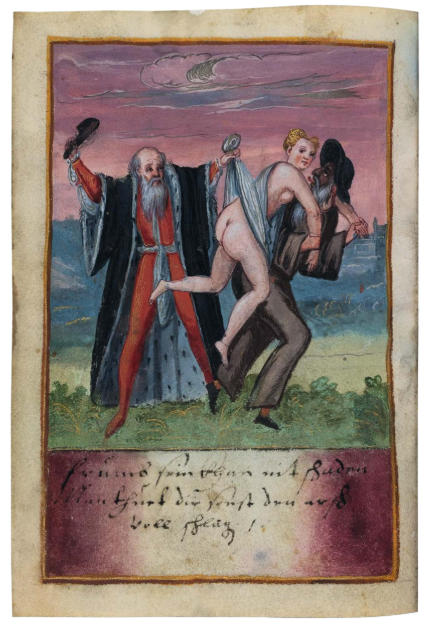
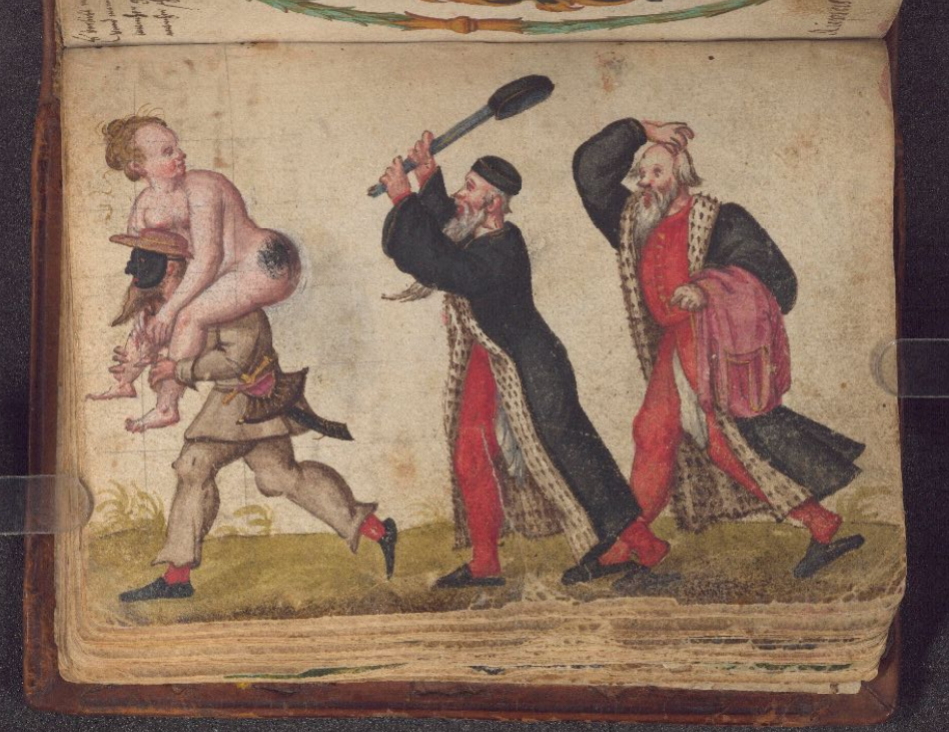
Three scenes featuring the dynamic duo (and a mountebanks scene) were painted in the album of Jacob Praun c.1584, which includes an unusually large series of Italian miniatures.
This scene and its parallels I have dealt with already in the Monks Behaving Badly post here:
https://albumamicorumear-e4qvahs764.live-website.com/monks-behaving-badly/
so I will content myself with merely reproducing it here, and won’t re-cap all that — but will just add the similar scene I have just found in the remarkable Widholz album — before moving on to the other two Praun album scenes.
Sailing on horseback
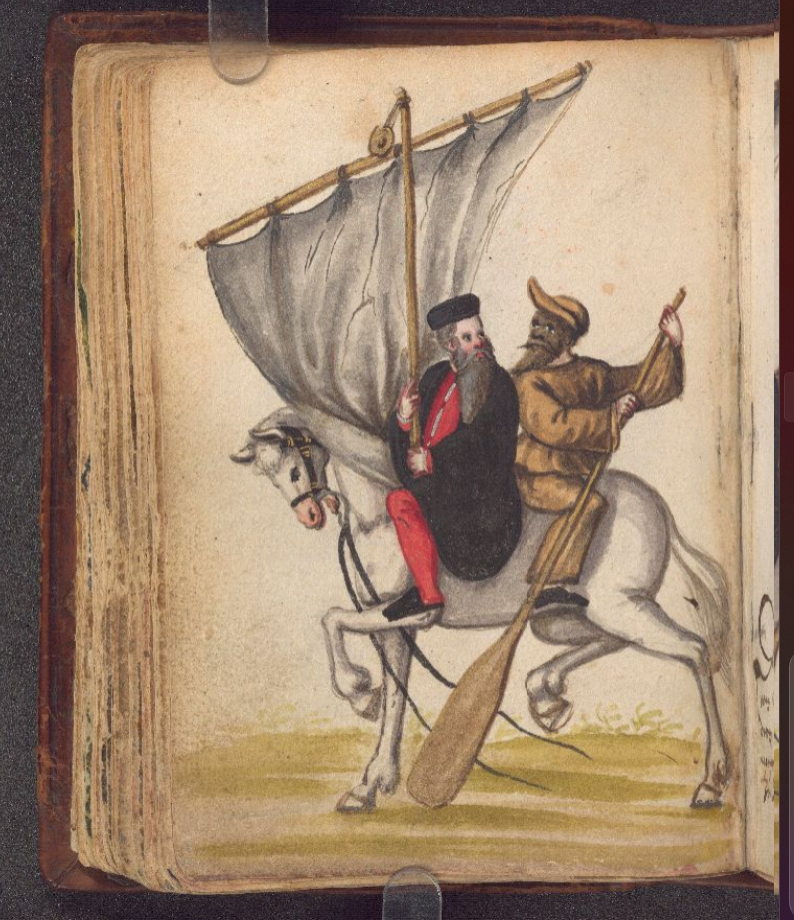
Here we see the pair ‘sailing’ on a horse — Pantalone holds the sail aloft while Zanni (seated backwards on the animal) paddles with a long oar. The only parallel that occurs to me is a detail of the pageant in honour of the marriage of Sophie, sister of Kurfürst Christian II, to Herzog Franz von Pommern, celebrated in Dresden in 1610. Here Pantalone alone is seated backwards on an ass to which a billowing sail is attached and again paddles with a long oar. [Leipzig, Stadtbibliothek, Rp.III 5ca, f.44v. — reproduced in F. Sieber, Volk und volkstümliche Motivik im Festwerk des Barocks (Berlin, 1960), Taf. 47.]
?Geldscheisser
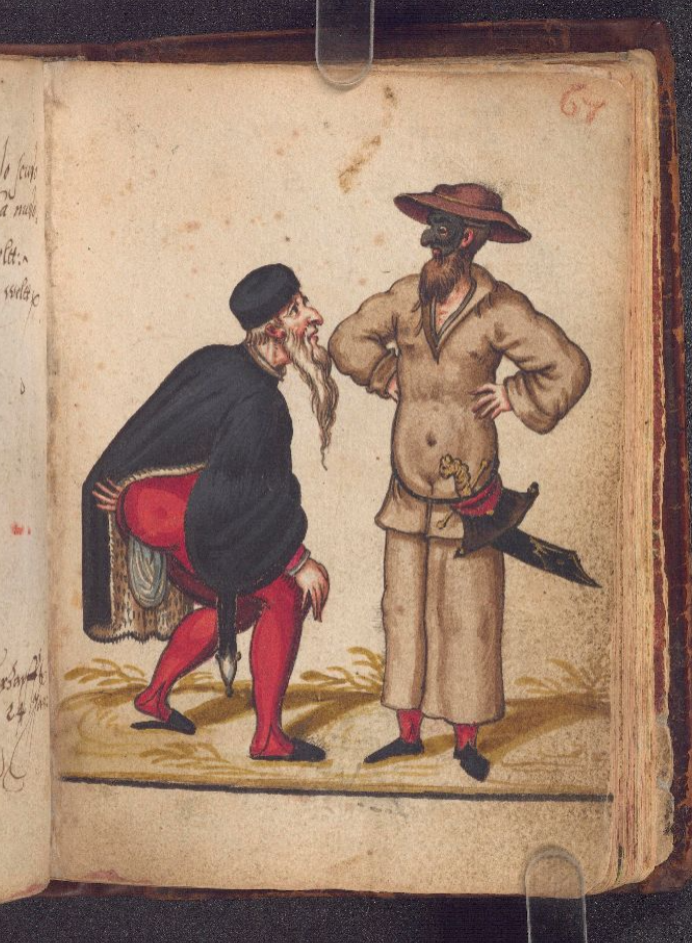
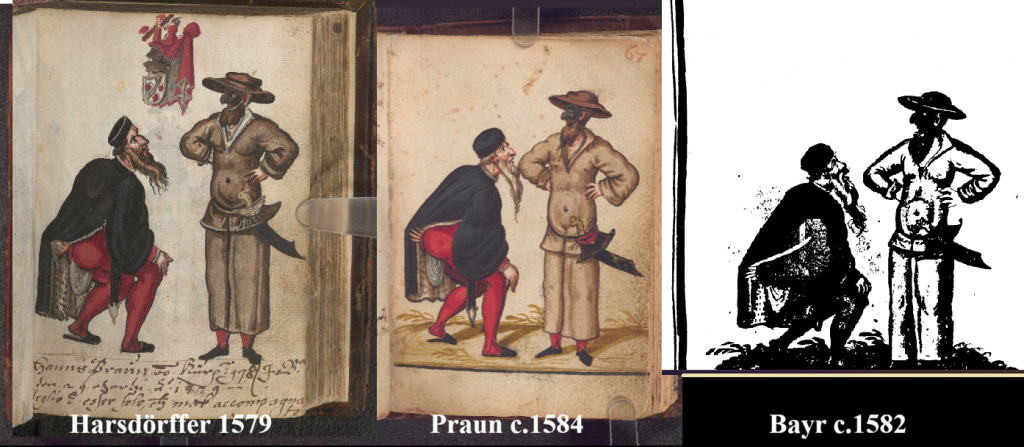
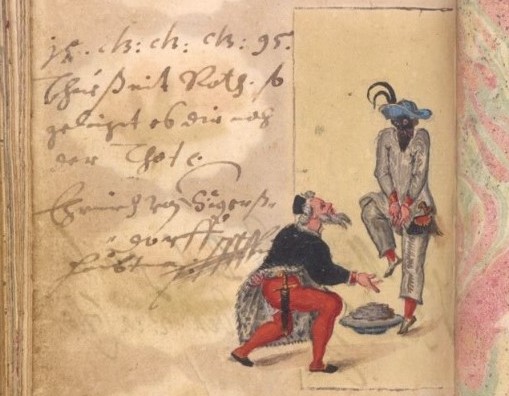
Katritzky reproduced, but did not comment on, another scenario featuring Pantalone and Zanni from the Bayr album (c.1582). Pantalone squats as if defecating, while Zanni stands over him arms akimbo. The identical scene appears also in the contemporary Praun (c.1584) and Harsdörffer (1579) albums — in the latter example, the GNM website misidentifies Pantalone as a Jew. It is clear that something is emerging from between his buttocks, it is not a fold of clothing — could it be an outsize coin? Is he what is termed in German folklore, a Geldscheisser ?
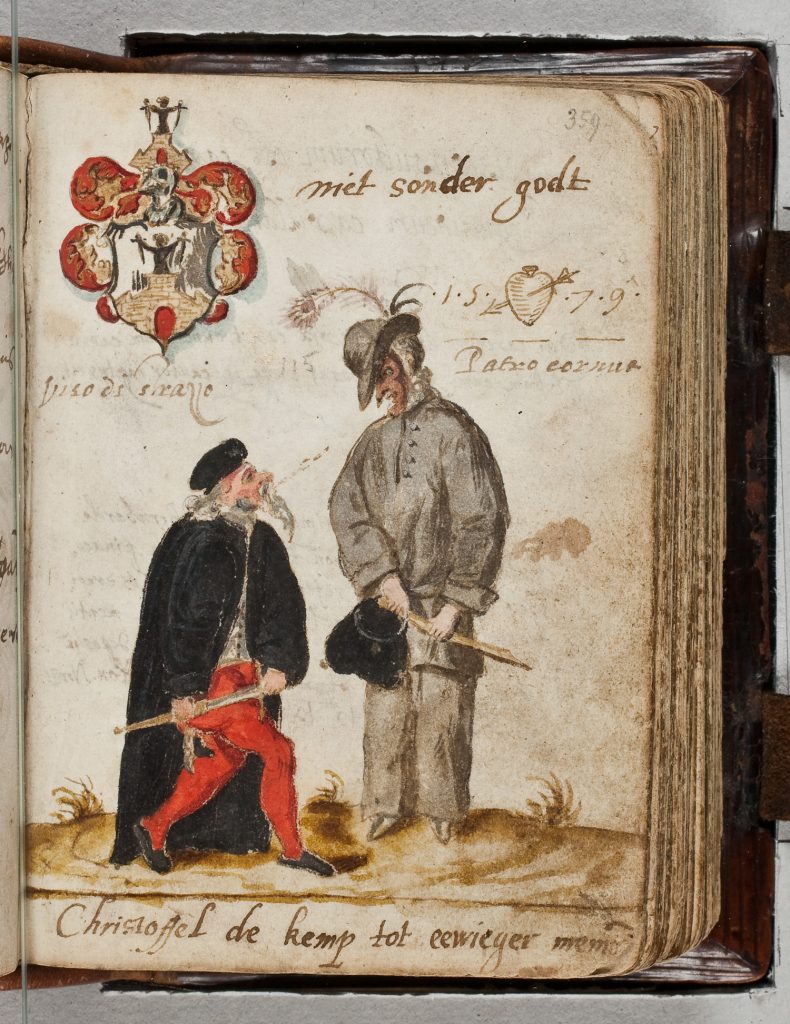
Is this part of the same episode?
In the scene below Pantalone spits at the taller figure, whom I take to be Zanni, and they trade insults. Pantalone says, ? Viso di strazzo [ ………..], to which Zanni replies, Patro cornut [old cuckold]
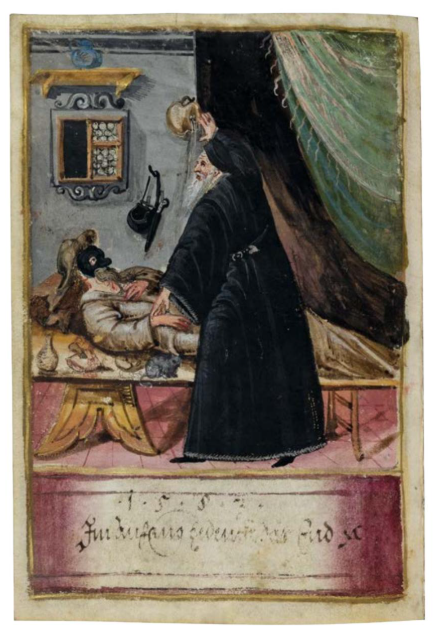
Zanni on his deathbed? Zanni & the Doctor
I only happened upon this scene yesterday in the wonderful Widholz album, so it can be closely dated 1583/4. The caption is a familair German proverb, Im Anfang bedenk das End [At the beginning think of the end] — the ‘end’ here would appear to be the death of Zanni.
? What’s going on here
RAA describes this next image as a Verführungsszene [scene of seduction] — well, it it is, I think it”s doomed to fail! Pantalone in his characteristic black gown and red tights — as seen above — stands behind a woman in the typical dress of the Venetian courtesan with the diagnostic corna coiffure. She holds a tall wine-glass (or is it a closed fan?) in her left hand, and he makes a gesture with the thumb and forefinger of his right hand — which I feel sure I ought to recognise! Readers ?!
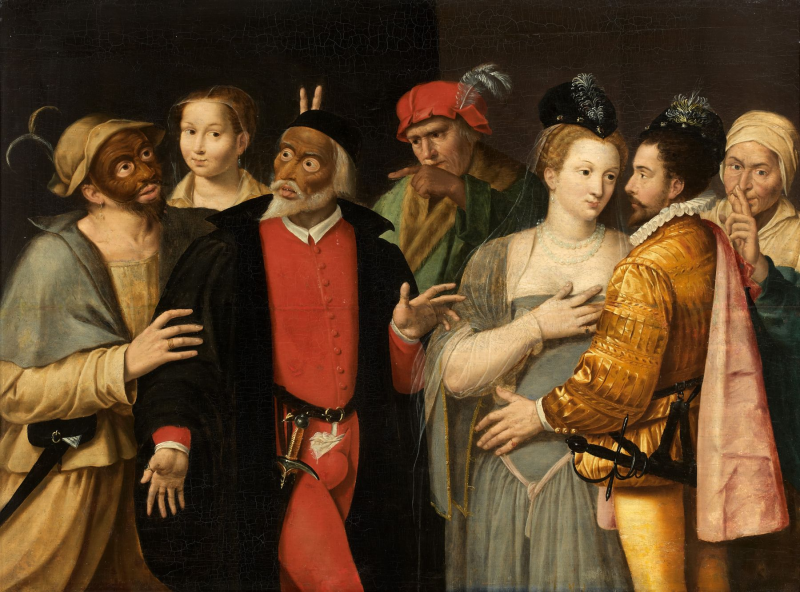
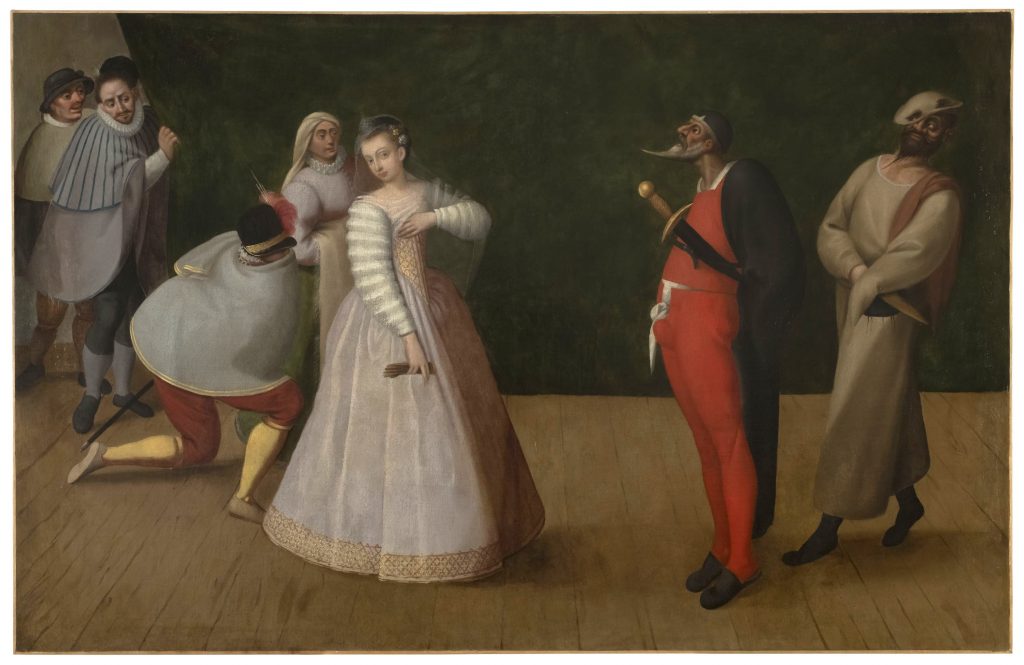
Pantalone’s characteristic colour-scheme (and a nice example of the horns gesture!) can be seen in these two anonymous contemporary paintings of I Gelosi troupe of Italian comedians in France
Mountebanks
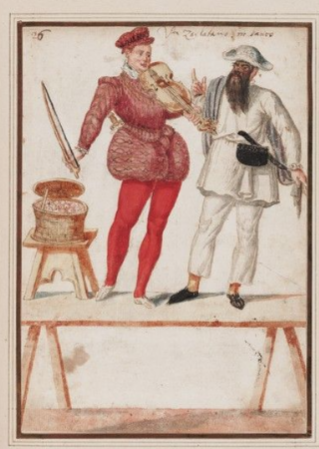
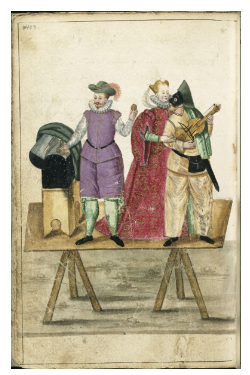
So-called, of course, from the ‘bench’ [Italian banco] — more of a trestle-table, in reality — on which they are mounted. Because — whether quack-doctors selling alleged panaceas, or salesman eager to offload some other kind of dubious merchandise — they had an ‘act’ up there on their makeshift stage, so that they have a definite connexion to the commedia dell’arte. In the simplest type of illustration we see just the salesman and his assistant, who is often shown playing an instrument. Again, the Beinecke Mores Italae series of 1575 includes the basic version:
Here is the Praun album version:
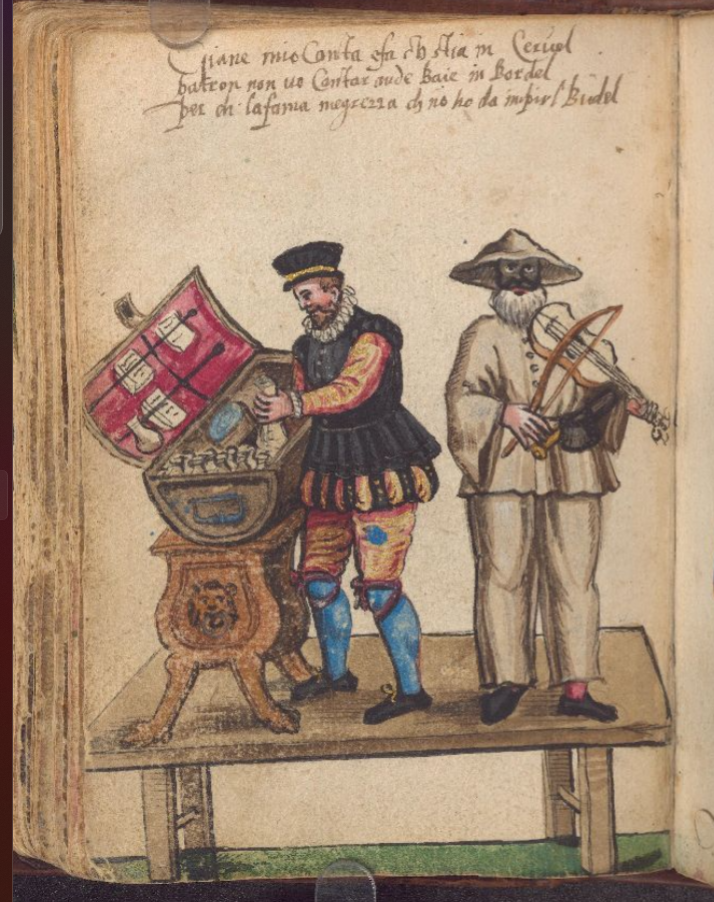
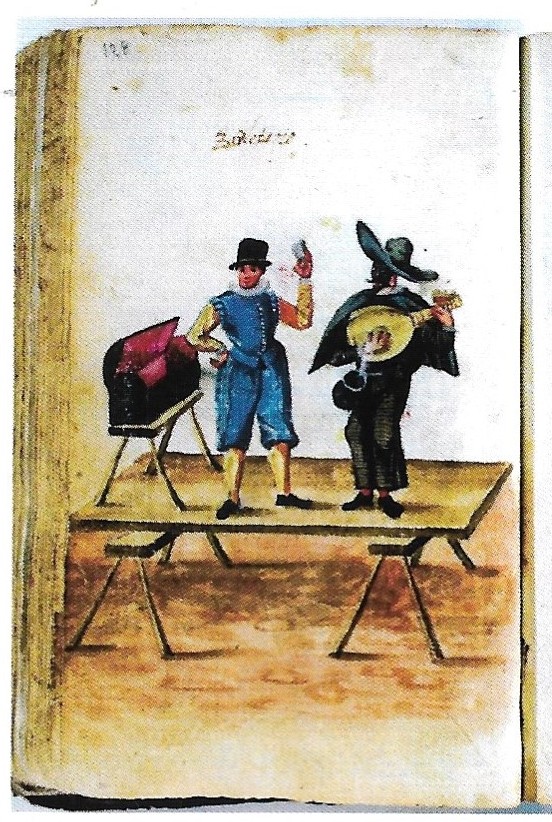
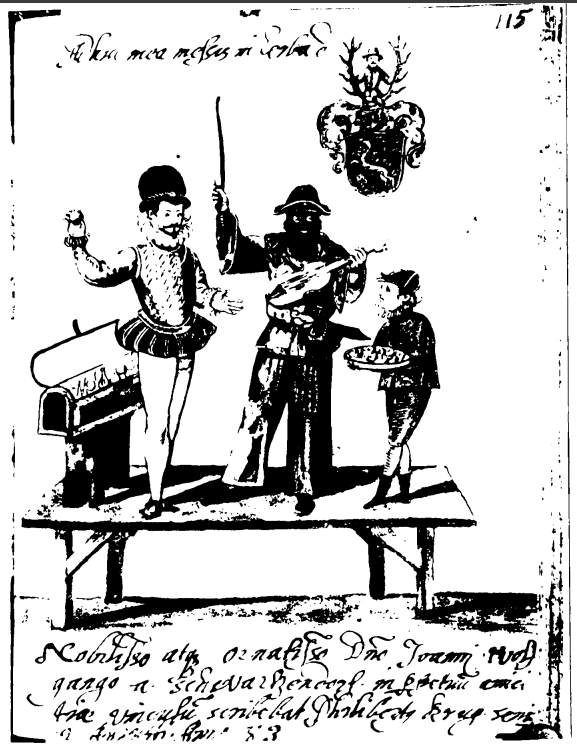
The Schwarzdorfer album painter adds a small boy to the cast:
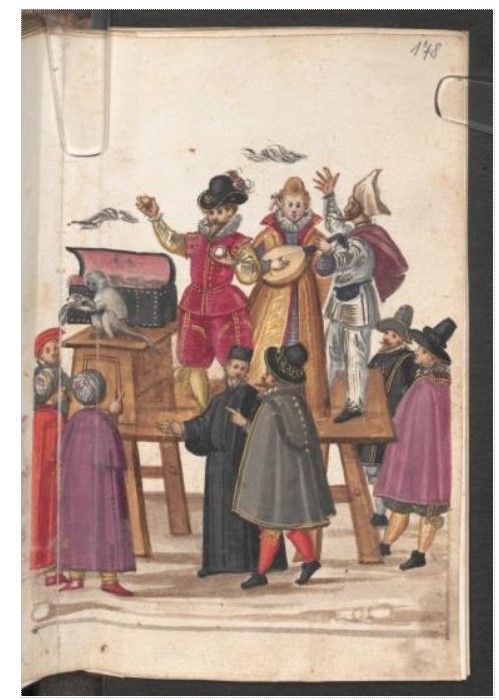
Other albums introduce a woman on stage as part of the act:
Callot-esque
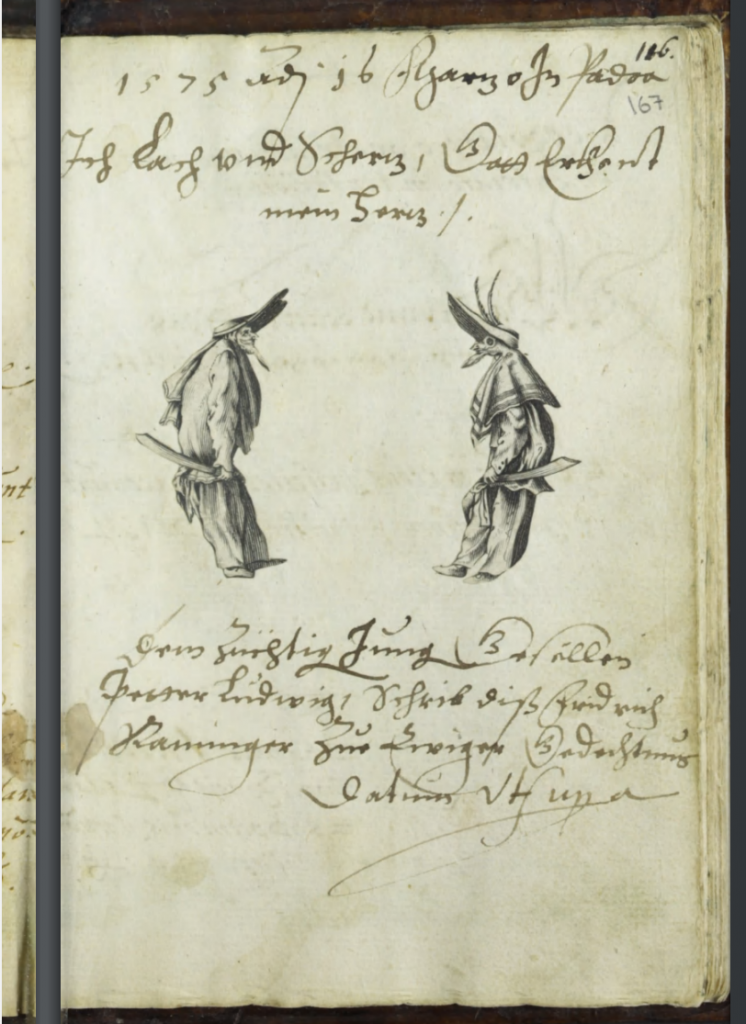
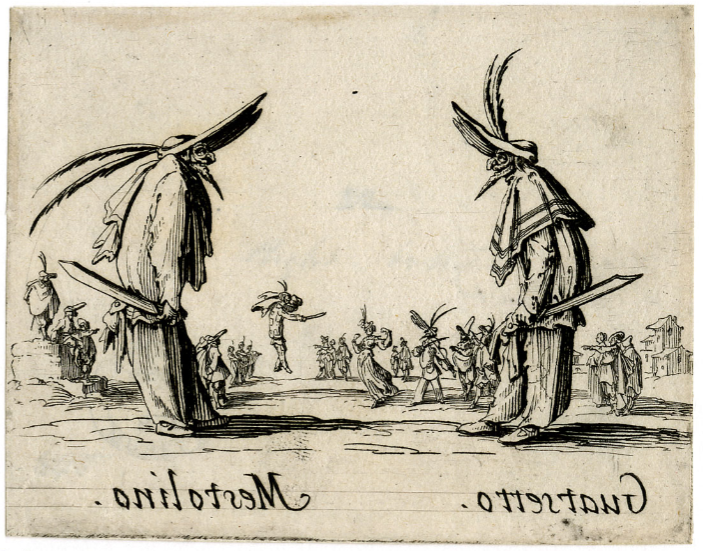
The first image below is a bit of a puzzle. The page is dated 1575, which is much too early for Callot, of course. The images do indeed look as if they are cut-outs stuck onto the page, yet magnification shows no sign of that. Their obvious relation to the Callot etching of Guatsetto and Mestolino, however — here reversed for the sake of comparison — suggests they must be from some post-1621 Callot copy which was itself reversed.
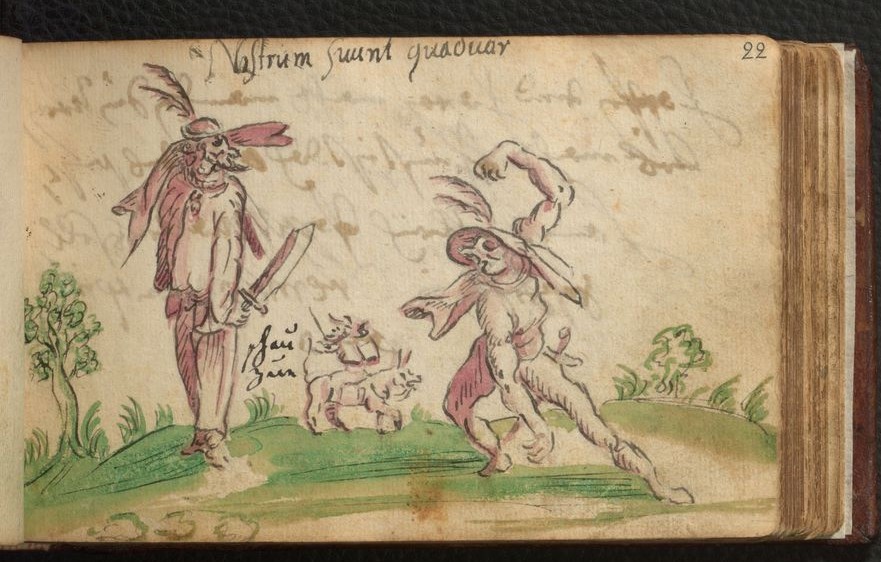
I have already discussed this next image, which clearly derives from the Callot etchings below, in this post —
https://albumamicorumear-e4qvahs764.live-website.com/the-additional-fool-that-would-be-you/
(nice little background detail of riding backwards on the ass taken from the similar in the second etching!)
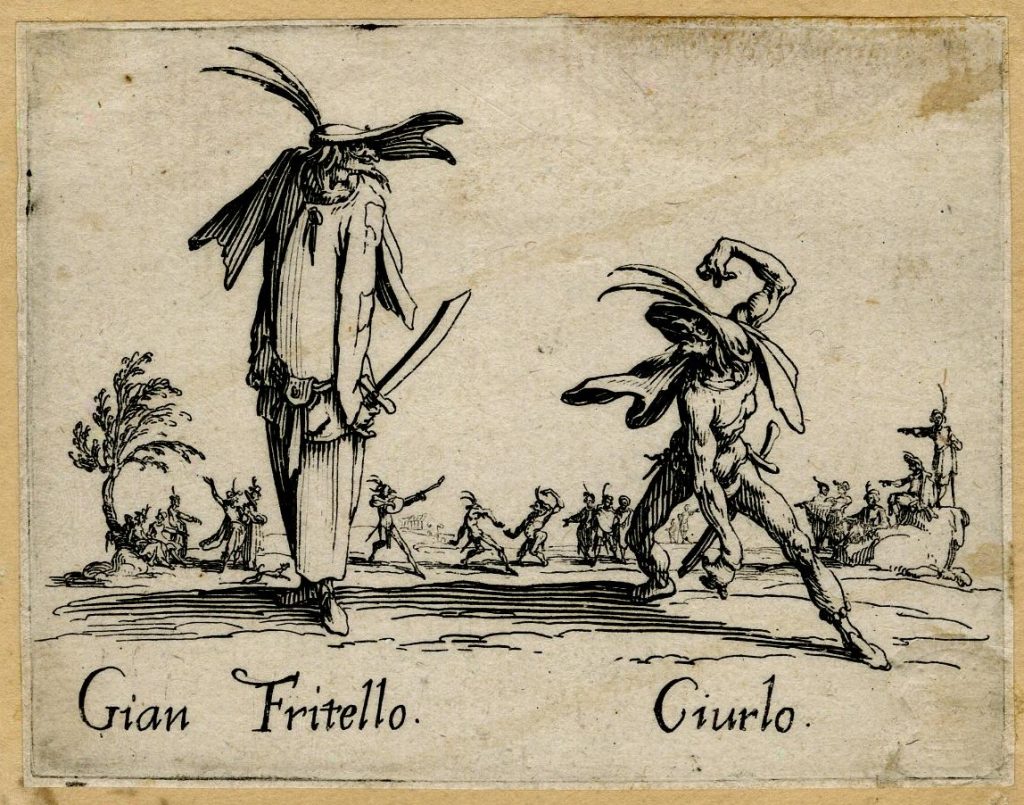
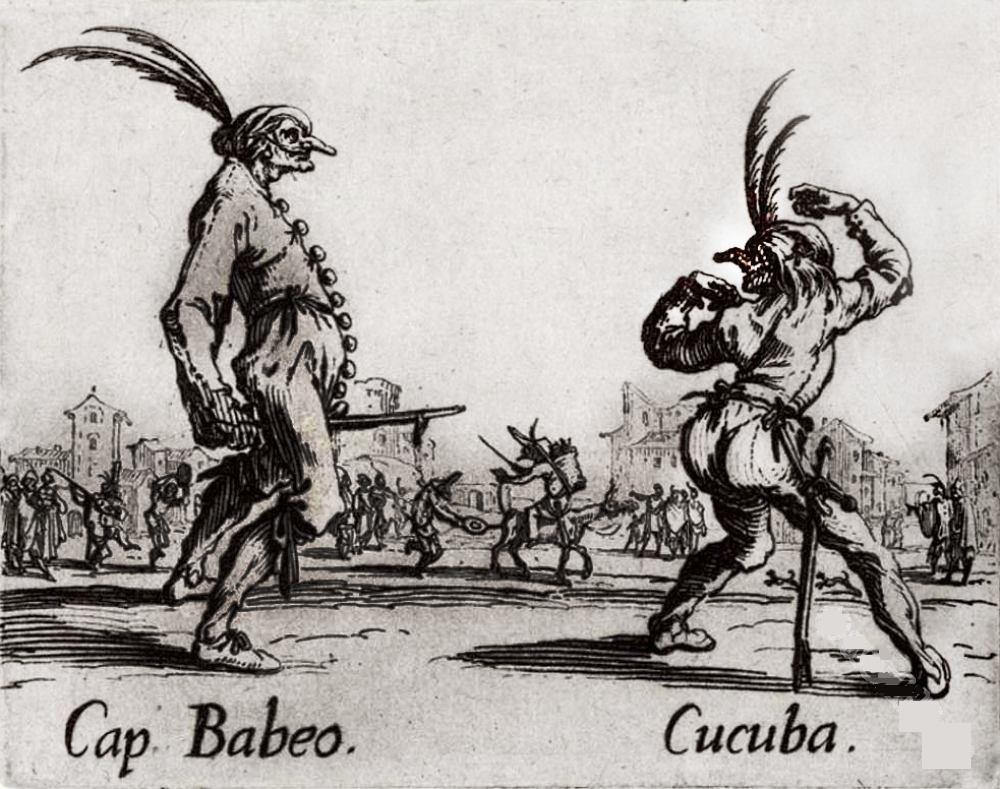
Another sketch in the Simmerl album is also Callot-derived — a reverse copy of his Scapino and Zerbino.
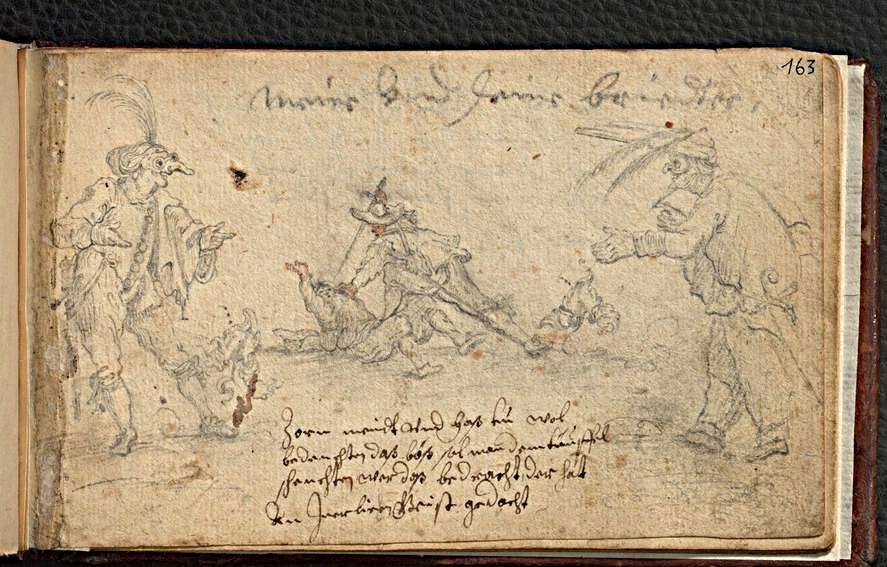
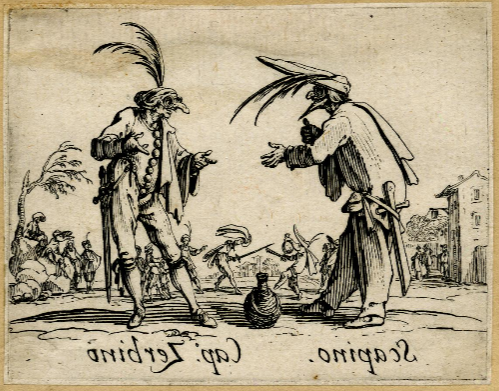
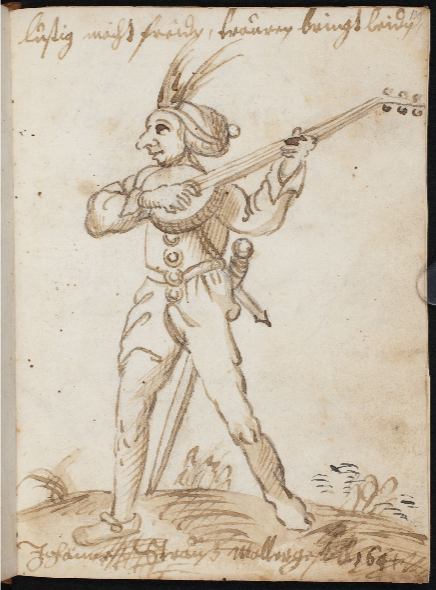
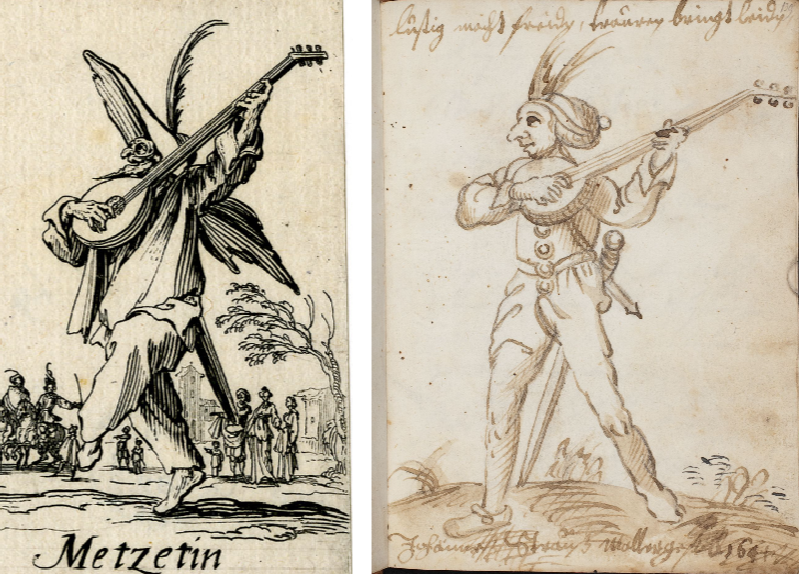
The drawing below looks vaguely commedia-esque to me [must find out what the proper name for that exceptionally long-handled lute/mandoline is! Readers, please?! ] — it bears a generic resemblance to Callot’s Metzetin. It was sketched in the album of apprentice sculptor, Hans Mayer, in 1641 and is captioned, lustig macht fraid, traurig bringt laid [cheerful makes joy, sad brings pain]
Leave a Reply