I know of only one example of this motif painted in the albums — and I have no image of it! That said, I think the motif is of sufficient intrinsic interest to post here as many examples ante 1650 as I am aware of. Always happy to be notified of others — in the Comment box below — or direct by email: malcmjones1@gmail.com
The sole example was painted in the album of Otto von Rietheim in 1582, but the album itself was destroyed in the Louvre fire of 1871, so we have only a verbal description to go on: “A priest on the side of life playing chess against Death. A sand-glass measures the hours, and the skulls of those checkmated litter the ground beneath the table” [Gazette des Beaux Arts 3. xiv (1859), 102 (my trans.)] Below, the miniature was captioned with an epigram of Sir Thomas More:
Nudus ut in terram veni sic nudus abibo. Quid frustra sudo funera nuda videns? [As naked I came into the world, naked I will leave. Why do I sweat in vain seeing naked corpses?]
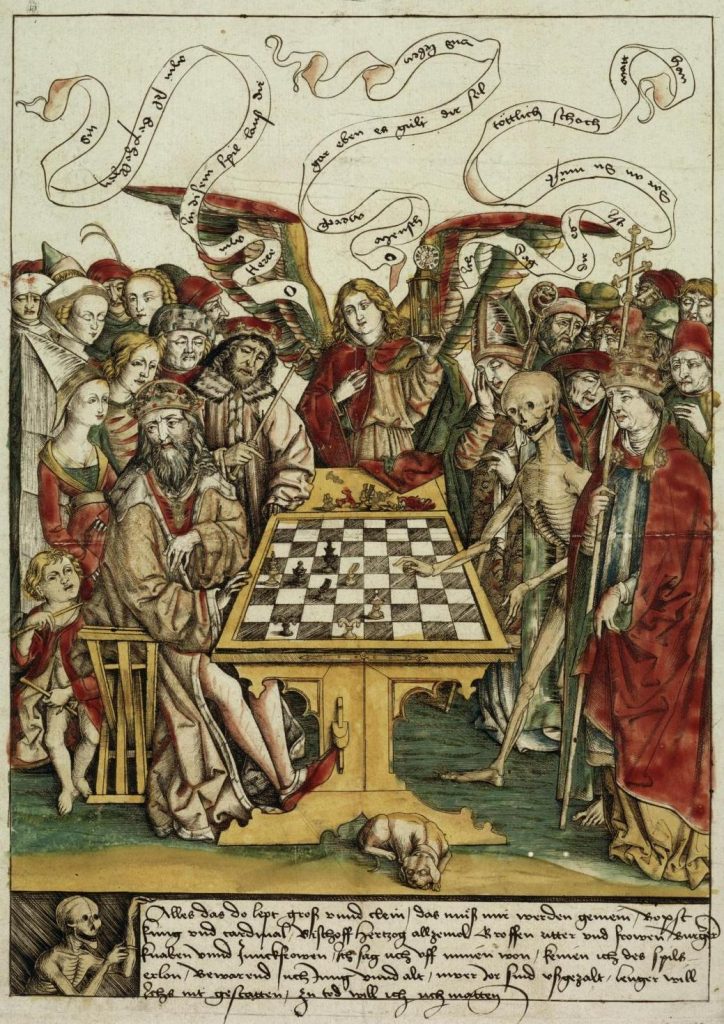
Thanks to the excellent dodedans blog — http://www.dodedans.com/Eskak.htm — I was referred to Oseas Schad’s Summum Argentoratensium templum (Strasbourg 1617), 51f., where our motif is described in detail as it was painted on the wall of Strasbourg Cathedral in 1480. An angel stands with an hourglass in hand addressing Man [Mensch] in the vernacular, and opposite the angel stands the image of Death, who tells him he has a deadly checkmate for him: Du solt tödtlichen Schachmatt han. Beside the angel stand many popes, emperors, kings, bishops, priests, and other prelates and clerics and a wealth of Latin verse
These same verses — in a later, sixteenth-century hand — appear on an impression of a rare late 15C print, engraved by the Master BR and Anchor, leading to the suggestion that it may reproduce the lost Strasbourg Cathedral wall-painting. Note that the angel holds an hour-glass with clock-face above.
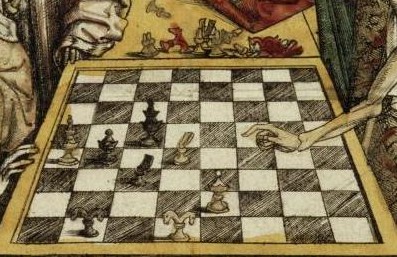
Below, detail of the board in the above print. I think I’ve worked out the checkmate here. That’s the White King on the back row, and Death playing Black — of course! — has just moved the piece next to it, i.e. the checking piece, which I take to be the Black Queen. The White King cannot take it, because it would be moving into check (from Death’s Black King), and all other possible moves result in check from Death’s Queen. So checkmate!
Four years after the publication of his pan-European best-seller, Das Narrenschiff [the Ship of Fools] Sebastian Brant — a native of Strasbourg — was inspired to write De periculoso scacorum ludo inter mortem & humanam conditionem [Concerning the dangerous game of chess between Death and the human condition], which first appeared in his Carmina (Basel 1498). This short poem in Latin and German seems to follow the same scheme as the Strasbourg painting, and once again, predictably, has Death — in the vernacular — saying, Kein zyt ich beitt, schachmatt ich sprich [I wait no longer, I declare checkmate].
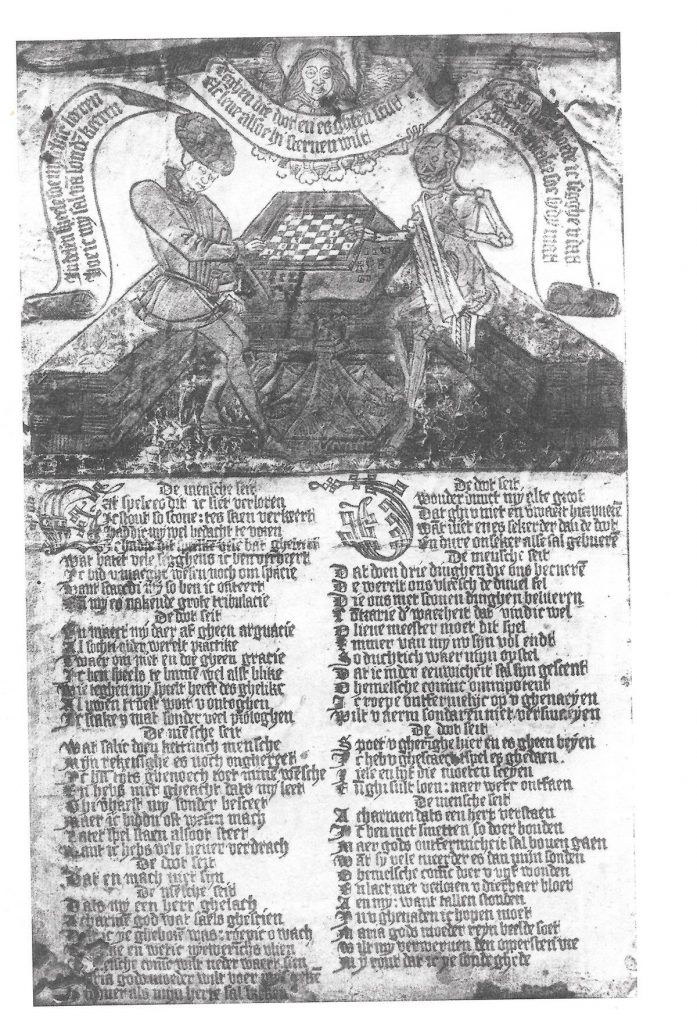
A contemporary, but less public, game to that engraved by the Master BR & Anchor is depicted in this Netherlandish (Lower Rhine) print below — now lost, it was formerly in the University Library of Konigsberg, and I have scanned it here from Sabine Griese, Text-Bilder und ihre Kontexte (Zurich, 2011), Abb.14 m. The board is accurately depicted as 8 x 8 squares, but the the definition is not adequate to make identification of the remaining pieces possible.
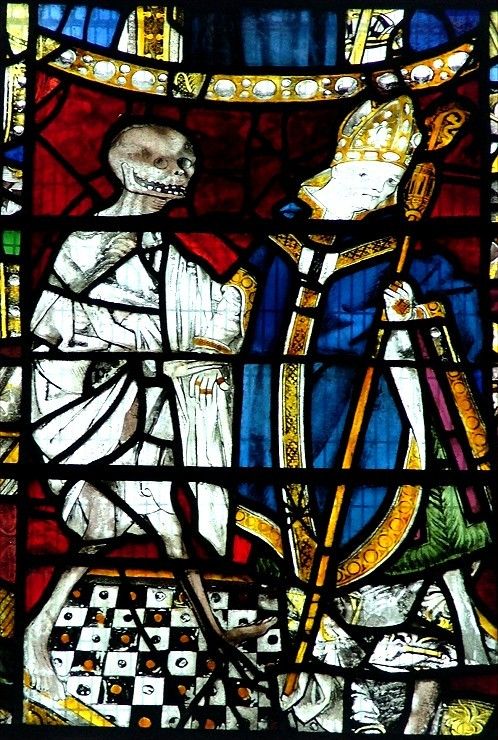
What may perhaps be the only surviving pane from a late medieval English Dance of Death series is preserved in St. Andrew’s Church, Norwich. Here perhaps Death, having, inevitably, won the game, tramples on the board, having just swept all the pieces away, and leads the Bishop off.
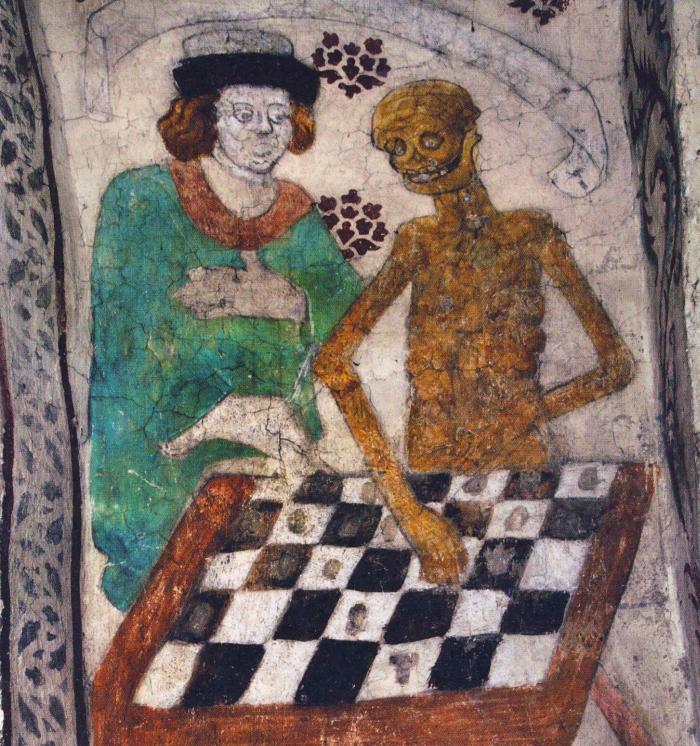
The famous scene in Ingmar Bergman’s 1957 film, The Seventh Seal , is said to have been inspired by this painting in the church at Taby in Sweden, by the German painter, Albertus Pictor (d.1507) — with its impossible board (7 x 5 squares)!
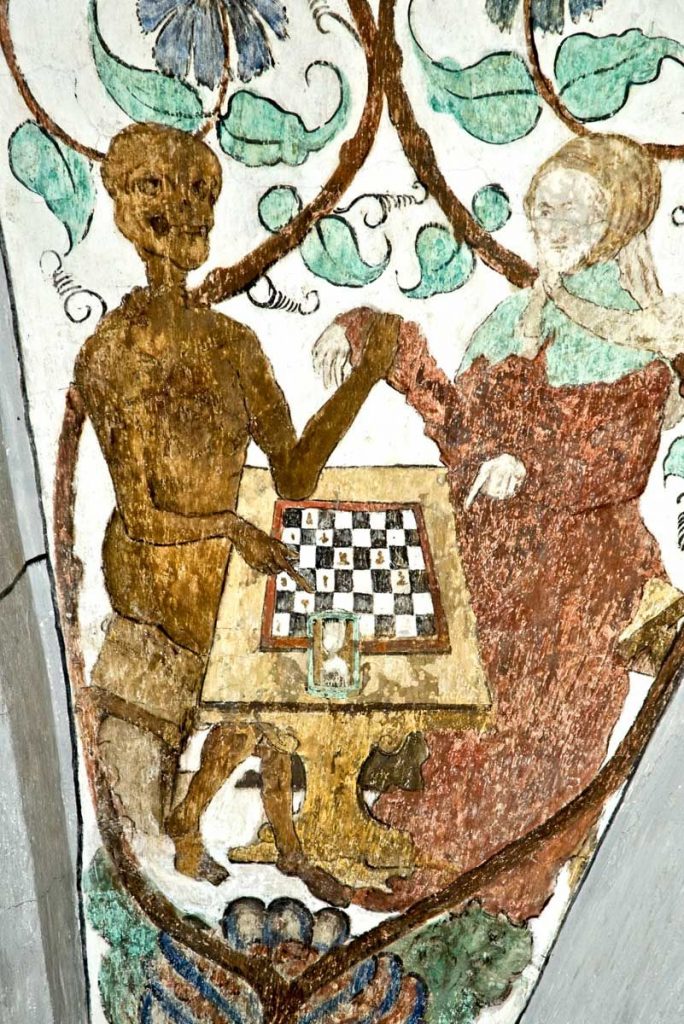
Less well-known is the similar confrontation painted c.1518 in the St. Margarethenkirche, Ilanz in Graubunden (Switzerland). Note how Death points to the hour-glass — a chess-clock with a vengeance! [But another dodgy board — 8 x 6 squares!]
If you thought that board was bad ….
[11 x12 squares — and none of them black!]
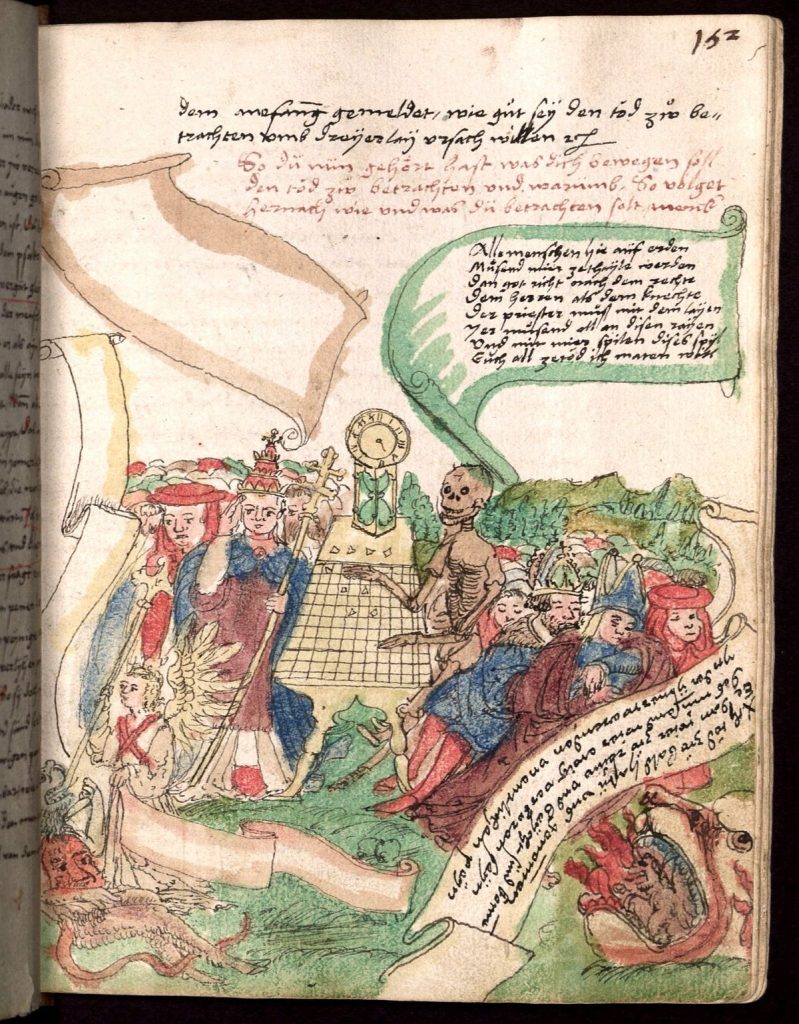
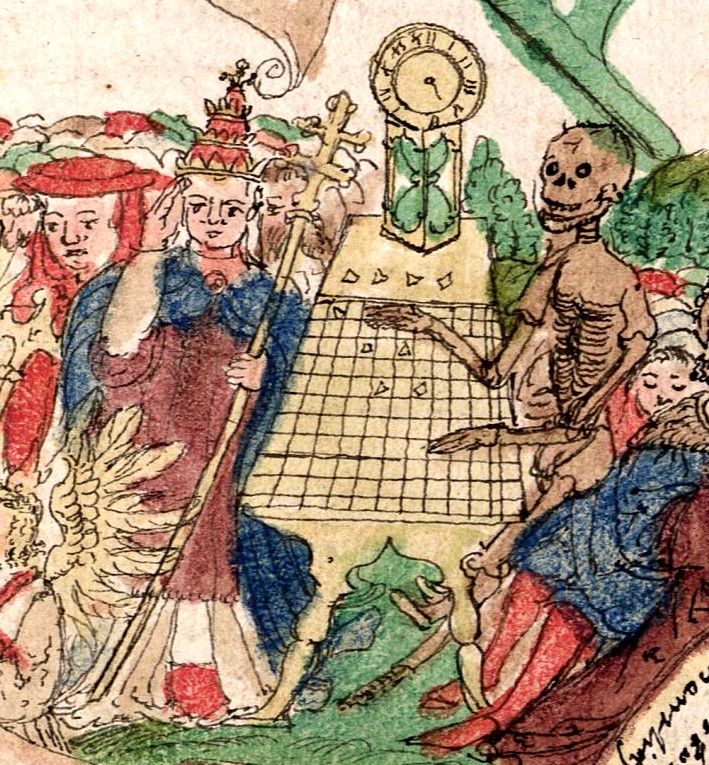
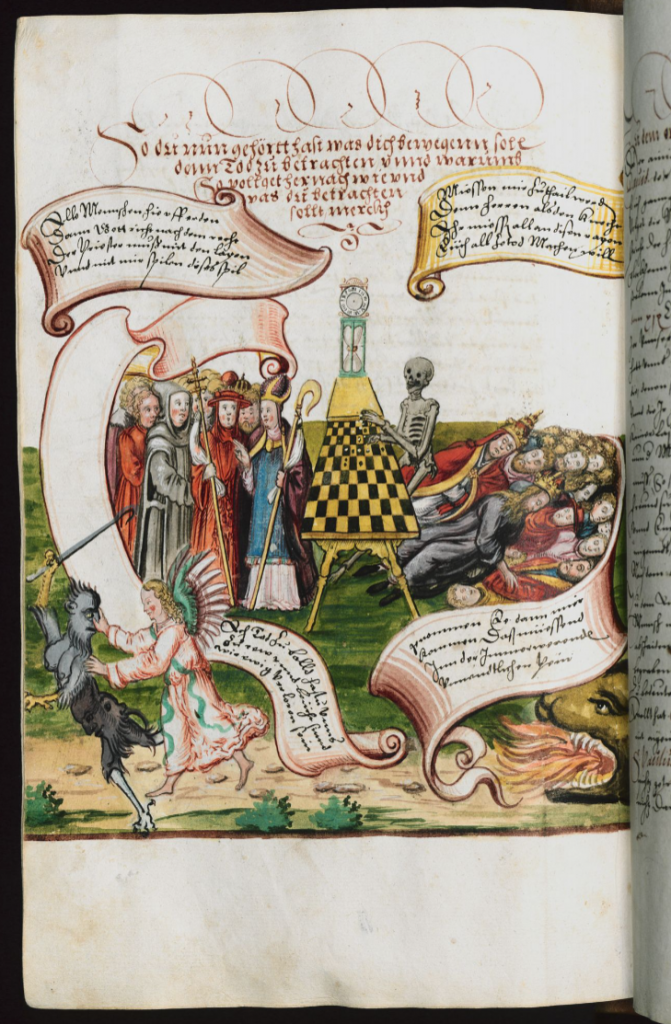
With the game as shown in Wilhelm Werner von Zimmern’s Verganglichkeitsbuch [Book of Transience] (above), we are in post-Reformation Germany (?1540s), and it is the Pope who plays against Death — but again, a decidedly rudimentary board — 12 by 12 squares, and none of them black! The pieces are also so rudimentary that they all look identical. The copy made c.1565 now in Donaueschingen has a similarly impossible board — 9 x 10 squares — and again the pieces are indistinguishable.
Leave a Reply