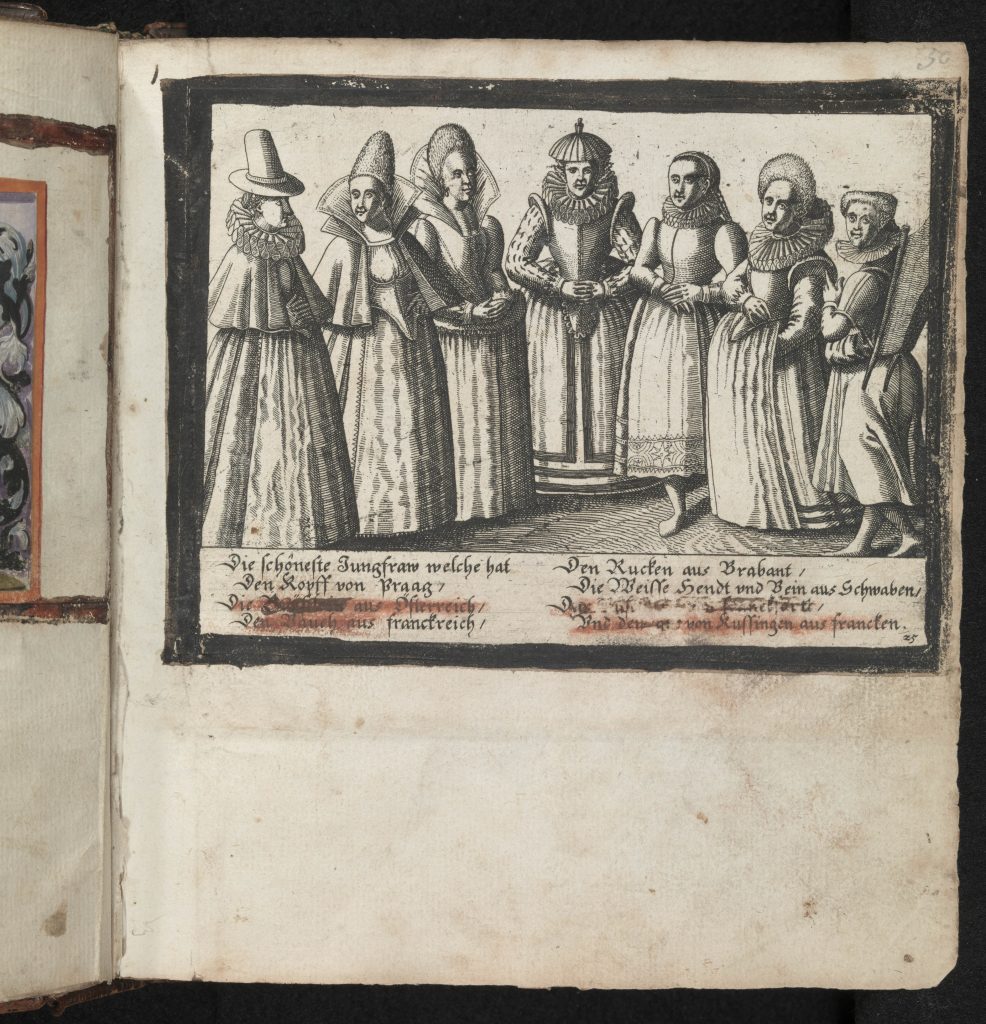
Because the captioning verse includes the origins of the ideal beauty’s sexual parts, it is sometimes censored — as in the above example of the print pasted onto an album page. Some time in the early 1620s, Hans Ludwig Pfinzing von Henfenfeld pasted this print, which appears in some copies of Peter Rollos’ Philotheca Corneliana (Berlin, 1619, 1623), into his album. It depicts seven demure-looking ladies in their respective national costumes, but the captioning verse is decidedly risqué. It belongs to a category of verse-catalogue, found in Germany from the late middle ages onwards, in which an Ideal Woman is assembled from parts from all over Europe. In the present instance, the physical features are thus: Prague – head; Austria – small breasts; France – small belly; Brabant – back; Swabia – hands and legs; Frankfurt – little ‘bush’; Kissingen — bottom (ars von Kussingen aus Francken [arse from (Bad) Kissingen in Franken] — this last, presumably for the sake of the arse-kissing pun [work with me here! This is 400 years ago! Anachronistic censoriousness is just silly !]. The Franconian lady is also the only one whose bottom we can see — as she alone stands in profile. But this was clearly all too much for some subsequent owner of the album who has (somewhat ineffectively) censored the lines relating to breasts, belly, and bottom, but totally obliterated the line describing Miss Frankfurt, the only lady whose hand is shown suggestively beneath her skirts.
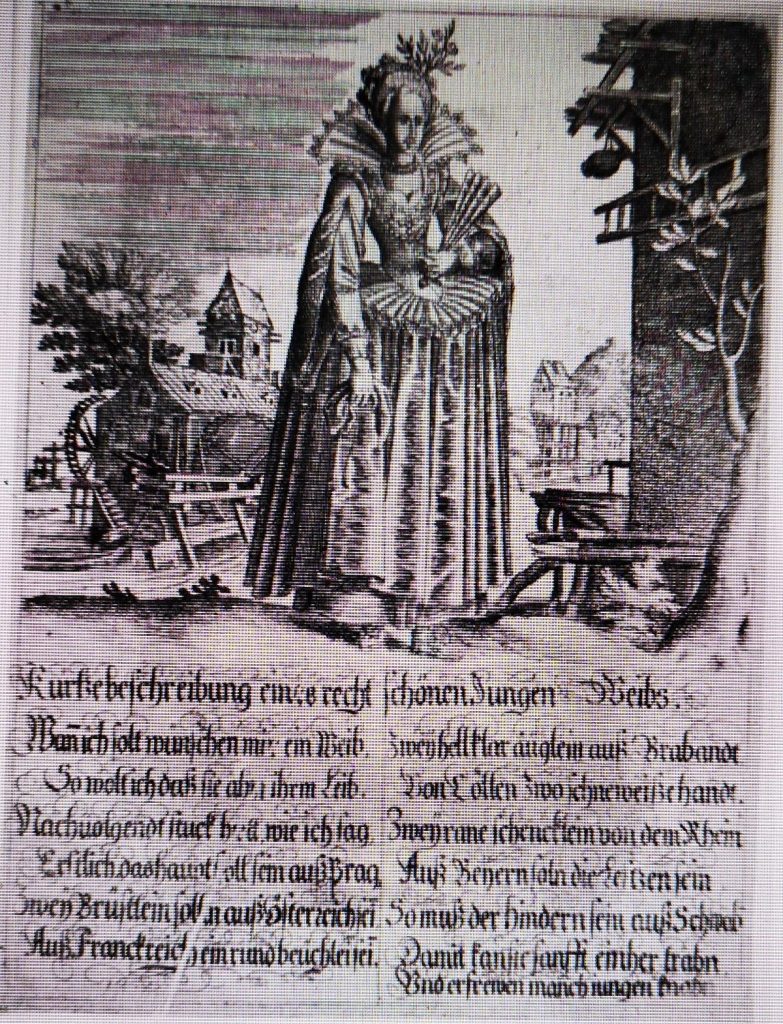
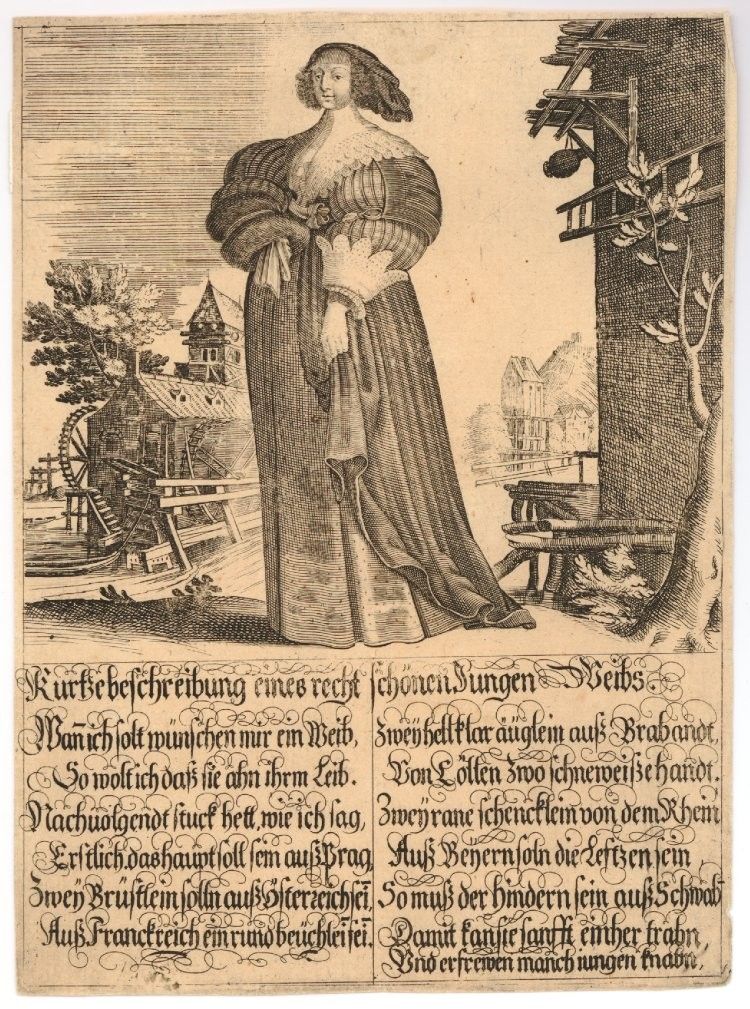
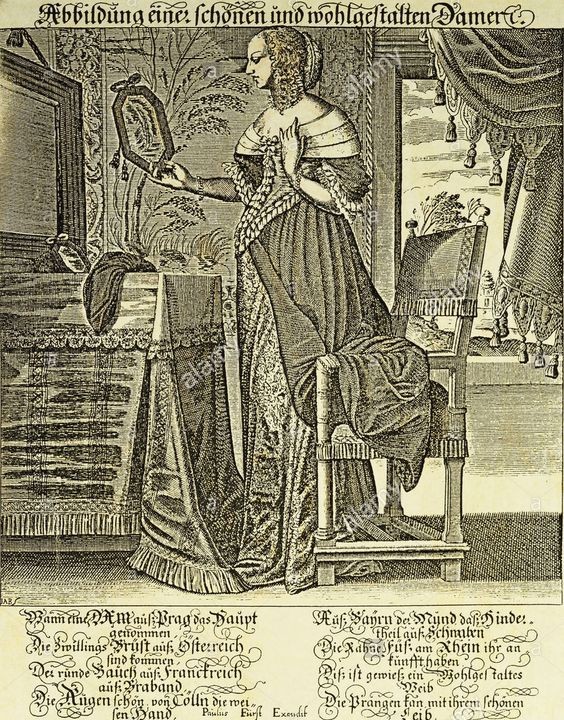
Single-sheet prints of the subject exist too, but these feature only the paragon herself — ready-assembled from all the appropriate European standard parts — as listed in the accompanying verses. The earliest I’m aware of entitled, Kurtze beschreibung eines recht schonen jungen weibs [Short description of a very beautiful young woman], was also issued c.1619, contemporary with the Rollos plate. It duly enumerates the origins of each feature, agreeing with Rollos for the first three, but then insists that it is her eyes that should come from Brabant, her hands from Köln, ankles from the Rhineland, and her bottom from Swabia, while her Leftzen [labia] are to come from Bavaria. Another such paragon is illustrated on this sheet entitled, Abbildung eines recht schonen jungen Weibs:
The contemporary Englishman, the frighteningly learned Robert Burton, was familiar with this topos and cites it in his Anatomy of Melancholy (1621), but patriotically includes England as the ideal source for her hands! [For more on this, see my discussion in The Print in Early Modern England – an Historical Oversight, (London/New Haven, 2010), 315-6.]
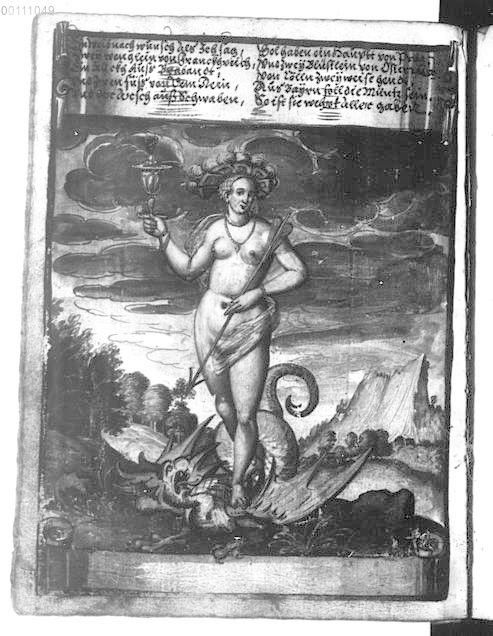
I have yet to happen upon either version of this motif painted into an album, but there is a most interesting and closely-related miniature in the Pusch album (1598-1606), antedating both types of visual presentation (above). Though the ten-line verse which appears above the image describes ein weib nach wunsch [a woman one would wish for], the woman herself is surely the Whore of Babylon! Naked, except for the type of extravagant hat favoured by Landsknechthuren [mercenaries’ whores], she stands on the back of a dragon, holding an arrow in one hand and lifting the ‘cup of abominations’ with the other. Once again — inevitably in this sort of catalogue — there are some agreements and some disagreements with the foregoing lists: here, it is her eyes that come from France, feet from the Rhineland, back from Brabant, bottom from Swabia, hands from Köln, head from Prague, breasts from Austria, and her Müutz [‘cap’, literally] from Bavaria.
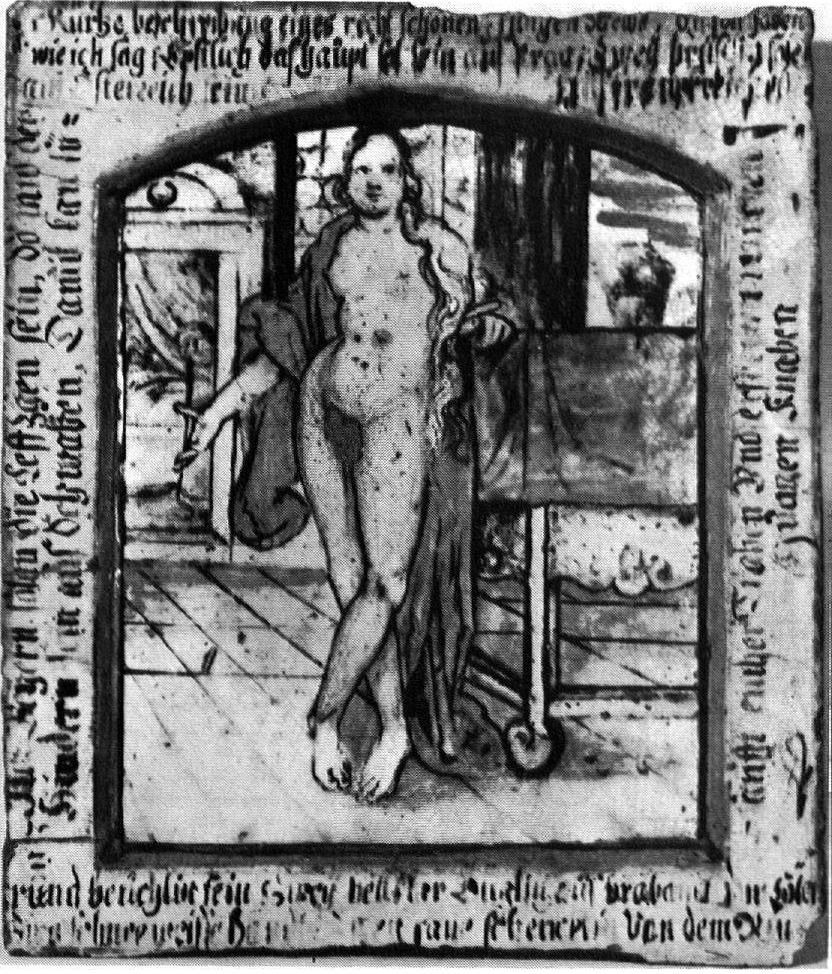
The motif is found in the applied arts too — in the form of a mid-17C Swiss tile in the Schweizerisches Nationalmuseum, which depicts a nude woman presented frontally, attributed to the potter, Hans Caspar Kesselbur. [see U. Isler-Hungerbühler, “Der Hafner Hans Caspar Kesselbur : ein Beitrag zur Geschichte der ostschweizerischen Keramik” in Zeitschrift für schweizerische Archäologie und Kunstgeschichte 15 (1954-1955), 25-32.]
As far as I can make out, the tile text reads:
Kurtze beschreibung eines recht schönen jungen Weibs
Dies soll haben wie ich sag:
Erstlich das haupt sol sein aus Prag.
Zwei brüstlin sollen aus Oesterreich sein.
Us ffrankreich sein rund beuchlein fein
[zwey hell klar] Ouglin aus brabant
[von Köllen] ouch Schneeweisse händt
zwen… schencklin von den Rin.
Aus Beyern solen Leffzgen sein
[So muss der] Hindern sein aus Schwaben
damit kan si sanfft einher traben.
Und erfr[ewen manch iungen] Knaben
The tile text is very close to the print of c.1619 — from which I have supplied the lacunae.
Beauty Contest
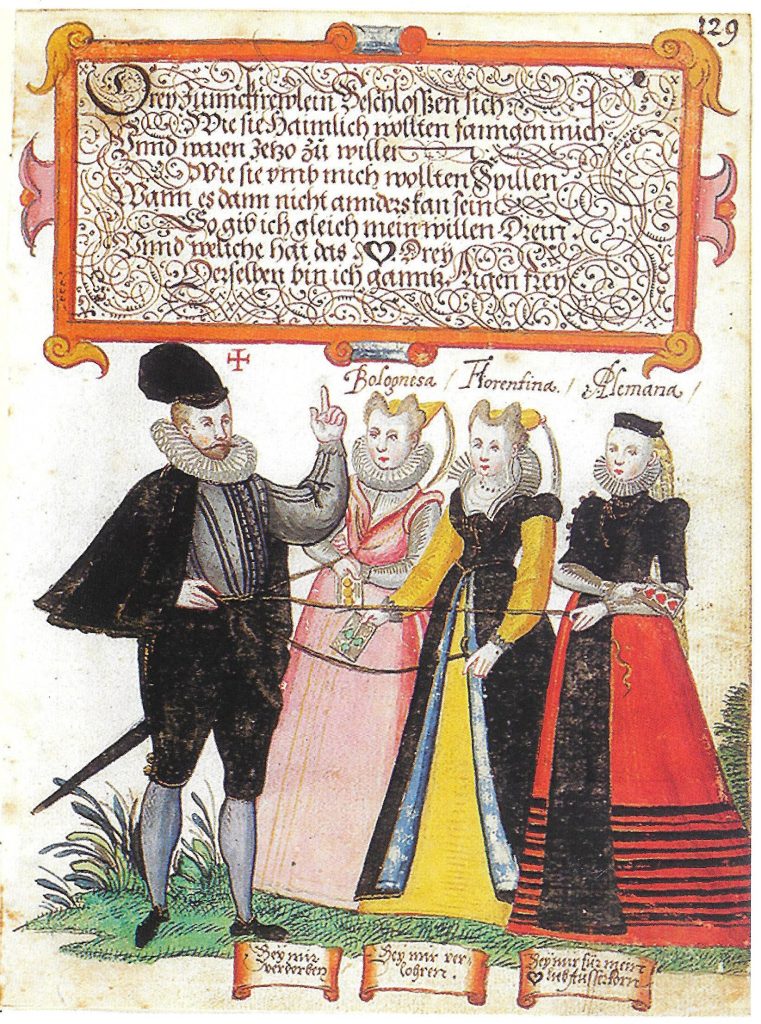
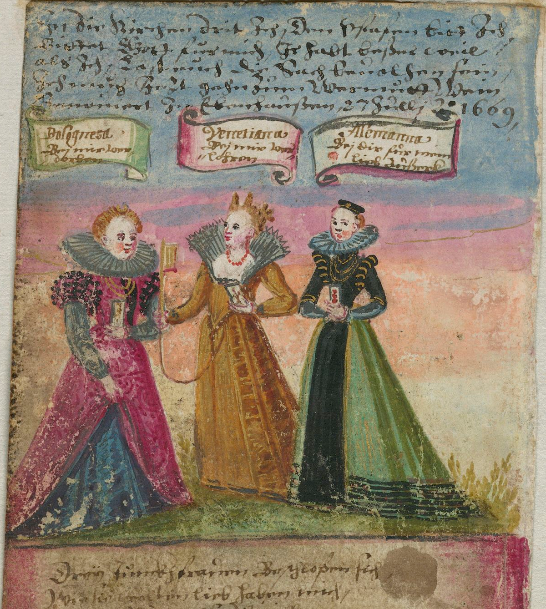
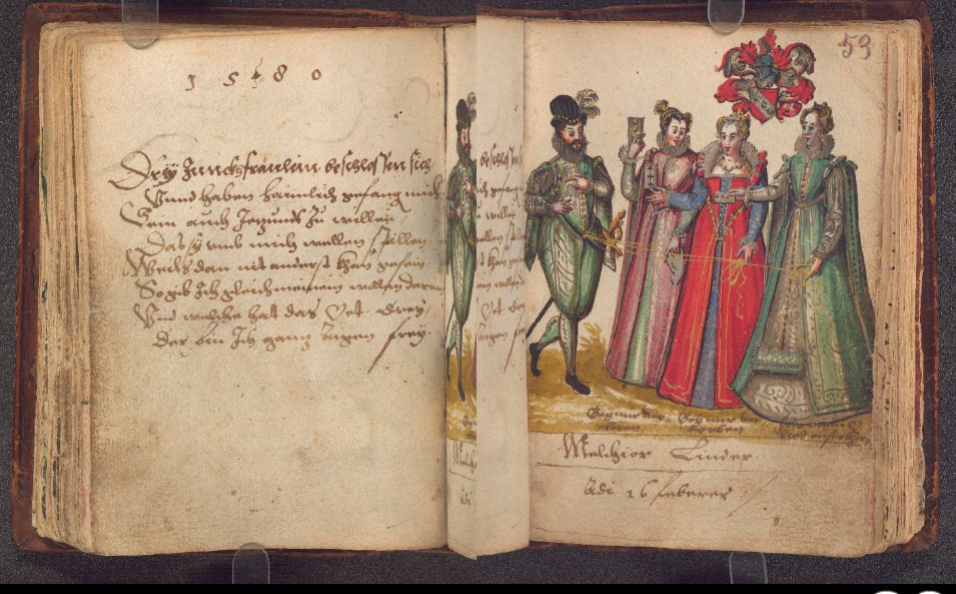
Images of young women, especially Italian young women, abound in the albums — but they are mostly depicted individually, and conventionally, in the manner of regional costume studies, but a miniature in the Schwingsherlein album (dated entries 1588-1602), and presumably painted a.1596 (see below), presents a strange, albeit patriotic, beauty contest in which three young women, labelled respectively, Bolognesa, Florentina and Alemana, are attached by the wrist on lines held by a young (German) man. Each holds a playing-card, the Three of Bells, the Three of Leaves, and the Three of Hearts, respectively, and clearly the German lady’s card has trumped those held by the Italian beauties, for beneath them, we read Bey mir verdorben [I’m ruined], Bey mir verlohren [I’ve lost], and Bey mir für mein ♥-Lieb ausserkorn [I’m the chosen/intended for my beloved]. An inscription explains the situation at some length as explained by the man:
Drey Junnckfrewlein beschlossen sich, Three maidens decided
wie sie haimlich wollten fanngen mich, secretly that they would catch me
unnd waren jetzo zu Willen,
wie sie umb mich wollten spillen. how they wished to play for me.
Wann es dann nicht annders kan sein, As it could not be otherwise
so gib ich gleich mein Willen drein, I gave my agreement
unnd weliche hat das ♥-Drey, and [said] whoever has the 3 of Hearts
derselben bin ich ganntz aigen frey I will gladly be her own.
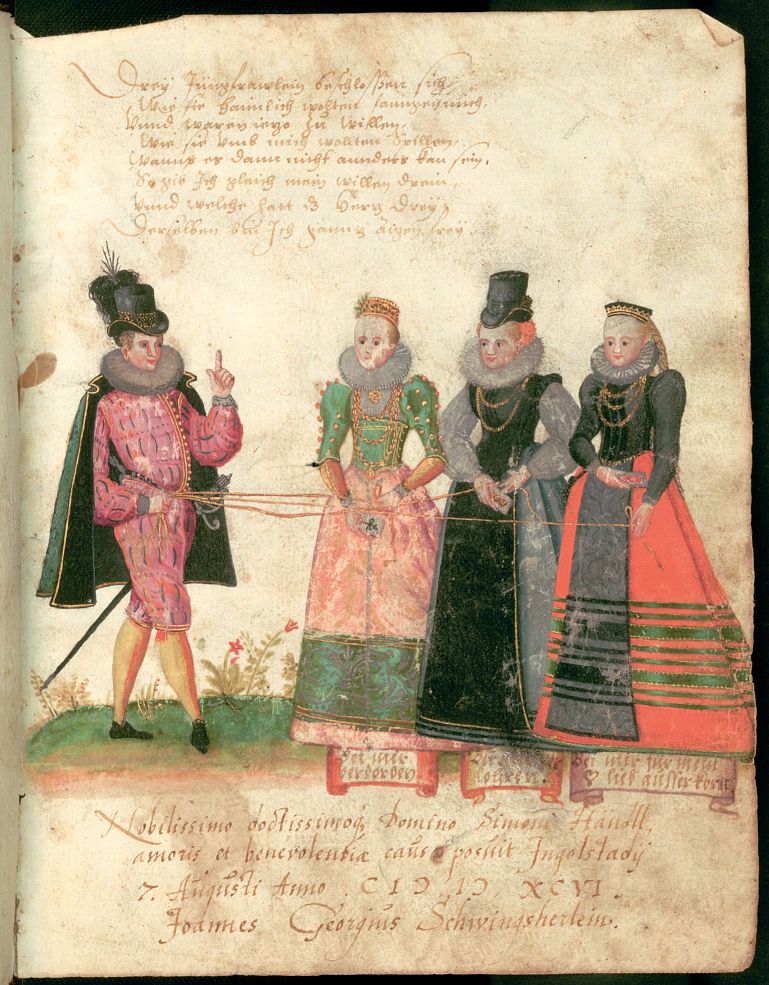
But a second copy of this scene was painted into the Haendel album at the behest of the same Schwingsherlein in 1596, [Olomouc, Olomouc M.I. 472, f.172r.] with the same verses and subscriptions, but somewhat diluting the ‘message’, by omitting the ladies’ places of origin.
The example in the album of Jacob Praun shows that the motif with its explanatory verse existed well before Schwingsherlein. A variant in which the Venetiana is substituted for the Florentina, dated 1609, appears on an orphaned leaf in the Frommann collection. The man is missing, but the three beauties hold playing cards as before, and predictably, Miss Alemanna‘s 3 of Hearts again trumps all!
[Note] The Schwingsherlein album itself is dismembered and survives only as a collection of some 30 miniatures in the Staatsbiblothek, Bamberg, I Qc 19-50.
Leave a Reply