There are, of course, many species of ‘allegorical hunt’ in late medieval and early modern art, but the present hunt for fidelity in love seems to be a ‘Germanic’ motif which arose c.1400 but disappeared not long after 1600. The Lady sets out to hunt for Fidelity-in-Love with her greyhounds [Ger. Winden — rhymes with finden!] — and encounters usually a hermit or older more experienced woman, who offer the cold comfort of the hereafter!
Just as in the Hunt of the Centauress post [ https://albumamicorumear-e4qvahs764.live-website.com/hunting-the-centauress/ ], the hounds are named after various abstractions
In the albums
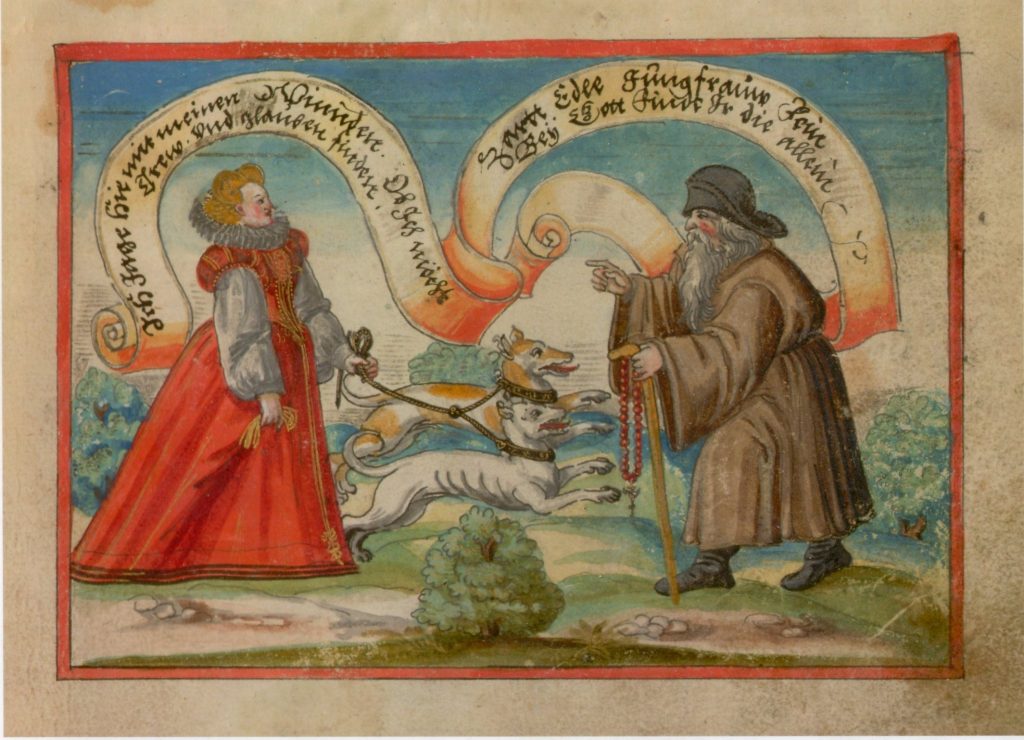
from the album of Daniel von Redern, dated entries 1589-1613. Stockholm, KB, Ir 2a, f.12v. Lady: Ich jage hie mit meinen Winnden / Ob ich mocht Trew Vnd glauben finden [I’m hunting here with my hounds/ so I might find fidelity and belief] Hermit: Zartt Edle Jungfrauw fein / Beij Gott findt Ir die allein [Tender and noble maiden/ you will find it only in God]
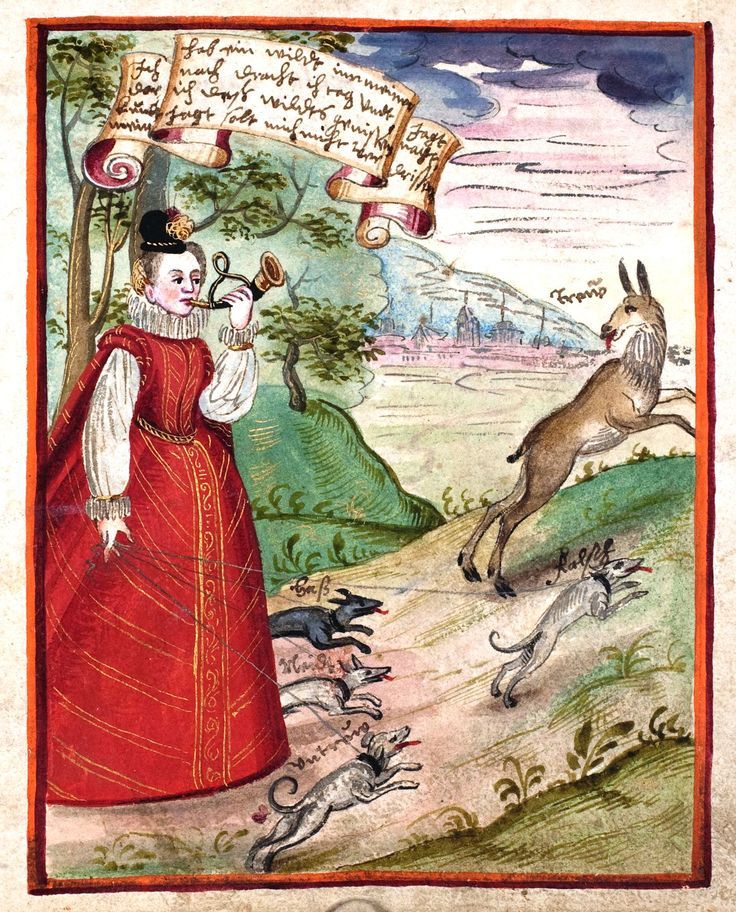
from the album of Andreas Huber (dated entries 1587-1609). Stuttgart, WLB, cod. don. 899, f.150r. The deer is labelled Treue [Fidelity], the hounds are named Hass [hatred], Neidt [Envy], Falsch [Falsehood] and Vntreue [Infidelity] — no wonder the deer is making a run for it! Not quite sure how this allegory works logically — if these are the Lady’s dogs, as they must surely be, why does she hope to capture Fidelity with them?
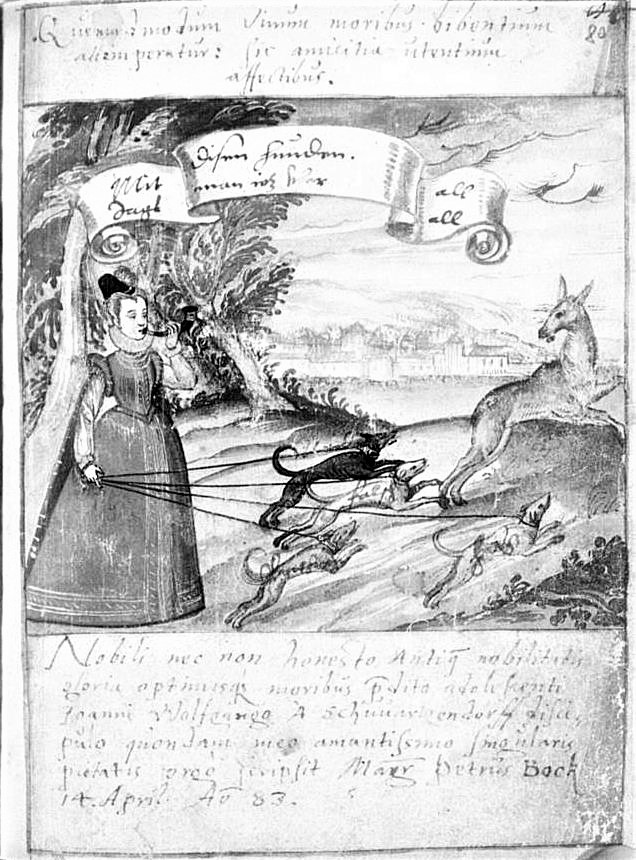
From the album of Johann Wolfgang Schwarzdorfer, this page dated 1583. München, Bayerische Staatsbibliothek, Signatur Cgm 3291. The names of the hounds are written on their sides, but the painting is so similar to the Huber example above, that they must derive from a common model — perhaps a lost print.
Earlier examples & examples in other media
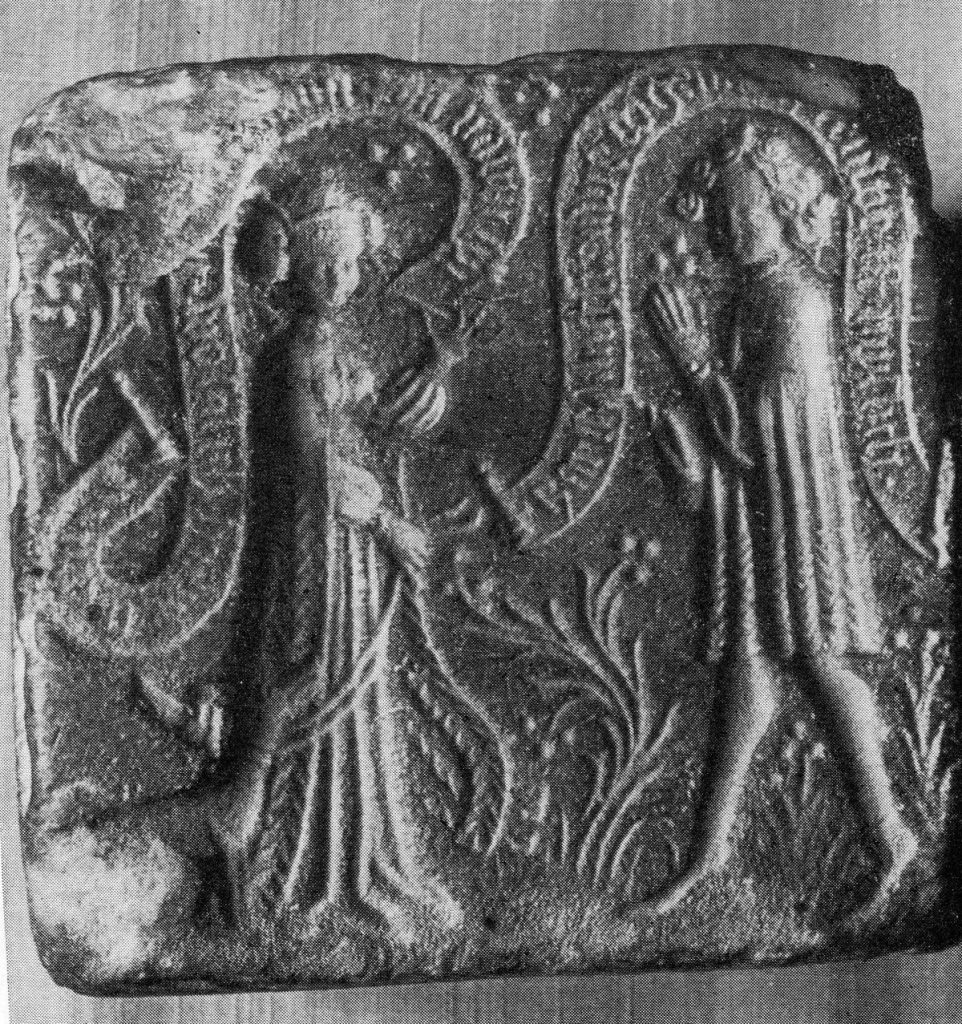
The earliest I have noticed this motif is on a biscuit-mould made c.1425 in the Historisches Museum, Frankfurt. My reading (based on Fritz Arens, “Die ursprungliche Verwendung gotischer Stein- und Tonmodel” in Mainzer Zeitschrift 66 (1971),115 ): Ich iagen mit wind[en]/ wo sol ich tr[ewe finden] [I hunt with greyhounds/ where shall I find Fidelity?] The young man’s response is not entirely legible, but opens zarte iuncfrawe [tender maiden] and ends ist wyslich [is wise], so perhaps offers her the same cold comfort as the hermit.
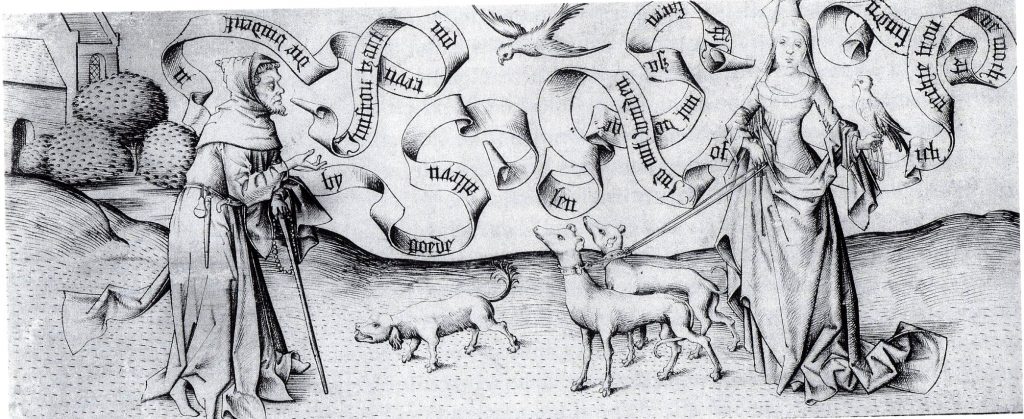
This beautiful late 15C engraving of our motif is by Israhel Van Meckenem (d.1503), and already the Lady’s couplet is the familiar:
Ich faren usz mit vogelen Ind mit winden I fare abroad with bird and hounds ob ich rechte trouue mochte finden so that I may find true fidelity
If we reverse this image, we see how close it is to that in the Daniel von Redern album of a century later. (above)
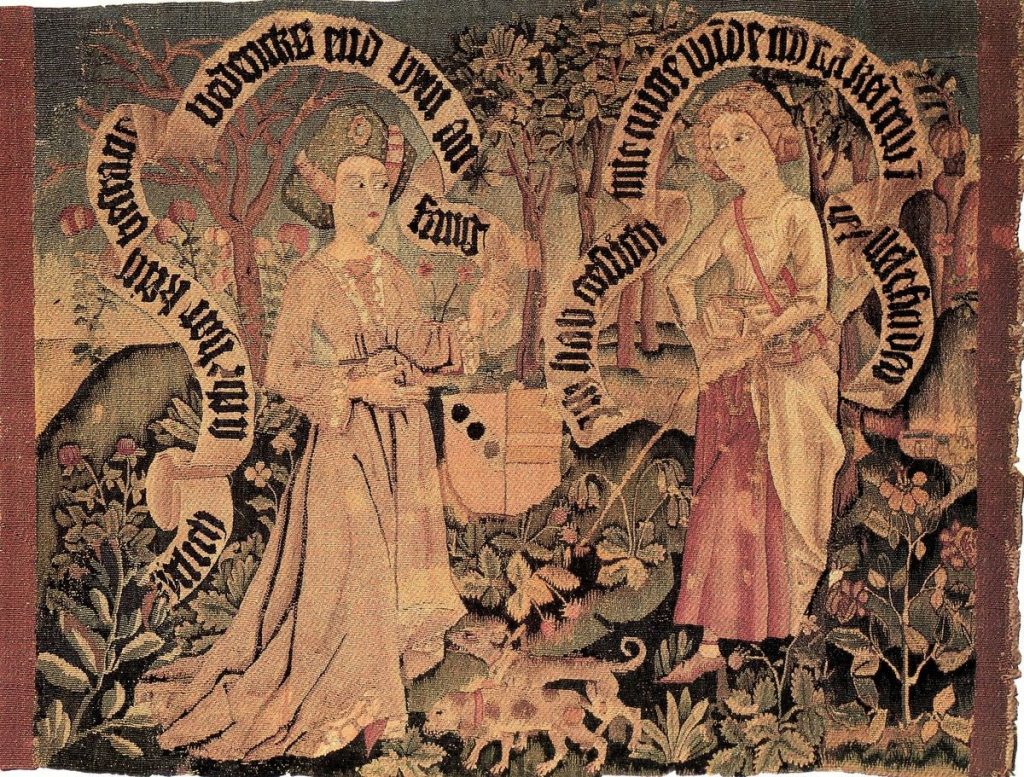
In this tapestry cushion-cover woven in Strasbourg c.1480, the Lady says,
Ich hab gesucht mit mine[n] wi[n]de[n]
ich ka[n] kei[n] tr[e]w i[n] der velt finden.
[I have searched with my greyhounds/ I can find no fidelity in the world],
to which the older woman responds proverbially and discouraginly!
zytlich liebe hat kein bestand/ bedencks end bym anfang
[temporal love does not endure, think on the end at the beginning].
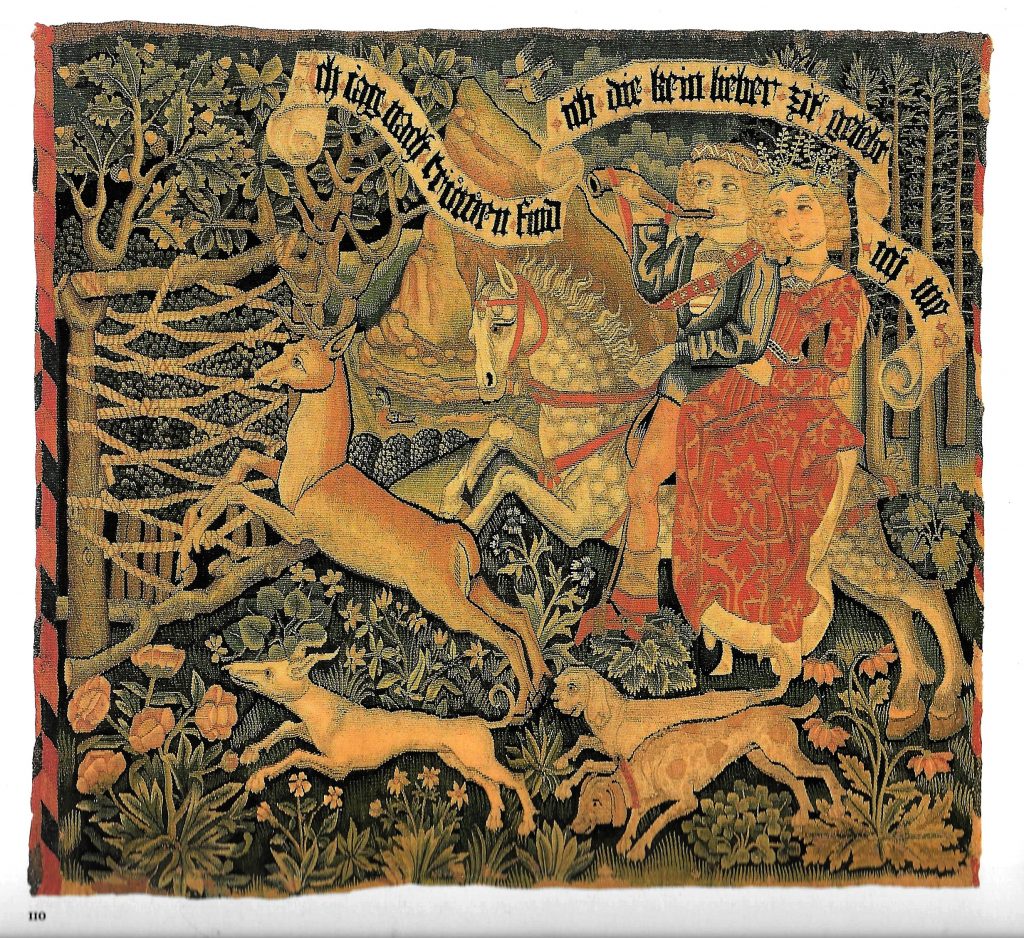
Another roughly contemporary late 15C Strasbourg tapestry in Glasgow’s Burrell Collection shows a young couple hunting Fidelity, here the banderole rhyme reads,
Ich iag nach truwen find ich die
kein lieber zit gelebt ich nie
[I’m hunting for fidelity, if I find it, I’ll never enjoy a pleasanter time]
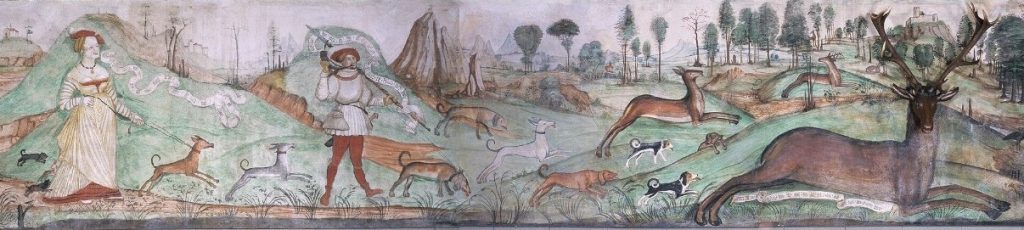
The mural above is part of an 8m-long Jagd nach der Treue painted by Jakob Boden in Diessenhofen, Switzerland, in 1535. The Lady says,
Ich bin ein jegerin von edler artt
und volgen, minem lieben ieger
intrywen nach uff vartt
[I am a huntress of noble kind and follow my beloved huntsman ….
I look forward to learning how the other banderoles read — especially that of the stag (best photos I could find!).
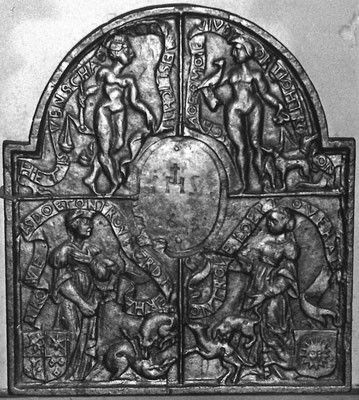
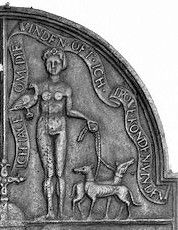
This remarkable cast-iron fireback, signed by the maker SB, was made in the Saarland in the 1590s, and is thus contemporary with the album images. It is the top right quadrant in which we are interested here, the (naked!) Lady’s banderole reads
ICH IACE [sic] OM DIE WINDEN
OFT ICH TROVE KONDEN VINDEN
[I hunt with greyhounds (to see) whether I can find fidelity].
Several examples are known, this is part of the Kremer collection (available online)
Leave a Reply