Thomas Schweiker
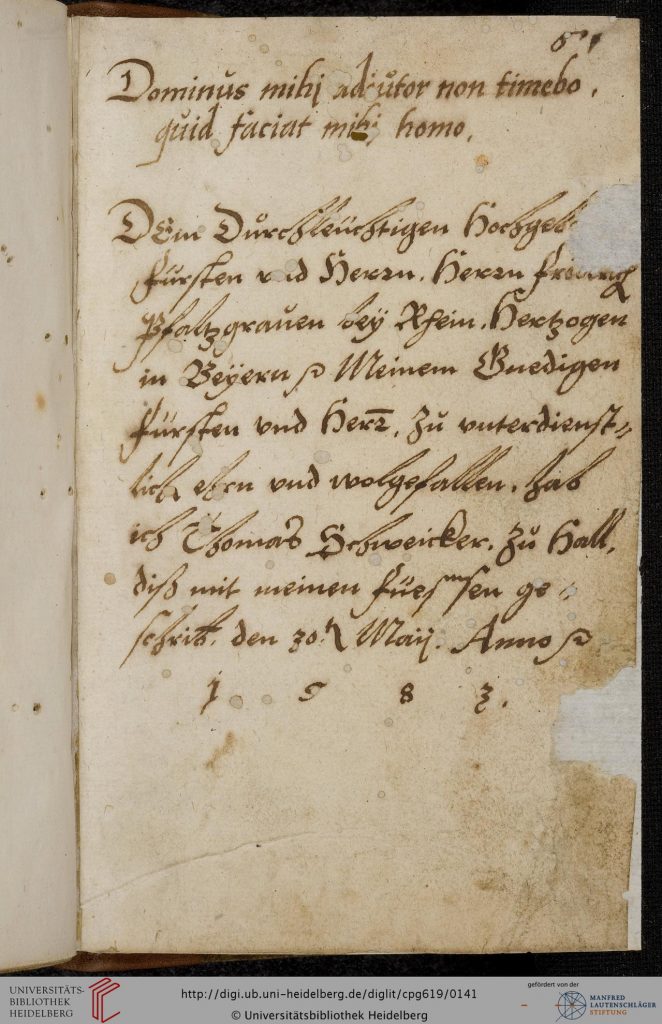
Owners were always keen to acquire the works of foot- and mouth-artists for their albums. The most famous foot-artist was Thomas Schweicker of Schwäbisch Hall (1540-1602). In May 1583, beneath the heading Dominus mihi adiutor non timebo quid faciat mihi homo [Ps.117.vi], he dedicated his entry — diβ mit meinem füessen geschrib [this written with my foot] — in the album of no less a personage than Frederick IV, Elector Palatine. In the same month he inscribed the album of Conrad Lautenbach, a rector in Heidelberg, a leaf which was later stuck into the painter, Georg Brentel’s album [see below].
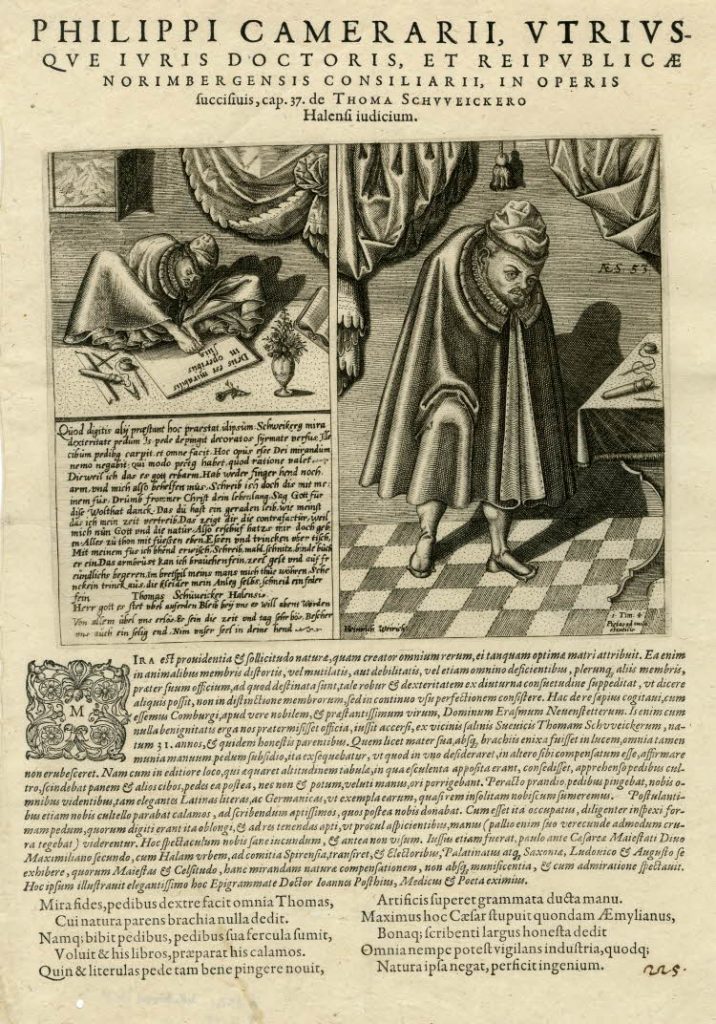
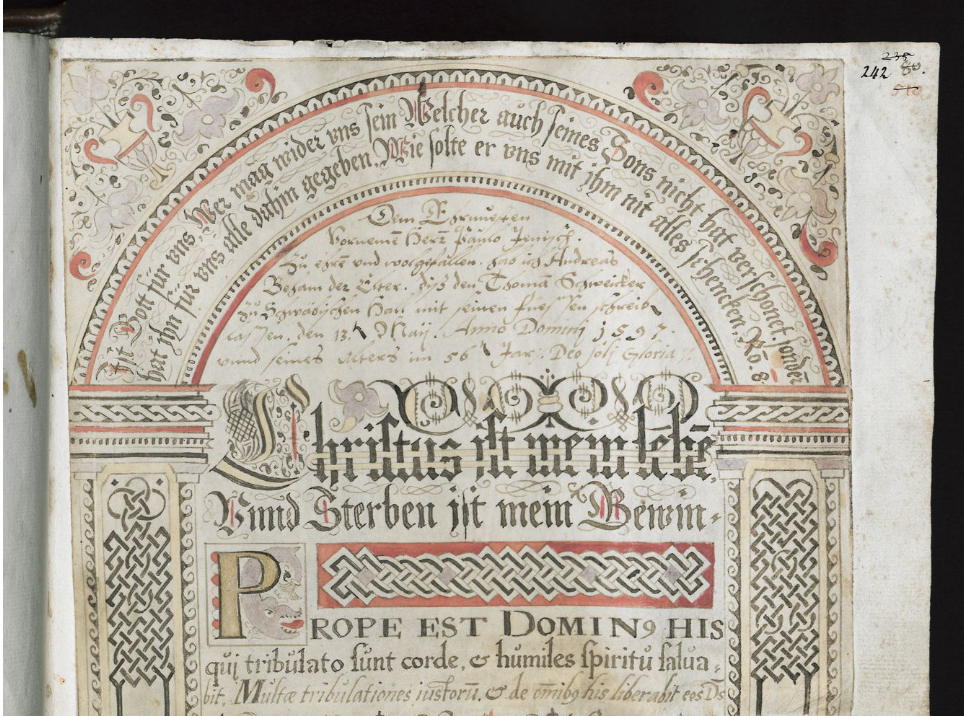
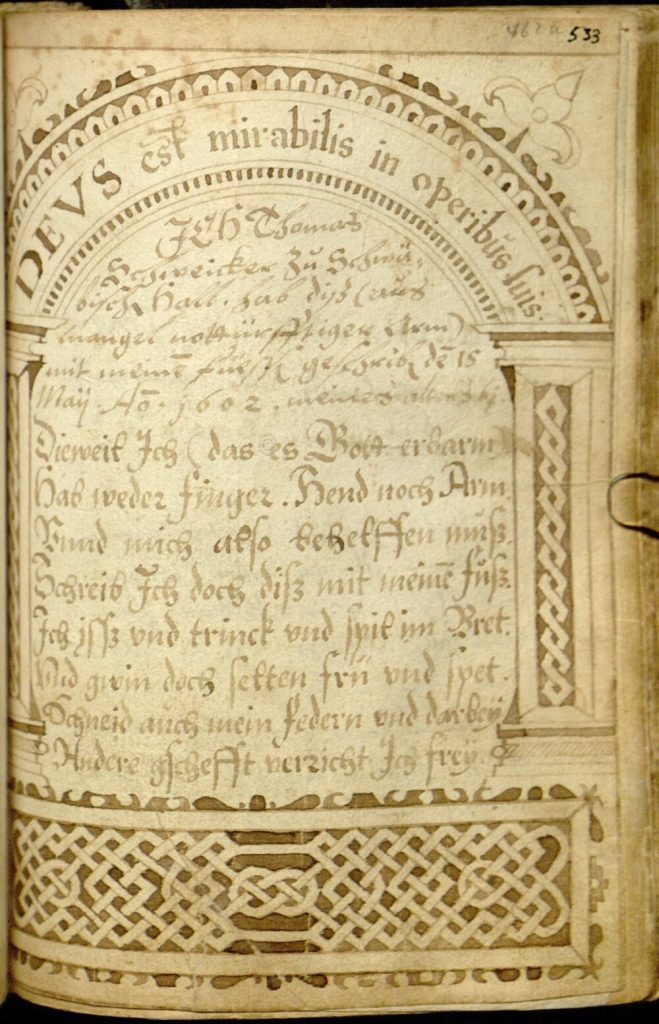
His footworks are also to be found in the albums of Speimann (1585), Strich (1593), Löchel (1594), Jenisch (1597) and Donauer (1602) – often in elaborately calligraphic script. Owners unable to secure examples of his work might resort to pasting into their albums one of the several prints depicting him at work, e.g. this by issued by Heinrich Weirich c.1594.
Theodor Steib
At the end of our period we encounter another foot-artist who in his short life achieved the same level of celebrity as the earlier Thomas Schweicker, Theodor Steib of Vienna (1629-1663). Three albums have entries written by him in 1651, those of Donauer (also containing an inscription by Schweicker — above), Winterbach and Pamer – in the last he has written, Quo me vertam, nescio. [I do not know which way to turn], and Illuminirt mitt meinem Fueß [painted with my foot].
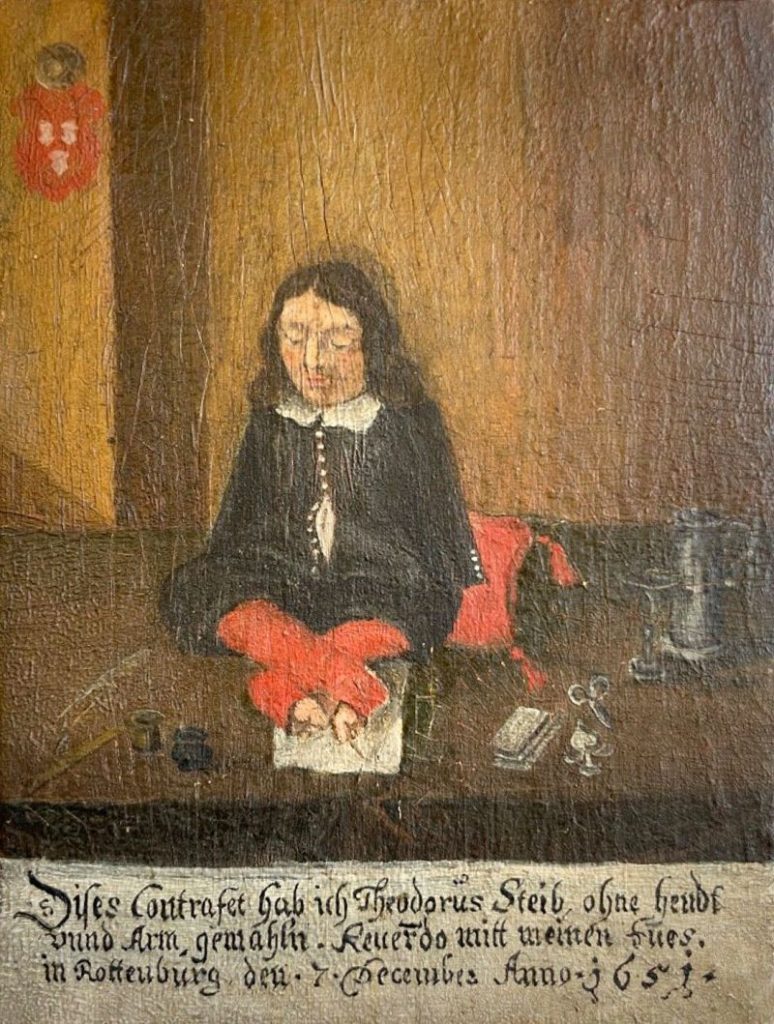
From the same year survives a self-portrait in oil on canvas (above), quite possibly painted at the winter fair in Rothenburg where he was described by a local chronicler as an artistic painter [künstlicher Maler] who had portrayed many of the city council as well as writing such verses as the following:
Ich Theodorus Steib I Theodore Steib
Verlohr mein Händt im Mutterleib; lost my hands in my mother’s womb
Ob ich schon dießes Leiden muß though I have to endure this
Schreib ich doch dieß mit meinem Fueß. yet I write this with my foot.
In 1652 he signed the album of Johann Jacob Müller, and two years later painted a Memonto Moris [sic] in the album of Christian Martini, signing, Dieses hab ich Theodorus Steib mit meinen Fueß gemahlen und geschrieben. In Budissin den 22. Juny Anno 1654 [This I, Theodore Steib painted and wrote with my foot. In Bautzen, 22 June Anno 1654].
The Benz album contains an undated entryTheodorus Steib Pedibus fecit [Theodorus Steib made this with his feet], and an engraving of himself he had made in Nurnberg entitled, Seines Alters 23 Jahr 1652 [his age 23] and captioned, Ich Theodor Steib gebürtig von Wien schreib dis oh[n]e Händ mit mein Fuß Anno 1652. [I Theodor Steib born in Vienna wrote this without hands with my foot Anno 1652]
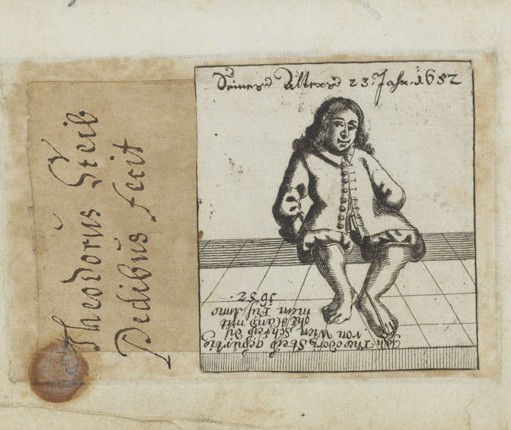
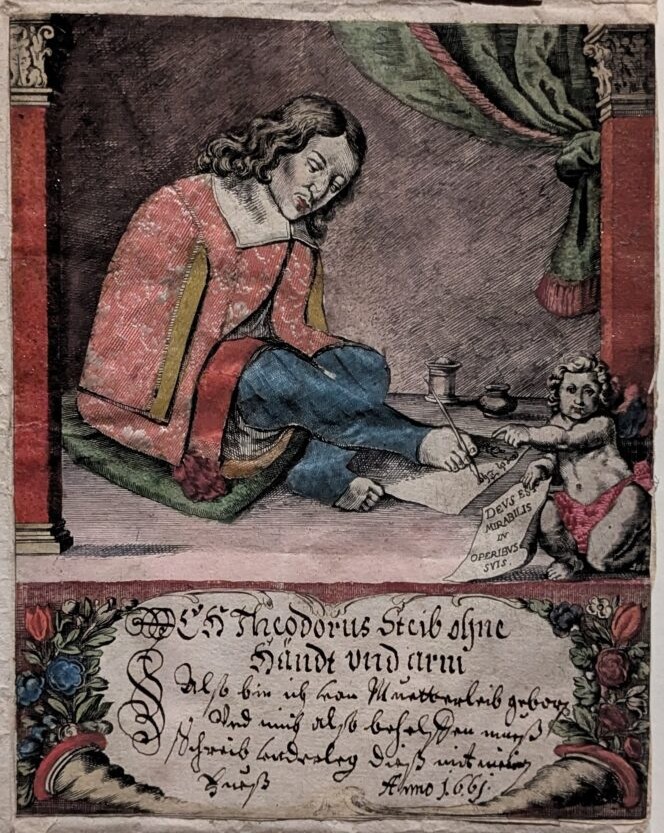
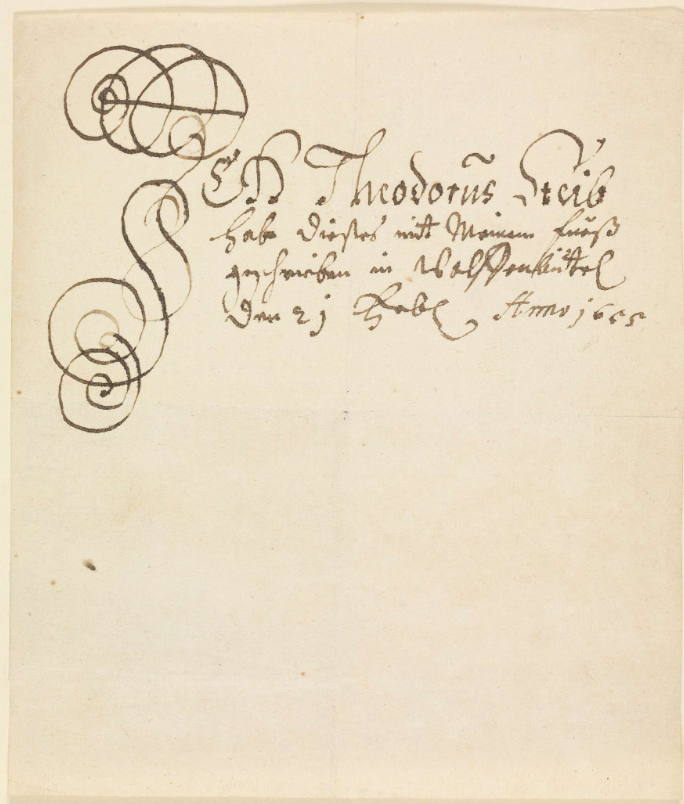
The Herzog Anton Ulrich Museum in Braunschweig possesses another calligraphic inscription of his dated 1655.
Robert Fisher
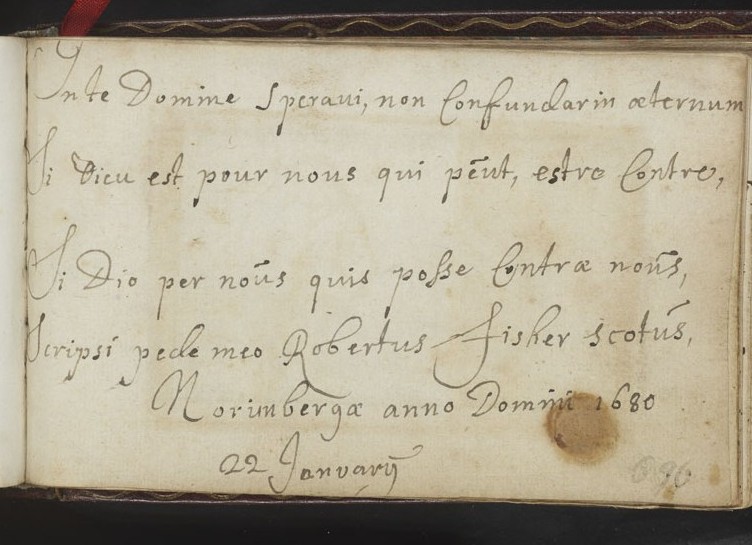
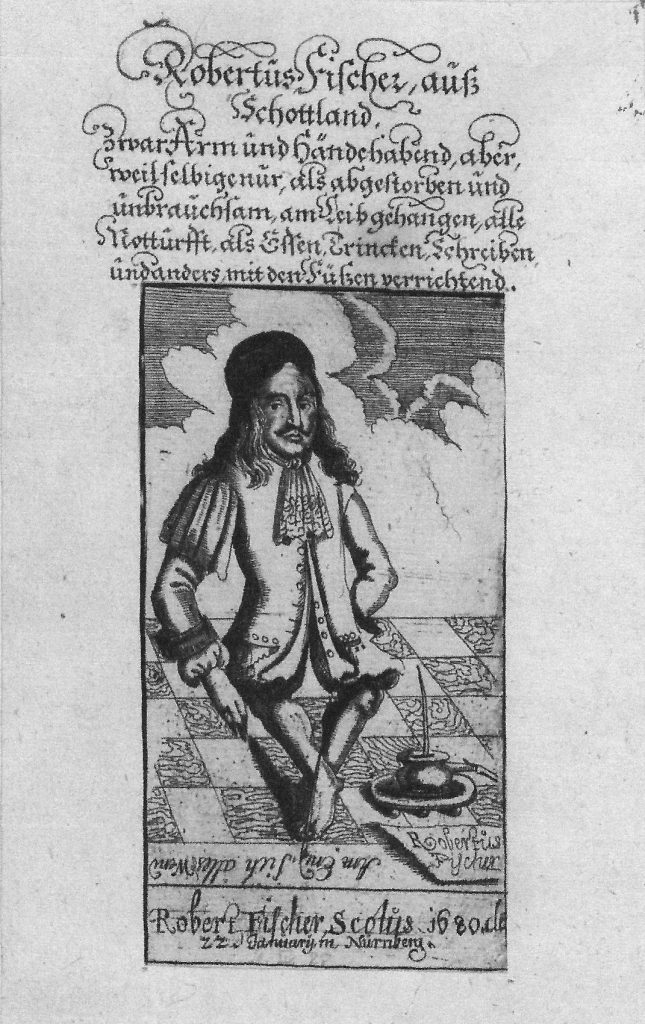
On the page opposite Steib’s portrait, are three lines of religious inscriptions in Latin and French (above), signed Scripsi pede meo Robertus Fisher scotus, Norimberga anno Domini 1680 22 January [written with my foot, Robert Fisher Scotsman, Nuremberg AD 1680 22nd January], and curiously – suspiciously? — there also exists an etched portrait of Robertus Fischer – spelled the German way and dated in Nürnberg the very same day, showing him writing with his foot the proverb, Am End sich alles Wend [everything runs to its end]. It may perhaps be an advertising flier.
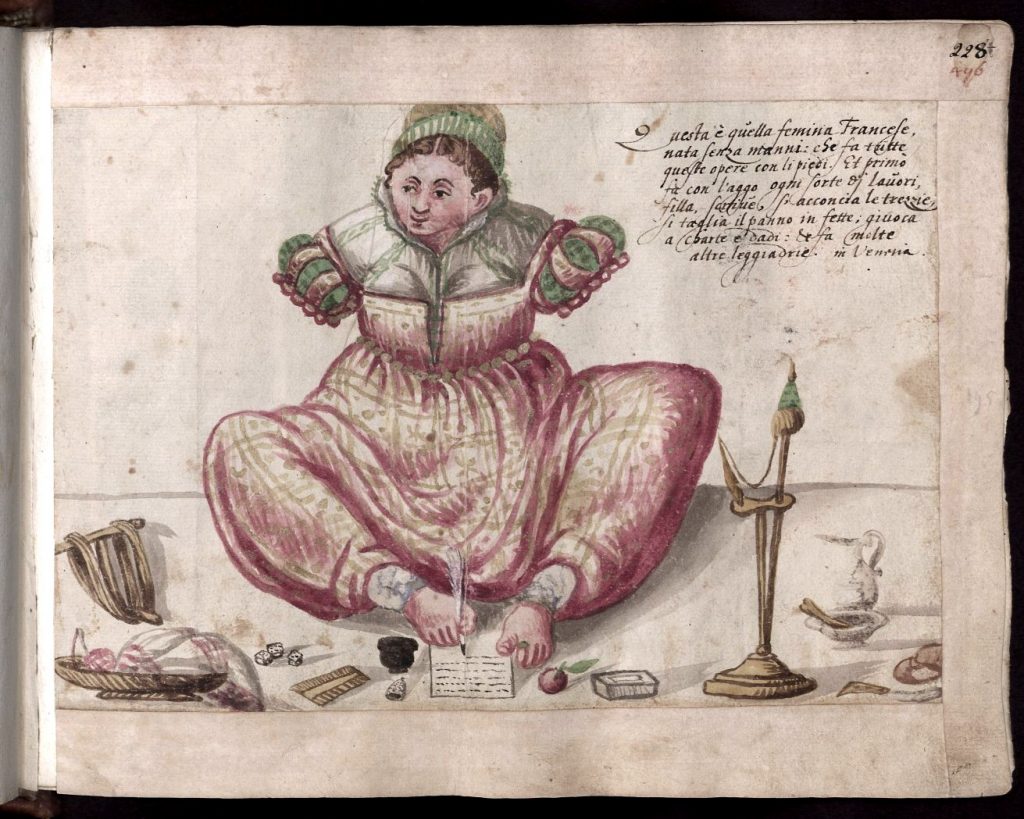
At an unknown date, Paul Jenisch had painted onto f.228r. of his album the portrait of an unnamed Frenchwoman who wrote with her feet in Venice,
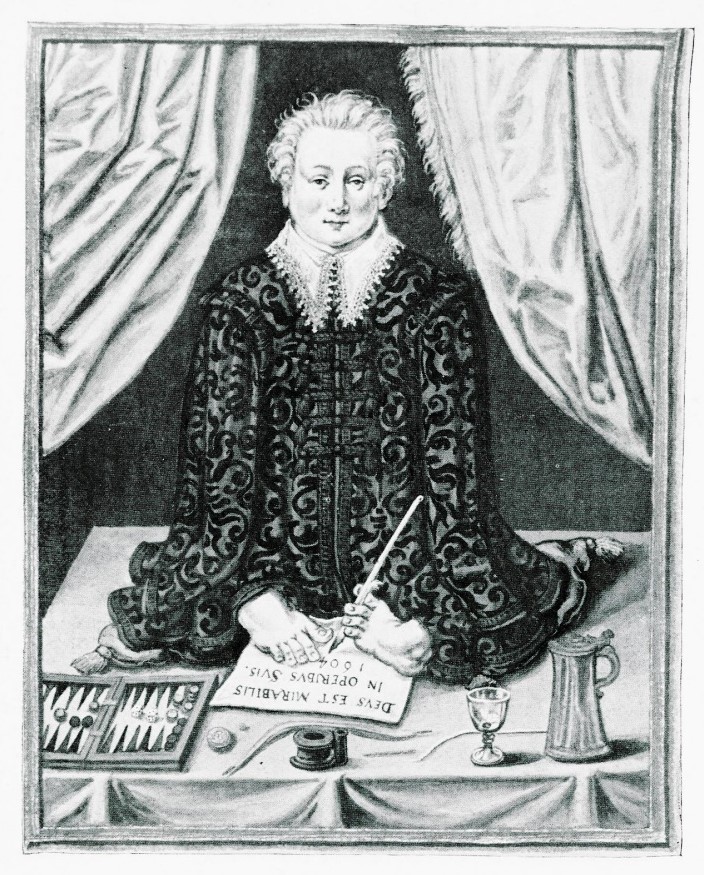
and painter Georg Brentel, the miniature of a young man writing with his foot the words, DEVS EST MIRABILIS IN OPERIBVS SVIS 1604 [God is wonderful in his works],
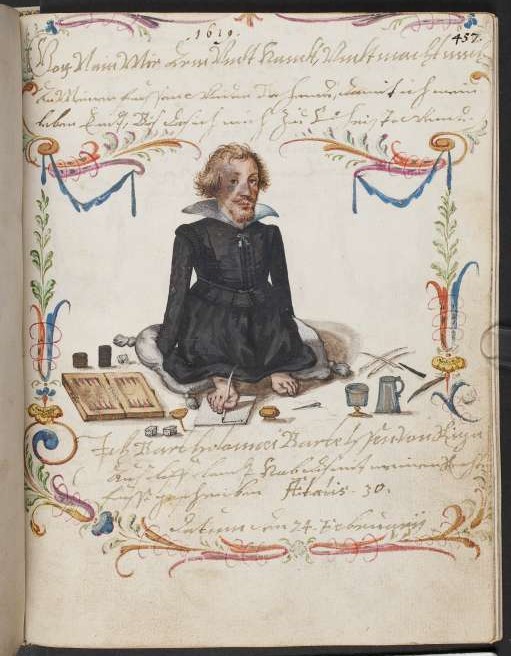
and in 1619 Philip Hainhofer a similar portrait signed, Joh. Bartholomaei Bartelsen, von Riga aus Ässeland. Hab dis mit meinem Rechten Fuße geschrieben [Johan Bartholomeus Bertelsen of Riga in Latvia wrote this with my right foot].
Elisabeth Simson
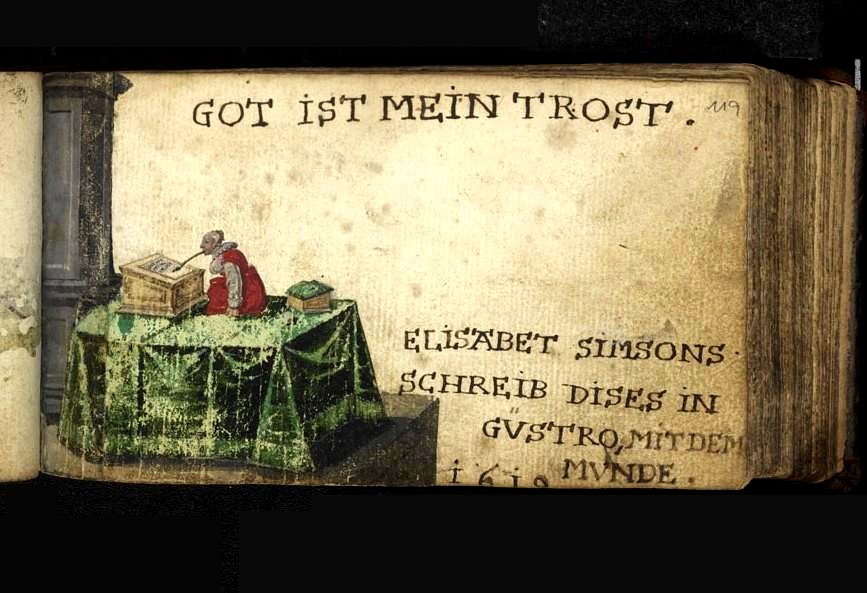
I have come across only a single examples of a mouth-artist, an extraordinary Englishwoman, without hands or feet, named Elisabeth Simson, who seems to have toured Europe, to judge from the inscriptions she wrote in at least five surviving albums. She was painted at work in Germany by the Erich album painter in 1619 (below) next to her inscription, GOT IST MEIN TROST ELISABET SIMSONS SCHREIB DISES IN GVSTRO MIT DEM MVNDE 1619 [God is my comfort. Elisabeth Simsons wrote this by mouth in Güstrow].
In 1616, in Bremen, she wrote in the album of Johan Opsimathes, who annotated her inscription, Lingua haec scripsit [she wrote this with her tongue]; in 1617, presumably in Wittenberg, she signed the album of Daniel Kröning, and in Copenhagen she inscribed, ELISABETH SIMSON ANNO 1620 in the album of the great Danish historian, Ole Worm; another entry in Jörgen Fuiren’s album is undated.
Leave a Reply