The motif of a king/emperor standing on a world-orb with a sword in one hand and a book in the other would seem to derive from an emblem in the 1560s editions of Paradin’s Devises Heroiques which include the Appendix by Simeoni ….
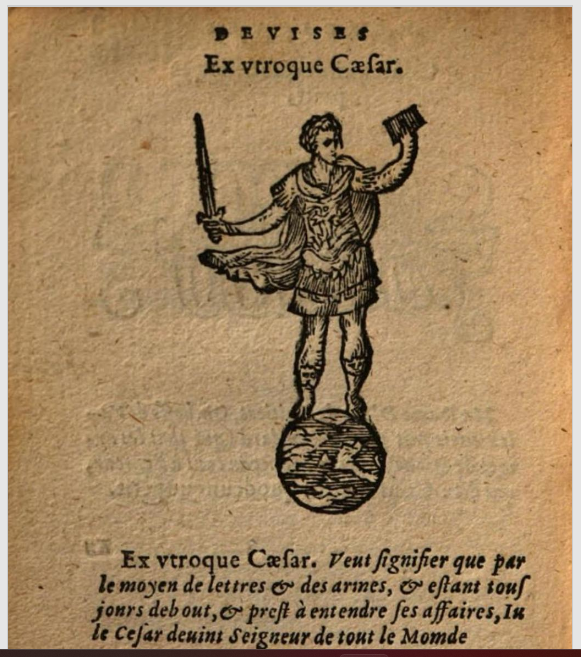
As the text below the image explains, Caesar became ruler of the whole world “by both” [ex utroque] ‘letters and arms’, which in its Latin version — litteris et armis — also labels this motif in the albums (see below).
Extraordinarily, an orphaned leaf described in the 1864 catalogue of the du Rosey sale (see below), turned up at auction in London in 2017:
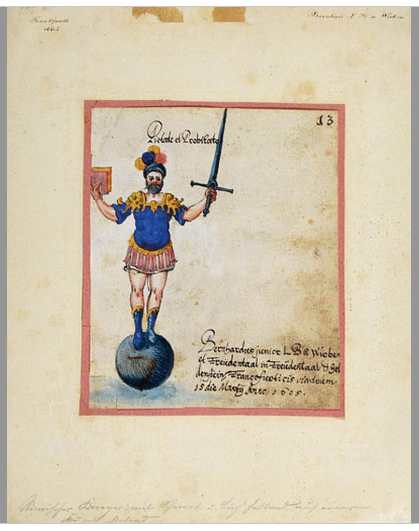
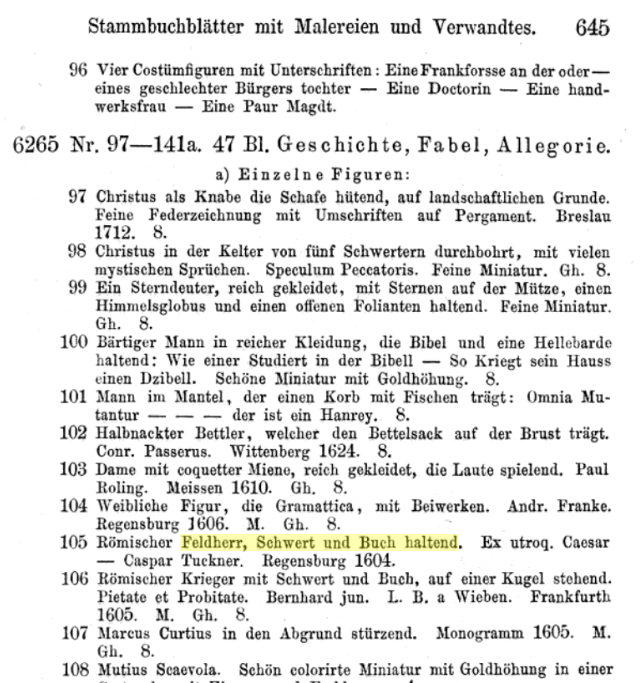
Its Emperor is not named but accompanied by the motto Pietate et Probitate [by piety and probity]. The previous leaf described in the 1864 catalogue (no.105) is another example of our motif labelled Ex utroq, Caesar — as in the emblem-book above.
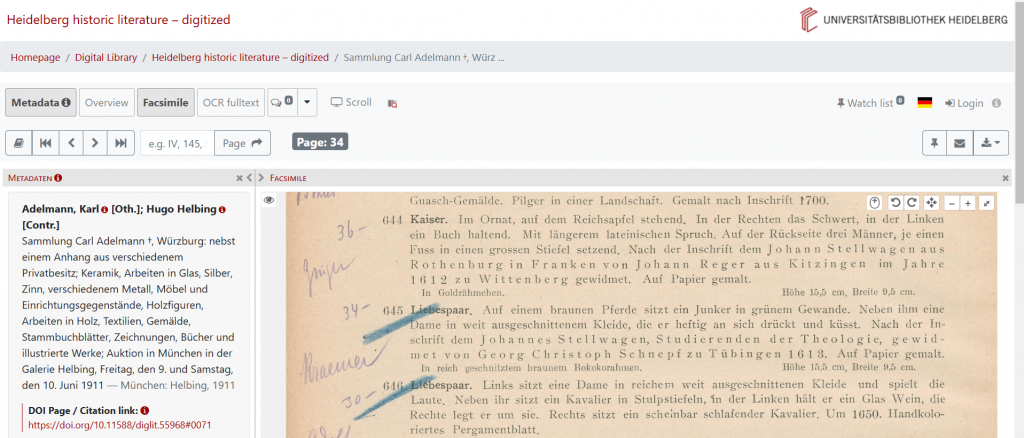
In a Helbig auction catalogue another is described (lot 644 Kaiser):
and the RAA records another, dated 1598, in the album of Stephan Jeszensky.
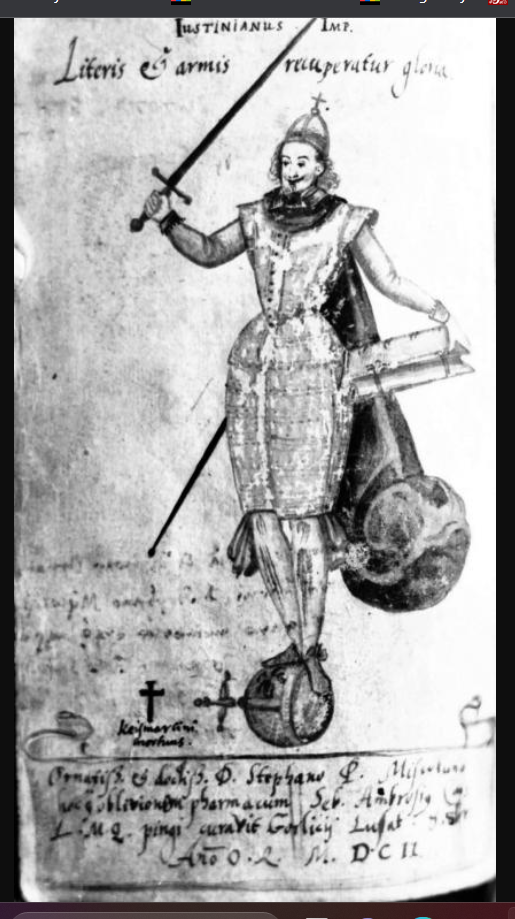
The Miskolci album presents an interesting variant where the Emperor — here identified as Justinian — stand on a world-orb decidedly out-of-kilter. The miniature is labelled Litteris & armis recuperatur gloria [Glory is recovered by letters and arms]:
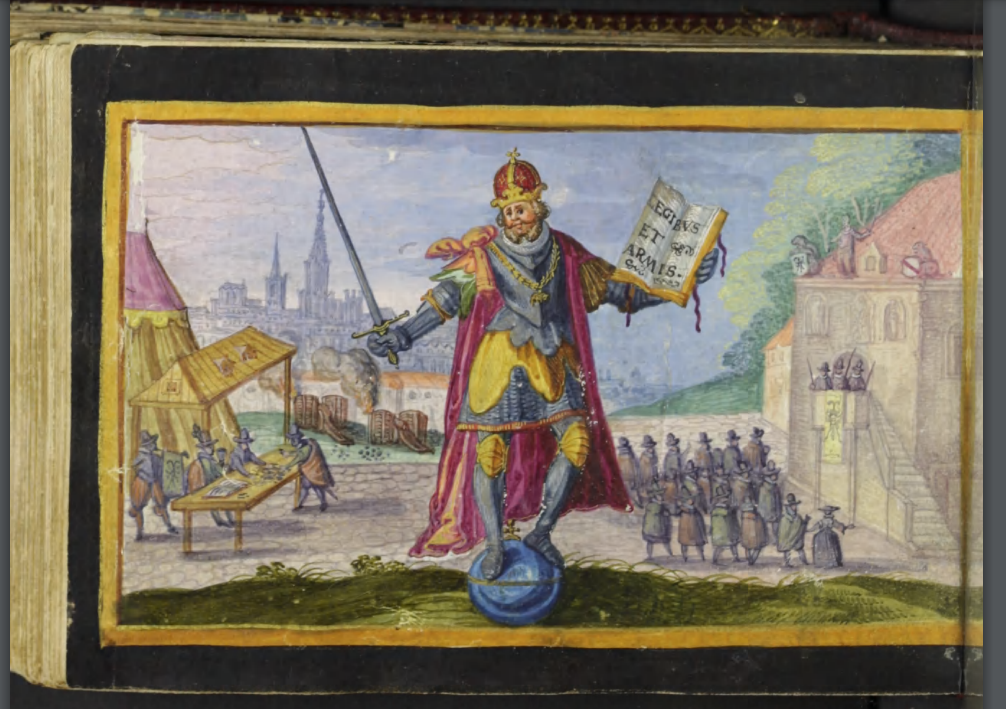
In the Deublinger album miniature, painted after 1636, the book held by the king/emperor is open and inscribed LEGIBVS ET ARMIS [by laws and arms], and we see what is presumably a court-building on the right, and an army bombarding a city on the left.
Leave a Reply