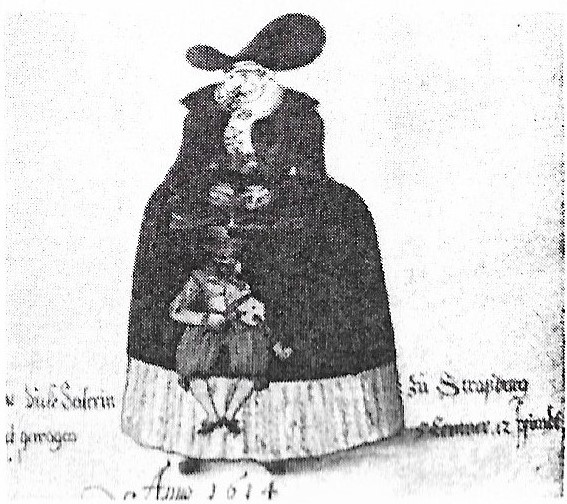
A fairly low-tech, supplementary amusement to be found in many albums is the painting which includes a liftable flap over some portion of the image, e.g. a woman’s skirts, and we have already noticed the small musician literally fiddling under the voluminous skirts of the famous Fat Woman of Strasbourg. In the example in the album of Rhaban Giese (below), the flap — as so often — is missing.
https://albumamicorumear-e4qvahs764.live-website.com/the-fat-woman-of-strasbourg-die-dicke-seilerin/
The courtesan
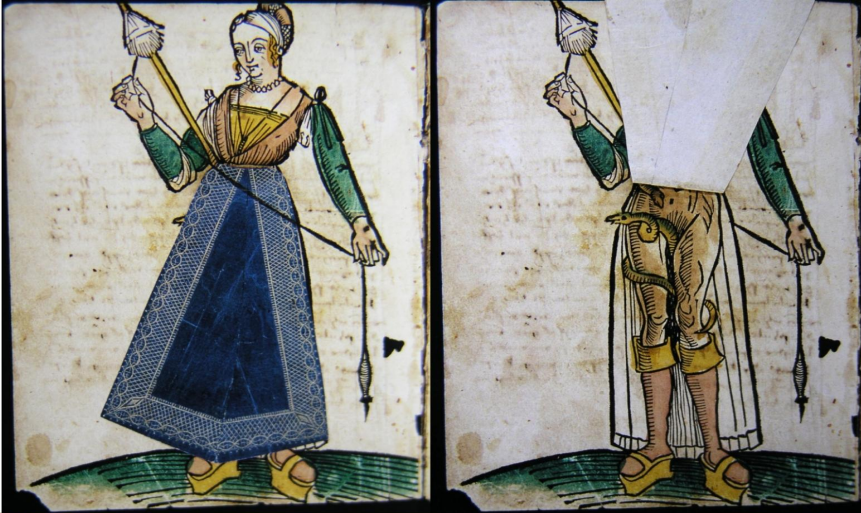
A favourite for this technique is the tall Venetian courtesan with her characteristic horns of hair under whose skirts, when we lift the flap, we are surprised to find her wearing breeches and standing on high chopines!
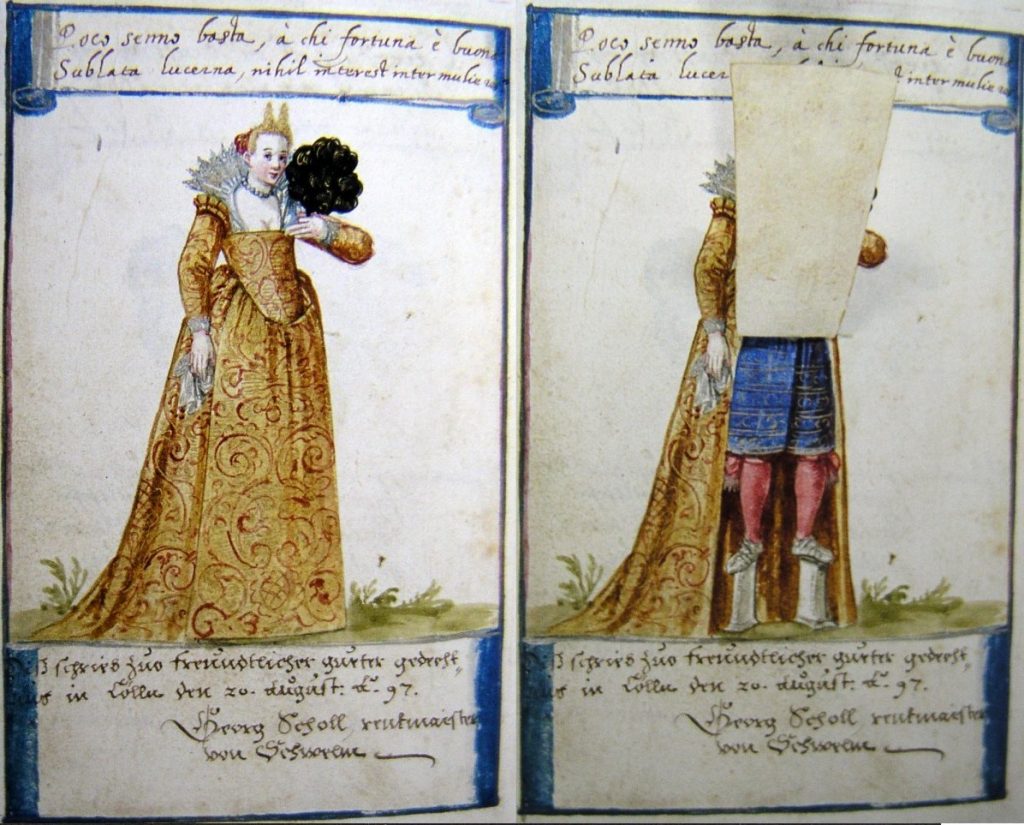
As so often, this type owes its existence to prints with liftable flaps first produced in Italy by the Bertelli family, c.1588.* I have noticed six examples in the albums, all dating from the second half of the 1590s — four of the prints themselves were pasted into the album of Wolfgang Kern from Obervilsern in the early 1590s [Christies sale, 7th June 2006, lot 67] — but thereafter the enthusiasm seems to have waned somewhat, though they can certainly be found into the mid-century.
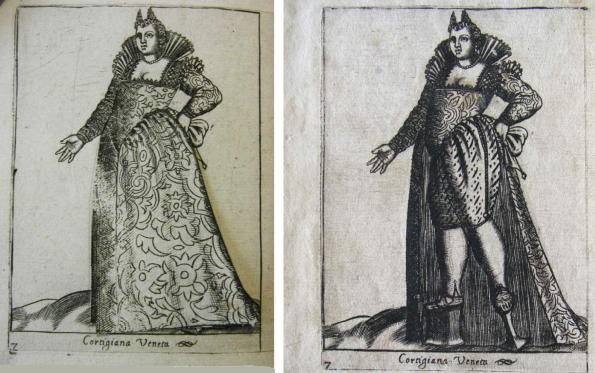
[*See Suzanne Karr Schmidt’s comprehensive study, Interactive and Sculptural Printmaking in the Renaissance (Brill, 2017)]
Memento mori
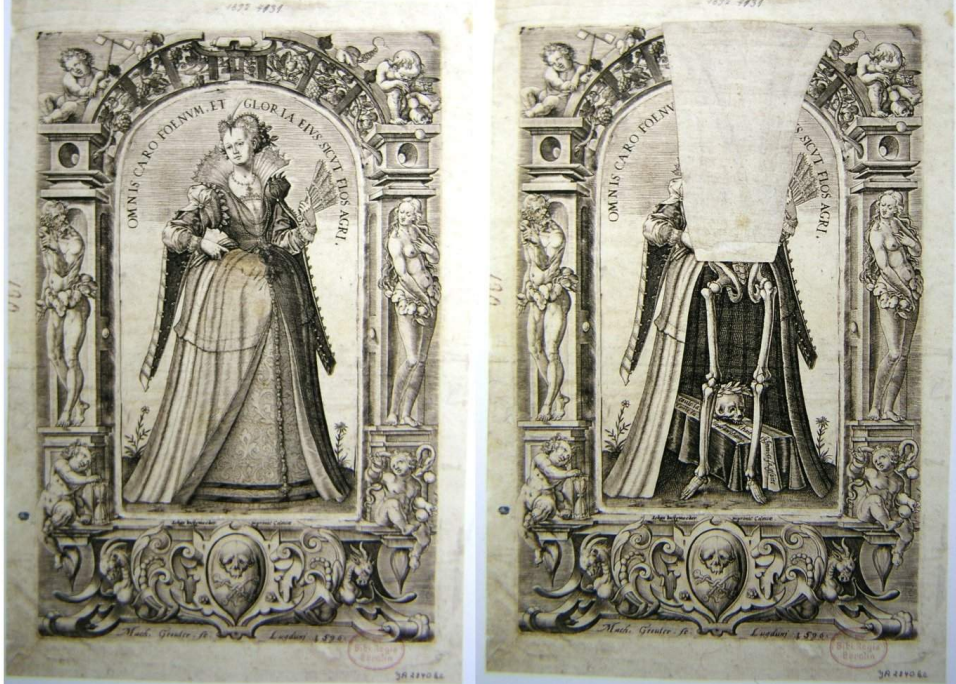
A surprise of a quite different sort awaited the viewer who lifted the — now missing — flap over the skirts of the courtesan on another leaf dated 1606 from the Steinweg album in the Frommann collection — though the obviously religious sentiment written above her head Spes mea unica Christus [Christ is my only hope] might perhaps have given a hint.
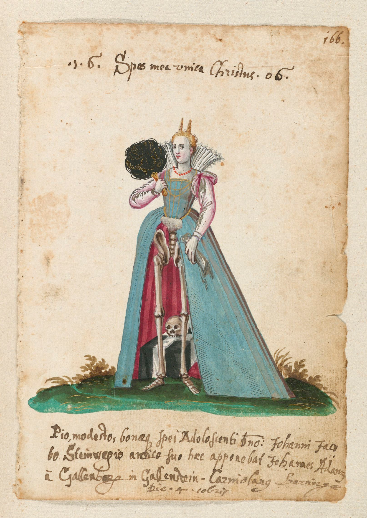
From the waist down the lifted flap reveals a skeleton with behind it, still within the compass of the skirt, a draped coffin with a skull on top — a classic memento mori. Again, this type is preceded by a print version
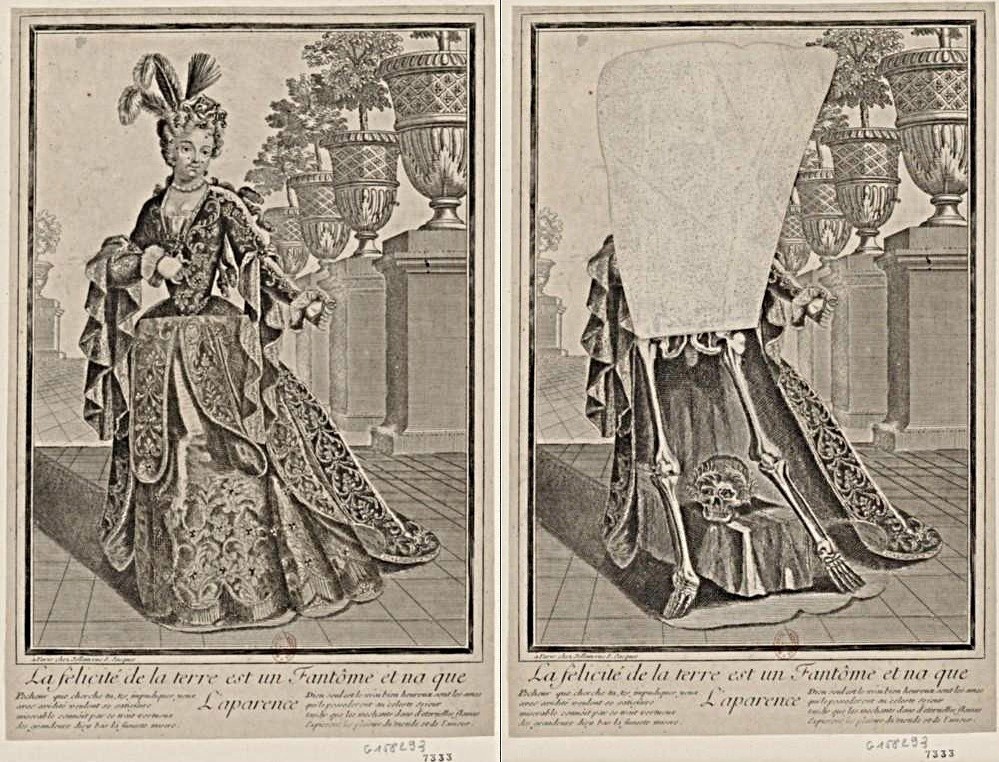
An early 18C version of this design is preserved in the Hennin Collection in Paris:
A similar — now flapless — image is painted in the album of Abel Prasch the Younger:
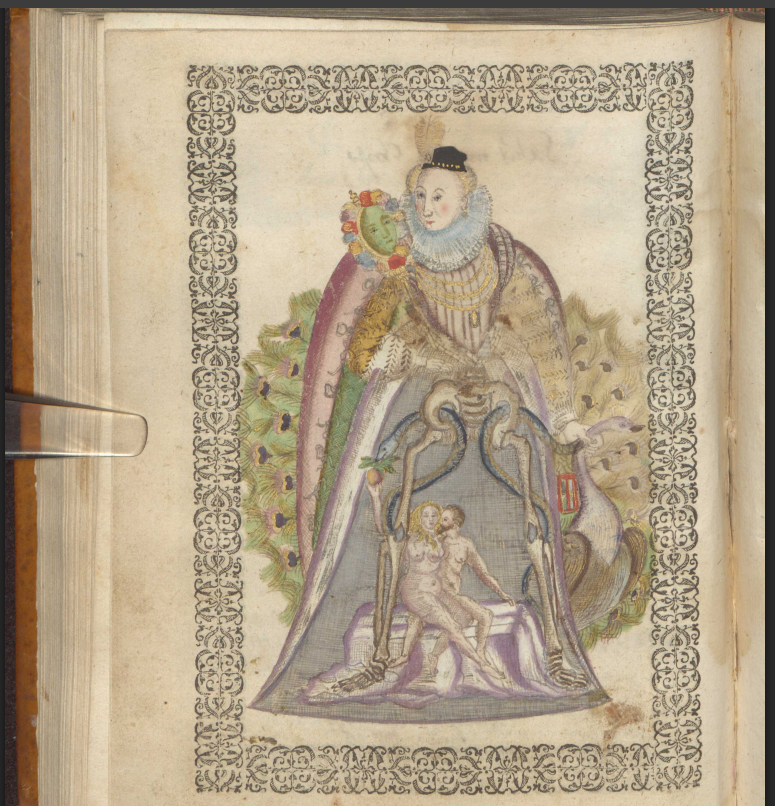
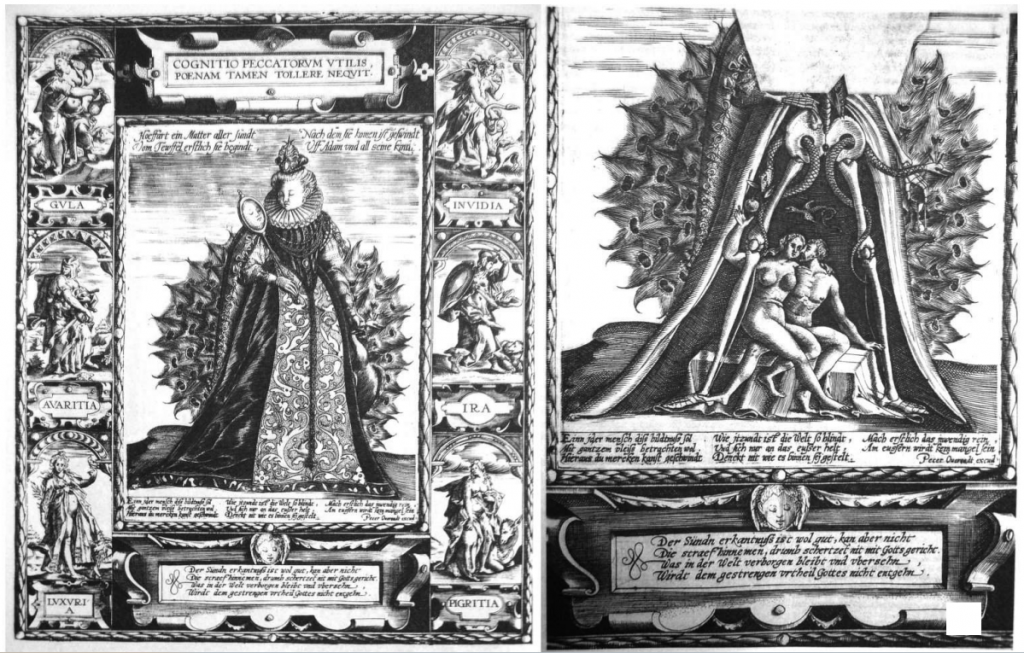
but in place of the skull and coffin seen in the Steinweg album painting, here it is Adam & Eve revealed hiding under the Lady’s skirts, as if attempting to hide from God in the Garden of Eden. Conrad Goltzius engraved two such undated print versions, one [EXTERIVS PICTA SVMQVE INTERIVS MALEDICTA (I am painted outside and cursed within)] published by Bussemacher in Köln, and the other [COGNITIO PECCATORVM VTILIS (it is useful to know your sins)] by Overraat, also in Köln.
Long before the Italian-inspired craze for such images of the 1590s, the lift-the-skirt variety was familiar in Germany, the earliest such image (?c.1520) now preserved in Berlin — where the shock is not a reminder of mortality, but a warning of the dangerous nature of women, and what is to be found between their legs!
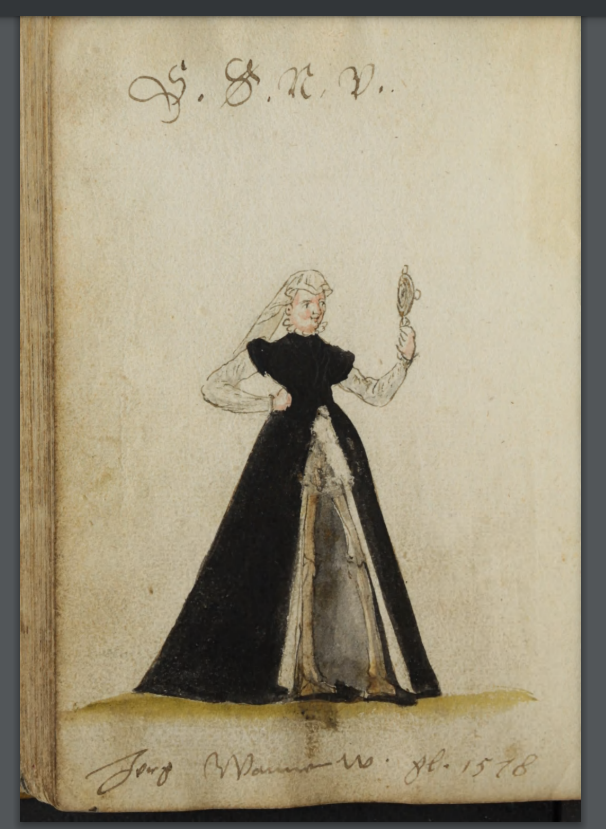
The album of Albert Twestreng with its several Danse Macabre miniatures which we have already discussed here
also includes such a lift-the-skirt miniature, dated 1578, though yet again, the flap has long since been lost. The young woman is shown admiring her beauty in the mirror, and like us, forgetting the evidence of mortality to be seen under her skirts.
And here in an early lift-the-flap print is an early 16C German lady who looked in her mirror:

Happy New Year!

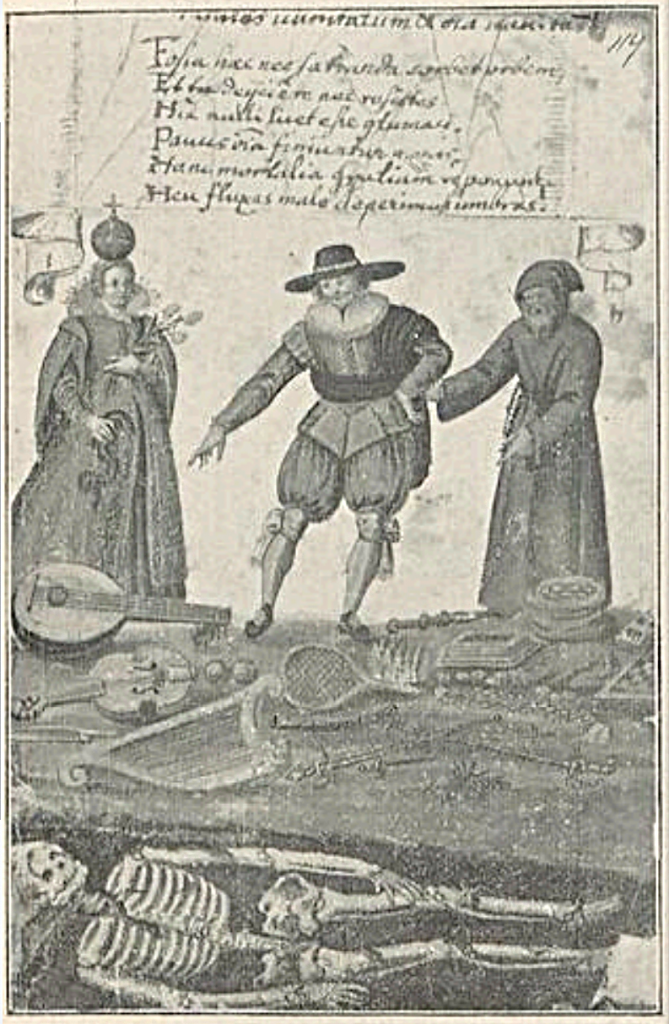
A miniature in the Hinterhofer album has not one but two flaps. one over the other. The present image is a variant of the enormously popular scene in which a young woman and an old man (priest or scholar) contend for the youth’s attention, the ground littered with the various vanities that seduce young students — which will be the subject of a future post! Additionally in the present scenario, the old man (?hermit ?monk) points to the memento mori which — thanks to the two overlapping flaps (one from each side) presents three states of his future corpse: in the first, with both flaps in position, we see the body under a shroud; lifting the top flap reveals a naked corpse gnawed by snakes and toads, and lifting the lower flap, reveals the skeleton that we see below:
In the gondola
So popular were the lift-the-flap gondola miniatures from the 1590s onwards that, after the first dozen or so, I gave up collecting them. Like the lift-her-skirt Venetian courtesan on her chopines, they begin with the Bertelli prints of c.1588
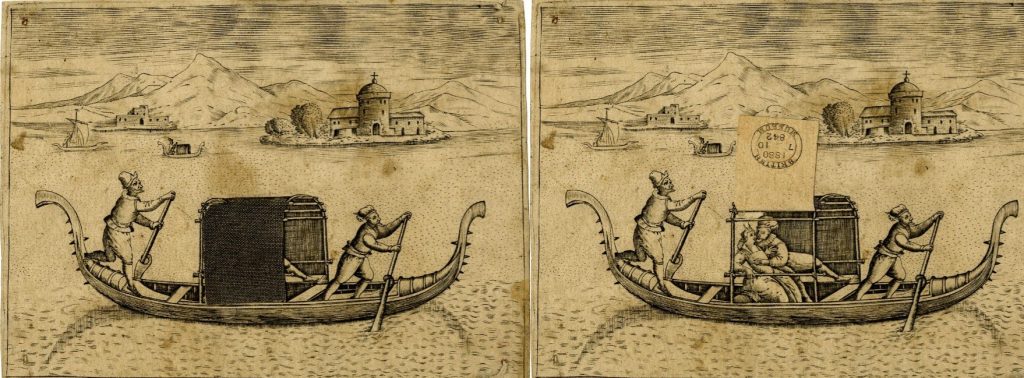

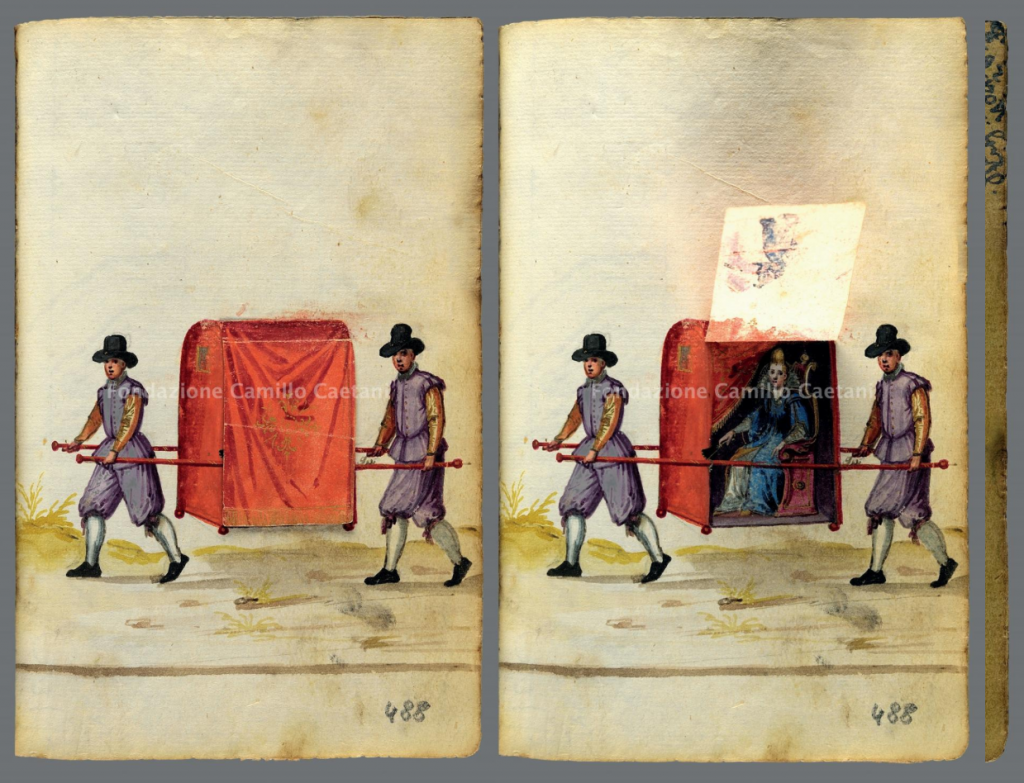
Lifting the flap reveals a courtesan — sometimes accompanied by another or chaperoned by a duenna — and a young man about to kiss her, or who perhaps places his hand on her breast as in the Matt album example below (1597×1606).
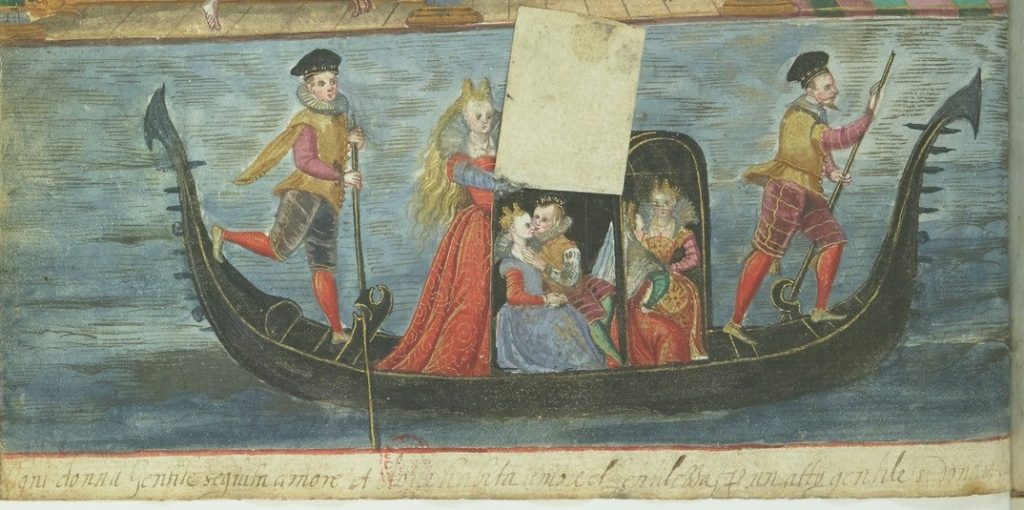
The voyeuristic act of lifting the flap to spy on these mildly erotic encounters is underlined in the Matt album by juxtaposing the scene in the gondola with that of an actual voyeur in the frame immediately above, where we see a man looking through a window at a naked Venetian courtesan sitting on her bed with mirror and shears, about to trim her pubic hair.
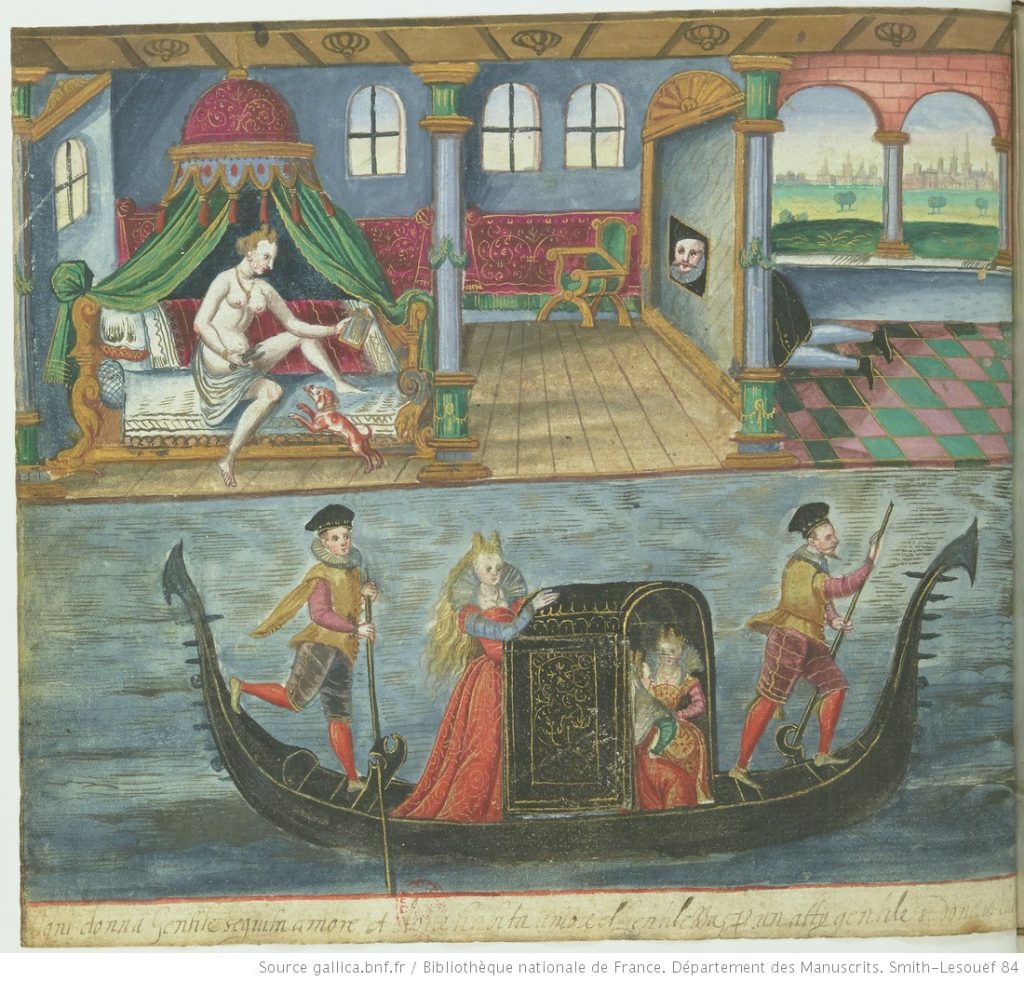
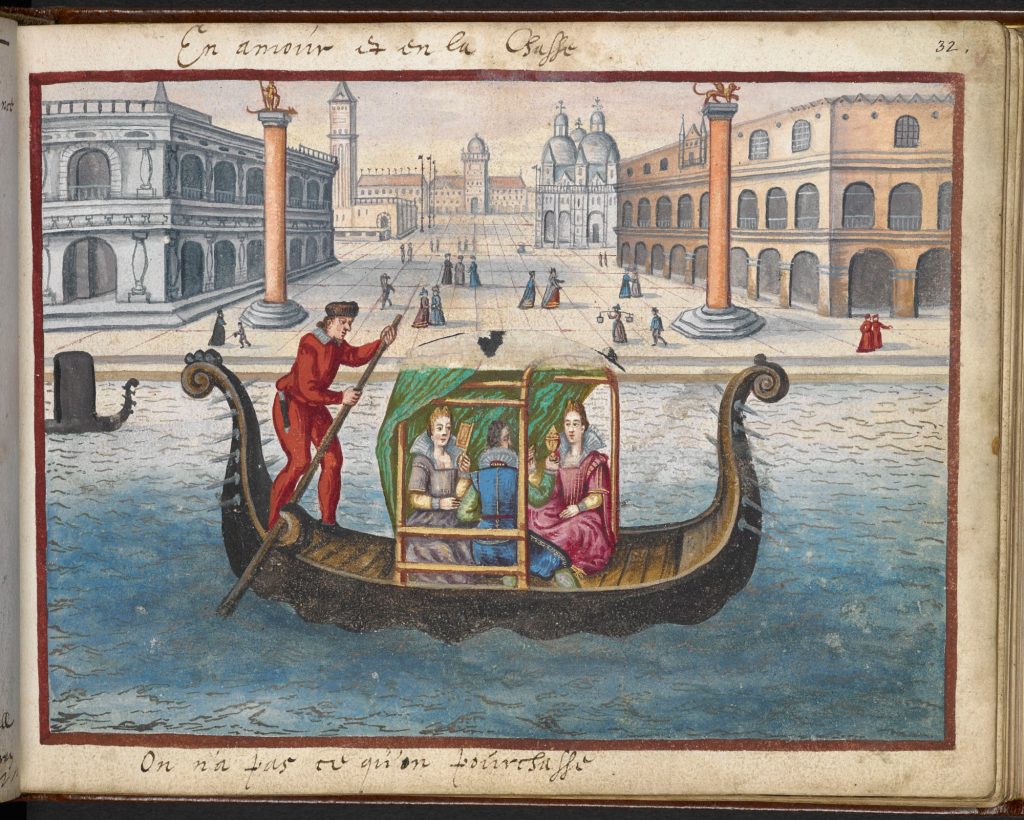
Below the gondola scene, the Italian caption opens, Ogni donna Gentile seguita amore [every noble lady followed love…], whereas in the Walens album, the (now lost) flap lifts to reveal another young German on his peregrinatio academica, widening his education in the company of two Venetian courtesans on the canal in front of the piazza San Marco, but is captioned in French:
En amour et en la chasse In love and in hunting on n’a pas eu qu’on pourchasse you get what you pay for (?!)
In the carriage and in the litter
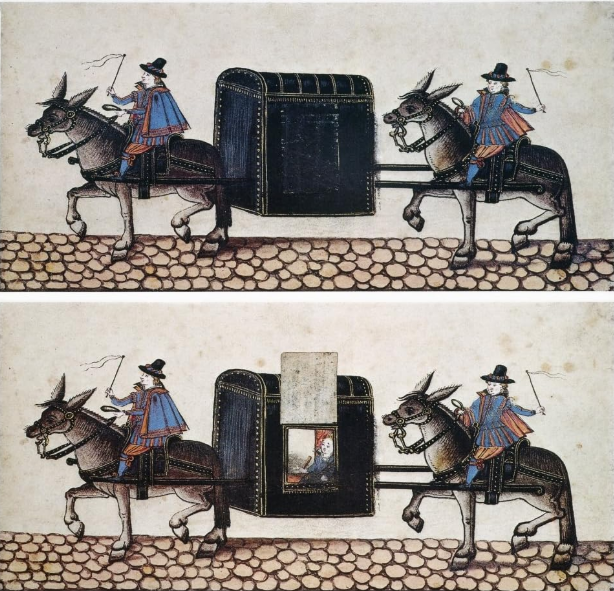
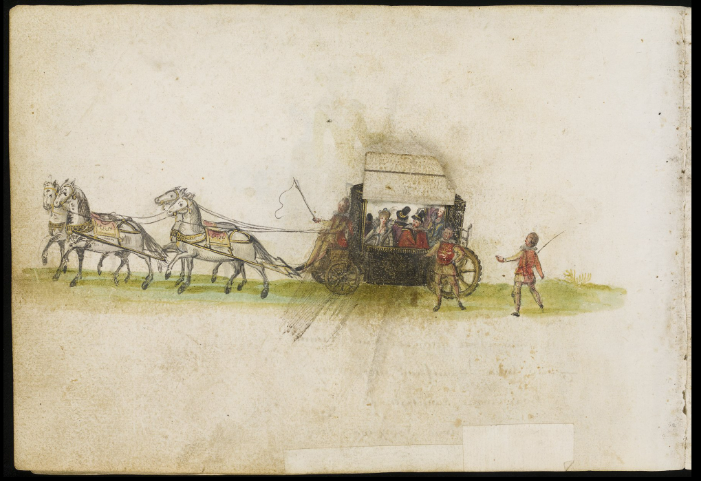
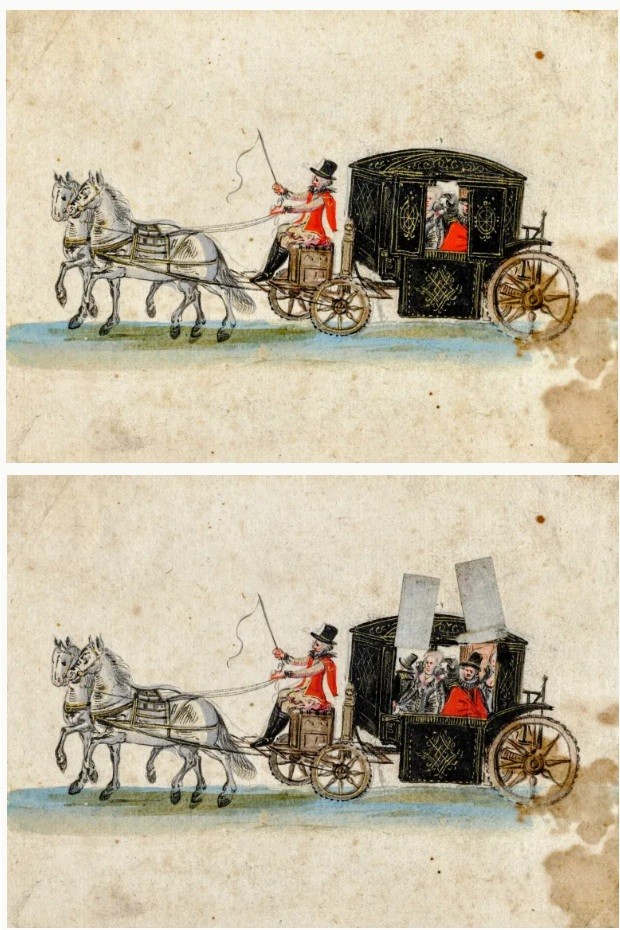
Much less frequent, but essentially the same, are miniatures of couples revealed embracing in carriages and litters — and not always in an Italian setting. Again, the inspiration was the Bertelli prints
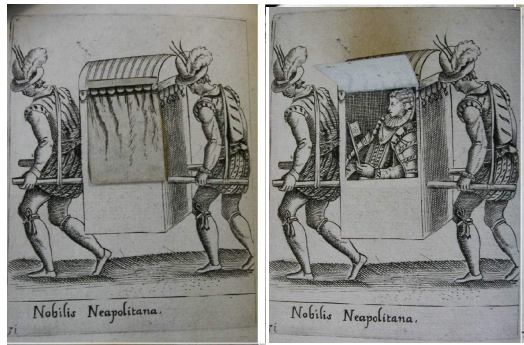
A leaf from a collection in the Folger Shakespeare Library — part of a series either intended for or extracted from an album — shows a mule-drawn litter:
In the Van Meer album, and in the Folger Shakespeare Library painting (below) we seem to be in an English context
The barrel affair/fabliau der Weinfaßschwank
The only other lift-the-flap scenario to exist in multiple copies is the fabliau known in German as the Weinfaβschwank. The flap — now often missing — is lifted to reveal a young woman, or a young woman in the arms of an old man. In the three-person version, the cellar-owner/landlord discovers his young wife in the arms of an old man at the end of a wine-barrel — as in the album of Loth von Weiβenbach (1580-1623) now in the Zwickau Library (below). The damage to the painting, where the flap formerly glued to the end of the barrel has come away, can clearly be seen.
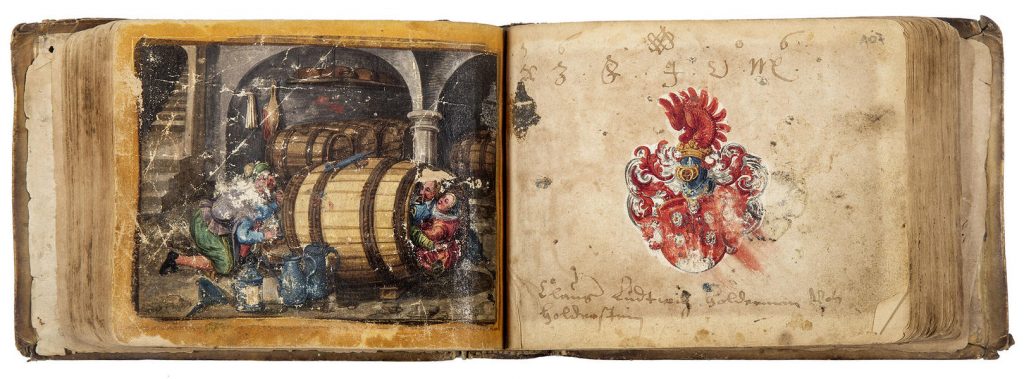
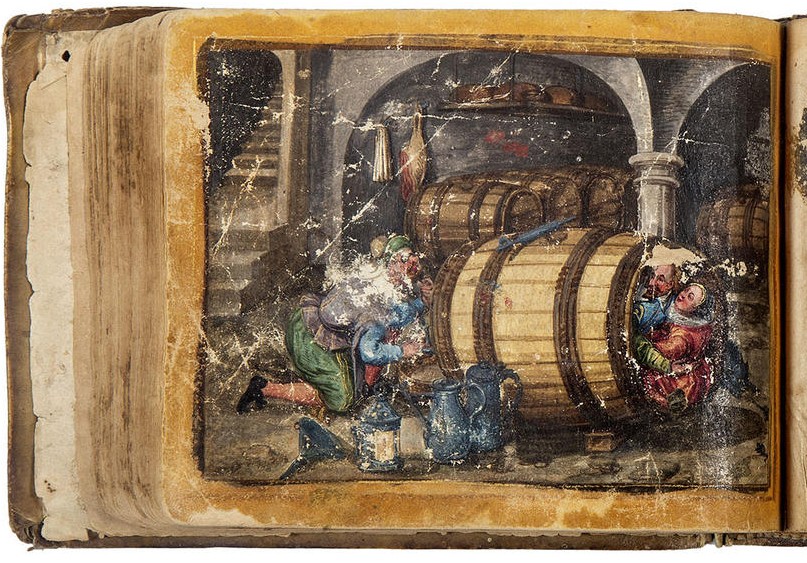
The design is clearly copied from a lift-the-flap print engraved by Theodor de Bry, c.1598:

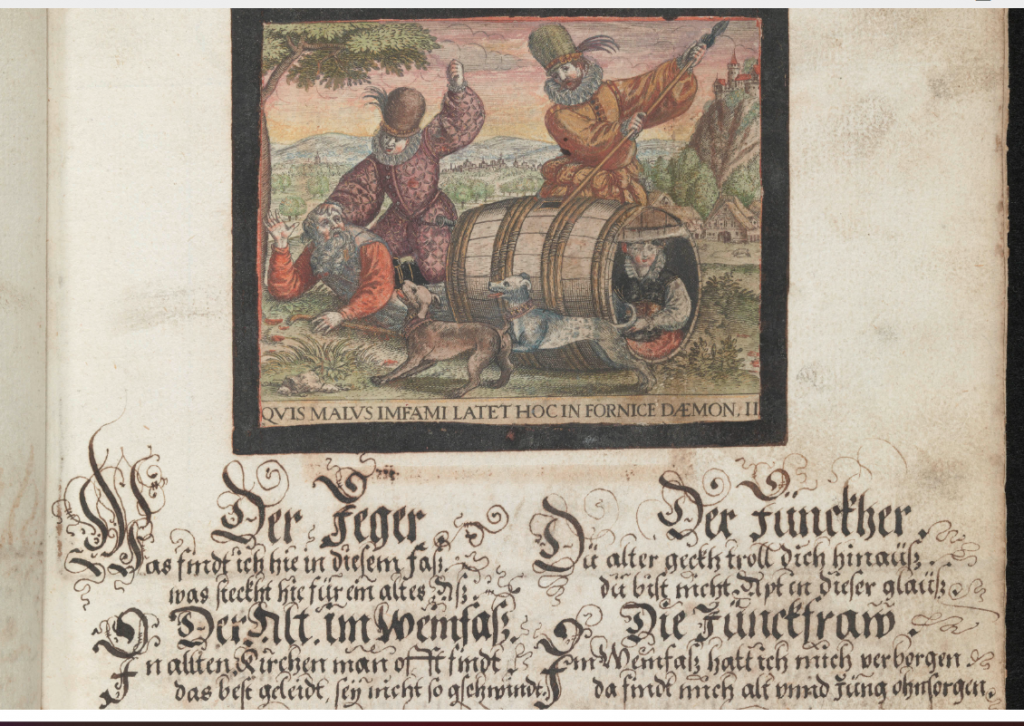
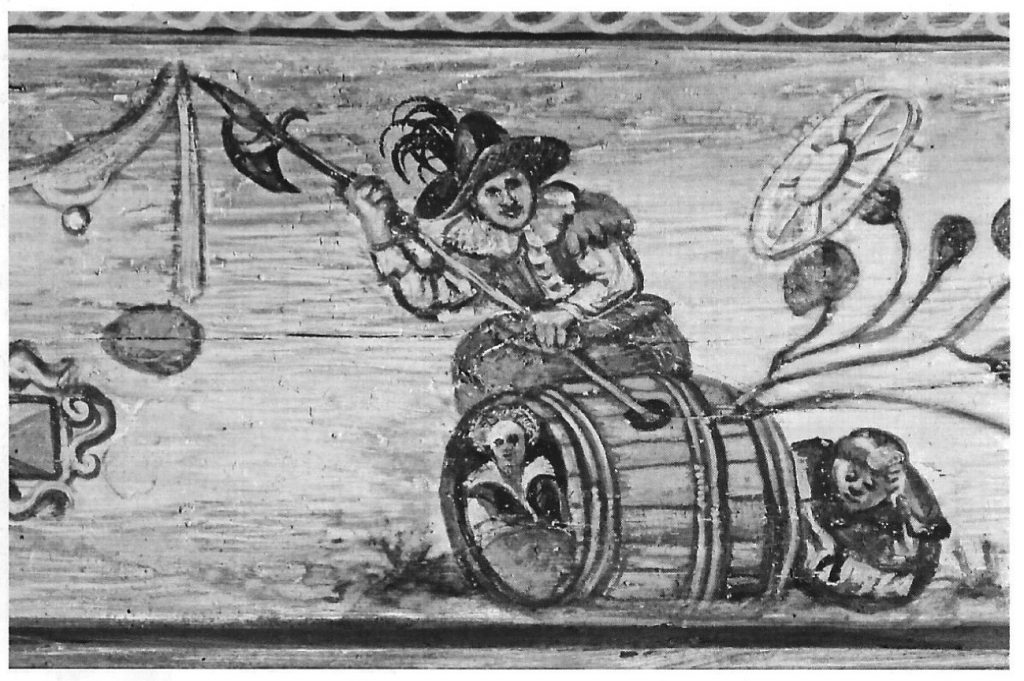
In the more complex version, the barrel is situated — bizarrely — in open countryside, a huntsman has thrust the butt of his boar-spear through the bung-hole of the barrel, which has flushed out an old man from the end of the barrel, who is being beaten by his comrade. This too is based on an engraving by de Bry first appearing in his Emblemata Nobilitati (Frankfurt 1592):
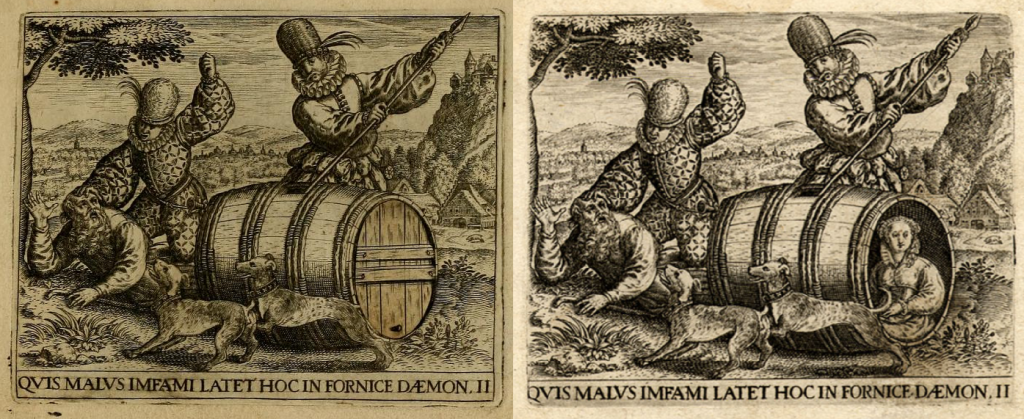
The Neithart album example (1598), a close copy of the de Bry engraving, is accompanied above the image by the speeches of all four participants. Again, the slight damage to the miniature above the girl’s head shows where the flap was once attached:
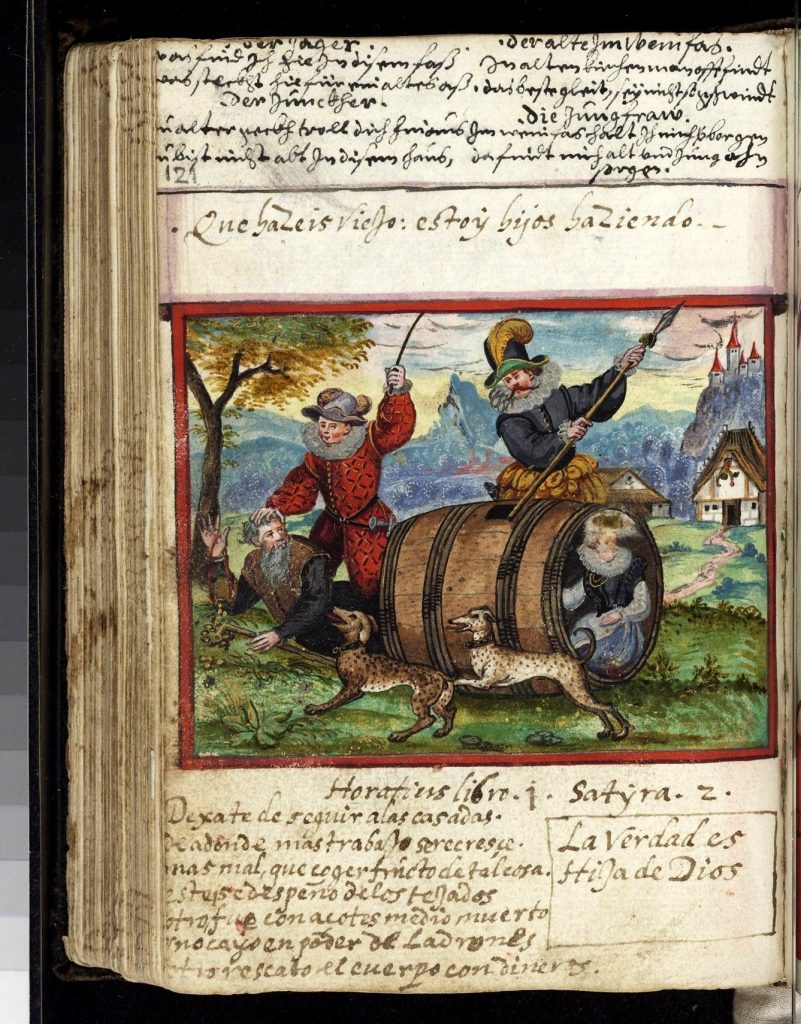
Der Jäger :
Was find ich hie in diesem Faβ [What do I find here in this barrel,
Was steckt hie für ein altes Aβ? What sort of old — is hiding here?
Der Juncker :
Du alter Geck, troll dich hinaus, You old fool, piss off out
Du bist nicht Abt in diesem haus. you are not abbot of this house
Der Alte im Weinfaβ :
In alten Kirchen man offt findt The best people are often found
Das best Geleut, sey nicht so schwindt in old churches, don’t be so hasty!
Die Jungfrauw :
Im Weinfaβ halt ich mich verborgen, I hide in the wine-barrel
Da findt mich Alt vnd Jung on sorgen. where old and young can find me easily.
The same verses caption an impression of the de Bry print, coloured and pasted into the album of Hans Ludwig von Henfenfeld:
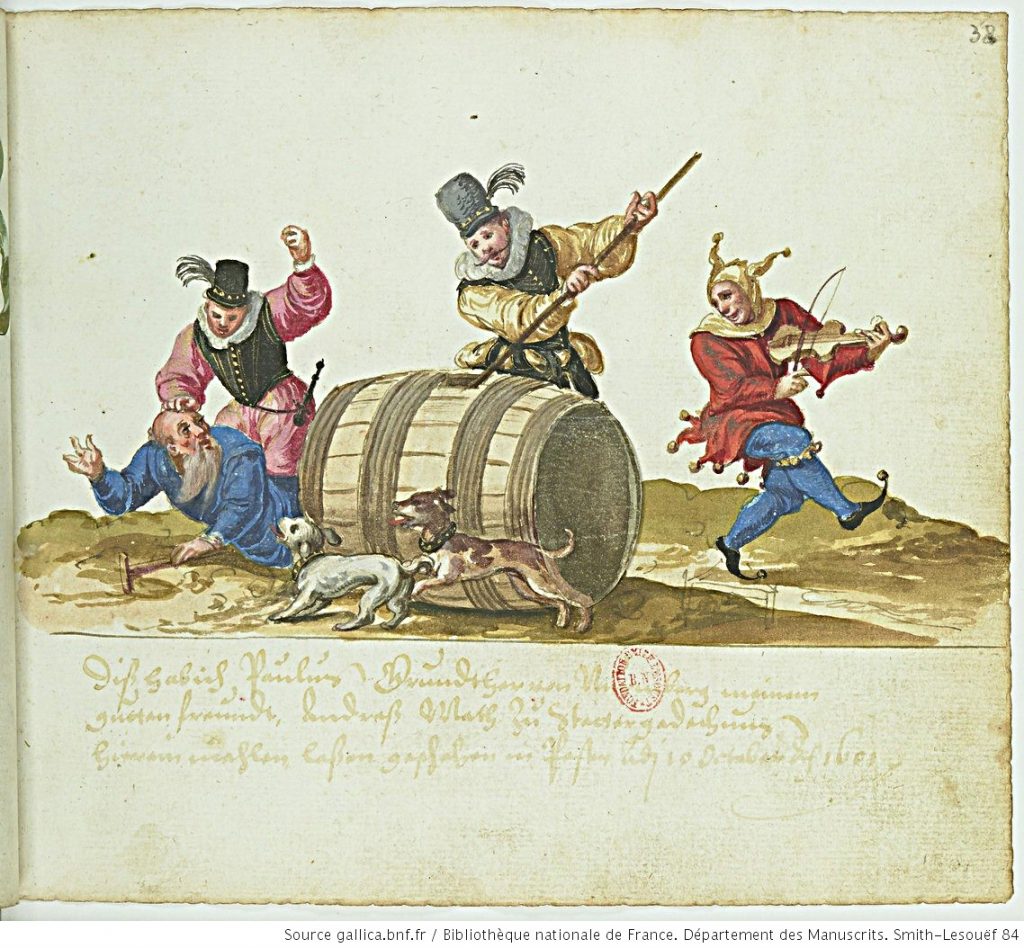
No text accompanies the version in the Matt album which seems still to retain its flap, but and a costumed fool playing the fiddle has been added to the scene:
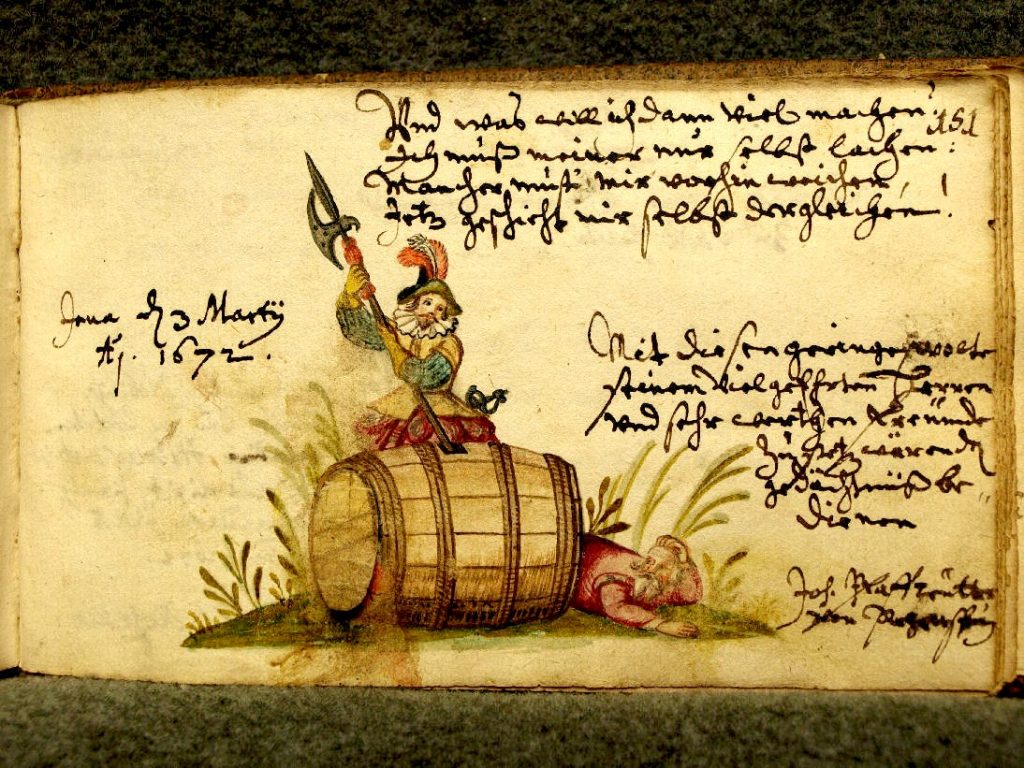
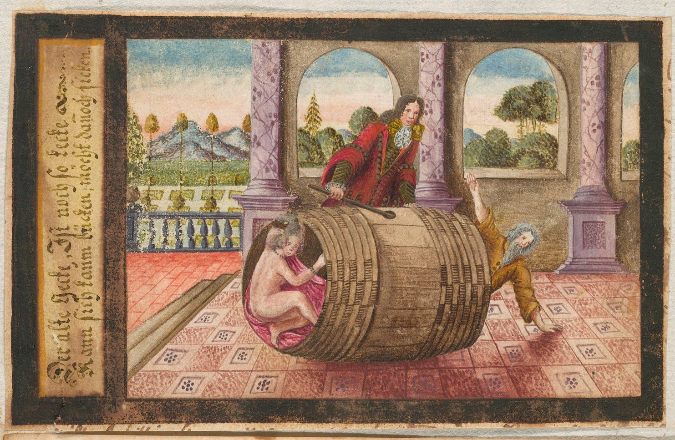
While the heyday of the wine-barrel affair was evidently around the turn of the century, I have come across two later examples, one dated 1672:
Contemporary with the turn-of-the-century miniatures — though obviously without a liftable flap! — the Weinfaβschwank is one of the motifs painted on the Wroclaw ceiling, providing a much-needed terminus post quem for that decoration:
Miscellanea
Other lift-the-flap scenes in the albums seem to be one-off — though perhaps they all have a certain risqué quality in common. Karr Schmidt notes what she calls “a candle-lit, obscure medical or perhaps initiation ritual” in the early 17C Weyermann album [BL, Egerton 1236, f.4], which features a “male figure with liftable trouser flap revealing naked genitalia … [the] man in question held down on the ground and surrounded by onlookers, some of whom may be doctors.”
In the post
https://albumamicorumear-e4qvahs764.live-website.com/cat-steals-dildo-penis/
I discuss the scene below — the flap missing, as so often — in the album of Matthias Huber dated 1633. The dildo is missing now too — erased by a later owner!
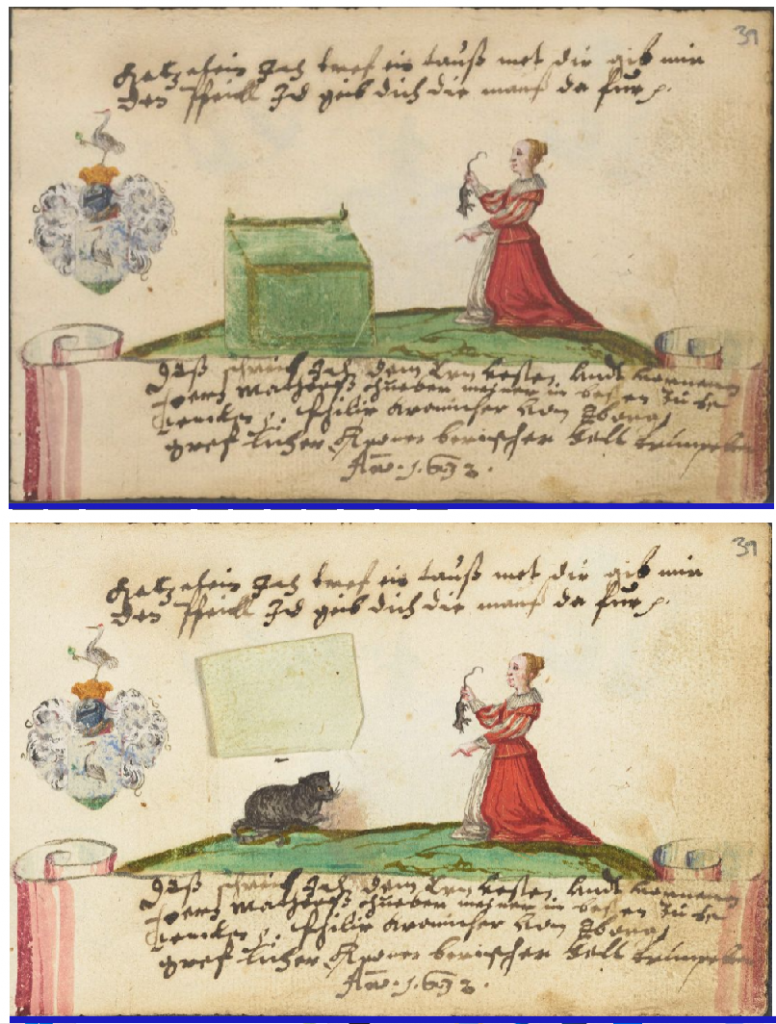
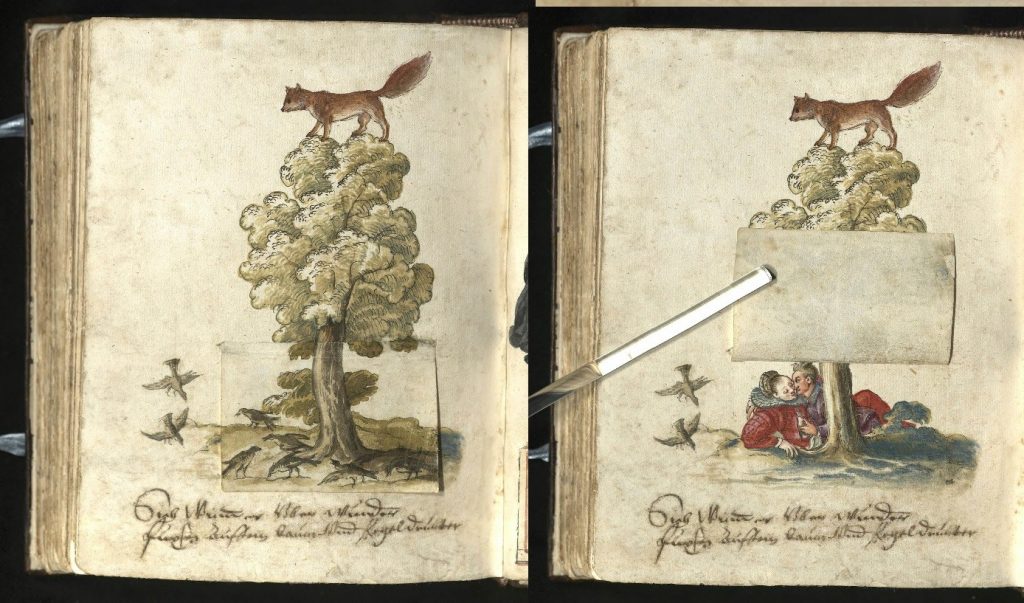
and in the post
I include the couple making love beneath the tree, in the early 17C album of Michael von Heidenreich:
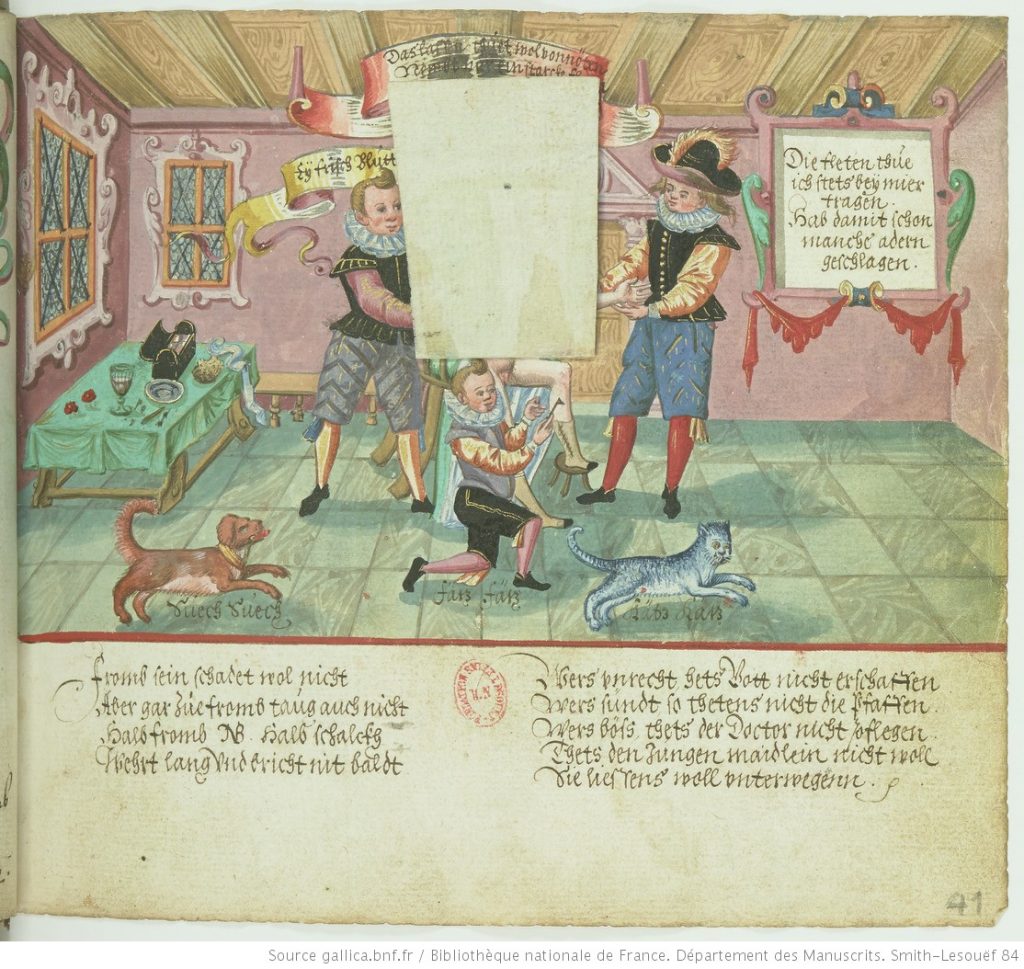
It is presumably the exposure of the genitalia that accounts for the curious lift-the-flap miniature painted in the contemporary Matt album, as part of a scene of blood-letting. With the flap closed, we see a physician letting blood from the arm of a middle-aged lady, the blood caught in a dish held by his young assistant:
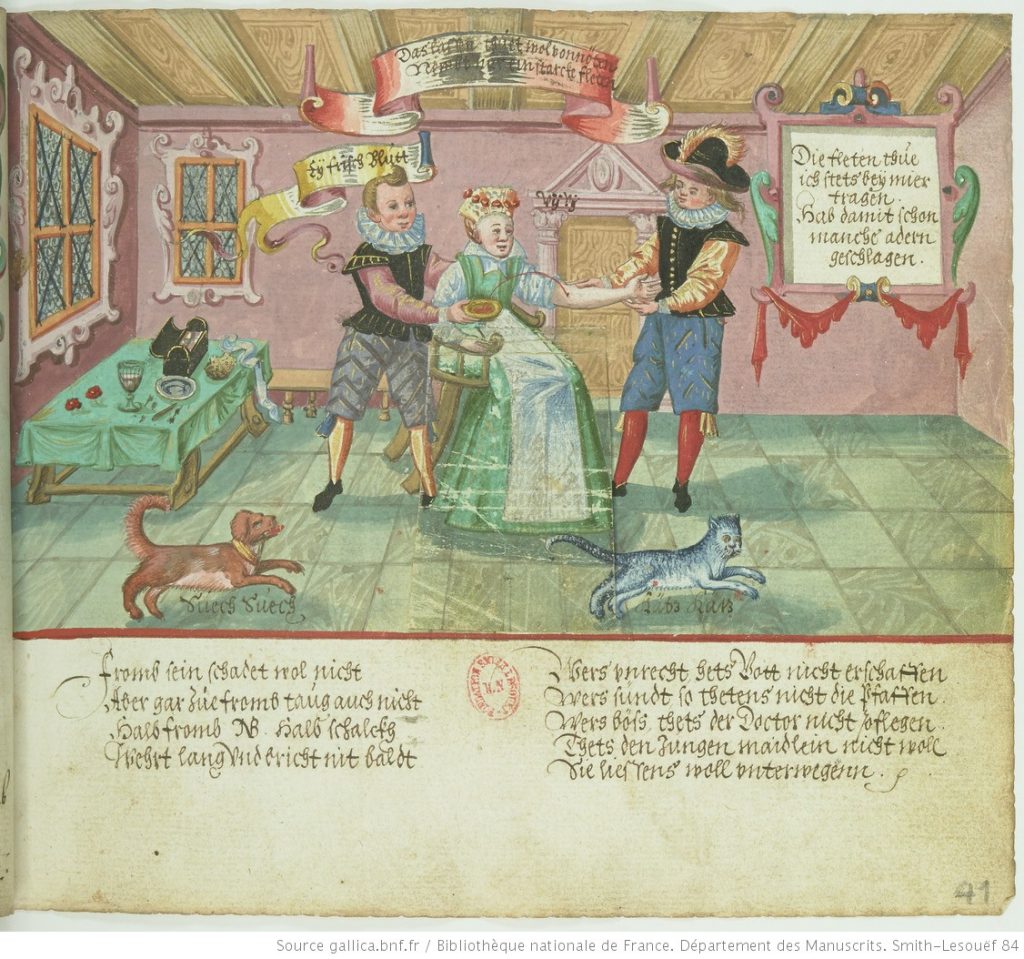
When the flap is lifted, we are surprised to find another young male assistant under the lady’s skirts! He has perhaps been suturing the scar visible on her left leg? But, of course, her crotch is also ‘accidentally’ thus exposed. The verses below are merely sententious and unrelated to the painting.
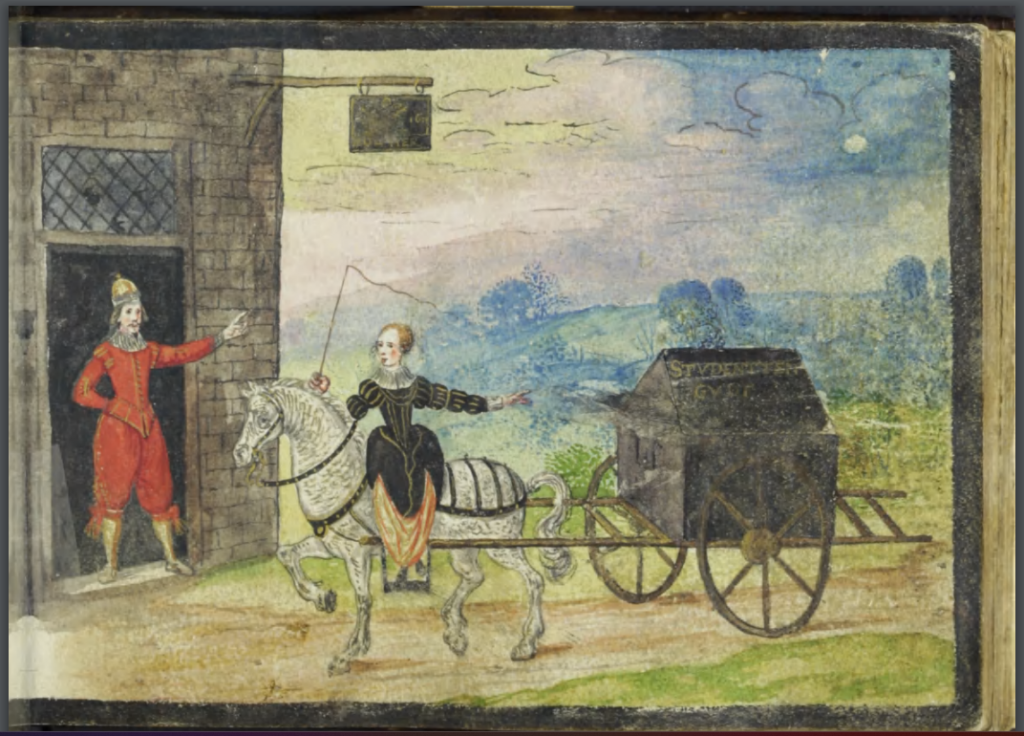
We also noted another surprising revelation in our post
https://albumamicorumear-e4qvahs764.live-website.com/student-goods-are-duty-free/
The mother of the baby, revealed when the flap on the carriage is lifted, maintains that she does not need to pay any toll for the infant as it is the law that ‘student goods are duty-free’!

The Pelican in her Piety
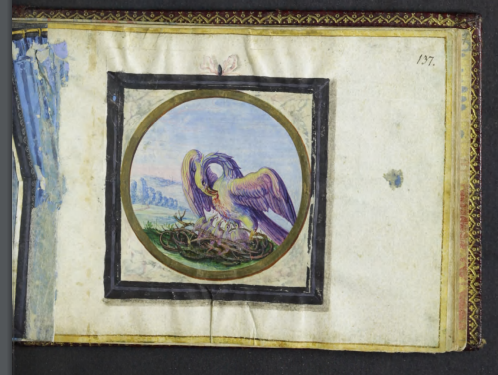
A final ‘hidden’ image I have noticed is this page in the Deublinger album which, at first sight, merely presents a curtain on a rail.
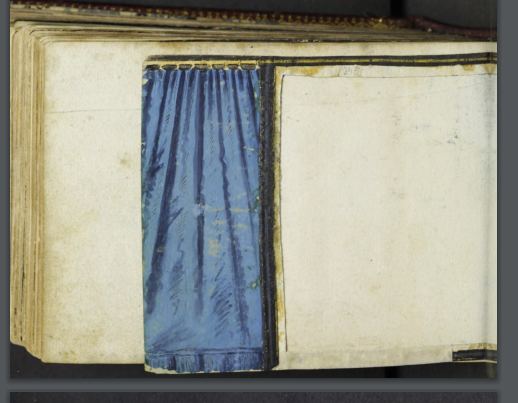
Opening both lateral flaps, however, reveals this emblematic painting of the popular Christian symbol of the Pelican in her Piety:
Thott 434, 8°
Leave a Reply