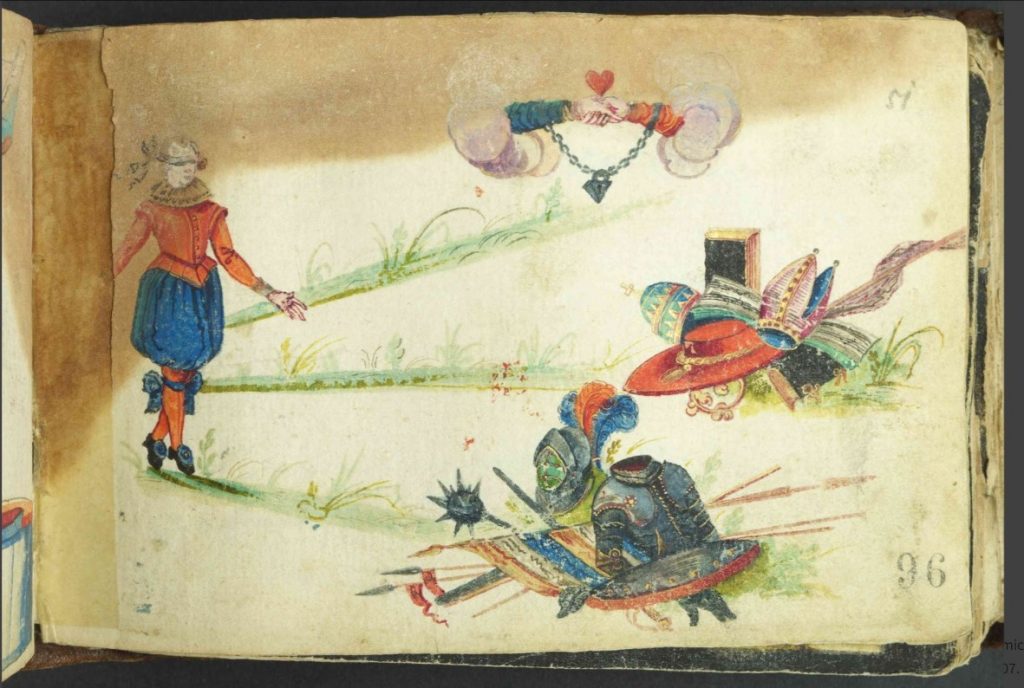
This young man from the 1620s appears to be heading into the future, blind. There are three paths he might follow here, the Church (centre), the Army (bottom) or marriage (top), this last option being symbolised by the same emblem we have discussed in the previous post
i.e. chains from his and her wrists, joined by a padlock, a heart above their hand-clasp (often flaming, but not here).
The same three ‘career’ choices are depicted in this orphaned leaf painted c.1600 and now in the Bayerisches National Museum — the marriage has not gone well… The banderole inscriptions need to be read from right to left here; the armoured knight says, Haec mea uxor [this is my wife] meaning the army, the priest, Et haec mea [and this mine] meaning the church, but the smartly dressed gentleman threatening his wife with a cudgel says, Haec autem mea [But this is mine] — and his very unmetaphorical wife is defending herself with the keys to the household.
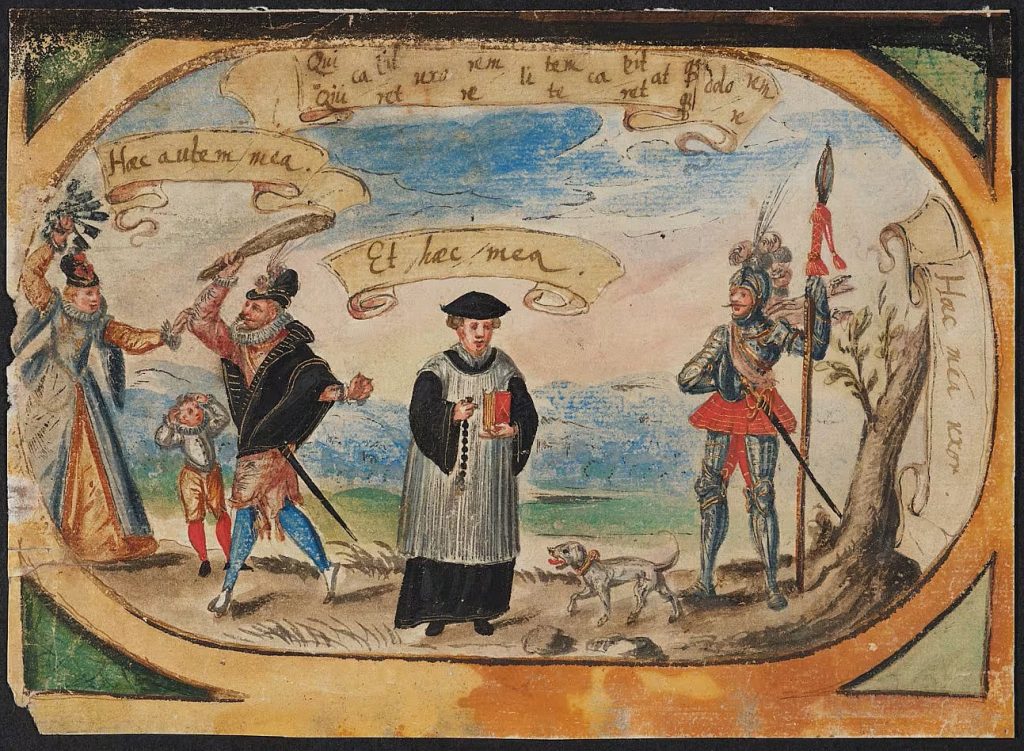
The title, is at first sight incomprehensible, until one realises how the Latin is to be read, syllable by syllable and up and down alternately, a process which yields a classic piece of misogyny:
Qui capit uxorem litem capit atque dolorem OR
Qui caret uxore lite caret atque dolore
He who takes on a wife takes on strife and sorrow OR
He who lacks a wife lacks strife and sorrow.
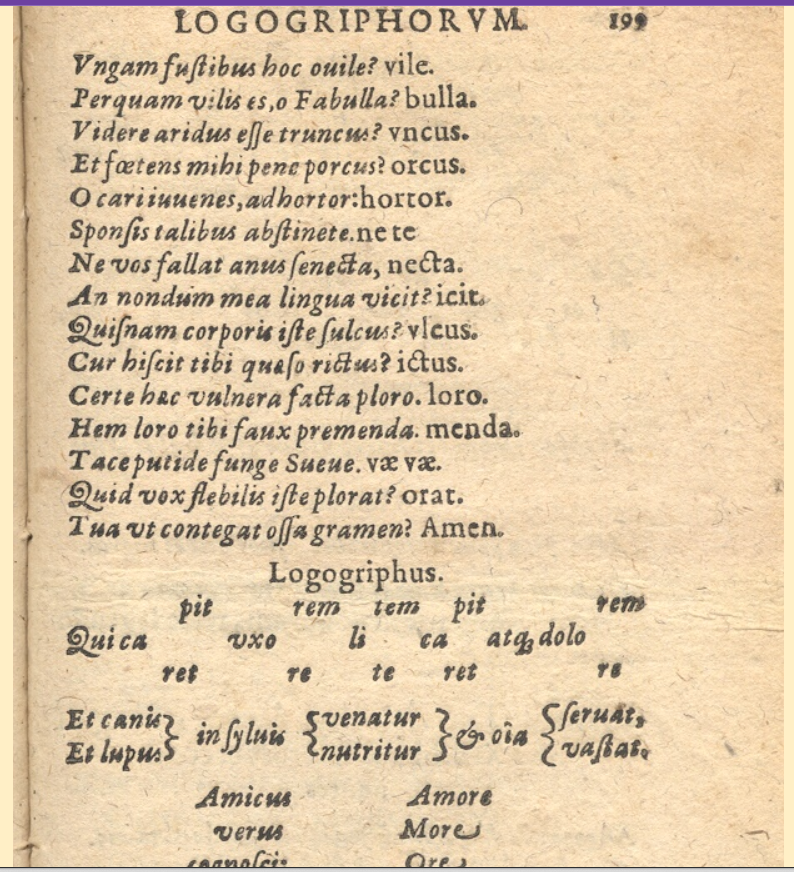
But the device was not invented by the painter; here is the very same logogriph as published in the 1601 edition of Lauterbach’s Aenigmata:
Courting
But let’s not anticipate trouble, let’s go back to the beginning!
If one is fortunate enough to find an agreeable partner, the courting process begins… A miniature in the Huber album depicts three courting couples in a love-garden — the golden feathers of Cupid’s arrows can be seen lodged in the breasts of the two couples in the foreground
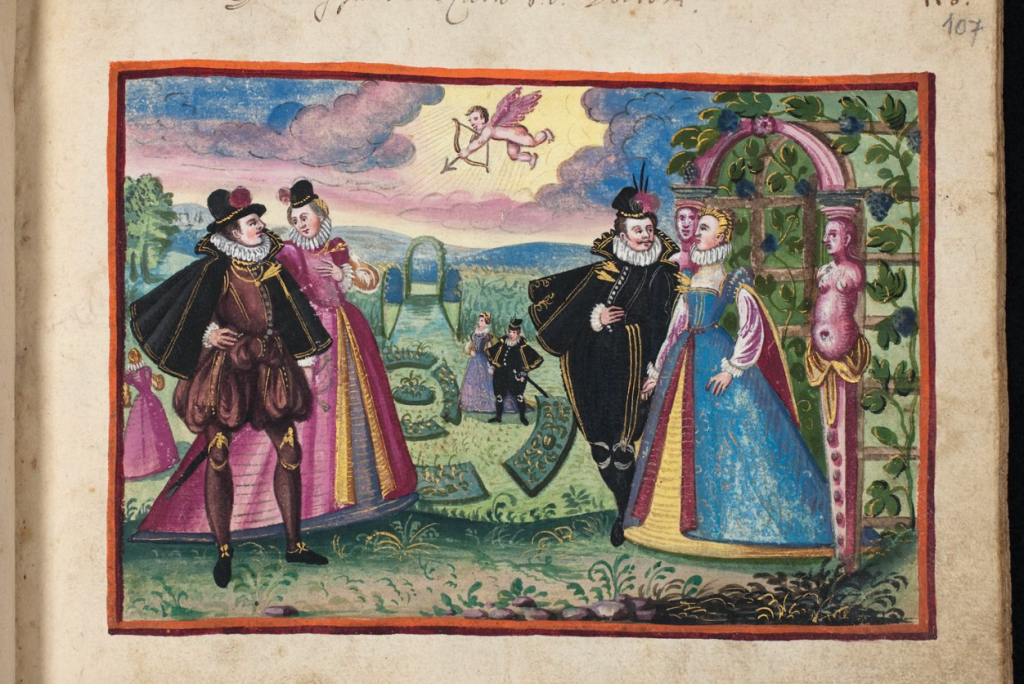
And things seem to be going well here too:
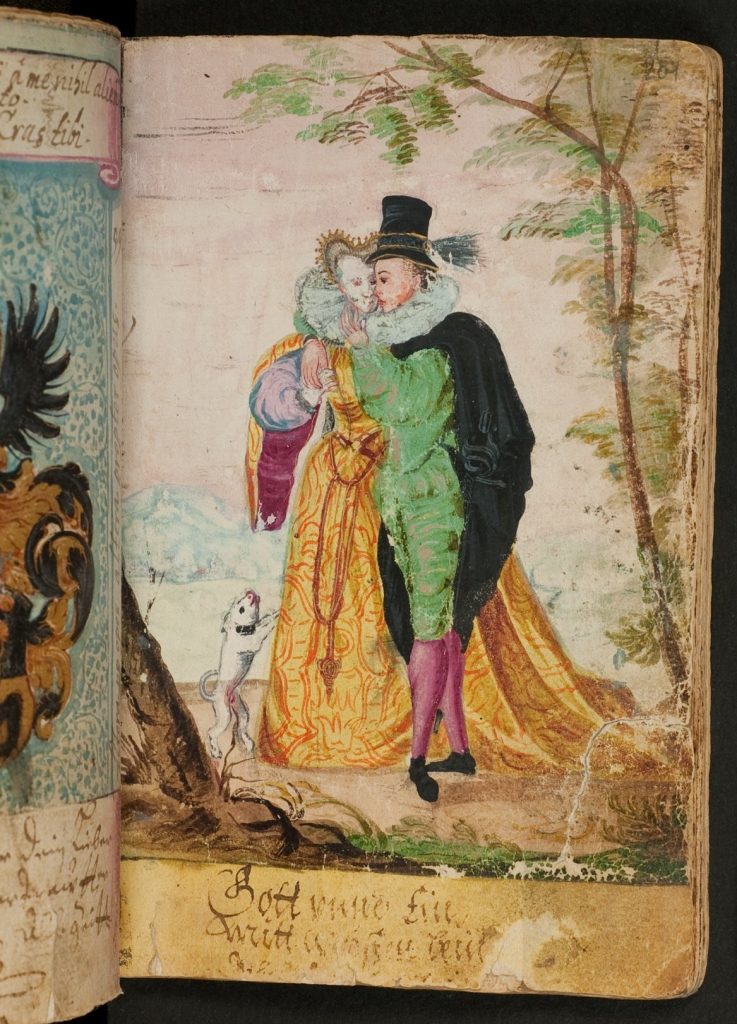
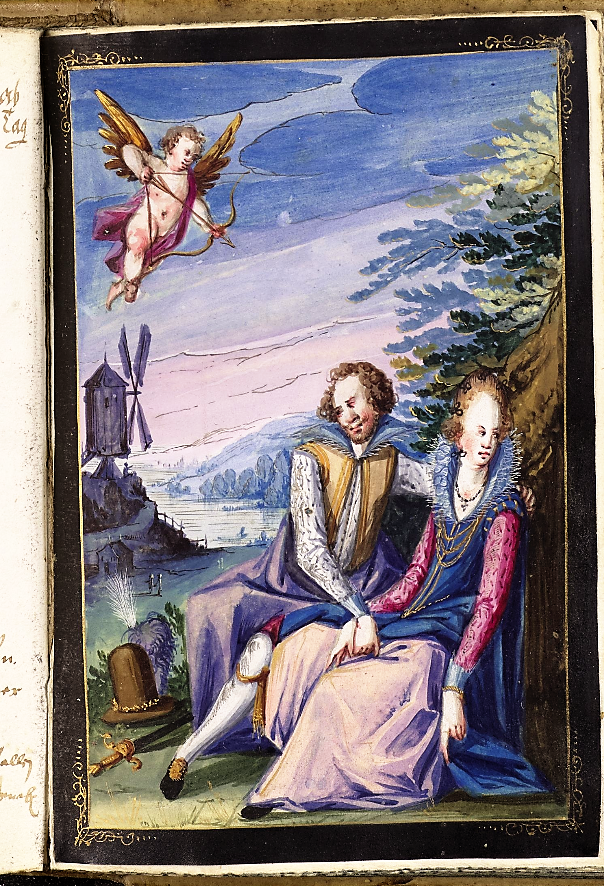
Hmm… not sure how well things are going here! The lady has turned away and looks a bit miffed. He has at least taken off his hat and sword — perhaps when Cupid looses his arrow… ?
Ah! This looks better! The Italian title means, “Come closer to the fire and you won’t lose the heat” — and she does look a bit cold!
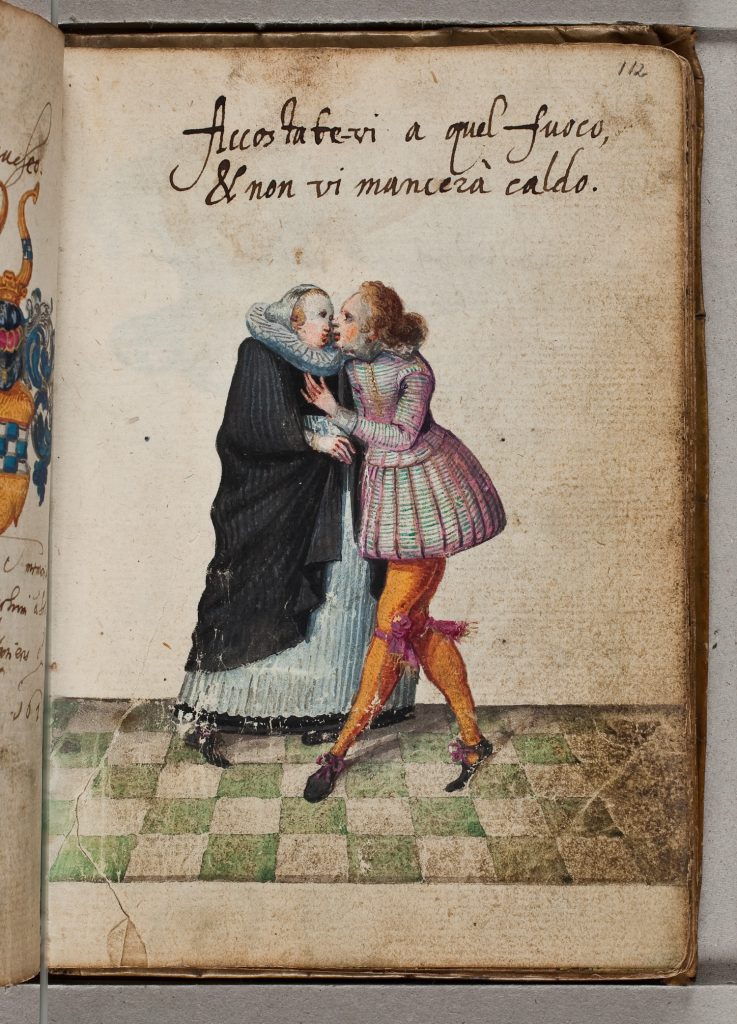
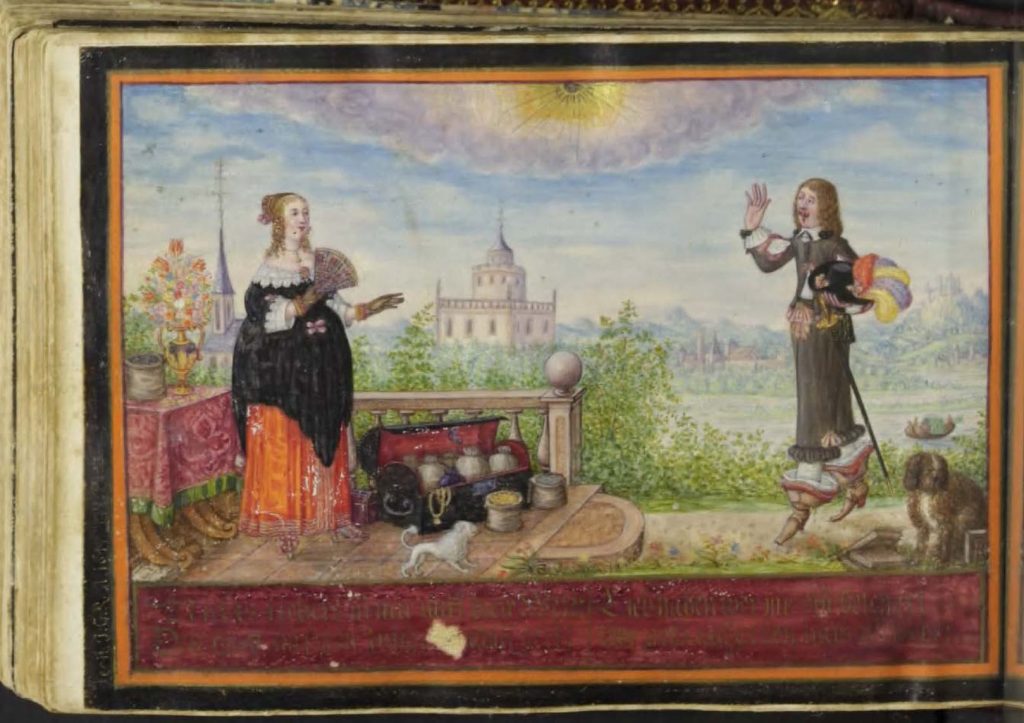
Below — what a very delicate greeting! (And those baggy boots are a very helpful for dating fashion of the late 1640s) — but the inscriptions are passionate!
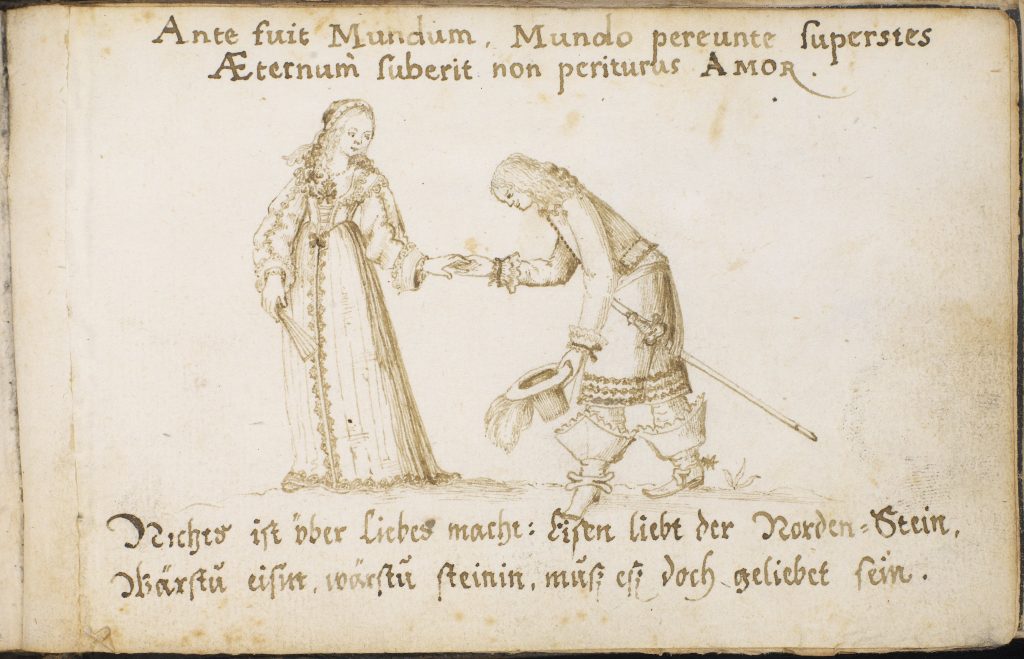
The Latin: “Before there was a world and after the world has perished, love will not perish, love will endure eternally” ; the German: “Nothing is beyond the power of love: as iron loves the magnet, were you iron, were you stone, you would have to be loved!” Ah! Feel the power of love!
Can the lady (below) take a hint from the animal world? -- in which all the creatures are pairing off!
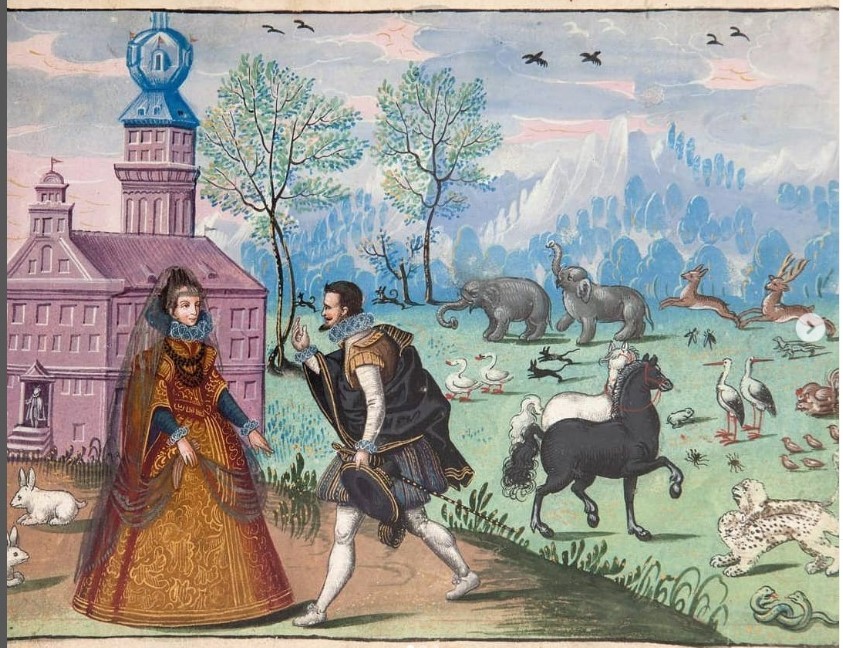
The rather effete-looking young gentleman in this miniature in the Deublinger album (below) greets the young lady who seems to have all her wealth on show — but, as all too often, from a mere photograph it is impossible to read the caption below.
The old dropped glove routine
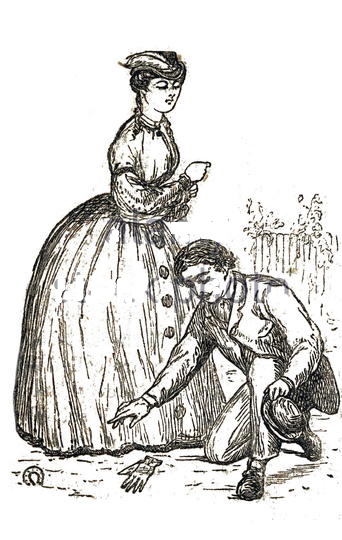
A lady could not be too forward, of course — which is where the good old dropped glove ploy comes in!
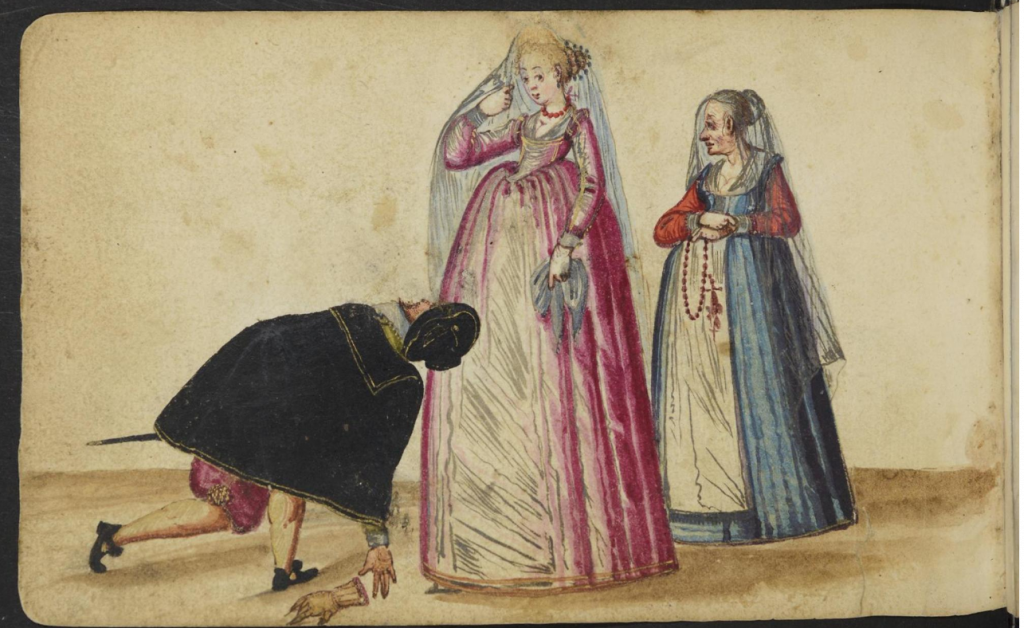
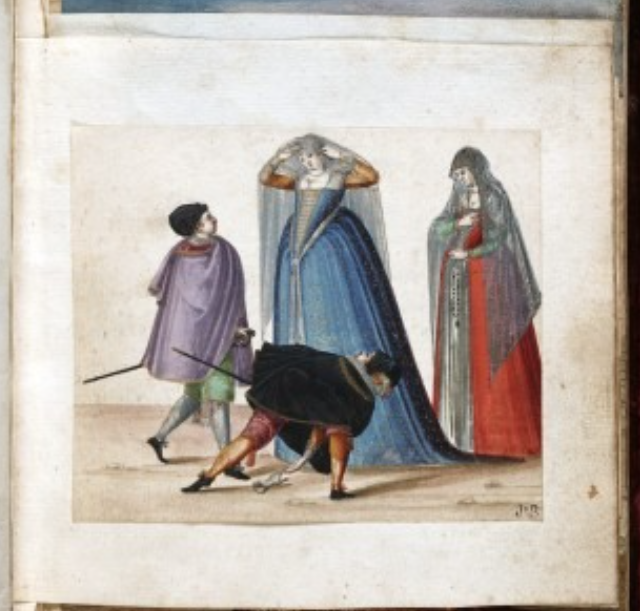
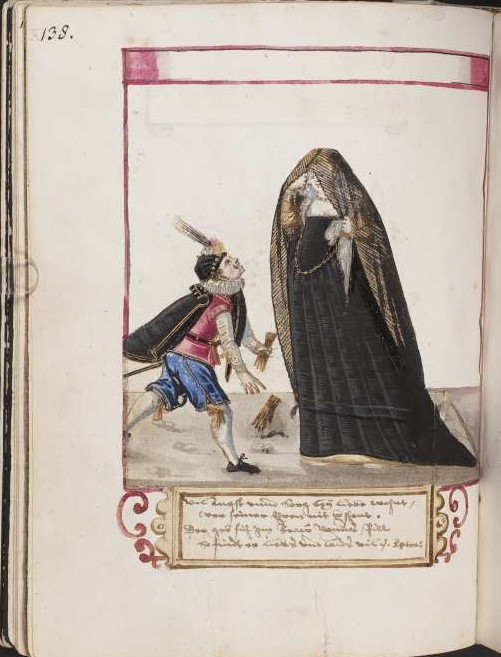
The man retrieving the lady’s glove below seems unusually tiny!
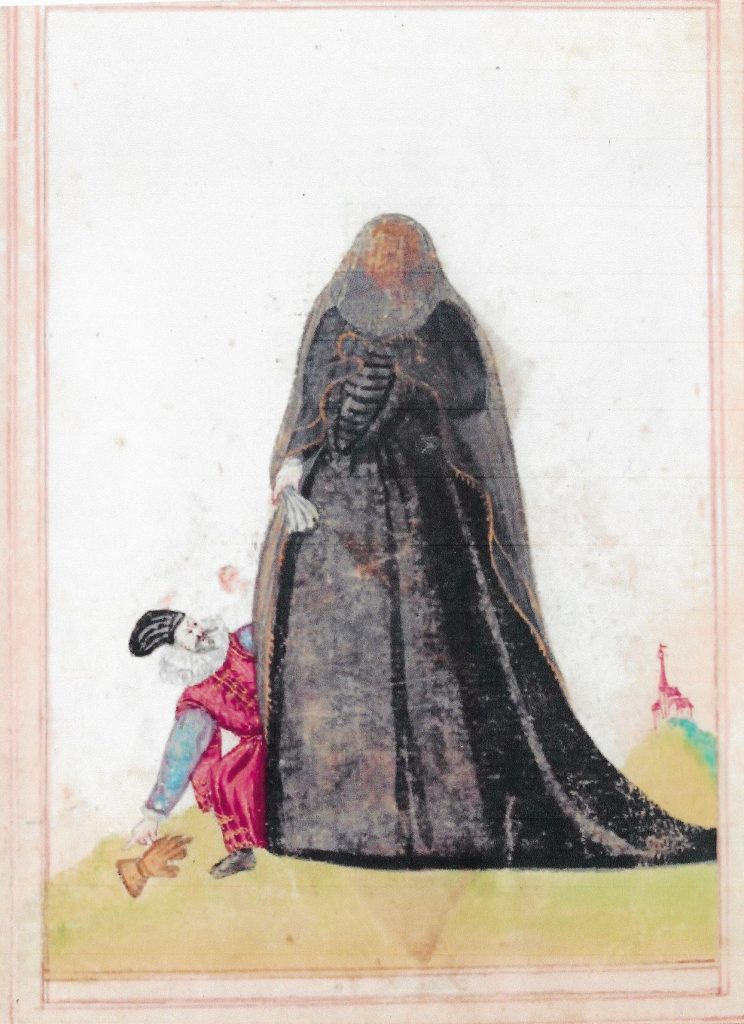
A rather more German version than the Italianate examples above.
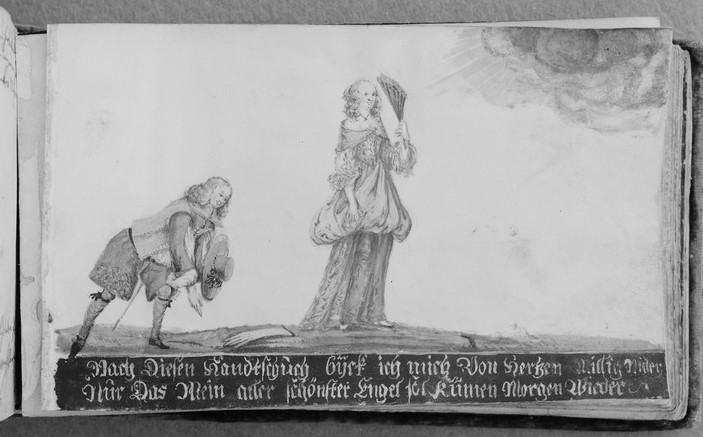
Nach Diesen Handtschuch bück ich mich Von Hertzen Willig Nider Nur Das Mein allerschönster Engel sol Kümen Morgen Wieder
For this glove I willingly bend down with all my heart if only my most beautiful angel will come again tomorrow
And they were still at it in Victorian London (1864):
Virgo is my favourite sign!
A musical couple painted in the Stephani album (though, even to my unmusical eye, the notation in the music-book looks a little ‘sketchy’ ! — just how I would have drawn it — if I could draw at all) — and, 4 centuries too early, he seems to be sporting one of those absurd ‘man-buns’ so popular amongst 2020s men. Once again, NB! the adjacent page to which he seems to be pointing has absolutely nothing to do with this image and was clearly painted at a quite different time.
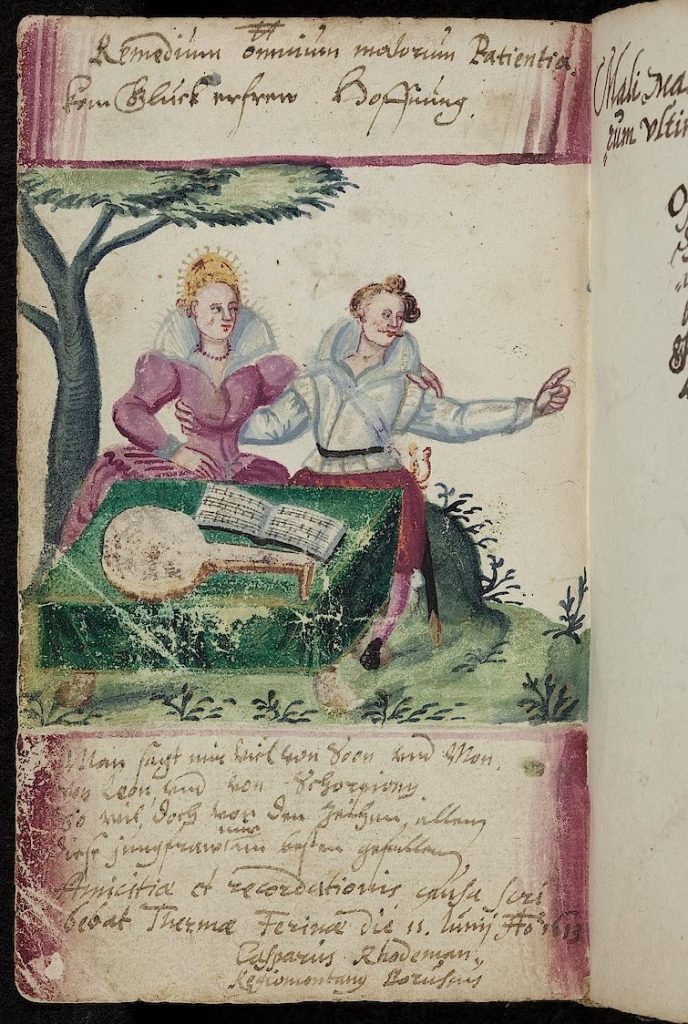
Ignoring the conventional sententiousness — in Latin and German — above, the vernacular verse below is tolerably amusing:
Man sagt mir Viel von Soon [sic] vnd Mon I hear much of Sun and Moon
von Leon vnd von Schorpion of Leo and Scorpio
so wil doch von den Zeichen allen and yet of all the signs
diese Jungfrawlain besten gefallen this Virgo pleases me best.
It is interesting to find this verse here in the Stephani album, dated four years before it turns up captioning this plate in the Speculum Cornelianum (Strasbourg 1617)
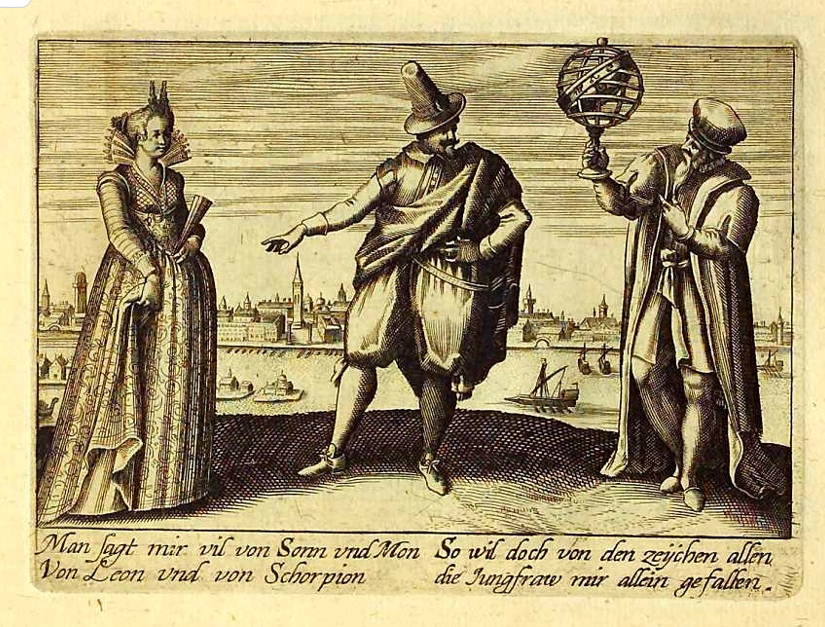
which was itself copied by the painter of the Meyer album leaf 20 years later:
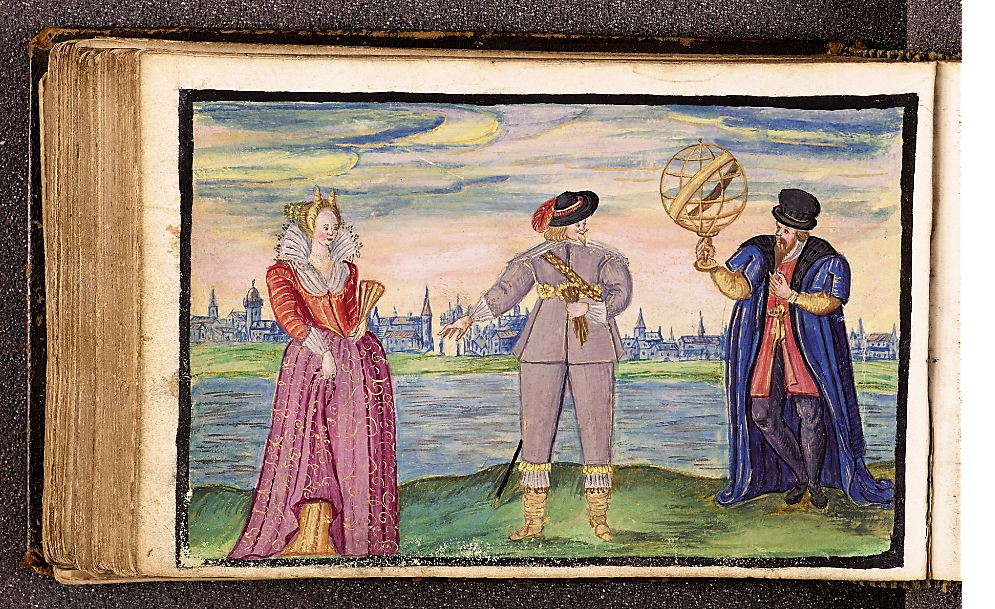
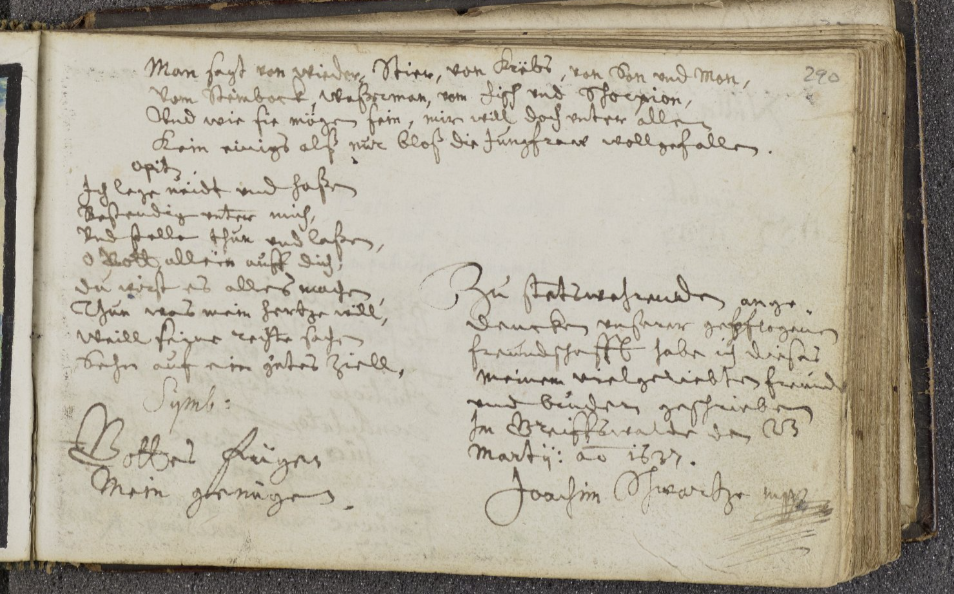
A dozen years later the image was the model for a painted glass pane now preserved in the museum in Mulhouse:
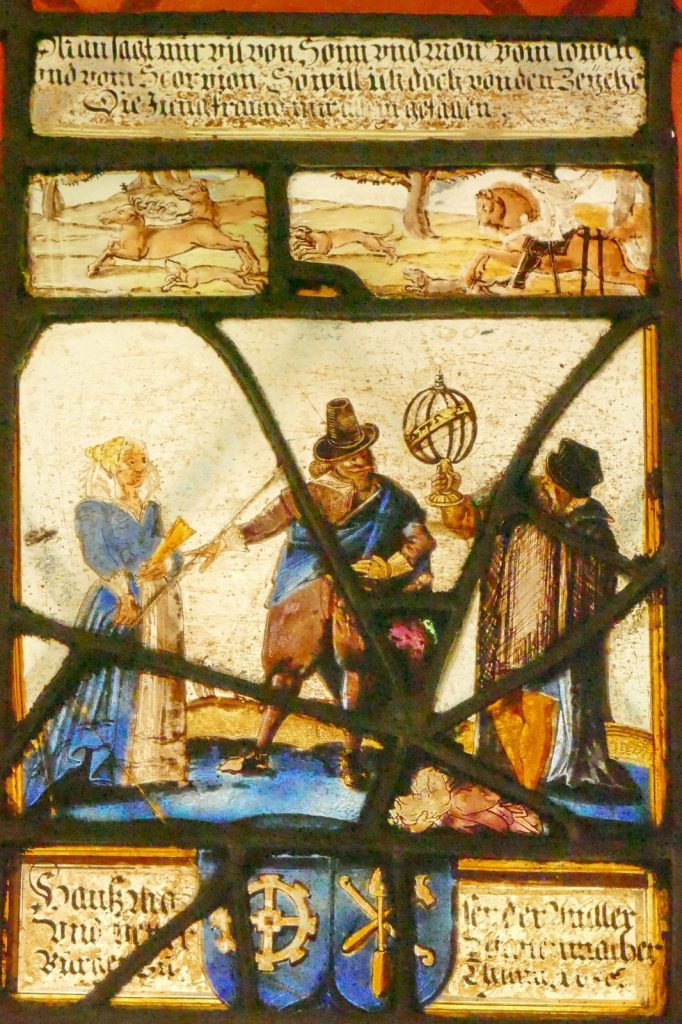
A tender moment? She wipes away his tears? But the French proverb [Symb.] labelling the miniature is a little more robust! Ou tout, ou rien [all or nothing].
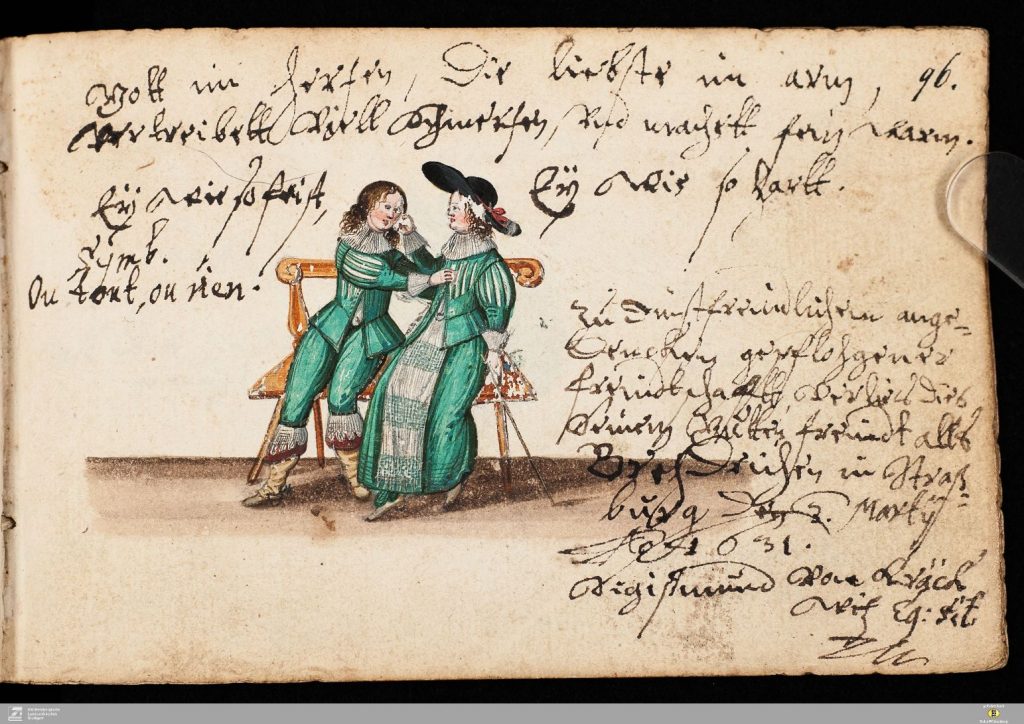
Fitting her shoe
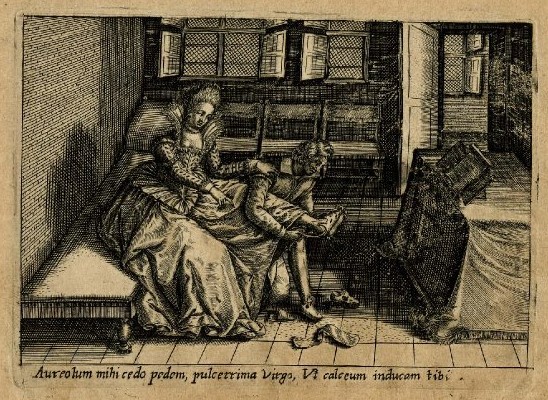
This is one of those intimate and, indeed, erotic motifs, but easily missed — fitting the shoe on the lady’s foot.
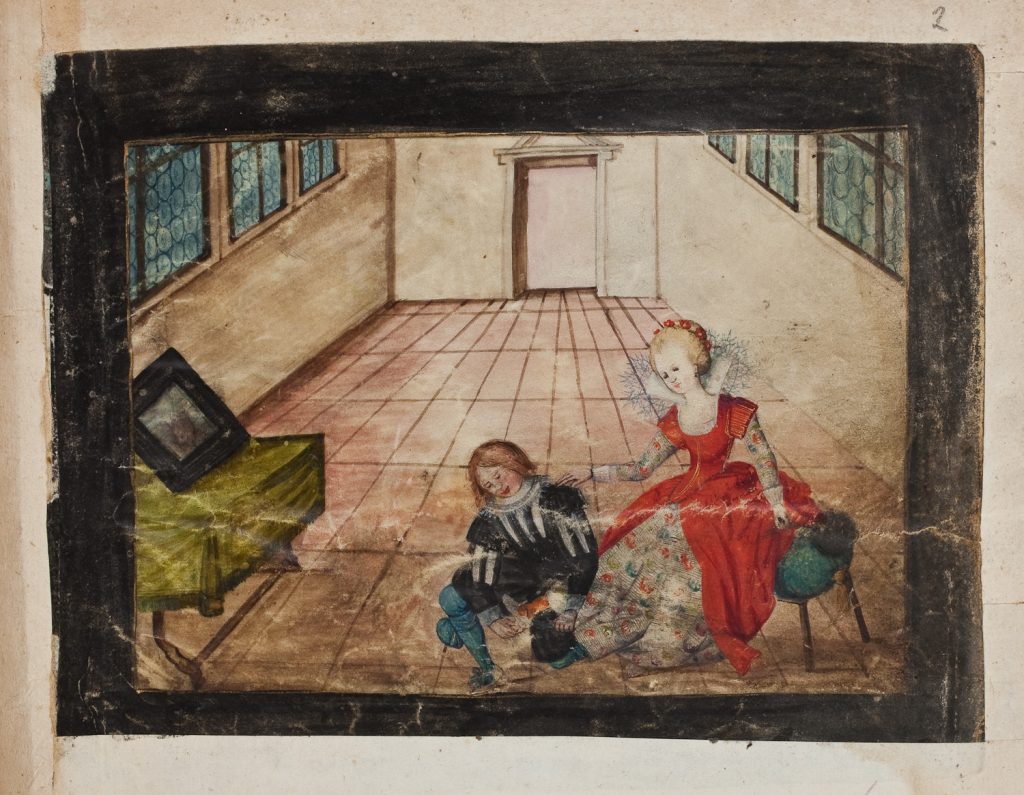
Even by 1624, the date of the earliest entry made in the Grossmann album, the painter had several possible models to choose from. He seems to have taken his hint from an illustration in an edition of the Enigmes Joyeuses of c.1615, a work whose very raison d’être is sexual innuendo!
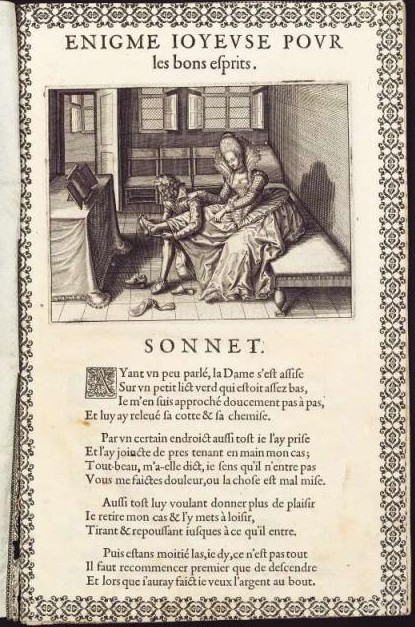
But this plate was copied in the Incogniti Scriptoris Nova Poemata which, first published in Leiden in 1618, was in its third edition by 1624 — this (below) is from the 3rd edition as no copy of the earlier editions is known to survive
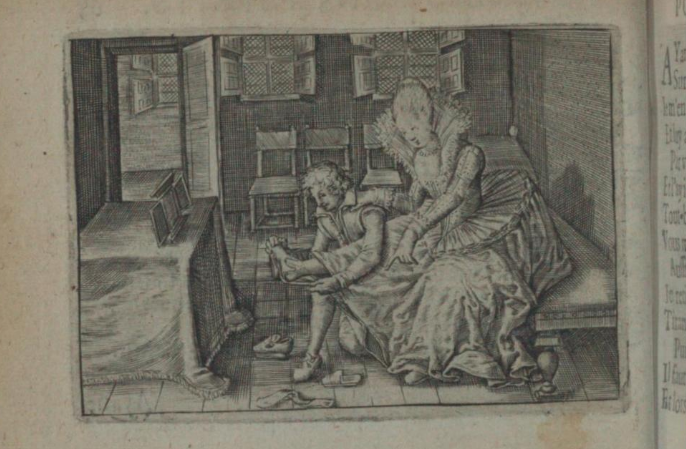
By 1617, at the latest, a reversed copy was appearing in the Stirpium Insignium Nobilitatis (Basel):
[A useful discussion is Wayne Franits, “If the Shoe Fits: Courtship, Sex, and Society in an Unusual Painting by Gonzales Coques” in ed. A. Golahny et al., In his milieu: essays on Netherlandish Art in Memory of John Michael Montias (Amsterdam, 2006), 165-72 — available via academia.edu]
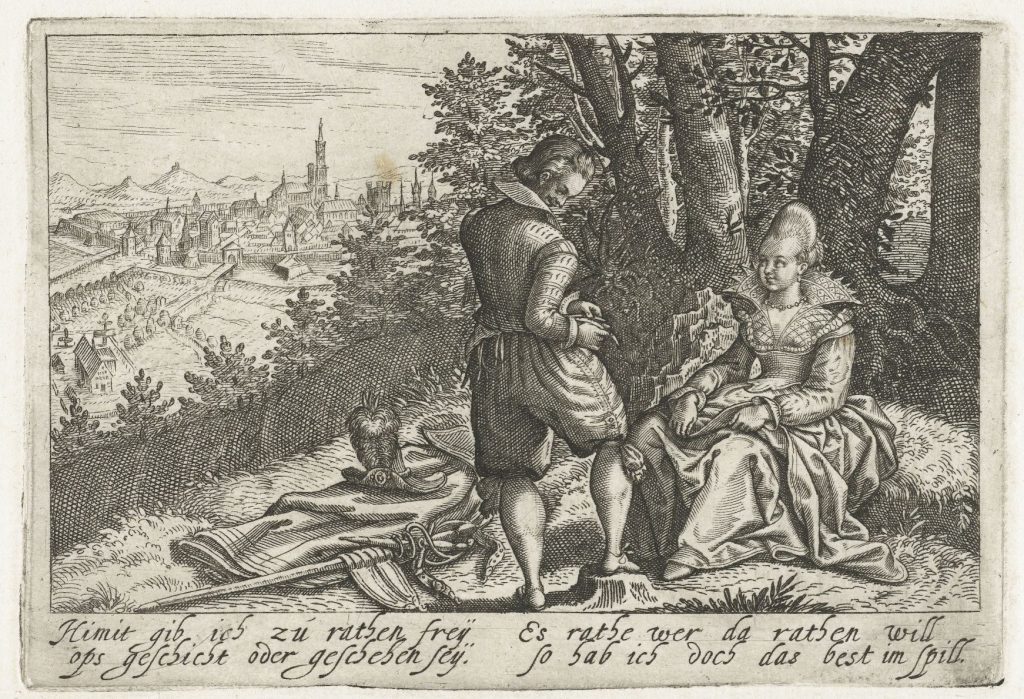
Have they or haven’t they? Already? or just about to?
Is he doing up his trousers because he’s just put them back om – or in the process of taking them off? Suggestive without being obscene!
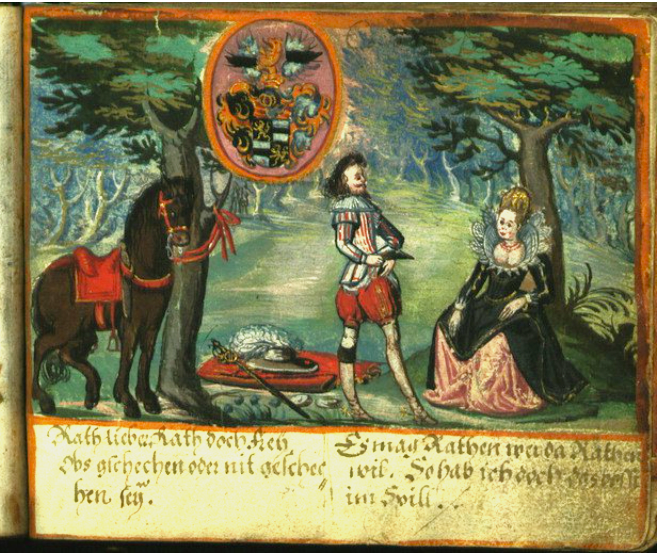
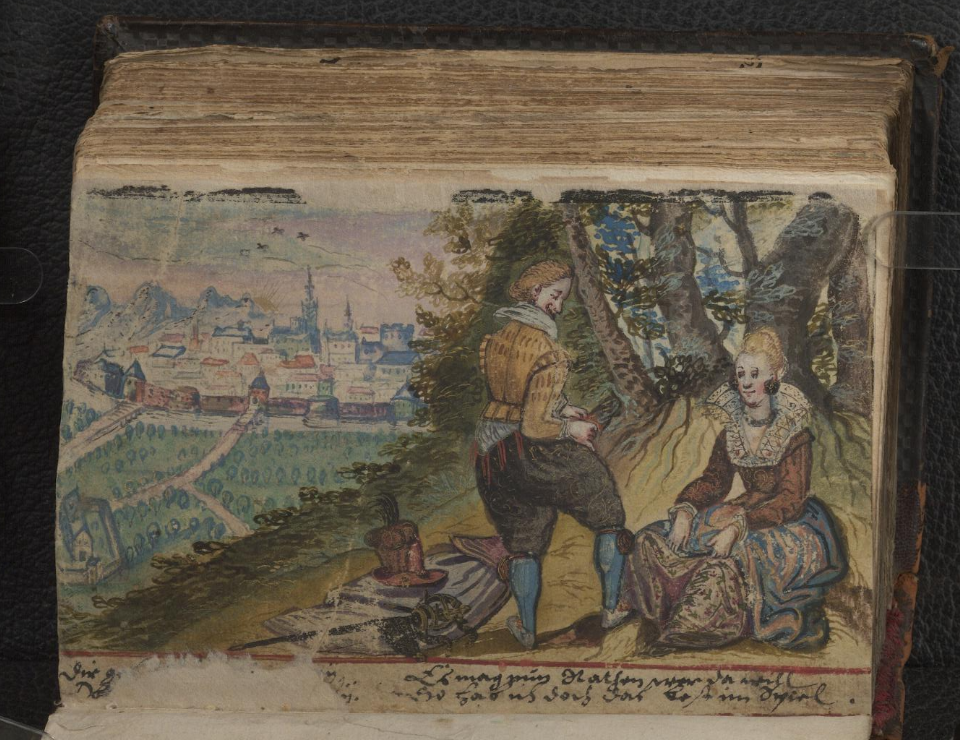
This is a much closer copy of the model — including the rhyming caption, half of which has been torn away, probably because it was felt to be too suggestive. Yet again, the original is a plate in the Pugillus facetiarum (1608, 1618), here’s my translation of the inscriptions:
Herewith I leave you to guess whether it’s happened or is about to. But guess however you like, as long as I have the best of the game.
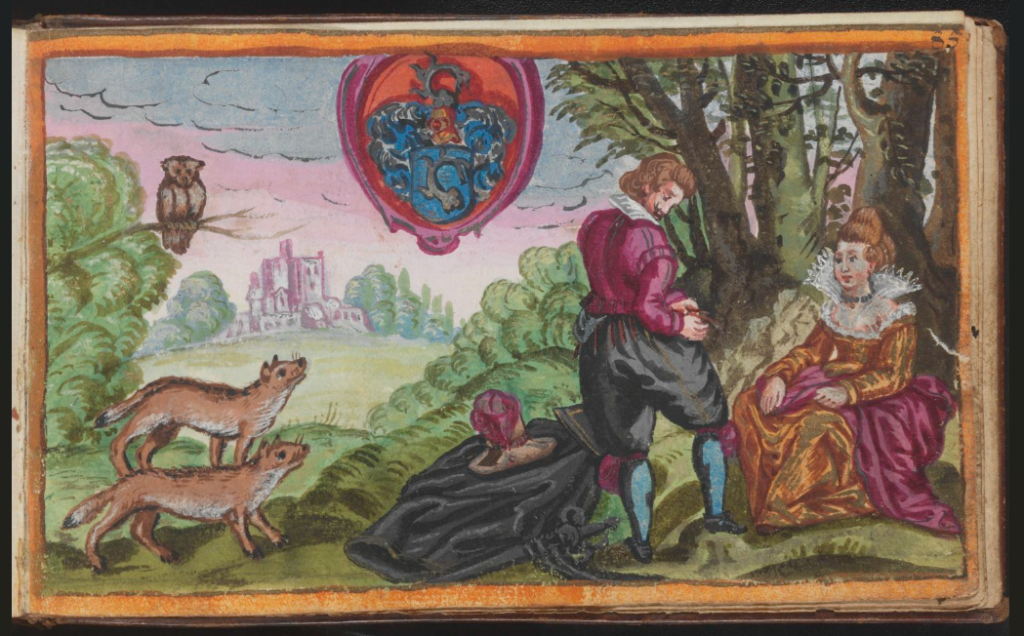
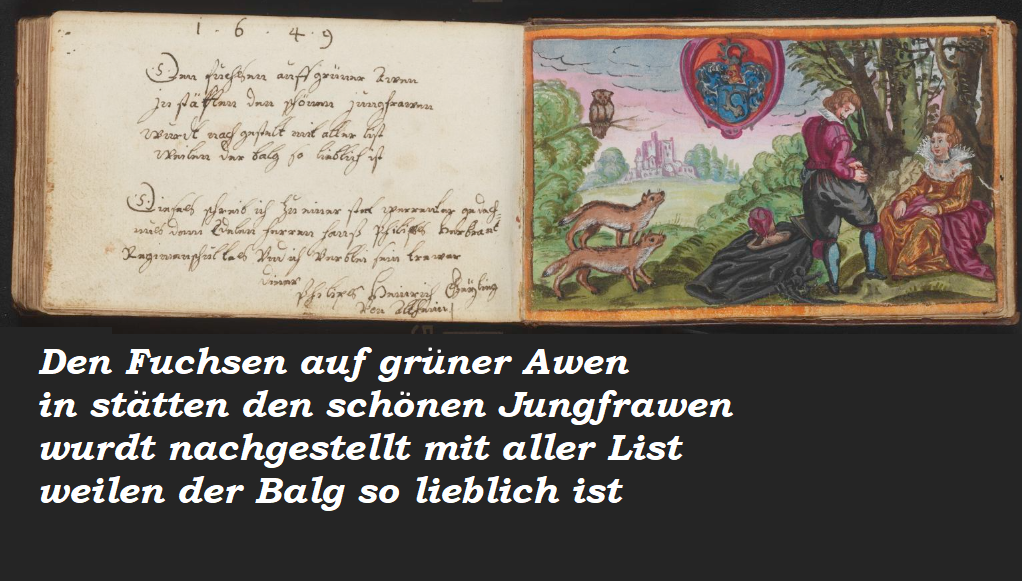
The Heerbrand album painter has added a pair of foxes (and an unlikely — considering it is broad daylight! owl!) — the verse at the top of the adjacent page makes no mention of the owl — I transcribe it above and translate it below:
Foxes in the green fields, fair maids in the towns, are pursued with all due cunning because the skin/pelt is so lovely. Hmm….
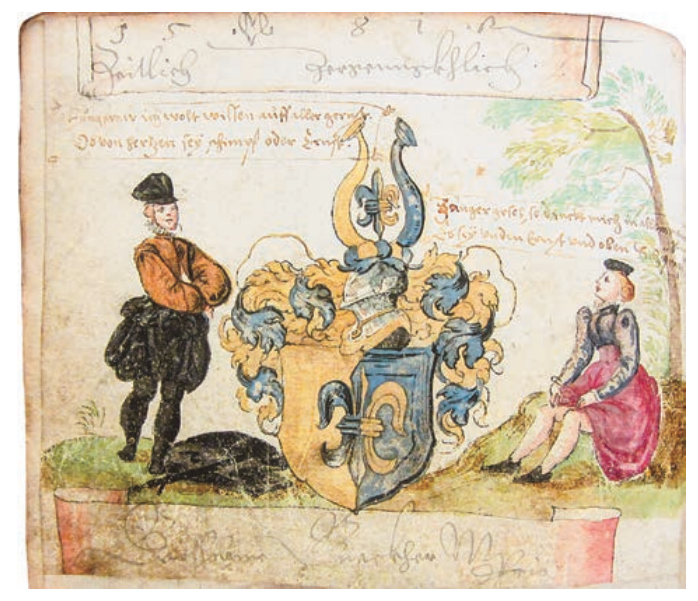
Another tryst is painted in the Gruttschreiber album — the young man’s coat and sword lie on the ground, and with arms crossed, he addresses the young lady who sits under a tree has hitched up her skirts. He says
Jungfraw ich wolt wissen auff aller gernst Girl I would very much like to know Ob von hertzen sey schimpf oder Ernst whether play or seriousness is in your heart
to which she replies
Junger gesel, so dinckt mich in allem meine glimpf Young friend it seems to me in all courtesy
Es sey vnden Ernst vnnd oben Schympff. it is seriousness below and playfulness above
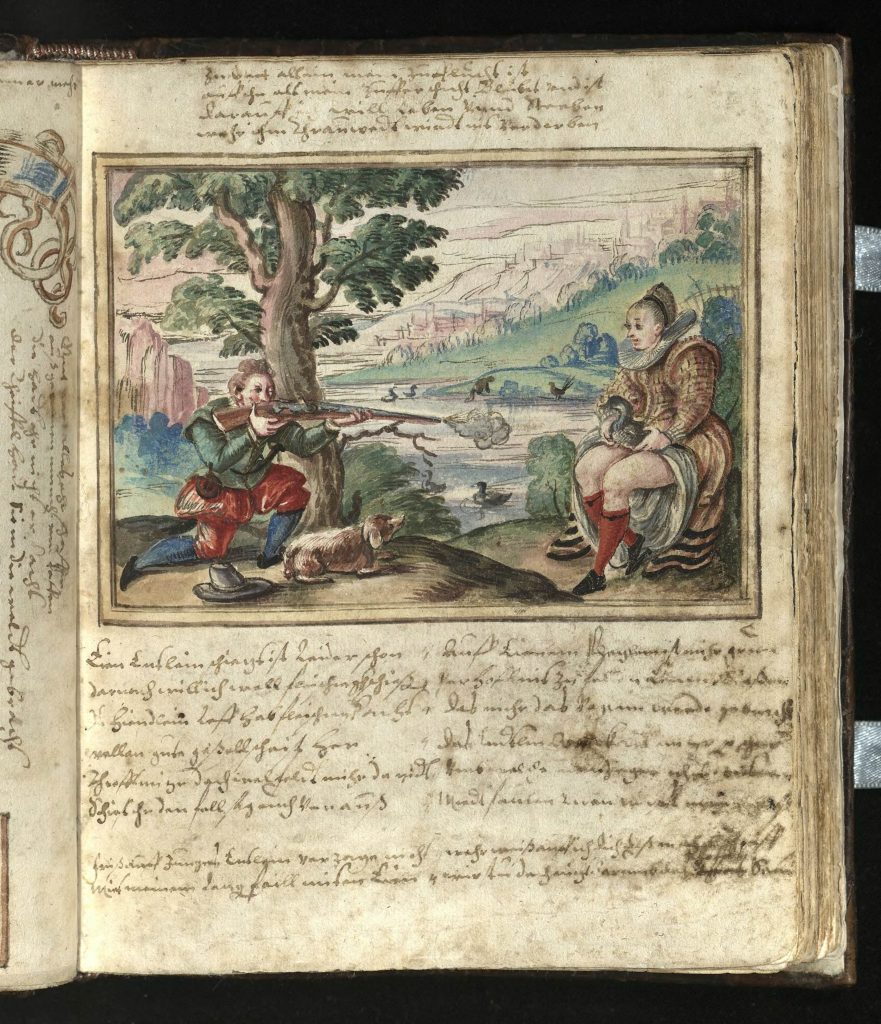
The lady who has similarly hitched up her skirts and holds a duck on her lap in this miniature in the Heidenreich album painted by Anton Möller in 1608 seems unperturbed by the fact that a young man is firing a rifle at it/her! Doubtless another ‘forgotten’ erotic metaphor.
Hiding behind the stove
Sometimes you just can’t find somewhere private!
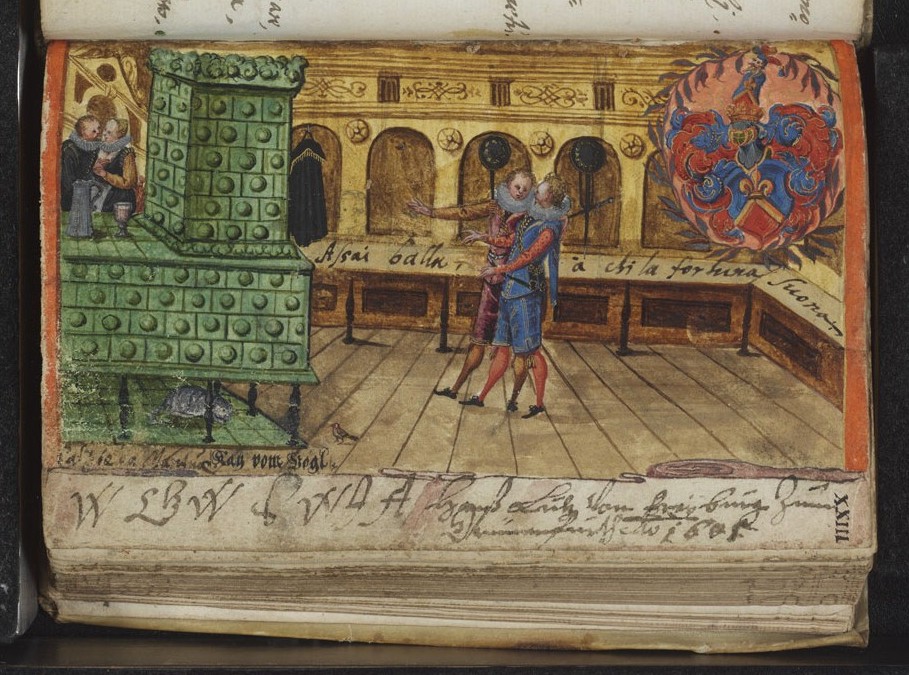
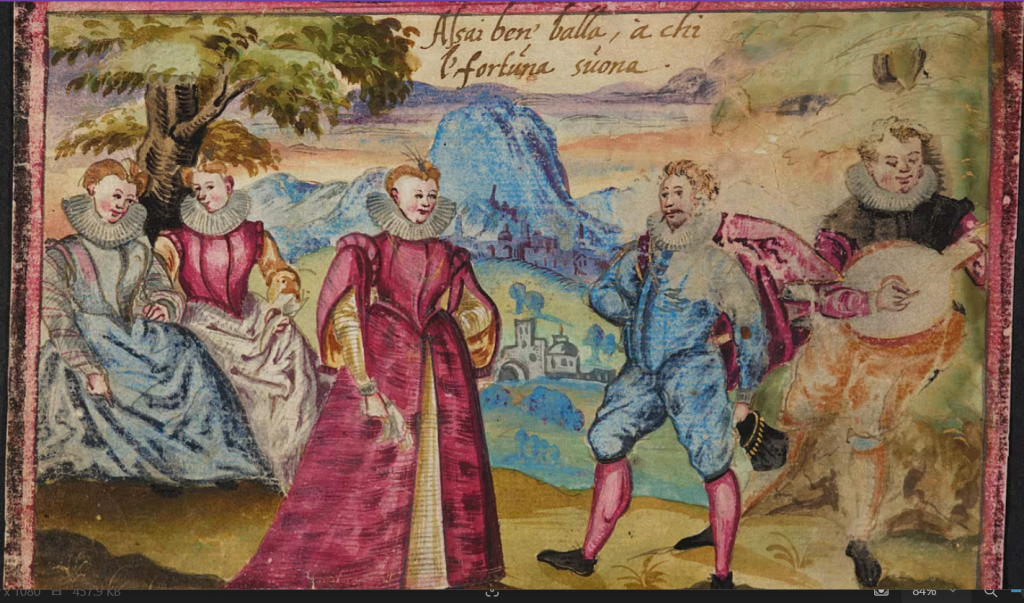
The Italian proverb written beneath the arcading — Assai balla a chi fortuna suona — is found again in the more usual fuller form — Assai ben balla a chi fortuna suona — on this orphaned leaf below, now in the collection of the Bayerisches National Museum — and evidently illustrated literally; as englished by Pietro Paravicino in hisThe true idioma of the Italian tongue wherein is contained many choice sentences and dialogues in Italian and English (1660), it means He danceth well to whom Fortune fidleth. Here, evidently, to whom Fortune luteth !
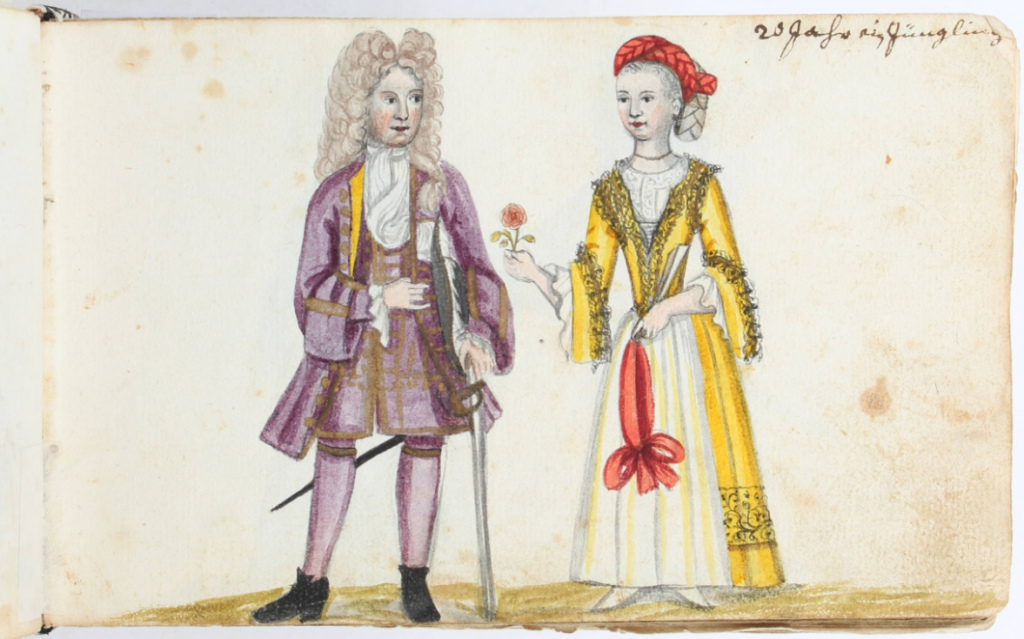
Beyond my time-frame at c.1690, but couldn’t resist it — at auction only last year — the young lady seems to be offering the young man in the ridiculous wig a flower — and someone has labelled the drawing, 20 Jahrig Jüngling [youth of 20 years old].
Lovers like to give flowers, and here, both lovers seem to be presenting each other with a flower
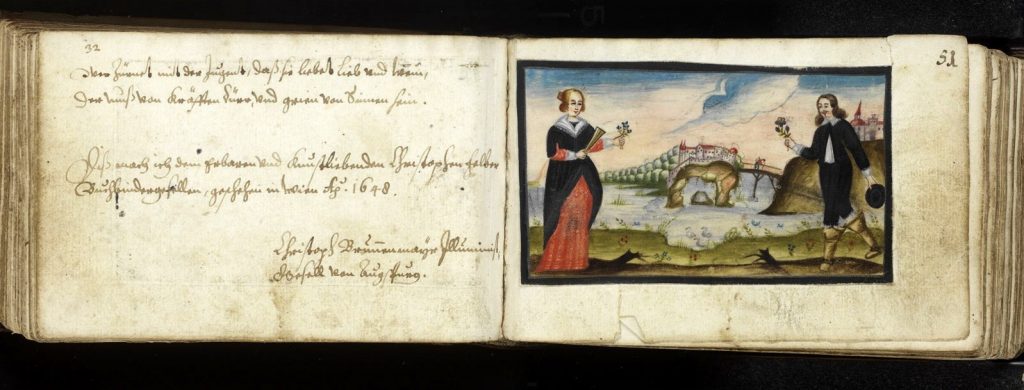
The Language of Flowers
Clearly by the same painter, are two accomplished miniatures in the Gutbrod and Zorer albums:
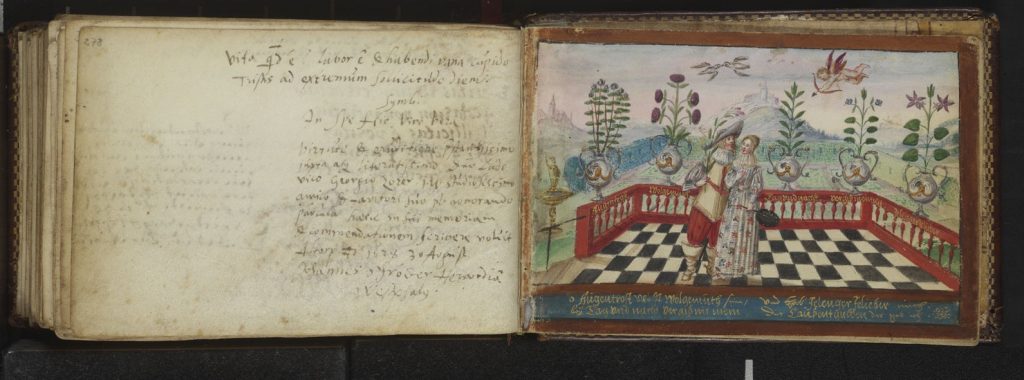
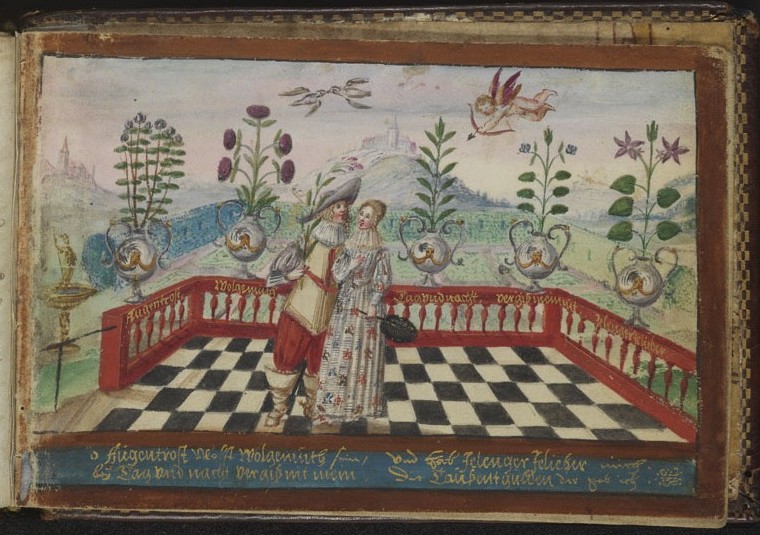
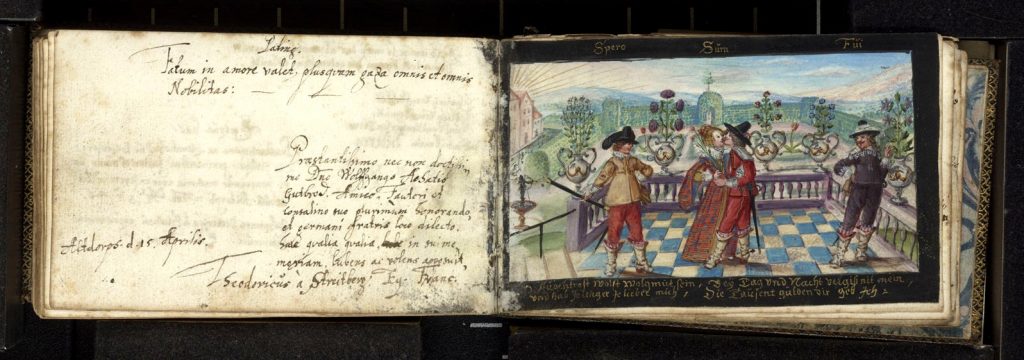
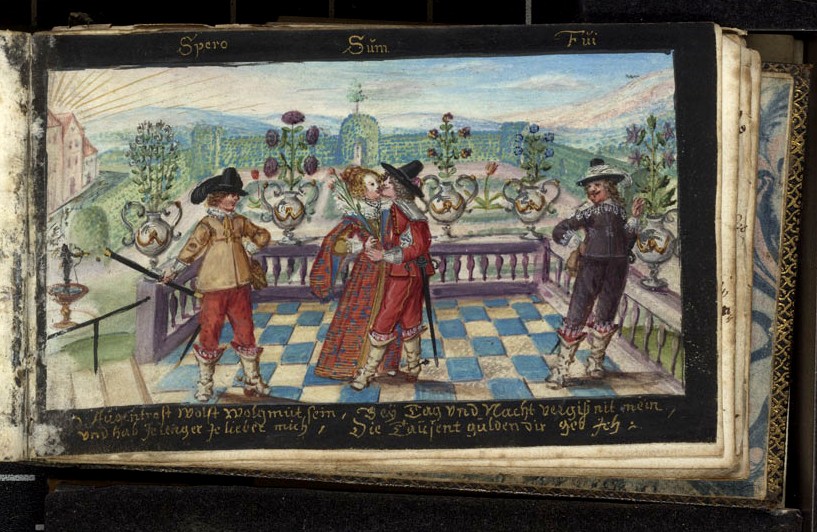
Augentrost wolst Wolgemut sein eyebright marjoram
Vnd hab Je anger je lieber mich, bittersweet
Bey Tag vnd Nacht vergiss nit mein pansy forget-me-not
Die Tausent gulden dir geb Ich centaury
The 5 potted plants are identified by their common names on the balustrade in the Zorer album painting, and in the verse which captions both miniatures — I have highlighted the vernacular names in bold and glossed each with its English common name. But the point of the quatrain is to understand the names not as those of flowers but as ordinary
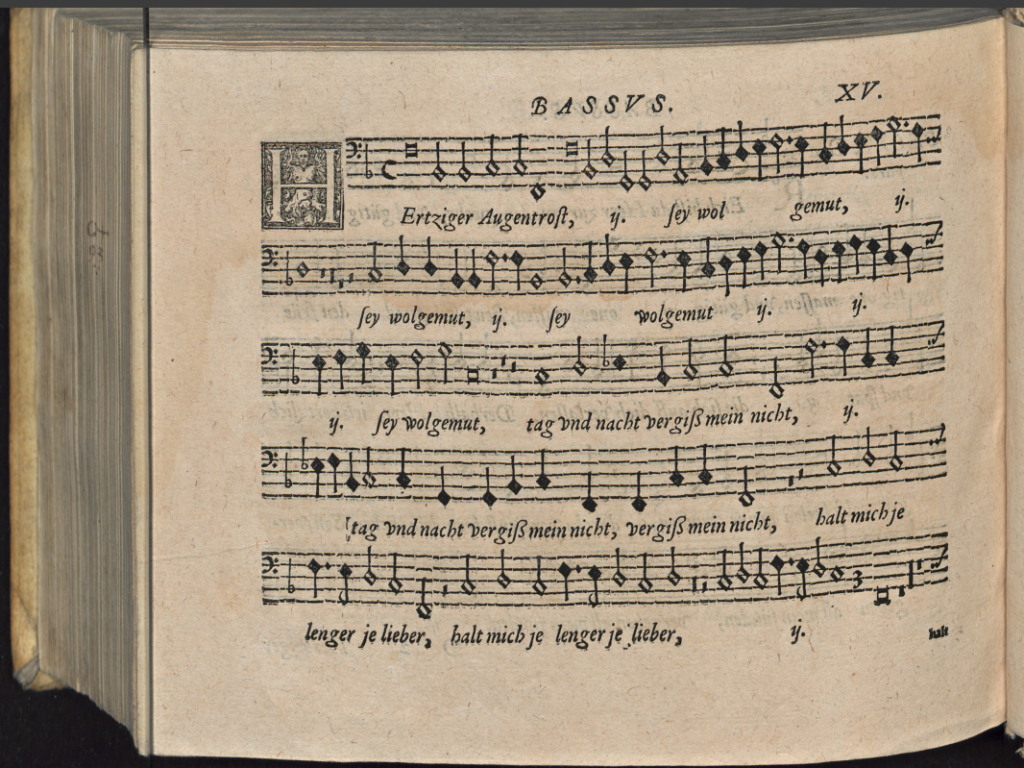
But yet again, this punning verse is no original creation of the album-painter or the friend of the owner who commissioned him, for it is found some 75 years earlier as a song set to music by Paulius Schedius Melissus:
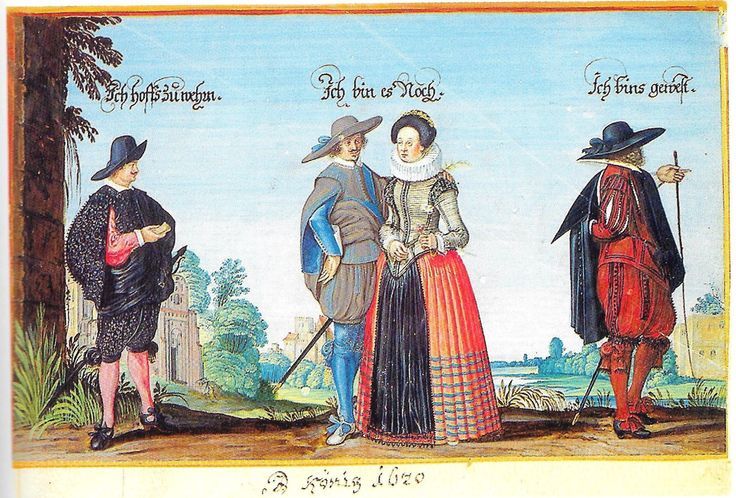
Additionally, the three men in the Gutbrod album are labelled above, Spero, Sum, and Fui, that is, “I hope [to be her lover]”; “I am [her lover]”; and “I was [her lover]” — the same trio can be seen earlier in a miniature signed by Johan König (1586-1642), painted in 1620 and now preserved in the Staatsbibliothek, Bamberg. Here the legends are in the vernacular: Ich hoffs Zu wehrn [I hope to be it]; Ich bin es Noch [I am still it]; and Ich bins gewest [I was it].
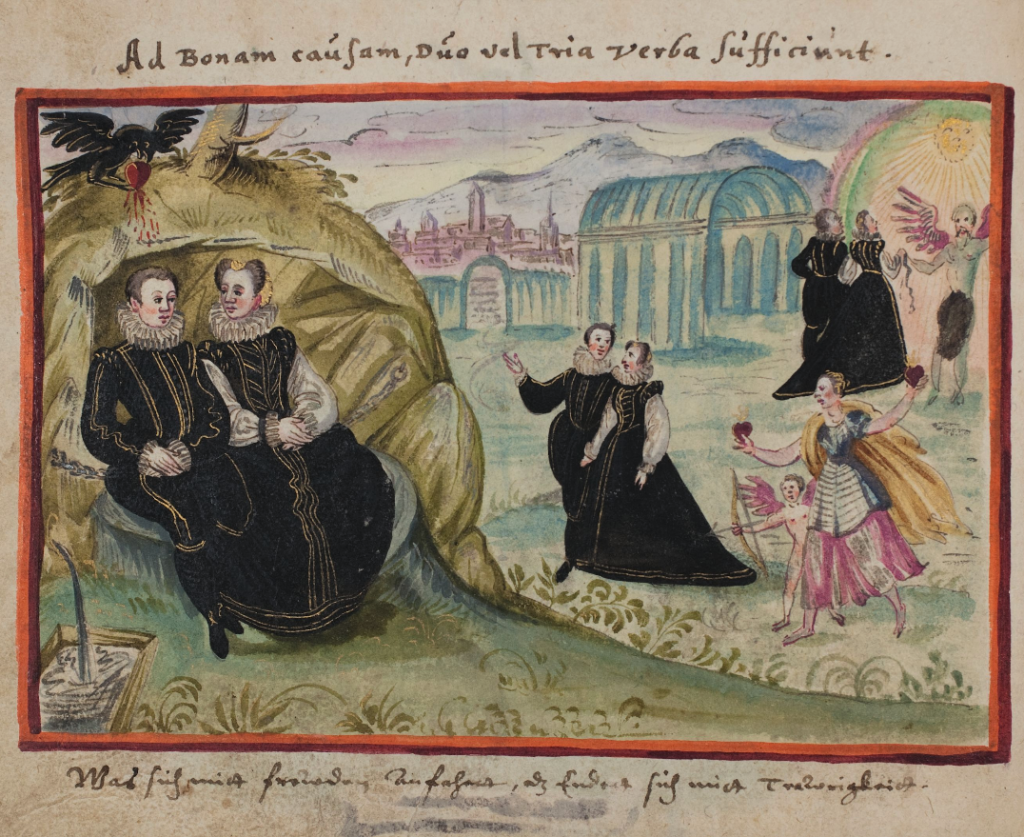
In another miniature in the Huber album we have, perhaps, a sort of Love’s Progress, presenting three stages in the lovers’ career. In the middle distance while out strolling, they are assailed by Venus and Cupid, in the foreground they seem to be seated in a grotto but each chained to it, while above their heads a bird of prey pecks at a bleeding heart [?shades of Prometheus], but in the distance we see them heading into a sort of sunny bower, the chain now dangling from the woman’s wrist, where they are welcomed by a winged and bearded ?spirit/god (too old-looking to be Eros?), whose presumably phallic, perhaps even ithyphallic, midriff has been censored by obliteration. The proverbial Latin ‘title’, “In a good cause, two or three words are enough”, does not seem obviously relevant.
Rejected!
I can’t resist posting this here as it is so interesting! It has everything! — ciphers, a sketch of a shooting star, and inscriptions in three languages — and one of them a rhyming couplet — in English! an (apparently original) lament by a rejected lover:
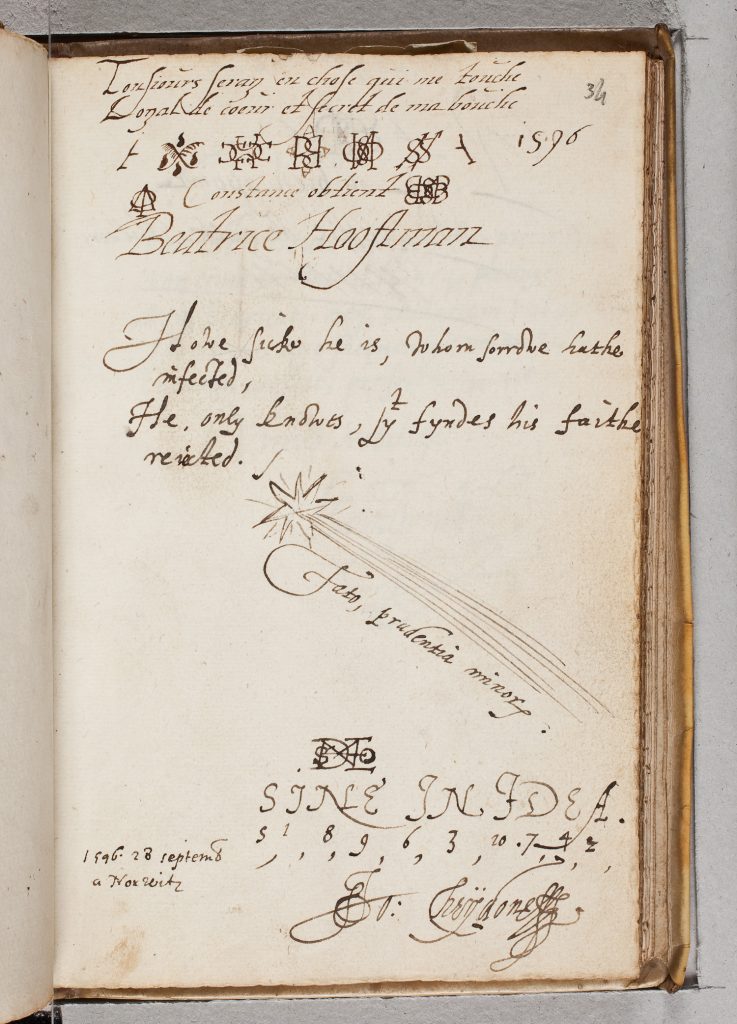
How sicke he is, whom sorrowe hathe infected,
He only knowes, yt fyndes his faithe reiected.
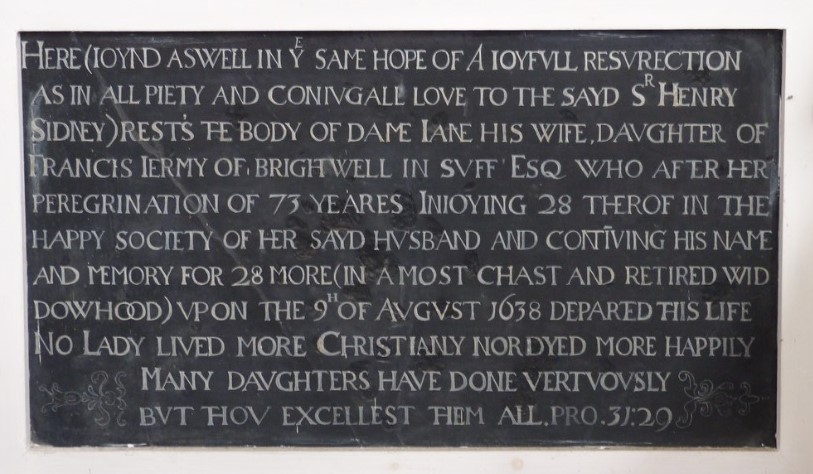
The page is dated 1596 28 septemb a Norwitz [i.e. Norwich], and signed by at least three people! Beatrice Hooftman is presumably Dutch, like the album-owner — who was 21 in 1596 — Jo: Heydone, who looks English, and Jane Sidney whose name, in the form JANE SIDNEI, is obtained by reading the capitals in the order given by the numerals beneath them. The monogram immediately above is also capable of spelling SIDNEIO. It seems likely that this Jane Sidney is the aunt of the poet Sir Philip Sidney, whose tomb is in Little Walsingham church, some 25 miles North West of Norwich, and whose epitaph is dated 1538:

The shooting star/comet is labelled Fato prudentia minor [Prudence is weaker than fate] — the motto of Paolo Giovio, incidentally — and perhaps refers to ….
………………………………
But let us look on the bright side and assume the lover’s addresses have met with favour! Though, even supposing the courting process is so successful as to lead to the proposal of marriage, one cannot afford to rush into such things blindly, the matter — the fiancé(e), indeed — must be weighed quite carefully. In the Marriage Balance. Here the parents of the young man are supervising the weighing — is the fiancée too ‘light’ ?
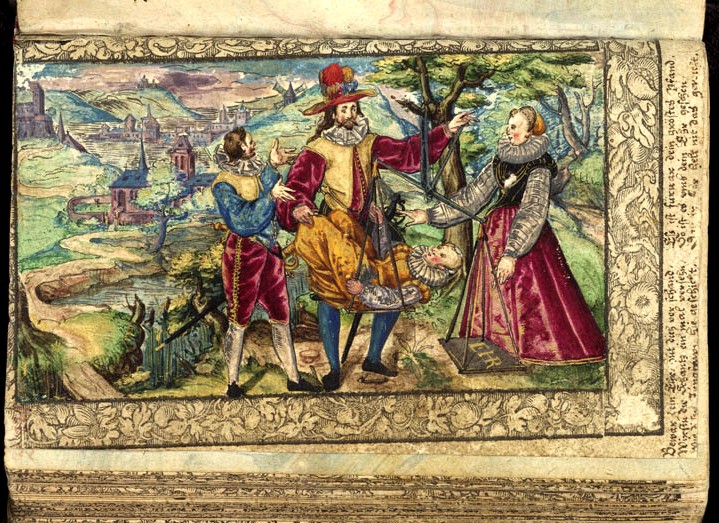
The Walens album painter clearly copied his Marriage Balance miniature from one of the plates in a recently-published print-book (below):
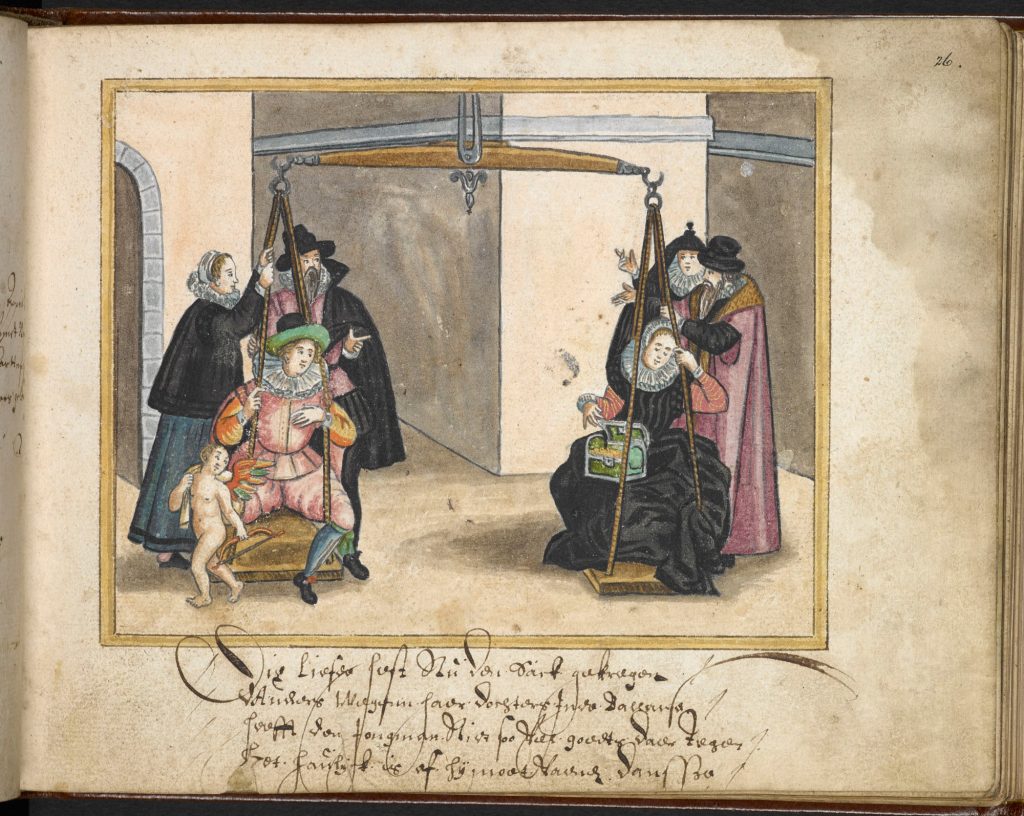
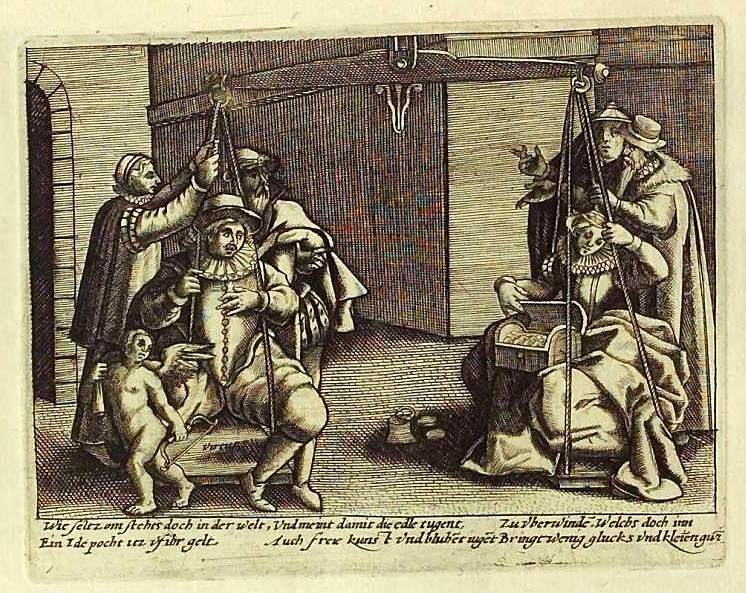
Here the young man is labelled Virtue and the young woman represents Riches which seem, as it were, to weigh more heavily, to judge from the scale-pans. Cupid wants nothing to do with such a cynically pecuniary union, and exits stage right.
The print-book version is itself adapting an original engraved Dutch print designed by Carel van Mander, which was taken up by the de Brys’ Emblemata Saecularia (1596, 1611):
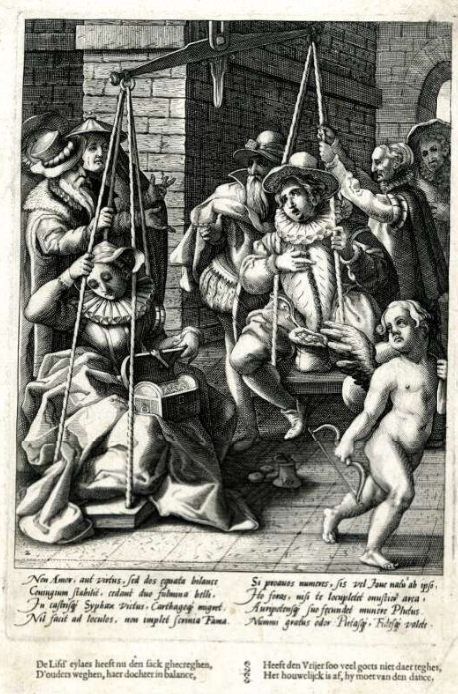
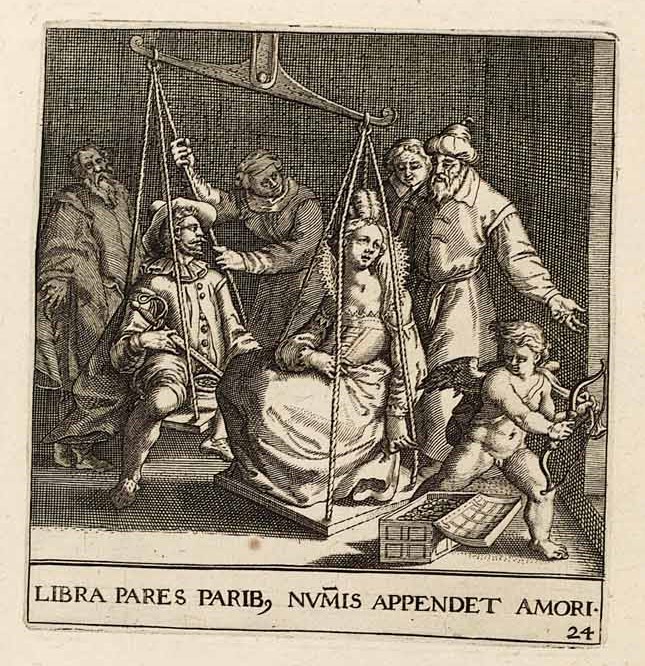
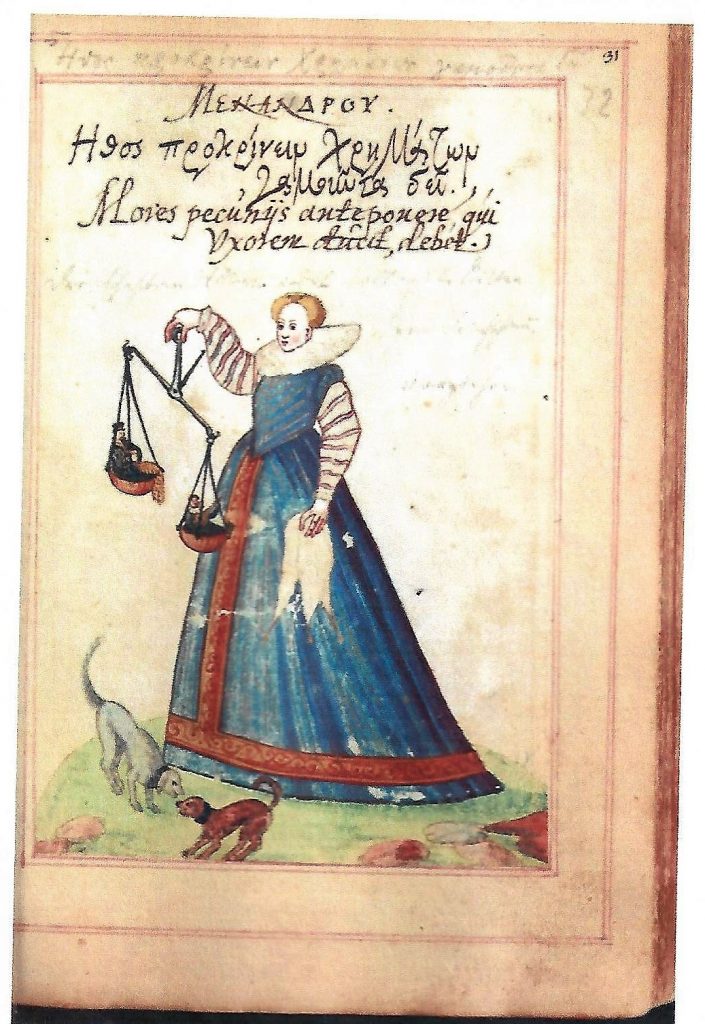
This young woman (below), painted earlier in the Gundlach album, seems to be weighing two potential suitors (in miniature) in her balance — I think we have an older rich man in the lighter scale-pan, and a younger man playing a lute in the heavier — so a victory for romance? Despite the female actor, the Latin inscription is addressed to the male owner of the album: “He who takes a wife should put morals before money”.
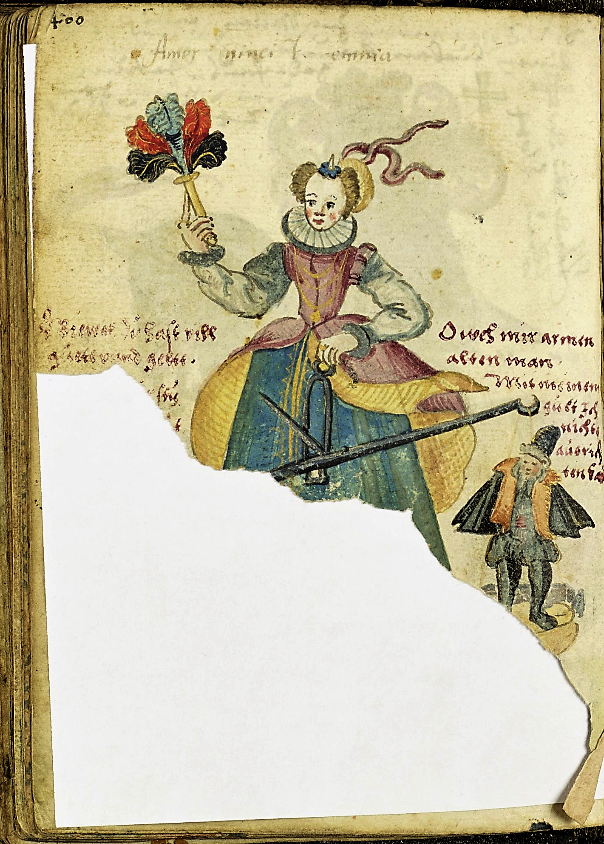
It seems the same conclusion was reached by the young woman painted on a damaged leaf of the Von Abschatz album under the most popular of all sayings about love — Amor uincit omnia [Love conquers all]. The young man in the heavier scale-pan and most of his speech are lost, so we have only the old man’s speech to go on — though the situation is pretty clear: O weh mir armen alten man / Mit meinem guet Ich nicht ausrichten kan. [Alas, I am a poor old man, I cannot win (even) with my wealth].
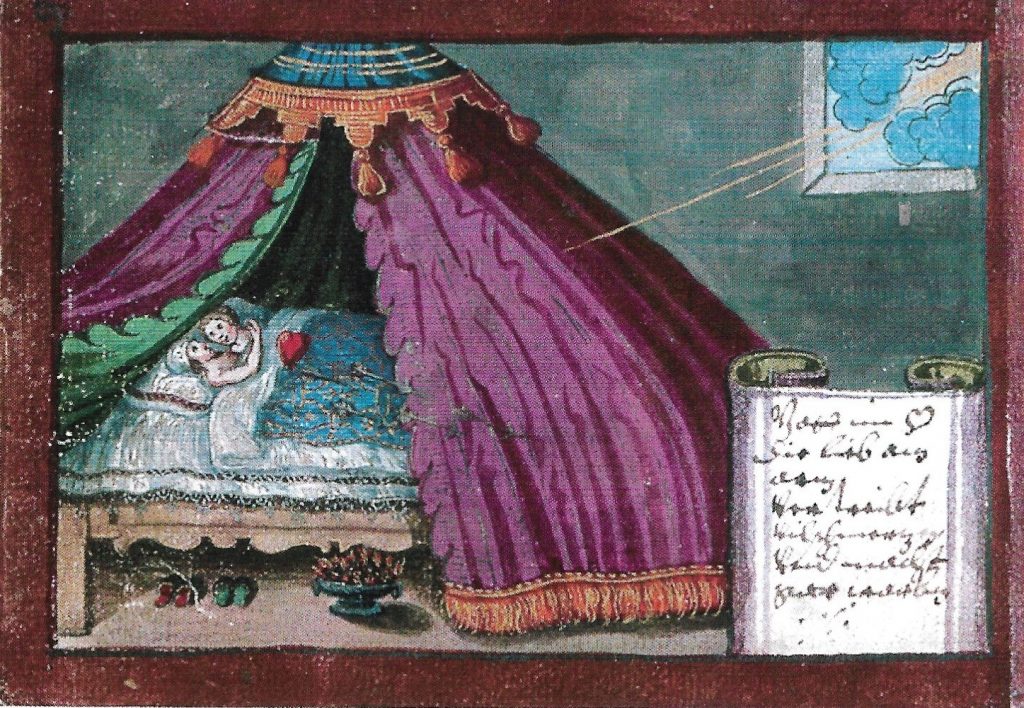
But let us assume the choice has been made, and put the young lovers to bed — as in this rather charming miniature painted in the album of Georg Rendl, their slippers tucked neatly under the bed, the sun coming in through the window, reminding me of Donne’s famous “Busy old fool, unruly sun/ why dost thou thus through windows and through curtains call on us?”
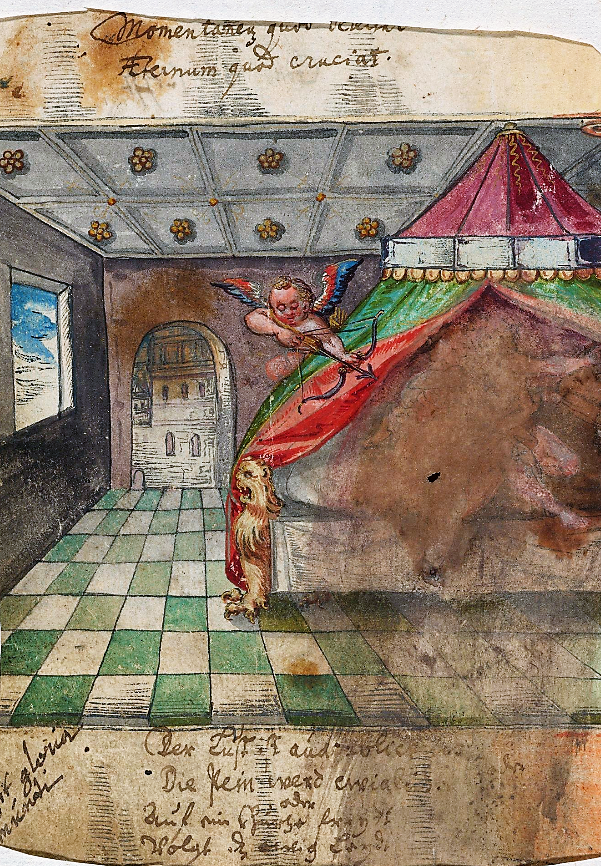
The lovers in the bed below must have been depicted as rather more active — certainly they provoked the wrath of some subsequent owner, for they have been almost entirely erased! The inscriptions do their best to present the miniature as monitory, as an example of the deadly sin of Lust. Momentaneum quod delectat aeternum quod cruciat [That which delights is momentary, that which torments eternal] — commonly attributed to Gregory the Great — and a version in the vernacular below: Der lust ist augenblicklich / die Pein werd ewigklich.
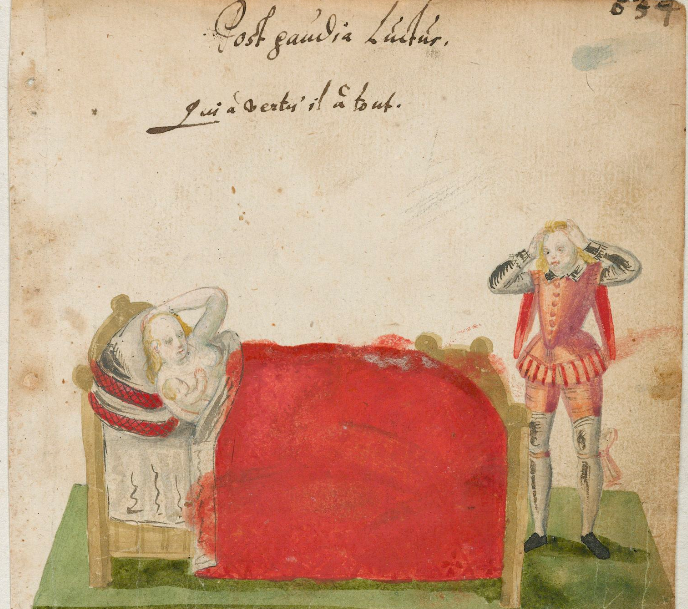
But however the religious regarded the sexual act — as a necessary evil, perhaps, if the species were to be propagated — in an age of little or no contraception it would not be long before the first fruits of the marriage appeared. In this miniature in the Schad album dated 1600 (below), we see the new-born baby suckling at the mother’s breast, while at the foot of the bed the new father appears to be tearing his hair out! The scene is captioned in Latin — Post gaudia Luctus [after joys, sorrows], which is perhaps humorously appropriate in the context — and in French — Qui a vertu il a tout [who has virtue has everything]. But the inscriptions are in different hands, and the French sentiment was probably added later.
Deception & Cuckoldry
But sometimes the lover or husband is deceived, in believing the woman’s affections are his exclusively, in short, he is a cuckold. The universally recognised sign to denote a cuckold was the two-finger ‘horns’ gesture, made usually with the little and index fingers, which we have already discussed in this post:
https://albumamicorumear-e4qvahs764.live-website.com/gesture-in-the-albums/
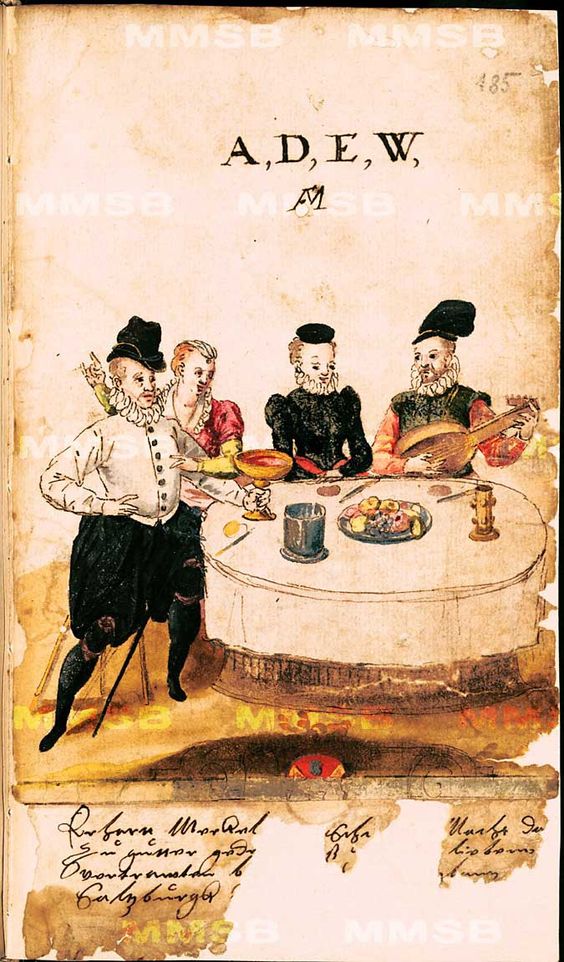
The wife of one of the couples at the dinner-party depicted in the Plan album has taken the opportunity, while her husband has risen from the table to propose a toast, of making the sign behind his back. The husband of the other couple looks embarrassed.
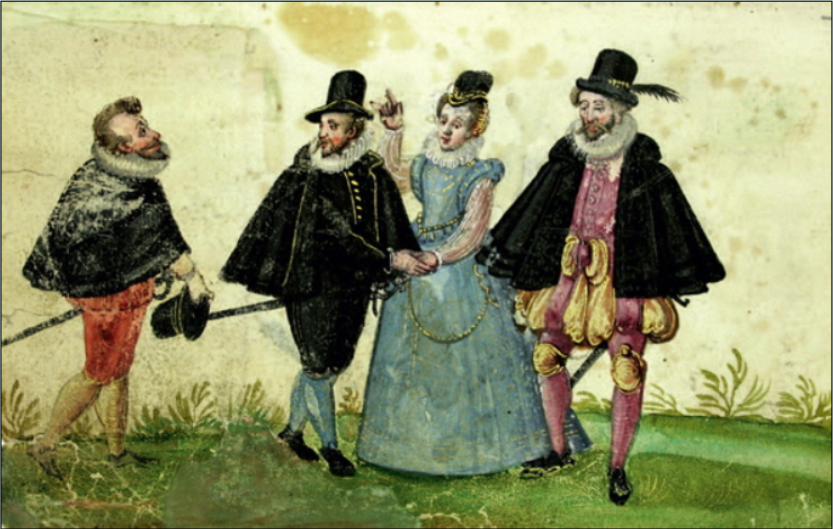
But what is going on in the painting below? The woman is evidently signalling to the man approaching on the left (but presumably the gesture is also visible to the man on the right), that the man currently holding her hand is a cuckold. In an earlier post I have discussed the very popular motif I call Woman & the 3 Suitors, in which it is a fool who makes the horns gesture — and this may well be another example of that motif
[ See https://albumamicorumear-e4qvahs764.live-website.com/woman-and-the-3-suitors/ ]
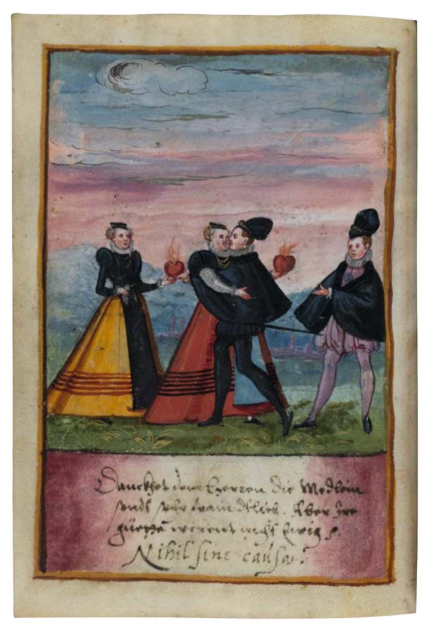
A similar situation seems to be represented in this miniature from the Widholz album — but replaces the finger-gesture with symbolic hearts
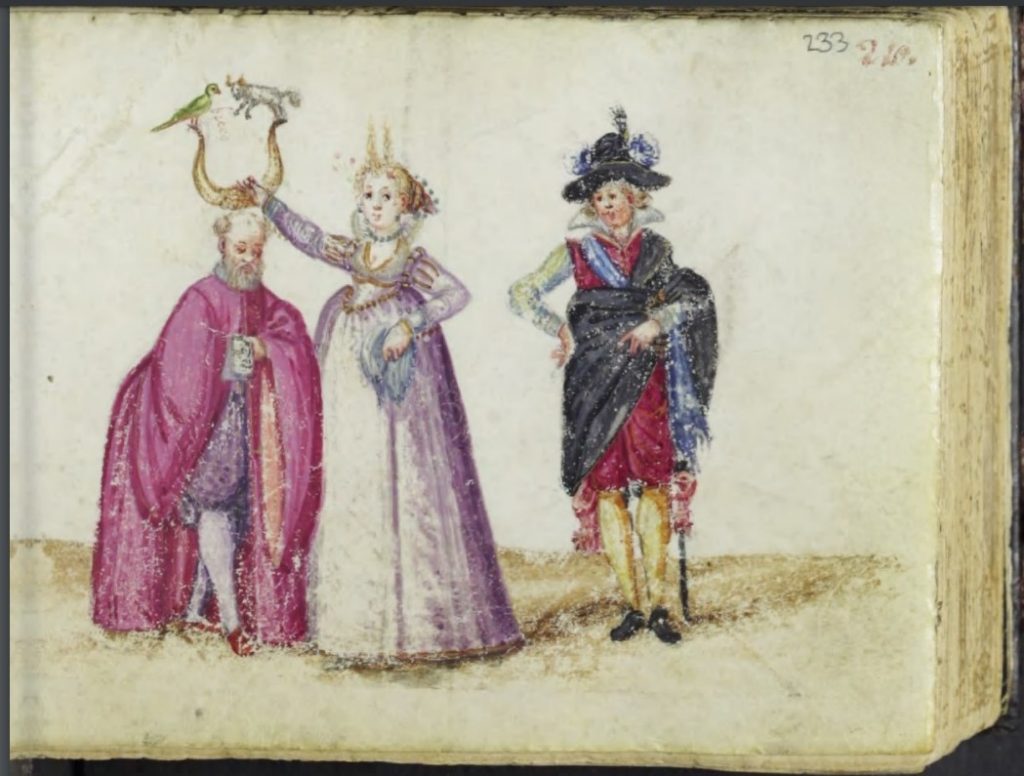
By contrast with this apparent delicacy, this miniature in the Rentsch album seems unusually blatant, and is also an example of the age-old motif of the Unequal Couple, where one partner — usually the husband — is old, and the other young, always the stuff of comedy.
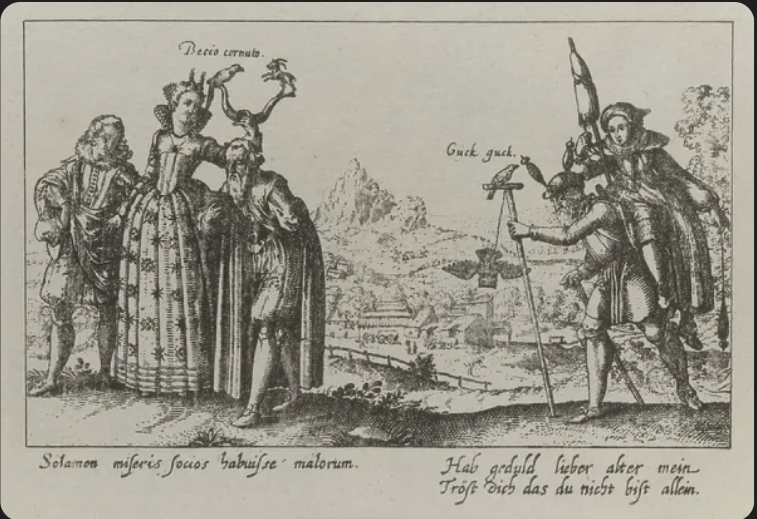
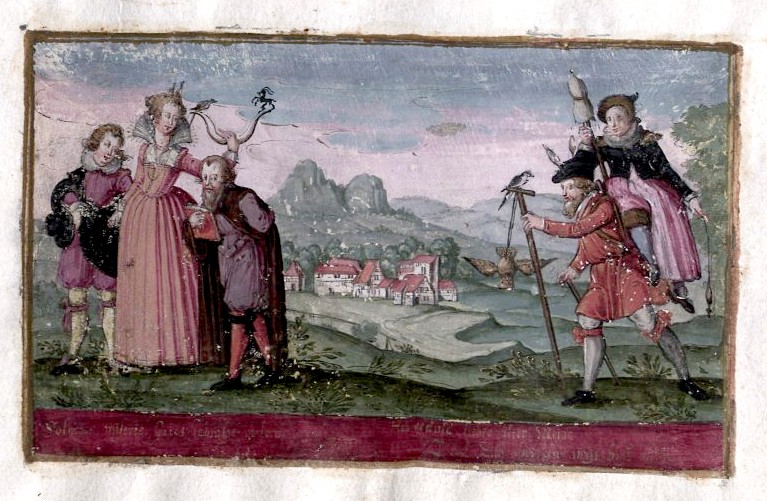
But — as so often — if we familiarise ourselves with the content of the print-books, we discover that this is no original invention of the album-painter, it is clearly derived from the the lefthand scene in the above plate. The Jenisch album painter, on the other hand, made a pretty thoroughgoing copy of the whole plate:
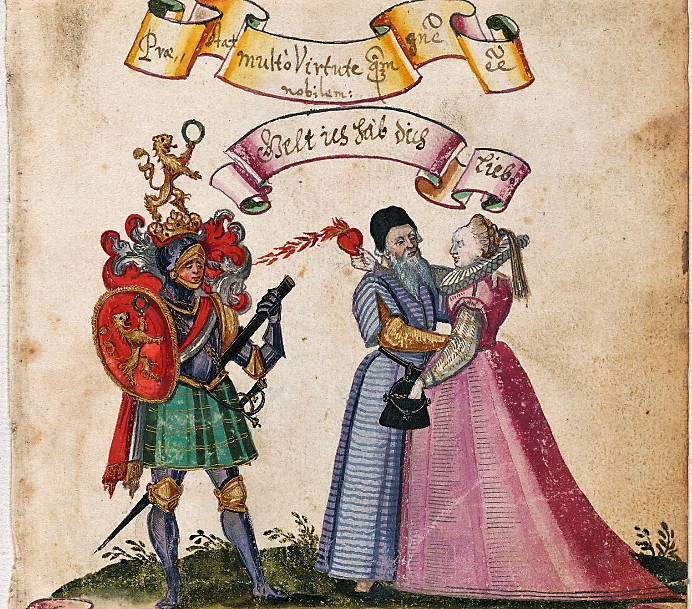
The old man with the young wife is a venerable stereotype, a stock comedy type, as in this leaf in the Frommann Collection where the young wife dips one hand in her old husband’s purse and with the other holds out a flaming heart behind his back towards a young knight. The German inscription is a pun, ostensibly meaning “Of course I love you”, it can also be understood as “Money, I love you” [see Grimm DWB, s.v. gelt (interjection), 2.c., where the same equivoque is cited from contemporary literature].
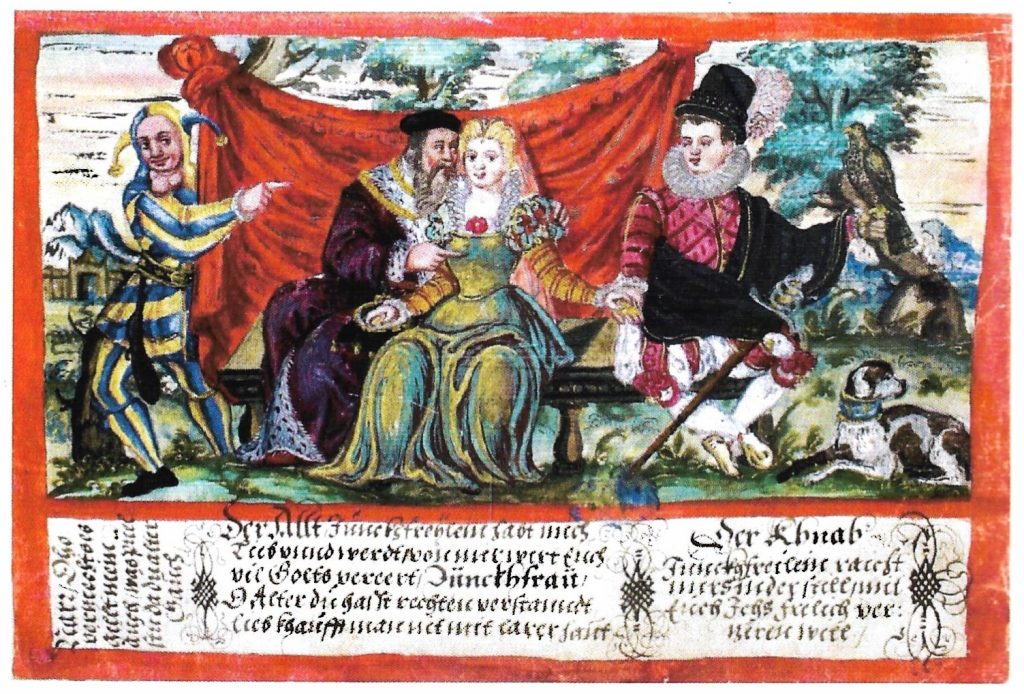
The version of the purse-picking in the Penzinger album is accompanied by what I call a ‘commentary fool’ who, quite literally, points out the old man’s folly. All four actors in this little scenario are given speeches below the image:
A similar scene is described on one of the hundreds of orphaned leaves collected by du Rosey and sold by Weigel in Leipzig in 1864:

The Blue Cloak
In the lavishly illustrated album of Moyses Walens is a miniature of a woman putting a blue cloak over her husband’s head. It is captioned …..
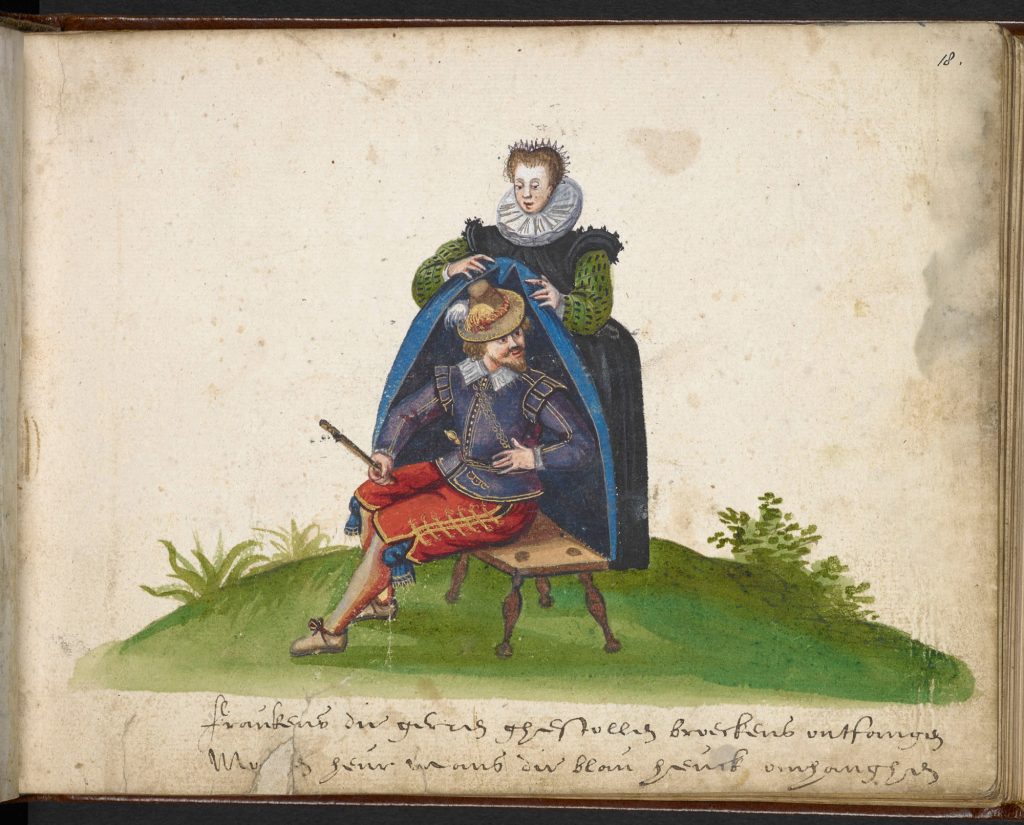
This is the pictorialisation of a Dutch idiom, seen most notably, half a century earlier as the central scene in Bruegel’s Netherlandish Proverbs painting of 1559, itself sometimes referred to as The Blue Cloak [Die Blauwe Huyck], indicating that the wife has made her husband a cuckold, placing a hood over his head so that he cannot see her infidelity.
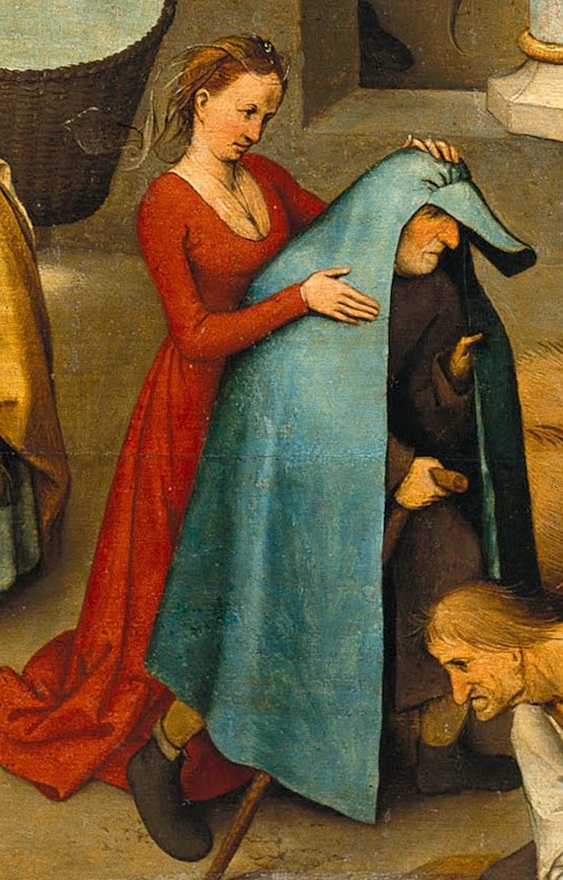
And a version by Bruegel the Younger, on the art market recently
the Complaisant Cuckold
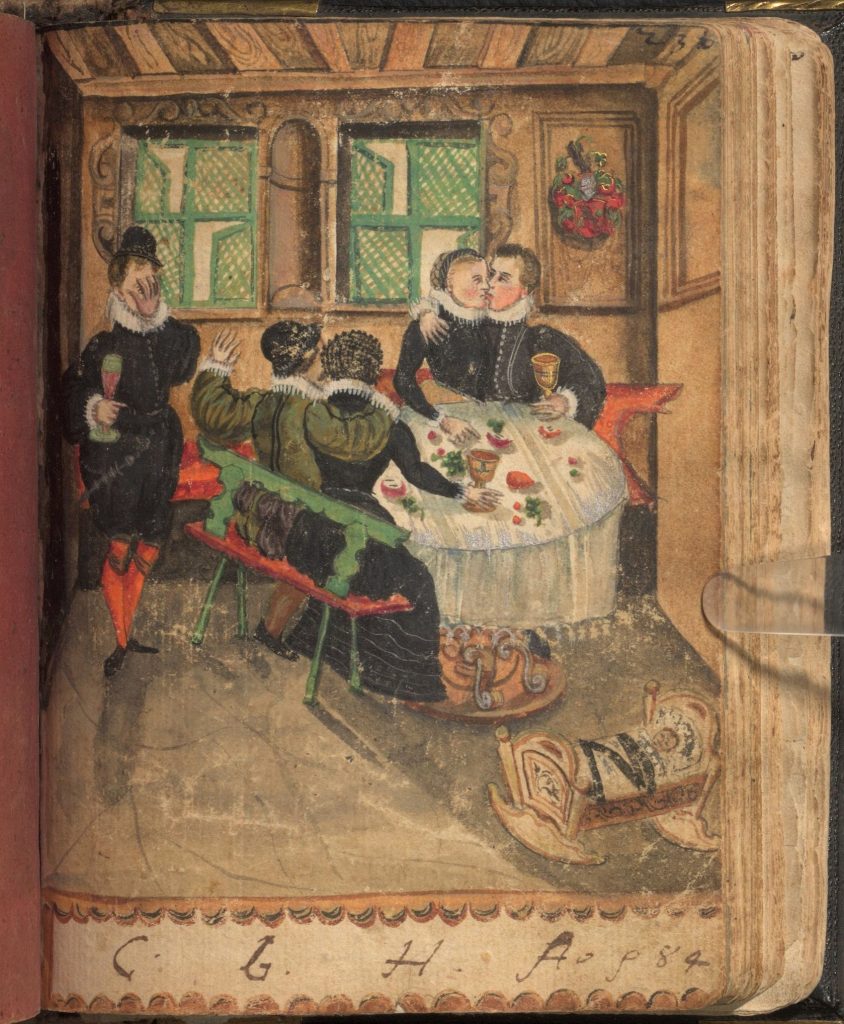
For the most part, the cuckold is ignorant of the infidelity, but occasionally he is complaisant — an attitude conveyed by ‘looking through his fingers’ as seen in this miniature in the Reutter album (below) The man standing in the doorway is perhaps the complaisant cuckold, who tolerates the evident intimacy with his wife of the man sitting in front of him — doubt is also cast on the paternity of the baby in the cradle.
Chastity Belt
Of course, once his suspicions are aroused, the old, bespectacled husband locks his wife into a chastity belt — she, of course, has already had a spare key made which she has handed to her young lover who brandishes it for us to see. In addition she points to her head with her index finger presumably indicating that her ancient husband is not only short-sighted, but demented.
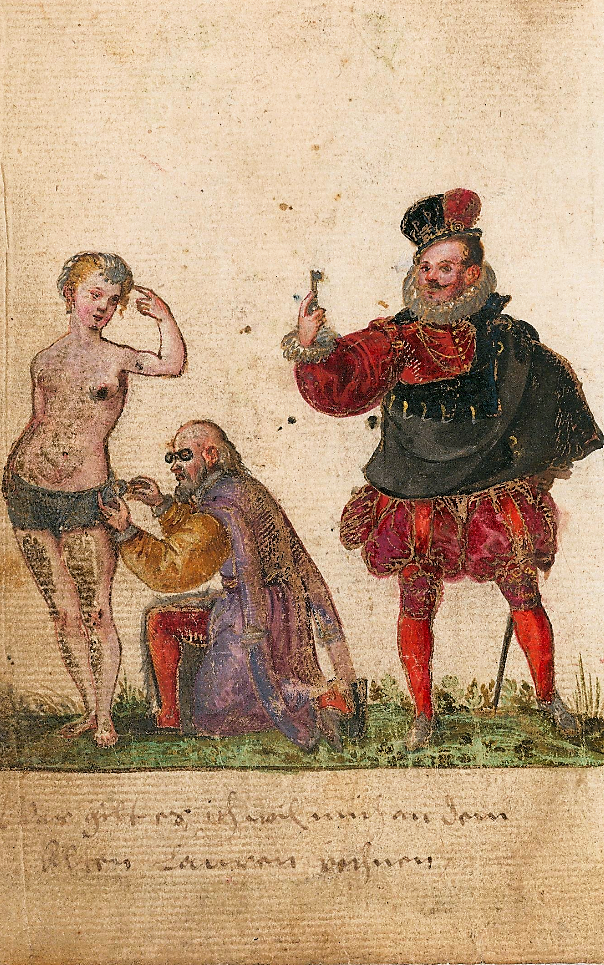
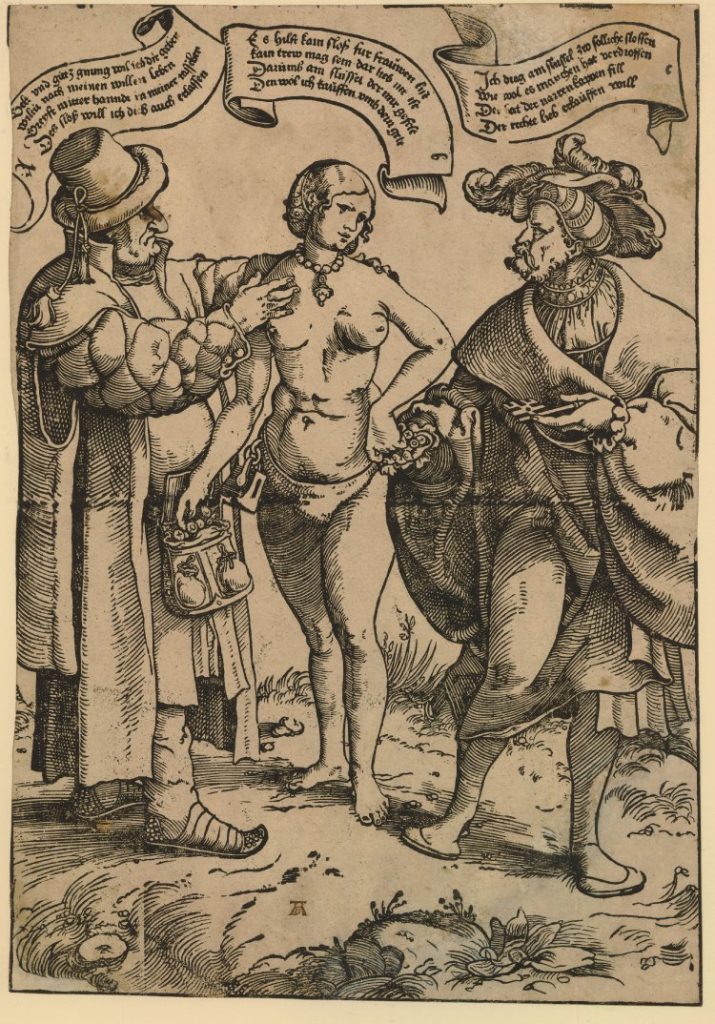
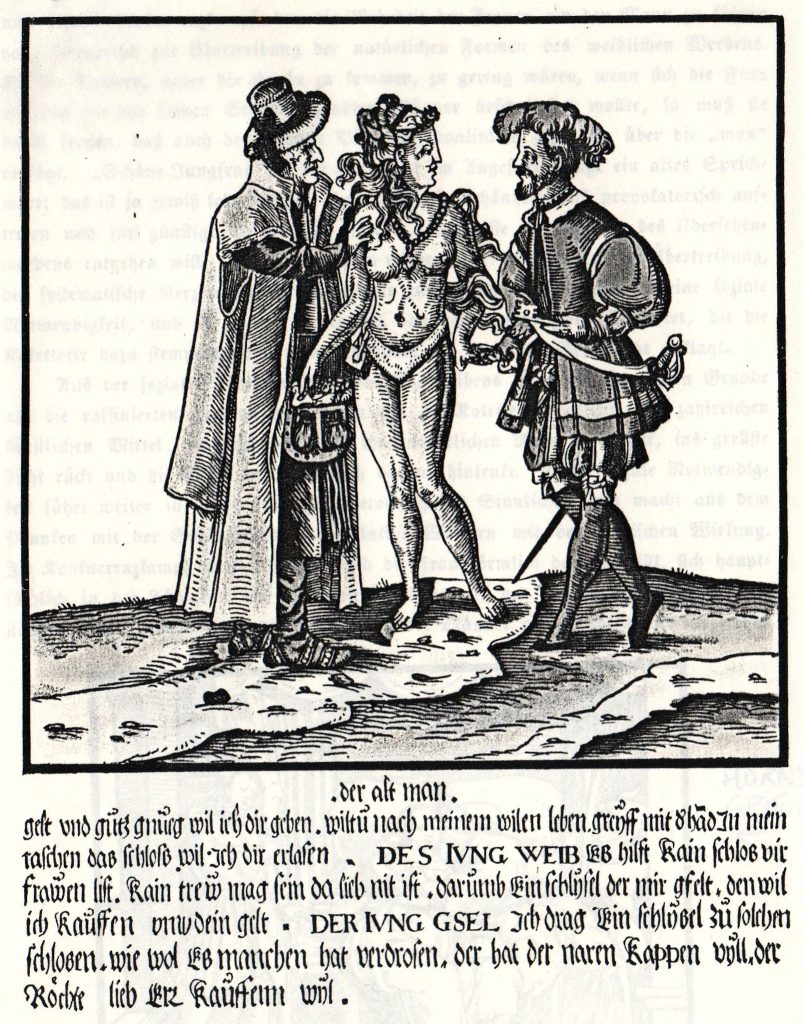
This was a popular contemporary print-type too – at least two versions of a mid-16C woodcut print variously attributed to Peter Floetner, Hans Baldung Grien and Heinrich Vogtherr the Younger exist, depicting a woman wearing a chastity-belt standing between rich old and poor young lovers – she passes the contents of the old man’s purse to the young man who has the key to her padlock in his other hand (below). A playing-card in Erhard Schoen’s pack of c.1528 [Geisberg 1311] similarly shows the elderly husband riding away with a wave, having locked his wife, naked but for the hat she is wearing into a chastity-belt, but she is already offering a presumably duplicate key to her young lover!
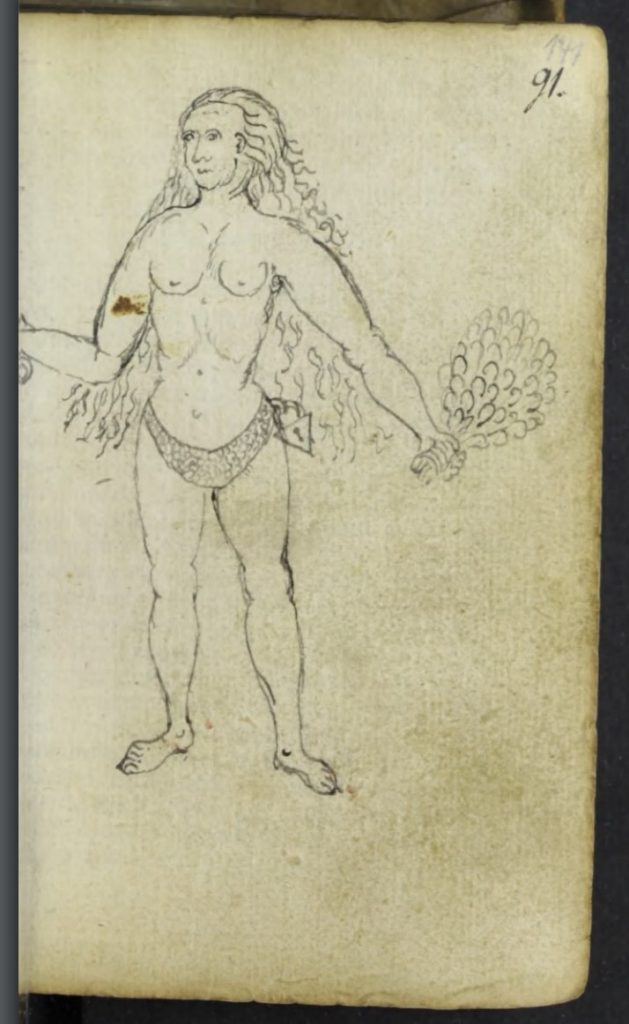
This very amateurish sketch of a female nude wearing nothing but a chastity-belt, secured by a triangular padlock, appears in the Pakebusch album (1579-96)
The indispensable Repertorium alborum amicorum notes another example in the album of David von Krakau (dated entries 1584-1605).
Charivari
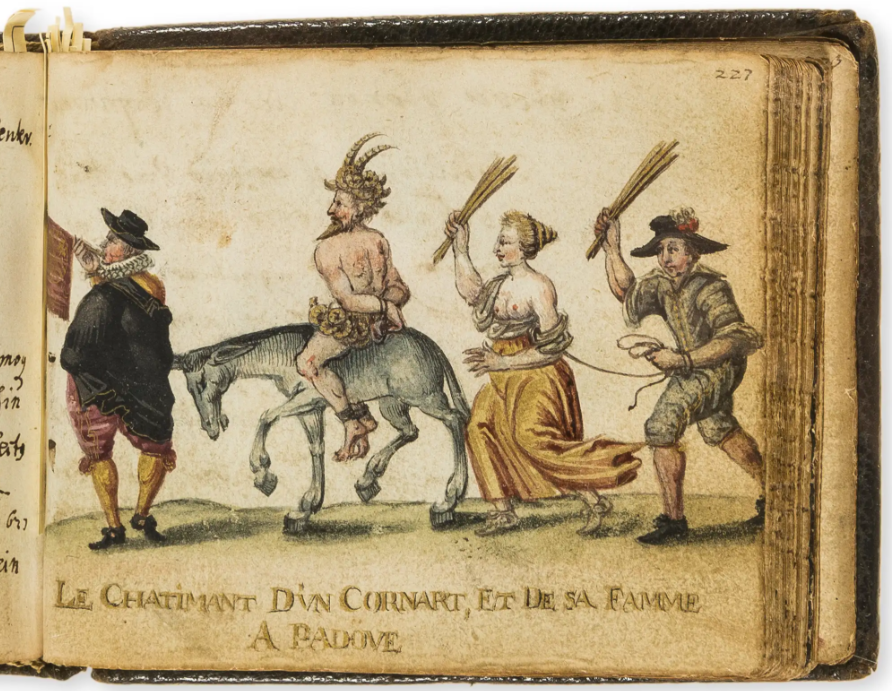
While recognising one has been made a cuckold might be thought punishment enough, a miniature in the Giese album records a public shaming ritual in 17C Padua. Preceded by a trumpeter to alert the public, the cuckold himself is tied onto an ass, hands bound behind him, and wearing a horned headdress; his wife, her breasts exposed, follows on foot beating him, being herself beaten by an official who holds her on a leash.
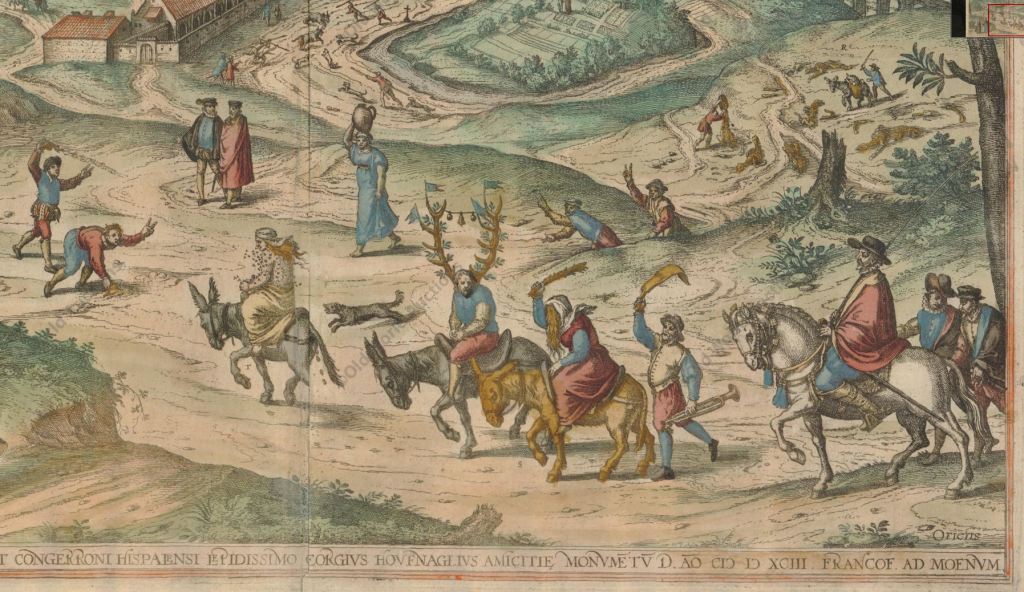
Such charivaris were familiar throughout Europe — this is Joris Hoefnagel’s drawing of one in Spain, dated 1569
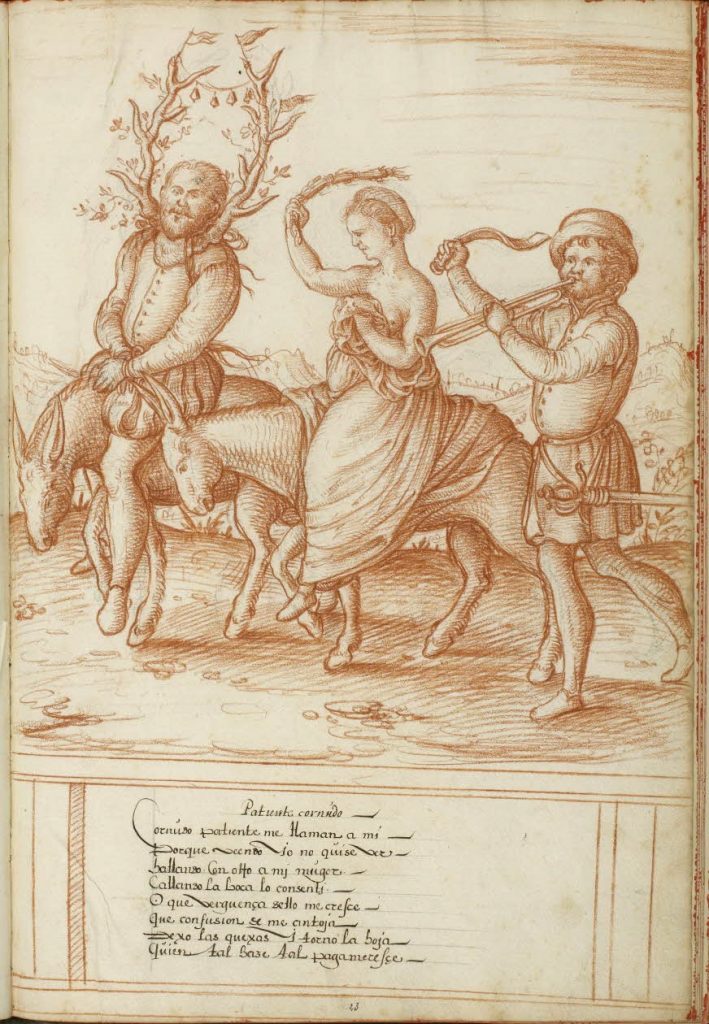
presumably related to the procession in the foreground of the map of Seville in the Braun & Hogenberg world-atlas …. Note the horns’ gestures made by the boys and other passers-by.
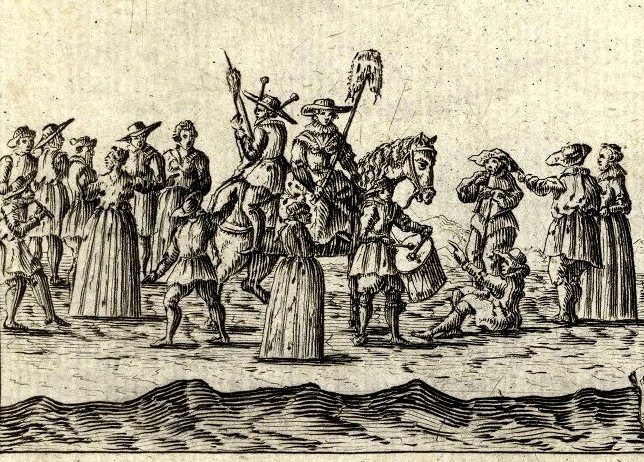
For the unique etching (by a German) of an English charivari in 1628 — known as a skimmington ride — see my essay, “Rough Music – images of cacophony in early modern England” in ed. …..
But I digress! Here, from the Rentsch album, is a charabanc outing drawn by three old cuckolds
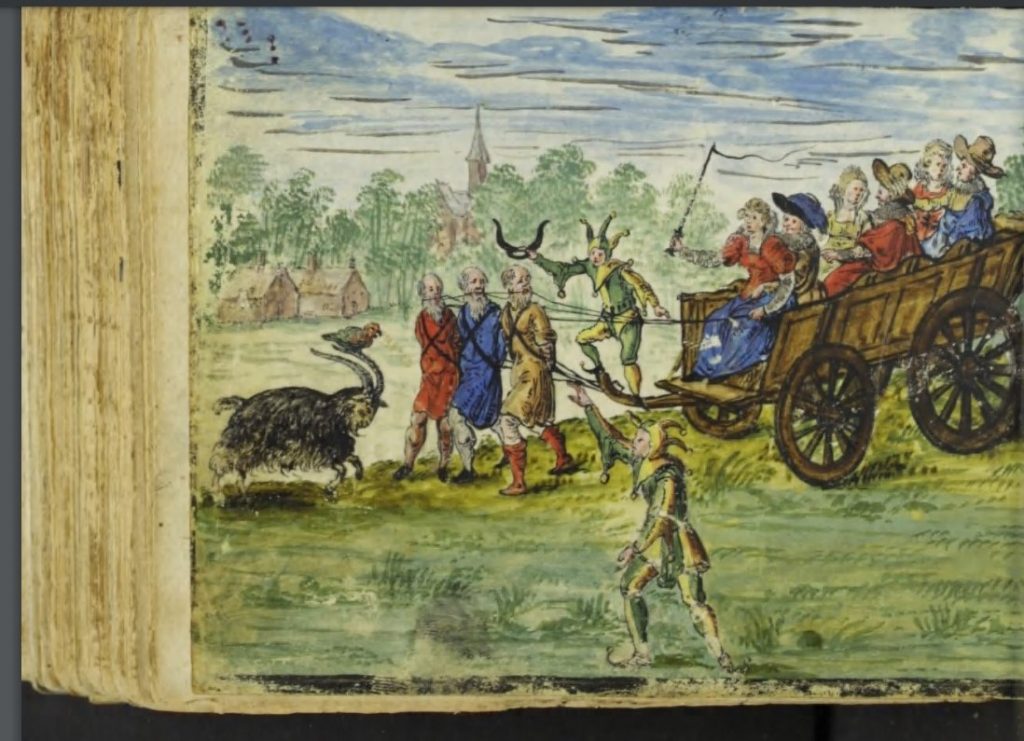
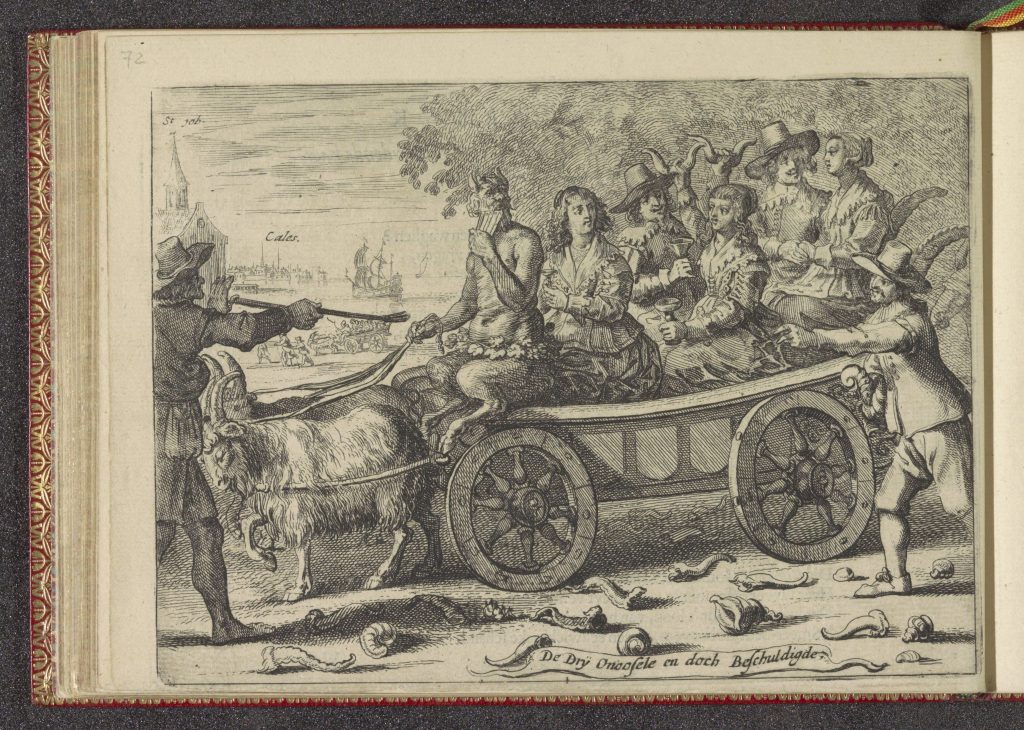
The manuscript entry on the adjacent page is dated 1623, but this does not mean it is necessarily contemporary with the miniature (to which it makes no reference). I feel the waggon-load of young women with their young-looking lovers and three elderly husbands drawing it, and the pair of horns brandished above their heads by the costumed fool, takes its hint from an etching of the Vrolick Wagen by Crispijn de Passe the Younger, bound at the end of his Abus du marriage, issued in 1641, and thus within the lifetime of the Rentsch album:
Leave a Reply