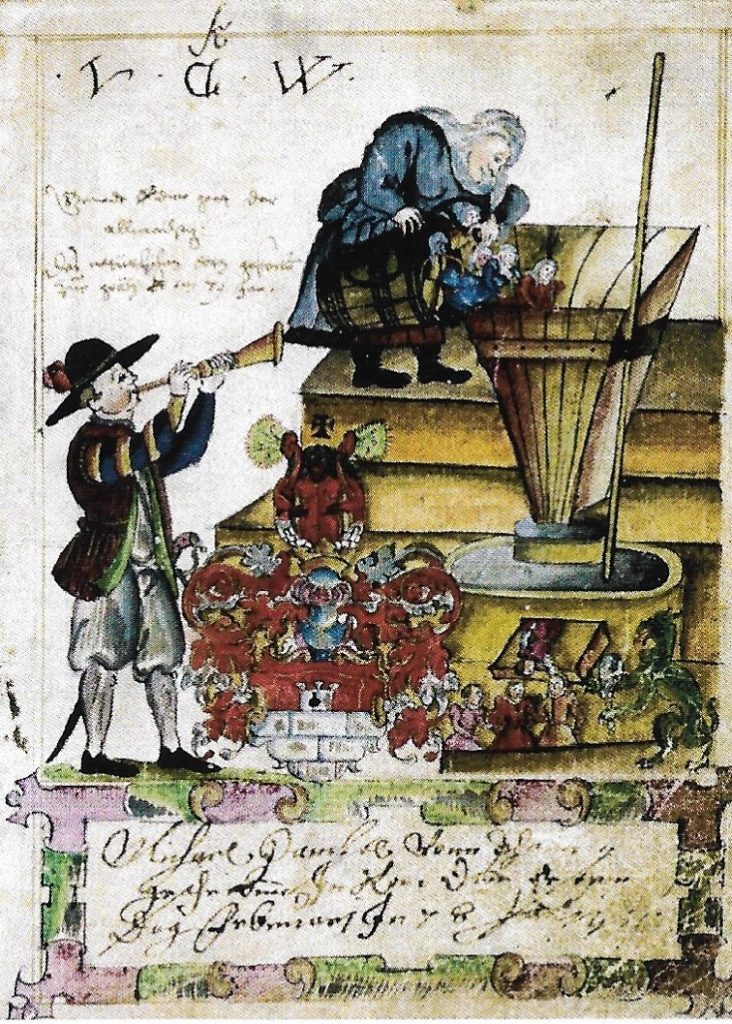
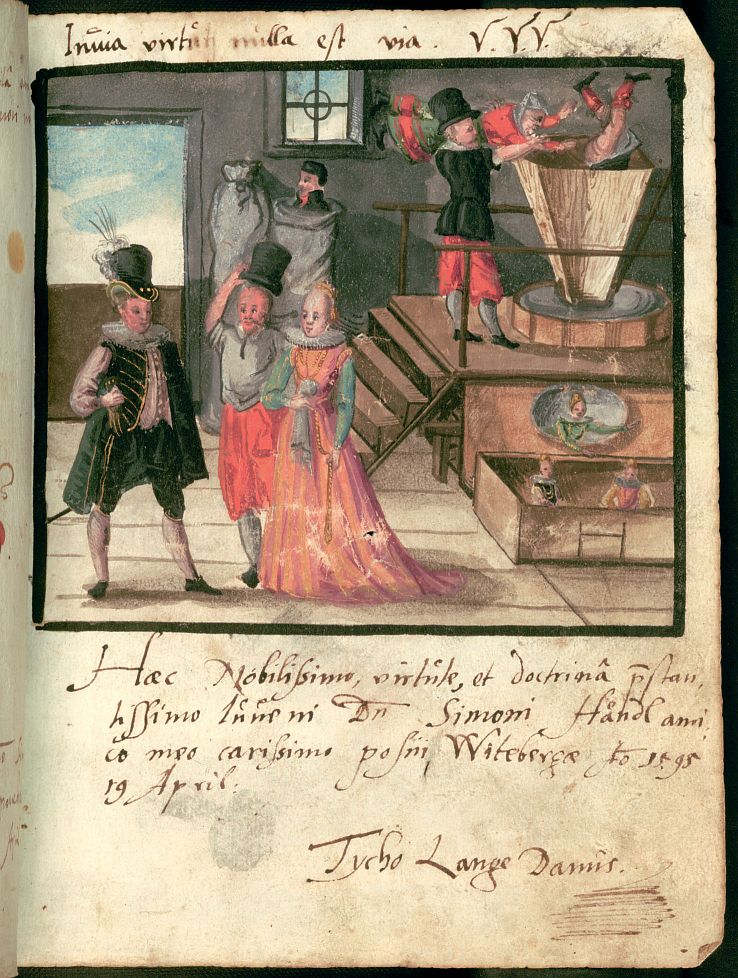
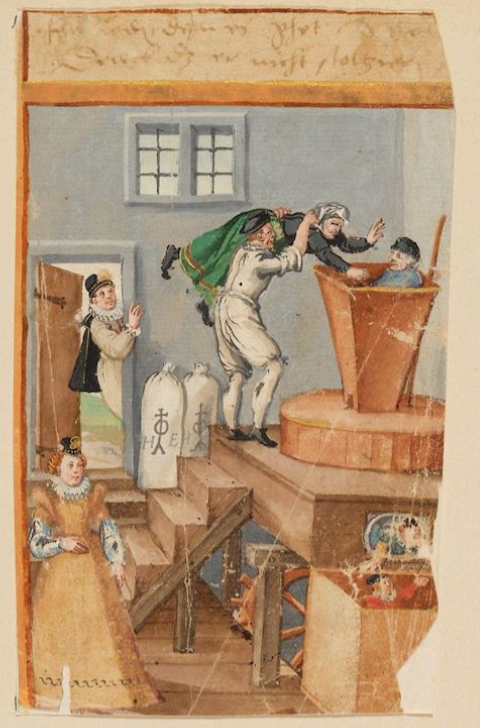
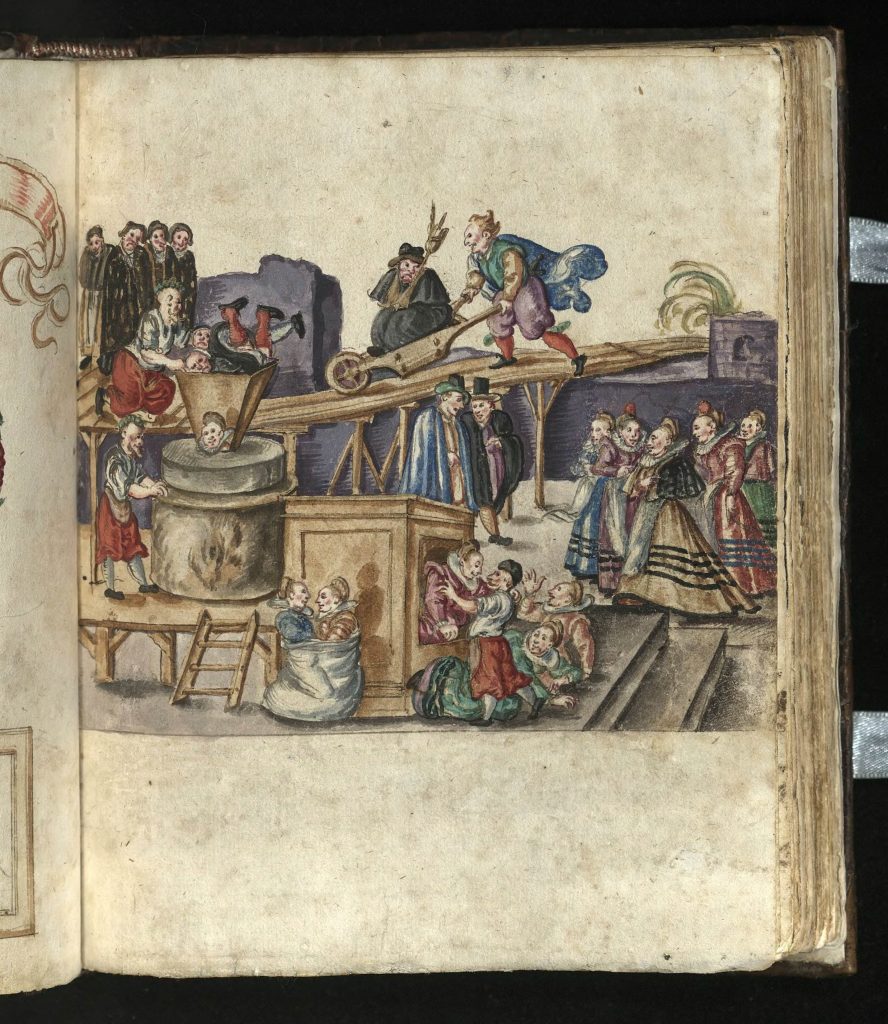
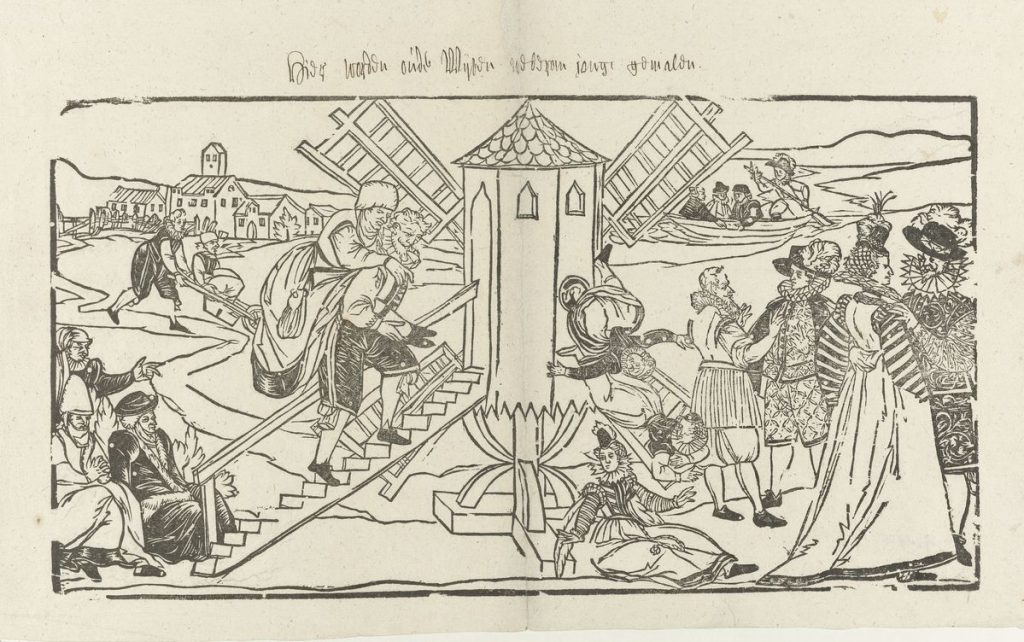
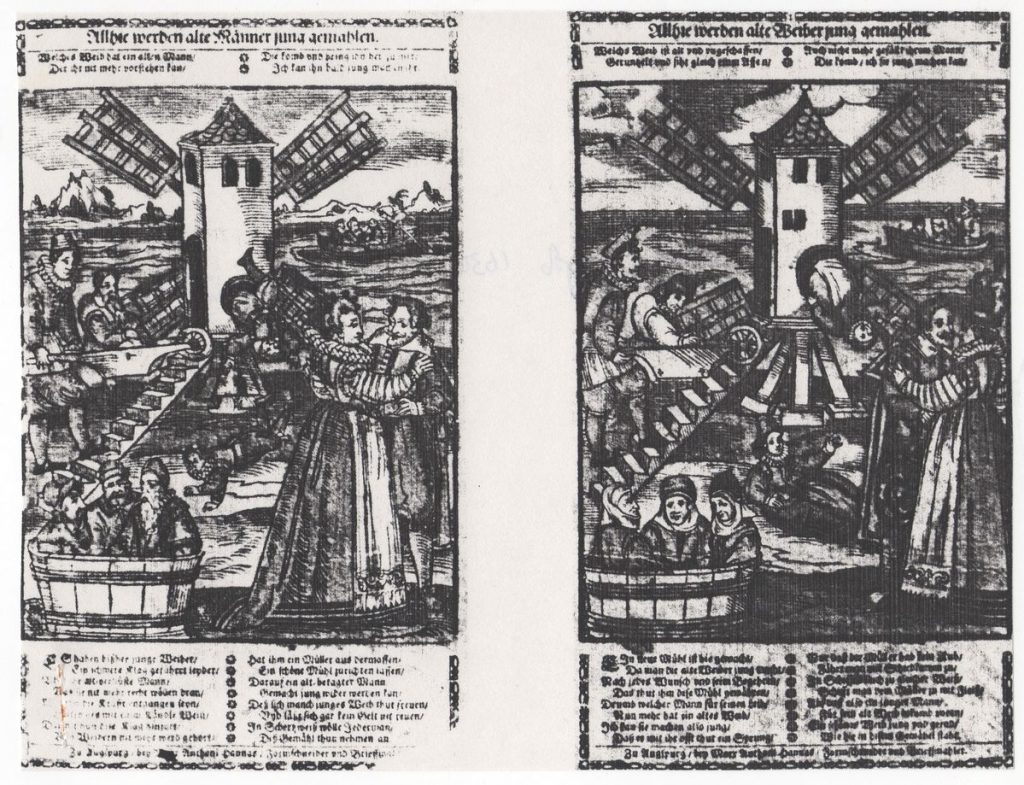
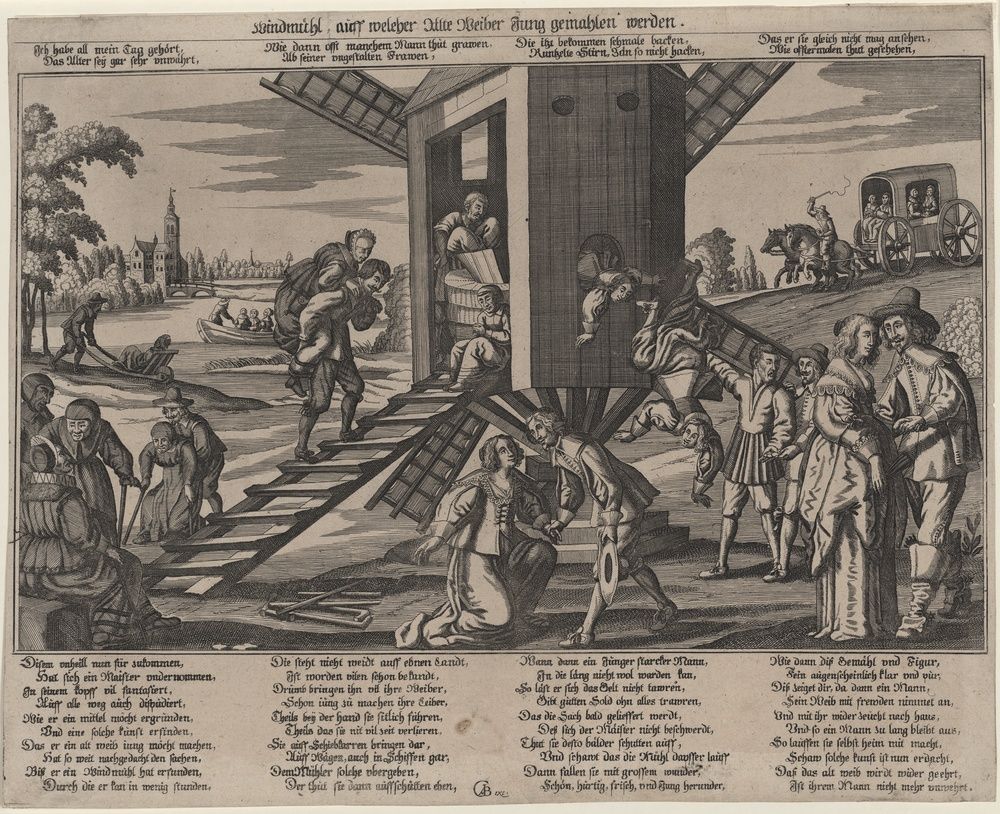
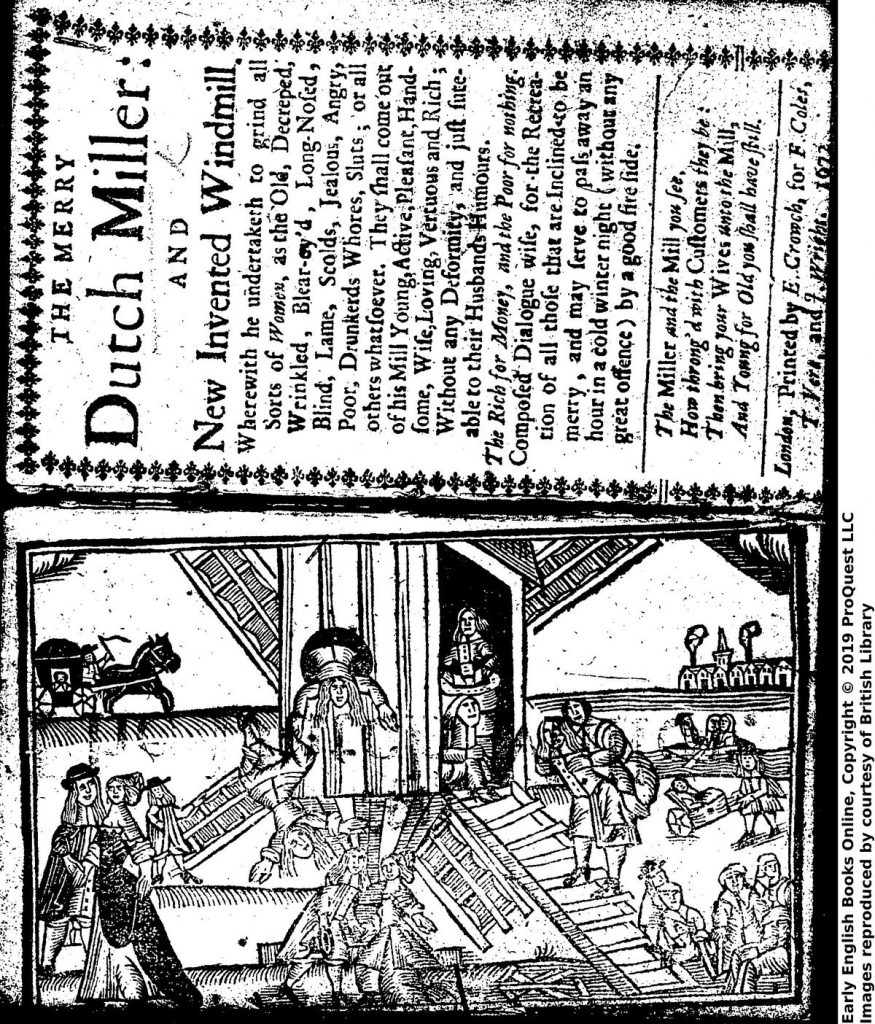
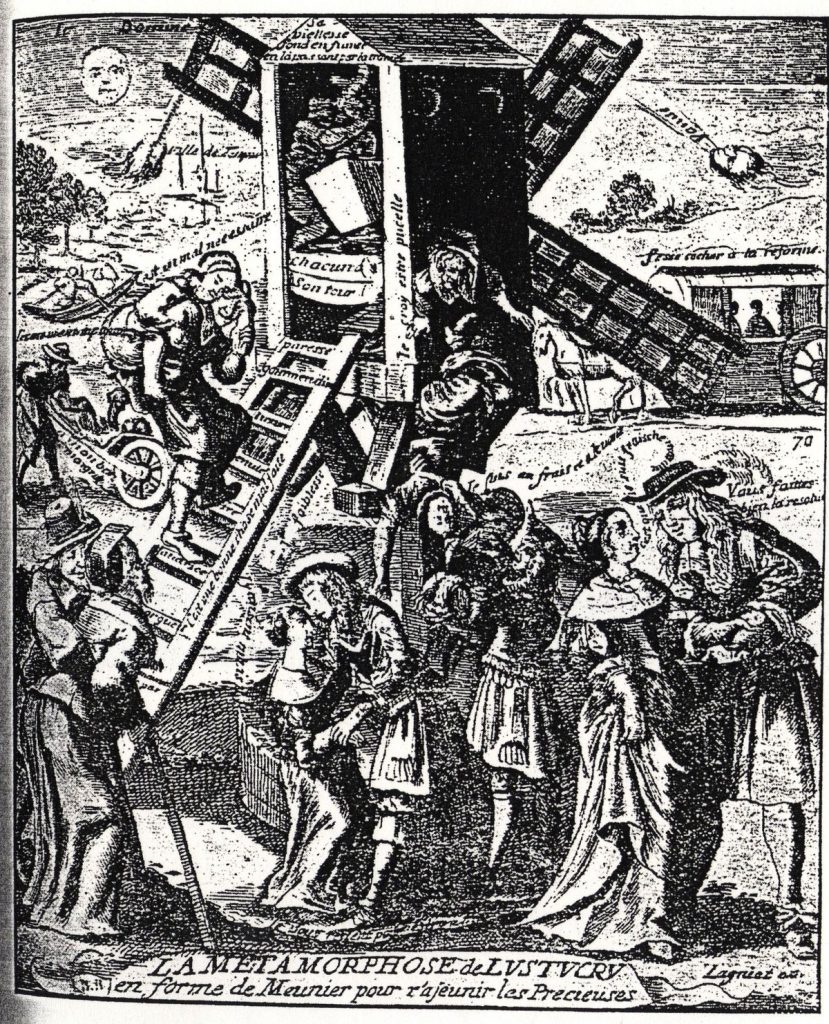
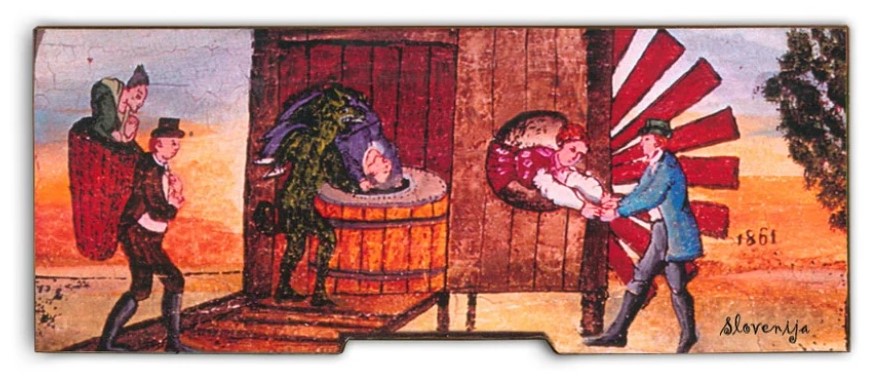
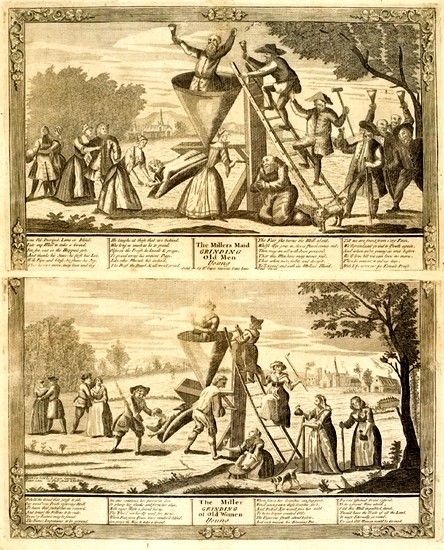
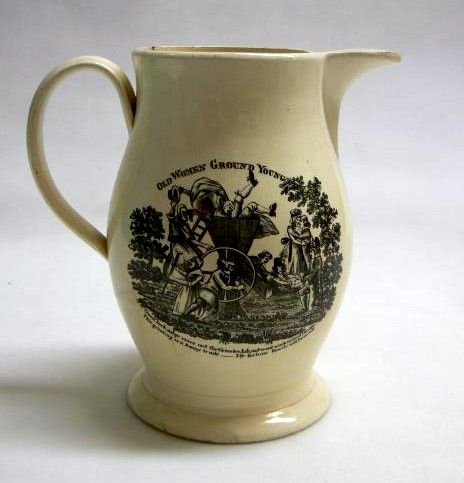
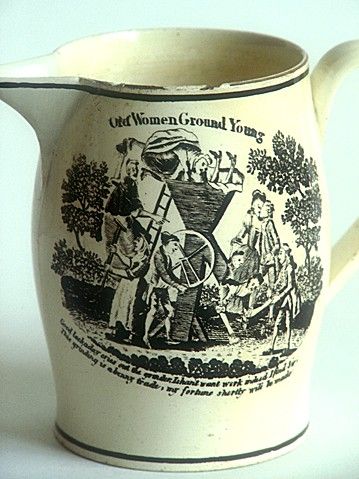
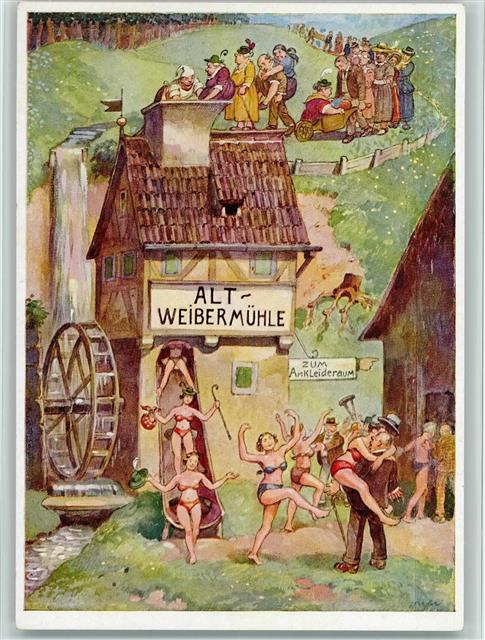
Popular ‘folk’ means of rejuvenation include fountains [Jungbrunnen], furnaces, and mills. I’m just concentrating on mills here, especially the Altweibermuhle which rejuvenates old wives, but also the Narrenmuhle, into which fools are poured, ground & emerge as… fools! — perhaps taking the hint from Proverbs 27.22: Crush a fool in a mortar…yet his folly will not depart from him. And also the virulently anti-Catholic Pfaffenmuhle, into which priests, bishops, cardinals, etc. are poured, and emerge as grotesques, vermin, devils, etc.
Though the Altweibermuhle is heard of as the title of a fastnachtspiel [carnival play] performed in Thorn, East Prussia, as early as 1440, importantly, the earliest illustrations of this miraculous mill are to be found in the albums. Other album examples — which I have no image of — are the Schoenheitsmuehle listed in the contents of the Ulmaninger album (dated entries 1599-1627) in the 1911 Boerner sale of Friedrich Warnecke’s Stammbuch collection, and the Weibermuhle listed as in the album of Daniel von Redern (ante 1613, and probably 1590s), i.e. Stockholm, Kunglige Biblioteket, [ms] Ir 2a, f.34r.
It is perhaps merely an accident of survival, but the 16C Narren– and Pfaffenmuhle images antedate the Altweibermuhle representations, though hardly outlast the century, whereas the latter, of course, remains hugely popular well into modern times, and thus I sample only a few of the early modern non-album images here.

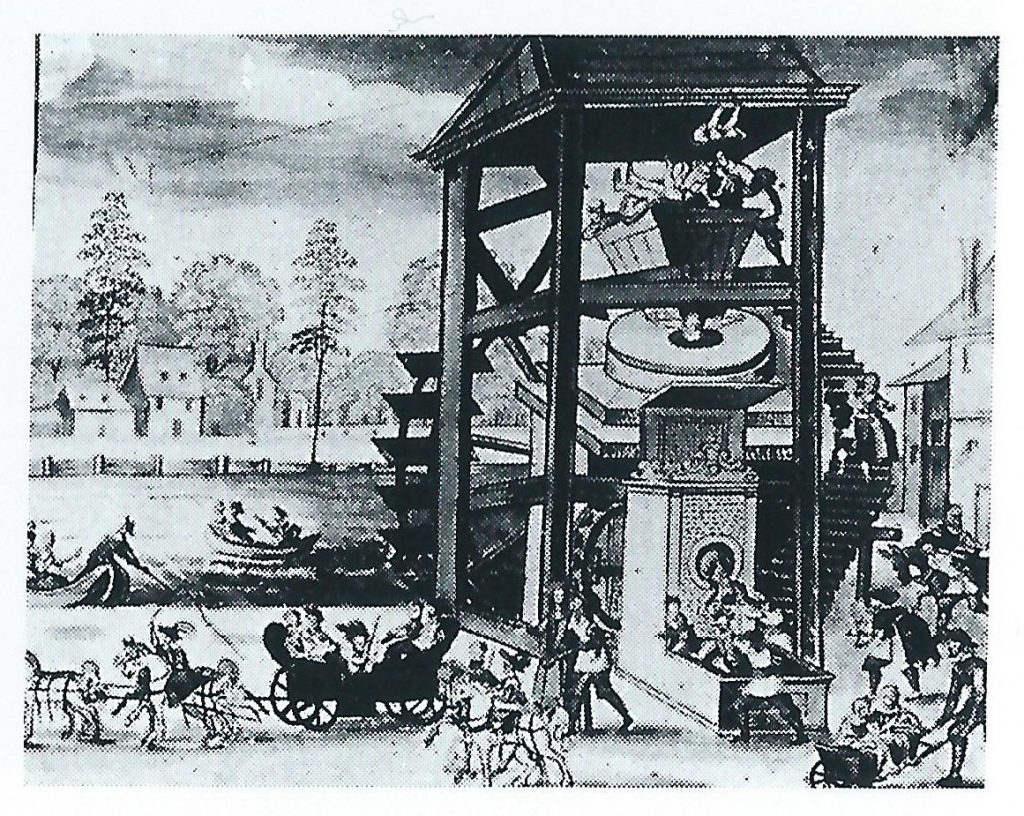
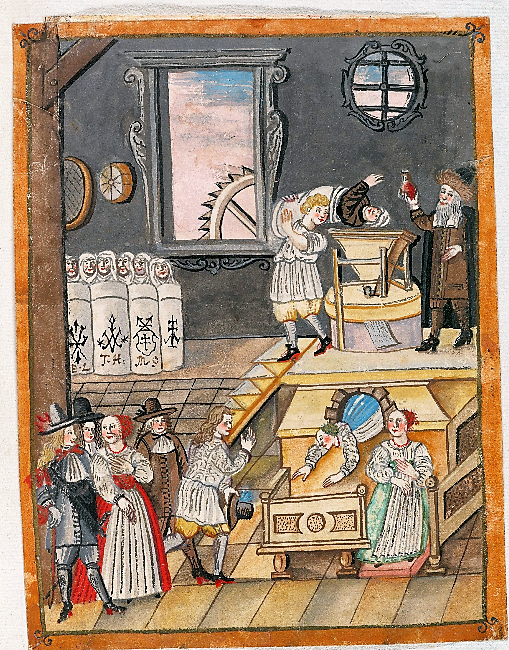
prints and other media
This Dutch woodcut — if, indeed it is Dutch and not German, the Dutch title is added in manuscript! — in the Rijksmuseum I take to be late 16C.
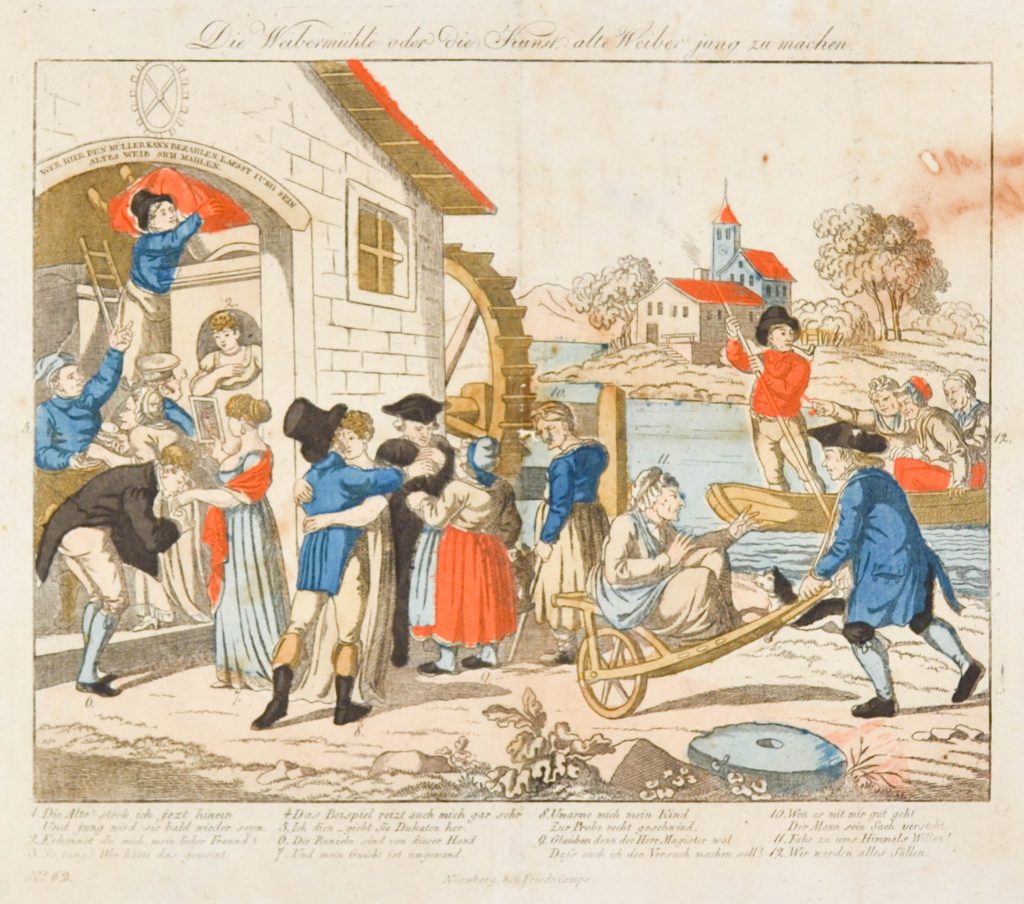
The Narrenmuhle [Fools’ Mill]
A miniature in the album of Wenzel Prunner [St. Florian, Stiftsbibliothek, CSF.III/228], adjacent page dated 1624, is described as showing small fool-figures brought into the mill in wheelbarrows which the miller loads into the hopper, but they emerge as fools still; a nobleman in the foreground makes an explanatory gesture and a banderole above him reads, Gleich wie das Korn ist / Also ist auch das mel [As the corn is, just so is the meal]. The album of Matthias Egger includes a small engraving pasted in and coloured of this very scene [BELOW], captioned with verses in German below but above with the Latin: Qualis granum talis et farina [as the corn is, such is the meal]. The print bears the imprint Joan bussemecher excudit Coloniae and was probably designed for Bussemacher’s own Stam und Wapenbuchlin (Koln, c.1600) — the title-page of which, together with 4 of the commedia dell’arte scenes in it also appear in Egger’s album. I have not seen the Kunstbibliothek Berlin copy of the book, Lipp.Cg. 67.kl
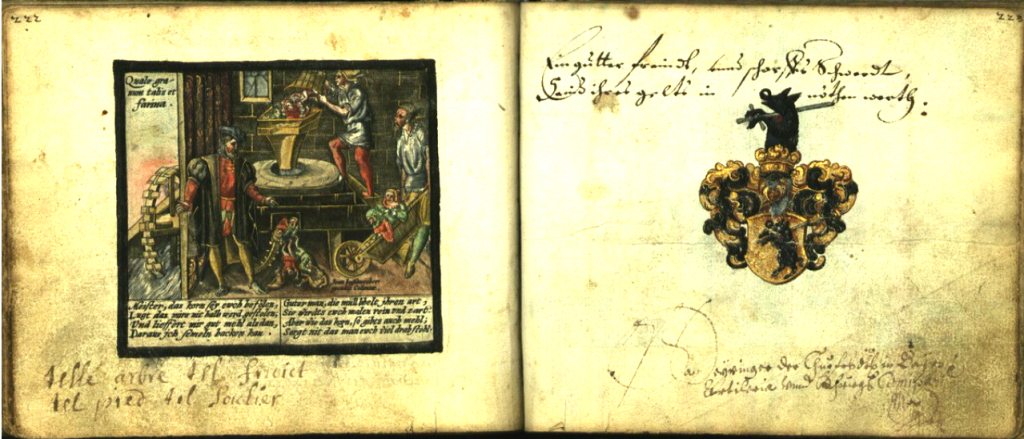
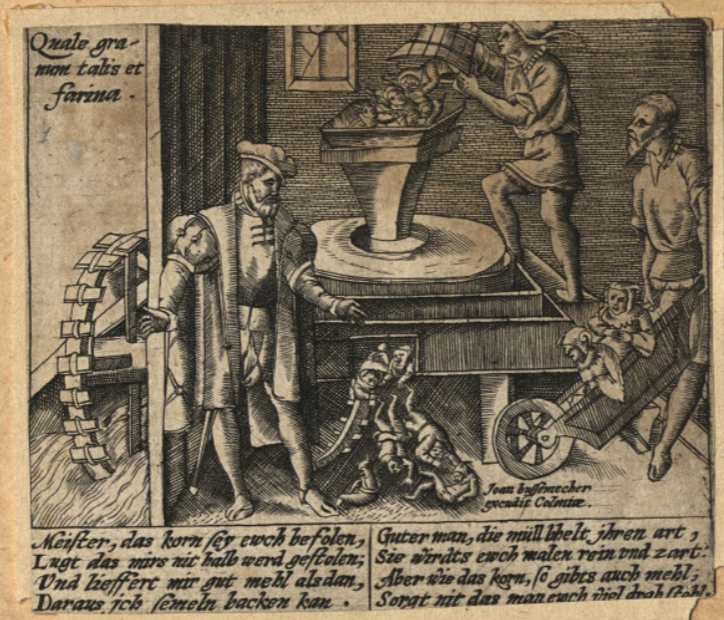
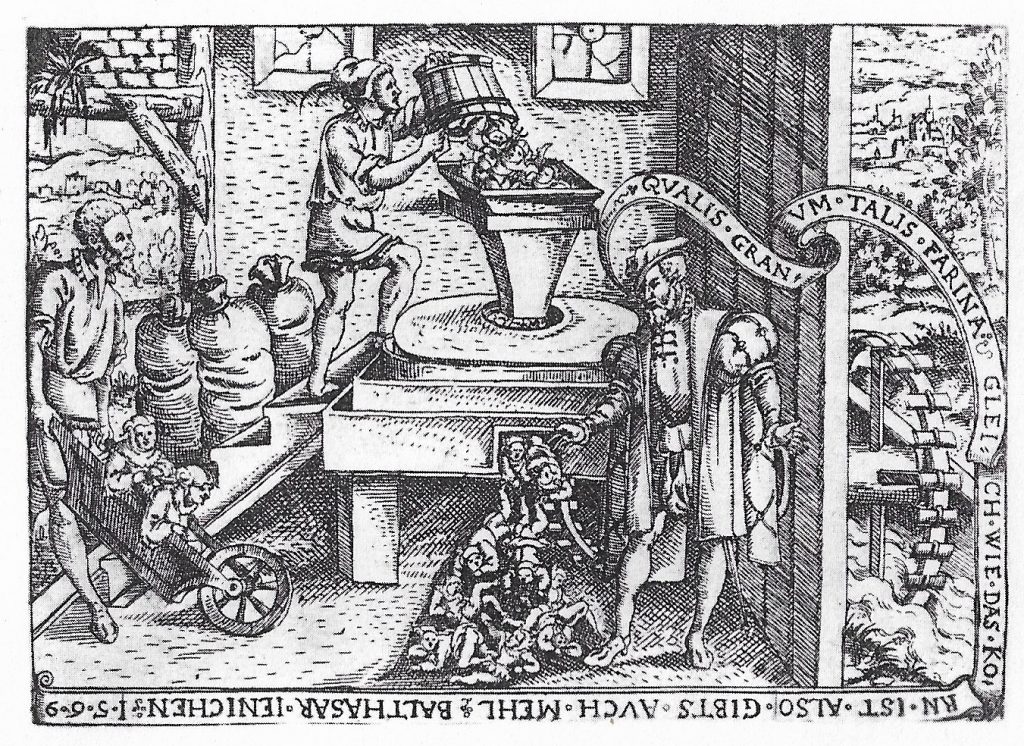
But Bussemacher’s composition is a close copy in reverse of a print originally engraved by Balthasar Jenichen in 1569 in which the proverbial motto appears in both German and Latin versions. [oddly absent from the encyclopedic TPMA — GETREIDE 4.4.2.4 Wie das Korn, so das Mehl und Brot, comes closest, but with only two citations, one Spanish, the other Provencal !]
possible earlier Narrenmuhlen
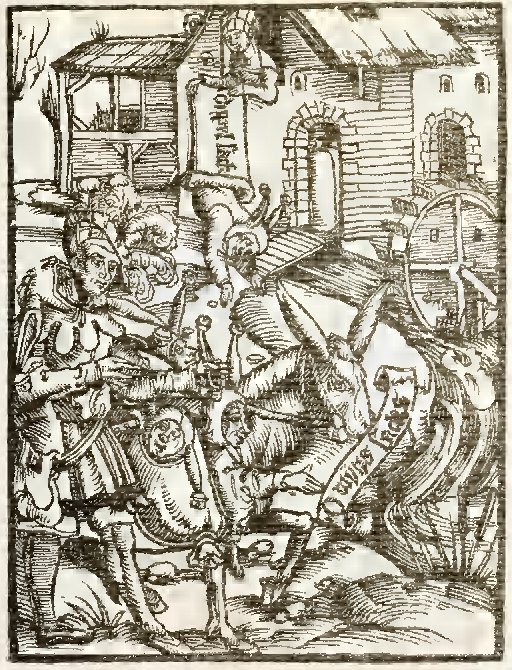
The fool-miller unloads the sacks of fools from the ass, but his wife, emptying a sack, shows the meal is fools still !
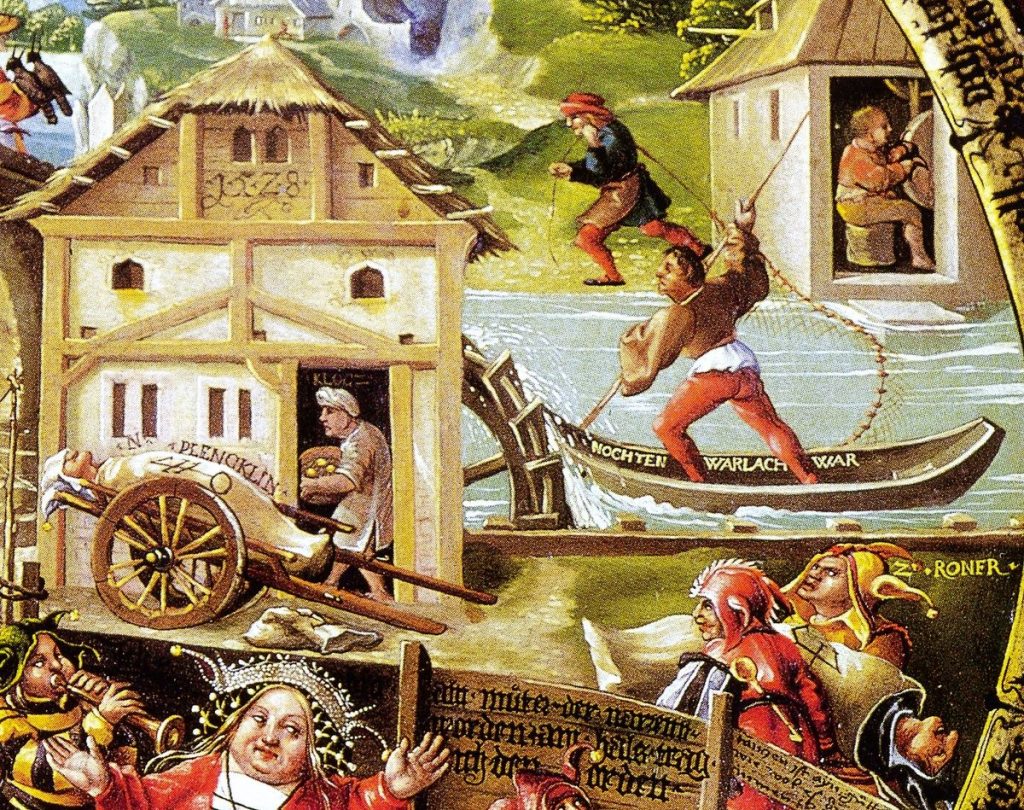
In his superb Narrenidee und Fastnachtsbrauch (Konstanz, 1991), 393ff., Werner Mezger suggests that one of the scenes painted on the extraordinary Ambraser Narrenteller of 1528 shows dead fools being brought to the mill to be ground (BELOW)
Pfaffenmuhle
From the second quarter of the 16C — the era of the Reformation, of course — appears the anti-Catholic motif of the Pfaffenmuhle — the mill into which the Catholic clergy are thrown to be ground and emerge variously as vermin, devils, grotesques, etc. Certainly to be dated before 1556 is a woodcut made by the block-cutter, Hieronimus Andreae — in one impression the print bears a title referring to Proverbs 27.22: Crush a fool in a mortar…yet his folly will not depart from him.
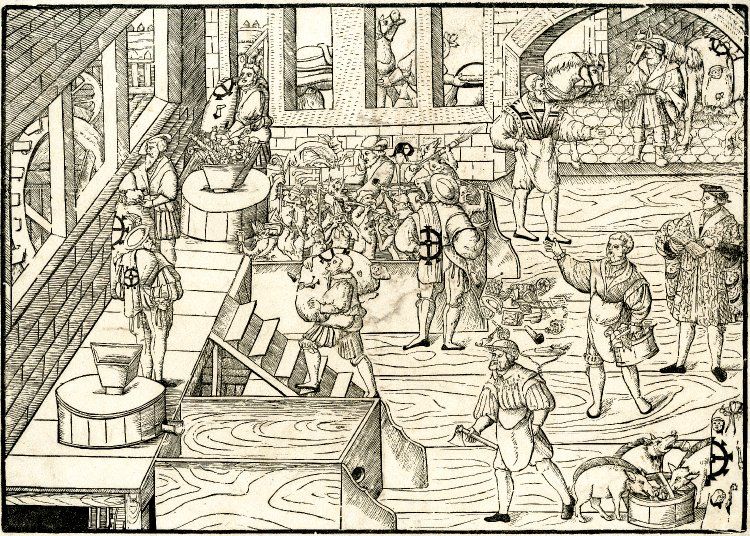
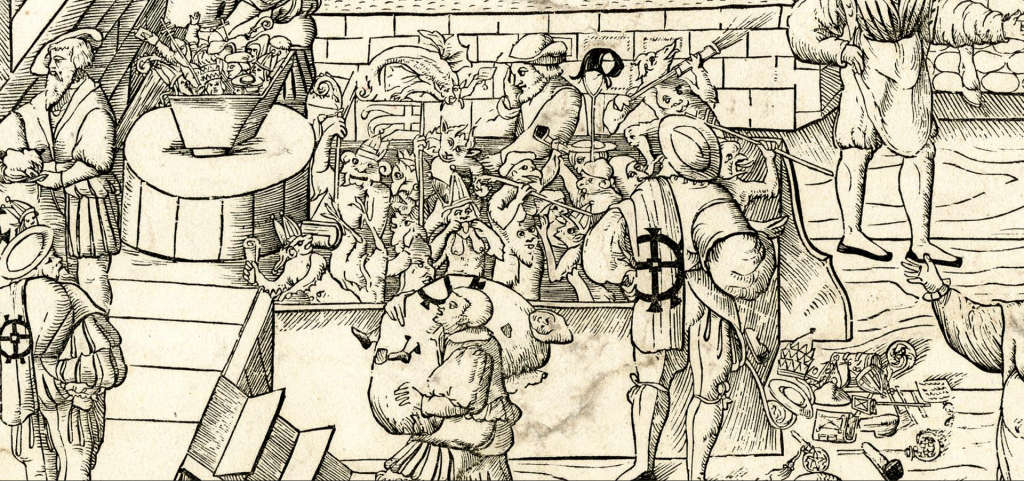
I know of only 3 Pfaffenmuhle images in the albums to date, and have only this single scan of the fold-out in the von Closen album — here the mill is ‘manned’ by devils, and the clerics emerge from it as worms. Again, the familiar proverb is inscribed, Wie das korn so ist das mel :
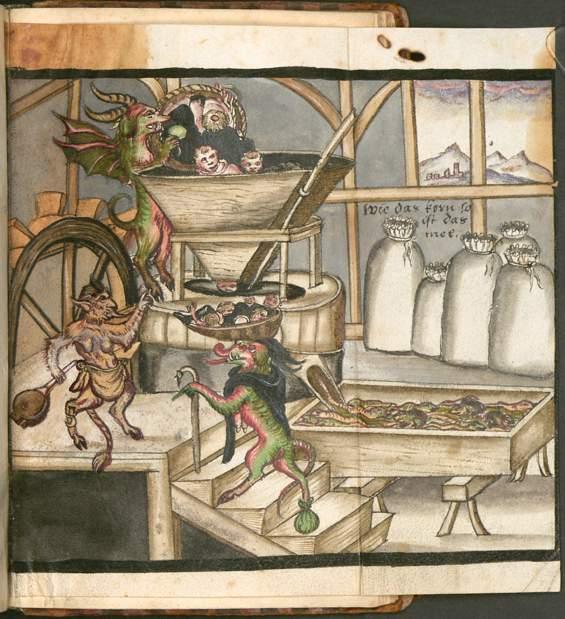
The second is also in an album in the BSB, that of Sylvia Spannocchi (d.1601) [Munchen, BSB, Clm. 30104], and the third, an orphaned leaf — one of the hundreds described in the catalogue of Weigel’s du Rosey sale (Leipzig, 1864), lot 256:

This appears to be another independent creation, though with links to the Narrenmuhle too, as the description mentions both fools who are swimming in the water, and fools — together with Old Wives — who emerge from the mill into which the monks and nuns were introduced. Nor am I entirely convinced this is not the same as the orphaned leaf sold at auction some 70 years later, when it was described under the heading Narrenmuhle, though only monks are mentioned going into the mill, and only fools as emerging from the grinding process — but they too swim away — and a 4-line verse caption is quoted:
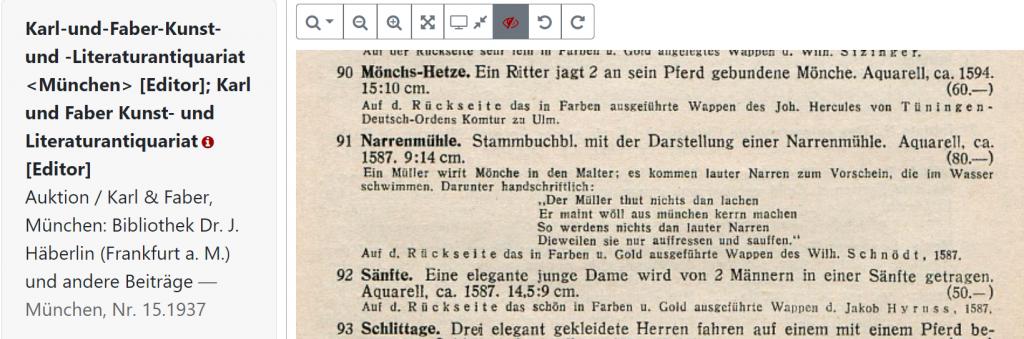
Only today [1st March 2026] did I come across what must be an almost identical scene to that described by the Karl & Faber cataloguer, in the remarkable album of Hans Jakob Widholz: here we see priest and monks being carried up to the hopper and emerging as fools who swim away in the mill-pond! Though it has faded too much to be able to read, it is possible that the same 4-line verse captions our miniature too.

in other 16C media
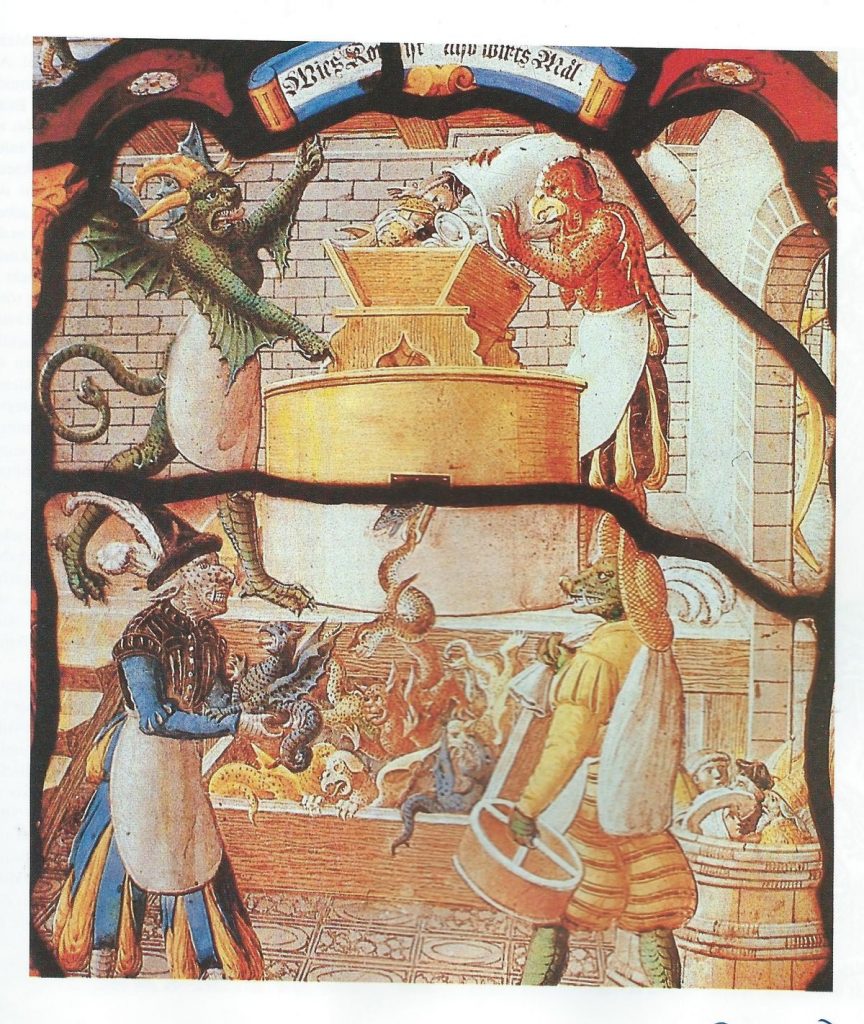
detail of a glass-painting attributed to Hans Jakob Kilchsperger and dated 1566, in the Schweizerisches Landesmuseum, Zurich — again, the proverbial motto: Wies Korn ist also wirts Mael [As the corn is, so will be the meal]
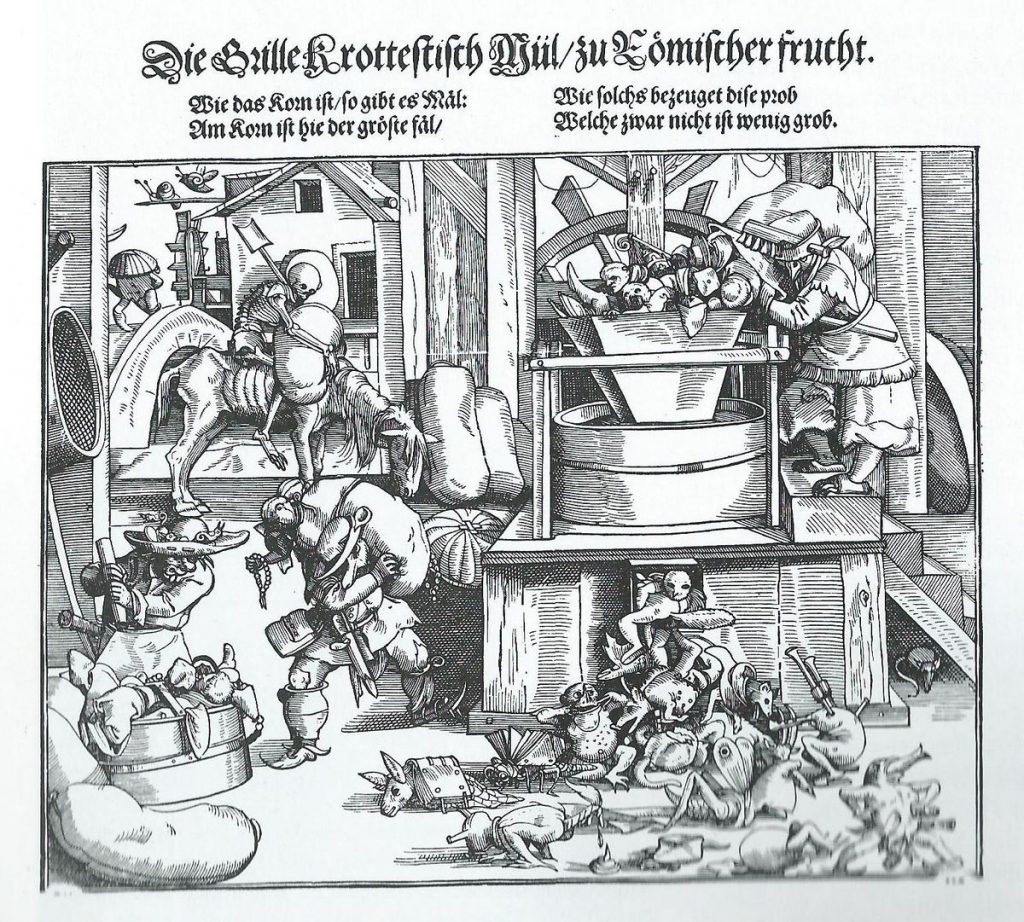
A decade later (1577) Tobias Stimmer illustrated a single-sheet print entitled Die Grille Krottestisch Mul zu Romischer frucht — again, the first line of the verse is Wie das Korn ist/ so gibt es Mael.
Leave a Reply