Not perhaps the most politically correct motif, but for a few years in the second decade of the 17th century she was a celebrity, famous for being fat! (can we still use the F word?). She was married to a Strasbourg rope-maker [Seiler] — hence her name — and evidently popular enough to be the subject of a single-sheet print, and even lift-the-flap album paintings, where we see what was going on beneath her voluminous skirts! It seems likely that the album miniatures derive from the print.
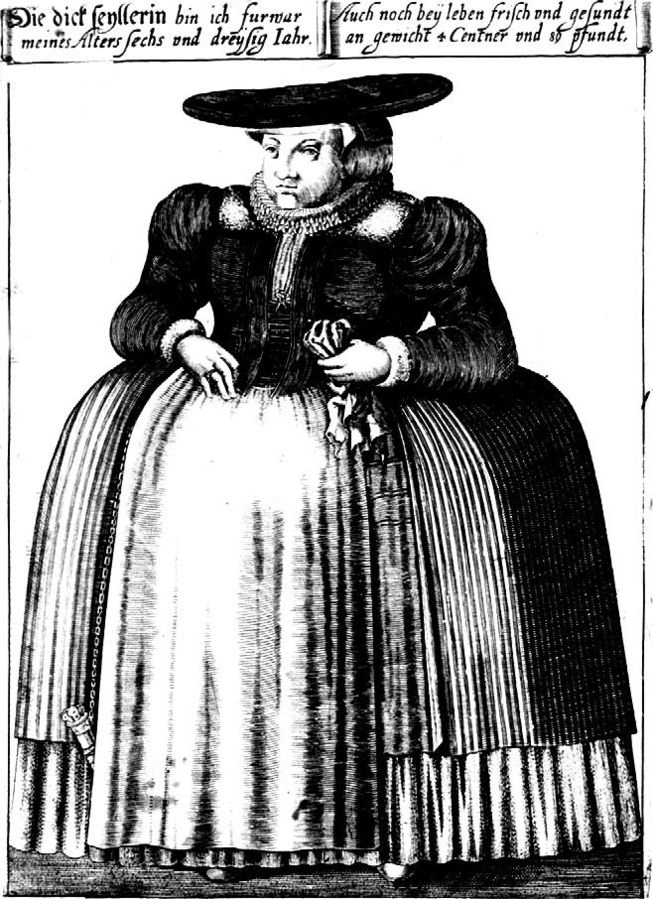
Die dick seyllerin bin ich furwar;
meines Alters sechs und dreißig Iahr;
Auch noch bey leben frisch und gesundt;
an gewicht 4 centner und 89 pfundt.
In this verse she tells us she is 36 years old, fit and healthy, and weighs in at 4 Centner and 89 pounds. A centner is etymologically 100 ‘pounds’, but, of course, the weight of a ‘pound’ varied over time and place. Nominally, then, she weighed 489 ‘pounds’, or 4.89 centner. If these were British pounds that would give her weight as almost exactly 30 stone. In later times, apparently, a German centner was regarded as the equivalent of 50 kilos (110 pounds), and on this measure, she would weigh in at 539 pounds or 38.5 stone.
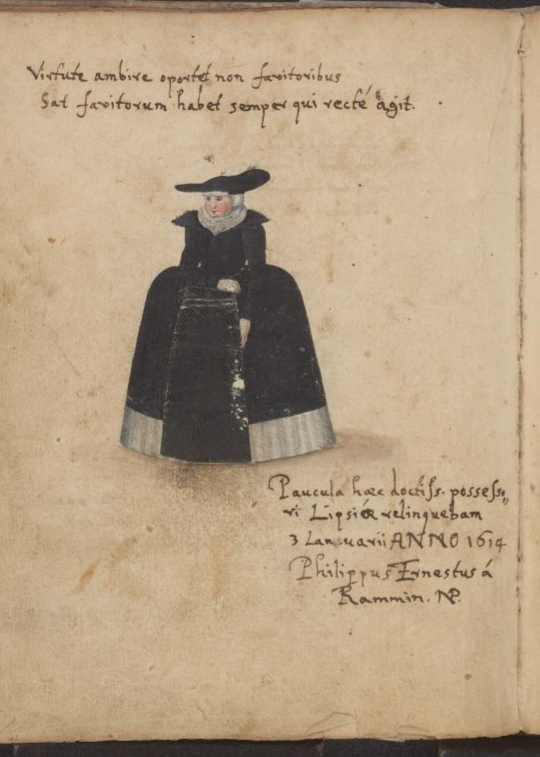
Close inspection shows that this is a lift-the-flap miniature, but sadly there is no separate image showing the page with the flap lifted — however, we can get a good idea of what may lurk under the Fat Lady’s skirts from a similar image which has lost its flap, created five years later in the album of Rhaban Giese — where we see a diminutive musician ‘fiddling’ under her skirt! The labelling inscription reads, Die dicke Seilerin zu Strassburg … gewogen 5 Zentner 12 pfunde Anno 1614, i.e. records her weight subsequent to the date of the print, by which time she had evidently put on a few more pounds — 23 more to be exact!
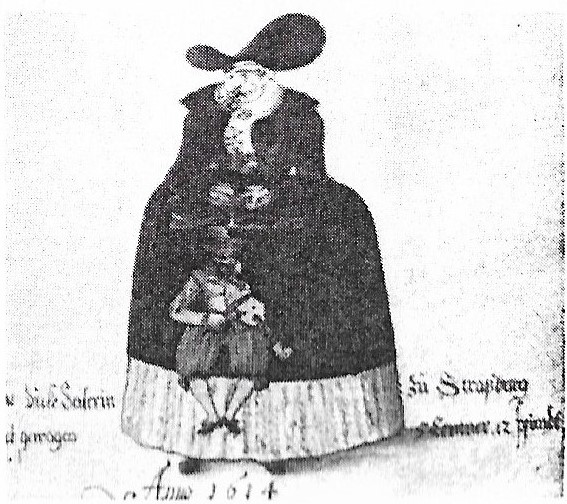
[The Giese album is particularly interesting as containing many English entries — apologies for poor reproduction, but it is blown up from a postage-stamp-size image in J. L. Nevinson, “Illustrations of Costume in the Alba Amicorum” inArchaeologia 106 (1979), pl. LXXXV. f.]
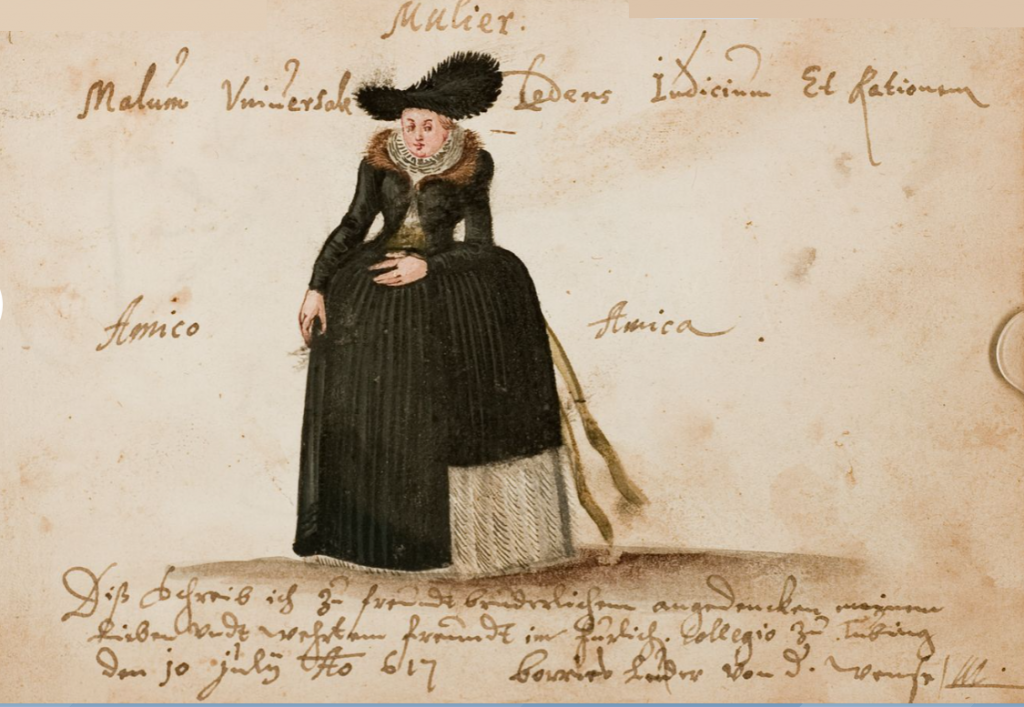
The RAA describes this image merely as weibl. Kostümbild [picture of female costume], but when compared to the other labelled images, I feel sure it is our heroine! The Latin inscription is a misogynist acrostic: labelled Mulier [Woman] which is expanded as if an acronym of Malum Vniversale L[a]edens Iudicium Et Rationem [a universal evil harming judgement and reason]. I had assumed this was a misogynist commonplace, but a quick google finds it only some 30 years later in Jan Baers, Cornucopiae (Amsterdam 1648) — another album first?
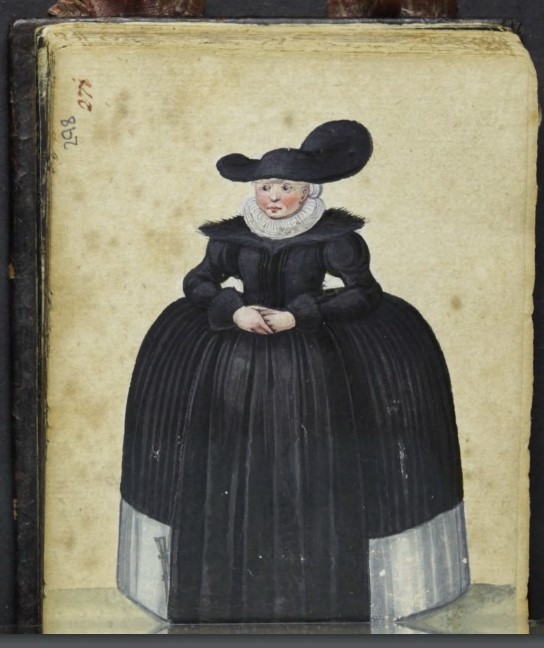
Thott 432, 8°, image 595
Is this another lift-the-flap image?
Leave a Reply