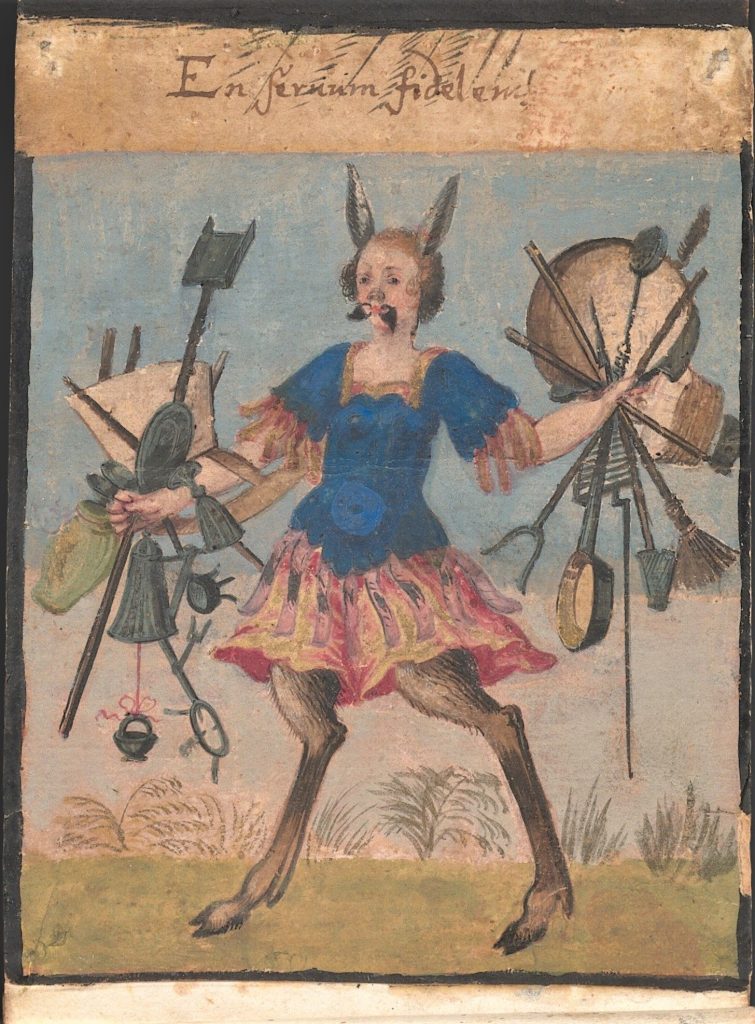
This grotesque image of a human/animal hybrid is captioned in Latin, En seruum fidelem [Behold a faithful servant], and to date, is the only depiction I have noticed in the albums of the motif I refer to as The Trusty Servant.
By this date, the image was well-known throughout Europe. In France, Gilbert Cousin attests to paintings of it in French houses by 1535, and French and German woodcuts of the device survive from the late 16C, but Ferdinand Columbus (d.1539) had two examples in his early and voluminous print-collection, one with banderoles en flamenco [see my essay, available here: https://www.academia.edu/42200157/_Washing_the_ass_s_head_exploring_the_non_religious_prints_]. In England prints are attested in 1577 [in the Stationers Registers — but not extant], and it was famously painted at Winchester College in the early 1580s by John Hoskins (below). In Poland a woodcut print was issued in 1655 (below).
As of now, the earliest extant image is a woodcut illustrating a German translation of Gilbert Cousin [Cognatus], Οίκετης sive De officio famulorum (Basel 1535), published in Erfurt in 1583, re-issued in 1593
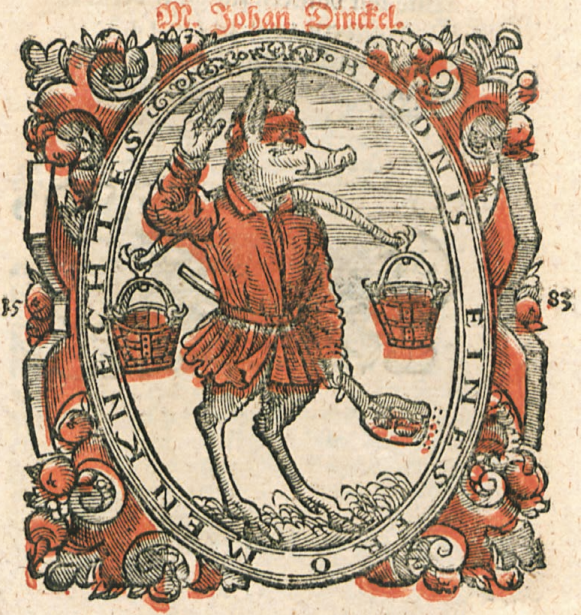
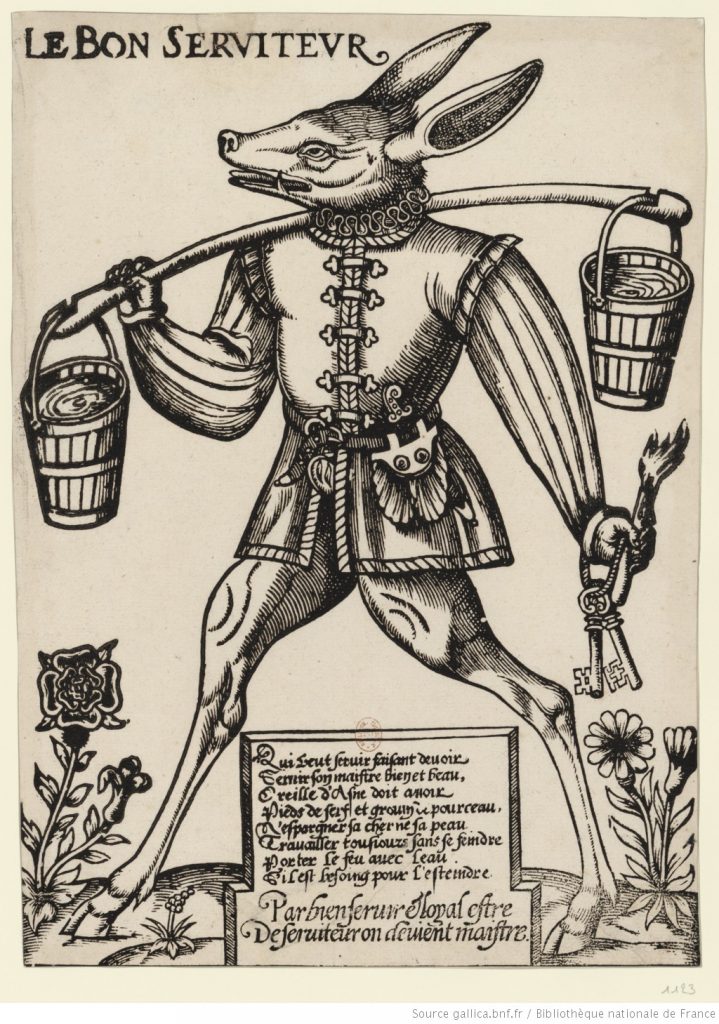
The earliest surviving French image is undated but must be roughly contemporary -- though the German image is far more faithful to Cousin's original description
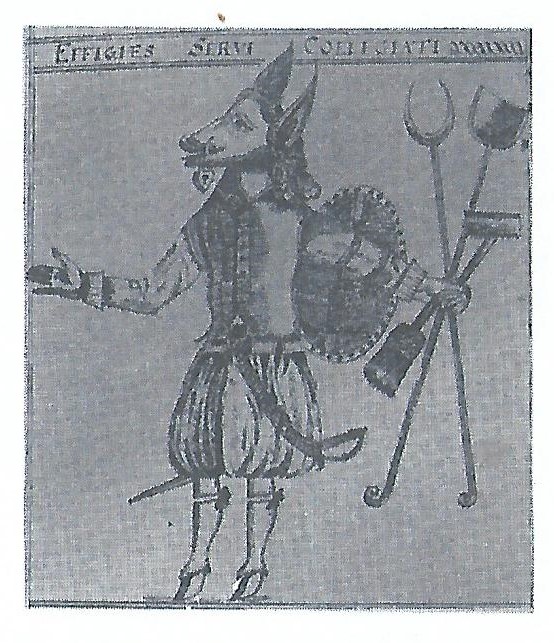
The Meyer album image represents a considerable departure from the Cousin description — the ass’s ears and hind’s feet are retained, but the pig’s snout is replaced with a human face; the pails of water hanging from the yoke have gone, and the shovel is but one of many implements held in both hands. New are the two padlocks that ensure he ‘keeps his mouth shut’ — though these were probably present in Hoskins’ original 1580s painting in Winchester College; in the earliest drawing made in 1644 of the Effigies Servi Collegiati [picture of a college servant], a single padlock is clearly visible attached to the lower jaw.
The figure appears in this popular Polish print issued in 1655 — see Radosław Grześkowiak, “Złego sługę malarze tak figurowali, Źródła wizerunków dobrego i złego sługi oraz dobrej i złej żony z czwartego rozdziału Źwierzyńca Mikołaja Reja” in Terminus 24 (2022), 1-23. I thank Radosław Grześkowiak for providing me with a copy of this article.
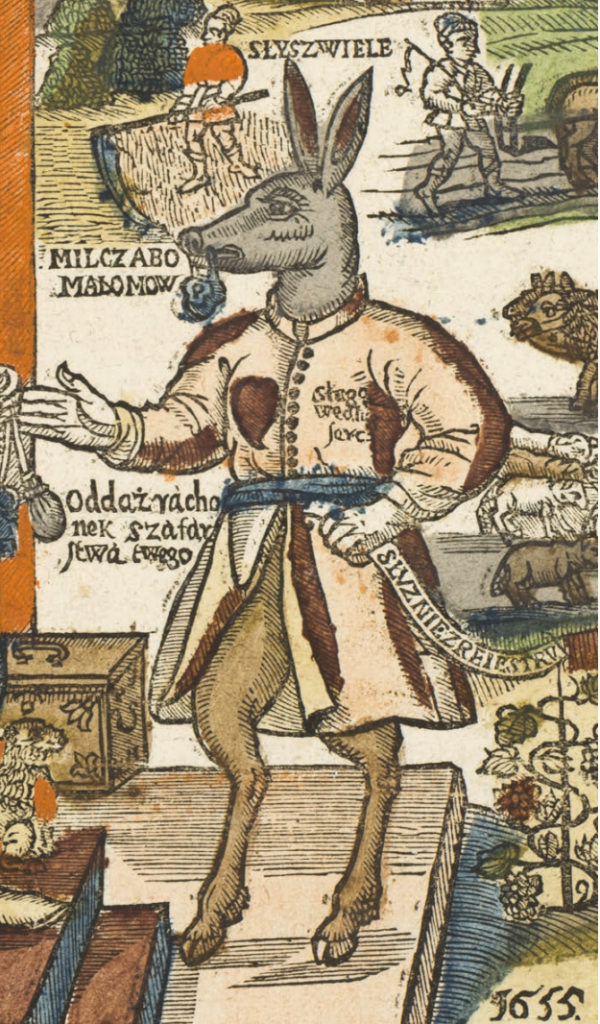
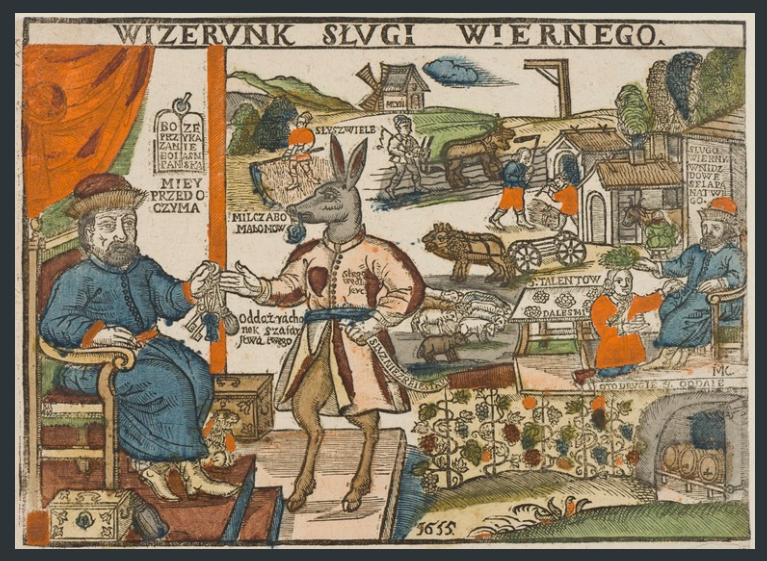
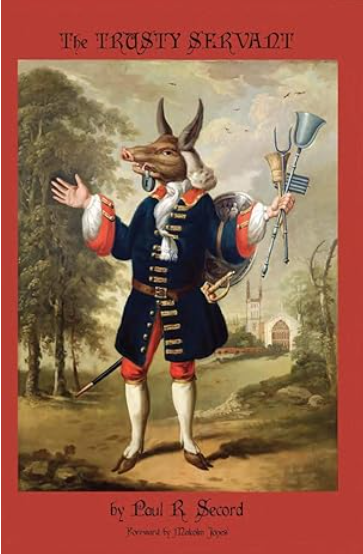
The Winchester College figure had already been repainted three times by the time of our earliest image of it drawn in 1644 (above), and has been repainted numerous times since. Its current appearance may be seen here on the cover of the most recent book on the subject by Paul Secord.
Leave a Reply