Never mind online-dating, what better way of securing a spouse than knocking her/him out of a tree with a stick?
Before the Albums
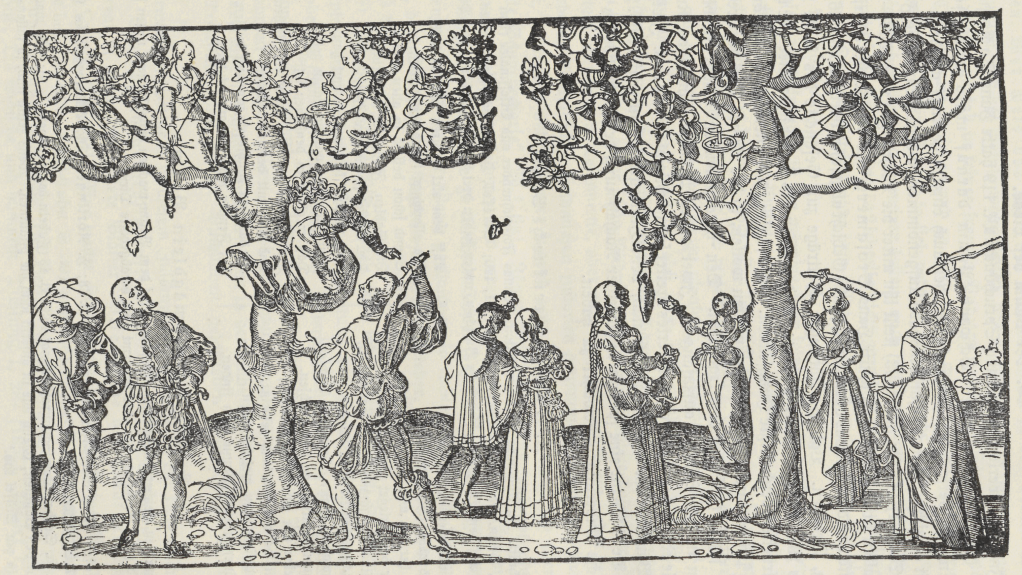
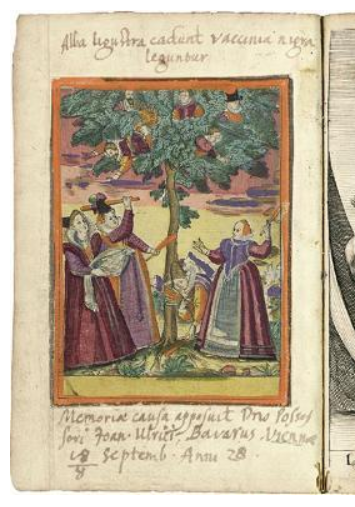
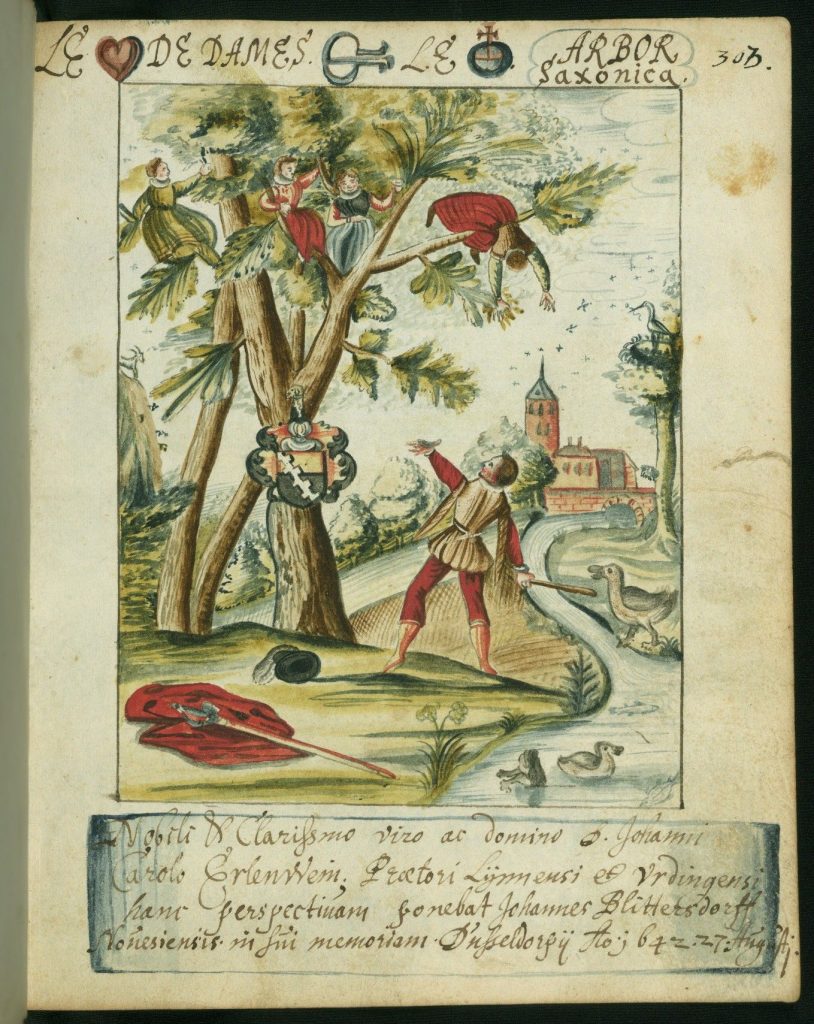
Like a boy throwing sticks into a chestnut tree to bring down the conkers, a man in the Erlenwein album (below) throws sticks into a tree of women to knock down a wife. But the Liebesbaum motif was already well over a century old by this time, the earliest representation known to me being Brosamer’s woodcut illustration to the Sachs poem, Paum darauf Maid und Gsellen wachsen [Tree on which girls and boys grow], published c.1533 (above).
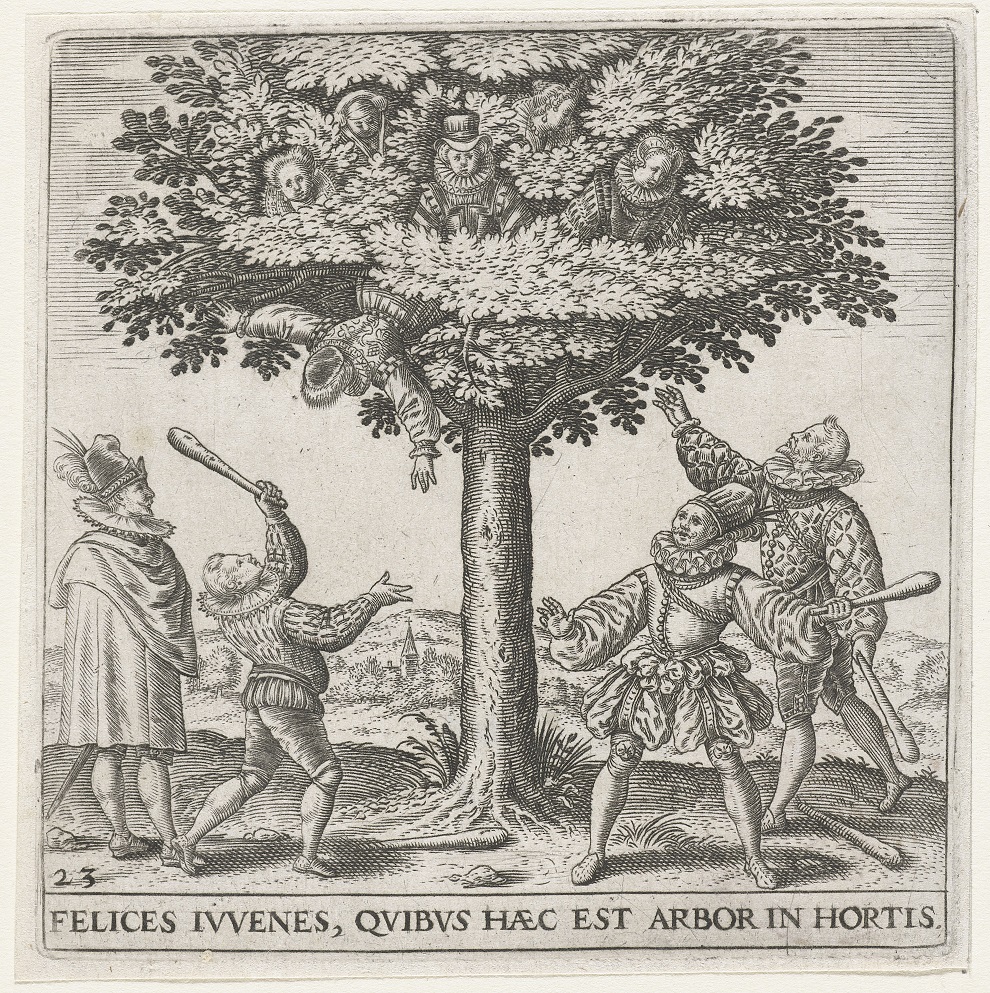
An image of four men throwing sticks up into another such tree populated by young women was one of the emblems in the enormously influential Emblemata Saecularia, engraved and published by the de Brys in 1596 (2nd ed., 1611). The Repertorium Alborum Amicorum notes that a watercolour image painted on f.160r. of the album of Michael Wider (dated entries 1613-21) shows four young men throwing sticks up into a tree from which five women hang like fruits — which sounds exactly like a copy of the de Brys’ engraving.
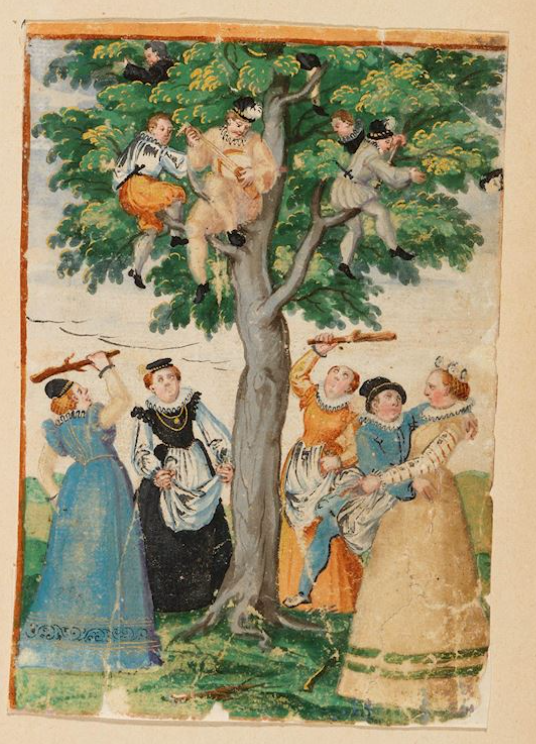
This now orphaned album leaf in the Frommann collection dated [15]98 is known to have come from the dismembered album of Seifrid von Gall zu Gallenstein and depicts the reverse situation with three young women throwing
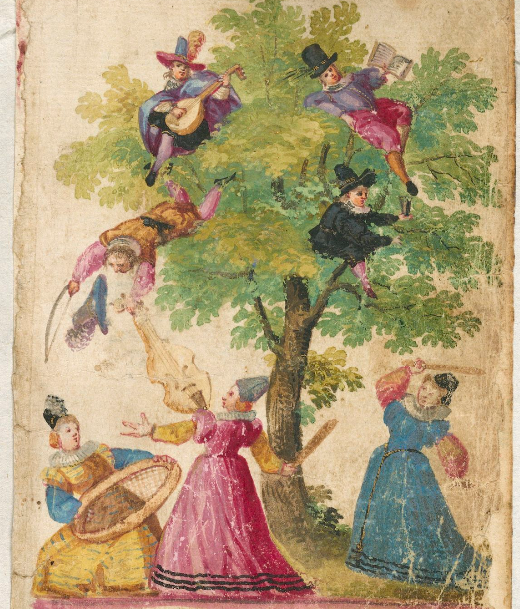
sticks into a tree of young men, one of whom is falling out of the tree, having dropped his cello (but still holding onto the bow) – his fall will be broken by a sieve held by one of the women.
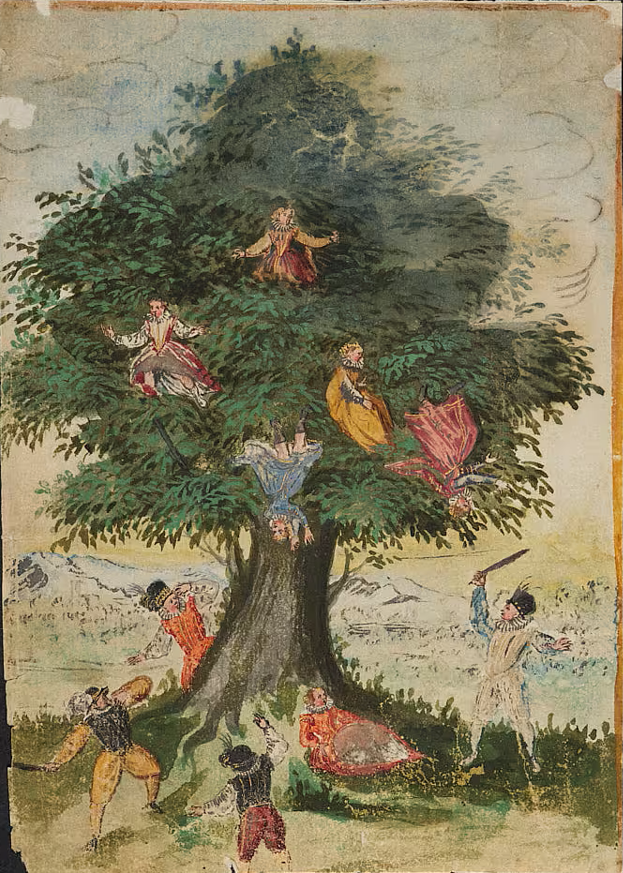
Another orphaned leaf described in the du Rosey sale catalogue (Weigel, Leipzig, 1864, lot 194) was painted with an archer aiming his bow at the uplifted skirts of a girl standing at the top of a tree, captioned
Spannen und winden soll mich nicht verdrissen
Mocht ich diesen Vogel von bome schiessen
Drawing and tensing (my bow)won’t bother me If I can shoot this bird out of the tree
Though not found so often in the albums, several prints of both husband and wife trees were issued throughout the seventeenth century. One was pasted into the album of Matthias Egger (dated entries 1618-30). It was presumably cut from a rare print-book, the STAM VND WAPENBVCHLI issued by Bussemacher in Koln in 1600, as are many other illustrations in this album — but is clearly a copy in reverse of the de Brys’ cut (see below).
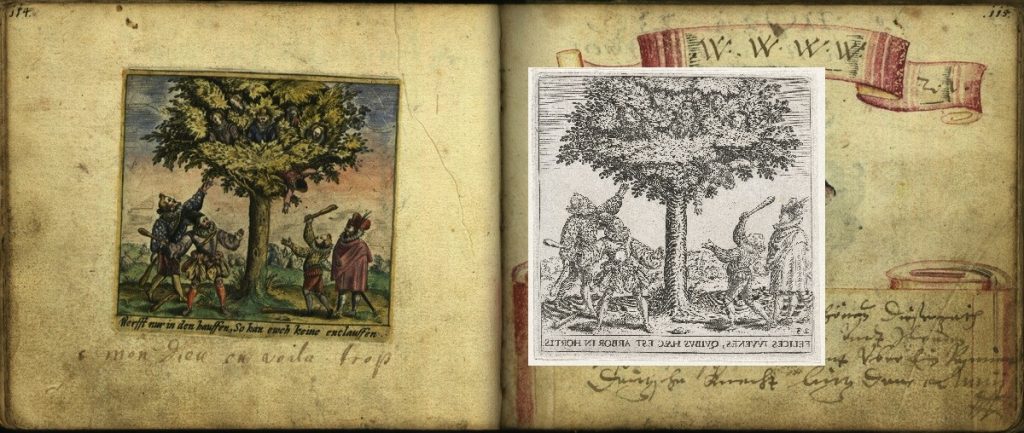
from the album of Matthias Egger, dated entries 1618-30. Prague, Narodni Muzeum, Knihovna, Ms. X G 79 [inset de Bry emblem reversed]
Wolfenbuttel, Herzog August Bibliothek, hab 22.1 geom. (6-29) is an etching of a tree of mainly fool-husbands with captioning verse beginning arbore fatati from a print-book of unknown title.
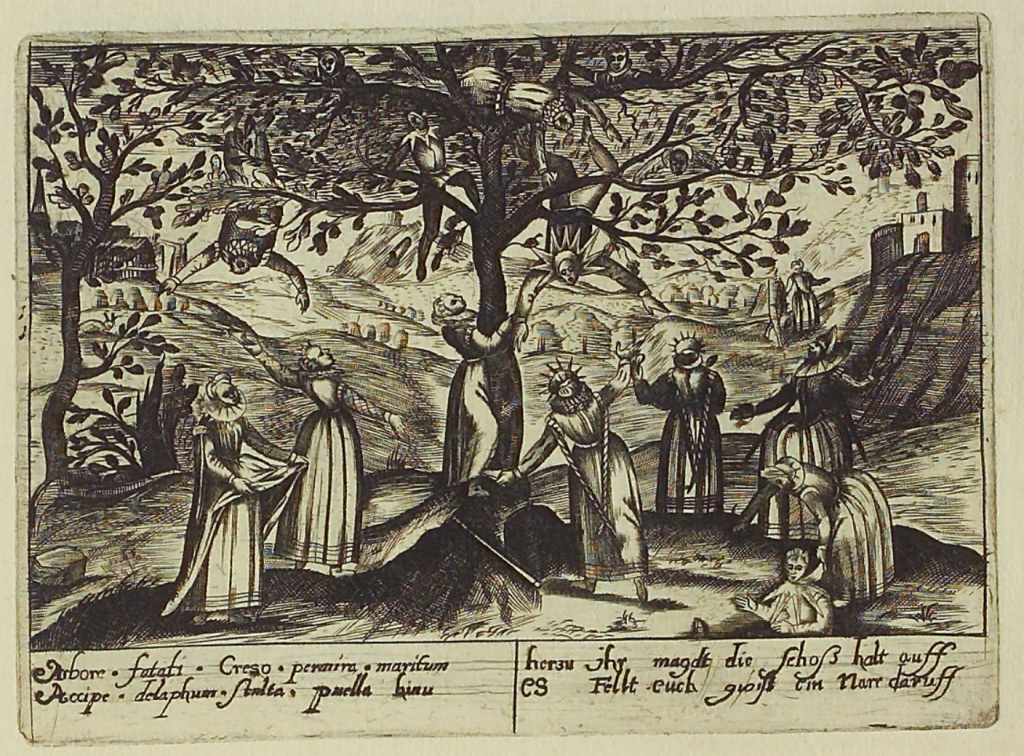
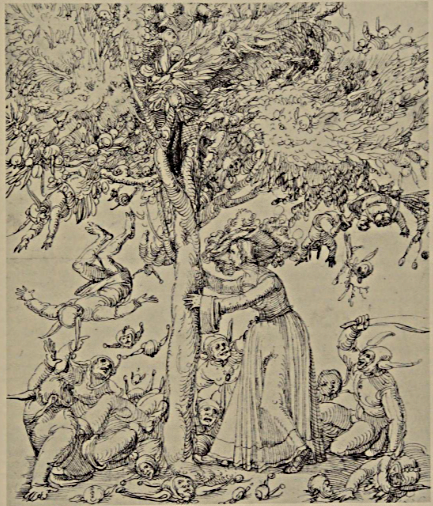
One of the women appears to be shaking the tree. Again we have the RAA to thank for the description of a miniature in the Rosenhane album dated 1593 which shows women shaking admirers down from a tree. There is a somewhat similar drawing of a ‘Tree of Fools’ attributed to Hans Weiditz and dated c.1525 in the Veste Coburg collection — again the woman shakes the tree and fools fall out:
Sometimes the sheets were issued in pairs, such as these published mid-century in Augsburg by Marc Anton Hannas
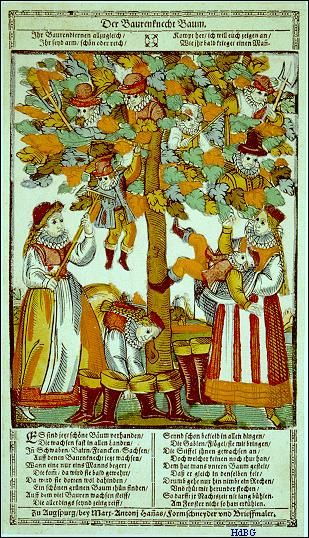
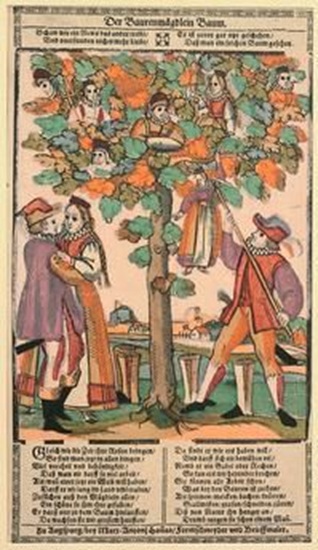
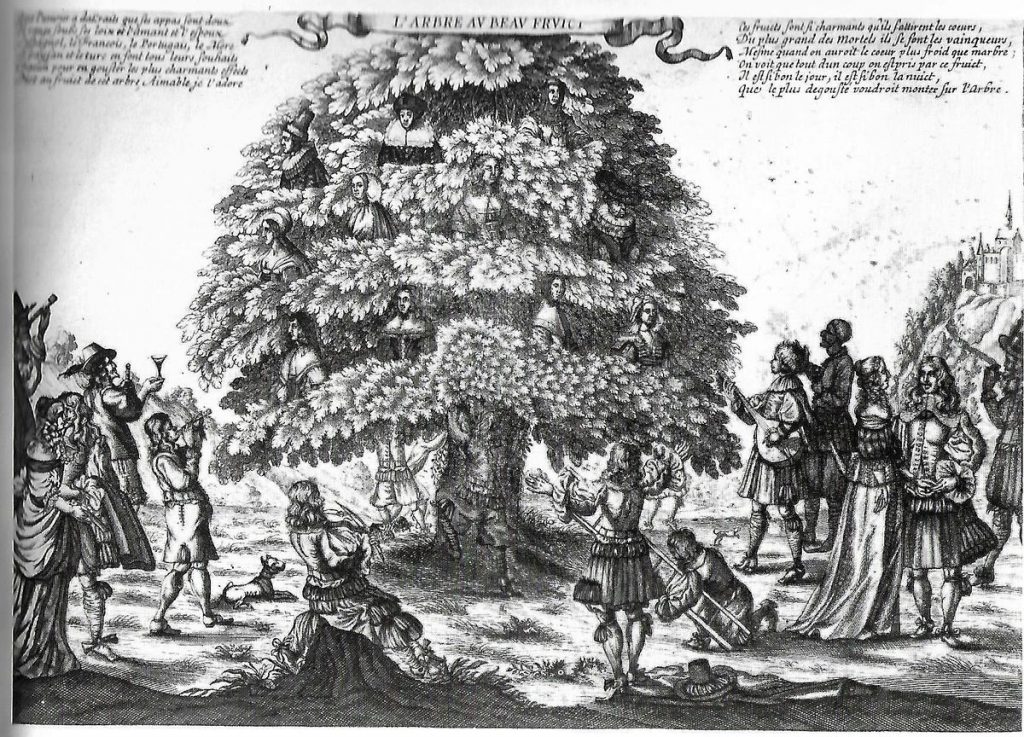
By the second half of the 17C such prints were issued by Paulus Furst in Nurnberg and Gerhard Altzenbach in Köln, and French and Netherlandish examples appear too. Here I add just one French print of ?c.1660 which I have rarely seen reproduced, L’Arbre au Beau Fruict [the Tree of Fine Fruit], the fruit here being both male and female:
On f.131r. of the album of Johann Hermann von Ochsenbach (dated entries 1573-96) is a painting described by the RAA as Spiel mit Kleinwüchsigem in einem Baum und Frauen mit Knüppeln [Game with a dwarf in a tree and women with clubs] — whether this is our motif or not is difficult to say from a mere description. The album is Graz, Steiermärkisches Landesarchiv, Hs. 203.
other media
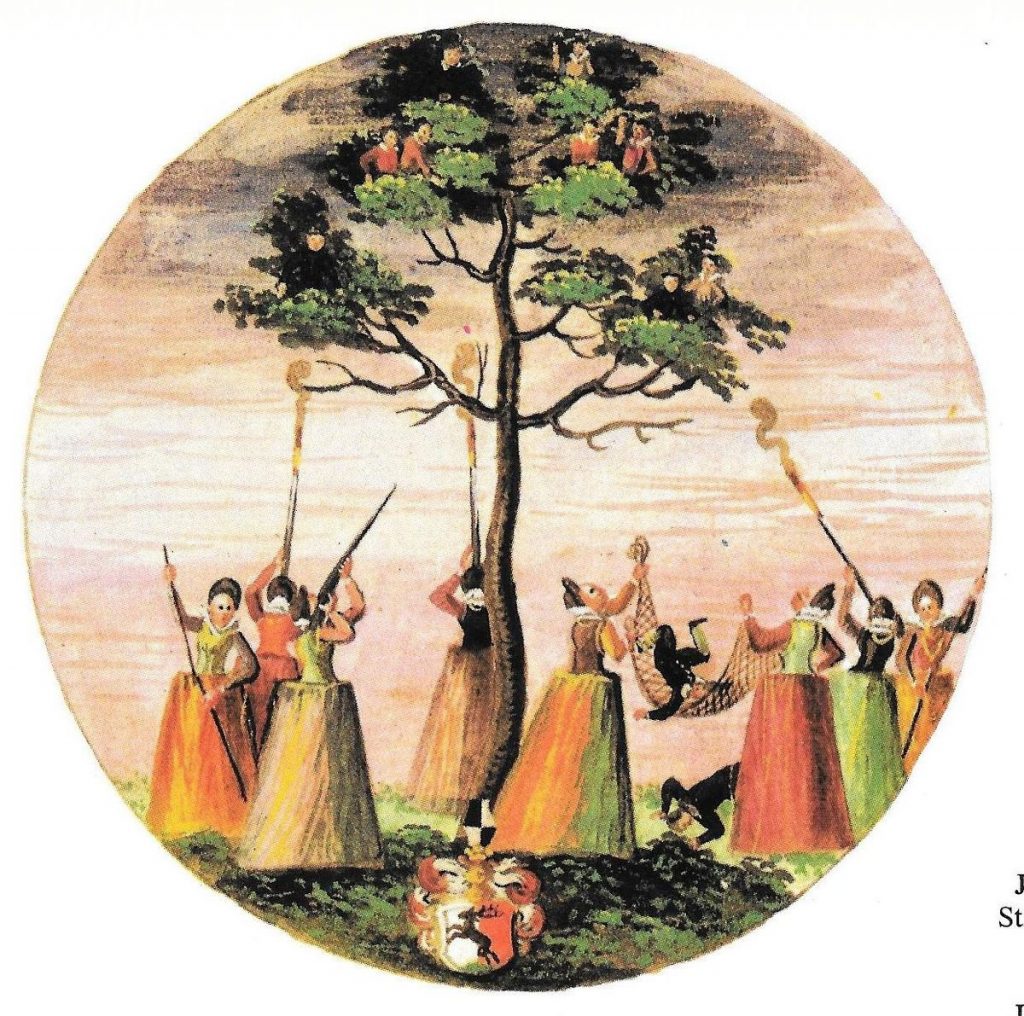
A true sign of the popularity of any motif is that it appears in a variety of media. Here is our motif as the design for an early 17C shooting target in the Coburger Scheibenbuch. As befits such a context, the women are armed with rifles!
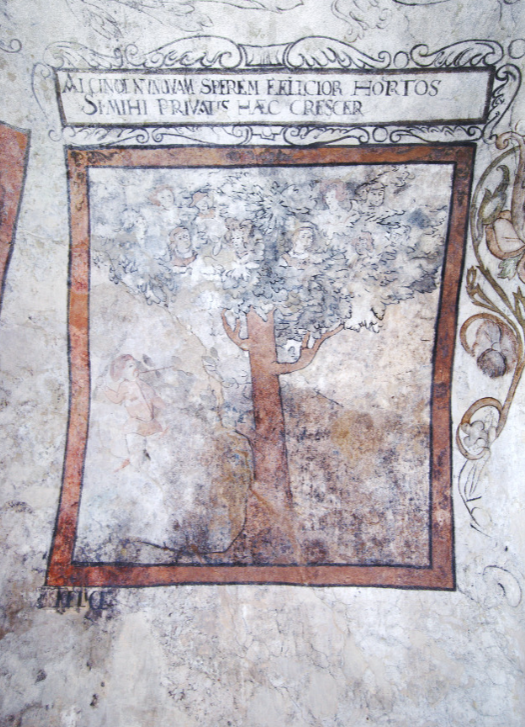
Clearly — like others at the same location — this now damaged 17C mural in Lublin was based on the de Bry engraving:
Aftermath
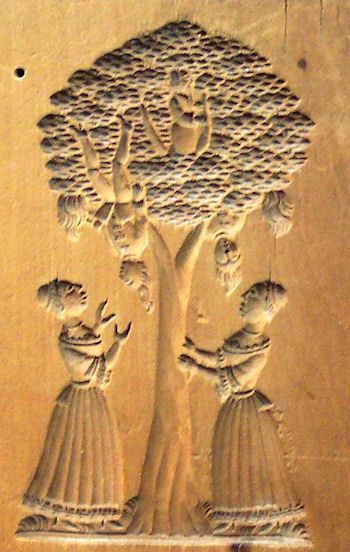
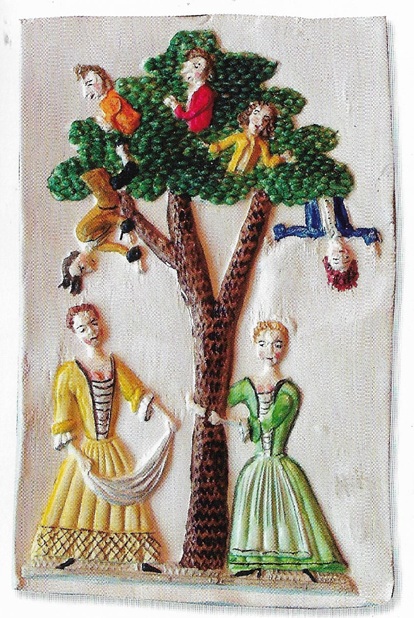
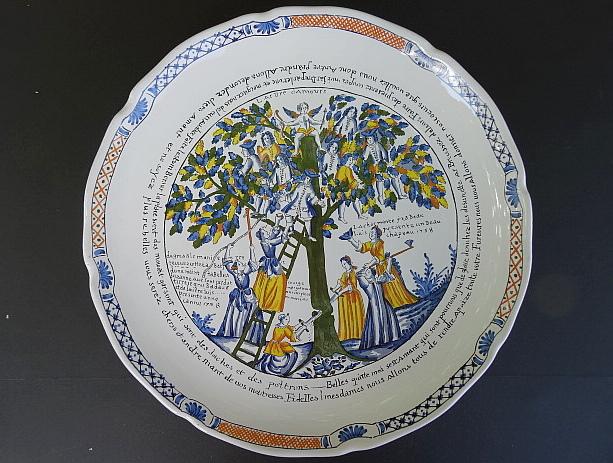
Thereafter, as with so much of this imagery, it survives into later centuries on gingerbread moulds and earthenware plates.
Leave a Reply