I was prompted to write this post by ‘discovering’ the page reproduced below in the album of Thomas Wanderer, painted in 1629 — which I think must be unknown, even to German scholars! Two witches, one naked riding a goat, the other clothed riding a pitch-fork, fly to the summit of a hill (the Braunsberg, according to the trial-testimony excerpted below) near the town of Hainburg-an-der-Donau (on the border between Austria and Slovakia) to rendezvous with a devil. This is clearly connected with the Hainburg witch-trials which took place in November 1617-to April 1618, and again in 1624.
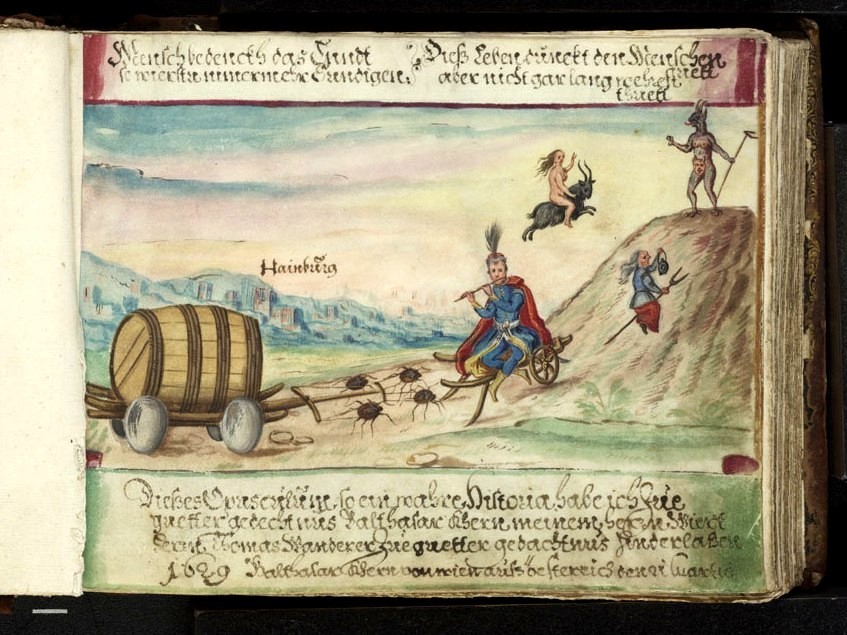
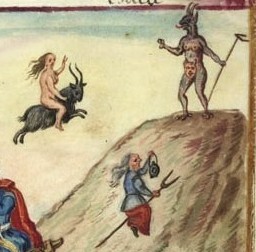
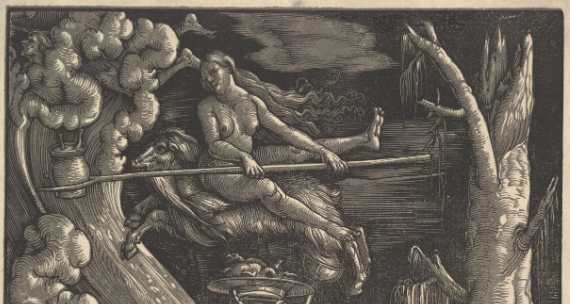
The inscription is conventionally pious — Mensch bedenckh das Enndt / so wierstu nimermehr sundigen [Man, think on the end, so you will never sin again]. The painting is dedicated by one Balthasar Khern who may himself be the artist, referring to the miniature as this little work [Diesses Opuscylum ] and a true story [wahre Historia]. Witches flying on pitch-forks and other sticks are mentioned in the trial-accounts, but not on goats — though this is conventional in art, as in early 16C prints by Durer and Hans Baldung Grien (below), for example:
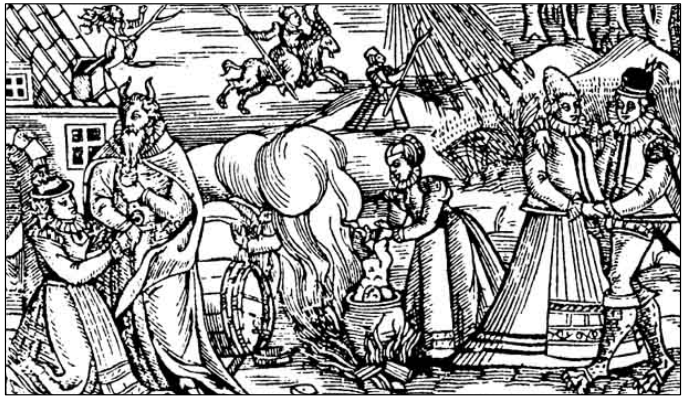
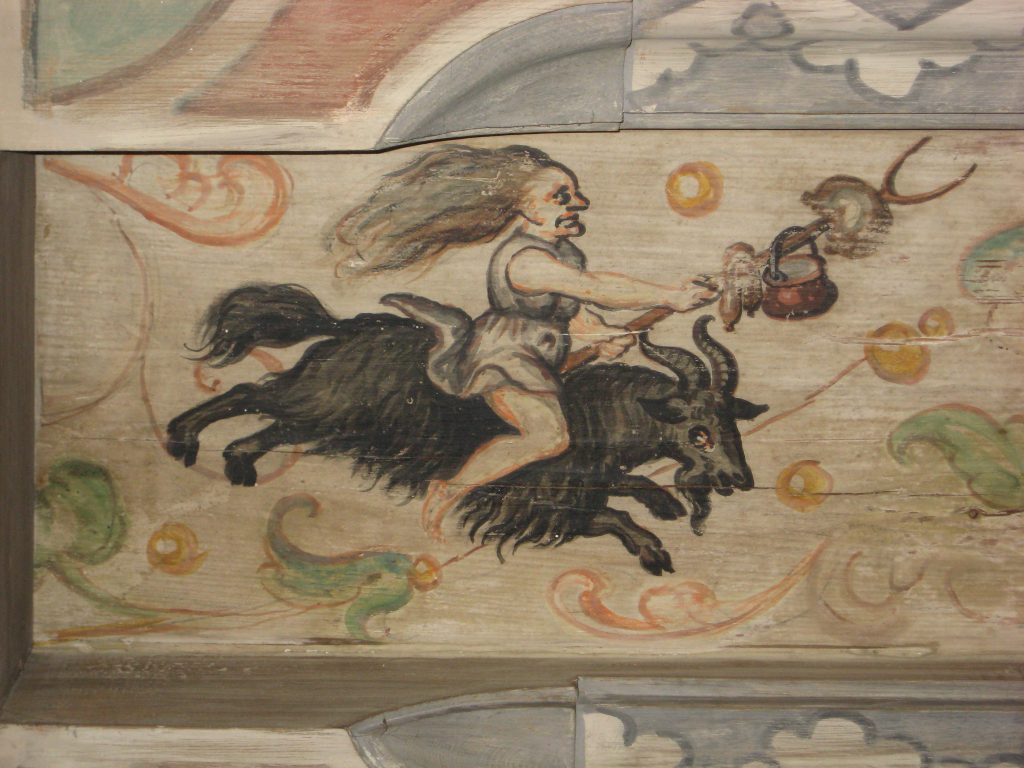
and I can’t resist showing this nice detail from one of the numerous Schnacken originally painted c.1600 on the ceiling of 5, Ausserer Platz, Nurnberg, and now in that city’s Fembohaus museum:
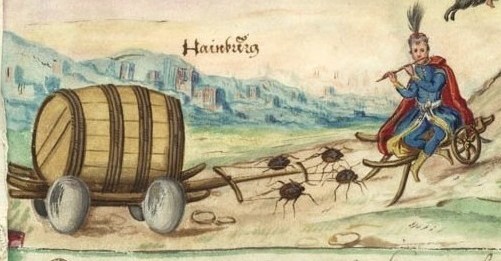
So far, so conventional, then — but what is certainly not conventional is the bizarre scene in the foreground of a man piping, seated on a stationary wheelbarrow, while a large barrel on a waggon is drawn towards him by four spiders. I have found no support for this in any of the Hainburg witch-trial accounts I have read.
I had got this far in my thoughts about this miniature, without the aid of Andreas Müller — who I knew had studied the Hainburg trials for his Master’s thesis, but had been unable to contact, the only email address I had found for him having been bounced back to me as unknown, but thanks to his namesake — of the Philosophy Department of the University of Bern [Cheers, Andreas — couldn’t have done it without you ! ] — and former colleagues, my email eventually reached him — in the Philippines! Ah! The wonders of the Internet! He was as excited as me to see the Wanderer album painting, and immediately scoured his resources, and fired this back (from the records of the 1617/18 trials):
Bekhendt auch, vor ungefähr 9 jahrn haben sy einen vier emer wein zu Hainburg nit weith vom plaz, zauberischer weiß aus einen kheller gezogen und solchen auf den Hainberg geführt mit roß unnd wagen, welches alles also bestelt: unnd geformirt gewest wie hernach beschriben, erstlich vier khreüten zu roß, vier ayer zu redern unnd zween strohalben zu weinpaumben, darauf sy bemelten vier emer wein gelegt unnd hinauf gebracht, welchen sy alda geleüth gebt, aber khain geldt darumben eingenomben. [from the trial testimony of Katharina Teütschmanin — H09 Katharina Teütschmanin 18 – ff. 32r.-25v., Pos. 7]
And Andreas was kind enough to provide an English translation:
“She admits, approximately 9 years ago, she extracted four buckets full of wine in a magical way in Hainburg out of a wine cellar not far from the market-place . This wine she drove up to the Hainberg (mountain) on a horse-drawn cart, which was made according to the following specification: four toads as horses, four eggs as wheels, two hayballs as wine boxes, on this she poured the four buckets of wine and brought it up [to the mountain], which wine she gave to the people but took no money for it.”
There was one detail in this poor, tortured woman’s account that caught my eye. vier ayer zu redern [four eggs as wheels] — this detail of the egg-wheels is a real ‘clincher’ ! I had looked at the wheels on the album-painter’s waggon and thought them merely odd — ovoid, and odd — and put them down to mere ineptness on the part of the painter! But now we have an unequivocal detail that must stem from Katharina Teütschmanin’s, or some similar, oral testimony! Clearly a first-hand reminiscence passed on to the painter, or perhaps familiar to him as being part of the community.
the Witches’ Sabbat
Much more ‘normal’ are depictions of the witches’ sabbat, dancing, feasting and drinking with the devils — though I have noticed only two such representations in the albums to date. This first might perhaps bear some other interpretation, for none of the women are obviously witch-like in appearance, and there are no devils present — witches and devils ride on pitchforks in the sky above the dancers, though, and the dancersd number 13, which may be significant in a witchcraft context (?)
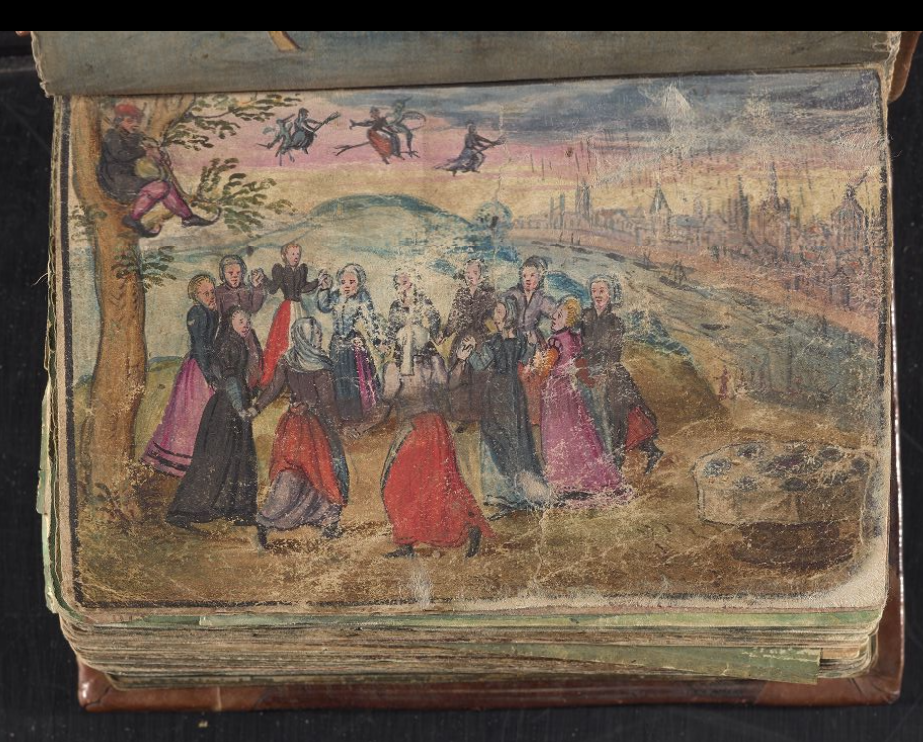
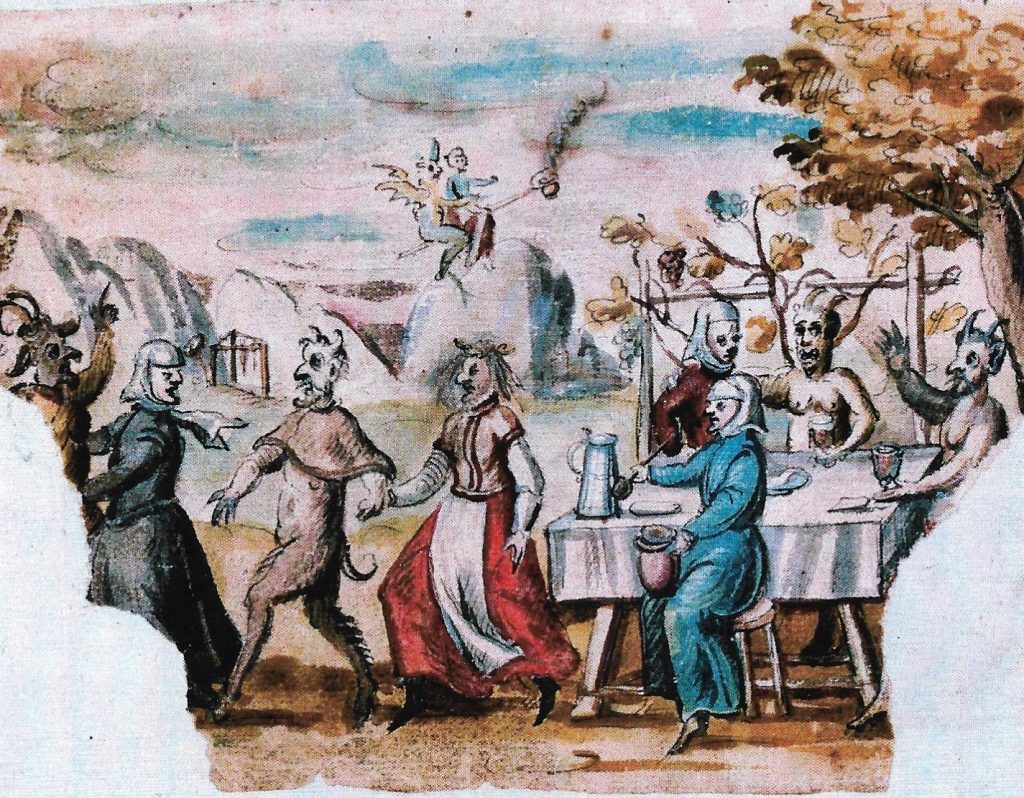
FB 1075 [scanned from Spadafora 2009]
Scottish witches ?
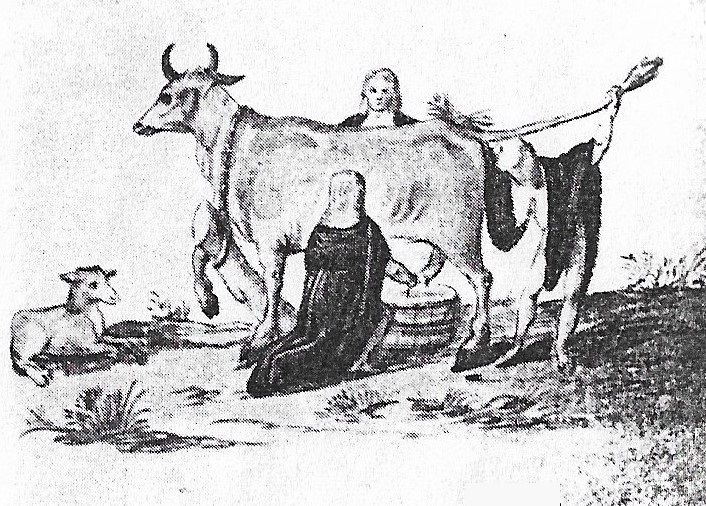
A strange scene in the Giese album appears to show three women milking a cow — now it doesn’t take 3 people to milk a cow, nor is examining its anus a normal part of the process! The miniature was commissioned in 1621 by Scotsman, Francis Gordon [Franciscus Gordonius Scoto-Britannus], so I am suggesting it depicts Scottish witches — already notorious by this date — ritually milking a cow.
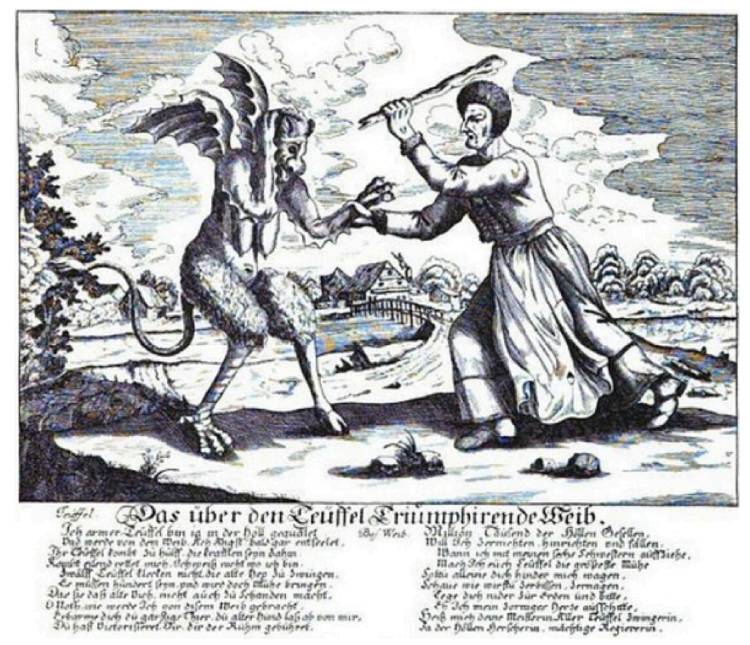
Old Woman too much for Devil
However much belief the early modern man and woman had in the reality of witches and devils, there can be no doubt that in the present, and doubtless misogynist, motif, we are seeing an avowedly fictional (and humorous) encounter.
The locus classicus — print-wise — is the frequently reproduced Hopfer engraving in which a gang of old women/witches have overpowered the Devil and are currently beating him up while he cries for mercy (next), which I supplement with a contemporary engraving by Binck in which the weapon is that quintessentially female implement, the distaff:
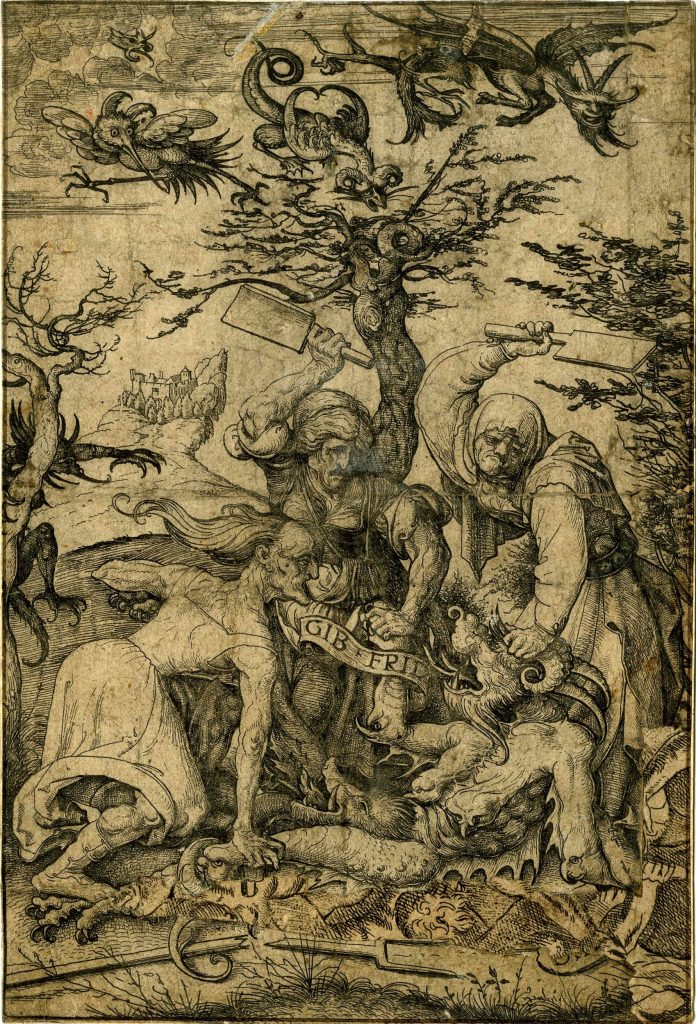
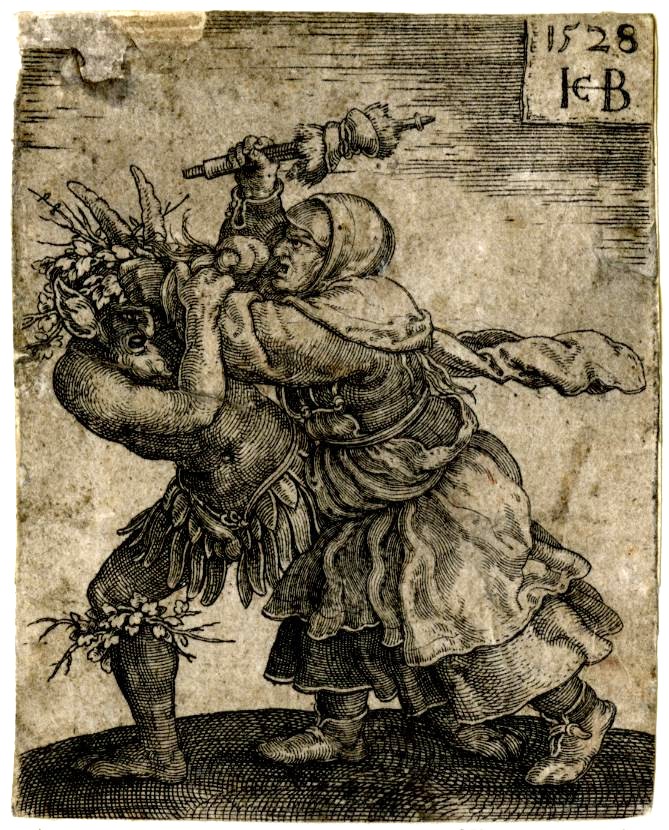
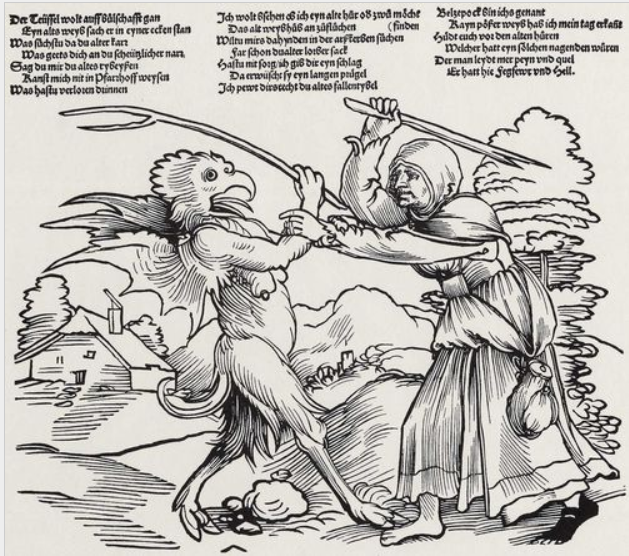
The type certainly continues via the mid 17C print entitled Das über den Teufel Triumphirende Weib
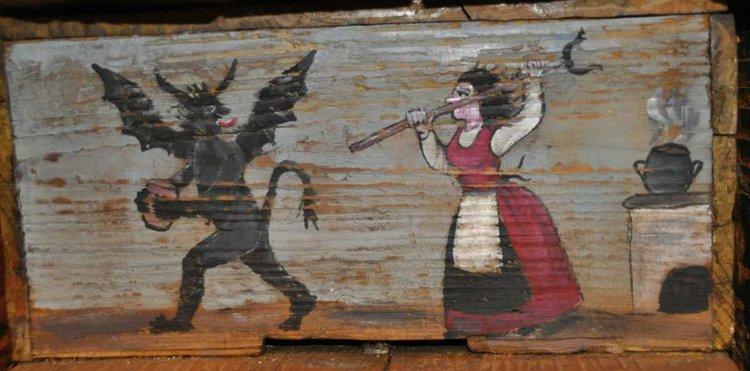
and on into the 19C on this Slovenian beehive board, on which boards so many early modern satirical motifs are preserved.
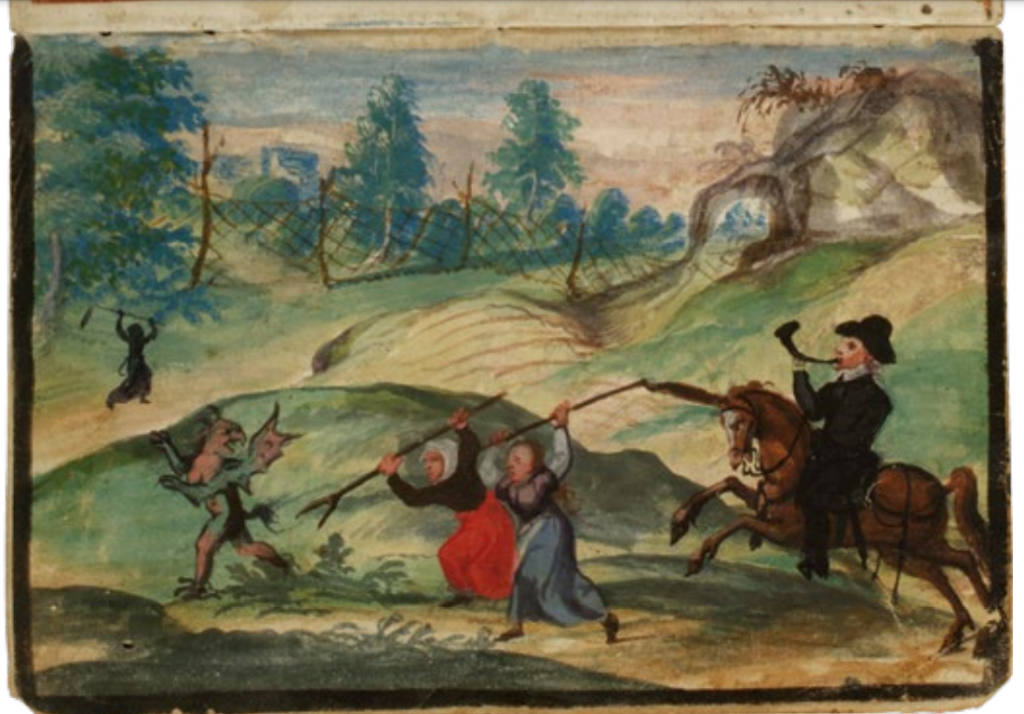
But back to our albums! It would be easy to miss this detail in a miniature painted in the Felber album in 1644:
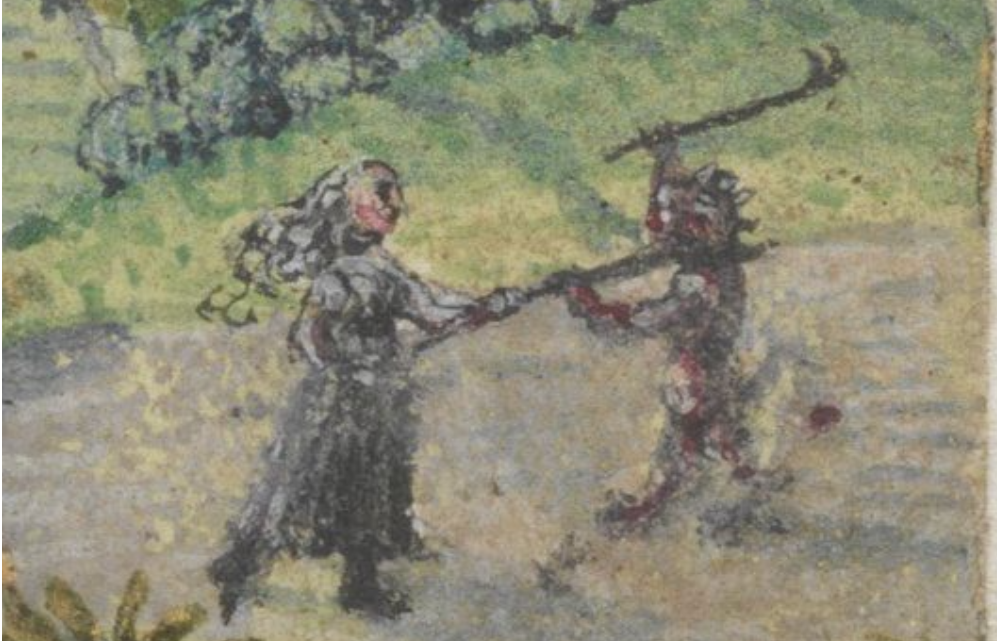
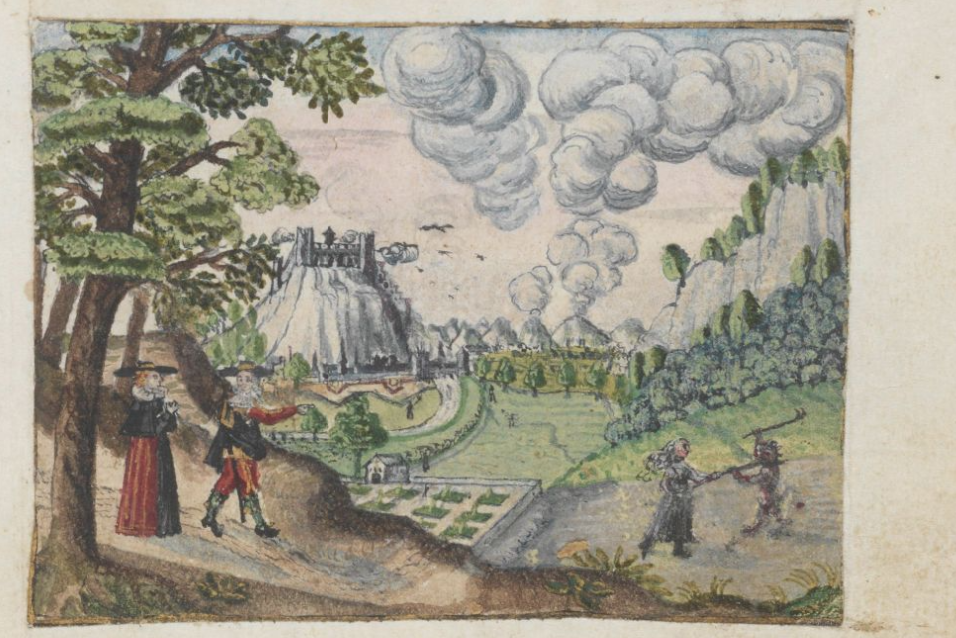
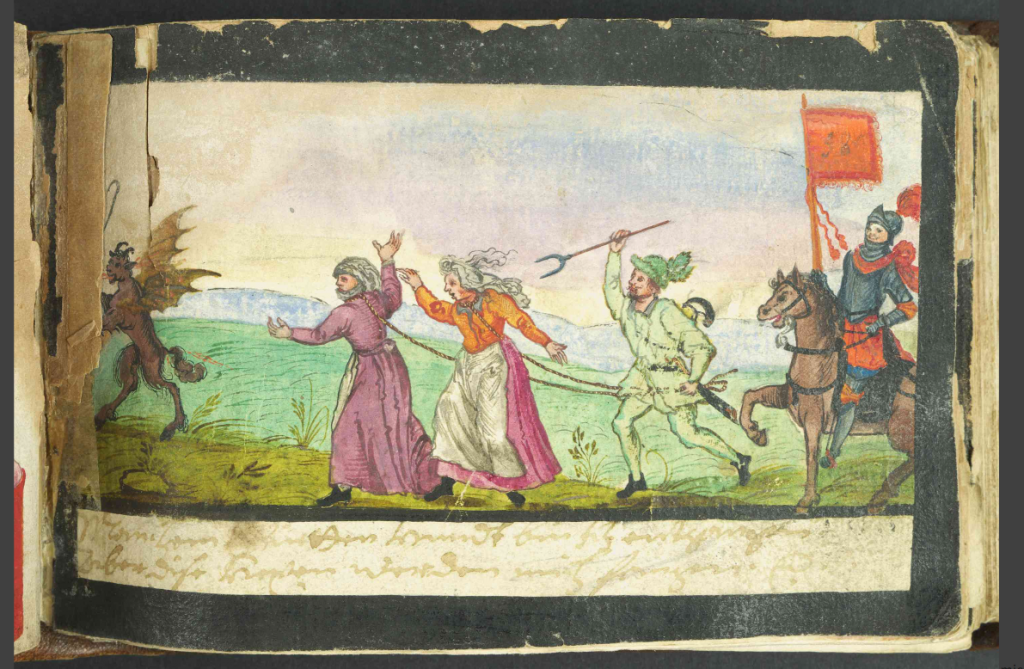
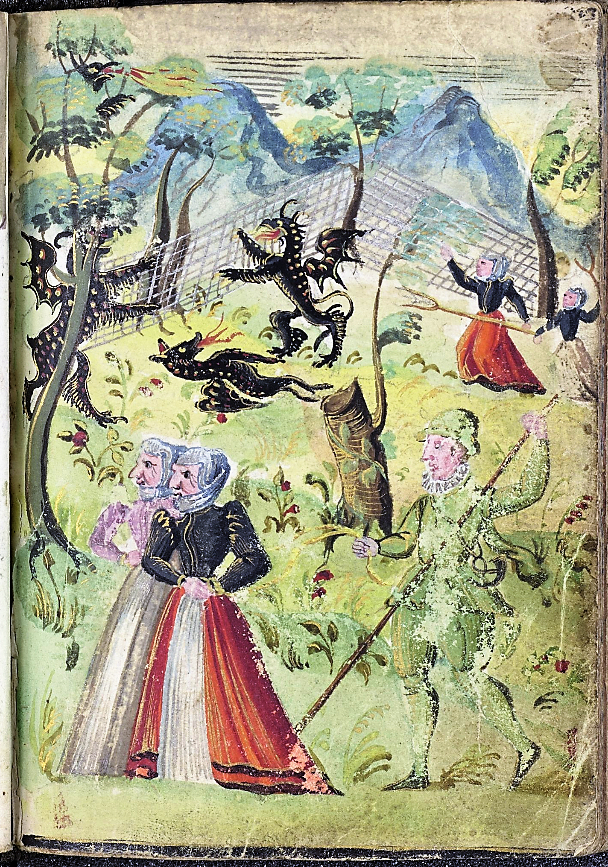
Indeed, so fierce are old women that they are used like hounds by huntsmen to drive the devils into the nets
or even to hunt young desirable women!
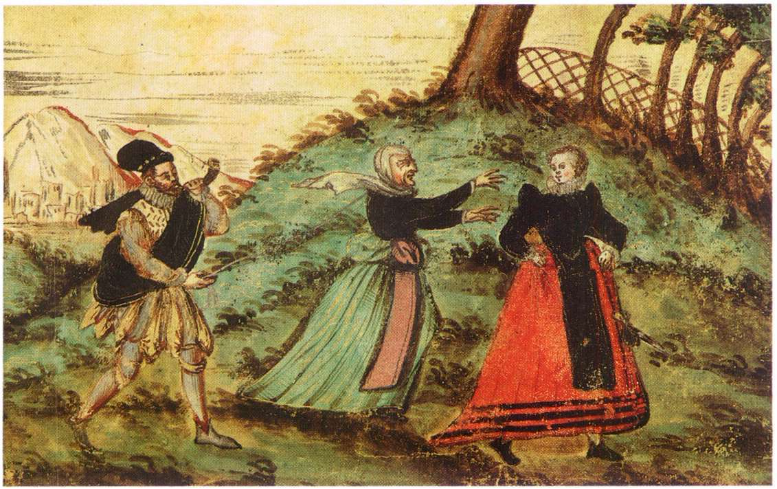
No examples in the albums — but couldn’t resist adding this!
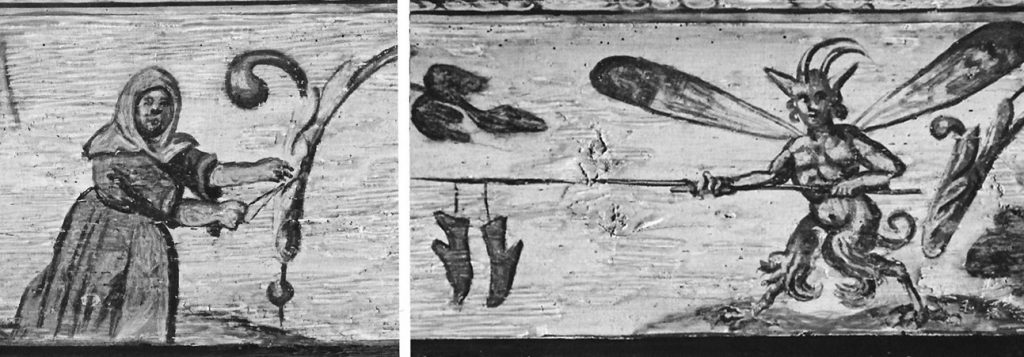
Because it was another popular motif, illustrative of the present subject, but seemingly little-known today. In this tale or exemplum, frustrated at being unable to sow discord between a happily married couple, the Devil enlists the aid of an Old Woman, promising her a pair of shoes if she is successful. When she triumphs easily in this piece of wickedness — that was beyond even the Devil’s capacities — he is obliged to hand over the reward, but is so afraid of her, that he can only proffer the shoes on the end of a stick held out at arm’s length. It was painted in the margin of the very first folio of Jan Olbracht’s Gradual, made for the Polish king c. 1500 — here we see what looks like a single shoe hanging from the point of a ?sword held by a devil with the Old Woman’s hand already grasping it.
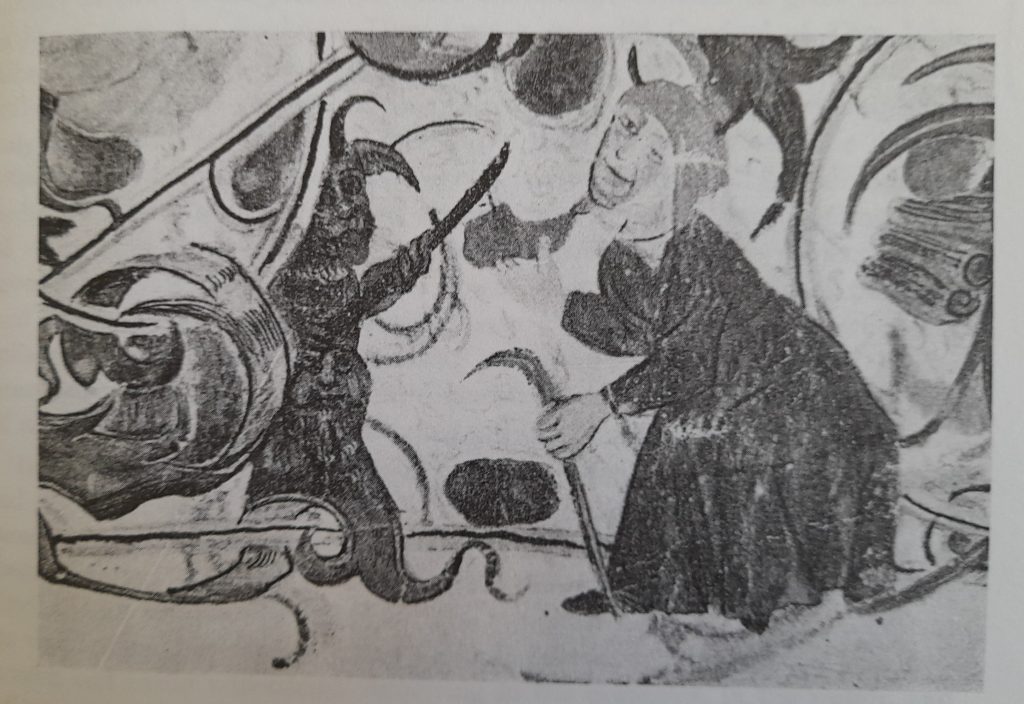
This is the only manuscript example I’m aware of, but there are many examples in Swedish church wall-painting — Odenius counted no fewer than 18 examples of the motif executed between the 1450s and 1520s, suggesting the exemplum must have had some sort of didactic function – perhaps as a pictorial warning to the congregation against the sin of calumny. In the church murals the favoured site is either side of the chancel arch, visually emphasising the distance the Devil is anxious to keep keep from the Old Woman!
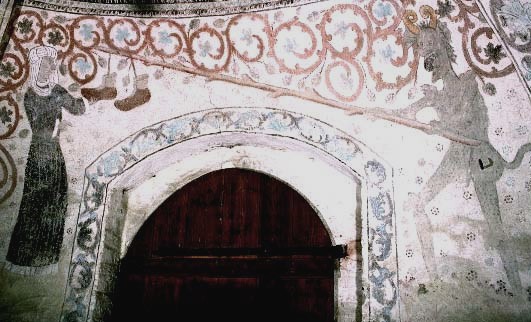
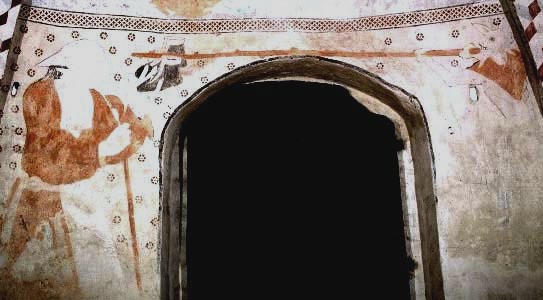
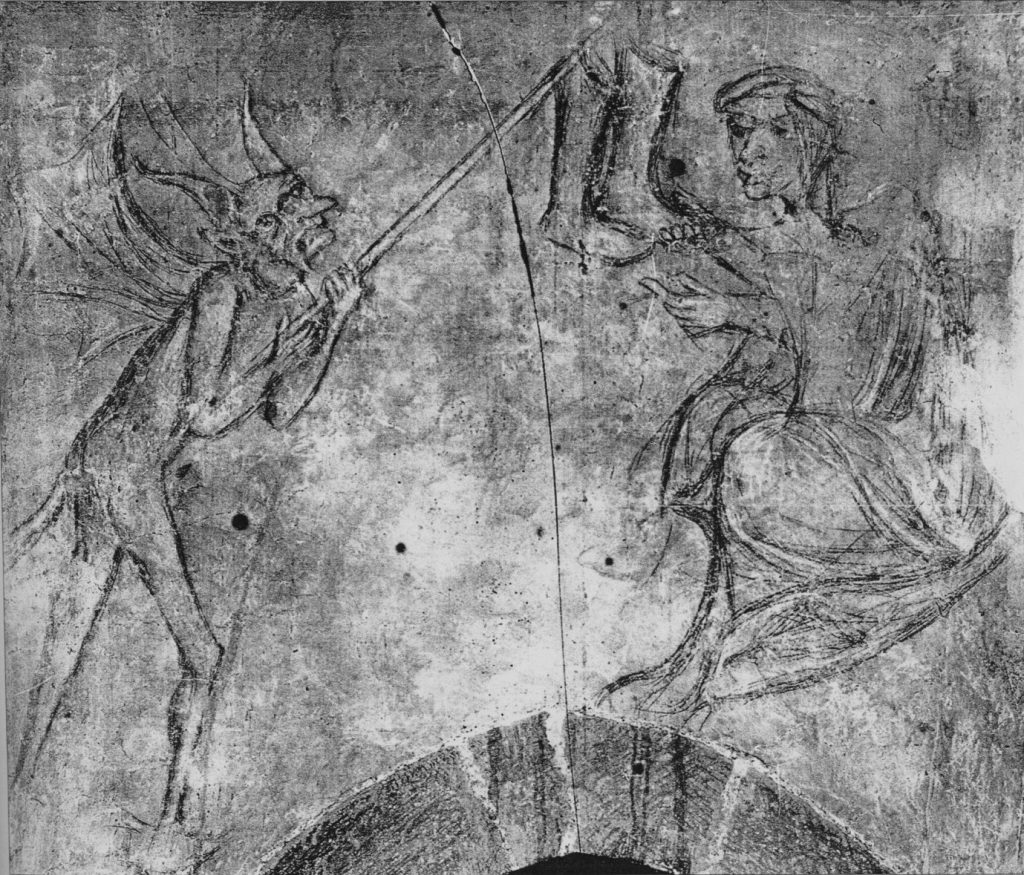
But there are examples in Czechia too. Jan Dienstbier recently identified one in the Castle at Zirovnice painted in the 1490s, but the earliest known example of the motif in any medium is in the church at Libis, painted in 1390:
And lastly, another Polish example, one of the numerous Schnacken painted on the ceiling of the house, Under the Golden Sun, Rynek 6, in the Market Square, Wroclaw, c.1600, contemporary with and stylistically very similar to the Nurnberg painted ceiling now preserved in that city’s Fembohaus museum [SEE goat-riding witch ABOVE]..
Devilish goings-on
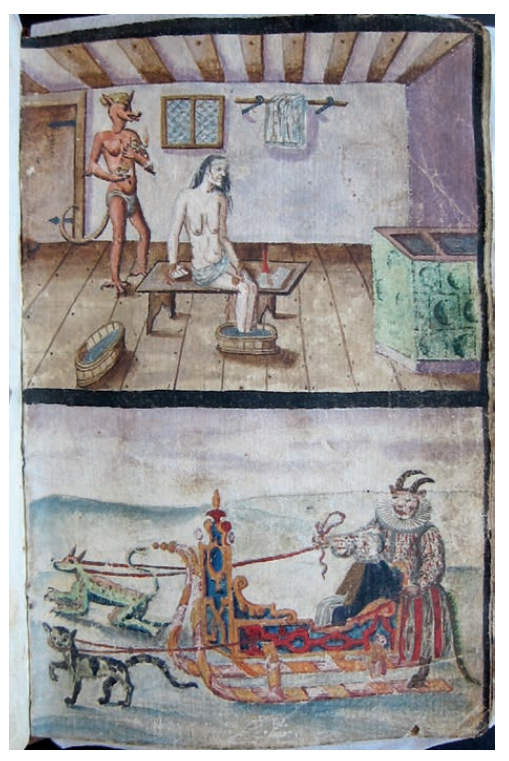
The Van Damm album includes several sinister scenes involving demons of various sorts — on one page, a horned devil wearing a ruff drives a sleigh drawn by a cat and dog (?), and in a separate scene set in a bath-house, a devilish long-tailed bath-attendant looms behind an old woman who sits bathing her feet in a tub of presumably warm water heated by the Kachelofen in front of her. On another page, this mysterious scene:
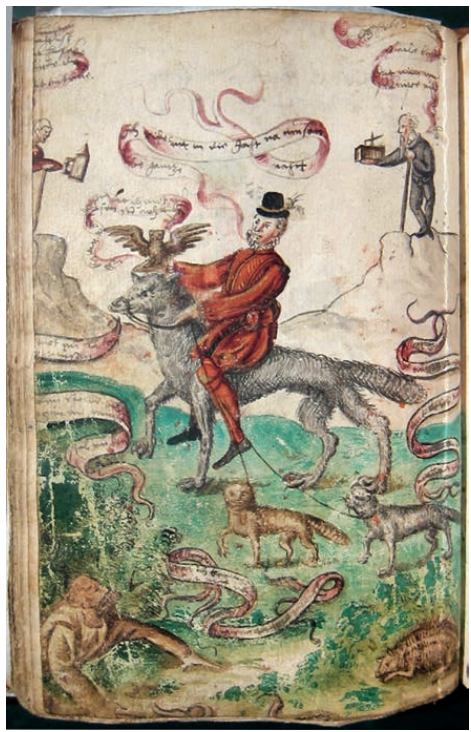
A young man rides a wolf, has an owl hawk-like on his right hand and has two cats on leashes. A monk (?) watches him (bottom left), while in the distance on opposite montainous crags, an old woman holds out a lantern, and an old man facing her, holds out a mouse-trap. The various banderoles are almost illegible but Christoph Gasser has kindly managed to make out the words spoken by the wolf-rider: Ich reidt mit in die Ja[c]ht na[ch] m[e]usen die ganze nahct [I ride along on the hunt for mice all night long] This fits with the presence of the mouse-trap in the old man’s hand and with the owl and cats, both of which prey on mice — or is this a heavily disguised sexual reference. with which we might compare Lady Capulet’s remark alluding to her husband’s past amorous adventures: Ay, you have been a mousehunt in your time [Romeo & Juliet, act IV, scene iv] ?
Protective measures
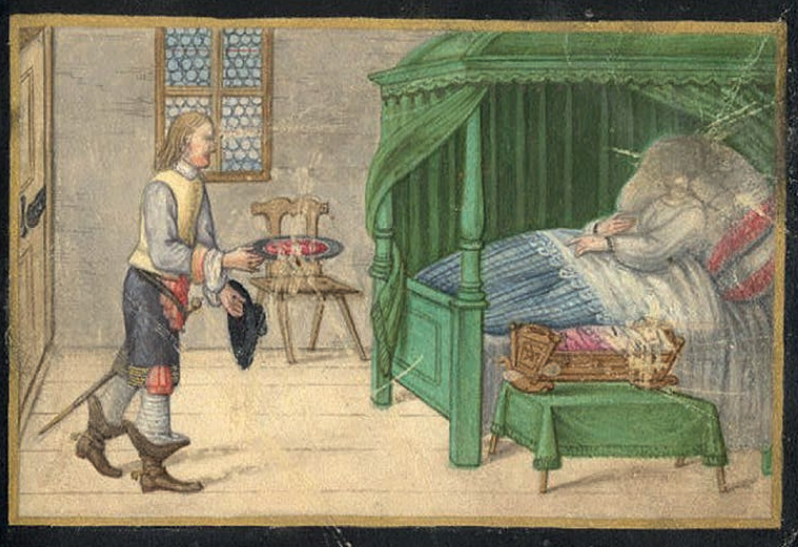
One of the many valuable insights the albums afford us is a glimpse into everyday life. During the witchcraft panics what protective measures could ordinary men and women take? The sign of the cross, of course, was regarded as protective and yet I have never noticed it painted or carved on the baby’s cradle — instead, the pentangle was the preferred apotropaion. Towards the end of our period, I happened to spot the device protecting the baby’s cradle painted in one of the few albums kept by a female owner, Anna Maria von Flachsland:
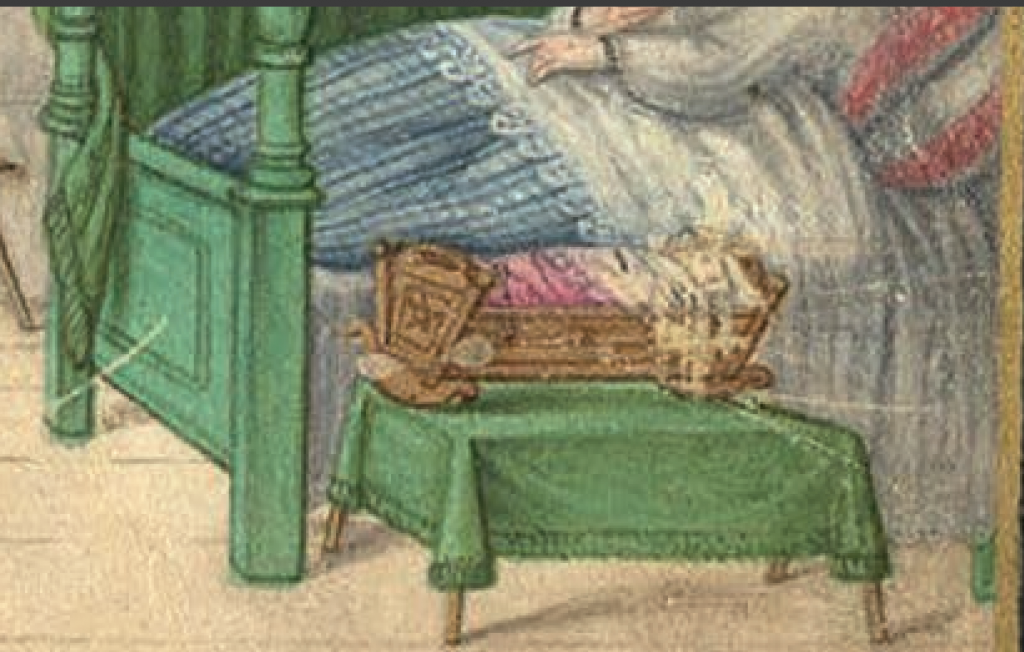
The proud father brings his recently delivered wife some nourishment while the baby sleeps in its cradle, poised — somewhat precariously one might think! — on a low table beside the bed.
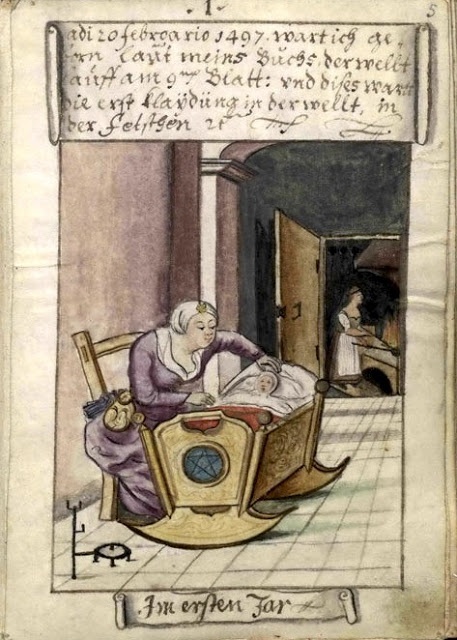
Here’s a small collection of cradles protected with the device, beginning with a page from the wonderful 16C Trachtenbuch of Matthäus Schwarz, depicting baby Matthäus in his cradle at one year old in 1497
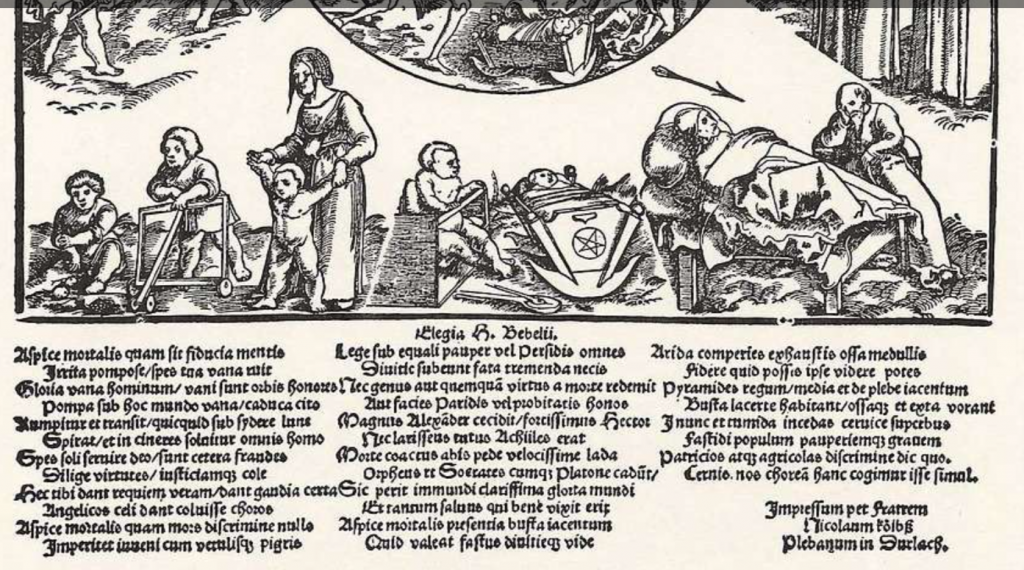
and here as one of the stages of human life on the print engraved by Hans Schaufelein in 1517 as a memorial to the recently deceased Heinrich Bebel
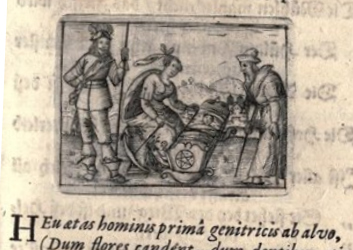
and in the same stages of human life context, from an emblem-book published in 1653
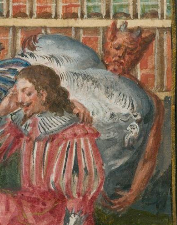
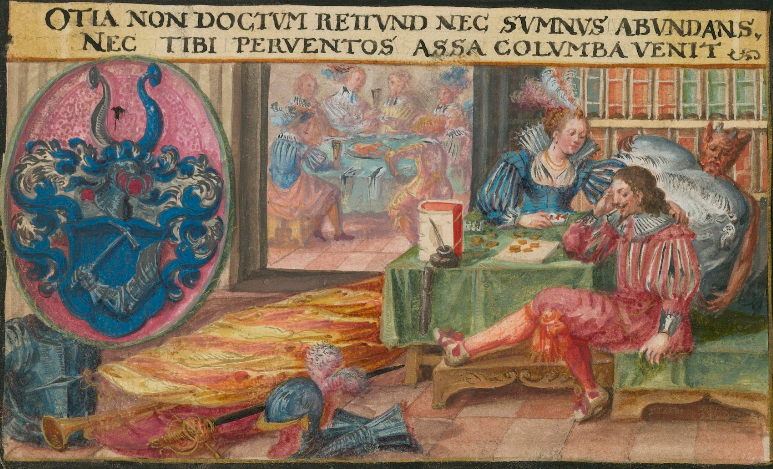
Idleness is the Devil’s cushion — a pictorialised proverb
I close this post — for the moment — with this pictorialised proverb
[for others, see my post https://albumamicorumear-e4qvahs764.live-website.com/pictorialised-proverbs/ ]
This proverb is found in various European vernaculars — my sub-heading is the usual English form. Here, the painter, who perhaps did not quite understand the Latin, has captioned the scene with a traditional couplet, but the 4th word should be REDDVNT and PER VENTOS is 2 words! It means “Laziness and too much sleep do not make one learned / nor will the winds bring a roast dove to you” — unless you live in Schlaraffenland /Cocagne, of course, where sleeping is paid by the hour, and ready-roasted birds fly into your mouth! The couplet, unillustrated, is found much earlier written into the album of Johann Jakob von Staal in 1567.
Ledigheid is des duivels oorkussen
Faulheit ist des Teufels Kopfkissen. EV 5406 : 65 Var
Leave a Reply