The comparison of a woman to a horse — however regrettable we may feel it today — was unexceptional, and unexceptionable, in the early modern era — at least, in the ‘Germanic’ world.
These two also make up two thirds of the triad we have considered in our post
https://albumamicorumear-e4qvahs764.live-website.com/triads-of-one-kind-and-another/
I first gave serious consideration to the matter in my book on early modern English prints, The Print in Early Modern England [Yale UP, 2010 — sadly, no longer ‘available from all good book-sellers’ — not even from bad ones!], so I’m just going to drop a little bit of that text in here
In our post on the
https://albumamicorumear-e4qvahs764.live-website.com/eurowoman-the-17cs-ideal-miss-europe/
in the process of enumerating the features which in our era were said to go to make up the perfect woman — from a male point of view, obviously! — we quoted the text of a German print issued in 1619, entitled Kurtze Beschreibung eines recht schönen jüngen Weibs [Short description of a very beautiful young woman]:
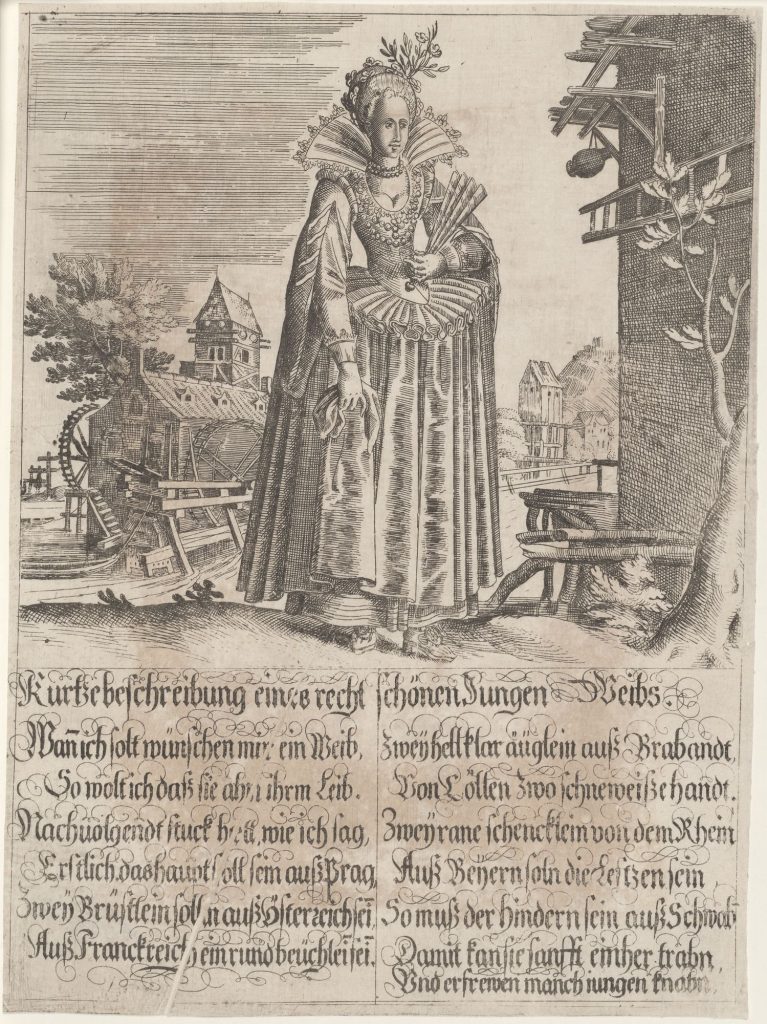
Wann ich solt wünschen mir ein Weib, If I were to wish a woman for myself
So wolt ich daβ sie ahn ihrm Leib I’d want her to have the
Nachvolgendt stuck hett, wie ich sag, following features on her body:
Erstlich: Das Haupt soll sein aüβ Prag, first, her head should be from Prague,
Zweij Brüstlein solln aüβ Österieich [sic] sein. Two little breasts from Austria,
Aüβ franckreich ein rundt bäuchlein fein. a little round belly from France,
Zweij hell klar auglein aüβ Brabandt, two little clear bright eyes from Brabant,
Von Cöllen zwo schneweisse handt. two snow-white hands from Cologne
Zweij rane schencklein von dem Rhein, two slender little thighs from the Rhine
Aüβ Baijern solln die Leftzen sein, her labia* should be from Bavaria
So müβ der Hindern sein aüβ Schwabn, and her behind must be from Swabia
Damit kan sie sanfft einher trabn, so that she can trot along softly
Vnd erfrewen manch jüngen knabn. and delight many a young man.
The comparison suggested with a horse that trots softly in the penultimate line of the above text was also a commonplace, and part of the metaphorics that sees intercourse as riding. It recurs in the text of another illustrated German sheet issued the previous year, entitled, Kurzer vnnd eigentliche Beschreibung deren 16. Eygenschafften welche ein schön vnd wol proportioniertes Pferdt an sich haben sol [Short and true description of the 16 properties that a fine and well-proportioned horse should have].
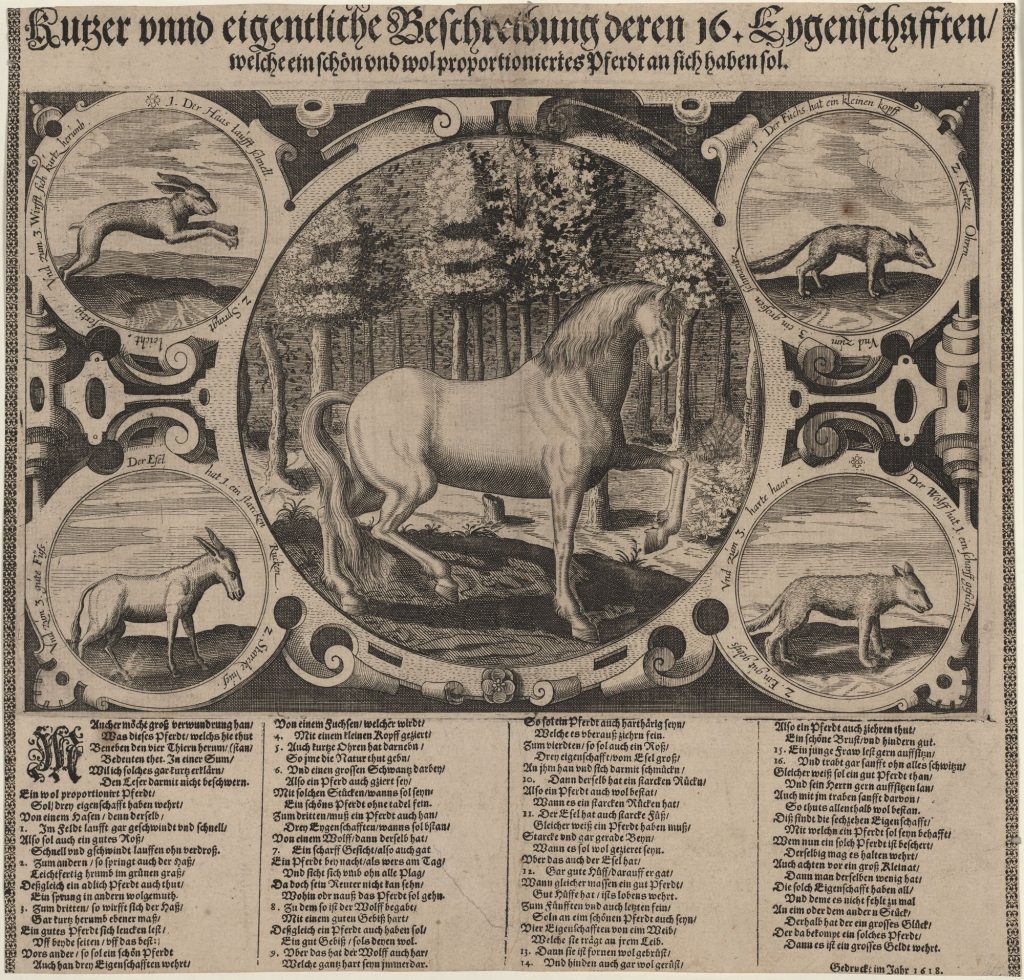
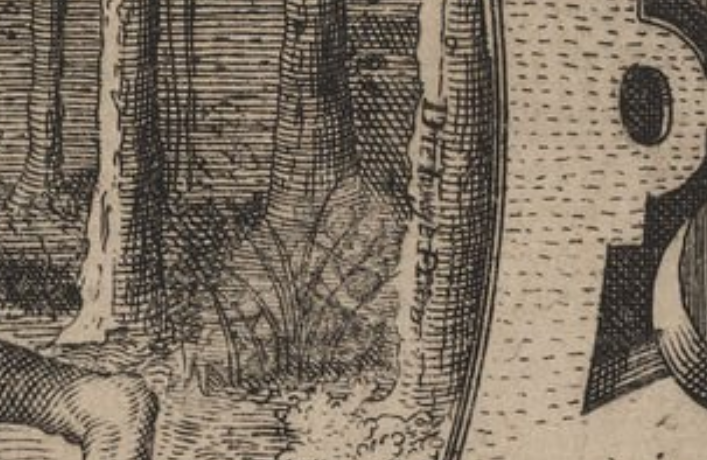
Around the central image of the horse are placed the four animals whose properties it should have, three each from the hare, fox, wolf, and ass. In the woodland that provides a background for the horse, however, is a tiny image of a copulating couple labelled, Die Iunge Fraw [the young woman], the fifth comparandum, who contributes four properties to those of the ideal horse – like her, it should be ‘well-breasted, have a good rump, be good to ‘sit on’, and be able to trot gently without any sweating’.
Another, slightly later, German sheet (1624) is entitled Erklerung, wie ein Pferd vnd ein Frauenperson in vielen Stücken einander gleichen sollen [Explanation how a horse and a woman should resemble each other in many respects — see “Ein Merkspruch von den Kennzeichen eines guten Pferdes” in Mélanges de linguistique et de philologie Fernand Mossé in memoriam (Paris, 1959), 129ff.]
But the comparison was already old and traditional by this date, and well-known in England too, appearing in print as early as the Boke of St. Albans (1486), and in contemporary manuscripts. Here is the version of the xv propreties of a good horse from a manuscript in the Bodleian Library, Oxford [MS. Wood empt. 18, f. 60r.]:
xv propreties of a good horse. scilicet.
Thre of a man. scilicet. bolde. proude. & hardy
Thre of a woman. scilicet. fair brested. fair heir. & easy to lepe on.
Thre of a Foxe. scilicet. fair taile. schort eeres. & a goode trotte
Three of an hair. scilicet. a grete eegh. a dry hede. & well rennyng [hare]
Thre of an Asse. scilicet. a bigge chyne. a flat legge. & goode hoofe [chine]
Other versions substitute different numbers of desirable properties; in the xxv properties, the five that the animal should take after a woman are that it too should be mery of chere, brod-buttokyd, and esy to lep on, good at long-rynnyng, and steryng [stirring] vnder a man. [The xxv properties are listed in London, British Library, Cotton Galba E. ix, f.113v., Sloane MS 1201, f.9r., and Oxford, Balliol College MS 354. f.7r.]
[*In modern German Lefzen is used only of an animal’s lips, e.g. those of a dog, I have suggested the translation ‘labia’ here, as the Bavarian feature, accorded the woman in late fifteenth-century manuscript versions of this verse, is the fut, ‘cunt’, e.g. from cgm 713, f.47r., und ein beirischiu fut dar an ; so too -– if somewhat more euphemistically — in Bebel’s Latin: pudibunda ex Bavaria.]
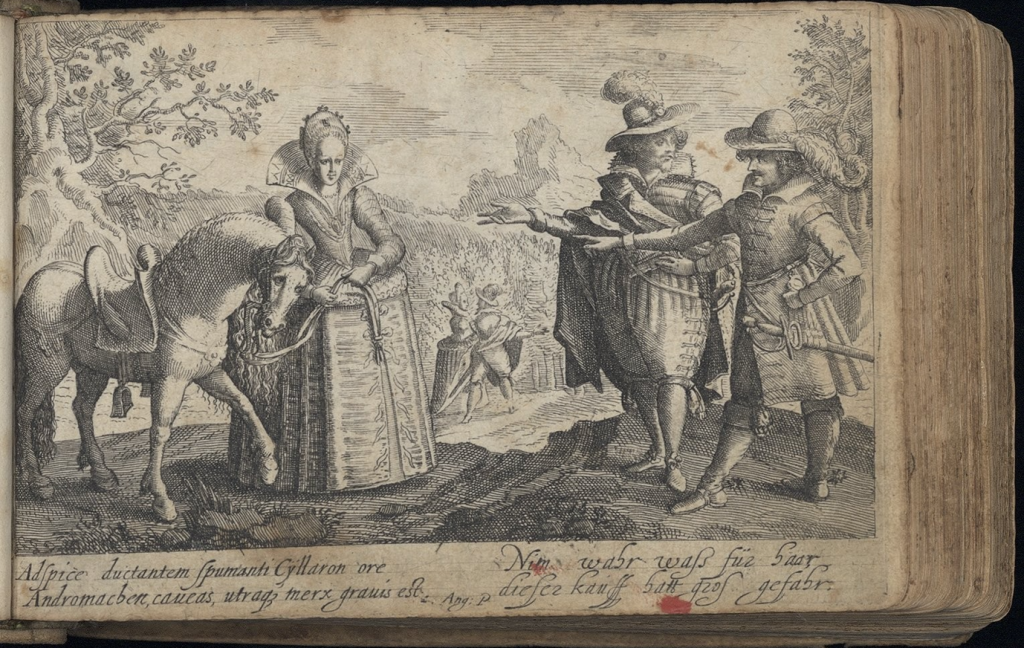
So… where were we? Ah, yes! Here (below) — in the Lilliesparre album — two men pointing at a woman and a horse — but some vandal has cropped the title inscription — which, fortunately, we can restore from the model (see next)
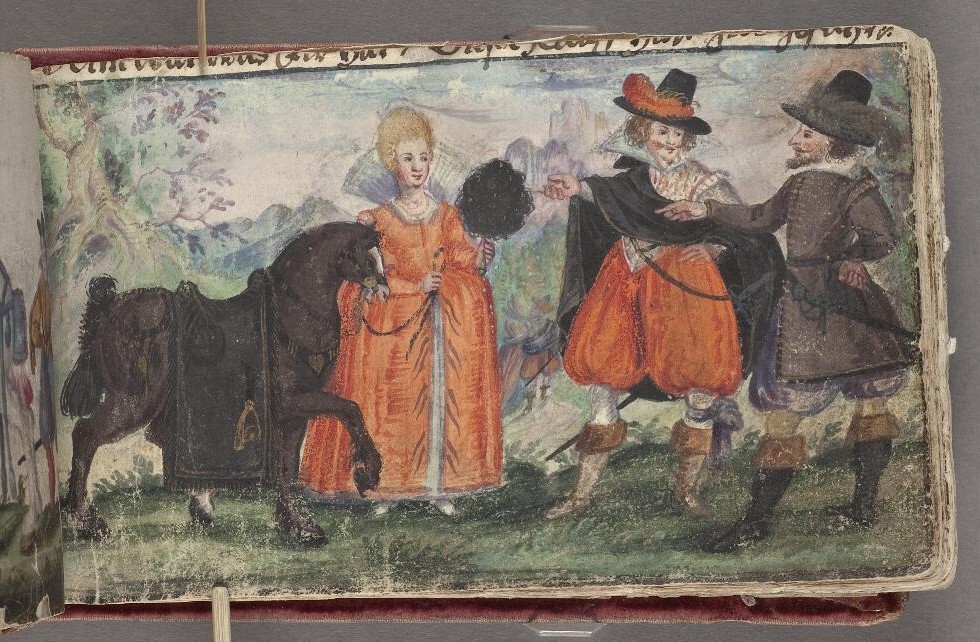
In Andreas Sötzinger’s album several plates from the Pugillus facetiarum (Strasbourg 1608, 1618) have been bound in, one of which is the model for the miniature but retains the couplet cropped by the binder, i.e.
Nim wahr waß für haar
dieser kauff hatt gros gefahr
Note what kind of hair — there’s great danger in this purchase.
Another common form of the rhyme illustrates the traditional prejudice against the red-haired: nimm wahr, was für Haar, ist solches roth, hat groß Gefahr
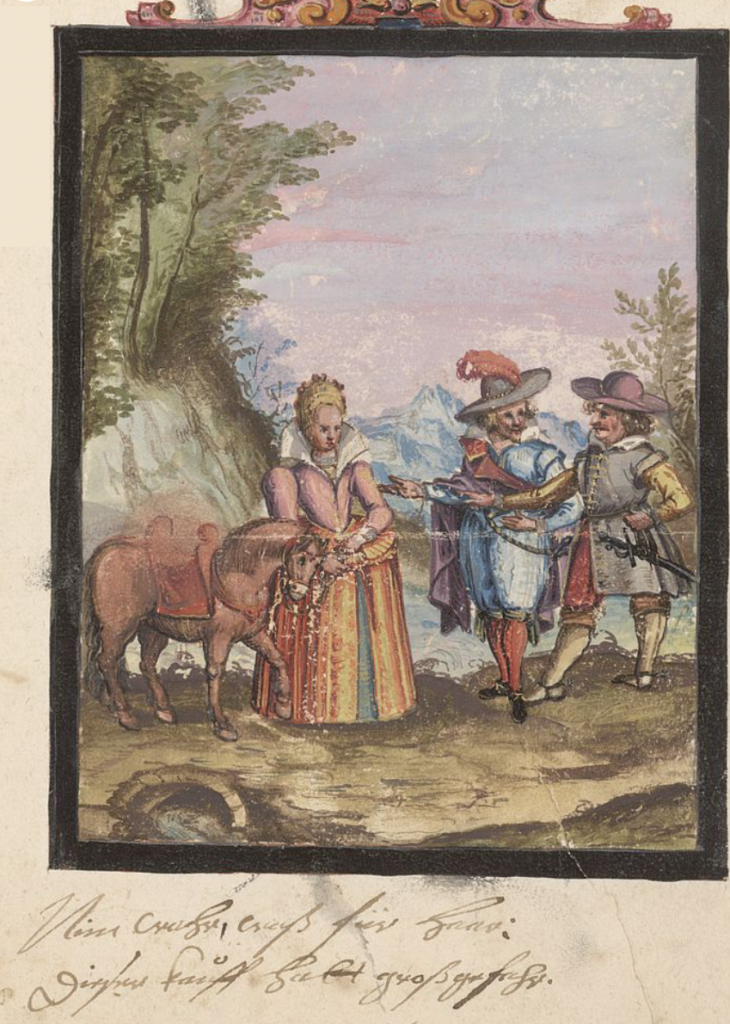
The painter/commissioner of the miniature in the Gastpar album (below) has captioned the scene with the usual German couplet:
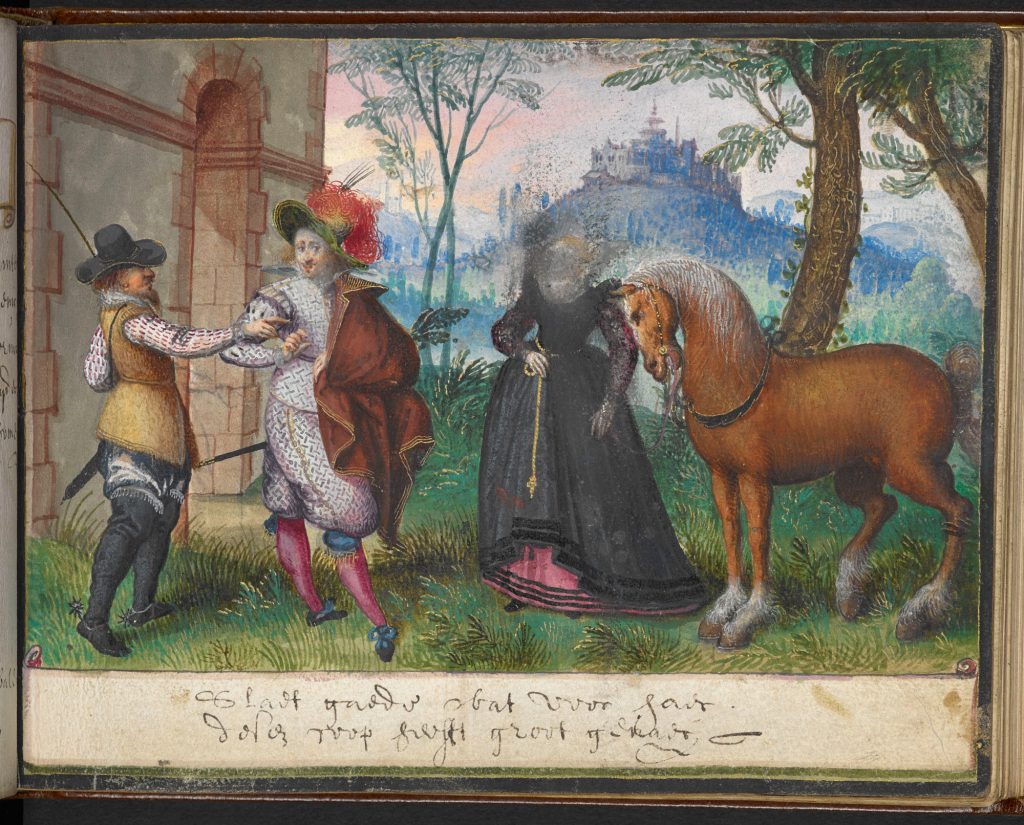
But in the Walens album our scene is captioned with a Dutch version of the couplet — and some later owner has rubbed out the young woman’s head!
A different version
This version shows simply the woman and the horse with no male onlookers — it is labelled with a longer verse, but the above couplet forms the final two lines. The same scene and verse are found in the Rosenhane album, though here dated 1595, and it is that text I give here:
Schone iungfraulein vndtt schone Pferdtt Beautiful girl and beautiful horse
Sein sie guth so sindtt sie lobens werdtt if they are good they are praiseworthy
Sein sie ohne Duecke so ist gros gluck if without defect that is very lucky
Drumb gutt gesell nim war was vur haar But, my friend, take note of the hair
Den dieser Kauff hatt die grost gefhar. Because this purchase is very dangerous
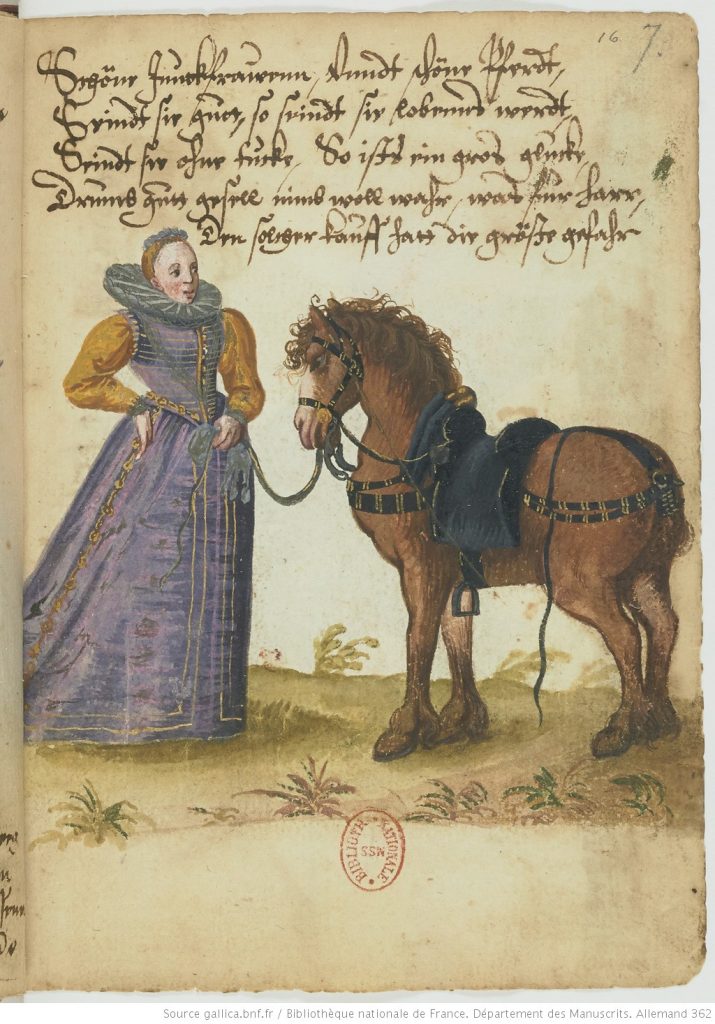
Other examples lack the rhyme but perhaps we are meant to be familiar with it in any case — a fine dapple grey horse held by the bridle — is there perhaps also something of a grudging admiration on the part of the male viewer of the domina who can keep such a powerful animal under control?
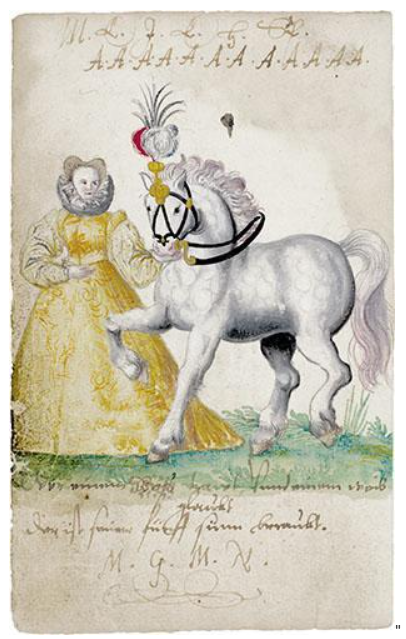
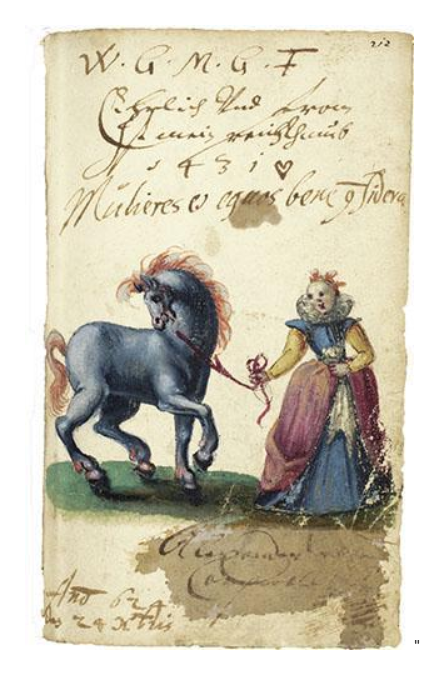
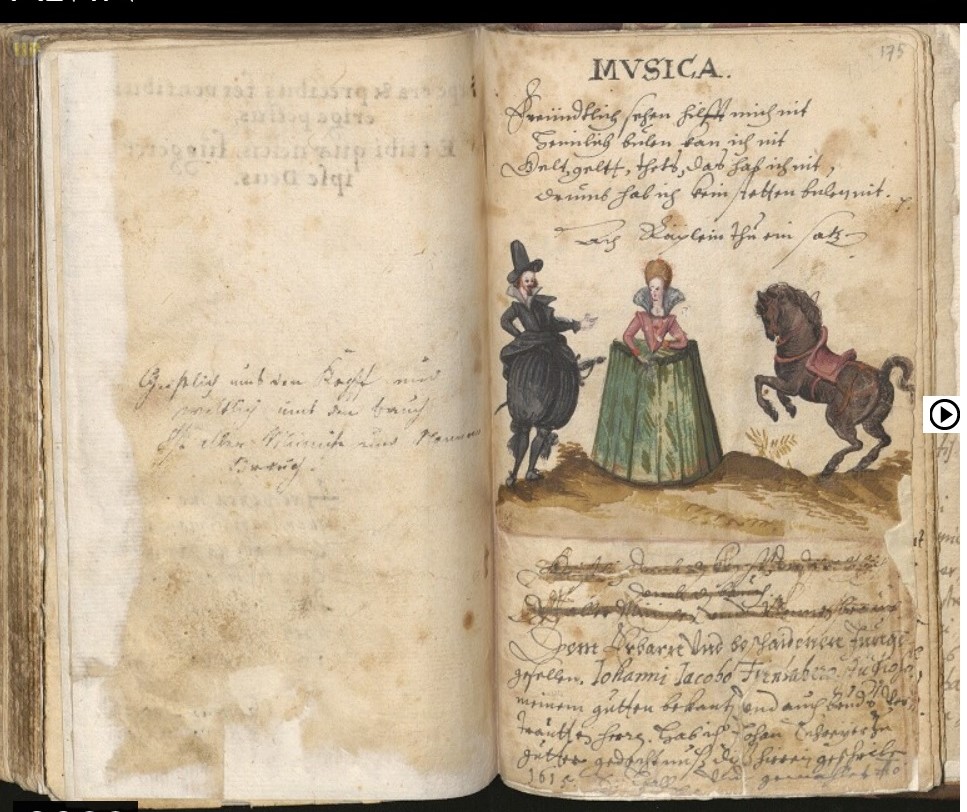
The miniature in the Firnhaber album is somewhere between the two above types:
Leave a Reply