Given that the habit of keeping albums originated in the Protestant university of Wittenberg, alma mater to both Luther and Melanchthon, the imagery in them, where it concerned matters of religion, was always bound to be anti-Catholic, and often, specifically, anti-Papal. By the time non-heraldic paintings appear with any frequency in the albums, the tradition of such imagery in single-sheet prints was already well over a generation old. The album-painters thus had a considerable body of ready-made anti-Catholic motifs to draw on – but seem to have been quite capable of inventing a few new ones of their own too
Several anti-Papal motifs found in the albums already had a venerable pedigree. The bizarre early political cartoon of the Pope and the Holy Roman Emperor wrestling in their underpants atop the mast of the ship of state was well over a century old by the time it appeared in the sadly dismembered album of Friederich von Wurttemberg-Mompelgard:
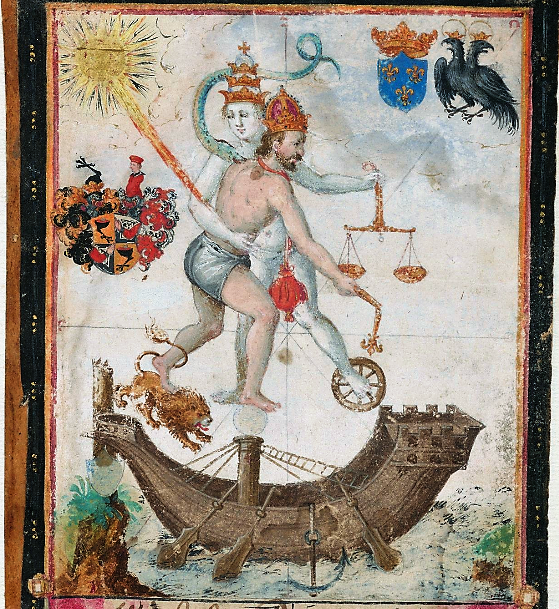
so that in the first decade of the seventeenth century, Pope Clement VIII and Emperor Rudolf II continue the struggle between the spiritual and temporal powers of their pre-Reformation forebears, Pope Paul II and Emperor Friedrich III – a motif thus innocent of Schismatic reference. For many other images of this picturesque struggle, see my Pinterest board
https://uk.pinterest.com/malcmjones/pope-v-emperor-history-of-an-anti-papal-motif/
Triad — 3 Things that drive the World Mad!
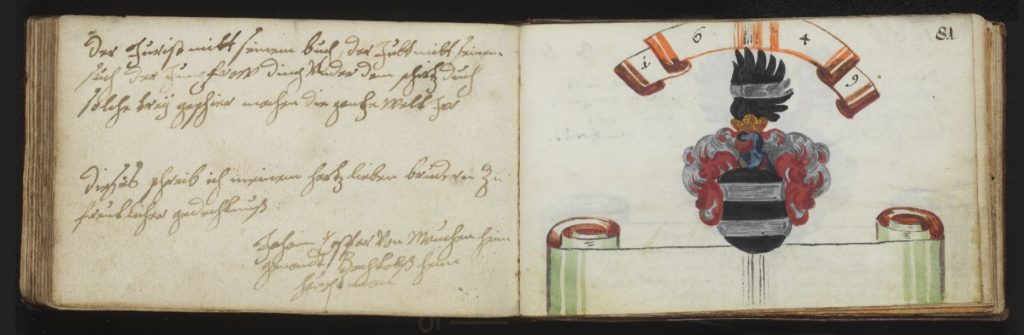
In the Heerbrand album, dated 1649, Johann Caspar von Mauchenheim-Bechtolsheim penned a well-known triad next to his coat-of-arms, it reads:
Der Jurist mit seinem Buch The Lawyer with his book
Der Jutt mit seinem Tuch The Jew with his cloth
Der Jungfraw Ding unter dem schirzduch The Girl’s thing under the apron
solche drey geschirr three such things
machen die ganze Welt irr drive the whole world mad.
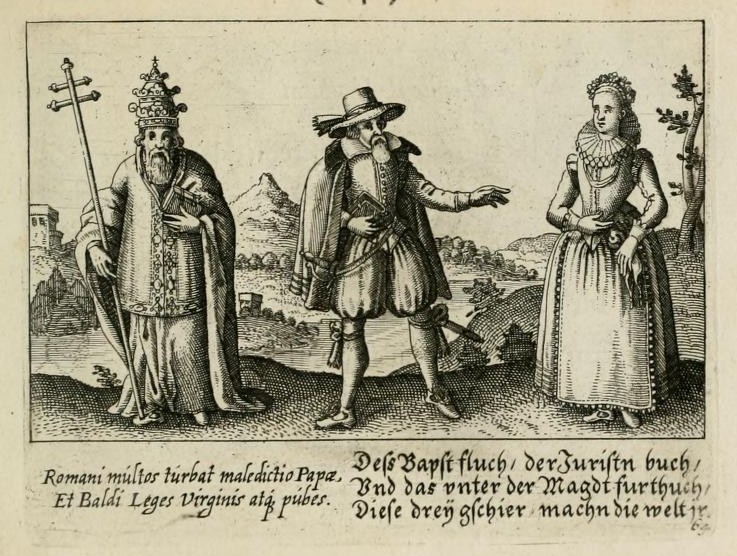
But twenty years earlier, a miniature painted in the album of Georg Christoph Walther (Nürnberg, Stadtbibliothek, Nor. H. 1619 a) depicted a slightly different line-up: the Pope, a lawyer, and a young woman. It is accompanied by the following almost identical text:
Des Babstes fluch, der Juristen Buch The Pope’s curse, the Lawyer’s book
Vnnd das vnter der Magd schürztuch And that under the Girl’s apron
Diesse drei geschirr These three things
Machen die gantze Welt irr Drive the whole world mad.
Though sadly I have no reproduction of this image, I am confident it looks like this plate below from a print-book issued four years earlier
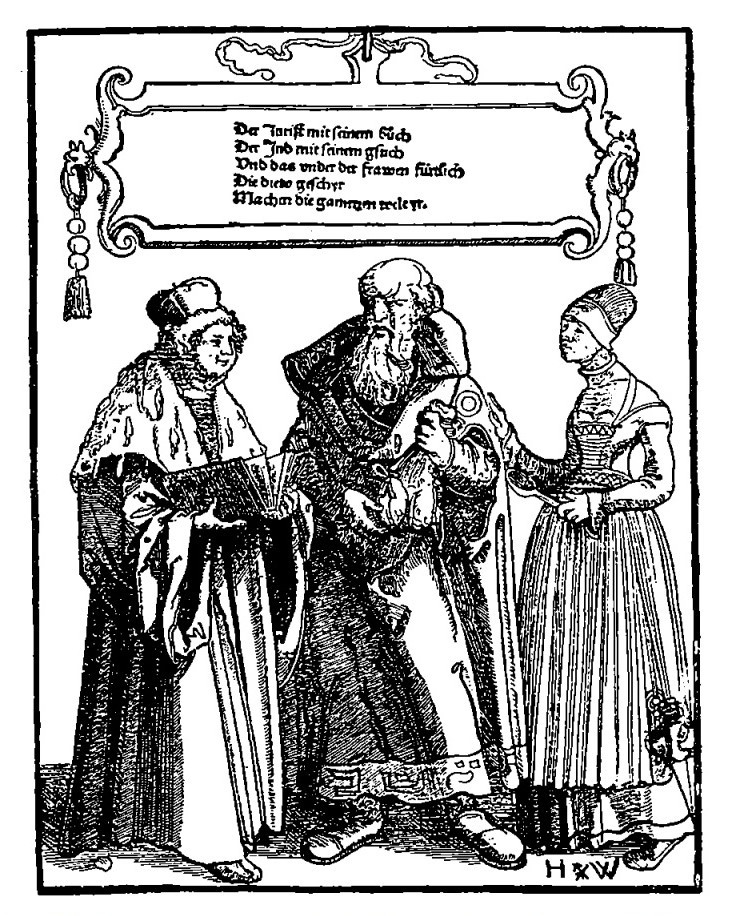
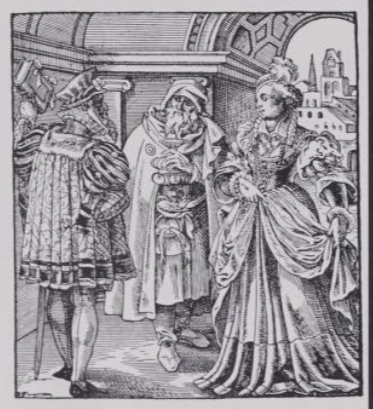
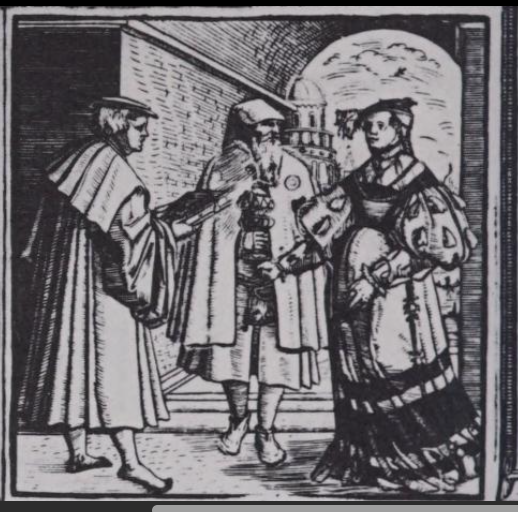
A century earlier, in Nurnberg in 1520, Hans Wandereisen made a similar woodcut print, but including the Jew rather than the Pope — note that in addition to the money-bags he holds, there is pseudo-Hebrew lettering on the hem of his robe and — as required by law — he wears the circular badge identifying him as a Jew.
Thereafter, both Heinrich Vogtherr the Younger (c.1537) and Jost Amman (c.1580) made woodcuts of this triad (again, note the badge worn by the Jew):
Other media
In the 19C enough remained of a painting on the Rathaus of Wasserburg-am-Inn for it to be described as depicting a Jew (left), a lawyer with book, gown and cap (right), and between them a woman with breast half-bared [eine Frauengestalt mit halbentblößter Brust]. The date was estimated as early 16C and the text given as
Der Jurist mit sei’m Buch,
Der Iud mit sei’m Gesuch,
Und was unter der Frauen Fürtuch,
Dieselben drei Gschir,
Machen die ganze Welt irr.
the Pope plays cards
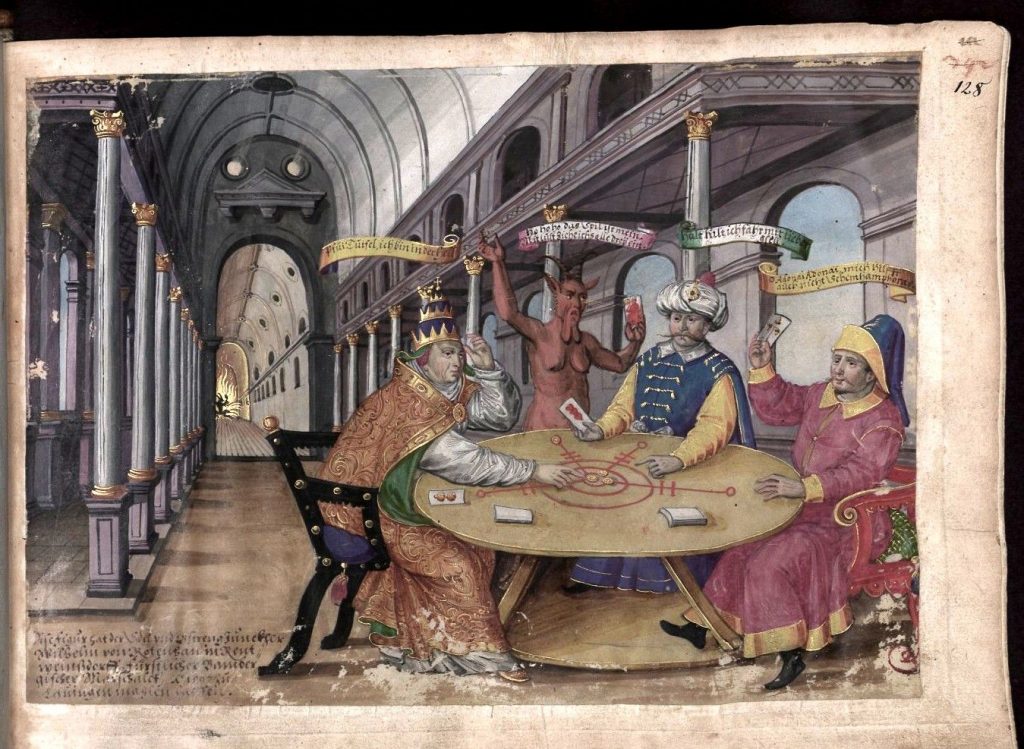
A remarkable undated miniature in the Jenisch album shows a standing Devil playing cards with a Pope, a Turk, and a Jew seated at a table, in the centre of which is a diagram of concentric circles. The innermost small circle is known as the ‘hell’ and gives its name to the game itself. The Pope is shown having just slid his counter into the ‘hell’. Beneath the image is written,
Dise Figur hat der Edel und Gstreng Junkher Wilhelm von Rotenhan in Rentweinsdorff furstlicher Marschalckh, Ao 1597 zu Lauingen mahlen lassen [The stern and worthy nobleman Wilhelm von Rotenhan in Rentweinsdorf, princely marshal, had this picture painted in Lauingen, anno 1597].
Each of the four players is provided with a speech banderole:
Pope: Pfui Tuifel, ich bin in der hell Ah, Devil, I am in the hell
Turk: halt halt ich fahr mit lieber grell (?) I prefer to go with a bright colour
Jew: O Adonai Adonai, mich hilfft auch nicht Schemhamphoras O Lord, Lord, even Schemhamphoras* can’t help me
Devil: Ho ho ho das Spil ist mein. Mit Lust ziehe ichs alle drey ein. Ho,ho, ho! The game is mine! I shall enjoy dragging all three into (hell)
The best-known painter in Lauingen at this date was David Brentel (c.1566-1615) — who painted several album miniatures — and may well be the author of this one, and perhaps the original.
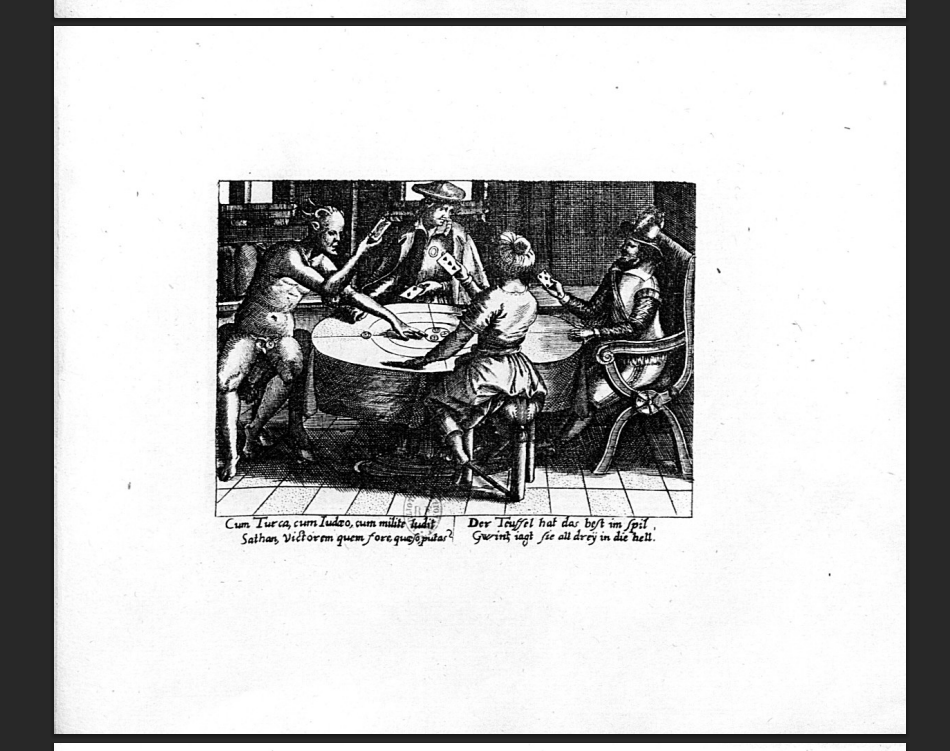
A decade later, the scene features as one of the engraved plates in the Pugillus Facetiarum (1608),
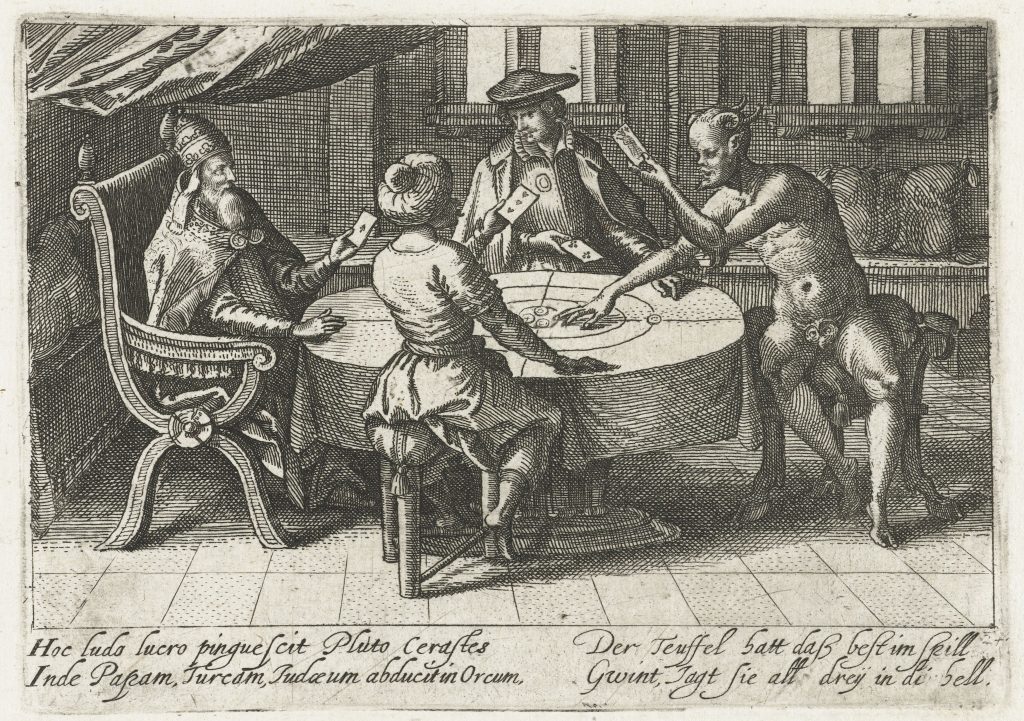
seemingly another example confirming von der Heyden’s assertion in the Preface that he drew on existing student-albums in designing the plates for the print-book. But here the Devil is seated at the table with his fellow-players, the Jew being again identified by the circular badge he was obliged to wear. The four exclamations of the miniature are here summarised into a single captioning couplet:
Der Teuffel hatt dass best im Spil The Devil has the best of the game
Gwint, Jagt sie all drey in die hell. Having won, harries them all three into hell
When the same plate was copied in reverse for the Stirpium (Basel, 1612, 1615, 1617),
the publisher adopted a more inclusive approach for his venture and avoided alienating potential Catholic buyers of the book by substituting a non-denominational soldier for von der Heyden’s Pope. It is the Stirpium version that was copied as one of the small inset scenes (often proverb illustrations) in Vol.2, Bk.3 of Meisner’s Thesaurus Philosophico-Politicus (Frankfurt, 1629) beside a view of Varpalota in Hungary.
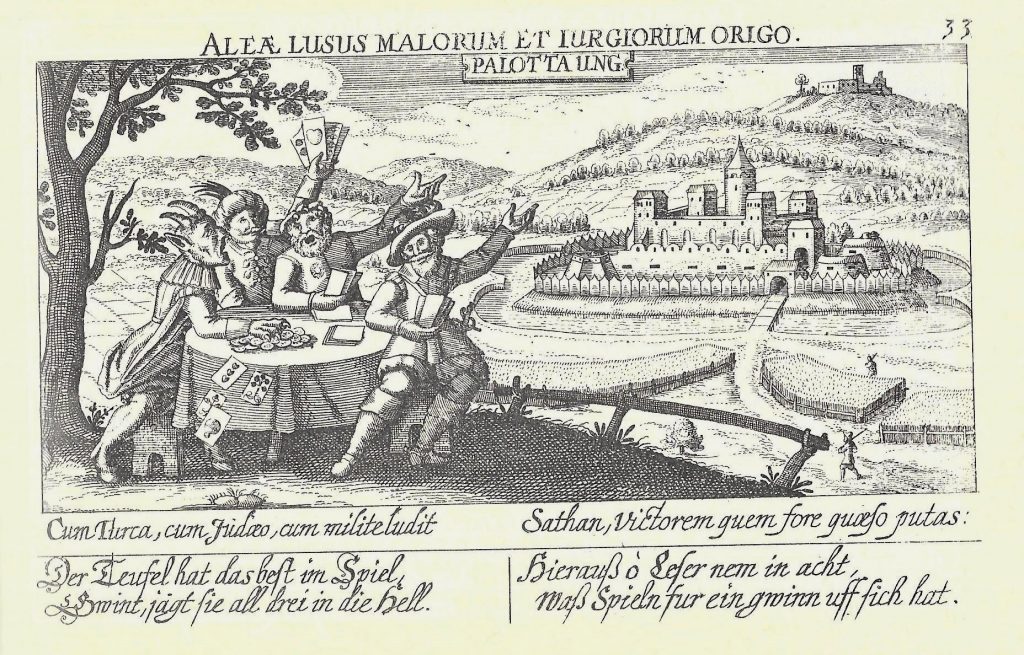
*Schemhamphoras Hebrew, meaning “the explicit name”, was originally a Tannaitic term for the Tetragrammaton, and is used to title at least two album miniatures of the Judensau — those of Wigandt (dated 1600) and Petzke (c.1620).
an equestrian confrontation
One of the most popular anti-Papal motifs depicts the Pope on his richly caparisoned steed, confronted by Christ on his humble ass. In the Jenisch album
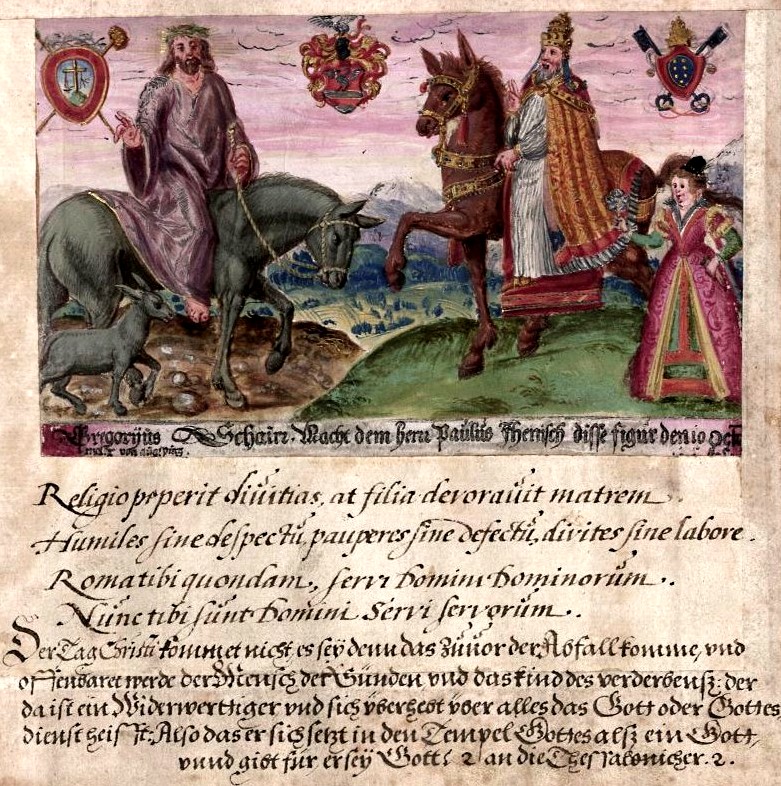
the miniature is dated 1585 and signed by Gregor Schain, who styles himself maler von augspirg [painter from Augsburg] — it is clear that he was basing his painting on a woodcut print by Bernhard Jobin who made and published prints in Strasbourg from 1570.
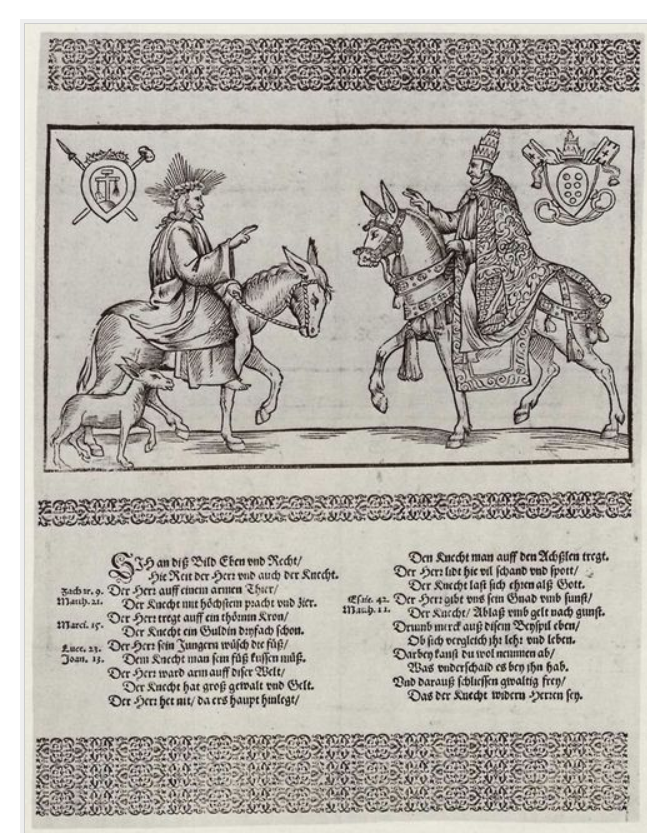
But the motif was so popular that it appears in a variety of other media, including a glass beaker from the Northern Netherlands engraved with the motif and dated 1604 [Amsterdam, Rijksmuseum, BK-NM-3108]
The allegorical balance
This is another popular anti-Catholic motif, and of some antiquity by this date; it was used, for example, in the Bohemian Hussite manuscript, Göttingen, Niedersächsische Staats- und Universitätsbibliothek Göttingen, 2 Cod. Ms. theol. 182 Cim. (1466)
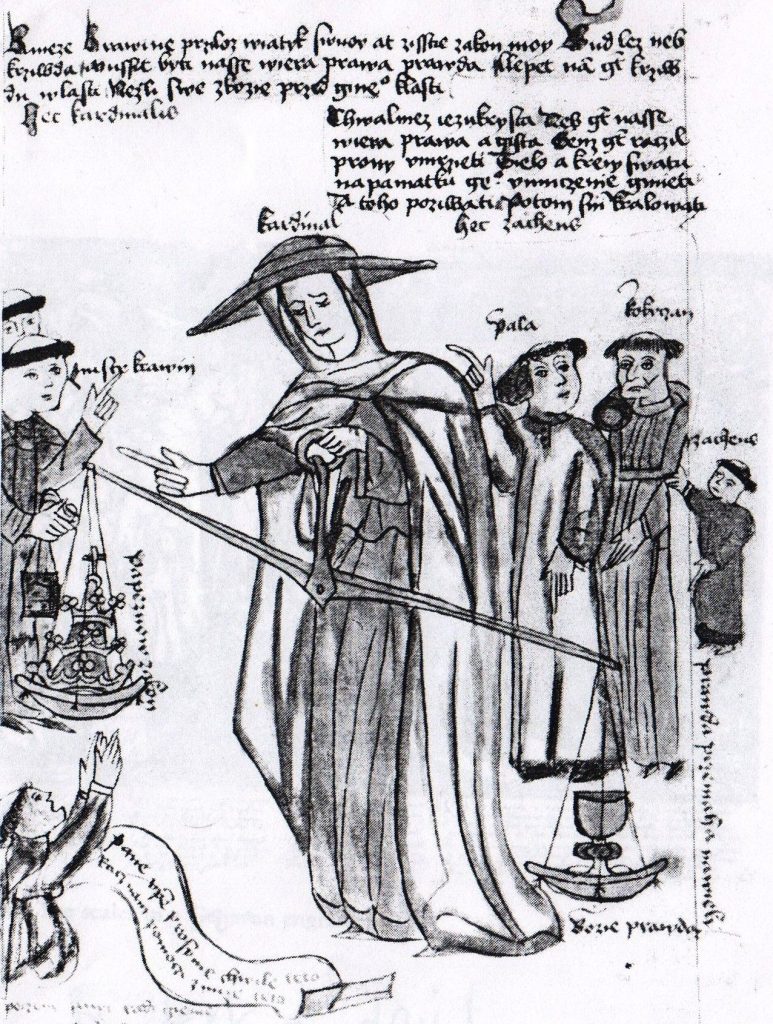
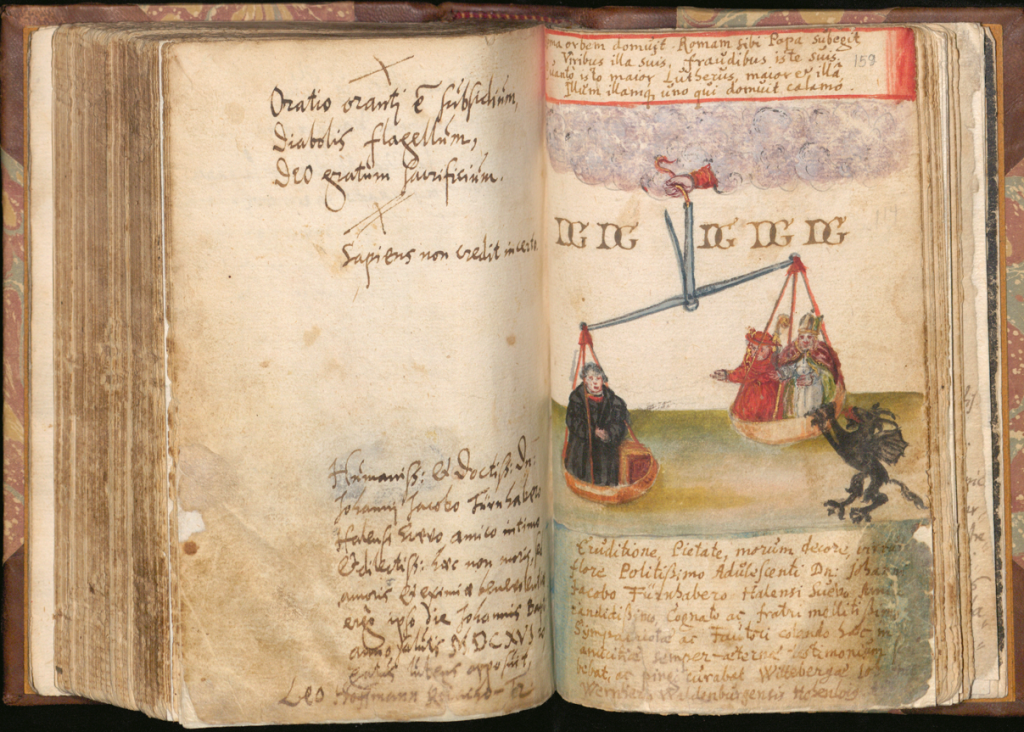
In the 16th and subsequent centuries, the motif shows the Reformers’ Bible in one scale-pan outweighing the combined weight of the Pope and Catholic clergy — and sometimes the Devil himself – in the other. Such an image was painted onto f.159r. of the Firnhaber album (dated entries 1614-20), in which Luther and the Bible outweigh the Pope and Cardinal, despite the Devil’s attempt to pull down the pan:
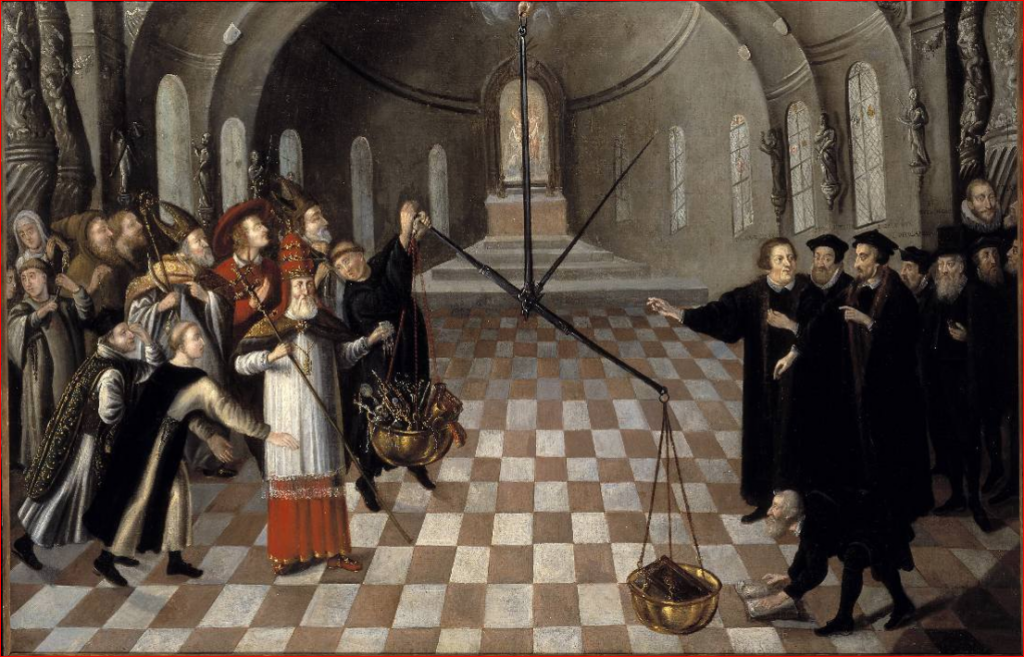
A very popular motif in full-scale paintings (here the Lutheran Bible outweighs the ornaments of Catholic ritual combined with the efforts of a monk)
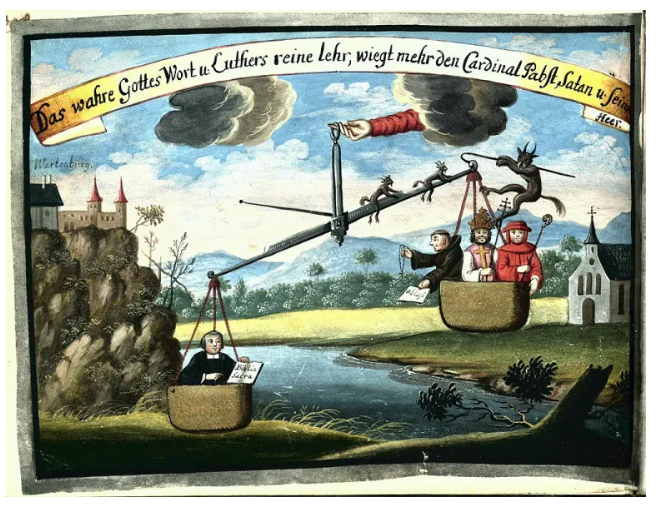
it is still to be seen in 18C albums in a form showing Luther and his Bible translation in the heavier pan, outweighing Pope, Cardinal, Monk and Devil in the other (the Wartenburg Castle near Wittenberg in the background is where Luther worked on his translation of the Bible after the Diet of Worms):
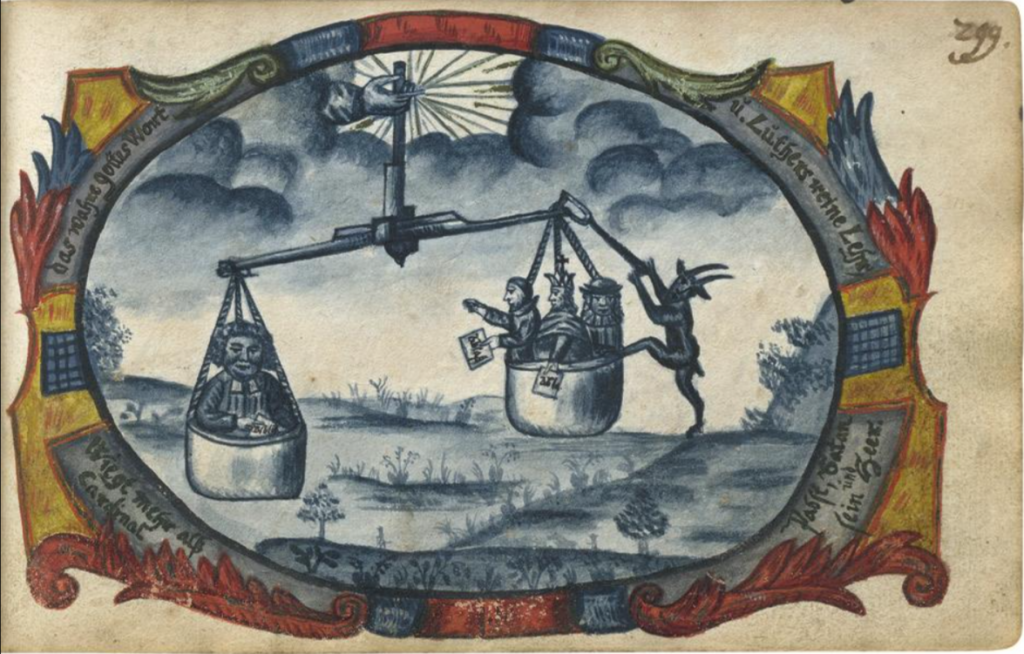
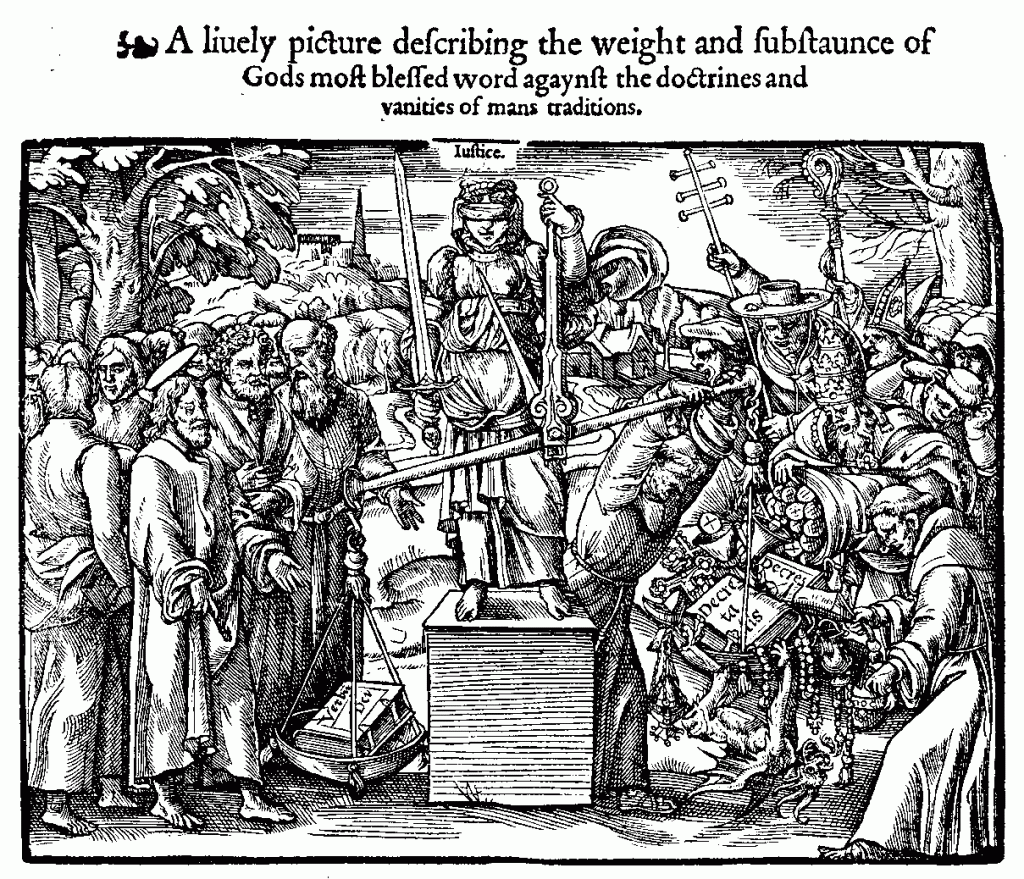
Other Protestant countries eagerly took up the motif; in England, one of the earliest such image is found as a woodcut first used in a 1572 edition of the works of Tyndale and others, edited by John Foxe, and thus appeared subsequently in the third and later editions of the editor’s own Actes and Monuments (London, 1576, 1583, 1596), where it closes the series of twelve cuts entitled, The Proud Primacy of Popes paynted out in Tables. It depicts a blindfold Iustice weighing a Bible, labelled Verbum Dei, in one scale-pan, attended by Christ and the disciples, against the Papal Decretals, decrees, cucifixes, rosaries, coins, etc. in the other, attended by the Pope, cardinals, bishops, and a friar who tries to pull down that side of the scale-beam, and a devil who clings bodily to the lighter scale-pan — all to no avail, of course.
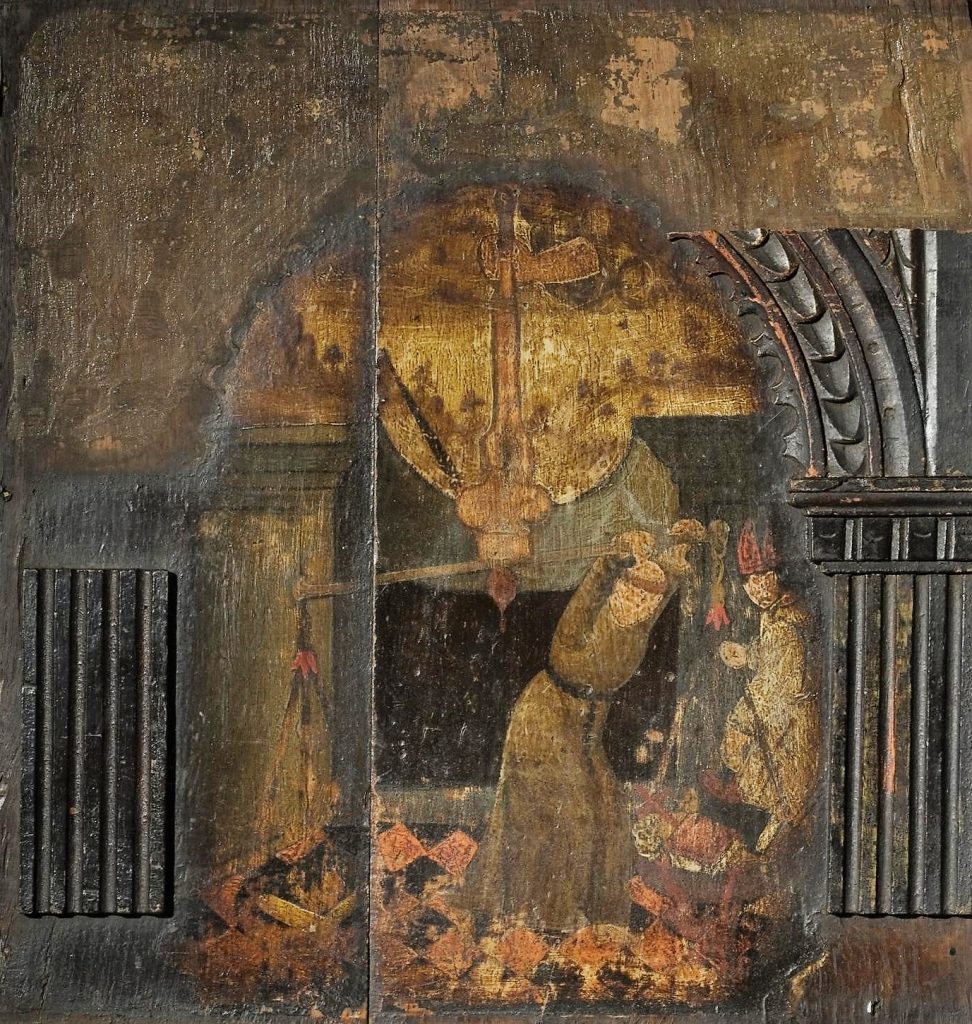
Though damaged, part of a late 16C painted overmantel depicting our motif is preserved in the Victoria & Albert Museum — though here it is certainly the Hand of God which holds the scales, not the abstract Justice of the earlier woodcut:
reversible heads
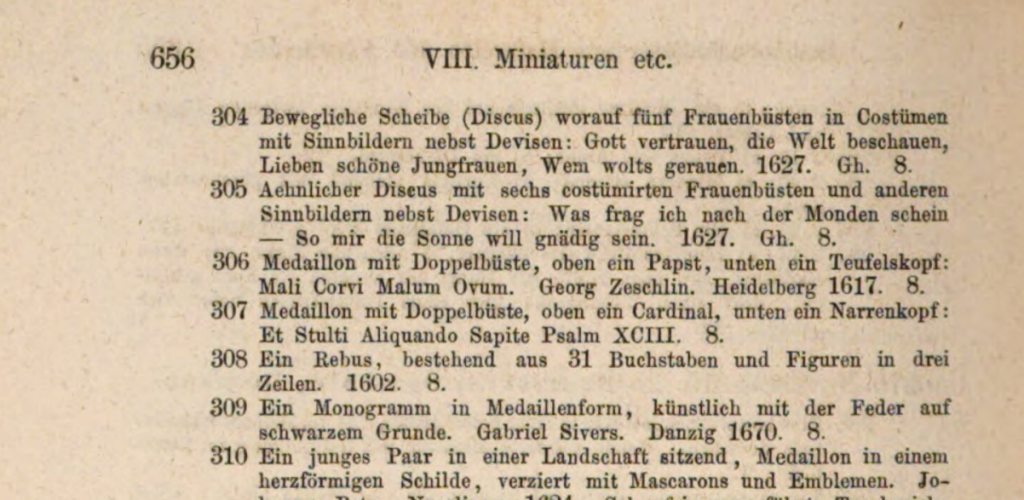
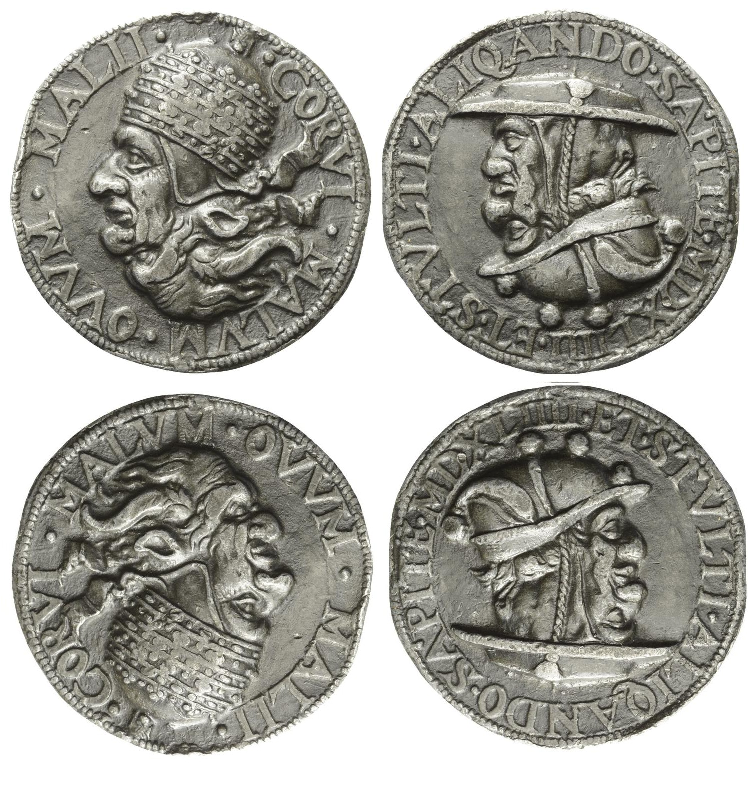
Although the enormously popular ‘reversible heads’ motifs, first issued as satirical medals (BELOW) in the early years of the Reformation, featuring the Pope/Devil and Cardinal/Fool, were and remained very popular, to date, I have only noted one example in the albums — and that I cannot show! According to the description of two of the hundreds of orphaned leaves in the Carl Rolas du Rosey collection sale by Weigel of 1864, both designs were painted in an unknown album at the behest of one Georg Zeschlin in Heidelberg in 1617 — lots 306, 307 below
Malcho Papo
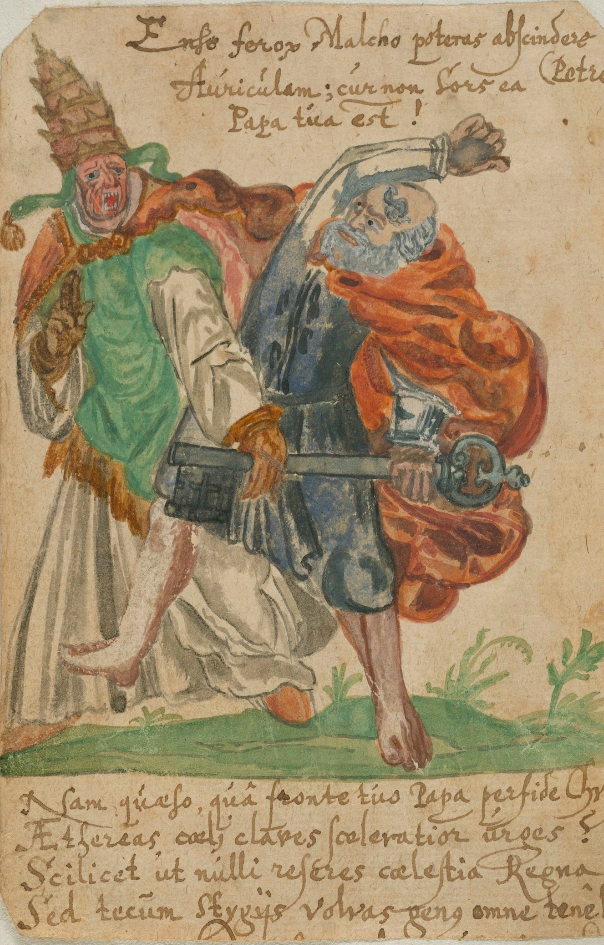
In a somewhat clumsy rendition, the miniature on this orphaned leaf depicts a ferociousy fanged Pope trying to wrest St. Peter’s key from him. It was copied from the woodcut by Tobias Stimmer which illustrates a print entitled MALCHOPAPO, with text by Fischart, first issued in Strasbourg in 1577 (and again under a different title in 1617).
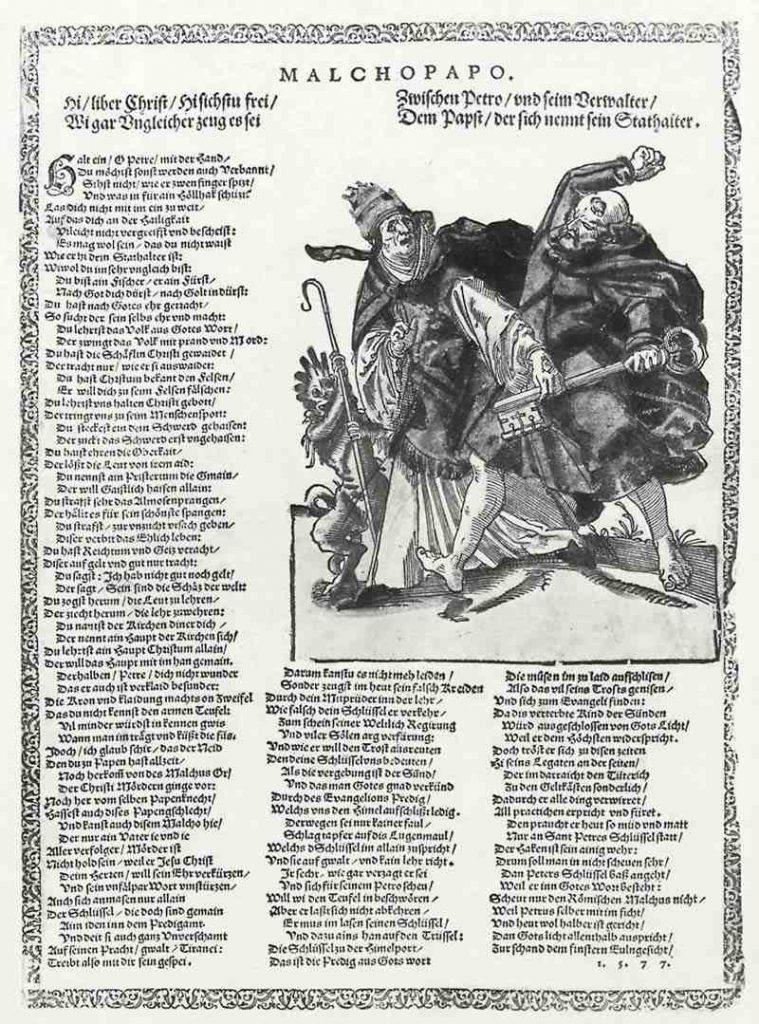
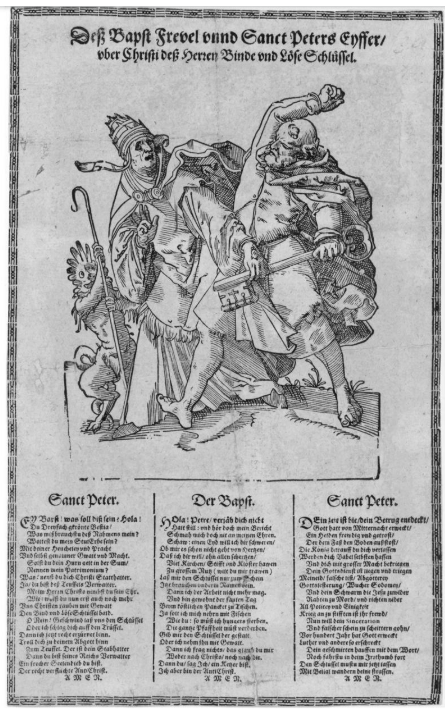
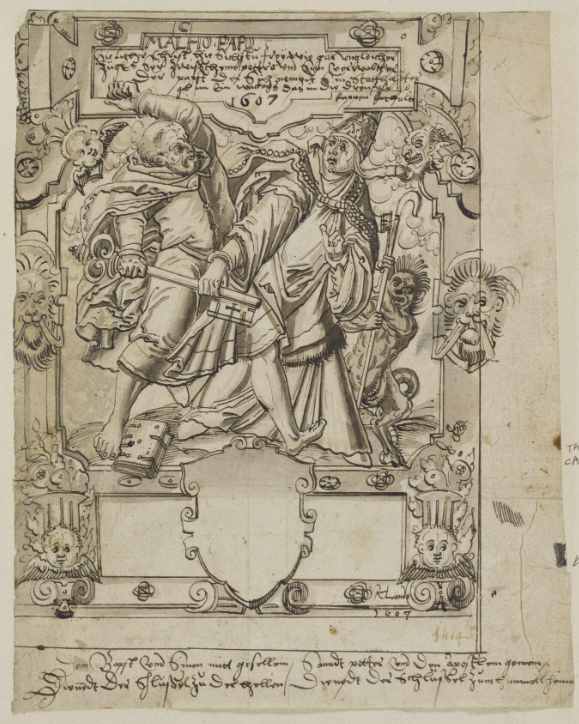
The Victoria & Albert Museum holds a design made after the Stimmer woodcut for a painted glass pane dated 1607, and probably used as a model in Hans Rudolf Lando’s glass painting workshop as it bears his collector’s mark.
copies of other anti-Papal prints
The Jenisch album includes copies of other anti-Catholic prints: on f.116r., for instance, is a copy of a print issued in 1568 entitled Lutherus Triumphans
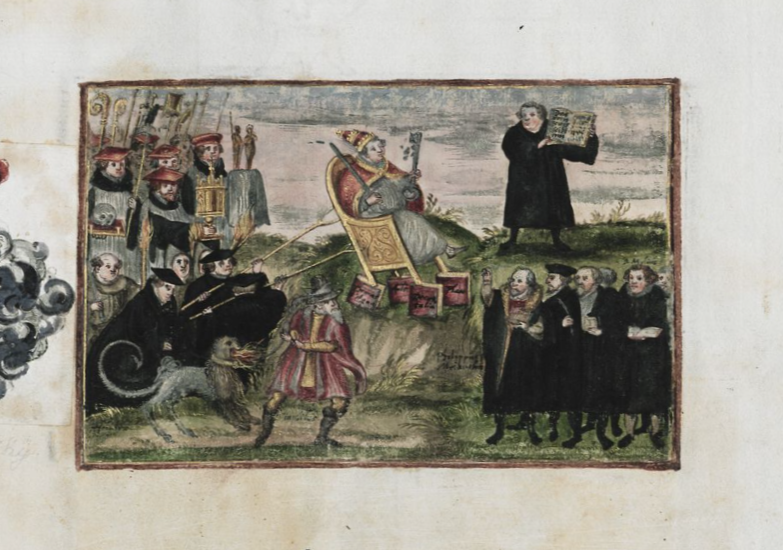
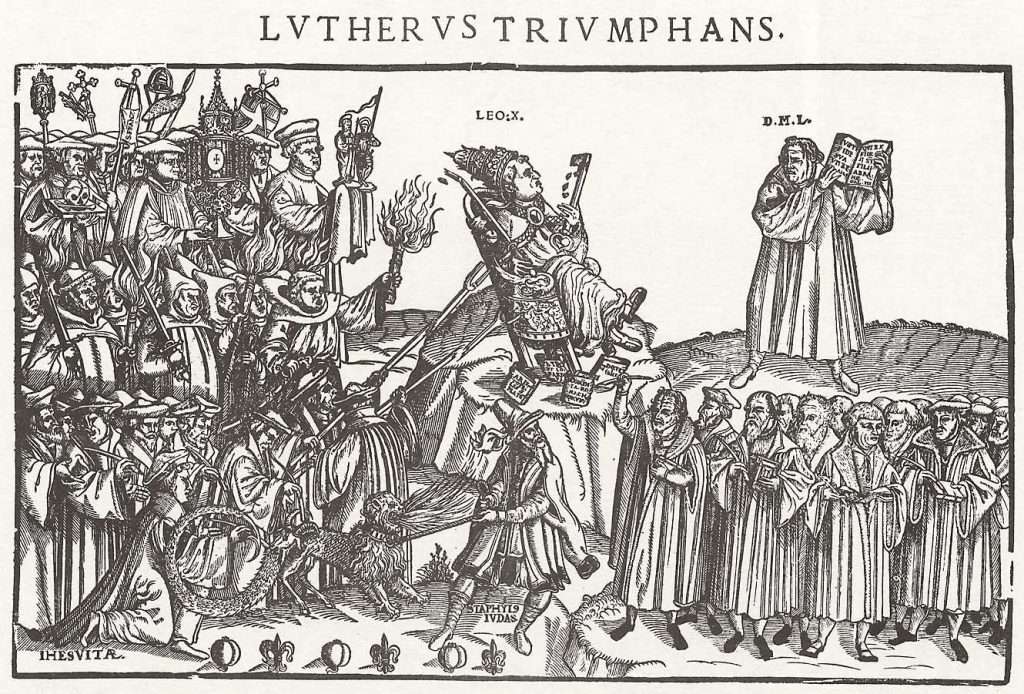
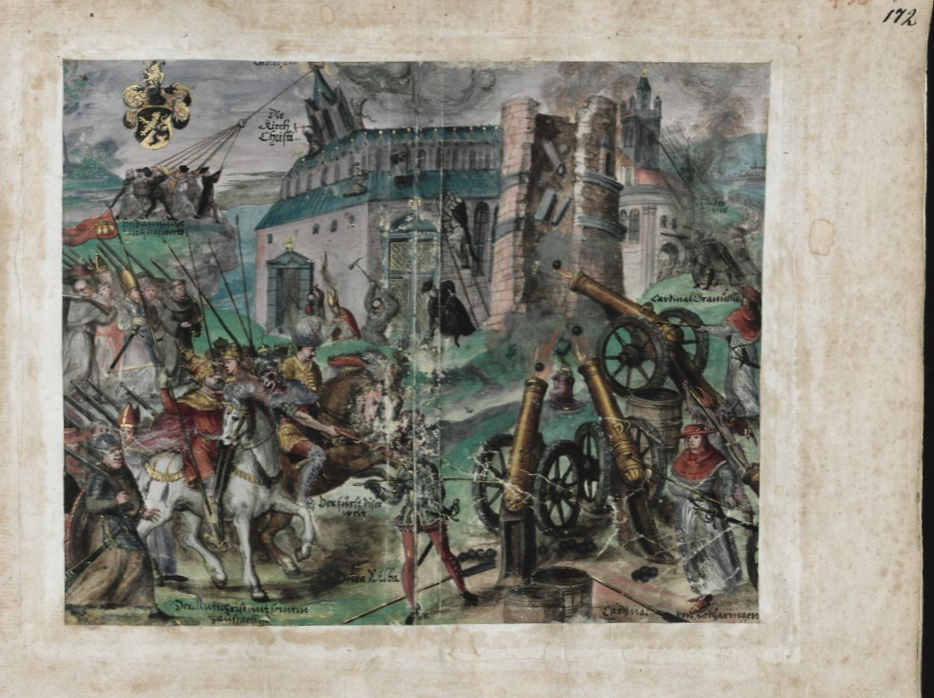
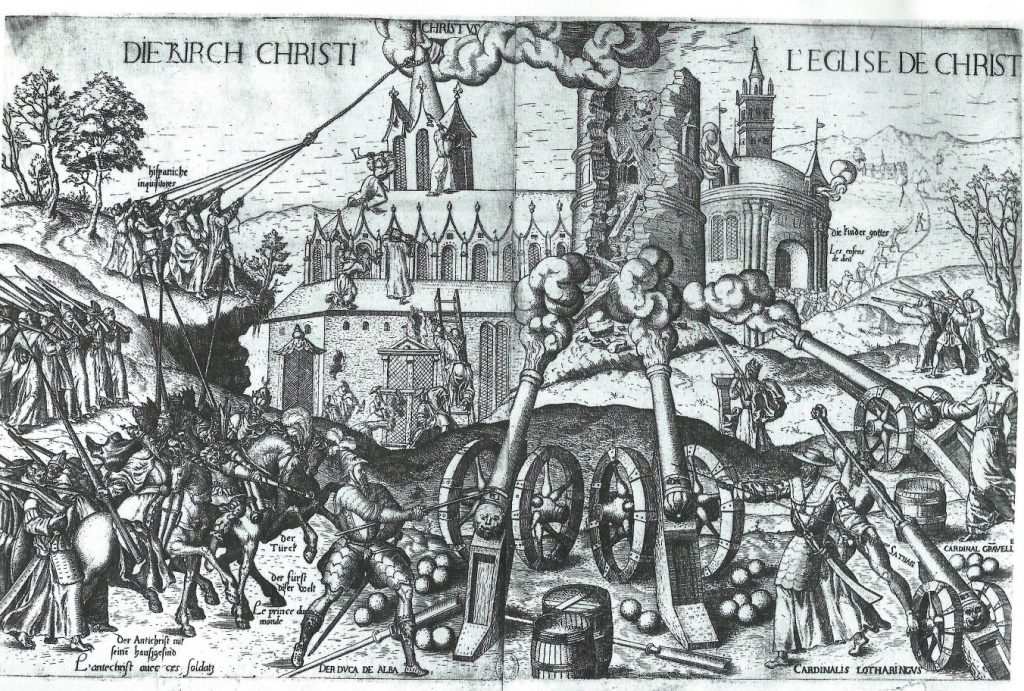
In the same album, on f.172r. another miniature depicts the canon of the Duke of Alva, the Pope (labelled Der Antichrist) on a white steed (bottom left), the Catholic clergy and the Spanish Inquisition destroying the Church — it is based on the print DIE KIRCH CHRISTI/L’EGLISE DE CHRIST (below)
Luther’s curse
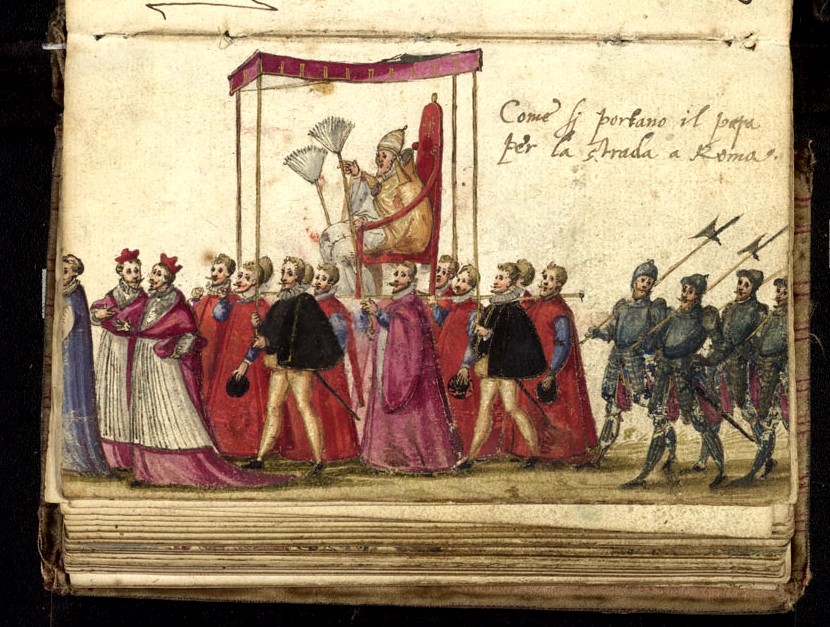
Miniatures of the Pope passing through the streets of Rome in his litter — such as this painted in the album of Christoph Ulrich von Knöringen in 1586 and entitled Come si portano il papa per la strada a Roma — are common enough, part of the numerous series of late 16C Italian costume and other scenes of daily life to be found in many students’ albums, but the version in the Pusch album is titled with a famous quotation by Luther, popularly known as ‘Luther’s curse’:
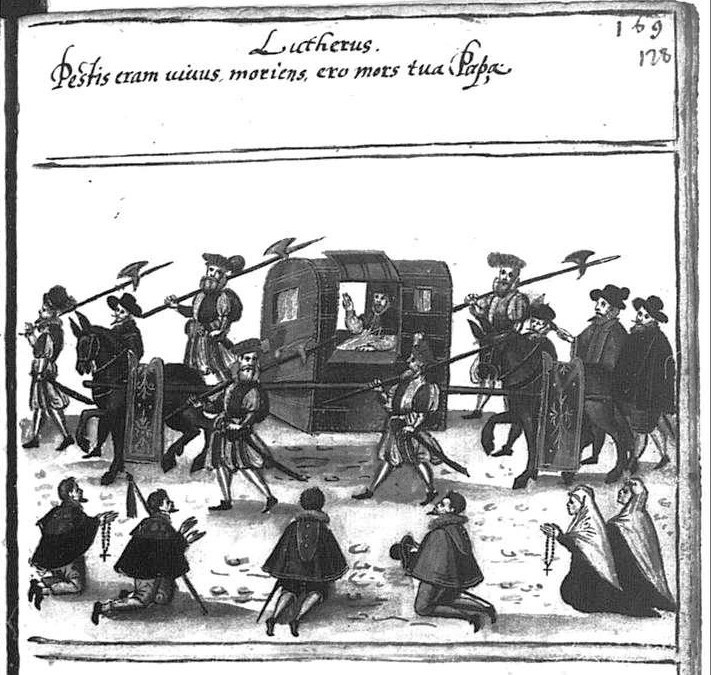
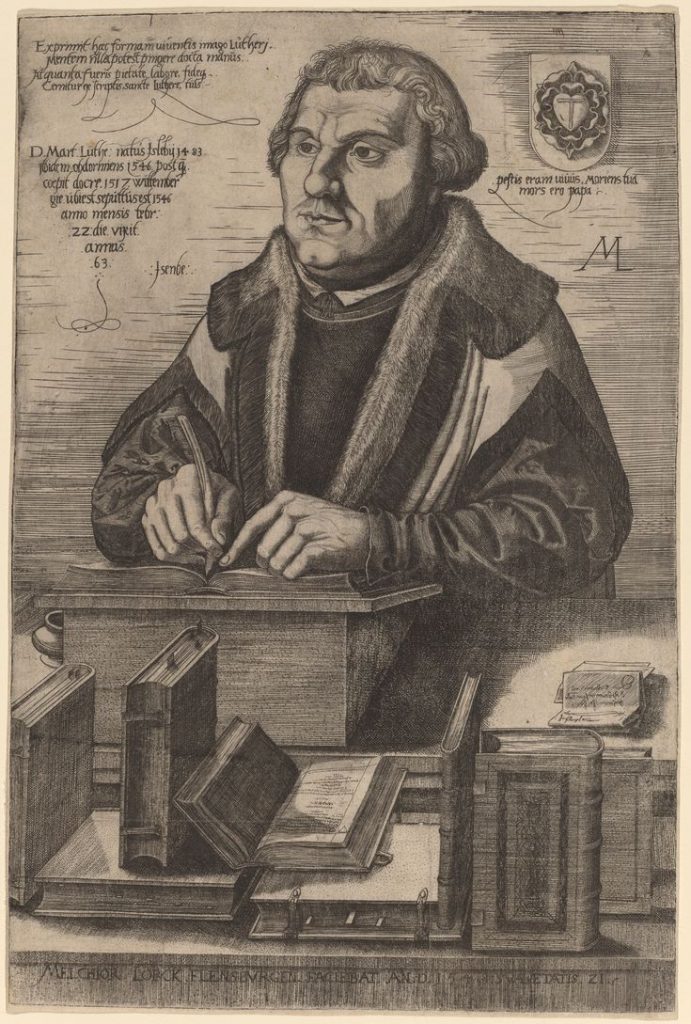
Pestis eram vivus, moriens, ero mors tua Papa. This famous Latin hexameter — which Luther quoted several times (from 1530 onwards), and once referred to as his epitaph, translates as, “Alive I was your plague, dying I will be your death, Pope!” It appears in the inscription at the foot of this portrait of Luther dated 1537 in the parish church at Penig near Chemnitz.
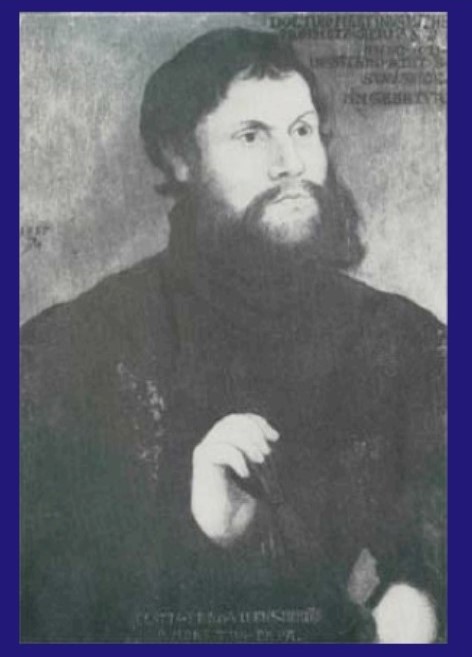
and in the 1548 portrait by Melchior Lorch
a parting shot
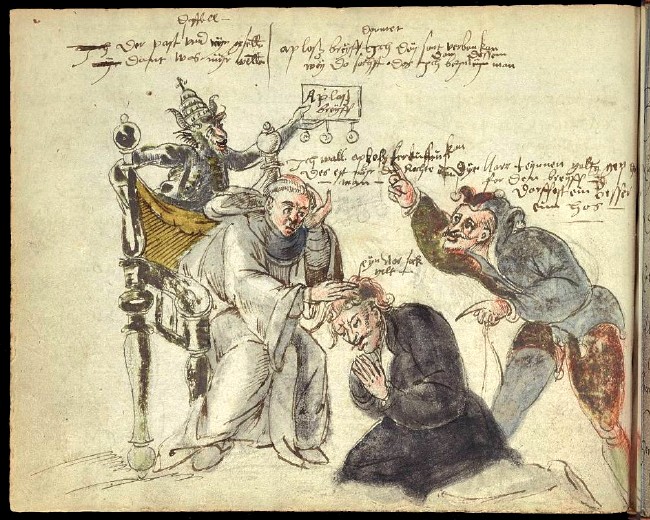
The album of the Cologne Briefmaler (calligrapher and painter, e.g. of album miniatures) and woodblock-cutter (two of his woodcuts of fools are preserved in the British Museum) includes a satirical hit at the sale of indulgences by the Catholic Church — one, pointed at by a fool, is offered here by a devil wearing the Pope’s tiara! [see the article by David Brafman, https://www.academia.edu/6544643/Diary_of_an_Obscure_German_Artist_with_Almost_No_Friends]
Leave a Reply to Monks behaving badly – Album Amicorum: Early Modern Stammbuch Iconography & related Cancel reply