Anti-Jewish motifs are to be found in the albums as they are elsewhere in contemporary art.
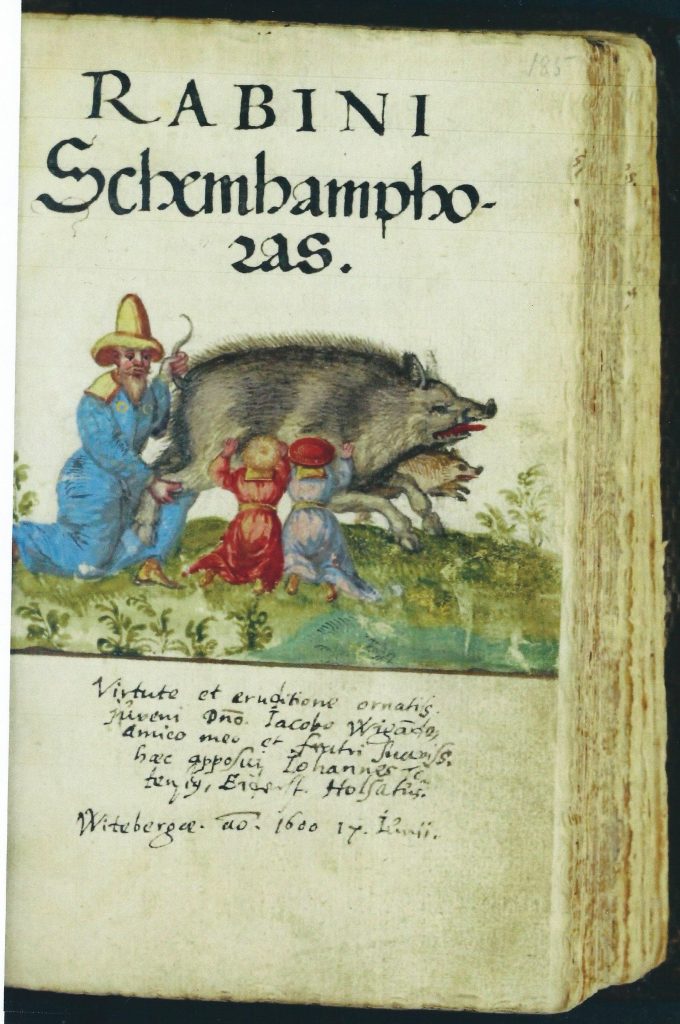
The Hebrew word Schemhamphoras, meaning “the explicit name”, was originally a Tannaitic term for the Tetragrammaton, and is used to title at least two album miniatures of the notorious Judensau [Jews’ sow] — those of Wigandt (dated 1600) and Petzke (c.1620).
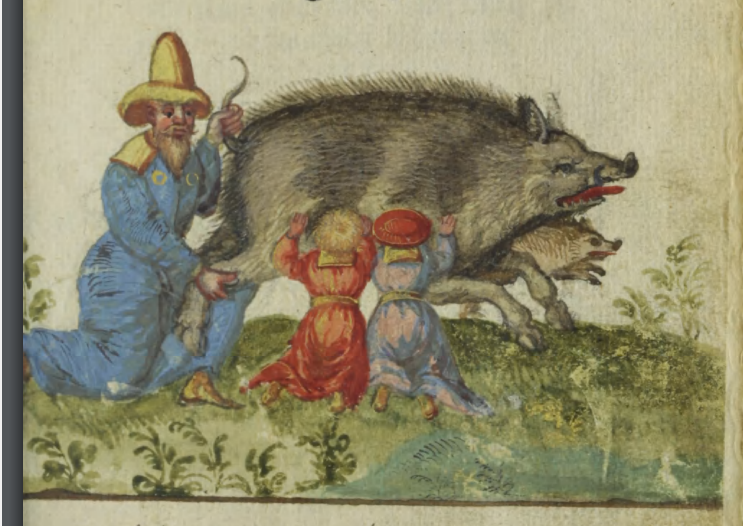
(Note the circular identifying badges Jews were required to wear by law)
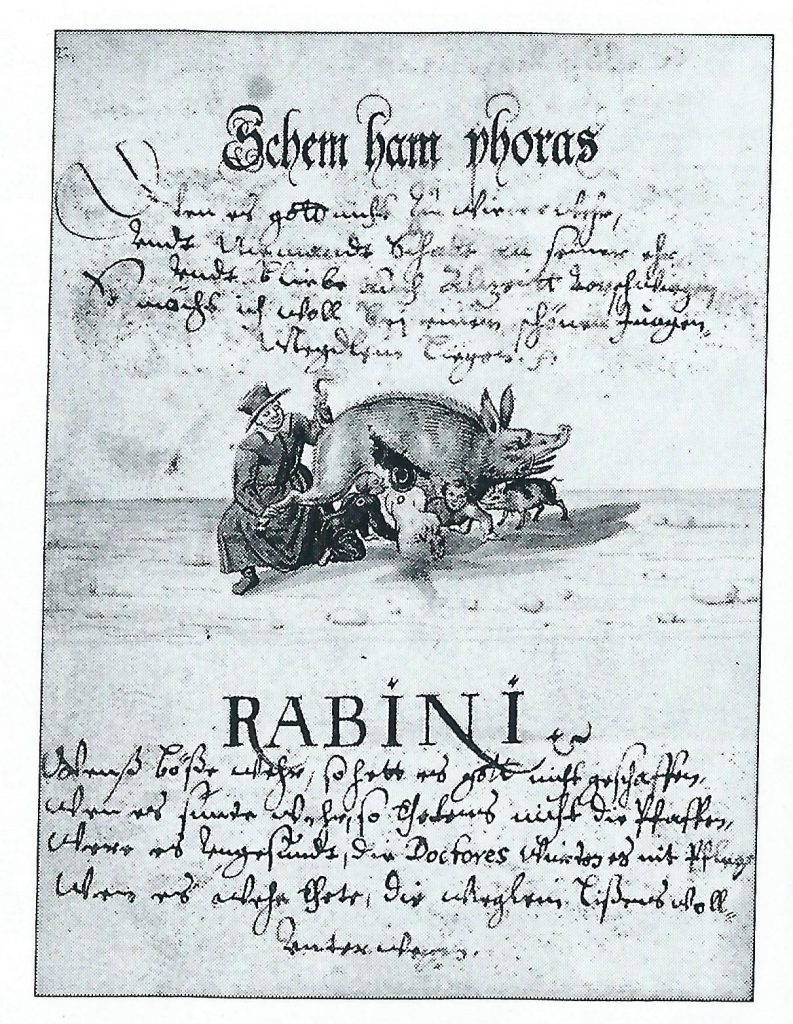
The miniature in the Löchel album (below) is undated, but other dated entries run from 1587-1616. On the Staatliche Museen zu Berlin website the newly-digitised image is described — no doubt, deliberately — as Allegorie Reiter auf Wildschwein, fünf Frischlinge [Allegory Rider on boar, five piglets], the neutral Reiter avoiding possible controversy. On the pitchfork — of the type held by witches, incidentally
[see my post here: https://albumamicorumear-e4qvahs764.live-website.com/witches-devils-etc/ ] —
we see strings of sausages and a ?hambone — meats which are, of course, traditionally forbidden to Jews.
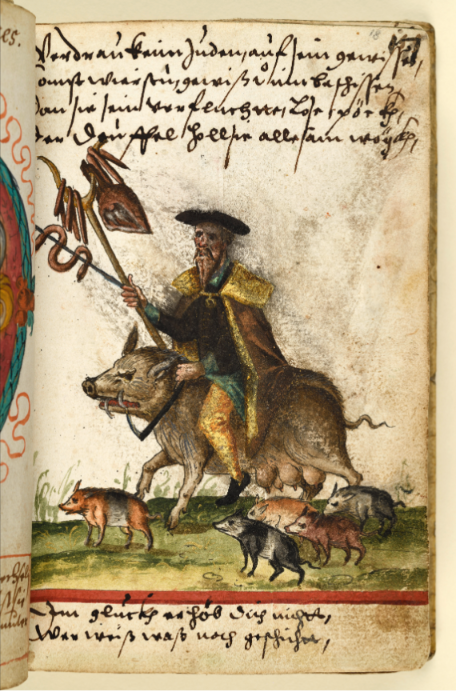
Thanks to friends on Reddit/Kurrent, I am able to give the following transcription, the translation is my own:
Verdrau keim Juden, auf sein gewissen, Sonnst wierstu gewiß (…) beschissen, Dan sie sein verfluchtte Böse pöckh, der Deuffel holl sie allesam wögkh. [Do not trust the conscience of any Jew, or you will certainly be shit on, for he … his damned evil, may the Devil carry them all off]
In contrast to the above, the caption below the image is merely a conventional commonplace
Im glückh erhöb dich nichtt, Wer weiß waß noch geschichtt. [Do not exult in times of good fortune, who knows what will happen in the future]
In the following caricatured image of the interior of a synagogue from the album of Andreas Matt there is an obvious stress on the characters’ noses
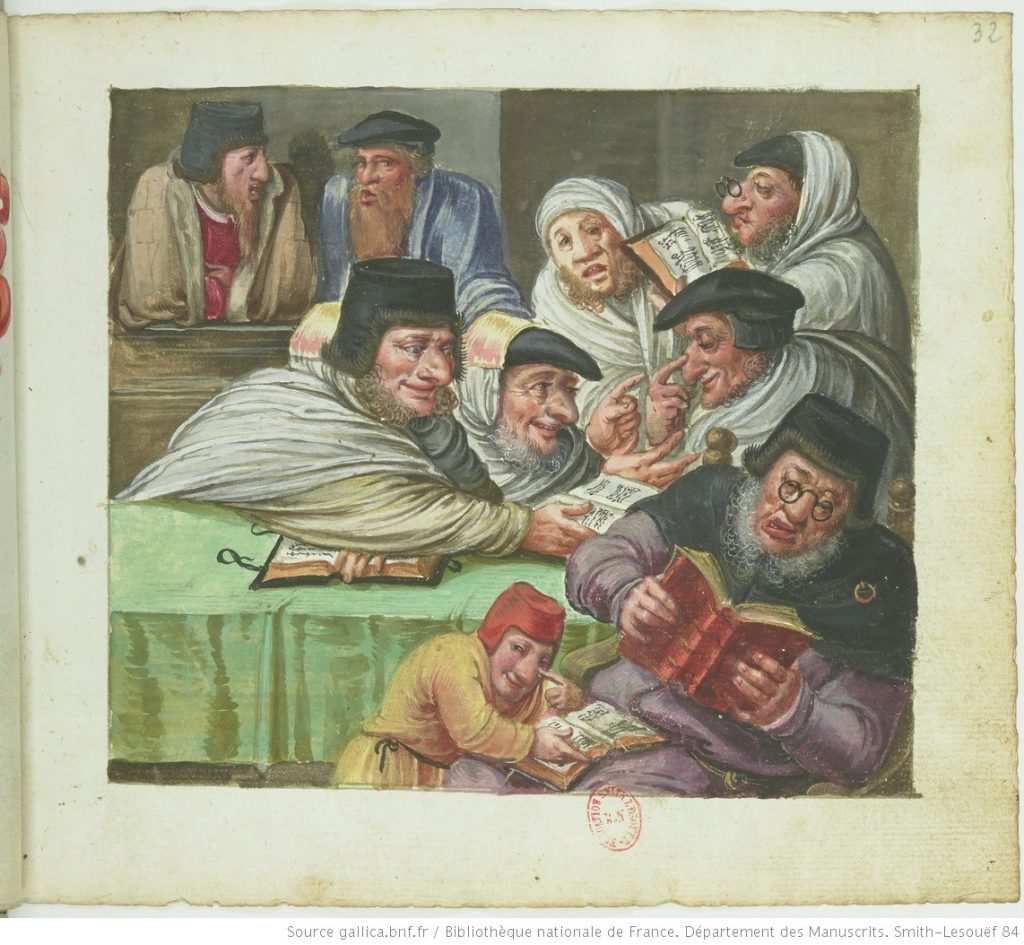
Julia Freisinger attributes the painting to Anton Möller.
Leave a Reply