The Symbol
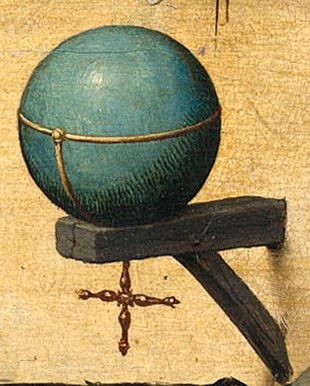
We have become familiar with Bruegel’s signal in his Netherlandish Proverbs painting of 1559 that all his busy characters enacting their proverbial follies are inhabitants of a topsy-turvy world, that they all dwell, as it were, at the Sign of the World Turned Upside Down.
[see my Pinterest board https://uk.pinterest.com/malcmjones/monde-literally-renverse/ for many more examples]
But this is one of my favourite, earlier uses — the device of Parisian printer, Olivier Senant, from at least 1507-11 [Silvestre 430; Renouard 1031; BaTyR no. 28398]
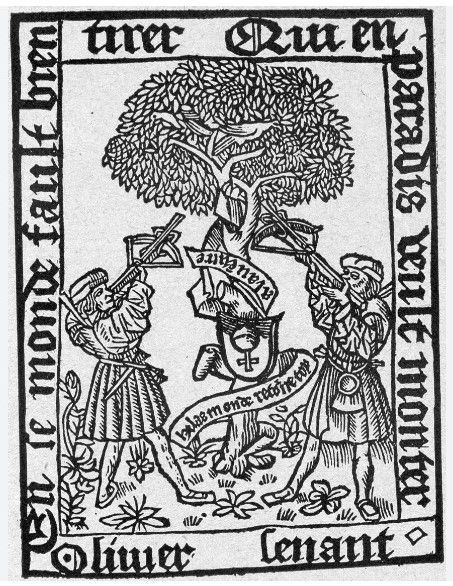
The shield hanging from the tree bears the world-orb turned upside down, the banderole around the trunk reads, helas monde retorne toy [Alas, world, turn yourself back!] The frame couplet reads, En ce monde fault bien tirer/ Qui en paradis veult monter [In this world, he who wishes to mount to paradise must shoot well — I suspect sexual innuendo, and indeed, that the cut may originally have illustrated a lost Monde pamphlet]
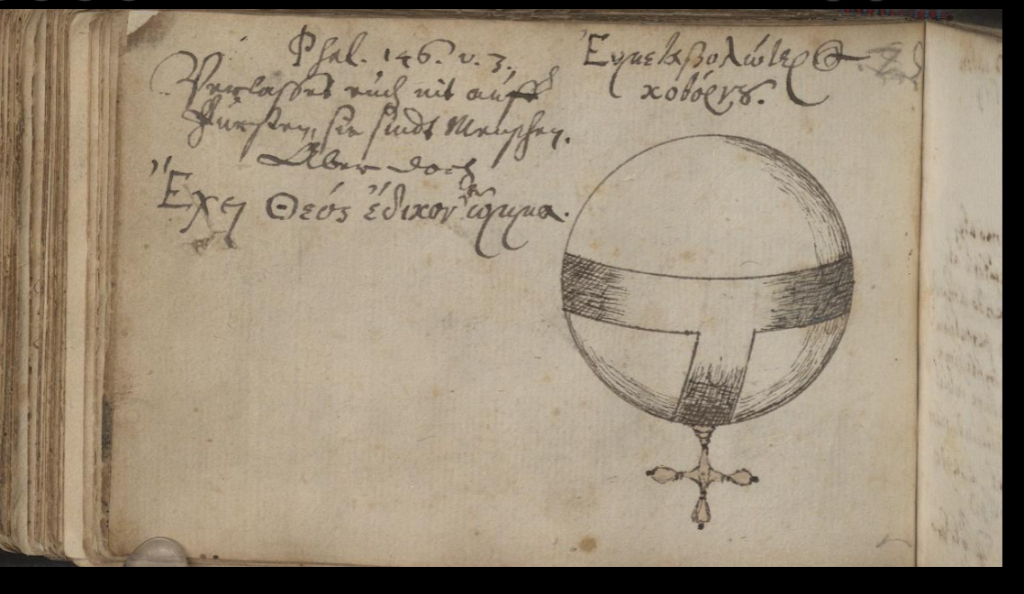
The albums too make use of this transparent symbolism. The monde renversé, the world turned upside down, was symbolised from at least the 15C by the depiction of the world-orb/Reichsapfel inverted, the cross which shows the orientation of the symbolic globe [globus cruciger], underneath, pointing downwards.
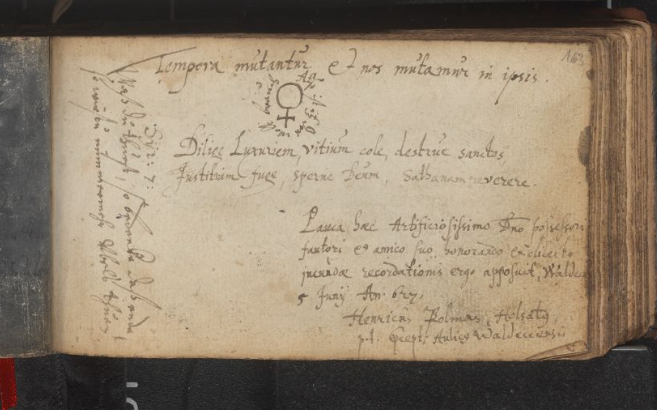
By the date of this tiny sketch of an inverted world orb labelled, Also ist itz der welt hinnab [Now the world is upside down like this] drawn on f.163r. of the Erich album in 1627, we may assume that the symbol was well-known. Twenty years later the motif occupies a full page in the Speidel album (1642-53)
A curious entry, signed Charle de Potyers, in the David von Mandelsloh album
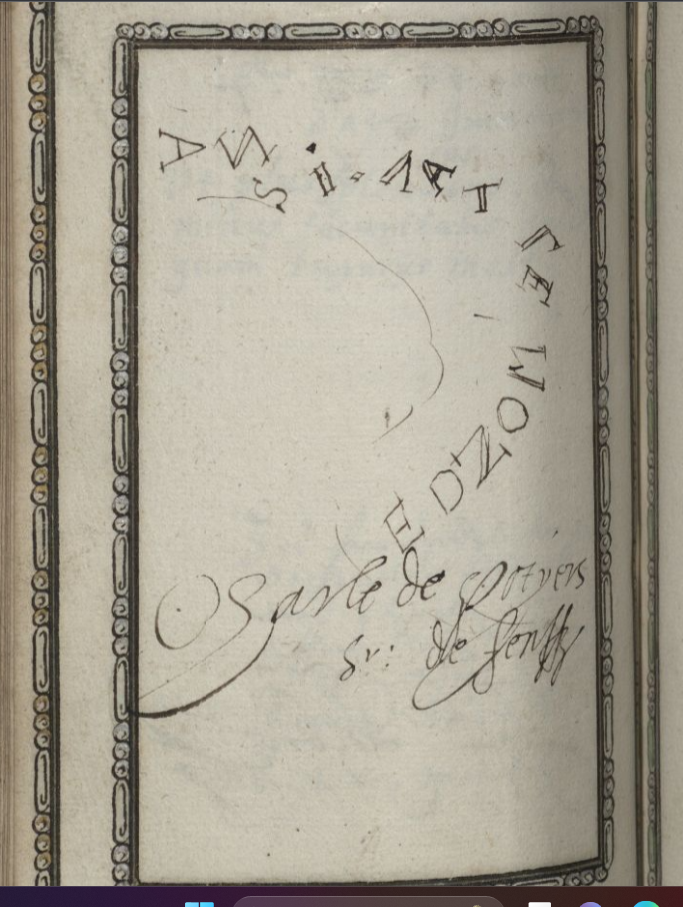
is composed of a number of capital letters some written on their sides, some upside down. Restoring them all to an upright position yields the French sentence, ANSI VAT LE MONDE [the world goes like this] — a purely verbal World Turned Upside Down! Similar tricks with lettering can be found in the contemporary print repertoire too:
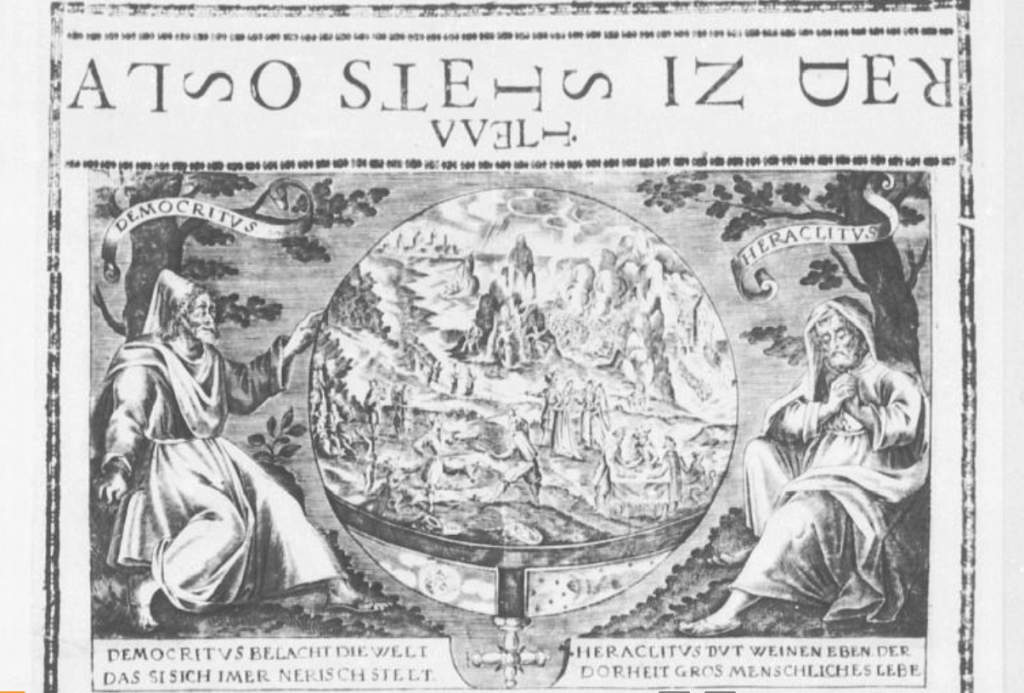
When we again restore order, we read ALSO STETS IN DER WELT [it is thus in the world] above a world-orb turned upside down and flanked by the philosophers Democritus and Heraclitus — but to explore this motif would be a post in itself! Some other time perhaps! [see now my post https://albumamicorumear-e4qvahs764.live-website.com/the-fool-in-the-albums/ ]
Constituent motifs of The World Turned Upside Down
Under the umbrella-term of the World Turned Upside Down [monde renversé, verkehrte Welt] are included many inversions and reversals of the natural order, mostly – by definition – impossible. While on consideration, we may suspect the point of all these motifs of reversal to be ‘moral’, even at times ‘political’, the immediate visual impact, the effect on the viewer, is humorous/comic and one cannot help but laugh!
Ass in the tree, birds on the ground
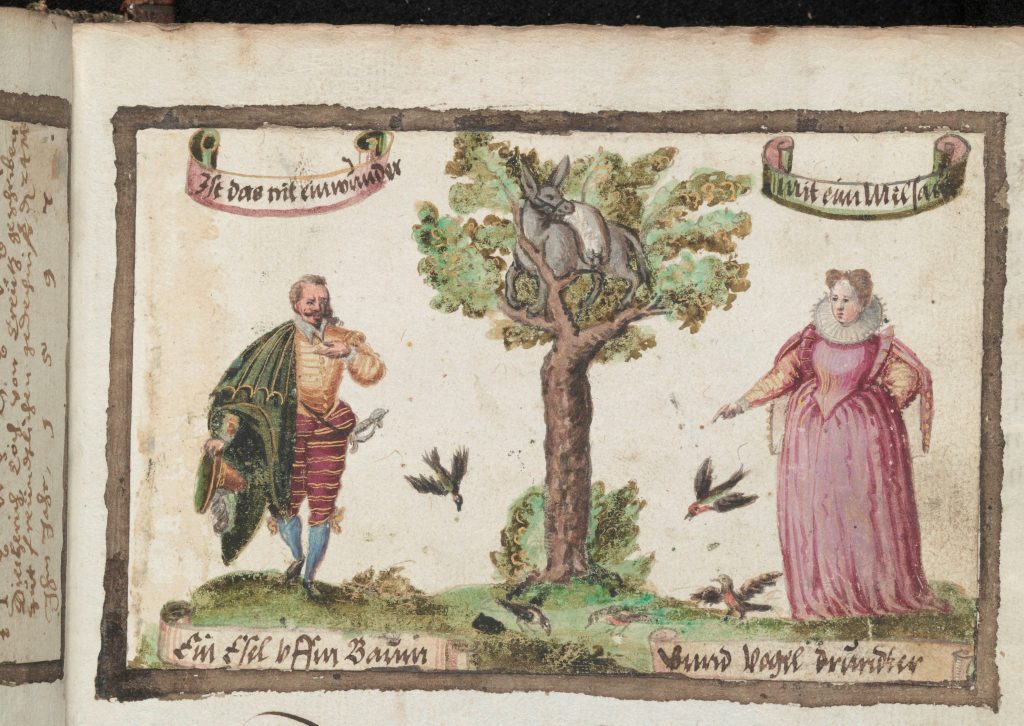
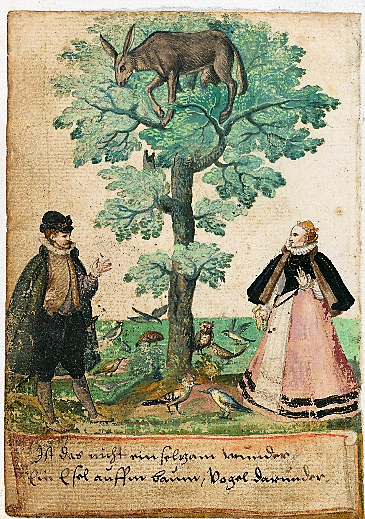
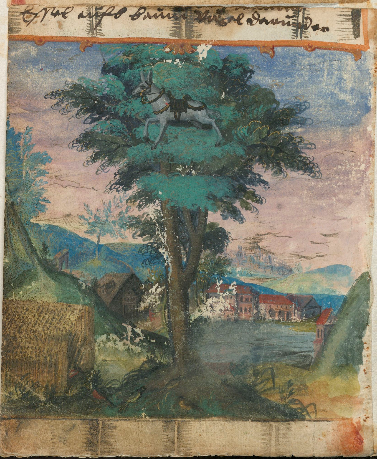
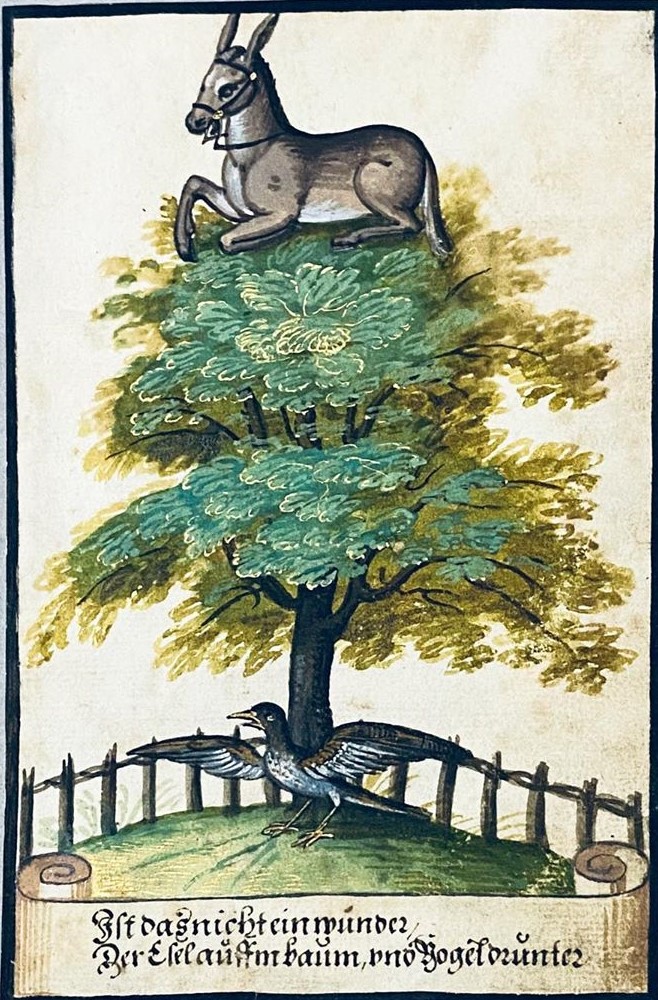
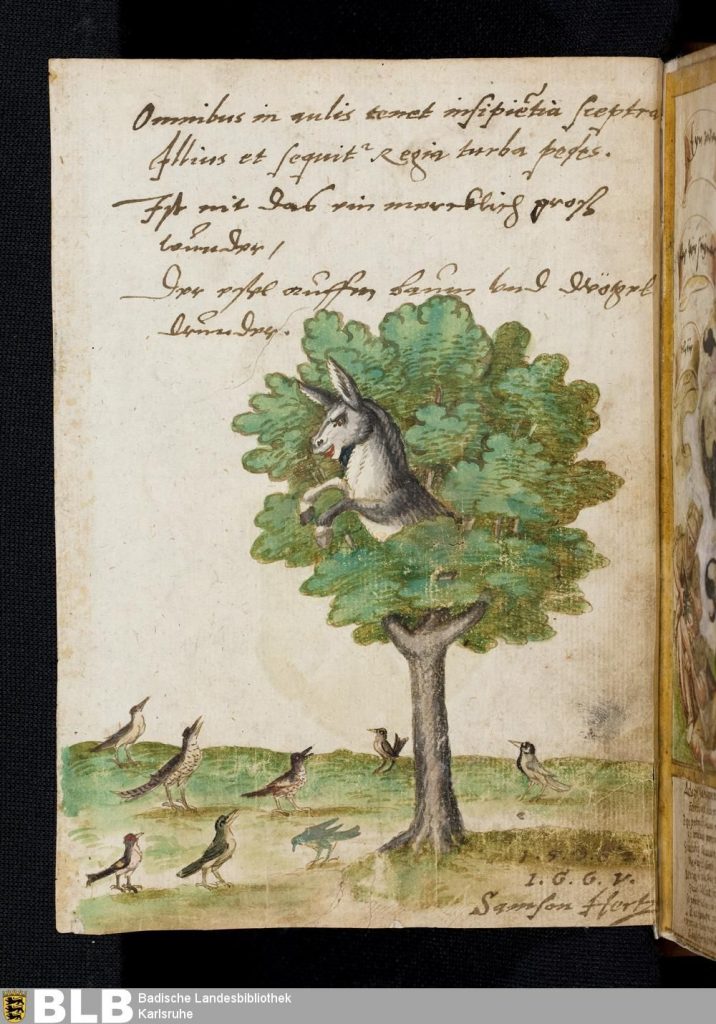
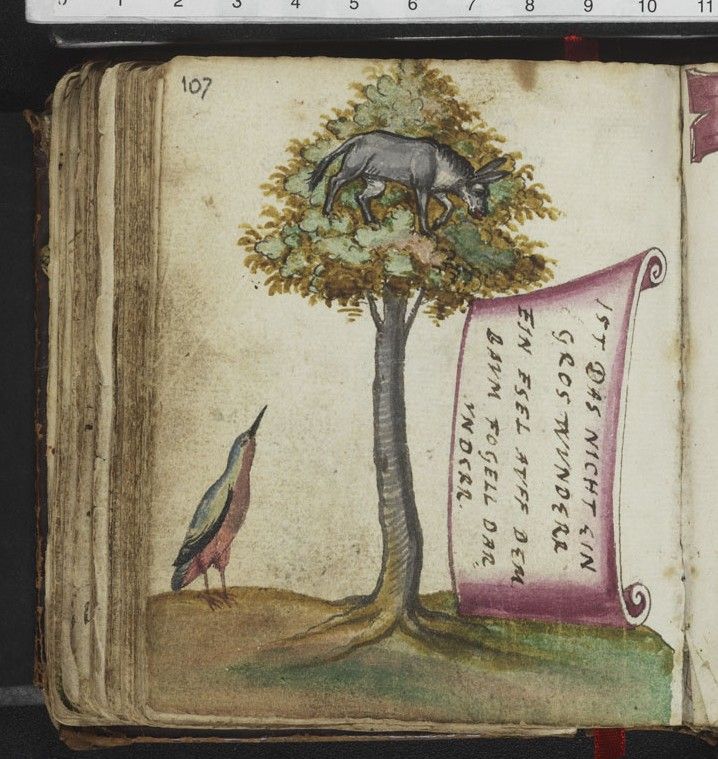
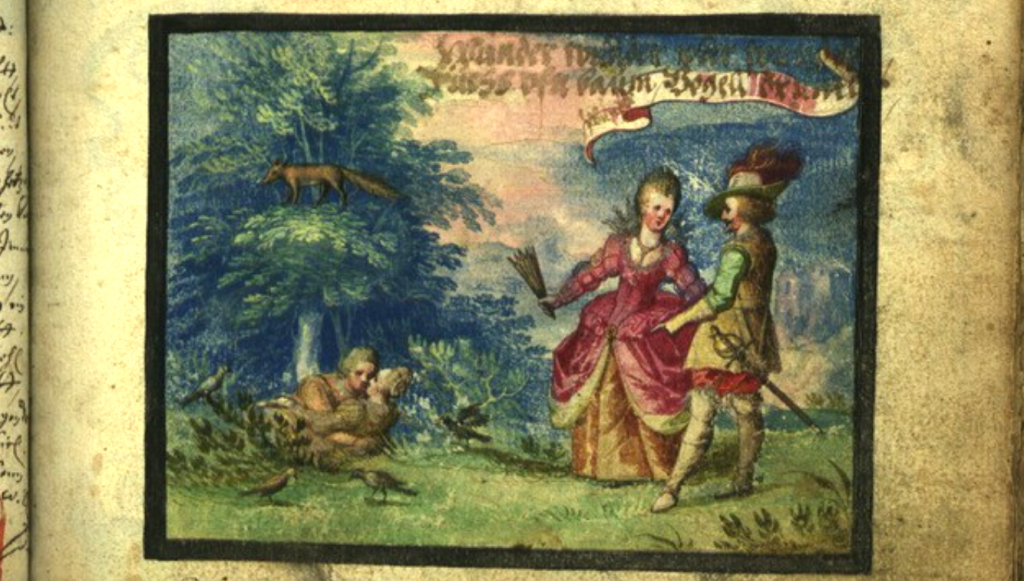
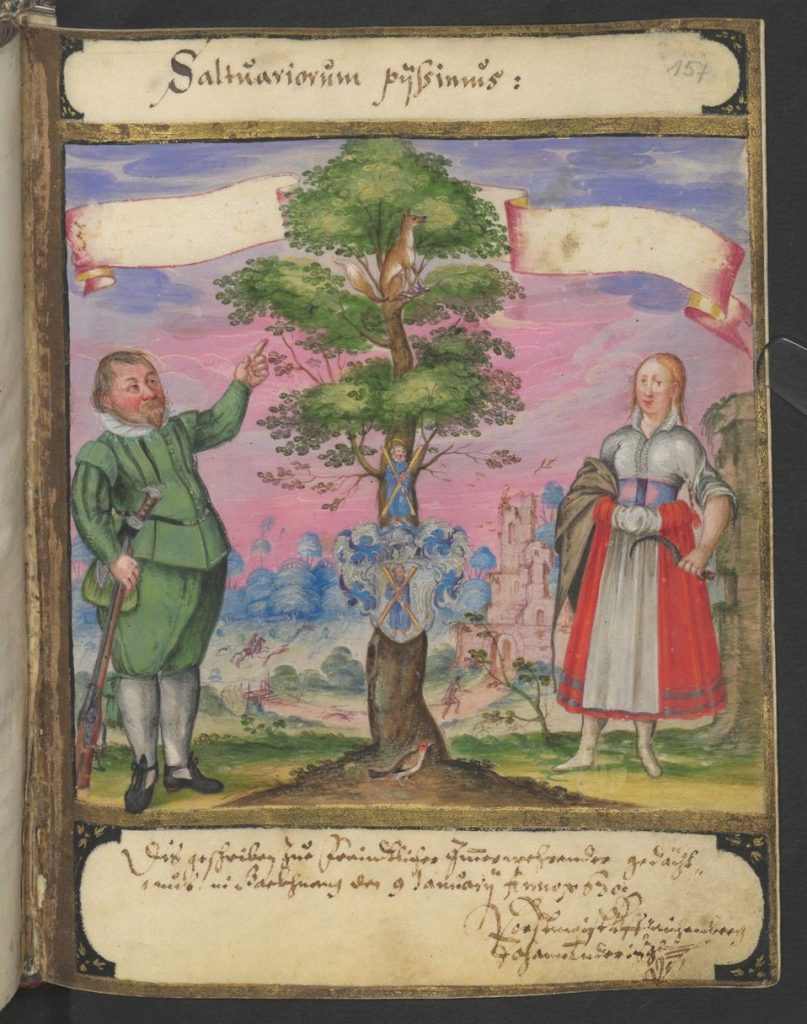
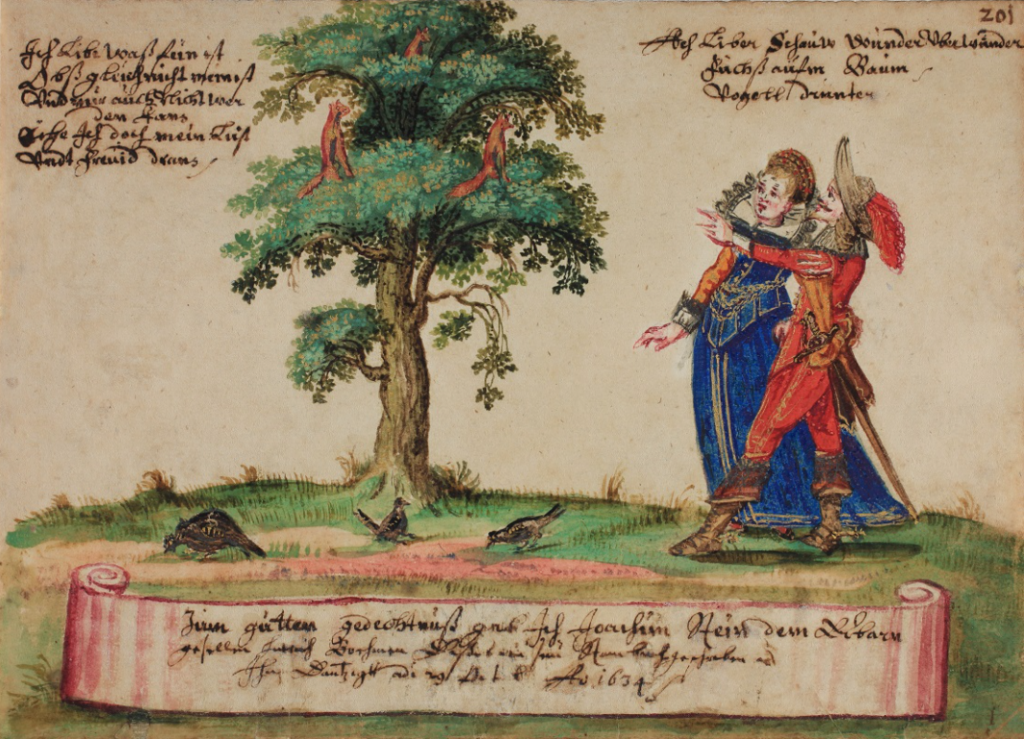
We expect to see birds perching in trees, not donkeys. The image of the ass/fox in the tree and the birds on the ground beneath it is surprisingly common in the albums – I have noted 10 such paintings to date. The earlier, 16C version features the ass, being superseded in the following century by the fox. It is usually accompanied by a rhyming couplet – that in the Schroetter album (1580s) is typical:
Ist das nicht ein gros wvnderr ein esel avff dem baum fogell darvnder [Is it not a great wonder/a donkey in the tree and birds thereunder]
But the earliest instance of the motif I’m aware of, dated 1521, is a carving in the low-relief Flachschnitzerei technique, formerly located above the door of the guestroom of the Oetenbach nunnery, near Zurich, but now reconstructed in that city’s museum, and labelled wunder ibe[r] wunder der esel uf dem bom die fogel darun[d]er.
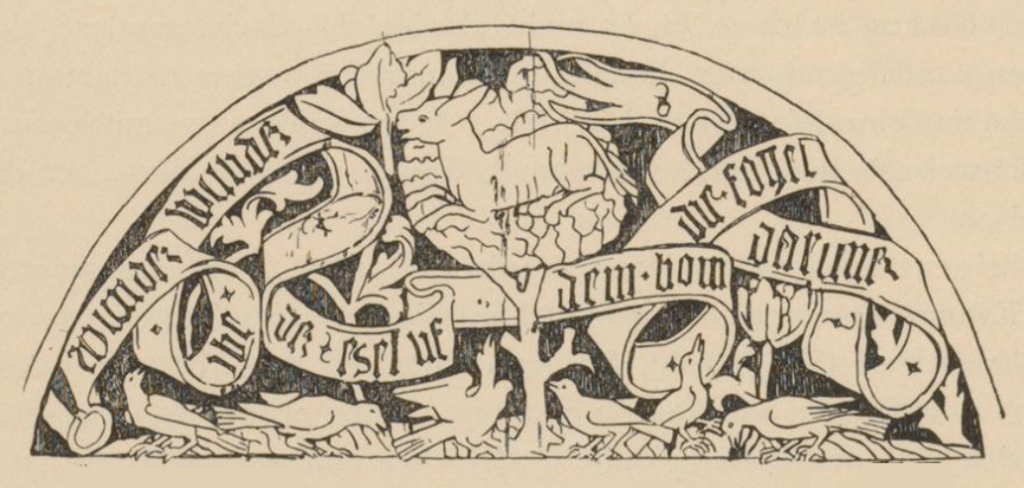
The motif was perhaps popular in the region, for in 1712, referring to what he considered the topsy-turvy decisions made by a local committee, a local nobleman compared its members to a painting he had in his house in Höng [now a suburb of Zurich] “in which the asses sat in the tree, several of them tumbling out of it, but the birds lay stretched out at the foot of the tree.” The painting in question was presumably of 17th or even 16C date. This is the original from Leonhard Meister, Helvetische Szenen (Zurich, 1785), p130:
Ein gewisser Junker Marr verglich diese Committee mit einem Gemaehlde in seinem Landguth zu Hoeng, in welchem die Esel auf dem Baum sassen, und einige freylich herunterpurzelten, die Voegel aber unten am Fuss des Baums ausgestreckt lagen.
But the motif had also been used polemically in Germany: in mid-sixteenth century Augsburg we hear of a satirical poster, a Schandbild indeed, fixed to the house of Bürgermeister Georg Oesterreicher, criticising the repressive measures introduced by the city council, and the report of the incident quotes the offending verse which captioned it:
Schau, Lieber, ist es nicht ein Wunder:
Esel auf dem Baum und Voegel darunter?
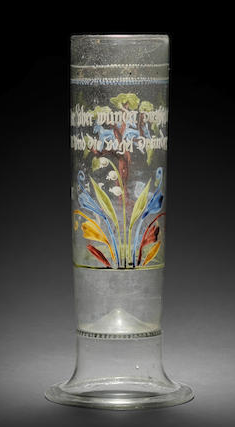
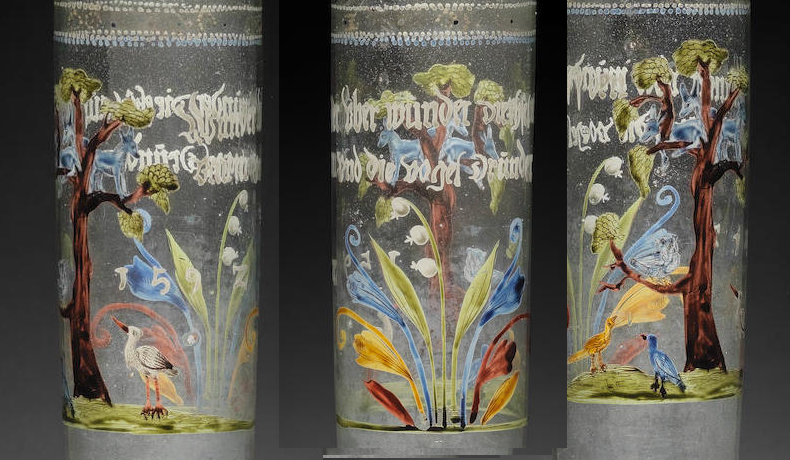
From the end of the century survives a magnificent Stangenglas dated 1592 and enamel-painted with the figural motif and caption: Wunder uber Wunder / die Ehsel auff den Baum und die vogel drunder. (Though no provenance was given by the auctioneer, this is the Humpen formerly in the Fürstlich Hohenzollern’sches Museum zu Sigmaringen)
Fox in the tree….
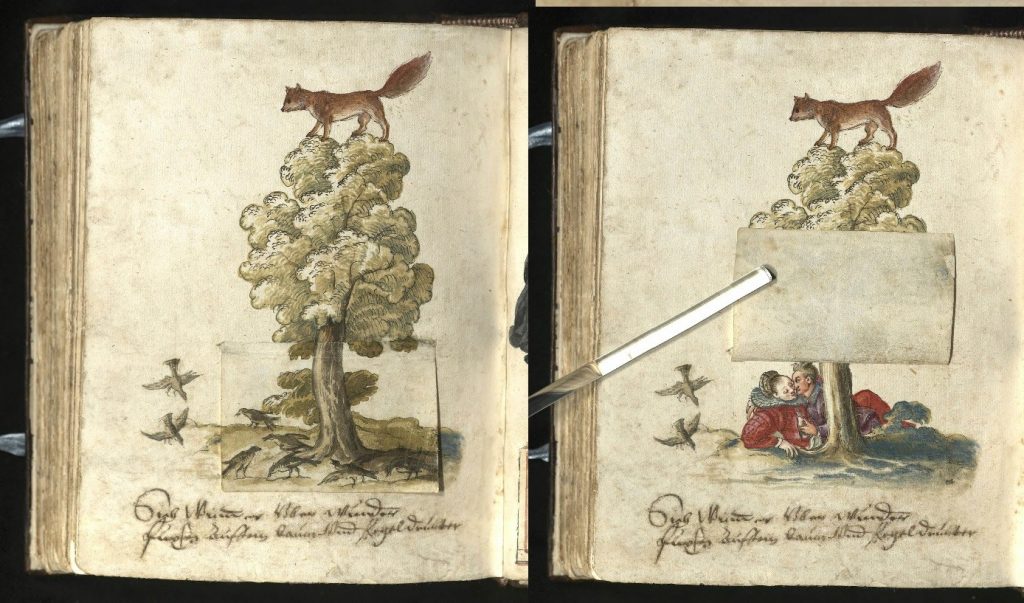
The 17C fox variant of our motif introduces a new, erotic element absent from the 16C ass original, in which — at most — the loving couple stand either side of the tree. The iconographically rich early 17C Heidenreich album is particularly relevant here. Its example, dated 1606, takes the form of a lift-the-flap painting: with the flap down, the fox stands on top of the tree, the birds walk about the foot of it — with the flap up, we see a young couple lying under the tree, the man’s hand cupping the woman’s bared breast.
The Egger album painting presents a similar scene accompanied by the usual Wunder Wunder... rhyme
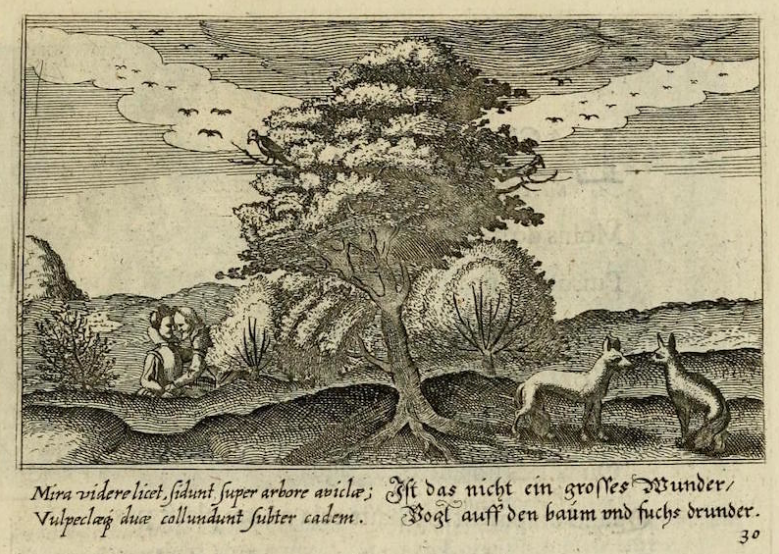
The engraved plate in the Philotheca Corneliana print-book (Frankfurt 1619) is anomalous and puzzling — because, No! It is not a great wonder to see the birds in the tree and the foxes beneath it! Is this some kind of ‘double bluff’ — or did the engraver simply misunderstand the motif?!
The Harant album now in Prague (dated entries 1631-60) presents an apparently more sedate couple beneath the foxes in the tree, but in alarming company.
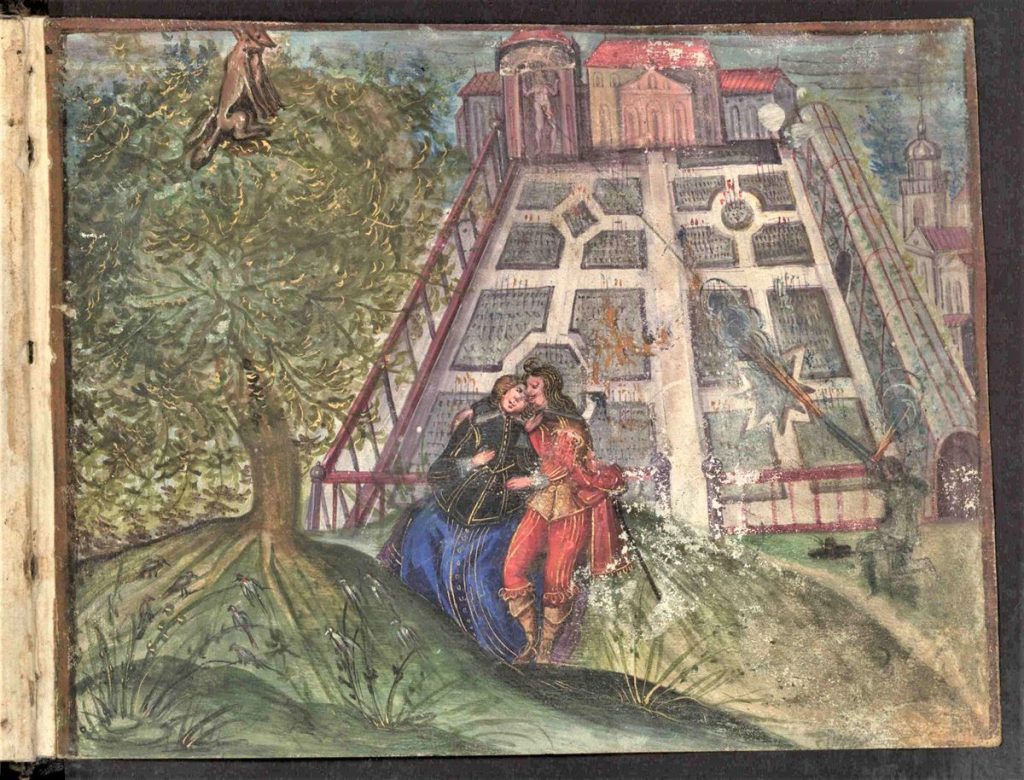
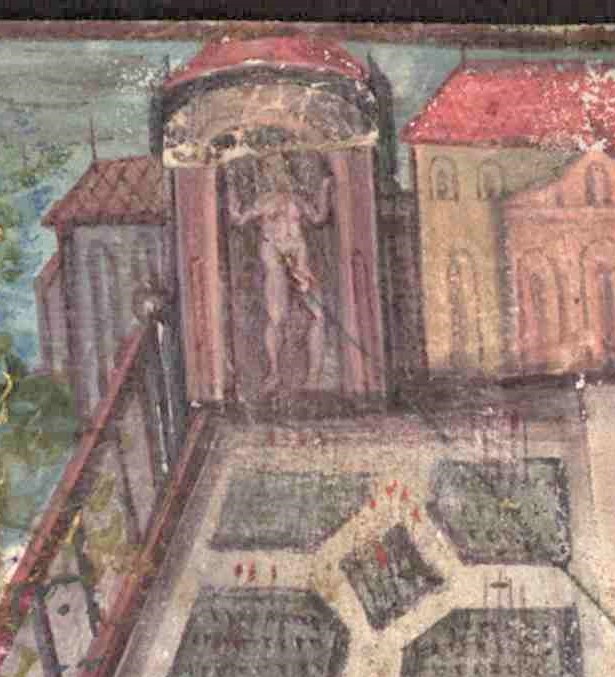
The rifleman (bottom right) appears to be firing a phallus at the figure of a naked woman standing in an archway in the distance.
The Steudlin album presentation of 1630 seems relatively ‘normal’ by comparison! Though the painter has forgotten to add the usual rhyme to the banderole.
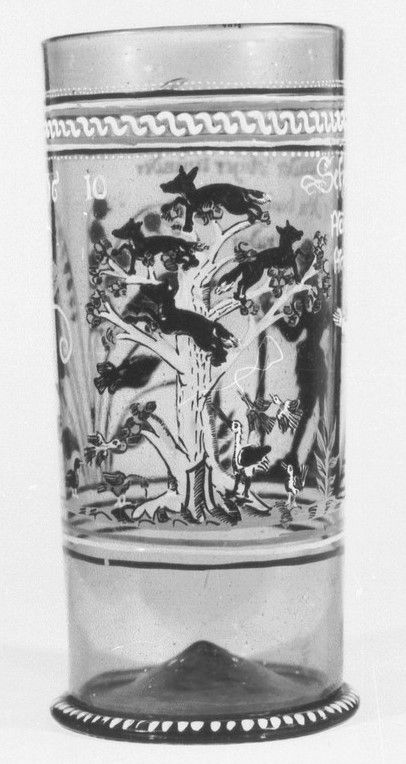
An enamel-painted Humpen made in Franken dated 1610 and now in the Dresden Museum substitutes foxes in its example of the motif with the verse altered accordingly:
Sehett hyr wunder vbyer wunder
Fösche [sic] auff Den baume vndt Fögel dar vnder.
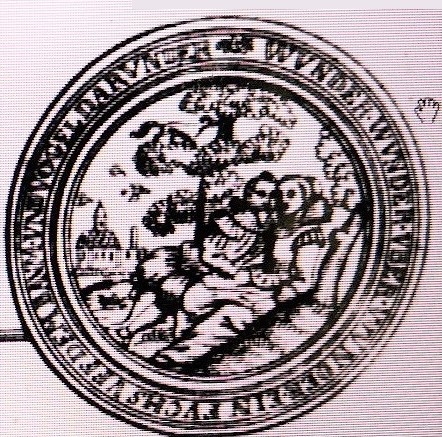
Lastly – in yet another medium – an engraving of 1705 records a satirical medal [Spotmedaille] cast in the previous century which Tentzel believed to have been issued by Johann Casimir von Sachsen Coburg (d. 1633), another example of the fox variant. A young couple who occupy half of the design recline in an embrace beneath a tree in which a fox is ‘perched’, at least one bird is indicated on the ground beside them. The surrounding legend reads
WVNDER WVNDER VBER WVNDER
EIN FVCHS VFF DEM BAVM VND VOGEL DARVNDER.
And the fish, of course…
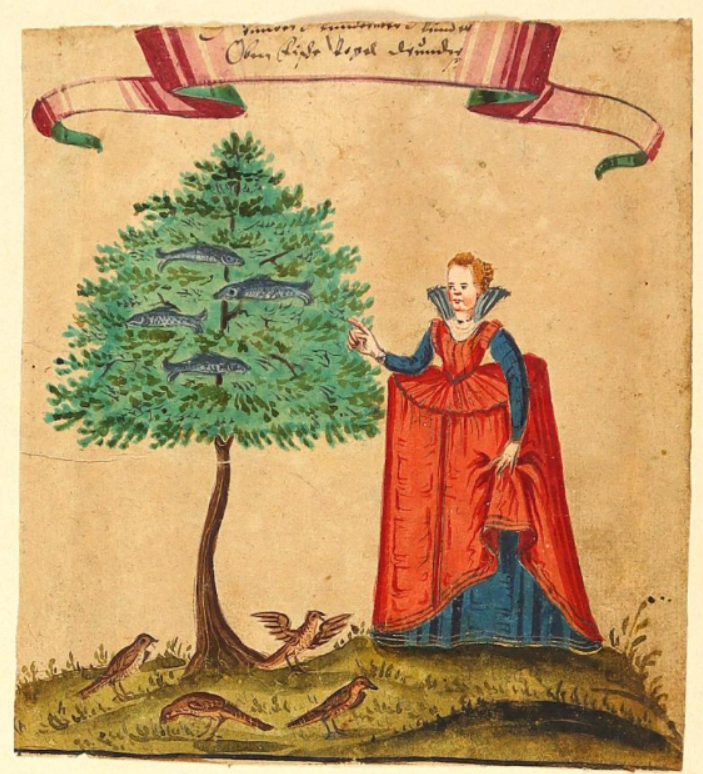
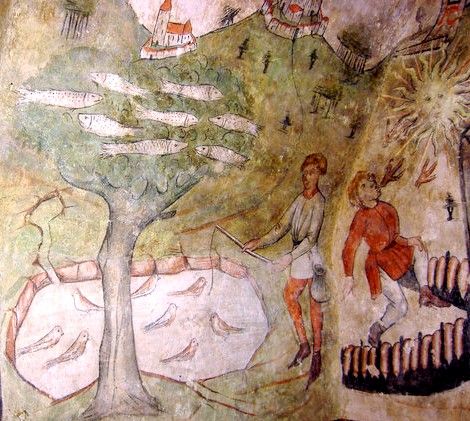
If anything, this is the traditional variant — fish in the tree! Wonderful accident of survival! An orphaned early 17C leaf sold at auction by Pieter Kiefer on 5th December 2022, as lot 2728. Cropped above, unfortunately, but I assume the first line ends Wunder, then follows the usual 2nd line of the couplet: Oben Fisch Vogel drunder [fish above, birds below] — someone better acquainted with this cursed cursive than me can doubtless supply the rest of the first line — pleeease, Gentle Reader! The perfect parallel — and precedent, indeed — has to be the image below, excerpted from the wonderful wall-painting of Schlaraffenland/ Cocagne at Ostermiething in Austria, c.1470
The hunter hunted
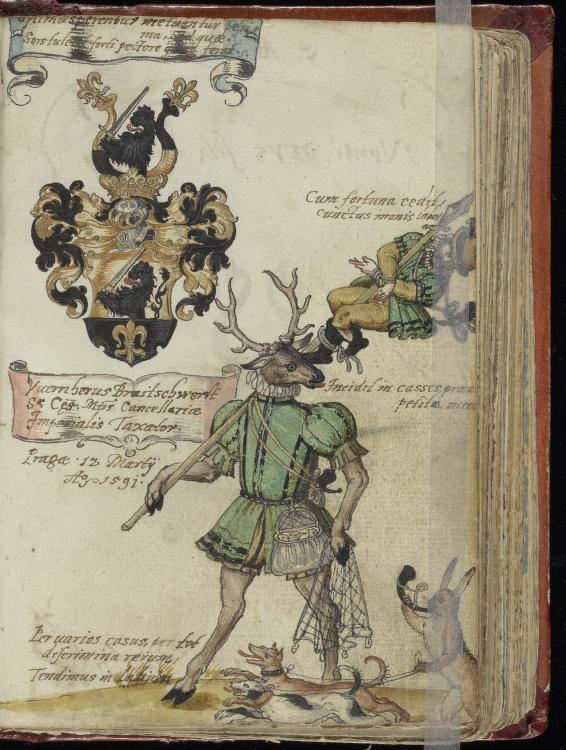
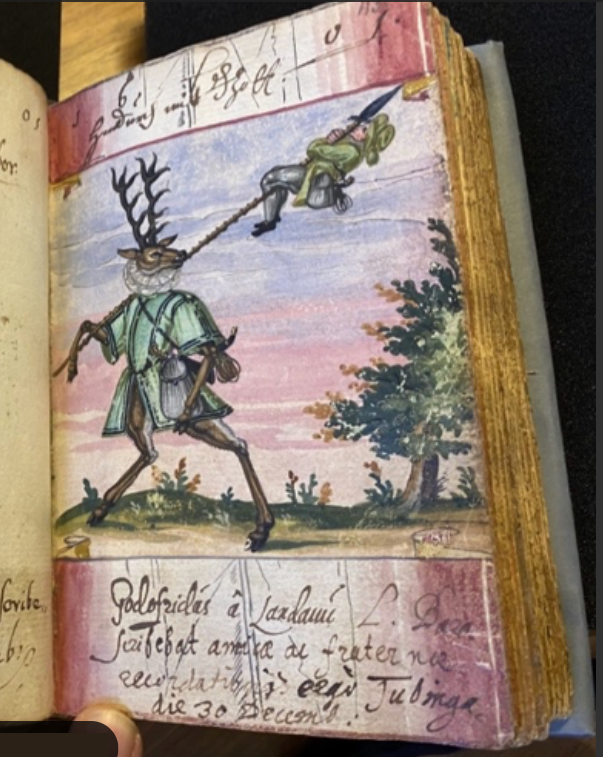
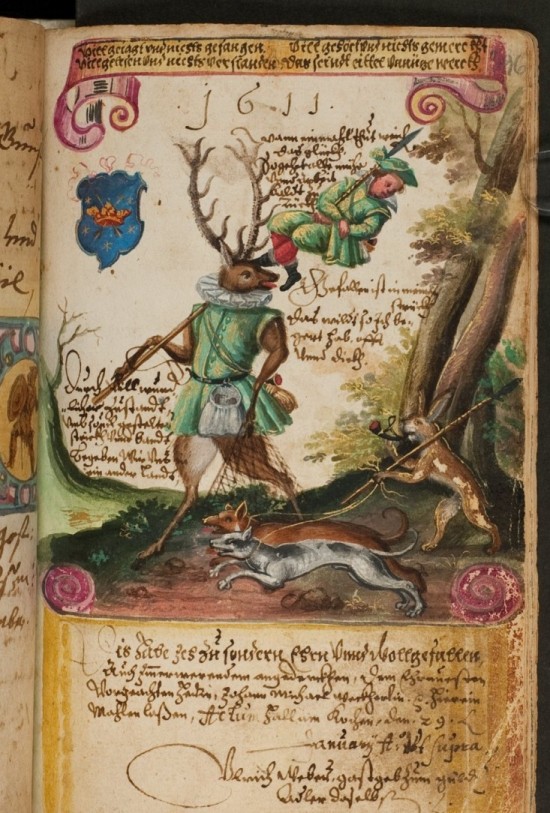
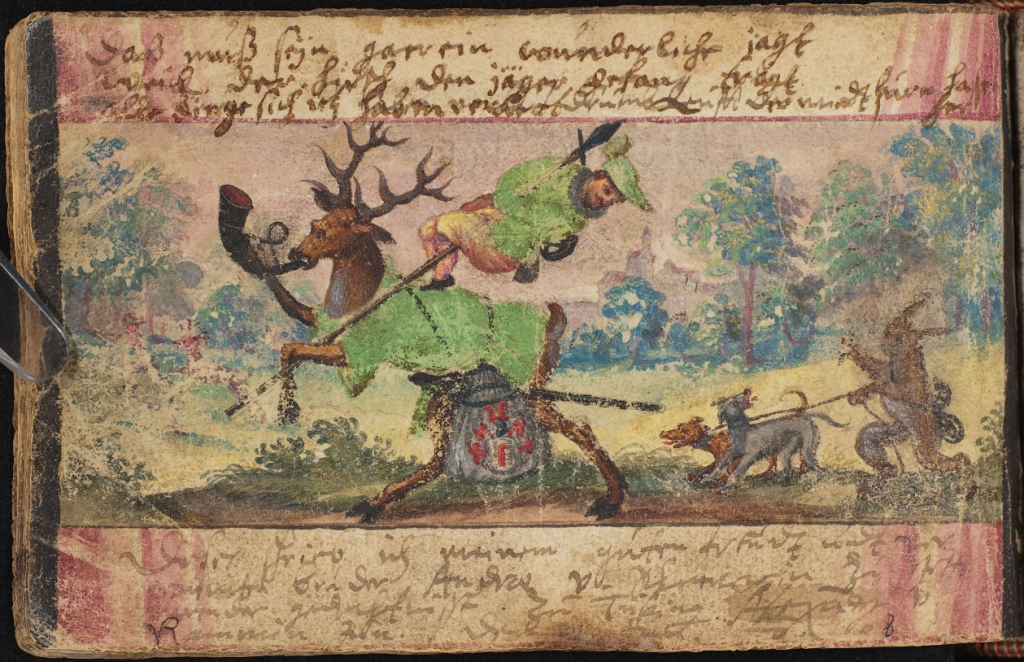
Another classic denizen of the world turned upside down is the stag who returns from the hunt – walking upright on his hind legs, of course — with the huntsman dangling from a pole over his ‘shoulder’.
I know of four examples in the albums. In all four the stag is followed by two hounds (perhaps the huntsman’s own?) held on the leash by a hare. Three are so very similar as to suggest a (lost) 16C print source, the von Schwerin stag is somewhat different and blows a horn as he returns in triumph from the hunt.
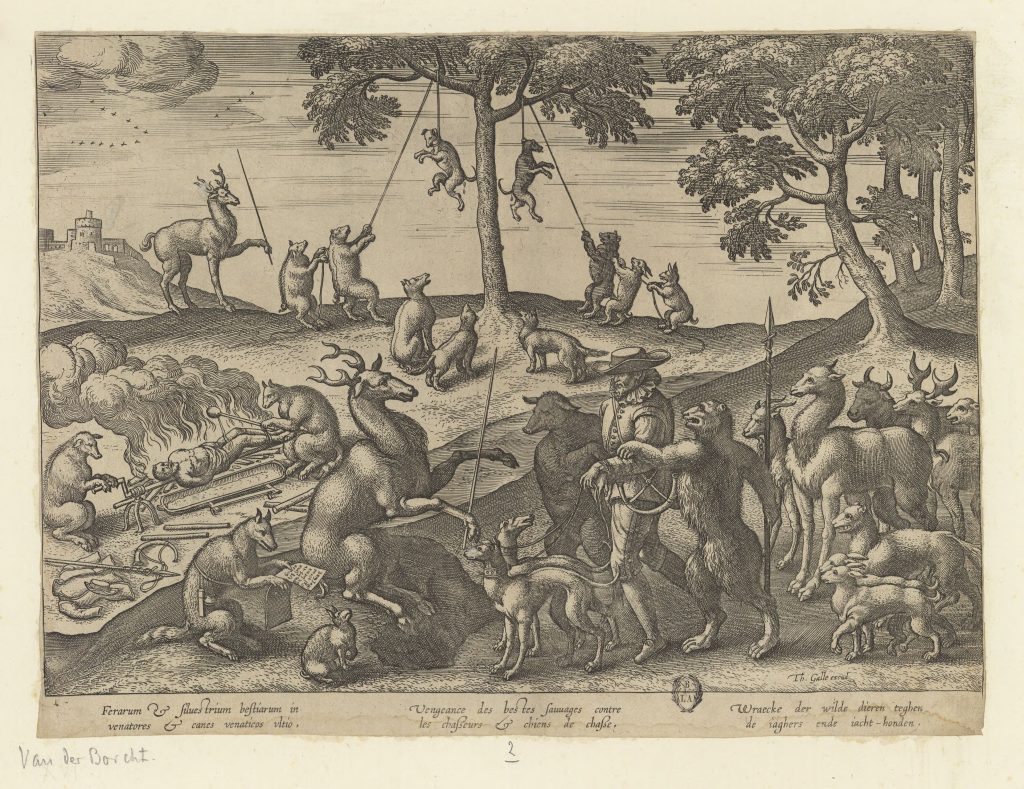
This print below, engraved by Pieter van der Borcht (d.1608), while obviously not the source of the above album images, is the earliest example known to me of the popular ‘Animals’ Revenge’ motif, showing the huntsman brought to trial (and torture), his hounds being hanged in the background.
Lobster
[Most of the material under this heading is taken from my study, “If like a crab you could go backward — Crab-riding in European Art and Culture” available at https://www.academia.edu/85675105/If_like_a_crab_you_could_go_backward_Crab_Riding_in_European_Art_and_Culture ]
A less familiar inhabitant of the monde renversé is the lobster or – to use the contemporary term, as the species were not normally distinguished in pre-Linnaean times – ‘crab’. In the early modern world the salient characteristic of this creature was that it often moved backwards (or sideways), and the classic image, the woodcut illustrating chapter 57 of Brant’s Narrenschiff [Ship of Fools], which depicts a fool in the characteristic ass-eared cap and bells riding on a lobster.
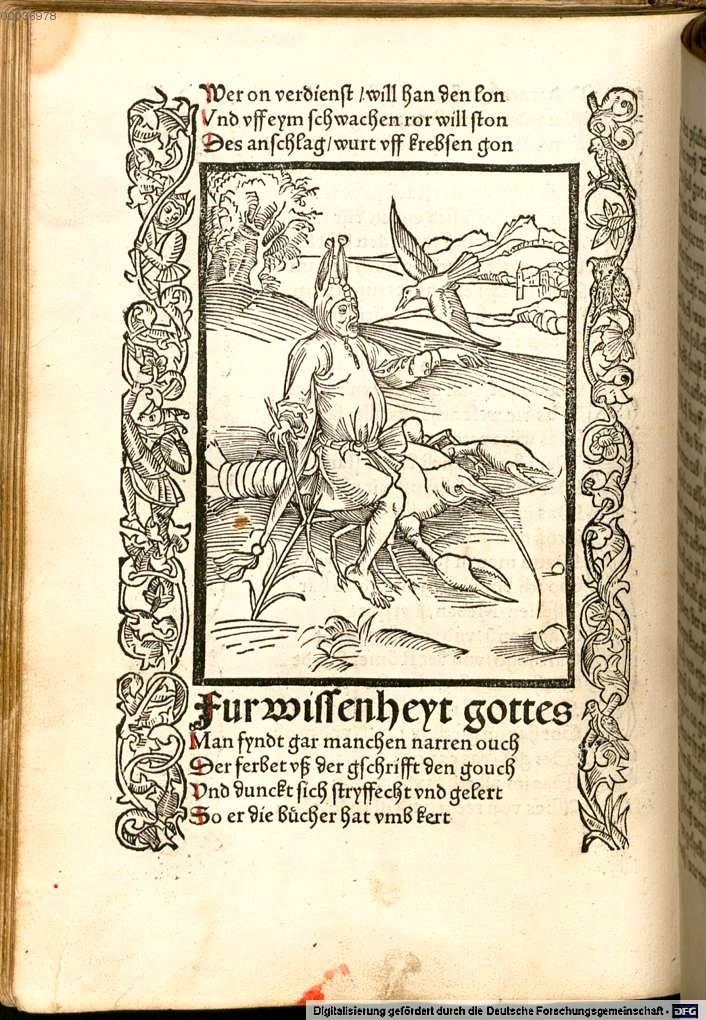
First published in Basel in 1494, the enormous, pan-European success enjoyed by the profusely-illustrated volume ensured that its illustrations (many attributed to Durer), became familiar throughout the continent – two illustrated English translations appeared in 1509 alone, to cite but one example.
But long before the alba amicorum made use of this popular motif it was familiar in Germany in forms not necessarily dependent on the Narrenschiff woodcut.
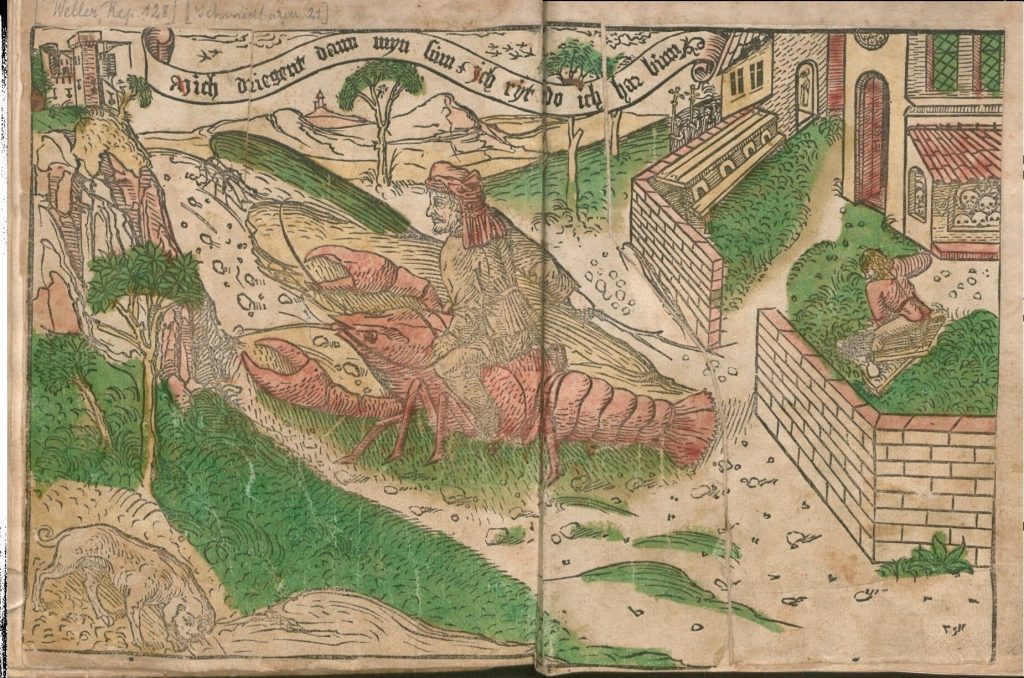
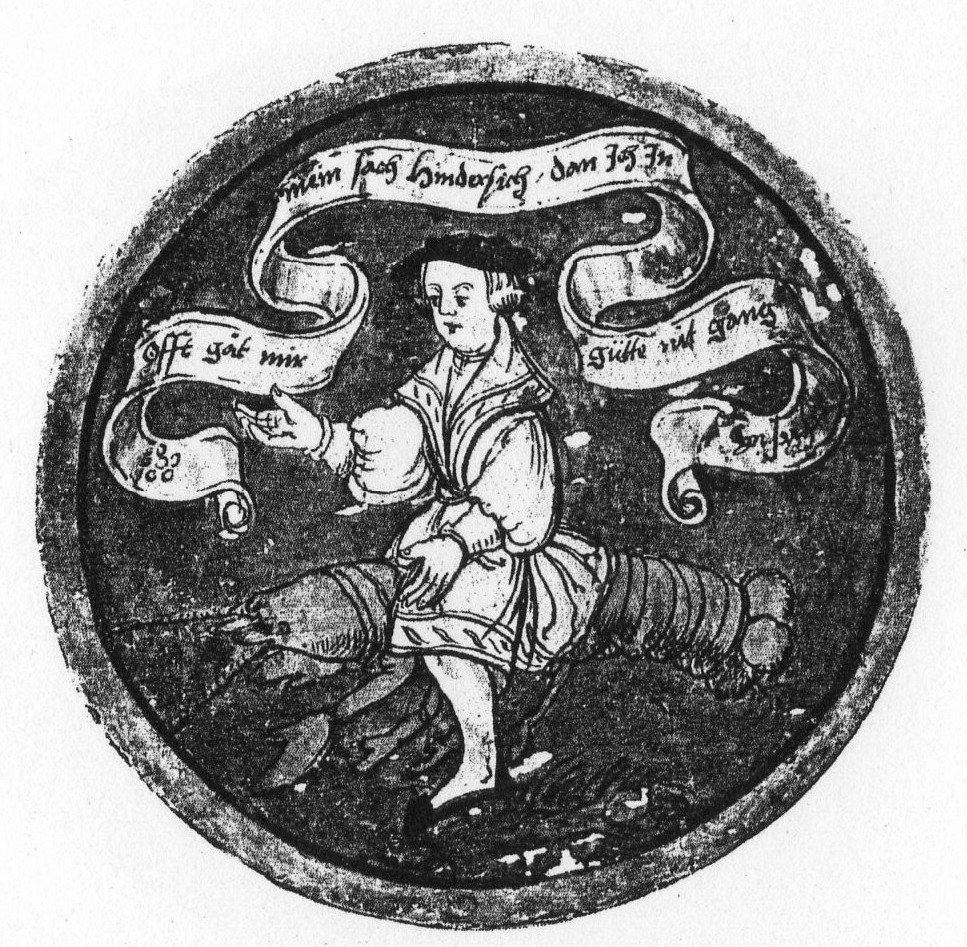
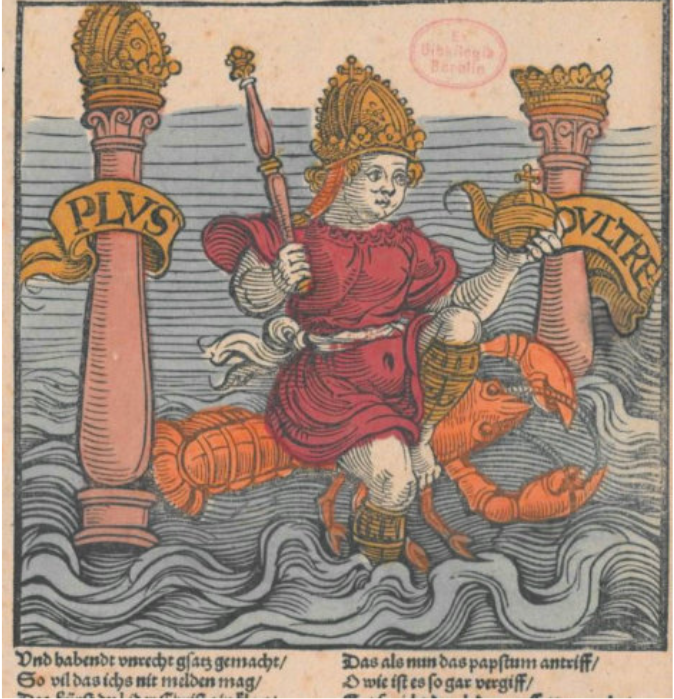
Current in 16C Germany too, it was inevitable that the motif would enter the imagery of the alba amicorum. Undated, but some time before 1613, painted on f.17r. of Daniel von Redern’s album we see a man about to saddle up a lobster against a maze-like background, the everyday nature of the action somehow making the motif more explicit and more absurd [Stockholm, Kungl. Bib., MS Ir 2a]. A little later in the 17C, in the Giese album recently acquired by the Deutsches Nationalbibliothek, we see the man now mounted confidently astride his crustacean, holding the whip in his left hand, and wearing a badge which perhaps identifies him as a Postbote [courier] – piling on the irony!
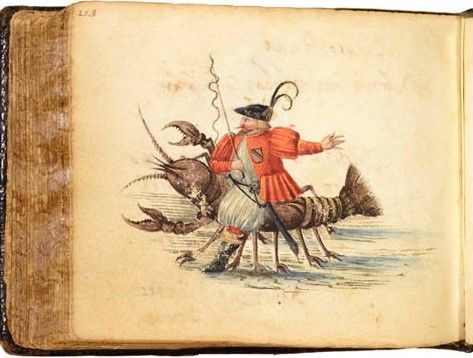
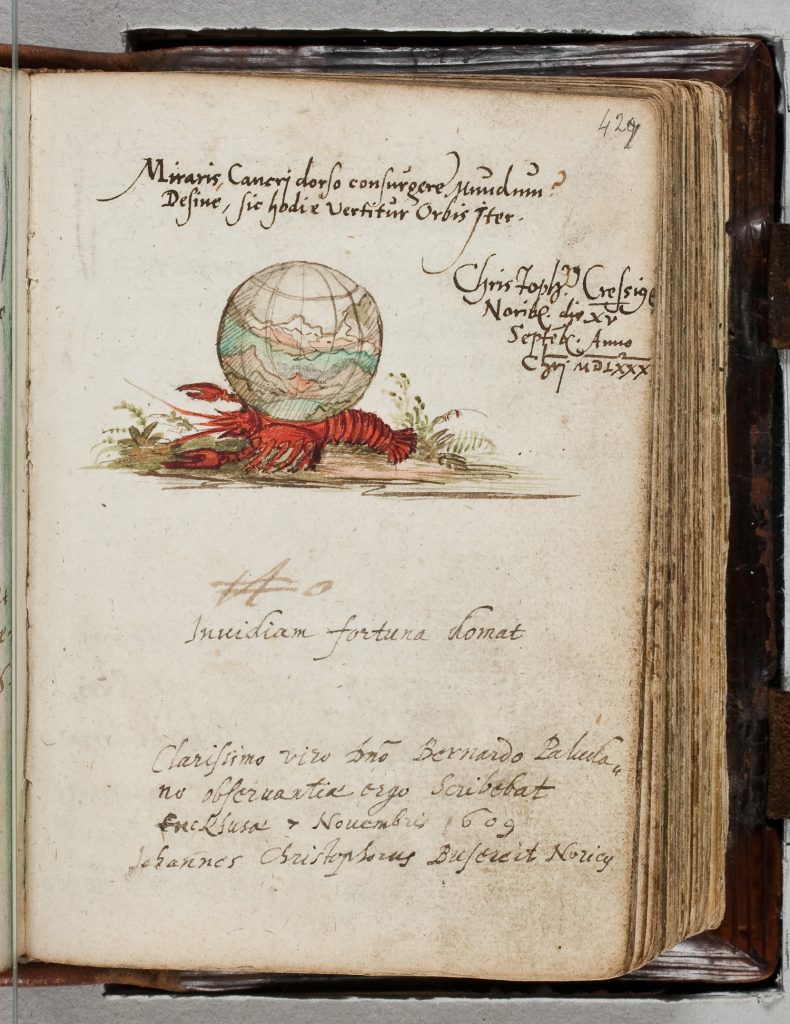
The emblematic image of the world-orb on the back of the backward-walking lobster is found first in the albums before being taken up by the emblem-books. It appears as early as 1560 in the album of Abel Prasch the Elder, and 20 years later in that of Bernardus Paludanus [Berent ten Broeke] (BELOW) — and later in the Kaltenhausen zu Greiffenstein (1615), Gesner (1644) and Dietherr von Anwanden (1651) albums.
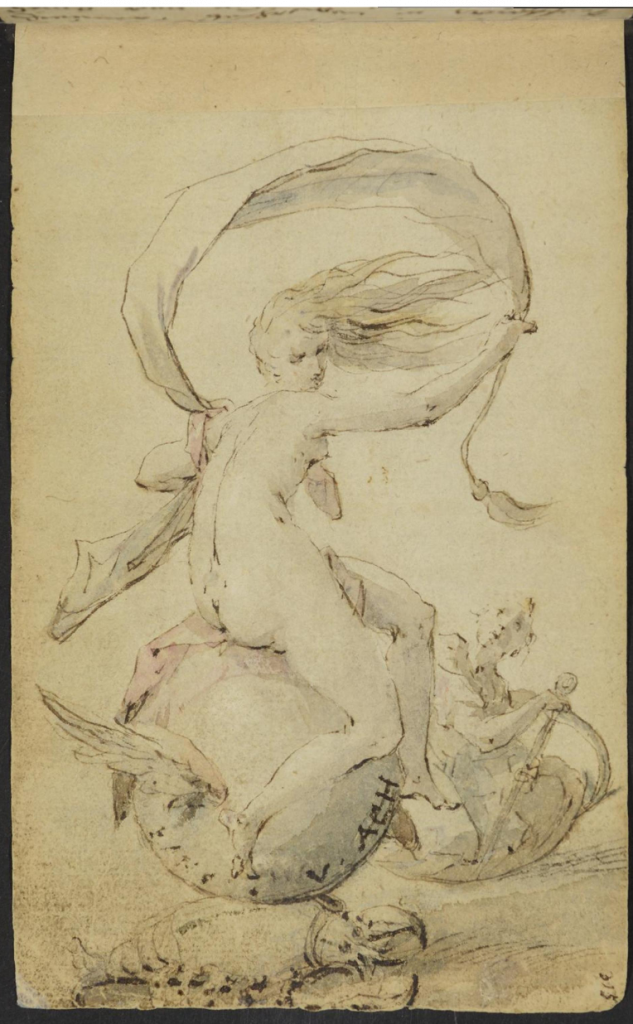
We are used to seeing Fortuna standing on a globe, but an unnoticed drawing in the Berlepsch album (1608-15), signed by painter Hans von Aachen, depicts the goddess sitting on a winged globe borne on the back of a lobster.
If – despite the disparity of scale — we can accept the notion of saddling up and riding (backwards) on a lobster, then we should not be surprised to find lobsters being employed as draught-animals!
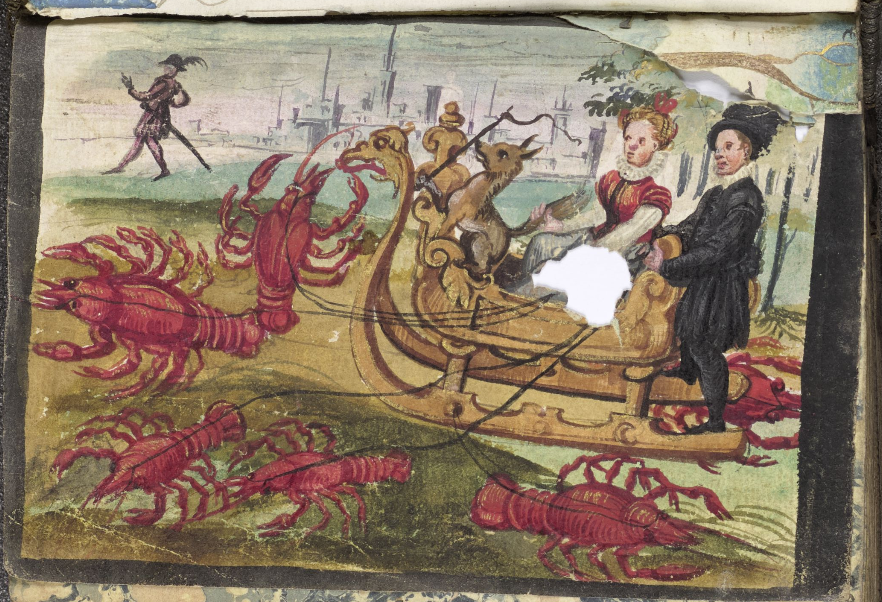
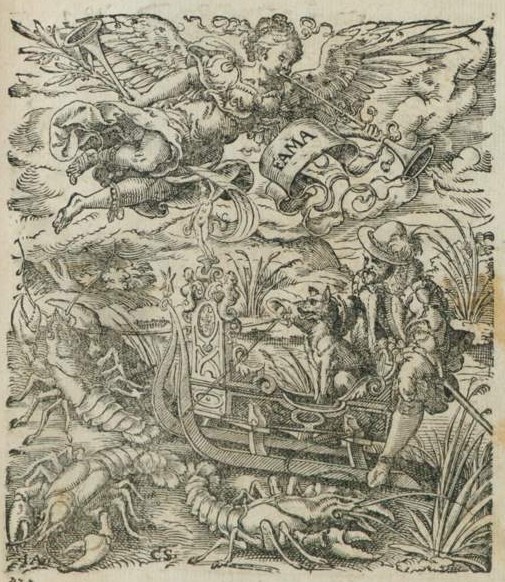
The von Abschatz album (above) features a couple and their dog in a sleigh drawn by six lobsters, only two of which are heading forwards, the others head backwards and sideways. Here the source for the motif is probably a woodcut entitled Fama by Jost Amman c.1579.
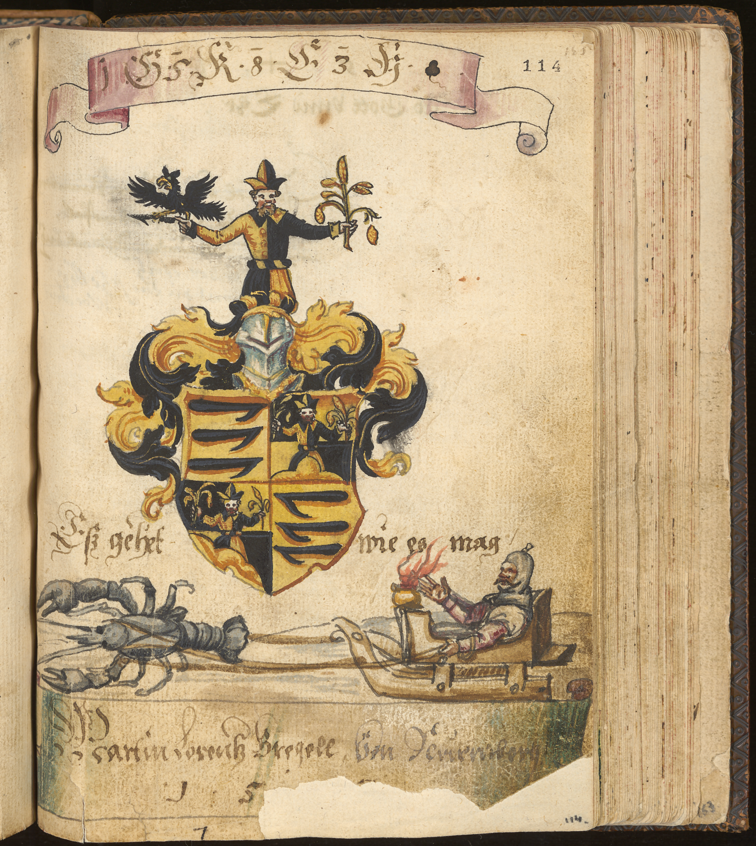
On f.114r. of the Francklin album (below) beneath a coat-of-arms dated 1583, however, a single lobster draws a man in a sleigh, the image being labelled es gehet wie es mag [it goes where it wants]– it is clear that the artist expected us to know the rest of the saying –als wenn Krebs am Schlitten ziehen [like when ‘crabs’ draw a sleigh] as Lehmann’s Florilegium politicum (Lübeck, 1639), the earliest literary record of the full form, presents it — the Francklin painting thus representing a considerable antedating of the proverb.
I have foolishly forgotten to annotate this drawing below and the image is too low-res to enable me to read the contributor’s name properly — Readers?
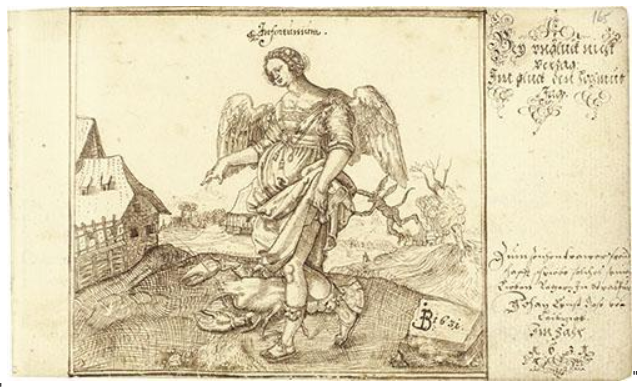
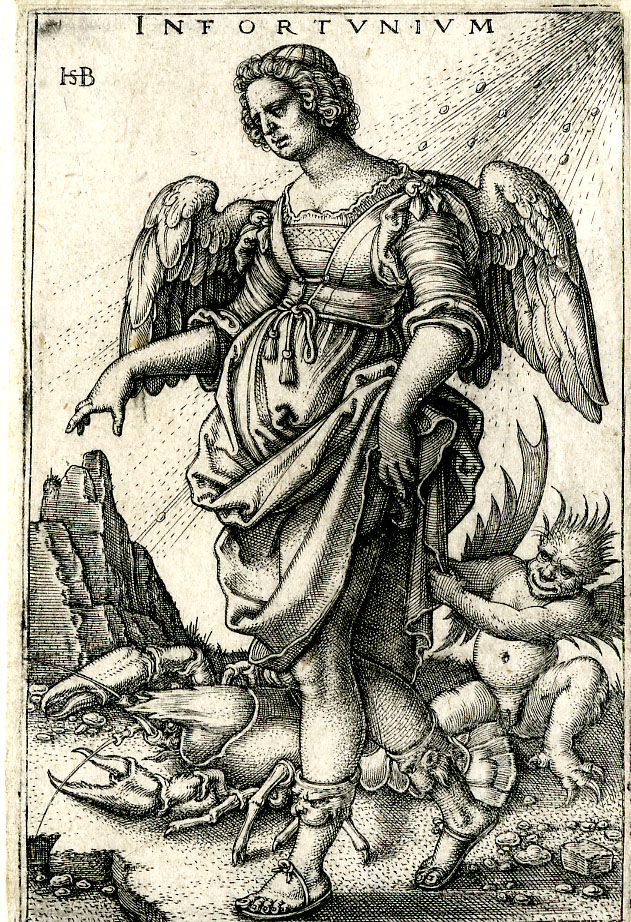
I can at least see that it is dated 1631 and entitled Infortunium, so almost a century after Beham’s Infortunium which it is copying (c.1541) — though notice how tiny the devil has become!
If riding on a lobster is a familiar activity in the monde renversé, then we should perhaps not be surprised to find numerous examples of naked women riding on giant hedgehogs in the albums, but – strange though it may seem — these seem more appropriately regarded as an erotic motif, and so I treat them under a separate post: Naked Woman Rides Hedgehog — Igelreiterin.
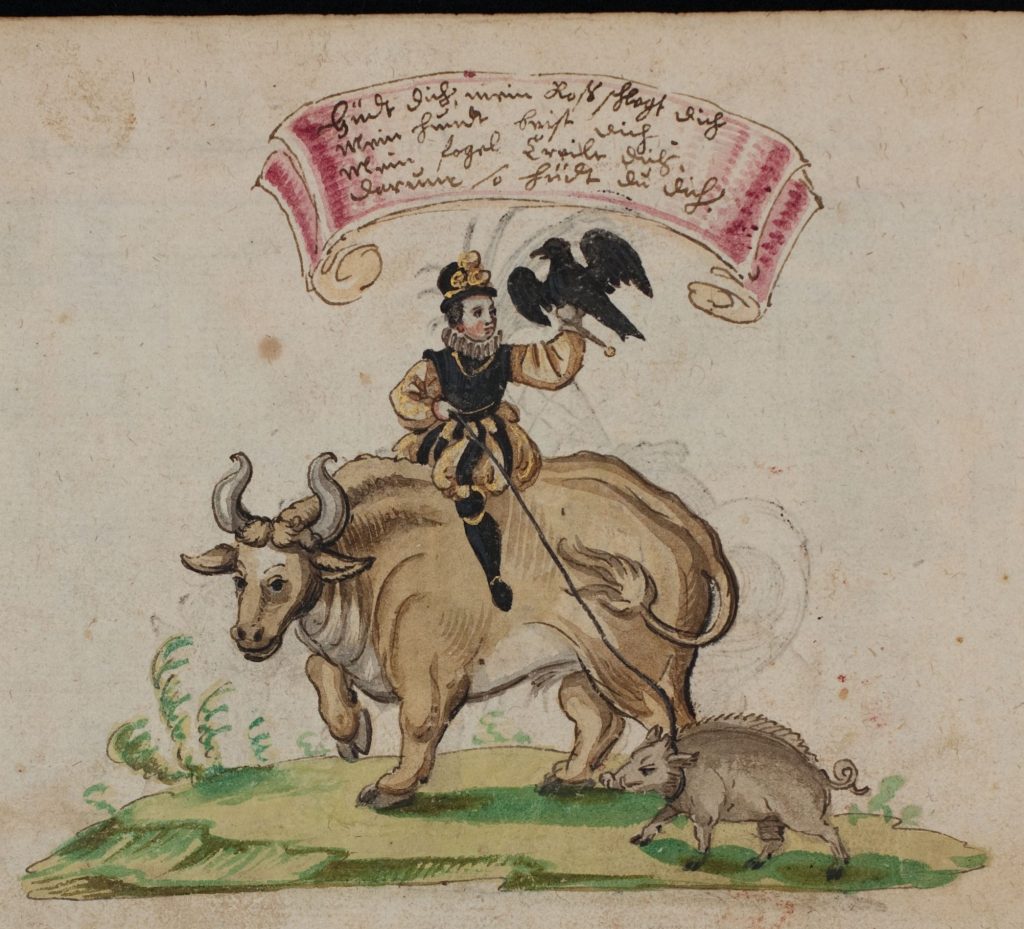
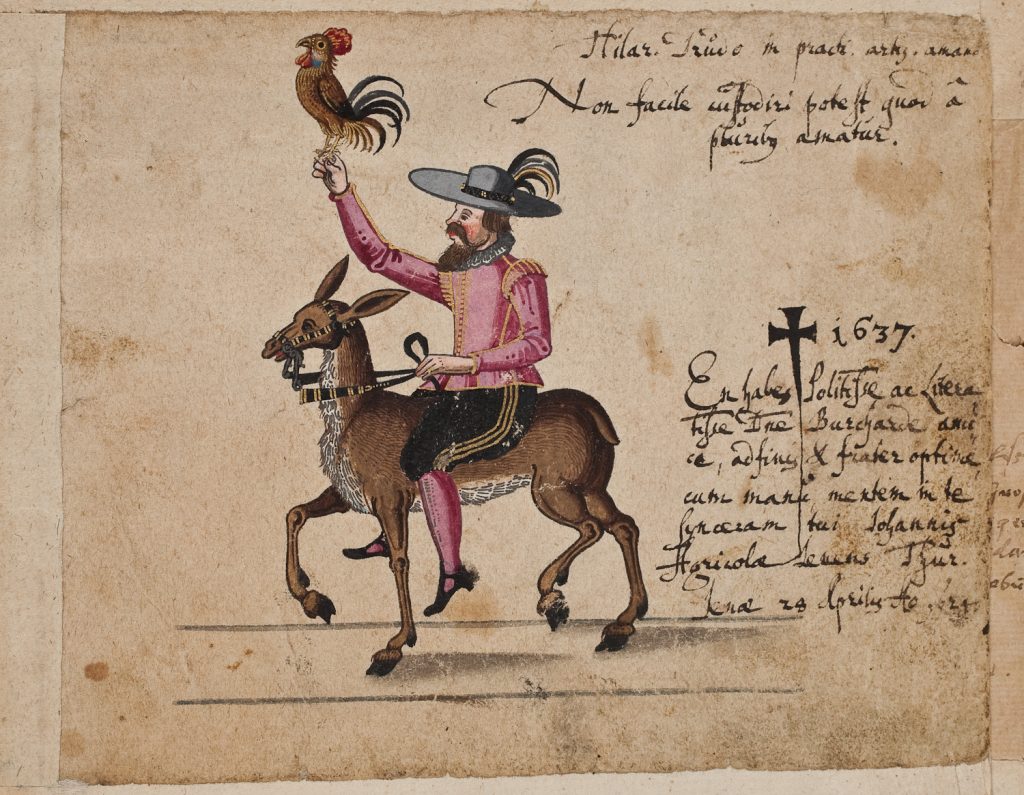
And if I’m to put them anywhere, this is surely the place for other unconventional mounts! Here, from the album of Christoph Huber, we see a gentleman out hawking (?crowing) on bullback, with a pig on a lead. The inscription reads
Hüdtt dich, mein Ross schlegt dich Beware My horse will kick you
Mein hundt beist dich My dog will bite you
Mein fogel Creilt dich My bird will scratch you
Darum so hüdt du dich so beware!
[My thanks to Christoph Gasser for the transcription]
and another gentleman riding on a deer painted in the Grossmann album
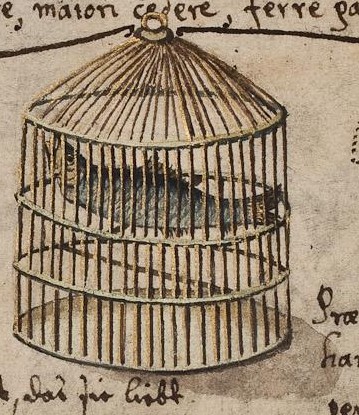
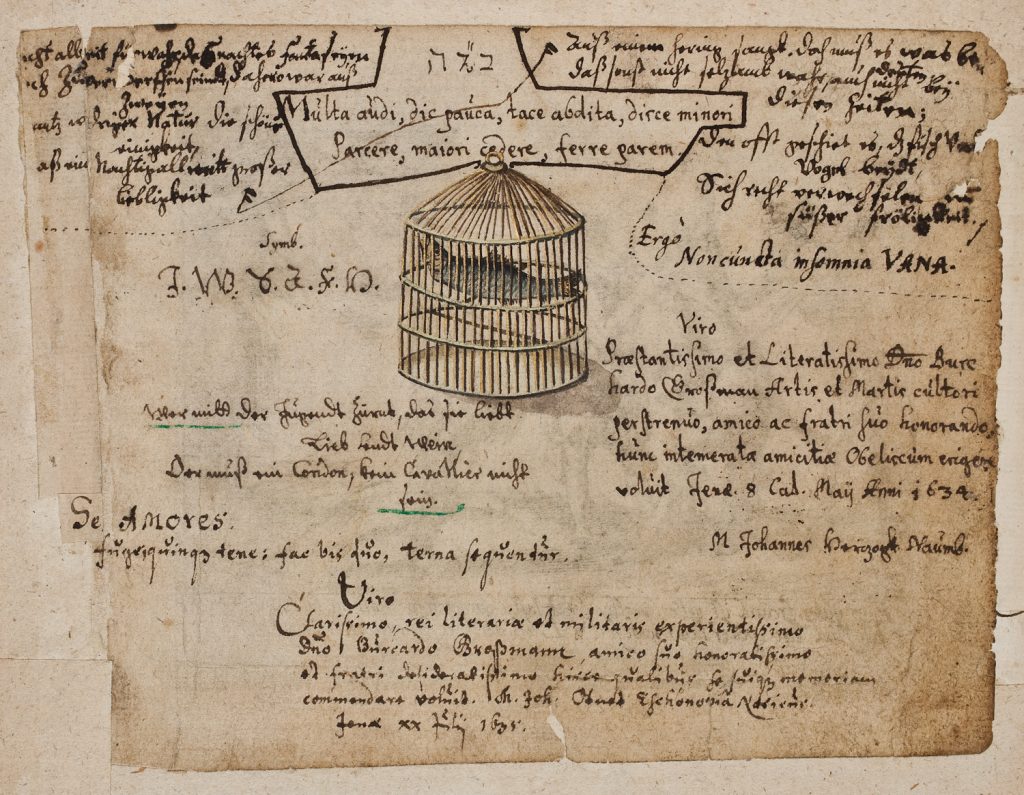
SADLY, I have not seen any reproduction of the scene of fish sitting at table while dogs pursue men in the water painted in the Albert von Rorbach album (1617-33) according to the RAA. But another surreal little drawing on a crowded page in the Grossmann album certainly qualifies for inclusion here, I think — a fish in a bird-cage!
Vestimentary reversal — Dressing Upside Down
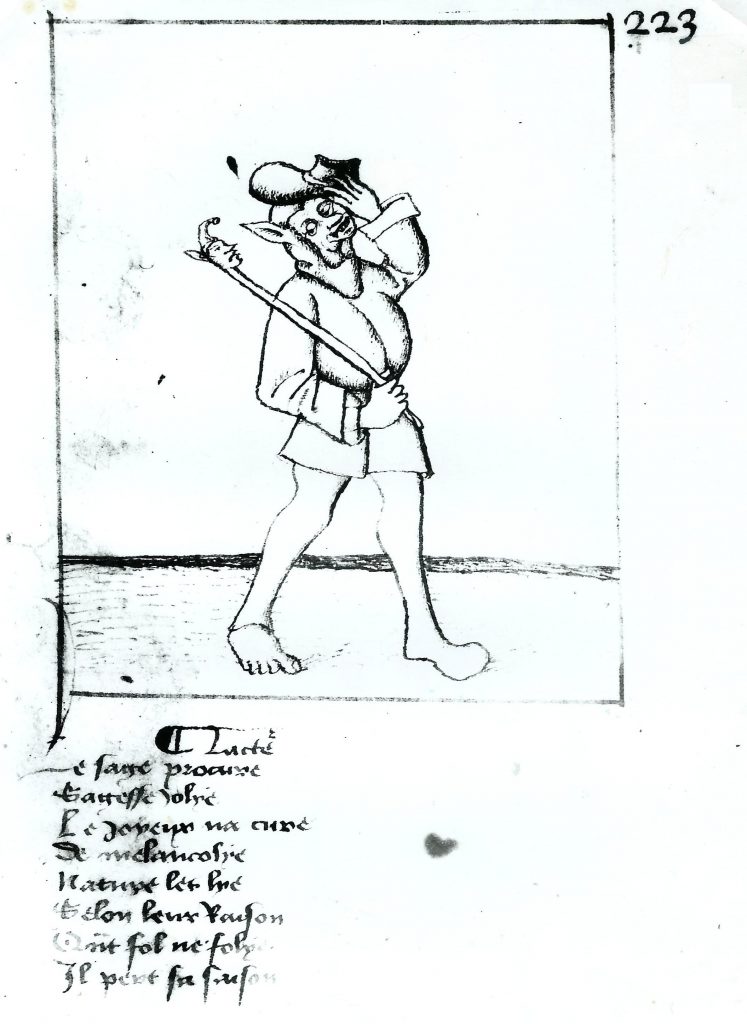
Unlike the fool in the late 15th and early 16C Proverbes en Rimes manuscripts who demonstrates his folly by putting a glove on his foot or a shoe on his head
the man in the Sparn album painting goes the whole hog!
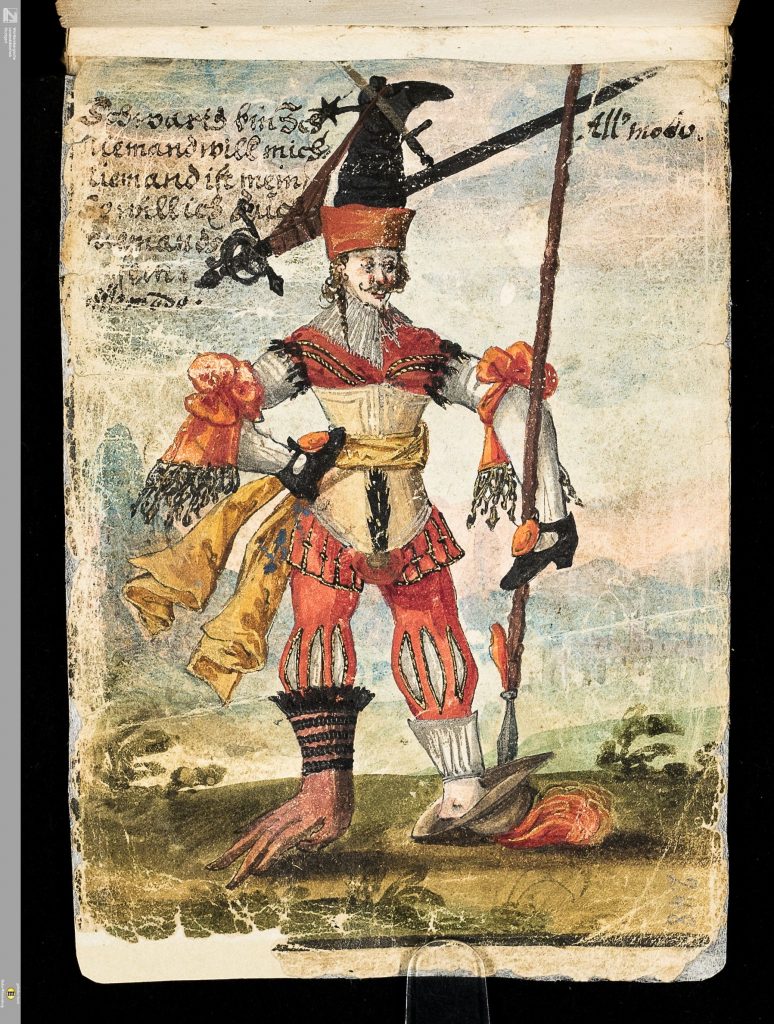
Schwartz ??kinzes/hinzes … Niemand will mich Niemand ist mein So will ich …. Niemands …. allomodo
The Allamodo satire on fashion was at its height in 1629, and this painting is presumably part of that satirical fashion, but we note that he wears on his head what should be on his foot (boot), on his hands what should be on his feet (shoes), and on his feet what should be on his head and hand (hat and glove).
More or less contemporary is the title-page woodcut to John Taylor’s significantly titled Mad Fashions, Od fashions, All out of Fashions (1642), which makes full use of monde renversé motifs to function as The Emblems of these Distracted Times
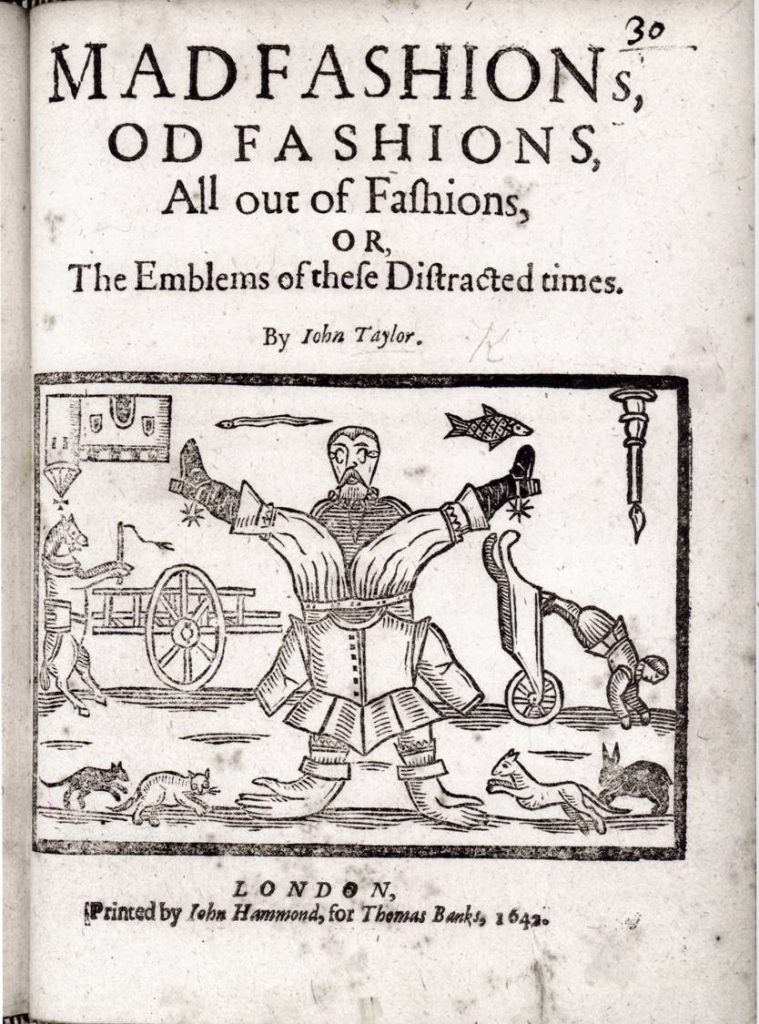
This thoroughgoing World Turned Upside Down illustration — as well as vestimentary reversal of the same type as in the Sparn album — also includes other classic constituents of the theme: the proverbial ‘cart before the horse’, the mouse hunting the cat, and the hare hunting the hound, fish flying in the air, and the wheelbarrow pushing the man! Taylor’s verse makes plain the way in which we are to interpret this emblem of the state of the English nation in the Civil War era:
The Picture that is printed in the front
Is like this Kingdome, if you look upon’t:
For if you well doe note it as it is,
It is a Transform’d Metamorphasis [sic]
This Monstrous Picture plainely doth declare
This land (quite out of order) out of square.
Leave a Reply to Lift-the-flap pictures [Klappbilder] – Album Amicorum: Early Modern Stammbuch Iconography & related Cancel reply