SEE ALSO cuckolds in the post https://albumamicorumear-e4qvahs764.live-website.com/lovers-ii-courting-consummation-cuckoldry/
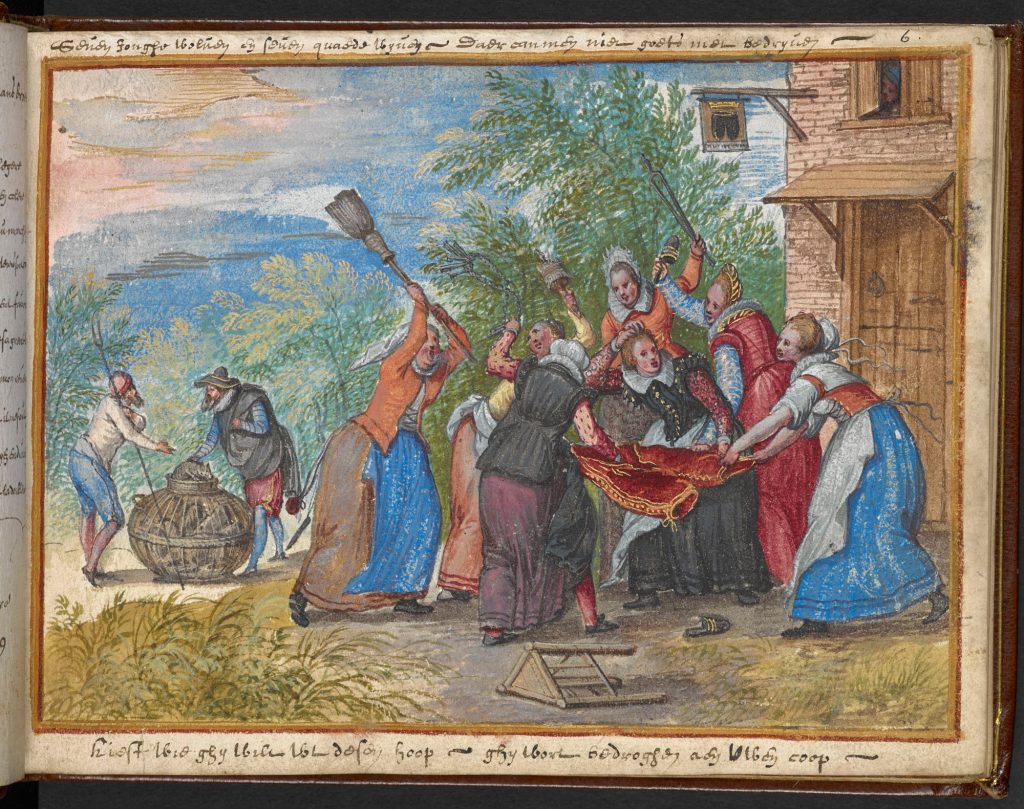
I’m surprised to have only found two examples of the very popular ‘Battle for the Breeches’ motif in which 7 women [cf. Isaiah …..] fight one another for possession of a pair of trousers, at this date a quintessentially male garment
I have traced earlier examples of the motif in my The Secret Middle Ages (new edition, 2025) so forebear from giving a thorough treatment, the importamt thing is to show the album images! The somewhat naive style of the painter of the miniature in the late 16C Balthasar von Nostitz album (below) somehow manages to seem innocent and charming — perhaps because only his trousers are being fought over so keenly, not the wearer. The only relevant quotation here (see below) is the line from Juvenal (Satires VI, 242) immediately above the miniature: Nulla fere causa est, in qua non foemina ltem moverit [There is almost no lawsuit in which a woman did not start the dispute]
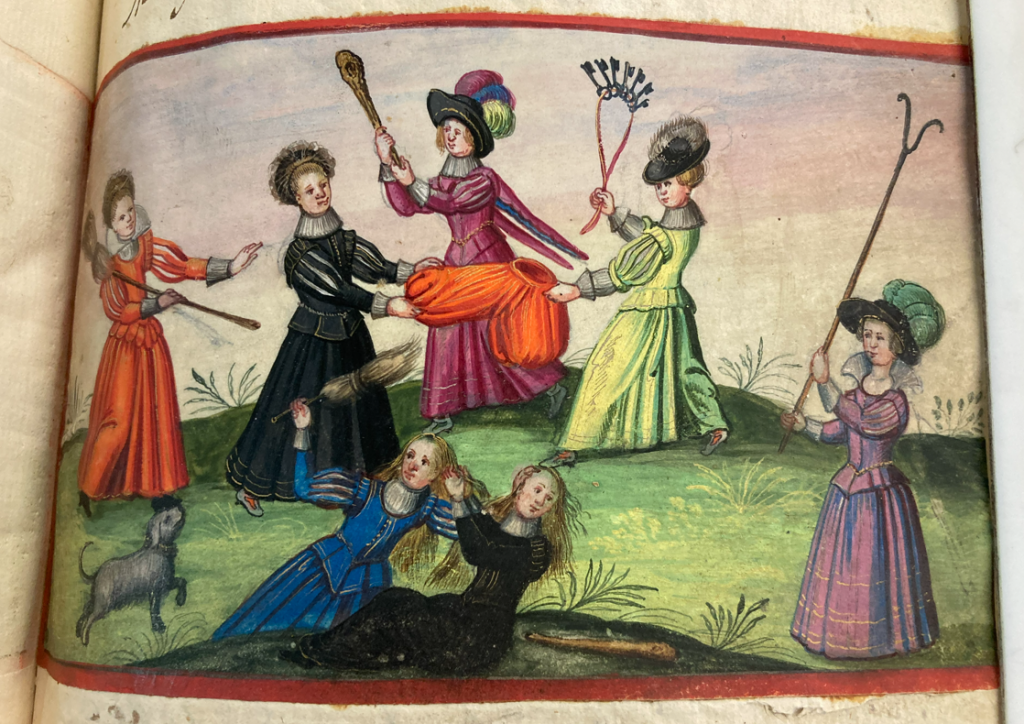
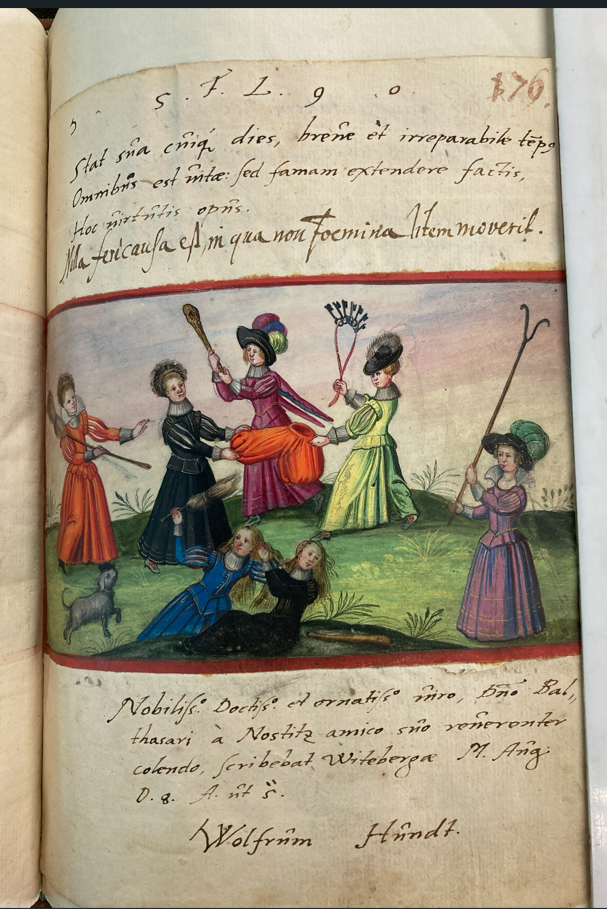
12602 Familiennachlass von Nostitz (D), Nr. 314. Photo c/o WIlfriede Fiedler
The only other illustration of the motif I’ve noticed to date is in the Walens album — the only one of their hundreds of albums the British Library has digitised so far — though even this only partially. Perhaps the cyber-attack may to some extent excuse this extraordinary omission — but it is to be hoped that at least a representative sample will be included in the Library’s forthcoming digitisation programme.
Virago
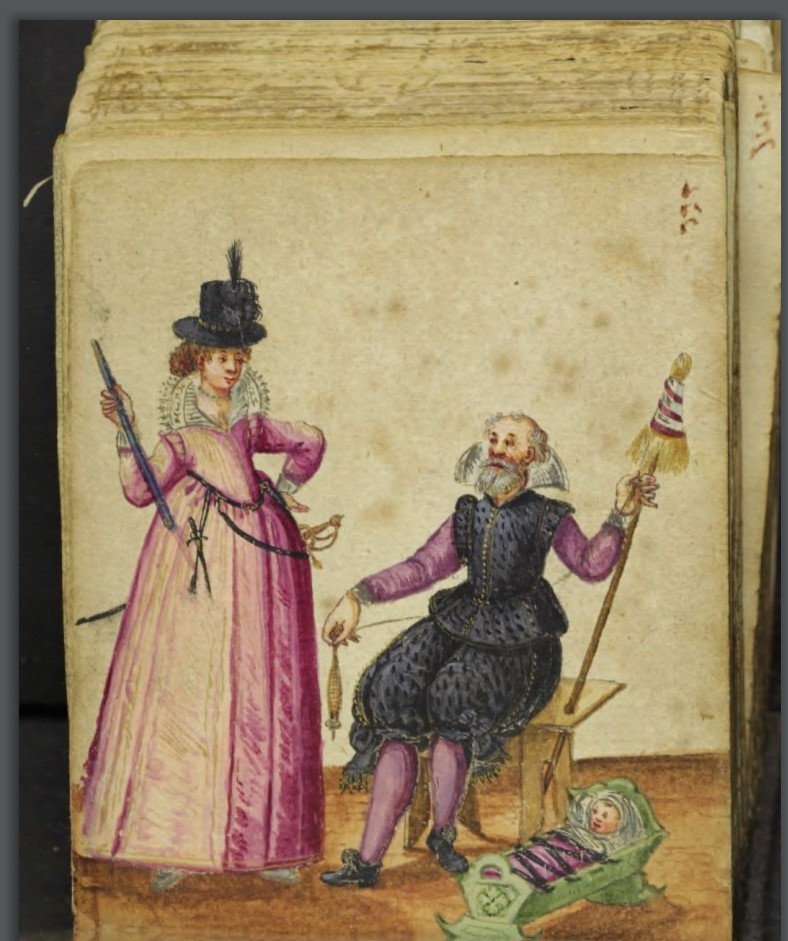
By ‘virago’ I intend those depictions of a woman who is obviously dominating her man — iconographically this usually means she is shown threatening him with a club, key-bunch, etc., and by ‘cotquean’ I intend those depictions of her submissive partner, often so unmanned as to be shown spinning — that quintessentially female occupation. That even Hercules is depicted thus (dominated by Omphale) in a popular sub-type of this motif, makes plain the fact that it is not physical strength that is at issue here. The miniature in the Rentsch album (below) — which I would date no later than 1630 — is a ‘classic’ example of the type: is the elderly husband also rocking the baby’s cradle with one foot? (cf. below)
I add a couple of parallel images here from my English prints book, The Print in Early Modern England (Yale UP, 2010):
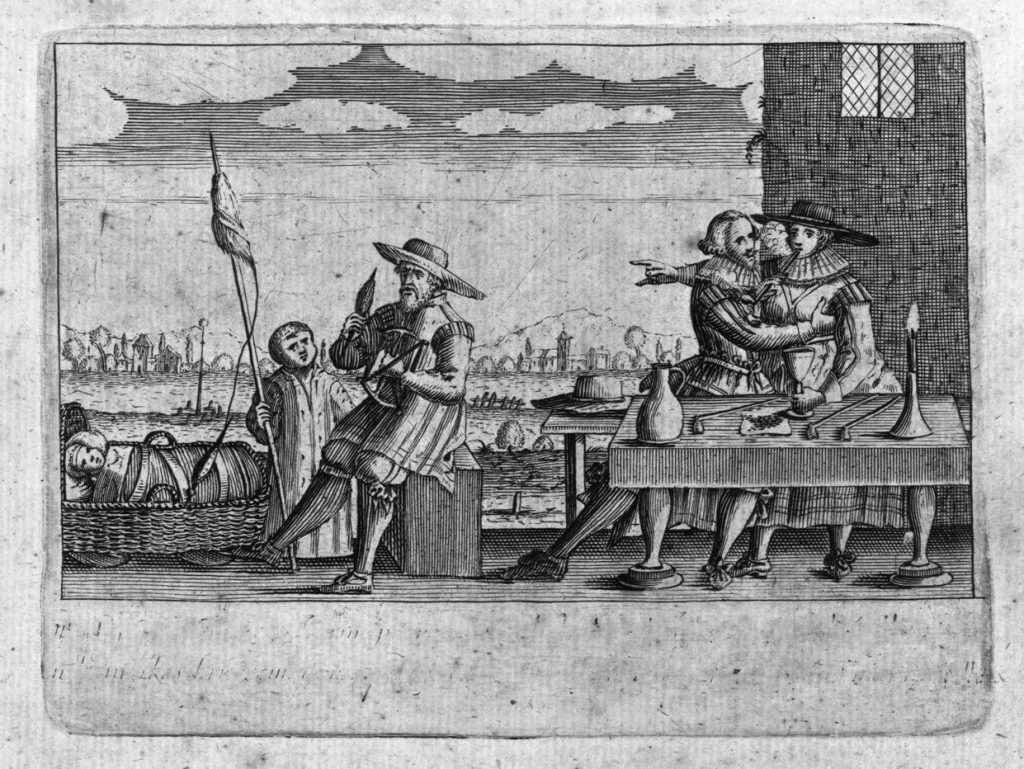
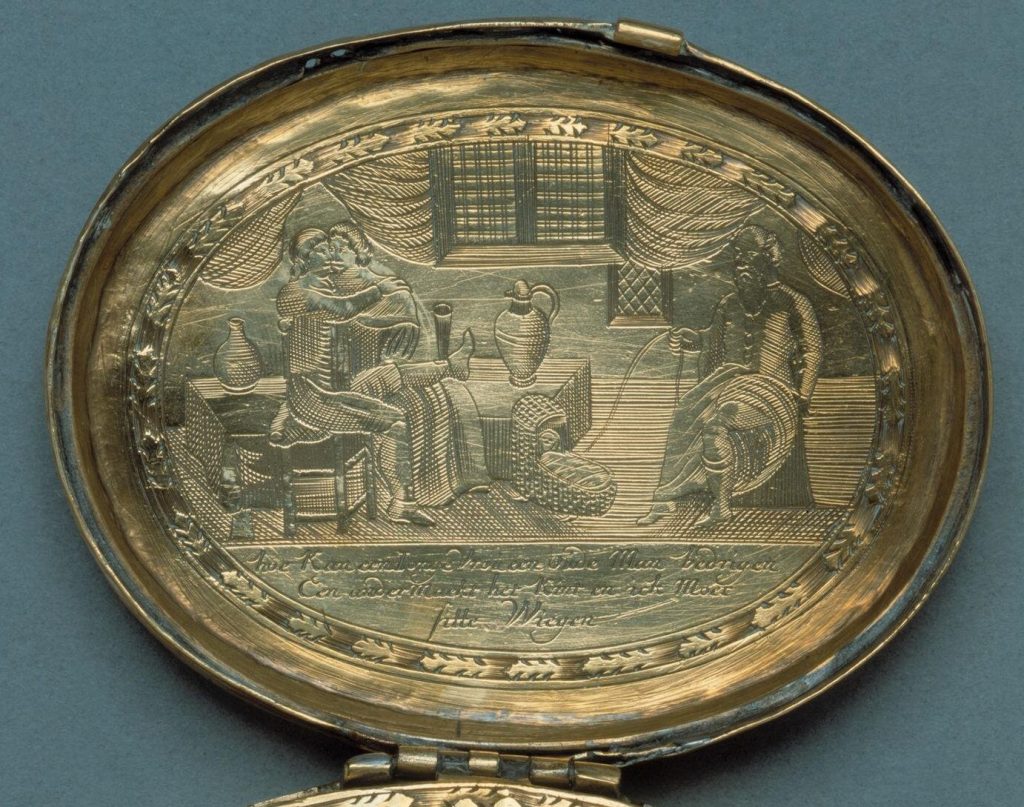
Most of the plates in the unique ‘English’ print-book of 1628 (above) are copied from the Pugillus Facetiarum (Strasbourg, 1618, 1618). This early 18C engraved tobacco-box lid, now in the Victoria & Albert Museum is another version of the print-book composition:
The Power of Women topos
The so-called ‘Power of Women’ topos enjoyed enormous popularity during the middle ages, exemplified by such doughty heroines as Judith, Phyllis, Jael, Omphale Febilla and Delilah, who triumphed over Holoferenes, Aristotle, Sisera, Hercules, Virgil and Samson, respectively.
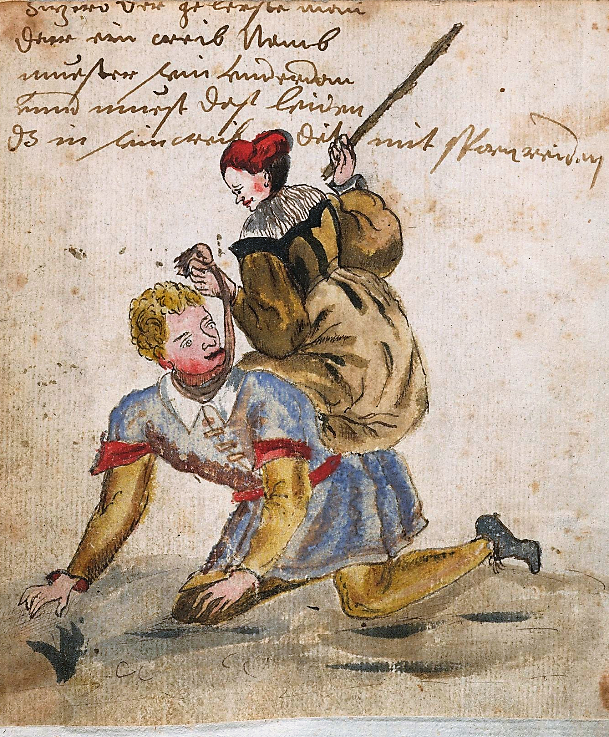
Again, I don’t intend to give earlier examples of these other ‘classic’ medieval virago motifs, but firstly here is Aristotle ridden by Phyllis — the beautiful young woman (Phyllis, the courtesan) humiliates the mature man (Aristotle, the philosopher) by making him crawl about with her mounted on his back — but it is surprisingly rare in the albums, indeed, to date, I have only spotted this one:
[For the transcription of this inscription and the banderole inscription of the following image, I a grateful to contributors of the Reddit/Kurrent forum — the translations are my own]
Zizero der gelerte man Cicero, that learned man, [said] Daer ein weib namb He who takes a wife muester sein Underdan must become her slave unnd muest daß leiden and must suffer d[a]z in sein weib that his wife Dut mit sporen reiden. rides him with spurs.
I cannot find that Cicero ever did say this and suspect the attribution is facetious.
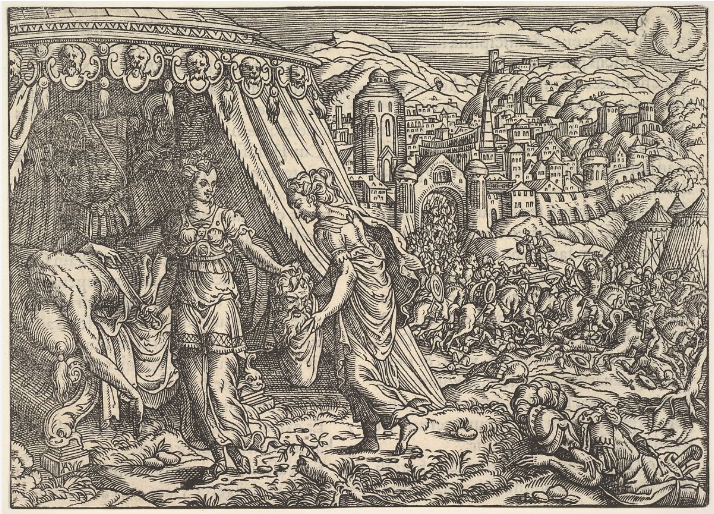
The ancient Jewish heroine, Judith, who cuts off the head of the tyrant Holofernes, was painted in Ludwig Hetzer’s album at some point in the first quarter of the 17C:
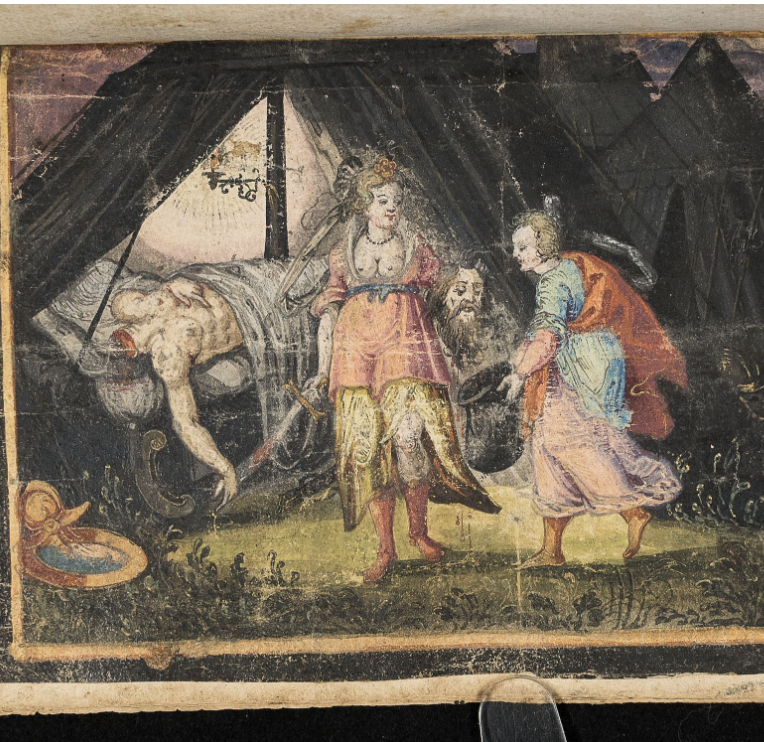
I’m grateful to my wife, Dana Jenei Jones, for informing me of the print-source, a woodcut of Jost Amman’s made in 1564 — Judith’s toplessness seems to have been the miniaturist’s own contribution!
The Heuss album is one of the earliest to contain full-page miniatures in addition to the ubiquitous Wappen [coats-of-arms], but even here, the painter has squeezed in the scene of Delilah shearing the locks of Samson as he sleeps in her lap (below):
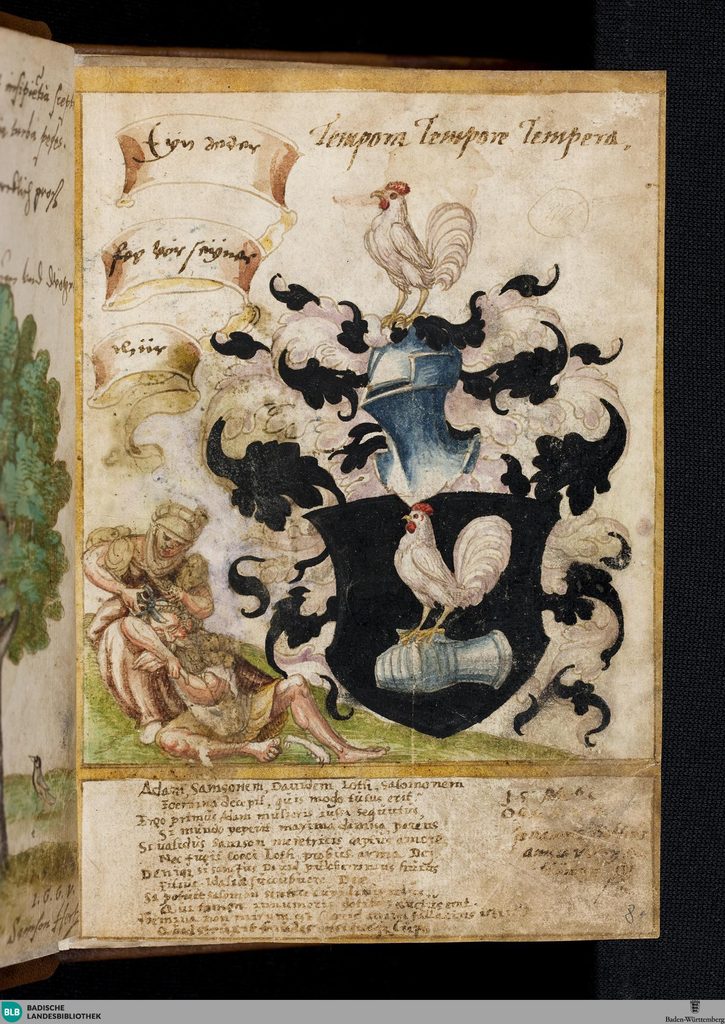
The opening couplet of the Latin verses below the image was already a coomonplace in the 12C,
Adam Samsonem Davidem Loth, Salomonem Foemina decepit, quis modo tutus erit [Adam, Samson, David, Lot, Samson — Woman deceived [them], who then will be safe?]
but the inscription on the banderole above Delilah’s head
Eyn jeder feg vor seyner Thür [Every man [should] sweep before his own door]
is a proverb (used earlier by Luther) which seems quite inapposite.
Other
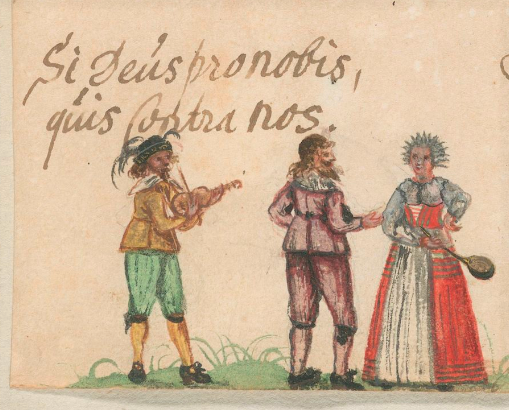
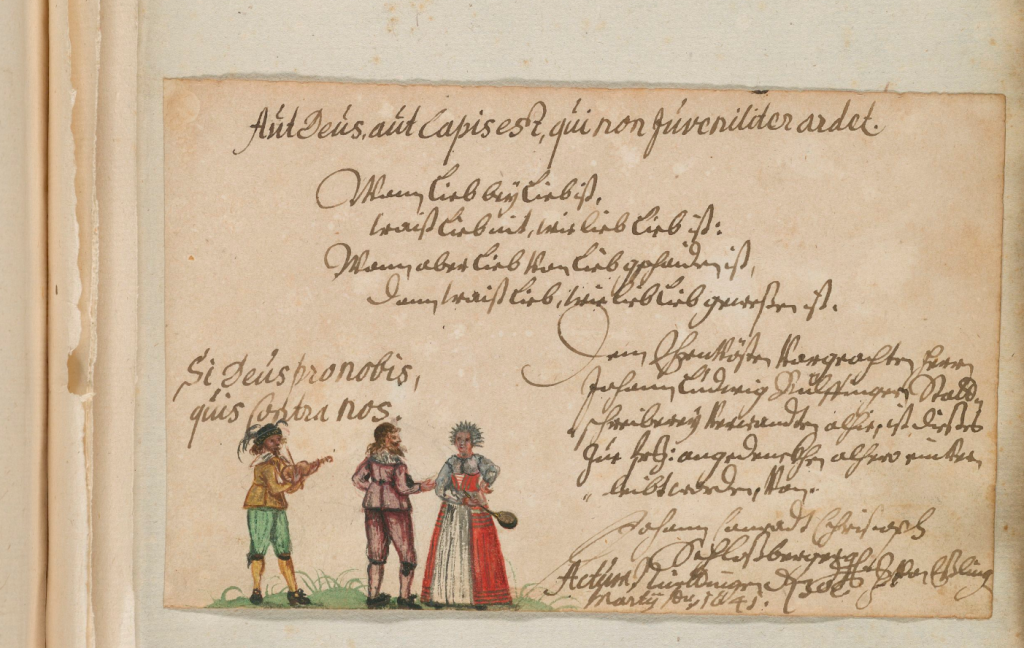
This tiny painting in the corner of a leaf in the Frommann Collection is labelled — ?sarcastically — with the very popular motto, Si Deus pro nobis, quis contra nos [If God is for us, who can be against us?]. I may be misinterpreting the scene anachronistically, but to me, it looks as if the woman’s hair is standing on end cartoon-fashion, and grips the skimming-ladle [cf. the semantics of the English skimmington] as if readying herself to clout the man addressing her with it! The fiddler has perhaps been called in to provide the music that ‘charms the savage breast’!

Leave a Reply