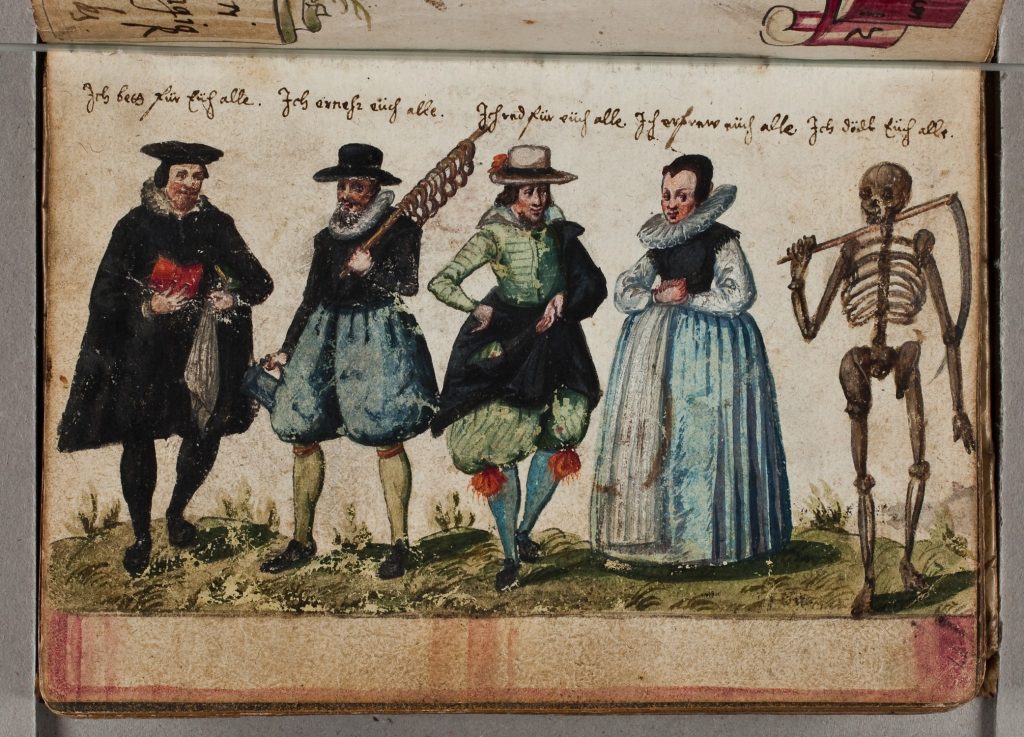
This is a motif which appears to me to evolve from an original model depicting the Three Estates, via the addition of Death (with — inevitably — incidental shades of the Danse Macabre). By the late 16C it is sometimes an incremental motif in which each ‘estate’ declares its service to ALL the preceding ones, but in which Death usually has ‘the last laugh’ — “and I kill you all!” Perhaps inevitably, from quite early in the history of this cumulative motif, Death’s role is sometimes usurped by the Lawyer — or the Woman (I deceive you all ).
[I propose to deal with album images of the Danse Macabre/Totentanz in a forthcoming post. And I did! see now https://albumamicorumear-e4qvahs764.live-website.com/the-danse-macabre-and-related-images-in-the-albums/ ]
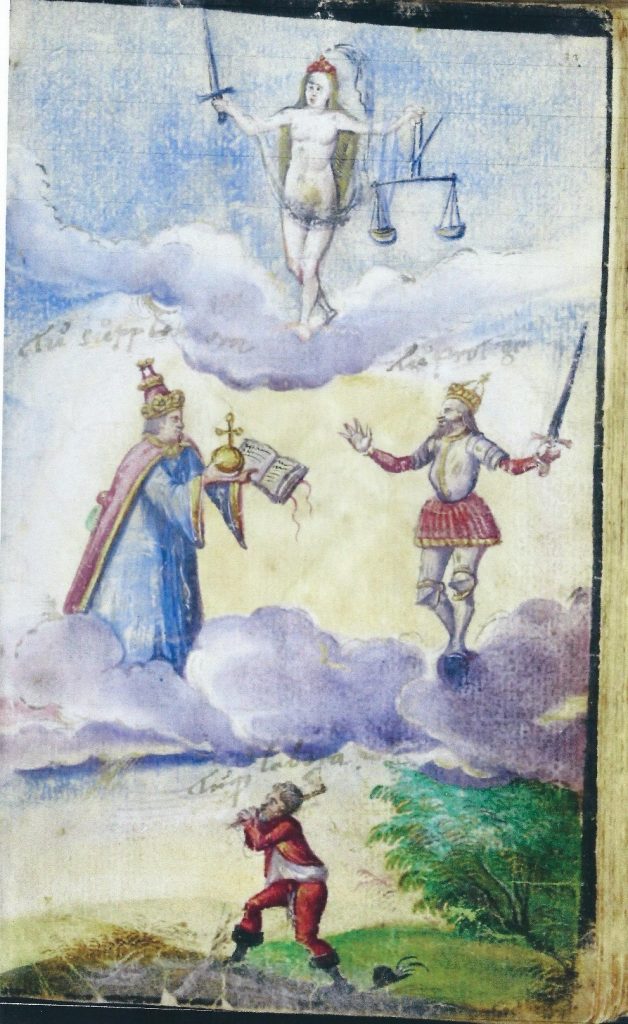
Thott 391, 8°
The album of Georg Bernhard (above) features a full page miniature painted c.1565 depicting, beneath a heavenly figure of Iustitia, a pope and a king (also in the clouds) above a decidedly earth-bound peasant hacking away at a log below. Justice’s instruction is written beside each figure, respectively:
Pope: Tu supplex ora You, pray humbly
Emperor/King: Tu protege You, protect
Peasant: Tuq[ue] laboro And you, work.
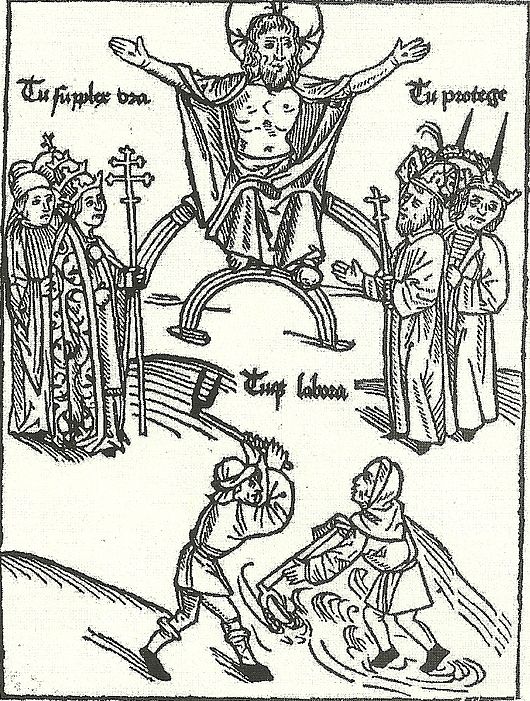
The composition clearly derives from a late medieval model in which God the Father is in Heaven — but could not, of course, be pictorialised in post-Reformation Germany — issuing those same instructions to the Three Estates arranged similarly (though each Estate is personified plurally). A woodcut in the numerous late 15C editions of Lichtenberger’s Pronosticatio seems to have been particularly influential in establishing this schema.
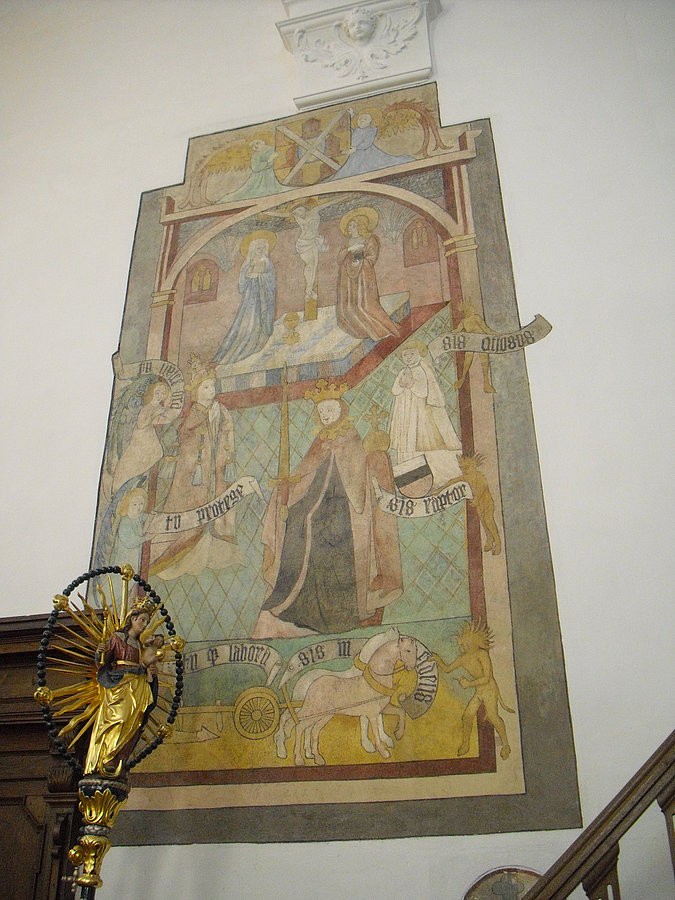
Particularly interesting is the above mid-15C fresco in the parish church of Wemding in Bavaria. Here each representative of the Three Estates is accompanied by an angel bearing a banderole with the appropriate verse (as in the album image above), but also by a devil bearing a banderole urging them, [Pope] sis infidelis [be unbelieving]; [Emperor] sis raptor [be rapacious]; and [Peasant ploughing] sis otiosus [be lazy].
Even in England, it seems these verses were familiar, thanks to travellers’ reports of a painting in the Town Hall in Basel, though after the Reformation, the personnel were changed. Now a Protestant minister substituted for the Pope, and a City counsellor for the Emperor, but – unsurprisingly — the peasant ploughman remained unchanged. In 1550, however, John Hooper back in England was still referring to the image in its pre-Reformation guise:
Thys duety of eche man is handsomly set forth by certeyne pictures in the towne house at Basyll in thys verse: Tu supplex ora, tu regna, tuque labora. There be thre images, the one of the Pope, the other of the Emperoure, the thyrde of a plough manne, and the verse teacheth all thre their dueties. He biddeth the Pope pray, the Emperoure to raygne, and the plougheman to laboure. [John Hooper, An ouersight (1550)].
A somewhat different arrangement, featuring Four Estates, is painted into the album of Frans Rosenberg (1615×23). It shows a nobleman, a king, a clergyman, and a peasant reaching up to receive their attributes from four heavenly hands, respectively, sword, sceptre, book and flail.
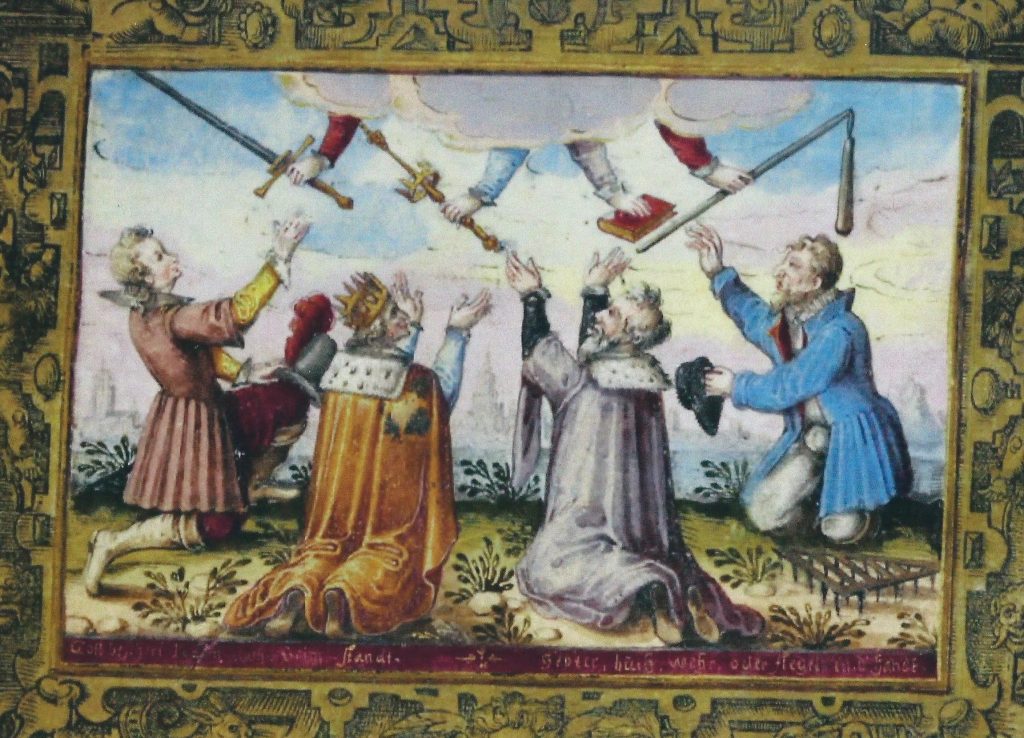
The composition and German caption are closely copied from this plate in the 1618 Speculum Cornelianum
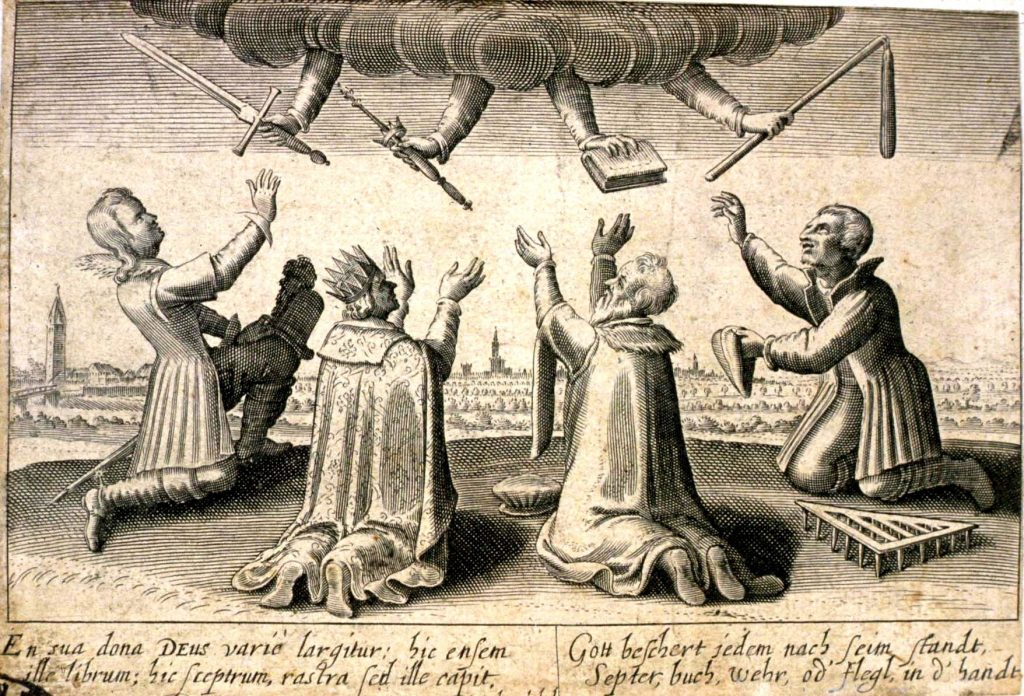
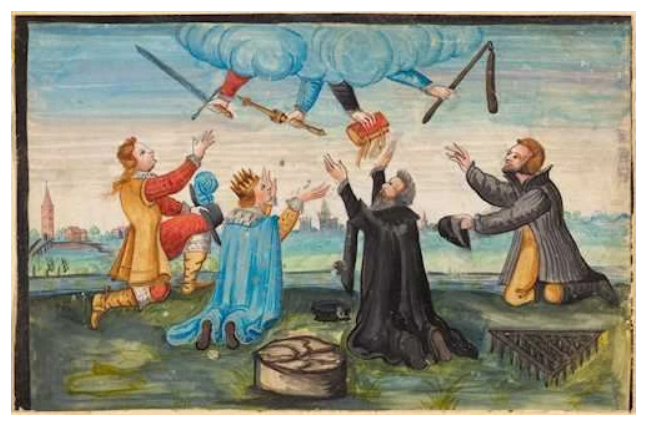
The Repertorium Alborum Amicorum [RAA] records another example, dated 1631, in the album of Sebastian Riegel (Nürnberg, Stadtbibliothek: Will III 521 a, f.234v.), and captioned with the German verse from the print-book, and I add that another, but with no accompanying texts, is painted in the album of Hans Heinrich Koller (dated entries 1623-7), now in the public library in Zofingen, Switzerland.[Described by Wilhem Knöbel, “Die alba amicorum in der Zofinger Bibliothek” in Beiträge zur Geschichte und Literatur vorzüglich aus den Archiven und Bibliotheken des Kantons Aargau 1 (1846), 425-6.]
Another orphaned leaf of the design was auctioned in 2022, where attributed to the Zurich painter and engraver, Dietrich Meyer (1572-1658) — note how the soldier/nobleman’s hat is updated!
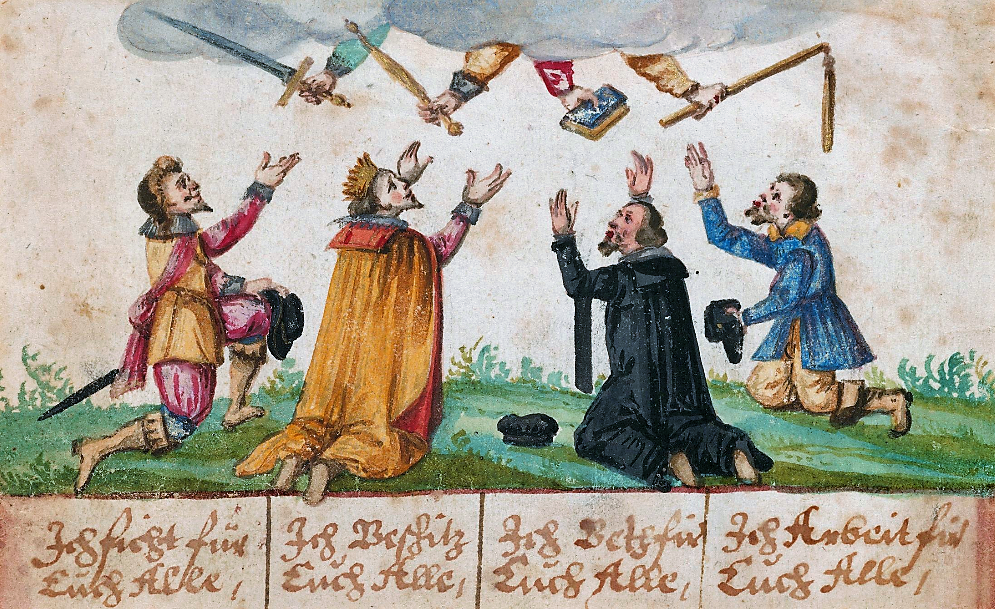
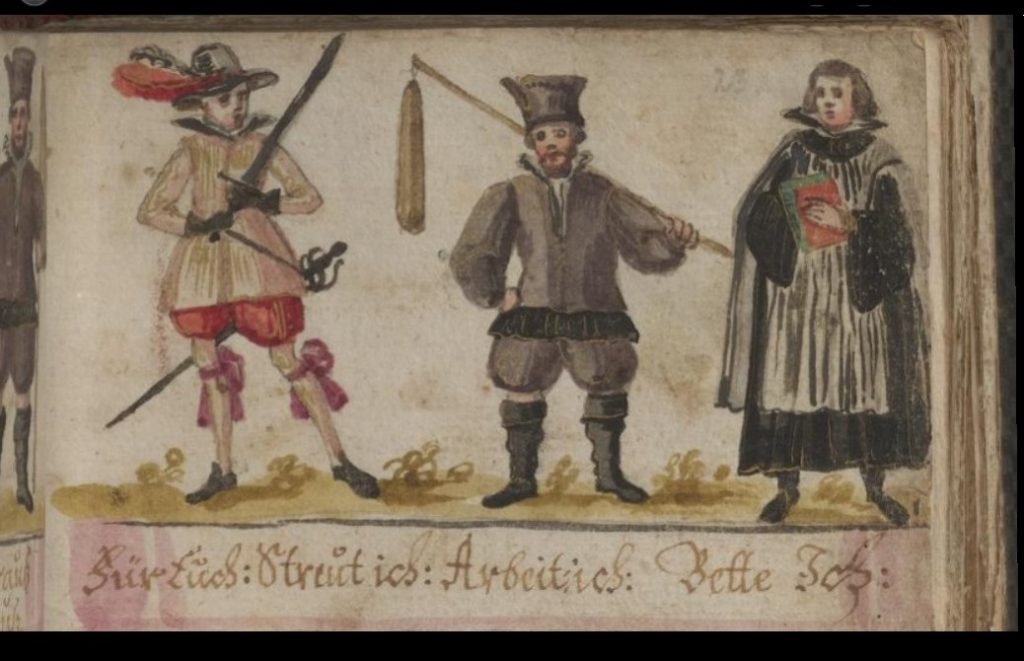
The copy of the illustration in the Frommann Collection (BELOW) replaces the print-book’s verse captions with speeches from the Alls tradition, so that the Four Estates are made to say, respectively,
Ich Fecht für Eüch Alle I fight for you all
Ich Beschütz Eüch Alle I protect you all
Ich Bete für Eüch Alle I pray for you all
Ich Arbeit für Eüch Alle. I work for you all.
The Gertner album — dated entries 1619-33 — includes just 3 Alls; the caption begins, For you : then continues under the pictures of soldier, peasant and minister, respectively, I fight, I work, I pray — a Three Estates image without the presence of Death, and no-one devouring anyone!
—————————————————————————–
Death & the Alls
The first, 1608, edition of the Pugillus Facetiarum includes this plate depicting the motif I call Death & the Alls
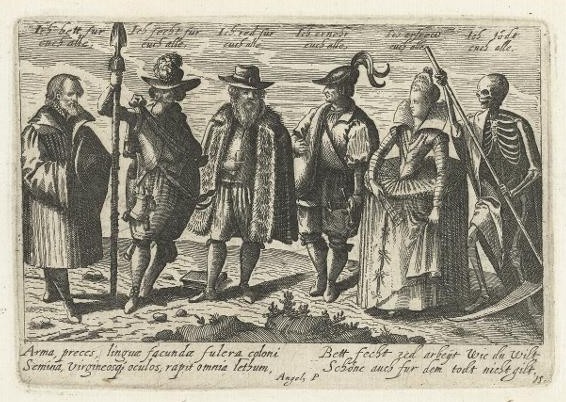
As for many other album motifs, the publication of the Pugillus Facetiarum print-book in Strasbourg in 1608 is a ‘watershed’ moment — of the several similar scenes I have noticed in the albums to date, only that in the von Hodenberg album (BELOW) is certainly earlier (dated entries 1577-1604) — and thus another example that would seem to bear out the publisher’s claim that the plates in the Pugillus were based on those he had himself seen in students’ albums. As the von Hodenberg album was last seen over a century ago, however, we must be grateful for the photo of our scene published in the 1911 Boerner sale catalogue of the Warnecke collection.
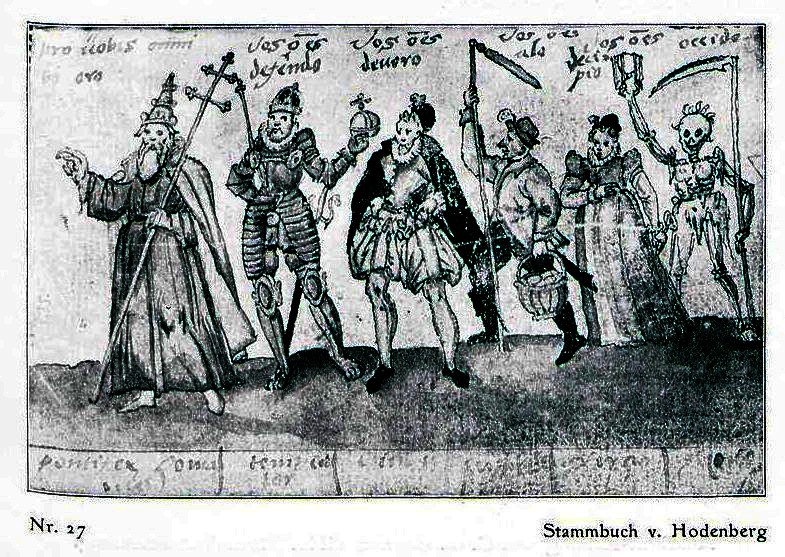
Pope: Pro uobis omni[bus] oro I pray for you all
Emperor: Vos o[mn]es defendo I defend you all
Lawyer: Vos o[mn]es deuoro I devour you all
Peasant: Vos o[mn]es alo I feed you all
Woman: Vos o[mn]es decipio I deceive you all
Death: Vos o[mn]es occido I kill you all
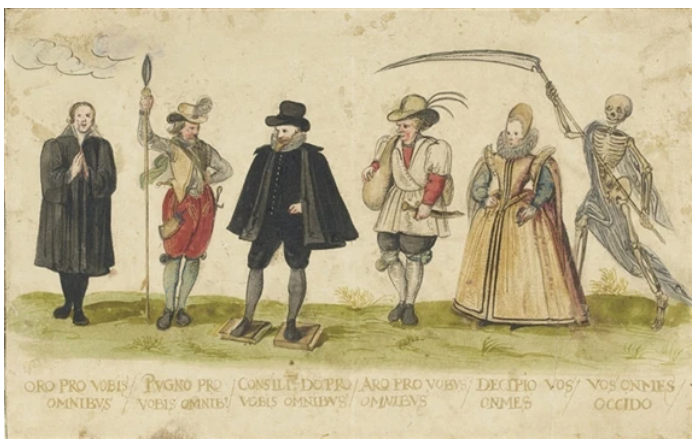
Minister: ORO PRO VOBIS OMNIBVS I pray for you all
Soldier: PVGNO PRO VOBIS OMNIB’ I fight for you all
Lawyer: CONSILI DO PRO VOBIS OMNIBVS I provide counsel for you all
Peasant: ARO PRO VOBVS [sic] OMNIBVS I plough for you all
Woman: DECIPIO VOS ONMES [sic] I deceive you all
Death: VOS ONMES [sic] OCCIDO I kill you all
Seventeenth-century German authors state that this Latin version was previously to be seen painted in monasteries, and according to Mitteilungen der schlesischen Gesellschaft für Volkskunde 27-29 (1926), 194, a 17C wall-painting of the subject formerly adorned the church-tower at Szestno in the north of present-day Poland, featuring the Three Estates and Death, who were allotted the following speeches in Latin:
Minister: Ego pro vobis omnibus oro I pray for you all
King: Ego vos omnes defendo I defend you all
Peasant: Ego pro vobis omnibus laboro I work for you all
Death: Ego vos omnes devoro. I devour you all
It seems that the speeches alone were recorded in the 17C parish register of Lauterbach in Swabia [See Deutsche Gaue 5 (1903),19]:
Papa: Ego pro omnibus oro I pray for all
Caesar: Ego vos omnes defendo I defend you all
Rusticus: Ego vos omnes alo I feed you all
Mors: Ego vos omnes devoro. I devour you all
Subsequent album representations are always captioned in the vernacular:
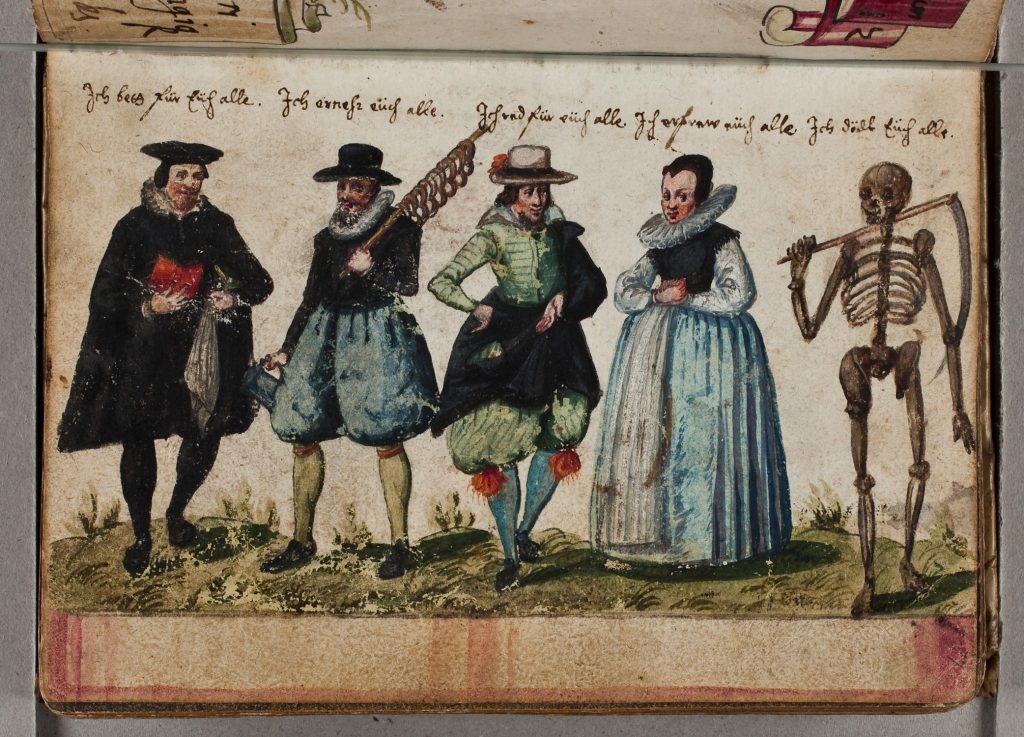
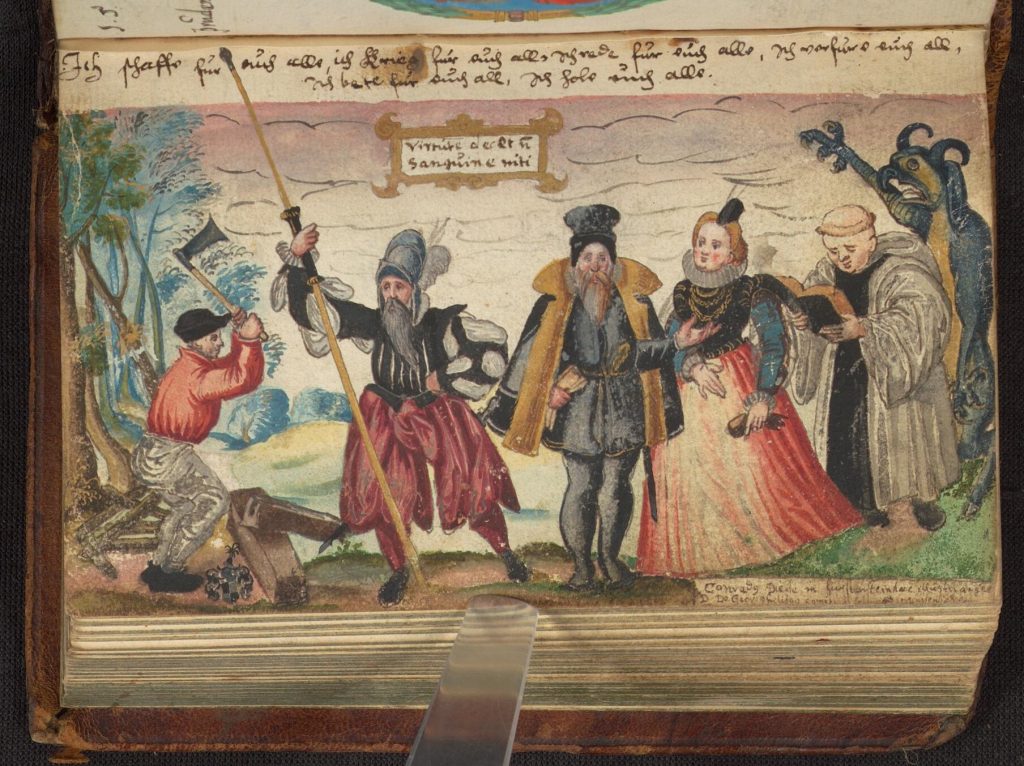
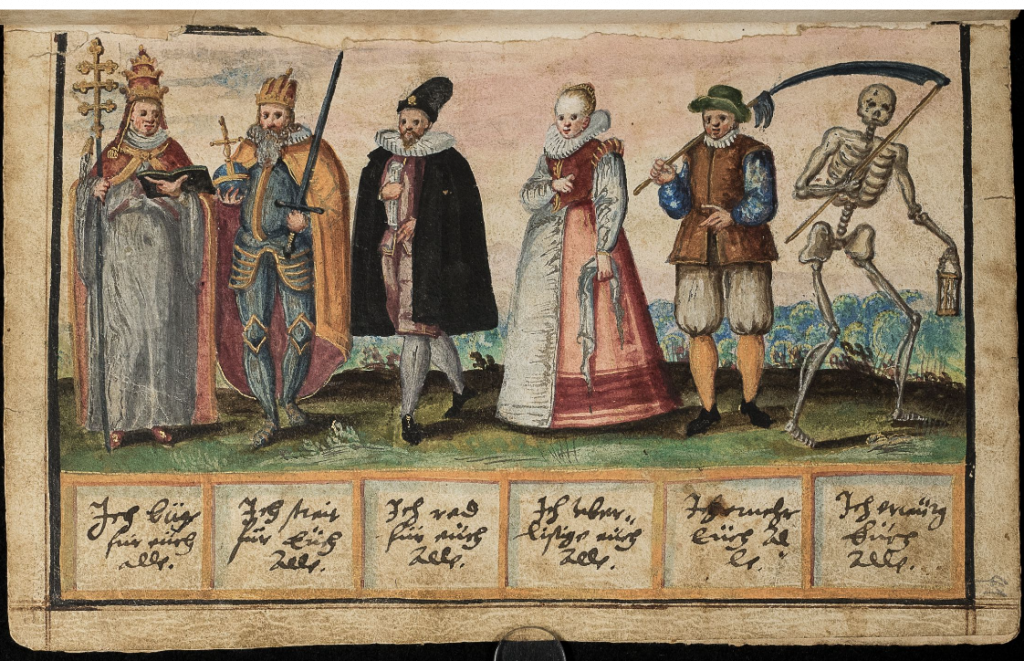
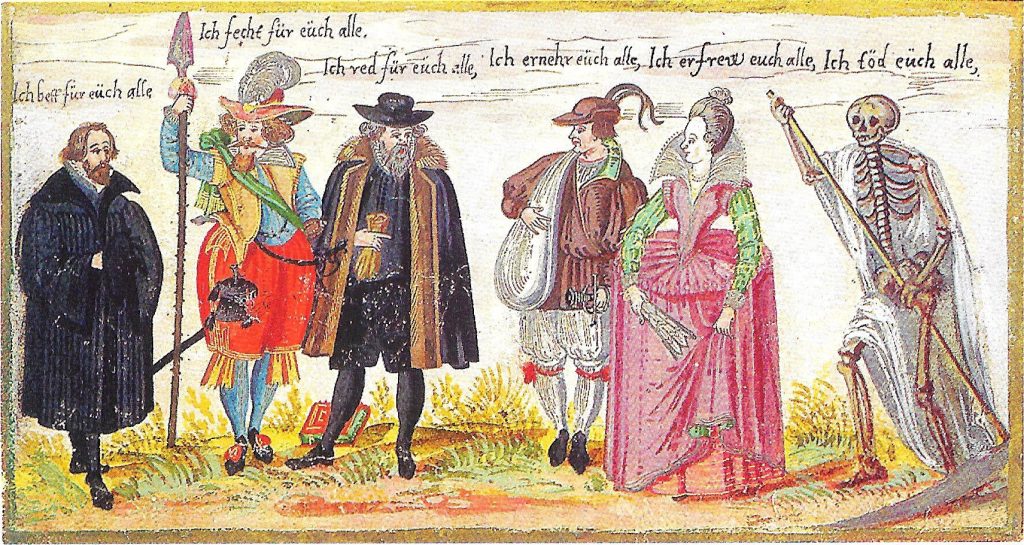
One of the often riddle-like questions posed in A Helpe to Discourse (London 1619) by William Basse, is Who are those that pray for all, Defend all, Feed all, Deuoure all? At first sight, the answer appears to be one of the relatively uncommon early seventeenth-century English descriptions of a work of art:
In an old picture, I found it thus written, The Pope with his Clergy, saies, I pray for you all; Cæsar with his Electors, I defend you all; The Clown [rustic, peasant] with his sack of Corne, I nourish you all: at last comes Death and sayes, I deuoure you all.
It is difficult to estimate just how old such an “old picture” might have been, of course, but from the context – the Electors being the Princes of Germany, formerly entitled to take part in the election of the Holy Roman Emperor (here Caesar, modern Kaiser) – we might guess that it must have belonged to the previous century, at least, and given the presence of the Pope, may even have predated the German Reformation. We might, then, be tempted to take this at face value, to accept that in Jacobean England, or while travelling in Germany perhaps, Basse had seen an early sixteenth- or late fifteenth-century German portrayal of the Three Estates (Pope, Emperor, Peasant) and Death. Sadly, the question-and-answer format, and the phrasing he uses, are suspiciously close to a passage in the 38th chapter — De Morte — of Leonardus Rubenus, Lingua aurea christianorum (Paderborn, 1606):
Qui sunt qui orant pro omnibus, defendunt omnes, pascunt omnes, & tamen omnes tandem pessum eunt? In veteri quadam pictura Pontifex cum toto clero ait: Ego oro pro vobis omnibus. Caesar cum Electoribus: Ego defendo vos omnes. Rusticus cum sacco farinae: Ego alo vos omnes. Tandem Mors ait: Ego deuoro vos omnes.
Unfortunately, it would appear that describing this ‘old picture’ was something of a commonplace amongst contemporary writers, the same passage occurring more-or-less verbatim in Heidfeld, Sextum renata renovata (Herborn, 1612), Tympe, Mensa Theolo-philosophica (Münster, 1615) and, in the vernacular, in Weibel, Catholische Leichpredig (Freiburg, 1609) and Scherer, Postill (München, 1610) -- to name but four. Basse might have come across his “old picture” in any of these five authors, and probably did not see it for himself.
The theologian Theodor Beza recalled a similar painting but with the Lawyer ‘devouring’ the Four Estates. He described it in one of the lectures he gave in 1587 on the Book of Job, which were published in Latin in Geneva and London in 1589 [Iobus Theodori Bezae partim commentariis], with an English translation also published there probably in the same year [Iob expounded]. The tabella of the Latin text is Englished as table, and the relevant personnel and their poesies, somewhat longer than usual – in the original Latin version, and as translated — are as follows:
Nobilis: Meis armis tueor vos omnes
Noble man: By my sword I defend you all
Ecclesiasticus: Meis precibus vos omnes servo
Cleargie man: By my prayers I preserve you all
Rusticus: Alo vos omnes
Countryman: I feede you all
Causidicus: Ego deuoro vos omnes
Lawyer: I devoure you all.
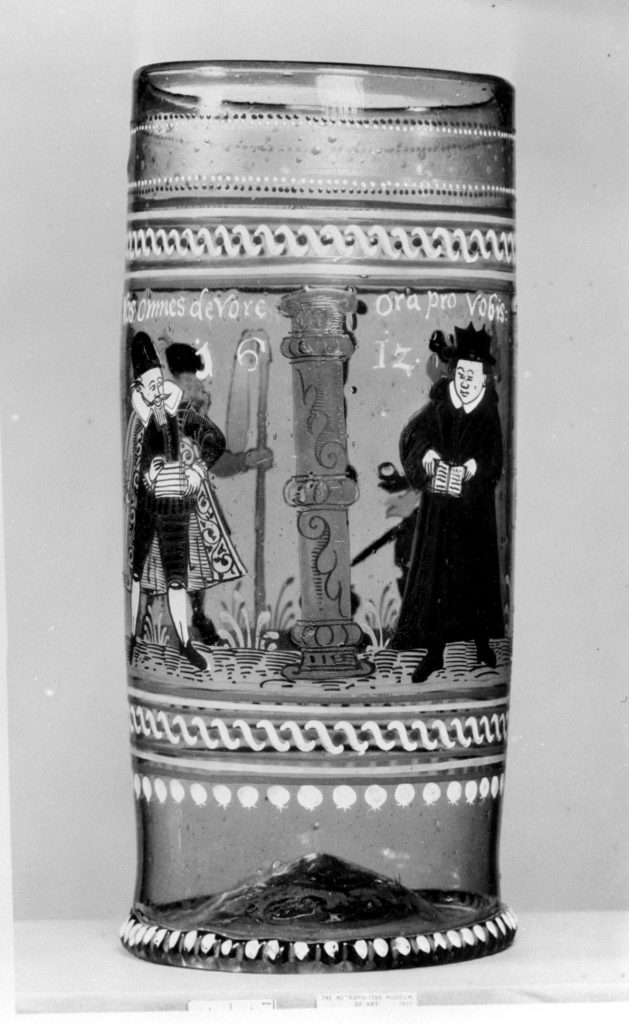
Beza gives no attributes to his characters, but it is interesting to see the Lawyer appropriate the role which is originally allotted to Death here – the lawyer having traditionally been seen, satirically, as similarly rapacious. The same personnel, with the Lawyer again usurping Death’s role (vos omnes devore [sic]), are to be found painted in enamel on this Bohemian Humpen dated 1612, now in the Metropolitan Museum, New York. Mistakenly described as a merchant on the Museum’s website, the pile of books he carries was intended to identify him as a lawyer.
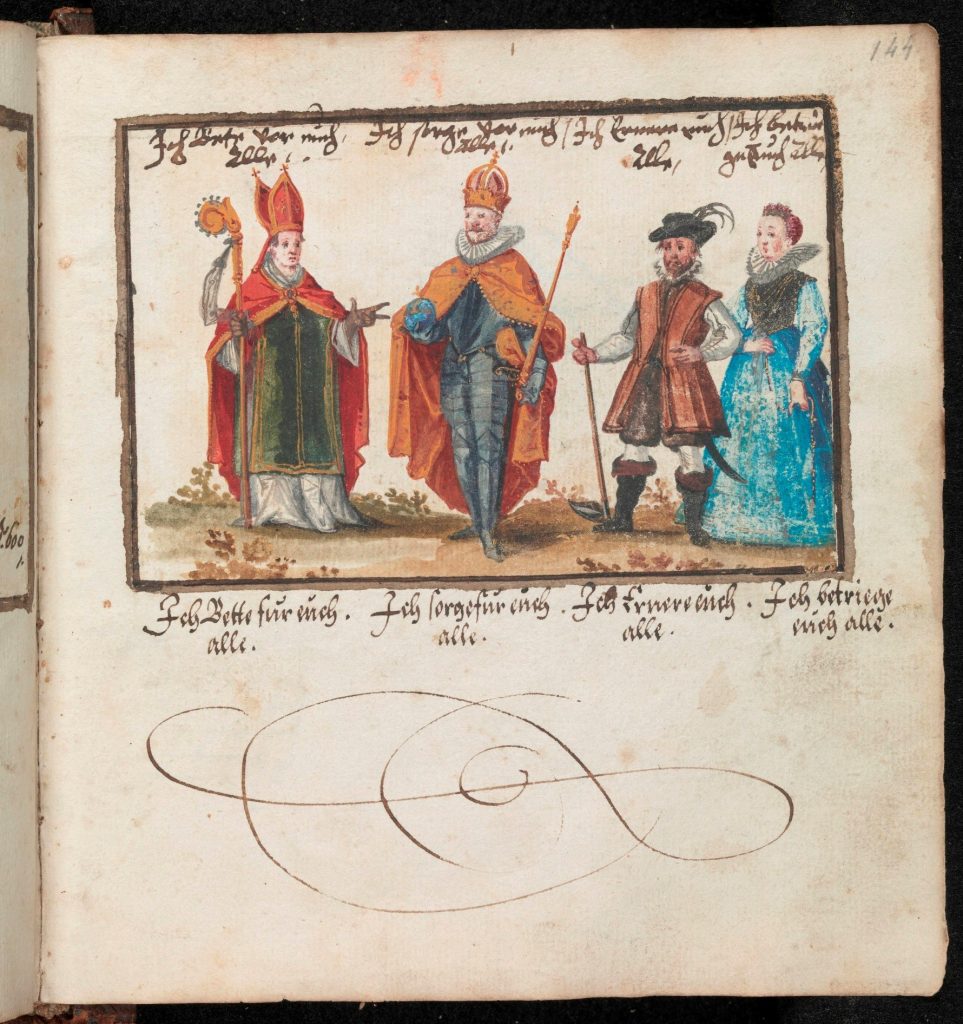
If the Devil’s role is here usurped by the Lawyer, it was inevitable that sooner or later — as in the album of Hans Ludwig Pfinzing von Henfenfeld (below) — the Devil would be ousted by the Woman (Ich betriege euch alle [I betray you all]). For a considerably earlier, French instance of the Woman in this role — SEE BELOW
Beza’s four omnes, duly rendered by his English translator as four alls, was the earliest literary example of this motif known to me, until I happened upon an unnoticed poem running to 160 lines of mediocre verse by one C. Thimelthorpe, published in his A short inuentory of certayne idle inuentions (1581). Here he affords full treatment to Death & the Five Alls. To judge from the titles he gives, he would appear to be basing his poem on an image of the type we have been discussing, though nowhere is this made explicit, but — published in 1581 — this is the earliest record of the number of human actors being increased to five. The six or seven quatrains allotted each speaker are dull and conventional, and the figures’ attributes are not explicitly described, though there is mention of the King’s sword, and the Husbandman’s saltbagge, and Death’s scythe. Thimelthorpe gives his poem no overall title as such, but launches straight in with the first of six sub-titles — I add the others here for the sake of convenience:
The Kinge Omnes vos defendo I defend you all
The Byshop Pro Omnibus vobis oro I pray for you all
The Husbandman Omnes vos nutruo I feede you all
The Phisition Omnes vos edo I eate you all
The light woman Omnes vos decipio I deceaue you all
Death Omnes vos interfitio [sic] I kyll you all
Making allowance for the fact that we are in post-Reformation England, so the Bishop is substituted for the Pope, and the King for the Emperor, this is the same cast as depicted in von Hodenberg’s album painting (above), except that for Thimelthorpe it is the Doctor, not the Lawyer, who devours them all.
Before the albums
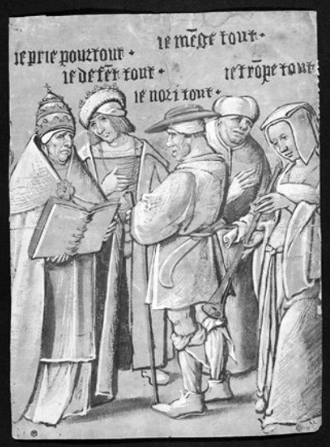
The earliest, but hitherto unnoticed, example of our motif, long before Beza’s description of 1587 – I would estimate the date at c.1510 – is a double-sided French drawing (plume, lavis de bistre et gouache). Here the personnel from left to right are Pope, nobleman, peasant, lawyer, and woman, saying respectively:
ie prie pour tout I pray for all
ie defe[n]t tout I defend all
ie nori tout I feed all
ie me[n]ge tout I devour all
ie tro[m]pe tout I deceive all.
It is interesting to note that it is already the Lawyer – just as in Beza’s description — who has taken on the role later exclusively allotted to Death.
A digression concerning trumpet rebuses
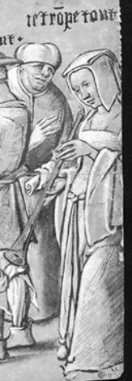
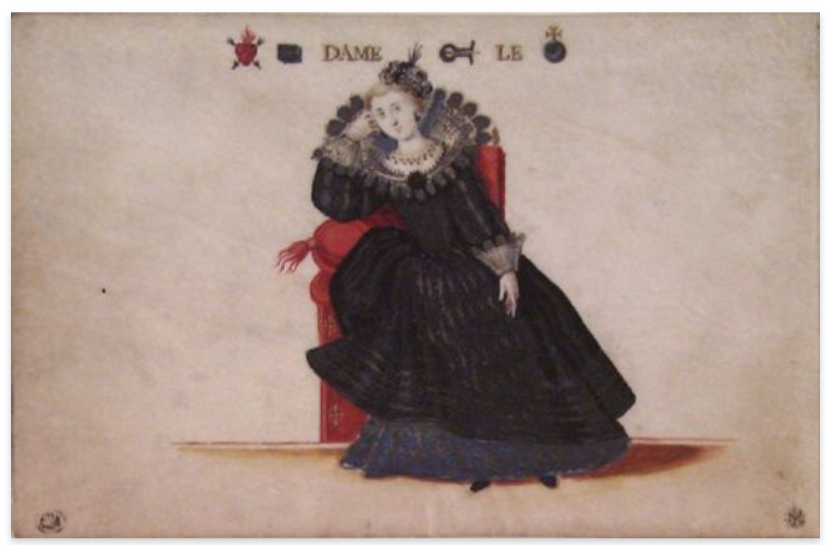
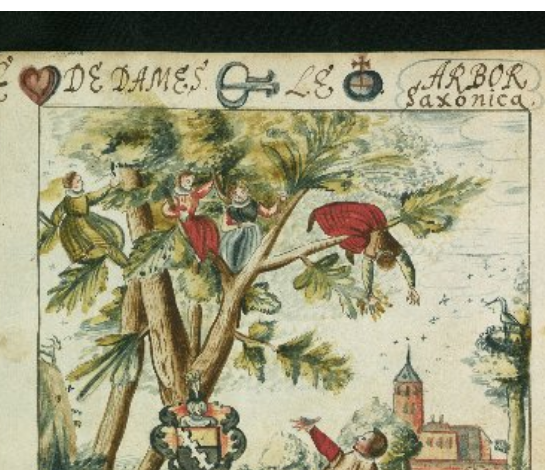
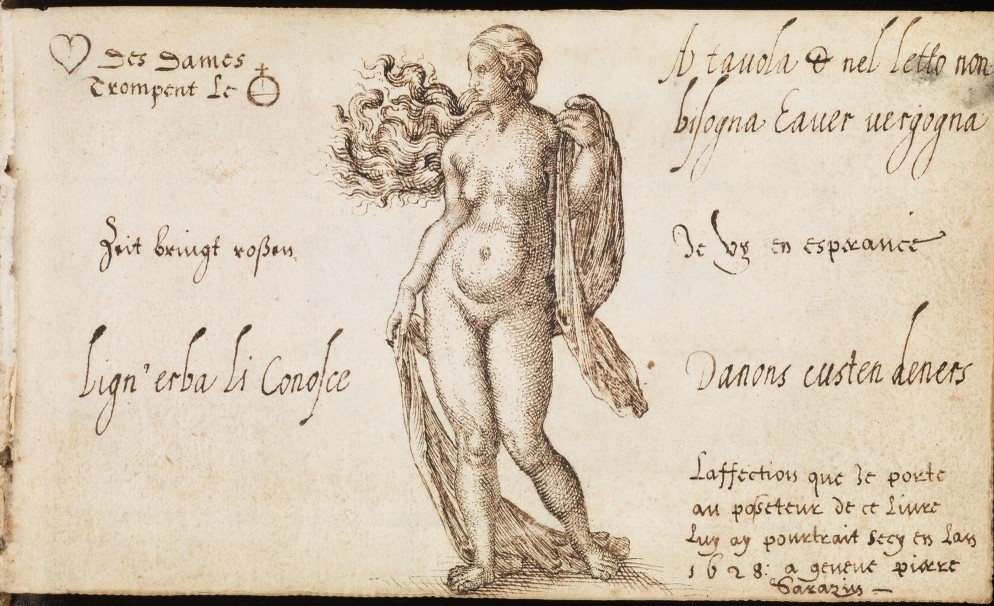
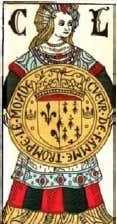
Extraordinarily, the woman in this French drawing is shown blowing a trumpet [trompe] – a rebus pun found elsewhere, and depending on the meaning of the verb tromper, ‘to deceive’, so that her speech, ie tro[m]pe tout, means both “I deceive all” and “I trumpet everything”! This rebus usage is found both before and after this date, and in three albums [SEE BELOW] where it occurs in the rebus sentence, coeur de dame trompe le monde [the heart of woman deceives the world] — though here the trompe is not a trumpet but a mouth-harp, also known as trompe in the French of this period.
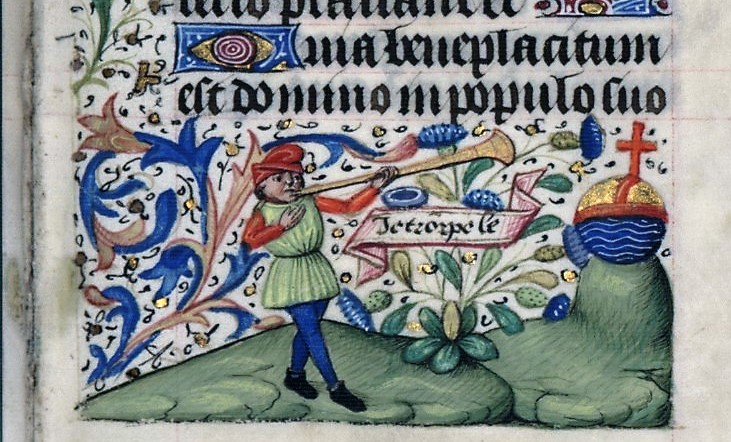
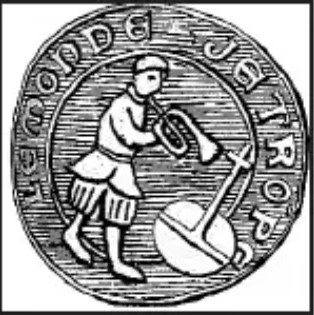
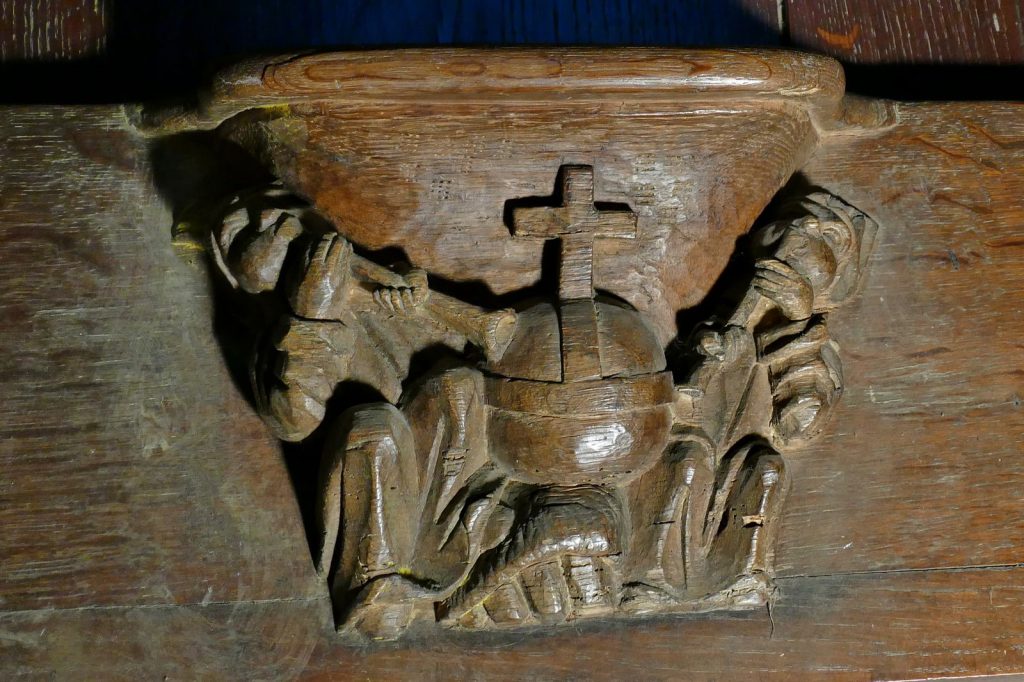
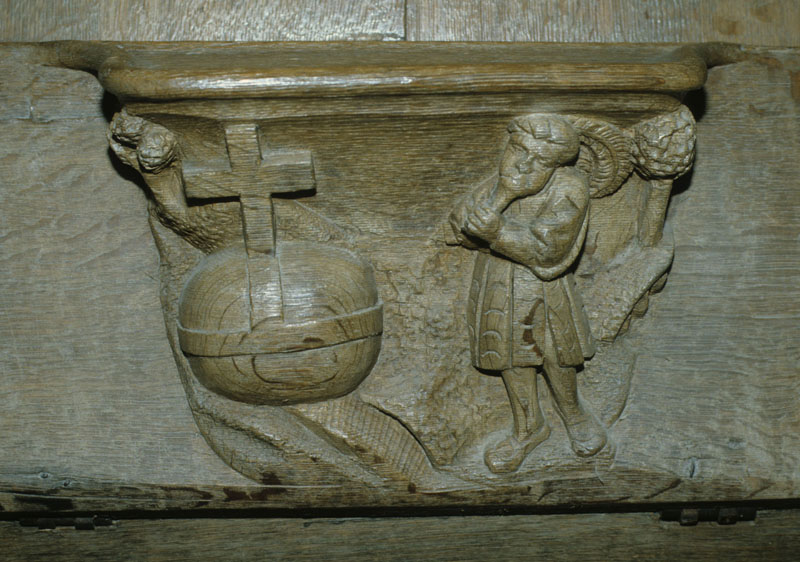
and in the albums … coeur de dame trompe le monde
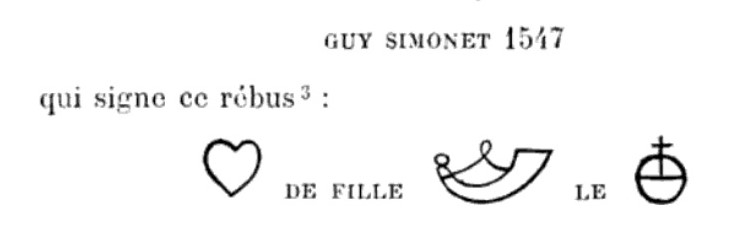
[Digression ends]
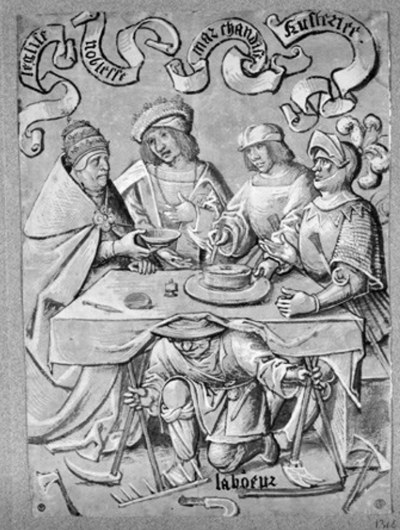
But to return to our proper theme … On the other side of the French drawing (ABOVE) the personnel are seated round a table; they are labelled from left to right, leglise, noblesse, merchandise and Austerite [firmness] personified, respectively, by the Pope, a nobleman, a merchant and a knight. Their tabletop rests quite literally on the back of a peasant who is labelled laboeur. This last detail seems to be a peculiarly French motif, found again later in the century on two prints, Hennin 1295, and a Rue de Montorgeuil woodcut which only survives in an English version (below). The drawings are currently misdescribed as deux caricatures antipapistes, as if Protestant satires, yet they are pre-Reformation in date, and while the Pope certainly appears, he is but one of the personnel belonging to this motif, and here as a representative of the Church (leglise), not Catholicism.
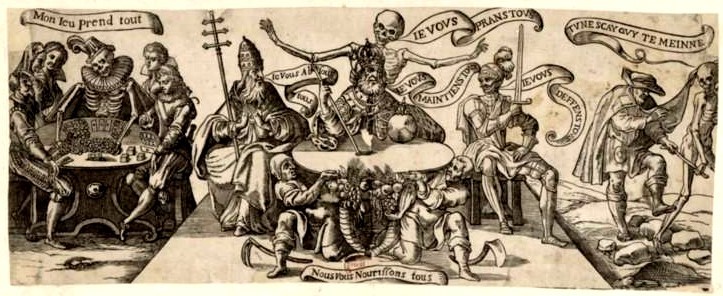
This print in the Hennin collection [BELOW] is composed of three scenes but only the central scene is of interest to us in the present context. The lefthand scene shows Death, the ‘winner who takes all’, and on the right, Death leading away a blind man (“you do not know who leads you”) copied from Holbein’s Danse Macabre series.* In our central scene we see the Pope (Ie Vous Absous tous) , the Emperor (IE VOVS MAINTIENS TOVS), and a noble Knight (IE VOVS DEFFENS TOVS), seated round a table literally supported by two Peasant labourers (Nous Vous Nourissons tous). Death — skeletal arms spread wide in triumph — proclaims IE VOVS PRANS TOVS.
*The same detail was copied to Awdeley’sThe Daunce and Song of Death (1569) [STC 6222]
With the unique surviving impression of this late 16C English Death & the 5 Alls print (BELOW) — though, I suggest, an originally Parisian Rue de Montorgueil woodcut, anglicised — we come full circle. It is contemporary with the album images, and a valuable witness to the presence of the motif in both England and France. This late 16C English/French print is also transitional textually, and constitutes the ‘missing link’ between the earlier, “I … you all” type, and the ‘cumulative’ type represented, a generation later (c.1625), by the Commonweals Canker Wormes …[BELOW]
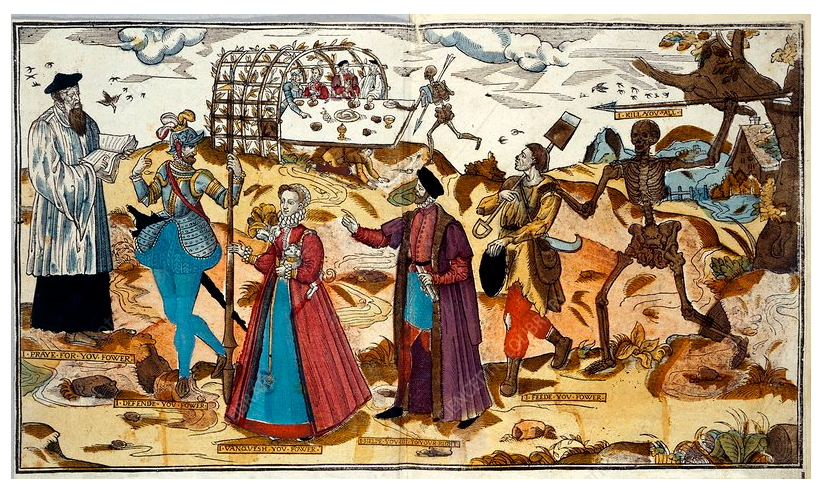
Minister: I PRAYE FOR YOV FOWER
Knight: I DEFENDE YOV FOWER
Woman: I VANQVESH YOV FOWER
Lawyer: I HELPE YOV ALL TO YOVR RIGHT
Peasant: I FEEDE YOV FOWER
Death: I KILL YOV ALL
=========================================================
Netherlandish examples of the motif
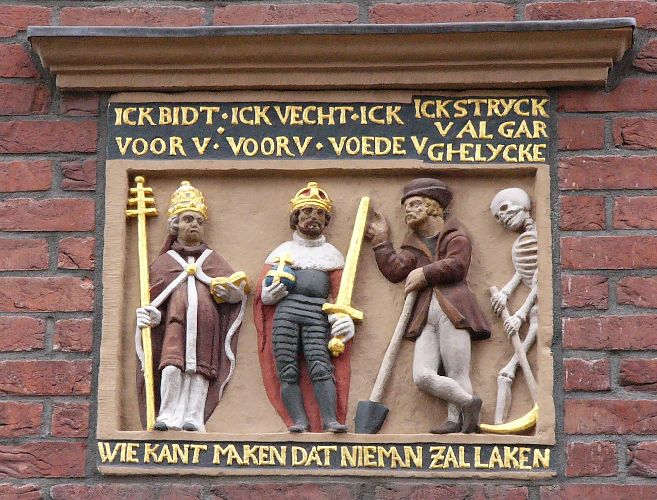
A carved stone sign on a house in Haarlem includes the same personages and inscriptions:
Pope Ick bidt voor U I pray for you
Emperor Ick vecht voor U I fight for you
Peasant Ick voede U I feed you
Death Ick strijke u algar ghelijcke I kill you all alike.
Beneath the four figures is the further legend referring to the last speaker, wie kant maken dat nieman zal laken [who knows how to make it that no-one escapes].
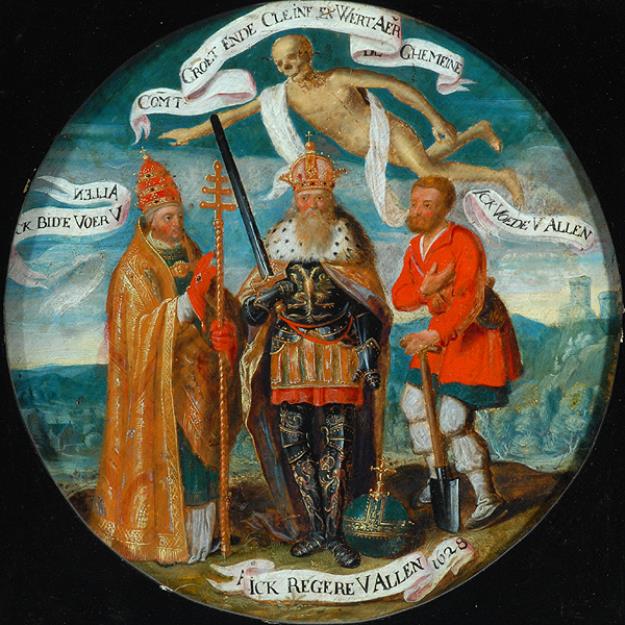
Also hailing from the Netherlands is the above elegant painted roundel, dated 1628, and currently attributed to Adriaen van de Venne. From left to right we see the
Pope: Ick bide voer u allen I pray for you all
Emperor: Ick regere u allen I rule you all
Peasant:     Ick voede u allen       I feed you all

while above them hovers the skeletal figure of Death, who says

Comt croet ende cleine ek wert aerde ghemeine -- this is currently translated as “a bitter unavoidable end comes, common to all” – but the inscription is difficult to read, and the translation may well be incorrect.
In fact, this is perhaps the earliest type historically, as in this glass roundel painted in Haarlem a century earlier
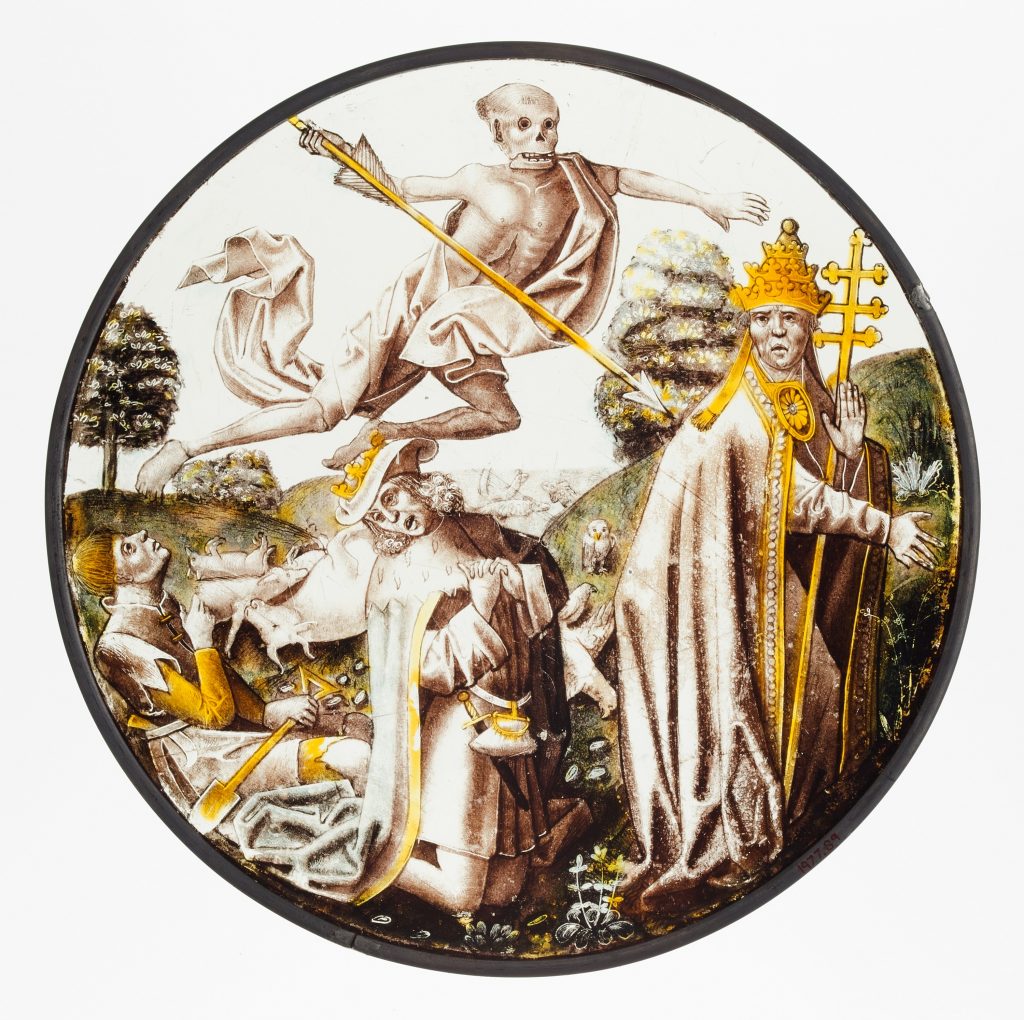
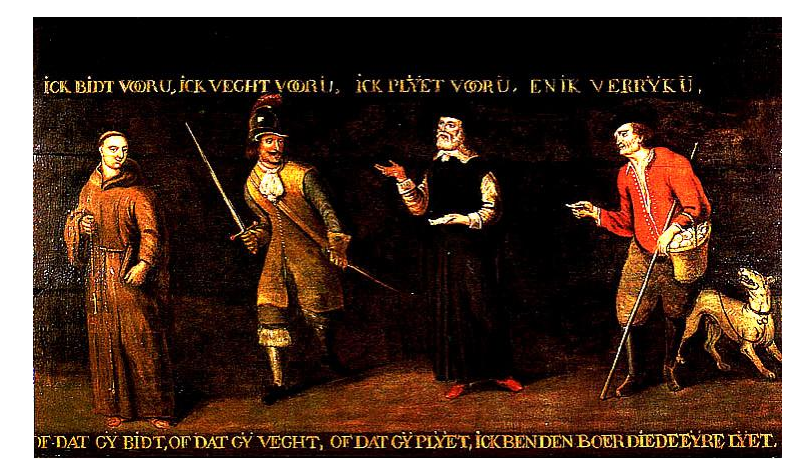
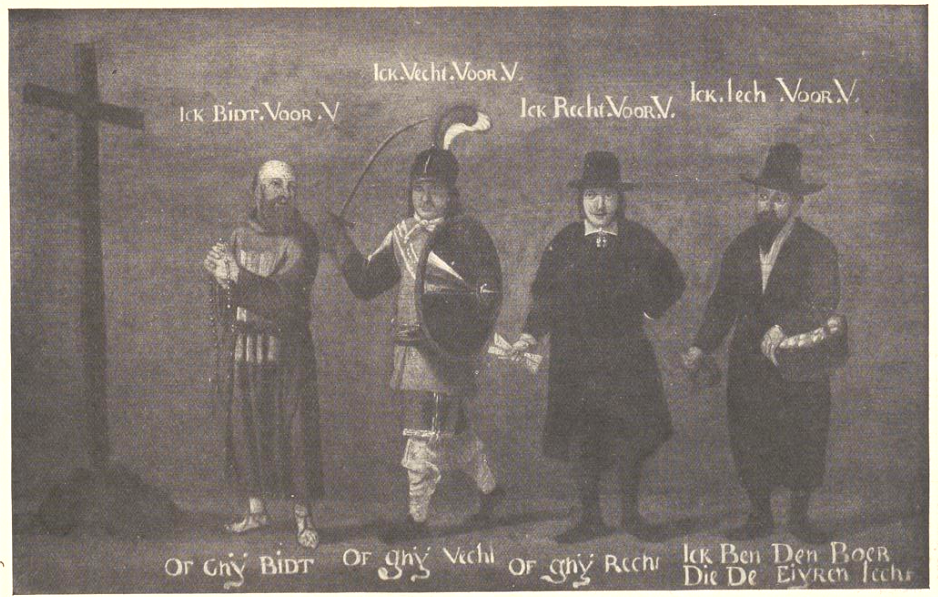
This Dutch panel (above) would seem to have been painted some time in the late seventeenth century. Here the personnel are a
Monk: Ick bidt voor u I pray for you
Soldier: Ick veght voor u I fight for you
Lawyer: Ick plyet voor u I plead for you
Peasant: En ick verryk u and I make you rich
but the peasant, who is accompanied by a barking dog, also carries a basket of eggs, and his speech continues along the bottom of the panel: of dat gy bidt, of dat gy veght, of dat gy plyet, ick ben den boer die den eyre lyet [whether you pray, whether you fight, whether you plead, I am the farmer who ‘lays the eggs’, i.e. feeds you all]. A similar contemporary composition (below) was formerly exhibited in De Gulden Spoor, Antwerp, which housed the collection of Frans Claes.
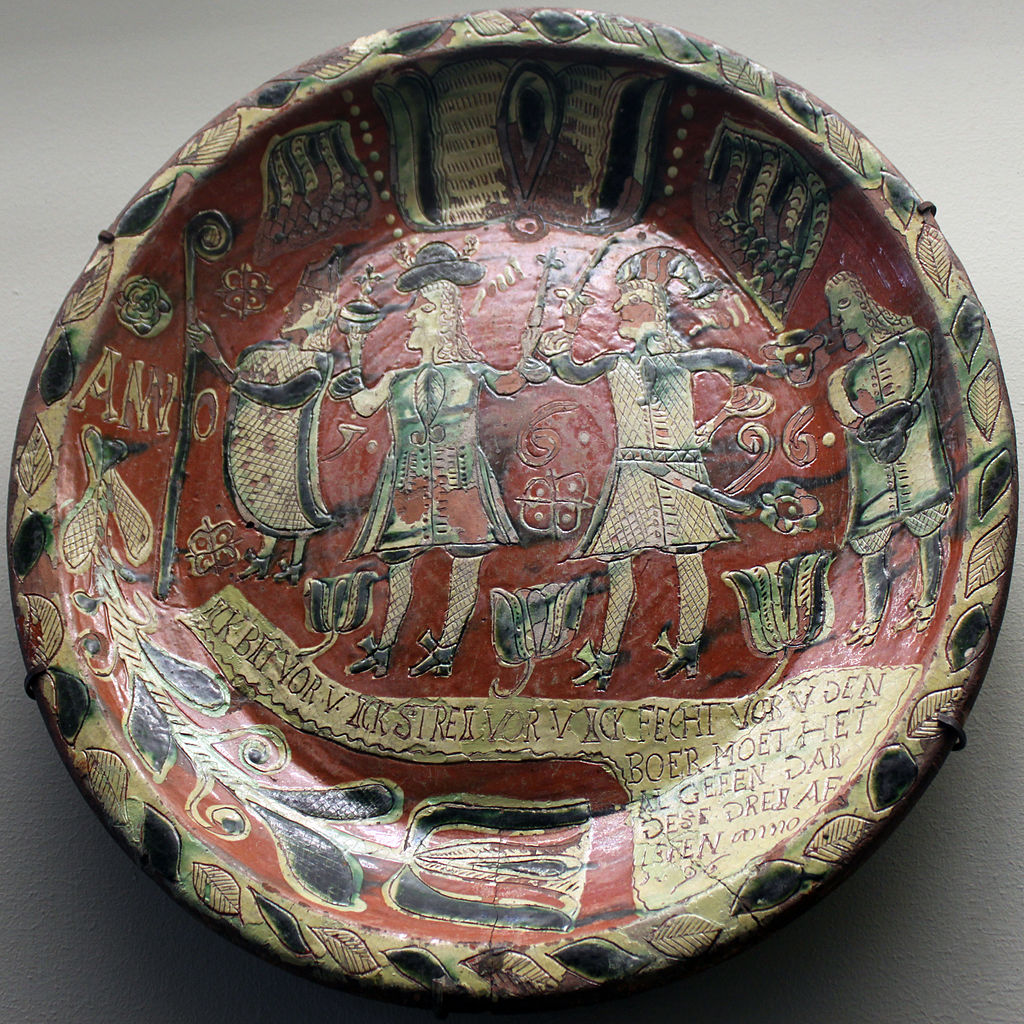
The Germanisches Nationalmuseum possesses an earthenware dish of decidedly popular appearance made in the pottery at Tönisberg, Kempen on the Dutch/German border and decorated in sgraffito technique. It is dated 1696 and depicts a Bishop, King, Soldier and finally the Peasant who supports them all:
Bishop: Ick bit vor v I pray for you
King: Ick strei vor v I ??? for you
Soldier: v[nd] Ick fecht vor v and I fight for you
Peasant: Den boer moet het al gefen dar dese drei aflefen The peasant must give all so that these three are supported
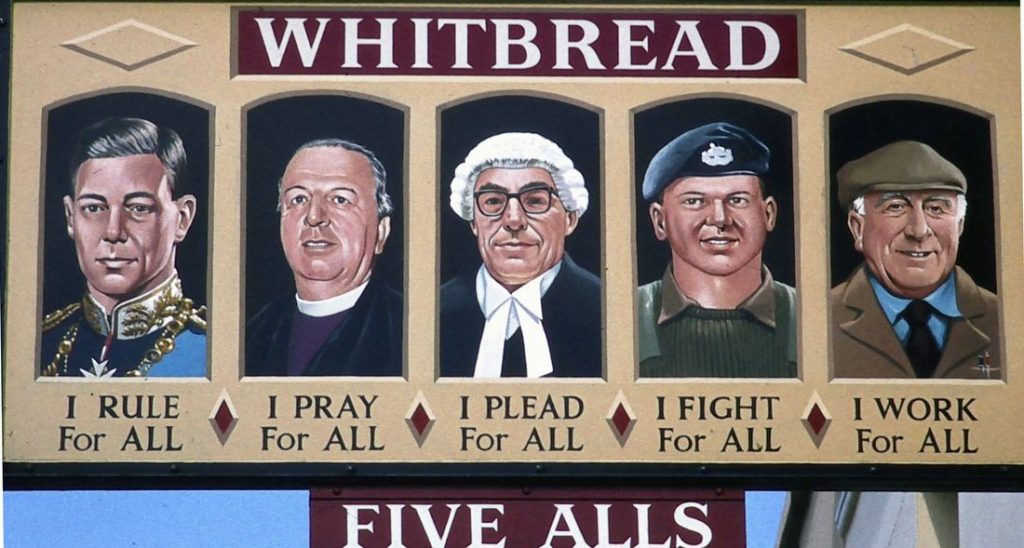
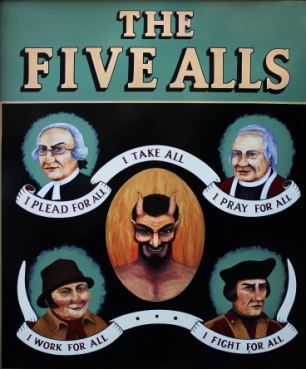
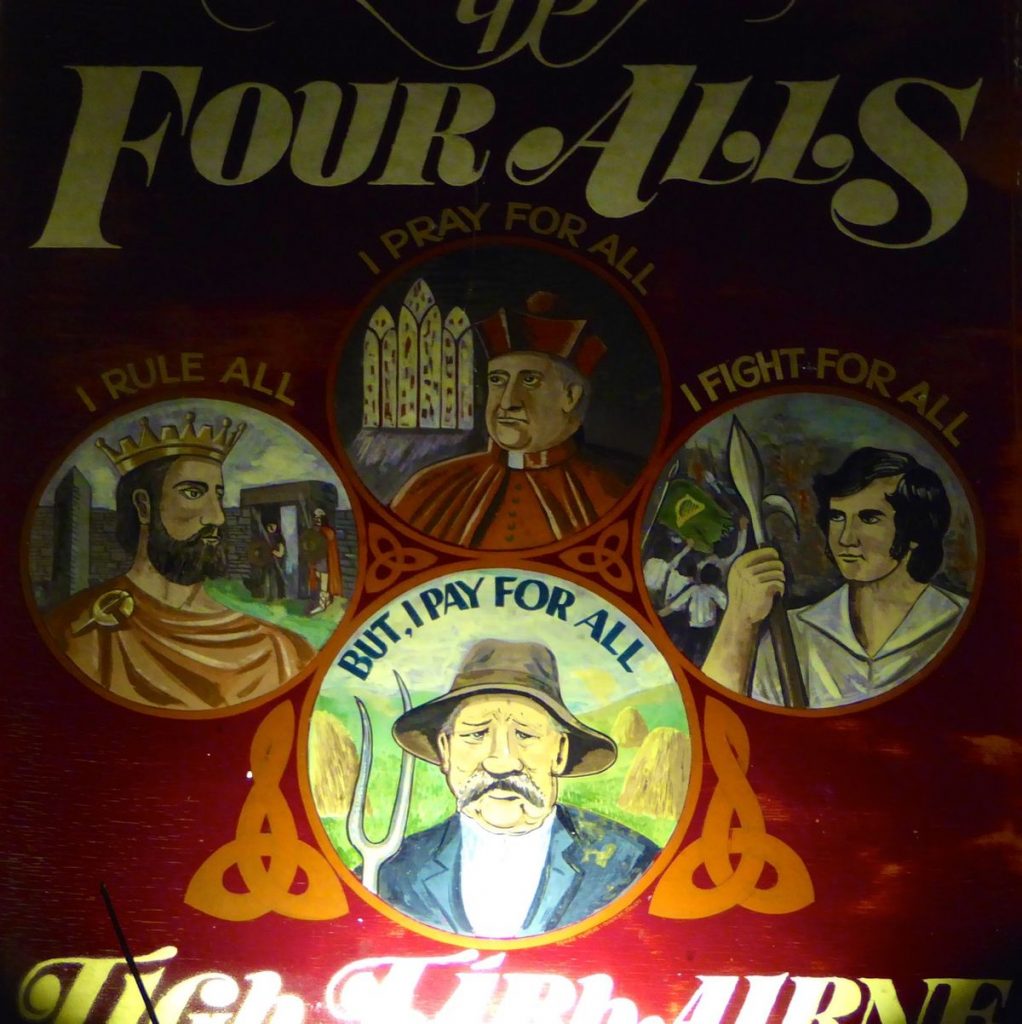
It was only to be expected that such a truly popular design would appear in the art of the street, as in the Haarlem house-sign above, and for England, Lillywhite recordsThe Five Alls as an inn-sign in 1660s London — a tradition which continues to the present day in numerous pub-signs
The French connexion
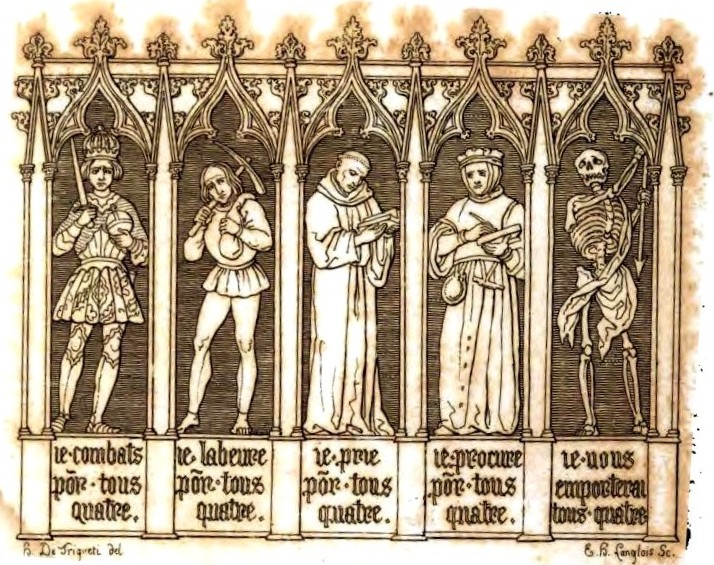
In the mid-nineteenth century, E.-H. Langlois reproduced a painting on panel in tempera on a gold ground which he did not venture to date, but from his drawing would appear to be as early as c.1500 [E.-H. Langlois, Essai Historique philosophique et pittoresque sur les danses des morts (Rouen 1852), tome 2, pl.39]. It depicts four Estates and Death under Gothic arches; from left to right, the personnel and speeches are as follows:
King: ie combats po[u]r tous quatre I fight for all four
Peasant: ie labeure po[u]r tous quatre I labour for all four
Priest: ie prie po[u]r tous quatre I pray for all four
Lawyer: ie procure po[u]r tous quatre I prosecute for all four
Death: ie vous emporterai tous quatre I will carry off all four
This ?late 15C painted panel reproduced by Langlois would seem to be the earliest to use the ‘all’ formula, here in the form pour tous quatre [for all four (of you)] – even though it really only makes sense as Death’s speech, as the four mortal estates cannot include Death in their own pour tous quatre, nor themselves; otherwise, as we have noted above, we have to wait till the 1580s or so for the re-appearance of the Alls/Omnes formula.
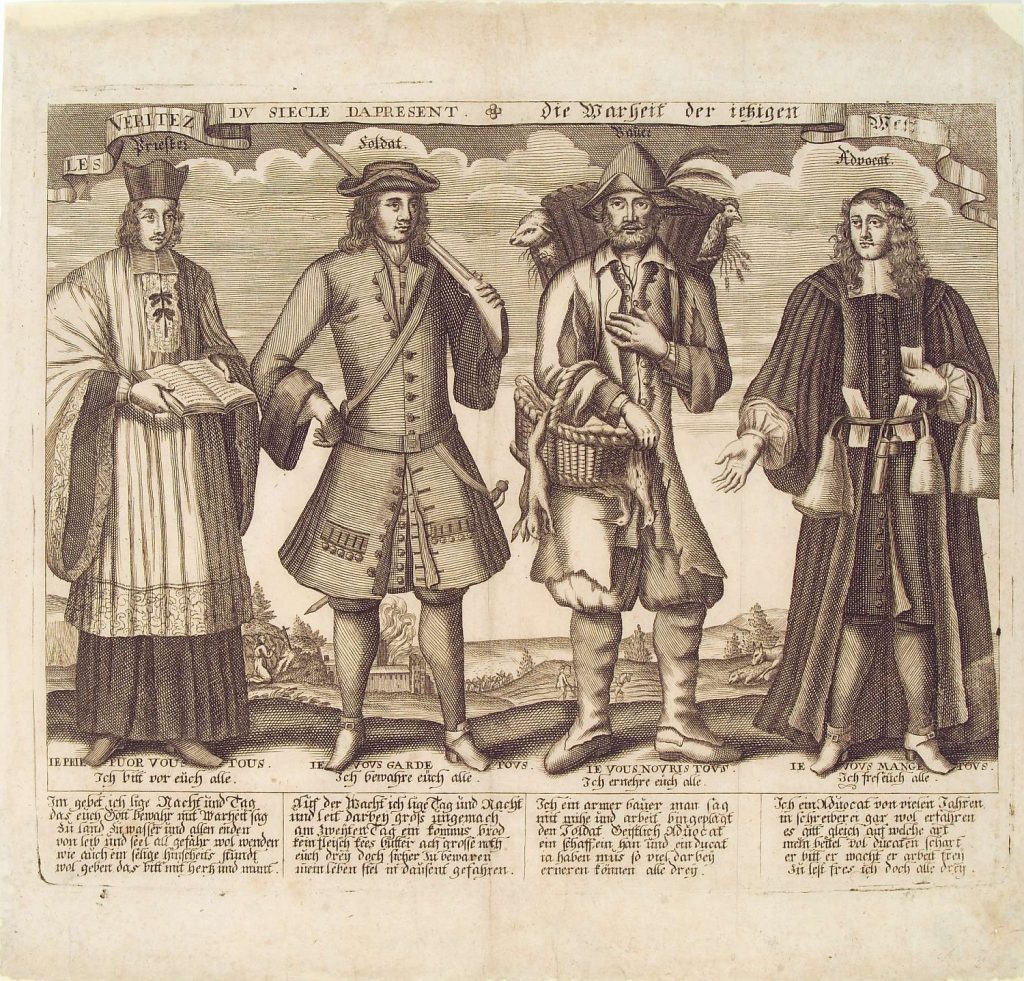
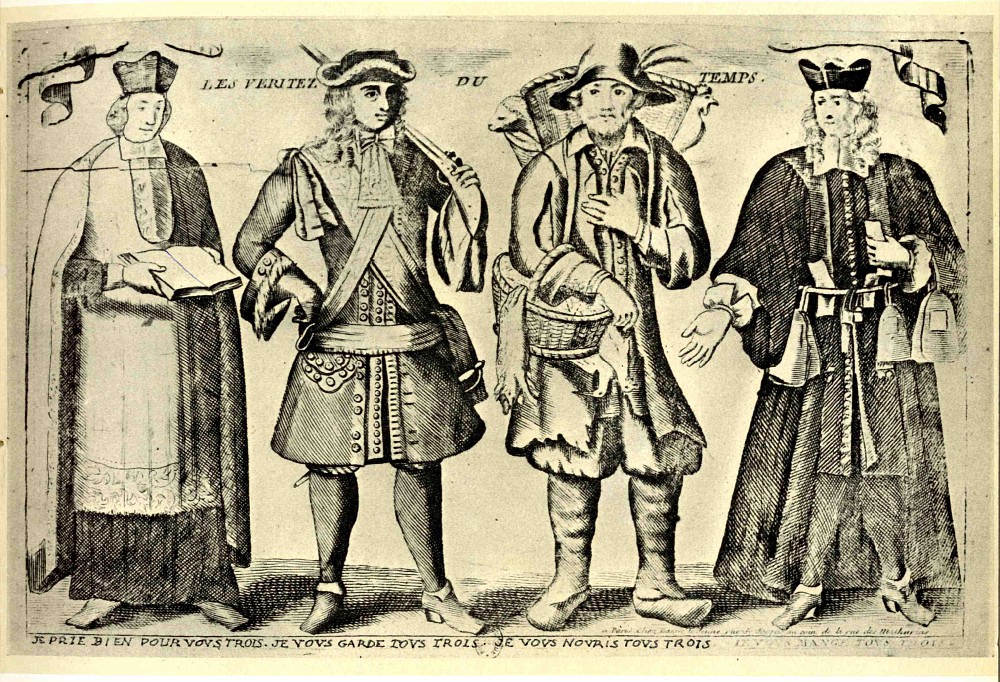
French versions of the motif usually include the word verités in the title, e.g. Les Quatre Verités, Les Veritez du Temps [BELOW], though in the earliest mention — assuming it is the same motif — it is listed as les quatre Estats in the inventory taken in 1598 of the stock of the Parisian woodcut-designer, Denis de Mathonière. [G. Wildenstein & J. Adhémar, “Les images de Denis de Mathonière d’après son inventaire (1598)” in Arts et Traditions Populaires 8 (1960), 150-157.]
The serial, cumulative type
This appears to be a later, seventeenth-century, stage in the development of our motif, though with obvious similarities to those we have already seen above. In this type, each estate or rank or profession of society refers to all the previous in an additional series thus: B: I x you 2
C: I y you 3
D: I z you 4, etc.
I first came across the type when redating the only known English example, a print entitled The Common Weales Canker Wormes, to c.1625
[essay available here https://www.academia.edu/42194242/_The_Common_Weales_Canker_Wormes_or_the_Locusts_Both_of_Church_and_States_Emblematic_Identities_in_a_Late_Jacobean_Print_ and Powerpoint presentation here: https://www.academia.edu/108369567/the_Common_Weales_Canker_Wormes_c_1625 ]
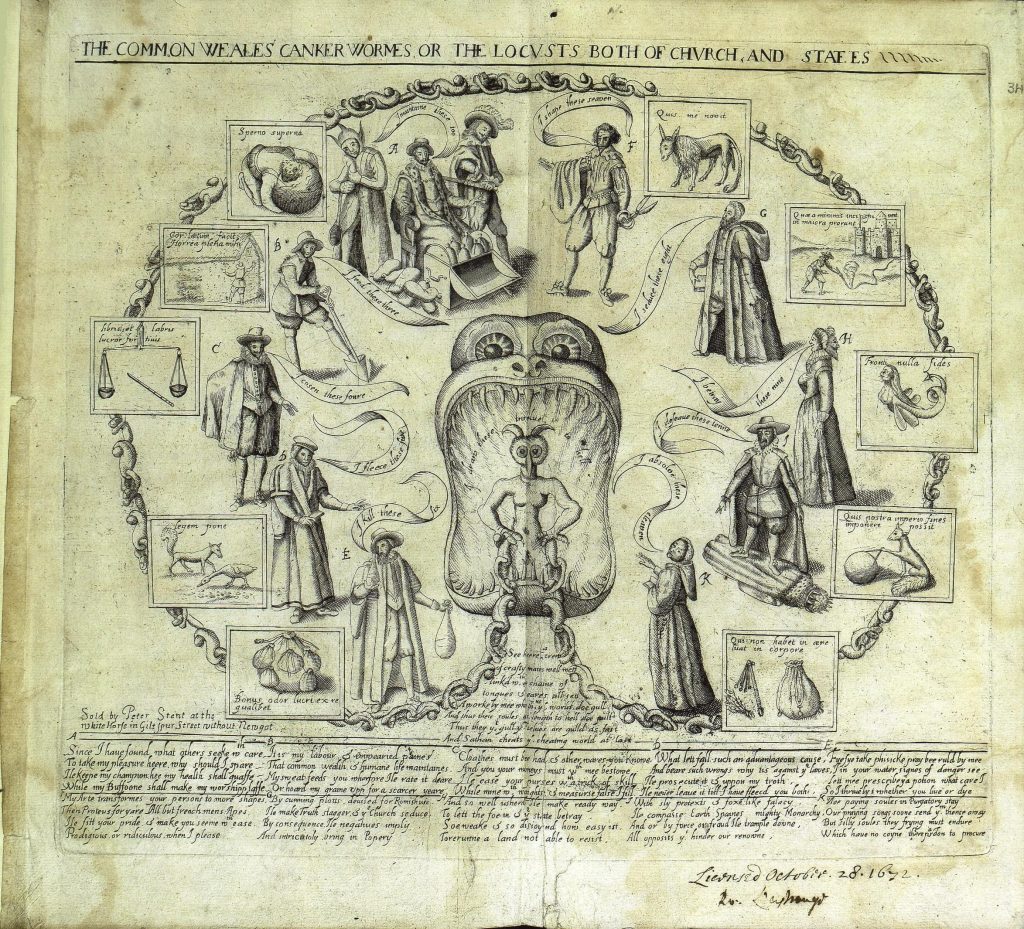
Rich Man attended by champion and jester: I maintaine these too
Peasant: I feed these three
Merchant: I cosen [trick, deceive] these foure
Lawyer: I fleece [rob]these five
Doctor: I kill these six
Tailor: I shape these seaven
Jesuit in disguise: I seduce these eight
Janus-headed hermaphrodite I betray these nine
Ambassador: I deseaue these tenne
Catholic Priest: I absolue these eleaven
Devil: these soules at length to hell [I] pull
With its inset emblems, and disguised personnel (including the Gunpowder Plotters’ confessor, the Jesuit, Henry Garnet) all about to be drawn into the hell-mouth by a chain made of ears and tongues pulled by the Devil, it is a rather more sophisticated composition than the Italian print issued at the end of the century by Giuseppi Maria Mitelli, Vno la fa‘ all’ altro e il diavolo a‘ tvti [Each does it to the other and the Devil to all] (1691), but there is nevertheless a resemblance, especially in the first group of three figures, the Rich Man with his attendants
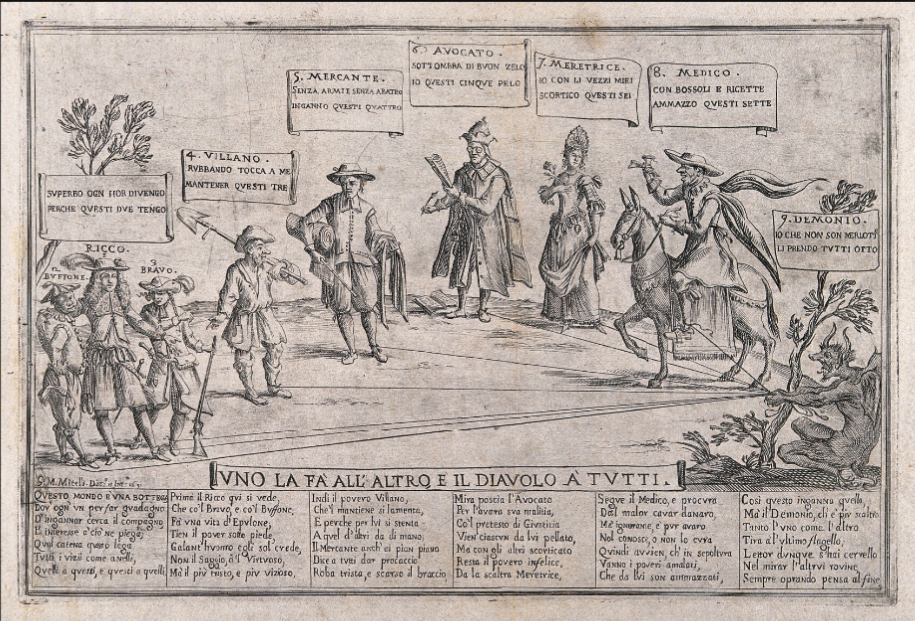
Ricco with Bravo & Bufone Superbo ogn hor divengo perche questi due tengo
I am always proud because I keep these two
Villano [peasant] Rubbando tocca a me mantener questi tre ?
….. I maintain these three
Mercante [merchant] Senza armie senza aratro inganno questi quattro
Without weapons and without plough I deceive these four
Avocato [lawyer] Sottombra di buon zelo io questi cinque pelo
Under the pretence of ‘good zeal’ I skin these five
Meretrice [whore] Io con li vezzi miei scortico questi sei
With my charms I fleece these
Medico [doctor] Con bossoli e ricette ammazzo questi sette
With little boxes and prescriptions I kill these seven
Demonio [Devil] Io che non son merlotto li prendo tutti otto
I’m no blackbird chick, I take all eight of them.
Roughly contemporary with the English print, though quite different compositionally, is a Dutch panel-painting preserved in the Stadsmuseum, Gent, though here it is Death rather than the Devil who terminates the series by ‘making peace’ between the seven!
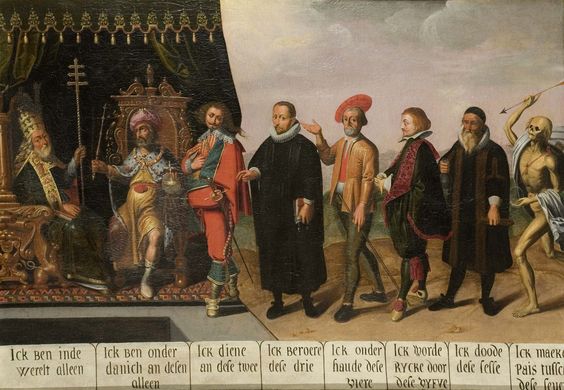
Pope: ICk Ben inde werelt alleen In the world I am alone
Emperor: ICk Ben onder danich an desen alleen I am subservient to him alone
Nobleman: ICK diene an dese twee I serve these 2
Lawyer: ICK Beroere dese drie I stir up these 3
Peasant: ICK onder haude dese viere I maintain these 4
Merchant: ICK worde RYCKe door dese vYFVe I become rich through these 5
Doctor: ICK doode dese sesse I kill these 6
Death: ICK maeKe Pais tussen dese seuen I make peace between these 7.
Another possibly Spanish painting of this type is alluded to in the Journal du Voyage du Cavalier Bernin en France, i.e. while Bernini was in France in 1665, as described by one Abbe Butti :
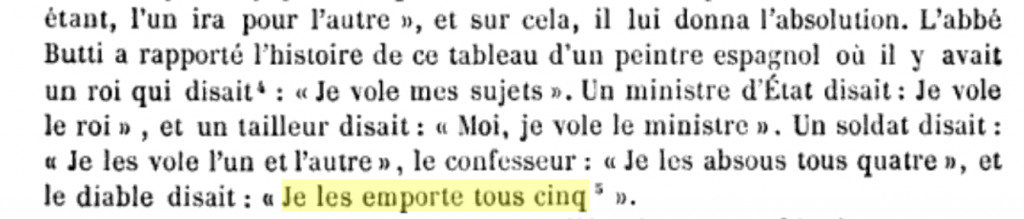
King: Je vole mes sujets I steal from my subjects
Minister of State: Je vole le roi I steal from the King
Tailor: Je vole le ministre I steal from the Minister
Soldier: Je les vole l’un et l’autre I steal from both of them
Confessor: Je les absous tous quatre I absolve all four of them
Devil: Je les emporte tous cinq I carry off all five of them
Leave a Reply to The Fool in the Albums – Album Amicorum: Early Modern Stammbuch Iconography & related Cancel reply