Alciato
Alciato’s Emblematum Liber, published in Augsburg in 1531 and conventionally considered the first emblem-book, in the usual sense of the term, appeared a mere generation before the birth of the album amicorum. From the second half of the 16C both genres evolve symbiotically — many printed emblem-books being ‘re-purposed’ as albums.
Given his book’s head-start, and its numerous re-printings and editions, it is not surprising to find that Alciato is the emblematist most frequently copied by the album-painters, and of all his emblems, by far the most popular is Emblem 121 (in the numeration of Mason Tung’s Variorum ed.), Paupertatem summis ingeniis obesse ne provehantur [Poverty hinders the greatest talents from advancing]. The woodcut illustration is adequately described in the accompanying Latin verse, which may be translated as,
“My right hand holds a stone; the other supports wings. Just as the feather lifts me, so the heavy burden weighs me down. By my talent I could have soared through the heights, had not envious poverty held me back”
It perhaps spoke to the young album-owner’s aspirations and insecurity as he looked to the future, hampered by limited finances.
Such was the popularity of the book that numerous editions and re-printings appeared throughout the early modern era in just about every country in Europe; thanks to Tung’s Variorum edition, it is possible to detect at a glance which edition the individual album-painter was copying.
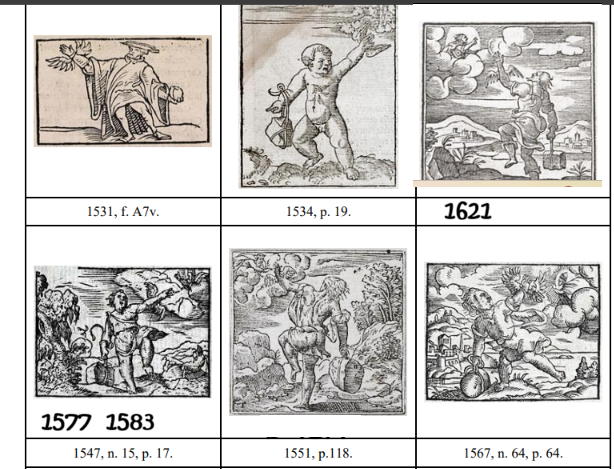
https://www.emblems.arts.gla.ac.uk/alciato/tung-variorum.php
The artist of the Hans Ludwig Pfinzing von Henfenfeld album, for example (below)
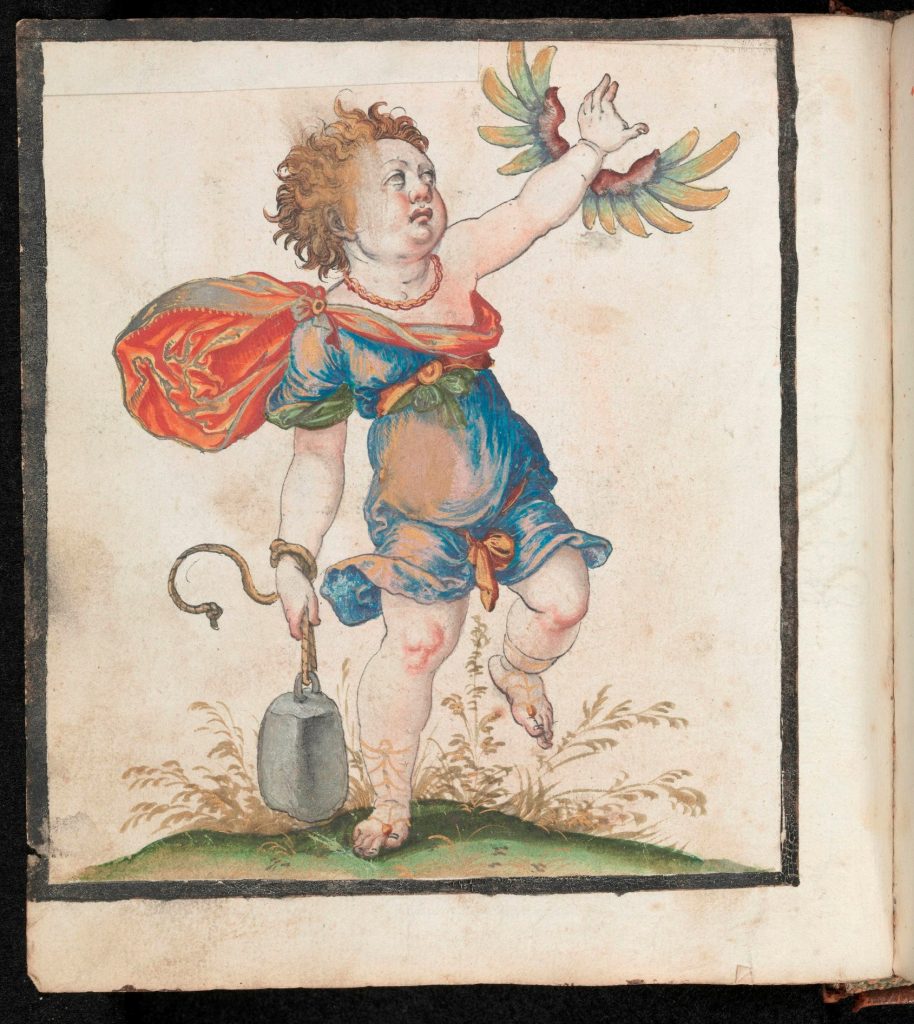
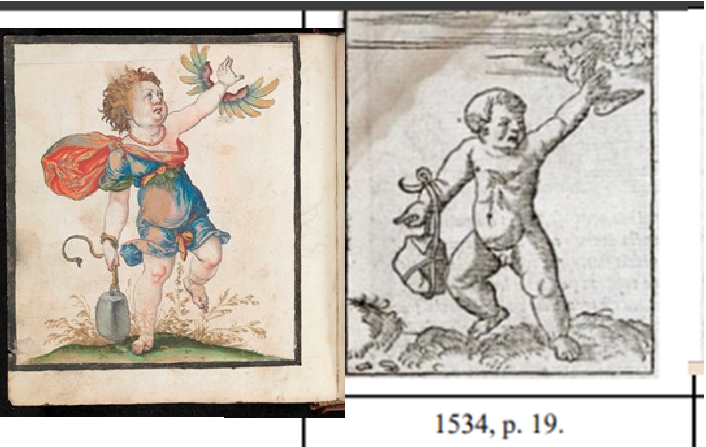
seems to have based his illustration on one of the earliest editions of 1534 — though he has modestly clothed the naked boy of his model
17C painters make their emblematic protagonist an older, indeed, student-aged youth — but are far from slavish imitators.
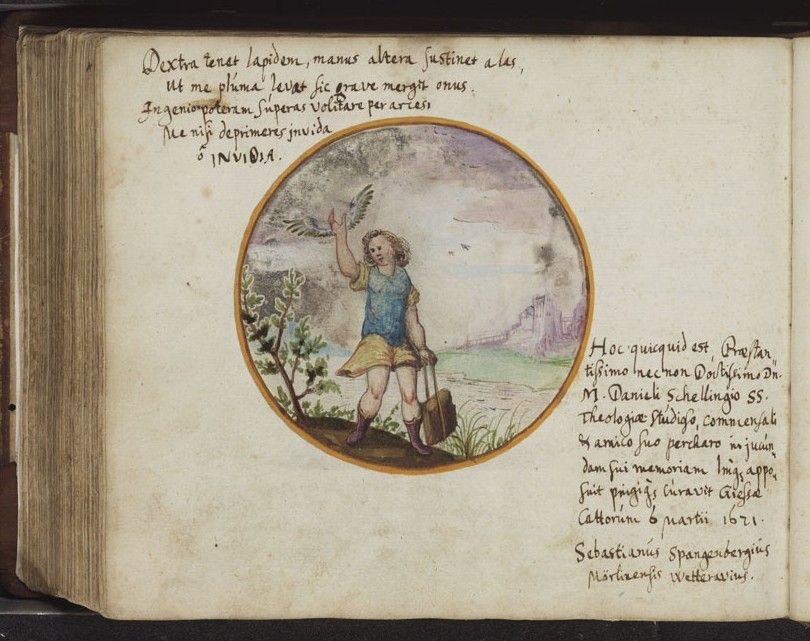
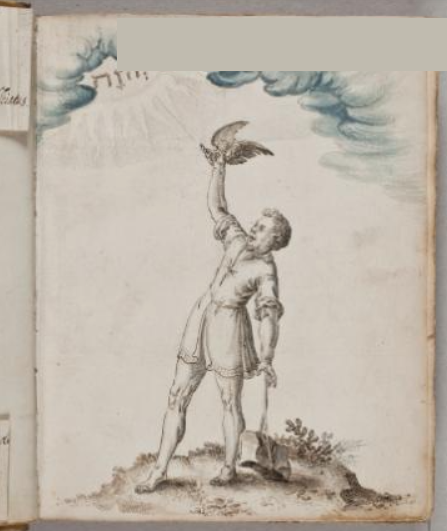
74 H 39
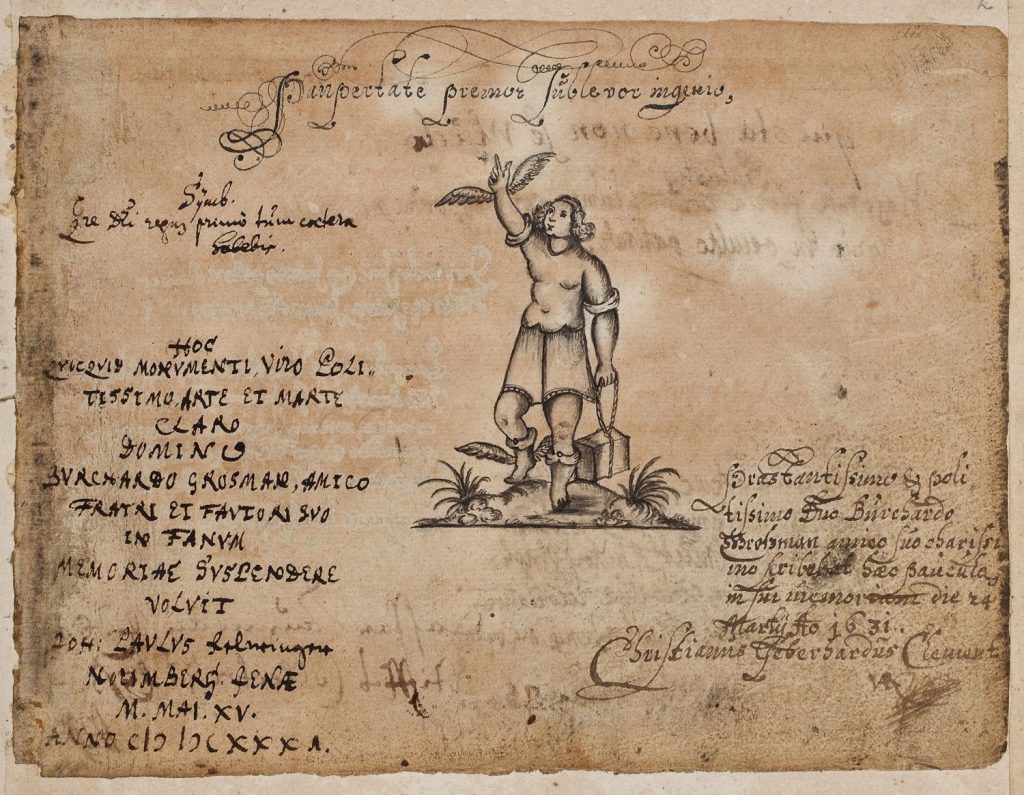
Distinct sub-genres show the man balanced either on a ball — in obvious allusion to the traditional depiction of Fortuna —
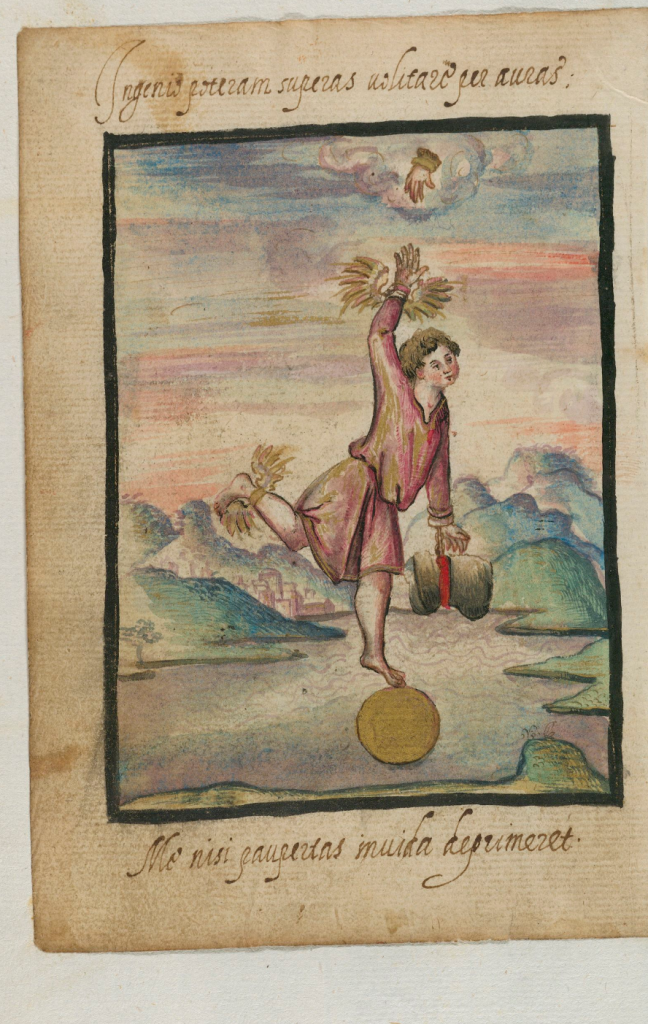
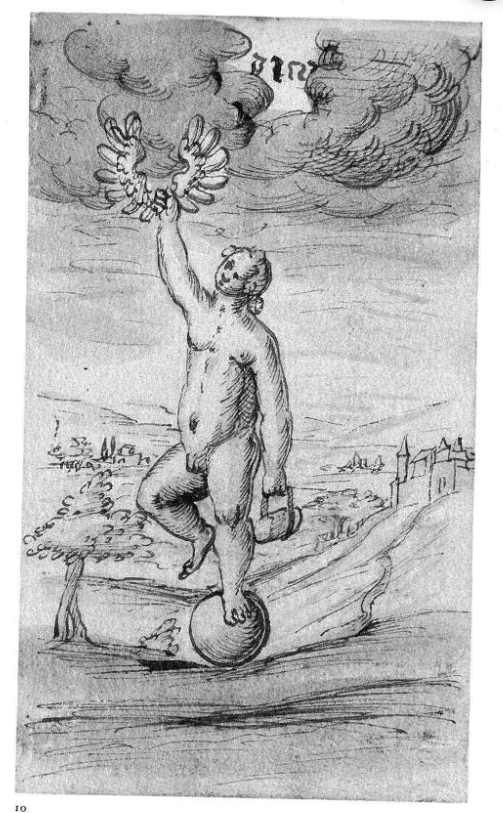
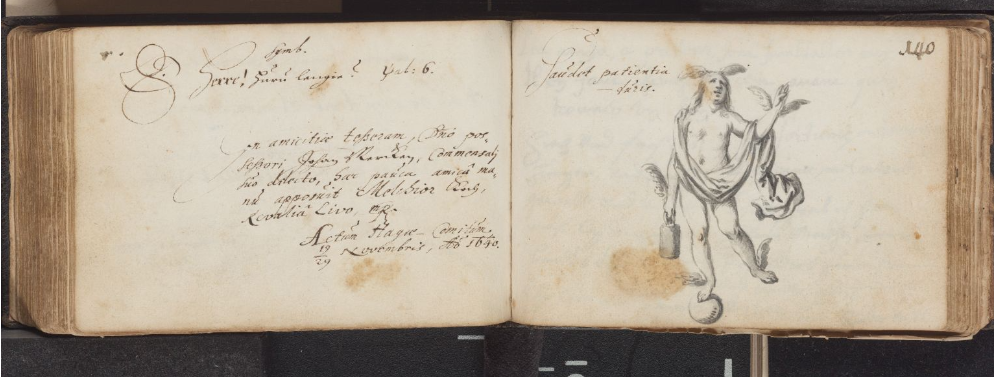
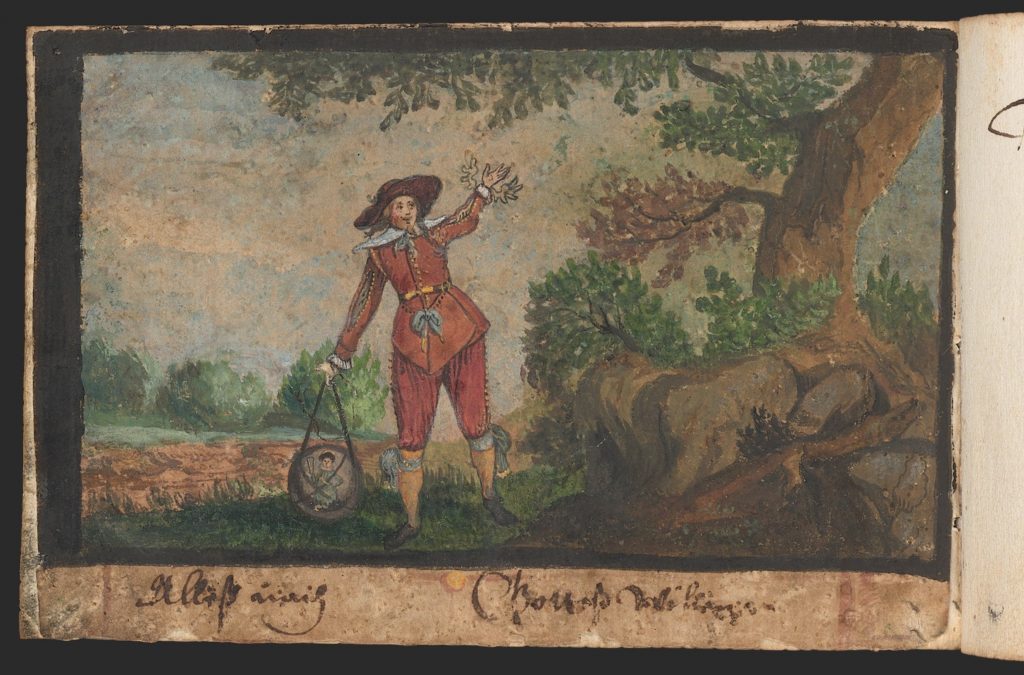
or a heart (on which is a weeping eye). The three examples of this type reproduced below are so similar, indeed, that I am tempted to suggest a lost print or other illustration unknown to me
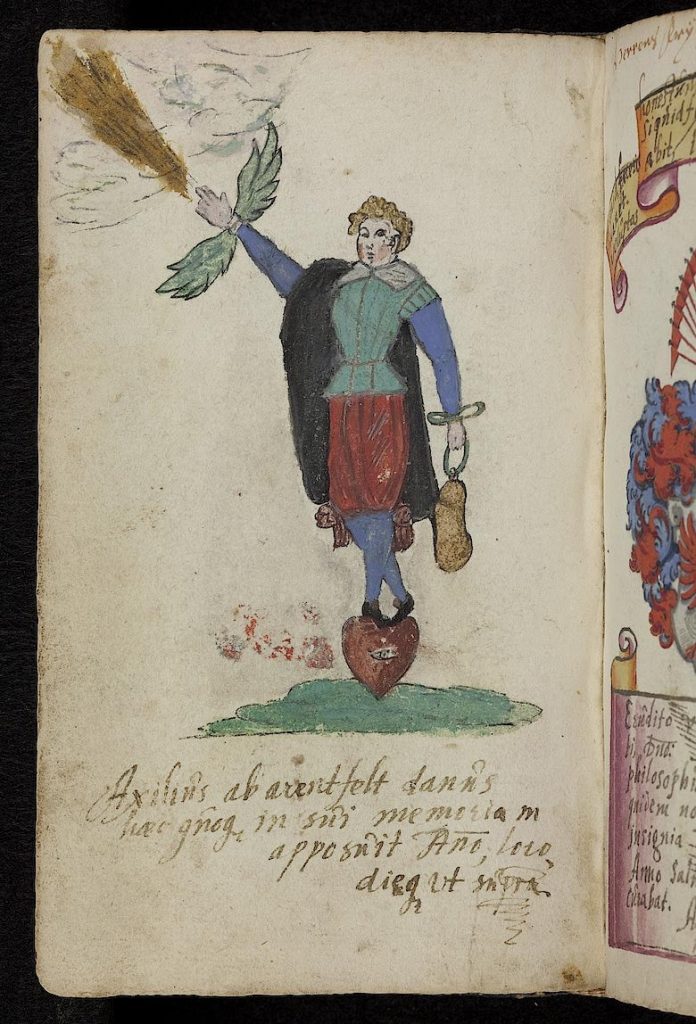
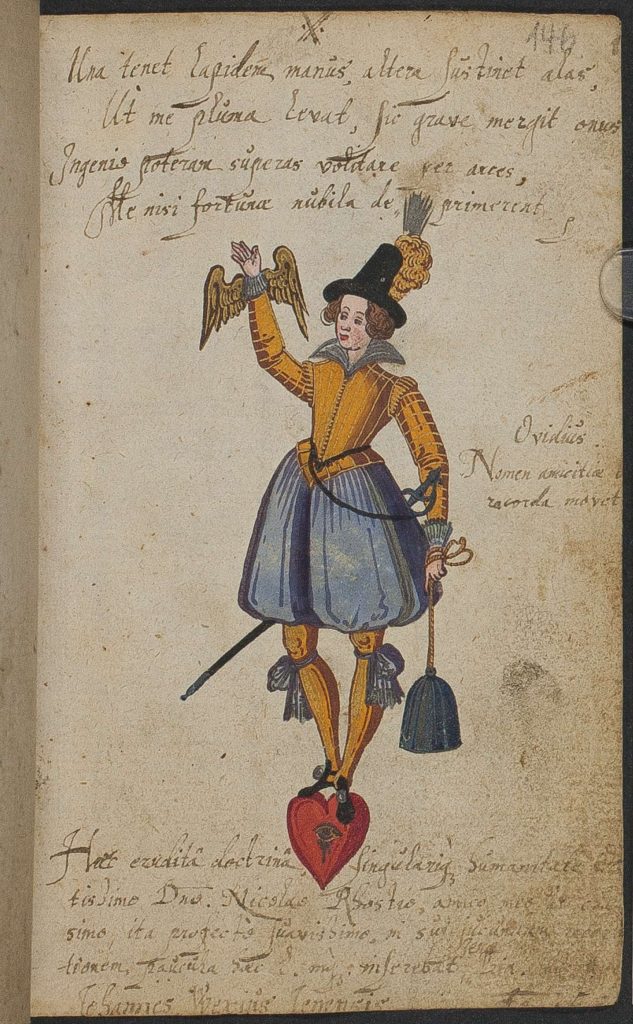
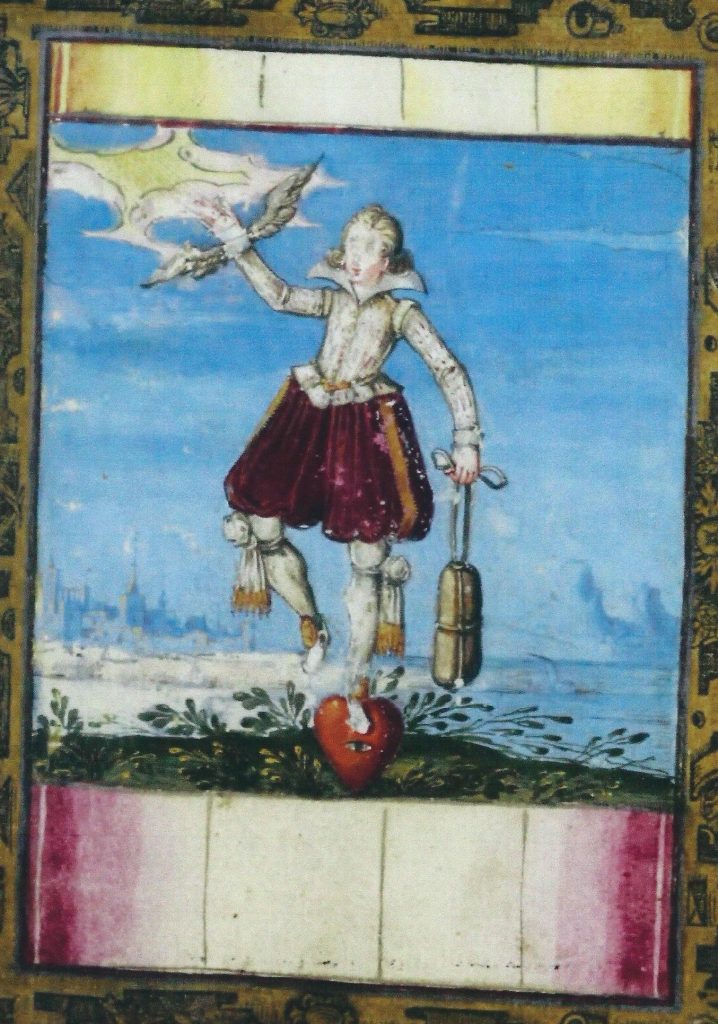
This latter heart-type hints at another worldly burden that brings the aspiring genius back to earth, as made explicit in a plate in the 1618 Speculum Cornelianum print-book (below), in which the ball-&-chain keeping the student earthbound is a world-orb on which appears the image of a young woman offering him hospitality!
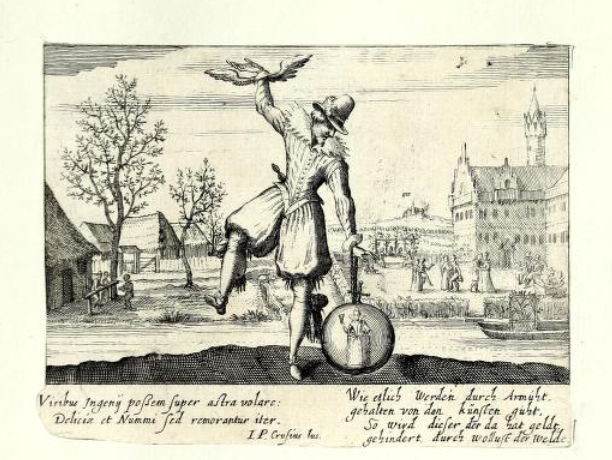
The Meyer album painter is perhaps indebted to this print-book version:
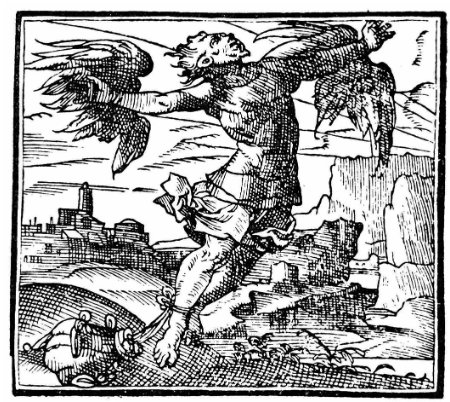
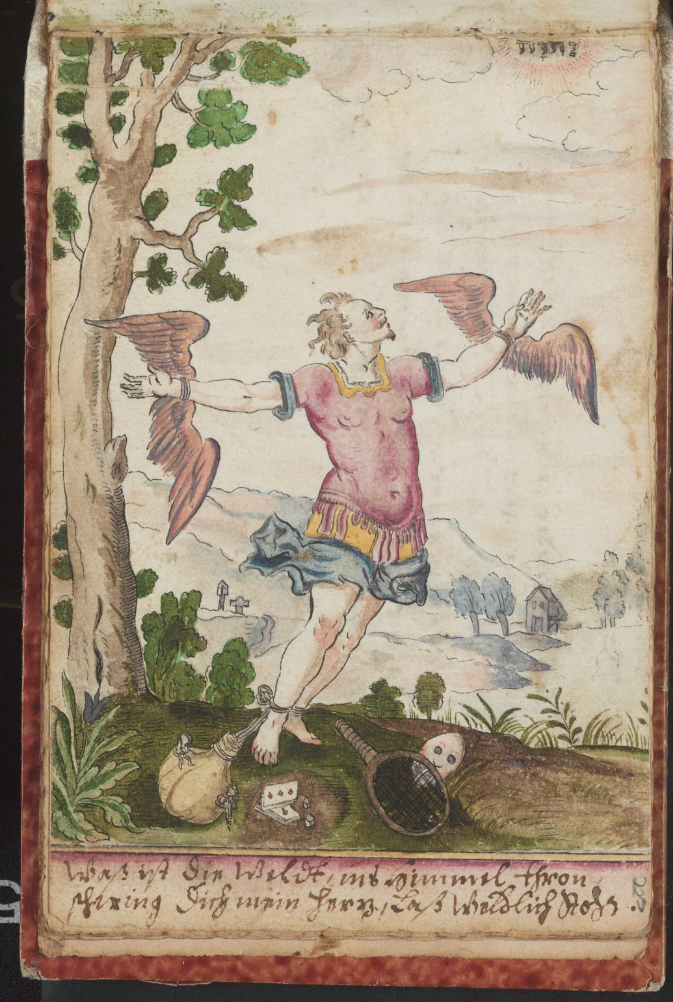
Other emblematists gladly pillaged Alciato’s corpus; Rollenhagen’s copy of our motif appeared in his Nucleus emblematum of 1611, and Holtzwart’s (below) in 1581 (reprinted in Reusner, 1591) — it is clear from the version of the emblem in Johann Lüdel’s emblem (below) that the painter was copying the cut in Holtzwart’s book — the telltale details, specifically, are that both his arms are winged, and that the weight which holds back the youth is a heavy purse (which rather contradicts the plea of poverty!) while on the ground beside it lie the assorted worldly pleasures symbolised by tennis racket, cards & dice, and theatrical mask.
I am grateful to the superb article, Emblematik, on the superb website, http://www.symbolforschung.ch here: http://www.symbolforschung.ch/Embleme.html#tocAnchornix
for the two following woodcuts:
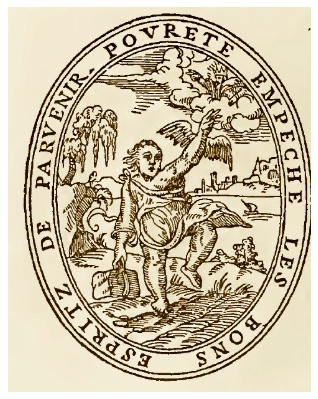
The above is the printer’s device of Barthelemy Breton, active in La Rochelle c.1570, clearly copying the cut in the 1547 edition of Alciato [see above], the motto POVRETE EMPECHE LES BONS ESPRITZ DE PARVENIR [Poverty prevents fine spirits from succeeding]. The following woodcut, however, is probably the earliest copy of Alciato’s device to be found outside an emblem-book — it illustrates a chapter in Ryff’s German translation of Vitruvius, Vitruvius Teutsch, published in Nurnberg in 1548. It is entitled “protractor (?), ruler, and all necessary instruments of the artistic profession of geometry” and shows the boy surrounded by a welter of technical instruments. The text makes it clear that the message is exactly that of Alciato, that poverty can hamper genius:

in other media
I enjoy Winterthur ceramics! You might care to sample some more here:
https://uk.pinterest.com/malcmjones/winterthur-faience-tiles-etc-1550-1700/
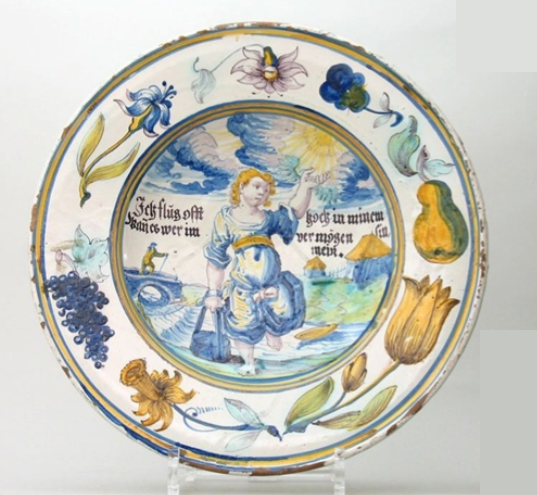
This Breitrandteller (below) is preserved in the Schweizerisches Landesmuseum where it is dated c.1650-60, and the inscription read as Ich flug offt hoch in minem sin / wan es wer im vermögen mein [I often fly high in my mind/ if only it were in my power]
And as one of the 170 emblems that border the Four Seasons tapestries in Hatfield House, probably woven by Flemish craftsmen c.1610:

another popular Alciato emblem
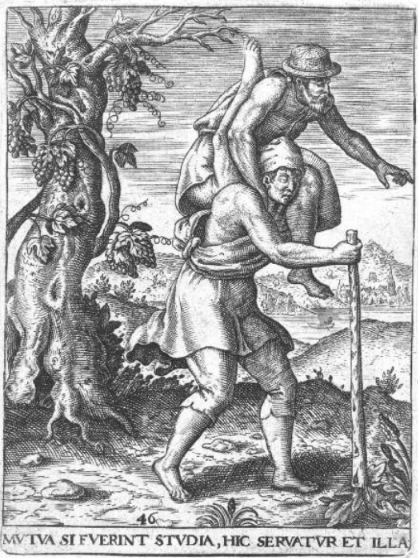
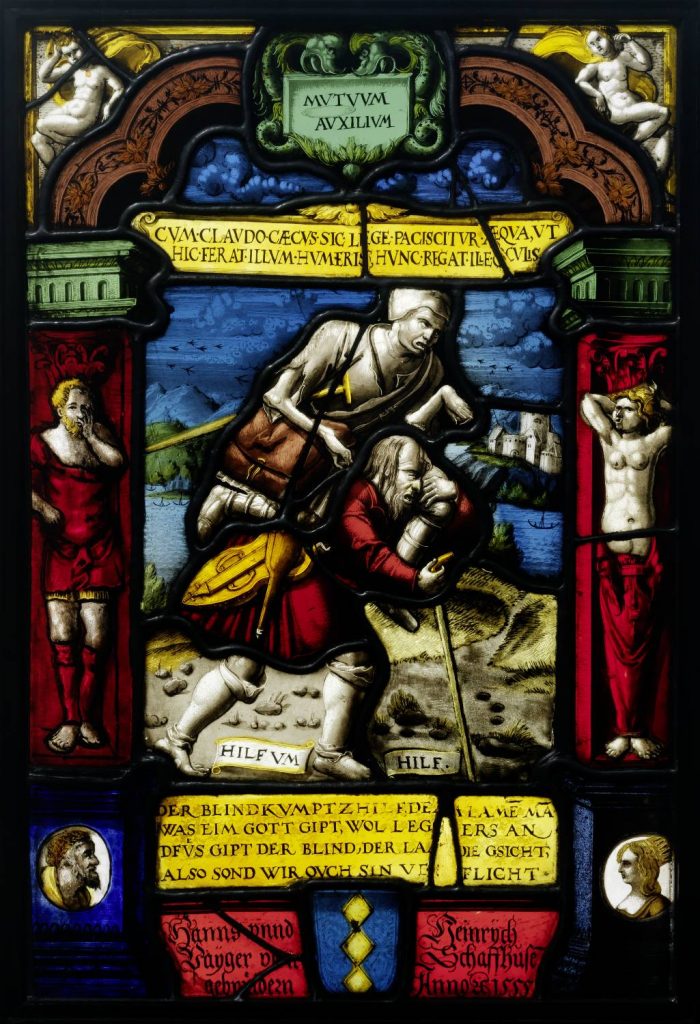
Not quite as popular in the albums, but found in other media too, was Emblem 161 (Tung), Mutuum Auxilium [mutual assistance]:
Again we may let the verse (in translation) describe the illustration:
“The blind man carries the lame man, hoisted upon his shoulders,
And thus repays his companion with the service of his eyes:
What one lacks, the other in harmony supplies;
The one lends his eyes, the other lends his feet.”
And again, here is Tung’s Variorum edition compilation of the various editions’ illustrations:

In the Frommann Collection leaf (below) the painter seems to have based his image on the 1567 edition


A late example from the early 18C:
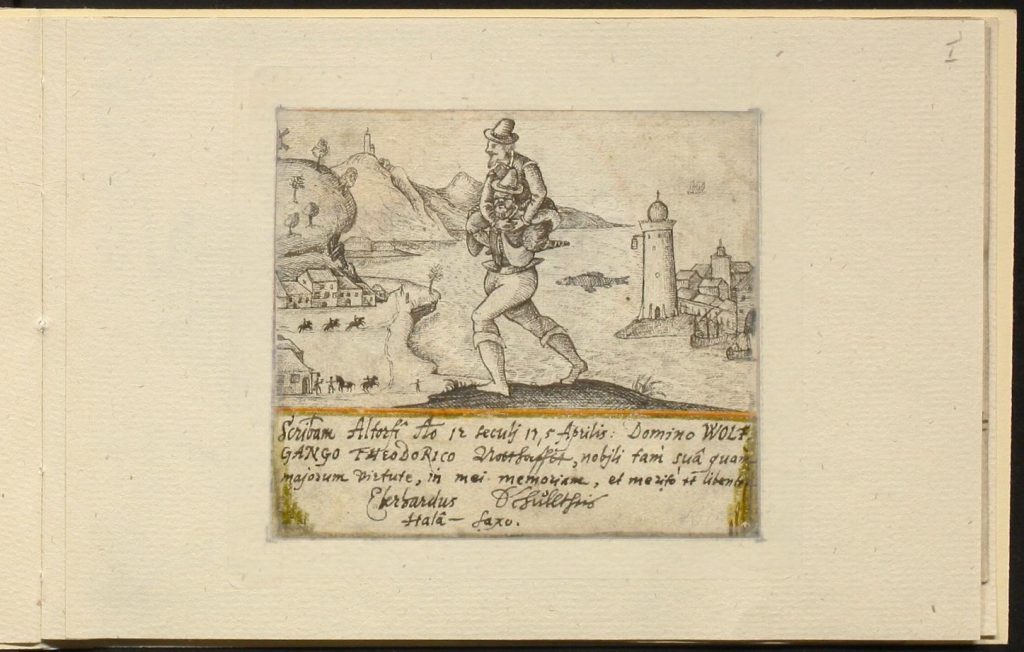
The motif (here combined with another Alciato emblem) was undoubtedly made even more visible by being taken up — evidently from the 1551 edition — by the de Brys in their Emblemata Saecularia books published in 1596 and 1611:
In other media:
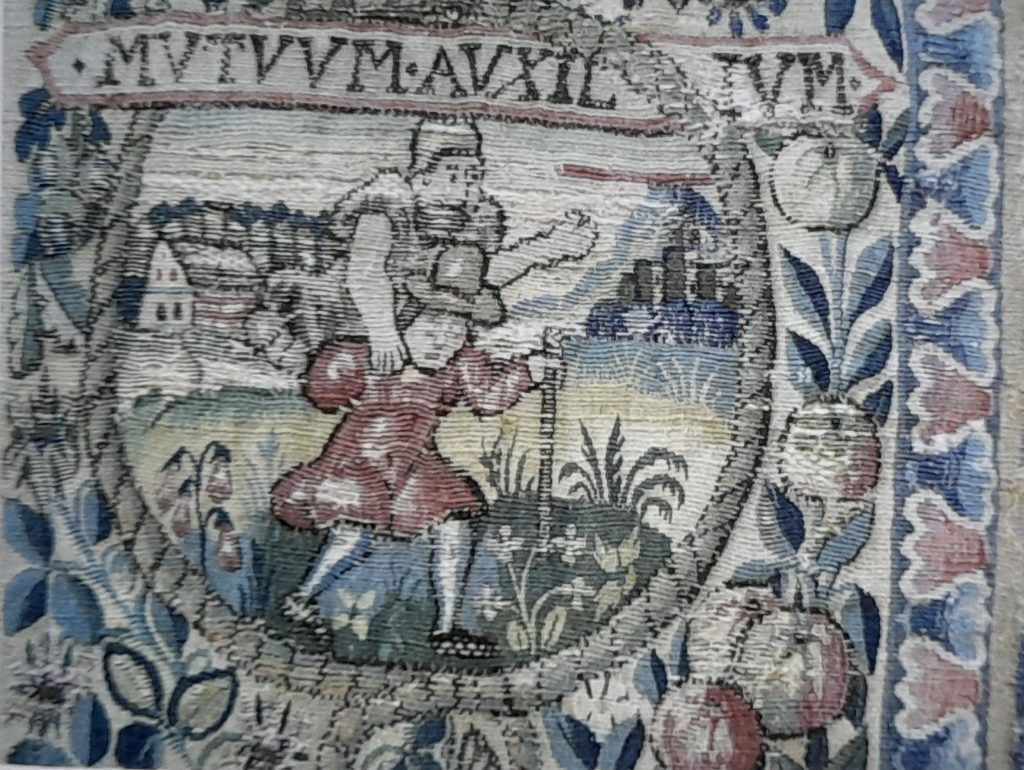
Michael Bath has shown how this same emblem was used in England — carved on a wooden panel in 1575 for a house in Oxford (below)

painted on one of a unique series of rectangular Jacobean banqueting trenchers preserved in the British Museum:

and woven in a tapestry preserved in Glasgow’s Burrell Collection:

and again as one of the emblems bordering the Hatfield House Four Seasons tapestries:
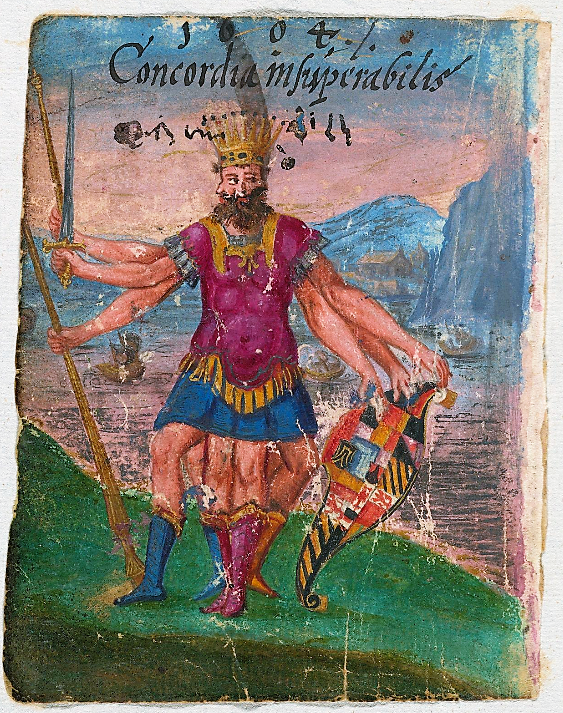
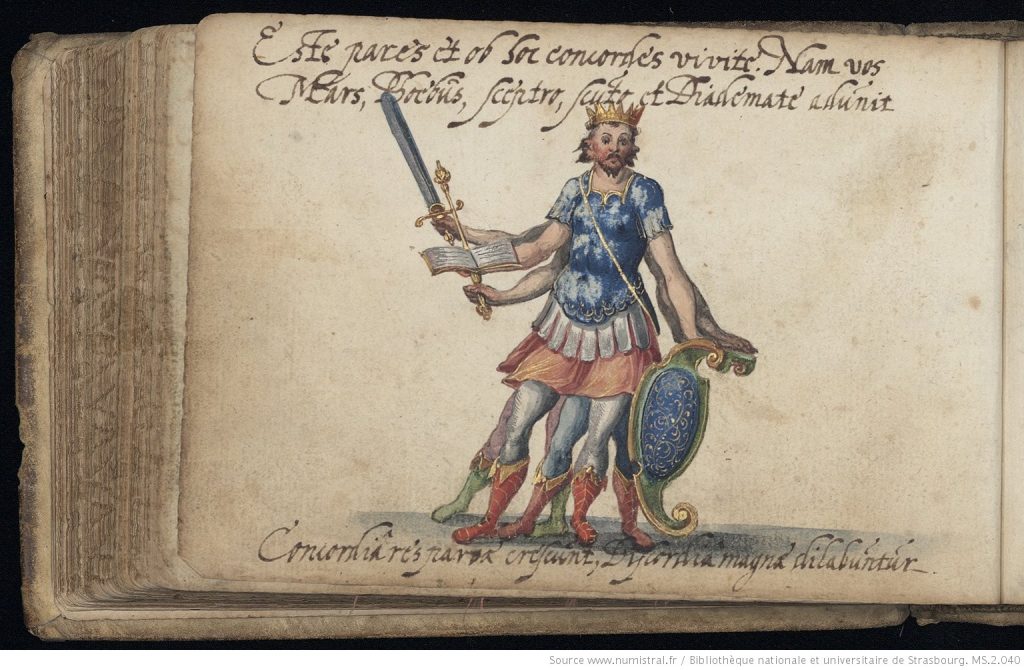
Concordia Insuperabilis (Geryon) — Alciato Emblem 40 (Tung Variorum ed. enumeration)
Also popular was the three-headed, multi-limbed image of Geryon symbolising Concord
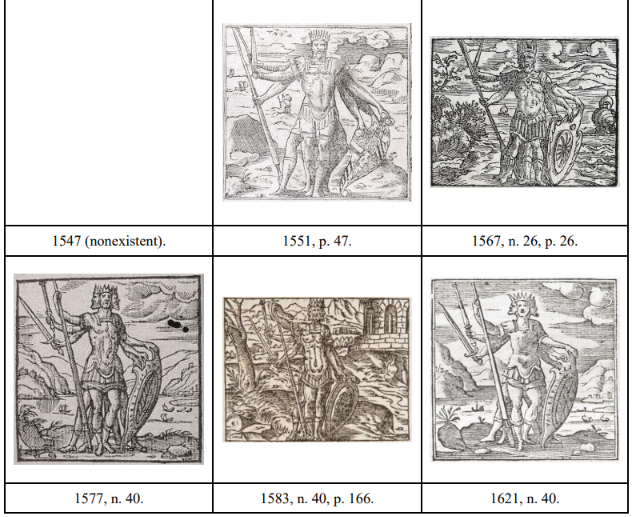
But note how the woodcut in the Emblemata Nicolai Reusneri (Frankfurt 1581) uses the same block as that in the 1567 edition of Alciato, both having been issued in Frankfurt by the same publisher, Sigismund Feyerabend .

This example of the motif in the album of Rudolf Ritter, painted in 1604, is evidently based on the illustration in the 1551 edition of Alciato
In the next two examples one of the hands holds a book
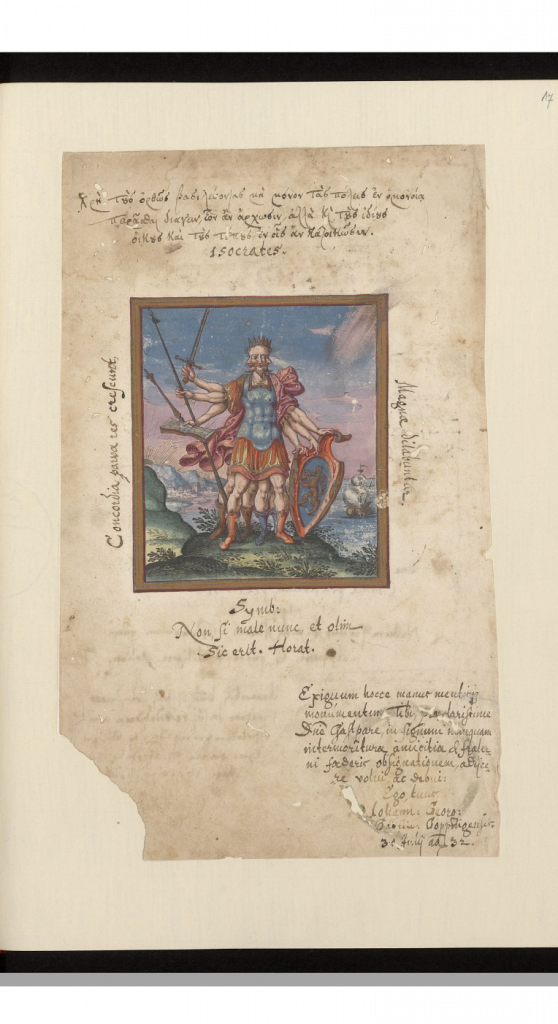
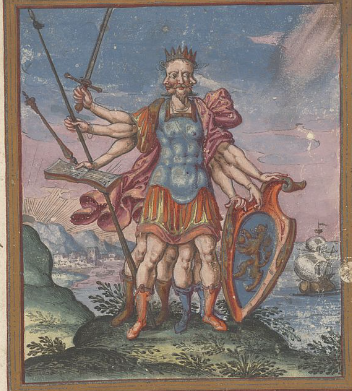
dated 1632. Stuttgart, WLB, cod. hist. fol, f.17ar.
This example on vellum (below) bears the monogram of the Viennese painter Donat Hübschmann and the date 1575. It is clear, not least from the column of German text below the image, that he was copying the woodcut in the edition published in Frankfurt in 1575:
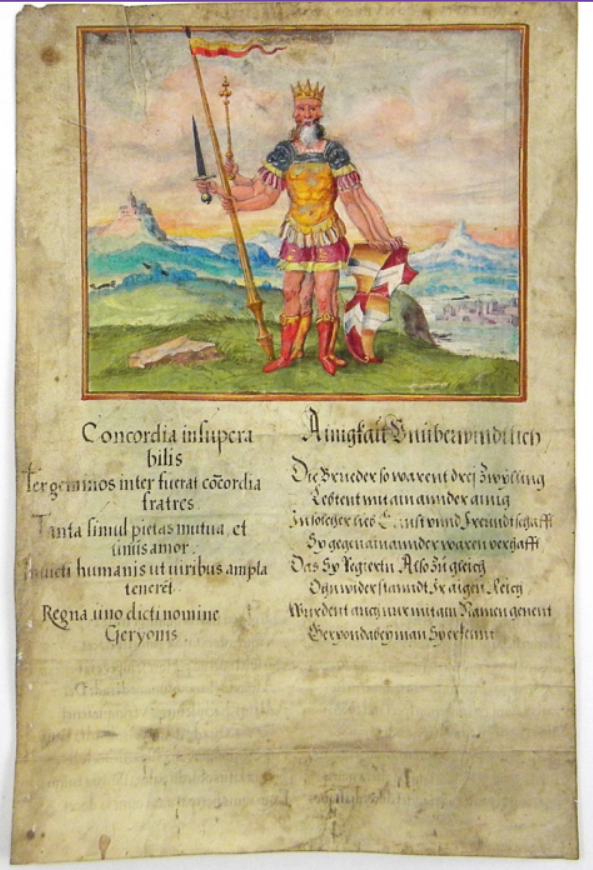
The cutter of the block for the device of the Cologne printer, Peter Horst, made a fairly free copy of the woodcut illustrating either the 1551 or the 1567 edition — below, as it appears on a book publshed in that city in 1573
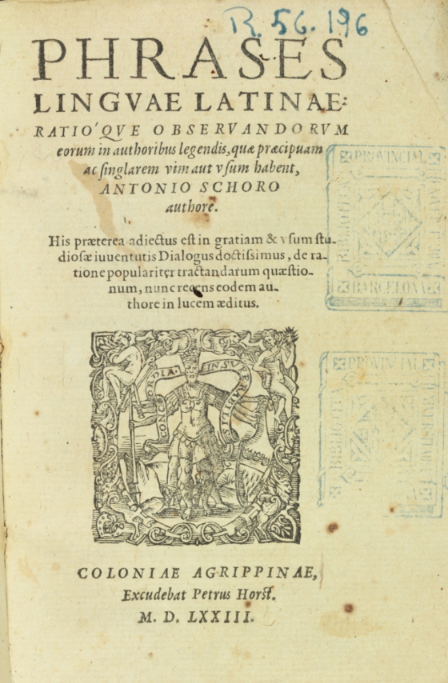
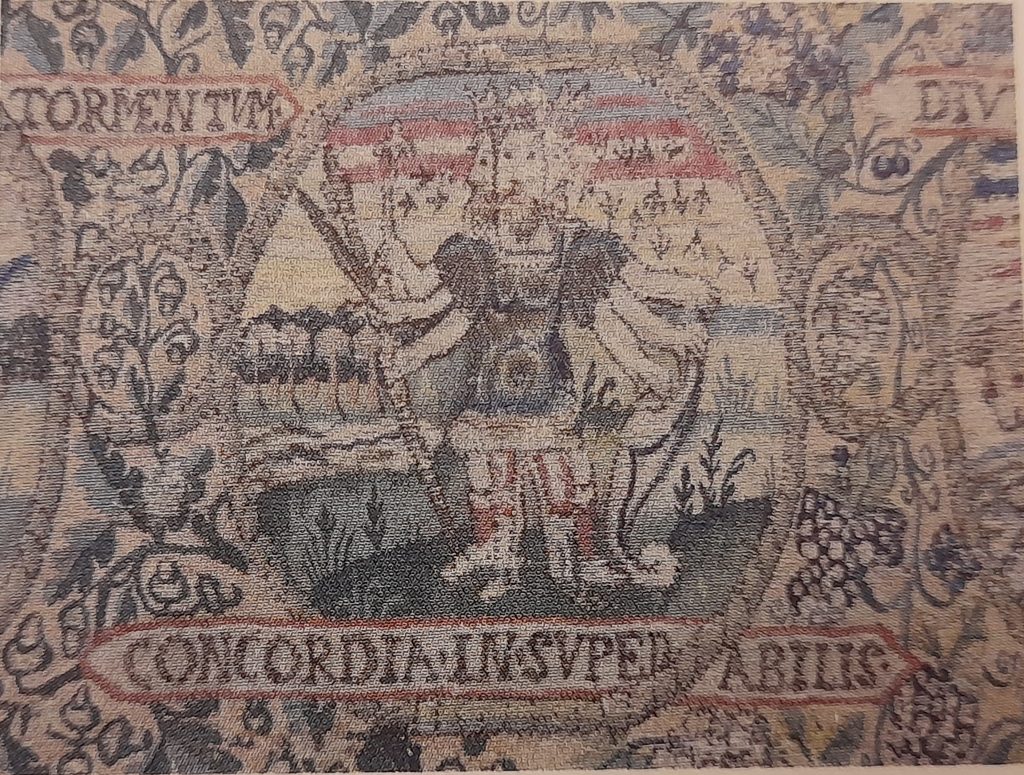
In other media
Another of the 170 emblems that border the Hatfirld House Four Seasons tapestries:
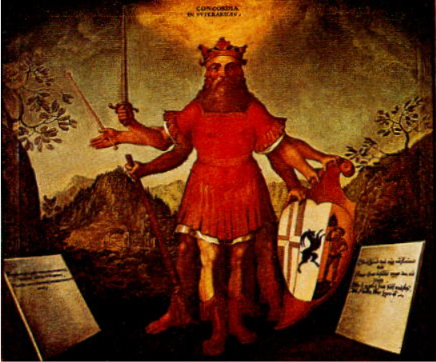
This painting on panel dated 1641 (below) is preserved in Chur in Switzerland, here symbolising the union of the Three Leagues of the Old Swiss Confederacy after the Bündner Wirren
Camerarius
The three centuries of emblems composed by Joachim Camerarius II/’the Younger’ (1534-98) were published in Nurnberg in 1590, 1595 and 1596; a fourth volume was added by his son, Ludwig Camerarius (1573/8-1651) in 1604, and a collected edition of all four volumes appeared the following year.
The album amicorum in the WLB, shelfmark cod. hist. oct. 309, belonged first to Ludwig Camerarius (from 1596) — in which portion the only images are of coats-of-arms [Wappen] and the highly popular costume portraits of Italian men and women — and then, from 1613, to his son, Joachim Camerarius III. Two entries made on New Year’s Day 1613 are signed by Ludwig’s nephew and Joachim’s cousin, yet another Joachim Camerarius; the earlier, on f.140r., being of some intrinsic interest, is reproduced below:
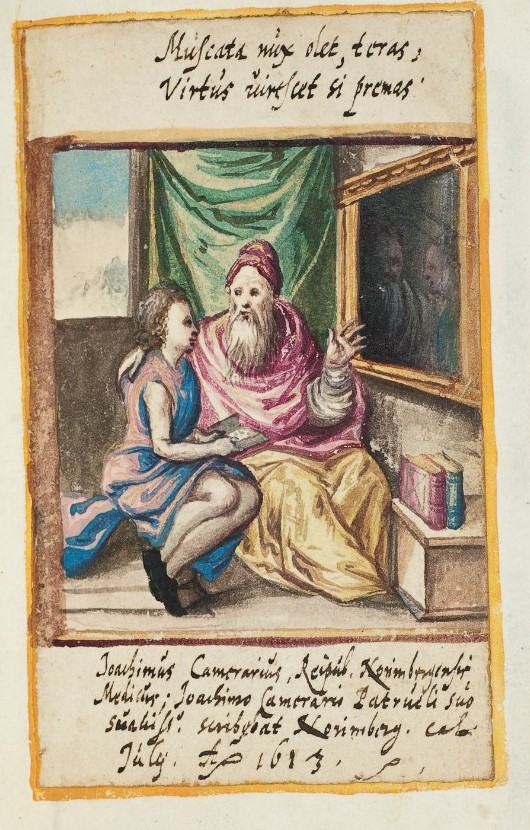
For young Joachim’s album, his cousin has had this miniature painted from an emblem-book by Mathias Holtzwart published in Strasbourg in 1581 and then re-issued by the same publisher under Reusner’s name a decade later. It shows Socrates seated beside a mirror with a young man teaching him the value of self-knowledge
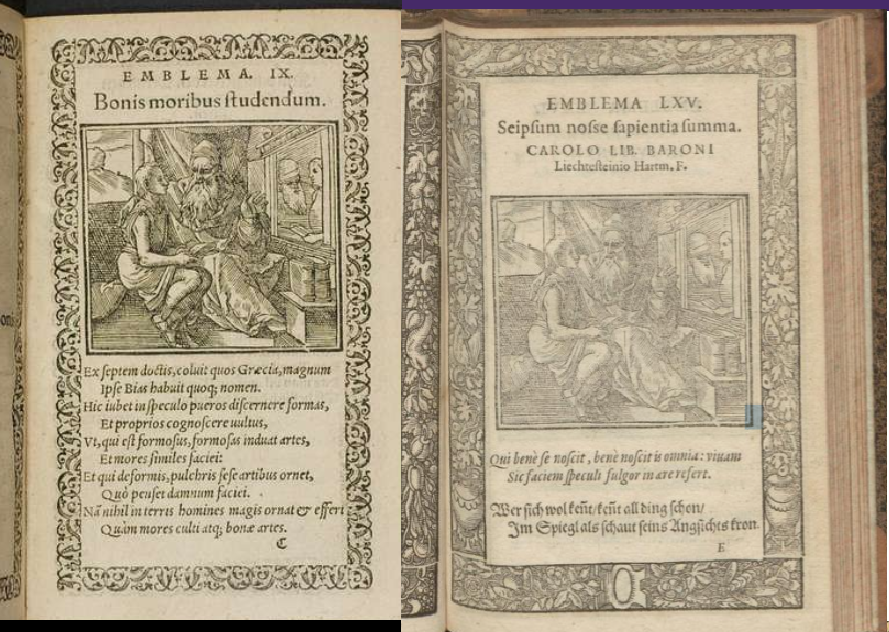
The Latin couplet above the painted scene — not obviously appropriate to the image — reads
Muscata nux olet, teras
Virtus virescet, si premas [The nutmeg smells when you crush it/ Virtue flourishes if you press (test) it]
Later in Joachim’s album appears another emblem copied from Peter Isselburg’s Emblemata Politica in aula magna Curiae Noribergensis depicta (Nurnberg 1617) [Political Emblems painted in the great hall of the Council of Nurnberg], copying the paintings of Gabriel Weyer.
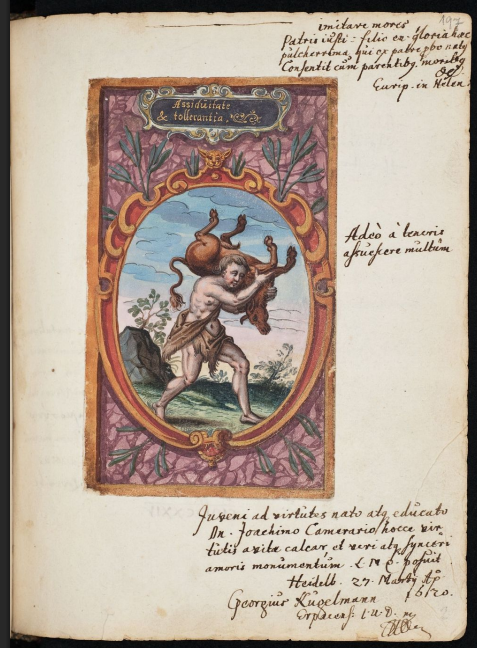
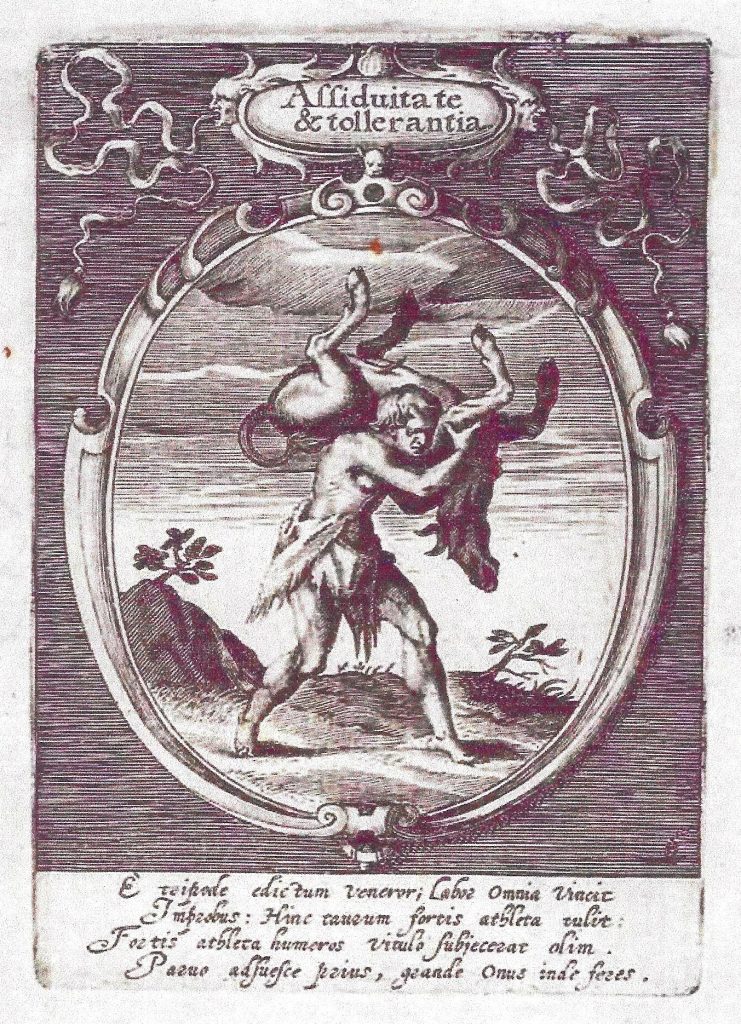
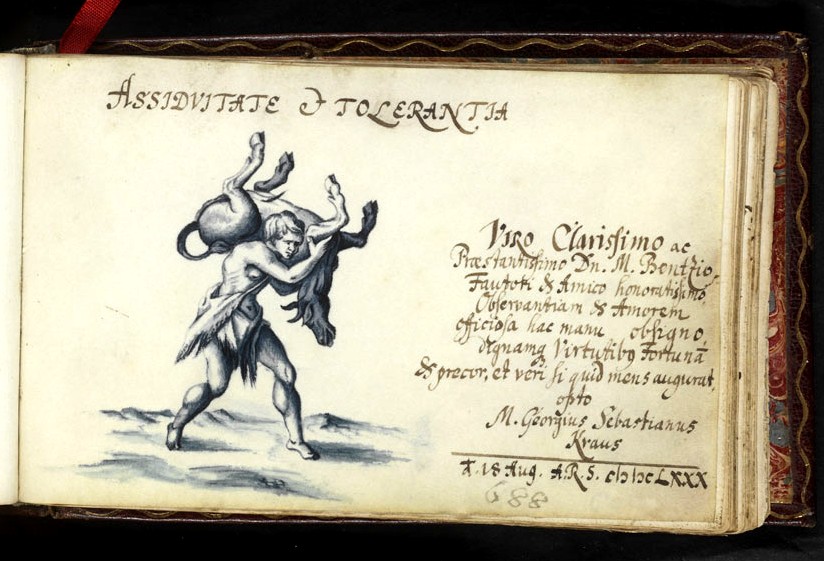
This emblem of the ancient Greek hero Milo carrying the bull caught the eye of other album-painters too, it appears in 1644 on f.195r, of the Kordenbusch album in Stockholm, and in later albums too (below)
And even Nurnberg counter-maker, Wolfgang Lauffer II (active 1612-58), who backed the counter [Rechenpfennig] with another popular emblem from Isselburg’s book:

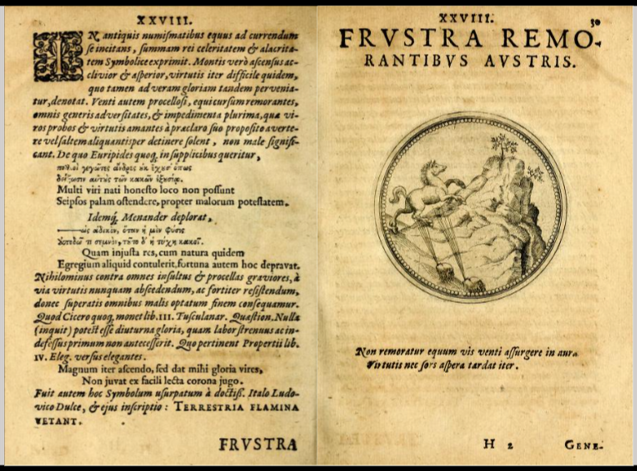
But — finally — on f.175v. of Joachim’s album, a miniature of the 28th emblem from his grandfather’s emblem-book first published in 1595, FRVSTRA REMORANTIBVS AVSTRIS [In vain the south winds (attempt to) delay (the horse from reaching the summit)]
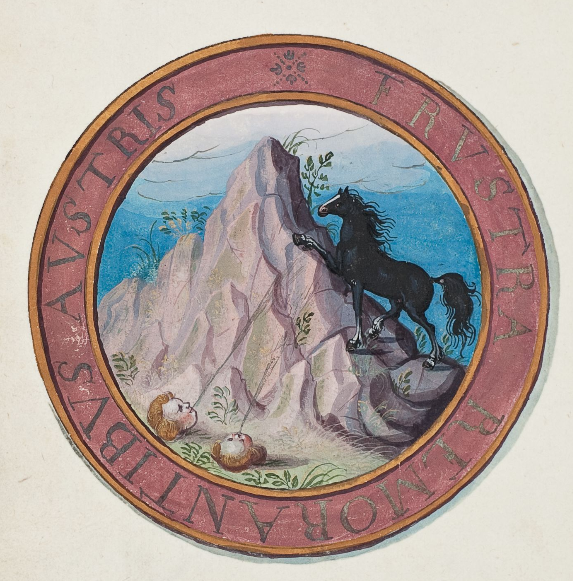
The painter seems to have been copying an image which was reversed with respect to the original (below).The adjacent page is dated 1620 which is probably the date of the miniature.
Other Camerarius emblems in other albums
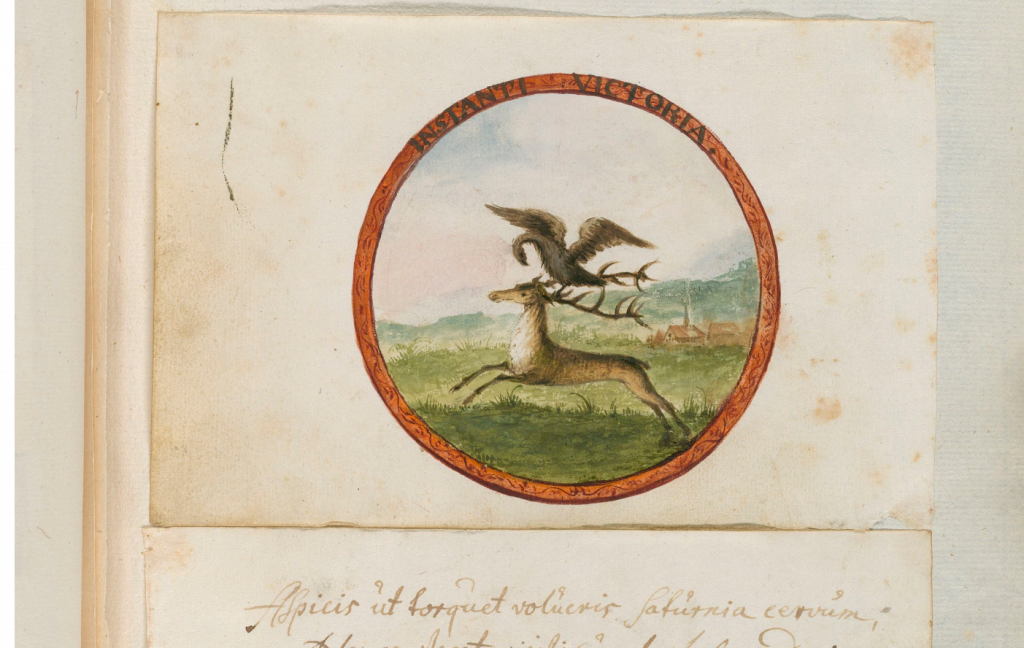
The emblem INSTANTI VICTORIA painted on a leaf in the Frommann Collection is again reversed with respect to the original in Camerarius’s third century first published in 1596 — perhaps suggesting the existence of sets of workshop copies in reverse:
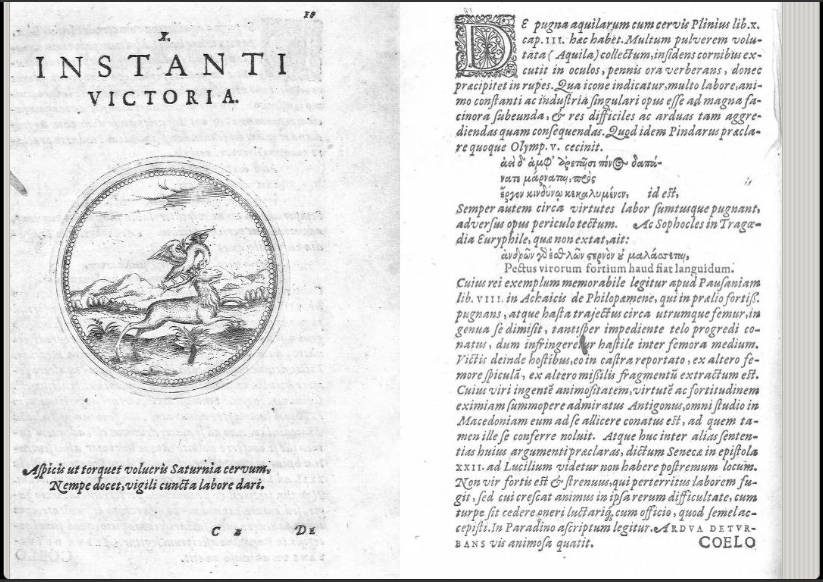
The miniature painted on an orphaned leaf recently on the art market, however, is in the same direction as its original also in Camerarius’s third century (emblem no.50)
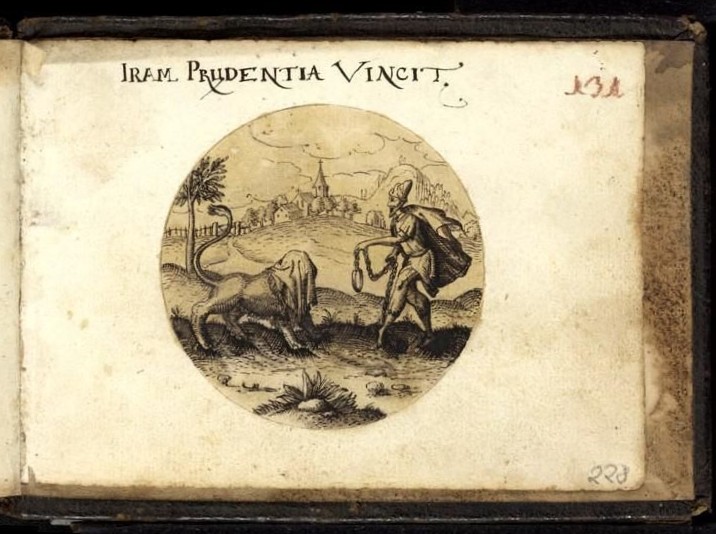
IRAM PRVDENTIA VINCIT [prudence conquers anger], the 10th emblem in Camerarius’s second century (Nurnberg 1595):
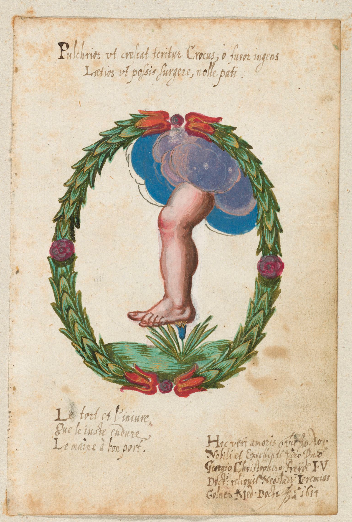
Stb 205

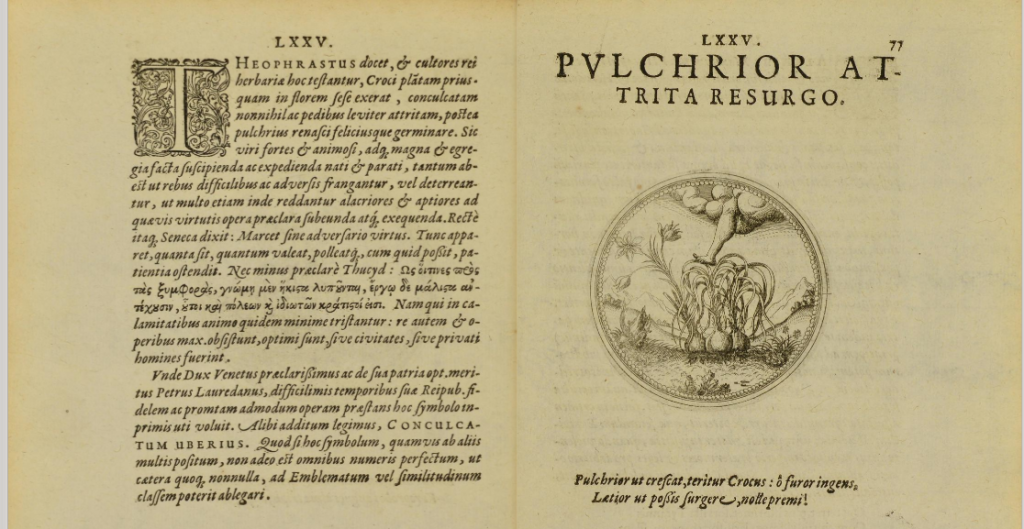
(below) This heavenly foot crushing a ?bluebell (Crocus) was painted in 1614, and the accompanying verse shows that it was based on another emblem in Camerarius’s first century, first published in 1590
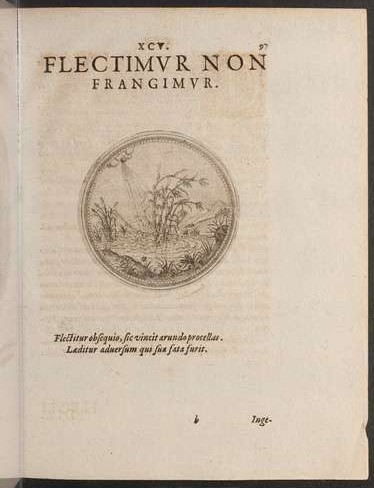
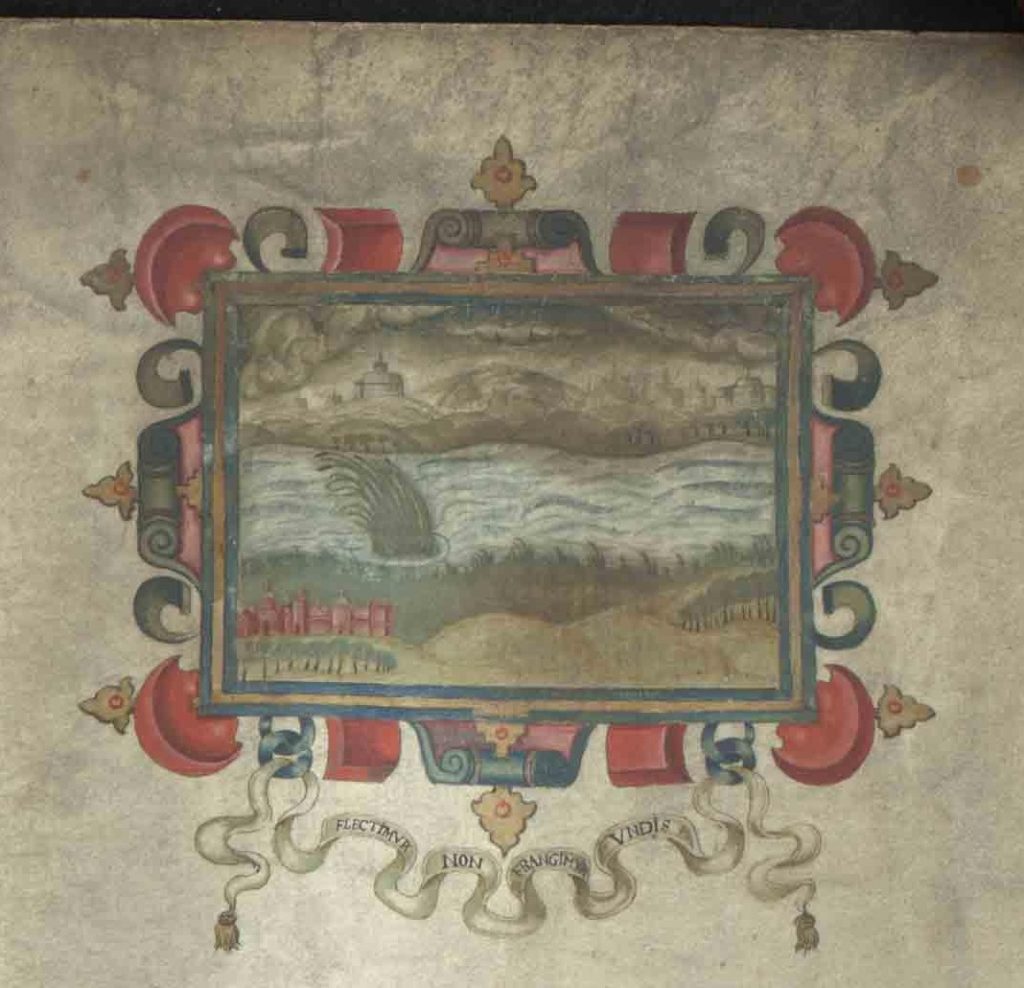
Flectimur non frangimur — we are bent, we are not broken
The (Avianus) fable of the reeds which in the tempest bend but do not break (unlike the oak tree) duly appears as an emblem accompanied by this motto in Camerarius’s 1st century published in 1590, but admittedly, the miniature painted in the album of Friedrich IV von der Pfalz three years later, is hardly a close copy of the emblem as published:

The published emblem has only one wind-head and several other plants:
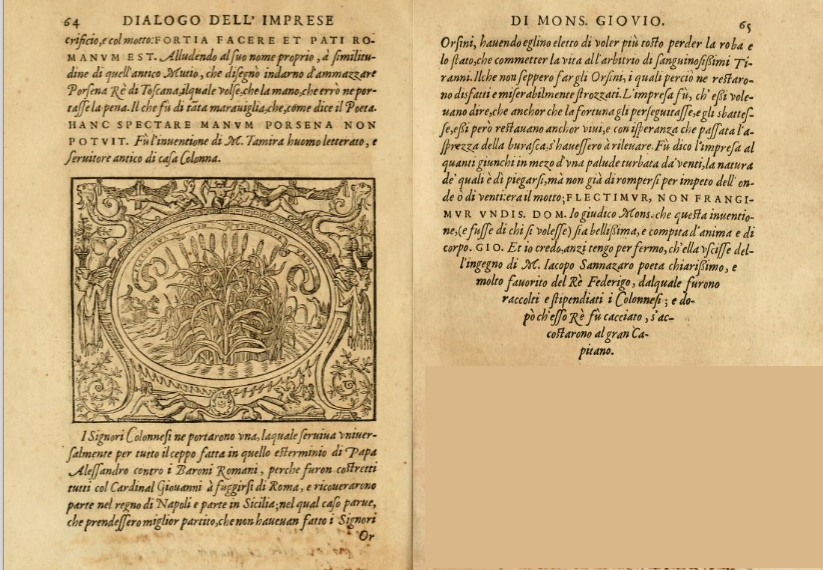
The woodcut in the first illustrated edition of Giovio’s highly important Dialogo dell’ Imprese (Lyon 1559) shows only the reeds, but expands the motto to FLECTIMVR NON FRANGIMVR VNDIS [we are bent, we are not broken by the waves] and it is given as the impresa of the Colonna family
At precisely the same date as in Friedrich’s album, Portuguese printers were using the emblem as their device:
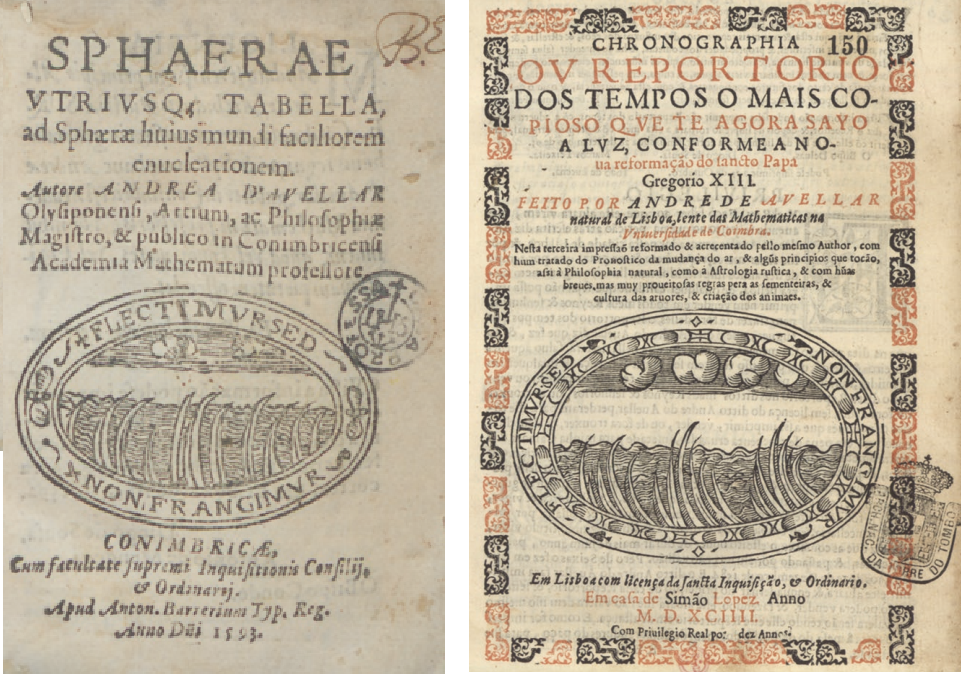
[see further, Roberto de Andrade Martins, “André do Avelar and the Teaching
of Sacrobosco’s Sphaera at the University of Coimbra” available online]
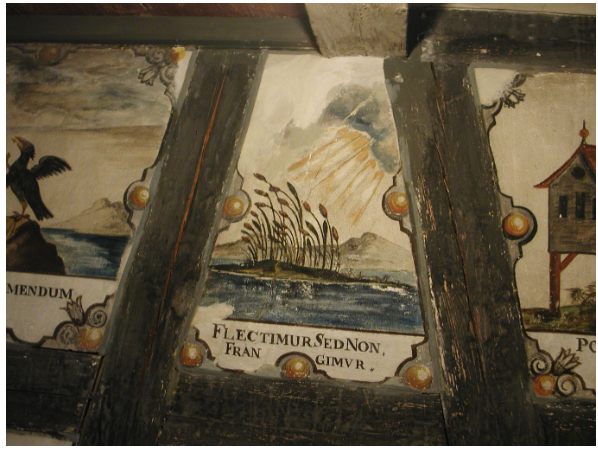
A rare English emblem of “c.1589” adorns a pedigree of the Greene family of Essex — my thanks to the Essex Record Office for making this most interesting document available online. That the emblem finishes with the word VNDIS makes it almost certain that it is independent of Camerarius, but may well imply acquaintance with Giovio’s Dialogo on the part of the English painter.
AND another of my favourite Winterthur ceramics — a late 17C Breitrandteller in the St. Gallen Museum:
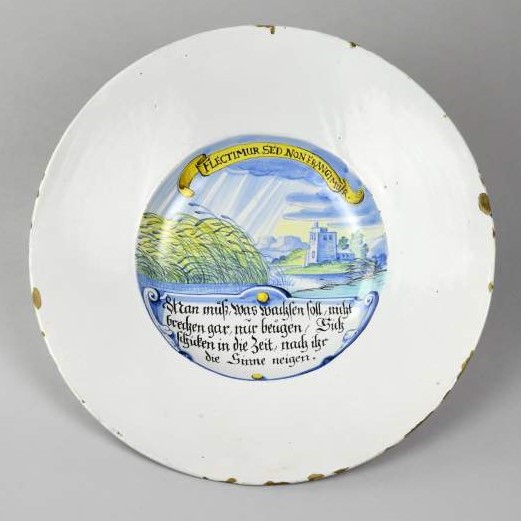
I know of two other such Winterthur plates deorated with emblems — but I have yet to identify the emblem-book from which their designs were taken — any offers, Readers?!
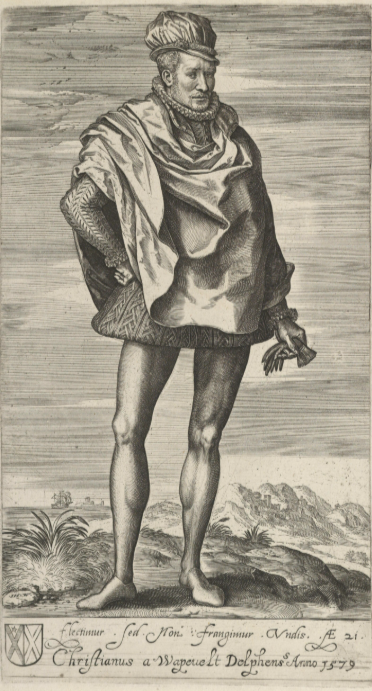
This portrait of Christiaan van Wapenfelt of Delft engraved by Johannes Wierix in 1579 shows him aged 21 standing on the shore together with his coat-of-arms and the motto flectimur sed non frangimur vndis. This might be the family motto or perhaps the young man’s personal motto, and certainly pre-Camerarius.
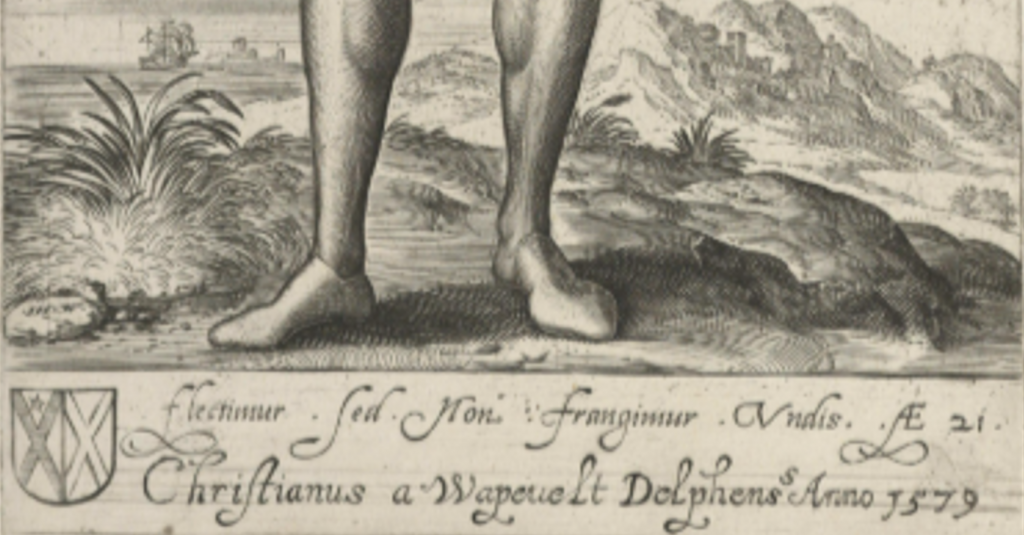
Could it be that the plant in th bottom lefthand corner of the print is the reed unbroken by the waves of the motto?


Leave a Reply