Glad to have the excuse of the Meyer album miniature, painted in Switzerland c.1640 (below), to post the Swiss painted glass panes of this (& other) motifs
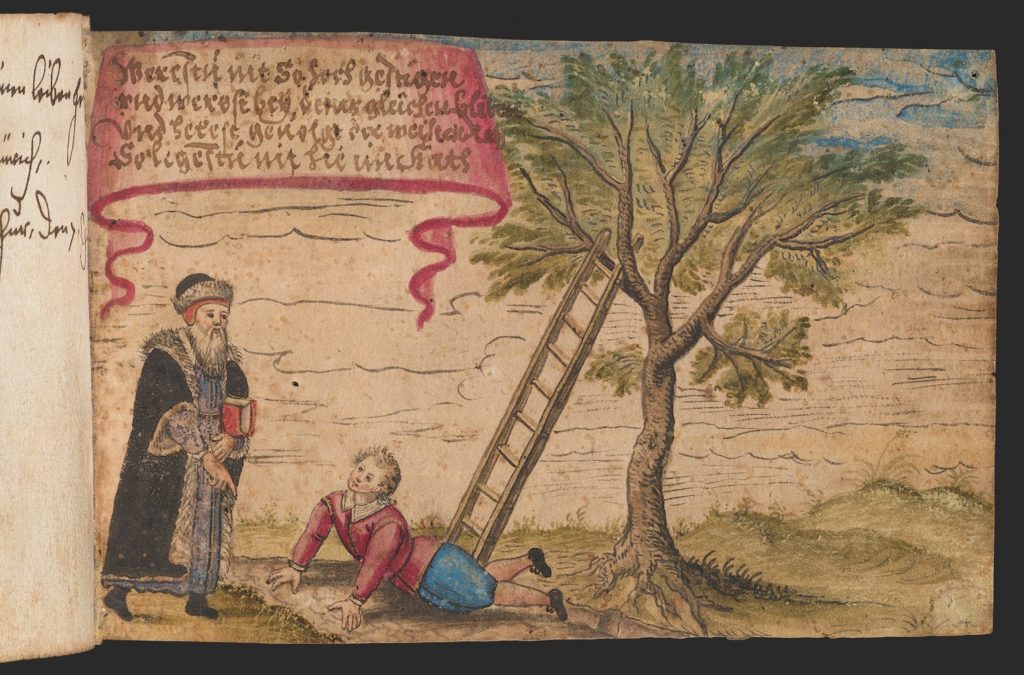
The elderly, book-under-his-arm, know-all (?teacher, scholar) says to the boy who has fallen from the ladder:
Werestu nit so hoch gestigen Vnd werest bey deinsgleichen bliben Vnd hetest geuolgt der weisten Rath So legestu nit hie im Kath
[If you hadn’t climbed so high, and had stayed with your colleagues, and had followed the wisest advice, you would not be lying here in the dirt.]
(Thanks for pointing that out, wise old man!)
This was perhaps a peculiarly Swiss Spruch, as otherwise, I know it only as painted on the 17C Swiss glass panes below.
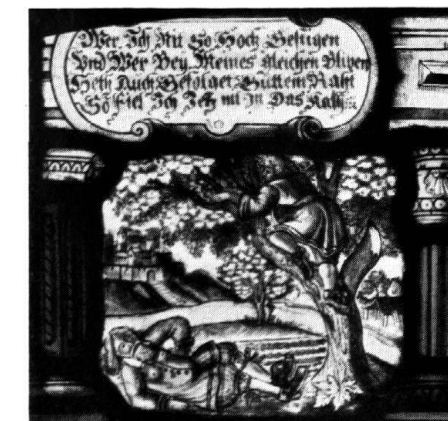
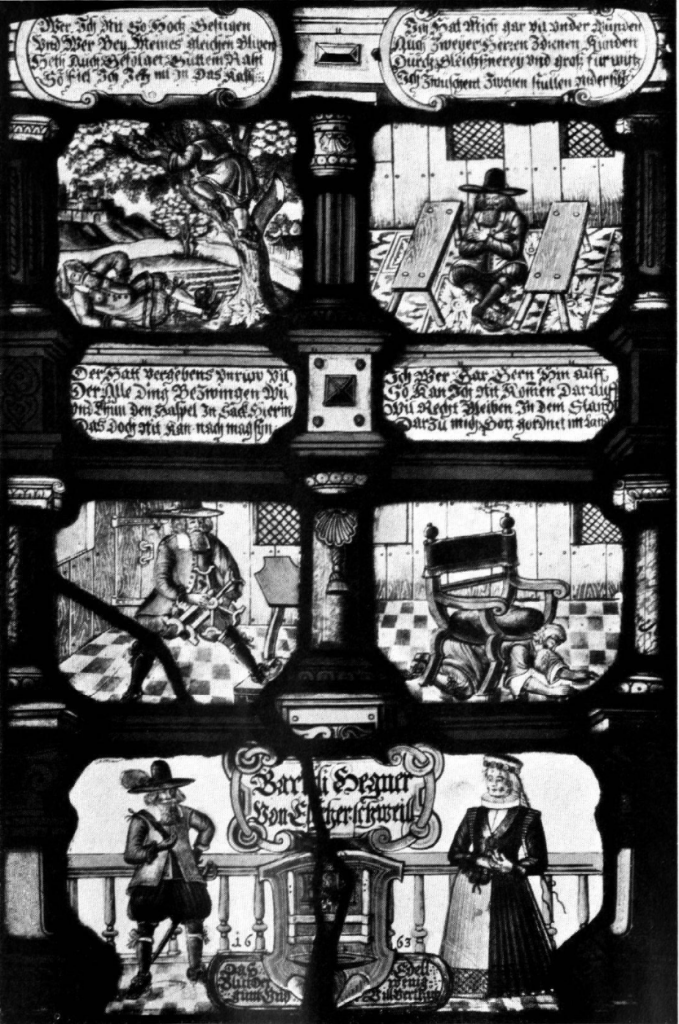
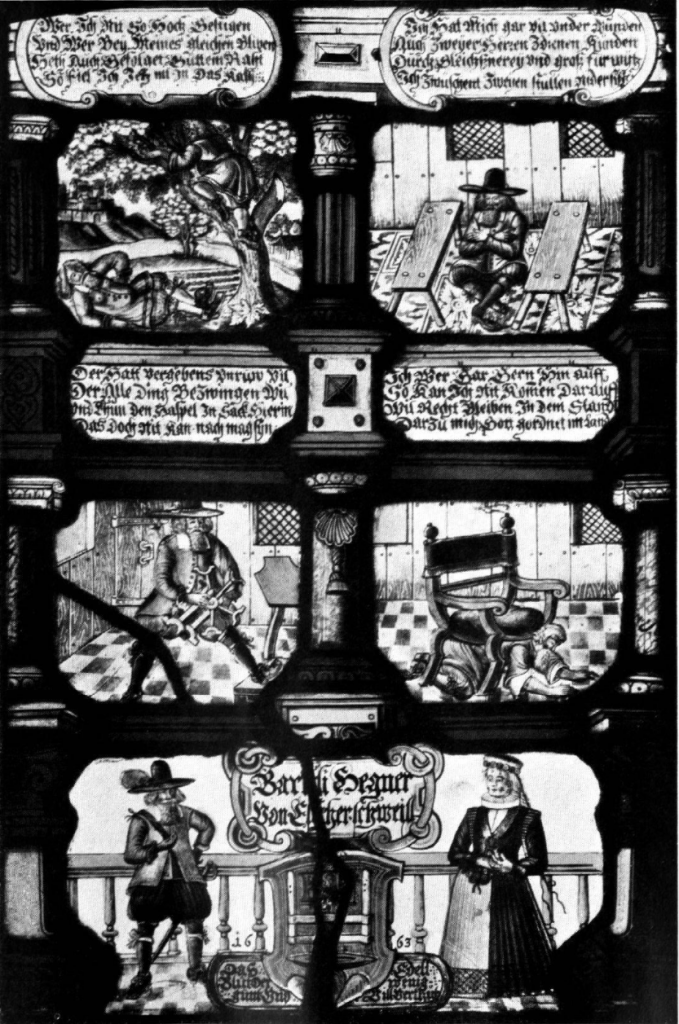
Wer Ich nit so hoch Gestigen Vnd Wer Bey Meines gleichen Bliben Heth Auch Gefolget Guttem Raht So fiel Ich Jetzt nit in Das Kath.
An undated panel — present whereabouts unknown — of this, and the accompanying Falling-Between-Two-Stools motif (just as in the 1663 pane above), was described in the 1909 auction catalogue of the Vincent collection (Konstanz), and the label to our motif transcribed thus:
Wer ich nicht also hoch gestiegen Vnd were bey meines gleichen bliben Hett auch gefolget gutem raht So fiel ich ietz nicht in das Kaath.
The same two scenes were inserted into a contemporary pane (dated 1649) painted with scenes from the story of the Prodigal Son — though no longer accompanied by the verses, they may possibly be the Vincent collection pane:
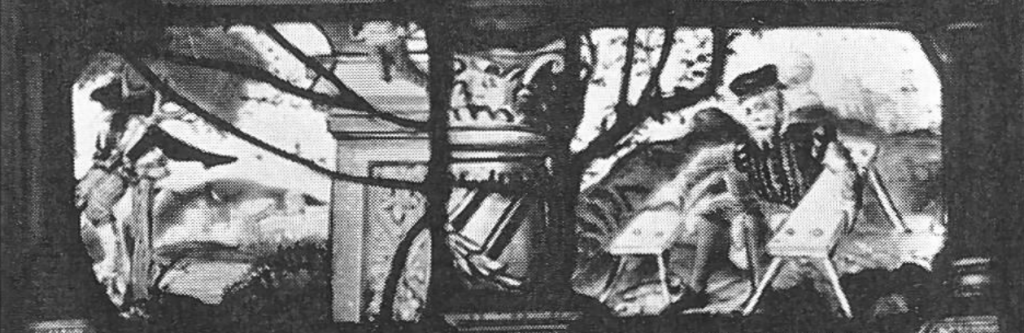
Three scenes are presented as a unified composition in a later 17C pane (below) — the lefthand banderole applying to the man standing at the base of the tree:
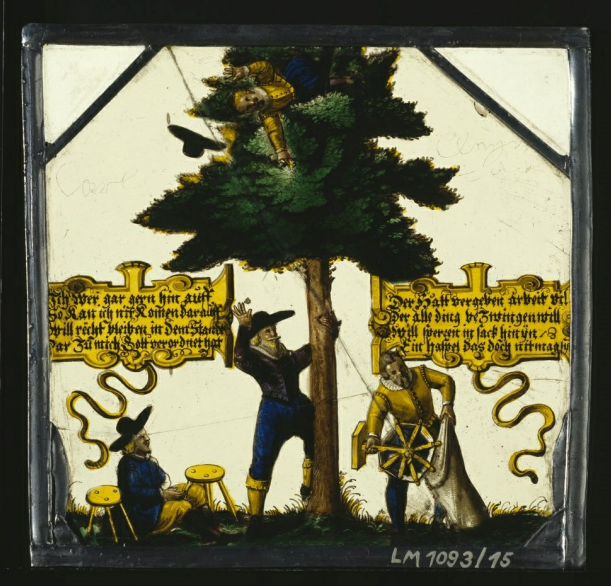
but confusingly positioned, as if spoken by the man who has Fallen Between Two Stools (who does not advertise his predicament at all):
Ich wer gar gern hin auff So kan ich nit komen darauff will recht bleiben in dem Standt Dar zu mich Gott verordnet hat.
[I would love to go up there, but I cannot, so must rightly remain in the estate ordained for me by God.]
The other man — speaker of the righthand banderole — is trying to stuff a spinning-wheel into a sack that is far too small for it, the same motif found on the 1663 pane:
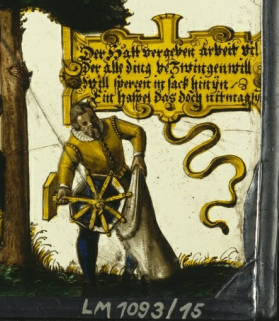
Both labelling banderoles begin with the same couplet, but reverse the lines of the second couplet (I transcribe the lefthand version):
Der hatt vergeben arbeit vil Der alle ding bezwingen will Will sperren in sack hinyn Ein haspel das doch nit mag syn
[He labours in vain who would force everything, would cram into a sack a spinning-wheel that just won’t go.]
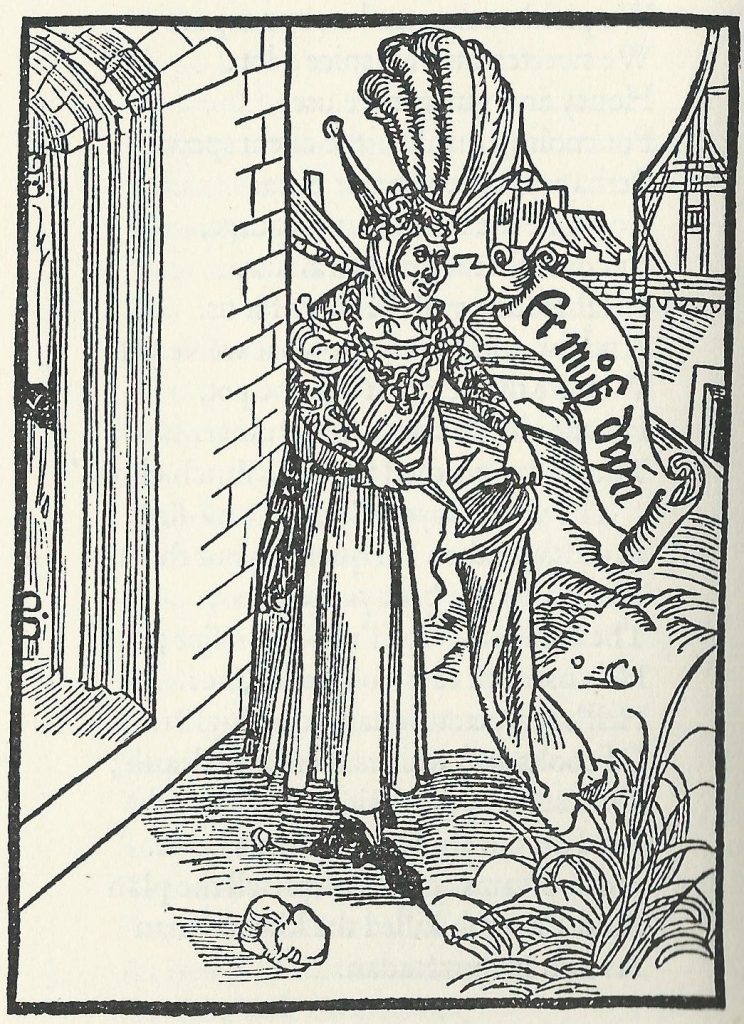
The motif derives ultimately from the woodcut illustration to Brant’s Narrenschiff — also Swiss (Basel, 1494)— showing a fool trying to force a giant caltrop into a sack, with a banderole reading, Er muß dryn [It must go in!]:
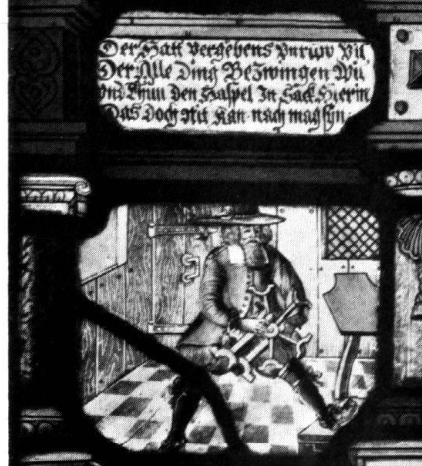
The fourth illustration on the 1663 pane repeats the verse we have noted above, spoken by the man who wishes he could climb the tree, but is here given a curious representation — an elderly man who appears to be stuck under an armchair!
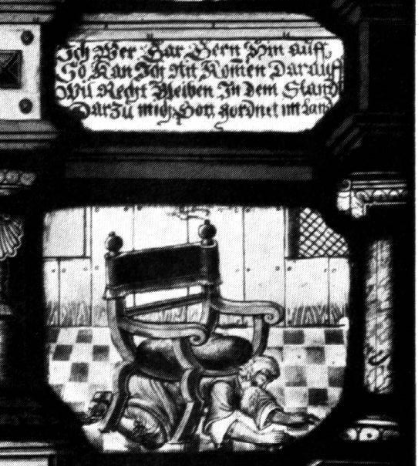
The 1663 pane (full image below) was anticipated by a similar 4-frame pane painted with the same 4 scenes and verses by Francist Fehr in 1644 (present whereabouts unknown — if indeed, still extant, as it hasn’t been seen for well over a century), recorded in 1909 [by J. Schinnerer, “Schweizer Glasgemälde in der Sammlung zu Maihingen” in Anzeiger für schweizerische Altertumskunde 11 (1909), 77-8.]
The ?lost 1644 pane also included the strange old-man-under-armchair image, the text of which was given as:
Ich were gar gern hinauff So kann ich nicht kummen drauff Will recht bliben in dem Stad Darzu mich Gott verordnet hatt
just as in the 1663 pane, and as given in the banderole of the man at the base of the tree in the late 17C pane in the Schweizerisches National Museum reproduced above.
Leave a Reply