Except that the participants/actors are of different sexes, iconographically, there is no difference between the emblem of a lovers’ union, and that of two male friends, this latter often symbolising Amicitia.
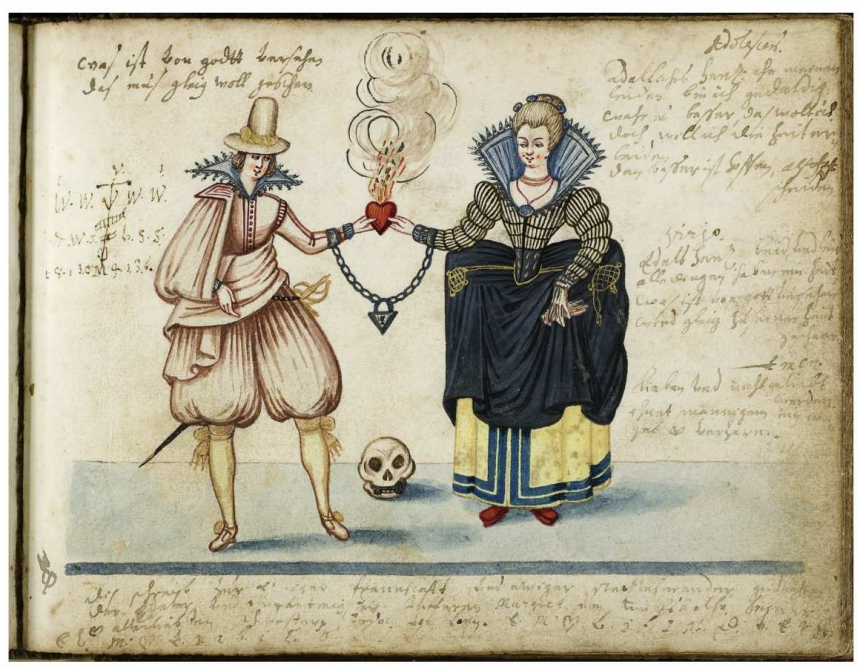
We begin with an image of the two lovers holding a flaming heart between them with chains hanging from their wrists united by a padlock — a skeletal Death is trying to fit his key into the lock.
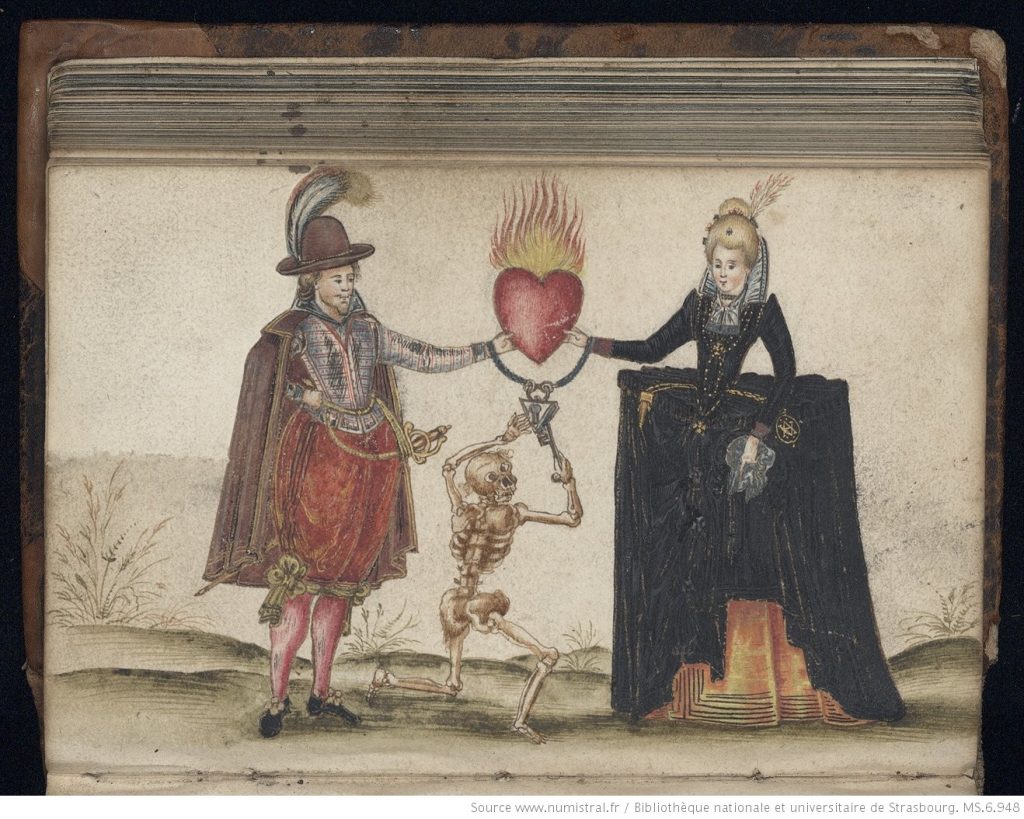
Similar examples can be seen in the contemporary albums of Amstel van Mijnden
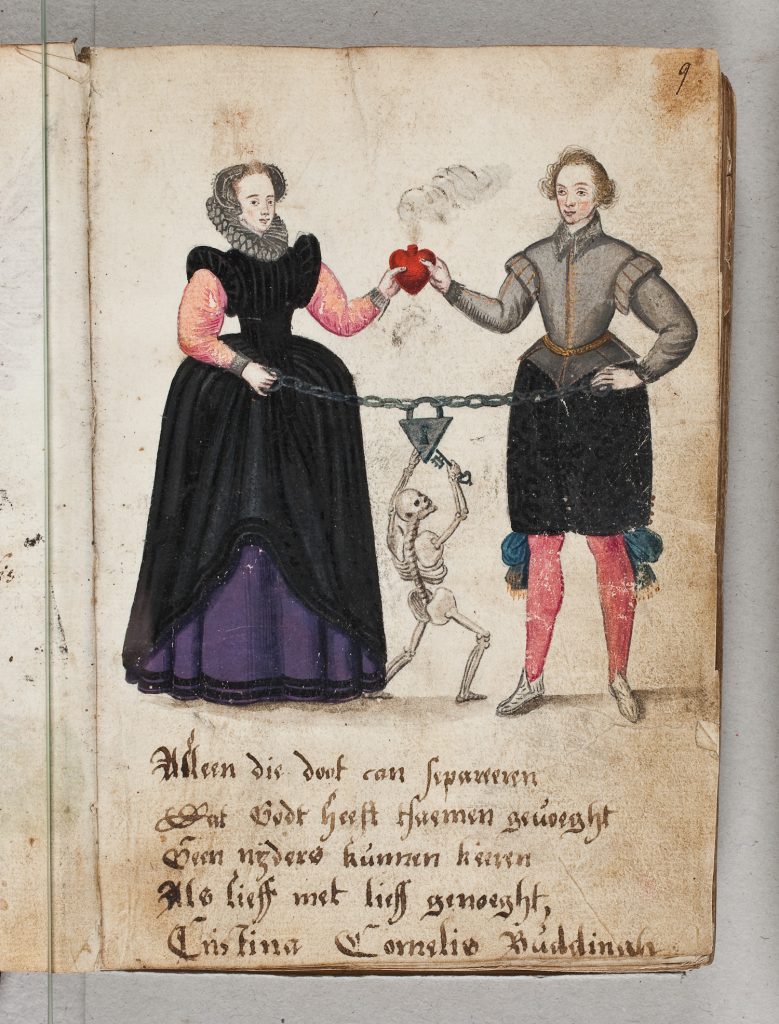
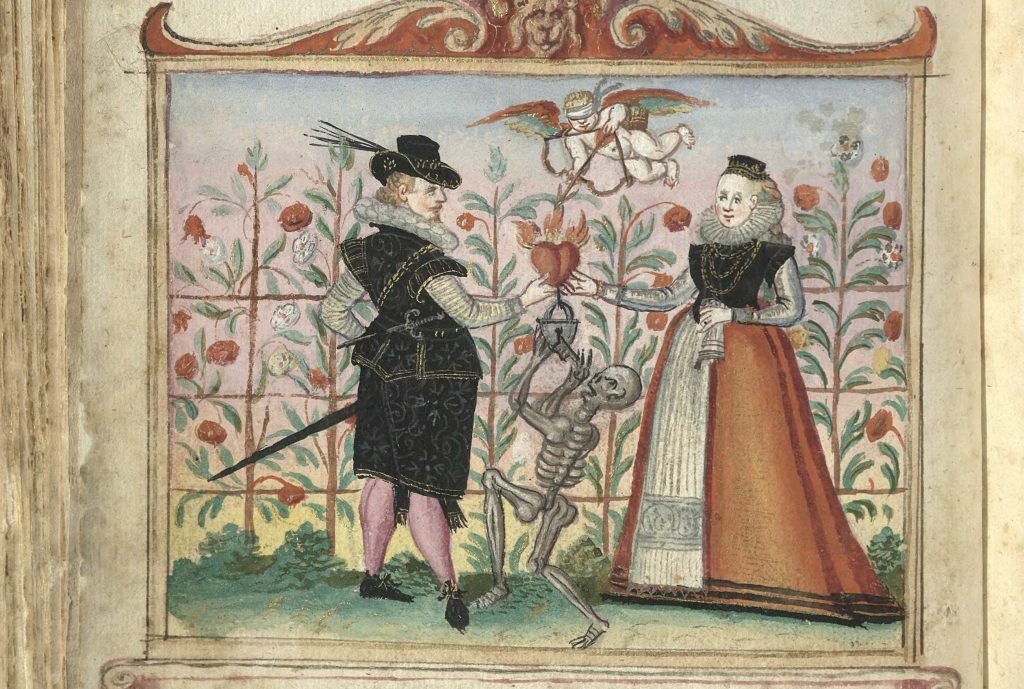
and Michael von Heidenreich (though here with no chains but added Cupid!) :
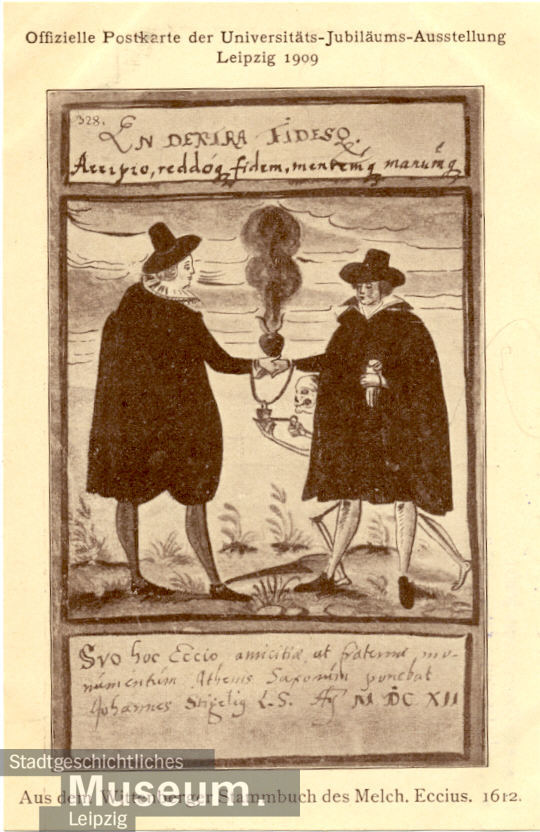
An image of friendship in the lost Eck album, painted in 1612, identical to that in the Flachsland album, showed the two friends united by chains from their wrists joined by a padlock into which the usual skeletal Death sees to insert his key. The image is curiously preserved in a postcard issued as part of Leipzig University’s jubilee in 1909!
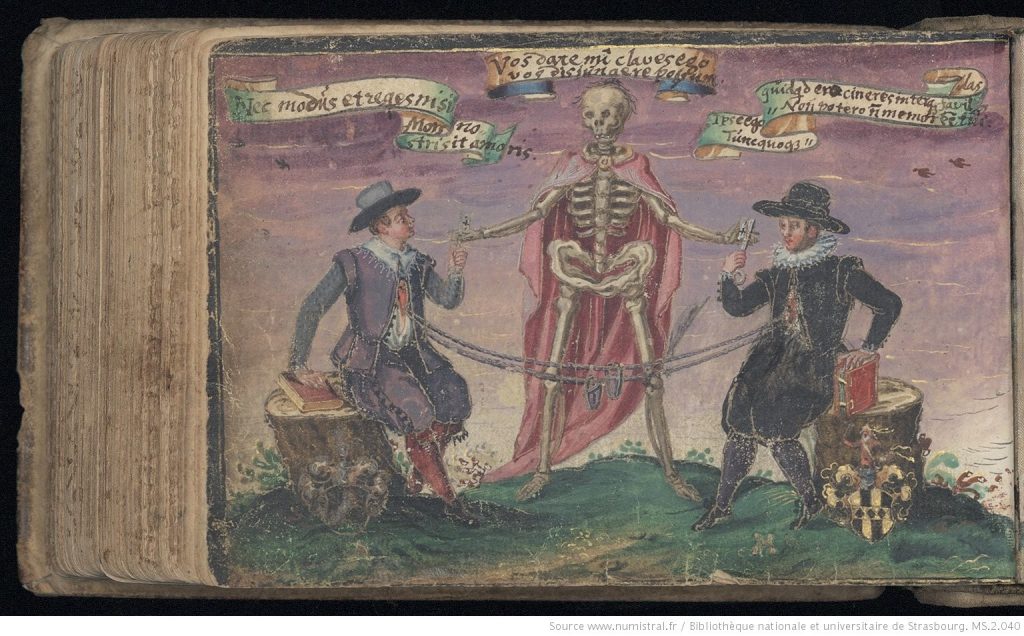
A similar image of friendship in the Soetzinger album shows the two friends united by chains from their hearts joined by padlocks, but the usual skeletal Death makes to seize their keys. This is also one of the most elaborate images textually, with the speeches of both friends taken from Classical sources. In a slight adaptation of Ovid, Metamorphoses 10, 377, the man on the left says, Nec modus et requies nisi/ Mors nostri sit amoris [Let there be no end nor rest to our love unless death], and his companion, Ipse ego quidquid ero cineres interque favillas/ Tunc quoque non potero non memor esse tui [I myself whatever I am will be ashes and cinders/ Then too I will not be able to remember], quoting from the second elegy on Maecenas, part of the so-called Appendix Vergiliana. Death, however, does not need to draw on the Classics, he writes his own script: Vos date mi[hi] claves ego vos disiungere possum [Give me the keys — (only) I can separate you].
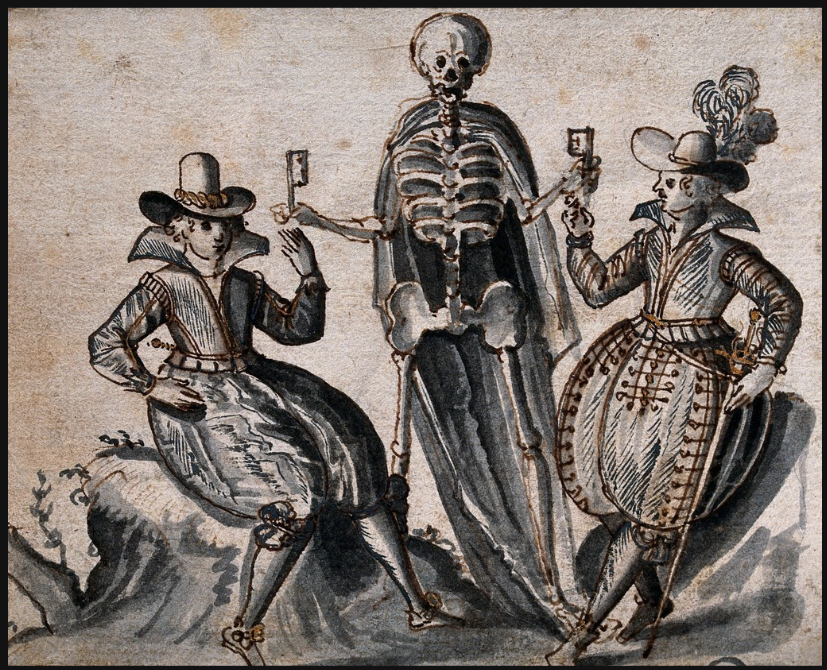
This leaf in the Wellcome collection looks as if it is an album painting and related to the above — Death seizes the keys, but there are no chains to unlock! Is it perhaps unfinished?
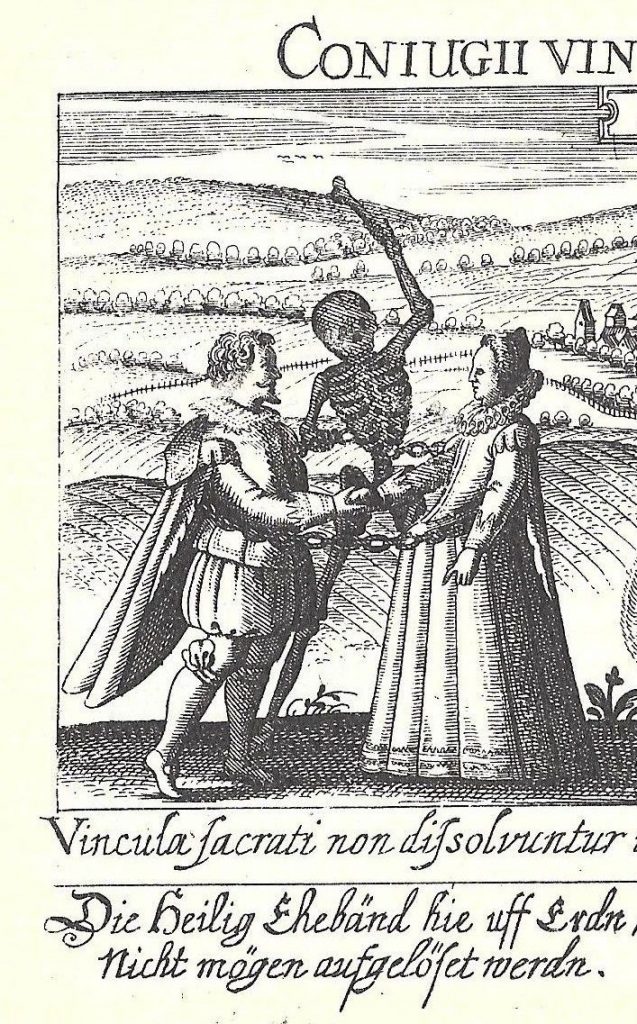
This motif enters the print repertoire too, of course — in this detail from a view of Čáslav in Bohemia engraved for one of the volumes of Daniel Meisner’s Thesaurus Philo-politicus published in 1623. Entitled CONIUGII VINCULUM [the chain of marriage], here, a simplified version of our motif shows the married couple joined by a single belt-like chain, and Death about to strike it with a bone. The half of the German caption visible reads, ‘The holy bond of matrimony cannot be dissolved here on earth’ and continues, ‘but Death can dissolve it without any effort’.
A simplified version of the motif can be seen in the von Brewer Familienbuch in which the skeleton Death with his key has been replaced by a mere skull between the couple.
It bears a close resemblance to one of the somewhat crude etched plates from an unknown print-book preserved in the Herzog August Bibliothek in Wolfenbüttel :
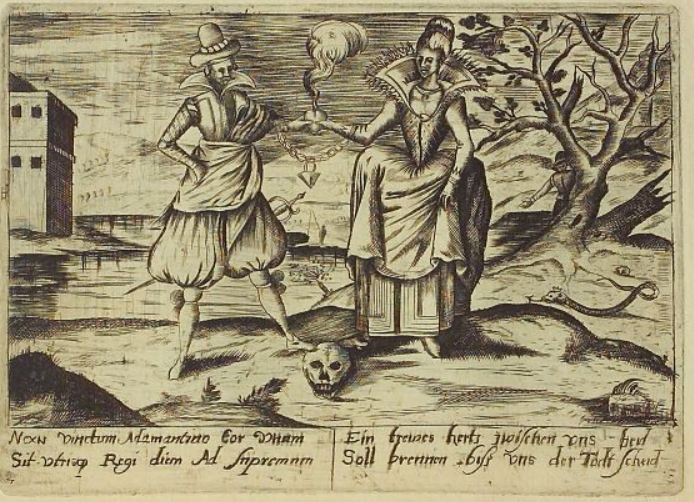
Similarly, the Amicitia emblems also exist in a simplified form in which the skull substitutes for the whole skeleton of Death.
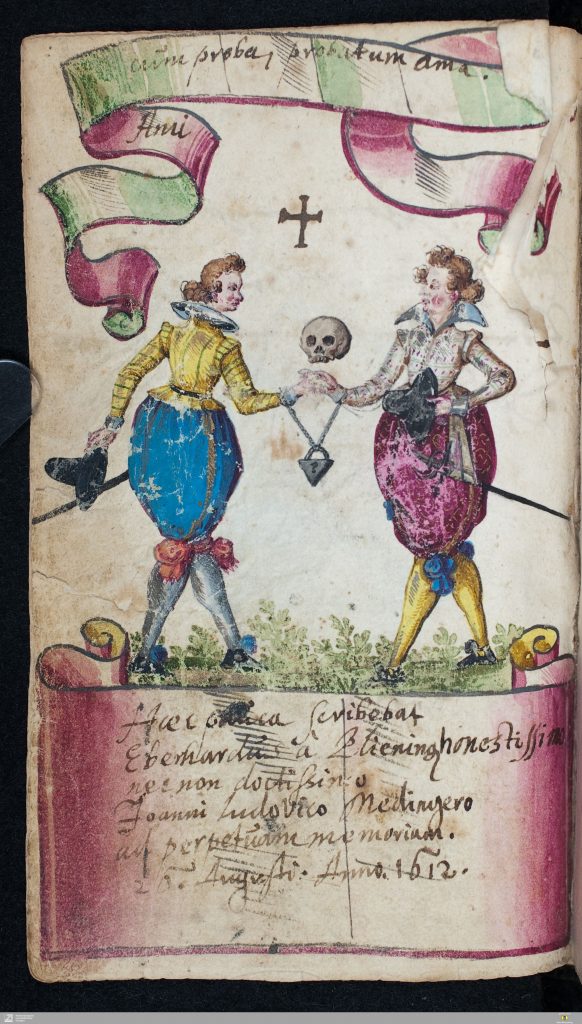
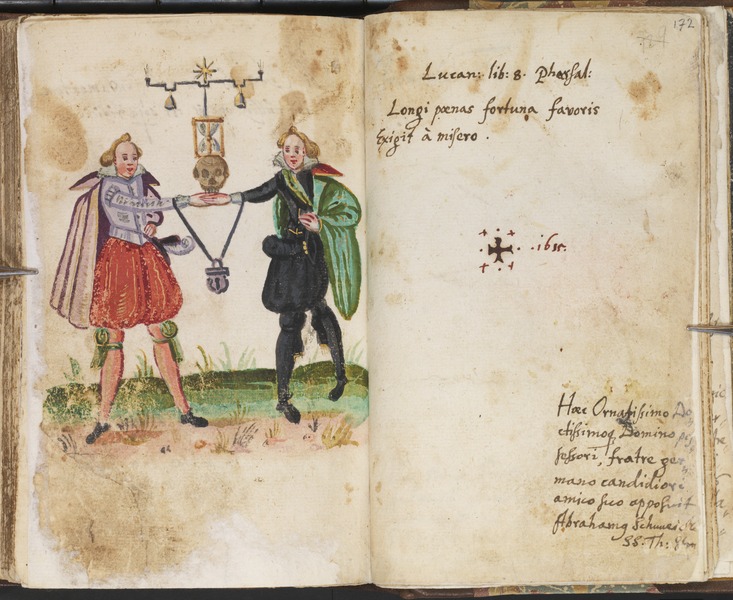
Now with added Lion!
A curious image in the Albert album, painted at some point in the 1620s, shows the couple joined by a chain padlocked round their waists, each with one hand holding a heart between them, and seemingly embraced by a lion. But climbing up towards them (from a hell-mouth(?) — resembling a railway-tunnel) — is a skeletal Death with scythe and hour-glass (on his head — can’t see him being allowed into the royal enclosure at Ascot wearing that hat).
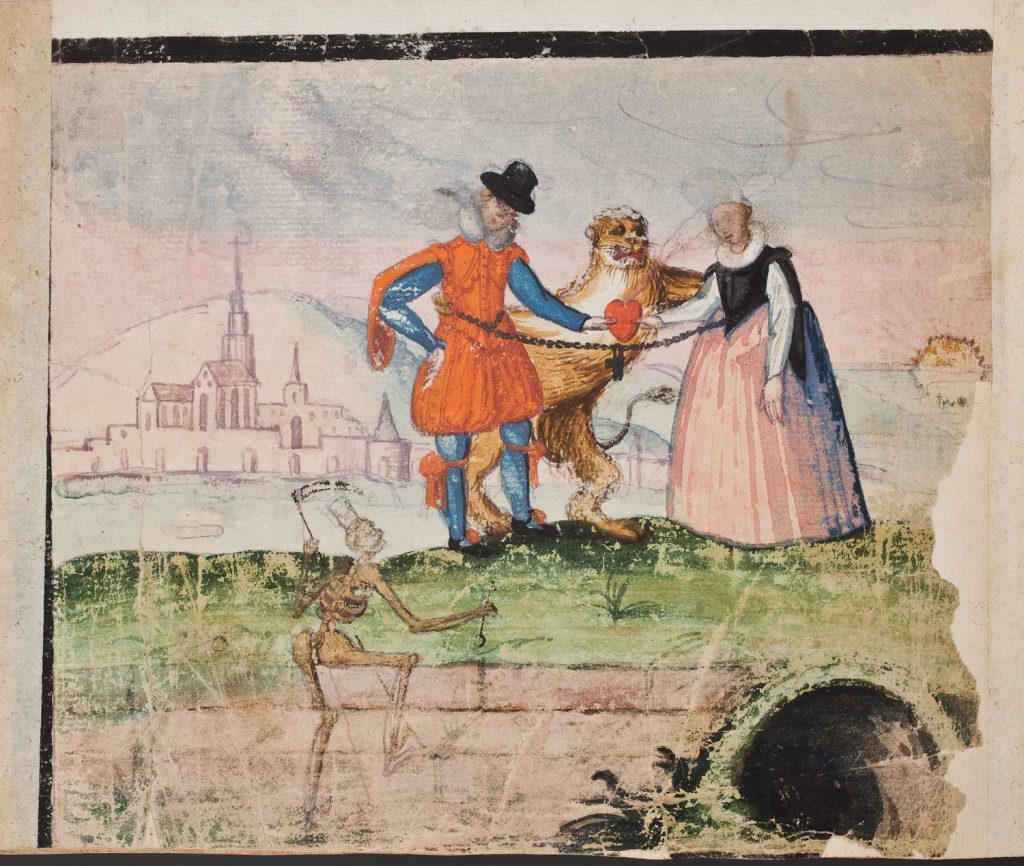
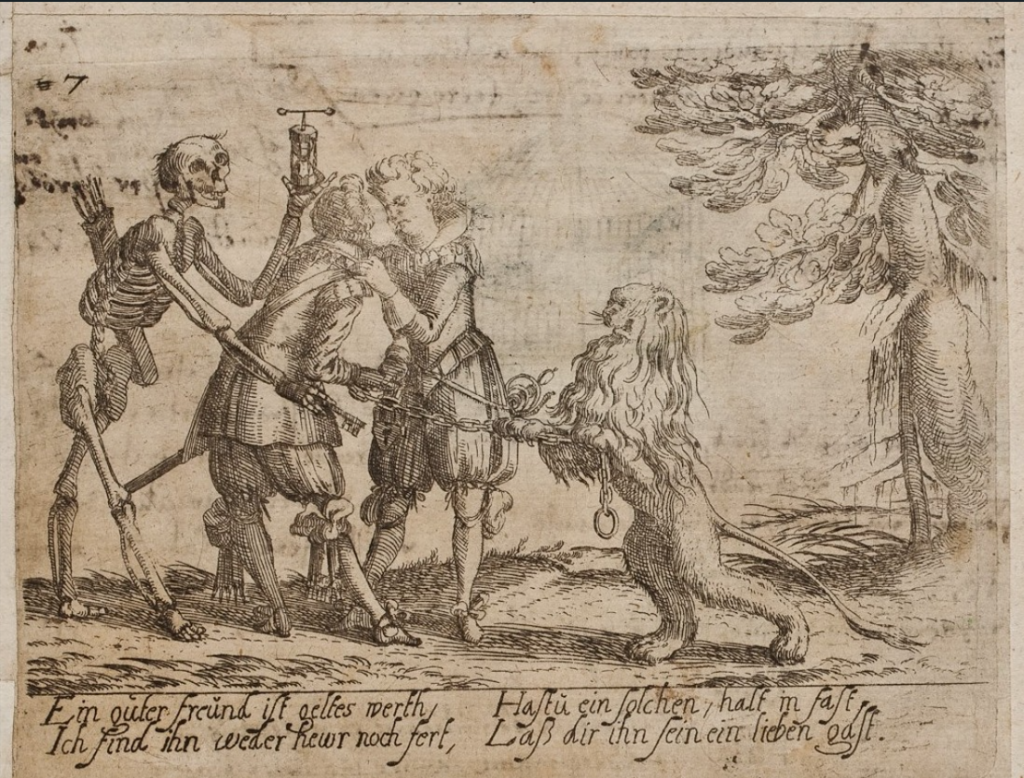
Again there is a relationship to an etched emblem of Amicitia which was pasted into the album of Burckhard Großmann and features the same cast: the hands of the two friends are clasped and their wrists chained together with a padlock; a lion pulls on the chain while a skeletal Death sneaks up behind the pair holding an hourglass aloft in his left hand, and a key in his right hand, close to the padlock. The captioning verses below are from the Trostspiegel (recent editions, 1604, 1620, etc.) and the print is numbered 7 in the plate, suggesting it is part of a series.
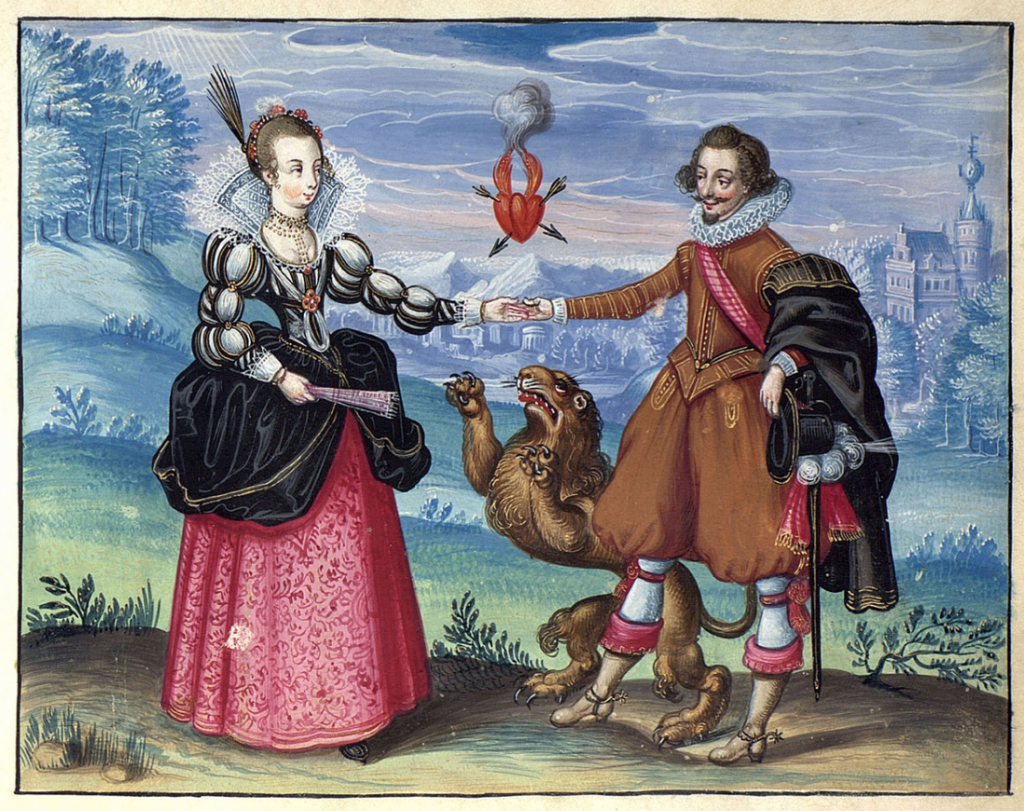
Here is a contemporary loving couple with a flaming heart pierced by arrows above their joined hands — and an evidently ferocious lion, whose presence leaves them strangely unmoved — such is the intoxication of love! The manuscript is not an album, but a chansonnier produced in Mons in 1620 entitled, Recueil des plus beaux airs de ce temps.
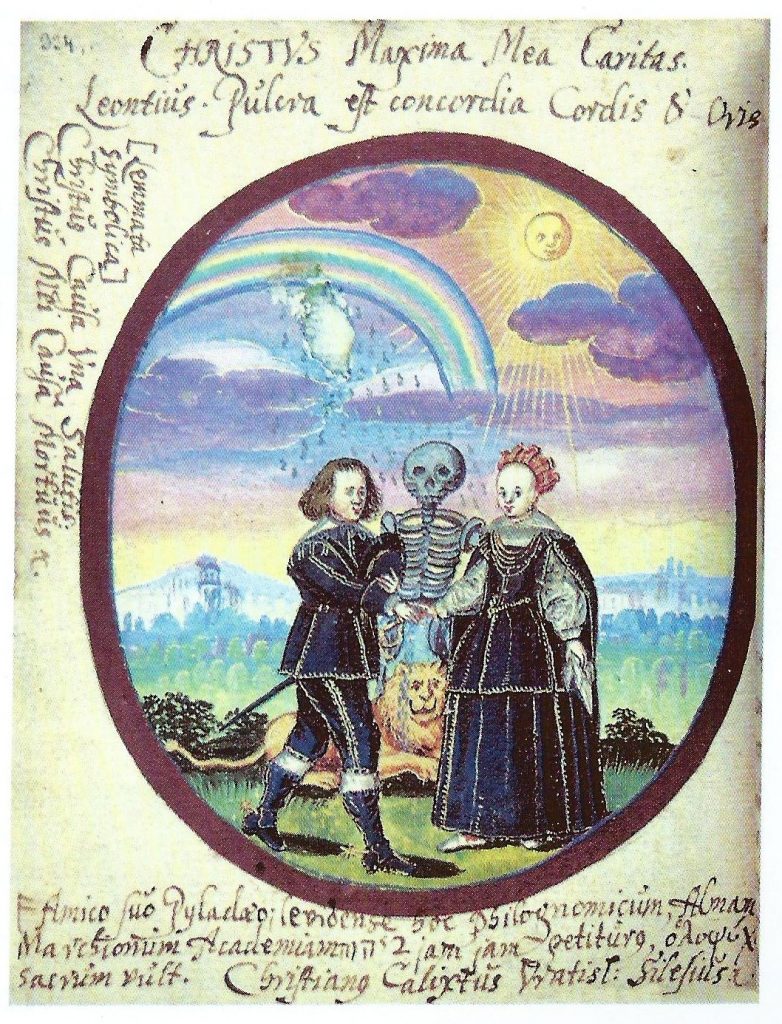
The album of Esaias Maior contains the added lion version of both types of motif. First, the young couple posing for their selfie with Death and a decidedly friendly lion — the whole happy (?) scene irradiated by a rainbow!
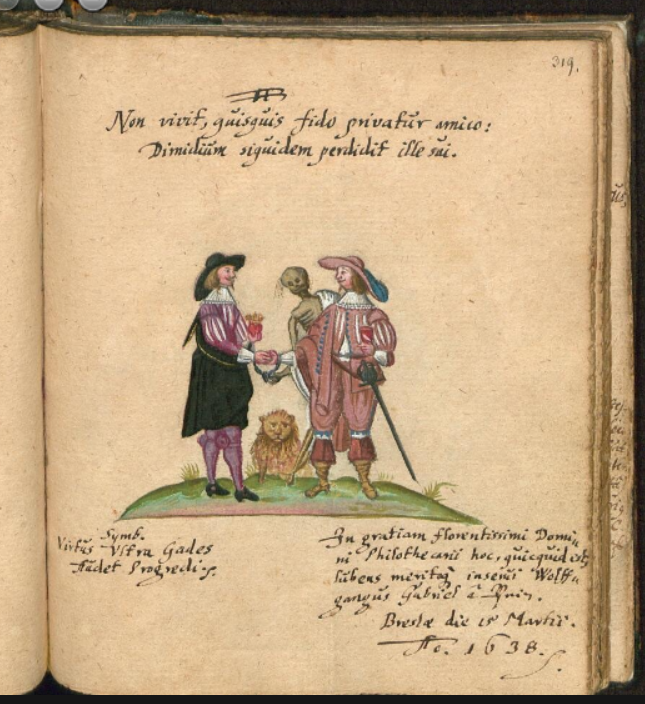
Now, the chaps — with Death looking cheekily over the shoulder of the man in pink, and appearing to fiddle with the padlock on the chain; the lion looking as if he’d rather be somewhere else.
Atypical scenes of lovers & Death
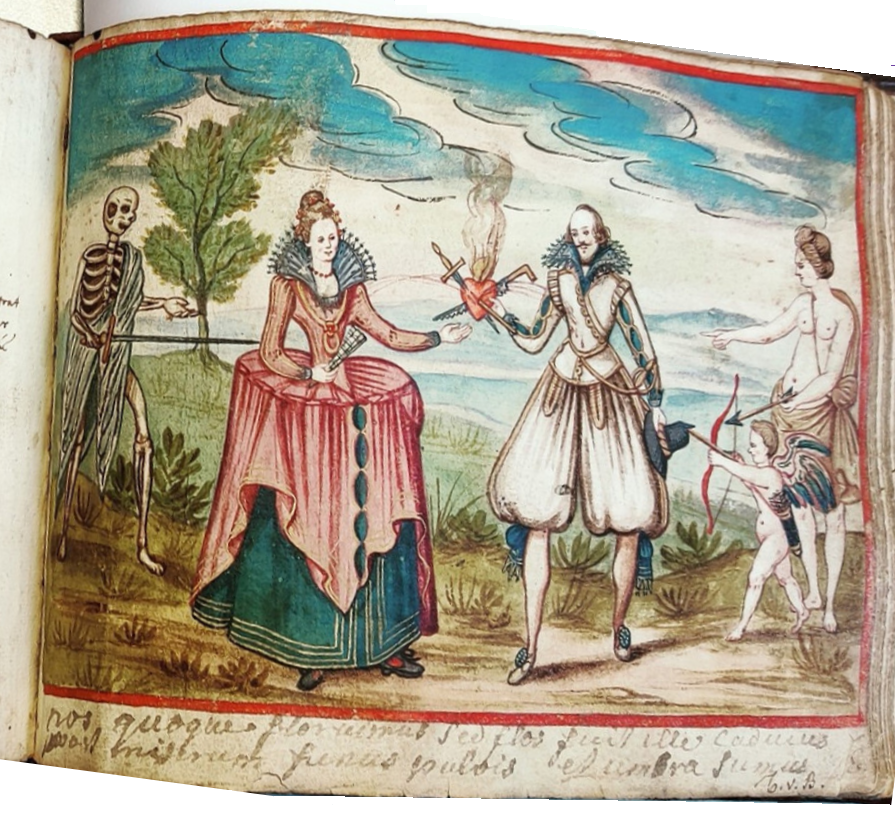
Here the lovers hold — well, almost! — a flaming heart pierced by a dagger, knife and arrow. Death in his shroud points a sword at the impossibly narrow waist of the woman, while Cupid aims another arrow at the heart, and Venus points at it. The captioning Latin quotations are from Ovid (Tristia VIII. 19) and Horace (Odes IV.7. 16).
In this strangely elegant painted leaf in the Bayerisches National Museum, Death is in the act of severing the lovers’s conjoined hearts with his shovel
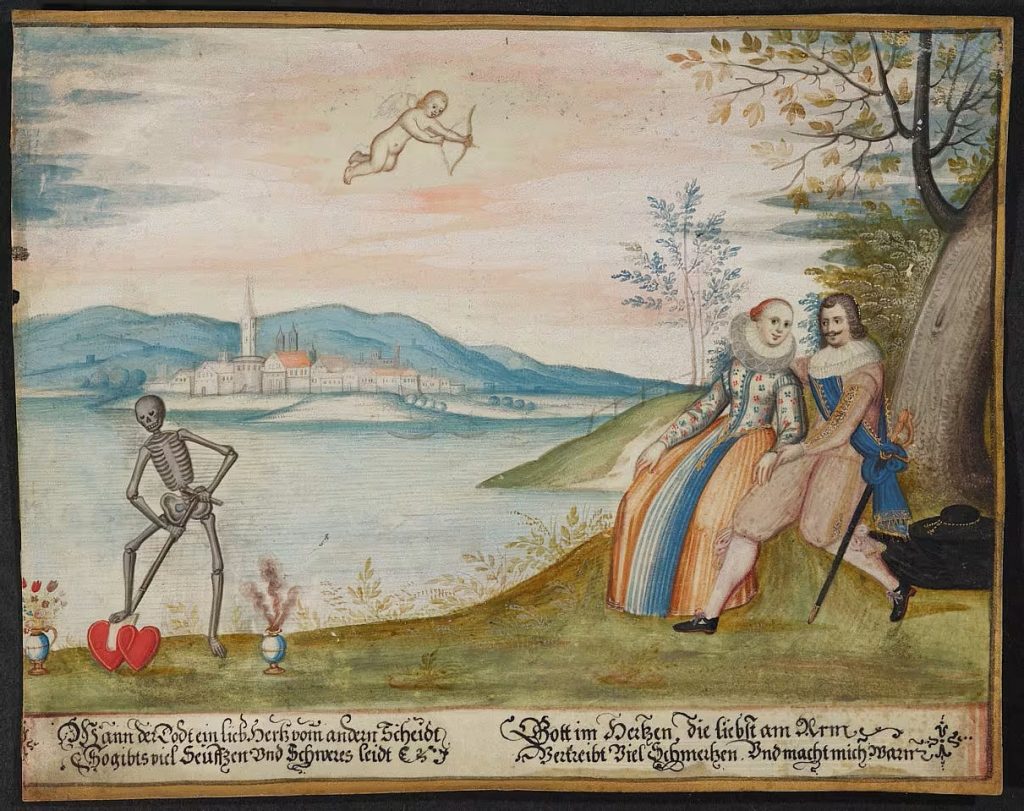
The verse caption reads:
Wann der Todt ein lieb Hertz vom andern Scheidt When Death separates one loving heart from the other
So gibts viel Seuffzen Vnd Schweres leidt there is much sighing and heavy suffering.
Gott im Hertzen, die liebst am Arm God in my heart, my love on my arm
Vertreibt Viel Schmertzen. Vnd macht mich warm drives away much pain, and keeps me warm.
Leave a Reply