Here I consider various types of visual tricks and puzzles found in the albums.
Riddles? Well, riddle — singular — really! But it’s an interesting one… Painted into the album of Georg Bernhard in 1574. The page in question is sadly rubbed, but the details are nevertheless recoverable.
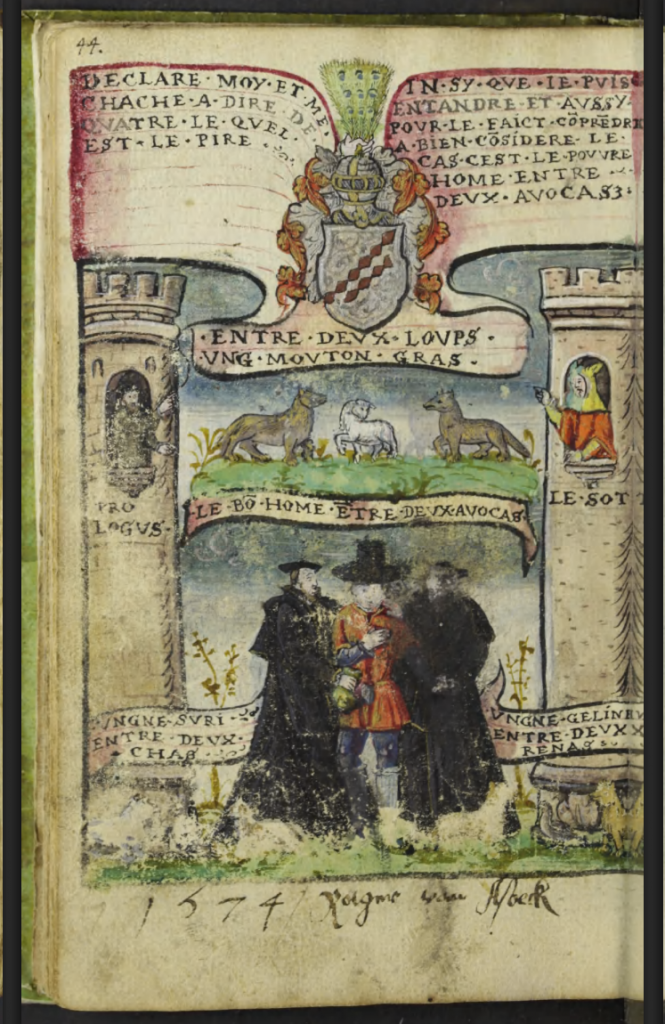
We see a man between two black-clad figures (identified as avocas in the text), above which is a sheep between two wolves — already we sense a parallel ! — they are flanked on either side by two figures leaning out of towers, one of which is costumed as a fool. At the base of the towers are two further scenes which would be unidentifiable, were it not for the labels above, which inform us they are a mouse between two cats, and a chicken between two foxes. The inscriptions are in French, and the figure in the lefthand tower, labelled Prologus, opens:
Declare moy et me chache a dire Declare to me and seek to tell me
De qvatre le qvel est le pire of these four which is the worst
It is the Fool, labelled Le Sot, in the righthand tower who solves the riddle:
In sy qve ie pvis entandre As far as I can see
Et avssy povr le faict co[m]pre[n]dre and, in fact, understand it,
A bien co[n]sidere le cas having well considered the case,
Cest le povvre home entre devx avocas it’s the poor man between two lawyers.
So, in essence this is a satirical attack on the rapacity of lawyers, fighting over and trapping their gullible clients! Interestingly, it achieved pictorialisation both earlier and later than our album painting. In a remarkable and important late 15C Hours of Rouen Use — its bas-de-page teeming with illustrated proverbs,* we see the chicken caught between the two foxes
[* I reproduce and translate many of its illustrated proverbs here: https://uk.pinterest.com/malcmjones/proverbs-pictorialised-bnf-nal-3134-late-15c-illum/ ]
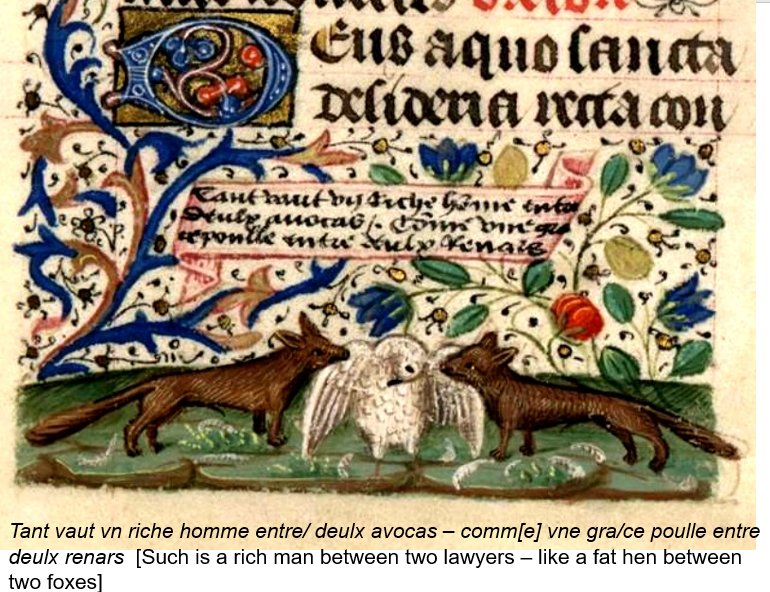
and its unhappy situation compared to that of the man between two lawyers in the accompanying text.
But there is evidence that this riddle enjoyed some popularity in Britain. Unillustrated texts of the riddle are found in Scottish sources contemporary with the Bernhard album miniature; one in the famous Bannatyne manuscript of 1568, the other in a manuscript jotting datable to 1581 made in a Scots Register of Signatures. Remarkably, a single impression of a woodcut-illustrated print of our riddle survives from Jacobean England:
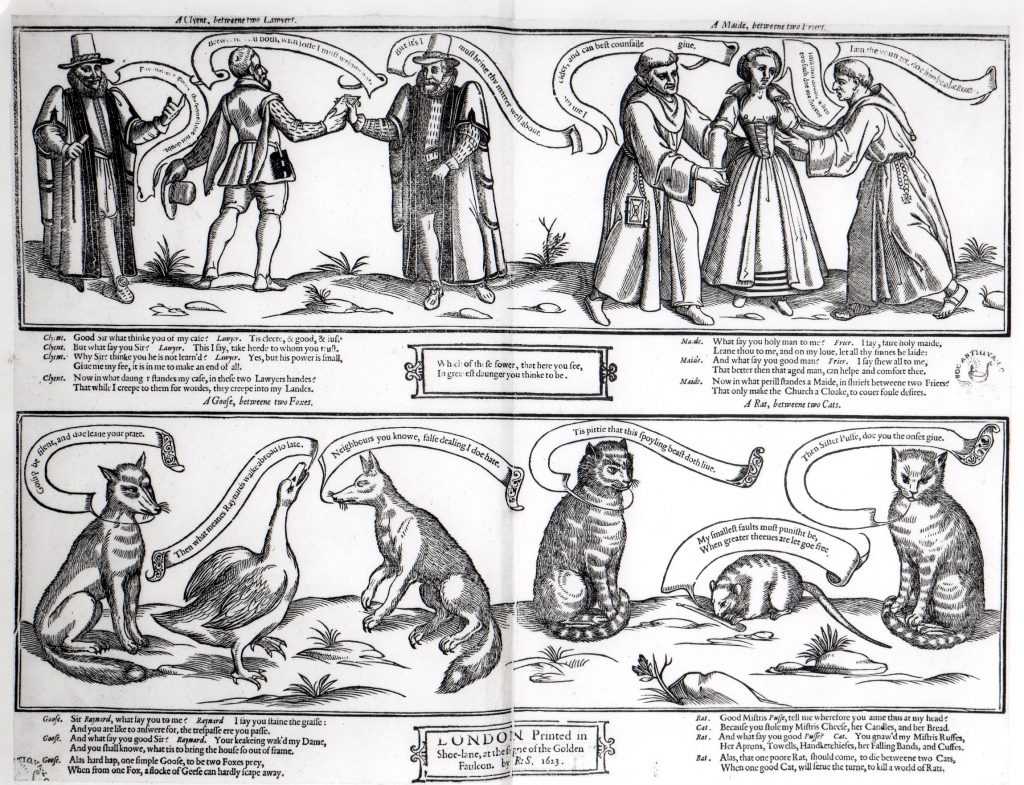
This woodcut sheet entitled, Which of these fower, that here you see, In greatest daunger you thinke to be, was printed by Richard Shorleyeker in London in 1623, and similarly portrays four animal and human encounters of a literally or metaphorically predatory nature – a goose between two foxes, a rat between two cats, a client between two lawyers, and a Maide, betweene two Friers — this last unwelcome encounter replacing our album’s sheep between two wolves — though clearly equivalent!
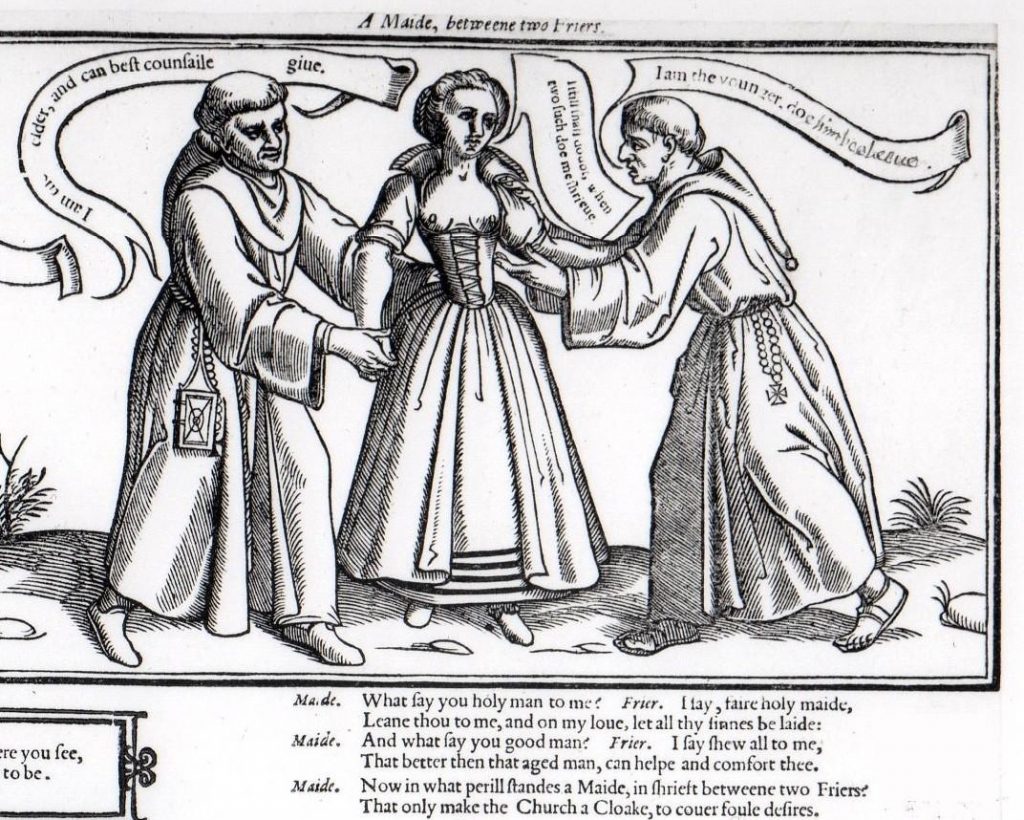
The older friar takes one of the maid’s hands in his and has his other hand on her waist, saying, I am the elder, and can best counsaile giue, to which the other man responds, I am the younger doe [not] him beeleeue, while the maid can only protest, I still shall doubt, when two such doe me shrieue [shrive/confess me]. I have to say, however, that I wonder whether she is quite as modest as she might be, for both her breasts are bare above her bodice, the nipples plainly visible – but, of course, she has been molested by the younger friar whose hand appears to touch her bodice and, indeed, she seems to be pushing him away. (There is no doubt that his shew all to me is a pun, meaning ostensibly ‘confess all to me’, but also, of course, ‘show me yourself entirely naked’. Perhaps there are shades of Cornelius of Dort here?). But we must not forget that this is, after all, a riddle, and I suspect that the loyal Protestant Englishman’s answer to the question, which of the four is in greatest danger ? would be, “The Maid!”
Constructs
By construct, I intend images which are assembled from parts in an obvious manner, such as the bi-partite human figures which I term bifids — and which have their own post here:
https://albumamicorumear-e4qvahs764.live-website.com/bifids-bi-partite-figures/
and the 3 hares with conjoined heads motif (‘hare trinities’) appear as a section within the post
https://albumamicorumear-e4qvahs764.live-website.com/the-additional-fool-that-would-be-you/
The Jenisch album must surely contain the greatest variety of image-types of all surviving albums — all the more unfortunate, then, that it has been disasembled and re-assembled more than once! So, unless the individual page is dated, we are left with an unusually wide date-bracket — 1575-1647 — and, in some cases, not even stylistic dating (always somewhat subjective, in any case) can help narrow down the date of a given image. Such is the case with this miniature of three stags which share a common head:
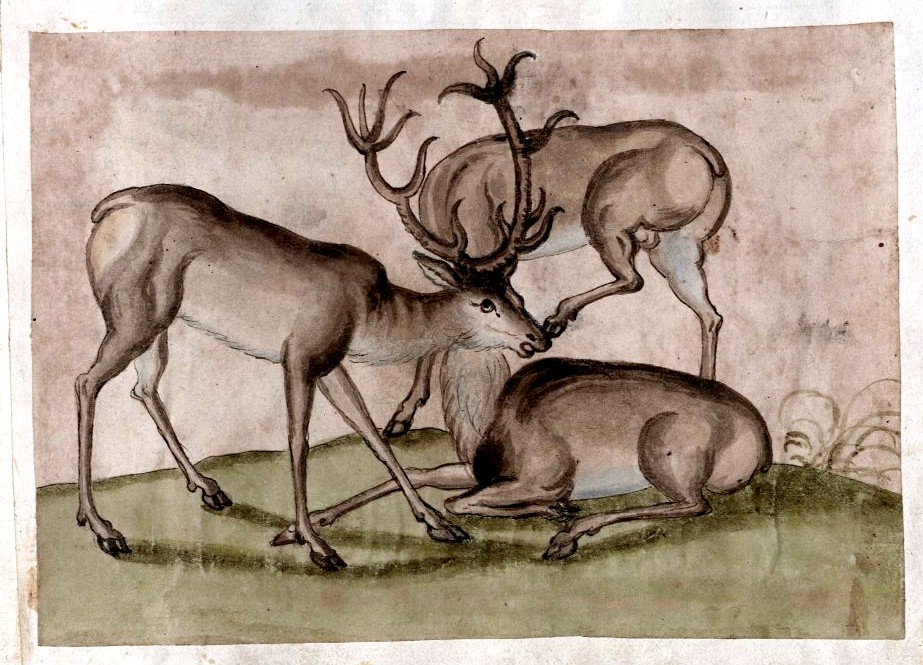
The design is also found on a Swiss stove tile, made in Winterthur in the early 17C
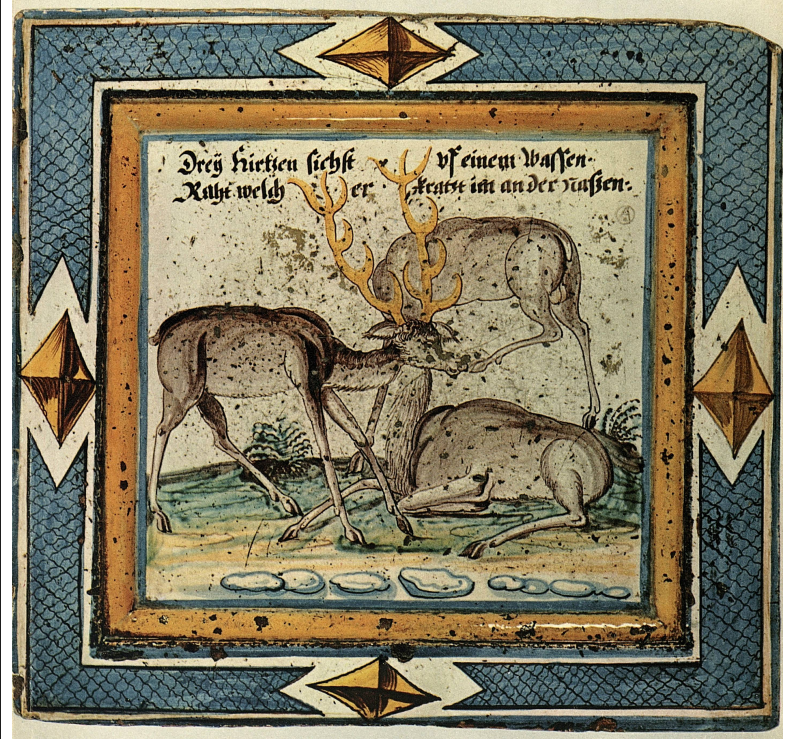
The inscription on the tile reads:
Drey Hirtzen sichst vf einem Wassen Three stags you see in a meadow
Raht welcher kratzt im an der Naßen Guess which one’s nose is scratched —
pointing implicitly at the visual riddle of the common head.
Some grotesques have been assembled from pre-existing parts — again the Jenisch album provides a fine example:
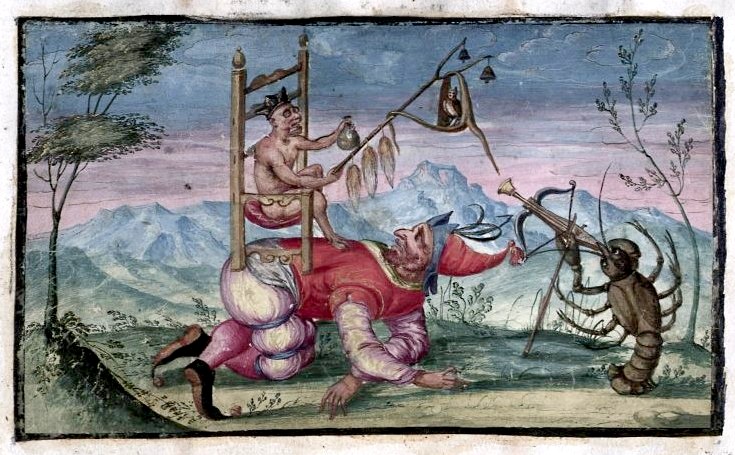
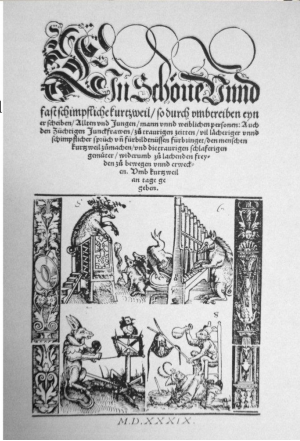
However original this composition appears, the painter has in fact assembled it from two woodcut illustrations to Wickram’s Kurtzweil (1539, 1550), reversed.
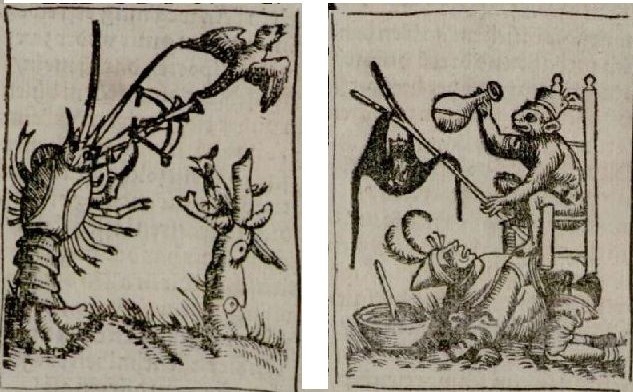
Here’s half the design on the title page to the work (Strasbourg 1539 ed.), the other half is found inside:
The painter of this rather amateurish grotesque in the Benz album (after 1652) evidently forgot to label his composition,
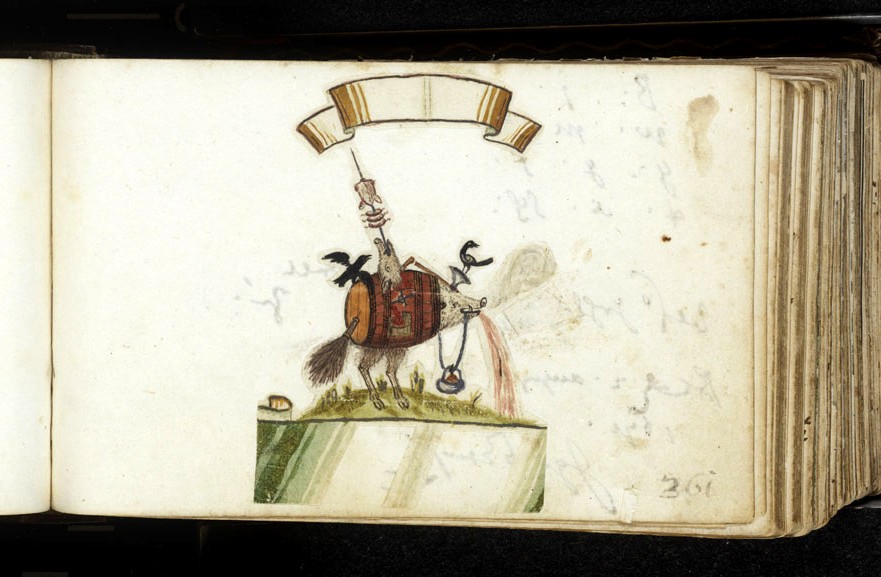
unlike the painter of this rather more accomplished version of what is evidently the same design in the earlier Hetzer album, dated 1619:
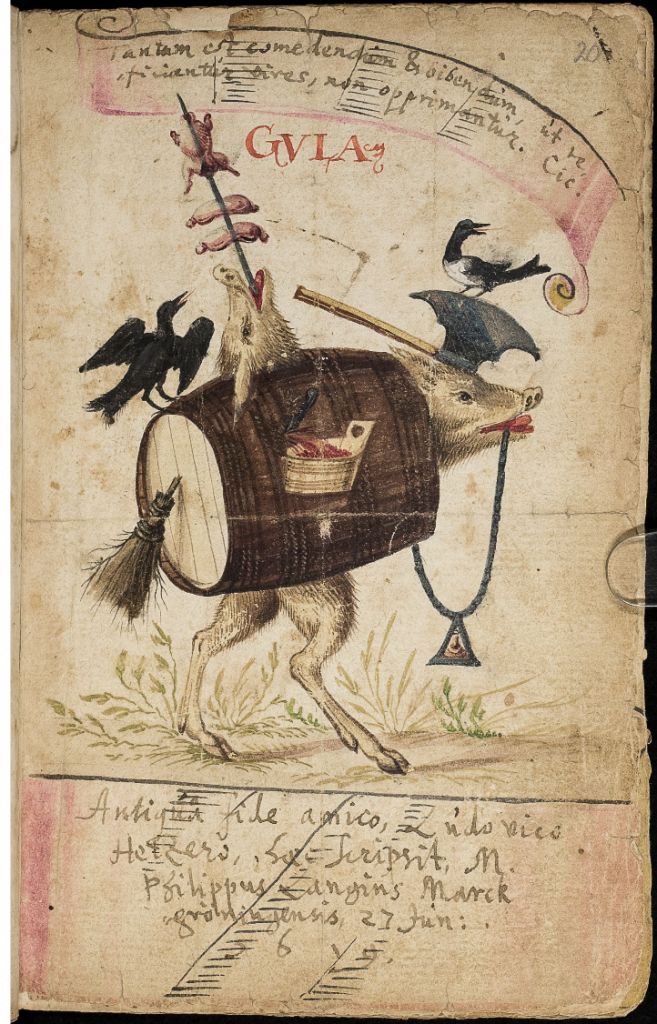
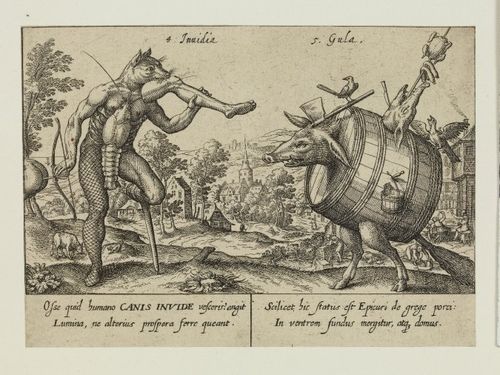
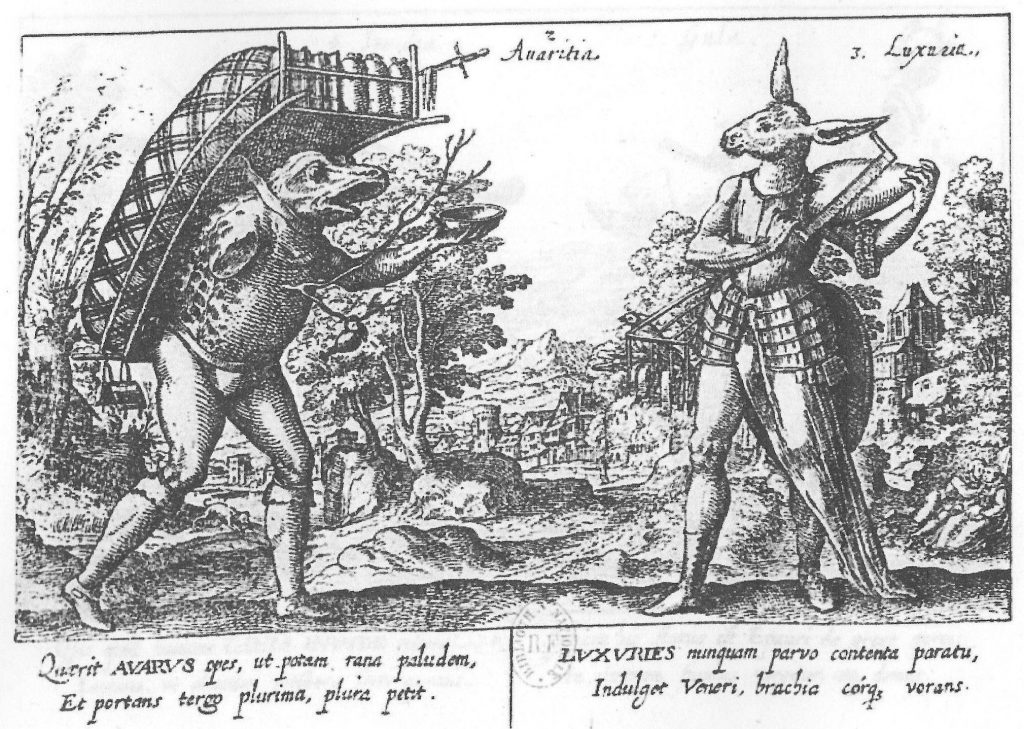
This earlier version is entitled GVLA [Gluttony], one of the Seven Deadly Sins, and clearly copied (in reverse) from the undated series issued in Strasbourg by Jakob von der Heyden
Here (below) is another bizarre miniature in the Rentsch album, depicting a one-armed frog with a pedlar’s pack on his back, pulling a child’s toy trolley full of ducks behind him:
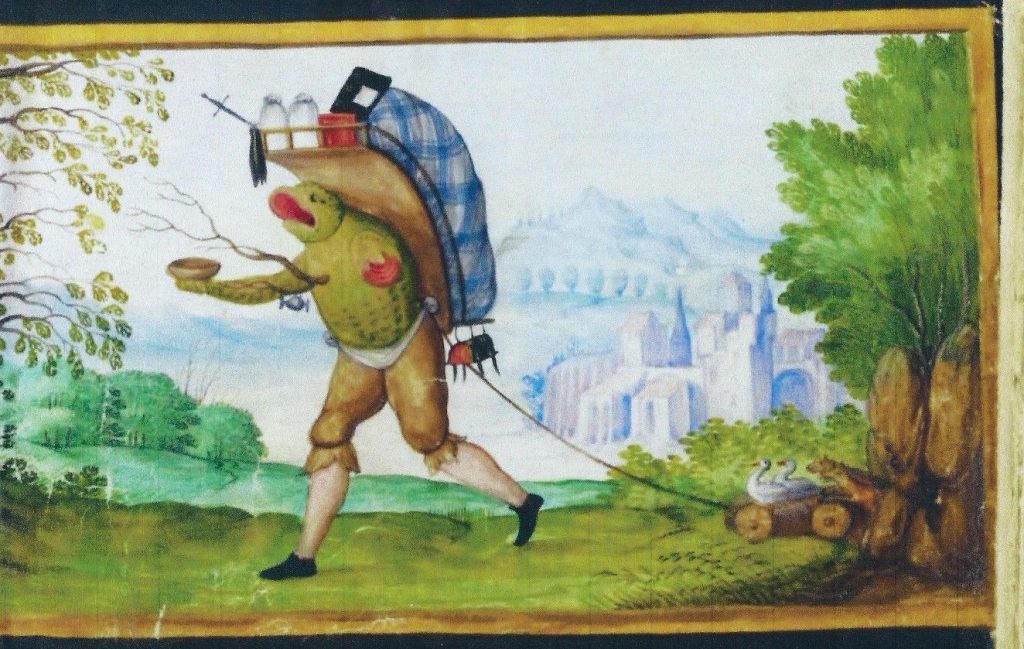
But this is another miniature adapted — by the addition of the trolley-load of ducks — from the same Von der Heyden series, in which the frog-pedlar symbolises Avaritia [avarice] — again, reversed with respect to the original.
Reversible heads
In our post on anti-papal motifs in the albums
https://albumamicorumear-e4qvahs764.live-website.com/anti-papal-imagery-in-the-albums/
we discussed a pair of reversible head images on two orphaned leaves sold at the du Rosey collection sale in 1864, the very popular early Reformation pair of images of the Pope/Devil and Cardinal/Fool.
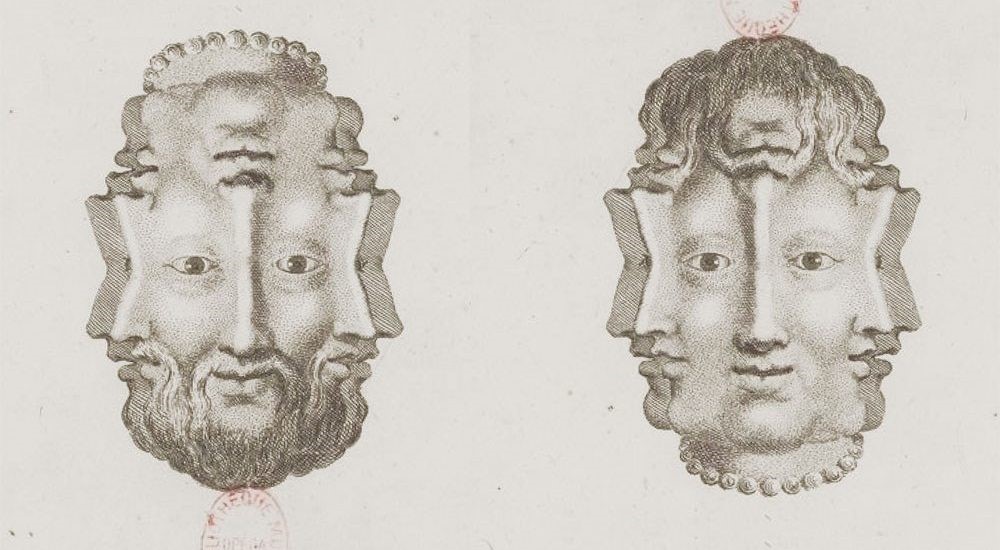
A multiple reversible heads design appears in the Öhlhans album:
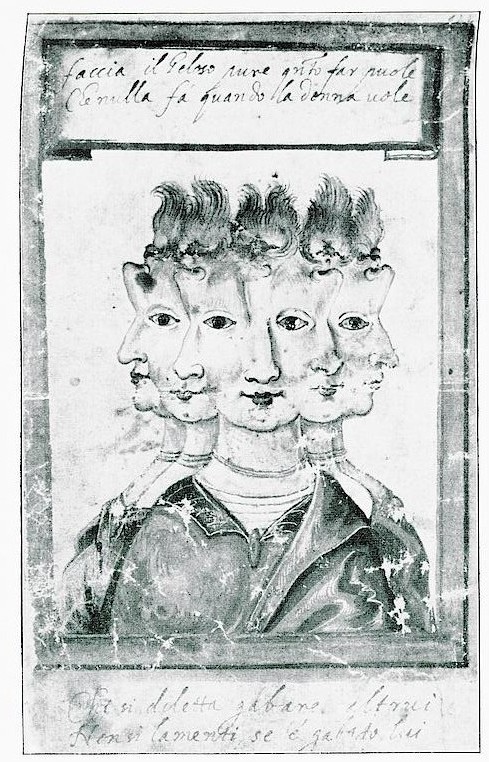
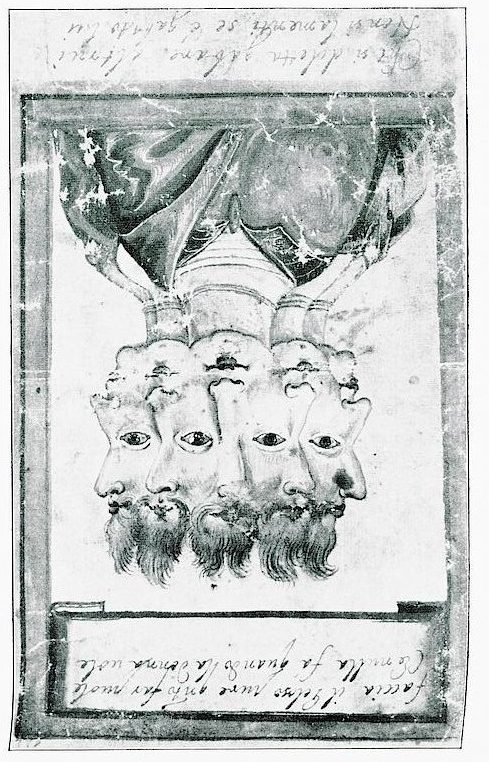
from the album of Matthias Öhlhans, dated entries 1588-1616. Stanford, University Libraries, Department of Special Collections and University Archives. Mss Codex 1474
The image is captioned in Italian:
faccia il Geloso pure qu[an]to far puole Let the jealous man do what he will
Che nulla fa quando la donna uole it is useless when the woman wants it
and
Chi si doletta gabare, l’altrui He who delights in tricking others
Non si lamenti se é gabado lui should not complain if he himself is tricked.
Our painted miniature seems to long predate the print versions of this type; this similar reversible head (below), engraved after Jean Berain, for example, cannot be earlier than c.1675:
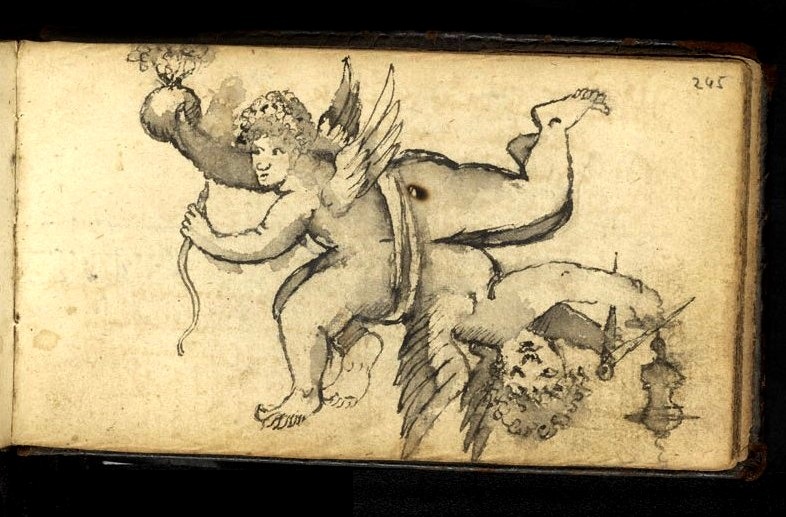
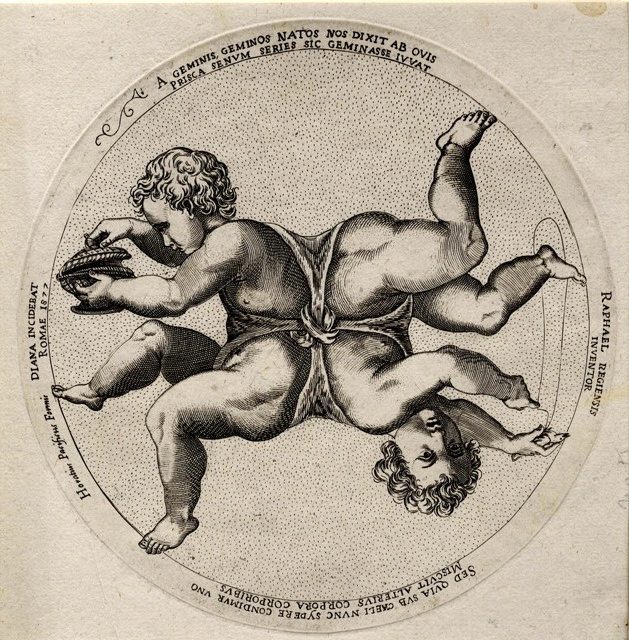
Below is another kind of visual ambiguity in which the putti can either be ‘read’ horizontally or vertically — this particular design seems to have been established by Diana Scultori, a rare example of a female engraver.
Stb 474
an early Magritte?
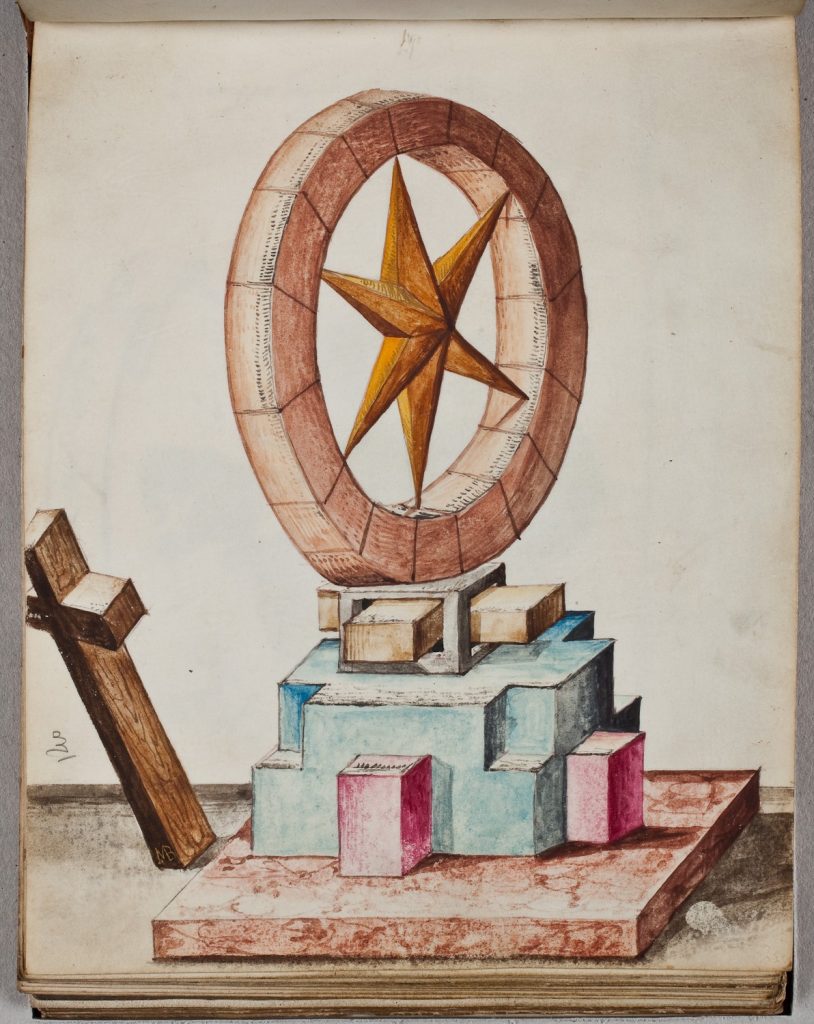
When I first saw this miniature in the Jenisch album (below) I thought I must accidentally managed to have changed websites — it looked like some 20C Surrealist production, reminding me of Magritte! Then I noticed it was dated 1590.
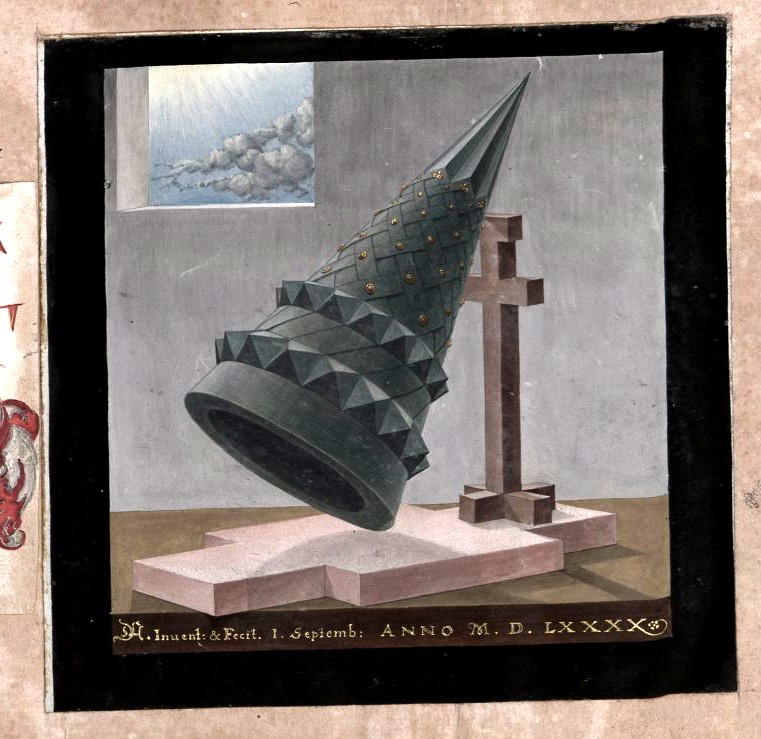
Subsequently, I realised that DA — if I read the painter’s initials correctly — must have taken this curious cone from one of Wenzel Jamnitzer’s solid geometry figures, engraved by Jost Amman, in his Perspective Corporum Regularium (Nürnberg 1568). But the setting — we can see the clouds in the sky through the window of the room — still feels uncanny, like Magritte’s claustrophobic room filled by a giant apple.
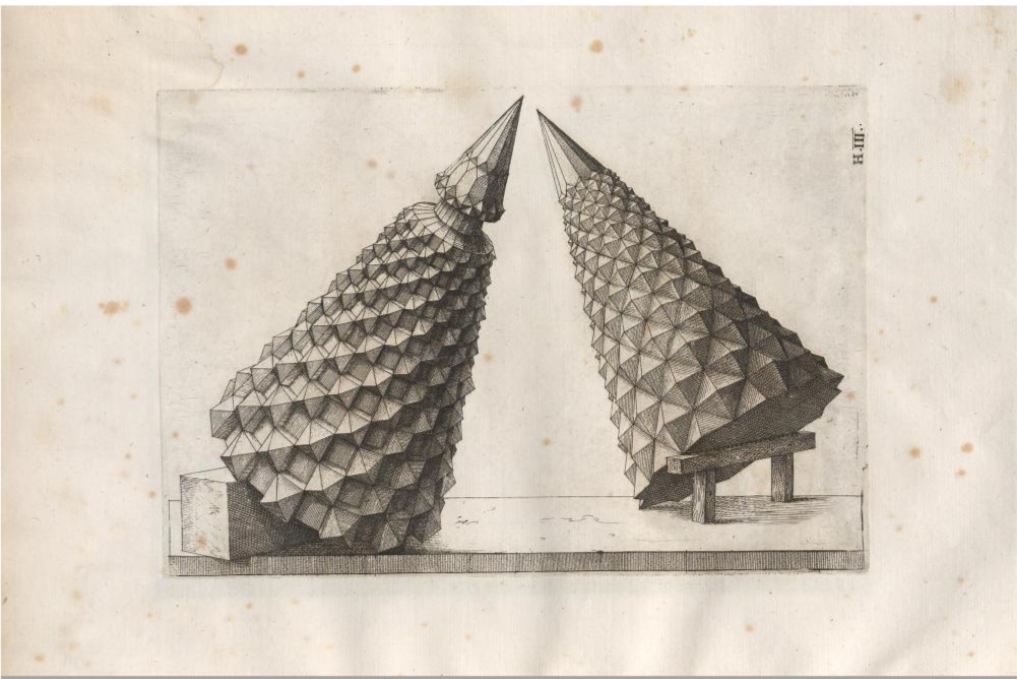
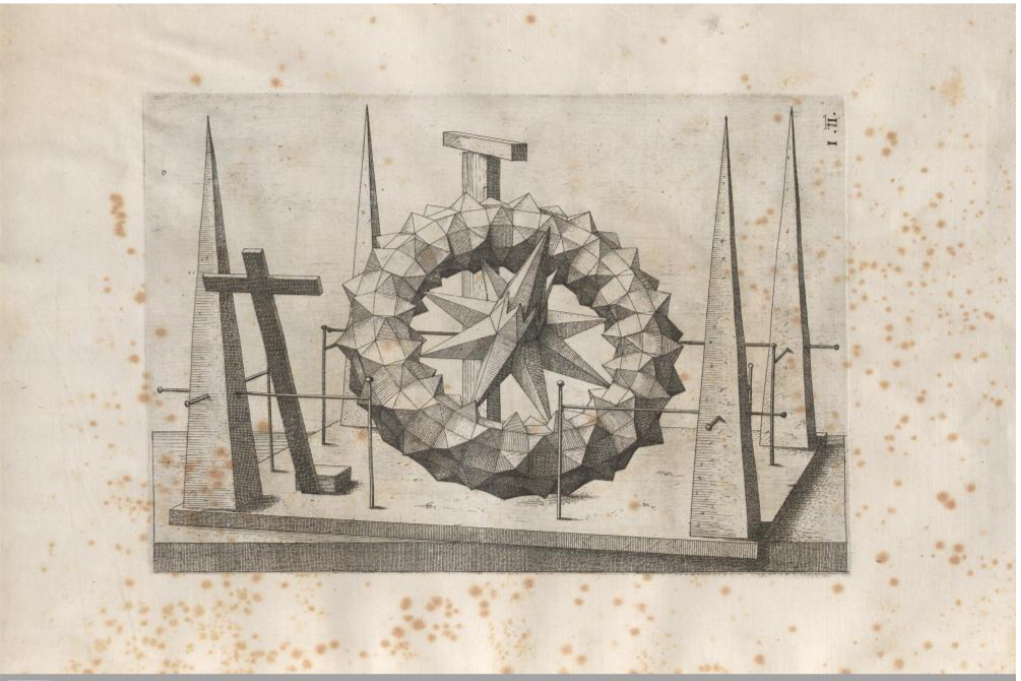
The type of stand used by the painter can be seen in the second plate.
This miniature in the van Meer album is equally surreal in its landscape setting — and clearly derives from the same work:
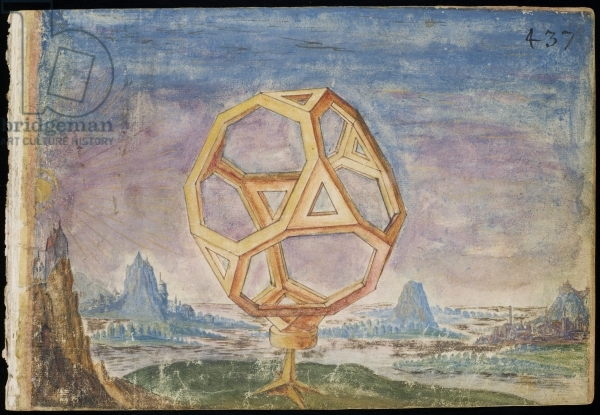
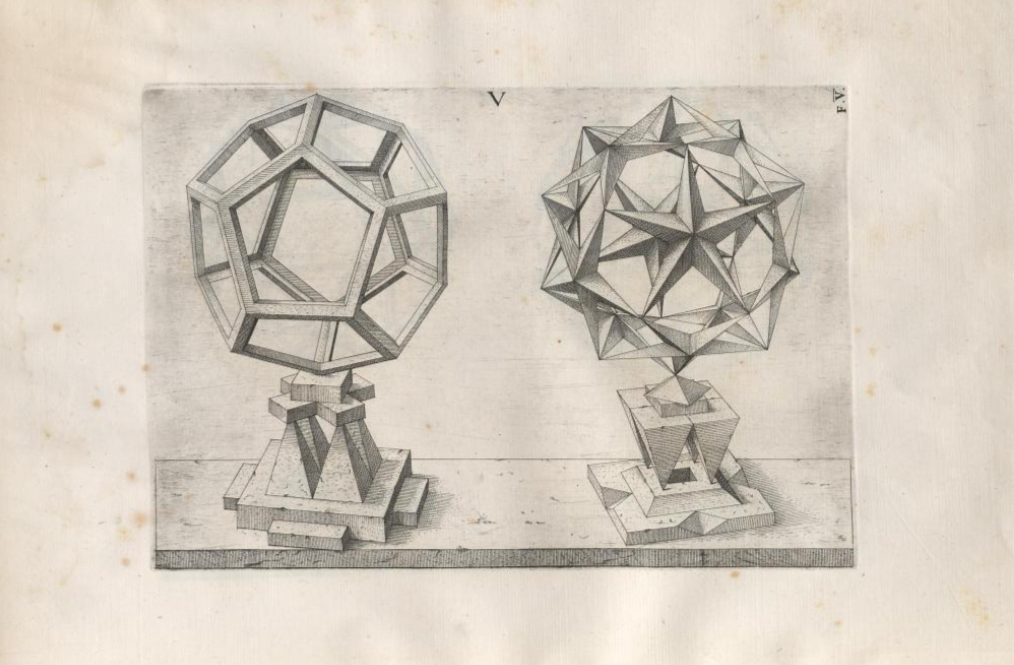
And the Twenhuysen album painter was surely drawing on the same source, even perhaps the second plate reproduced from the Perspectiva above:
Trompe-l’oeil
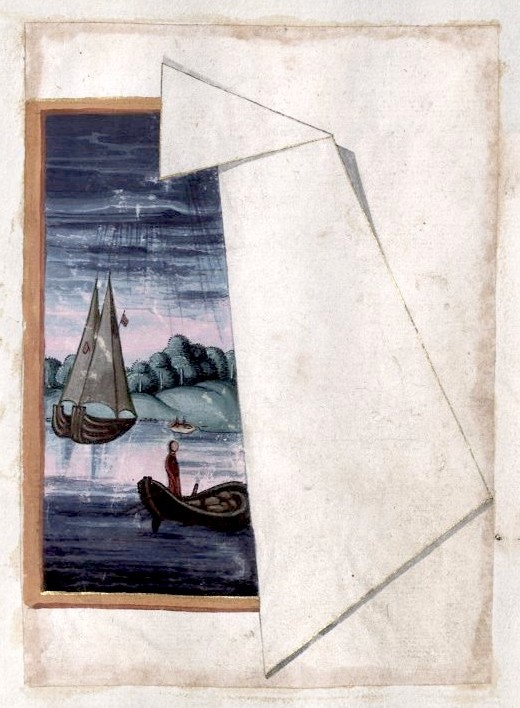
The only trompe-l’oeil I have noticed which certainly lies within our period is again from the Jenisch album (below) — but then, of course, my oeil may have been truly tromped and missed others!
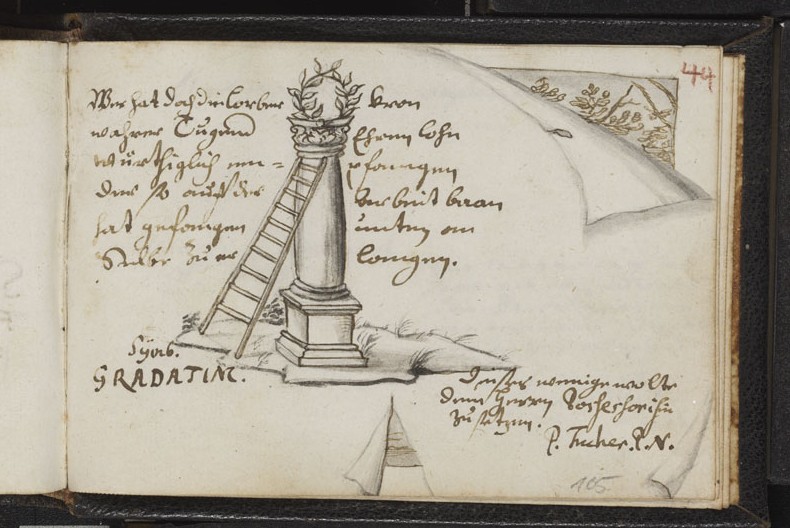
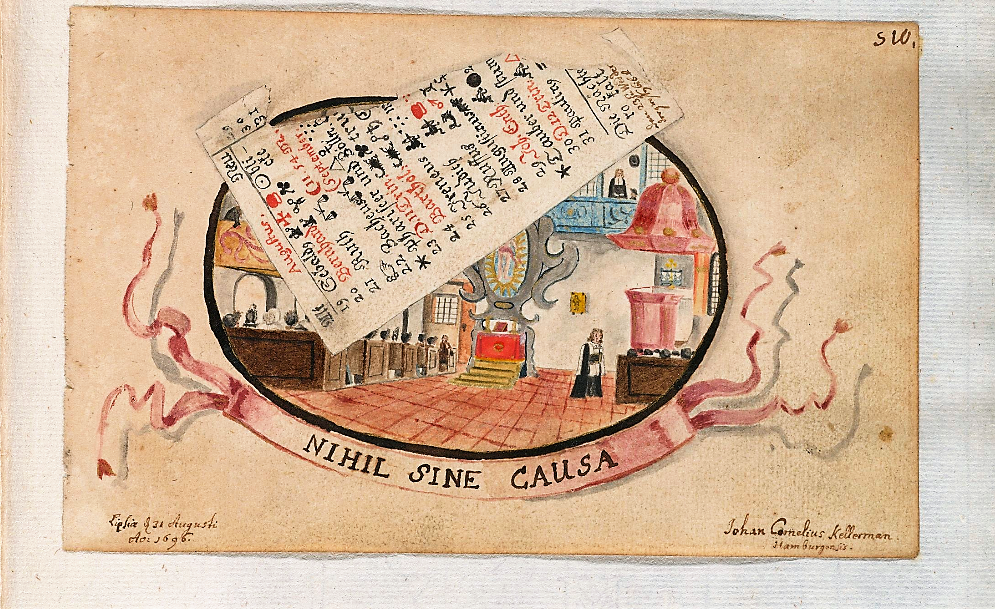
But here are two other album pages from the second half of the seventeenth century:
Anthropomorphic landscapes
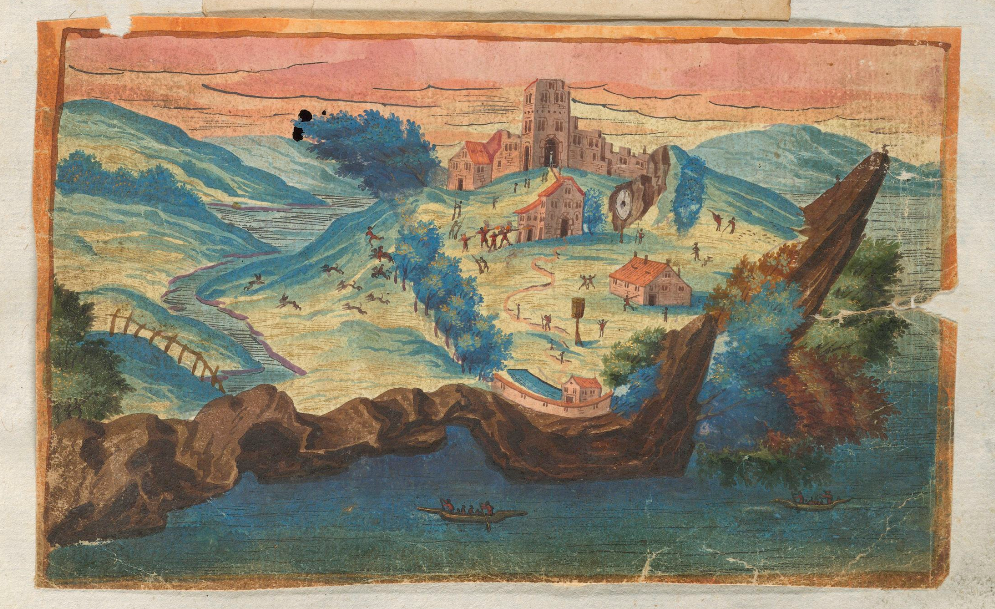
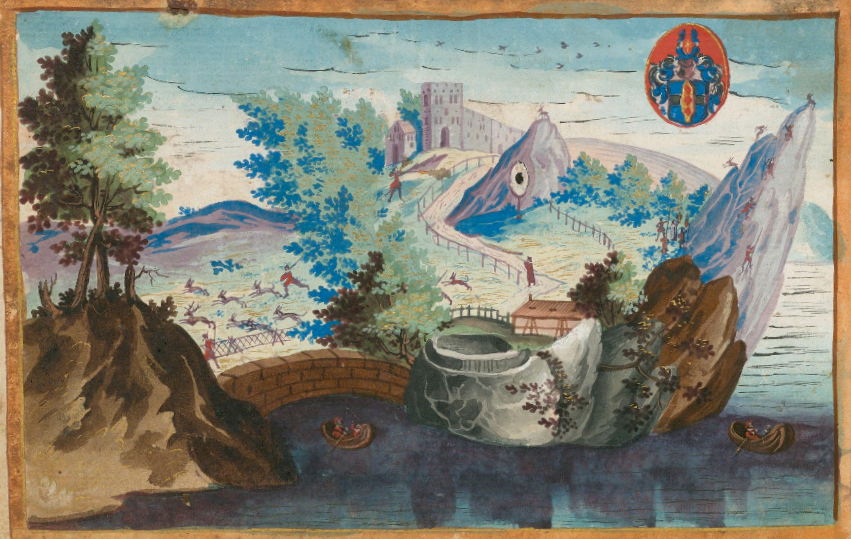
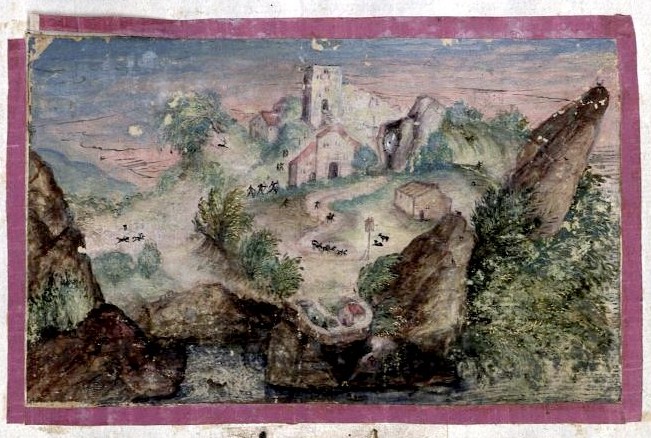
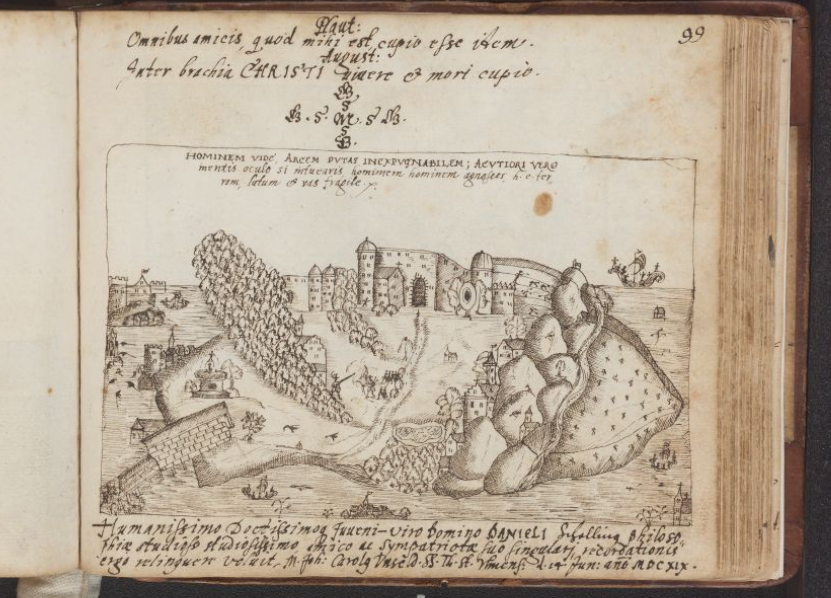
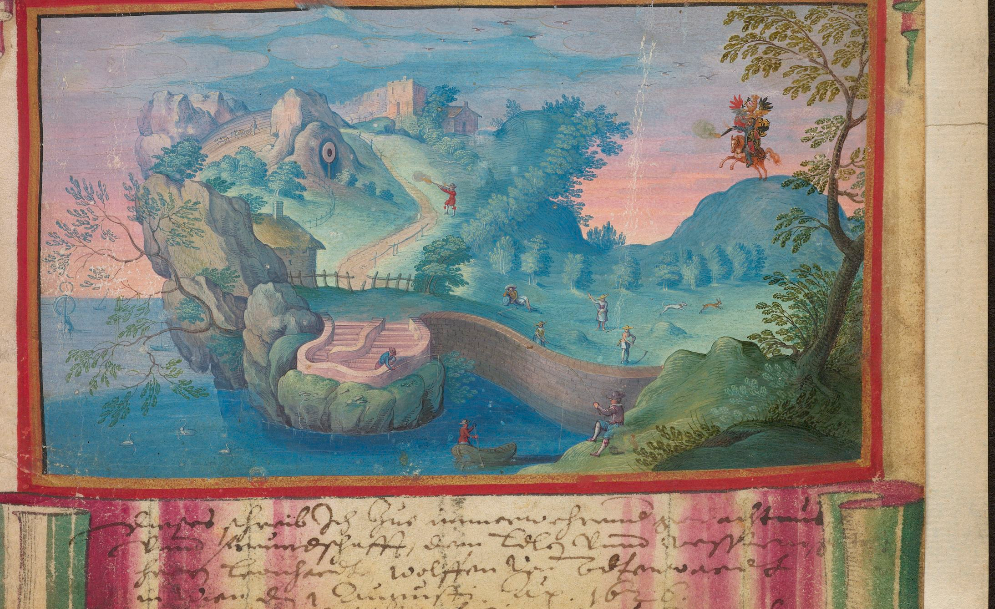
A special case of the trompe l’oeil is the anthropomorphic landscape — the landscape which, when turned through 90°, can be seen as a human head in profile.
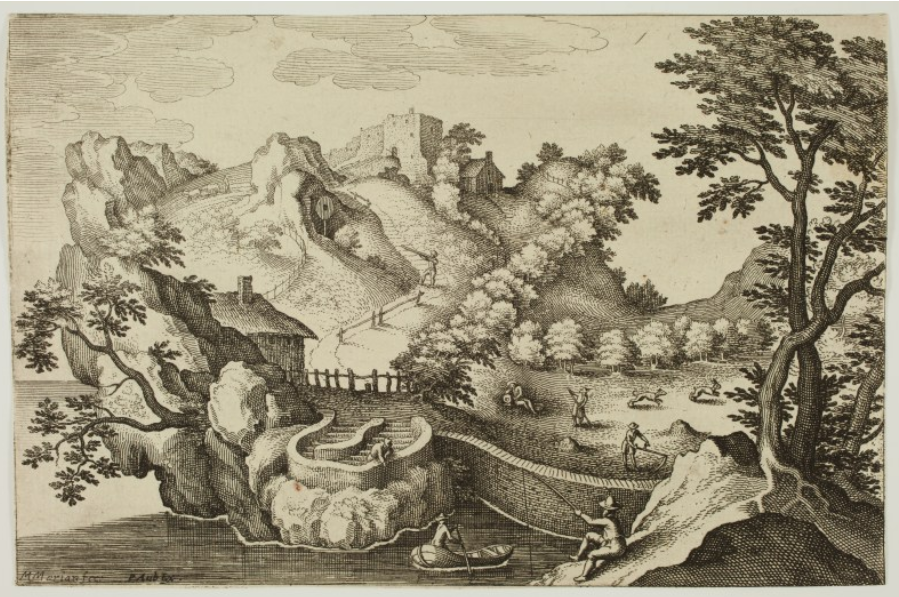
The design above engraved by Matthaus Merian in the early 1620s fossilised the motif, and almost every example after this date is based on his version, but several examples in the albums, securely dated ante 1620, show that Merian himself based his engraving on a form that must have already enjoyed some currency. Unfortunately, I have no image of the example painted in the album of Duke Augustus the Younger of Braunschweig-Lüneburg in 1597, so must begin with two examples dated 1605 and 1606 by the Repertorium Alborum Amicorum:
The Jenisch album copy, though without any dating context, appears to be based on the same model as the previous two:
The Sparn album example (below), though dated 1628, nevertheless seems also to belong to this pre-Merian type:
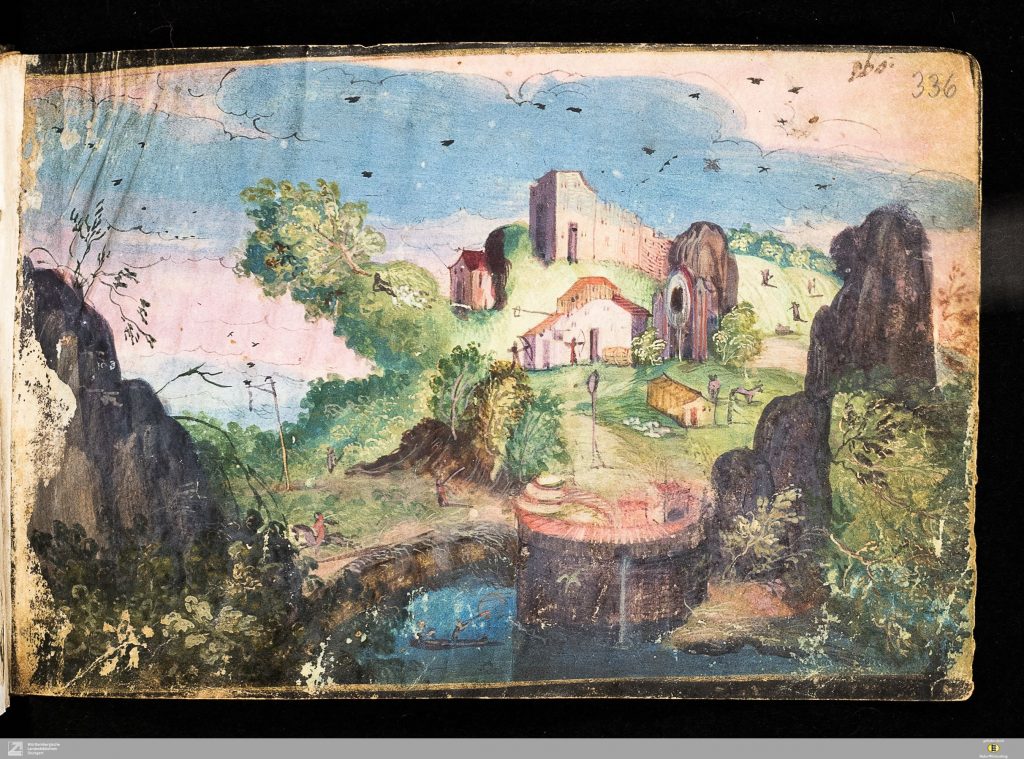
The Weckherlin album example (below), while certainly not dependent on the Merian engraving, does not seem to be following the same model as the other pre-Merian examples either,
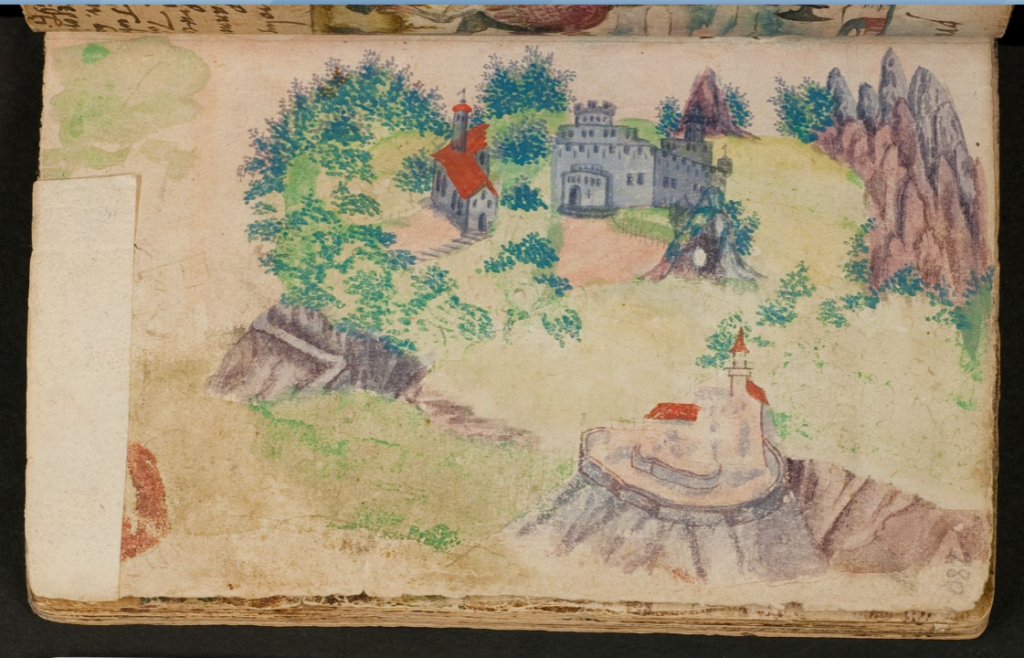
and nor does this uncoloured drawing in the Schelling album, dated 1619:
But I think we can be pretty certain that this example in the Leonhard Wolff von Todenwarth album (below) is the first to derive from the Merian engraving — note that, unlike all the other, earlier examples of the motif, it is in the same direction as the engraving
I close this run of album paintings with a mid-18C example, showing how long-lasting was the popularity of this particular optical illusion:
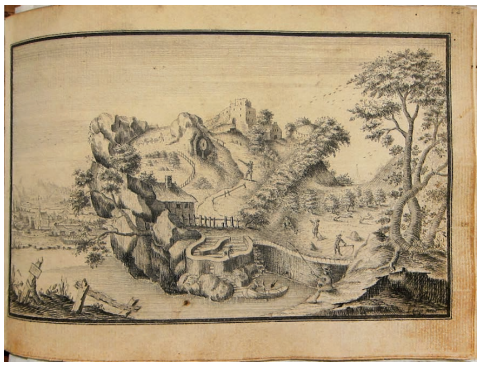
[scanned from Seibold 2021. vol.2]
And one more
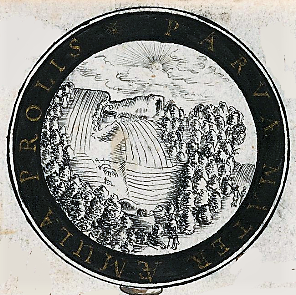
This example from the end of our period, dated 1649, is another original creation, independent of Merian
Leave a Reply