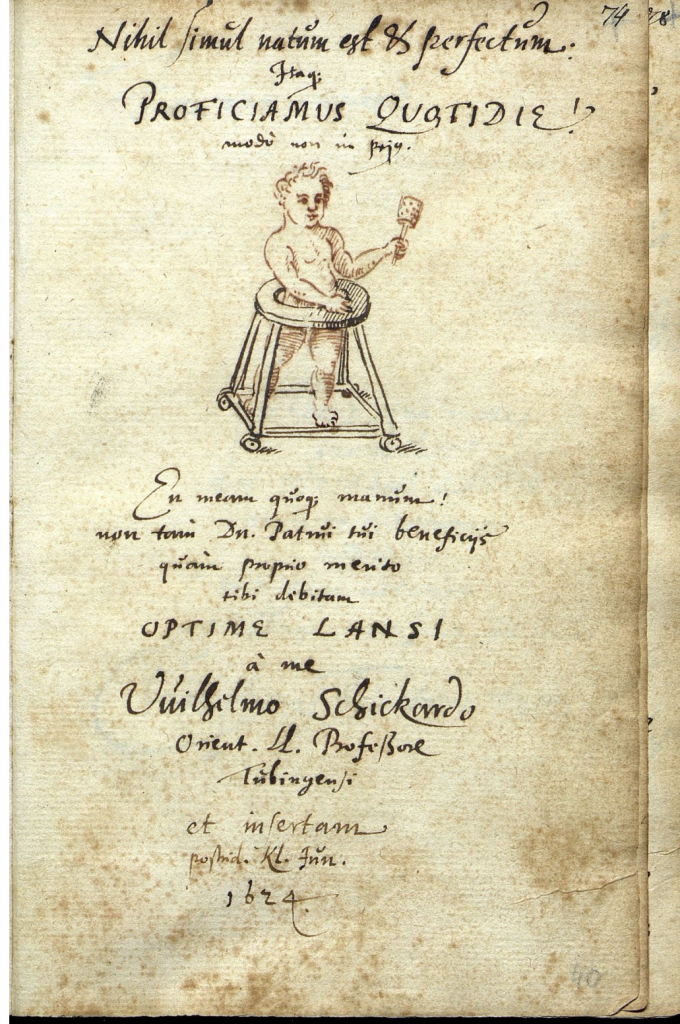
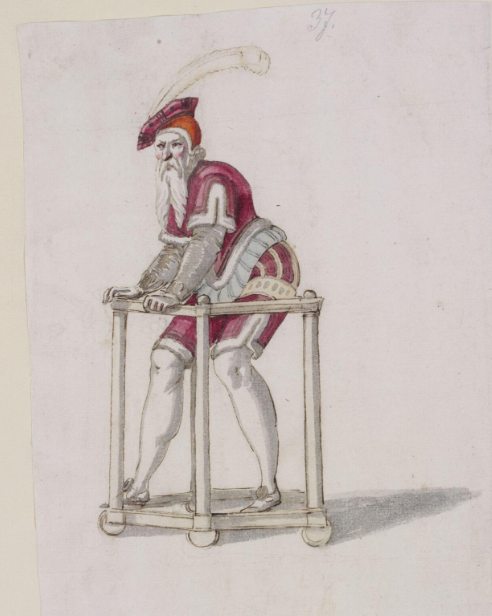
One expects to see a baby in a baby-walker — as in this image in the album of Stephan Lansius drawn in 1624
One does not expect to see an Old Man:
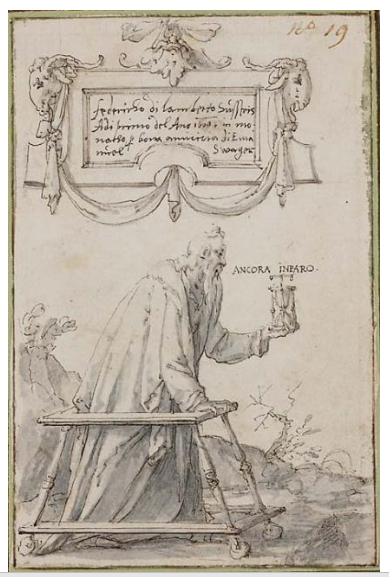
The hour-glass held by this ancient toddler is labelled in Italian ANCORA INPARO [still learning]. Friedrich Sustris, Emperor Maximilian’s court-painter in Munchen, from 1580 until he died in 1599, made this drawing in the very year of his death, going one better than Michaelangelo, to whom the saying is traditionally attributed when he was 87 years old, the year before he died.
Sustris worked in Italy in the 1560s and is documented in Rome from 1560, and given the Italian label, it seems certain that he must have known the engraving below, now attributed to Girolamo Fagiuolo and first published in that city in 1538, but which exists in at least two versions :
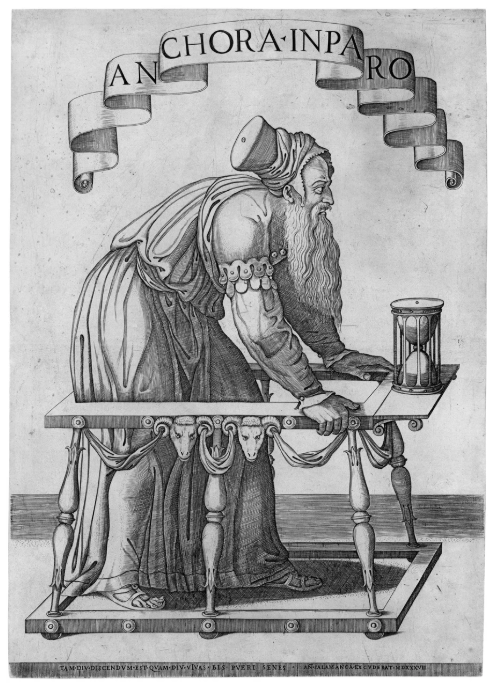
The inscriptions tam diu discendum est quam diu vivas [you must keep learning as long as you live] and bis puer senex [the old man is twice a boy] are found on both, but are much more visible on the later version.
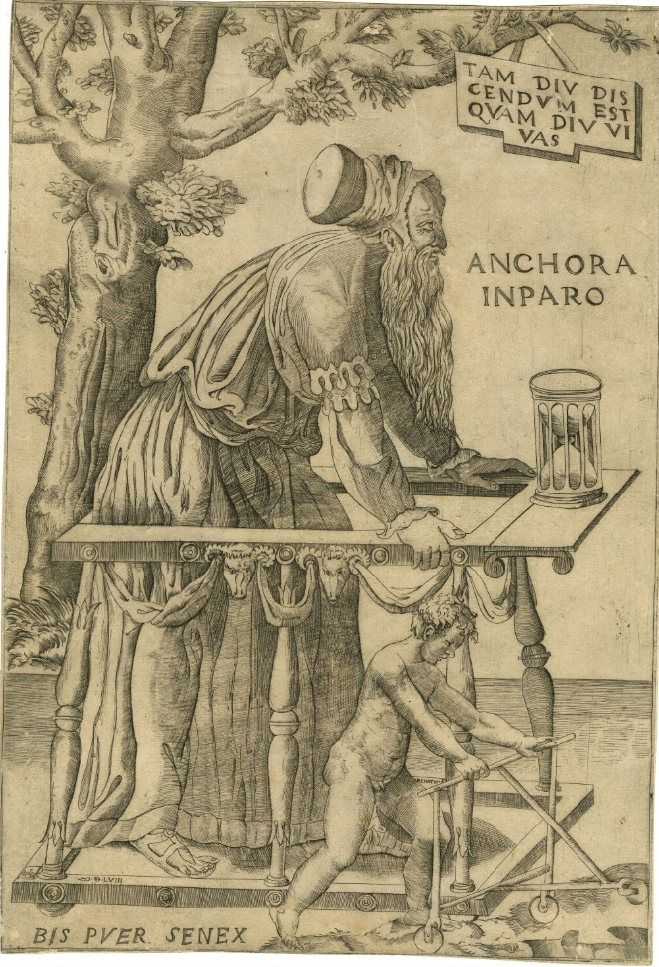
The later version dated 1568 on the frame also features a small boy pushing a different design of baby-walker beside the old man. The later version may have been the inspiration for the sheet made by the woodcut-artist, Hans Glaser, who was still issuing prints in Nurnberg as late as 1672 (though the Gotha state is there dated c.1552/3).
The earlier state of Glaser’s print (below) bears the title Ich lern noch [I am still learning], a German translation of the Italian Ancora Inparo, and his name. There is no indication of the old man’s identity in the Italian prints — he is merely an old Everyman — but in Glaser’s version he is identified as the ancient Greek philosopher Solon [Selon [sic] Philosophus], and the figure is accompanied by a poem, entitled vom Alter [On Old Age], as if his:
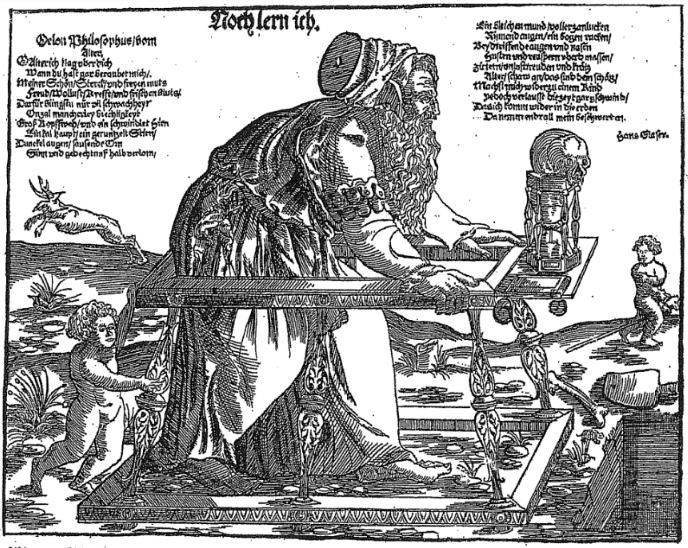
Glaser has added two small boys to his Italian model, one of them riding a hobby-horse, and a skull on top of the hourglass — and his doddering Old Man is clearly piloting his walker to an open grave, beside which we see the grave-digger’s spade and an excavated bone.
The verse in the Gotha impression is set slightly differently and the print has lost its author’s name and its title (perhaps cropped?), but we still read that Alter… Machst mich wider zu einem Kindt [Old Age… you make me a child again]:
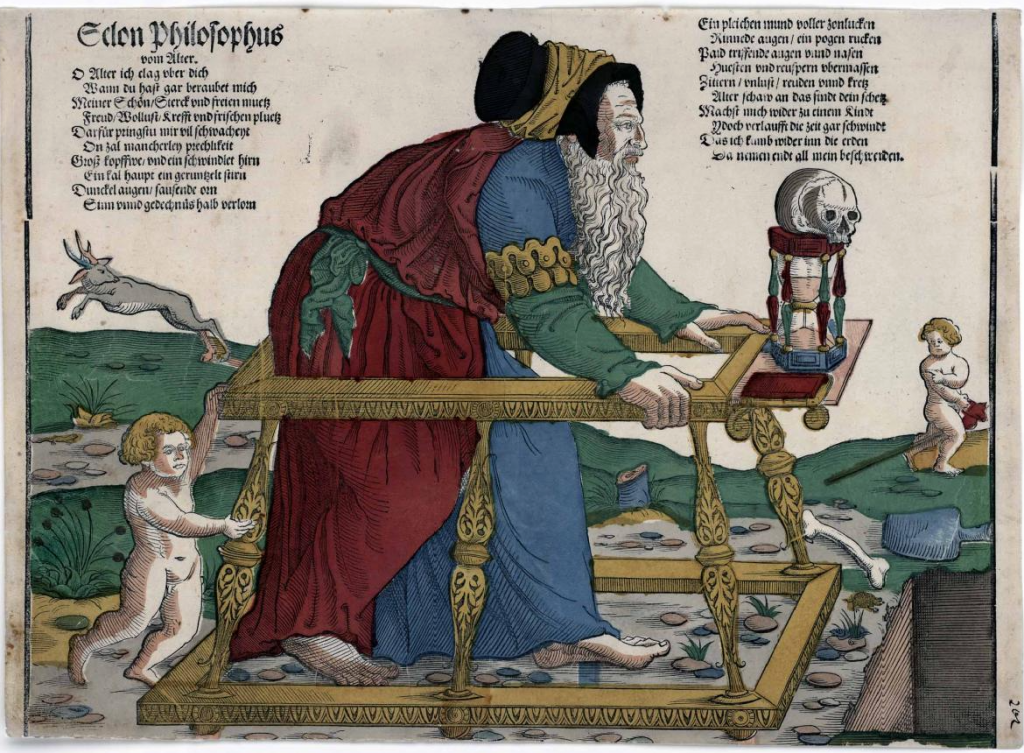
Solon’s sayings and verses are uncertainly preserved, but one fragment is given as Seek to learn constantly while you live; do not wait in the faith that old age, by itself, will bring wisdom.
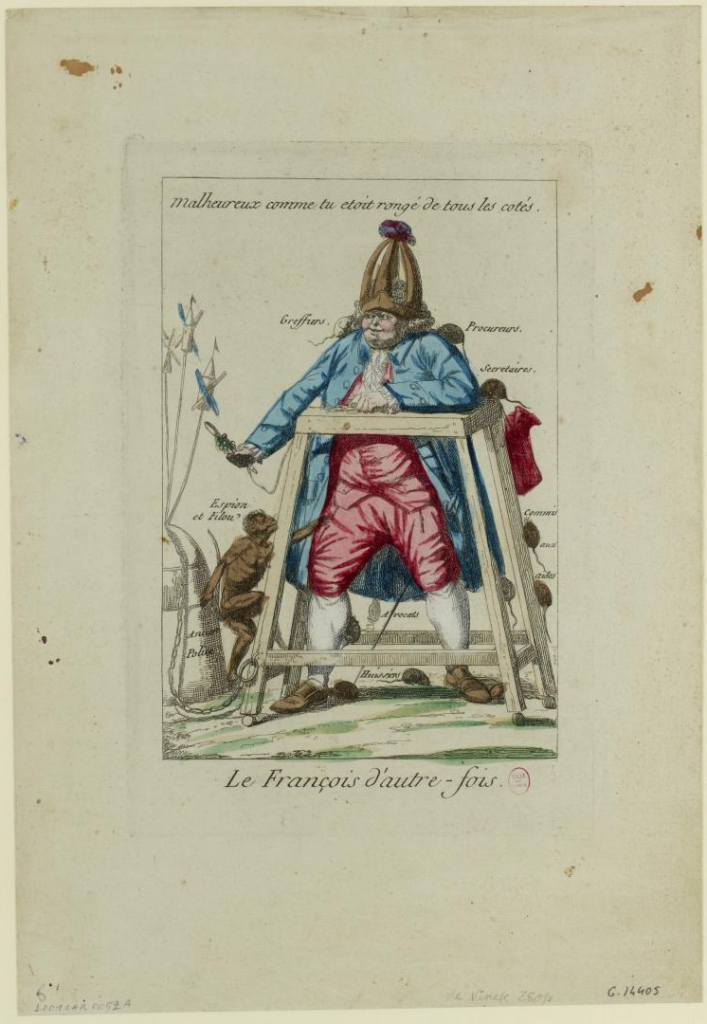
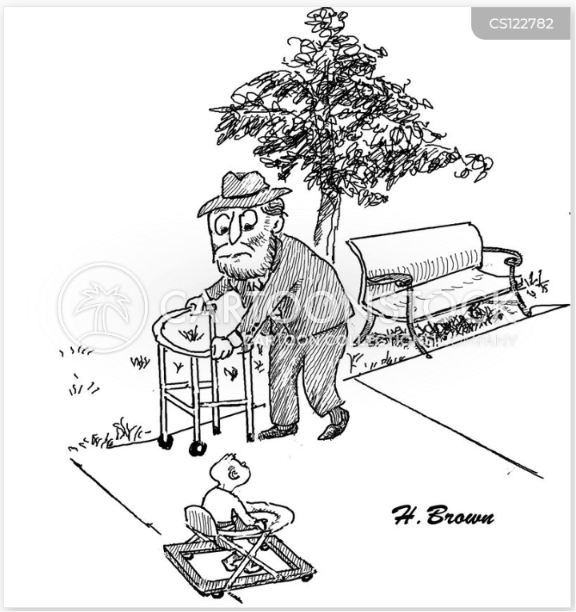
The device of the Old Man in the baby-walker was much too striking to be abandoned and can be found again in the 17th and 18th centuries, and even in modern cartoons:
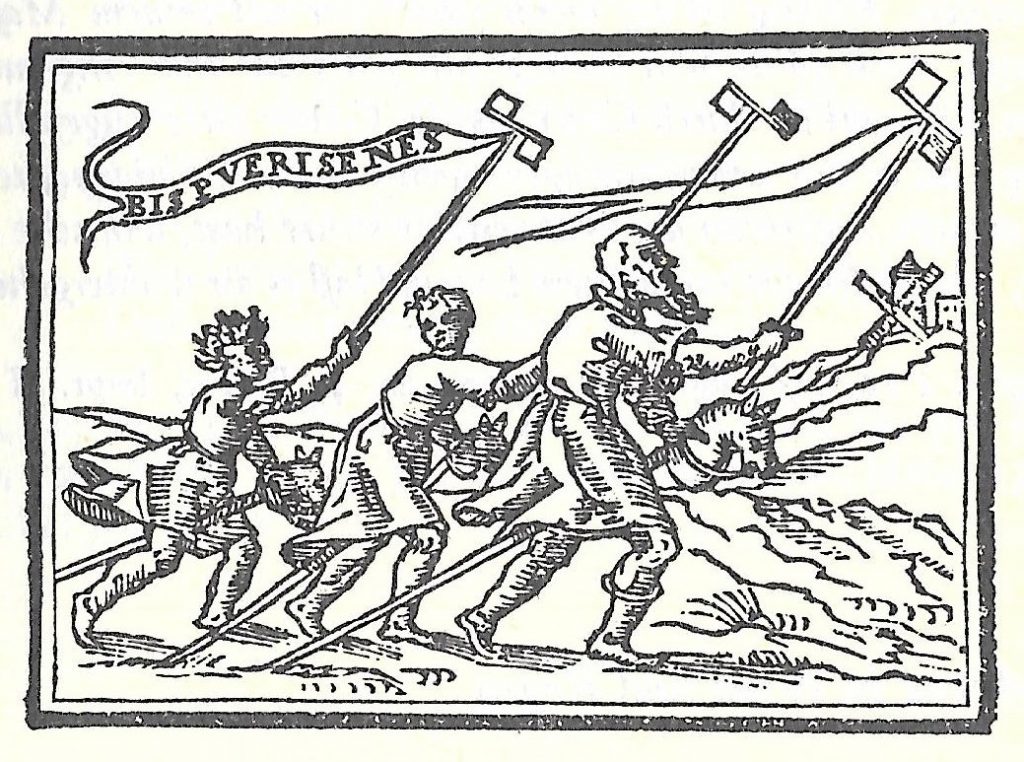
Old Men (and foolish men) ride hobby-horses
A related depiction which I have yet to note in the albums, admittedly — shows the Old Man riding a child’s hobby-horse, as in this emblem from Covarubias’s Emblemas Morales, first published in Segovia in 1589 (next):

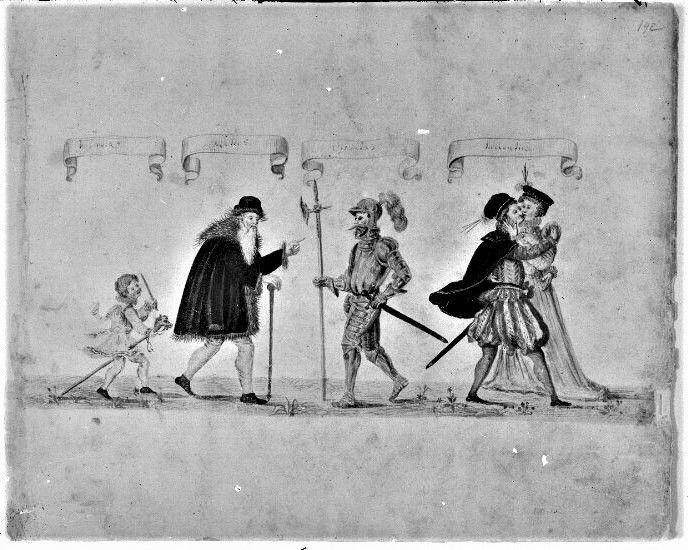
But the notion of a Second Childhood, that an Old Man is Twice a Boy, is perhaps hinted at in this deliberate and unchronological painting of the Four Ages of Man on an orphaned album-leaf in the collection of the Austrian National Library in which Pueritia [boyhood] treads hard on the heels of Senectus [old age], both having their sticks, hobby-horse and walking-stick:
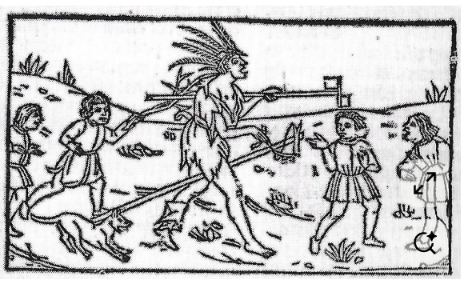
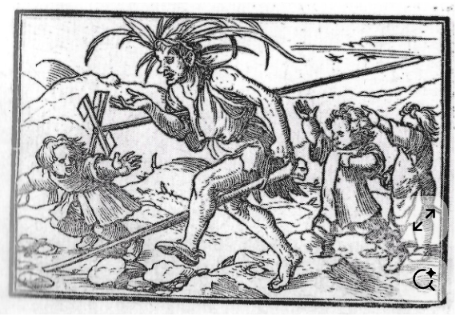
But it is not just senile old men in their second childhood who ride the hobby-horse, grown men costumed as fools do too. Below is the woodcut illustrating Psalm 52 [Dixit inspiens..– “The fool has said in his heart there is no God”] as seen in editions of the Vulgate published by Luca Antonio di Giunta in Venice from 1490. Here, with abusive gestures and cries, children mock the (atheistic) fool — his various fool-attributes include the feathered head-dress [cf. Giotto’s Stultitia in the Arena Chapel], the wearing of only one shoe [“monosandalism”], and the riding of the hobbyhorse:
Editions of the Vulgate printed by Marion for Koberger in Lyon in 1518 and 1520 include Erhard Schoen’s fairly close copy of the Italian cut (below).

And this (below) is Holbein’s adaptation of the Schoen woodcut (above) for the Bible published by Froben in Basel in 1538 (sometimes art history is like those Spot-the-difference puzzles for children!) — here the major difference is that Holbein has made the fool compound his folly by riding his hobbyhorse backwards!
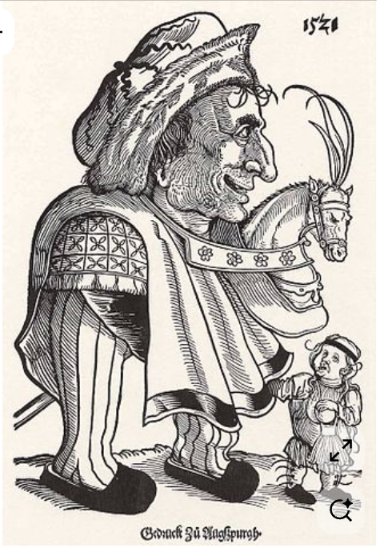
The incomparable Hans Weiditz had his version of the motif too — published in Augsburg in 1521 — here the little girl/?daughter looks up wonderingly at the grown man astride the hobby-horse!
Leave a Reply