Forget industry — the “busy bee” — for the moment; the bee also features in emblematic contrasts: the contrast between the sweetness of the bee’s honey and the sharpness of its sting; and the contrast of the bee and spider that (in medieval and early modern belief) make opposite products from the same flower (honey v. poison) — as spelled out on the Van Meckenem print (below). To date, I have noticed three examples of this in the albums, but two of these in the same album!
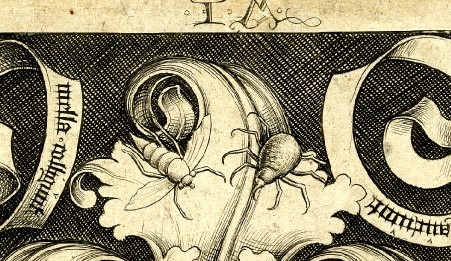
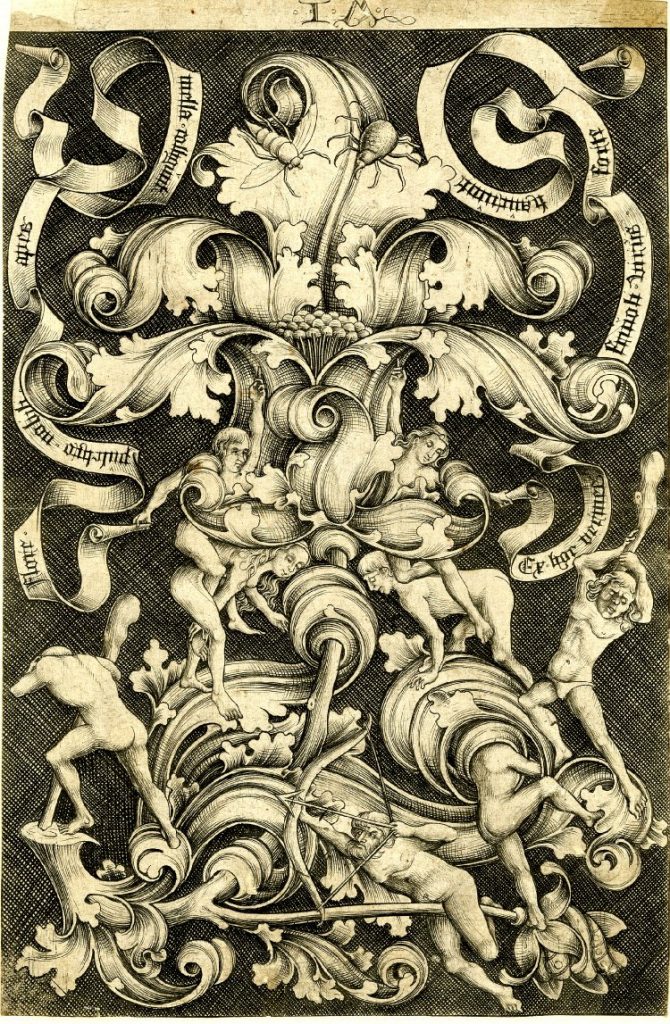
Van Meckenem’s print is inscribed Flore pulchro nobili apes mella colligunt / Et hoc vermes frivoli virus forte hauriunt [The bees gather honey from the beautiful noble flower / and this worthless vermin draws up poison].
The motif is innately emblematic, and naturally appears in the emblem-books from Junius’s Emblemata (1565) to Bruck’s Emblemata moralia & bellica (1615) and beyond:
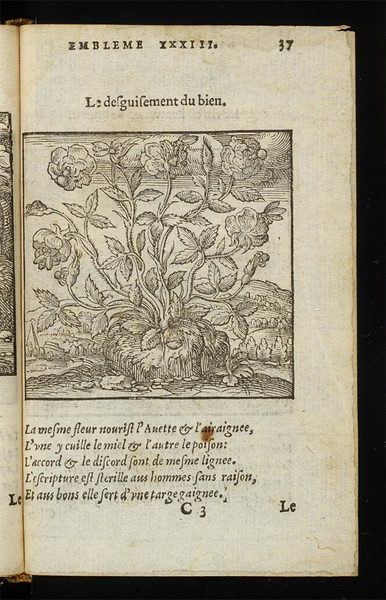
Junius expreses the matter succinctly:
La mesme fleur nourist l’Auette & l’airignee L’vne y cuille le miel & l’autre le poison
The same flower feeds the bee & the spider one gathers honey from it the other poison.
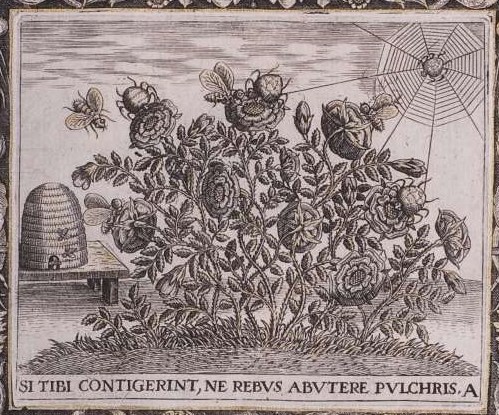
It appeared too in the de Brys’ first emblem-book, the Emblemata Nobilitati issued in 1592, with the motto, SI TIBI CONTIGERINT, NE REBVS ABVTERE PVCHRIS […… do not abuse beautiful things]
Sorrounded by the neutral motto, USU DIVERSO [different uses], in Bruck’s Emblemata moralia & bellica, the spider is not singled out for condemnation.
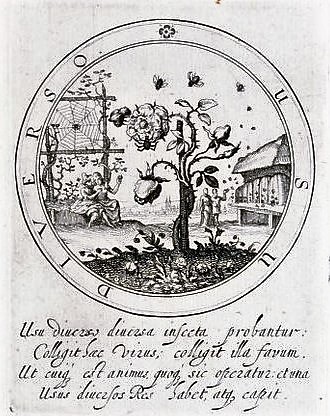
The Latin verse merely remarking that insects are commended for different uses, one collects poison, another honey, each operating according to its mind, and that one thing (here, the flower) has different uses.
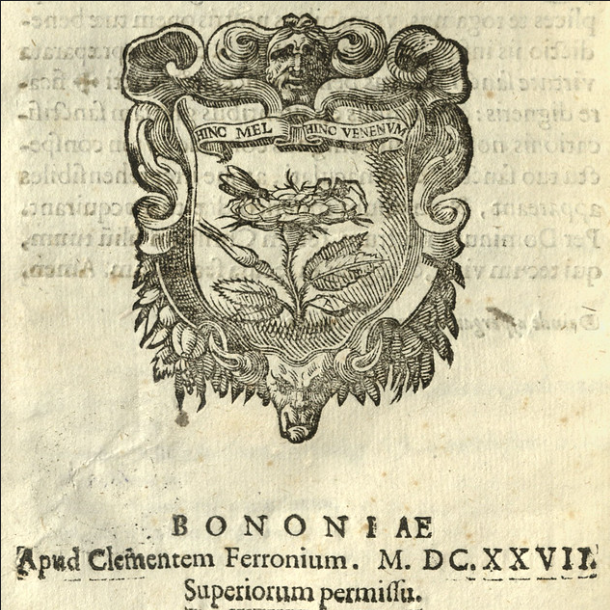
Beneath the motto, HINC MEL HINC VENENVM [this one honey, this one poison], the Bolognese printer, Clemente Ferroni, used it as his device in the 1620s
In the albums
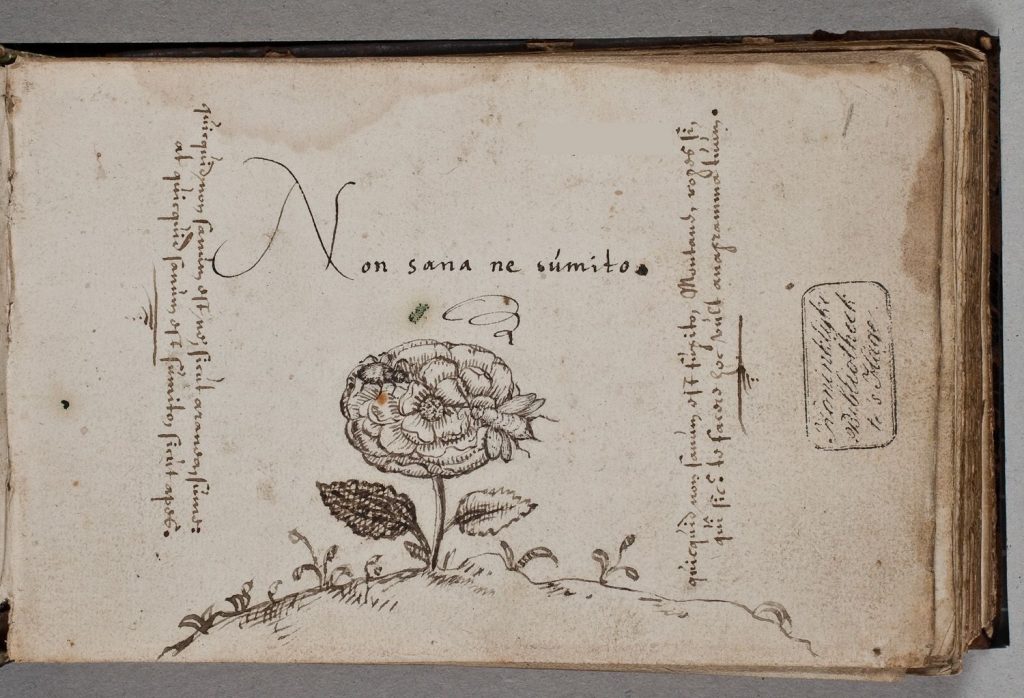
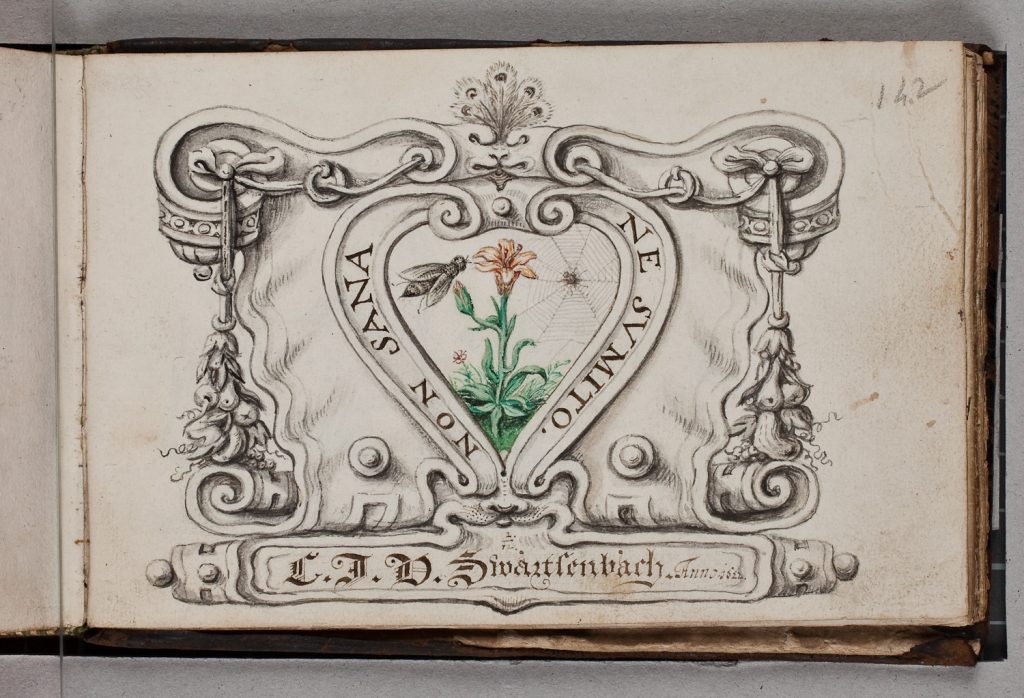
The motif appears as a drawing on the very first page of the Montanus album (below) and, later in the same album, as a painted emblem. The Latin motto which accompanies both — NON SANA NE SVMITO — is an anagram of IOANNES MONTANVS, though not easy to translate.
The sole illustration in the album of Michael Schumann (yet another re-purposed Alciato edition), painted at some date between 1594 and 1610, is a complex three-tier emblem in which our motif constitutes the middle tier.
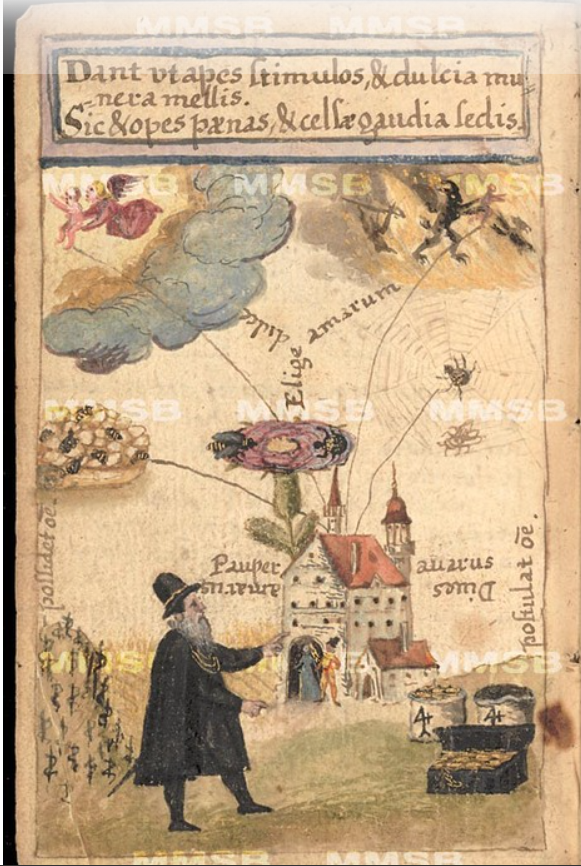
A representative bee and spider are pictured on the central flower, above which one soul is being carried to heaven by an angel (left), another to hell by a devil (right); beside the flower — on the heavenly side — several bees are busy on a honeycomb, while on the other — hell — side, a bee has been caught in a spider’s web. The caption above the miniature reads:
Dant ut apes stimulos et dulcia munera mellis, sic et opes paenas et celsae gaudia sedis. [Just as bees give stings and sweet gifts of honey, so are given riches, pains, and the exalted joys of the [heavenly] throne] (my trans.)
Leave a Reply