I do not propose to sample the numerous memento mori images to be found in the albums here, but to try to limit myself to Danse Macabre and related images that did not properly belong in my previous Death & the Alls post.
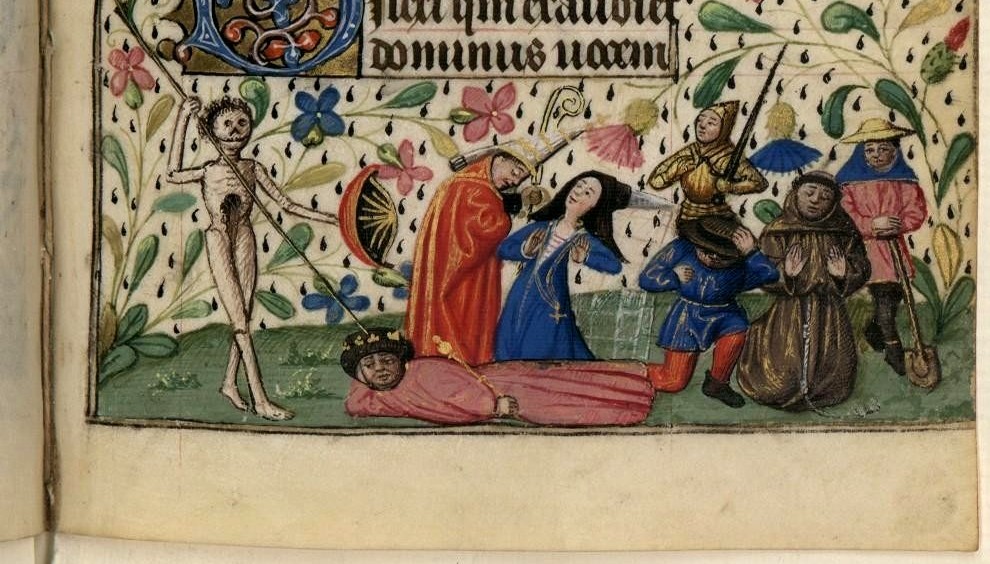
The scene of Death with his scythe ‘reaping’ all manner of human conditions was hardly new iconography in the early decades of album production, and may be seen, for example, in the margins of late medieval Books of Hours, as here:
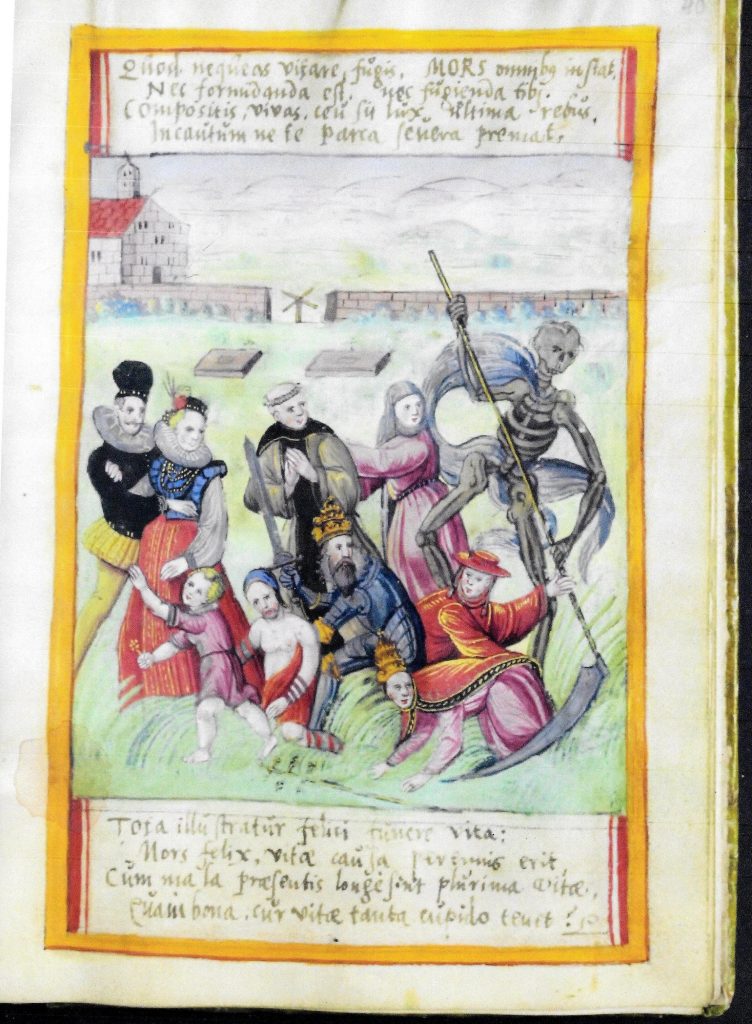
A painting in the Sitzinger album (above) continues this traditional iconography representing Death as the Grim Reaper.[i] The skeleton Death — whom this very accomplished artist has somehow managed to make look gleeful, despite the absence of flesh — here plies his scythe, and reaps a total of nine human types: Pope, Cardinal, Emperor, Monk and Nun, Couple with young Child, and another indeterminate naked figure. Above and below, the miniature is captioned with Latin verses taken from Verini’s De puerorum moribus disticha, first published in 1487 — the year its brilliant teenage author died — and a book which in its numerous reprints would have been familiar to generations of schoolboys.
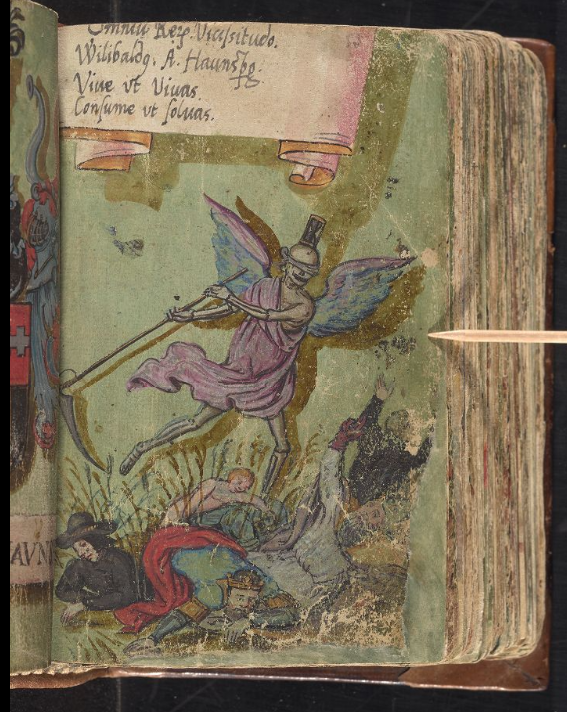
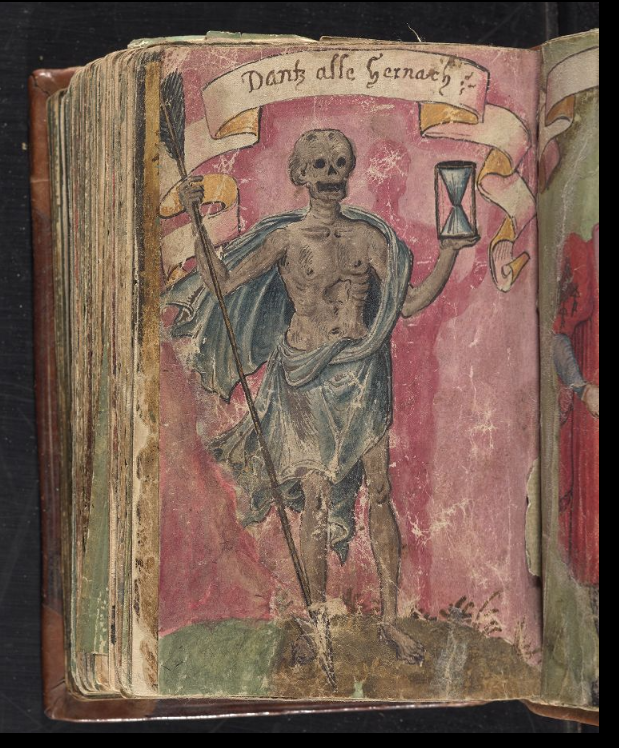
Somewhat earlier this similar scene (above) was painted in the Helbig album (dated entries 1561-90), though here the skeleton Death, an hourglass balanced on his skull, is winged and blindfolded as he wields his indiscriminate scythe – although the page in question is somewhat rubbed, a King and Pope can still be made out, as well as a naked child and sundry other adults. The page is headed by three Latin mottoes including the popular Omnium rerum vicissitudo [all things change] and Vive ut vivas [live so you may live (life to the full)]. Later in the same album, appears a full-page ‘portrait’ of Death looking strangely fleshy, but holding his customary hourglass and dart, who says in obvious allusion to the Danse Macabre, Dantz alle hernach [Dance all hereafter], punningly referring to the 41 similarly full-length, costumed portraits painted on the following pages.
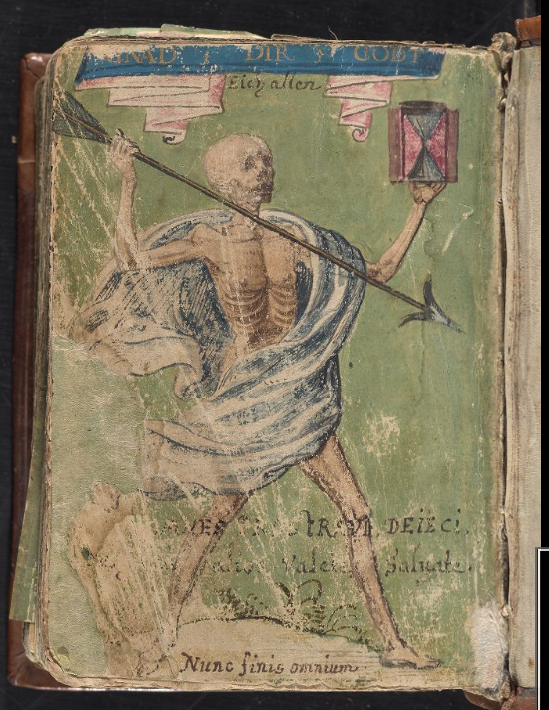
He appears again, fittingly, as the final illustration in the Helbig album, hourglass held high and dart poised. At the head of this page, somewhat softening the impact of the image perhaps, are the words, Gnad Dir Godt [God bless you], and mid-page, though the area is very rubbed, the words OMNES PROSTRAVI DEIECI [I cast them all down, prostrate] are discernible, and at the foot of the page, Nunc finis omnium [Now everything ends].
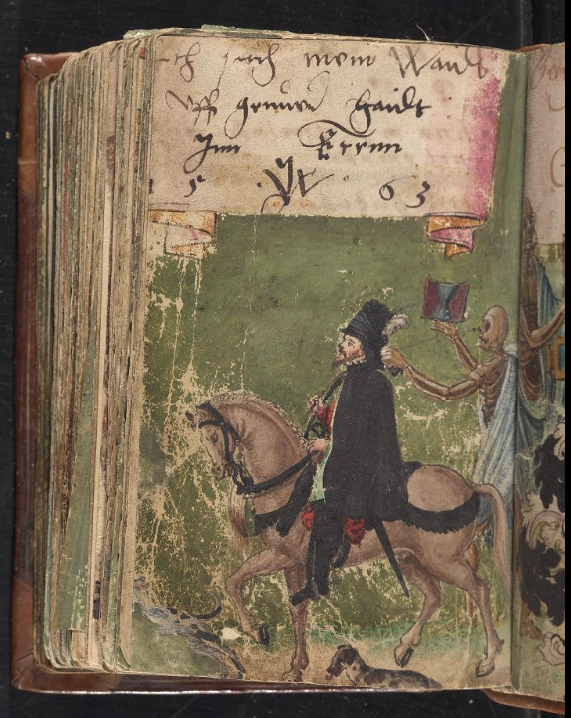
The same album along with such traditional memento mori devices as prone skeletons and skull-and-crossbones, includes this chilling scene of a gentleman evidently setting out for the hunt, astride his horse and accompanied by his dogs, unaware of the imminence of his death, as with hourglass in one hand Death’s other hand reaches up to grasp his hat.
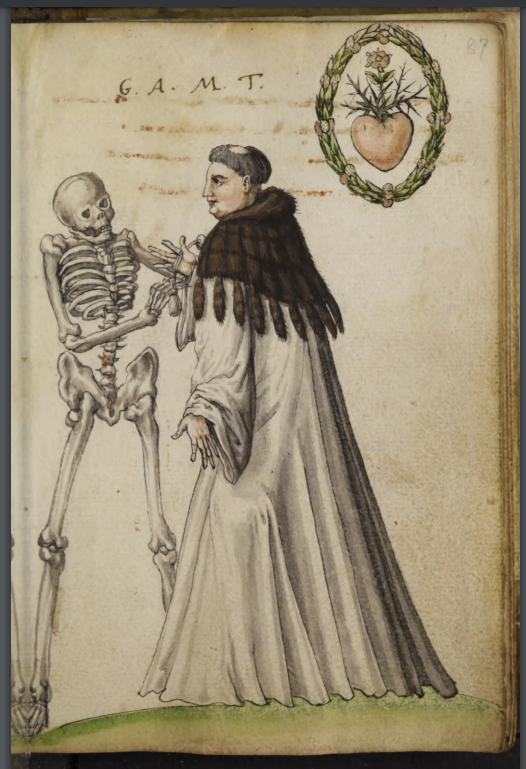
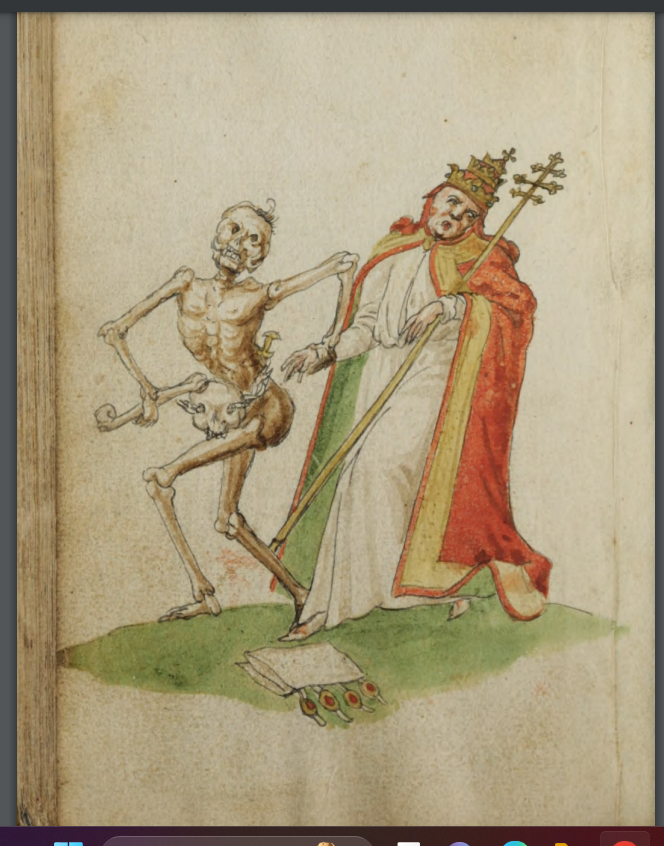
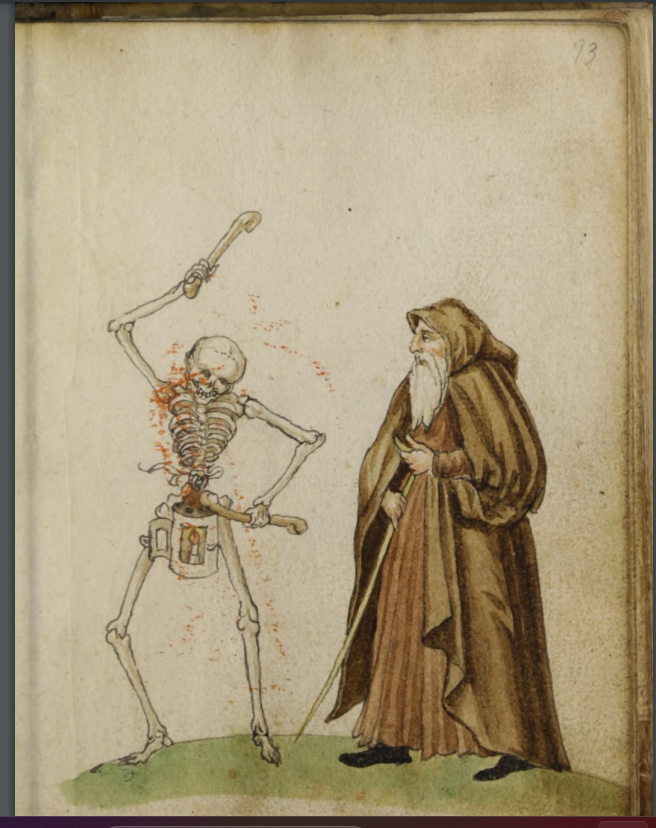
There are relatively few reflexes of the Danse Macabre in the albums, but there are several representations of individual ‘dancers’: the Twestreng album (dated entries 1580-4) includes high-quality paintings of Death and the Monk, the Pope, the Old Man, and the Cook (BELOW) – there are no accompanying inscriptions, but behind the monk’s head, within a wreath is the device of a rose amidst thorny stems springing from a heart.
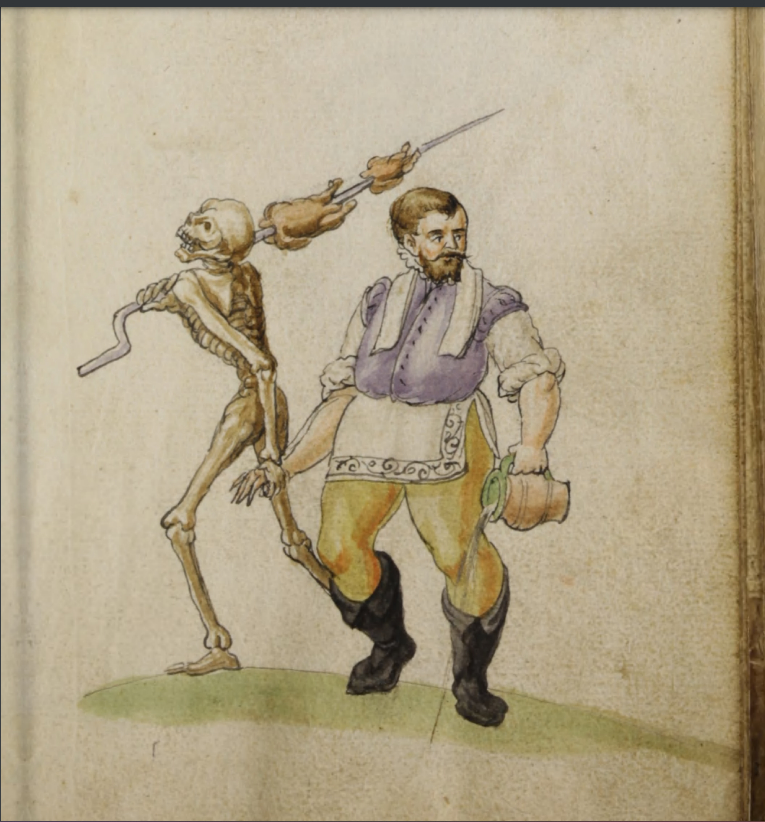
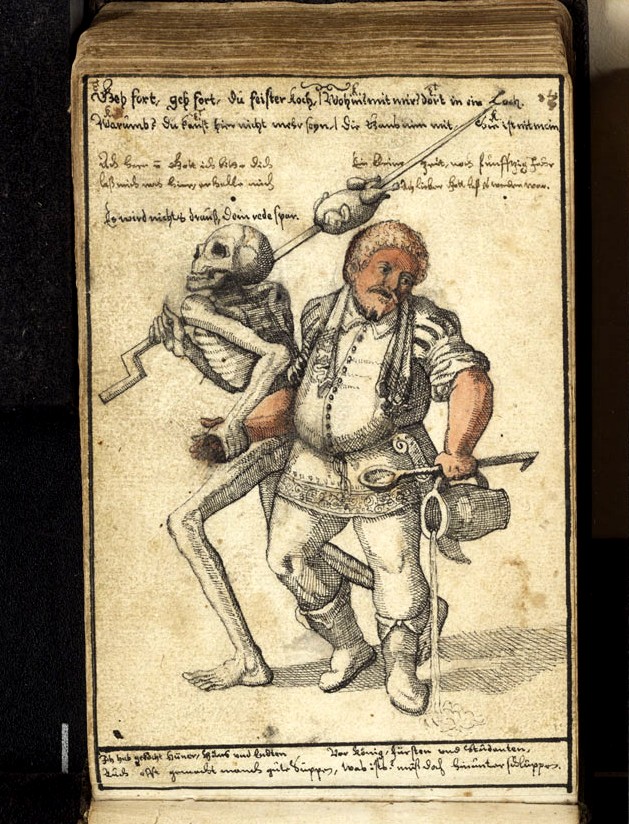
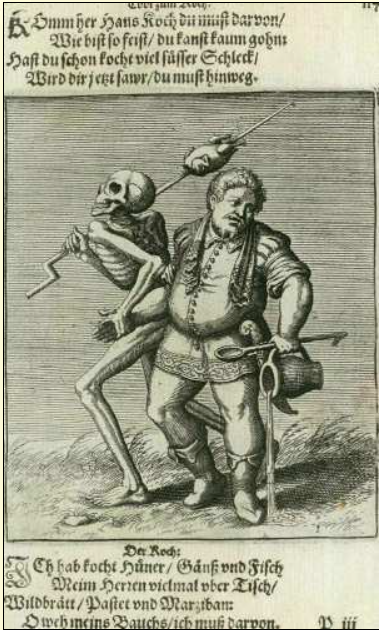
In the Merk album there is a fine painting of Death & the Cook made in the 1640s, a skeletal Death, a chicken on a spit over his shoulder, seizes the hand of the plump cook who spills liquid from the jug he holds in his other hand. Death cries, Geh fort, geh fort, du feister Koch! [Come away, come away, you plump cook]. The resemblance to the Twestreng image (PREVIOUS) is obvious and clearly suggests a common model based on the Basel dance (cf. Merian’s 1616 engraving below)
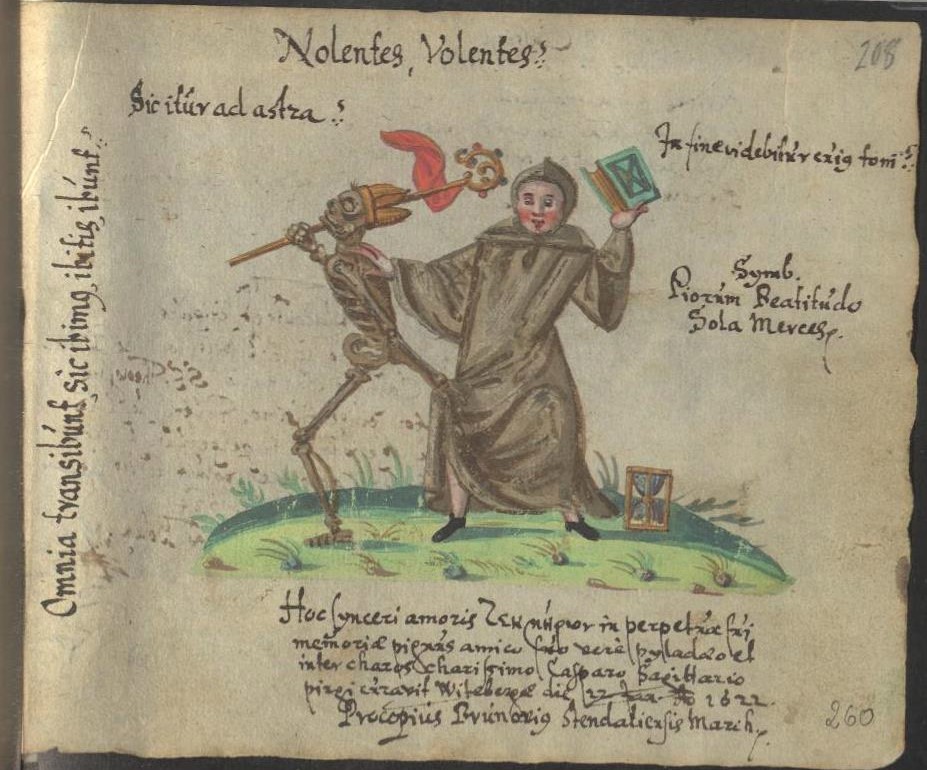
In the Sagittarius album (BELOW), on a page dated 1622, it is a bishop who is led away by the skeletal Death who seizes his robe, having already donned his mitre and carrying his crozier over his shoulder. The bishop holds up a book, and an hourglass sits on the ground by his feet. The scene is headed Nolentes, Volentes [willing or not], and surrounded with quotations of ominous import: Omnia transibunt! Sic ibimus, ibitis, ibunt [All things will pass away! So we will go, you will go, they will go], and In fine videbitur [cuius] toni [In the end we will see what key it is in], from the language of musical notation.
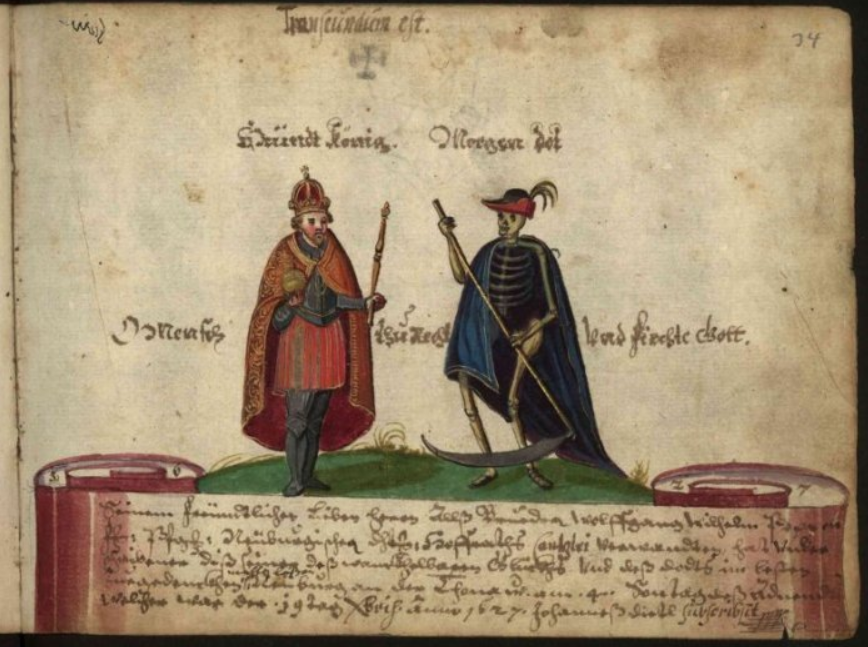
Painted in 1627 in the Popp album are Death & the King, with their respective attributes, scythe and sceptre, and the text, neundt konig morgen tot [today a king, tomorrow dead]. Perhaps to drive the point home, Popp has recorded the death of the commissioner of the miniature, almost functioning as a title to the scene, the customary small black-ink cross, and the words Transeundum est [he has passed over].
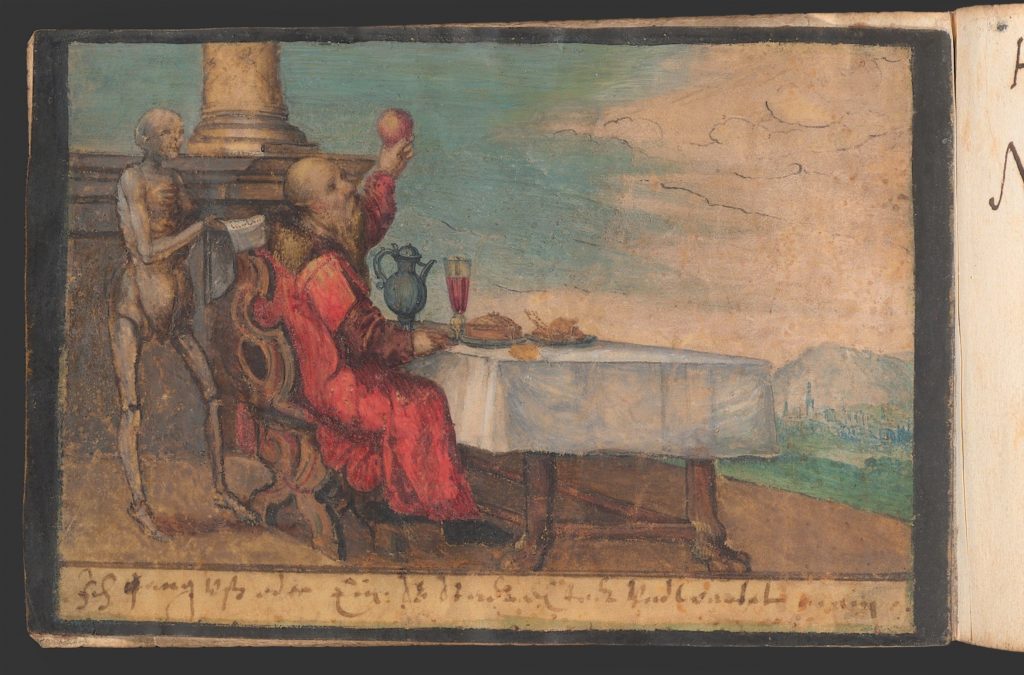
Some time between 1636 and 1643 an unknown artist painted a particularly sinister Death & the Old Man on f.64v. of the Meyer album. He sits at table – on the terrace of his evidently substantial house, perhaps – staring out at the view of the distant town, with before him on the white table-cloth, a large pie, the remains of a roast bird, and a large glass of red wine, and holds aloft a round fruit of some kind. But right behind him – unseen – hovering like a respectful waiter, waits Death, a long paper in his bony hands with some illegible script visible – perhaps a record of the old man’s sins?
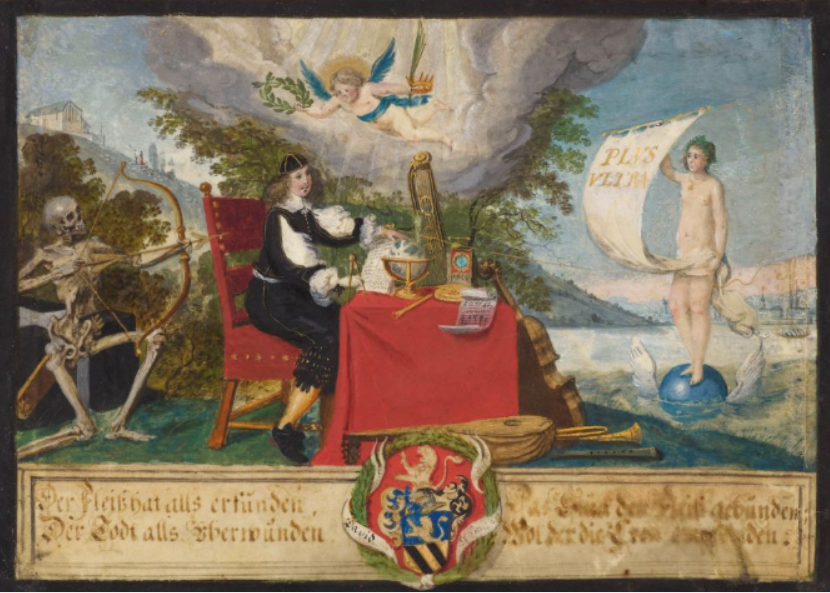
In this slightly later miniature below, dated 1658, the situation is perhaps not quite so bleak as appears at first sight. Again, the scholar at his desk is unaware of the skeletal Death who has sneaked up behind him, poised to shoot him in the back with his arrow, but in the distance the scholar sees Fortuna holding up her sail on which is the motto PLVS VLTRA [more beyond], encouraging further discovery, as above his head, a genius hovers to crown his researches with a laurel wreath! The inscription below reads
Der Fleiss hat alles erfunden
Das Gluck den Fleiss gebunden
der Tod alls uberwunden
wol der die Frau gefunden
An encouraging note on which to end this piece!
[i] I have not been able to ascertain the nature of the Totentanz recorded in RAA as painted in the Michaelis album (1612-35).
Leave a Reply to Death & the Alls — “and I kill you all!” (with a digression on trumpet rebuses) – Album Amicorum: Early Modern Stammbuch Iconography & related Cancel reply