[SEE also my post
https://albumamicorumear-e4qvahs764.live-website.com/the-additional-fool-that-would-be-you/
and the various posts that show women making fools of men (often so-costumed) in one way or another, e.g. tempting them into the eel-/lobster-pot, fishing for them, fowling for them, watching them flutter down from the dovecote, etc]
We have already met several examples of what I call the ‘commentary’ fool — who stands at the edge of the scene and maybe even points at the foolish behaviour in question, but here I want to concentrate on the figure of the costumed fool himself — in his own right, as it were.
While far from absent, the fool — so abundantly present in the late 15th and early 16th centuries, is surprisingly rarely encountered in the albums — evidence of a certain decline in popularity of the figure, which happens to coincide with the rise in popularity of album-painting.
Commentary fool
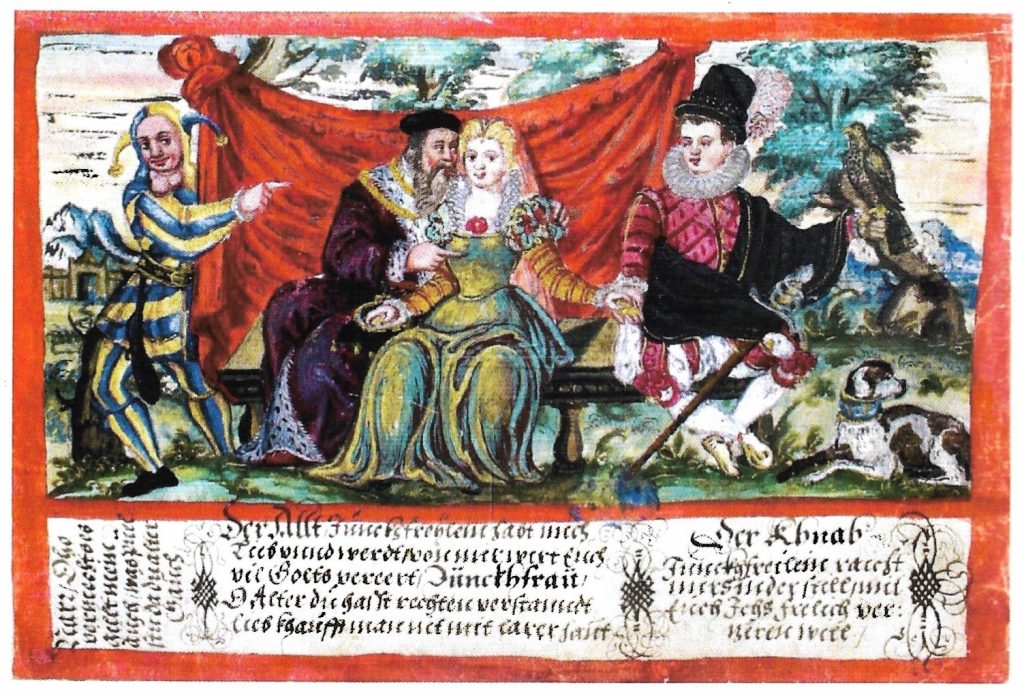
That said, I begin with a quick reminder of the ‘commentary’ fool — whose very presence signals the foolishness of the actions represented. On f.63v of the Penzinger album, for example, the fool — also, interestingly, here exhibiting several goitres, an occasional fool-attribute — points to the scene in which we see that the old man embracing the young woman has not noticed that she has picked his purse, and is handing on the money to the young nobleman sitting on the other side of her. (Also a fairly common motif in earlier 16C woodcuts)
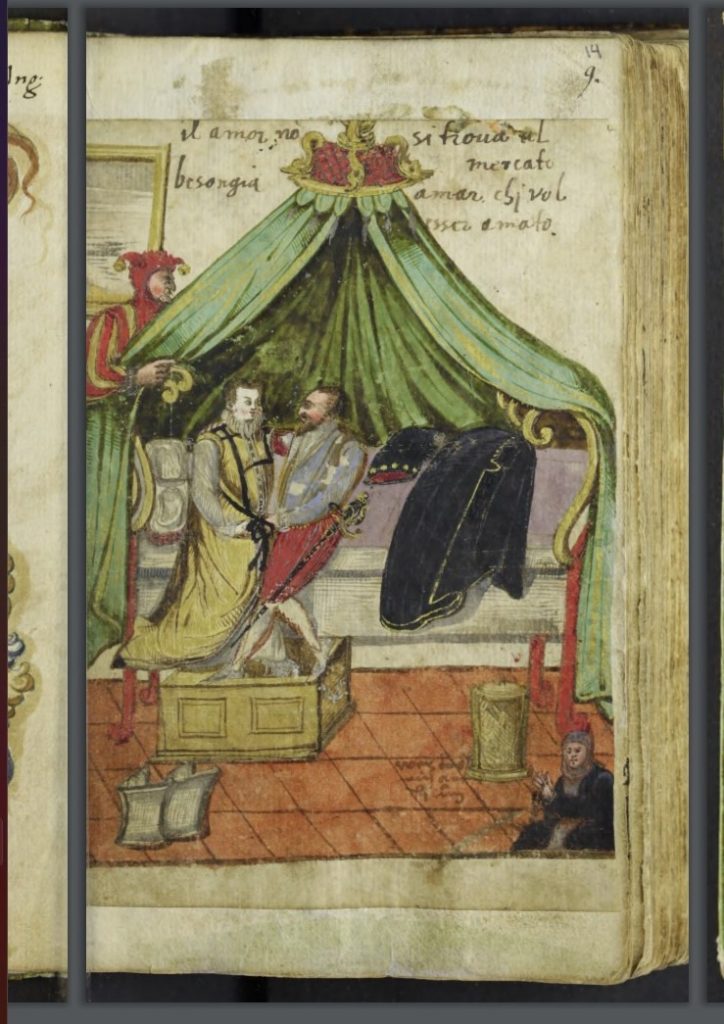
In Georg Bernhard’s album a young man visiting an Italian courtesan in a brothel is also pointed at, by a fool skulking behind the bed-canopy. The Italian inscription — perhaps we may think of it as spoken by the fool — reads, Il amor no si troua nel mercato, besongia amar ebi vol esser amato [Love is not to be found at the market, one has to love if one wants to be loved].
Thott 391, 8°, image 31
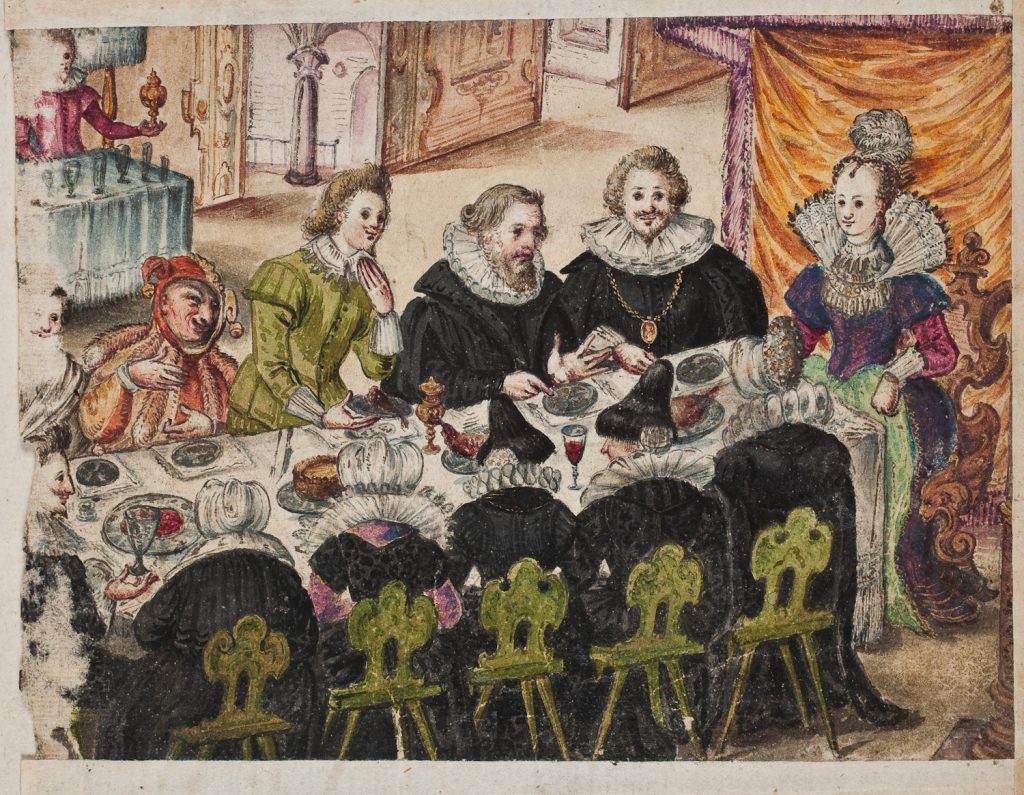
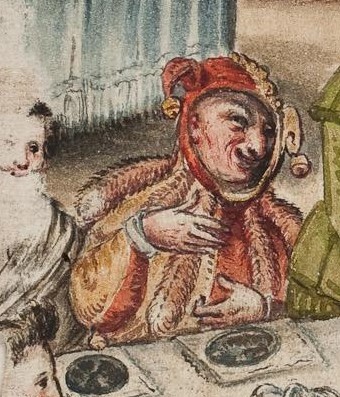
In 16C paintings of banquets a fool is often represented — this may be as much a realium as a symbol — on the miniature scale of the album we see him, for example, in those of Sebastian von Stamps and Hans Ludwig Pfinzing von Henfenfeld in one of his usual costumes with coxcomb hood, but the fool attending the Grossmann banquet (below), in addition to the usual parti-coloured costume and hood, with coxcomb and belled ass’s ears, also sports a collar of five foxtails.
Fool’s Hood
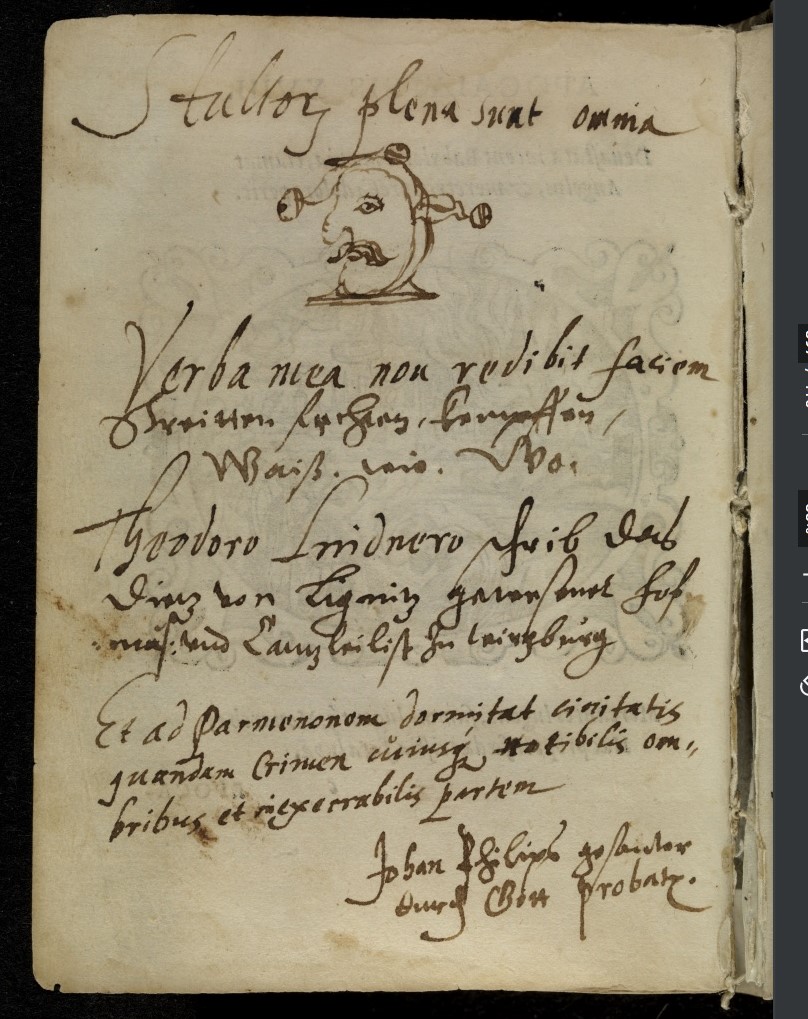
The fool’s hood/cap is, of itself, a sufficient visual shorthand for the notion of folly, of course, and occasionally, indeed, is the only motif represented in otherwise strictly literary albums. Stultorum plena sunt omnia [everything is full of fools — from Cicero, Ad Familiares 9.22.4] is the label above an amateurish sketch of a mustachio’d fool’s head in a belled and eared hood, drawn in the album of Theodor Lindner, whose nickname was Schnarrenbarth — presumably an earlier variant of modern Schnurrbart [moustache]. So a little joke at the album-owner’s expense too!
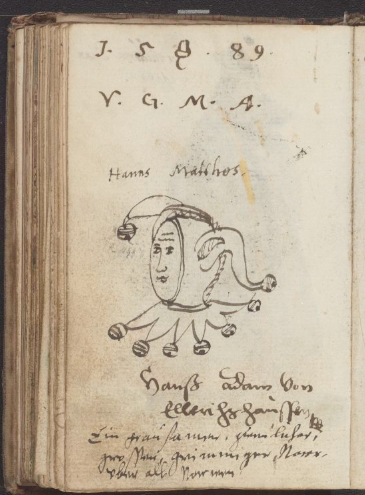
A similarly costumed fool’s head with an additional collar of bells is sketched in the album of Ulrich von Knöringen, dated 1589.
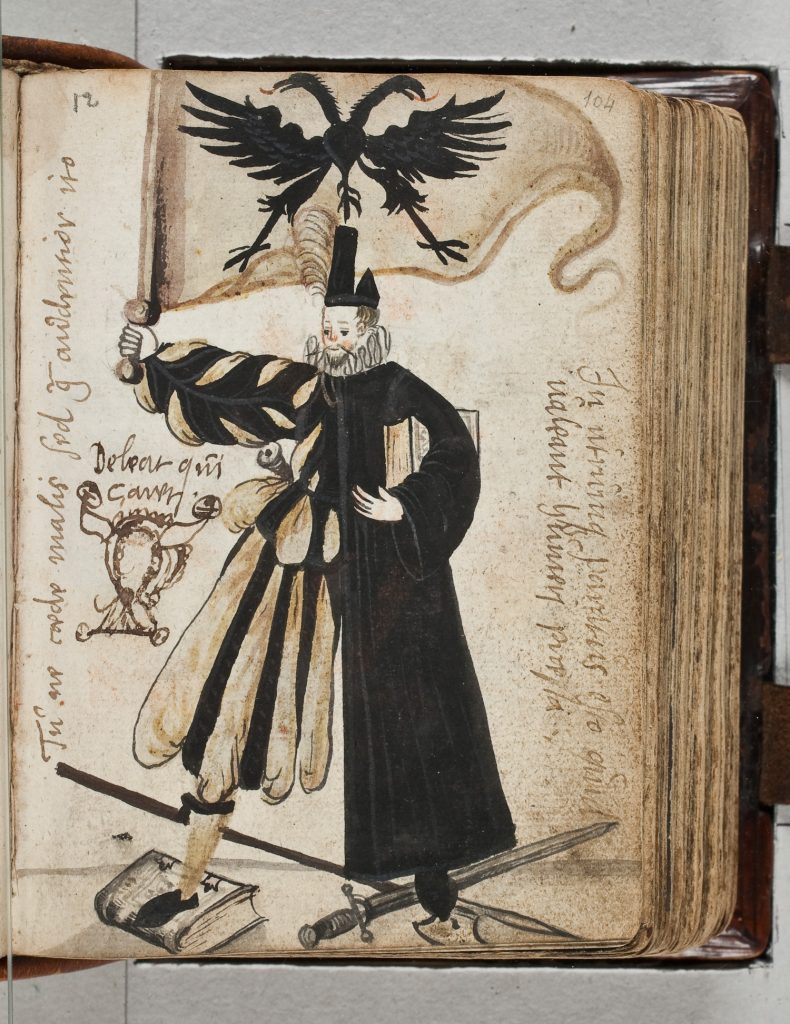
On f.104r. of the Paludanus album a bifid figure [we shall deal with these popular ‘bifids’ in a later post] is drawn, and beside it a fool’s hood labelled, deleat qui cavet [?]
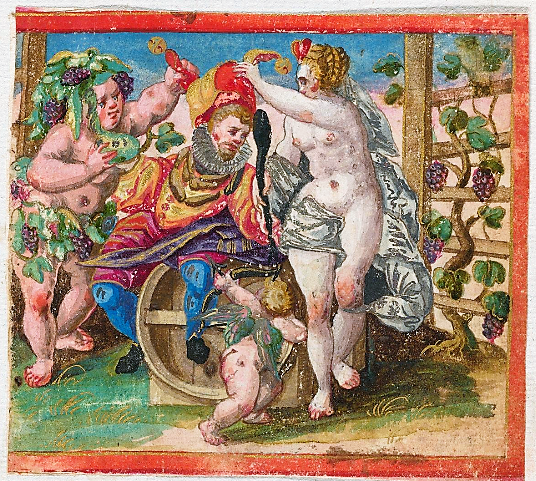
An orphaned leaf in the Frommann Collection shows Bacchus and Venus putting a fool’s hood on a drunken man who slumps against (Bacchus’s) wine-barrel — the symbolism is transparent, though one cannot help thinking Bacchus has a nerve!
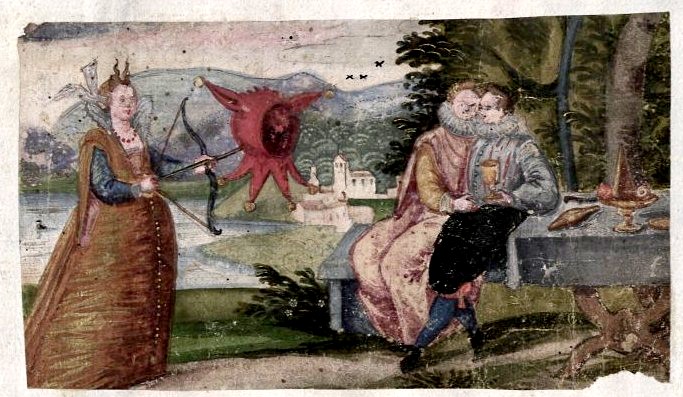
A miniature painted in the Jenisch album, f.223v., has Venus dressed as a Venetian courtesan — and coiffured with the diagnostic corna so beloved of our painters — aiming her son’s bow at a pair of lovers seated at table in a garden setting, except that her arrow is tipped with a large fool’s hood. (c.1600?).
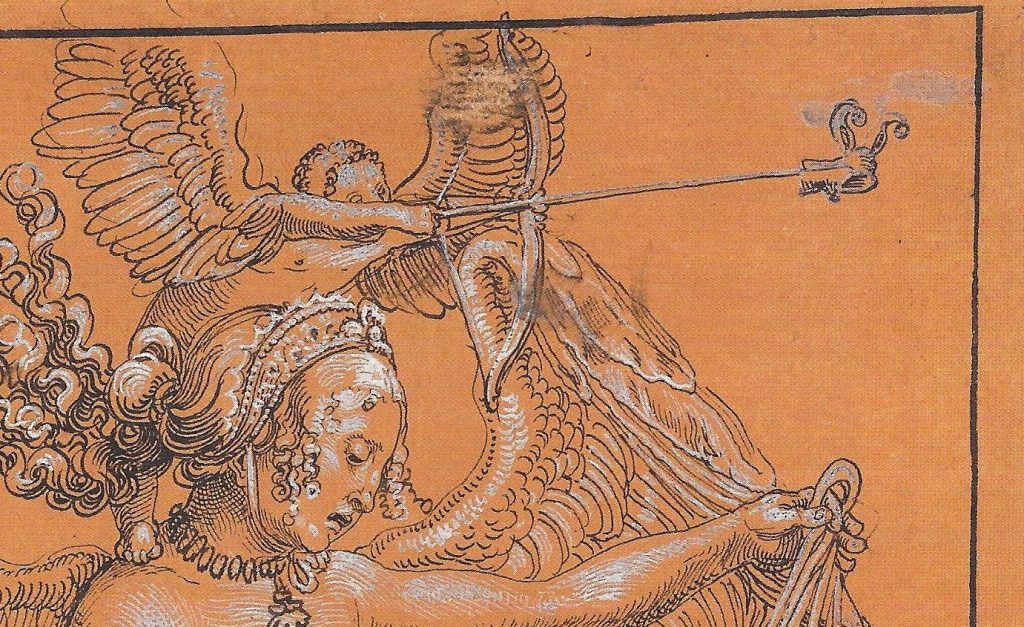
The only precedent I’m aware of for this scenario is a much earlier pen-&-ink drawing made by Swiss artist, Niklaus Manuel Deutsch, c.1512/13, of Venus with snares for catching lovers, and Cupid on her shoulders, firing his arrow tipped with a tiny fool’s cap.
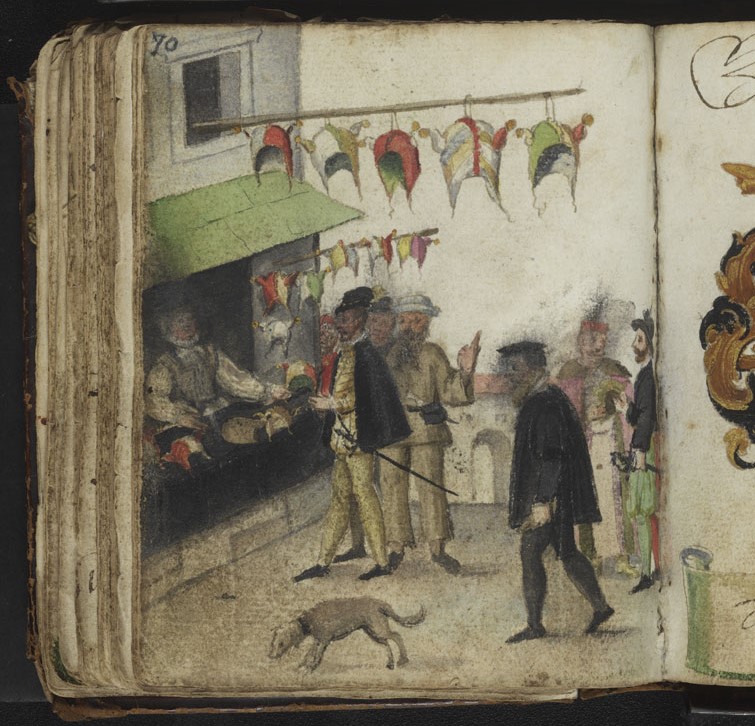
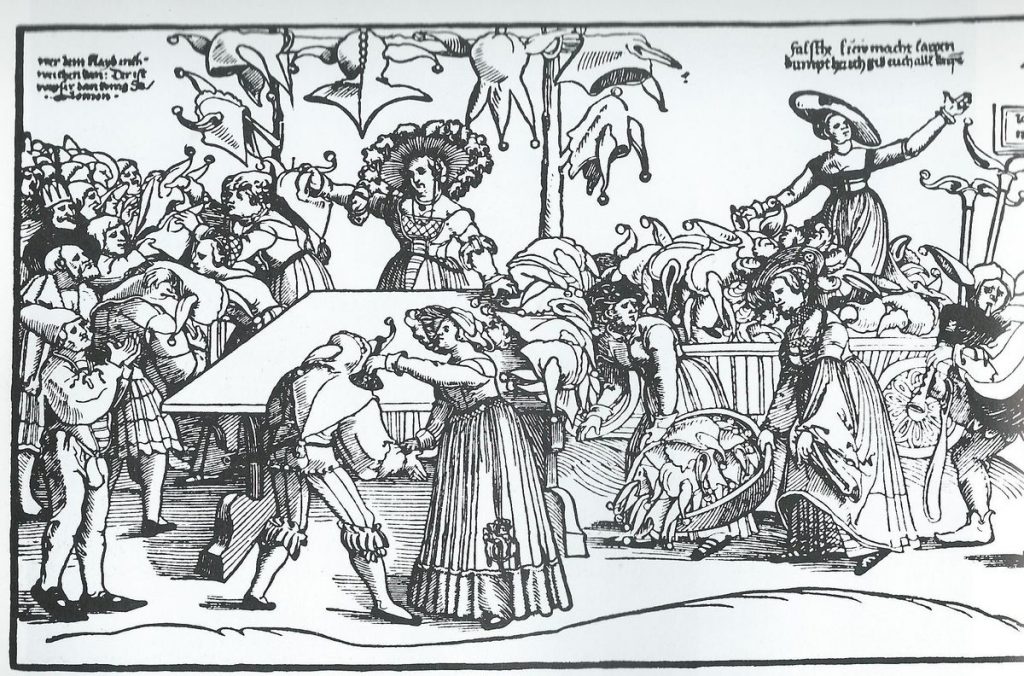
A miniature in the Schrötter album depicts a woman in a shop that sells only fools’ hoods doing a roaring trade — evidently not the ‘niche market’ one might have thought! Though it is quite independent of his 4-sheet Kram der Narrenkappen (excerpt below), the same subject had been treated at much greater length some 40 years earlier in a series of woodcuts by Erhard Schoen.
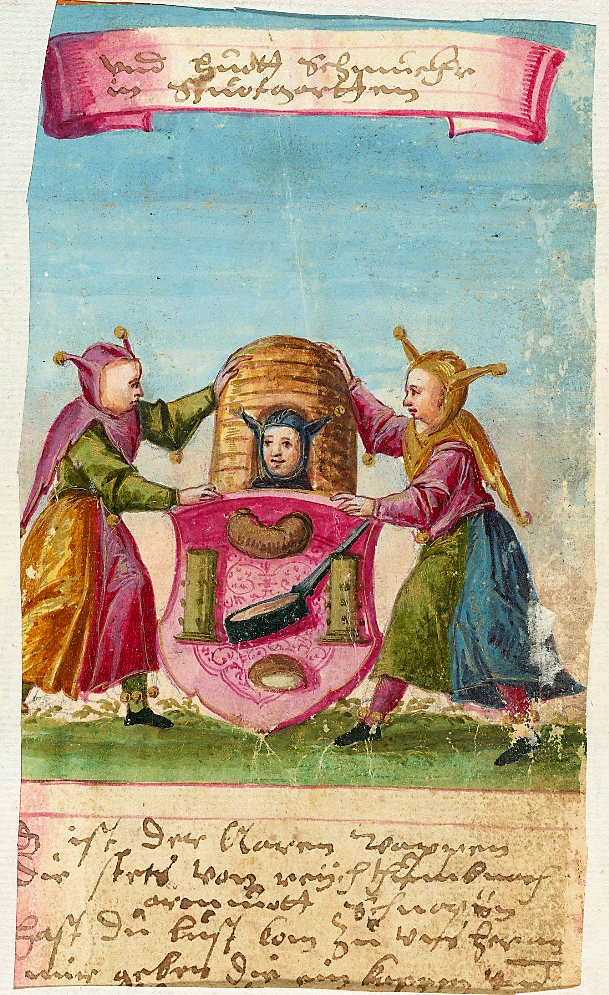
In a culture so obsessed with coats-of-arms, it is a relief to come across the occasional artist original enough to burlesque that self-advertising penchant. To the extent that the albums which are our concern here evolve out of — but are never entirely outgrow — the Wappenbücher, we should not be surprised to find that the fool has his arms too. Another orphaned leaf in the Frommann Collection depicts the fool’s coat-of-arms — food and drink — here with two fools as ‘supporters’:
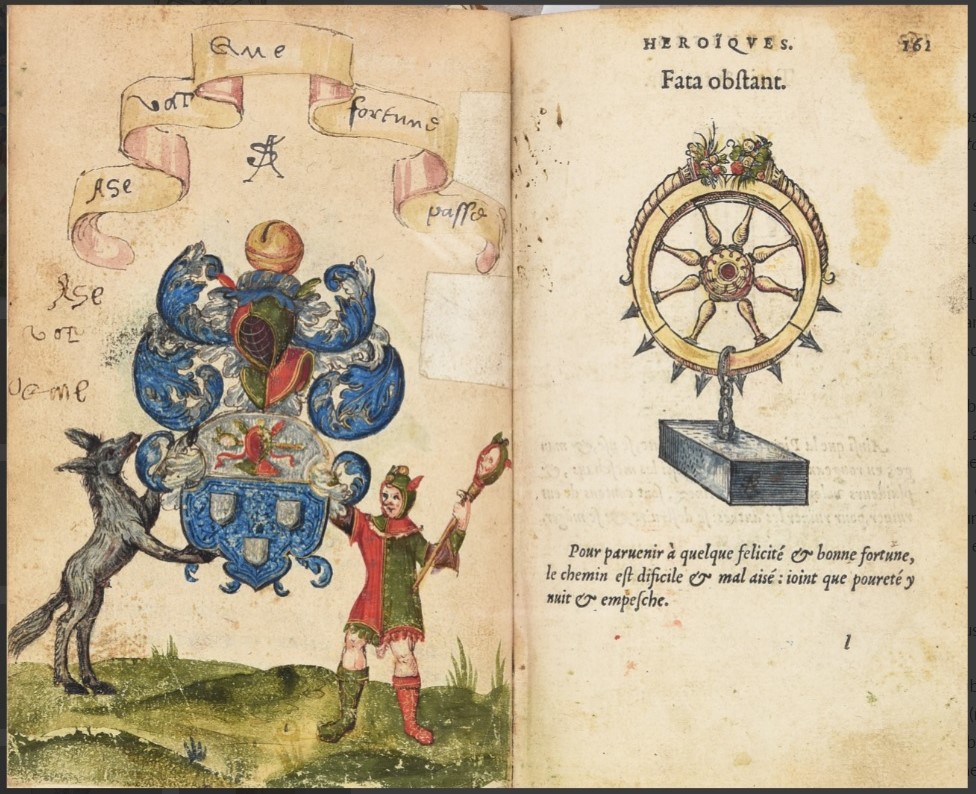
Cristobal de Ametzaga used a copy of the 1557 edition of Paradin’s emblem-book, Devises Heroiques, as his album — it includes a burlesque coat-of-arms with fool and ass supporters, and a parti-coloured armoured fencer’s masked hood surmounted by a fool’s bell as crest. The shield bears a fool’s hood and marotte [bauble], and the banderole above is inscribed with a French proverb (found also as a contemporary house-inscription), Ase vat que fortune passe [? He fares well enough whom Fortune passes over] — with a pun on the ass [aze in earlier French].
It’s a mad world
When this orphaned leaf was sold in 2014 the auctioneer clearly didn’t recognise the “two men” painted on it, and even the RAA repeats this vague identification — zwei Männer mit Buch bei einer großen Kugel mit Kreuz [two men with a book beside a great ball with cross] — and no mention of the fool’s hood at all!
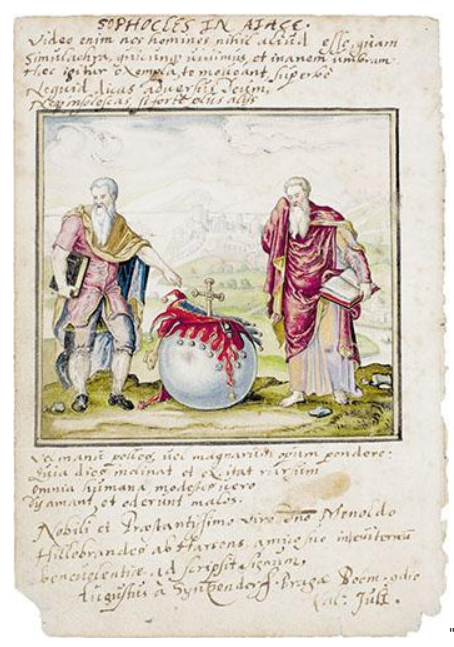
But these are no ordinary mortals! These are the ancient Greek philosophers, Democritus and Heraclitus, frequently paired in the early modern era on account of their contrasting attitudes to the behaviour of humanity; Democritus, styled ‘the laughing philosopher’ and often shown laughing, espoused a cheerful attitude to humanity’s follies, where Heraclitus, ‘the weeping philosopher’, wept over those same follies — here we see him wiping his tears away with his robe. On internal evidence this leaf can be dated to 1614, but yet again, it is no invention of the painter — he has made a fairly close copy of one of the emblems in the de Brys’ highly influential Emblemata Saecularia which by this date was in its second edition (1596, 1611), and the emblems from which frequently appear cut out and pasted, and often coloured, in the albums. The Latin motto beneath the emblem means “We seem equally worthy of laughter and tears”, and that symbol of folly, the fool’s hood, here covers the world in an obvious visual metaphor.
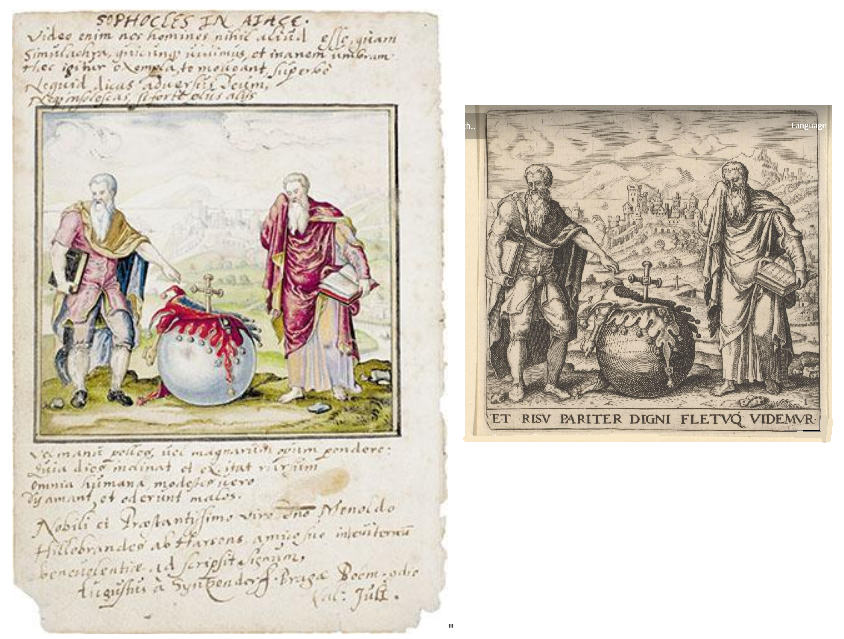
But as with almost all the images in the Emblemata Saecularia, de Bry was copying this much earlier print originally etched by Dirck Volckertsz. Coornheert after a design by Maarten van Heemskerck, and published by Cock in Antwerp in 1557
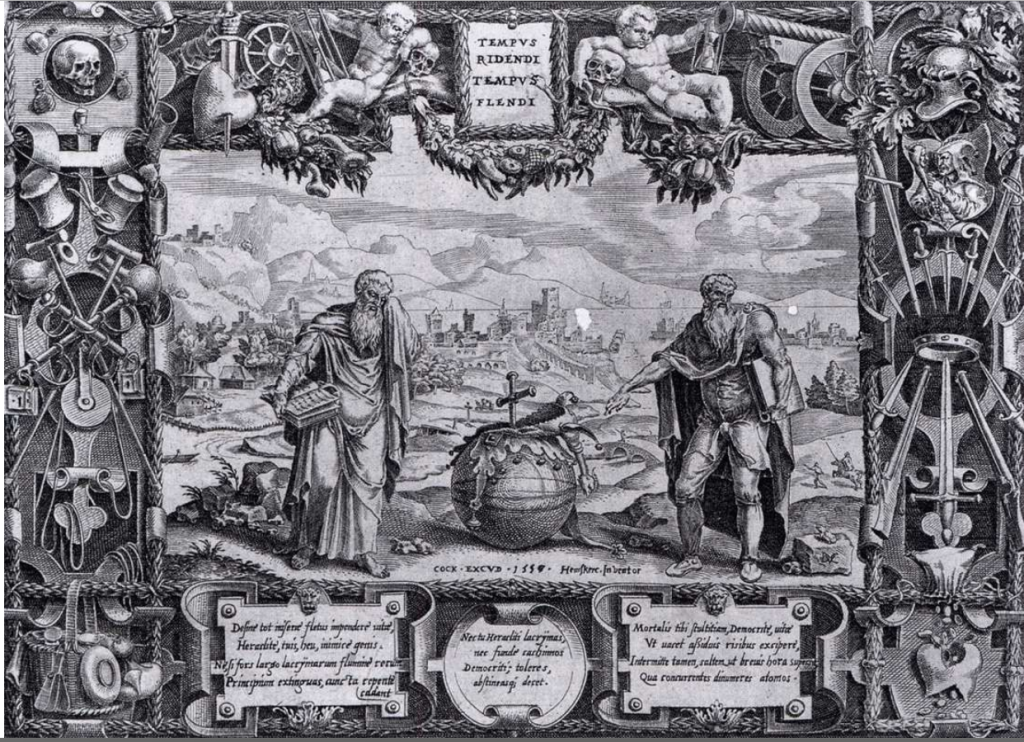
A hasty sketch, signed and dated 1623, by the Dutch landscape painter, Jan van Goyen (1596-1656), was probably intended for an album (according to the RKD –Nederlands Instituut voor Kunstgeschiedenis). It shows the two philosophers leaning on what is perhaps a tomb, with an out-of-kilter world-orb between them, though it bears no fool’s hood this time. They are accompanied by presumably emblematic creatures — Democritus (left) by the playful ape, Heraclitus (right) by an ominous owl,
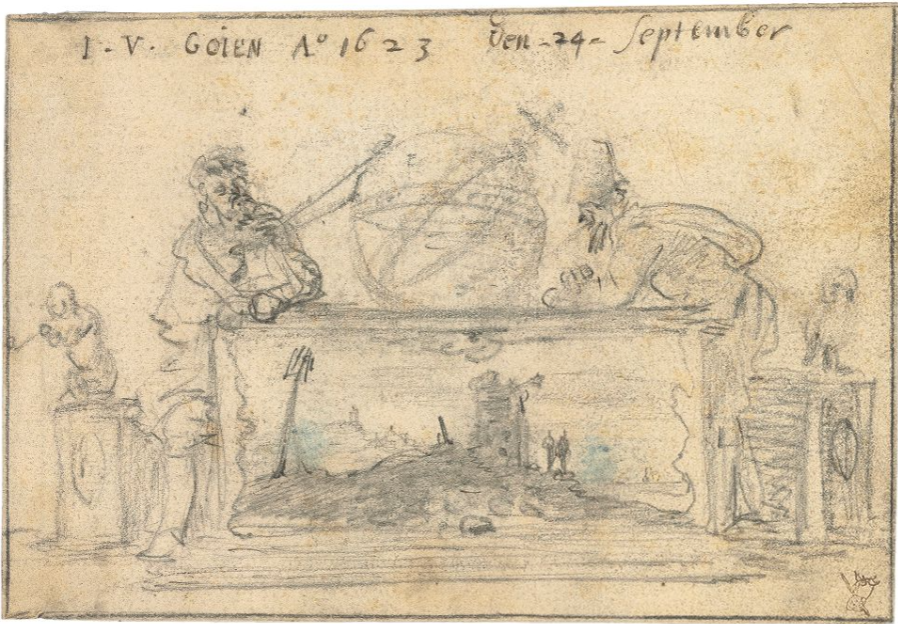
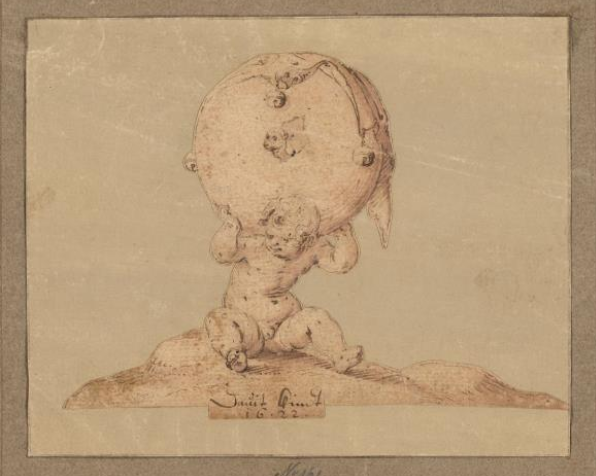
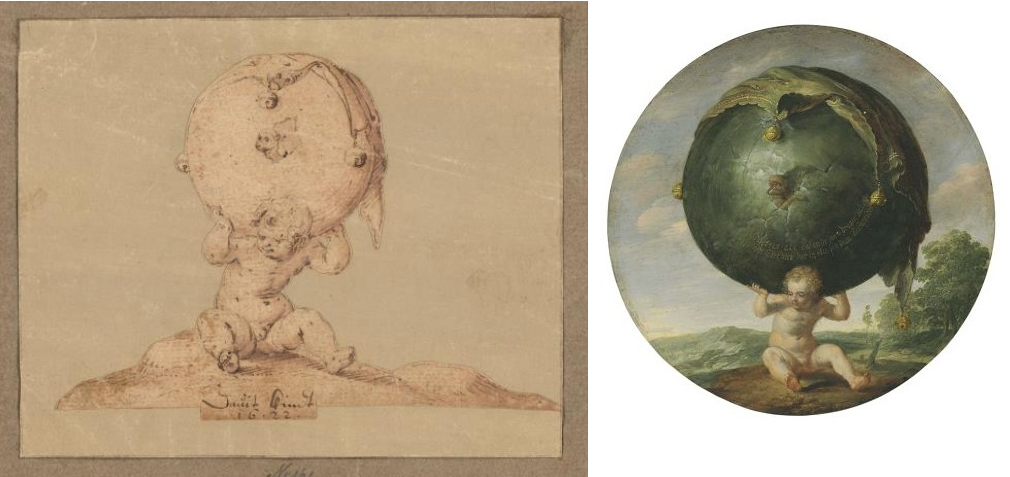
Another drawing, signed by the artist David Kindt, made in Hamburg in 1622, was also almost certainly intended for an album or, indeed, extracted from an album. It depicts a baby boy or putto bearing the whole world, Atlas-like, on his shoulders, a fool’s hood draped over the top of the globe, and a small animal-head poking out from the centre of it. It is obviously related to, if indeed it does not copy, a small oil on panel painting attribute to Cornelis Ketel (d.1616), which emerged at auction only recently, in 2017.
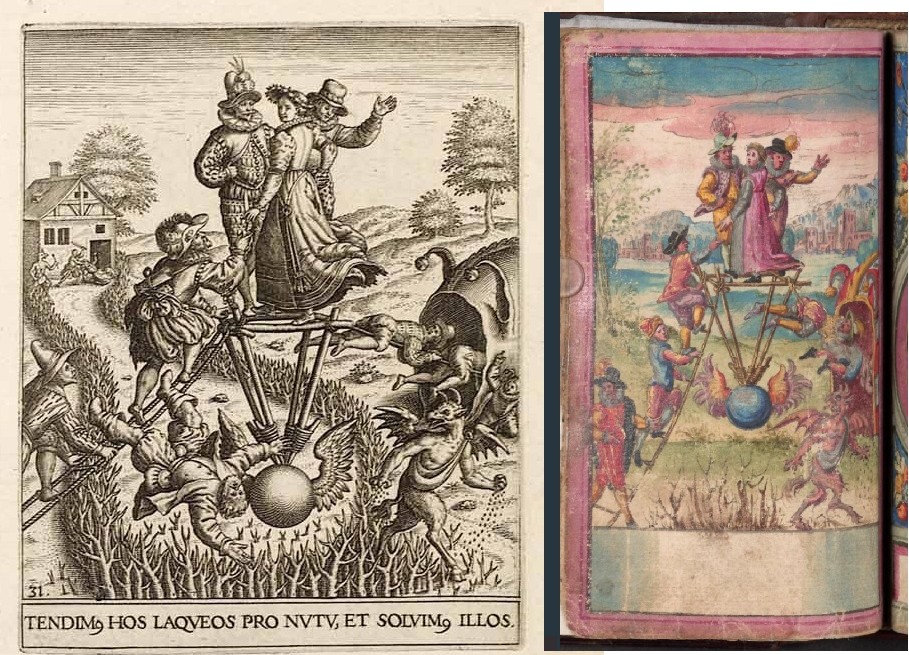
But another album-painter also copied one of de Bry’s engravings from the Emblemata Saecularia which also features a (giant) fool’s hood in which, after their precarious passage through life, transient mortals end up:
a female fool
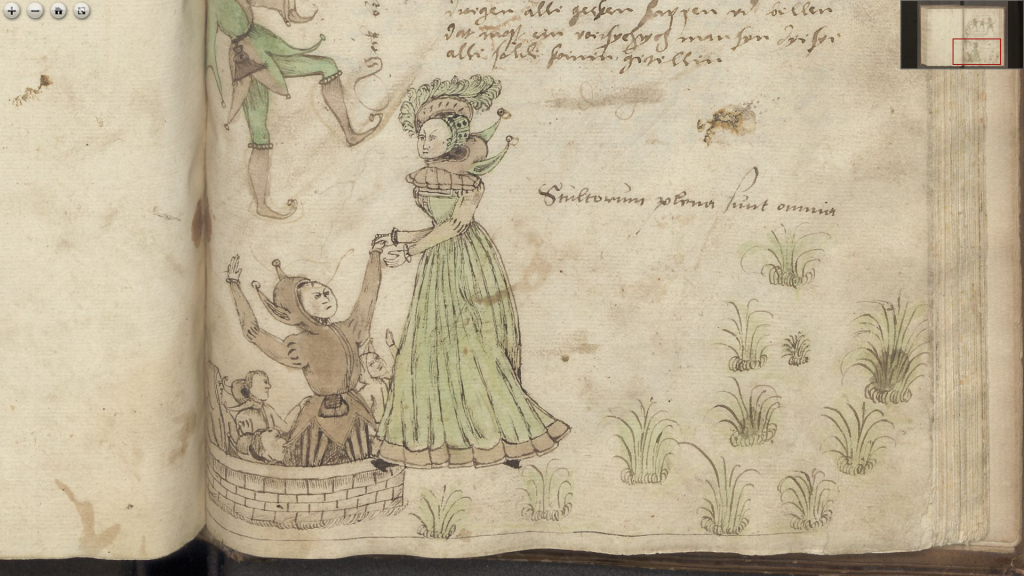
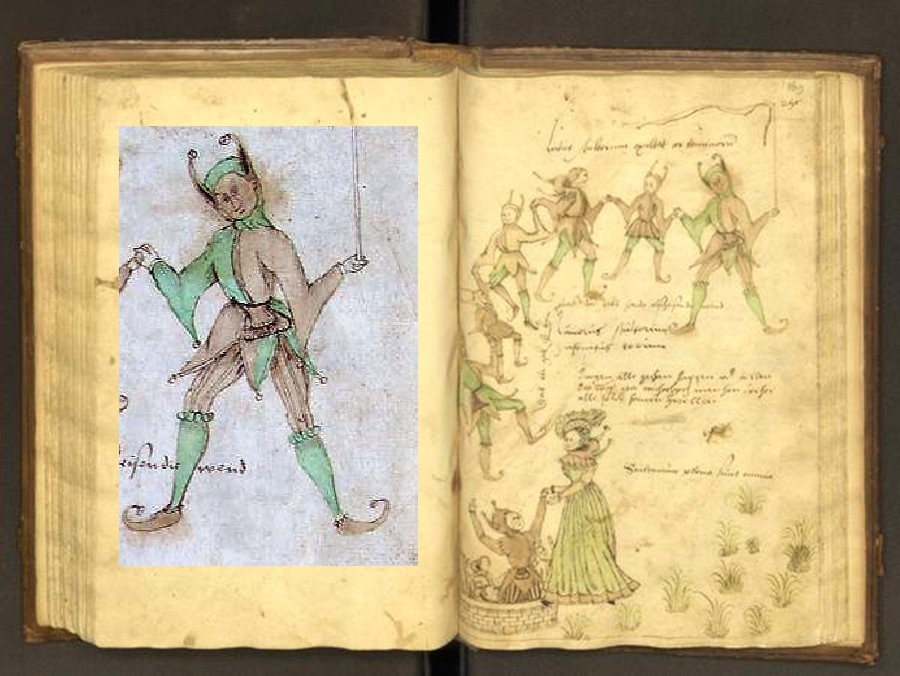
A dance of six fools labelled Ludus Stultorum [the fools’ game] appears in the so-called ‘Overijssels Liedboek’ (1564-77), used as an album amicorum by Margaretha Hagen, and on the same page a woman — wearing a fool’s hood — helps four other fools from some sort of circular enclosure, perhaps a well. Two of the most popular fool-proverbs are inscribed within these two scenes: Numerus stultorum infinitus est [the number of fools is infinite — Ecclesiastes 1.15] and Stultorum plena sunt omnia, which we have noted already accompanying the hood in the Lindner album (above). [For more detailed description of the traditional fool costume, see further below]
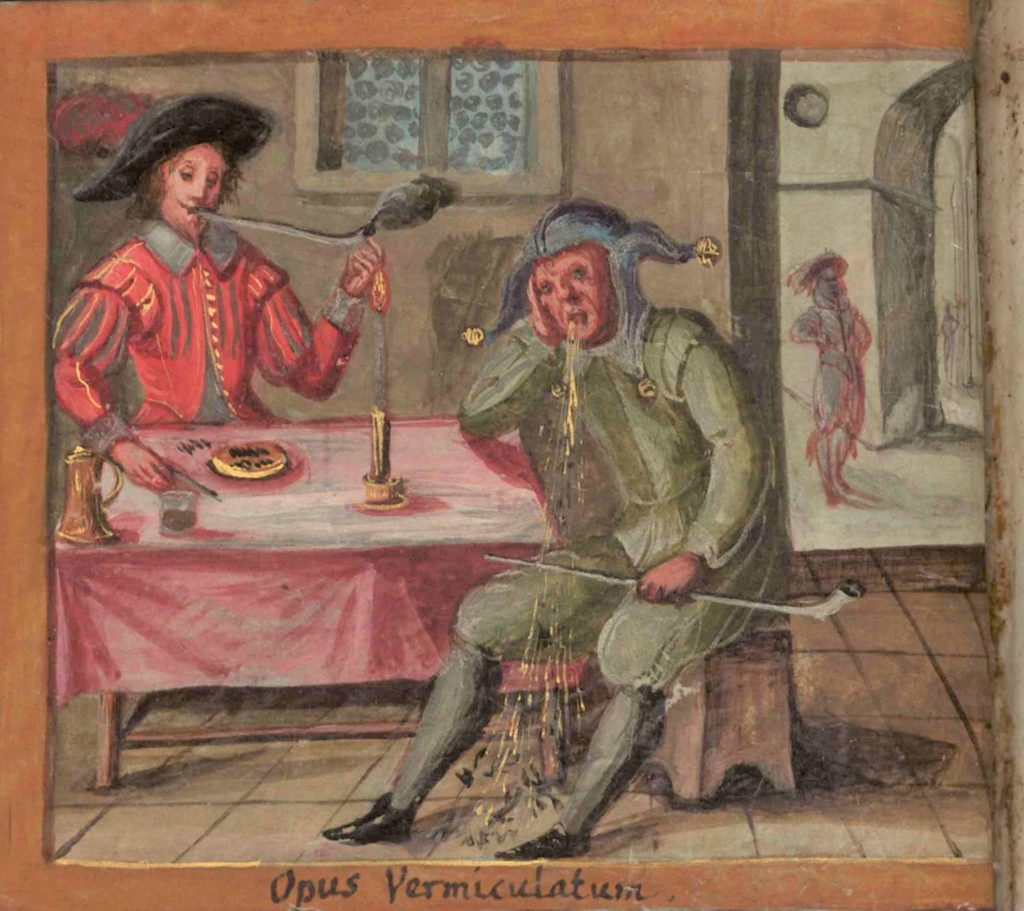
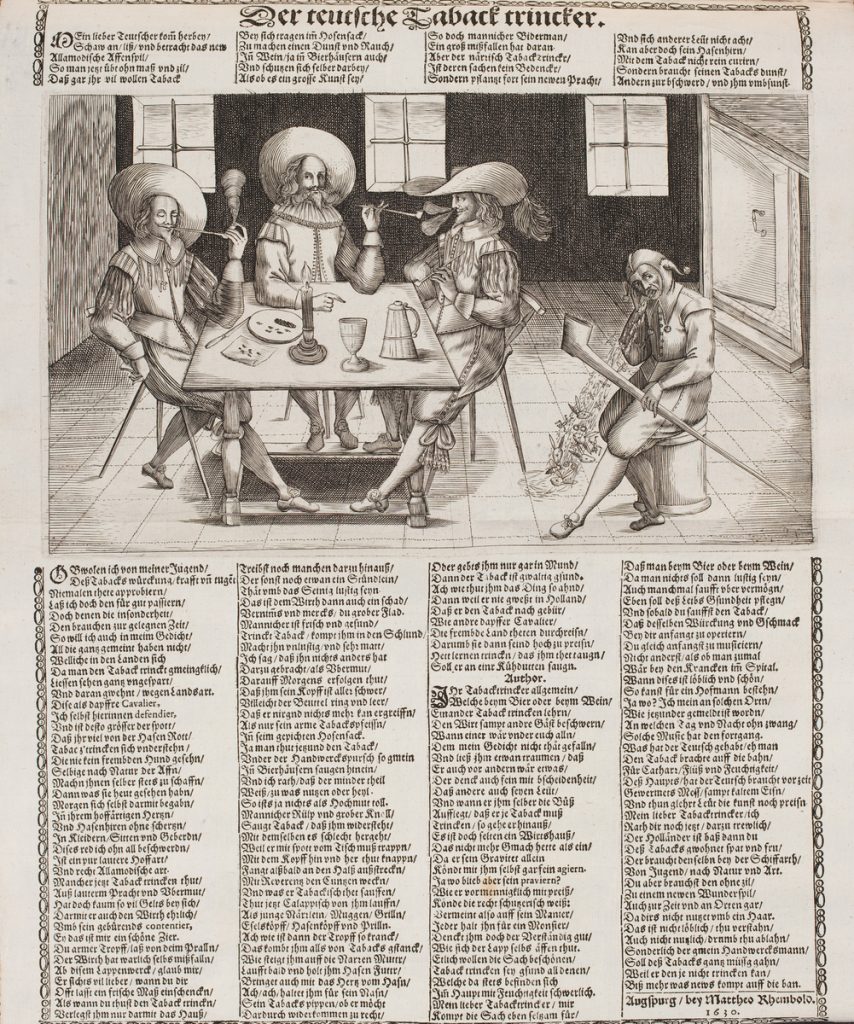
A miniature in the Aurpach album dated 1631 of a costumed fool holding an outsize clay-pipe and vomiting, beside another man smoking a pipe at table, owes its inspiration to the cut illustrating a German broadside issued in Augsburg the previous year entitled, Der teutsche taback trincker. So, in fact, this is probably another ‘commentary’ fool, demonstrating the foolishness of smoking.
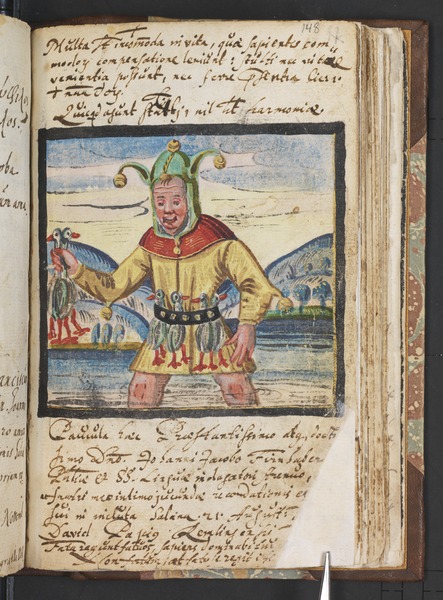
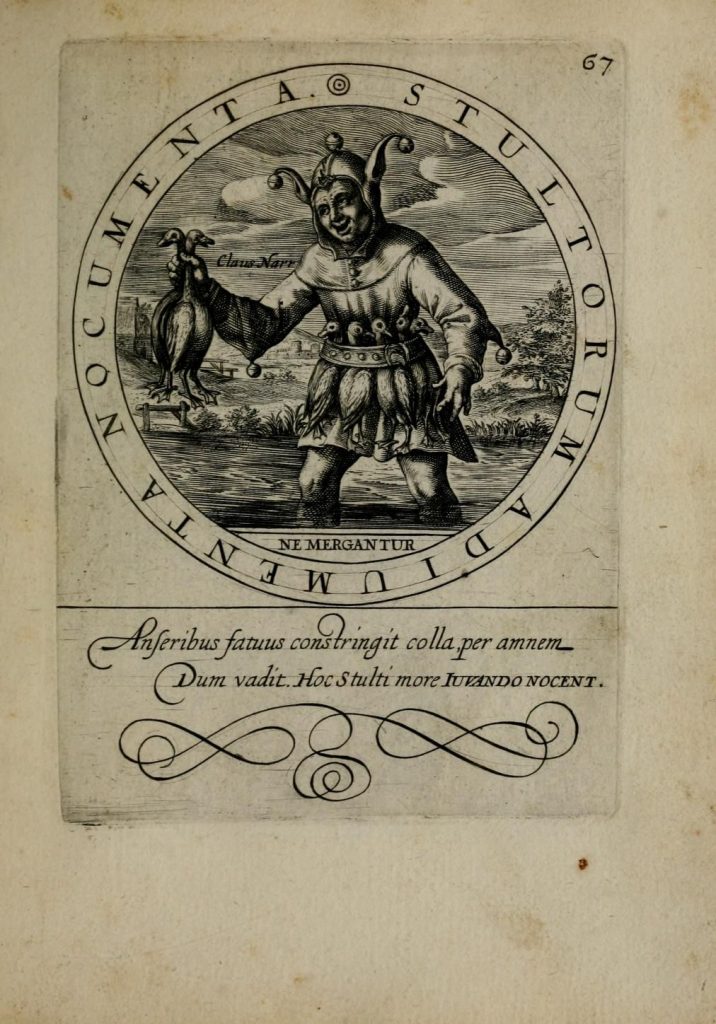
The fool painted on f.148r. of the Firnhaber album in 1614, who ‘saves the ducks from drowning’ by wading across the river, holding some, and with others tucked so tightly inside his belt that they are strangled as he wades across, is clearly copied from emblem 67, NE MERGANTUR [so they should not drown], in Rollenhagen’s Nucleus Emblematum Centuria Secunda (Arnhem, 1613), where he is named as the (historical) Claus Narr. The moral is that the help of fools can be harmful, even fatal.
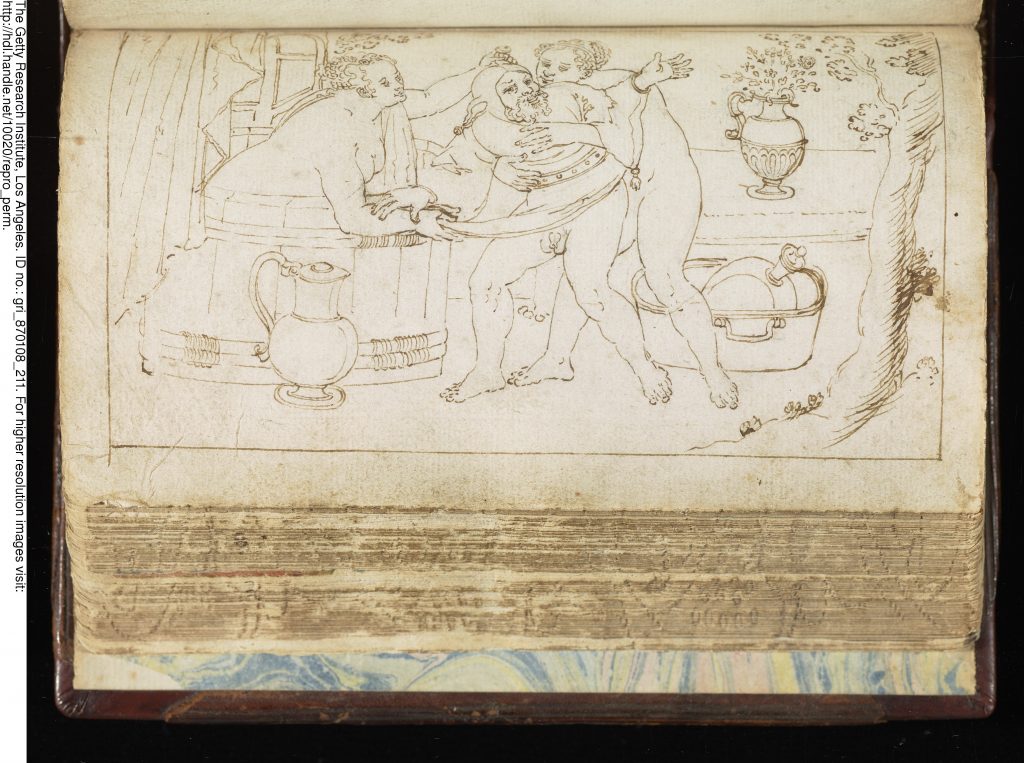
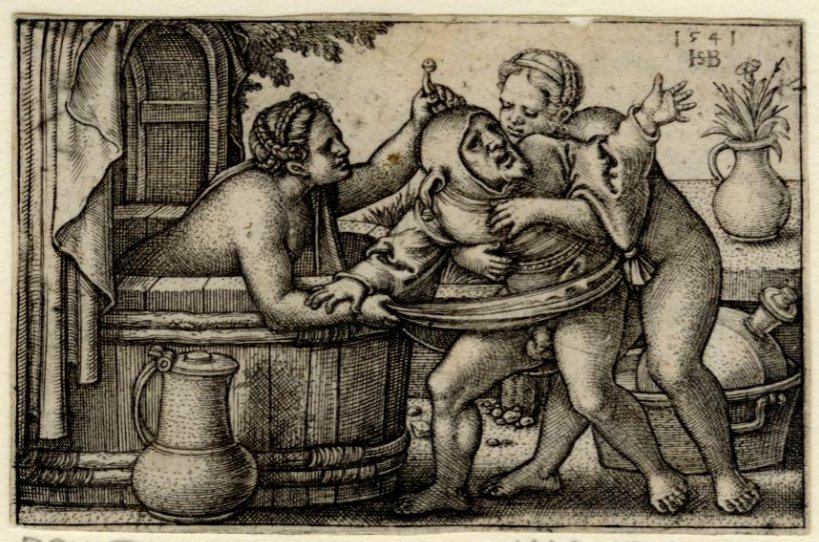
And the popular scene of the fool who resists being pulled into the bath by two women in an unfinished miniature in the early 17C Gruber album is clearly copied from Beham’s print of that subject engraved in 1541.
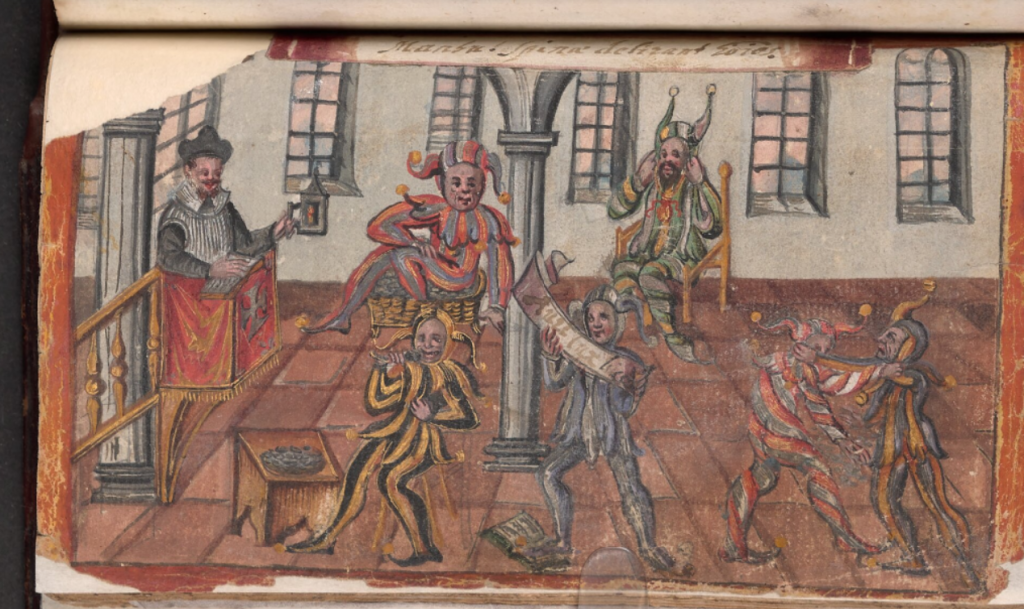
A curious scene in the album of Matthias Wiemayer, begun in 1606, shows a room not unlike a church interior, with a preacher in a pulpit and six costumed fools. The two inscriptions are difficult to make out — that on a banderole held by one of the fools perhaps reads Fiat lux facta… i.e. an irreverent use of Genesis I.3, “Let there be light, and there was light”. Is this a parodic sermon, a sermon joyeux with the preacher, who holds a lantern, addressing a congregation of fools? And Is the fool nearest the preacher shown as sitting on a basket of eggs — is he an Eierausbrüter [egg-hatcher] ? [for which motif see my Pinterest board https://uk.pinterest.com/malcmjones/fool-etc-broods-hatches-eggs-eierausbruter/]
Towards the end of our period, apprentice painter Hans Georg Haimbhilger drew a scene of three fools, one of whom appears to be blindfolding Justice, in the album of fellow apprentice, Ferdinand Simmerl
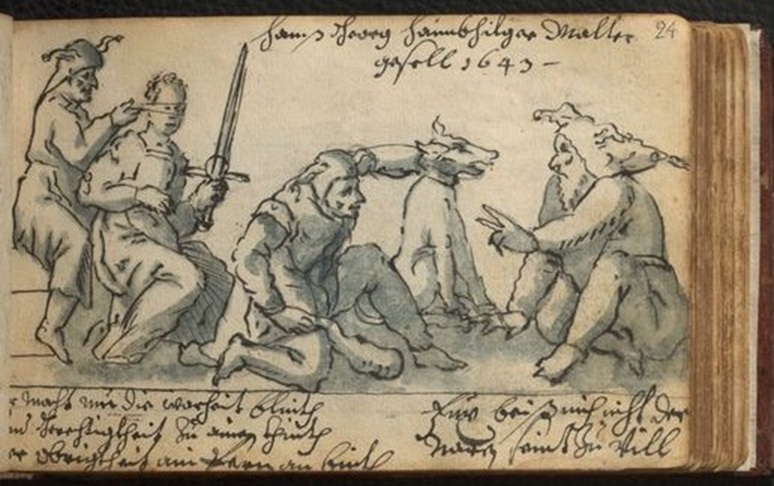
Their fool costume is pretty rudimentary, only the belled ears of the hoods they wear serving to identify them as fools — a far cry from the detailed miniature of the fool Henricus van den Borch painted in his own album-cum-songbook 30 or 40 years earlier (note his signature H.V. Borch fecit at the very bottom of the page):
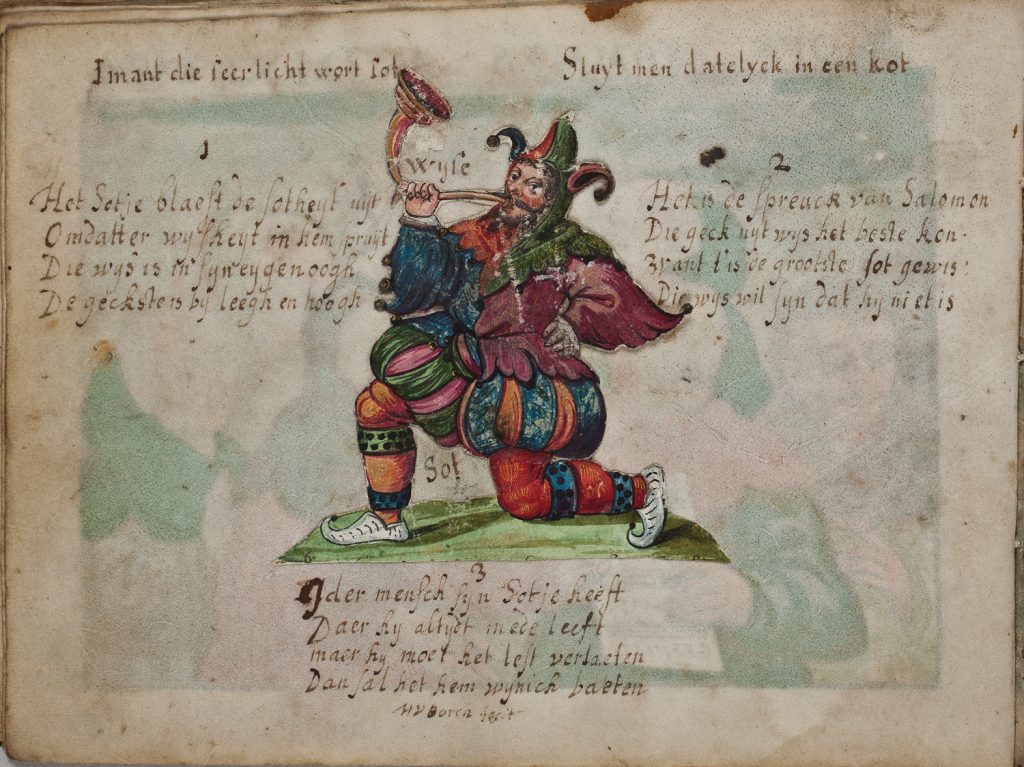
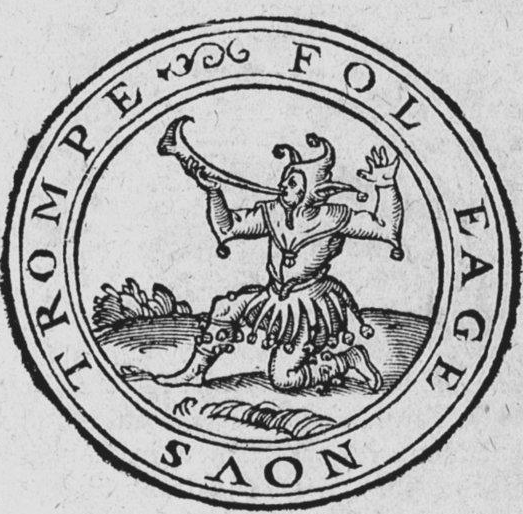
Here is the whole traditional brightly-coloured motley costume: curly pointed shoes, bands of bells round the calves, puffy slashed trousers, scallop-edged tunic with bells on the sleeves, and of course, the peaked hood with the belled ass’s ears. It seems likely Van Den Borch based his miniature on one of the woodcuts illustrating the rebus de Picardie in Tabourot’s Bigarrures (1572, 1583). [For other trumpet rebuses see my post, https://albumamicorumear-e4qvahs764.live-website.com/death-the-alls-and-i-kill-you-all-with-an-entertaining-digression-on-trumpet-rebuses/]
The scholarly fool?
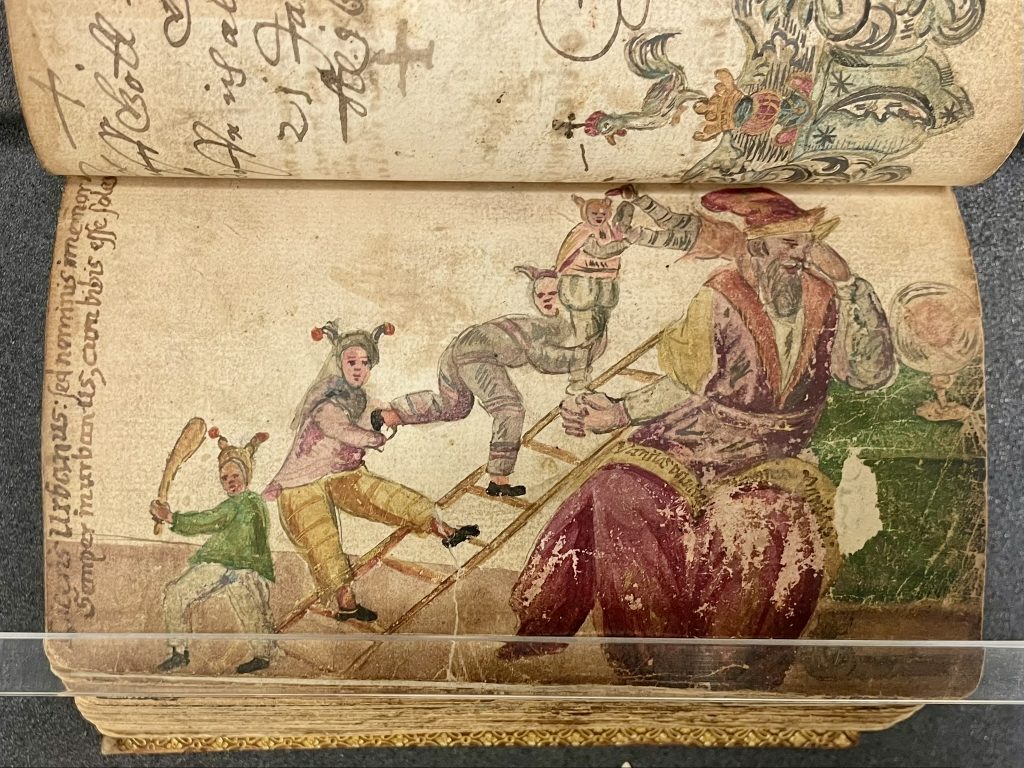
Thanks to the kindness of Rebecca Flore, Special Collections Librarian in the University of Chicago Library, I am able to reproduce here yet another curious fool image from the albums — this has been painted in a copy of Reusner’s emblem-book, Aureolorum emblematum liber singularis, published in 1591 and used as an album amicorum by the Krueger brothers — a use to which many emblem-books were put [the Repertorium Alborum Amicorum records no fewer than 8 other contemporary albums that use this very book].
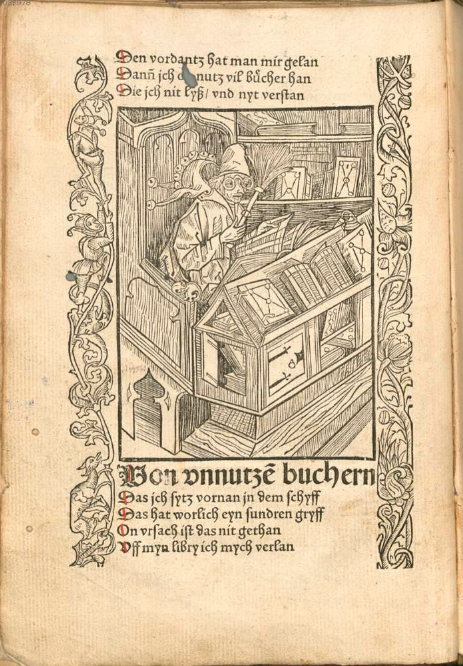
An elderly man sits head-in hand at a table on which stands a globe (or armillary sphere), while a number of costumed fools climb a ladder up to his head, and one seems to have dived into his ear! Close inspection shows that his right fist is clenched round the base of a marotte, as the fool’s bauble was known, and it is this miniature fool who tops the marotte who appears to be pushing the topmost fool into the scholar’s head. Perhaps he is another melancholy Heraclitus (above), looking down, desparingly, on the world and its follies? Or is he himself a scholarly fool? A book-fool, perhaps — as famously illustrated at the opening of Brant’s pan-European best-seller, Das Narrenschiff [the Ship of Fools], first published in 1494 — and yet there are no books in our painting, nor does our man himself wear fool’s costume — though as we have noticed, he does indeed hold a marotte.
Do the inscriptions help us? Across his red robe, though rubbed, we can still make out the frequently quoted opening of the second verse of Ecclesiastes: Vanitas vanitatum et omnia vanitas [Vanity of vanities, all is vanity]. But the other inscription is something of a surprise — is it even related to our painting or merely a vacant space in which to jot down some witticism?
It reads, Diceris Urbanus, sed nominis immemor huius / Semper Inurbanus, cum bibis, esse soles [your’e called Urbanus, but I don’t remember you by this name, when you drink you are always uncivilsed]
There is a pun here on the Latin urbanus meaning ‘civilised, urbane’, which was also used as a forename — most famously, in the present context, by the humanist scholar and Reformer, Urban Rheggius (d.1541), but it does not certainly refer to him — unlike Luther, he was not a noted boozer. But this is a learned quotation, an epigram by the humanist scholar Sabinus [i.e. Georg Schüler, 1508-60] and first appears in his collected works, published posthumously in Leipzig in 1568. He wrote several works condemning drunkenness, including an Ebrietas Detestatio [Detestation of Drunkenness], but I cannot see how this is relevant to our miniature — the old man does not appear obviously drunk, and there are no glasses, bottles, etc., as in other scenes of drunkenness.
Lastly, I should compare this miniature to another popular contemporary album motif which shows a tiny man climbing a tall ladder to kiss a woman — which has its own separate post here
https://albumamicorumear-e4qvahs764.live-website.com/tiny-man-climbs-ladder-to-kiss-woman/
The lascivious fool
The fool, however foolish, is still a man — in this print [unknown to me — glad to learn engraver, etc. from one of my knowledgeable readers! ] he cannot help himself from admiring the naked woman reflected in the mirror — the folly of voyeurism?
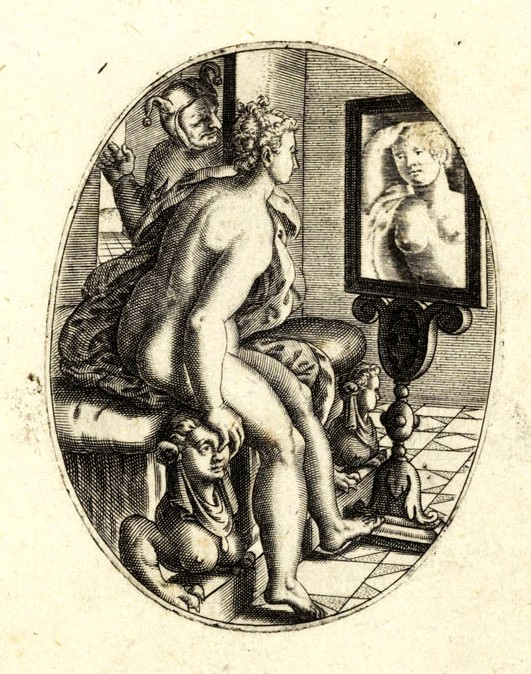
Though hardly in the same league, the engraver may well have been familiar with the notorious I Modi engraved by Raimondi with verses by Aretino — to judge from the grotesque feet of the lady’s bed
Rebus
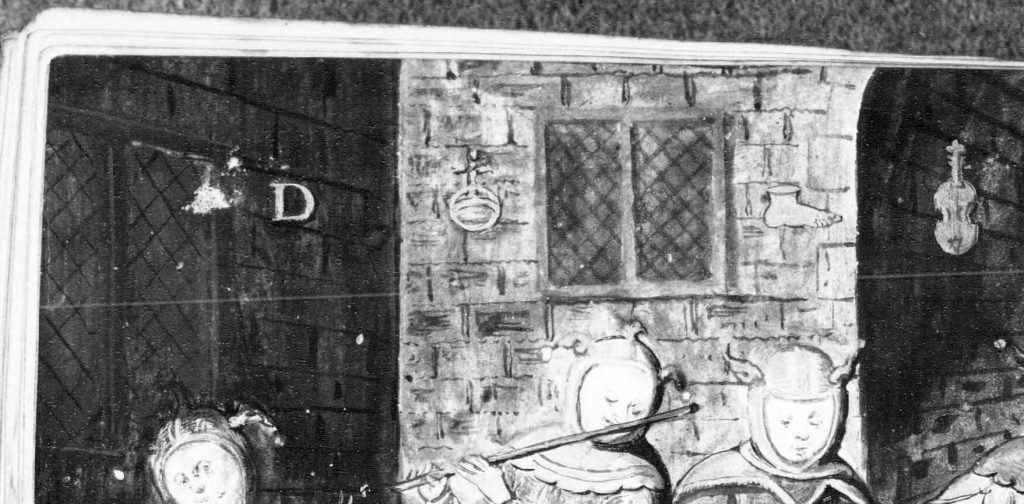
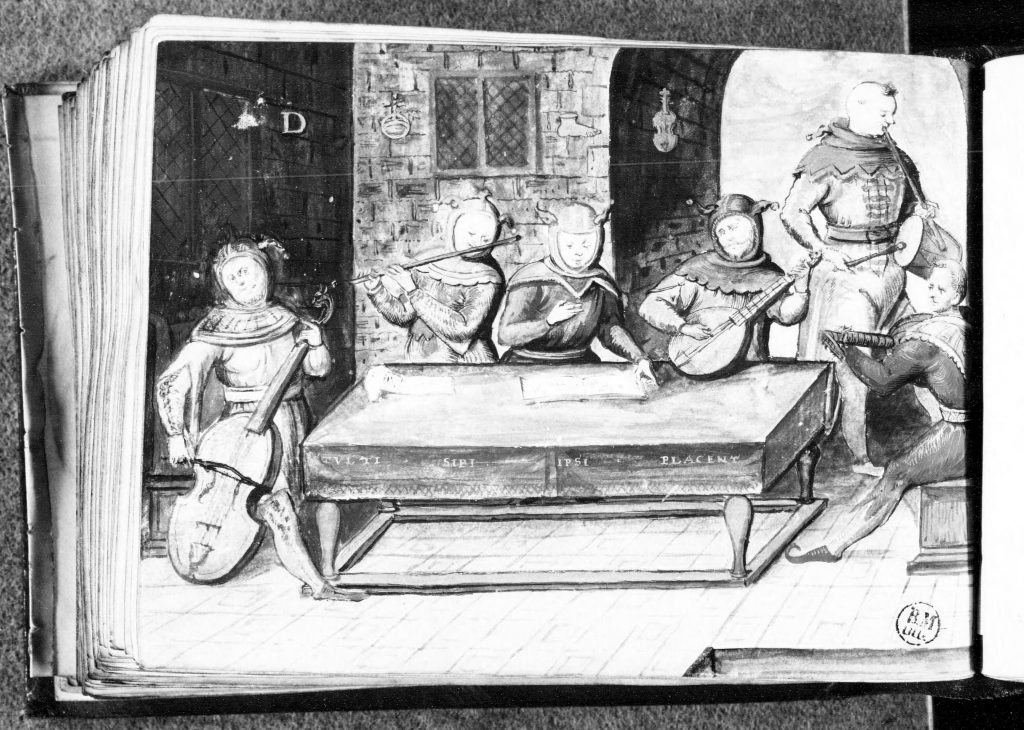
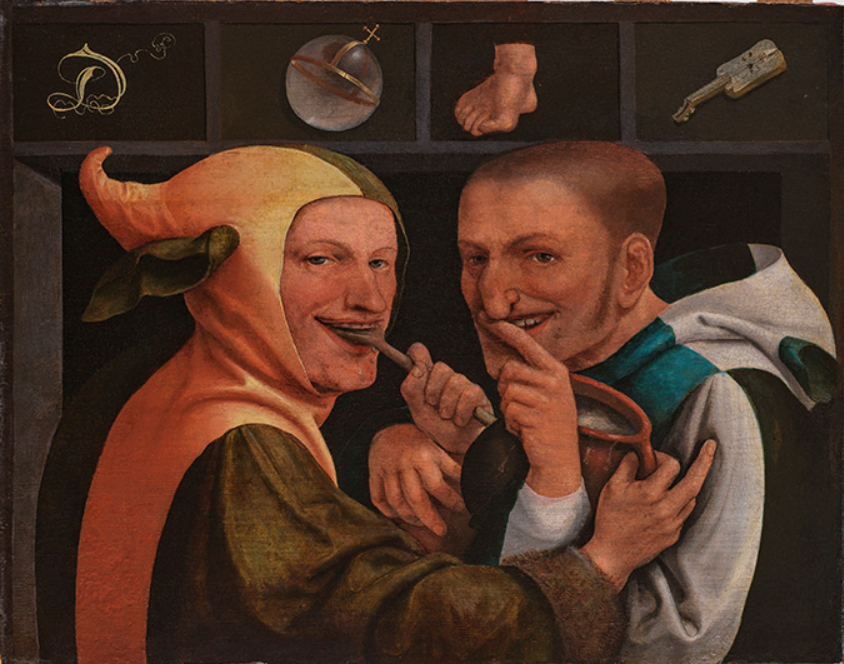
This entertaining fools’ concert is labelled twice — en clair in Latin on the table, STVLTI SIBI IPSI PLACENT [fools please themselves], and enigmatically (in Dutch) via the rebus above their heads, which consists of a capital letter D, a world-orb, a foot, and a violin — and the fools below. The solution — The World Feeds Many Fools — is spelled out in both Dutch and Latin in a print issued in Antwerp c.1650 by Frans van den Wijngaerde. (the Dutch words for foot and violin are homophones of the words for feeds and many):
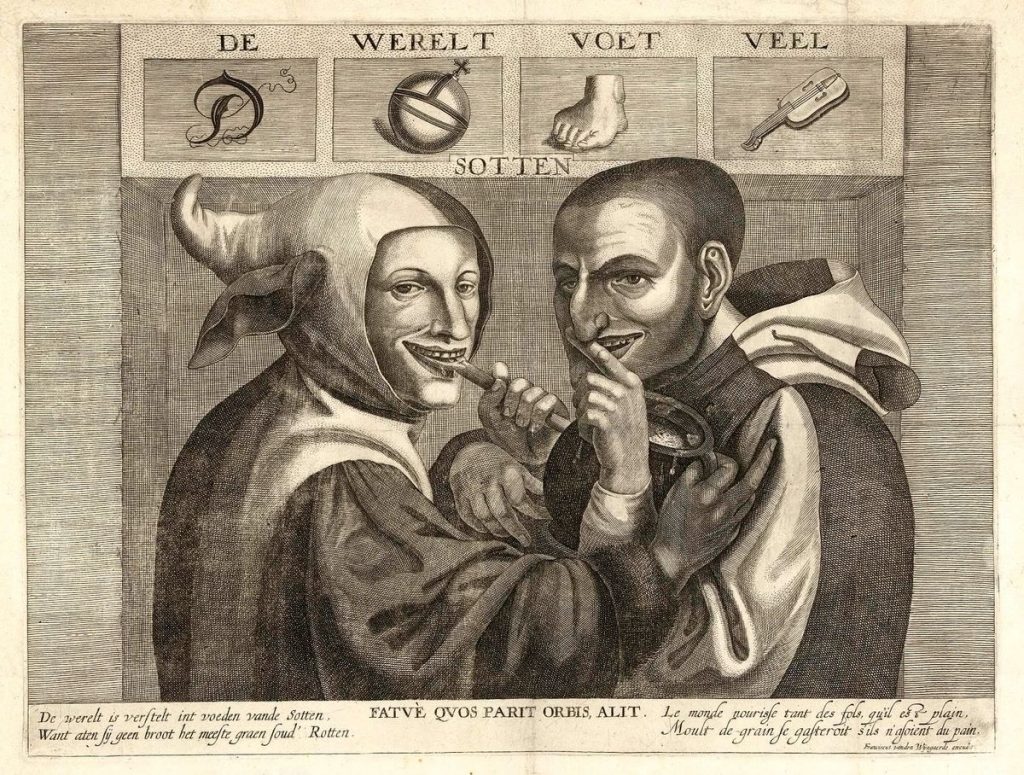
The ‘original’ is this painting attributed to Jan Massys of c.1530
Leave a Reply to Ass in the Tree and Birds on the Ground, Lobster-Riding, etc., –Manifestations of the World Turned Upside Down (WTUD) [Monde Renverse, Verkehrte Welt] in the Albums – Album Amicorum: Early Modern Stammbuch Iconography & related Cancel reply