“What I tell you three times is true”, cried the Bellman in Carroll’s The Hunting of the Snark, and verbal and visual triads seem to be one of those cultural universals that are somehow innately satisfying.
[We have already posted examples of The Three Proudest triad here https://albumamicorumear-e4qvahs764.live-website.com/the-three-proudest-a-misogynist-triad/ so the present post will not repeat those images]
On an undated page in the album of Matthias Egger (dated entries 1618-30)
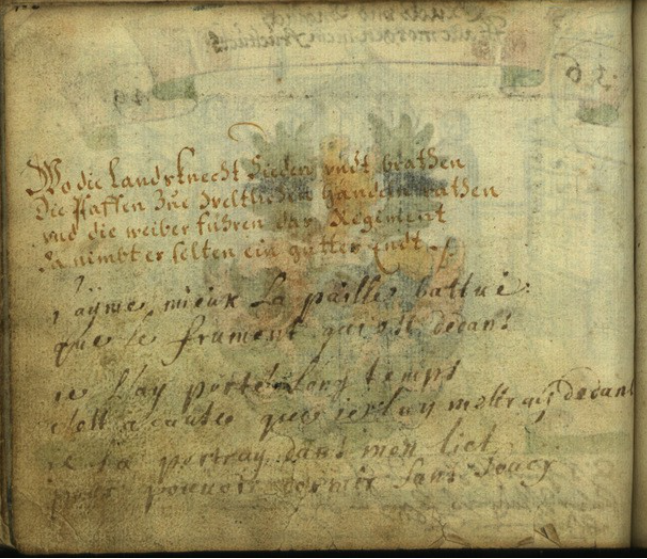
above 6 lines of French verse, are 4 lines of a German rhyme:
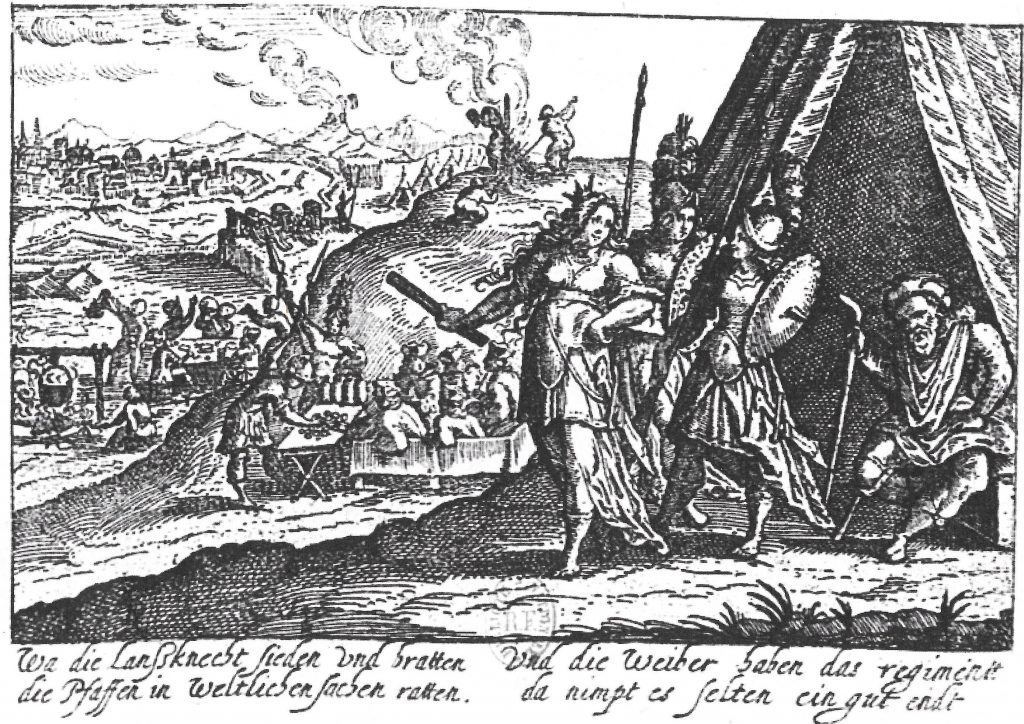
Wo die Landsknecht sieden vndt braten Where soldiers boil and roast
Die Pfaffen zue weltlichen handeln rathen Priests advise on worldly matters
vnd die weiber fuhren das Regiment and women run the government
Da nimbt es selten ein gutter Endt things rarely end well.
There is no illustration on the adjacent page, sadly, and the same verse was apparently inscribed in the lost album of Ernst von Mandelsloh in 1592, and is also recorded as an inscription on a house in Heidelberg’s Drachengasse, dated 1588.
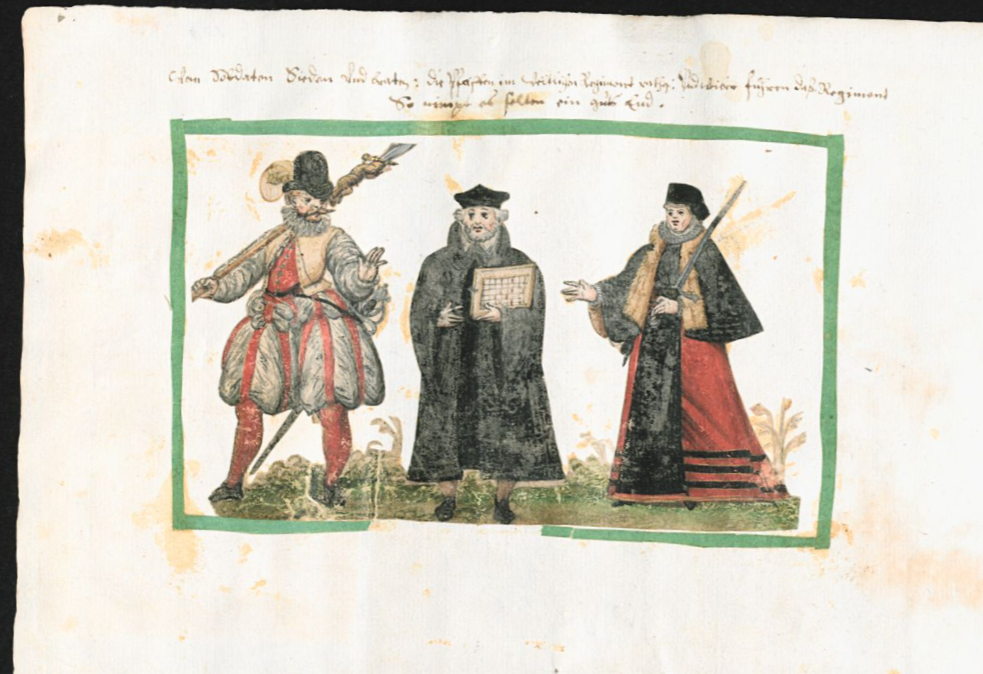
In the Jenisch album, however, is a miniature of 3 figures, looking at first sight like a depiction of the Three Estates, but captioned with a version of our rhyme, beginning,Wan Soldaten sieden vnd braten... Here we have a soldier, a priest, and a woman holding a sword
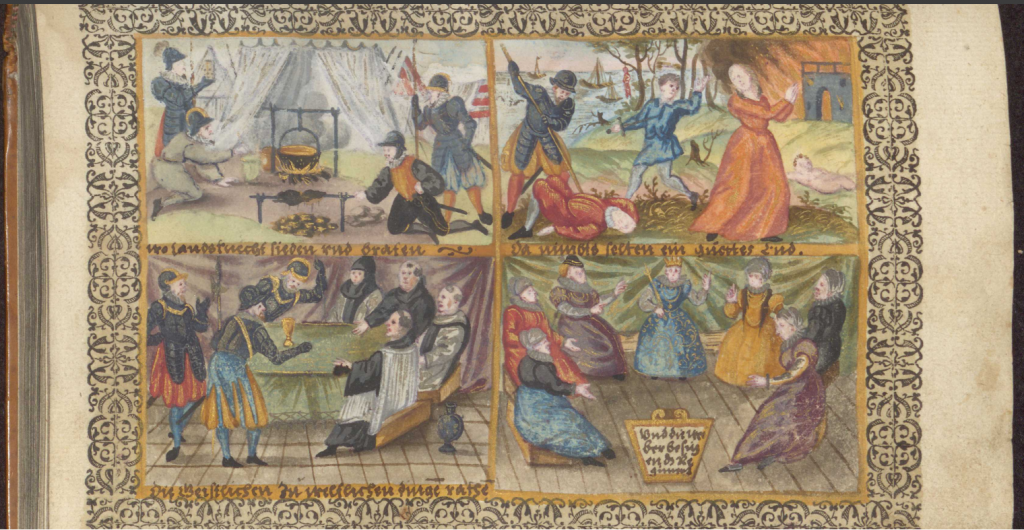
At some point in the 1590s, and clearly independent of any other version, four separate scenes were painted on a page in the Prasch album, but need to be read in an anti-clockwise direction, in the order 1,3,4,2, and here it is young men who are meddling in religious matters (and not vice versa), and — as in the next — it is also clear here that by Regiment , the painter understood civil government (symbolised by the queens and her all-female council), not an army battalion — as we shall see elsewhere. And here the punch-line is the scene of murder and pillage that ensues:
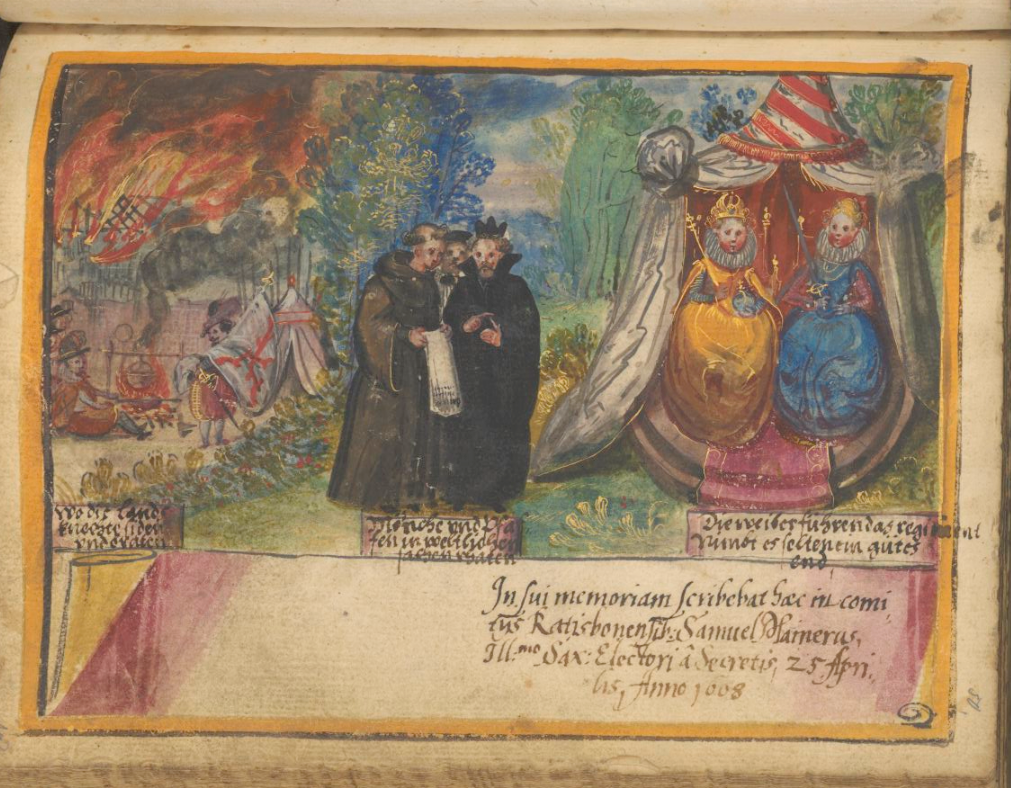
In the Lattermann album we have another fully detailed rendering of the triad in paint, dated 1608 —
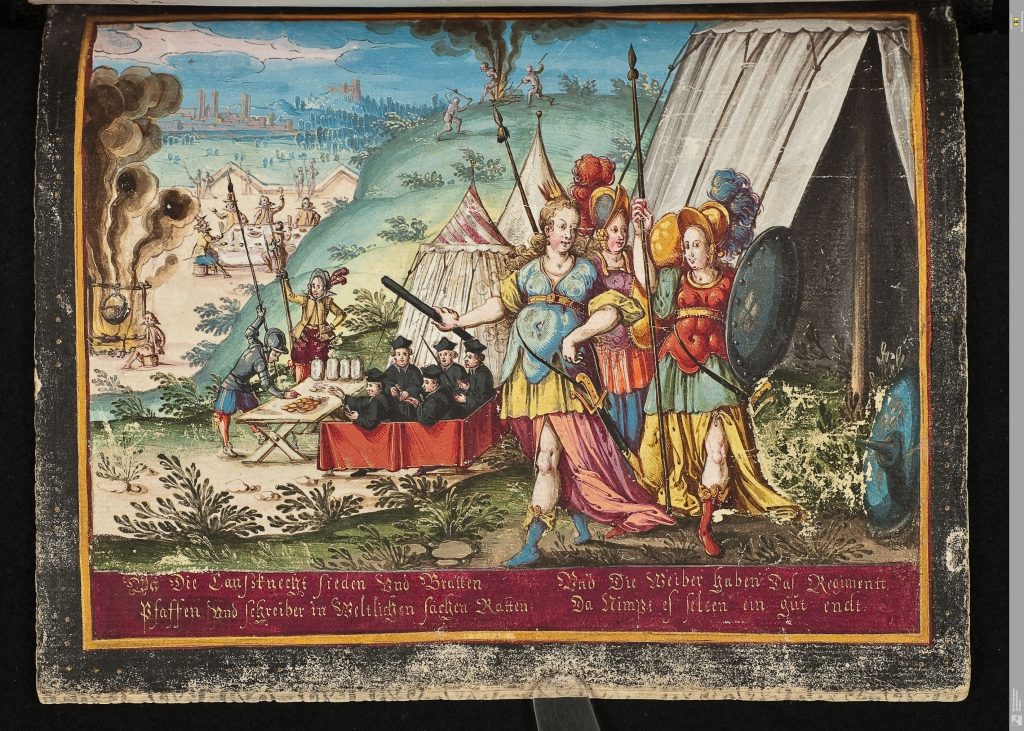
In 1617 An illustration of the triad was included in the plates engraved for the Stirpium print-book — here Regiment has clearly been understood in the army sense, as the women are armed and equipped for battle:
A close copy of this appears in the Ochsenbach album, painted before 1626:
Other media
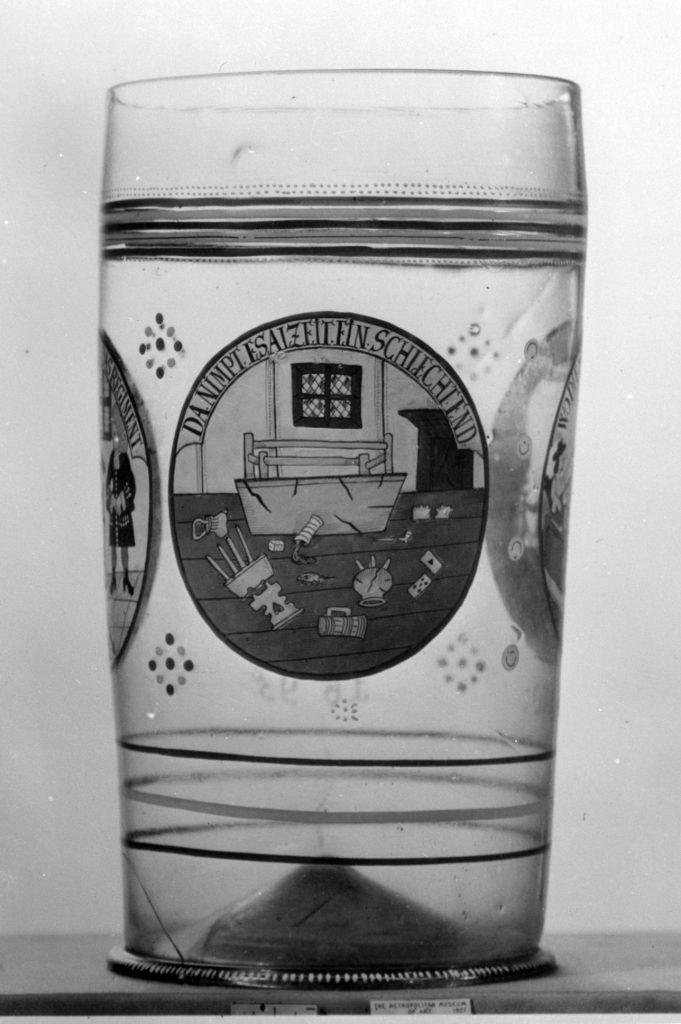
There is a large glass beaker in the Metropolitan Museum enamel-painted with our motif and dated 1695 — the only photo shows the roundel depicting the conclusion of the verse, a room in chaos, full of broken articles, the inscription, DA NIMPT ES ALZEIT EIN SCHLECHT END [that always leads to a bad end].
ISN’T THERE A COBURGER SCHEIBENBUCH TARGET DESIGN OF THIS MOTIF TOO ?? CHECK WHEN I GET HOME
Horse, Woman, Music
[This is quite similar to The Three Proudest triad which has its own separate post here https://albumamicorumear-e4qvahs764.live-website.com/the-three-proudest-a-misogynist-triad/ ]
Though unaccompanied by text — at least in its present location (the album having been dismembered and re-assembled more than once) — a miniature in the Jenisch album depicts three scenes which the painter did his best to make into a unified composition: four musicians at a table, a pair of lovers on a canopied bed, and three horses in their stalls.
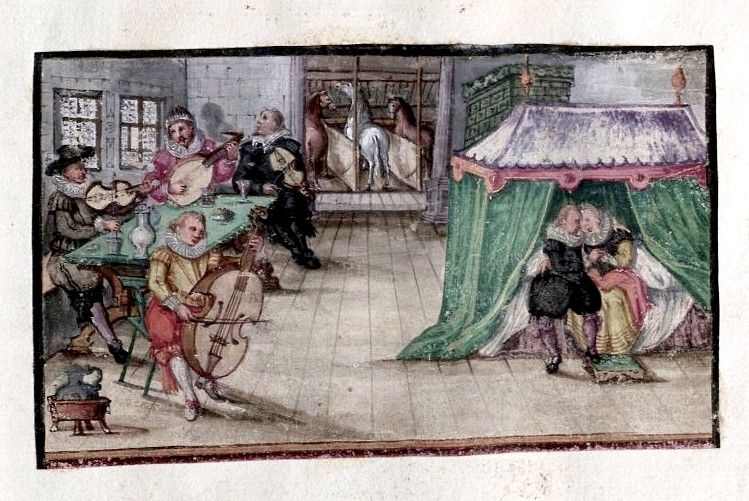
The similarity to a plate in Peter Rollos’ Philotheca Corneliana (Frankfurt, 1619) is so marked (only the Cupid and flaming heart pierced by arrows in the foreground are missing) that we may be sure the Jenisch album painter had this plate as his model:
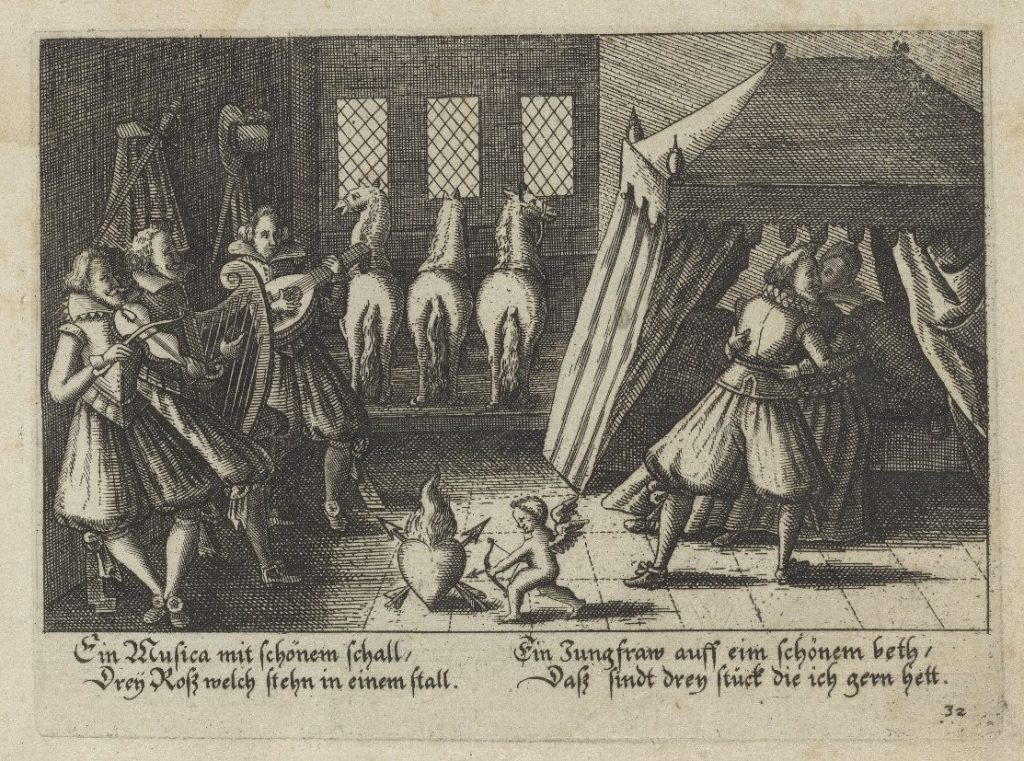
Here the caption spells out the triad:
Ein Musica mit schönem Schall Music with a lovely sound
Drey Ross welch stehn in einem stall Three horses standing in one stall
Ein Jungfraw auff eim schönem beth A girl on a lovely bed
Dass sindt drey stück die ich gern hett. These are three things I’d love to have
Schmidt (1906, no.720) recorded the same verse with trivial variants in the album of one Ernst von Holl in an entry dated 22nd March 1614, i.e., five years before the publication of the Philotheca Corneliana.
Hans Ludwig Pfinzing von Henfenfelden pasted into his album a copy of the Philotheca Corneliana plate from a different edition — but here the scene is set outside, and there is no male lover, and only one horse — the captioning verse is altered accordingly (and a later owner — as throughout this album — has censored the line he/she felt to be objectionable):
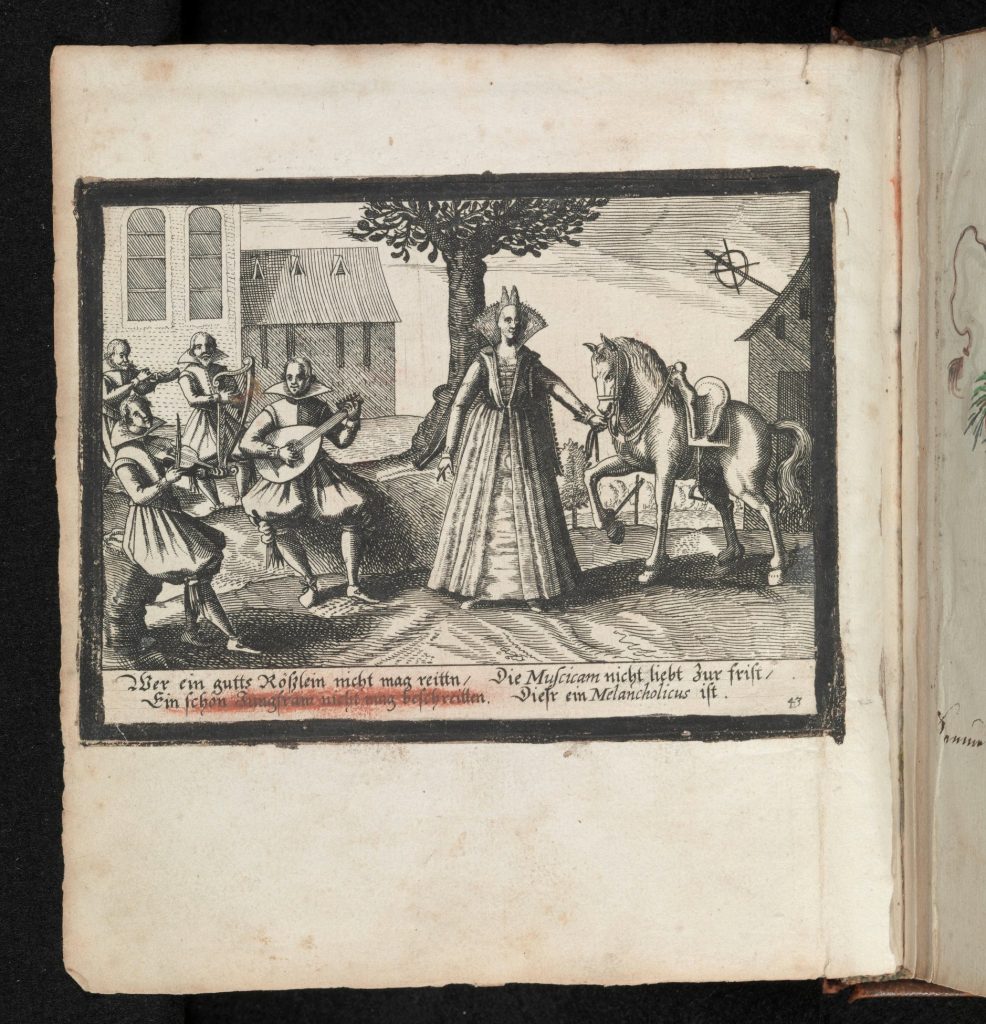
Wer ein gutts Rösslein nicht mag reittn He who doesn’t like to ride a little steed
Ein schon Jungfraw nicht mag beschreitten nor bestride a fair maid
Die Muscicam [sic] nicht liebt zur frist nor music in good time
Diesr ein Melancholicus ist — he is a melancholic
This is also a common type of formula in the album inscriptions, opening “He who does not like” followed by a list of a number of good things, and finishing with some usually rather more insulting description of the individual concerned (examples below)
Our triad appears again five years later in Rollos’ Vita Corneliana (Berlin 1624) in a not dissimilar plate, though I have yet to come across an album painting that copies either.
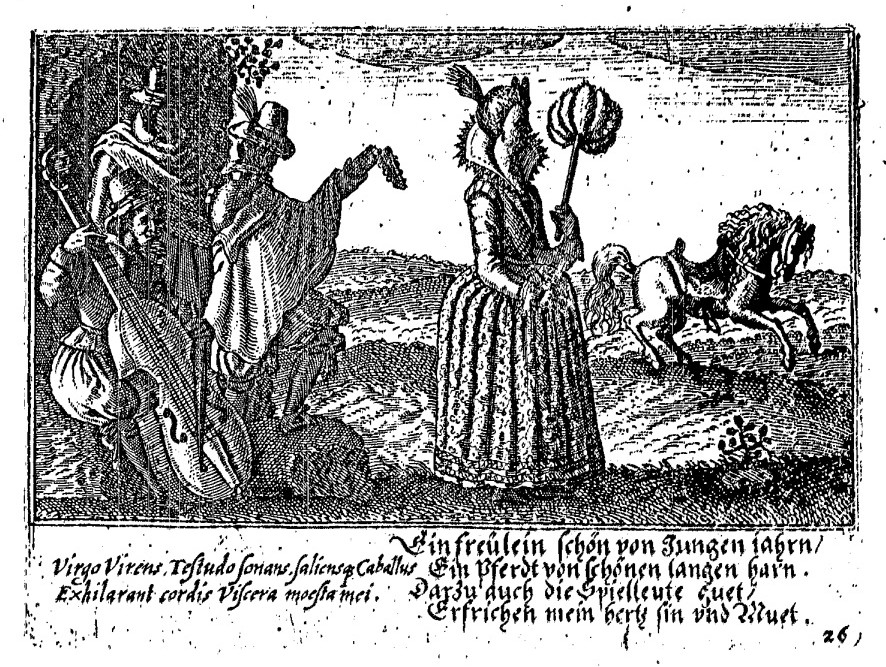
By 1675, when the triad was entered into the von Logau album, the number of horses is increased to six, and the woman is in the bed.
Eine Musika mit hellem Schalle 6 schöne Pferde in meinem Stalle und eine schöne Dame in einem weichen Bette das sind 3 Stücke, die ich gerne hätte.[ix]
Woman & Horse (& Sword)
The erotic comparison of woman and horse was well-established by this date, in Germany as elsewhere in Europe, cf. the print issued in 1624 entitled, Erklerung, wie ein Pferd vnd ein Frauenperson in vielen Stücken einander gleichen sollen (Explanation, how a horse and a woman should resemble each other in many respects) [ I discuss this at some length in The Print in Early Modern England (Yale UP, 2010), 316]. Indeed, his horse and his woman were almost equally essential to the young man, and form the common basis of more than one proverbial triad illustrated in the albums. The Keils record one such triadic Priamel inscribed in an entry dated Köln, 1595 (no.68):
Wer nicht Lust hat zu einem schönen Pferd He who doesn’t want a fair horse
Zu einem blanken Schwerd a bright sword
Zu einem schönen Weib a beautiful woman,
Der hat kein Hertz im Leib. he has no heart in his body].
The same triad is recorded verbally in other albums dated 1608, 1620 (2), 1623 and 1640; one of the two 1620 inscriptions is dated Strasbourg, 1620, a now lost painting of the triad, for the album of an unknown contemporary, commissioned by the Polheimb brothers, but captioned in French:
Bon cheval, Epee et belle amie A good horse, sword and lovely girl
toujours de moy sont cheri are always dear to me
[from one of the orphaned leaves described in the 1864 Leipzig Weigel du Rosey collection sale]
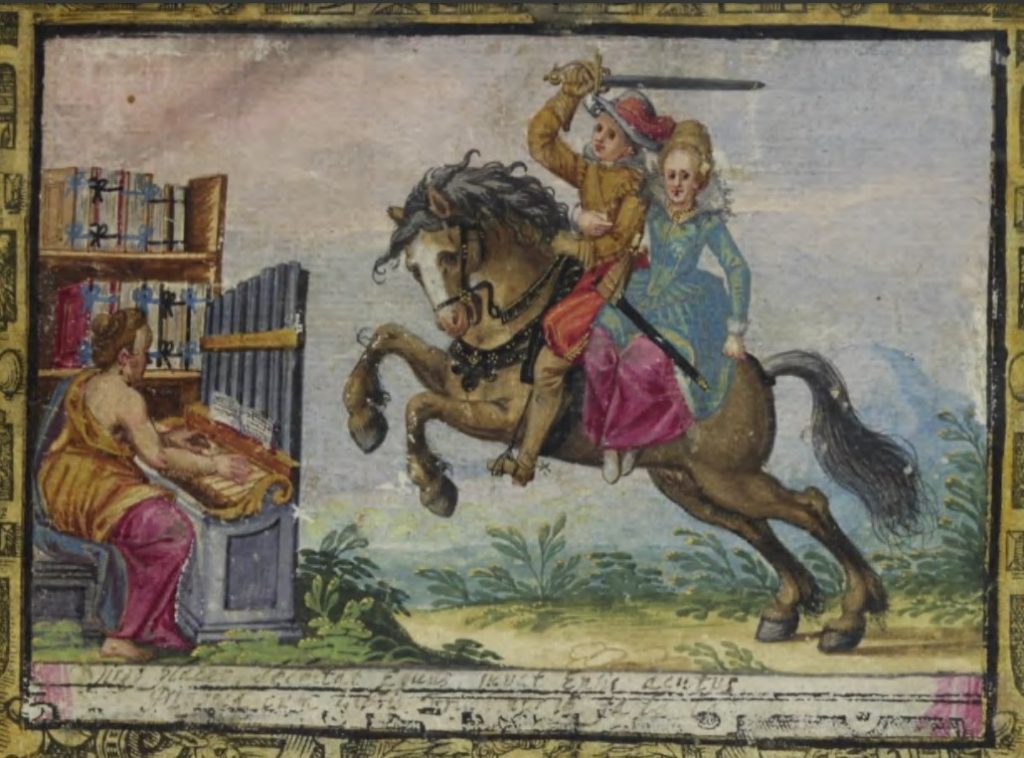
An illustration of this variety of triad survives, however, in the Rosenberg album (1615×23),[iv] above the Latin caption, Virgo placet, delectat equus, juvat ensis acutus [The girl is pleasing, the horse delights, and the sharp sword assists — I cannot make out the line below this — Readers?! ]. In the painted miniature it is presumably the young woman playing the organ who pleases, and not the one sitting behind our sword-wielding hero on the leaping horse!
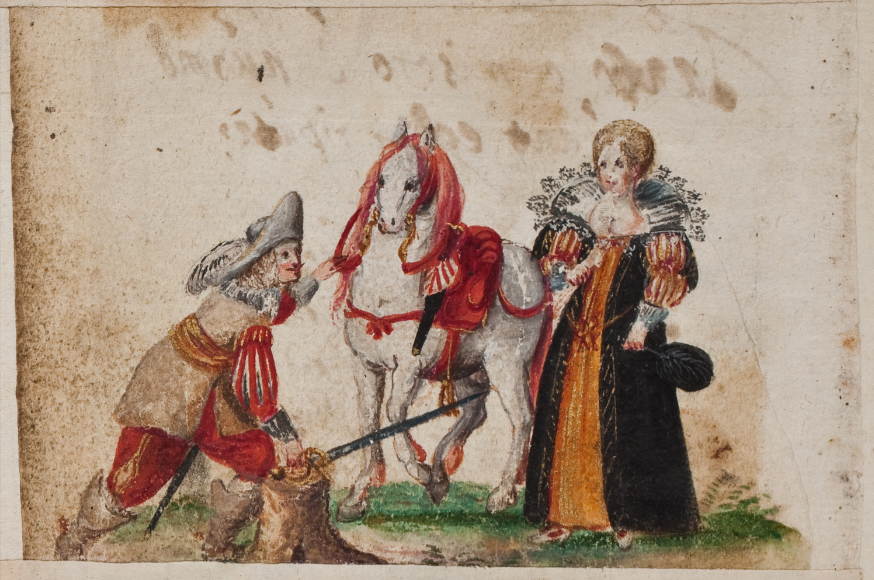
Though uncaptioned, a miniature in the Grossman album, which on costume grounds we may date to c.1640, may well have been intended to invoke our present triad — it shows a young woman standing beside a fine horse whose rein is held in one hand by the young cavalier whose other hand resting on a tree-stump manages to point a sword, thus prominently positioned in the composition, directly towards her.
A charming miniature in the Morold album (1622) portrays a young couple on a lively horse, the young woman — laughing — mounted behind the young man who discharges his pistol at a bird in a tree.[ and see Keils no.453 for a different text of 1626]
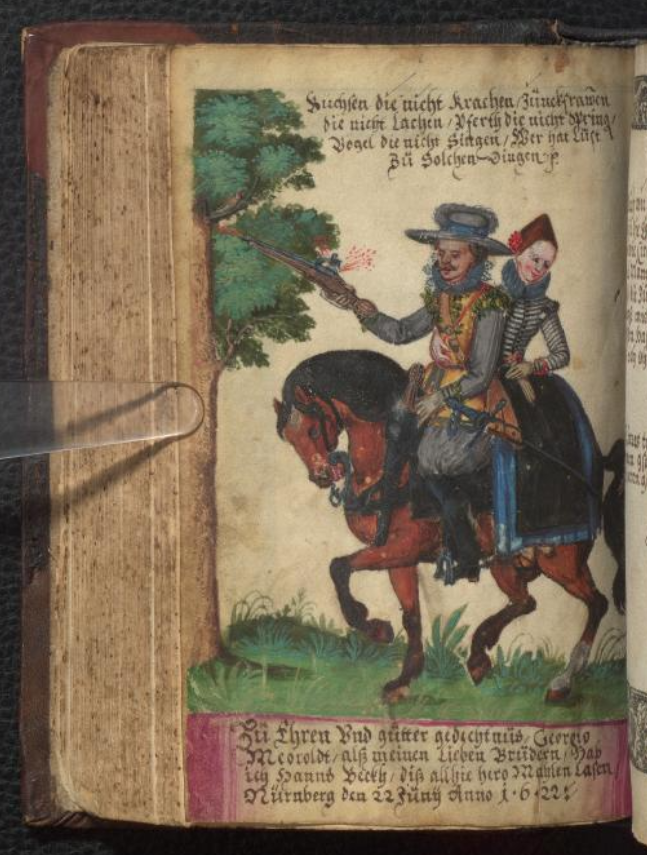
Here the triad has become a quartet, by means of the addition of a songbird – and the sword has been replaced by a gun – and the absence of the qualities lauded in the triad here deplored. The caption is another Priamel:
Büchsen die nicht krachen Guns that don’t fire
Jünckfrawen die nicht lachen girls who don’t laugh
Pferth die nicht spring[en] horses that don’t leap
Vögel die nicht singen birds that don’t sing
Wer hat Lüst Zu solchen Dingen who wants such things
A more pacific variant was painted on f.117v. of the Prunner album in 1634, showing a young couple kissing on a leaping horse, flanking a central tree around which birds fly. The sound of kissing has replaced that of gunfire! I have not seen the miniature but it is evidently captioned
Jungfraw die nit lachen Girls who don’t laugh
küssen die nicht krachen kisses that don’t smack
Vögel die nicht Siengen birds that don’t sing
Rossen die nicht springen horses that don’t jump
Wer hat lust zu solchen Diengen — who wants such things.
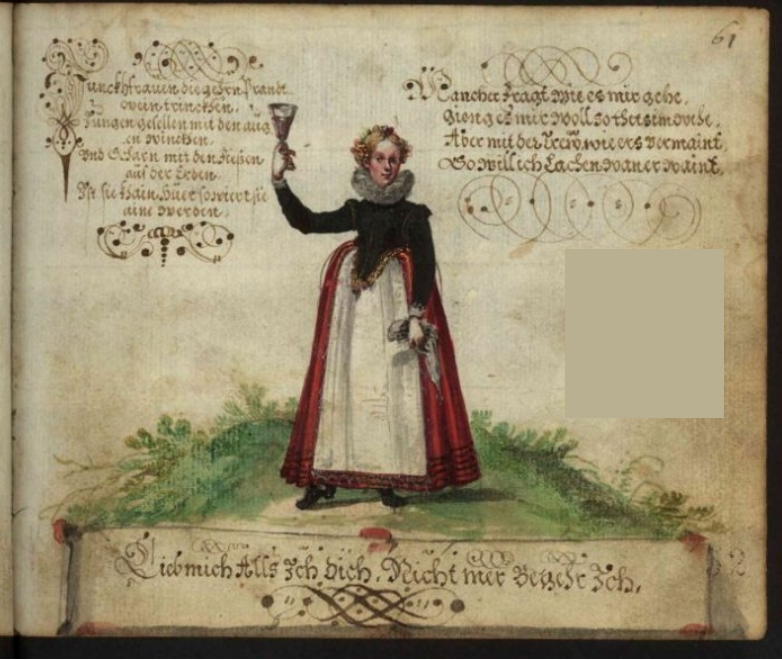
In the Reif album (1606-26) is a miniature of a girl holding up a wine-glass and captioned Lieb mich Alls Ich dich, Nicht mer begehr Ich [Love me as I (love) you, I desire nothing more] — (above) — but this harmless sentiment is more than a little undermined by the triadic verse above her head which reads
Junckfrauen die gehrn Brandtwein trinckhen Girls who like to drink brandy
Jungen gesellen mit den augen winckhen and make eyes at young men
Vnd Scharn mit den Fußen auf der Erden and whose feet scratch at the ground
Ist sie kain Hure so wiert sie aine werden if she’s not a whore, she will be.
…and punch a priest!
A curious illustration in the Miller album depicts. from left to right, a young couple embracing, a man winding a clock, and another man hitting a priest!
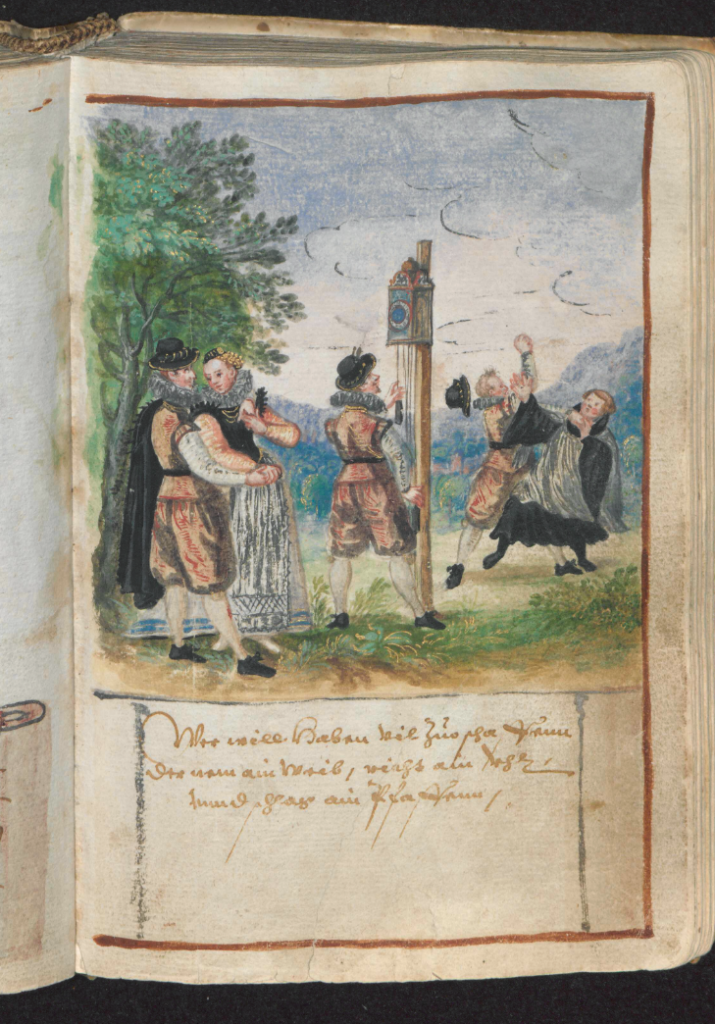
The caption explains the triad:
Wer will haben vil zuo shaffenn He would like a lot do do/to keep busy
der nem ain Weib, ? ain Vhr let him take a wife, buy a clock
Vnnd slag ain Pfaffenn and strike a priest.
The Keils record the rhyme from an Altdorf album dated 1622 (no.524).
Two women/sisters-in-law in one house ….
This miniature was painted in the Heidenreich album and is yet another triadic grouping
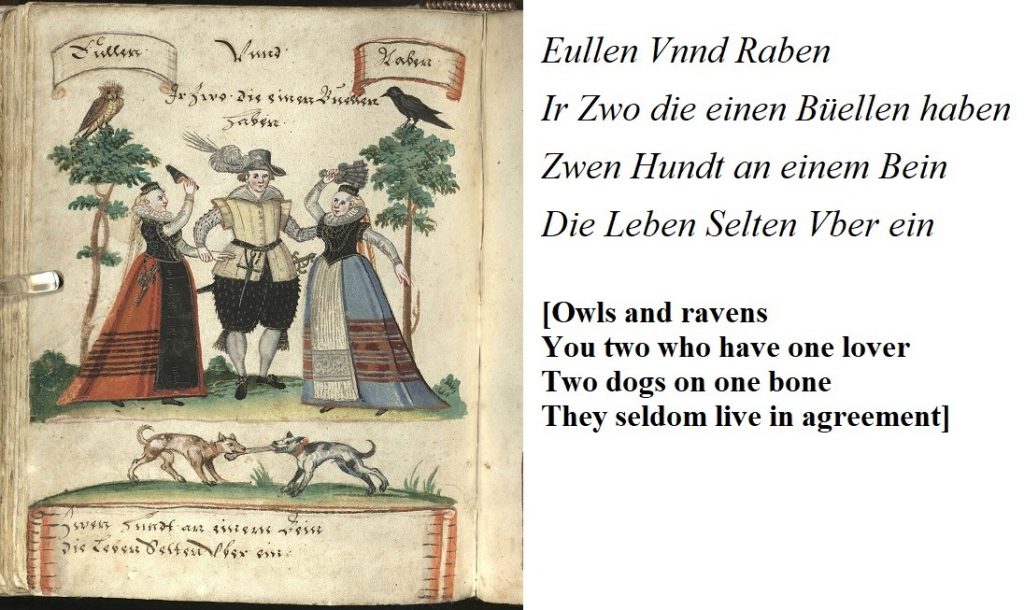
BK 1508
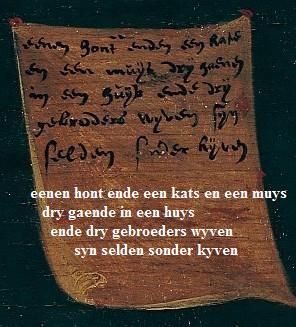
A slight variant — but evidently the more usual form — at least in the Netherlands is to be seen in the Amsinck album dated 1622 on the adjacent page which gives the verse. Unlike the Heidenreich album miniature which is obviously stylised, the Amsinck painting looks at first sight like a country life genre scene: two women are arguing outside a farmhouse, in the yard two cockerels are squaring up for a fight and two cats watching a mouse
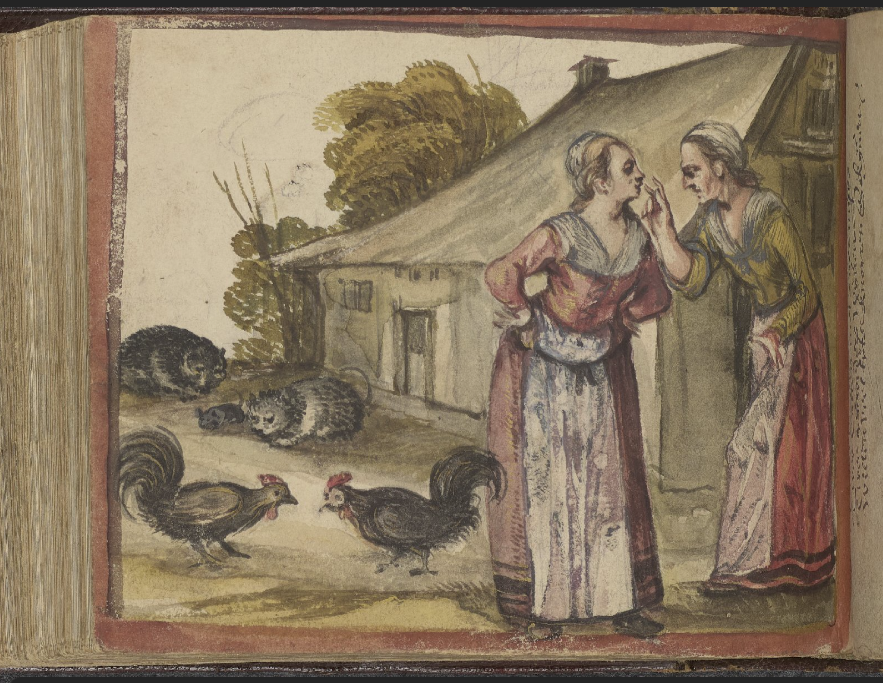
Twee Haenen in een huys Two cockerels in one house
Twee Catten eener muys Two cats with one mouse
Twee gebrooders Wyuen Two brothers’ wives
Willen veel tyts knorren & skyuen ! will always squabble & fight!
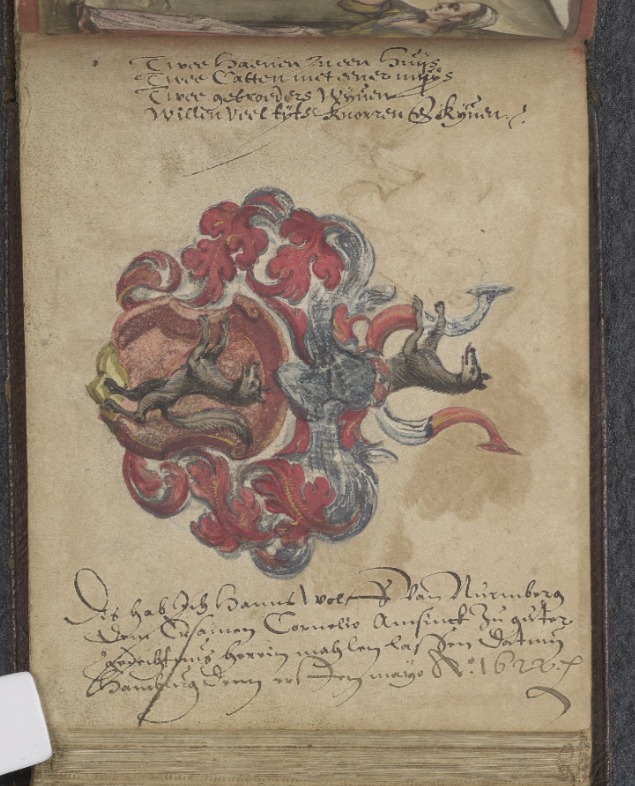
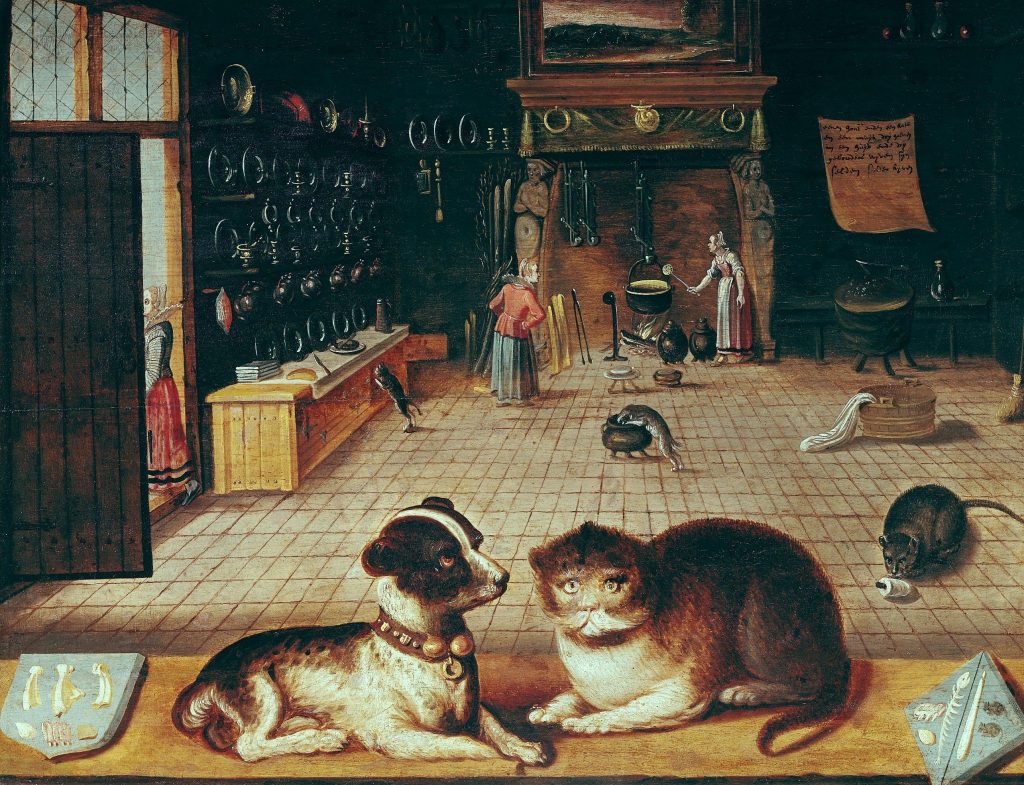
The same text can be seen — just! — in the background of a contemporary Netherlandish panel-painting preserved in the Museum in Bourges
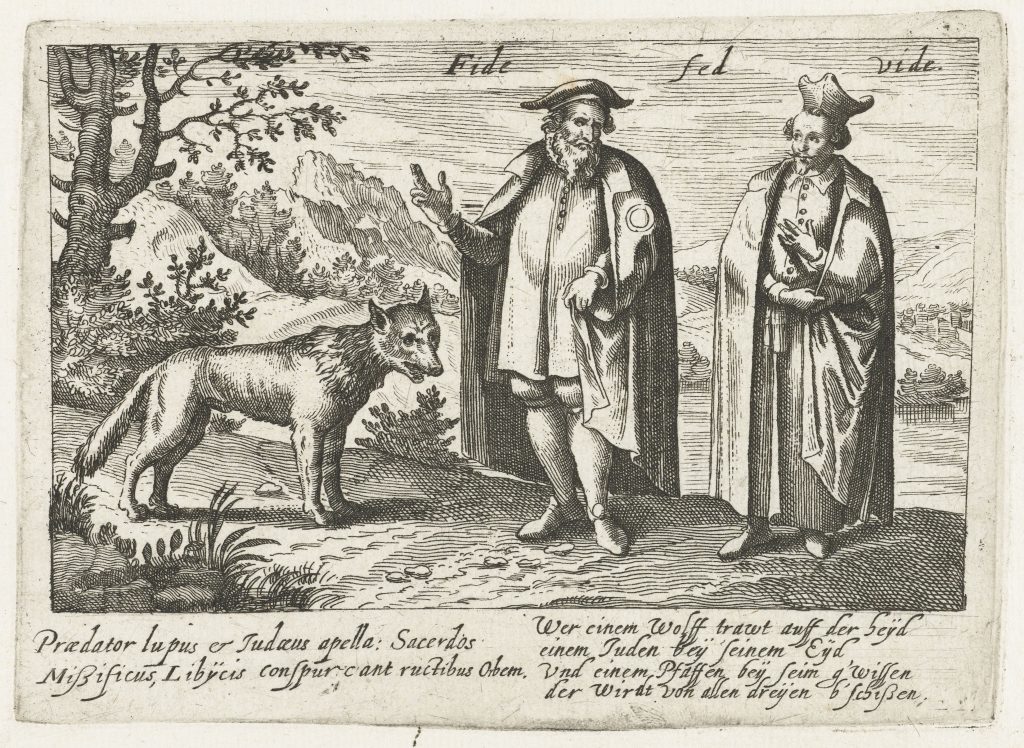
Wolf, Priest, Jew
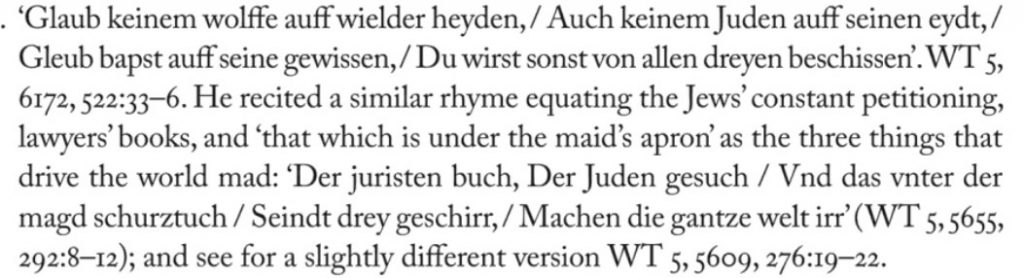
In the Anti-Papal imagery in the albums post we noticed another visual triad, Whore, Lawyer, Jew — here is another politically incorrect triad exhibiting the same anti-semitism. Though I have yet to find this triad painted in an album, clearly it has been, as the description of one of the hundreds of orphaned leaves in the du Rosey collection sale (by Weigel, Leipzig, 1864) shows [Gh. = Gouache]:

I note that both these triads are said to have been quoted by Luther (d.1546) in his Table-Talk
But what of this miniature sold in 1864? In fact, we can be pretty sure what this looked like because it is evidently copied from a plate in the Pugillus Facetiarum (Strasbourg 1608) — as the quoted text confirms. (Again note the circular badge of identity that Jews were legally required to wear)
A Parting Shot ?!
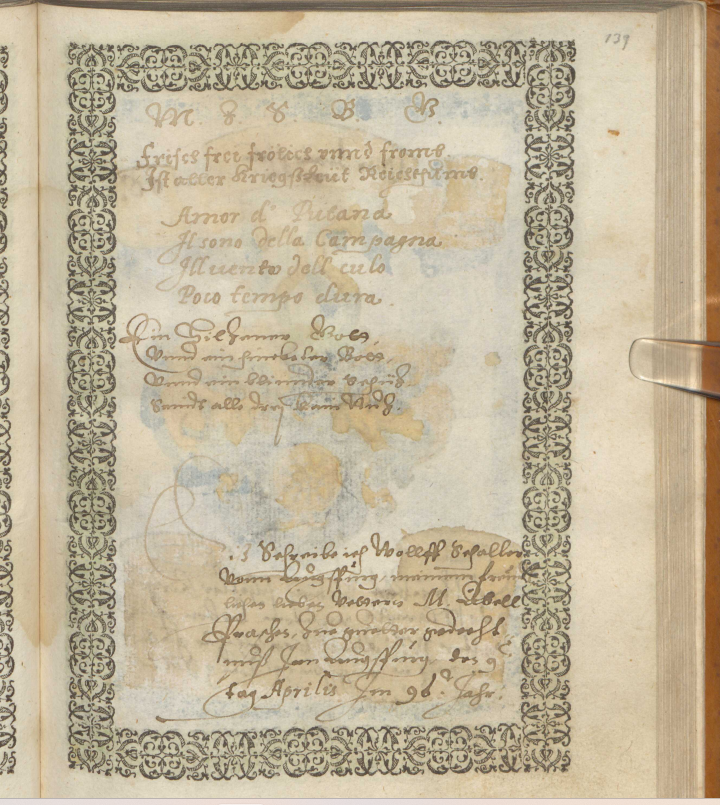
As a further example of the enthusiasm for triads, I end with the above, inscribed by Wolf Schaller of Augsburg in the album of Abel Prasch the Younger in 1596 – – in Italian — as far as I’m aware, no album painter ever attempted to illustrate the triad:
Amor d’ Putana The love of a Whore
Il sono della campana The sound of a bell
Ill uento del culo The wind from the arse
Poco tempo dura last (only) a short time
Personally, I find such irreverence a breath of fresh air [Hmm.. perhaps not quite the appropriate expression ? ], a little light relief from the innumerable portentous quotations from Classical writers. Curiously, the Elizabethan lute-teacher, Thomas Whythorne — to whose diary we were indebted for an amusing anecdote in The Four (Sexual) Ages of Man post — also quotes this triad in Italian in his diary
Leave a Reply to the Three Proudest — a misogynist triad – Album Amicorum: Early Modern Stammbuch Iconography & related Cancel reply