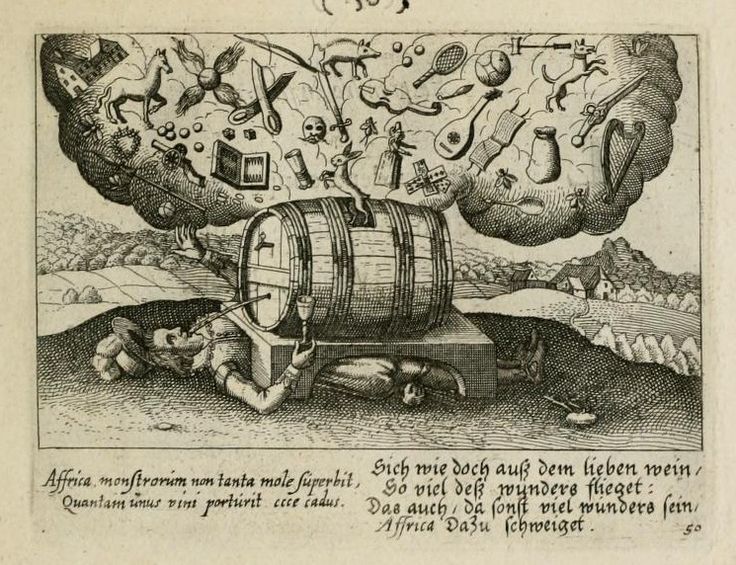
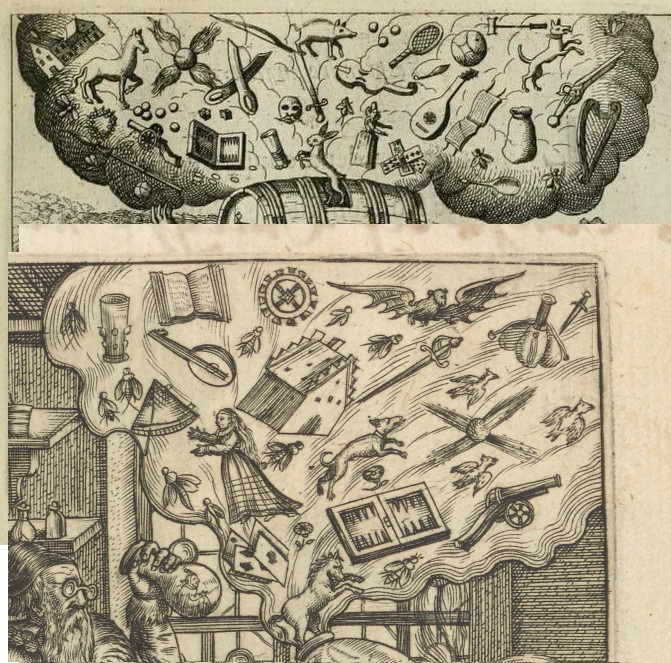
The plate below appears in Peter Rollos’ Vita Corneliana, published in Berlin in 1624
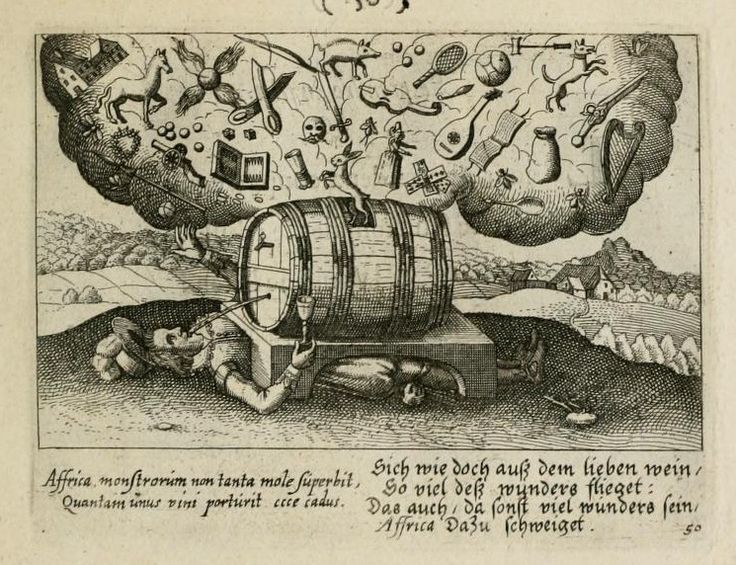
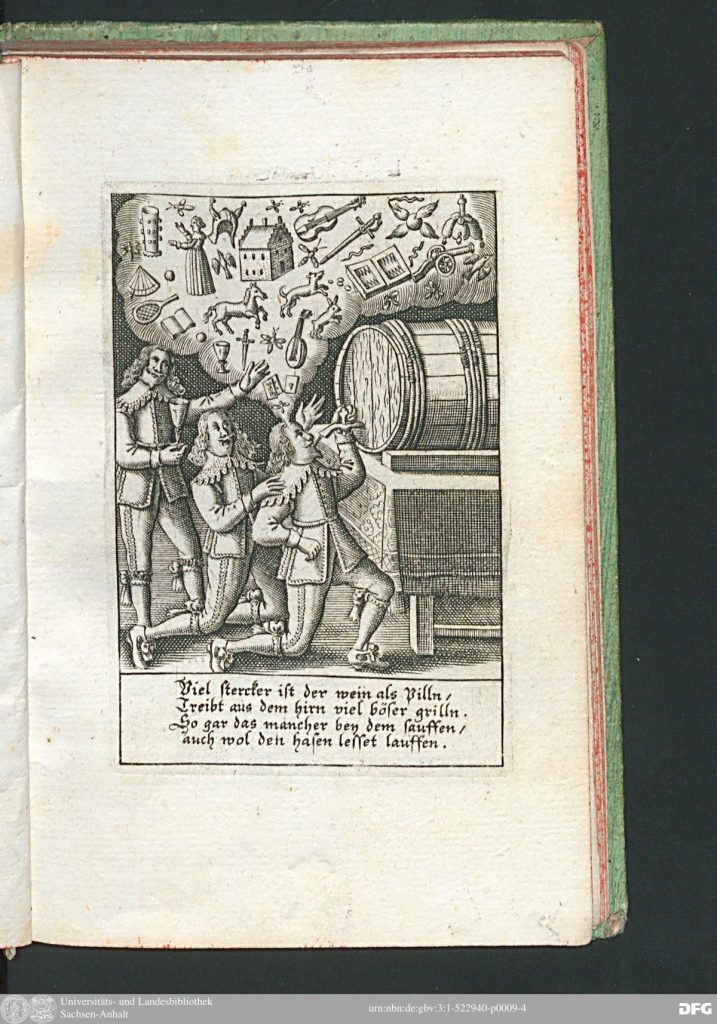
The motif, entitled Viel wunder im Weinfaß, is found in the album of Hans Heintze, which I have not seen, and though it must therefore just pre-date the print-book (dated entries 1619-22), it is described as looking exactly like the above engraving, though in the cloud of phatasmagoria issuing from the barrel a fool’s cap is evidently included, which is not present in the 1624 print-book, but is in a later version of the motif engraved in the Alemodisch Stambuch of c.1640:
Earlier still, Adam Szczepaniec describes a miniature dated 1580 in the album of Adam von Gruttschreiber as “a barrel out if which wine is pouring, filling a glass, with the caption reading: Viel wunder im weinfasse” [in Polish Libraries 9 (2021), 24-78].
Certainly dependent on the Vita Corneliana plate, however, is this engraved lidded glass goblet [Deckelpokal] in the collection of the St Annen museum in Lübeck, the title, Viel wunder im Weinfass, just visible at the base of the bowl:
Grillen
Paul Vandenbroeck* showed that Grillen was the most popular term for what I have called above ‘phantasmagoria’, the tiny images and grotesques populating the cloud issuing from the wine-barrel or drunkard’s head. A generation earlier than the Vita Corneliana, in his Emblemata Saecularia (1596) de Bry had engraved a similar cloud of Grillen distilled from the head of a young gallant, and Rollos was undoubtedly familiar with the motif as published there.
* Paul Vandenbroeck, “Zur Herkunft und Verwurzelung der ‘Grillen’.
Vom Volksmythos zum kunst- und literaturtheoretischen Begriff, 15.-17. Jahrhundert” in De Zeventiende Eeuw 3 (1987), 52-84.
Leave a Reply