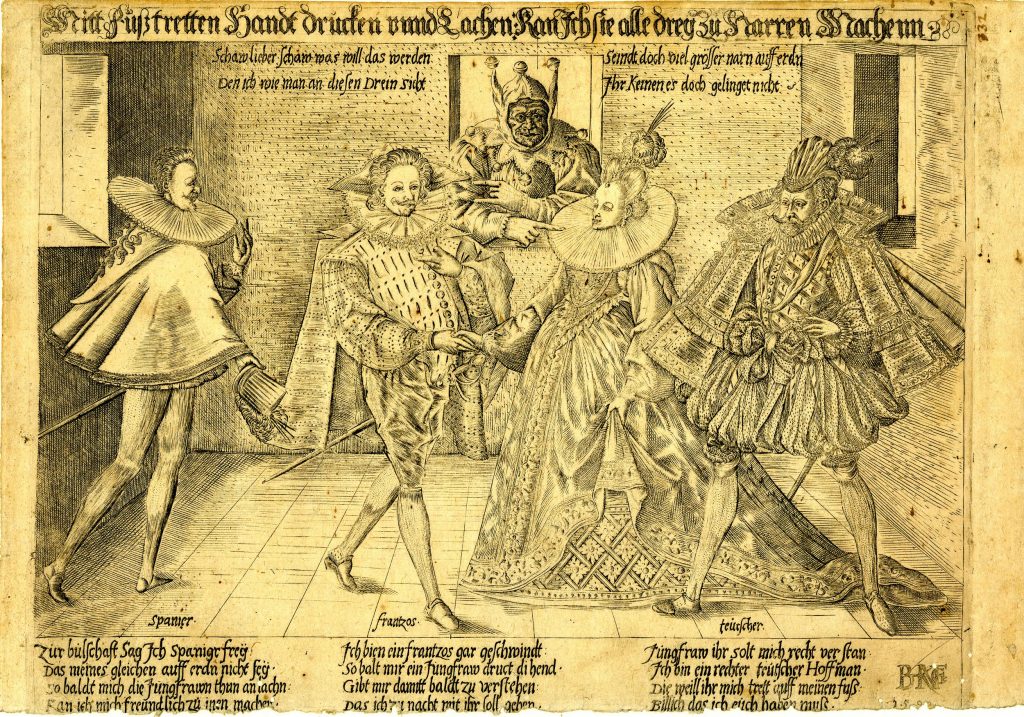
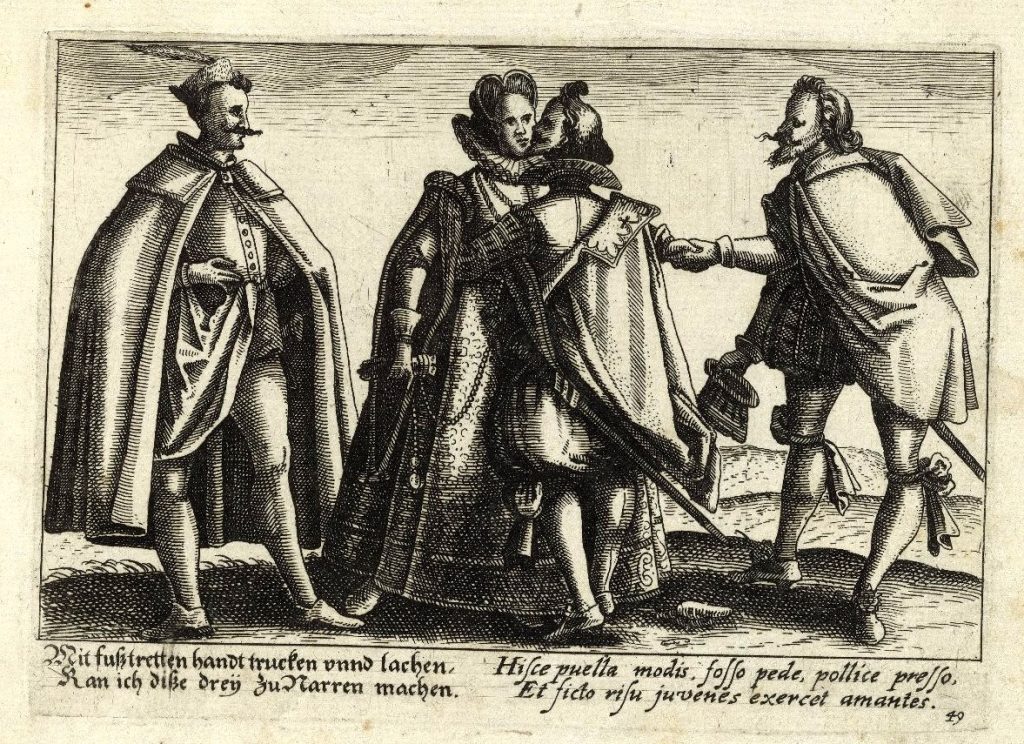
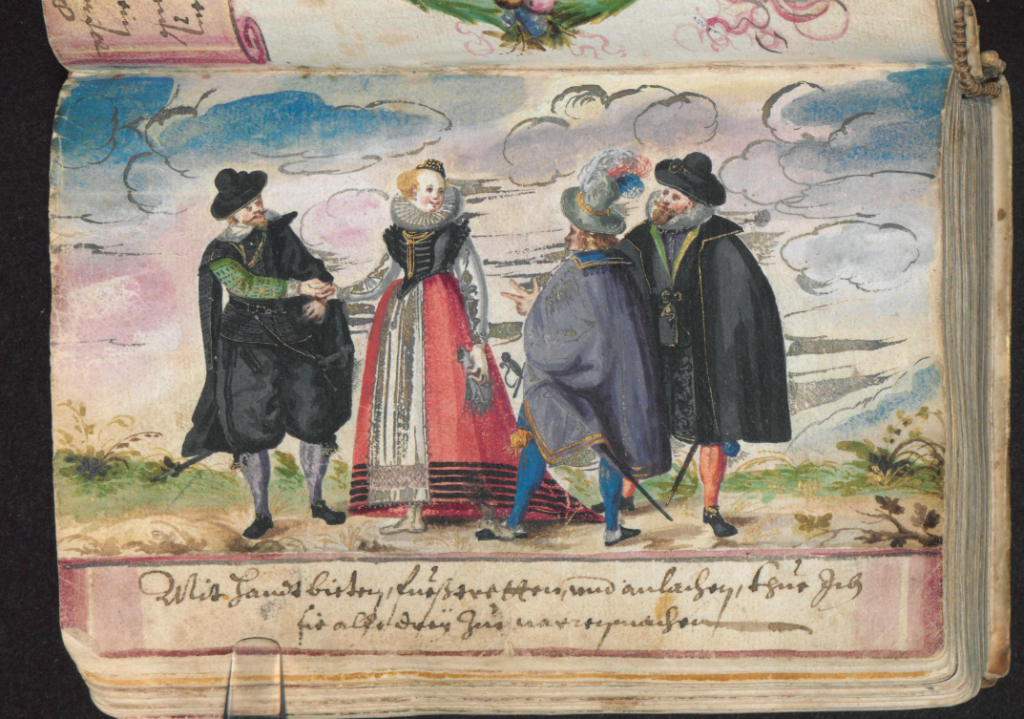
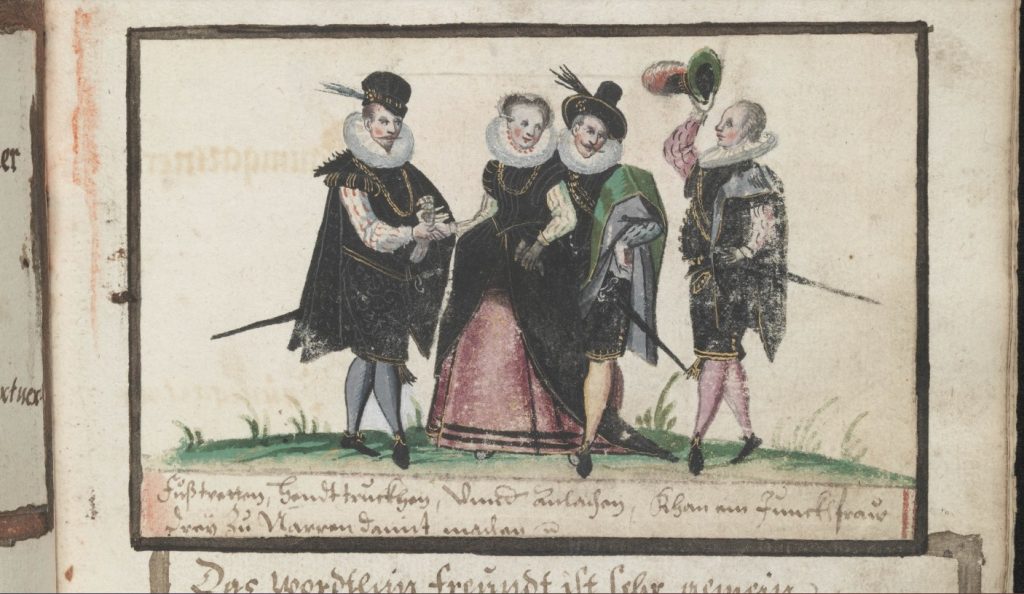
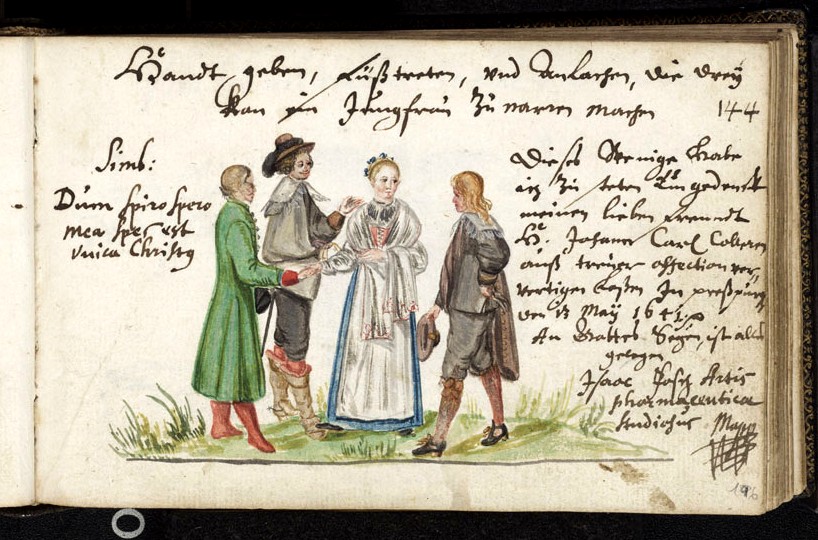
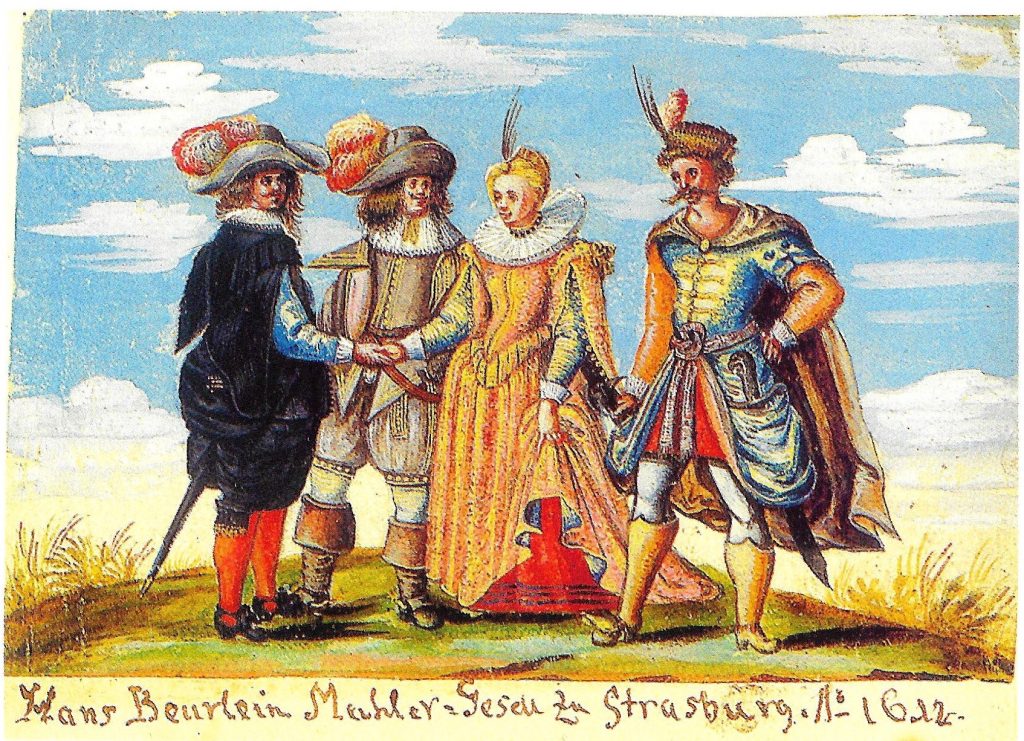
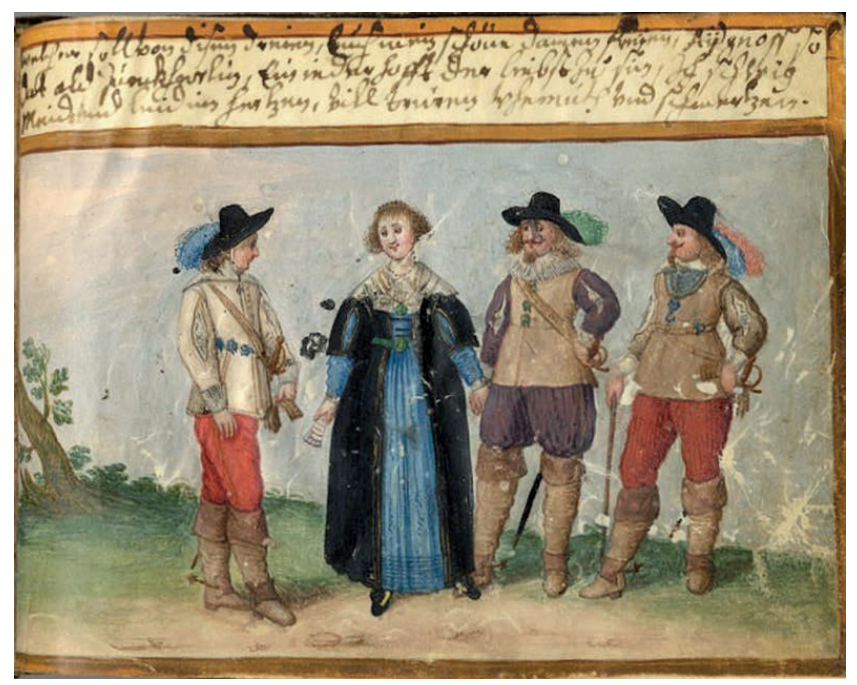
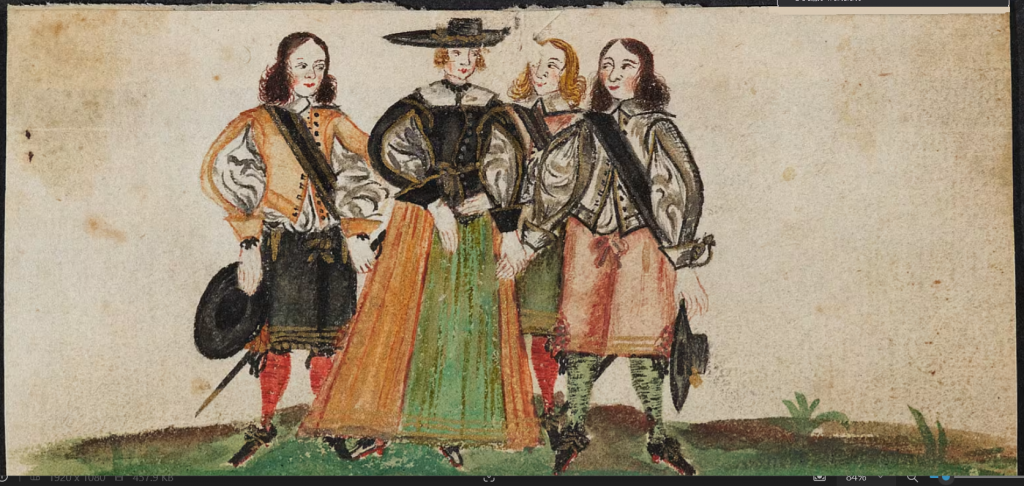
Playing footsie! This is an example of what, in one of my Pinterest boards, I call “significant gesture”. The lady is spoiled for choice — positively over-run with suitors. But who is her favourite? Is it the one whose foot she subtly treads on? But her mocking verse, frequently quoted, suggests that she is happy to string all three along! I give it here in the form used as the title of BKGF’s print of 1590 (see below):
Mitt Fuß tretten Handt drucken unnd Lachen
Kan Ich sie alle drey zu Narren Machenn
[With foot-treading, hand-squeezing and laughing I can make all three of them fools]
For the most part — after 1608, that is — this is yet another Pugillus Facetiarum popularisation, though also taken up by subsequent print-books (e.g. the Philotheca Corneliana (1619)). But the contemporary etching by Claes Jansz. Vischer II in Daniel Heinzius, Bloem-hof (Amsterdam 1608, 1610), shows it was already known in the Netherlands too.
Before the Pugillus, the Monogrammist BKGF produced a print in 1590 in which, what I have elsewhere termed a ‘commentary’ fool, observes the lady and her 3 suitors and makes the ‘horns’ gesture …. [for other examples of this gesture not made by fools, see my post (30 Jan 2026) Gesture in the Albums]. We begin with this engraving and three album images that clearly derive from it. Extra spice is added to the Monogrammist BKGF’s print by the fact that the lady’s 3 suitors all hail from different countries. At the moment she is dancing?/holds hands with the Frenchman [frantzos], but the Spaniard [Spanier] is trying to engage her attention (left), while her countryman, the German [teutscher] behind her, looks decidedly miffed!
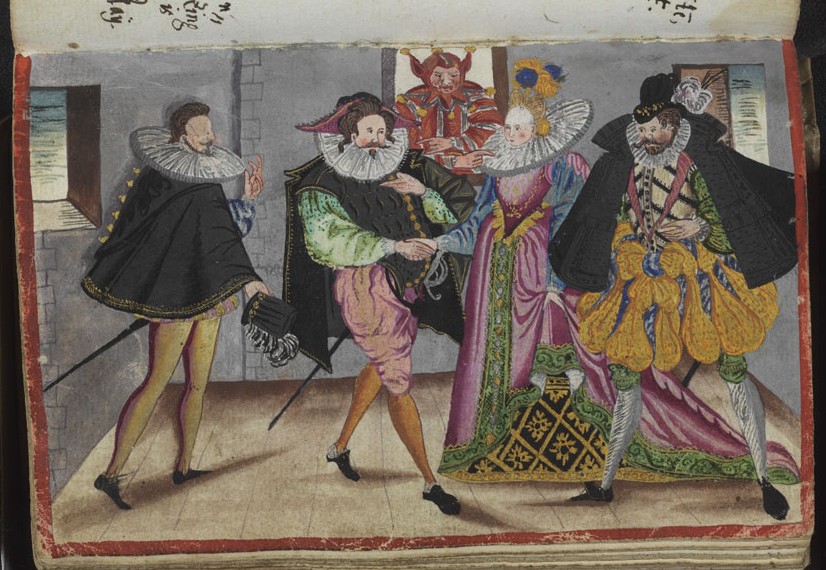
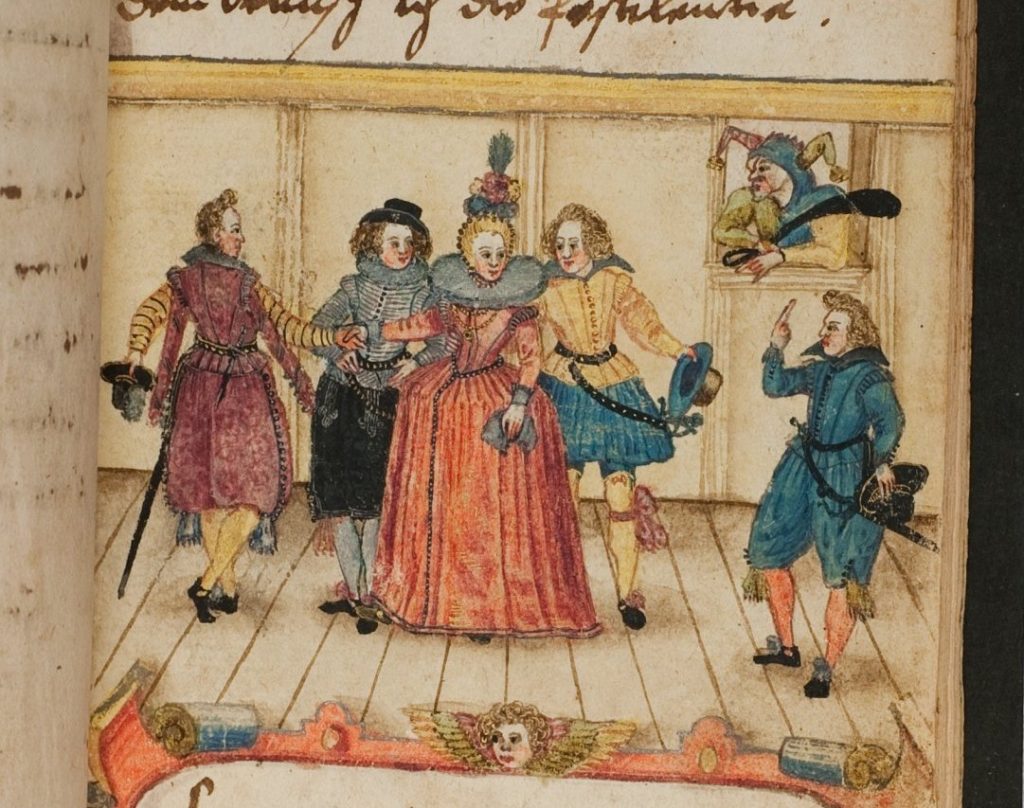
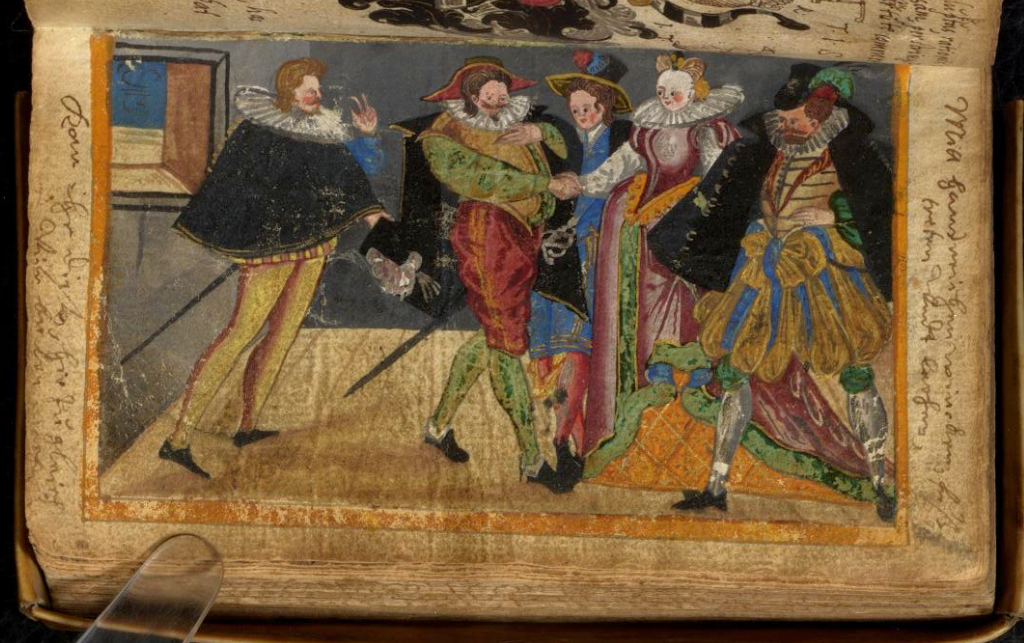
The same print was also the model for a contemporary enamel-painted Bohemian Humpen dated 1599 now in the Museum für Angewandte Kunst [MAK], Vienna.
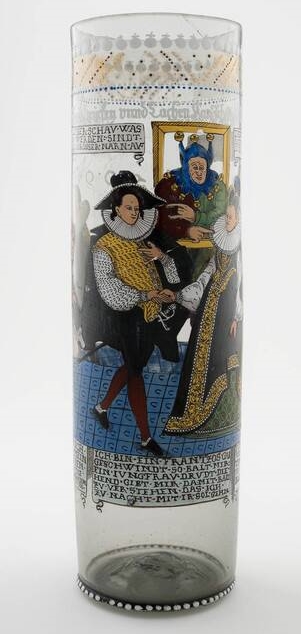
There is another such Humpen dated 1621 in the Kunsthistorisches Museum in Vienna, and Bernt (1928), no.75 also records an enamel-painted glass dated 1694 with the usual couplet.
17C prints
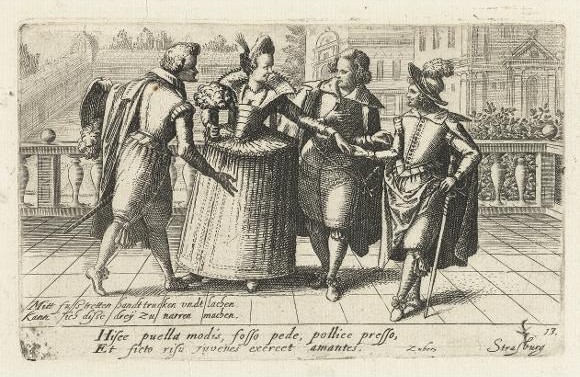
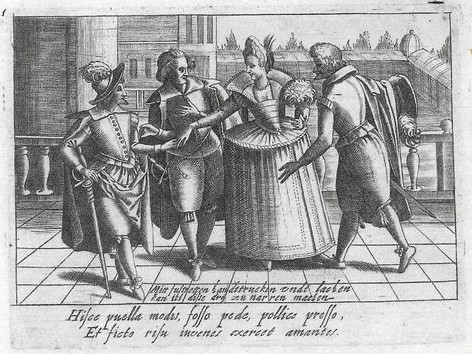
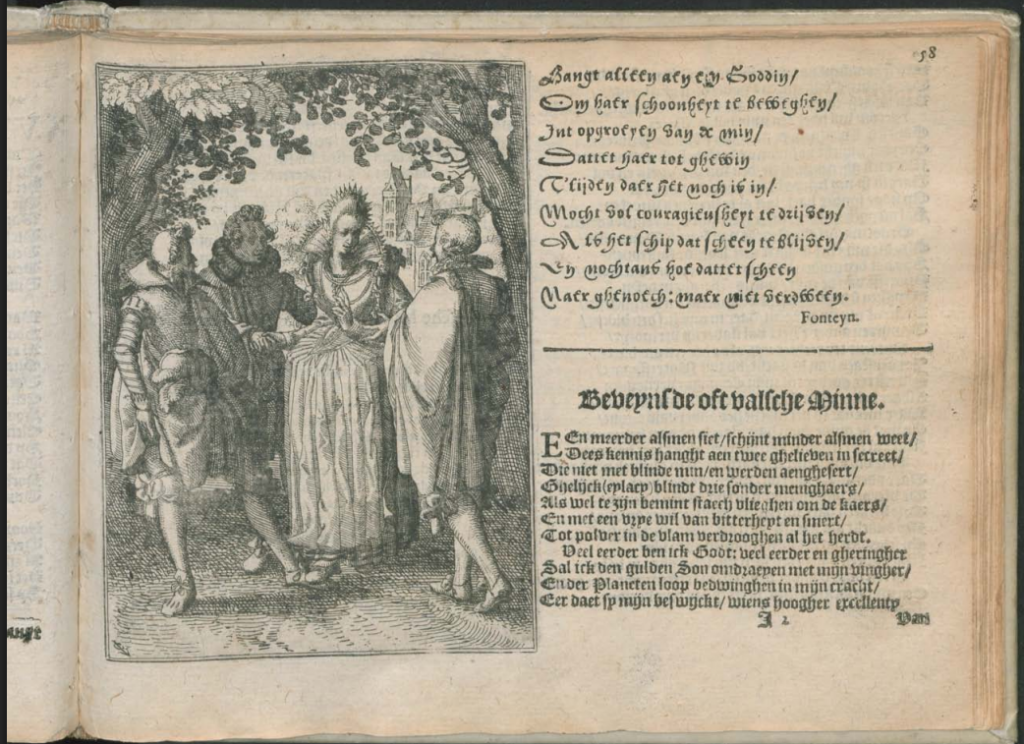
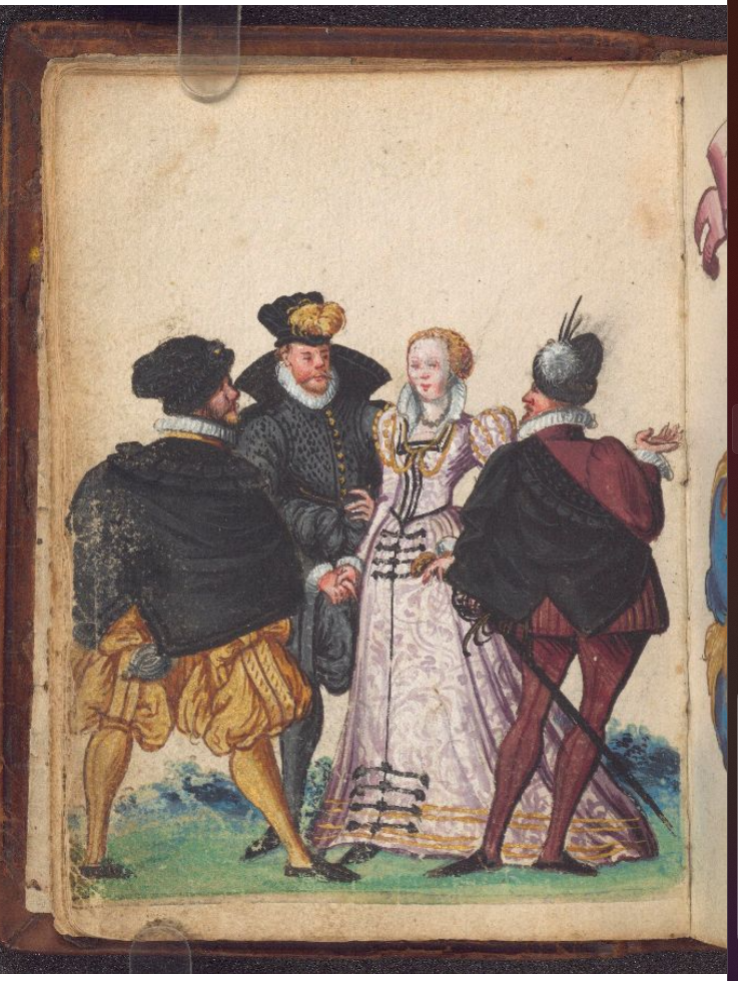
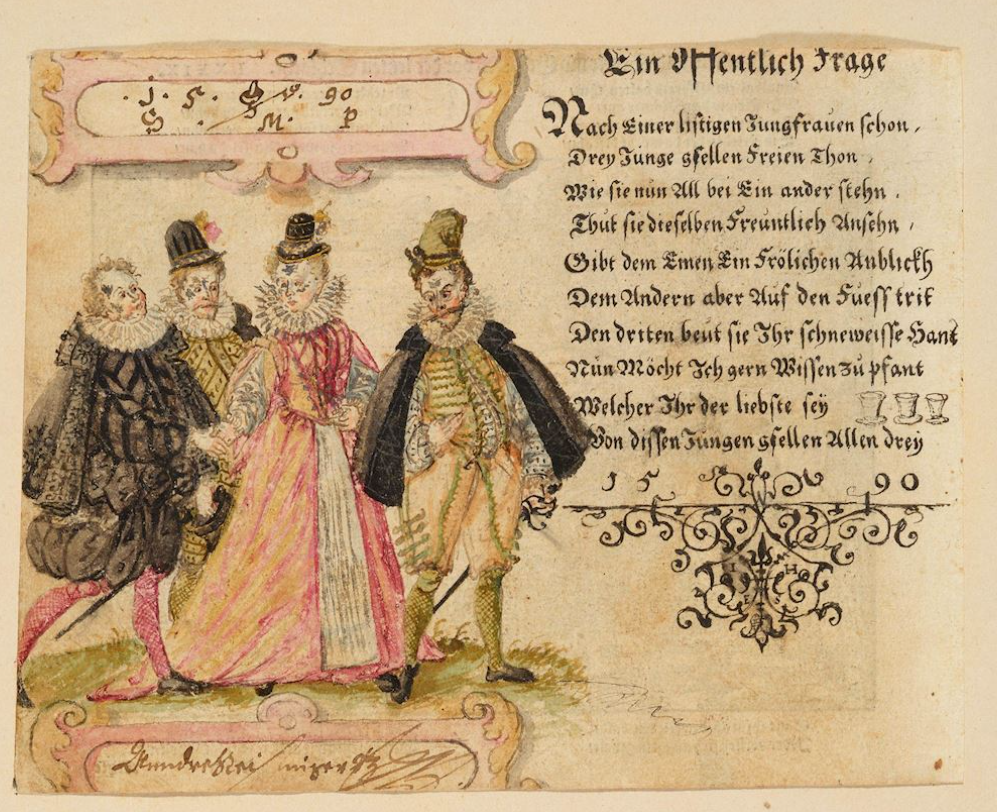
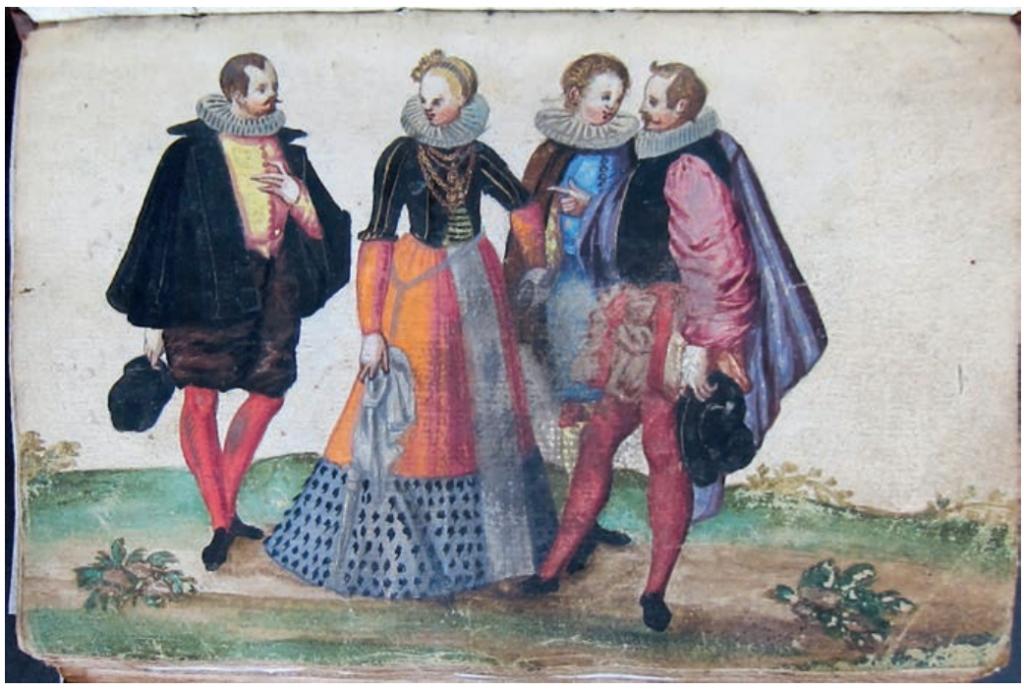
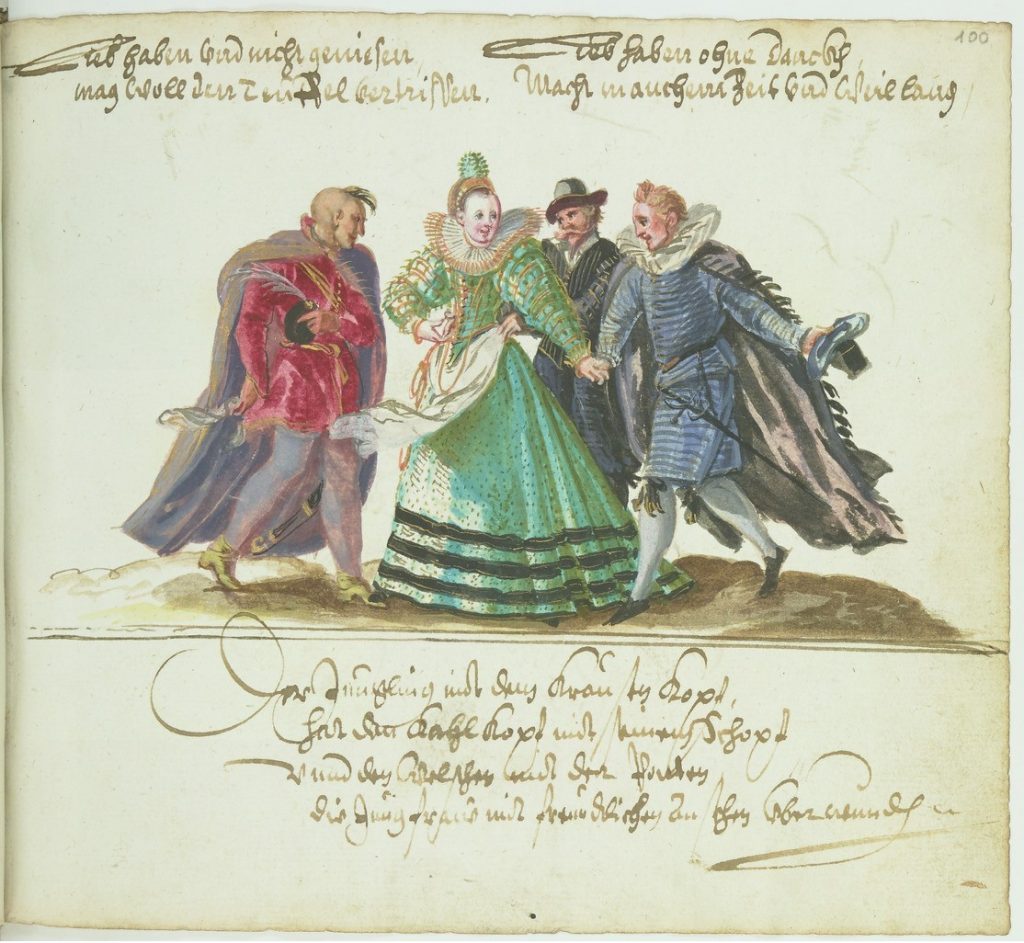
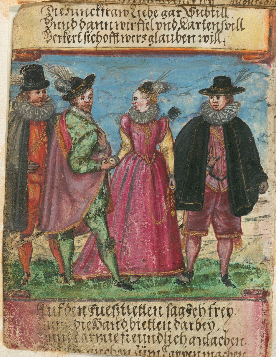
The scene as painted in the Matt album (above) is headed by two traditional couplets:
Lieb haben und nicht geniesen To have love and not enjoy it
mag woll den Teuffel verdrissen would vex even the Devil
Lieb haben ohne danckh To have love without thanks
macht manchen Zeit und Weil lang makes all the time seem long.
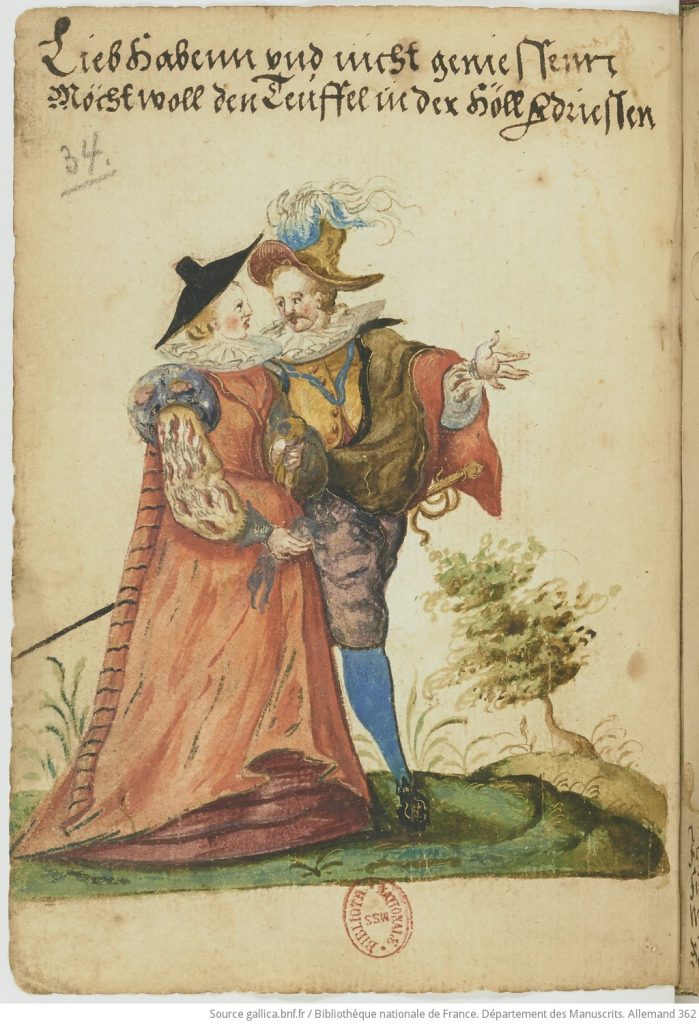
Here is a miniature of two contemporary lovers painted in the album of Johann Müllegg captioned with the same couplet:
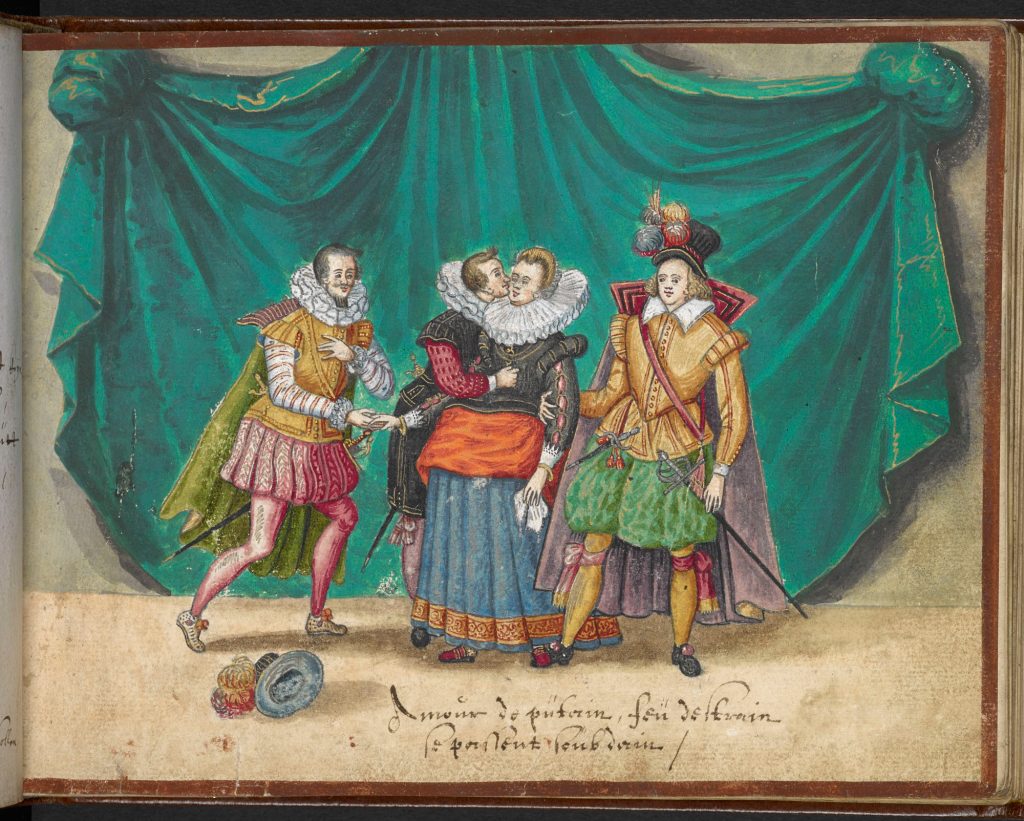
In the Walens album (below) the scene is captioned with a proverbial, if unflattering, verse: amour de putain, feu destrain se passent soubdain [a whore’s love is like fire in straw — both pass suddenly]
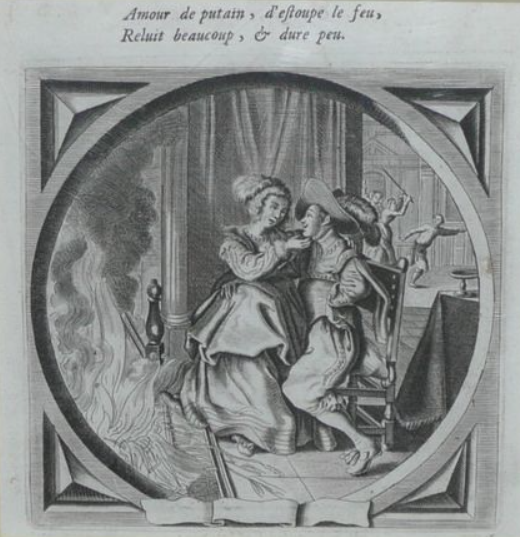
Here the same proverb is illustrated in Jacob Cats’ emblem-book, Spiegel van den Ouden ende Nieuwen Tijdt (Den Haag 1632, etc.)
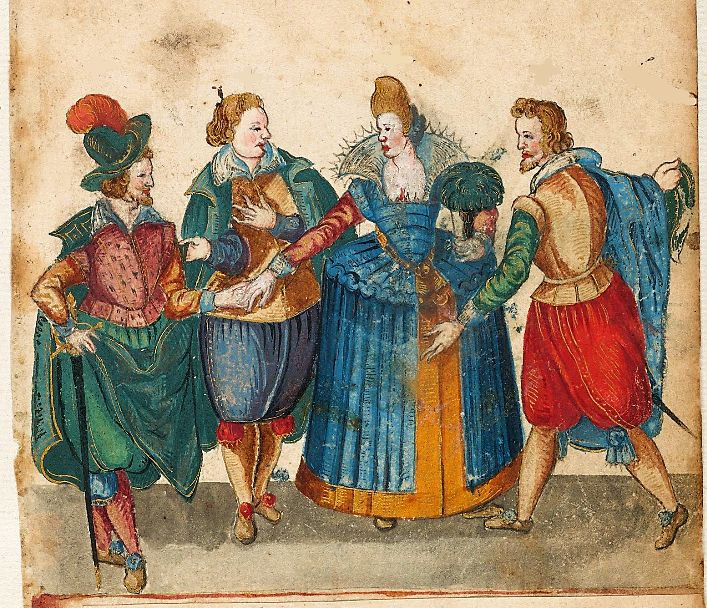
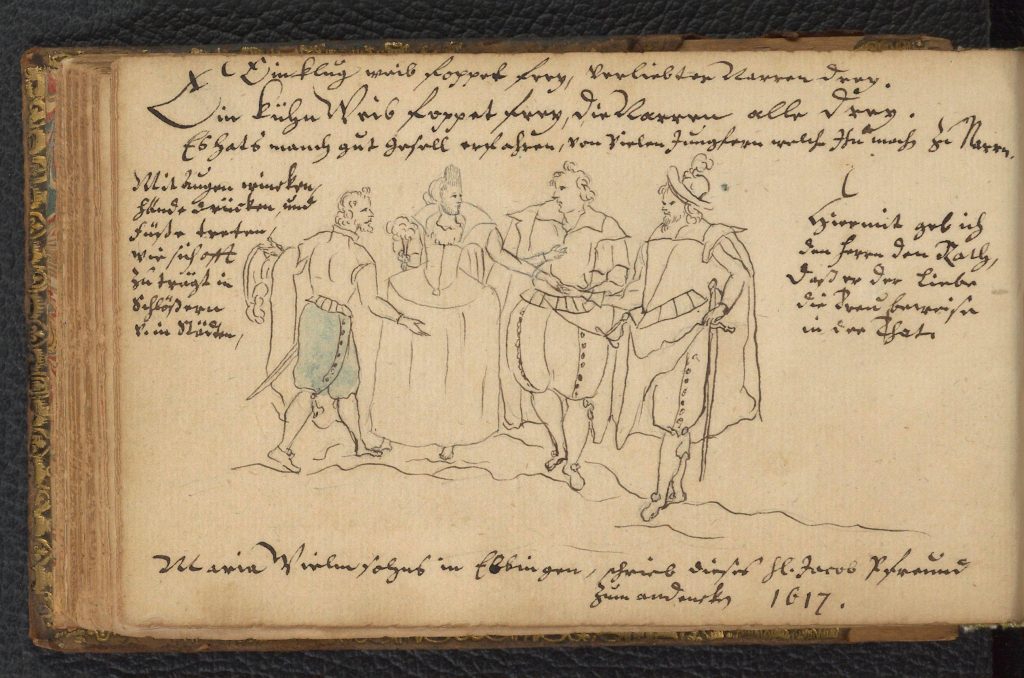
In the Freund album the scene, apparently dated 1617, is sketched in lightly, as if awaiting colouring:
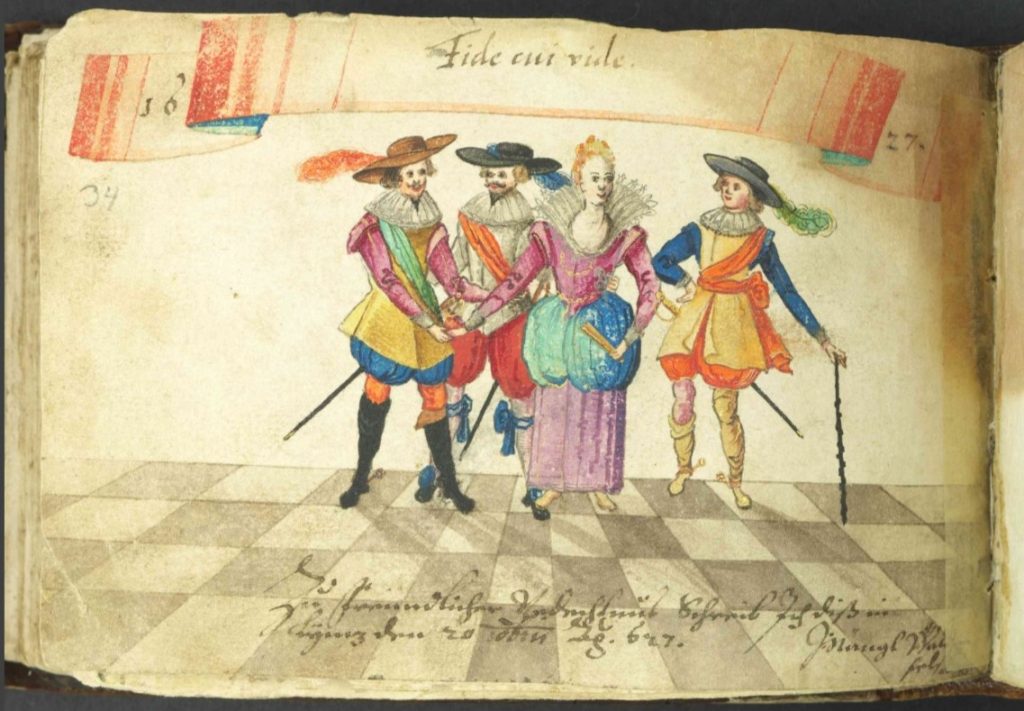
In the Jacob von Zinnenburg album the scene is captioned with a Latin proverb very common in the albums, Fide cui vide, which means ‘be careful who you trust’.
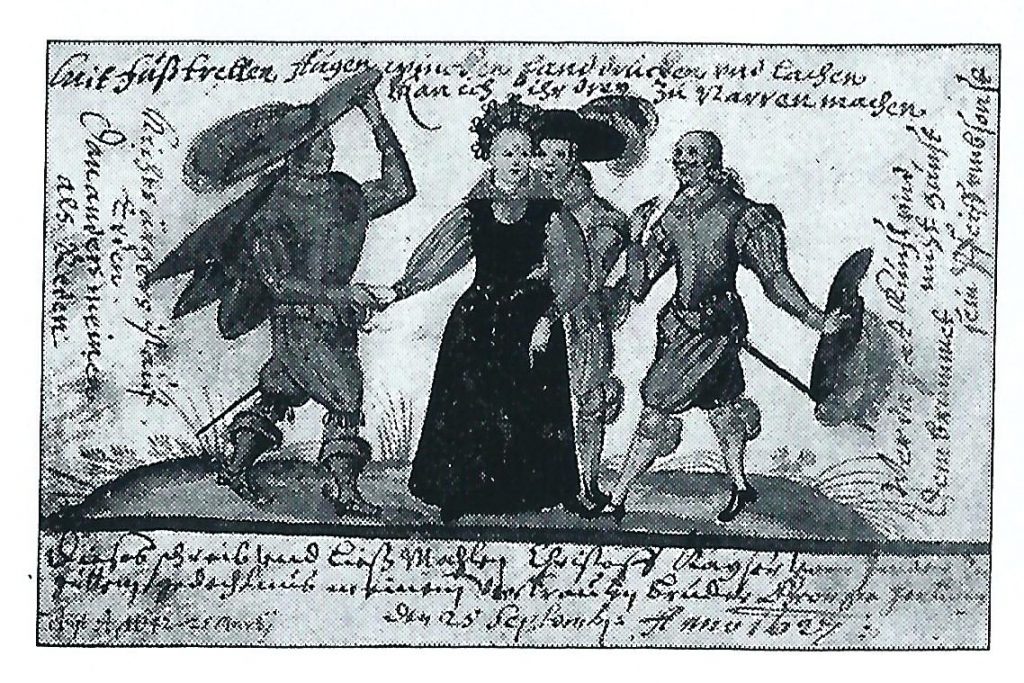
R 2306 (formerly 1969 / 179)
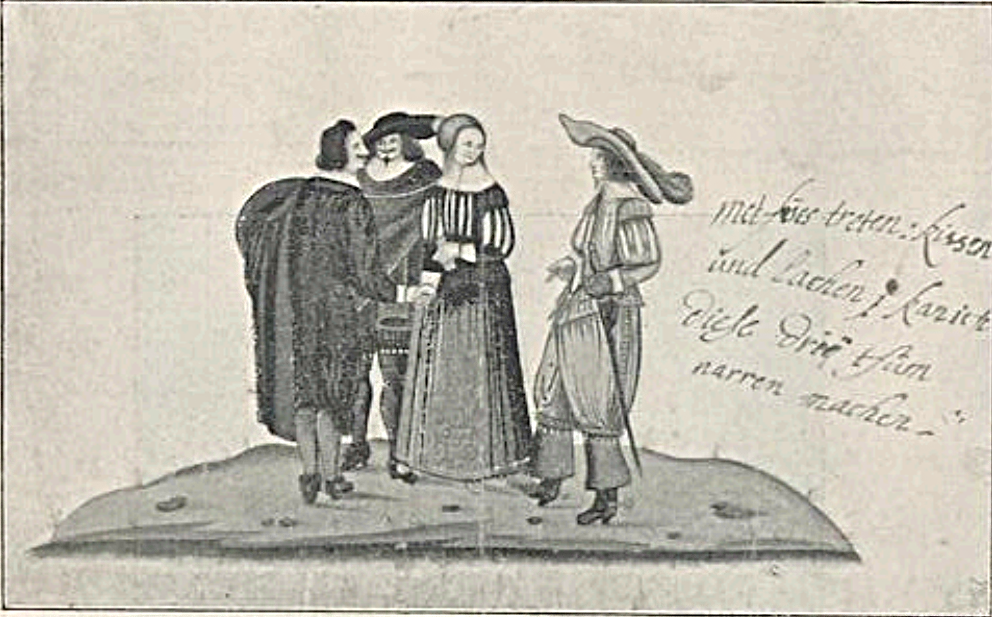
In the 1653 edition of Zingref’s Apophthegmata we hear of a glass pane (?) painted with our motif and accompanying verse in a Dusseldorf tavern:

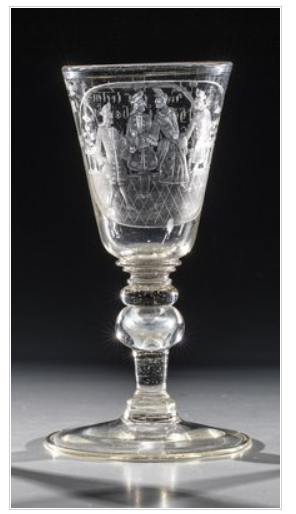
Above I mention three 17C glasses enamel-painted with the scene, but it is found engraved on glassware too, as in this early 18C Bohemian goblet sold at auction only last year; here the verse reads Mit fus treten hande geben kni beugen und lachen / kan ich alle drey Zu narren machen:
And finally…
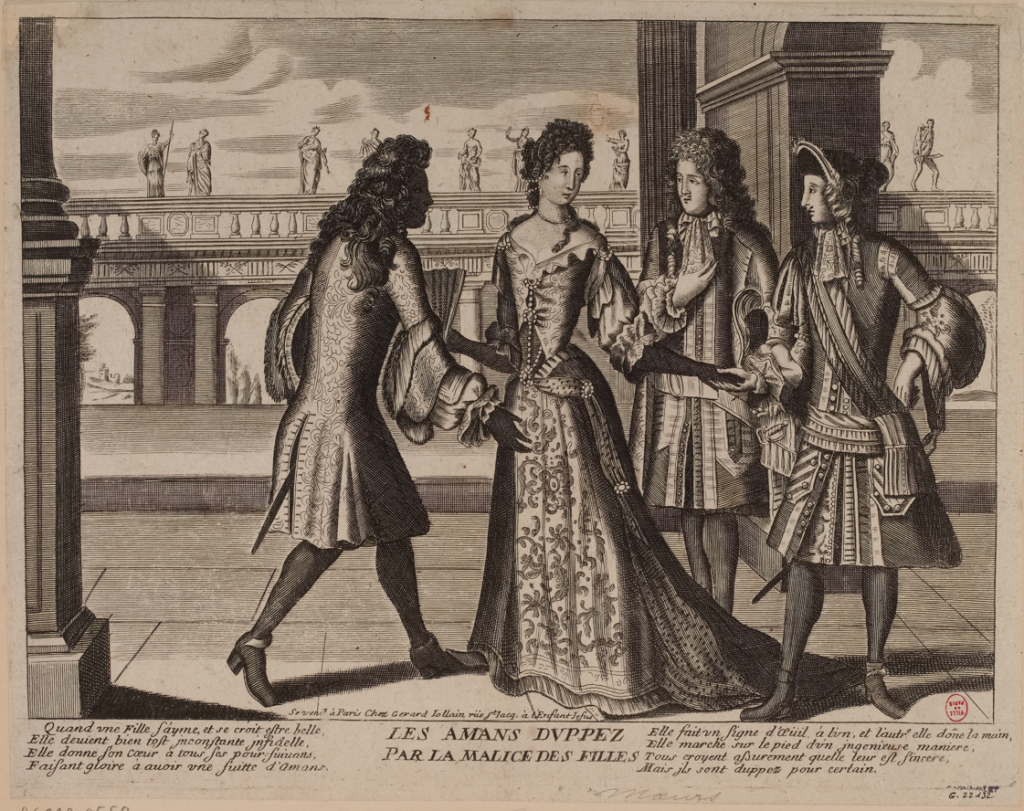
There is no doubting the tenor of this later 17C French print of our motif — the title is a bit of a giveaway! Les amans dvppez par la malice des filles [the lovers duped by the malice of girls]
Leave a Reply to Gesture in the Albums – Album Amicorum: Early Modern Stammbuch Iconography & related Cancel reply