We might say that the album amicorum was born out of the Reformation, and given that the overwhelming majority of albums were produced in a Protestant milieu, there is no shortage of anti-Catholic iconography, often virulent. Anti-Papal motifs are common enough, but perhaps the commonest such images accuse monks of improper relations with nuns and laywomen. [The Provision for the Convent motif, in which a monk is seen heading back to the monastery, a woman hidden in a sheaf of corn carried over his shoulder, was so common that I have given it its own post here:
https://albumamicorumear-e4qvahs764.live-website.com/provision-for-the-convent/
Given that the habit of keeping albums originated in the Protestant university of Wittenberg, alma mater to both Luther and Melanchthon, the imagery in them, where it concerned matters of religion, was always bound to be anti-Catholic. By the time non-heraldic paintings appear with any frequency in the albums, the tradition of such imagery in single-sheet prints was already well over a generation old. The album-painters thus had a considerable body of ready-made anti-Catholic motifs to draw on – but seem to have been quite capable of inventing a few new ones of their own too
Anti-Catholic motifs were targeted at the clergy, both male and female – ideally, both male and female simultaneously – and, of course, the Pope, but I propose to sample anti-Papal motifs in a separate post.
[I did! It’s here: https://albumamicorumear-e4qvahs764.live-website.com/anti-papal-imagery-in-the-albums/]
But — in view of what is to come — let us begin with a positive example of the monastic ideal!
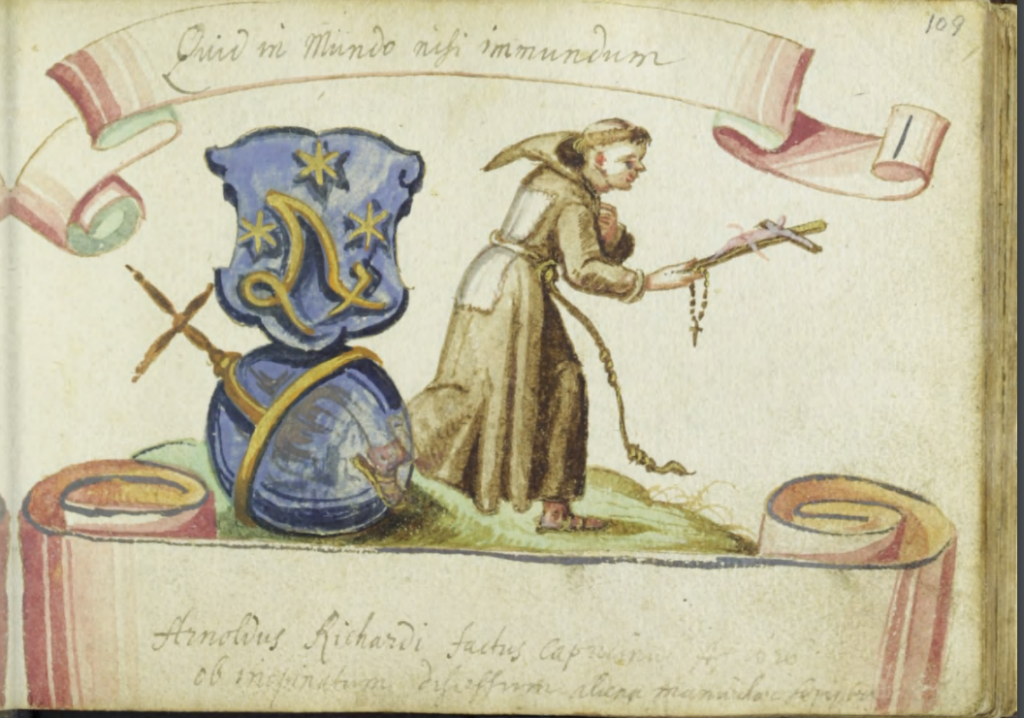
Painted into the Hensel album in 1626, a monk flees from the wicked world, the emblem entitled, Quid in mundo nisi immundum [What is in the world but that which is unclean?]
monks and nuns
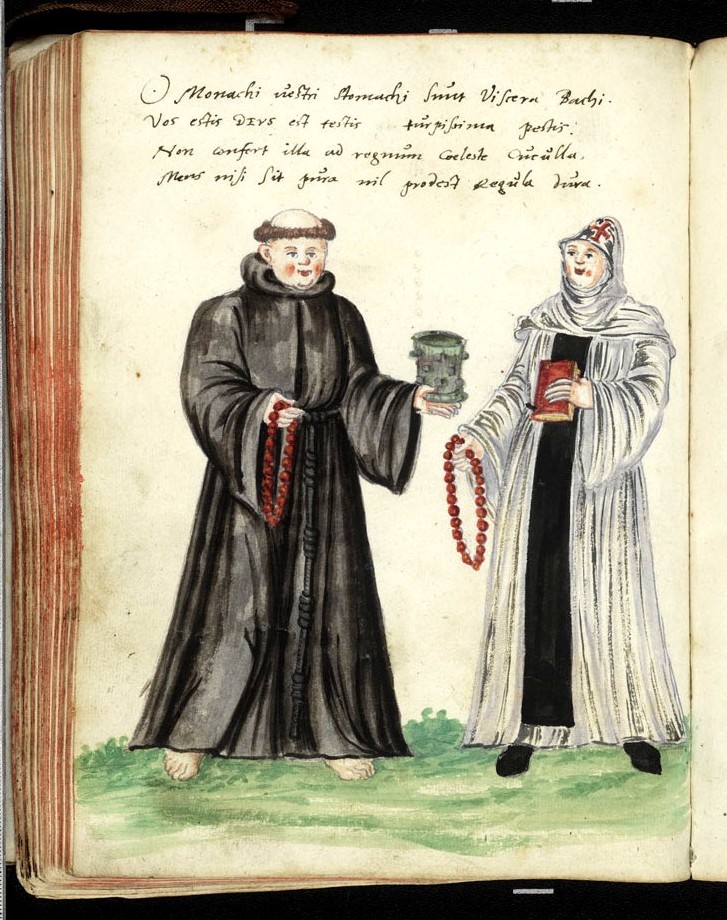
A painting dated 1574 in the Tetzel album shows a barefoot, rosy-cheeked monk standing beside a nun – both hold rosaries in one hand; the nun has a (presumably religious) book in her other hand, but the monk holds out a large beer-glass. Above their heads are two couplets of Latin verse, both medieval in origin and current long before the Reformation [Walther 19507 and 17396, respectively], though Luther is said to have quoted the first in his Table Talk:
O monachi vestri stomachi sunt viscera Bachi O monks, your bellies are Bacchus’ entrails
Vos estis DEVS est testis turpissima pestis You are, as God is witness, the vilest plague
Non confert illa ad regnum coeleste cuculla The hooded one [i.e. nun] does not contribute to the heavenly kingdom Mens nisi sit pura nil prodest Regula dura a hard rule avails nothing unless the mind is pure.
Despite the vicious language of the verse, the miniature is not overtly indecent – almost charming, in fact!
This next leaf colourfully indicates the degree of hostility that was felt towards the often too demanding visits of monks and other mendicants:
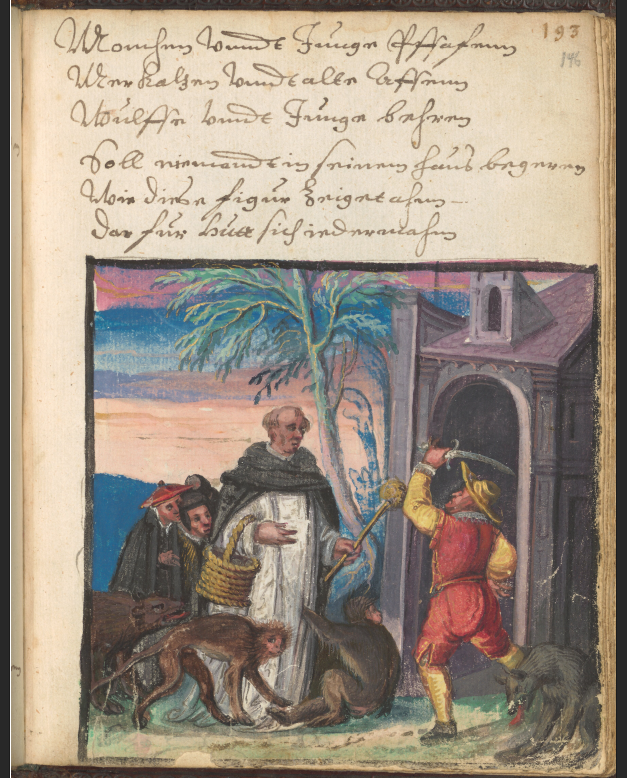
Monchen unnd junge Pffafenn Monks and young priests
Merkatzen undt alte Affenn apes and monkeys
Wulffe undt Junge behren wolves and young bears
Soll niemandt in seinem haus begeren nobody wants in their house
Wie diese figur zeiget ahn as this illustration shows
Dar fur huet sich iedermahn everyone wants to protect themselves from that
[The above text was kindly transcribed for me by my friend, Dr. Christoph Gasser]
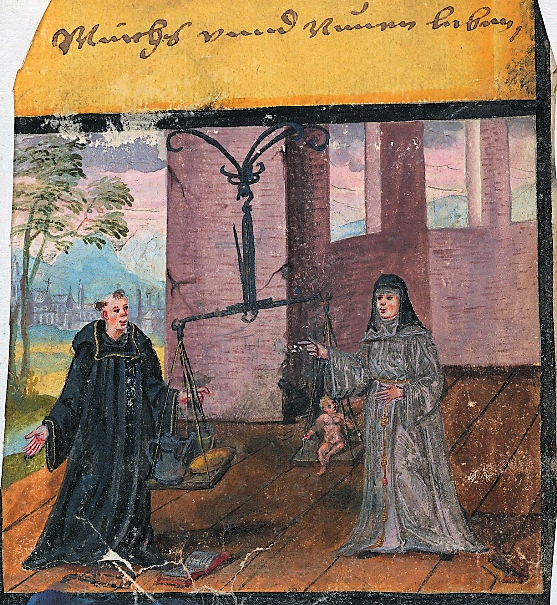
But we are surely right to suspect some impropriety in this curious scene painted on an orphaned leaf in the Frommann collection (probably from the album of Philipp Schad, dated entries 1600-22). A monk and nun stand either side of a giant balance, in the lighter scale-pan beside the nun sits a small naked baby who looks up at her as she points at the monk. In the other evidently heavier pan are a loaf of bread and a large flagon.
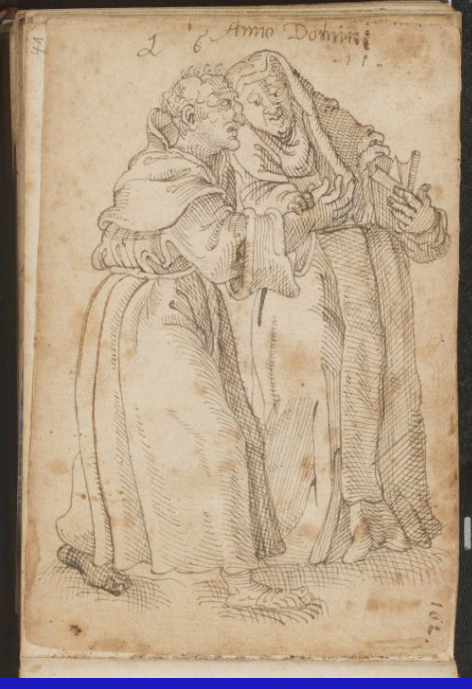
In the drawing in the Zorer album (below) an elderly monk gropes an elderly nun
This full-page painting in the Hans Ludwig Pfinzing von Henfenfeld album below depicts a scene of unrestrained debauchery:
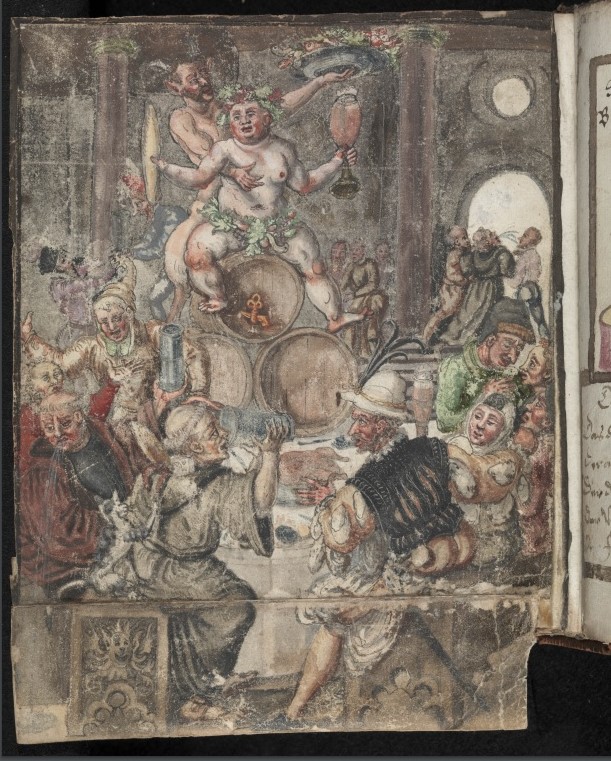
We look on a feast inside a church-like building seemingly presided over by a chubby Bacchus seated on the top of a pyramid of beer-barrels and brandishing bread in one hand and a very large glass of wine in the other. In the foreground one monk is quaffing from an outsize glass while his neighbour is vomiting, to the obvious astonishment of a layman opposite, seated next to a nun with a similarly large glass of wine in front of her. A fool is in attendance signalling this folly, and for good measure, in the background, another monk in the process of vomiting is being hurried out of the door.
Secrets of the Confessional
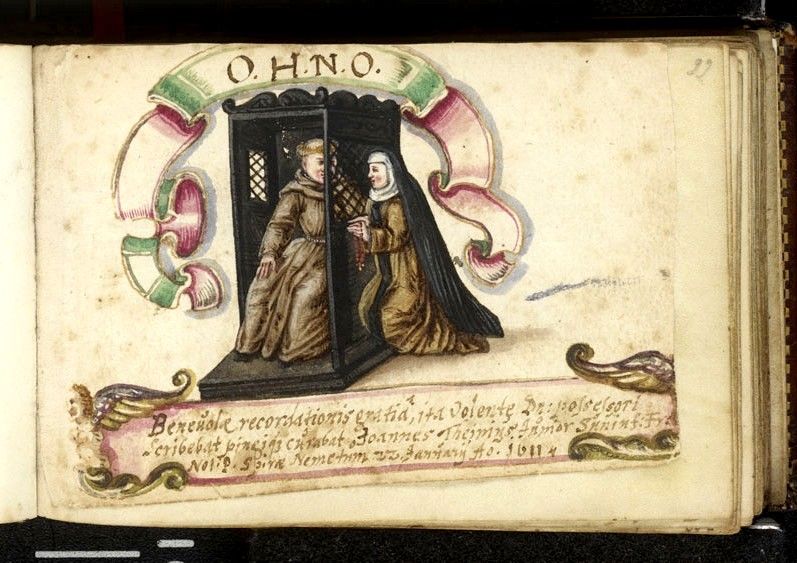
The monk who listens to the nun’s confession in a miniature dated 1611 in the Zorer album may be perfectly innocent, and indeed there is no obvious pictorial sign of impropriety, but in post-Reformation Germany… It may be that, were we able to expand the mysterious abbreviation O.H.N.O., in the banderole above the confessional, we should know exactly how to read this image.
carried in a back-basket
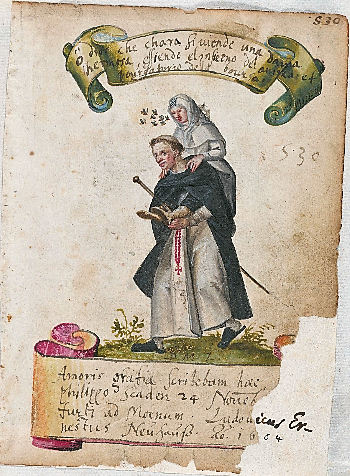
Perhaps related to the Provision for the Convent motif — for which see my separate post of that name — we also find examples of monks carrying nuns in back-baskets. The young woman in the Schad album miniature (below) is not actually carried in a back-basket, but rides piggy-back fashion on the monk’s back — note the insect-swarm above the monk’s head, a common iconographic convention in this era signifying wickedness. The Italian inscription above is a traditional triadic and misogynist definition of woman, but here omitting the first, positive term of the triad — a paradise for the eyes — leaving only the two negative elements — a hell for the spirit, a purgatory for the purse.
The triad in its normal form was to appear just four years later as the caption to this plate in the Pugillus Facetiarum
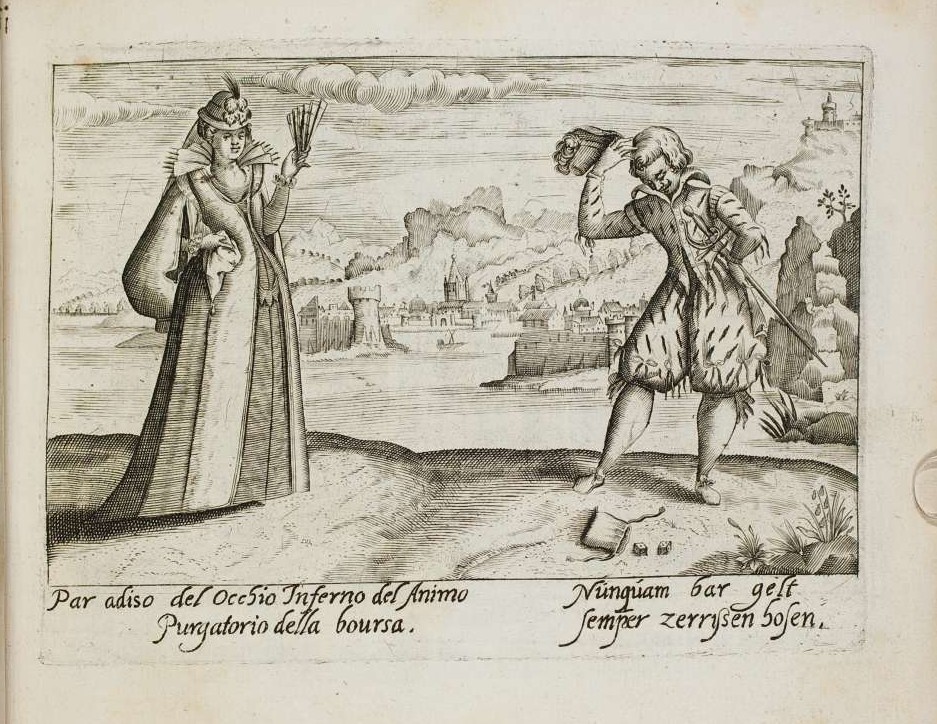
Paradiso del Occhio Paradise for the eyes
Inferno del Animo Hell for the spirit
Purgatorio della boursa Purgatory for the purse,
and this drawing dated 1642 in Frankfurt’s Stadel Museum quotes the same triad, and being of suitable dimensions, may well be an orphaned leaf extracted from an album.
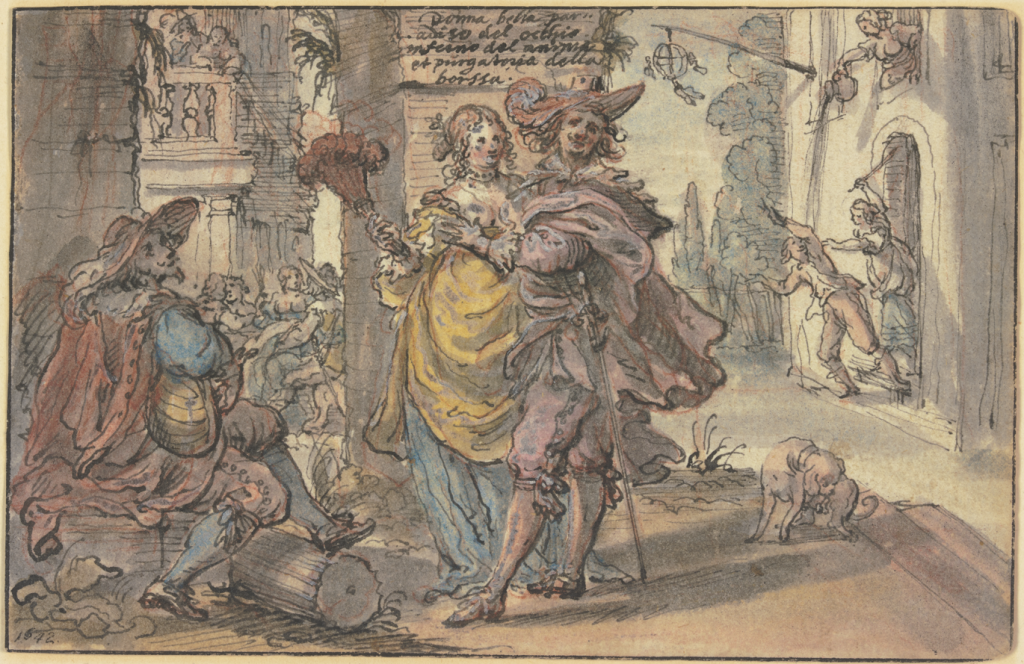
But I digress! In the Sötzinger album (below) the tiny woman in the monk’s back-basket is not dressed as a nun, but as an ordinary young German woman,
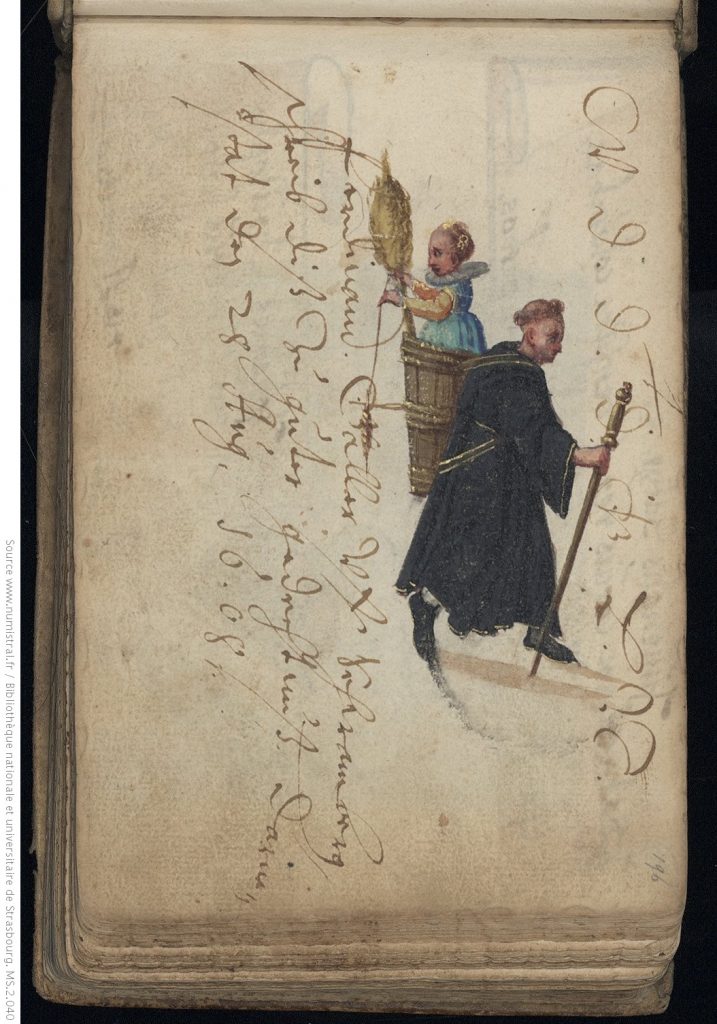
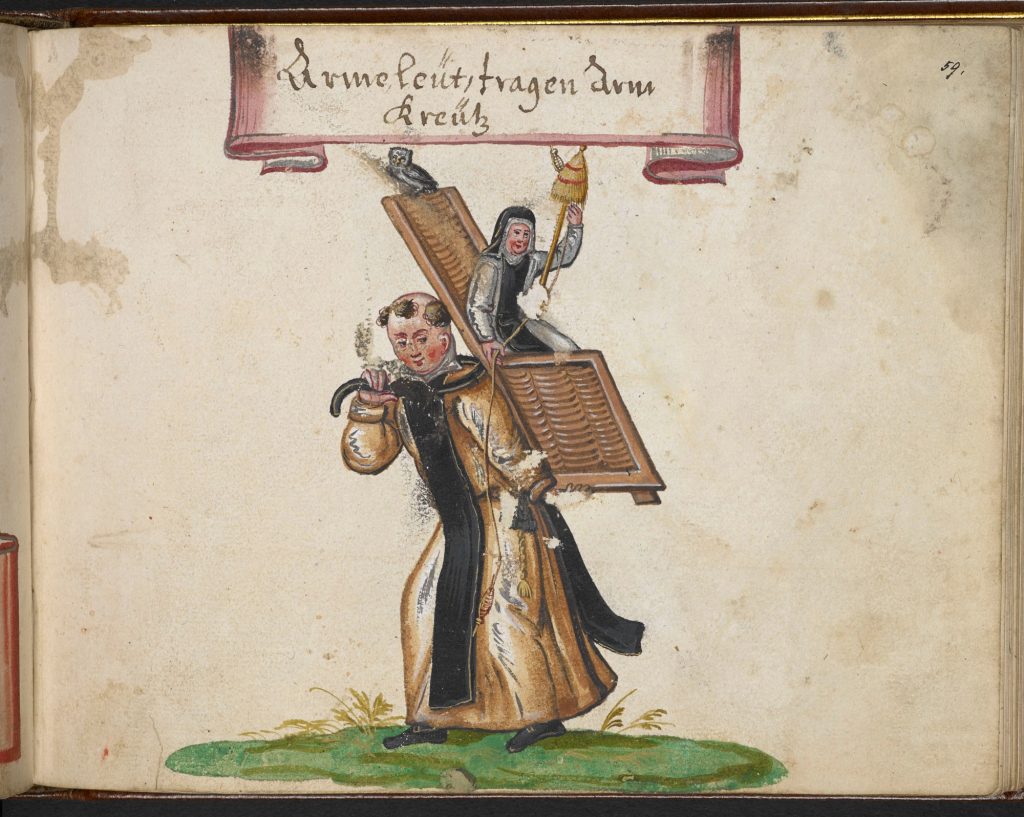
The painting in the contemporary Walens album, however, does indeed show a cheerful, diminutive nun spinning in the basket (an owl perched on the back of it) with another facetious title above — Arme Leut tragen dein Kreutz [poor man, carry your cross]. Does the owl derive, I wonder, from the mobbed owl of Beck’s woodcut? [see below]
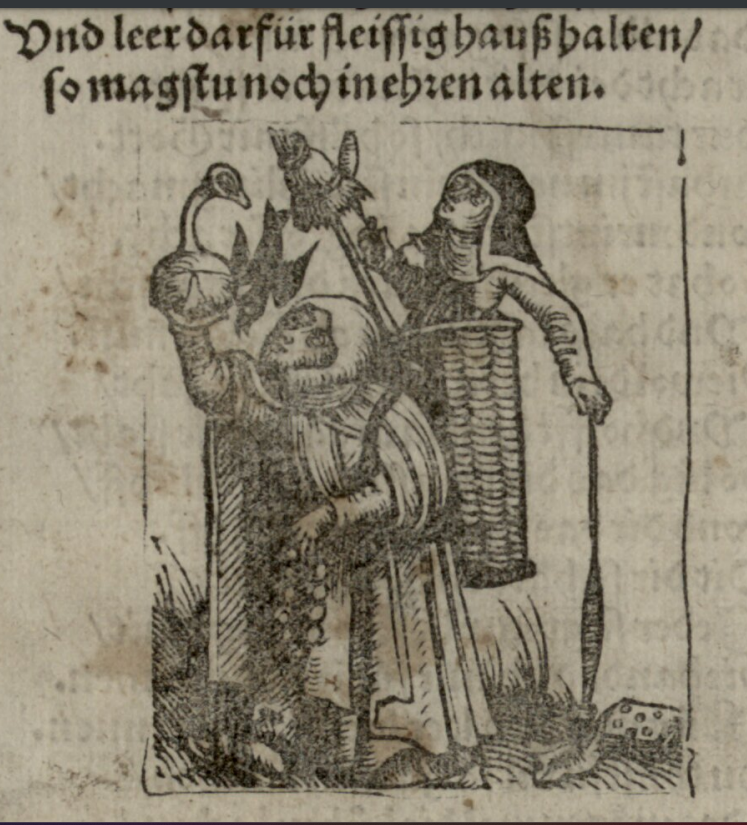
A slightly later example, again apparently a laywoman (Frau), is to be found painted in the album of Rhaban Giese, dated 1619. But the motif itself is much older, belonging to the earliest years of the Reformation, indeed, as in this woodcut sheet by Leonhard Beck dated 1523, with the spinning nun saying, Also wer gut im ruckorb spinnen / vill verthun und wenig gewinnen [who spins in a back-basket wastes much and gains little] !
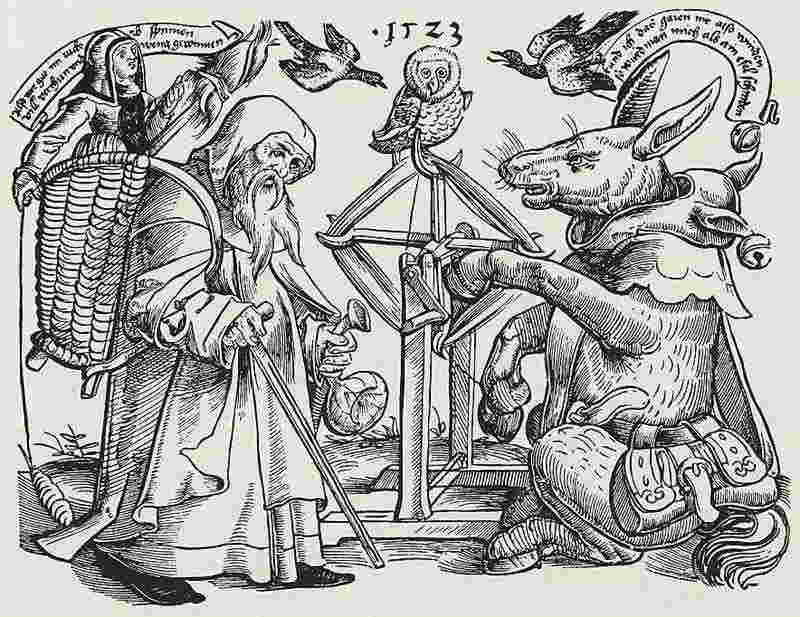
and the motif is found again a generation later in Wickram’s Losbuch of c.1550.
Though I have not seen it, the reverse situation, the nun carrying the monk piggyback-fashion (as well as a cockerel in a basket) is apparently painted in the Gottberg album (dated entries 1591-1613), the miniature starkly labelled, Zwei Huren [two whores]! [RAA]
riding the nun
A damaged leaf in the album of Johann Christoph Lattermann (1622-6) shows a monk riding on the back of a nun on all fours tilting at the ring, to the sound of a bagpiper leaning against a nearby tree. His command to his ‘steed’ is written above her, but is incomplete thanks to the damage. A remarkably similar composition, however, with the same inscriptions, enables us to complete his command, surviving as the lower half of a design for a shooting-target made in 1609, preserved in the Coburg manuscript: Schwester halt dich woll [Sister, bear up! ]. The couplet which entitles the scene reads
Wer woll nach den Ringk rennen kan He who knows how to tilt at the ring Bekombt den Preis von Iderman Will get the prize from everyone.
Though the present monastic variant presents a bizarre version, tilting at the ring was a familiar erotic metaphor — See my separate post here
https://albumamicorumear-e4qvahs764.live-website.com/tilting-at-the-ring-another-erotic-metaphor/
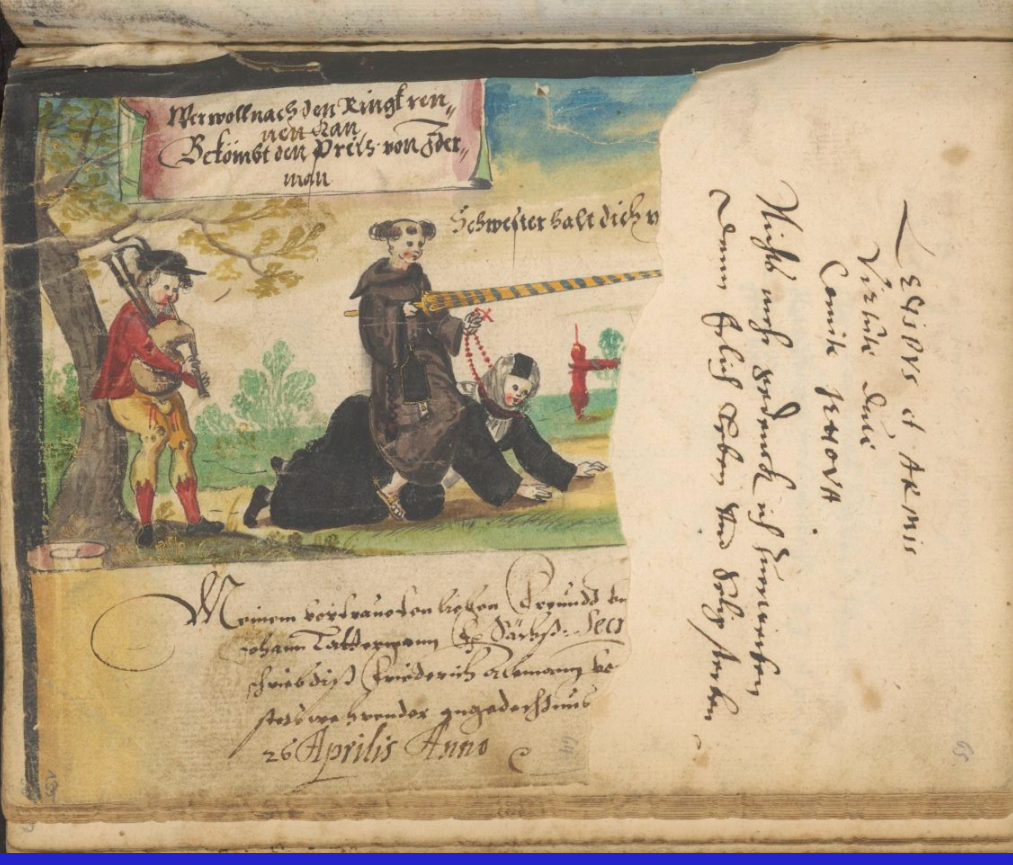
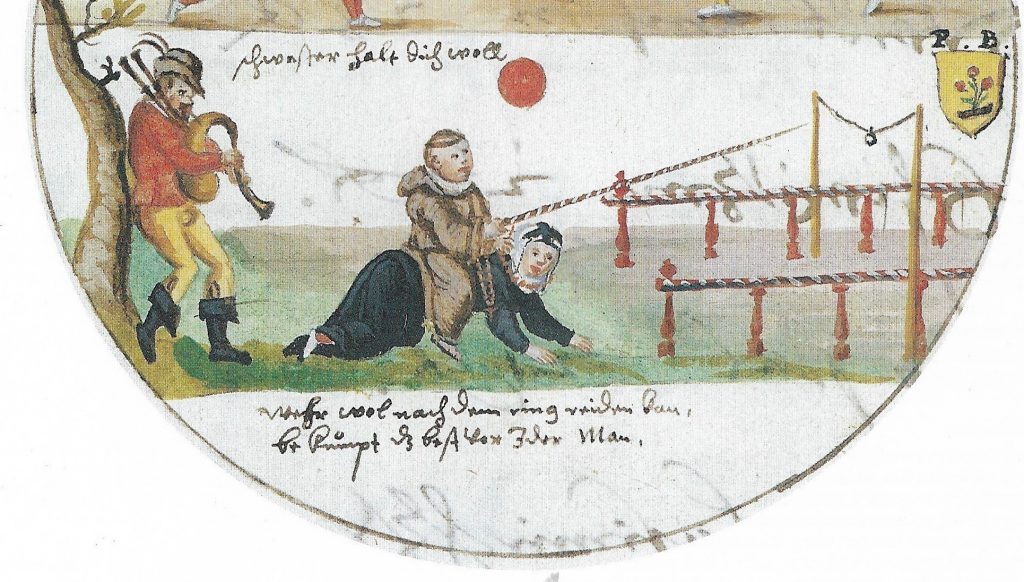
The Vita Corneliana print-book, etched and published in Berlin by Peter Rollos in 1624 presents a somehow more lascivious version of this equus eroticus.
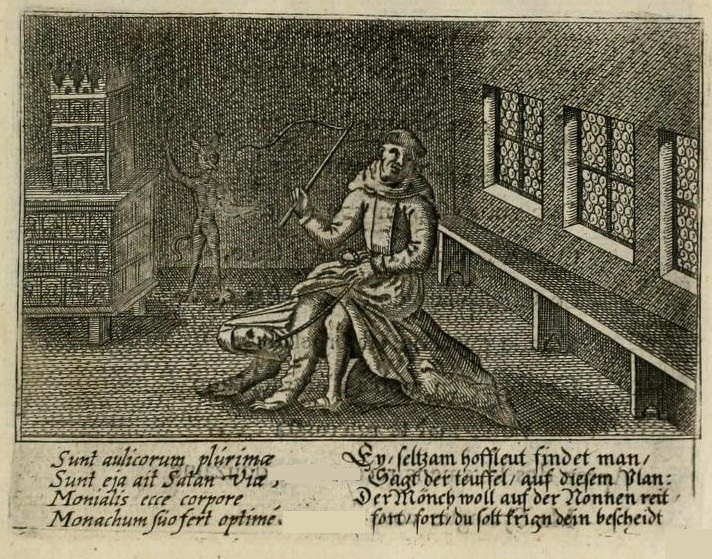
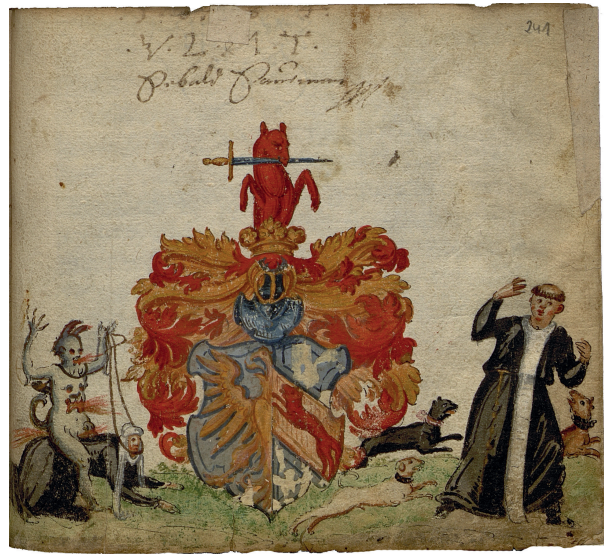
In the earlier Gruttschreiber album (f.241r.) in a miniature dated 1584 a nun is ridden by a fire-breathing devil who is hunting a fleeing monk with dogs,
taking the nun for a ride
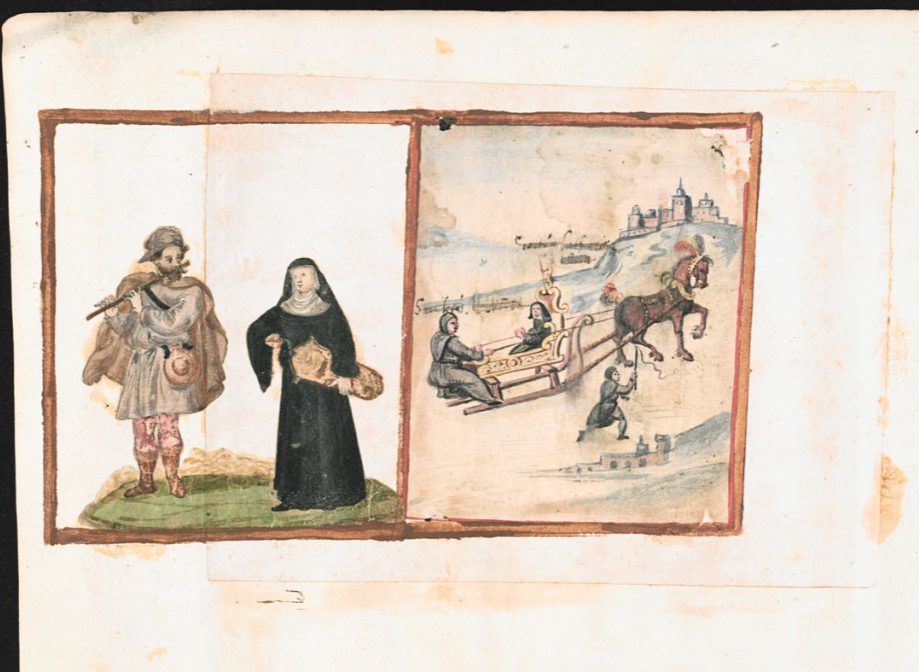
On one side of a miniature painted In the Jenisch album, a nun plays the hurdy-gurdy while a ?pilgrim plays the flute, while on the other side a monk and nun enjoy a sleigh-ride together — which is at least a recognised mode of transport —
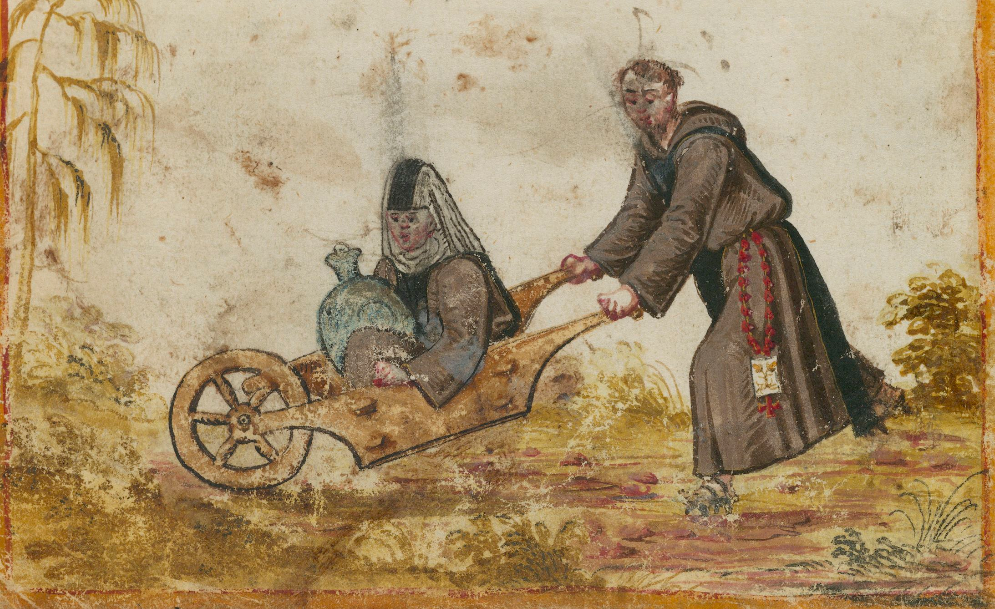
unlike the wheelbarrow, in which a nun holding a large wine-flask is wheeled by a monk whose rosary terminates, scapular-like, in a Two of Acorns playing-card!
Mixed Bathing…
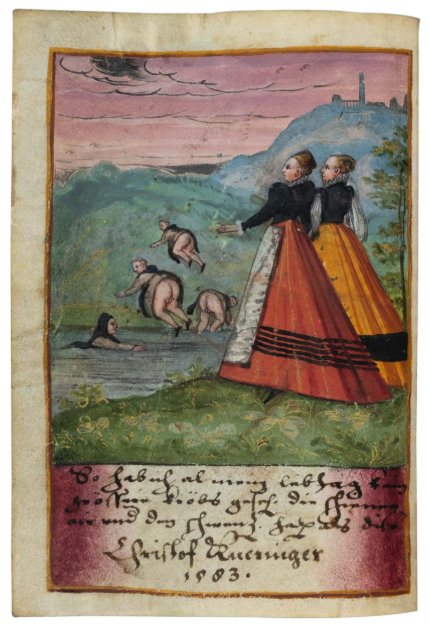
One of the remarkable miniatures in the Widholz album — which I only happened upon yesterday! One of the two fine ladies who observe the scene is moved to comment, So hab ich al mein Lebtag kein grössere Knödl geseh [In all my days I have never seen bigger dumplings!]
in the eel-pot
In a previous post
we discussed in some detail the motif of the woman as bait in the eel-pot to catch men – in which one of the representative males, eager to ‘taste the fish’ is a monk who says,
Alles fleisch wollt ich vergessen I’d forget all meat/everything carnal
Geb man solch fisch im kloster zessen If there was such fish to eat in the monastery
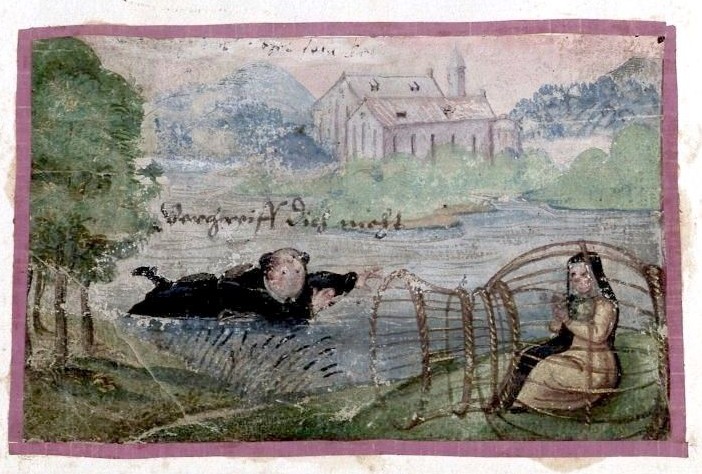
A variant in the Jenisch album (above) depicts a lone monk swimming towards a nun who appears to be praying as she sits inside the eel-pot. The handwritten caption reads Vergreift dich nicht [Don’t molest me!] Is she praying he won’t reach her, or that he will? In the Reichwein album (below)
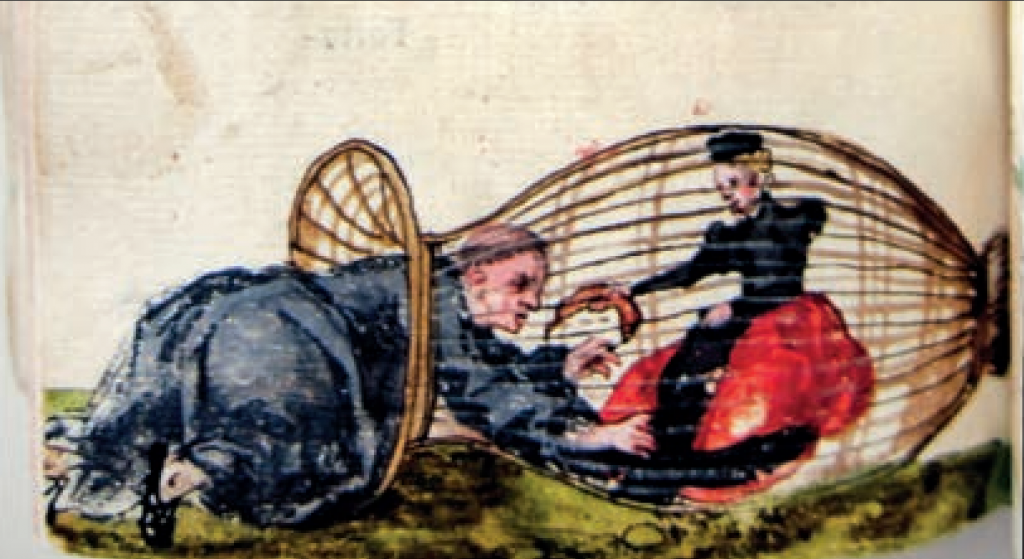
a monk crawls into an eel-pot in which a laywoman sits, further tempted by the offer of a sausage -– presumably, in addition to lasciviousness, implying the traditional accusation of gluttony.
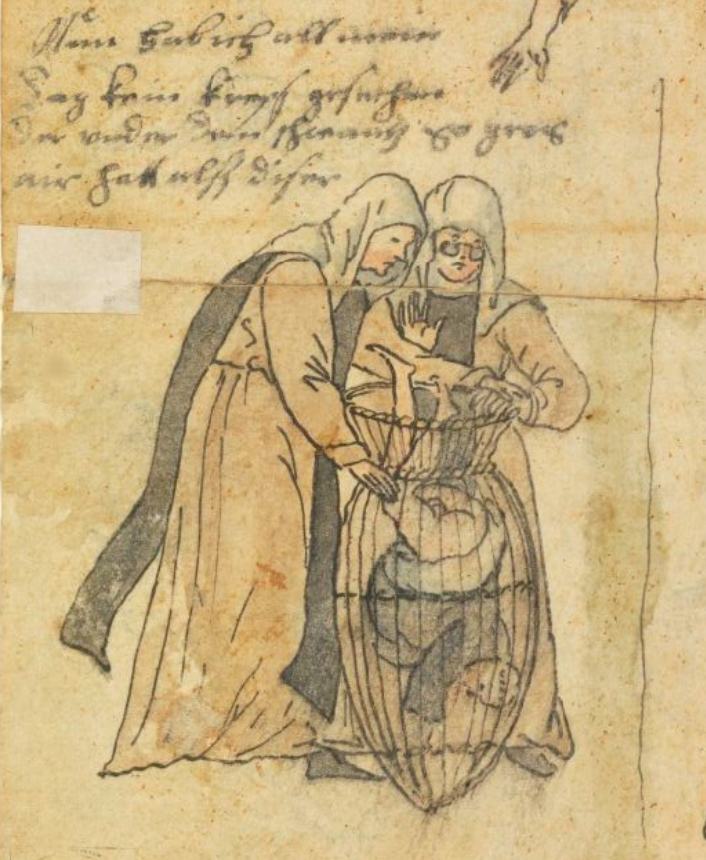
The two extraordinary sheets of watercoloured drawings in the GNM which look as if they must be sketches made by some album-artist, include a scene of two nuns (one wearing spectacles — are we meant to think she is so short-sighted that she really thinks it’s a lobster they have there?) holding an eel/lobster-pot vertically between them in which is a bare-arsed monk. Caption with typical innuendo (kindly read for me by Christoph Gasser, translation mine): Nun hab ich all mein Tag kein kreps gesechen der weder sein schwantz so groß nie hatt alß dieser [In all my days I have not seen a lobster with a tail as big as this one’s].
The regretful monk
In much the same vein as the regretful nun — whose regret we have presented in this post
https://albumamicorumear-e4qvahs764.live-website.com/who-kisses-me-asks-the-poor-little-nun/
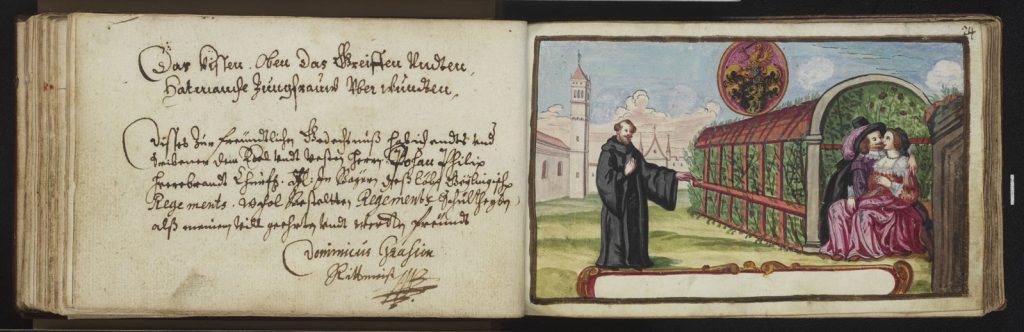
— in the Heerbrand album, painted c.1650, a monk encounters two young lovers in an arbour,
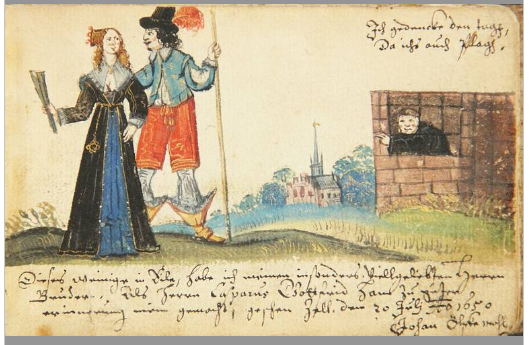
while on an orphaned leaf dated 1650 a monk looks wistfully out from his cell at another pair of young lovers and says, Ich gedenckh den tagh / Da ich auch pflagh [I think back to the day when I also used to].
Quicquid agit mundus, Monachus vult esse secundus
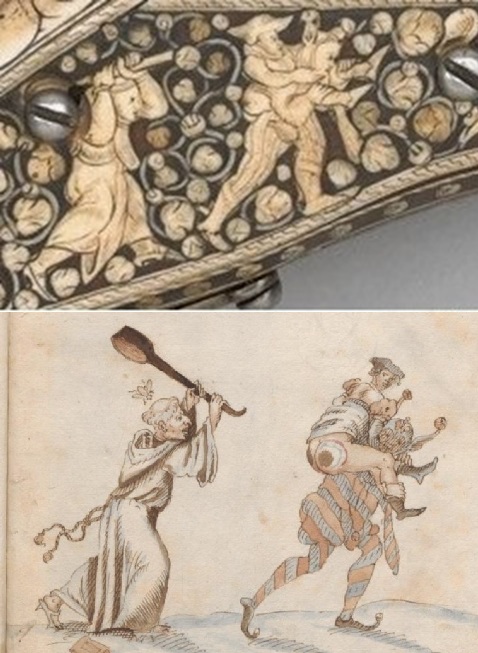
This traditional hit at the monk which we may translate, Whatever’s going on in the world, the monk wants to be in on it [Walther 25255], captions this sketch drawn c.1601 in the so-called Breslau/Wroclaw Goldsmith’s Sketchbook [ …..]
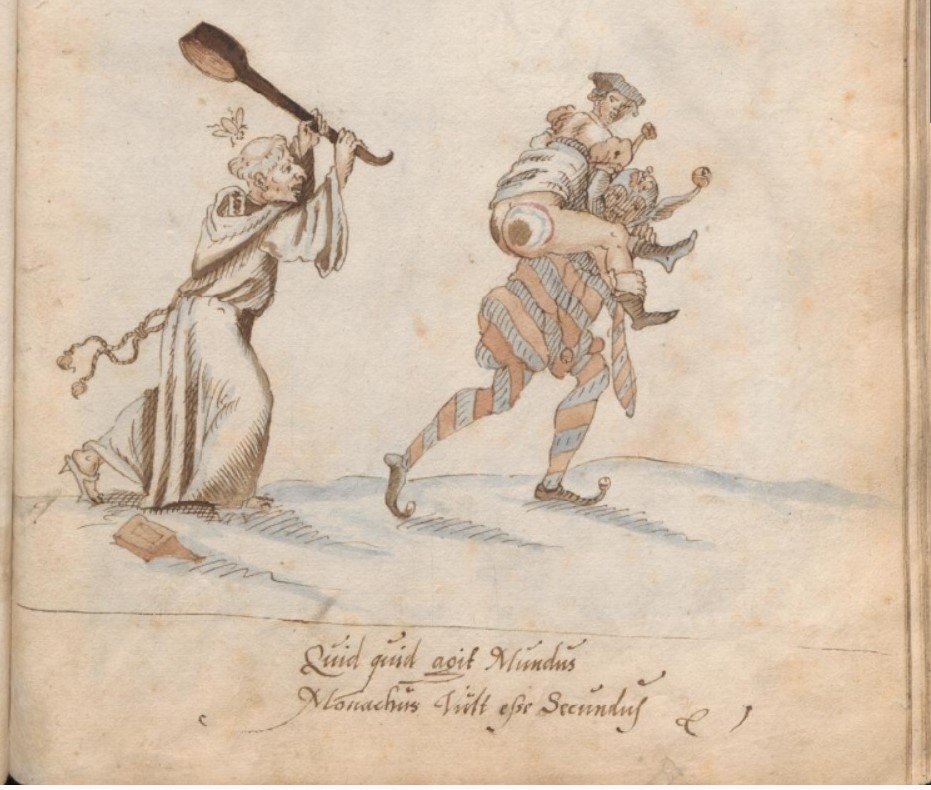
and, as we have already noticed other motifs in the sketchbook which are found in the album repertoire [foxtail between naked woman’s legs, riding the hedgehog], it does not seem unreasonable to suggest that this is another. In fact, one of the orphaned leaves in the Weigel du Rosey sale (Leipzig, 1864) is described as

[a man in rich masquing costume carries on his shoulders a lady (who is) bare behind; behind (them) walks a monk holding a reflecting-mirror in both hands].
and, to my mind, sounds like the same scenario — except that the man in ‘masquing costume’ is clearly dressed as a fool in the traditional motley in the sketchbook, and the monk — who has evidently already scored several direct hits on the lady’s behind with the instrument raised above his head — wields a long-handled pan of some sort, not any kind of mirror.
But this commedia dell’arte scene painted — along with several others — in the album of Jacob Praun (dated entries 1577-1607) must surely be part of the same tradition
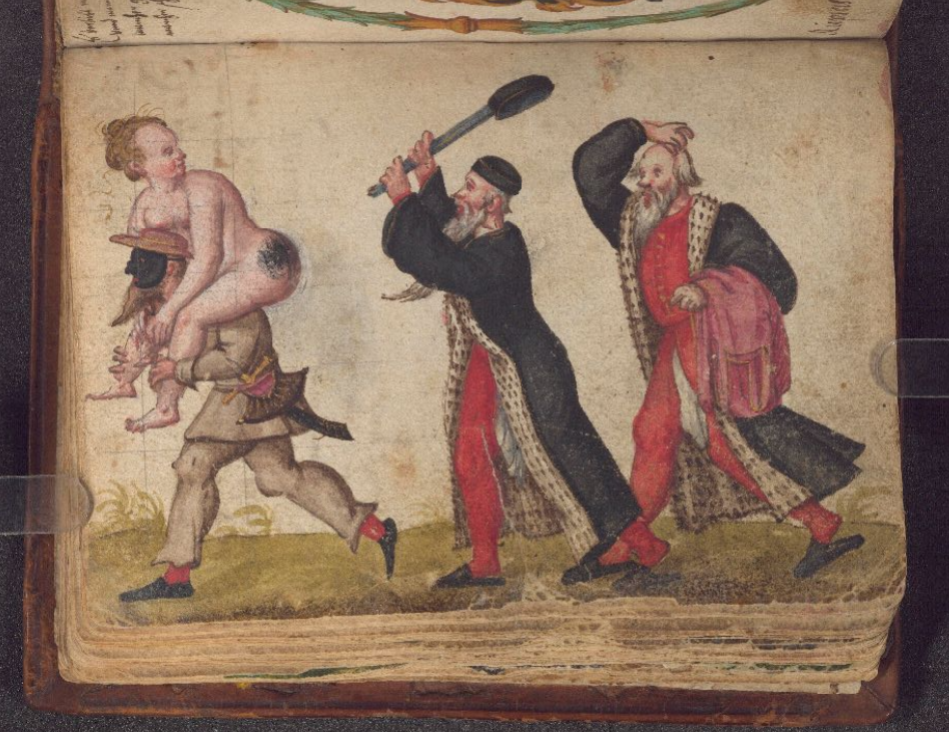
And the somewhat dubious nature of the scene makes it entirely appropriate to the sort of ‘erotic’ decoration found on such contemporary firearms as the rifle made in 1612 now in Darmstadt, or the bone-inlaid grip of a pistol made in Nürnberg c.1590 and now in the Wallace Collection (below)
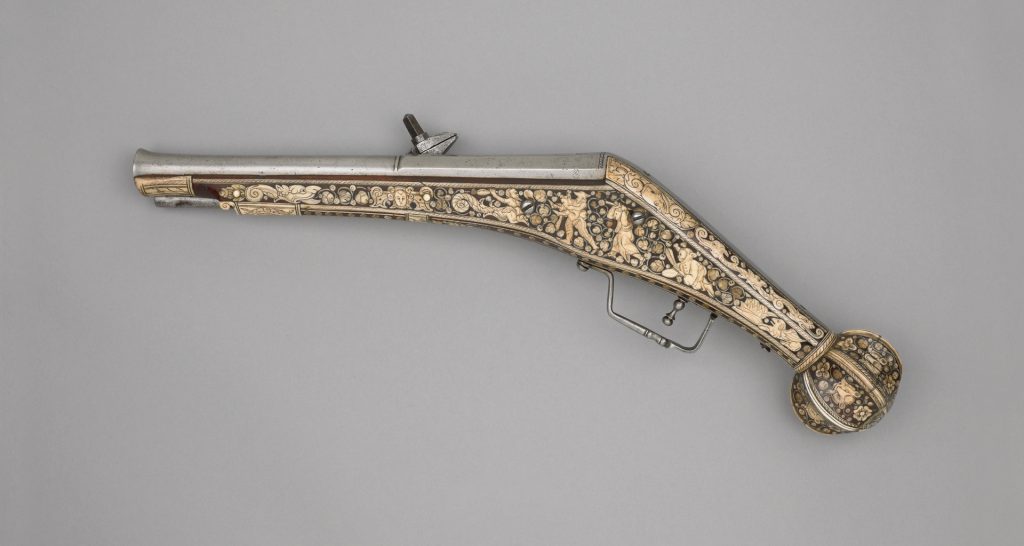
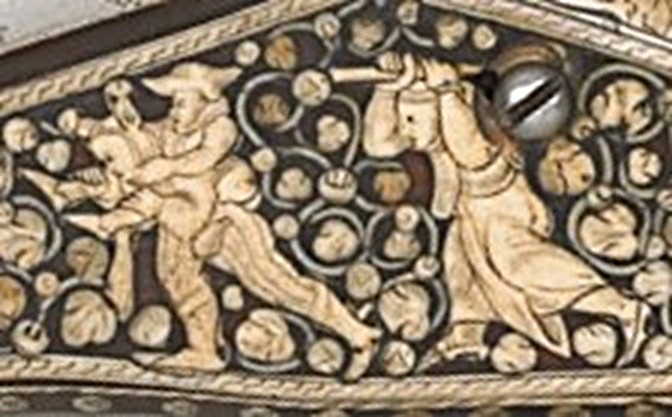
Below I have reversed the pistol inlay for comparison with the sketchbook drawing. Note that both bare-bottomed women are carried off by fools.
more monkish vices – gambling
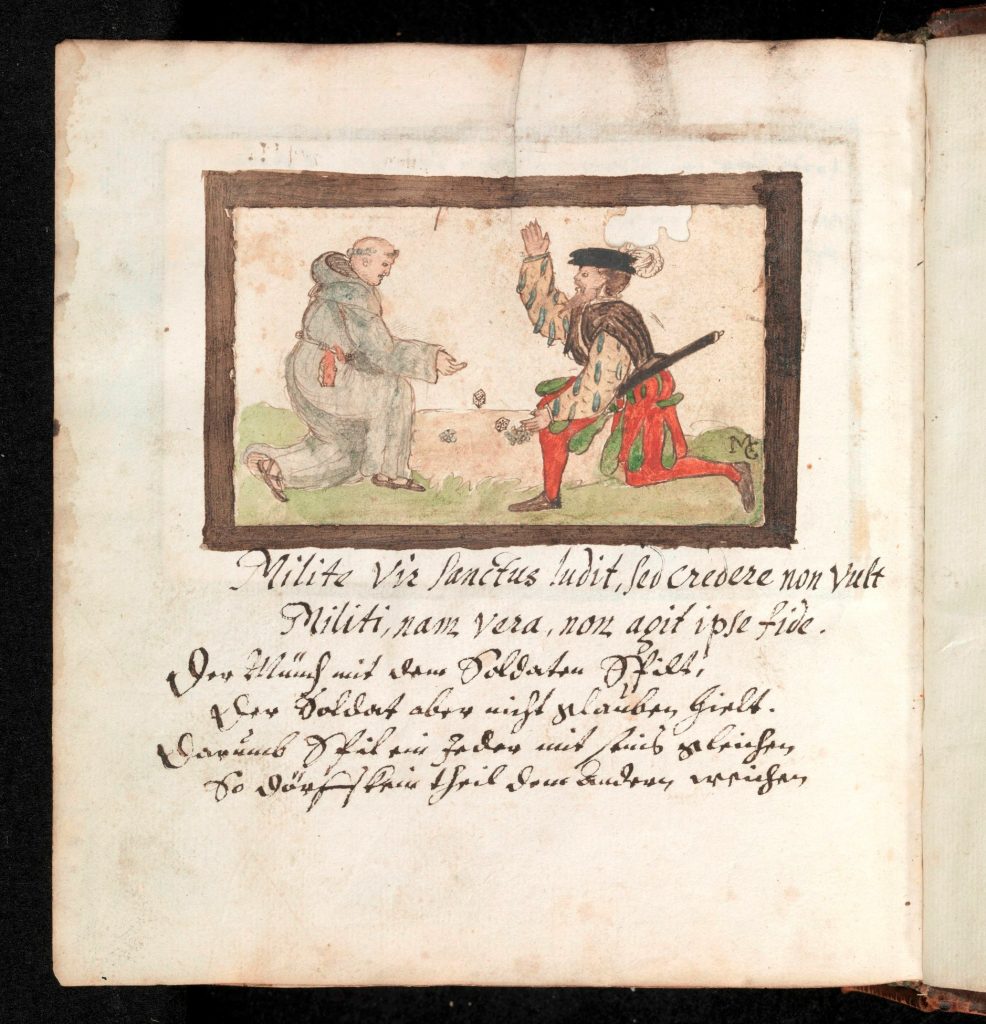
On f.148v. of Hanns Ludwig Pfinzing von Henfenfeld’s album (above) we see a rather amateurish coloured drawing of a Landsknecht and a monk playing dice. The former, whose pile of winnings seems to be larger than the monk’s, throws up his hand, but whether in triumph or remonstration, is difficult to make out. The captioning Latin verse reads:
Milite Vir Sanctus ludit, sed credere non vult, Militi, nam vera, non agit ipse fide [The holy man plays with the soldier, but doesn’t want to believe (the outcome), for the soldier himself doesn’t play fairly (either)]
Maybe each is as bad as the other ? – except that a monk should not be gambling in the first place, of course!
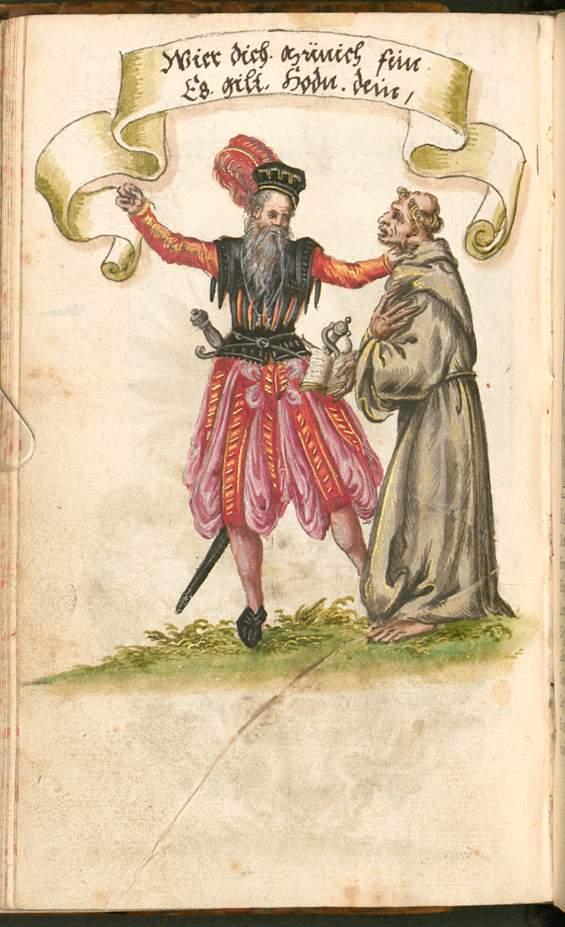
Artistically, a far more impressive miniature painted in another album (above), depicts another even less friendly confrontation between the two, here a Landsknecht has a barefoot monk by the throat, and threatens to punch him with his other hand already balled into a fist, exclaiming,
Wier dich münich fein [Watch yourself, my fine monk, Es gilt hodn dein your balls are in danger!].
It is not obvious quite what the monk’s fault is, who seems to be showing the soldier an open book – unless it is his very existence, of course.
The strange bifid figure in the Widholz album painted in 1583/4 seems to be at war with himself! Half-monk/half-soldier the caption reads Hiet dich Pfaff ich fris dich [defend yourself, ‘priest’, I will eat you!]
[Incidentally, cf. the contemporary pistol in the Wallace Collection (above)]
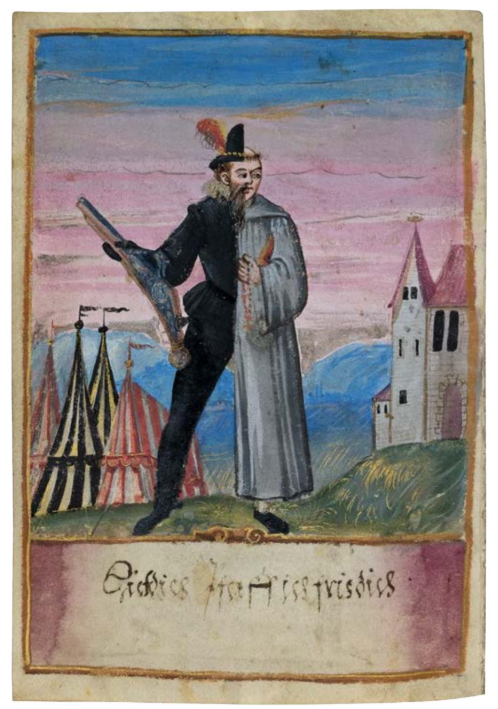
See my separate post on these ‘bifid’ figures here:
https://albumamicorumear-e4qvahs764.live-website.com/bifids-bi-partite-figures/
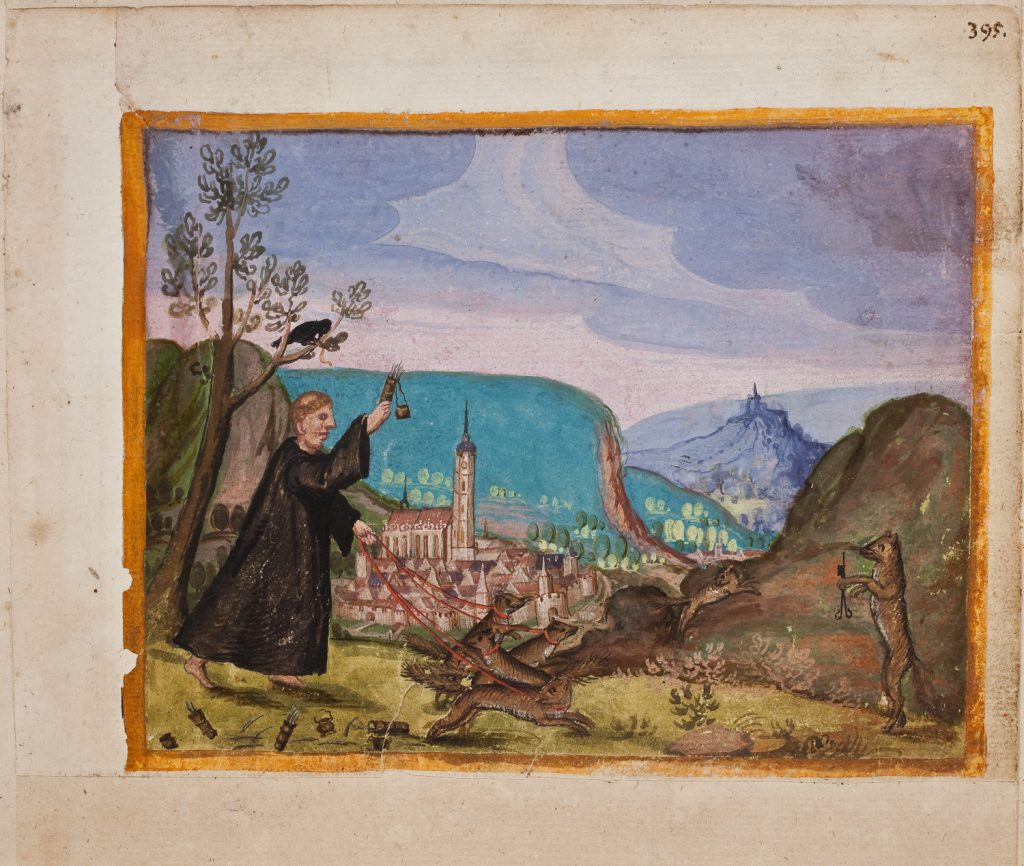
Puzzle! Any offers?
Can anyone help here, please — what’s going on?! A barefoot monk with 4 foxes on leashes (one fox pointing the wrong way!) holds up what I think is a pen-case/penner [KB entry suggests incense-burner and aspergillum] and is confronted by a fox on its hind legs holding up a candle-snuffer. The monk is observed by a crow/raven in the branch of a tree and in the middle distance another fox runs off. Scattered on the ground are more pen-cases
The monastic trombonist
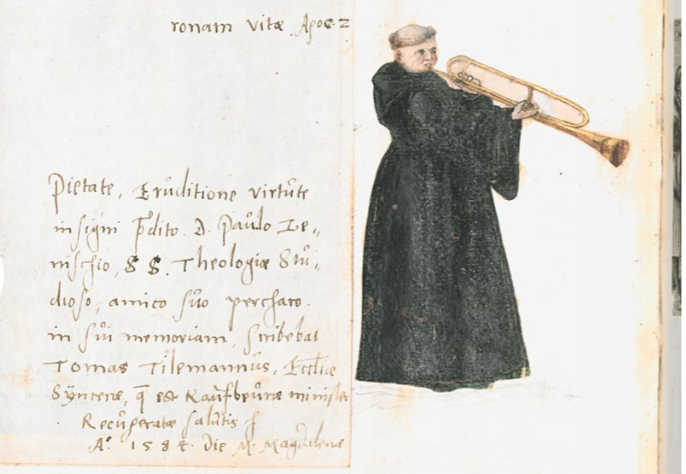
Let us end on a friendlier note — c/o the album of Paul Jenisch!
Leave a Reply to Students! Tattered trousers and never any money – Album Amicorum: Early Modern Stammbuch Iconography & related Cancel reply